

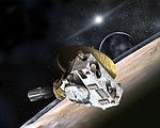
New Horizons

Encyclopedia
New Horizons is a NASA
robotic spacecraft
mission currently en route to the dwarf planet
Pluto
. It is expected to be the first spacecraft
to fly by and study Pluto and its moons, Charon
, Nix
, Hydra
and S/2011 P 1
. Its estimated arrival date at the Pluto-Charon system is July 14th, 2015. NASA may then also attempt flybys of one or more other Kuiper belt objects
if a suitable one can be located.
New Horizons was launched on January 19, 2006, directly into an Earth-and-solar-escape trajectory
with an Earth-relative velocity of about 16.26 km/s after its last engine shut down. Thus, the spacecraft left Earth at the greatest ever launch speed for a man-made object. It flew by Jupiter
on February 28, 2007, the orbit of Saturn
on June 8, 2008; and the orbit of Uranus
on March 18, 2011.
. The spacecraft was at a declination of -21.44 degrees, and a right ascension of 18.483 hours at that time. At that distance, light took about 2.98 hours to reach the spacecraft from Earth, meaning that a round trip time for a radio signal was about 5.96 hours.
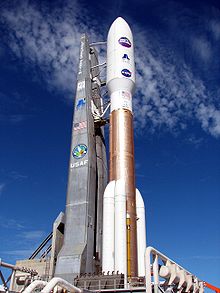 New Horizons is the first mission in NASA's New Frontiers
mission category, larger and more expensive than Discovery missions
but smaller than the Flagship Program
. The cost of the mission (including spacecraft and instrument development, launch vehicle, mission operations, data analysis, and education/public outreach) is approximately 650 million USD over 15 years (from 2001 to 2016). An earlier proposed Pluto mission – Pluto Kuiper Express
– was cancelled by NASA in 2000 for budgetary reasons. Further information relating to an overview with historical context can be found at the IEEE
website and gives further background and details, with more details regarding the Jupiter fly-by.
The spacecraft was built primarily by Southwest Research Institute
(SwRI) and the Johns Hopkins
Applied Physics Laboratory
(APL). The mission's principal investigator
is Alan Stern
(NASA Associate Administrator, formerly of the Southwest Research Institute).
Overall control, after separation from the launch vehicle, is performed at Mission Operations Center (MOC) at the Applied Physics Laboratory
. The science instruments are operated at the Clyde Tombaugh Science Operations Center (T-SOC) in Boulder, Colorado
. Navigation, which is not real-time, is performed at various contractor facilities; KinetX
is the lead on the New Horizons navigation team and is responsible for planning trajectory adjustments as the spacecraft speeds toward the outer Solar System.
New Horizons was originally planned as a voyage to what was the only unexplored planet in the Solar System. When the spacecraft was launched, Pluto was still classified as a planet
, later to be reclassified as a dwarf planet by the International Astronomical Union
(IAU). Some members of the New Horizons team, including Alan Stern, disagree with the IAU definition and still describe Pluto as the ninth planet. Pluto's newly-discovered satellites, Nix and Hydra, also have a connection with the spacecraft: the first letters of their names, N and H, are the initials of "New Horizons". The moons' discoverers chose these names for this reason, in addition to Nix and Hydra's relationship to the mythological Pluto
.
In addition to the scientific equipment, there are several cultural artifacts traveling with the spacecraft. These include a collection of 434,738 names stored on a compact disc, a piece of Scaled Composites SpaceShipOne, and an American flag
, along with other mementos. One of the trim weights on the spacecraft is a Florida state quarter
.
To commemorate the discovery of Pluto, one ounce of the ashes of Pluto discoverer Clyde Tombaugh
are aboard the spacecraft, while one of the science packages (a dust counter) is named after Venetia Burney, who as a child suggested the name Pluto after its discovery.
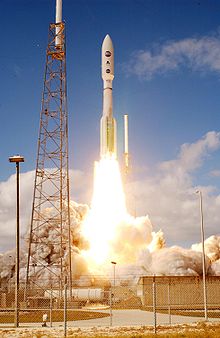 The launch of New Horizons was originally scheduled for January 11, 2006, but was initially delayed until January 17 to allow for borescope
inspections of the Atlas rocket's kerosene
tank. Further delays related to low cloud ceiling conditions downrange
, and high winds and technical difficulties — unrelated to the rocket itself — prevented launch for a further two days. The probe finally lifted off from Pad 41 at Cape Canaveral Air Force Station
, Florida
, directly south of Space Shuttle
Launch Complex 39, at 14:00 EST on January 19, 2006.
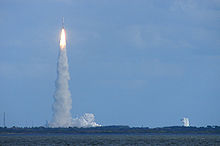 The Centaur
second stage reignited at 14:30 EST (19:30 UTC), successfully sending the probe on a solar-escape trajectory. New Horizons took only nine hours to reach the Moon's orbit, passing lunar orbit before midnight EST that day.
Although there were backup launch opportunities in February 2006 and February 2007, only the first 23 days of the 2006 window permitted the Jupiter fly-by. Any launch outside that period would have forced the spacecraft to fly a slower trajectory directly to Pluto, delaying its encounter by 2–4 years.
The craft was launched by a Lockheed Martin
Atlas V
551 rocket, with an ATK
Star 48B
third stage added to increase the heliocentric (escape) speed. This was the first launch of the 551 configuration of the Atlas V, as well as the first Atlas V launch with an additional third stage (Atlas V rockets usually do not have a third stage). Previous flights had used none, two, or three solid boosters
, but never five. This puts the Atlas V 551 take-off thrust, at well over 2000000 lbf (9 MN), past the Delta IV
-Heavy. The major part of this thrust is supplied by the Russia
n RD-180 engine, providing 4.152 MN (933,406.7 lbf). The Delta IV-H remains the larger vehicle, at over 1600000 lb (725,747.8 kg) compared to 1260000 lb (571,526.4 kg) of the AV-010. The Atlas V rocket had earlier been slightly damaged when Hurricane Wilma
swept across Florida
on October 24, 2005. One of the solid rocket boosters was hit by a door. The booster was replaced with an identical unit, rather than inspecting and requalifying the original.
The Star 48B third stage is also on a hyperbolic Solar System escape trajectory
, and reached Jupiter before the New Horizons spacecraft. However, since it is not in controlled flight, it did not receive the correct gravity assist, and will only pass within 200000000 km (124,274,547.3 mi) of Pluto.
New Horizons is often erroneously given the title of Fastest Spacecraft Ever Launched, when in fact the Helios probes
are the holders of that title. To be more specific New Horizons achieved the highest launch velocity and thus left Earth faster than any other spacecraft to date. It is also the first spacecraft launched directly into a solar escape trajectory, which requires an approximate velocity of 16.5 km/s, plus losses, all to be provided by the launcher. However, it will not be the fastest spacecraft to leave the Solar System. This record is held by Voyager 1
, currently travelling at 17.145 km/s relative to the Sun. Voyager 1 attained greater hyperbolic excess velocity from Jupiter and Saturn gravitational slingshot
s than New Horizons. Other spacecraft, such as Helios 1 & 2
, can also be measured as the fastest objects, due to their orbital velocity relative to the Sun at perihelion
. However, because they remain in solar orbit, their orbital energy relative to the Sun is lower than the five probes, and three other third stages on hyperbolic trajectories, including New Horizons, that achieved solar escape velocity, as the Sun has a much deeper gravitational well than Earth.
During the week of February 20, controllers conducted initial in-flight tests of three onboard scientific instruments, the Alice ultraviolet imaging spectrometer, the PEPSSI plasma-sensor, and the LORRI long-range visible-spectrum camera. No scientific measurements or images were taken, but instrument electronics, and in the case of Alice, some electromechanical systems were shown to be functioning correctly.
On March 9 at 1700 UTC, controllers performed TCM-3, the last of three scheduled course corrections. The engines burned for 76 seconds, adjusting the spacecraft's velocity by about 1.16 meters per second.
On September 25, 2007 on 16:04 EDT, the engines were fired for 15 minutes and 37 seconds, changing the spacecraft's velocity by 2.37 meters per second.
On June 30, 2010 on 7:49 EDT, mission controllers executed a fourth TCM on New Horizons that lasted 35.6 seconds.
New Horizons made a distant flyby of the small asteroid 132524 APL (previously known by its provisional designation), at a distance of 101,867 km at 04:05 UTC on June 13, 2006. The best current estimate of the asteroid's diameter is approximately 2.3 kilometers, and the spectra obtained by New Horizons showed that APL is an S-type asteroid
.
The spacecraft successfully tracked the asteroid over June 10–12, 2006. This allowed the mission team to test the spacecraft's ability to track rapidly moving objects. Images were obtained through the Ralph telescope.
 New Horizons Long Range Reconnaissance Imager (LORRI) took its first photographs of Jupiter on September 4, 2006. The spacecraft began further study of the Jovian system in December 2006.
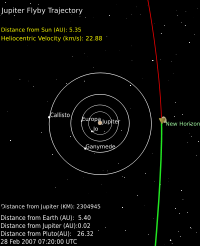
New Horizons received a Jupiter gravity assist with a closest approach at 5:43:40 UTC (12:43:40am EST) on February 28, 2007. It passed through the Jupiter system at 21 km/s relative to Jupiter (23 km/s relative to the Sun). The flyby increased New Horizons speed away from the Sun by nearly 4 km/s, putting the spacecraft on a faster trajectory to Pluto, about 2.5 degrees out of the plane of the Earth's orbit (the "ecliptic
"). , the gravitational attraction of the Sun has slowed down the spacecraft to about 16.656 km/s. New Horizons was the first probe launched directly toward Jupiter since the Ulysses probe
in 1990.
While at Jupiter, New Horizons instruments made refined measurements of the orbits of Jupiter's inner moons, particularly Amalthea
. The probe's cameras measured volcanoes on Io
and studied all four Galilean moons in detail, as well as long distance studies of the outer moons Himalia
and Elara
. Imaging of the Jovian system began on September 4, 2006. The craft also studied Jupiter's Little Red Spot and the planet's magnetosphere and tenuous ring system.
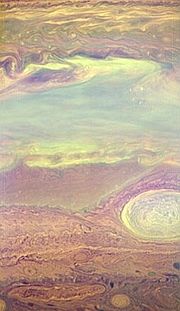 The flyby came within about 32 Jovian radii (3 Gm) of Jupiter and was the center of a 4-month intensive observation campaign. Jupiter is an interesting, ever-changing target, observed intermittently since the end of the Galileo
mission. New Horizons also has instruments built using the latest technology, especially in the area of cameras. They are much improved over Galileo's cameras, which were evolved versions of Voyager
cameras which, in turn, were evolved Mariner
cameras. The Jupiter encounter also served as a shakedown and dress rehearsal for the Pluto encounter. Because of the much shorter distance from Jupiter to Earth, the communications link can transmit multiple loadings of the memory buffer; thus the mission actually returned more data from the Jovian system than it is expected to transmit from Pluto. Imaging of Jupiter began on September 4, 2006, after which several images were taken.
The primary encounter goals included Jovian cloud dynamics, which were greatly reduced from the Galileo observation program, and particle readings from the magnetotail of the Jovian magnetosphere
. The spacecraft trajectory coincidentally flew down the magnetotail for months. New Horizons also examined the Jovian nightside for aurorae
and lightning
.
New Horizons also provided the first close-up examination of Oval BA, a storm feature that has informally become known as the "Little Red Spot", since the storm turned red. It was still a white spot when Cassini flew by.
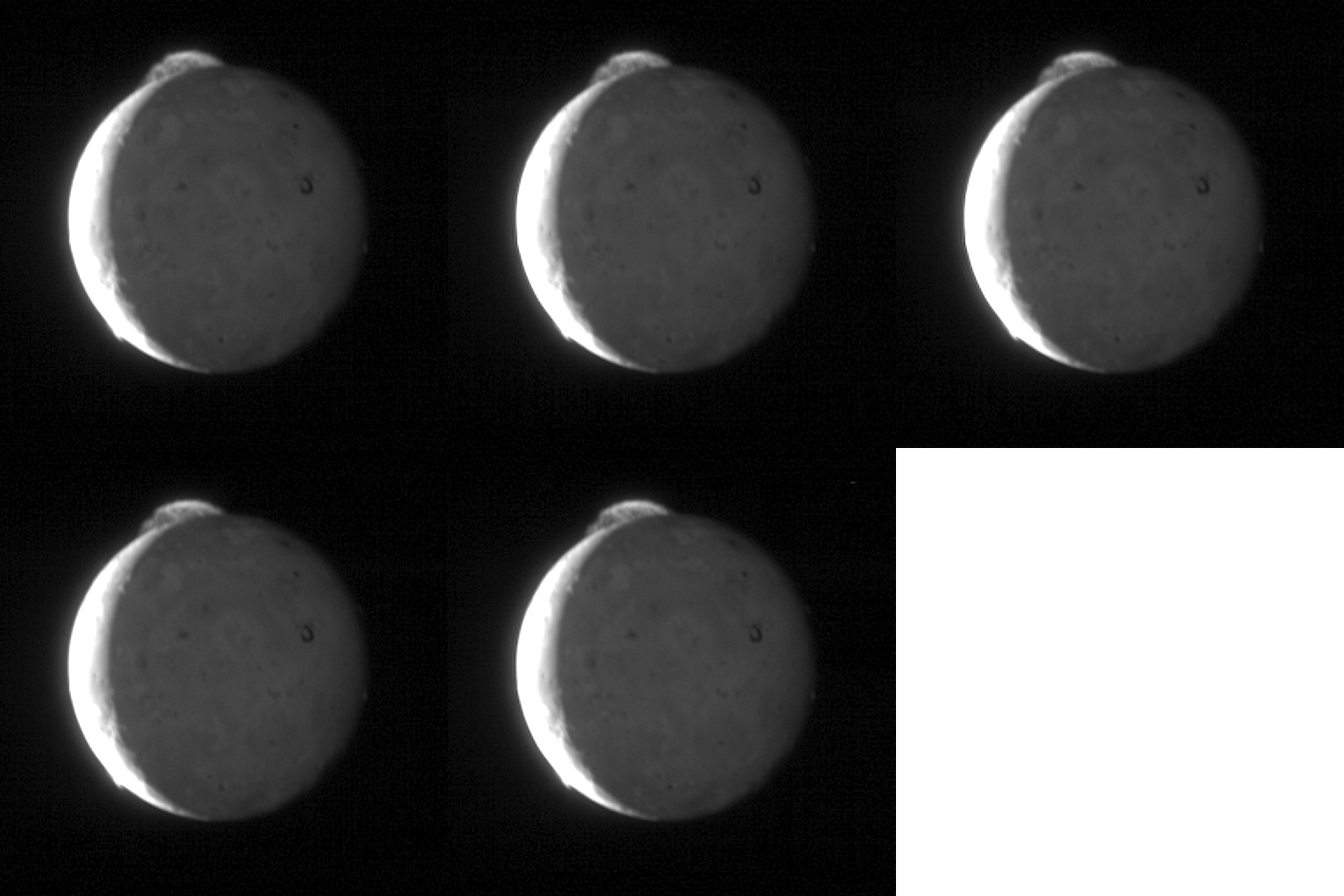
) moons were in poor position. The aim point of the gravity-assist maneuver meant the spacecraft passed millions of kilometers from any of the Galilean moons. Still, the New Horizons instruments were intended for small, dim targets, so they were scientifically useful on large, distant moons. LORRI searched for volcanoes and plumes on Io
. The infrared capabilities of LEISA searched for chemical compositions (including Europa
ice dopants), and nightside temperatures (including hotspots on Io). The ultraviolet resolution of Alice searched for aurorae and atmospheres, including the Io torus.
Minor moons such as Amalthea
had their orbit solutions refined. The cameras determined their position, acting as "reverse optical navigation".
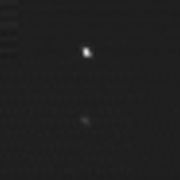
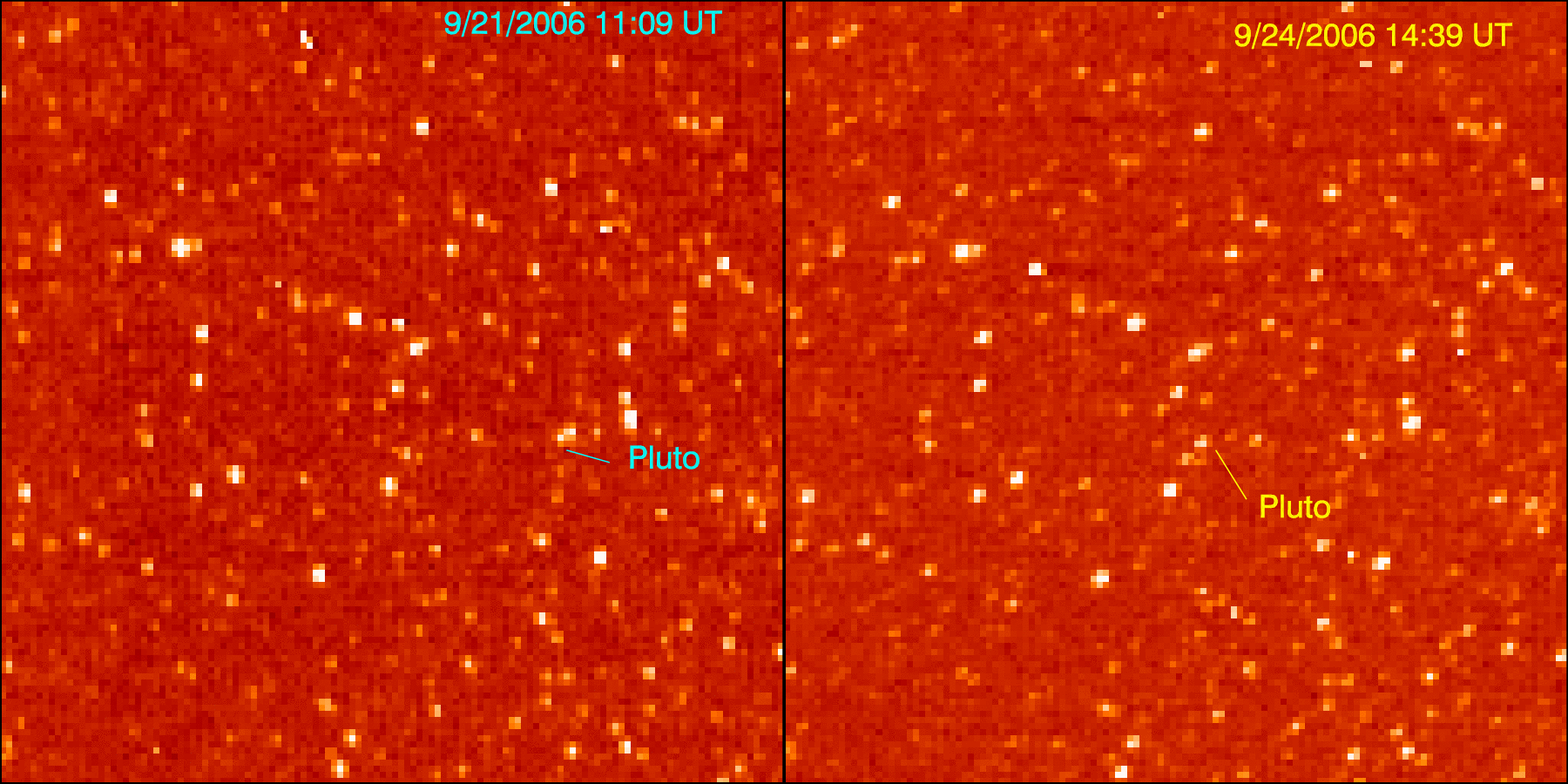 The first images of Pluto from New Horizons were created between September 21–24, 2006, during a test of the LORRI. They were released on November 28. The images, taken from a distance of approximately 4.2 billion kilometers (2.6 billion miles), confirmed the spacecraft's ability to track distant targets, critical for maneuvering toward Pluto and other Kuiper belt objects.
It is planned for New Horizons to fly within 10000 km (6,213.7 mi) of Pluto in 2015. New Horizons will have a relative velocity of 13.78 km/s at closest approach, and will come as close as 27000 km (16,777.1 mi) to Charon
, although these parameters may be changed during flight.
, a trans-Neptunian object
comparable in size to Pluto. The available region, being fairly close to the plane of the Milky Way and thus difficult to survey for dim objects, is one that has not been well-covered by previous KBO search efforts. The public is being encouraged to help scan telescopic images for possible mission candidates by participating in the Ice Hunters project.
-sized satellite dish". As a point of departure, the team took inspiration from the Ulysses
spacecraft, which also carried an RTG and dish on a box-in-box structure through the outer Solar System. Many subsystems and components have flight heritage from APL's CONTOUR
spacecraft, which in turn had heritage from APL's TIMED
spacecraft.
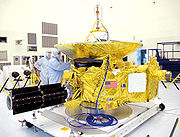 The spacecraft's body forms a triangle, almost 2.5 foot (0.762 m) thick. (The Pioneers had hexagonal bodies, while the Voyagers
, Galileo
, and Cassini–Huygens had decagon
al, hollow bodies.) A 7075 aluminium alloy tube forms the main structural column, between the launch vehicle adapter ring at the "rear," and the 2.1 m radio dish antenna affixed to the "front" flat side. The titanium
fuel tank is in this tube. The radioisotope thermoelectric generator
, or RTG attaches with a 4-sided titanium mount resembling a grey pyramid or stepstool. Titanium provides strength and thermal isolation. The rest of the triangle is primarily sandwich panels of thin aluminium facesheet (less than 1/64 in) bonded to aluminium honeycomb core.
The structure is larger than strictly necessary, with empty space inside. The structure is designed to act as shielding, reducing electronics errors caused by radiation from the RTG. Also, the mass distribution required for a spinning spacecraft demands a wider triangle.
monopropellant
. 77 kg (170 lb) of hydrazine provides a delta-v
capability of over 290 m/s (649 mph) after launch. Helium is used as a pressurant, with an elastomer
ic diaphragm assisting expulsion. The spacecraft's on-orbit mass including fuel will be over 470 kg (1,036 lb) for a Jupiter flyby trajectory, but would have been only 445 kg (981 lb) for a direct flight to Pluto. This would have meant less fuel for later Kuiper belt operations and is caused by the launch vehicle performance limitations for a direct-to-Pluto flight.
There are 16 thrusters
on New Horizons: four 4.4 N (0.989159349696654 lbf) and twelve 0.9 N (0.202328048801588 lbf) plumbed into redundant branches. The larger thrusters are used primarily for trajectory corrections, and the small ones (previously used on Cassini and the Voyager
spacecraft) are used primarily for attitude control and spinup/spindown maneuvers. Two star cameras (from Galileo Avionica) are used for fine attitude control. They are mounted on the face of the spacecraft and provide attitude information while in spinning or in 3-axis mode. Between star camera readings, knowledge is provided by dual redundant Miniature Inertial Measurement Unit (MIMU)
from Honeywell
. Each unit contains three solid-state gyroscopes and three accelerometers. Two Adcole
Sun sensors provide coarse attitude control. One detects angle to the Sun, while the other measures spin rate and clocking.
, or RTG, protrudes from one vertex in the plane of the triangle. The RTG will provide about 240 W
, 30 V DC at launch, and is predicted to drop approximately 5% every 4 years, decaying to 200 W by the encounter with the Plutonian system in 2015. The RTG, model "GPHS-RTG
," was originally a spare from the Cassini mission. The RTG contains 11 kg (24.3 lb) of plutonium-238
oxide pellets. Each pellet is clad in iridium
, then encased in a graphite shell. It was developed by the U.S. Department of Energy
.
The use of a plutonium
RTG battery was opposed by about 30 anti-nuclear protesters in minor demonstrations some days before launch. The amount of radioactive plutonium in the RTG is 10.9 kg, about one-third the amount on-board the Cassini–Huygens probe when it launched in 1997. That launch was protested by over 300 people. The United States Department of Energy
estimated the chances of a launch accident that would release radiation into the atmosphere at 1 in 350 and monitored the launch as it always does when RTGs are involved. It was believed that a worst-case scenario of total dispersal of on-board plutonium would spread the equivalent radiation of 80% the average annual dosage in North America from background radiation over an area with a radius of 105 km (65.2 mi), with cleanup costing anywhere from US$93 million to US$463 million per square kilometre (US$241 million to US$1.2 billion per square mile) at the Materials and Fuels Complex (formerly Argonne West), a part of the Idaho National Laboratory
in Bingham County
, near the town of Arco
and the city of Idaho Falls
. The plutonium was produced at Los Alamos National Laboratory
in New Mexico. Less than the original design goal was produced, due to delays at the United States Department of Energy, including security activities, which held up production. The mission parameters and observation sequence had to be modified for the reduced wattage; still, not all instruments can operate simultaneously. The Department of Energy transferred the space battery program from Ohio to Argonne in 2002 because of security concerns. There are no onboard batteries. RTG output is relatively predictable; load transients are handled by a capacitor bank and fast circuit breakers.
heat transfer. Overall, the spacecraft is thoroughly blanketed to retain heat. Unlike the Pioneers and Voyagers, the radio dish is also enclosed in blankets which extend to the body. The heat from the RTG also adds warmth to the spacecraft in the outer Solar System. In the inner Solar System, the spacecraft must prevent overheating. Electronic activity is limited, power is diverted to shunts
with attached radiators, and louver
s are opened to radiate excess heat. Then, when the spacecraft is cruising inactively in the cold outer Solar System, the louvers are closed, and the shunt regulator reroutes power to electric heaters
.
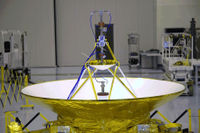 Communication with the spacecraft is via X band
.
At Pluto's distance, a rate of approximately 1,000 bits per second is expected. The craft had a communication rate of 38 kbit/s at Jupiter.
The 70 m Deep Space Network
(DSN) dishes will be used to relay data beyond Jupiter.
Besides the low bandwidth, Pluto's distance also causes a (one way) latency
of about 4.5 hours.
The spacecraft uses dual redundant transmitters and receivers, and either right- or left-hand circular polarization. The downlink signal is amplified by dual redundant 12-watt TWTAs (traveling-wave tube amplifiers) mounted on the body under the dish.
The receivers are new, low-power designs. The system can be controlled to power both TWTAs at the same time, and transmit a dual-polarized downlink signal to the DSN that could almost double the downlink rate. Initial tests with the DSN in this dual-polarized mode have been successful, and an effort to make the DSN polarization-combining technique operational is underway.
In addition to the high-gain antenna, there are two low-gain antennas and a medium-gain dish. The high-gain dish has a Cassegrain
layout, composite construction, and a 2.1 meter diameter (providing well over 40 dB of gain, and a half-power beam width of about a degree). The prime-focus, medium-gain antenna, with a 0.3 meter aperture and 10-degree half-power beamwidth, is mounted to the back of the high-gain antenna's secondary reflector. The forward low-gain antenna is stacked atop the feed of the medium-gain antenna. The aft low-gain antenna is mounted within the launch adapter at the rear of the spacecraft. This antenna was only used for early mission phases near Earth, just after launch and for emergencies if the spacecraft had lost attitude control.
To save mission costs, the spacecraft will be in "hibernation" between Jupiter and Pluto. It will awaken once per year, for 50 days, for equipment checkout and trajectory tracking. The rest of the time, the spacecraft will be in a slow spin, sending a beacon tone which will be checked once per week. Depending on frequency, the beacon indicates normal operation, or one of seven fault modes. New Horizons is the first mission to use the DSN's beacon tone system operationally, the system having been flight-tested by the DS1
mission.
(one primary, one backup) holding up to 8 gigabyte
s each. Because of the extreme distance from Pluto and the Kuiper belt, only one buffer load at those encounters can be saved. This is because New Horizons will have left the vicinity of Pluto (or future target object) by the time it takes to transmit the buffer load back to Earth.
Part of the reason for the delay between the gathering and transmission of data is because all of the New Horizons instrumentation is body-mounted. In order for the cameras to record data, the entire probe must turn, and the one-degree-wide beam of the high-gain antenna will almost certainly not be pointing toward Earth. Previous spacecraft, such as the Voyager program
probes, had a rotatable instrumentation platform (a "scan platform") that could take measurements from virtually any angle without losing radio contact with Earth. New Horizons elimination of excess mechanisms was implemented to save weight, shorten the schedule, and improve reliability to achieve a 15+-year lifetime.
(The Voyager 2 spacecraft experienced platform jamming at Saturn; the demands of long time exposures at Uranus led to modifications of the probe to rotate the entire probe instead to achieve the time exposure photos at Uranus and Neptune, similar to how New Horizons will rotate.)
systems, the Command and Data Handling system and the Guidance and Control processor. Each of the two systems is duplicated for redundancy
, giving a total of four computers. The processor used is the Mongoose-V
, a 12 MHz radiation-hardened
version of the MIPS R3000
CPU
. Multiple clocks and timing routines are implemented in hardware and software to help prevent faults and downtime.
To conserve heat and mass, spacecraft and instrument electronics are housed together in IEMs (Integrated Electronics Modules). There are two redundant IEMs. Including other functions such as instrument and radio electronics, each IEM contains 9 boards.
On March 19, 2007 the Command and Data Handling computer experienced an uncorrectable memory error and rebooted itself, causing the spacecraft to go into safe mode
. The craft fully recovered within two days, with some data loss on Jupiter's magnetotail. No impact on the subsequent mission is expected.
 The spacecraft carries seven scientific instruments. Total mass is 31 kg; rated power is 21 watts (though not all instruments operate simultaneously).
Fundamental physics-Pioneer Anomaly: It was shown that New Horizons may be used to test the Pioneer Anomaly
issue.
Long Range Reconnaissance Imager (LORRI): LORRI is a long focal length imager designed for high resolution and responsivity at visible wavelengths. The instrument is equipped with a high-resolution 1024×1024 monochromatic CCD
imager with a 208.3 mm (8.2 in) aperture giving a resolution of 5 microradians (approximately one arcsecond). The CCD is chilled far below freezing by a passive radiator on the antisolar face of the spacecraft. This temperature differential requires insulation, and isolation from the rest of the structure. The Ritchey-Chretien
mirrors and metering structure are made of silicon carbide
, to boost stiffness, reduce weight, and prevent warping at low temperatures. The optical elements sit in a composite light shield, and mount with titanium and fibreglass for thermal isolation. Overall mass is 8.6 kg, with the Optical tube assembly (OTA) weighing about 5.6 kg, for one of the largest silicon-carbide telescopes yet flown.
Pluto Exploration Remote Sensing Investigation (PERSI): This consists of two instruments: The Ralph telescope, 6 centimeters in aperture, with two separate channels: a visible-light CCD
imager (MVIC- Multispectral Visible Imaging Camera) with broadband and color channels, and a near-infrared
imaging spectrometer
, LEISA (Linear Etalon Imaging Spectral Array). LEISA is derived from a similar instrument on the EO-1
mission. The second instrument is an ultraviolet
imaging spectrometer, Alice. Alice resolves 1,024 wavelength bands in the far and extreme ultraviolet (from 180 to 50 nanometers), over 32 view fields. Its goal is to view the atmospheric makeup of Pluto. This Alice is derived from an Alice on the Rosetta mission. Ralph, designed afterwards, was named after Alice's husband on The Honeymooners
. Ralph and Alice are names, not acronyms.
Plasma
and high energy particle spectrometer suite (PAM): Two instruments, consisting of SWAP (Solar Wind At Pluto), a toroidal electrostatic analyzer
and retarding potential analyzer, and PEPSSI (Pluto Energetic Particle Spectrometer Science Investigation), a time of flight
ion
and electron
sensor. SWAP measures particles of up to 6.5 keV, PEPSSI goes up to 1 MeV. Because of the tenuous solar wind
at Pluto's distance, the SWAP instrument has the largest aperture
of any such instrument ever flown.
Radio Science Experiment (REX): REX will use an ultrastable crystal oscillator
(essentially a calibrated crystal in a miniature oven
) and some additional electronics to conduct radio science investigations using the communications channels. These are small enough to fit on a single card. Since there are two redundant communications subsystems, there are two, identical REX circuit boards.
 Venetia Burney Student Dust Counter (VBSDC): Built by students at the University of Colorado at Boulder
, the Student Dust Counter will operate continuously through the trajectory to make dust
measurements. It consists of a detector panel, about 18 by 12 in (457.2 by 304.8 mm), mounted on the antisolar face of the spacecraft (the ram direction), and an electronics box within the spacecraft. The detector contains fourteen PVDF panels, twelve science and two reference, which generate voltage when impacted. Effective collecting area is 0.125 m². No dust counter has operated past the orbit of Uranus
; models of dust in the outer Solar System, especially the Kuiper belt
, are speculative. VBSDC is always turned on measuring the masses of the interplanetary and interstellar dust particles (in the range of nano and pico grams) as they collide with the PVDF panels mounted on the New Horizons spacecraft. The measured data shall greatly contribute to the understanding of the dust spectra of the Solar System. The dust spectra can then be compared with those observed via telescope of other stars, giving new clues as to where earthlike planets can be found in our universe. The dust counter is named for Venetia Burney, who first suggested the name "Pluto" at the age of 11. An interesting thirteen minute short film about VBSDC garnered an Emmy award for student achievement in 2006.
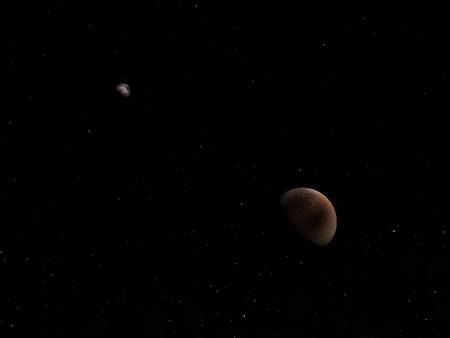 Observations of Pluto, with LORRI plus Ralph, will begin about 6 months prior to closest approach. The targets will be only a few pixel
s across. This should detect any rings or any additional moons (eventually down to 2 kilometers diameter), for avoidance and targeting maneuvers, and observation scheduling. 70 days out, resolution will exceed the Hubble Space Telescope's
resolution, lasting another two weeks after the flyby. Long-range imaging will include 40 km (24.9 mi) mapping of Pluto and Charon 3.2 days out. This is half the rotation period of Pluto-Charon and will allow imaging of the side of both bodies that will be facing away from the spacecraft at closest approach. Coverage will repeat twice per day, to search for changes due to snows or cryovolcanism. Still, due to Pluto's tilt and rotation, a portion of the northern hemisphere will be in shadow at all times.
During the flyby, LORRI should be able to obtain select images with resolution as high as 50 m
/px
(if closest distance is around 10,000 km), and MVIC should obtain 4-color global dayside maps at 1.6 km resolution. LORRI and MVIC will attempt to overlap their respective coverage areas to form stereo pairs. LEISA will obtain hyperspectral near-infrared maps at 7 km/px globally and 0.6 km/pixel for selected areas. Meanwhile, Alice will characterize the atmosphere, both by emissions of atmospheric molecules (airglow
), and by dimming of background stars as they pass behind Pluto (occultation
).
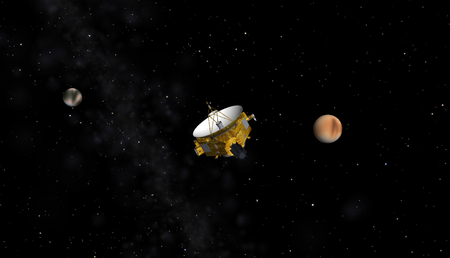 During and after closest approach, SWAP and PEPSSI will sample the high atmosphere and its effects on the solar wind
. VBSDC will search for dust, inferring meteoroid collision rates and any invisible rings. REX will perform active and passive radio science. Ground stations on Earth will transmit a powerful radio signal as New Horizons passes behind Pluto's disk, then emerges on the other side. The communications dish will measure the disappearance and reappearance of the signal. The results will resolve Pluto's diameter (by their timing) and atmospheric density and composition (by their weakening and strengthening pattern). (Alice can perform similar occultations, using sunlight instead of radio beacons.) Previous missions had the spacecraft transmit through the atmosphere, to Earth ("downlink"). Low power and extreme distance means New Horizons will be the first such "uplink" mission. Pluto's mass and mass distribution will be evaluated by their tug on the spacecraft. As the spacecraft speeds up and slows down, the radio signal will experience a Doppler shift. The Doppler shift will be measured by comparison with the ultrastable oscillator in the communications electronics.
Reflected sunlight from Charon will allow some imaging observations of the nightside. Backlighting by the Sun will highlight any rings or atmospheric hazes. REX will perform radiometry of the nightside.
Initial, highly-compressed
images will be transmitted within days. The science team will select the best images for public release. Uncompressed images will take about nine months to transmit, depending on Deep Space Network
traffic. It may turn out, however, that fewer months will be needed. The spacecraft link is proving stronger than expected, and it is possible that both downlink channels may be ganged together to nearly double the data rate.
Primary objectives (required)
Loss of any of these objectives will constitute a failure of the mission.
Secondary objectives (expected)
It is expected, but not demanded, that most of these objectives will be met.
Tertiary objectives (desired)
These objectives may be attempted, though they may be skipped in favor of the above objectives. An objective to measure any magnetic field of Pluto was dropped. A magnetometer
instrument could not be implemented within a reasonable mass budget and schedule, and SWAP and PEPSSI could do an indirect job detecting some magnetic field around Pluto.
 Because of the need to conserve fuel for possible encounters with Kuiper belt objects subsequent to the Pluto flyby, intentional encounters with objects in the asteroid belt
were not planned. Subsequent to launch, the New Horizons team scanned the spacecraft's trajectory to determine if any asteroids would, by chance, be close enough for observation. In May 2006 it was discovered that New Horizons would pass close to the tiny asteroid 132524 APL on June 13, 2006. Closest approach occurred at 4:05 UTC at a distance of 101,867 kilometers. The asteroid was imaged by Ralph (use of LORRI at that time was not possible due to proximity to Sun), which gave the team a chance to exercise Ralph's capabilities, and make observations of the asteroid's composition as well as light and phase curves. The asteroid was estimated to be 2.5 kilometers in diameter.
s. The probe's trajectory to Pluto passes near Neptune's
trailing Lagrange point
(""), which may host hundreds of bodies in 1:1 resonance
with the planet (the first one, , was discovered in 2008). If any Neptune trojans are found to be close enough to be studied, observations may be planned. However, spacecraft passage near this Lagrange point comes shortly before the Pluto encounter. Depending on where the object is along the spacecraft trajectory, New Horizons may not have significant downlink bandwidth, and thus free memory, for trojan encounter data.
remaining, objects must be found within a cone, extending from Pluto, of less than a degree's width, within 55 AU. Past 55 AU, the communications link becomes too weak, and the RTG wattage will have decayed significantly enough to hinder observations. Desirable KBOs will be well over 50 km in diameter, neutral in color (to compare with the reddish Pluto), and, if possible, possess a moon. Because the population of KBOs appears quite large, multiple objects may qualify. Large ground telescopes, such as Pan-STARRS
and later the Large Synoptic Survey Telescope
, will look for targets up until the Pluto flyby; the Pluto aim point, plus subsequent thruster firing, will then determine the post-Pluto trajectory. The citizen science
project Ice Hunters is aiding in the search for a suitable object. KBO flyby observations will be similar to those at Pluto, but reduced due to lower light, power, and bandwidth.
in exploring the outer heliosphere
and mapping the heliosheath and heliopause.
Even though it was launched far faster than any outward probe before it, New Horizons will never overtake Voyager 1
as the most distant man-made object from Earth. Close fly-bys of Saturn
and Titan
gave Voyager 1 an advantage with its extra gravity assist. When New Horizons reaches the distance of 100 AU
, it will be travelling at about 13 km/s, around 4 km/s slower than Voyager 1 at that distance.
NASA
The National Aeronautics and Space Administration is the agency of the United States government that is responsible for the nation's civilian space program and for aeronautics and aerospace research...
robotic spacecraft
Robotic spacecraft
A robotic spacecraft is a spacecraft with no humans on board, that is usually under telerobotic control. A robotic spacecraft designed to make scientific research measurements is often called a space probe. Many space missions are more suited to telerobotic rather than crewed operation, due to...
mission currently en route to the dwarf planet
Dwarf planet
A dwarf planet, as defined by the International Astronomical Union , is a celestial body orbiting the Sun that is massive enough to be spherical as a result of its own gravity but has not cleared its neighboring region of planetesimals and is not a satellite...
Pluto
Pluto
Pluto, formal designation 134340 Pluto, is the second-most-massive known dwarf planet in the Solar System and the tenth-most-massive body observed directly orbiting the Sun...
. It is expected to be the first spacecraft
Spacecraft
A spacecraft or spaceship is a craft or machine designed for spaceflight. Spacecraft are used for a variety of purposes, including communications, earth observation, meteorology, navigation, planetary exploration and transportation of humans and cargo....
to fly by and study Pluto and its moons, Charon
Charon (moon)
Charon is the largest satellite of the dwarf planet Pluto. It was discovered in 1978 at the United States Naval Observatory Flagstaff Station. Following the 2005 discovery of two other natural satellites of Pluto , Charon may also be referred to as Pluto I...
, Nix
Nix (moon)
Nix is a natural satellite of Pluto. It was discovered along with Hydra in June 2005, and is to be visited along with Pluto by the New Horizons mission in July 2015.- Discovery :...
, Hydra
Hydra (moon)
Hydra is the second outermost known natural satellite of Pluto. It was discovered along with Nix in June 2005, and is to be visited along with Pluto by the New Horizons mission in July 2015.- Discovery :...
and S/2011 P 1
S/2011 P 1
S/2011 P 1 is a small natural satellite of Pluto whose existence was announced on July 20, 2011...
. Its estimated arrival date at the Pluto-Charon system is July 14th, 2015. NASA may then also attempt flybys of one or more other Kuiper belt objects
Kuiper belt
The Kuiper belt , sometimes called the Edgeworth–Kuiper belt, is a region of the Solar System beyond the planets extending from the orbit of Neptune to approximately 50 AU from the Sun. It is similar to the asteroid belt, although it is far larger—20 times as wide and 20 to 200 times as massive...
if a suitable one can be located.
New Horizons was launched on January 19, 2006, directly into an Earth-and-solar-escape trajectory
Escape velocity
In physics, escape velocity is the speed at which the kinetic energy plus the gravitational potential energy of an object is zero gravitational potential energy is negative since gravity is an attractive force and the potential is defined to be zero at infinity...
with an Earth-relative velocity of about 16.26 km/s after its last engine shut down. Thus, the spacecraft left Earth at the greatest ever launch speed for a man-made object. It flew by Jupiter
Jupiter
Jupiter is the fifth planet from the Sun and the largest planet within the Solar System. It is a gas giant with mass one-thousandth that of the Sun but is two and a half times the mass of all the other planets in our Solar System combined. Jupiter is classified as a gas giant along with Saturn,...
on February 28, 2007, the orbit of Saturn
Saturn
Saturn is the sixth planet from the Sun and the second largest planet in the Solar System, after Jupiter. Saturn is named after the Roman god Saturn, equated to the Greek Cronus , the Babylonian Ninurta and the Hindu Shani. Saturn's astronomical symbol represents the Roman god's sickle.Saturn,...
on June 8, 2008; and the orbit of Uranus
Uranus
Uranus is the seventh planet from the Sun. It has the third-largest planetary radius and fourth-largest planetary mass in the Solar System. It is named after the ancient Greek deity of the sky Uranus , the father of Cronus and grandfather of Zeus...
on March 18, 2011.
Current status
, the spacecraft was traveling at 15.49 km/s, or about 3.265 AU a year, at a distance of 21.31 AU from the Sun, just beyond the orbit of UranusUranus
Uranus is the seventh planet from the Sun. It has the third-largest planetary radius and fourth-largest planetary mass in the Solar System. It is named after the ancient Greek deity of the sky Uranus , the father of Cronus and grandfather of Zeus...
. The spacecraft was at a declination of -21.44 degrees, and a right ascension of 18.483 hours at that time. At that distance, light took about 2.98 hours to reach the spacecraft from Earth, meaning that a round trip time for a radio signal was about 5.96 hours.
Background
New Frontiers program
The New Frontiers program is a series of space exploration missions being conducted by NASA with the purpose of researching several of the Sun's planets including Jupiter, Venus, and the dwarf planet Pluto...
mission category, larger and more expensive than Discovery missions
Discovery Program
NASA's Discovery Program is a series of lower-cost, highly-focused American scientific space missions that are exploring the Solar System. It was founded in 1992 to implement then-NASA Administrator Daniel S. Goldin's vision of "faster, better, cheaper" planetary missions...
but smaller than the Flagship Program
Flagship Program
The Flagship Program is a series of NASA missions to explore the Solar System. It is the largest and most expensive of three classes of NASA Solar System Programs – the other two being the Discovery Program, which is the cheapest in cost, and the New Frontiers Program, which is...
. The cost of the mission (including spacecraft and instrument development, launch vehicle, mission operations, data analysis, and education/public outreach) is approximately 650 million USD over 15 years (from 2001 to 2016). An earlier proposed Pluto mission – Pluto Kuiper Express
Pluto Kuiper Express
The Pluto Kuiper Express mission was a space mission designed to fly by the Pluto-Charon system and at least one large object in the Kuiper belt beyond Pluto's orbit. Originally designated the Pluto Fast Flyby, it was scheduled to reach Pluto by 2012...
– was cancelled by NASA in 2000 for budgetary reasons. Further information relating to an overview with historical context can be found at the IEEE
Institute of Electrical and Electronics Engineers
The Institute of Electrical and Electronics Engineers is a non-profit professional association headquartered in New York City that is dedicated to advancing technological innovation and excellence...
website and gives further background and details, with more details regarding the Jupiter fly-by.
The spacecraft was built primarily by Southwest Research Institute
Southwest Research Institute
Southwest Research Institute , headquartered in San Antonio, Texas, is one of the oldest and largest independent, nonprofit, applied research and development organizations in the United States...
(SwRI) and the Johns Hopkins
Johns Hopkins University
The Johns Hopkins University, commonly referred to as Johns Hopkins, JHU, or simply Hopkins, is a private research university based in Baltimore, Maryland, United States...
Applied Physics Laboratory
Applied Physics Laboratory
The Johns Hopkins University Applied Physics Laboratory , located in Howard County, Maryland near Laurel and Columbia, is a not-for-profit, university-affiliated research center employing 4,500 people. APL is primarily a defense contractor. It serves as a technical resource for the Department of...
(APL). The mission's principal investigator
Principal investigator
A principal investigator is the lead scientist or engineer for a particular well-defined science project, such as a laboratory study or clinical trial....
is Alan Stern
Alan Stern
S. Alan Stern is an American planetary scientist. He is the principal investigator of the New Horizons mission to Pluto....
(NASA Associate Administrator, formerly of the Southwest Research Institute).
Overall control, after separation from the launch vehicle, is performed at Mission Operations Center (MOC) at the Applied Physics Laboratory
Applied Physics Laboratory
The Johns Hopkins University Applied Physics Laboratory , located in Howard County, Maryland near Laurel and Columbia, is a not-for-profit, university-affiliated research center employing 4,500 people. APL is primarily a defense contractor. It serves as a technical resource for the Department of...
. The science instruments are operated at the Clyde Tombaugh Science Operations Center (T-SOC) in Boulder, Colorado
Boulder, Colorado
Boulder is the county seat and most populous city of Boulder County and the 11th most populous city in the U.S. state of Colorado. Boulder is located at the base of the foothills of the Rocky Mountains at an elevation of...
. Navigation, which is not real-time, is performed at various contractor facilities; KinetX
KinetX
KinetX, Inc. is a privately held Tempe, Arizona based engineering, technology, software development and business consulting firm specializing in aerospace systems...
is the lead on the New Horizons navigation team and is responsible for planning trajectory adjustments as the spacecraft speeds toward the outer Solar System.
New Horizons was originally planned as a voyage to what was the only unexplored planet in the Solar System. When the spacecraft was launched, Pluto was still classified as a planet
Planet
A planet is a celestial body orbiting a star or stellar remnant that is massive enough to be rounded by its own gravity, is not massive enough to cause thermonuclear fusion, and has cleared its neighbouring region of planetesimals.The term planet is ancient, with ties to history, science,...
, later to be reclassified as a dwarf planet by the International Astronomical Union
International Astronomical Union
The International Astronomical Union IAU is a collection of professional astronomers, at the Ph.D. level and beyond, active in professional research and education in astronomy...
(IAU). Some members of the New Horizons team, including Alan Stern, disagree with the IAU definition and still describe Pluto as the ninth planet. Pluto's newly-discovered satellites, Nix and Hydra, also have a connection with the spacecraft: the first letters of their names, N and H, are the initials of "New Horizons". The moons' discoverers chose these names for this reason, in addition to Nix and Hydra's relationship to the mythological Pluto
Pluto (mythology)
In ancient Greek religion and myth, Pluto was a name for the ruler of the underworld; the god was also known as Hades, a name for the underworld itself...
.
In addition to the scientific equipment, there are several cultural artifacts traveling with the spacecraft. These include a collection of 434,738 names stored on a compact disc, a piece of Scaled Composites SpaceShipOne, and an American flag
Flag of the United States
The national flag of the United States of America consists of thirteen equal horizontal stripes of red alternating with white, with a blue rectangle in the canton bearing fifty small, white, five-pointed stars arranged in nine offset horizontal rows of six stars alternating with rows...
, along with other mementos. One of the trim weights on the spacecraft is a Florida state quarter
50 State Quarters
The 50 State Quarters program is the release of a series of circulating commemorative coins by the United States Mint. Between 1999 and 2008, it featured each of the 50 U.S. states on unique designs for the reverse of the quarter....
.
To commemorate the discovery of Pluto, one ounce of the ashes of Pluto discoverer Clyde Tombaugh
Clyde Tombaugh
Clyde William Tombaugh was an American astronomer. Although he is best known for discovering the dwarf planet Pluto in 1930, the first object to be discovered in what would later be identified as the Kuiper Belt, Tombaugh also discovered many asteroids; he also called for serious scientific...
are aboard the spacecraft, while one of the science packages (a dust counter) is named after Venetia Burney, who as a child suggested the name Pluto after its discovery.
Launch
Borescope
A borescope is an optical device consisting of a rigid or flexible tube with an eyepiece on one end, an objective lens on the other linked together by a relay optical system in between. The optical system is usually surrounded by optical fibers used for illumination of the remote object...
inspections of the Atlas rocket's kerosene
Kerosene
Kerosene, sometimes spelled kerosine in scientific and industrial usage, also known as paraffin or paraffin oil in the United Kingdom, Hong Kong, Ireland and South Africa, is a combustible hydrocarbon liquid. The name is derived from Greek keros...
tank. Further delays related to low cloud ceiling conditions downrange
Downrange
Downrange is the horizontal distance traveled by a spacecraft, or the spacecraft's horizontal distance from the launch site. More often, it is used as an adverb or adjective specifying the direction of that travel being measured in a horizontal direction....
, and high winds and technical difficulties — unrelated to the rocket itself — prevented launch for a further two days. The probe finally lifted off from Pad 41 at Cape Canaveral Air Force Station
Cape Canaveral Air Force Station
Cape Canaveral Air Force Station is an installation of the United States Air Force Space Command's 45th Space Wing, headquartered at nearby Patrick Air Force Base. Located on Cape Canaveral in the state of Florida, CCAFS is the primary launch head of America's Eastern Range with four launch pads...
, Florida
Florida
Florida is a state in the southeastern United States, located on the nation's Atlantic and Gulf coasts. It is bordered to the west by the Gulf of Mexico, to the north by Alabama and Georgia and to the east by the Atlantic Ocean. With a population of 18,801,310 as measured by the 2010 census, it...
, directly south of Space Shuttle
Space Shuttle
The Space Shuttle was a manned orbital rocket and spacecraft system operated by NASA on 135 missions from 1981 to 2011. The system combined rocket launch, orbital spacecraft, and re-entry spaceplane with modular add-ons...
Launch Complex 39, at 14:00 EST on January 19, 2006.
Centaur (rocket stage)
Centaur is a rocket stage designed for use as the upper stage of space launch vehicles. Centaur boosts its satellite payload to geosynchronous orbit or, in the case of an interplanetary space probe, to or near to escape velocity...
second stage reignited at 14:30 EST (19:30 UTC), successfully sending the probe on a solar-escape trajectory. New Horizons took only nine hours to reach the Moon's orbit, passing lunar orbit before midnight EST that day.
Although there were backup launch opportunities in February 2006 and February 2007, only the first 23 days of the 2006 window permitted the Jupiter fly-by. Any launch outside that period would have forced the spacecraft to fly a slower trajectory directly to Pluto, delaying its encounter by 2–4 years.
The craft was launched by a Lockheed Martin
Lockheed Martin
Lockheed Martin is an American global aerospace, defense, security, and advanced technology company with worldwide interests. It was formed by the merger of Lockheed Corporation with Martin Marietta in March 1995. It is headquartered in Bethesda, Maryland, in the Washington Metropolitan Area....
Atlas V
Atlas V
Atlas V is an active expendable launch system in the Atlas rocket family. Atlas V was formerly operated by Lockheed Martin, and is now operated by the Lockheed Martin-Boeing joint venture United Launch Alliance...
551 rocket, with an ATK
Alliant Techsystems
Alliant Techsystems Inc., most commonly known by its ticker symbol, ', is one of the largest aerospace and defense companies in the United States with more than 18,000 employees in 22 states, Puerto Rico and internationally, and 2010 revenues in excess of an estimated...
Star 48B
Star 48
The Star 48 is a type of solid rocket motor used by many space propulsion and launch vehicle stages, including the Space Shuttle and the New Horizons probe. It is used almost exclusively as an upper stage...
third stage added to increase the heliocentric (escape) speed. This was the first launch of the 551 configuration of the Atlas V, as well as the first Atlas V launch with an additional third stage (Atlas V rockets usually do not have a third stage). Previous flights had used none, two, or three solid boosters
Solid rocket booster
Solid rocket boosters or Solid Rocket Motors, SRM, are used to provide thrust in spacecraft launches from the launchpad up to burnout of the SRBs. Many launch vehicles include SRBs, including the Ariane 5, Atlas V , and the NASA Space Shuttle...
, but never five. This puts the Atlas V 551 take-off thrust, at well over 2000000 lbf (9 MN), past the Delta IV
Delta IV rocket
Delta IV is an active expendable launch system in the Delta rocket family. Delta IV uses rockets designed by Boeing's Integrated Defense Systems division and built in the United Launch Alliance facility in Decatur, Alabama. Final assembly is completed at the launch site by ULA...
-Heavy. The major part of this thrust is supplied by the Russia
Russia
Russia or , officially known as both Russia and the Russian Federation , is a country in northern Eurasia. It is a federal semi-presidential republic, comprising 83 federal subjects...
n RD-180 engine, providing 4.152 MN (933,406.7 lbf). The Delta IV-H remains the larger vehicle, at over 1600000 lb (725,747.8 kg) compared to 1260000 lb (571,526.4 kg) of the AV-010. The Atlas V rocket had earlier been slightly damaged when Hurricane Wilma
Hurricane Wilma
Hurricane Wilma was the most intense tropical cyclone ever recorded in the Atlantic basin. Wilma was the twenty-second storm , thirteenth hurricane, sixth major hurricane, and fourth Category 5 hurricane of the record-breaking 2005 season...
swept across Florida
Florida
Florida is a state in the southeastern United States, located on the nation's Atlantic and Gulf coasts. It is bordered to the west by the Gulf of Mexico, to the north by Alabama and Georgia and to the east by the Atlantic Ocean. With a population of 18,801,310 as measured by the 2010 census, it...
on October 24, 2005. One of the solid rocket boosters was hit by a door. The booster was replaced with an identical unit, rather than inspecting and requalifying the original.
The Star 48B third stage is also on a hyperbolic Solar System escape trajectory
Hyperbolic trajectory
In astrodynamics or celestial mechanics a hyperbolic trajectory is a Kepler orbit with the eccentricity greater than 1. Under standard assumptions a body traveling along this trajectory will coast to infinity, arriving there with hyperbolic excess velocity relative to the central body. Similarly to...
, and reached Jupiter before the New Horizons spacecraft. However, since it is not in controlled flight, it did not receive the correct gravity assist, and will only pass within 200000000 km (124,274,547.3 mi) of Pluto.
New Horizons is often erroneously given the title of Fastest Spacecraft Ever Launched, when in fact the Helios probes
Helios probes
Helios-A and Helios-B , were a pair of probes launched into heliocentric orbit for the purpose of studying solar processes. A joint venture of the Federal Republic of Germany and NASA, the probes were launched from the John F. Kennedy Space Center at Cape Canaveral, Florida, on Dec. 10, 1974,...
are the holders of that title. To be more specific New Horizons achieved the highest launch velocity and thus left Earth faster than any other spacecraft to date. It is also the first spacecraft launched directly into a solar escape trajectory, which requires an approximate velocity of 16.5 km/s, plus losses, all to be provided by the launcher. However, it will not be the fastest spacecraft to leave the Solar System. This record is held by Voyager 1
Voyager 1
The Voyager 1 spacecraft is a 722-kilogram space probe launched by NASA in 1977, to study the outer Solar System and eventually interstellar space. Operating for as of today , the spacecraft receives routine commands and transmits data back to the Deep Space Network. At a distance of as of...
, currently travelling at 17.145 km/s relative to the Sun. Voyager 1 attained greater hyperbolic excess velocity from Jupiter and Saturn gravitational slingshot
Gravitational slingshot
In orbital mechanics and aerospace engineering, a gravitational slingshot, gravity assist maneuver, or swing-by is the use of the relative movement and gravity of a planet or other celestial body to alter the path and speed of a spacecraft, typically in order to save propellant, time, and expense...
s than New Horizons. Other spacecraft, such as Helios 1 & 2
Helios probes
Helios-A and Helios-B , were a pair of probes launched into heliocentric orbit for the purpose of studying solar processes. A joint venture of the Federal Republic of Germany and NASA, the probes were launched from the John F. Kennedy Space Center at Cape Canaveral, Florida, on Dec. 10, 1974,...
, can also be measured as the fastest objects, due to their orbital velocity relative to the Sun at perihelion
Apsis
An apsis , plural apsides , is the point of greatest or least distance of a body from one of the foci of its elliptical orbit. In modern celestial mechanics this focus is also the center of attraction, which is usually the center of mass of the system...
. However, because they remain in solar orbit, their orbital energy relative to the Sun is lower than the five probes, and three other third stages on hyperbolic trajectories, including New Horizons, that achieved solar escape velocity, as the Sun has a much deeper gravitational well than Earth.
Trajectory corrections and instrument testing
On January 28 and January 30, 2006, mission controllers guided the probe through its first trajectory correction maneuver (TCM), which was divided into two parts (TCM-1A and TCM-1B). The total velocity change of these two corrections was about 18 meters per second. TCM-1 was accurate enough to permit the cancellation of TCM-2, the second of three originally scheduled corrections.During the week of February 20, controllers conducted initial in-flight tests of three onboard scientific instruments, the Alice ultraviolet imaging spectrometer, the PEPSSI plasma-sensor, and the LORRI long-range visible-spectrum camera. No scientific measurements or images were taken, but instrument electronics, and in the case of Alice, some electromechanical systems were shown to be functioning correctly.
On March 9 at 1700 UTC, controllers performed TCM-3, the last of three scheduled course corrections. The engines burned for 76 seconds, adjusting the spacecraft's velocity by about 1.16 meters per second.
On September 25, 2007 on 16:04 EDT, the engines were fired for 15 minutes and 37 seconds, changing the spacecraft's velocity by 2.37 meters per second.
On June 30, 2010 on 7:49 EDT, mission controllers executed a fourth TCM on New Horizons that lasted 35.6 seconds.
Passing Mars orbit and asteroid flyby
On April 7, 2006 at 10:00 UTC, the spacecraft passed the orbit of Mars, moving at roughly 21 km/s away from the Sun at a solar distance of 243 million kilometers.New Horizons made a distant flyby of the small asteroid 132524 APL (previously known by its provisional designation), at a distance of 101,867 km at 04:05 UTC on June 13, 2006. The best current estimate of the asteroid's diameter is approximately 2.3 kilometers, and the spectra obtained by New Horizons showed that APL is an S-type asteroid
S-type asteroid
S-type asteroids are of a stony composition, hence the name. Approximately 17% of asteroids are of this type, making it the second most common after the C-type.-Characteristics:...
.
The spacecraft successfully tracked the asteroid over June 10–12, 2006. This allowed the mission team to test the spacecraft's ability to track rapidly moving objects. Images were obtained through the Ralph telescope.
Jupiter gravity assist
New Horizons received a Jupiter gravity assist with a closest approach at 5:43:40 UTC (12:43:40am EST) on February 28, 2007. It passed through the Jupiter system at 21 km/s relative to Jupiter (23 km/s relative to the Sun). The flyby increased New Horizons speed away from the Sun by nearly 4 km/s, putting the spacecraft on a faster trajectory to Pluto, about 2.5 degrees out of the plane of the Earth's orbit (the "ecliptic
Ecliptic
The ecliptic is the plane of the earth's orbit around the sun. In more accurate terms, it is the intersection of the celestial sphere with the ecliptic plane, which is the geometric plane containing the mean orbit of the Earth around the Sun...
"). , the gravitational attraction of the Sun has slowed down the spacecraft to about 16.656 km/s. New Horizons was the first probe launched directly toward Jupiter since the Ulysses probe
Ulysses probe
Ulysses is a decommissioned robotic space probe that was designed to study the Sun as a joint venture of NASA and the European Space Agency . The spacecraft was originally named Odysseus, because of its lengthy and indirect trajectory to near Solar distance...
in 1990.
While at Jupiter, New Horizons instruments made refined measurements of the orbits of Jupiter's inner moons, particularly Amalthea
Amalthea (moon)
Amalthea is the third moon of Jupiter in order of distance from the planet. It was discovered on September 9, 1892, by Edward Emerson Barnard and named after Amalthea, a nymph in Greek mythology. It is also known as '....
. The probe's cameras measured volcanoes on Io
Io (moon)
Io ) is the innermost of the four Galilean moons of the planet Jupiter and, with a diameter of , the fourth-largest moon in the Solar System. It was named after the mythological character of Io, a priestess of Hera who became one of the lovers of Zeus....
and studied all four Galilean moons in detail, as well as long distance studies of the outer moons Himalia
Himalia (moon)
Himalia is the largest irregular satellite of Jupiter, the sixth largest overall in size, and the fifth largest in mass. It was discovered by Charles Dillon Perrine at the Lick Observatory on 3 December 1904 and is named after the nymph Himalia, who bore three sons of Zeus .- Discovery...
and Elara
Elara (moon)
Elara is a prograde irregular satellite of Jupiter. It was discovered by Charles Dillon Perrine at Lick Observatory in 1905. It is the eighth largest moon of Jupiter and is named after the mother by Zeus of the giant Tityus....
. Imaging of the Jovian system began on September 4, 2006. The craft also studied Jupiter's Little Red Spot and the planet's magnetosphere and tenuous ring system.
Jupiter observations
Galileo spacecraft
Galileo was an unmanned spacecraft sent by NASA to study the planet Jupiter and its moons. Named after the astronomer and Renaissance pioneer Galileo Galilei, it was launched on October 18, 1989 by the Space Shuttle Atlantis on the STS-34 mission...
mission. New Horizons also has instruments built using the latest technology, especially in the area of cameras. They are much improved over Galileo's cameras, which were evolved versions of Voyager
Voyager program
The Voyager program is a U.S program that launched two unmanned space missions, scientific probes Voyager 1 and Voyager 2. They were launched in 1977 to take advantage of a favorable planetary alignment of the late 1970s...
cameras which, in turn, were evolved Mariner
Mariner program
The Mariner program was a program conducted by the American space agency NASA that launched a series of robotic interplanetary probes designed to investigate Mars, Venus and Mercury from 1963 to 1973...
cameras. The Jupiter encounter also served as a shakedown and dress rehearsal for the Pluto encounter. Because of the much shorter distance from Jupiter to Earth, the communications link can transmit multiple loadings of the memory buffer; thus the mission actually returned more data from the Jovian system than it is expected to transmit from Pluto. Imaging of Jupiter began on September 4, 2006, after which several images were taken.
The primary encounter goals included Jovian cloud dynamics, which were greatly reduced from the Galileo observation program, and particle readings from the magnetotail of the Jovian magnetosphere
Magnetosphere
A magnetosphere is formed when a stream of charged particles, such as the solar wind, interacts with and is deflected by the intrinsic magnetic field of a planet or similar body. Earth is surrounded by a magnetosphere, as are the other planets with intrinsic magnetic fields: Mercury, Jupiter,...
. The spacecraft trajectory coincidentally flew down the magnetotail for months. New Horizons also examined the Jovian nightside for aurorae
Aurora (astronomy)
An aurora is a natural light display in the sky particularly in the high latitude regions, caused by the collision of energetic charged particles with atoms in the high altitude atmosphere...
and lightning
Lightning
Lightning is an atmospheric electrostatic discharge accompanied by thunder, which typically occurs during thunderstorms, and sometimes during volcanic eruptions or dust storms...
.
New Horizons also provided the first close-up examination of Oval BA, a storm feature that has informally become known as the "Little Red Spot", since the storm turned red. It was still a white spot when Cassini flew by.
Jovian moons
The major (GalileanGalilean moons
The Galilean moons are the four moons of Jupiter discovered by Galileo Galilei in January 1610. They are the largest of the many moons of Jupiter and derive their names from the lovers of Zeus: Io, Europa, Ganymede and Callisto. Ganymede, Europa and Io participate in a 1:2:4 orbital resonance...
) moons were in poor position. The aim point of the gravity-assist maneuver meant the spacecraft passed millions of kilometers from any of the Galilean moons. Still, the New Horizons instruments were intended for small, dim targets, so they were scientifically useful on large, distant moons. LORRI searched for volcanoes and plumes on Io
Io (moon)
Io ) is the innermost of the four Galilean moons of the planet Jupiter and, with a diameter of , the fourth-largest moon in the Solar System. It was named after the mythological character of Io, a priestess of Hera who became one of the lovers of Zeus....
. The infrared capabilities of LEISA searched for chemical compositions (including Europa
Europa (moon)
Europa Slightly smaller than Earth's Moon, Europa is primarily made of silicate rock and probably has an iron core. It has a tenuous atmosphere composed primarily of oxygen. Its surface is composed of ice and is one of the smoothest in the Solar System. This surface is striated by cracks and...
ice dopants), and nightside temperatures (including hotspots on Io). The ultraviolet resolution of Alice searched for aurorae and atmospheres, including the Io torus.
Minor moons such as Amalthea
Amalthea (moon)
Amalthea is the third moon of Jupiter in order of distance from the planet. It was discovered on September 9, 1892, by Edward Emerson Barnard and named after Amalthea, a nymph in Greek mythology. It is also known as '....
had their orbit solutions refined. The cameras determined their position, acting as "reverse optical navigation".
Pluto approach
It is planned for New Horizons to fly within 10000 km (6,213.7 mi) of Pluto in 2015. New Horizons will have a relative velocity of 13.78 km/s at closest approach, and will come as close as 27000 km (16,777.1 mi) to Charon
Charon (moon)
Charon is the largest satellite of the dwarf planet Pluto. It was discovered in 1978 at the United States Naval Observatory Flagstaff Station. Following the 2005 discovery of two other natural satellites of Pluto , Charon may also be referred to as Pluto I...
, although these parameters may be changed during flight.
Kuiper-belt mission
After passing by Pluto, New Horizons will continue farther into the Kuiper belt. Mission planners are now searching for one or more additional Kuiper belt objects (KBOs) on the order of 50 – in diameter for flybys similar to the spacecraft's Plutonian encounter. As maneuvering capability is limited, this phase of the mission is contingent on finding suitable KBOs close to New Horizonss flight path, ruling out any possibility for a planned flyby of ErisEris (dwarf planet)
Eris, formal designation 136199 Eris, is the most massive known dwarf planet in the Solar System and the ninth most massive body known to orbit the Sun directly...
, a trans-Neptunian object
Trans-Neptunian object
A trans-Neptunian object is any minor planet in the Solar System that orbits the Sun at a greater distance on average than Neptune.The first trans-Neptunian object to be discovered was Pluto in 1930...
comparable in size to Pluto. The available region, being fairly close to the plane of the Milky Way and thus difficult to survey for dim objects, is one that has not been well-covered by previous KBO search efforts. The public is being encouraged to help scan telescopic images for possible mission candidates by participating in the Ice Hunters project.
Key mission dates
| Next event | Date | Event | Description | References |
|---|---|---|---|---|
| 8 June 2001 | New Horizons picked by NASA. | After a three month concept study before submission of the proposal, two design teams were competing: POSSE (Pluto and Outer Solar System Explorer) and New Horizons. | ||
| 13 June 2005 | Spacecraft departed APL Applied Physics Laboratory The Johns Hopkins University Applied Physics Laboratory , located in Howard County, Maryland near Laurel and Columbia, is a not-for-profit, university-affiliated research center employing 4,500 people. APL is primarily a defense contractor. It serves as a technical resource for the Department of... for final testing. |
Spacecraft to endure final testing at Goddard Space Flight Center Goddard Space Flight Center The Goddard Space Flight Center is a major NASA space research laboratory established on May 1, 1959 as NASA's first space flight center. GSFC employs approximately 10,000 civil servants and contractors, and is located approximately northeast of Washington, D.C. in Greenbelt, Maryland, USA. GSFC,... (GSFC). |
||
| 24 September 2005 | Spacecraft shipped to Cape Canaveral Cape Canaveral Cape Canaveral, from the Spanish Cabo Cañaveral, is a headland in Brevard County, Florida, United States, near the center of the state's Atlantic coast. Known as Cape Kennedy from 1963 to 1973, it lies east of Merritt Island, separated from it by the Banana River.It is part of a region known as the... |
It was moved through Andrews Air Force Base Andrews Air Force Base Joint Base Andrews is a United States military facility located in Prince George's County, Maryland. The facility is under the jurisdiction of the United States Air Force 11th Wing, Air Force District of Washington .... , aboard a C-17 Globemaster III C-17 Globemaster III The Boeing C-17 Globemaster III is a large military transport aircraft. Developed for the United States Air Force from the 1980s to the early 1990s by McDonnell Douglas, the C-17 is used for rapid strategic airlift of troops and cargo to main operating bases or forward operating bases throughout... cargo aircraft Cargo aircraft A cargo aircraft is a fixed-wing aircraft designed or converted for the carriage of goods, rather than passengers. They are usually devoid of passenger amenities, and generally feature one or more large doors for the loading and unloading of cargo... . |
||
| 17 December 2005 | Spacecraft ready for in rocket positioning | Transported from Hazardous Servicing Facility to Vertical Integration Facility at Space Launch Complex 41. | ||
| 11 January 2006 | Primary launch window opened | The launch was delayed for further testing. | ||
| 16 January 2006 | Rocket moved onto launch pad | Atlas V Atlas V Atlas V is an active expendable launch system in the Atlas rocket family. Atlas V was formerly operated by Lockheed Martin, and is now operated by the Lockheed Martin-Boeing joint venture United Launch Alliance... launcher, serial number AV-010, rolled out onto pad. |
||
| 17 January 2006 | Launch delayed | First day launch attempts scrubbed because of unacceptable weather conditions (high winds). | ||
| 18 January 2006 | Launch delayed again | Second launch attempt scrubbed because of morning power outage at the Applied Physics Laboratory Applied Physics Laboratory The Johns Hopkins University Applied Physics Laboratory , located in Howard County, Maryland near Laurel and Columbia, is a not-for-profit, university-affiliated research center employing 4,500 people. APL is primarily a defense contractor. It serves as a technical resource for the Department of... . |
||
| 19 January 2006 | Successful launch at 14:00 EST (19:00 UTC) | The spacecraft was successfully launched after brief delay due to cloud cover. | ||
| 7 April 2006 | Passing of Mars Mars Mars is the fourth planet from the Sun in the Solar System. The planet is named after the Roman god of war, Mars. It is often described as the "Red Planet", as the iron oxide prevalent on its surface gives it a reddish appearance... ' orbit |
The probe passed Mars Mars Mars is the fourth planet from the Sun in the Solar System. The planet is named after the Roman god of war, Mars. It is often described as the "Red Planet", as the iron oxide prevalent on its surface gives it a reddish appearance... ' orbit: 1.7 AU Astronomical unit An astronomical unit is a unit of length equal to about or approximately the mean Earth–Sun distance.... from Earth. |
||
| 13 June 2006 | Fly by of asteroid 132524 APL | The probe passed closest to the asteroid 132524 APL in the Belt at about 101,867 km at 04:05 UTC. Pictures were taken. | ||
| 28 November 2006 | First image of Pluto | The image of Pluto was taken from a great distance, rendering the dwarf planet Dwarf planet A dwarf planet, as defined by the International Astronomical Union , is a celestial body orbiting the Sun that is massive enough to be spherical as a result of its own gravity but has not cleared its neighboring region of planetesimals and is not a satellite... faint. |
||
| 10 January 2007 | Navigation exercise near Jupiter Jupiter Jupiter is the fifth planet from the Sun and the largest planet within the Solar System. It is a gas giant with mass one-thousandth that of the Sun but is two and a half times the mass of all the other planets in our Solar System combined. Jupiter is classified as a gas giant along with Saturn,... |
Long distance observations of Jupiter's outer moon Callirrhoe Callirrhoe (moon) Callirrhoe , also known as ' , is one of Jupiter's outermost named natural satellites. It is an irregular moon that orbits in a retrograde direction. Callirrhoe was imaged by Spacewatch at Kitt Peak National Observatory from October 6 through November 4, 1999, and originally designated as asteroid... as a navigation exercise. |
||
| 28 February 2007 | Jupiter flyby | Closest approach occurred at 05:43:40 UTC at 2.305 million km, 21.219 km/s. | ||
| 8 June 2008 | Passing of Saturn Saturn Saturn is the sixth planet from the Sun and the second largest planet in the Solar System, after Jupiter. Saturn is named after the Roman god Saturn, equated to the Greek Cronus , the Babylonian Ninurta and the Hindu Shani. Saturn's astronomical symbol represents the Roman god's sickle.Saturn,... 's orbit. |
The probe passed Saturn Saturn Saturn is the sixth planet from the Sun and the second largest planet in the Solar System, after Jupiter. Saturn is named after the Roman god Saturn, equated to the Greek Cronus , the Babylonian Ninurta and the Hindu Shani. Saturn's astronomical symbol represents the Roman god's sickle.Saturn,... 's orbit: 9.5 AU for Earth. |
||
| 29 December 2009 | The probe became closer to Pluto than to Earth | Pluto was then 32.7 AU from Earth and the probe was 16.4 AU from Earth | ||
| 25 February 2010 | Half mission distance reached | Half the travel distance, of 1480000000 miles (2,381,823,200 km) was completed. | ||
| 17 October 2010 | Half mission time reached | As of 4.25 UTC, half the mission time between launch and closest approach had elapsed, with 1731 days, 8 hours and 25 minutes remaining to closest approach and having elapsed since launch. | ||
| 18 March 2011 | The probe passed Uranus Uranus Uranus is the seventh planet from the Sun. It has the third-largest planetary radius and fourth-largest planetary mass in the Solar System. It is named after the ancient Greek deity of the sky Uranus , the father of Cronus and grandfather of Zeus... ' orbit. |
This is the fourth planetary orbit the spacecraft crossed since its start. New Horizons reached Uranus' orbit at 22:00 GMT. The science team did not snap images of Uranus since it was nearly 3.9 billion km away from the spacecraft when New Horizons crossed the planet's orbit. | ||
| 2 December 2011 | New Horizons will be closer to Pluto than any other spacecraft has ever been. | Currently (as of 2011), Voyager 2 Voyager 2 The Voyager 2 spacecraft is a 722-kilogram space probe launched by NASA on August 20, 1977 to study the outer Solar System and eventually interstellar space... holds the record for the closest approach. |
||
| 24 August 2014 | The probe will pass Neptune Neptune Neptune is the eighth and farthest planet from the Sun in the Solar System. Named for the Roman god of the sea, it is the fourth-largest planet by diameter and the third largest by mass. Neptune is 17 times the mass of Earth and is slightly more massive than its near-twin Uranus, which is 15 times... 's orbit. |
This will be the fifth planetary orbit the spacecraft crosses. | ||
| 14 July 2015 | Flyby of Pluto Pluto Pluto, formal designation 134340 Pluto, is the second-most-massive known dwarf planet in the Solar System and the tenth-most-massive body observed directly orbiting the Sun... , Charon Charon (moon) Charon is the largest satellite of the dwarf planet Pluto. It was discovered in 1978 at the United States Naval Observatory Flagstaff Station. Following the 2005 discovery of two other natural satellites of Pluto , Charon may also be referred to as Pluto I... , Hydra Hydra (moon) Hydra is the second outermost known natural satellite of Pluto. It was discovered along with Nix in June 2005, and is to be visited along with Pluto by the New Horizons mission in July 2015.- Discovery :... , Nix Nix (moon) Nix is a natural satellite of Pluto. It was discovered along with Hydra in June 2005, and is to be visited along with Pluto by the New Horizons mission in July 2015.- Discovery :... and S/2011 P 1 S/2011 P 1 S/2011 P 1 is a small natural satellite of Pluto whose existence was announced on July 20, 2011... |
Flyby of Pluto around 11:47 UTC at 13,695 km, 13.78 km/s. Flyby of Charon, Hydra Hydra (moon) Hydra is the second outermost known natural satellite of Pluto. It was discovered along with Nix in June 2005, and is to be visited along with Pluto by the New Horizons mission in July 2015.- Discovery :... , Nix and S/2011 P 1 S/2011 P 1 S/2011 P 1 is a small natural satellite of Pluto whose existence was announced on July 20, 2011... around 12:01 UTC at 29,473 km, 13.87 km/s. |
||
| 2016–2020 | Possible flyby of one or more Kuiper belt objects (KBOs). | The probe will perform flybys of other KBOs, if any are in the spacecraft's proximity. It is expected that the craft may have enough power to maintain high speed communications until 2025. | ||
| 2029 | The probe will leave the Solar System. | Based upon its current speed and Voyager craft data on the extent of the Solar System. Low-rate communications are expected to be mandatory after 2025, as available power decreases. | ||
Spacecraft subsystems
The spacecraft is comparable in size and general shape to a grand piano and has been compared to a "piano glued to a sports-carSports car
A sports car is a small, usually two seat, two door automobile designed for high speed driving and maneuverability....
-sized satellite dish". As a point of departure, the team took inspiration from the Ulysses
Ulysses probe
Ulysses is a decommissioned robotic space probe that was designed to study the Sun as a joint venture of NASA and the European Space Agency . The spacecraft was originally named Odysseus, because of its lengthy and indirect trajectory to near Solar distance...
spacecraft, which also carried an RTG and dish on a box-in-box structure through the outer Solar System. Many subsystems and components have flight heritage from APL's CONTOUR
CONTOUR
The COmet Nucleus TOUR was a NASA Discovery-class space probe that failed shortly after its July 2002 launch. It had as its primary objective close flybys of two comet nuclei with the possibility of a flyby of a third known comet or an as-yet-undiscovered comet.The two comets scheduled to be...
spacecraft, which in turn had heritage from APL's TIMED
TIMED
The TIMED mission was a two year project to study the dynamics of the Mesosphere and Lower Thermosphere portion of the Earth's atmosphere. The mission was launched from Vandenberg Air Force Base in California on December 7, 2001 aboard a Delta II rocket launch vehicle...
spacecraft.
Structural
Voyager program
The Voyager program is a U.S program that launched two unmanned space missions, scientific probes Voyager 1 and Voyager 2. They were launched in 1977 to take advantage of a favorable planetary alignment of the late 1970s...
, Galileo
Galileo spacecraft
Galileo was an unmanned spacecraft sent by NASA to study the planet Jupiter and its moons. Named after the astronomer and Renaissance pioneer Galileo Galilei, it was launched on October 18, 1989 by the Space Shuttle Atlantis on the STS-34 mission...
, and Cassini–Huygens had decagon
Decagon
In geometry, a decagon is any polygon with ten sides and ten angles, and usually refers to a regular decagon, having all sides of equal length and each internal angle equal to 144°...
al, hollow bodies.) A 7075 aluminium alloy tube forms the main structural column, between the launch vehicle adapter ring at the "rear," and the 2.1 m radio dish antenna affixed to the "front" flat side. The titanium
Titanium
Titanium is a chemical element with the symbol Ti and atomic number 22. It has a low density and is a strong, lustrous, corrosion-resistant transition metal with a silver color....
fuel tank is in this tube. The radioisotope thermoelectric generator
Radioisotope thermoelectric generator
A radioisotope thermoelectric generator is an electrical generator that obtains its power from radioactive decay. In such a device, the heat released by the decay of a suitable radioactive material is converted into electricity by the Seebeck effect using an array of thermocouples.RTGs can be...
, or RTG attaches with a 4-sided titanium mount resembling a grey pyramid or stepstool. Titanium provides strength and thermal isolation. The rest of the triangle is primarily sandwich panels of thin aluminium facesheet (less than 1/64 in) bonded to aluminium honeycomb core.
The structure is larger than strictly necessary, with empty space inside. The structure is designed to act as shielding, reducing electronics errors caused by radiation from the RTG. Also, the mass distribution required for a spinning spacecraft demands a wider triangle.
Propulsion and attitude control
New Horizons has both spin-stabilized (cruise) and three-axis stabilized (science) modes, controlled entirely with hydrazineHydrazine
Hydrazine is an inorganic compound with the formula N2H4. It is a colourless flammable liquid with an ammonia-like odor. Hydrazine is highly toxic and dangerously unstable unless handled in solution. Approximately 260,000 tons are manufactured annually...
monopropellant
Monopropellant rocket
A monopropellant rocket is a rocket that uses a single chemical as its propellant.-Chemical-reaction monopropellant rockets:...
. 77 kg (170 lb) of hydrazine provides a delta-v
Delta-v
In astrodynamics a Δv or delta-v is a scalar which takes units of speed. It is a measure of the amount of "effort" that is needed to change from one trajectory to another by making an orbital maneuver....
capability of over 290 m/s (649 mph) after launch. Helium is used as a pressurant, with an elastomer
Elastomer
An elastomer is a polymer with the property of viscoelasticity , generally having notably low Young's modulus and high yield strain compared with other materials. The term, which is derived from elastic polymer, is often used interchangeably with the term rubber, although the latter is preferred...
ic diaphragm assisting expulsion. The spacecraft's on-orbit mass including fuel will be over 470 kg (1,036 lb) for a Jupiter flyby trajectory, but would have been only 445 kg (981 lb) for a direct flight to Pluto. This would have meant less fuel for later Kuiper belt operations and is caused by the launch vehicle performance limitations for a direct-to-Pluto flight.
There are 16 thrusters
Monopropellant rocket
A monopropellant rocket is a rocket that uses a single chemical as its propellant.-Chemical-reaction monopropellant rockets:...
on New Horizons: four 4.4 N (0.989159349696654 lbf) and twelve 0.9 N (0.202328048801588 lbf) plumbed into redundant branches. The larger thrusters are used primarily for trajectory corrections, and the small ones (previously used on Cassini and the Voyager
Voyager program
The Voyager program is a U.S program that launched two unmanned space missions, scientific probes Voyager 1 and Voyager 2. They were launched in 1977 to take advantage of a favorable planetary alignment of the late 1970s...
spacecraft) are used primarily for attitude control and spinup/spindown maneuvers. Two star cameras (from Galileo Avionica) are used for fine attitude control. They are mounted on the face of the spacecraft and provide attitude information while in spinning or in 3-axis mode. Between star camera readings, knowledge is provided by dual redundant Miniature Inertial Measurement Unit (MIMU)
Miniature Inertial Measurement Unit (MIMU)
Miniature inertial measurement unit is an inertial measurement unit developed and built by Honeywell International to control and stabilize spacecraft during mission operations. MIMUs can also be configured to perform as an inertial reference unit...
from Honeywell
Honeywell
Honeywell International, Inc. is a major conglomerate company that produces a variety of consumer products, engineering services, and aerospace systems for a wide variety of customers, from private consumers to major corporations and governments....
. Each unit contains three solid-state gyroscopes and three accelerometers. Two Adcole
Adcole
Adcole Corporation is a company based in Marlborough, Massachusetts. Established in 1957 by Addison D. Cole, it specializes in machines for measuring camshafts, crankshafts and pistons, and builds digital Sun Angle Sensor systems for satellites and inter-planetary explorers.Its sun angle sensor...
Sun sensors provide coarse attitude control. One detects angle to the Sun, while the other measures spin rate and clocking.
Power
A cylindrical radioisotope thermoelectric generatorRadioisotope thermoelectric generator
A radioisotope thermoelectric generator is an electrical generator that obtains its power from radioactive decay. In such a device, the heat released by the decay of a suitable radioactive material is converted into electricity by the Seebeck effect using an array of thermocouples.RTGs can be...
, or RTG, protrudes from one vertex in the plane of the triangle. The RTG will provide about 240 W
Watt
The watt is a derived unit of power in the International System of Units , named after the Scottish engineer James Watt . The unit, defined as one joule per second, measures the rate of energy conversion.-Definition:...
, 30 V DC at launch, and is predicted to drop approximately 5% every 4 years, decaying to 200 W by the encounter with the Plutonian system in 2015. The RTG, model "GPHS-RTG
GPHS-RTG
GPHS-RTG or General Purpose Heat Source Radioisotope Thermoelectric Generator. These are a specific American design of Radioisotope Thermoelectric Generator used on space missions GPHS-RTG or General Purpose Heat Source Radioisotope Thermoelectric Generator. These are a specific American design of...
," was originally a spare from the Cassini mission. The RTG contains 11 kg (24.3 lb) of plutonium-238
Plutonium-238
-External links:**...
oxide pellets. Each pellet is clad in iridium
Iridium
Iridium is the chemical element with atomic number 77, and is represented by the symbol Ir. A very hard, brittle, silvery-white transition metal of the platinum family, iridium is the second-densest element and is the most corrosion-resistant metal, even at temperatures as high as 2000 °C...
, then encased in a graphite shell. It was developed by the U.S. Department of Energy
United States Department of Energy
The United States Department of Energy is a Cabinet-level department of the United States government concerned with the United States' policies regarding energy and safety in handling nuclear material...
.
The use of a plutonium
Plutonium
Plutonium is a transuranic radioactive chemical element with the chemical symbol Pu and atomic number 94. It is an actinide metal of silvery-gray appearance that tarnishes when exposed to air, forming a dull coating when oxidized. The element normally exhibits six allotropes and four oxidation...
RTG battery was opposed by about 30 anti-nuclear protesters in minor demonstrations some days before launch. The amount of radioactive plutonium in the RTG is 10.9 kg, about one-third the amount on-board the Cassini–Huygens probe when it launched in 1997. That launch was protested by over 300 people. The United States Department of Energy
United States Department of Energy
The United States Department of Energy is a Cabinet-level department of the United States government concerned with the United States' policies regarding energy and safety in handling nuclear material...
estimated the chances of a launch accident that would release radiation into the atmosphere at 1 in 350 and monitored the launch as it always does when RTGs are involved. It was believed that a worst-case scenario of total dispersal of on-board plutonium would spread the equivalent radiation of 80% the average annual dosage in North America from background radiation over an area with a radius of 105 km (65.2 mi), with cleanup costing anywhere from US$93 million to US$463 million per square kilometre (US$241 million to US$1.2 billion per square mile) at the Materials and Fuels Complex (formerly Argonne West), a part of the Idaho National Laboratory
Idaho National Laboratory
Idaho National Laboratory is an complex located in the high desert of eastern Idaho, between the town of Arco to the west and the cities of Idaho Falls and Blackfoot to the east. It lies within Butte, Bingham, Bonneville and Jefferson counties...
in Bingham County
Bingham County, Idaho
Bingham County is a county located in the U.S. state of Idaho. As of the 2000 Census the county had a population of 41,735 . The county seat and largest city is Blackfoot. Bingham County comprises the Blackfoot, ID, Micropolitan Statistical Area.Bingham County was created January 13, 1885, and...
, near the town of Arco
Arco, Idaho
Arco is a city in Butte County, Idaho, United States. The population was 995 at the 2010 census. The city is the county seat of Butte County.Craters of the Moon National Monument is located along U.S. Route 20, southwest of the city. The Idaho National Laboratory is located east of Arco...
and the city of Idaho Falls
Idaho Falls, Idaho
Idaho Falls is a city in and the county seat of Bonneville County, Idaho, United States, and the largest city in Eastern Idaho. As of the 2010 census, the population of Idaho Falls was 56,813, with a metro population of 130,374....
. The plutonium was produced at Los Alamos National Laboratory
Los Alamos National Laboratory
Los Alamos National Laboratory is a United States Department of Energy national laboratory, managed and operated by Los Alamos National Security , located in Los Alamos, New Mexico...
in New Mexico. Less than the original design goal was produced, due to delays at the United States Department of Energy, including security activities, which held up production. The mission parameters and observation sequence had to be modified for the reduced wattage; still, not all instruments can operate simultaneously. The Department of Energy transferred the space battery program from Ohio to Argonne in 2002 because of security concerns. There are no onboard batteries. RTG output is relatively predictable; load transients are handled by a capacitor bank and fast circuit breakers.
Thermal
Internally, the structure is painted black. This equalizes temperature by radiativeThermal radiation
Thermal radiation is electromagnetic radiation generated by the thermal motion of charged particles in matter. All matter with a temperature greater than absolute zero emits thermal radiation....
heat transfer. Overall, the spacecraft is thoroughly blanketed to retain heat. Unlike the Pioneers and Voyagers, the radio dish is also enclosed in blankets which extend to the body. The heat from the RTG also adds warmth to the spacecraft in the outer Solar System. In the inner Solar System, the spacecraft must prevent overheating. Electronic activity is limited, power is diverted to shunts
Shunt (electrical)
In electronics, a shunt is a device which allows electric current to pass around another point in the circuit. The term is also widely used in photovoltaics to describe an unwanted short circuit between the front and back surface contacts of a solar cell, usually caused by wafer damage.-Defective...
with attached radiators, and louver
Louver
A louver or louvre , from the French l'ouvert; "the open one") is a window, blind or shutter with horizontal slats that are angled to admit light and air, but to keep out rain, direct sunshine, and noise...
s are opened to radiate excess heat. Then, when the spacecraft is cruising inactively in the cold outer Solar System, the louvers are closed, and the shunt regulator reroutes power to electric heaters
Resistor
A linear resistor is a linear, passive two-terminal electrical component that implements electrical resistance as a circuit element.The current through a resistor is in direct proportion to the voltage across the resistor's terminals. Thus, the ratio of the voltage applied across a resistor's...
.
Telecommunications
X band
The X band is a segment of the microwave radio region of the electromagnetic spectrum. In some cases, such as in communication engineering, the frequency range of X band is rather indefinitely set at approximately 7.0 to 11.2 gigahertz . In radar engineering, the frequency range is specified...
.
At Pluto's distance, a rate of approximately 1,000 bits per second is expected. The craft had a communication rate of 38 kbit/s at Jupiter.
The 70 m Deep Space Network
Deep Space Network
The Deep Space Network, or DSN, is a world-wide network of large antennas and communication facilities that supports interplanetary spacecraft missions. It also performs radio and radar astronomy observations for the exploration of the solar system and the universe, and supports selected...
(DSN) dishes will be used to relay data beyond Jupiter.
Besides the low bandwidth, Pluto's distance also causes a (one way) latency
Latency (engineering)
Latency is a measure of time delay experienced in a system, the precise definition of which depends on the system and the time being measured. Latencies may have different meaning in different contexts.-Packet-switched networks:...
of about 4.5 hours.
The spacecraft uses dual redundant transmitters and receivers, and either right- or left-hand circular polarization. The downlink signal is amplified by dual redundant 12-watt TWTAs (traveling-wave tube amplifiers) mounted on the body under the dish.
The receivers are new, low-power designs. The system can be controlled to power both TWTAs at the same time, and transmit a dual-polarized downlink signal to the DSN that could almost double the downlink rate. Initial tests with the DSN in this dual-polarized mode have been successful, and an effort to make the DSN polarization-combining technique operational is underway.
In addition to the high-gain antenna, there are two low-gain antennas and a medium-gain dish. The high-gain dish has a Cassegrain
Cassegrain reflector
The Cassegrain reflector is a combination of a primary concave mirror and a secondary convex mirror, often used in optical telescopes and radio antennas....
layout, composite construction, and a 2.1 meter diameter (providing well over 40 dB of gain, and a half-power beam width of about a degree). The prime-focus, medium-gain antenna, with a 0.3 meter aperture and 10-degree half-power beamwidth, is mounted to the back of the high-gain antenna's secondary reflector. The forward low-gain antenna is stacked atop the feed of the medium-gain antenna. The aft low-gain antenna is mounted within the launch adapter at the rear of the spacecraft. This antenna was only used for early mission phases near Earth, just after launch and for emergencies if the spacecraft had lost attitude control.
To save mission costs, the spacecraft will be in "hibernation" between Jupiter and Pluto. It will awaken once per year, for 50 days, for equipment checkout and trajectory tracking. The rest of the time, the spacecraft will be in a slow spin, sending a beacon tone which will be checked once per week. Depending on frequency, the beacon indicates normal operation, or one of seven fault modes. New Horizons is the first mission to use the DSN's beacon tone system operationally, the system having been flight-tested by the DS1
Deep Space 1
Deep Space 1 is a spacecraft of the NASA New Millennium Program dedicated to testing a payload of advanced, high risk technologies....
mission.
Data handling
New Horizons will record scientific instrument data to its solid-state buffer at each encounter, then transmit the data to Earth. Data storage is done on two low-power solid-state recordersFlash memory
Flash memory is a non-volatile computer storage chip that can be electrically erased and reprogrammed. It was developed from EEPROM and must be erased in fairly large blocks before these can be rewritten with new data...
(one primary, one backup) holding up to 8 gigabyte
Gigabyte
The gigabyte is a multiple of the unit byte for digital information storage. The prefix giga means 109 in the International System of Units , therefore 1 gigabyte is...
s each. Because of the extreme distance from Pluto and the Kuiper belt, only one buffer load at those encounters can be saved. This is because New Horizons will have left the vicinity of Pluto (or future target object) by the time it takes to transmit the buffer load back to Earth.
Part of the reason for the delay between the gathering and transmission of data is because all of the New Horizons instrumentation is body-mounted. In order for the cameras to record data, the entire probe must turn, and the one-degree-wide beam of the high-gain antenna will almost certainly not be pointing toward Earth. Previous spacecraft, such as the Voyager program
Voyager program
The Voyager program is a U.S program that launched two unmanned space missions, scientific probes Voyager 1 and Voyager 2. They were launched in 1977 to take advantage of a favorable planetary alignment of the late 1970s...
probes, had a rotatable instrumentation platform (a "scan platform") that could take measurements from virtually any angle without losing radio contact with Earth. New Horizons elimination of excess mechanisms was implemented to save weight, shorten the schedule, and improve reliability to achieve a 15+-year lifetime.
(The Voyager 2 spacecraft experienced platform jamming at Saturn; the demands of long time exposures at Uranus led to modifications of the probe to rotate the entire probe instead to achieve the time exposure photos at Uranus and Neptune, similar to how New Horizons will rotate.)
Flight computer
The spacecraft carries two computerComputer
A computer is a programmable machine designed to sequentially and automatically carry out a sequence of arithmetic or logical operations. The particular sequence of operations can be changed readily, allowing the computer to solve more than one kind of problem...
systems, the Command and Data Handling system and the Guidance and Control processor. Each of the two systems is duplicated for redundancy
Redundancy (engineering)
In engineering, redundancy is the duplication of critical components or functions of a system with the intention of increasing reliability of the system, usually in the case of a backup or fail-safe....
, giving a total of four computers. The processor used is the Mongoose-V
Mongoose-V
The Mongoose-V 32-bit microprocessor for spacecraft onboard computer applications is a radiation-hardened and expanded 10–15 MHz version of the MIPS R3000 CPU. The Mongoose was developed by Synova, Inc...
, a 12 MHz radiation-hardened
Radiation hardening
Radiation hardening is a method of designing and testing electronic components and systems to make them resistant to damage or malfunctions caused by ionizing radiation , such as would be encountered in outer space, high-altitude flight, around nuclear reactors, particle accelerators, or during...
version of the MIPS R3000
R3000
The R3000 is a microprocessor chip set developed by MIPS Computer Systems that implemented the MIPS I instruction set architecture . Introduced in June 1988, it was the second MIPS implementation, succeeding the R2000 as the flagship MIPS microprocessor...
CPU
Central processing unit
The central processing unit is the portion of a computer system that carries out the instructions of a computer program, to perform the basic arithmetical, logical, and input/output operations of the system. The CPU plays a role somewhat analogous to the brain in the computer. The term has been in...
. Multiple clocks and timing routines are implemented in hardware and software to help prevent faults and downtime.
To conserve heat and mass, spacecraft and instrument electronics are housed together in IEMs (Integrated Electronics Modules). There are two redundant IEMs. Including other functions such as instrument and radio electronics, each IEM contains 9 boards.
On March 19, 2007 the Command and Data Handling computer experienced an uncorrectable memory error and rebooted itself, causing the spacecraft to go into safe mode
Safe mode (spacecraft)
Safe mode is an operating mode of a modern spacecraft during which all non-essential systems are shut down and only essential functions such as thermal management, radio reception and attitude control are active.-Triggering events:...
. The craft fully recovered within two days, with some data loss on Jupiter's magnetotail. No impact on the subsequent mission is expected.
Mission science
Fundamental physics-Pioneer Anomaly: It was shown that New Horizons may be used to test the Pioneer Anomaly
Pioneer anomaly
The Pioneer anomaly or Pioneer effect is the observed deviation from predicted accelerations of the Pioneer 10 and Pioneer 11 spacecraft after they passed about on their trajectories out of the Solar System....
issue.
Long Range Reconnaissance Imager (LORRI): LORRI is a long focal length imager designed for high resolution and responsivity at visible wavelengths. The instrument is equipped with a high-resolution 1024×1024 monochromatic CCD
Charge-coupled device
A charge-coupled device is a device for the movement of electrical charge, usually from within the device to an area where the charge can be manipulated, for example conversion into a digital value. This is achieved by "shifting" the signals between stages within the device one at a time...
imager with a 208.3 mm (8.2 in) aperture giving a resolution of 5 microradians (approximately one arcsecond). The CCD is chilled far below freezing by a passive radiator on the antisolar face of the spacecraft. This temperature differential requires insulation, and isolation from the rest of the structure. The Ritchey-Chretien
Ritchey-Chrétien telescope
A Ritchey–Chrétien telescope is a specialized Cassegrain telescope designed to eliminate coma, thus providing a large field of view compared to a more conventional configuration. An RCT has a hyperbolic primary and a hyperbolic secondary mirror. It was invented in the early 1910s by American...
mirrors and metering structure are made of silicon carbide
Silicon carbide
Silicon carbide , also known as carborundum, is a compound of silicon and carbon with chemical formula SiC. It occurs in nature as the extremely rare mineral moissanite. Silicon carbide powder has been mass-produced since 1893 for use as an abrasive...
, to boost stiffness, reduce weight, and prevent warping at low temperatures. The optical elements sit in a composite light shield, and mount with titanium and fibreglass for thermal isolation. Overall mass is 8.6 kg, with the Optical tube assembly (OTA) weighing about 5.6 kg, for one of the largest silicon-carbide telescopes yet flown.
Pluto Exploration Remote Sensing Investigation (PERSI): This consists of two instruments: The Ralph telescope, 6 centimeters in aperture, with two separate channels: a visible-light CCD
Charge-coupled device
A charge-coupled device is a device for the movement of electrical charge, usually from within the device to an area where the charge can be manipulated, for example conversion into a digital value. This is achieved by "shifting" the signals between stages within the device one at a time...
imager (MVIC- Multispectral Visible Imaging Camera) with broadband and color channels, and a near-infrared
Infrared
Infrared light is electromagnetic radiation with a wavelength longer than that of visible light, measured from the nominal edge of visible red light at 0.74 micrometres , and extending conventionally to 300 µm...
imaging spectrometer
Spectrometer
A spectrometer is an instrument used to measure properties of light over a specific portion of the electromagnetic spectrum, typically used in spectroscopic analysis to identify materials. The variable measured is most often the light's intensity but could also, for instance, be the polarization...
, LEISA (Linear Etalon Imaging Spectral Array). LEISA is derived from a similar instrument on the EO-1
New Millennium program
New Millennium Program is a NASA project with focus on engineering validation of new technologies for space applications. Funding for the program was eliminated from the FY2009 budget by the 110th United States Congress, effectively leading to its cancellation.The spacecraft in the New Millennium...
mission. The second instrument is an ultraviolet
Ultraviolet
Ultraviolet light is electromagnetic radiation with a wavelength shorter than that of visible light, but longer than X-rays, in the range 10 nm to 400 nm, and energies from 3 eV to 124 eV...
imaging spectrometer, Alice. Alice resolves 1,024 wavelength bands in the far and extreme ultraviolet (from 180 to 50 nanometers), over 32 view fields. Its goal is to view the atmospheric makeup of Pluto. This Alice is derived from an Alice on the Rosetta mission. Ralph, designed afterwards, was named after Alice's husband on The Honeymooners
The Honeymooners
The Honeymooners is an American situation comedy television show, based on a recurring 1951–'55 sketch of the same name. It originally aired on the DuMont network's Cavalcade of Stars and subsequently on the CBS network's The Jackie Gleason Show hosted by Jackie Gleason, and filmed before a live...
. Ralph and Alice are names, not acronyms.
Plasma
Plasma (physics)
In physics and chemistry, plasma is a state of matter similar to gas in which a certain portion of the particles are ionized. Heating a gas may ionize its molecules or atoms , thus turning it into a plasma, which contains charged particles: positive ions and negative electrons or ions...
and high energy particle spectrometer suite (PAM): Two instruments, consisting of SWAP (Solar Wind At Pluto), a toroidal electrostatic analyzer
Electrostatic analyzer
An electrostatic analyzer or ESA is an instrument used in ion optics that employs an electric field to allow the passage of only those ions or electrons that have a given specific energy. It usually also focuses these particles into a smaller area...
and retarding potential analyzer, and PEPSSI (Pluto Energetic Particle Spectrometer Science Investigation), a time of flight
Time-of-flight mass spectrometry
Time-of-flight mass spectrometry is a method of mass spectrometry in which an ion's mass-to-charge ratio is determined via a time measurement. Ions are accelerated by an electric field of known strength. This acceleration results in an ion having the same kinetic energy as any other ion that has...
ion
Ion
An ion is an atom or molecule in which the total number of electrons is not equal to the total number of protons, giving it a net positive or negative electrical charge. The name was given by physicist Michael Faraday for the substances that allow a current to pass between electrodes in a...
and electron
Electron
The electron is a subatomic particle with a negative elementary electric charge. It has no known components or substructure; in other words, it is generally thought to be an elementary particle. An electron has a mass that is approximately 1/1836 that of the proton...
sensor. SWAP measures particles of up to 6.5 keV, PEPSSI goes up to 1 MeV. Because of the tenuous solar wind
Solar wind
The solar wind is a stream of charged particles ejected from the upper atmosphere of the Sun. It mostly consists of electrons and protons with energies usually between 1.5 and 10 keV. The stream of particles varies in temperature and speed over time...
at Pluto's distance, the SWAP instrument has the largest aperture
Aperture
In optics, an aperture is a hole or an opening through which light travels. More specifically, the aperture of an optical system is the opening that determines the cone angle of a bundle of rays that come to a focus in the image plane. The aperture determines how collimated the admitted rays are,...
of any such instrument ever flown.
Radio Science Experiment (REX): REX will use an ultrastable crystal oscillator
Crystal oscillator
A crystal oscillator is an electronic oscillator circuit that uses the mechanical resonance of a vibrating crystal of piezoelectric material to create an electrical signal with a very precise frequency...
(essentially a calibrated crystal in a miniature oven
Crystal oven
A crystal oven is a temperature-controlled chamber used to maintain the quartz crystal in electronic crystal oscillators at a constant temperature, in order to prevent changes in the frequency due to variations in ambient temperature...
) and some additional electronics to conduct radio science investigations using the communications channels. These are small enough to fit on a single card. Since there are two redundant communications subsystems, there are two, identical REX circuit boards.
University of Colorado at Boulder
The University of Colorado Boulder is a public research university located in Boulder, Colorado...
, the Student Dust Counter will operate continuously through the trajectory to make dust
Cosmic dust
Cosmic dust is a type of dust composed of particles in space which are a few molecules to 0.1 µm in size. Cosmic dust can be further distinguished by its astronomical location; for example: intergalactic dust, interstellar dust, interplanetary dust and circumplanetary dust .In our own Solar...
measurements. It consists of a detector panel, about 18 by 12 in (457.2 by 304.8 mm), mounted on the antisolar face of the spacecraft (the ram direction), and an electronics box within the spacecraft. The detector contains fourteen PVDF panels, twelve science and two reference, which generate voltage when impacted. Effective collecting area is 0.125 m². No dust counter has operated past the orbit of Uranus
Uranus
Uranus is the seventh planet from the Sun. It has the third-largest planetary radius and fourth-largest planetary mass in the Solar System. It is named after the ancient Greek deity of the sky Uranus , the father of Cronus and grandfather of Zeus...
; models of dust in the outer Solar System, especially the Kuiper belt
Kuiper belt
The Kuiper belt , sometimes called the Edgeworth–Kuiper belt, is a region of the Solar System beyond the planets extending from the orbit of Neptune to approximately 50 AU from the Sun. It is similar to the asteroid belt, although it is far larger—20 times as wide and 20 to 200 times as massive...
, are speculative. VBSDC is always turned on measuring the masses of the interplanetary and interstellar dust particles (in the range of nano and pico grams) as they collide with the PVDF panels mounted on the New Horizons spacecraft. The measured data shall greatly contribute to the understanding of the dust spectra of the Solar System. The dust spectra can then be compared with those observed via telescope of other stars, giving new clues as to where earthlike planets can be found in our universe. The dust counter is named for Venetia Burney, who first suggested the name "Pluto" at the age of 11. An interesting thirteen minute short film about VBSDC garnered an Emmy award for student achievement in 2006.
Pluto flyby
Pixel
In digital imaging, a pixel, or pel, is a single point in a raster image, or the smallest addressable screen element in a display device; it is the smallest unit of picture that can be represented or controlled....
s across. This should detect any rings or any additional moons (eventually down to 2 kilometers diameter), for avoidance and targeting maneuvers, and observation scheduling. 70 days out, resolution will exceed the Hubble Space Telescope's
Hubble Space Telescope
The Hubble Space Telescope is a space telescope that was carried into orbit by a Space Shuttle in 1990 and remains in operation. A 2.4 meter aperture telescope in low Earth orbit, Hubble's four main instruments observe in the near ultraviolet, visible, and near infrared...
resolution, lasting another two weeks after the flyby. Long-range imaging will include 40 km (24.9 mi) mapping of Pluto and Charon 3.2 days out. This is half the rotation period of Pluto-Charon and will allow imaging of the side of both bodies that will be facing away from the spacecraft at closest approach. Coverage will repeat twice per day, to search for changes due to snows or cryovolcanism. Still, due to Pluto's tilt and rotation, a portion of the northern hemisphere will be in shadow at all times.
During the flyby, LORRI should be able to obtain select images with resolution as high as 50 m
Metre
The metre , symbol m, is the base unit of length in the International System of Units . Originally intended to be one ten-millionth of the distance from the Earth's equator to the North Pole , its definition has been periodically refined to reflect growing knowledge of metrology...
/px
Pixel
In digital imaging, a pixel, or pel, is a single point in a raster image, or the smallest addressable screen element in a display device; it is the smallest unit of picture that can be represented or controlled....
(if closest distance is around 10,000 km), and MVIC should obtain 4-color global dayside maps at 1.6 km resolution. LORRI and MVIC will attempt to overlap their respective coverage areas to form stereo pairs. LEISA will obtain hyperspectral near-infrared maps at 7 km/px globally and 0.6 km/pixel for selected areas. Meanwhile, Alice will characterize the atmosphere, both by emissions of atmospheric molecules (airglow
Airglow
Airglow is the very weak emission of light by a planetary atmosphere. In the case of Earth's atmosphere, this optical phenomenon causes the night sky to never be completely dark .-Development:The airglow phenomenon was first identified in 1868 by Swedish scientist...
), and by dimming of background stars as they pass behind Pluto (occultation
Occultation
An occultation is an event that occurs when one object is hidden by another object that passes between it and the observer. The word is used in astronomy . It can also refer to any situation wherein an object in the foreground blocks from view an object in the background...
).
Solar wind
The solar wind is a stream of charged particles ejected from the upper atmosphere of the Sun. It mostly consists of electrons and protons with energies usually between 1.5 and 10 keV. The stream of particles varies in temperature and speed over time...
. VBSDC will search for dust, inferring meteoroid collision rates and any invisible rings. REX will perform active and passive radio science. Ground stations on Earth will transmit a powerful radio signal as New Horizons passes behind Pluto's disk, then emerges on the other side. The communications dish will measure the disappearance and reappearance of the signal. The results will resolve Pluto's diameter (by their timing) and atmospheric density and composition (by their weakening and strengthening pattern). (Alice can perform similar occultations, using sunlight instead of radio beacons.) Previous missions had the spacecraft transmit through the atmosphere, to Earth ("downlink"). Low power and extreme distance means New Horizons will be the first such "uplink" mission. Pluto's mass and mass distribution will be evaluated by their tug on the spacecraft. As the spacecraft speeds up and slows down, the radio signal will experience a Doppler shift. The Doppler shift will be measured by comparison with the ultrastable oscillator in the communications electronics.
Reflected sunlight from Charon will allow some imaging observations of the nightside. Backlighting by the Sun will highlight any rings or atmospheric hazes. REX will perform radiometry of the nightside.
Initial, highly-compressed
Image compression
The objective of image compression is to reduce irrelevance and redundancy of the image data in order to be able to store or transmit data in an efficient form.- Lossy and lossless compression :...
images will be transmitted within days. The science team will select the best images for public release. Uncompressed images will take about nine months to transmit, depending on Deep Space Network
Deep Space Network
The Deep Space Network, or DSN, is a world-wide network of large antennas and communication facilities that supports interplanetary spacecraft missions. It also performs radio and radar astronomy observations for the exploration of the solar system and the universe, and supports selected...
traffic. It may turn out, however, that fewer months will be needed. The spacecraft link is proving stronger than expected, and it is possible that both downlink channels may be ganged together to nearly double the data rate.
Primary objectives (required)
- Characterize the global geology and morphology of Pluto and Charon
- Map chemical compositions of Pluto and Charon surfaces
- Characterize the neutral (non-ionIonAn ion is an atom or molecule in which the total number of electrons is not equal to the total number of protons, giving it a net positive or negative electrical charge. The name was given by physicist Michael Faraday for the substances that allow a current to pass between electrodes in a...
ized) atmosphere of Pluto and its escape rate
Loss of any of these objectives will constitute a failure of the mission.
Secondary objectives (expected)
- Characterize the time variability of Pluto's surface and atmosphere
- Image select Pluto and Charon areas in stereoStereoscopyStereoscopy refers to a technique for creating or enhancing the illusion of depth in an image by presenting two offset images separately to the left and right eye of the viewer. Both of these 2-D offset images are then combined in the brain to give the perception of 3-D depth...
- Map the terminatorsTerminator (solar)A terminator, twilight zone or "grey line" is a moving line that separates the illuminated day side and the dark night side of a planetary body...
(day/night border) of Pluto and Charon with high resolution - Map the chemical compositions of select Pluto and Charon areas with high resolution
- Characterize Pluto's ionosphereIonosphereThe ionosphere is a part of the upper atmosphere, comprising portions of the mesosphere, thermosphere and exosphere, distinguished because it is ionized by solar radiation. It plays an important part in atmospheric electricity and forms the inner edge of the magnetosphere...
, and its interaction with the solar windSolar windThe solar wind is a stream of charged particles ejected from the upper atmosphere of the Sun. It mostly consists of electrons and protons with energies usually between 1.5 and 10 keV. The stream of particles varies in temperature and speed over time... - Search for neutral species such as H2HydrogenHydrogen is the chemical element with atomic number 1. It is represented by the symbol H. With an average atomic weight of , hydrogen is the lightest and most abundant chemical element, constituting roughly 75% of the Universe's chemical elemental mass. Stars in the main sequence are mainly...
, hydrocarbonHydrocarbonIn organic chemistry, a hydrocarbon is an organic compound consisting entirely of hydrogen and carbon. Hydrocarbons from which one hydrogen atom has been removed are functional groups, called hydrocarbyls....
s, HCN and other nitrileNitrileA nitrile is any organic compound that has a -C≡N functional group. The prefix cyano- is used interchangeably with the term nitrile in industrial literature. Nitriles are found in many useful compounds, one example being super glue .Inorganic compounds containing the -C≡N group are not called...
s in the atmosphere - Search for any Charon atmosphere
- Determine bolometric bond albedoAlbedoAlbedo , or reflection coefficient, is the diffuse reflectivity or reflecting power of a surface. It is defined as the ratio of reflected radiation from the surface to incident radiation upon it...
s for Pluto and Charon - Map surface temperatures of Pluto and Charon
It is expected, but not demanded, that most of these objectives will be met.
Tertiary objectives (desired)
- Characterize the energetic particle environment at Pluto and Charon
- Refine bulk parameters (radii, masses) and orbits of Pluto and Charon
- Search for additional moonsNatural satelliteA natural satellite or moon is a celestial body that orbits a planet or smaller body, which is called its primary. The two terms are used synonymously for non-artificial satellites of planets, of dwarf planets, and of minor planets....
, and any ringsPlanetary ringA planetary ring is a ring of cosmic dust and other small particles orbiting around a planet in a flat disc-shaped region.The most notable planetary rings known in Earth's solar system are those around Saturn, but the other three gas giants of the solar system possess ring systems of their...
These objectives may be attempted, though they may be skipped in favor of the above objectives. An objective to measure any magnetic field of Pluto was dropped. A magnetometer
Magnetometer
A magnetometer is a measuring instrument used to measure the strength or direction of a magnetic field either produced in the laboratory or existing in nature...
instrument could not be implemented within a reasonable mass budget and schedule, and SWAP and PEPSSI could do an indirect job detecting some magnetic field around Pluto.
Asteroid belt
Asteroid belt
The asteroid belt is the region of the Solar System located roughly between the orbits of the planets Mars and Jupiter. It is occupied by numerous irregularly shaped bodies called asteroids or minor planets...
were not planned. Subsequent to launch, the New Horizons team scanned the spacecraft's trajectory to determine if any asteroids would, by chance, be close enough for observation. In May 2006 it was discovered that New Horizons would pass close to the tiny asteroid 132524 APL on June 13, 2006. Closest approach occurred at 4:05 UTC at a distance of 101,867 kilometers. The asteroid was imaged by Ralph (use of LORRI at that time was not possible due to proximity to Sun), which gave the team a chance to exercise Ralph's capabilities, and make observations of the asteroid's composition as well as light and phase curves. The asteroid was estimated to be 2.5 kilometers in diameter.
Neptune trojans
Other possible targets are Neptune trojanNeptune Trojan
Neptune trojans are Kuiper belt object-like bodies in solar orbit that have the same orbital period as Neptune and follow roughly the same orbital path...
s. The probe's trajectory to Pluto passes near Neptune's
Neptune
Neptune is the eighth and farthest planet from the Sun in the Solar System. Named for the Roman god of the sea, it is the fourth-largest planet by diameter and the third largest by mass. Neptune is 17 times the mass of Earth and is slightly more massive than its near-twin Uranus, which is 15 times...
trailing Lagrange point
Lagrangian point
The Lagrangian points are the five positions in an orbital configuration where a small object affected only by gravity can theoretically be stationary relative to two larger objects...
(""), which may host hundreds of bodies in 1:1 resonance
Orbital resonance
In celestial mechanics, an orbital resonance occurs when two orbiting bodies exert a regular, periodic gravitational influence on each other, usually due to their orbital periods being related by a ratio of two small integers. Orbital resonances greatly enhance the mutual gravitational influence of...
with the planet (the first one, , was discovered in 2008). If any Neptune trojans are found to be close enough to be studied, observations may be planned. However, spacecraft passage near this Lagrange point comes shortly before the Pluto encounter. Depending on where the object is along the spacecraft trajectory, New Horizons may not have significant downlink bandwidth, and thus free memory, for trojan encounter data.
Kuiper belt objects
New Horizons is designed to fly past one or more Kuiper belt objects (KBOs) after passing Pluto. Because the flight path is determined by the Pluto flyby, with only minimal hydrazineHydrazine
Hydrazine is an inorganic compound with the formula N2H4. It is a colourless flammable liquid with an ammonia-like odor. Hydrazine is highly toxic and dangerously unstable unless handled in solution. Approximately 260,000 tons are manufactured annually...
remaining, objects must be found within a cone, extending from Pluto, of less than a degree's width, within 55 AU. Past 55 AU, the communications link becomes too weak, and the RTG wattage will have decayed significantly enough to hinder observations. Desirable KBOs will be well over 50 km in diameter, neutral in color (to compare with the reddish Pluto), and, if possible, possess a moon. Because the population of KBOs appears quite large, multiple objects may qualify. Large ground telescopes, such as Pan-STARRS
Pan-STARRS
The Panoramic Survey Telescope and Rapid Response System is a planned array of astronomical cameras and telescopes and computing facility that will survey the sky on a continual basis, including accurate astrometry and photometry of detected objects...
and later the Large Synoptic Survey Telescope
Large Synoptic Survey Telescope
The Large Synoptic Survey Telescope is a planned wide-field "survey" reflecting telescope that will photograph the available sky every three nights. The LSST is currently in its design and development phase and will achieve engineering first light four years after construction starts...
, will look for targets up until the Pluto flyby; the Pluto aim point, plus subsequent thruster firing, will then determine the post-Pluto trajectory. The citizen science
Citizen science
Citizen science is a term used for the systematic collection and analysis of data; development of technology; testing of natural phenomena; and the dissemination of these activities by researchers on a primarily avocational basis...
project Ice Hunters is aiding in the search for a suitable object. KBO flyby observations will be similar to those at Pluto, but reduced due to lower light, power, and bandwidth.
Heliosphere
Provided it survives that far out, New Horizons is likely to follow the Voyager probesVoyager program
The Voyager program is a U.S program that launched two unmanned space missions, scientific probes Voyager 1 and Voyager 2. They were launched in 1977 to take advantage of a favorable planetary alignment of the late 1970s...
in exploring the outer heliosphere
Heliosphere
The heliosphere is a bubble in space "blown" into the interstellar medium by the solar wind. Although electrically neutral atoms from interstellar volume can penetrate this bubble, virtually all of the material in the heliosphere emanates from the Sun itself...
and mapping the heliosheath and heliopause.
Even though it was launched far faster than any outward probe before it, New Horizons will never overtake Voyager 1
Voyager 1
The Voyager 1 spacecraft is a 722-kilogram space probe launched by NASA in 1977, to study the outer Solar System and eventually interstellar space. Operating for as of today , the spacecraft receives routine commands and transmits data back to the Deep Space Network. At a distance of as of...
as the most distant man-made object from Earth. Close fly-bys of Saturn
Saturn
Saturn is the sixth planet from the Sun and the second largest planet in the Solar System, after Jupiter. Saturn is named after the Roman god Saturn, equated to the Greek Cronus , the Babylonian Ninurta and the Hindu Shani. Saturn's astronomical symbol represents the Roman god's sickle.Saturn,...
and Titan
Titan (moon)
Titan , or Saturn VI, is the largest moon of Saturn, the only natural satellite known to have a dense atmosphere, and the only object other than Earth for which clear evidence of stable bodies of surface liquid has been found....
gave Voyager 1 an advantage with its extra gravity assist. When New Horizons reaches the distance of 100 AU
Astronomical unit
An astronomical unit is a unit of length equal to about or approximately the mean Earth–Sun distance....
, it will be travelling at about 13 km/s, around 4 km/s slower than Voyager 1 at that distance.
See also
- Timeline of Solar System explorationTimeline of solar system explorationThis is a timeline of Solar System exploration ordered by date of spacecraft launch. It includes:*All spacecraft that have left Earth orbit for the purposes of Solar System exploration , including lunar probes....
- List of spaceflights (2006)
Further reading
External links
- Official New Horizons mission website
- New Horizons (PKB) Profile at NASA's Solar System Exploration web site
- Ice Hunters - a citizen science project searching for Kuiper belt objects that could be visited by New Horizons
- Deep Space Network @ Home a proposal that could increase the data return at Pluto-Charon.
- New Horizons animation of visit through Jupiter's magnetic field
- New Horizons launch APOD
- The New Horizons spacecraft – Spaceflight Now, January 8, 2006 (from the NASA mission press kit)
- The New Horizons Spacecraft, Glen H. Fountain et al
- How the mission got its name
- NSSDC page
- Johns Hopkins Magazine – Mission: Pluto
- New Horizons Set To Launch With Minimum Amount of Plutonium
- NASA's New Horizons mission also a new horizon for INL
- Unofficial "Where is New Horizons Now?"
- Keep tracking New Horizons on your Dashboard (Mac OS X Tiger)
- Student-Built Dust Detector Renamed Venetia, Honoring Girl Who Named Ninth Planet