


Venera 4

Encyclopedia
Venera 4 was a probe in the Soviet
Venera program for the exploration of Venus
. Venera-4 was the first successful probe to perform in-place analysis of the environment of another planet
. It was also the first probe to land on another planet. Venera 4 provided the first chemical analysis of the Venusian atmosphere, showing it to be primarily carbon dioxide
with a few percent of nitrogen
and below one percent of oxygen
and water vapors. The station detected a weak magnetic field and no radiation field. The outer atmospheric layer contained very little hydrogen and no atomic oxygen. The probe sent the first direct measurements proving that Venus was extremely hot, that the atmosphere was far denser than expected, and that Venus had lost most of its water long ago.
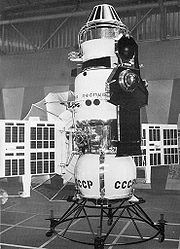 The main hub of Venera 4 stood 3.5 meters high, its solar panels spanned 4 meters and had an area of 2.5 m². The hub included a 2 meter long magnetometer
, an ion detector, a cosmic ray detector and an ultraviolet spectrometer
capable of detecting hydrogen and oxygen gases. The devices were intended to operate until entry into the Venusian atmosphere. At that juncture, the station was designed to release the probe capsule and disintegrate. The rear part of the hub contained a liquid-fuel thruster capable of correcting the flight course. The flight program was planned to include two significant course corrections, for which purpose the station could receive and execute up to 127 different commands sent from the Earth.
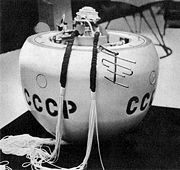 The front part of the hub contained a nearly spherical landing capsule 1 meter in diameter and weighing 383 kg. Compared to previous (failed) Venera probes, the capsule contained an improved heat shield which could withstand temperatures up to 11000 °C. Instead of the previous liquid-based cooling design, a simpler and more reliable gas system was installed. The durability of the capsule was checked by exposing it to high temperatures, pressures and accelerations using three unique testing installations. The heat resistance was checked in a high-temperature vacuum system emulating the upper layers of the atmosphere. The capsule was also pressurized up to 25 atmospheres. (The surface pressure on Venus was unknown at the time. Estimates ranged from a few to hundreds of atmospheres). Finally, it was subjected to accelerations of up to 450 G
in a centrifuge. The centrifuge test caused cracking of electronic components and cable brackets, which were all replaced shortly before launch. The timing for launch was rather tight, so as not to miss the "launch window
" - the days of the year when the path to the destination planet from Earth is energetically least demanding.
The capsule could float in case of a water landing. Considering the possibility of such a landing, its designers made the lock of the capsule using sugar; it was meant to dissolve in liquid water, releasing the transmitter antennas. The capsule contained a newly developed vibration-damping system and its parachute could resist temperatures up to 450 °C.
The capsule contained an altimeter, thermal control, a parachute and equipment for making atmospheric measurements. The latter included a thermometer
, barometer
, hydrometer
, altimeter
and a set of gas analysis instruments. The data were sent by two transmitters at a frequency of 922 MHz and a rate of 1 bit/s; the measurements were sent every 48 seconds. The transmitters were activated by the parachute deployment as soon as the outside pressure increased to 0.6 atmospheres, which was thought to occur at the altitude about 26 km above the surface of Venus. The signals were received by several stations, including the Jodrell Bank Observatory.
The capsule was equipped with a rechargeable battery with a capacity sufficient for 100 minutes of powering the measurement and transmitter systems. To avoid becoming discharged during the flight to Venus, the battery was recharged using the solar panels of the hub. Before the launch, the entire Venera 4 station was sterilized to prevent possible biological contamination of Venus.
(67-058B). A course correction was performed on 29 July when it was 12 million km away from Earth; otherwise the probe would have missed Venus. Although two such corrections had been planned, the first one was accurate enough and therefore the second correction was canceled. On October 18, 1967, the spacecraft entered the Venusian atmosphere with an estimated landing place near .
The second, launched on 17 June, experienced a failure of one of its rocket stages and only managed to reach Earth orbit, reentering the Earth's atmosphere 8 days later. This probe was renamed Cosmos 167.
During entry into the Venusian atmosphere, the surface temperature rose to 11000 °C and at one point the cabin acceleration reached 300 G. The descent lasted 93 minutes. The capsule deployed its parachute at an altitude of about 52 km, and started sending data on pressure, temperature and gas composition back to Earth. The temperature control kept the inside of the capsule at -8 °C. The temperature at 52 km was recorded as 33 °C, and the pressure as less than 1 atm. At the end of the 26-km descent, the temperature reached 262 °C and pressure increased to 22 atmospheres, and the signal transmission terminated. The atmospheric composition was measured as 90-93% carbon dioxide
, 0.4-0.8% oxygen, 7% nitrogen and 0.1-1.6% water vapor.
Misbehavior of the altimeter resulted in the value of initial altitude (deployment of the capsule's parachute and start of the measurements) being transmitted as 26 km. Therefore, some Earth observers interpreted the descent as having continued to the surface of Venus, which was quickly dismissed as inconsistent with other data. In particular, the pressure readings by the capsule were much too low for the Venusian surface.
analysis of the atmosphere of another planet was performed and the data sent back to Earth; the analysis included chemical composition, temperature and pressure. The measured ratio of carbon dioxide
to nitrogen
of about 13 corrected the previous estimates so much (an inverse ratio was expected in some quarters) that some scientists contested the observations. The main station detected no radiation belts; relative to Earth, the measured magnetic field was 3000 times weaker, and the hydrogen corona
was 1000 times less dense. No atomic oxygen was detected. All the data suggested that water, if present, had leaked from the planet long before. This conclusion was unexpected considering the thick Venusian clouds. Because of the negligible humidity, the sugar lock system, employed on Venera 4 in case of a water landing, was abandoned in the subsequent Venus probes.
The mission was considered a complete success, especially given several previous failures of Venera probes. Although the Venera 4 design did allow for data transmission after landing, the Venera 3-6 probes were not built to withstand the pressures at the Venusian surface. The first successful landing on Venus was achieved by Venera 7
in 1970.
Soviet space program
The Soviet space program is the rocketry and space exploration programs conducted by the former Union of Soviet Socialist Republics from the 1930s until its dissolution in 1991...
Venera program for the exploration of Venus
Venus
Venus is the second planet from the Sun, orbiting it every 224.7 Earth days. The planet is named after Venus, the Roman goddess of love and beauty. After the Moon, it is the brightest natural object in the night sky, reaching an apparent magnitude of −4.6, bright enough to cast shadows...
. Venera-4 was the first successful probe to perform in-place analysis of the environment of another planet
Planet
A planet is a celestial body orbiting a star or stellar remnant that is massive enough to be rounded by its own gravity, is not massive enough to cause thermonuclear fusion, and has cleared its neighbouring region of planetesimals.The term planet is ancient, with ties to history, science,...
. It was also the first probe to land on another planet. Venera 4 provided the first chemical analysis of the Venusian atmosphere, showing it to be primarily carbon dioxide
Carbon dioxide
Carbon dioxide is a naturally occurring chemical compound composed of two oxygen atoms covalently bonded to a single carbon atom...
with a few percent of nitrogen
Nitrogen
Nitrogen is a chemical element that has the symbol N, atomic number of 7 and atomic mass 14.00674 u. Elemental nitrogen is a colorless, odorless, tasteless, and mostly inert diatomic gas at standard conditions, constituting 78.08% by volume of Earth's atmosphere...
and below one percent of oxygen
Oxygen
Oxygen is the element with atomic number 8 and represented by the symbol O. Its name derives from the Greek roots ὀξύς and -γενής , because at the time of naming, it was mistakenly thought that all acids required oxygen in their composition...
and water vapors. The station detected a weak magnetic field and no radiation field. The outer atmospheric layer contained very little hydrogen and no atomic oxygen. The probe sent the first direct measurements proving that Venus was extremely hot, that the atmosphere was far denser than expected, and that Venus had lost most of its water long ago.
Design
Magnetometer
A magnetometer is a measuring instrument used to measure the strength or direction of a magnetic field either produced in the laboratory or existing in nature...
, an ion detector, a cosmic ray detector and an ultraviolet spectrometer
Lyman-alpha forest
In astronomical spectroscopy, the Lyman-alpha forest is the sum of absorption lines arising from the Lyman-alpha transition of the neutral hydrogen in the spectra of distant galaxies and quasars....
capable of detecting hydrogen and oxygen gases. The devices were intended to operate until entry into the Venusian atmosphere. At that juncture, the station was designed to release the probe capsule and disintegrate. The rear part of the hub contained a liquid-fuel thruster capable of correcting the flight course. The flight program was planned to include two significant course corrections, for which purpose the station could receive and execute up to 127 different commands sent from the Earth.
G-force
The g-force associated with an object is its acceleration relative to free-fall. This acceleration experienced by an object is due to the vector sum of non-gravitational forces acting on an object free to move. The accelerations that are not produced by gravity are termed proper accelerations, and...
in a centrifuge. The centrifuge test caused cracking of electronic components and cable brackets, which were all replaced shortly before launch. The timing for launch was rather tight, so as not to miss the "launch window
Launch window
Launch window is a term used in spaceflight to describe a time period in which a particular launch vehicle must be launched. If the rocket does not launch within the "window", it has to wait for the next window....
" - the days of the year when the path to the destination planet from Earth is energetically least demanding.
The capsule could float in case of a water landing. Considering the possibility of such a landing, its designers made the lock of the capsule using sugar; it was meant to dissolve in liquid water, releasing the transmitter antennas. The capsule contained a newly developed vibration-damping system and its parachute could resist temperatures up to 450 °C.
The capsule contained an altimeter, thermal control, a parachute and equipment for making atmospheric measurements. The latter included a thermometer
Thermometer
Developed during the 16th and 17th centuries, a thermometer is a device that measures temperature or temperature gradient using a variety of different principles. A thermometer has two important elements: the temperature sensor Developed during the 16th and 17th centuries, a thermometer (from the...
, barometer
Barometer
A barometer is a scientific instrument used in meteorology to measure atmospheric pressure. Pressure tendency can forecast short term changes in the weather...
, hydrometer
Hydrometer
A hydrometer is an instrument used to measure the specific gravity of liquids; that is, the ratio of the density of the liquid to the density of water....
, altimeter
Altimeter
An altimeter is an instrument used to measure the altitude of an object above a fixed level. The measurement of altitude is called altimetry, which is related to the term bathymetry, the measurement of depth underwater.-Pressure altimeter:...
and a set of gas analysis instruments. The data were sent by two transmitters at a frequency of 922 MHz and a rate of 1 bit/s; the measurements were sent every 48 seconds. The transmitters were activated by the parachute deployment as soon as the outside pressure increased to 0.6 atmospheres, which was thought to occur at the altitude about 26 km above the surface of Venus. The signals were received by several stations, including the Jodrell Bank Observatory.
The capsule was equipped with a rechargeable battery with a capacity sufficient for 100 minutes of powering the measurement and transmitter systems. To avoid becoming discharged during the flight to Venus, the battery was recharged using the solar panels of the hub. Before the launch, the entire Venera 4 station was sterilized to prevent possible biological contamination of Venus.
The mission
Two nominally identical Venera 4-type probes were launched in June 1967. The first probe, Venera 4, was launched on 12 June from a Tyazheliy SputnikMolniya (rocket)
Molniya 8K78 was a modification of the well-known R-7 Semyorka rocket and had four stages.This derivative of the original three stage Vostok rocket was especially designed to bring high flying satellites into orbit or to launch probes to other planets. The first launch of this rocket was on...
(67-058B). A course correction was performed on 29 July when it was 12 million km away from Earth; otherwise the probe would have missed Venus. Although two such corrections had been planned, the first one was accurate enough and therefore the second correction was canceled. On October 18, 1967, the spacecraft entered the Venusian atmosphere with an estimated landing place near .
The second, launched on 17 June, experienced a failure of one of its rocket stages and only managed to reach Earth orbit, reentering the Earth's atmosphere 8 days later. This probe was renamed Cosmos 167.
During entry into the Venusian atmosphere, the surface temperature rose to 11000 °C and at one point the cabin acceleration reached 300 G. The descent lasted 93 minutes. The capsule deployed its parachute at an altitude of about 52 km, and started sending data on pressure, temperature and gas composition back to Earth. The temperature control kept the inside of the capsule at -8 °C. The temperature at 52 km was recorded as 33 °C, and the pressure as less than 1 atm. At the end of the 26-km descent, the temperature reached 262 °C and pressure increased to 22 atmospheres, and the signal transmission terminated. The atmospheric composition was measured as 90-93% carbon dioxide
Carbon dioxide
Carbon dioxide is a naturally occurring chemical compound composed of two oxygen atoms covalently bonded to a single carbon atom...
, 0.4-0.8% oxygen, 7% nitrogen and 0.1-1.6% water vapor.
Misbehavior of the altimeter resulted in the value of initial altitude (deployment of the capsule's parachute and start of the measurements) being transmitted as 26 km. Therefore, some Earth observers interpreted the descent as having continued to the surface of Venus, which was quickly dismissed as inconsistent with other data. In particular, the pressure readings by the capsule were much too low for the Venusian surface.
Achievements
For the first time, in situIn situ
In situ is a Latin phrase which translated literally as 'In position'. It is used in many different contexts.-Aerospace:In the aerospace industry, equipment on board aircraft must be tested in situ, or in place, to confirm everything functions properly as a system. Individually, each piece may...
analysis of the atmosphere of another planet was performed and the data sent back to Earth; the analysis included chemical composition, temperature and pressure. The measured ratio of carbon dioxide
Carbon dioxide
Carbon dioxide is a naturally occurring chemical compound composed of two oxygen atoms covalently bonded to a single carbon atom...
to nitrogen
Nitrogen
Nitrogen is a chemical element that has the symbol N, atomic number of 7 and atomic mass 14.00674 u. Elemental nitrogen is a colorless, odorless, tasteless, and mostly inert diatomic gas at standard conditions, constituting 78.08% by volume of Earth's atmosphere...
of about 13 corrected the previous estimates so much (an inverse ratio was expected in some quarters) that some scientists contested the observations. The main station detected no radiation belts; relative to Earth, the measured magnetic field was 3000 times weaker, and the hydrogen corona
Corona
A corona is a type of plasma "atmosphere" of the Sun or other celestial body, extending millions of kilometers into space, most easily seen during a total solar eclipse, but also observable in a coronagraph...
was 1000 times less dense. No atomic oxygen was detected. All the data suggested that water, if present, had leaked from the planet long before. This conclusion was unexpected considering the thick Venusian clouds. Because of the negligible humidity, the sugar lock system, employed on Venera 4 in case of a water landing, was abandoned in the subsequent Venus probes.
The mission was considered a complete success, especially given several previous failures of Venera probes. Although the Venera 4 design did allow for data transmission after landing, the Venera 3-6 probes were not built to withstand the pressures at the Venusian surface. The first successful landing on Venus was achieved by Venera 7
Venera 7
The Venera 7 was a Soviet spacecraft, part of the Venera series of probes to Venus. When it landed on the Venusian surface, it became the first man-made spacecraft to successfully land on another planet and to transmit data from there back to Earth.*Launch date/time: 1970 August 17 at 05:38...
in 1970.