
All Topics  
Saturn V


   Email Print
   Bookmark   Link


Saturn V


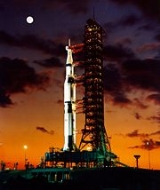
The Saturn V (pronounced 'Saturn Five', popularly known as the Moon Rocket) was a multistage
Multistage rocket

A multistage rocket is a rocket that usestwo or more stages, each of which contains its own Rocket engine and Rocket propellant. A tandem or serial stage is mounted on top of another stage; a parallel stage is attached alongside another stage....
 liquid-fuel expendable
Expendable launch system

An expendable launch system is a launch system that uses an expendable launch vehicle to carry a payload into space. The vehicles used in expendable launch systems are designed to be used only once , and their components are not recovered after launch....
 rocket
Rocket

A rocket or rocket vehicle is a missile, aircraft or other vehicle which obtains thrust by the Reaction of the rocket to the ejection of fast moving fluid exhaust from a rocket engine....
 used by NASA
NASA

The National Aeronautics and Space Administration is an agency of the Federal government of the United States, responsible for the nation's public list of space agencies....
's Apollo and Skylab
Skylab

Skylab was the first space station the United States launched into orbit, and the second space station ever visited by a human crew. The 100 ton space station was in Earth's orbit from 1973 to 1979, and it was visited by crews three times in 1973 and 1974....
 programs from 1967 until 1973. In total NASA launched thirteen Saturn V rockets with no loss of payload. It remains the largest and most powerful launch vehicle ever brought to operational status from a height, weight and payload standpoint. The Soviet Energia
Energia

The Energia rocket was a Soviet Union rocket that was designed by NPO Energia to serve as a heavy-lift expendable launch system as well as a booster for the Buran ....
, which flew two test missions in the late 1980s before being cancelled, had slightly more takeoff thrust.

The largest production model of the Saturn family of rockets, the Saturn V was designed under the direction of Wernher von Braun
Wernher von Braun

Wernher Magnus Maximilian Freiherr von Braun , a Germans rocket physicist and astronautics engineer, became one of the leading figures in the development of rocket technology in Germany and the United States....
 at the Marshall Space Flight Center
Marshall Space Flight Center

The George C. Marshall Space Flight Center , the original home of NASA, is a lead center for Spacecraft propulsion, Space Shuttle propulsion, Space Shuttle external tank, crew training and payloads, International Space Station design and construction, for computers, networks, and information management....
 in Huntsville, Alabama
Huntsville, Alabama

Huntsville is a city in Madison County, Alabama and Limestone County, Alabama Counties in the U.S. state of Alabama, and the county seat of Madison County....
, with Boeing
Boeing

The Boeing Company is a major aerospace and defense corporation, originally founded by William Edward Boeing in Seattle, Washington. Boeing has expanded over the years, merging with McDonnell Douglas in 1997....
, North American Aviation
North American Aviation

North American Aviation was a major United States aircraft manufacturer, responsible for a number of historic aircraft, including the T-6 Texan trainer, the P-51 Mustang fighter aircraft, the B-25 Mitchell bomber, the F-86 Sabre jet aircraft fighter, and the X-15 rocket plane, as well as Apollo Apollo spacecraft, the second stage of the Satu...
, Douglas Aircraft Company
Douglas Aircraft Company

The Douglas Aircraft Company was an American aerospace manufacturer, based in Long Beach, California. It was founded in 1921 by Donald Wills Douglas, Sr....
, and IBM
IBM

International Business Machines Corporation, abbreviated IBM and nicknamed "Big Blue" , is a multinational corporation computer technology and consulting corporation headquartered in Armonk, New York, New York, United States....
 as the lead contractors.


Discussion
Ask a question about 'Saturn V'
Start a new discussion about 'Saturn V'
Answer questions from other users
Full Discussion Forum


Encyclopedia


The Saturn V (pronounced 'Saturn Five', popularly known as the Moon Rocket) was a multistage
Multistage rocket

A multistage rocket is a rocket that usestwo or more stages, each of which contains its own Rocket engine and Rocket propellant. A tandem or serial stage is mounted on top of another stage; a parallel stage is attached alongside another stage....
 liquid-fuel expendable
Expendable launch system

An expendable launch system is a launch system that uses an expendable launch vehicle to carry a payload into space. The vehicles used in expendable launch systems are designed to be used only once , and their components are not recovered after launch....
 rocket
Rocket

A rocket or rocket vehicle is a missile, aircraft or other vehicle which obtains thrust by the Reaction of the rocket to the ejection of fast moving fluid exhaust from a rocket engine....
 used by NASA
NASA

The National Aeronautics and Space Administration is an agency of the Federal government of the United States, responsible for the nation's public list of space agencies....
's Apollo and Skylab
Skylab

Skylab was the first space station the United States launched into orbit, and the second space station ever visited by a human crew. The 100 ton space station was in Earth's orbit from 1973 to 1979, and it was visited by crews three times in 1973 and 1974....
 programs from 1967 until 1973. In total NASA launched thirteen Saturn V rockets with no loss of payload. It remains the largest and most powerful launch vehicle ever brought to operational status from a height, weight and payload standpoint. The Soviet Energia
Energia

The Energia rocket was a Soviet Union rocket that was designed by NPO Energia to serve as a heavy-lift expendable launch system as well as a booster for the Buran ....
, which flew two test missions in the late 1980s before being cancelled, had slightly more takeoff thrust.

The largest production model of the Saturn family of rockets, the Saturn V was designed under the direction of Wernher von Braun
Wernher von Braun

Wernher Magnus Maximilian Freiherr von Braun , a Germans rocket physicist and astronautics engineer, became one of the leading figures in the development of rocket technology in Germany and the United States....
 at the Marshall Space Flight Center
Marshall Space Flight Center

The George C. Marshall Space Flight Center , the original home of NASA, is a lead center for Spacecraft propulsion, Space Shuttle propulsion, Space Shuttle external tank, crew training and payloads, International Space Station design and construction, for computers, networks, and information management....
 in Huntsville, Alabama
Huntsville, Alabama

Huntsville is a city in Madison County, Alabama and Limestone County, Alabama Counties in the U.S. state of Alabama, and the county seat of Madison County....
, with Boeing
Boeing

The Boeing Company is a major aerospace and defense corporation, originally founded by William Edward Boeing in Seattle, Washington. Boeing has expanded over the years, merging with McDonnell Douglas in 1997....
, North American Aviation
North American Aviation

North American Aviation was a major United States aircraft manufacturer, responsible for a number of historic aircraft, including the T-6 Texan trainer, the P-51 Mustang fighter aircraft, the B-25 Mitchell bomber, the F-86 Sabre jet aircraft fighter, and the X-15 rocket plane, as well as Apollo Apollo spacecraft, the second stage of the Satu...
, Douglas Aircraft Company
Douglas Aircraft Company

The Douglas Aircraft Company was an American aerospace manufacturer, based in Long Beach, California. It was founded in 1921 by Donald Wills Douglas, Sr....
, and IBM
IBM

International Business Machines Corporation, abbreviated IBM and nicknamed "Big Blue" , is a multinational corporation computer technology and consulting corporation headquartered in Armonk, New York, New York, United States....
 as the lead contractors. The three stages of the Saturn V were developed by various NASA contractors, but following a sequence of mergers and takeovers all of them are now owned by Boeing.

Background


In 1957 the Soviet Union
Soviet Union

The Union of Soviet Socialist Republics was a Constitution of the Soviet Union socialist state that existed in Eurasia from 1922 to 1991.The name is a translation of the , romanization of Russian Soyuz Sovetskikh Sotsialisticheskikh Respublik, abbreviated ????, SSSR....
 launched Sputnik 1
Sputnik 1

Sputnik 1 was the world's first Earth-orbiting artificial satellite. It was launched into a low altitude elliptical orbit by the Soviet Union on October 4, 1957, and was the first in a series of satellites collectively known as the Sputnik program....
, the first artificial satellite
Satellite

In the context of spaceflight, a satellite is an Physical body which has been placed into orbit by human endeavor. Such objects are sometimes called artificial satellites to distinguish them from natural satellites such as the Moon....
. Lyndon B. Johnson
Lyndon B. Johnson

Lyndon Baines Johnson , often referred to as LBJ, was the List of Presidents of the United States President of the United States and List of Vice Presidents of the United States Vice President of the United States ....
—at the time Senate Majority Leader and later President
President of the United States

The President of the United States is the head of state and head of government of the United States and is the highest political official in the United States by influence and recognition....
—recalled feeling "the profound shock of realizing that it might be possible for another nation to achieve technological superiority over this great country of ours." The resulting Sputnik crisis
Sputnik crisis

The Sputnik crisis was a turning point of the Cold War that began on October 4, 1957 when the Soviet Union launched the Sputnik 1 satellite. The United States had believed itself to be the world leader in space technology and thus the leader in missile development....
 continued, and by 1961, when Soviet cosmonaut Yuri Gagarin
Yuri Gagarin

Yuri Alexeyevich Gagarin , Hero of the Soviet Union, was a Soviet Union cosmonaut. On 12 April 1961, he became the first human in space and the first to orbit the Earth....
 orbited the Earth aboard Vostok 1
Vostok 1

Vostok 1 was the first human spaceflight. The Vostok 3KA spacecraft was launched on April 12, 1961, taking into space Yuri Gagarin, a astronaut from the Soviet Union....
 during the first human spaceflight
Human spaceflight

A human spaceflight is a spaceflight with a Astronaut, and possibly passengers. This makes it unlike Robotic spacecraft space probes or remotely-controlled satellites....
, many people in the United States felt the Soviets had developed a considerable lead in the Space Race
Space Race

File:Space race1.jpgThe Space Race was a competition of space exploration between the Soviet Union and the United States, which lasted roughly from 1957 to 1975....
.

On May 25, 1961, President Kennedy
John F. Kennedy

John Fitzgerald "Jack" Kennedy , often referred to by his initials JFK, was the List of Presidents of the United States President of the United States, serving from 1961 until John F....
 announced that America would attempt to land a man on the Moon by the end of the decade. At that time, the only experience the United States had with human spaceflight was the 15-minute suborbital flight of Alan Shepard
Alan Shepard

Alan Bartlett Shepard, Jr. was the second person and the first United States in space. He later commanded the Apollo 14 mission, and was the List of Apollo astronauts....
 aboard Freedom 7. No rocket then available was capable of propelling a manned spacecraft
Spacecraft

A spacecraft is a Craft or machine designed for spaceflight. On a sub-orbital spaceflight, a spacecraft enters outer space then returns to the Earth....
 to the Moon in one piece. The Saturn I was in development, but would not fly for six months. Although larger than other contemporary rockets, it would require several launches to place all the components of a lunar spacecraft in orbit. The much larger Saturn V had not been designed, although its powerful F-1 engine
F-1 (rocket engine)

The F-1 is a rocket engine developed by Rocketdyne and used in the Saturn V. Five F-1 engines were used in the S-IC first stage of each Saturn V, which served as the main launch vehicle in the Apollo program....
 had already been developed and test fired.

Mission configuration


Early in the planning process, NASA considered three leading ideas for the moon mission: Earth Orbit Rendezvous
Earth orbit rendezvous

Earth orbit rendezvous is a method that has been proposed for space missions to the Moon. NASA considered an EOR mission profile for the Apollo program, but chose instead to use lunar orbit rendezvous ....
, Direct Ascent
Direct ascent

Direct ascent was a proposed method for a mission to the Moon. In the United States, direct ascent proposed using the enormous Nova rocket or Saturn C-8 to loft a spacecraft directly to the Moon, where it would land tail-first and then launch off the Moon back to Earth....
, and Lunar Orbit Rendezvous
Lunar orbit rendezvous

Lunar orbit rendezvous was the method used by the Project Apollo for human spaceflight to the Moon. In an LOR mission a main spacecraft and a smaller Lunar Module travel together into lunar orbit ....
 (LOR). A direct ascent configuration would launch a larger rocket which would land directly on the lunar surface, while an Earth orbit rendezvous would launch two smaller spacecraft which would combine in Earth orbit. A LOR mission would involve a single rocket launching a single spacecraft, but only a small part of that spacecraft would land on the moon. That smaller landing module would then rendezvous with the main spacecraft, and the crew would return home.

NASA at first dismissed LOR as a riskier option, given that an orbital rendezvous
Space rendezvous

A space rendezvous between two spacecraft, often between a spacecraft and a space station, is an orbital maneuver where the two arrive at the same orbit, make their orbital velocity the same, and bring them together ; it may or may not include docking....
 had yet to be performed in Earth orbit, much less in lunar orbit. Several NASA officials, including Langley Research Center engineer John Houbolt
John Houbolt

John Cornelius Houbolt is a retired space engineer. He is generally credited with having effectively promoted the lunar mission mode called Lunar Orbit Rendezvous or LOR....
 and NASA Administrator George Low
George Low

George Michael Low, born George Wilhelm Low was a NASA administrator and 16th President of Rensselaer Polytechnic Institute. He was born near Vienna, Austria to Artur and Gertrude Burger Low, small business people in Austria....
, argued that a Lunar Orbit Rendezvous provided the simplest landing on the moon, the most cost–efficient launch vehicle and, perhaps most importantly, the best chance to accomplish a lunar landing within the decade. Other NASA officials were convinced, and LOR was officially selected as the mission configuration for the Apollo program on 7 November, 1962.

Development


C-1 to C-4

Between 1960 and 1962, the Marshall Space Flight Center
Marshall Space Flight Center

The George C. Marshall Space Flight Center , the original home of NASA, is a lead center for Spacecraft propulsion, Space Shuttle propulsion, Space Shuttle external tank, crew training and payloads, International Space Station design and construction, for computers, networks, and information management....
 (MSFC) designed rockets that could be used for various missions.

The C-1 was developed into the Saturn I
Saturn I

The Saturn I was the United States' first dedicated "space launcher," a rocket designed specifically to launch cargo into Earth's orbit. Most of the rocket's power came from a "clustered" lower stage consisting of tanks taken from older rocket designs and strapped together to make a single larger booster....
, and the C-2 rocket was dropped early in the design process in favor of the C-3, which was intended to use two F-1
F-1 (rocket engine)

The F-1 is a rocket engine developed by Rocketdyne and used in the Saturn V. Five F-1 engines were used in the S-IC first stage of each Saturn V, which served as the main launch vehicle in the Apollo program....
 engines on its first stage, four J-2
J-2 (rocket engine)

Rocketdyne's J-2 was America's largest production liquid hydrogen fueled rocket engine before the Space Shuttle main engines , and is being revived in support of Project Constellation....
 engines for its second stage, and an S-IV stage, using six RL-10
RL-10

The RL-10 was USA's first liquid hydrogen fueled rocket engine, and an updated version is used in several current launch vehicles. Six RL-10 engines were used in the S-IV second stage of the Saturn I rocket....
 engines.

NASA planned to use the C-3 as part of the Earth Orbit Rendezvous concept, with at least four or five launches needed for a single mission, but MSFC was already planning an even bigger rocket, the C-4, which would use four F-1 engines on its first stage, an enlarged C-3 second stage, and the S-IVB
S-IVB

The S-IVB was built by the Douglas Aircraft Company and served as the third stage on the Saturn V and second stage on the Saturn IB. It had one J-2 engine....
, a stage with a single J-2 engine, as its third stage. The C-4 would need only two launches to carry out an Earth Orbit Rendezvous mission.

C-5

On January 10, 1962, NASA announced plans to build the C-5. The three-stage rocket would consist of five F-1 engines for the first stage, five J-2 engines for the second stage, and a single, additional J-2 engine for the third stage. The C-5 was designed for the higher payload capacity necessary for a lunar mission, and could carry up to 41,000 kg into lunar orbit.

The C-5 would undergo component testing even before the first model was constructed. The rocket's third stage would be utilized as the second stage for the C-IB, which would serve both to demonstrate proof of concept and feasibility for the C-5, but would also provide flight data critical to the continued development of the C-5. Rather than undergoing testing for each major component, the C-5 would be tested in an "all-up" fashion, meaning that the first test flight of the rocket would include complete versions of all three stages. By testing all components at once, far fewer test flights would be required before a manned launch.

The C-5 was confirmed as NASA's choice for the Apollo Program in early 1963, and was given a new name—the Saturn V.

Technology

The Saturn V's huge size and payload capacity dwarfed all other previous rockets which had successfully flown at that time. With the Apollo spacecraft on top it stood tall and without fins it was 33 feet (10 m) in diameter. Fully fueled it had a total mass of 6.5 million pounds (2.9 million kg) and a payload capacity of 260,000 pounds (118,000 kg) to LEO
Low Earth orbit

A Low Earth Orbit is generally defined as an orbit within the Locus extending from the Earth?s surface up to an altitude of 2,000 km. Given the rapid orbital decay of objects below approximately 200 km, the commonly accepted definition for LEO is between 160 - 2,000 km above the Earth surface....
. Comparatively, at , the Saturn V is just one foot shorter than St Paul's Cathedral
St Paul's Cathedral

St Paul's Cathedral is the Anglicanism cathedral on Ludgate Hill, in the City of London, and the seat of the Bishop of London. The present building dates from the 17th century and is generally reckoned to be London's fifth St Paul's Cathedral, although the number is higher if every major medieval reconstruction is counted as a new cathedr...
 in London, and only cleared the doors of the Vehicle Assembly Building
Vehicle Assembly Building

The Vehicle Assembly Building, or VAB, is located at NASA's Kennedy Space Center. It is the fourth List of largest buildings in the world in the world by volume....
 (VAB) by 6 ft (1.82 m) when rolled out. In contrast, the Redstone
Redstone (rocket)

First launched in 1953, the United States Redstone rocket was a direct descendant of the German V-2 rocket. Redstone was used for the first live nuclear missile tests by the United States....
 used on Freedom 7, the first manned American spaceflight, was just under longer than the S-IVB
S-IVB

The S-IVB was built by the Douglas Aircraft Company and served as the third stage on the Saturn V and second stage on the Saturn IB. It had one J-2 engine....
 stage, and less powerful than the Launch Escape System
Apollo spacecraft

The Apollo spacecraft was designed as part of the Project Apollo, by the United States in the early 1960s to land men on the moon before 1970 and return them safely to earth....
 rockets mounted on the Apollo command module.

Saturn V was principally designed by the Marshall Space Flight Center
Marshall Space Flight Center

The George C. Marshall Space Flight Center , the original home of NASA, is a lead center for Spacecraft propulsion, Space Shuttle propulsion, Space Shuttle external tank, crew training and payloads, International Space Station design and construction, for computers, networks, and information management....
 in Huntsville, Alabama
Huntsville, Alabama

Huntsville is a city in Madison County, Alabama and Limestone County, Alabama Counties in the U.S. state of Alabama, and the county seat of Madison County....
, although numerous major systems, including propulsion, were designed by subcontractors. It used the powerful new F-1
F-1 (rocket engine)

The F-1 is a rocket engine developed by Rocketdyne and used in the Saturn V. Five F-1 engines were used in the S-IC first stage of each Saturn V, which served as the main launch vehicle in the Apollo program....
 and J-2
J-2 (rocket engine)

Rocketdyne's J-2 was America's largest production liquid hydrogen fueled rocket engine before the Space Shuttle main engines , and is being revived in support of Project Constellation....
 rocket engine
Rocket engine

A rocket engine or simply rocket is a jet engineRocket Propulsion Elements; 7th edition- chapter 1 that uses only propellant mass for forming its high speed propulsive Jet ....
s for propulsion. When tested, these engines shattered the windows of nearby houses. Designers decided early on to attempt to use as much technology from the Saturn I program as possible. As such, the S-IVB
S-IVB

The S-IVB was built by the Douglas Aircraft Company and served as the third stage on the Saturn V and second stage on the Saturn IB. It had one J-2 engine....
 third stage of the Saturn V was based on the S-IV
Saturn I

The Saturn I was the United States' first dedicated "space launcher," a rocket designed specifically to launch cargo into Earth's orbit. Most of the rocket's power came from a "clustered" lower stage consisting of tanks taken from older rocket designs and strapped together to make a single larger booster....
 second stage of the Saturn I. The instrument unit that controlled the Saturn V shared characteristics with that carried by the Saturn I.

Stages

Saturn V Schematic
The Saturn V consisted of three stages the S-IC first stage, S-II second stage and the S-IVB third stage and the instrument unit. All three stages used liquid oxygen
Liquid oxygen

Liquid oxygen is a form of the element oxygen. It has a pale blue color and is strongly paramagnetism. Liquid oxygen has a density of 1.141 g/cm? and is moderately cryogenics ...
 (LOX) as an oxidizer
Oxidizing agent

An oxidizing agent can be defined as either:#a chemical compound that readily transfers oxygen atoms, or#a substance that gains electrons in a redox chemical reaction...
. The first stage used RP-1
RP-1

RP-1 is a highly refined form of kerosene outwardly similar to jet fuel, used as a rocket fuel. Although having a lower specific impulse than liquid hydrogen and thus less thrust per unit mass, RP-1 is cheaper, can be stored at room temperature, is far less of an explosive hazard and is far more dense....
 for fuel, while the second and third stages used liquid hydrogen
Liquid hydrogen

Liquid hydrogen is the liquid state of the element hydrogen. Hydrogen is found naturally in the molecule H2 form.To exist as a liquid, H2 must be pressurized and cooled to a very low temperature, 20.28 K ....
 (LH2). The upper stages also used small solid-fuelled ullage motor
Ullage motor

Ullage motors or Ullage engines are relatively small, independently-fueled rocket engines that may be fired to accelerate the rocket prior to main engine ignition, when the vehicle is in a zero-g situation....
s that helped to separate the stages during the launch, and to ensure that the liquid propellants were in a proper position to be drawn into the pumps.

S-IC first stage
Ap8 68 Hc 70
The S-IC was built by The Boeing Company
Boeing

The Boeing Company is a major aerospace and defense corporation, originally founded by William Edward Boeing in Seattle, Washington. Boeing has expanded over the years, merging with McDonnell Douglas in 1997....
 at the Michoud Assembly Facility
Michoud Assembly Facility

The Michoud Assembly Facility is an 832-acre site owned by the United States' National Aeronautics and Space Administration and located in Eastern New Orleans, Louisiana, United States....
, New Orleans
New Orleans, Louisiana

New Orleans is a major United States port city and the largest city in Louisiana. New Orleans is the center of the New Orleans metropolitan area metropolitan area, the largest metro area in the state....
, where the Space Shuttle
Space Shuttle

NASA's Space Shuttle, officially called the Space Transportation System , is the spacecraft currently used by the United States government for its human spaceflight missions....
 External Tanks are now constructed. Most of its mass of over two thousand metric tonnes at launch was propellant, in this case RP-1
RP-1

RP-1 is a highly refined form of kerosene outwardly similar to jet fuel, used as a rocket fuel. Although having a lower specific impulse than liquid hydrogen and thus less thrust per unit mass, RP-1 is cheaper, can be stored at room temperature, is far less of an explosive hazard and is far more dense....
 rocket fuel and liquid oxygen
Lox

Lox is salmon Fillet that has been curing . In its most popular form, it is thinly sliced—less than in thickness—and, typically, served on a bagel, often with cream cheese and capers....
 oxidizer
Oxidizing agent

An oxidizing agent can be defined as either:#a chemical compound that readily transfers oxygen atoms, or#a substance that gains electrons in a redox chemical reaction...
. It was 138 feet (42 m) tall and 33 feet (10 m) in diameter, and provided over 34 MN (7.64 million pounds force) of thrust to get the rocket through the first 61 kilometers of ascent. The S-IC stage had a dry weight of about 288,000 pounds (131,000 kg) and fully fueled at launch had a total weight of some 5.0 million pounds (2.3 million kg). The five F-1
F-1 (rocket engine)

The F-1 is a rocket engine developed by Rocketdyne and used in the Saturn V. Five F-1 engines were used in the S-IC first stage of each Saturn V, which served as the main launch vehicle in the Apollo program....
 engines were arranged in a cross pattern. The center engine was fixed, while the four outer engines could be hydraulically turned ("gimballed")
Gimbal

A gimbal is a pivoted support that allows the rotation of an object about a single axis. A set of two gimbals, one mounted on the other with pivot axes orthogonal, may be used to allow an object mounted on the innermost gimbal to remain immobile regardless of the motion of its support....
 to control the rocket. In flight, the center engine was turned off about 26 seconds earlier than the outboard engines to limit acceleration. During launch, the S-IC fired its engines for 168 seconds (ignition occurred about 7 seconds before liftoff) and at engine cutoff, the vehicle was at an altitude of about 42 miles (68 km), was downrange about 58 miles (93 km), and was moving about 7,850 ft/sec (2,390 m/sec, or approximately 5352 mph).

S-II second stage
The S-II was built by North American Aviation
North American Aviation

North American Aviation was a major United States aircraft manufacturer, responsible for a number of historic aircraft, including the T-6 Texan trainer, the P-51 Mustang fighter aircraft, the B-25 Mitchell bomber, the F-86 Sabre jet aircraft fighter, and the X-15 rocket plane, as well as Apollo Apollo spacecraft, the second stage of the Satu...
 at Seal Beach, California
Seal Beach, California

Seal Beach is a city in Orange County, California, California. As of 2000, its population was 24,157. The city was incorporated on 25 October, 1915....
. Using liquid hydrogen and liquid oxygen, it had five J-2
J-2 (rocket engine)

Rocketdyne's J-2 was America's largest production liquid hydrogen fueled rocket engine before the Space Shuttle main engines , and is being revived in support of Project Constellation....
 engines in a similar arrangement to the S-IC, also using the outer engines for control. The S-II was 81 feet and 7 inches (24.9 m) tall with a diameter of 33 feet (10 m), identical to the S-IC, and thus is the largest cryogenic stage ever built. The S-II had a dry weight of about 80,000 pounds (36,000 kg) and fully fueled, weighed 1.06 million pounds (480,000 kg). The second stage accelerated the Saturn V through the upper atmosphere with 5.1 MN of thrust (in vacuum). When loaded, significantly more than 90 percent of the mass of the stage was propellant, however, the ultra-lightweight design had led to two failures in structural testing. Instead of having an intertank structure to separate the two fuel tanks as was done in the S-IC, the S-II used a common bulkhead that was constructed from both the top of the LOX tank and bottom of the LH2 tank. It consisted of two aluminum sheets separated by a honeycomb structure made of phenolic resin
Phenolic resin

Phenolic resin can include any of various synthetic thermosetting resins such as Bakelite, obtained by the reaction of phenols with simple aldehydes and used to make molded products, including billiards balls, laboratory countertops, and as coatings and adhesives....
. This had to insulate against the 70 °C (125 °F) temperature difference between the two tanks. The use of a common bulkhead saved 3.6 metric tons in weight. Like the S-IC, the S-II was transported by sea.

S-IVB third stage
The S-IVB was built by the Douglas Aircraft Company
Douglas Aircraft Company

The Douglas Aircraft Company was an American aerospace manufacturer, based in Long Beach, California. It was founded in 1921 by Donald Wills Douglas, Sr....
 at Huntington Beach, California
Huntington Beach, California

Huntington Beach is a seaside city in Orange County, California in southern California, United States. As of the 2006 census, the city population was 194,436....
. It had one J-2 engine and used the same fuel as the S-II. The S-IVB used a common bulkhead to insulate the two tanks. It was 58 feet and 7 inches (17.85 m) tall with a diameter of 21 feet and 8 inches (6.60 m) and was also designed with high mass efficiency, though not quite as aggressively as the S-II. The S-IVB had a dry weight of about 25,000 pounds (11,000 kg) and fully fueled, weighed about 262,000 pounds (119,000 kg). This stage was used twice during the mission: first in a 2.5 min burn for the orbit insertion after second stage cutoff, and later for the trans lunar injection
Trans Lunar Injection

A Trans Lunar Injection is a Orbital maneuver used to set a spacecraft on a trajectory which will arrive at the Moon.Typical lunar transfer trajectories approximate Hohmann transfer orbits, although low energy transfers have also been used in some cases, as with the Hiten probe....
 (TLI) burn, lasting about 6 mins. Two liquid-fueled auxiliary propulsion system units mounted at the aft end of the stage were used for attitude control during the parking orbit
Parking orbit

A parking orbit is a temporary orbit used during the launch of a satellite or other space probe. A launch vehicle boosts into the parking orbit, then coasts for a while, then fires again to enter the final desired trajectory....
 and the trans-lunar phases of the mission. The two APSs were also used as ullage engines
Ullage motor

Ullage motors or Ullage engines are relatively small, independently-fueled rocket engines that may be fired to accelerate the rocket prior to main engine ignition, when the vehicle is in a zero-g situation....
 to help settle the fuel prior to the translunar injection burn.

The S-IVB was the only rocket stage of the Saturn V small enough to be transported by plane, in this case the Guppy
Aero Spacelines Pregnant Guppy

The Pregnant Guppy was a large, wide-bodied cargo aircraft built in the USA and used for ferrying outsize cargo items, most notably NASA's components of the Project Apollo....
. Apart from the interstage adapter and the stage restart capability, this stage is nearly identical to the second stage of the Saturn IB
Saturn IB

The Saturn IB was an uprated version of the Saturn I, which featured a much more powerful second stage, the S-IVB. Unlike the earlier Saturn I, the IB had enough throw weight to launch the Apollo Command/Service Module or Apollo Lunar Module into Earth orbit, which made it invaluable for testing the Apollo spacecraft while the larger Saturn V...
 rocket.

Instrument unit
Saturn V Iu
The Instrument Unit was built by IBM
IBM

International Business Machines Corporation, abbreviated IBM and nicknamed "Big Blue" , is a multinational corporation computer technology and consulting corporation headquartered in Armonk, New York, New York, United States....
 and rode atop the third stage. It was constructed at the Space Systems Center in Huntsville
Huntsville, Alabama

Huntsville is a city in Madison County, Alabama and Limestone County, Alabama Counties in the U.S. state of Alabama, and the county seat of Madison County....
. This computer controlled the operations of the rocket from just before liftoff until the S-IVB was discarded. It included guidance and telemetry
Telemetry

Telemetry is a technology that allows the remote measurement and reporting of information of interest to the system designer or operator. The word is derived from Greek language roots tele = remote, and metron = measure....
 systems for the rocket. By measuring the acceleration and vehicle attitude, it could calculate the position and velocity of the rocket and correct for any deviations.

Range safety

In the event of an abort requiring the destruction of the rocket, the range safety officer would remotely shut down the engines and after several seconds send another command for the shaped explosive charges attached to the outer surfaces of the rocket to detonate. These would make cuts in fuel and oxidizer tanks to disperse the fuel quickly and to minimize mixing. The pause between these actions would give time for the crew to escape using the Launch Escape Tower
Apollo spacecraft

The Apollo spacecraft was designed as part of the Project Apollo, by the United States in the early 1960s to land men on the moon before 1970 and return them safely to earth....
 or (in the later stages of the flight) the propulsion system of the Service module. A third command, "safe", was used after the S-IVB stage reached orbit to irreversibly deactivate the self-destruct system. The system was also inactive as long as the rocket was still on the launch pad.

Comparisons

S Ic Engines and Von Braun
The Soviet
Soviet space program

The Soviet space program consisted of initiatives within the Soviet Union by competing design groups. Being primarily a military program, it was classified....
 counterpart of the Saturn V was the N-1 rocket. The Saturn V was taller, heavier and had greater payload capacity, but the N-1 had more liftoff thrust and a larger first stage diameter. The N1 had four test launches before the program was canceled, each resulting in the vehicle catastrophically failing early in the flight. The first stage of Saturn V used five powerful engines rather than the 30 smaller engines of the N-1. During two launches, Apollo 6
Apollo 6

Apollo 6, launched on April 4, 1968, was the Apollo program's second and last unmanned test flight of its Saturn V launch vehicle....
 and Apollo 13
Apollo 13

Apollo 13 was the third manned lunar-landing mission, part of Project Apollo under NASA in the United States. The crew members were Commander Jim Lovell, Command Module pilot Jack Swigert, and Lunar Module pilot Fred W....
, the Saturn V was able to recover from engine loss incidents. The N-1 likewise was designed to compensate for engine failures, but the system never successfully saved a launch from failure.

Saturnvthrust2
The three-stage Saturn V had a peak thrust of at least 34.02 MN
Newton

The newton is the International System of Units SI derived unit of force, named after Isaac Newton in recognition of his work on classical mechanics....
 (SA-510 and subsequent) and a lift capacity of 118,000 kg to LEO
Low Earth orbit

A Low Earth Orbit is generally defined as an orbit within the Locus extending from the Earth?s surface up to an altitude of 2,000 km. Given the rapid orbital decay of objects below approximately 200 km, the commonly accepted definition for LEO is between 160 - 2,000 km above the Earth surface....
. The SA-510 mission (Apollo 15) had a liftoff thrust of 7.823 million pounds (34.8 MN). The SA-513 mission (Skylab) had slightly greater liftoff thrust of 7.891 million pounds (35.1 MN). No other operational launch vehicle has ever surpassed the Saturn V in height, weight, or payload. If the two Soviet Energia
Energia

The Energia rocket was a Soviet Union rocket that was designed by NPO Energia to serve as a heavy-lift expendable launch system as well as a booster for the Buran ....
 test launches are counted as operational, it had the same liftoff thrust as SA-513, 35.1 MN. The N-1 had a sea-level liftoff thrust of about 9.9 million pounds (44.1 MN), but it never achieved orbit.

Hypothetical future versions of the Soviet Energia
Energia

The Energia rocket was a Soviet Union rocket that was designed by NPO Energia to serve as a heavy-lift expendable launch system as well as a booster for the Buran ....
 would have been significantly more powerful than the Saturn V, delivering 46 MN of thrust and able to deliver up to 175 metric tonnes to LEO in the "Vulkan" configuration. Planned uprated versions of the Saturn V using F-1A engines would have had about 18 percent more thrust and 137,250 kg (302,580 lb) payload. NASA contemplated building larger members of the Saturn family, such as the Saturn C-8
Saturn C-8

The Saturn C-8 was the largest Saturn rocket to be designed. It was an alternative to the Nova rocket, should a direct landing method of Exploration of the Moon have been chosen by NASA for the Apollo program....
, and also unrelated rockets, such as Nova
Nova rocket

Nova was a series of proposed rocket designs, originally as NASA's first large launchers for missions similar to the Saturn V that entered production, and later as larger follow-ons to the Saturn V intended for missions to Mars ....
, but these were never produced.

The Space Shuttle
Space Shuttle

NASA's Space Shuttle, officially called the Space Transportation System , is the spacecraft currently used by the United States government for its human spaceflight missions....
 generates a peak thrust of 30.1 MN, and payload capacity to LEO (excl. Shuttle Orbiter itself) is 28,800 kg, which is about 25 percent of the Saturn V's payload. If the Shuttle Orbiter itself is counted as payload, this would be about 112,000 kg (248,000 lb). An equivalent comparison would be the Saturn V S-IVB third stage total orbital mass on Apollo 15, which was 140,976 kg (310,800 lb).

Some other recent launch vehicles have a small fraction of the Saturn V's payload capacity: the European Ariane 5
Ariane 5

Ariane 5 is a European expendable launch system designed to deliver payloads into geostationary transfer orbit or low Earth orbit.It is manufactured under the authority of the European Space Agency and the Centre National d'Etudes Spatiales , with EADS Astrium Space Transportation as prime contractor, leading a consortium of sub-contracto...
 with the newest versions Ariane 5 ECA delivers up to 10,000 kg to geostationary transfer orbit
Geostationary transfer orbit

A Geosynchronous Transfer Orbit or Geostationary Transfer Orbit is anintermediate orbit used to reach geostationary orbit. It is a highly ellipse earth orbit with apogee at about 35,700 km, geostationary orbit altitude, and a argument of perigee such that apogee occurs on or near the equator....
 (GTO). The US Delta 4 Heavy
Delta IV rocket

Delta IV is an active expendable launch system in the Delta rocket family. Delta IV uses rockets designed by Boeing's Boeing Integrated Defense Systems and built in the United Launch Alliance facility in Decatur, Alabama....
, which launched a dummy satellite on December 21, 2004, has a capacity of 13,100 kg to geosynchronous transfer orbit. The Atlas V rocket (using engines based on a Russian design) delivers up to 25,000 kg to LEO and 13,605 kg to GTO.

S-IC thrust comparisons
Because of its large size, attention is often focused on the S-IC
S-IC

The S-IC was the first Multistage rocket of the Saturn V rocket. The S-IC first stage was built by The Boeing Company. Like the first stages of most rockets, most of its mass of over two thousand metric tonnes at launch was propellant, in this case RP-1 rocket fuel and liquid oxygen oxidizer....
 thrust and how this compares to other large rockets. However, several factors make such comparisons more complex than first appears:
  • Commonly-referenced thrust numbers are a specification, not an actual measurement. Individual stages and engines may fall short or exceed the specification, sometimes significantly.
  • The F-1
    F-1 (rocket engine)

    The F-1 is a rocket engine developed by Rocketdyne and used in the Saturn V. Five F-1 engines were used in the S-IC first stage of each Saturn V, which served as the main launch vehicle in the Apollo program....
     thrust specification was uprated beginning with Apollo 15
    Apollo 15

    Apollo 15 was the ninth manned mission in the Apollo program and the fourth mission to land on the Moon. It was the first of what were termed "J missions", long duration stays on the Moon with a greater focus on science than had been possible on previous missions....
     (SA-510) from 1.5 million lbf (6.67 MN) to 1.522 million lbf (6.77 MN), or 7.61 million lbf (33.85 MN) for the S-IC stage. The higher thrust was achieved via a redesign of the injector orifices and a slightly higher propellant mass flow rate. However, comparing the specified number to the actual measured thrust of 7.823 million lbf (34.8 MN) on Apollo 15 shows a significant difference.
  • There is no "bathroom scale" way to directly measure thrust of a rocket in flight. Rather a mathematical calculation is made from combustion chamber pressure, turbopump
    Turbopump

    As the name suggests, a turbopump comprises basically two main components: a rotodynamic pump and a driving turbine, both mounted on the same shaft....
     speed, calculated propellant density and flow rate, nozzle design, and atmospheric conditions, in particular, external pressure.
  • Thrust varies greatly with external pressure and thus, with altitude, even for a non-throttled engine. For example on Apollo 15, the calculated total liftoff thrust (based on actual measurements) was about 7.823 million lbf (34.8 MN), which increased to 9.18 million lbf (40.8 MN) at T+135 seconds, just before center engine cutoff (CECO), at which time the jet was heavily underexpanded.
  • Thrust specifications are often given as vacuum thrust (for upper stages) or sea level thrust (for lower stages or boosters), sometimes without qualifying which one. This can lead to incorrect comparisons.
  • Thrust specifications are often given as average thrust or peak thrust, sometimes without qualifying which one. Even for a non-throttled engine at a fixed altitude, thrust can often vary somewhat over the firing period due to several factors. These include intentional or unintentional mixture ratio changes, slight propellant density changes over the firing period, and variations in turbopump, nozzle and injector performance over the firing period.


Without knowing the exact measurement technique and mathematical method used to determine thrust for each different rocket, comparisons are often inexact. As the above shows, the specified thrust often differs significantly from actual flight thrust calculated from direct measurements. The thrust stated in various references is often not adequately qualified as to vacuum vs sea level, or peak vs average thrust.

Similarly, payload increases are often achieved in later missions independent of engine thrust. This is by weight reduction or trajectory reshaping.

The result is there is no single absolute figure for engine thrust, stage thrust or vehicle payload. There are specified values and actual flight values, and various ways of measuring and deriving those actual flight values.

The performance of each Saturn V launch was extensively analyzed and a Launch Evaluation Report produced for each mission, including a thrust/time graph for each vehicle stage on each mission.

Assembly

Ap10 Ksc 69pc 110
After the construction of a stage was completed, it was shipped to the Kennedy Space Center. The first two stages were so large that the only way to transport them was by barge. The S-IC constructed in New Orleans was transported down the Mississippi River
Mississippi River

The Mississippi River is the longest river in the United States, with a length of from its source in Lake Itasca in Minnesota to its mouth in the Gulf of Mexico....
 to the Gulf of Mexico
Gulf of Mexico

The Gulf of Mexico is the ninth largest body of water in the world. Considered a smaller part of the Atlantic Ocean, it is an oceanic basin largely surrounded by the North American continent and the island of Cuba....
. After rounding Florida
Florida

Florida is a U.S. state located in the Southeastern United States of the United States, bordering Alabama to the northwest and Georgia to the northeast....
, it was then transported up the Intra-Coastal Waterway to the Vertical Assembly Building (now called the Vehicle Assembly Building). The S-II was constructed in California
California

California is a U.S. state on the West Coast of the United States of the United States, along the Pacific Ocean. It is bordered by Oregon to the north, Nevada to the east, Arizona to the southeast, and to the south the Mexico state of Baja California....
 and so traveled via the Panama Canal
Panama Canal

The Panama Canal is a man-made canal which joins the Pacific Ocean and Atlantic Ocean oceans. One of the largest and most difficult engineering projects ever undertaken, it had an enormous impact on shipping between the two oceans, replacing the long and treacherous route via the Drake Passage and Cape Horn at the southernmost tip of South Am...
. The third stage and Instrument Unit could be carried by the Aero Spacelines
Aero Spacelines

Aero Spacelines, Inc. was a US aircraft manufacturer that made a namefor itself by converting Boeing Boeing 377 Stratocruisers into the famous...
 Pregnant Guppy and Super Guppy
Aero Spacelines Super Guppy

The Super Guppy is a large, wide-bodied US cargo aircraft used for ferrying outsized cargo components. It was the successor to the Pregnant Guppy, the first of the Guppy aircraft produced by Aero Spacelines, Inc....
.

On arrival at Vertical Assembly Building, each stage was checked out in a horizontal position before being moved to a vertical position. NASA also constructed large spool-shaped structures that could be used in place of stages if a particular stage was late. These spools had the same height and mass and contained the same electrical connections as the actual stages.

NASA assembled the Saturn V on a mobile launch platform, which consisted of a Launch Umbilical Tower (LUT), Crawler Transporter, and Mobile Launcher Platform
Mobile Launcher Platform

The Mobile Launcher Platform or MLP is a two-story structure used by NASA, along with the Crawler-Transporter, to transport the Space Shuttle stack from the Vehicle Assembly Building to either Launch Complex 39 or 39-B at the Kennedy Space Center, as well as serve as the vehicle's launch platform....
 (MLP). The whole structure was then moved from the Vehicle Assembly Building
Vehicle Assembly Building

The Vehicle Assembly Building, or VAB, is located at NASA's Kennedy Space Center. It is the fourth List of largest buildings in the world in the world by volume....
 (VAB
VAB

VAB is an initialism for several things:*Vehicle Assembly Building - the large building at NASA's Kennedy Space Center where the space shuttles are prepared for launch...
) to the launch complex using the Crawler Transporter (CT). The CT is still in use today by the Space Shuttle and will be used in NASA's next manned space system, The Constellation Program. The CT runs on four double tracked treads, each with 57 'shoes'. Each shoe weighs 900 kg (2,000 lb). This transporter had to keep the rocket level as it traveled the 3 miles (5 km) to the launch site.

Lunar mission launch sequence

The Saturn V carried all Apollo lunar missions. All Saturn V missions launched from Launch Complex 39 at the John F. Kennedy Space Center. After the rocket cleared the launch tower, mission control transferred to the Johnson Space Center
Lyndon B. Johnson Space Center

The Lyndon B. Johnson Space Center is the National Aeronautics and Space Administration's center for human spaceflight activities. The center consists of a complex of 100 buildings constructed on located in southeast Houston, Texas....
 in Houston, Texas
Houston, Texas

Houston is the fourth-largest city in the United States of America and the largest city within the state of Texas. As of the 2007 U.S. Census estimate, the city has a population of 2.2 million within an area of 600 square miles ....
.

An average mission used the rocket for a total of just 20 minutes. Although Apollo 6
Apollo 6

Apollo 6, launched on April 4, 1968, was the Apollo program's second and last unmanned test flight of its Saturn V launch vehicle....
 and Apollo 13
Apollo 13

Apollo 13 was the third manned lunar-landing mission, part of Project Apollo under NASA in the United States. The crew members were Commander Jim Lovell, Command Module pilot Jack Swigert, and Lunar Module pilot Fred W....
 experienced engine failures, the onboard computers were able to compensate by burning the remaining engines longer, and none of the Apollo launches resulted in a payload loss.

S-IC sequence

Apollo 11 Launch
The first stage burned for 2.5 minutes, lifting the rocket to an altitude of and a speed of 6164 mph (9921 km/h) and burning of propellant.

At 8.9 seconds before launch, the first stage ignition sequence started. The center engine ignited first, followed by opposing outboard pairs at 300-millisecond intervals to reduce the structural loads on the rocket. When thrust had been confirmed by the onboard computers, the rocket was 'soft-released' in two stages: first, the hold-down arms released the rocket, and second, as the rocket began to accelerate upwards, it was slowed by tapered metal pins pulled through dies for half a second. Once the rocket had lifted off, it could not safely settle back down onto the pad if the engines failed.

It took about 12 seconds for the rocket to clear the tower. During this time, it yawed
Flight dynamics

Flight dynamics is the science of aircraft and spacecraft vehicle orientation and control in three dimensions. The three critical flight dynamics parameters are the angles of rotation in three dimensions about the vehicle's center of mass, known as pitch, roll and yaw ....
 1.25 degrees away from the tower to ensure adequate clearance despite adverse winds. (This yaw, although small, can be seen in launch photos taken from the east or west.) At an altitude of 430 ft (130 m) the rocket rolled to the correct flight azimuth and then gradually pitched down until 38 seconds after second stage ignition. This pitch program was set according to the prevailing winds during the launch month. The four outboard engines also tilted toward the outside so that in the event of a premature outboard engine shutdown the remaining engines would thrust through the rocket's center of gravity. The Saturn V quickly accelerated, reaching 1600 feet/s. (500 m/s) at 1+ miles (2 km) in altitude. Much of the early portion of the flight was spent gaining altitude, with the required velocity coming later.

At about 80 seconds, the rocket experienced maximum dynamic pressure (Max Q
Max Q

In aerospace engineering, max Q is the point of maximum dynamic pressure, the point at which aerodynamic stress on a spacecraft in atmospheric flight is maximized....
). The dynamic pressure on a rocket varies with air density and the square of relative velocity. Although velocity continues to increase, air density decreases so quickly with altitude that dynamic pressure falls beyond Max Q
Max Q

In aerospace engineering, max Q is the point of maximum dynamic pressure, the point at which aerodynamic stress on a spacecraft in atmospheric flight is maximized....
.

Acceleration increased during S-IC flight for two reasons: decreasing propellant mass; and increasing thrust as F-1 engine efficiency improved in the thinner air at altitude. At 135 seconds, the inboard (center) engine shut down to limit acceleration to 4 g
G-force

The g-force of an object is its acceleration relative to free-fall. The unit of measure used is informally but commonly known as the "gee" , symbolized as g . An acceleration of 1 g is generally considered as equal to standard gravity , which is defined as precisely metre per second square...
. Acceleration again increased to 4 g just before first stage cut off. The other engines continued to burn until either oxidizer or fuel depletion as detected by sensors in the suction assemblies. First stage separation was a little less than 1 second after cutoff to allow for F-1 thrust tail-off. Eight small solid fuel separation motors backed the S-IC from the interstage at an altitude of about 67 km. The first stage continued ballistically to an altitude of about 68 miles (110 km) and then fell in the Atlantic Ocean about 350 miles (560 km) downrange.

S-II sequence

Ap6 68 Hc 191
After S-IC separation, the S-II second stage burned for 6 minutes and propelled the craft to 109 miles (176 km) and 15,647 mph (25,182 km/h 7.00 km/s), close to orbital velocity.

For the first two unmanned launches, eight solid-fuel ullage motor
Ullage motor

Ullage motors or Ullage engines are relatively small, independently-fueled rocket engines that may be fired to accelerate the rocket prior to main engine ignition, when the vehicle is in a zero-g situation....
s ignited for four seconds to give positive acceleration to the S-II stage, followed by start of the five J-2 engines. For the first seven manned Apollo missions only four ullage motors were used on the S-II, and they were eliminated completely for the final four launches. About 30 seconds after first stage separation, the interstage ring dropped from the second stage. This was done with an inertially fixed attitude so that the interstage, only 1 meter from the outboard J-2 engines, would fall cleanly without contacting them. Shortly after interstage separation the Launch Escape System
Launch escape system

A Launch Escape System is a top-mounted rocket connected to the crew module of a crewed spacecraft and used to quickly separate the crew module from the rest of the rocket in case of emergency....
 was also jettisoned. See Apollo abort modes
Apollo abort modes

During the launch of an Apollo spacecraft by the Saturn V rocket, the flight could be aborted to rescue the crew if the rocket failed catastrophically....
 for more information about the various abort modes that could have been used during a launch.

About 38 seconds after the second stage ignition the Saturn V switched from a preprogrammed trajectory to a "closed loop" or Iterative Guidance Mode. The Instrument Unit now computed in real time the most fuel-efficient trajectory toward its target orbit. If the Instrument Unit failed, the crew could switch control of the Saturn to the Command Module's computer, take manual control, or abort the flight.

About 90 seconds before the second stage cutoff, the center engine shut down to reduce longitudinal pogo oscillation
Pogo oscillation

Pogo oscillation is the term for a potentially dangerous type of oscillation found in rocket engines. This oscillation results in variations of thrust from the engines, generally caused by variations in fuel flow rate, and placing stress on the frame of the vehicle....
s. A pogo suppressor, first flown on Apollo 14, stopped this motion but the center engine was still shut down early to limit acceleration G forces
G-force

The g-force of an object is its acceleration relative to free-fall. The unit of measure used is informally but commonly known as the "gee" , symbolized as g . An acceleration of 1 g is generally considered as equal to standard gravity , which is defined as precisely metre per second square...
. At around this time, the LOX flow rate decreased, changing the mix ratio of the two propellants, ensuring that there would be as little propellant as possible left in the tanks at the end of second stage flight. This was done at a predetermined delta-v
Delta-v

In astrodynamics, the term delta-v, literally "change in velocity" , has a specific meaning: it is a scalar which takes units of speed that measures the amount of "effort" needed to carry out an orbital maneuver, i.e., to change from one trajectory to another....
.

Five level sensors in the bottom of each S-II propellant tank were armed during S-II flight, allowing any two to trigger S-II cutoff and staging when they were uncovered. One second after the second stage cut off it separated and several seconds later the third stage ignited. Solid fuel retro-rockets mounted on the interstage at the top of the S-II fired to back it away from the S-IVB. The S-II
S-II

The S-II was the second stage of the Saturn V rocket. It was built by North American Aviation. Using LH2 and liquid oxygen it had five J-2 in a cross pattern....
 impacted about 4200 km from the launch site.

S-IVB sequence

Unlike the two-plane separation of the S-IC and S-II, the S-II and S-IVB stages separated with a single step. Although it was constructed as part of the third stage, the interstage remained attached to the second stage.

During Apollo 11
Apollo 11

The Apollo 11 mission was the first manned mission to land on the Moon. It was the fifth human spaceflight of Apollo program and the third human voyage to the Moon....
, a typical lunar mission, the third stage burned for about 2.5 minutes until first cutoff at 11 minutes 40 seconds. At this point it was 2640 km downrange and in a parking orbit at an altitude of 188 km and velocity of 7790 m/sec. The third stage remained attached to the spacecraft while it orbit
ORBit

ORBit is a Common Object Request Broker Architecture 2.4 compliant Object Request Broker . It features mature C , C++ and Python bindings, and less developed bindings for Perl, Lisp , Pascal , Ruby , and Tcl....
ed the Earth two and a half times while astronauts and mission controllers prepared for translunar injection (TLI).

As7 3 1545
This parking orbit is quite low by Earth orbit standards, and it would have been short-lived due to aerodynamic drag. This was not a problem on a lunar mission because of the short stay in the parking orbit. The S-IVB also continued to thrust at a low level with hydrogen vents to settle the propellants in their tanks, and this thrust easily exceeded aerodynamic drag.

For the final three Apollo flights, the temporary parking orbit was even lower (approximately ), to increase payload for these missions. For the two Earth orbit missions of the Saturn V, Apollo 9
Apollo 9

Apollo 9 was the first manned flight of the Apollo Command/Service Module along with the Apollo Lunar Module . Its three-person crew of Mission Commander Jim McDivitt, Command Module Pilot David Scott, and Lunar Module Pilot Rusty Schweickart tested several aspects critical to landing on the moon including the LM engines, backpack life suppo...
and Skylab
Skylab

Skylab was the first space station the United States launched into orbit, and the second space station ever visited by a human crew. The 100 ton space station was in Earth's orbit from 1973 to 1979, and it was visited by crews three times in 1973 and 1974....
, the orbits were much higher and more typical of manned orbital missions.

On Apollo 11, TLI came at 2 hours and 44 minutes after launch. The S-IVB burned for almost six minutes giving the spacecraft a velocity close to the earth's escape velocity of 11.2 km/s (40,320 km/h; 25,053 mph). This gave an energy-efficient transfer to lunar orbit with the moon helping to capture the spacecraft with a minimum of CSM fuel consumption.

About 40 minutes after TLI the Apollo Command Service Module (CSM) separated from the third stage, turned 180 degrees and docked with the Lunar Module (LM) that rode below the CSM during launch. The CSM and LM separated from the spent third stage 50 minutes later.

If it were to remain on the same trajectory as the spacecraft, the S-IVB could have presented a collision hazard so its remaining propellants were vented and the auxiliary propulsion system fired to move it away. For lunar missions before Apollo 13
Apollo 13

Apollo 13 was the third manned lunar-landing mission, part of Project Apollo under NASA in the United States. The crew members were Commander Jim Lovell, Command Module pilot Jack Swigert, and Lunar Module pilot Fred W....
, the S-IVB was directed toward the moon's trailing edge in its orbit so that the moon would slingshot
Gravitational slingshot

In orbital mechanics and aerospace engineering, a gravitational slingshot, gravity assist or swing-by is the use of the relative movement and gravity of a planet or other celestial body to alter the path and speed of a spacecraft, typically in order to save fuel, time, and expense....
 it beyond earth escape velocity and into solar orbit. From
Apollo 13 onwards, controllers directed the S-IVB to hit the Moon. Seismometer
Seismometer

Seismometers are instruments that measure and record motions of the ground, including those of seismic waves generated by earthquakes, nuclear explosions, and other seismic sources....
s left behind by previous missions detected the impacts, and the information helped map the inside of the Moon.

Apollo 9 was a special case; although it was an earth orbital mission, after spacecraft separation its S-IVB was fired out of earth orbit into a solar orbit.

On September 3, 2002, Bill Yeung discovered a suspected asteroid
Asteroid

Asteroids, sometimes called minor planets or planetoids, are small Solar System bodies in orbit around the Sun, smaller than planets but larger than meteoroids....
, which was given the discovery designation J002E3
J002E3

J002E3 is the designation given to a supposed asteroid discovered by amateur astronomer William Kwong Yu Yeung on September 3, 2002. Further examination revealed the object was not a rock asteroid but instead the S-IVB third Multistage rocket of the Apollo 12 Saturn V rocket....
. It appeared to be in orbit around the Earth, and was soon discovered from spectral analysis to be covered in white titanium dioxide
Titanium dioxide

Titanium dioxide, also known as titanium oxide or titania, is the naturally occurring oxide of titanium, chemical formula titaniumoxygen2....
 paint, the same paint used for the Saturn V. Calculation of orbital parameters identified the apparent asteroid as being the
Apollo 12 S-IVB stage. Mission controllers had planned to send Apollo 12's S-IVB into solar orbit, but the burn after separating from the Apollo spacecraft lasted too long, and hence it did not pass close enough to the Moon, remaining in a barely-stable orbit around the Earth and Moon. In 1971, through a series of gravitational perturbations, it is believed to have entered in a solar orbit and then returned into weakly-captured Earth orbit 31 years later. It left Earth orbit again in June 2003.

Skylab

Skylab Launch On Saturn V
In 1968, the Apollo Applications Program
Apollo Applications program

The Apollo Applications Program was established by NASA headquarters in 1968 to develop science-based manned space missions using surplus material from the Apollo program....
 was created to look into science missions that could be performed with the surplus Apollo hardware. Much of the planning centered on the idea of a space station, which eventually spawned the Skylab
Skylab

Skylab was the first space station the United States launched into orbit, and the second space station ever visited by a human crew. The 100 ton space station was in Earth's orbit from 1973 to 1979, and it was visited by crews three times in 1973 and 1974....
 program. Skylab was launched using a two-stage Saturn V, sometimes called a Saturn INT-21
Saturn INT-21

The Saturn INT-21 was an United States orbital launch vehicle of the 1970s. It was derived from the Saturn V rocket, used for the Project Apollo, and is commonly mistaken for the Saturn V....
,. It was the only launch not directly related to the Apollo lunar landing program.

Originally it was planned to use a 'wet workshop
Wet workshop

Wet workshop is the idea of using a spent rocket stage as a makeshift space station. A liquid rocket primarily consists of two large, airtight fuel tanks; it was realized that the fuel tanks could be retrofitted into the living quarters of a space station....
' concept, with a rocket stage being launched into orbit by a Saturn 1B and its spent S-IVB outfitted in space, but this was abandoned for the 'dry workshop
Wet workshop

Wet workshop is the idea of using a spent rocket stage as a makeshift space station. A liquid rocket primarily consists of two large, airtight fuel tanks; it was realized that the fuel tanks could be retrofitted into the living quarters of a space station....
' concept: An S-IVB stage from a Saturn IB was converted into a space station on the ground and launched on a Saturn V. A backup, constructed from a Saturn V third stage, is now on display at the National Air and Space Museum
National Air and Space Museum

The National Air and Space Museum of the Smithsonian Institution is a museum in Washington, D.C., United States, and is the most popular of the Smithsonian museums....
.

Three crews lived aboard Skylab from May 25, 1973 to February 8, 1974, with Skylab remaining in orbit until July 11, 1979.

It was originally hoped that Skylab would stay in orbit long enough to be visited by the Space Shuttle
Space Shuttle

NASA's Space Shuttle, officially called the Space Transportation System , is the spacecraft currently used by the United States government for its human spaceflight missions....
 during its first few flights. The Shuttle could have raised Skylab's orbit, and allowed it to be used as a base for future space stations. However, the Shuttle did not fly until 1981, and it is now realized in retrospect that Skylab would have been of little use, as it was not designed to be refurbished and replenished with supplies.

Proposed post-Apollo developments

The (cancelled) second production run of Saturn Vs would very likely have used the F-1A engine in its first stage, providing a substantial performance boost. Other likely changes would have been the removal of the fins (which turned out to provide little benefit when compared to their weight); a stretched S-IC first stage to support the more powerful F-1As; and uprated J-2s for the upper stages.

A number of alternate Saturn vehicles were proposed based on the Saturn V, ranging from the Saturn INT-20
Saturn INT-20

The Saturn INT-20 was a proposed intermediate payload follow-on from the Project Apollo Saturn V launch vehicle. An interstage would be fitted on top of the S-IC stage to support the S-IVB stage, so it could be considered either a souped-up Saturn IB with a more powerful first stage, or a stubby, cut-down Saturn V without the S-II second stag...
 with an S-IVB
S-IVB

The S-IVB was built by the Douglas Aircraft Company and served as the third stage on the Saturn V and second stage on the Saturn IB. It had one J-2 engine....
 stage and interstage mounted directly onto an S-IC
S-IC

The S-IC was the first Multistage rocket of the Saturn V rocket. The S-IC first stage was built by The Boeing Company. Like the first stages of most rockets, most of its mass of over two thousand metric tonnes at launch was propellant, in this case RP-1 rocket fuel and liquid oxygen oxidizer....
 stage, through to the Saturn V-23(L) which would not only have five F-1 engines in the first stage, but also four strap-on boosters with two F-1 engines each: giving a total of thirteen F-1 engines firing at launch.

The Space Shuttle
Space Shuttle

NASA's Space Shuttle, officially called the Space Transportation System , is the spacecraft currently used by the United States government for its human spaceflight missions....
 was initially conceived of as a cargo transport to be used in concert with the Saturn V, even to the point that a "Saturn-Shuttle
Saturn-Shuttle

The Saturn-Shuttle was a proposed interface of the Space Shuttle orbiter and external tank with the S-IC stage on the Saturn V rocket. An interstage would be fitted on top of the S-IC stage to support the external tank, formerly occupied by the S-II stage, so that NASA would have been able to steer completely away from Space Shuttle Solid Roc...
," using the current orbiter and external tank, but with the tank mounted on a modified, fly-back version of the S-IC, would be used to power the Shuttle during the first two minutes of flight, after which the S-IC would be jettisoned (which would then fly back to KSC for refurbishment) and the Space Shuttle Main Engines would then fire and place the orbiter into orbit. The Shuttle would handle space station
Space station

A space station is an artificial structure designed for humans to live in outer space. So far only low earth orbit stations are implemented, also known as orbital stations....
 logistics, while Saturn V would launch components. Lack of a second Saturn V production run killed this plan and has left the United States without a heavy-lift booster. Some in the U.S. space community have come to lament this situation, as continued production would have allowed the International Space Station
International Space Station

The International Space Station is a research facility Assembly of the International Space Station in outer space. On-orbit construction of the station began in 1998, and is scheduled to be complete by 2011, with operations continuing until around 2015....
, using a Skylab or Mir
Mir

Mir was a Soviet Union orbital station. Mir was the world's first consistently inhabited long-term research station in space, and the first 'third generation' type space station, constructed over a number of years with a Space station#Modular....
 configuration with both U.S. and Russian docking ports, to have been lifted with just a handful of launches, with the "Saturn Shuttle" concept possibly eliminating the conditions that caused the
Challenger Disaster
Space Shuttle Challenger disaster

The Space Shuttle Challenger disaster occurred on January 28, 1986, when Space Shuttle Challenger broke apart 73 seconds into its flight leading to the deaths of its seven crew members....
 in 1986.

The Saturn V would have been the prime launch vehicle for the canceled
Voyager Mars probes
Voyager program (Mars)

The Voyager Mars Program was a planned series of unmanned NASA probes to the planet Mars. The missions were planned, as part of the Apollo Applications Program, between 1966 and 1968 and were scheduled for launch in 1974–75....
, and was to have been the launch vehicle for the nuclear rocket stage RIFT
Rift

In geology, a rift is a place where the Earth's Crust and lithosphere are being pulled apart and is an example of extensional tectonics.Typical rift features are a central linear downdropped geologic fault segment, called a graben, with parallel normal faulting and rift-flank uplifts on either side forming a rift valley, where the rift r...
 test program and the later NERVA
Nerva

Marcus Cocceius Nerva was a Roman Emperor who reigned from AD 96 until his death in 98. Nerva acceded to this position at the advanced age of 65, after a lifetime of imperial service under Nero and the rulers of the Flavian dynasty--Vespasian, Titus and Domitian....
.

Successors

U.S. proposals for a rocket larger than the Saturn V from the late 1950s through the early 1980s were generally called Nova
Nova rocket

Nova was a series of proposed rocket designs, originally as NASA's first large launchers for missions similar to the Saturn V that entered production, and later as larger follow-ons to the Saturn V intended for missions to Mars ....
. Over thirty different large rocket proposals carried the Nova name.

Wernher von Braun
Wernher von Braun

Wernher Magnus Maximilian Freiherr von Braun , a Germans rocket physicist and astronautics engineer, became one of the leading figures in the development of rocket technology in Germany and the United States....
 and others also had plans for a rocket that would have featured eight F-1 engines in its first stage allowing it to launch a manned spacecraft on a direct ascent flight to the Moon. Other plans for the Saturn V called for using a Centaur as an upper stage or adding strap-on boosters. These enhancements would have increased its ability to send large unmanned spacecraft to the outer planet
Planet

A planet , as 2006 definition of planet by the International Astronomical Union , is a celestial body orbiting a star or Stellar evolution#Stellar remnants that is massive enough to be rounded by its own gravity, is not massive enough to cause thermonuclear fusion, and has cleared the neighbourhood of planetesimals....
s or manned spacecraft to Mars
MARS

In cryptography, MARS is a block cipher that was IBM's submission to the Advanced Encryption Standard process. MARS was selected as an AES finalist in August 1999, after the AES2 conference in March 1999, where it was voted as the fifth and last finalist algorithm....
.

In 2006, NASA unveiled plans to construct the heavy-lift Ares V
Ares V

The Ares V is the cargo launch component of Project Constellation. Ares V will launch the Earth Departure Stage and Altair when NASA returns to the Moon, which is currently planned for 2019....
 rocket, a Shuttle Derived Launch Vehicle using some existing Space Shuttle
Space Shuttle

NASA's Space Shuttle, officially called the Space Transportation System , is the spacecraft currently used by the United States government for its human spaceflight missions....
 infrastructure. Named in homage of the Saturn V, the original design was . tall, powered by five Space Shuttle Main Engines (SSMEs) and two 5-segment Space Shuttle Solid Rocket Booster
Space Shuttle Solid Rocket Booster

The Space Shuttle Solid Rocket Boosters are the pair of large solid rocket booster used by the Space Shuttle during the first two minutes of powered flight....
s. The Ares V design evolved, later using five RS-68 engines, primarily due to the higher thrust and cheaper pricetag than the SSME. In 2008, NASA unveiled a new design using
six RS-68B engines with two "5.5-segment" SRBs. The vehicle would have a total of approx. 8.9 million lbs. of thrust at liftoff, making it more powerful than the Saturn V or the Soviet/Russian N-1 and Energia
Energia

The Energia rocket was a Soviet Union rocket that was designed by NPO Energia to serve as a heavy-lift expendable launch system as well as a booster for the Buran ....
 boosters. An upper stage, known as the Earth Departure Stage
Earth Departure Stage

The Ares V Earth Departure Stage is a multistage rocket which will be designed by NASA at its Marshall Space Flight Center in Huntsville, Alabama as part of Project Constellation....
 and based on the S-IVB, will utilize a more advanced version of the J-2 engine known as the "J-2X," and will place the Altair
Lunar Surface Access Module

The Altair spacecraft, previously known as the Lunar Surface Access Module or LSAM, is the planned lander component of NASA Project Constellation, which astronauts are to use for landings on the Moon intended to begin around 2019....
 lunar landing vehicle into a low earth orbit
Low Earth orbit

A Low Earth Orbit is generally defined as an orbit within the Locus extending from the Earth?s surface up to an altitude of 2,000 km. Given the rapid orbital decay of objects below approximately 200 km, the commonly accepted definition for LEO is between 160 - 2,000 km above the Earth surface....
. At . tall and with the capability of placing ~180 tons into low earth orbit, the Ares V will surpass the Saturn V and the two Soviet/Russian superboosters in both height, lift, and launch capability.

The RS-68B engines, based on the current RS-68 engines built by the Rocketdyne Division of Pratt and Whitney (formerly under the ownerships of Boeing
Boeing

The Boeing Company is a major aerospace and defense corporation, originally founded by William Edward Boeing in Seattle, Washington. Boeing has expanded over the years, merging with McDonnell Douglas in 1997....
 and Rockwell International
Rockwell International

Rockwell International was the ultimate incarnation of a series of companies under the sphere of influence of Willard Rockwell, who had made his fortune after the invention and successful launch of a new bearing system for truck axles in 1919....
) produce less than half the thrust per engine as the Saturn V's F-1 engines, but are more efficient and can be throttled up or down, much like the SSMEs on the Shuttle. The J-2
J-2 (rocket engine)

Rocketdyne's J-2 was America's largest production liquid hydrogen fueled rocket engine before the Space Shuttle main engines , and is being revived in support of Project Constellation....
 engine used on the S-II and S-IVB will be modified into the improved J-2X engine for use on the Earth Departure Stage
Earth Departure Stage

The Ares V Earth Departure Stage is a multistage rocket which will be designed by NASA at its Marshall Space Flight Center in Huntsville, Alabama as part of Project Constellation....
 (EDS), and on the second stage of the proposed Ares I
Ares I

Ares I is the crew launch vehicle being developed by NASA as a component of Constellation program. NASA plans to use Ares I to launch Orion , the spacecraft being designed for NASA human spaceflight missions after the Space Shuttle is retired in 2010....
. Both the EDS and the Ares I second stage would use a single J-2X motor, although the EDS was originally designed to use two motors until the redesign employing the five (later six) RS-68Bs in place of the five SSMEs.

Cost

From 1964 until 1973, a total of US$
United States dollar

The United States dollar is the unit of currency of the United States and was defined by the Coinage Act of 1792 to be between 371 and 416 grains of silver ....
6.5 billion was appropriated for the Saturn V, with the maximum being in 1966 with US$1.2 billion. Allowing for inflation this is equivalent to roughly $32-45 billion in 2007 money. This works out at an amortised cost of $2.4-3.5 billion per launch.

One of the main reasons for the cancellation of the Apollo program was the cost. In 1966, NASA received its highest budget of US$4.5 billion, about 0.5 percent of the GDP
Gross domestic product

File:GDP nominal per capita world map IMF 2008.pngThe gross domestic product or gross domestic income is one of the measures of national income and output for a given country's economy....
 of the United States at that time.

Saturn V vehicles and launches

Saturn V Launches
Serial Number Mission Launch Date Notes
SA-501 Apollo 4
Apollo 4

Apollo 4 was the first Unmanned space mission of the Saturn V launch vehicle. It was also the first flight of the S-IC and S-II stages of the rocket....
November 9, 1967 First test flight, a complete success.
SA-502 Apollo 6
Apollo 6

Apollo 6, launched on April 4, 1968, was the Apollo program's second and last unmanned test flight of its Saturn V launch vehicle....
April 4, 1968 Second test flight, with some serious second and third stage problems occurring.
SA-503 Apollo 8
Apollo 8

Apollo 8 was the first manned space voyage to achieve a velocity sufficient to allow escape from the gravitational field of planet Earth; the first to escape from the gravitational field of another celestial body; and the first manned voyage to return to planet Earth from another celestial body....
December 21, 1968 First manned flight of Saturn V and lunar orbit
SA-504 Apollo 9
Apollo 9

Apollo 9 was the first manned flight of the Apollo Command/Service Module along with the Apollo Lunar Module . Its three-person crew of Mission Commander Jim McDivitt, Command Module Pilot David Scott, and Lunar Module Pilot Rusty Schweickart tested several aspects critical to landing on the moon including the LM engines, backpack life suppo...
March 3, 1969 Earth orbit LM test
SA-505 Apollo 10
Apollo 10

Apollo 10 was the fourth manned mission in the Apollo program. The mission included the second crew to orbit the Moon and an all-up test of the Apollo Lunar Module in lunar orbit....
May 18, 1969 Lunar orbit LM test
SA-506 Apollo 11
Apollo 11

The Apollo 11 mission was the first manned mission to land on the Moon. It was the fifth human spaceflight of Apollo program and the third human voyage to the Moon....
July 16, 1969 First manned lunar landing
SA-507 Apollo 12
Apollo 12

Apollo 12 was the sixth manned mission in the Apollo program and the second to land on the Moon....
November 14, 1969 Landed near Surveyor 3. Vehicle was struck twice by lightning after liftoff with no serious damage.
SA-508 Apollo 13
Apollo 13

Apollo 13 was the third manned lunar-landing mission, part of Project Apollo under NASA in the United States. The crew members were Commander Jim Lovell, Command Module pilot Jack Swigert, and Lunar Module pilot Fred W....
April 11, 1970 Mission aborted en route to moon, crew saved.
SA-509 Apollo 14
Apollo 14

Apollo 14 was the eighth manned mission in the Apollo program and the third mission to land on the Moon. The 9 day mission was launched on January 31 1971, with lunar touch down on February 5....
January 31, 1971 Landed near Fra Mauro
Fra Mauro (crater)

Fra Mauro is the worn remnant of a walled Moon plain. It is part of the surrounding Fra Mauro formation, being located to the northeast of Mare Cognitum and southeast of Mare Insularum....
SA-510 Apollo 15
Apollo 15

Apollo 15 was the ninth manned mission in the Apollo program and the fourth mission to land on the Moon. It was the first of what were termed "J missions", long duration stays on the Moon with a greater focus on science than had been possible on previous missions....
July 26, 1971 First Lunar Rover
SA-511 Apollo 16
Apollo 16

Apollo 16 was the tenth manned mission in the Apollo program, the fifth mission to land on the Moon and the first to land in the highlands area....
April 16, 1972 Landed at Descartes
SA-512 Apollo 17
Apollo 17

Apollo 17 was the eleventh Human spaceflight in the NASA Apollo program. It was the first night launch of a United States human spaceflight and the sixth and final lunar landing mission of the Apollo program....
December 6, 1972 First and only night launch; Final Apollo lunar mission
SA-513 Skylab 1
Skylab

Skylab was the first space station the United States launched into orbit, and the second space station ever visited by a human crew. The 100 ton space station was in Earth's orbit from 1973 to 1979, and it was visited by crews three times in 1973 and 1974....
May 14, 1973 Two-stage Skylab version (Saturn INT-21
Saturn INT-21

The Saturn INT-21 was an United States orbital launch vehicle of the 1970s. It was derived from the Saturn V rocket, used for the Project Apollo, and is commonly mistaken for the Saturn V....
)
SA-514 Unused Designated but never used for Apollo 18/19
SA-515 Unused Designated but never used as a backup Skylab launch vehicle


Currently there are three Saturn Vs on display:
Saturn V On Display
*At the Johnson Space Center
Lyndon B. Johnson Space Center

The Lyndon B. Johnson Space Center is the National Aeronautics and Space Administration's center for human spaceflight activities. The center consists of a complex of 100 buildings constructed on located in southeast Houston, Texas....
 made up of first stage of SA-514, the second stage from SA-515 and the third stage from SA-513.
  • At the Kennedy Space Center
    Kennedy Space Center

    The John F. Kennedy Space Center is the NASA space vehicle launch facility and Launch Control Center on Merritt Island, Florida, Brevard County, Florida, United States....
     made up of S-IC-T (test stage) and the second and third stages from SA-514.
  • At the U.S. Space & Rocket Center, made up of S-IC-D, S-II-F/D and S-IVB-D (all test stages not meant for actual flight) (displayed in the Davidson Center for Space Exploration).


Of these three, only the one at the Johnson Space Center consists entirely of stages meant to be launched. The U.S. Space & Rocket Center in Huntsville
Huntsville, Alabama

Huntsville is a city in Madison County, Alabama and Limestone County, Alabama Counties in the U.S. state of Alabama, and the county seat of Madison County....
 also has on display an erect full scale model of the Saturn V. Additionally, the S-IC stage from SA-515 resides on display at the Michoud Assembly Facility
Michoud Assembly Facility

The Michoud Assembly Facility is an 832-acre site owned by the United States' National Aeronautics and Space Administration and located in Eastern New Orleans, Louisiana, United States....
 in New Orleans, Louisiana
New Orleans, Louisiana

New Orleans is a major United States port city and the largest city in Louisiana. New Orleans is the center of the New Orleans metropolitan area metropolitan area, the largest metro area in the state....
. The S-IVB stage from SA-515 was converted for use as a backup for Skylab. The Skylab backup is now on display at the National Air and Space Museum
National Air and Space Museum

The National Air and Space Museum of the Smithsonian Institution is a museum in Washington, D.C., United States, and is the most popular of the Smithsonian museums....
 in Washington, D.C.
Washington, D.C.

Washington, D.C. , formally the District of Columbia and commonly referred to as Washington, the District, or simply D.C., is the Capital of the United States, founded on July 16, 1790....
.

The blueprints or other plans for the Saturn V still exist on microfilm at the Marshall Space Flight Center
Marshall Space Flight Center

The George C. Marshall Space Flight Center , the original home of NASA, is a lead center for Spacecraft propulsion, Space Shuttle propulsion, Space Shuttle external tank, crew training and payloads, International Space Station design and construction, for computers, networks, and information management....
.

Media


See also

  • Comparison of heavy lift launch systems
    Comparison of heavy lift launch systems

    For this article, Heavy Lift Launch Vehicle are determined as being those capable of lifting at least 20,000 kg to low Earth orbit or at least 9,000 kg to geosynchronous transfer orbit....


External links


NASA sites


Other sites

  • ApolloTV.net Video


Simulators