

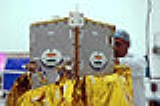
Moon Impact Probe

Encyclopedia
The Moon Impact Probe developed by the Indian Space Research Organisation (ISRO)
, India
's national space agency, was a lunar
probe that was released by ISRO's Chandrayaan-1 lunar remote sensing
orbiter which in turn was launched, on 22 October 2008, aboard a modified version of ISRO's Polar Satellite Launch Vehicle
.
The Moon Impact Probe separated from the moon-orbiting Chandrayaan-1 on 14 November 2008, 20:06 and crashed, as planned, into the lunar south pole after a controlled descent. The MIP struck the Shackleton Crater at 20:31 on 14 November 2008 releasing underground debris that could be analysed by the orbiter for presence of water/ice. With this mission, India became the fifth entity to reach the lunar surface. Other entities to have done so are the former Soviet Union
, the United States
, the European Space Agency
(currently owned by 18 member nations) and Japan
.
Abdul Kalam
's vision who felt that since the Chandrayaan orbiter was already going so near to the moon, the mission would have more scientific relevance if the probe was included. He believed that the moon could not be left to a few codiscussion about India planting its flag. The Times of India also reported a political motive by former president Abdul Kalam as "He believed that if this was done, India could always stake a claim to a portion of the Moon." At the same time, The Indian Express reported Kalam as saying "no nation can claim the moon as its own. The resources of the moon should be a common property and that is one of the aims of the moon mission."
The probe was designed to collide with the lunar surface and eject underground soil which could then be analysed by instruments on the orbiting Chandrayaan for the presence of water ice, and organic and other materials.
The probe's external surface had four oval-shaped anodised aluminium plates measuring 120mm X 180 mm on which the image of the Indian flag was depicted, complete with the Emblem of India
and the words "Satyameva Jayate
". These plates were attached to each one of the four vertical sides of the probe. As per ISRO specifications these plates had to endure a temperature range from -50 degrees celsius
and as high as +150 degrees celsius.
on 22 October 2008 from Satish Dhawan Space Centre
, Sriharikota
, Andhra Pradesh
at 06:22 IST
(00:52 UTC).
The lunar probe separated from Chandrayaaan-1, in a 102 km circular polar orbit around the Moon
, at 20:06 IST
on 14 November 2008. After separation, it first fired its spin up rockets and then its retro rocket to lower itself to an orbit intersecting the lunar surface. While descending, the MIP continuously sent information back to the Chandrayaan-1 orbiter which in turn beamed the information back to earth. After a 25 minute controlled descent, it struck the Moon at 20:31 IST, 14 November 2008 at a speed of 1.69 kilometers per second (approximately 6100 km/h or 3800 miles per hour). The crash destroyed the probe. It crashed into Shackleton Crater, at the lunar south pole, 89°S 30°W, at 20:31 on 14 November 2008 releasing underground material that could be analyzed by the orbiter for the presence of water ice.
magazine by the NASA payload Moon Mineralogy Mapper
carried on board Chandrayaan-1.
It gifted the answer to the millennia-old question whether water is there in Earth’s moon when it led to the discovery of water in its vapour phase by the CHACE (CHandra’s Altitudinal Composition Explorer) payload on board the Moon Impact Probe (MIP) and complementarily in its solid phase by the Moon Mineralogy Mapper (M3) payload on board the main orbiter in the Chandrayaan I mission. This ‘discovery-class-of-finding’ by CHACE was achieved by direct in situ measurement of the lunar atmosphere during the descend journey of the MIP to the Lunar South Pole, while M3 discovered water in ice form by remote sensing techniques. As water cannot retain its liquid phase in the lunar environment because of its own vapour pressure and the ultra-high vacuum prevailing there, it can be found in solid (ice) and gaseous (vapour) phases. While the Moon Mineralogy Mapper (M3), a payload by NASA, on board Chandrayaan I lunar orbiter has detected, by mapping almost 97 % of the lunar surface using remote sensing techniques, the presence of water in ice form in higher latitudes especially in the polar caps, the CHACE payload in the lunar impactor (MIP) has directly detected water in its gaseous form along 14 degree E meridian from 45 degree N to 90 degree S latitude, with a latitudinal resolution of around 0.10 and altitudinal resolution of ~ 250 m from 98 km altitude till impact .
Indian Space Research Organisation
The Indian Space Research Organisation is an independent Indian governmental agency established in 1969 for the research and development of vehicles and activities for the exploration of space within and outside of Earth’s atmosphere. Headquartered in Bangalore...
, India
India
India , officially the Republic of India , is a country in South Asia. It is the seventh-largest country by geographical area, the second-most populous country with over 1.2 billion people, and the most populous democracy in the world...
's national space agency, was a lunar
Moon
The Moon is Earth's only known natural satellite,There are a number of near-Earth asteroids including 3753 Cruithne that are co-orbital with Earth: their orbits bring them close to Earth for periods of time but then alter in the long term . These are quasi-satellites and not true moons. For more...
probe that was released by ISRO's Chandrayaan-1 lunar remote sensing
Exploration of the Moon
The physical exploration of the Moon began when Luna 2, a space probe launched by the Soviet Union, made an impact on the surface of the Moon on September 14, 1959. Prior to that the only available means of exploration had been observation. The invention of the optical telescope brought about the...
orbiter which in turn was launched, on 22 October 2008, aboard a modified version of ISRO's Polar Satellite Launch Vehicle
Polar Satellite Launch Vehicle
The Polar Satellite Launch Vehicle , commonly known by its abbreviation PSLV, is an expendable launch system developed and operated by the Indian Space Research Organisation . It was developed to allow India to launch its Indian Remote Sensing satellites into sun synchronous orbits, a service that...
.
The Moon Impact Probe separated from the moon-orbiting Chandrayaan-1 on 14 November 2008, 20:06 and crashed, as planned, into the lunar south pole after a controlled descent. The MIP struck the Shackleton Crater at 20:31 on 14 November 2008 releasing underground debris that could be analysed by the orbiter for presence of water/ice. With this mission, India became the fifth entity to reach the lunar surface. Other entities to have done so are the former Soviet Union
Soviet Union
The Soviet Union , officially the Union of Soviet Socialist Republics , was a constitutionally socialist state that existed in Eurasia between 1922 and 1991....
, the United States
United States
The United States of America is a federal constitutional republic comprising fifty states and a federal district...
, the European Space Agency
European Space Agency
The European Space Agency , established in 1975, is an intergovernmental organisation dedicated to the exploration of space, currently with 18 member states...
(currently owned by 18 member nations) and Japan
Japan
Japan is an island nation in East Asia. Located in the Pacific Ocean, it lies to the east of the Sea of Japan, China, North Korea, South Korea and Russia, stretching from the Sea of Okhotsk in the north to the East China Sea and Taiwan in the south...
.
Kalam's Vision
The probe was a product of former PresidentPresident of India
The President of India is the head of state and first citizen of India, as well as the Supreme Commander of the Indian Armed Forces. President of India is also the formal head of all the three branches of Indian Democracy - Legislature, Executive and Judiciary...
Abdul Kalam
Abdul Kalam
Avul Pakir Jainulabdeen Abdul Kalam usually referred to as A. P. J. Abdul Kalam, is a renowned aerospace engineer, professor , and first Chancellor of the Indian Institute of Space Science and Technology Thiruvananthapuram , who served as the 11th President of India from 2002 to 2007...
's vision who felt that since the Chandrayaan orbiter was already going so near to the moon, the mission would have more scientific relevance if the probe was included. He believed that the moon could not be left to a few codiscussion about India planting its flag. The Times of India also reported a political motive by former president Abdul Kalam as "He believed that if this was done, India could always stake a claim to a portion of the Moon." At the same time, The Indian Express reported Kalam as saying "no nation can claim the moon as its own. The resources of the moon should be a common property and that is one of the aims of the moon mission."
Mission objectives
The main objectives of the MIP were to demonstrate the technologies for reaching a specified location on the Moon, qualifying technologies required for any future soft landing missions, and scientific exploration of the moon from close range just prior to the impact.The probe was designed to collide with the lunar surface and eject underground soil which could then be analysed by instruments on the orbiting Chandrayaan for the presence of water ice, and organic and other materials.
Payload
The MIP carried three instruments:- Radar AltimeterRadar altimeterA radar altimeter, radio altimeter, low range radio altimeter or simply RA measures altitude above the terrain presently beneath an aircraft or spacecraft...
– which measured the altitude of the probe during descent and provided information on qualifying technologies for future landing missions. The operating frequency band was 4.3 GHzGHZGHZ or GHz may refer to:# Gigahertz .# Greenberger-Horne-Zeilinger state — a quantum entanglement of three particles.# Galactic Habitable Zone — the region of a galaxy that is favorable to the formation of life....
± 100 MHz. - Video Imaging System – acquired close range images of the surface of the Moon during descent and before impact. The video imaging system consisted of an analogAnalog signalAn analog or analogue signal is any continuous signal for which the time varying feature of the signal is a representation of some other time varying quantity, i.e., analogous to another time varying signal. It differs from a digital signal in terms of small fluctuations in the signal which are...
CCD camera. - Mass Spectrometer based payload CHACE – measured trace constituents of the lunar atmosphere during descent. This instrument was a quadrupole mass spectrometerQuadrupole mass analyzerThe quadrupole mass analyzer is one type of mass analyzer used in mass spectrometry. As the name implies, it consists of 4 circular rods, set parallel to each other. In a quadrupole mass spectrometer the quadrupole is the component of the instrument responsible for filtering sample ions, based on...
with a mass resolution of 0.5 amuAtomic mass unitThe unified atomic mass unit or dalton is a unit that is used for indicating mass on an atomic or molecular scale. It is defined as one twelfth of the rest mass of an unbound neutral atom of carbon-12 in its nuclear and electronic ground state, and has a value of...
and sensitivities to partial pressures on the order of 1.3×10⁻¹¹ pascalPascal (unit)The pascal is the SI derived unit of pressure, internal pressure, stress, Young's modulus and tensile strength, named after the French mathematician, physicist, inventor, writer, and philosopher Blaise Pascal. It is a measure of force per unit area, defined as one newton per square metre...
s.
The probe's external surface had four oval-shaped anodised aluminium plates measuring 120mm X 180 mm on which the image of the Indian flag was depicted, complete with the Emblem of India
Emblem of India
The emblem of India is an adaptation of the Sarnath Lion Capital of Ashoka.- History :Emperor Ashoka the Great erected the capital atop an Ashoka Pillar to mark the spot where Gautama Buddha first taught the Dharma and where the Buddhist Sangha was founded...
and the words "Satyameva Jayate
Satyameva Jayate
"Satyameva Jayate" is a Hindu mantra from the ancient scripture Mundaka Upanishad. Upon independence of India, it was adopted as the national motto of India. It is inscribed in Devanagari script at the base of the national emblem. The emblem and words 'Satyameva Jayate' are inscribed on one side...
". These plates were attached to each one of the four vertical sides of the probe. As per ISRO specifications these plates had to endure a temperature range from -50 degrees celsius
Celsius
Celsius is a scale and unit of measurement for temperature. It is named after the Swedish astronomer Anders Celsius , who developed a similar temperature scale two years before his death...
and as high as +150 degrees celsius.
Mission chronology
India launched the Chandrayaan-1 spacecraft using a modified version of the PSLV C11Polar Satellite Launch Vehicle
The Polar Satellite Launch Vehicle , commonly known by its abbreviation PSLV, is an expendable launch system developed and operated by the Indian Space Research Organisation . It was developed to allow India to launch its Indian Remote Sensing satellites into sun synchronous orbits, a service that...
on 22 October 2008 from Satish Dhawan Space Centre
Satish Dhawan Space Centre
The Satish Dhawan Space Centre is the launch centre for the Indian Space Research Organisation . It is located in Sriharikota, Andhra Pradesh, India, north of Chennai in South India. It was originally called Sriharikota High Altitude Range , and was sometime known as Sriharikota Launching Range...
, Sriharikota
Sriharikota
Sriharikota is a barrier island off the coast of the southern state of Andhra Pradesh in India. It houses India's only satellite launch centre in the Satish Dhawan Space Centre and is used by the Indian Space Research Organisation to launch satellites using multi-stage rockets such as the Polar...
, Andhra Pradesh
Andhra Pradesh
Andhra Pradesh , is one of the 28 states of India, situated on the southeastern coast of India. It is India's fourth largest state by area and fifth largest by population. Its capital and largest city by population is Hyderabad.The total GDP of Andhra Pradesh is $100 billion and is ranked third...
at 06:22 IST
Indian Standard Time
Indian Standard Time is the time observed throughout India and Sri Lanka, with a time offset of UTC+05:30. India does not observe daylight saving time or other seasonal adjustments, although DST was used briefly during the Sino–Indian War of 1962 and the Indo–Pakistani Wars of 1965 and 1971...
(00:52 UTC).
The lunar probe separated from Chandrayaaan-1, in a 102 km circular polar orbit around the Moon
Moon
The Moon is Earth's only known natural satellite,There are a number of near-Earth asteroids including 3753 Cruithne that are co-orbital with Earth: their orbits bring them close to Earth for periods of time but then alter in the long term . These are quasi-satellites and not true moons. For more...
, at 20:06 IST
Indian Standard Time
Indian Standard Time is the time observed throughout India and Sri Lanka, with a time offset of UTC+05:30. India does not observe daylight saving time or other seasonal adjustments, although DST was used briefly during the Sino–Indian War of 1962 and the Indo–Pakistani Wars of 1965 and 1971...
on 14 November 2008. After separation, it first fired its spin up rockets and then its retro rocket to lower itself to an orbit intersecting the lunar surface. While descending, the MIP continuously sent information back to the Chandrayaan-1 orbiter which in turn beamed the information back to earth. After a 25 minute controlled descent, it struck the Moon at 20:31 IST, 14 November 2008 at a speed of 1.69 kilometers per second (approximately 6100 km/h or 3800 miles per hour). The crash destroyed the probe. It crashed into Shackleton Crater, at the lunar south pole, 89°S 30°W, at 20:31 on 14 November 2008 releasing underground material that could be analyzed by the orbiter for the presence of water ice.
Discovery of water
On the 25 September 2009, ISRO announced that the MIP had discovered water on the moon just before impact. This announcement was made after the discovery of water was announced on September 24, 2009 by ScienceScience (journal)
Science is the academic journal of the American Association for the Advancement of Science and is one of the world's top scientific journals....
magazine by the NASA payload Moon Mineralogy Mapper
Moon Mineralogy Mapper
The Moon Mineralogy Mapper is one of two instruments that NASA contributed to India's first mission to the Moon, Chandrayaan-1, launched October 22, 2008...
carried on board Chandrayaan-1.
It gifted the answer to the millennia-old question whether water is there in Earth’s moon when it led to the discovery of water in its vapour phase by the CHACE (CHandra’s Altitudinal Composition Explorer) payload on board the Moon Impact Probe (MIP) and complementarily in its solid phase by the Moon Mineralogy Mapper (M3) payload on board the main orbiter in the Chandrayaan I mission. This ‘discovery-class-of-finding’ by CHACE was achieved by direct in situ measurement of the lunar atmosphere during the descend journey of the MIP to the Lunar South Pole, while M3 discovered water in ice form by remote sensing techniques. As water cannot retain its liquid phase in the lunar environment because of its own vapour pressure and the ultra-high vacuum prevailing there, it can be found in solid (ice) and gaseous (vapour) phases. While the Moon Mineralogy Mapper (M3), a payload by NASA, on board Chandrayaan I lunar orbiter has detected, by mapping almost 97 % of the lunar surface using remote sensing techniques, the presence of water in ice form in higher latitudes especially in the polar caps, the CHACE payload in the lunar impactor (MIP) has directly detected water in its gaseous form along 14 degree E meridian from 45 degree N to 90 degree S latitude, with a latitudinal resolution of around 0.10 and altitudinal resolution of ~ 250 m from 98 km altitude till impact .
See also
- Chandrayaan-1
- Exploration of the MoonExploration of the MoonThe physical exploration of the Moon began when Luna 2, a space probe launched by the Soviet Union, made an impact on the surface of the Moon on September 14, 1959. Prior to that the only available means of exploration had been observation. The invention of the optical telescope brought about the...
- LCROSSLCROSSThe Lunar Crater Observation and Sensing Satellite was a robotic spacecraft operated by NASA. The mission was conceived as a low-cost means of determining the nature of hydrogen detected at the polar regions of the moon. The main LCROSS mission objective was to explore the presence of water ice...
- List of current and future lunar missions
- Lunar water
- SELENESELENESELENE , better known in Japan by its nickname after the legendary Japanese moon princess, was the second Japanese lunar orbiter spacecraft. Produced by the Institute of Space and Astronautical Science and the National Space Development Agency , both now part of the Japan Aerospace Exploration...