


Japan Aerospace Exploration Agency

Encyclopedia
The , or JAXA, is Japan
's national aerospace
agency. Through the merger of three previously independent organizations, JAXA was formed on October 1, 2003, as an Independent Administrative Institution
administered by the Ministry of Education, Culture, Sports, Science and Technology (MEXT) and the Ministry of Internal Affairs and Communications
(MIC). JAXA is responsible for research, technology development and the launch of satellite
s into orbit, and is involved in many more advanced missions, such as asteroid
exploration and possible manned exploration of the Moon
. Its motto is One JAXA and its corporate slogan is Reaching for the skies, exploring space.
 On October 1, 2003, three organizations were merged to form the new JAXA: Japan's Institute of Space and Astronautical Science
(or ISAS), the National Aerospace Laboratory of Japan (NAL), and National Space Development Agency of Japan
(NASDA).
Before the merger, ISAS was responsible for space
and planetary research, while NAL was focused on aviation research. NASDA, which was founded on October 1, 1969, had developed rocket
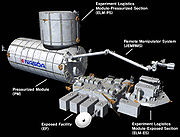
s, satellites, and also built the Japanese Experiment Module
. The old NASDA headquarters were located at the current site of the Tanegashima Space Center
, on Tanegashima Island
, 115 kilometers south of Kyūshū
. NASDA also trained Japanese astronauts, who flew with the US Space Shuttle
s.
(H "two" A) rocket from the former NASDA body to launch engineering test satellites, weather satellites, etc. For science missions like X-ray astronomy
, JAXA has been using the M-V ("Mu-five") solid-fueled rocket from the former ISAS. For experiments in the upper atmosphere JAXA uses the SS-520, S-520, and S-310 sounding rockets.
(VLBI) with the HALCA
mission. Additional success was achieved with solar observation and research of the magnetosphere
, among other areas.
NASDA was mostly active in the field of communication satellite technology. However, since the satellite market of Japan is completely open, the first time a Japanese company won a contract for a civilian communication satellite was in 2005. Another prime focus of the NASDA body is Earth climate
observation.
JAXA was awarded the Space Foundation
's John L. "Jack" Swigert, Jr., Award for Space Exploration in 2008.
, in 1970, using ISAS' L-4S
rocket. Rather than using solid-fuelled rockets, Japan chose a much slower path, with liquid-fuelled rocket technology. In the beginning, NASDA used licensed American models. The first model of rocket developed in Japan was the H-II
, introduced in 1994. However, at the end of the 1990s, with two H-II launch failures, Japanese rocket technology began to face criticism.
, placing a satellite into orbit on February 26, 2005.
and Sakigake
. To prepare for future missions, ISAS tested Earth swing by orbits with the Hiten
mission in 1990. The first Japanese interplanetary mission was the Mars Orbiter Nozomi (Planet-B), which was launched in 1998. It reached its target in 2003, but orbit injection had to be given up.
Currently interplanetary missions remain at the ISAS group under the JAXA umbrella. However for FY 2008 JAXA is planning to set up an independent working group within the organization. New head for this group will be Hayabusa
project manager Kawaguchi. http://ilws.gsfc.nasa.gov/china_jaxa.pdf
Active Mission: Hayabusa, SELENE
, Under Development: Planet-C
, BepiColombo
, Hayabusa 2
?
 On May 9, 2003, Hayabusa
(meaning, Peregrine falcon
), was launched from an M-V rocket. The goal of this mission is to collect samples from a small near-Earth asteroid named 25143 Itokawa
. The craft was scheduled to rendezvous
in November 2005, and return to Earth with samples from the asteroid by July 2007. It was confirmed that the spacecraft successfully landed on the asteroid on November 20, 2005, after some initial confusion regarding the incoming data. On November 26, 2005, Hayabusa succeeded in making a soft contact, but whether it gathered the samples or not is unknown. Hayabusa returned to Earth on June 13, 2010.
thick film.
ISAS tested a solar sail again as a sub payload to the Astro-F (Akari) mission on February 22, 2006. However the solar sail did not deploy fully. ISAS tested a solar sail again as a sub payload of the Solar-B launch at September 23, 2006, but contact with the probe was lost. The IKAROS
solar sail was launched on May 21, 2010. The solar sail deployed successfully. The goal is to have a solar sail mission to Jupiter after 2010.
in 1990, ISAS planned a lunar exploration mission LUNAR-A
but after delays due to technical problems, the project was terminated in January 2007. The seismometer penetrator design for Lunar-A may be reused in future mission.
On September 14, 2007, JAXA succeeded in launching lunar orbit explorer Kaguya
, also known as SELENE (costing 55 billion yen including launch vehicle), the largest such mission since the Apollo program, on an H-2A rocket. Its mission is to gather data on the moon's origin and evolution. It entered into a lunar orbit on October 4, 2007.
Active Mission: Suzaku, Akari, Hinode Under Development: ASTRO-G, ASTRO-H
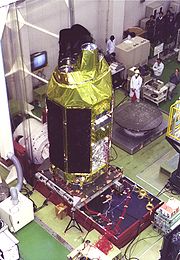 Japan's first infrared astronomy mission was the 15 cm IRTS telescope which was part of the SFU
multipurpose satellite in 1995. IRTS scanned during its one month lifetime around 7% of the sky before SFU got brought back to Earth by the Space Shuttle. During the 1990s JAXA also gave ground support for the ESA Infrared Space Observatory
(ISO) infrared mission.
The next step for JAXA was the AKARI
spacecraft, with the pre-launch designation ASTRO-F
. This satellite was launched on 21 February 2006. Its mission is infrared
astronomy with a 68 cm telescope. This is the first all sky survey since the first infrared mission IRAS
in 1983.
(A 3.6 kg nanosatellite named CUTE-1.7
was also released from the same launch vehicle.) http://nssdc.gsfc.nasa.gov/database/MasterCatalog?sc=2006-005A
JAXA is also doing further R&D for increasing the performance of its mechanical coolers for its future infrared mission SPICA. This would enable a warm launch without liquid helium. SPICA has the same size as the ESA Herschel Space Observatory
mission, but is planned with a temperature of just 4.5 K to be much colder. The launch is planned for the year 2015, however the mission is not yet fully funded. Also ESA and NASA
might contribute an instrument each. http://www.jaxa.jp/article/interview/no19/p4_e.html
(CORSA-B), Japan achieved for nearly 20 years continuous observation with its Hinotori, Tenma
, Ginga and Asuka (ASTRO-A to D) x-ray observation satellites. However in the year 2000 the launch of Japan's fifth x-ray observation satellite ASTRO-E
failed (as it failed at launch it never received a proper name).
Then on July 10, 2005, JAXA was finally able to launch a new X-ray astronomy
mission named Suzaku (ASTRO-E II). This launch was important for JAXA, because in the five years since the launch failure of the original ASTRO-E satellite, Japan was without an x-ray telescope
. Three instruments were included in this satellite: an X-ray spectrometer (XRS), an X-ray imaging spectrometer (XIS), and a hard X-ray detector (HXD). However, the XRS was rendered inoperable due to a malfunction which caused the satellite to lose its supply of liquid helium.
The next planned x-ray mission is the Monitor of All-sky X-ray Image (MAXI)
. It will continuously monitors astronomical X-ray objects over a broad energy band (0.5 to 30 keV). MAXI will be installed on the Japanese external module of the ISS. After this mission JAXA plans to launch ASTRO-H
, also known under the name NeXT, in the summer of 2013.
(SOLAR-B) spacecraft, the follow-on to the Japan/US/UK Yohkoh
(SOLAR-A) spacecraft, was launched on 23 September 2006. http://solar-b.nao.ac.jp/index_e.shtml http://solar-b.msfc.nasa.gov/ A SOLAR-C can be expected sometime after 2010. However no details are worked out yet other than it will not be launched with the former ISASs Mu rockets. Instead H-2A from Tanegashima could launch it. As H-2A is more powerful SOLAR-C could either be heavier or be stationed at (Lagrange point 1).
For details see:
ASTRO-G
HALCA
Testing of communication technologies remains as one of the Jaxas key duties in cooperation with NICT.
Active Mission: ETS-VIII
, WINDS
, Index Under Development: QZSS-1 Retired: OICETS
ETS-VIII was launched on December 18, 2006. The purpose of ETS-VIII
is to test communication equipment with two very large antennas and an atomic clock test. On December 26 both antennas were successfully deployed. This didn't come unexpected, since JAXA tested the deployment mechanism before with the LDREX-2 Mission, which was launched on October 14 with the European Ariane 5. The test was successful. The mission of WINDS
is to create the worlds fastest satellite internet connection. WINDS was launched in February 2008.
and INDEX with the Dnepr rocket. OICETS mission is to test optical links with the European Space Agency
(ESA) satellite ARTEMIS
, which is around 40,000 km away from OICETS. The experiment was successful on December 9, when the link could be established. In March 2006 Jaxa could establish with OICETS the worldwide first optical links between a LEO satellite and a ground station first in Japan and in June 2006 with a mobile station in Germany.
INDEX is a small 70 kg satellite for testing various equipment and for a small aurora
observation mission. The satellite is currently in the extended mission phase.
Active Mission: ALOS, GOSAT Under Development: GCOM-W, GCOM-C, ALOS 2 SAR
(ALOS/Daichi). Communication between ALOS and the ground station in Japan will be done through the Kodama Data Relay Satellite, which was launched during 2002. This project is under intense pressure due to the shorter than expected lifetime of the ADEOS II (Midori) Earth Observation Mission. For the following on mission JAXA plans to split the mission into a radar satellite and an optical satellite. ALOS 2 SAR is currently planned for the winter of FY 2012.
in the atmosphere
. The satellite is being jointly developed by JAXA and Japan's Ministry of the Environment
. JAXA is building the satellite while the Ministry is in charge of the data that will be collected. Since the number of ground-based carbon dioxide observatories cannot monitor enough of the world's atmosphere and are distributed unevenly throughout the globe, the GOSAT may be able to gather more accurate data and fill in the gaps on the globe where there are no observatories on the ground. Sensors for methane
and other greenhouse gas
ses are also being considered for the satellite, although the plans are not yet finalized. The satellite weighs approximately 1650 kg and is expected to have a life span of 5 years.
. To reduce the risk and for a longer observation time the mission will be split into smaller satellites. Altogether GCOM will be a series of six satellites. First launch, GCOM-W
is scheduled for February 2012 with the H-IIA. Second launch GCOM-C is currently planned for February 2014.
On February 18, 2006, JAXA, as head of the H-IIA at this time, successfully launched the MTSAT-2 aboard a H-2A rocket. MTSAT-2 is the backup to the MTSAT-1R. The MTSAT-2 uses the DS-2000 satellite bus developed by Mitsubishi Electric. The DS-2000 is also used for the DRTS Kodama, ETS-VIII and the Superbird 7 communication satellite, making it the first commercial success for Japan.
As a secondary mission both the MTSAT-1R and MTSAT-2 help to direct air traffic.
On going joint missions with NASA are the Tropical Rainfall Measuring Mission
(TRMM), the Aqua
Earth Observation Satellite.
), also called "KIZUNA." WINDS will facilitate experiments with faster internet connections. The launch, using H-IIA
launch vehicle 14, took place from the Tanegashima Space Center
.
On September 10, 2009 the first H-IIB
rocket was successfully launched, delivering the HTV-1
freighter to resupply the International Space Station
.
Another project is the Global Precipitation Measurement
/Dual-frequency Precipitation Radar (GPM/DPR) which is a joint development with NASA. This mission is the successor to the highly successful TRMM mission. JAXA will develop the radar and provide the launch vehicle. Other countries/agencies like China, India, ESA etc. will provide the subsatellites. The aim of this mission is to measure global rainfall. However because of NASA budget limitations this project was pushed back to 2010.
In the year 2009 JAXA plans to launch the first satellite of the Quasi Zenith Satellite System (QZSS), a subsystem of the global positioning system (GPS). Two others are expected to follow later. If successful, one satellite will be in a zenith position over Japan full time. The QZSS mission is the last scheduled major independent mission for JAXA, as no major civilian projects were funded after that for now. The only exception is the IGS programme which will be continued beyond 2008. However it seems Japan is pressing forward now with the GCOM earth observation satellites as successors to the ADEOS missions. First launch is planned for 2010.
In 2009 Japan also plans to launch a new version of the IGS with an improved resolution of 60 cm.
and the HTV is September 1, 2009. After the first flight one HTV launch is planned during each FY until 2015.
(If not mentioned otherwise launch vehicle for the following missions is the H-IIA
.)
. JAXA will provide the Auroral Electron Sensor (AES) for the Taiwanese FORMOSAT-5.http://www.pssc.ncku.edu.tw/FISFES/Presentation/FISFES_2008-11(Hirahara).pdf
. Due to the lag time between these interplanetary events and mission planning time, opportunities to gain new knowledge about the cosmos might be lost. To prevent this, JAXA plans on using smaller, faster missions from 2010 onwards. JAXA is also planning to develop a new solid fueled rocket to replace the twelve year old M-V.
 Japan has ten astronauts but has not yet developed its own manned spacecraft and is not currently developing one officially. Sometime ago an unmanned mainly and manned prospectively space shuttle
-spaceplane
HOPE-X
project launched by conventional space launcher H-II
was developed for several years (including test flights of Hyflex
/OREX
prototypes) but was postponed. Then the simpler manned capsule Fuji
was proposed but not adopted. Projects of single-stage to orbit, reusable launch vehicle horizontal takeoff and landing ASSTS and vertical takeoff and landing
Kankoh-maru
also exist but have not been adopted.
The first Japanese citizen to fly in space was Toyohiro Akiyama
, a journalist sponsored by TBS
, who flew on the Soviet Soyuz TM-11
in December 1990. He spent more than seven days in space on the Mir
space station, in what the Soviets called their first commercial spaceflight which allowed them to earn $14 million.
Japan participates in US and international manned space programs including flights of Japanese astronauts on a board of US Space Shuttle
s, Russian Soyuz spacecraft and ISS
. Besides this paid for seat flights, one Space Shuttle mission (STS-47
, which occurred in September 1992) was partially funded by Japan. On board STS-47 was Japan's first professional astronaut Mamoru Mohri
, as the Payload Specialist for the Spacelab-J, one of the European built Spacelab
modules. This mission was also designated Japan.
Mainly for Japan, another three US Space Shuttles missions (STS-123
, STS-124
, STS-127
) were in 2008-2009 for delivery of parts of Japan built spacelab-module Kibo to ISS.
Under a new plan, Japan and JAXA has set a goal of constructing a manned lunar base. Japanese robots and then astronauts would be sent to the Moon by beyond 2020 which is approximately the same time as Indian Space Research Organisation
(ISRO) manned lunar mission beyond 2020, China National Space Administration
(CNSA) manned lunar mission near 2030. NASA is currently developing the Multi-Purpose Crew Vehicle
(MPCV) which is based on the Orion design for traveling beyond Low Earth Orbit
(LEO). The MPCV is capable of translunar trajectory.
Before this Moon goals JAXA intends to develop the manned capsule spacecraft launched by space launcher H-IIB
. http://www.flightglobal.com/blogs/hyperbola/2009/01/pictures-jaxas-h-iib-launched.html
transport that could become the commercial replacement for the Concorde
. The design goal of the project (working name NEXST) is to develop a jet that can carry 300 passengers at Mach
2. A subscale model of the jet underwent aerodynamic testing in September and October 2005 in Australia
. The economic success of such a project is still unclear, and as a consequence the project has been met with limited interest from Japanese aerospace companies like Mitsubishi Heavy Industries so far.
) conducted research on a reusable launch vehicle under the Reusable Vehicle Testing (RVT)
project.
 JAXA has research centers in many locations in Japan, and some offices overseas. Its headquarters are in Chōfu, Tokyo
. It also has
(USEF), Japan's other space agency.
Archived sites of the JAXA predecessor agencies:
Japan
Japan is an island nation in East Asia. Located in the Pacific Ocean, it lies to the east of the Sea of Japan, China, North Korea, South Korea and Russia, stretching from the Sea of Okhotsk in the north to the East China Sea and Taiwan in the south...
's national aerospace
Aerospace
Aerospace comprises the atmosphere of Earth and surrounding space. Typically the term is used to refer to the industry that researches, designs, manufactures, operates, and maintains vehicles moving through air and space...
agency. Through the merger of three previously independent organizations, JAXA was formed on October 1, 2003, as an Independent Administrative Institution
Independent Administrative Institution
An Incorporated Administrative Agency or in lay terms an Independent Administrative Corporation or Independent Administrative Institution is a newly designed type of legal body for Japanese governmental organizations regulated by the Basic Law on Reforming Government Ministries of 1998...
administered by the Ministry of Education, Culture, Sports, Science and Technology (MEXT) and the Ministry of Internal Affairs and Communications
Ministry of Internal Affairs and Communications
The ' or Ministry of Internal Affairs and Communications is a cabinet-level ministry in the Government of Japan. The English name Ministry of Public Management, Home Affairs, Posts and Telecommunications was used prior to 2004...
(MIC). JAXA is responsible for research, technology development and the launch of satellite
Satellite
In the context of spaceflight, a satellite is an object which has been placed into orbit by human endeavour. Such objects are sometimes called artificial satellites to distinguish them from natural satellites such as the Moon....
s into orbit, and is involved in many more advanced missions, such as asteroid
Asteroid
Asteroids are a class of small Solar System bodies in orbit around the Sun. They have also been called planetoids, especially the larger ones...
exploration and possible manned exploration of the Moon
Moon
The Moon is Earth's only known natural satellite,There are a number of near-Earth asteroids including 3753 Cruithne that are co-orbital with Earth: their orbits bring them close to Earth for periods of time but then alter in the long term . These are quasi-satellites and not true moons. For more...
. Its motto is One JAXA and its corporate slogan is Reaching for the skies, exploring space.
History
Institute of Space and Astronautical Science
is a Japanese national research organization of astrophysics using rockets, astronomical satellites and interplanetary probes. It is a division of Japan Aerospace Exploration Agency .- History :...
(or ISAS), the National Aerospace Laboratory of Japan (NAL), and National Space Development Agency of Japan
National Space Development Agency of Japan
of Japan, or NASDA, was a Japanese national space agency established on October 1, 1969 under the National Space Development Agency Law only for peaceful purposes...
(NASDA).
Before the merger, ISAS was responsible for space
Outer space
Outer space is the void that exists between celestial bodies, including the Earth. It is not completely empty, but consists of a hard vacuum containing a low density of particles: predominantly a plasma of hydrogen and helium, as well as electromagnetic radiation, magnetic fields, and neutrinos....
and planetary research, while NAL was focused on aviation research. NASDA, which was founded on October 1, 1969, had developed rocket
Rocket
A rocket is a missile, spacecraft, aircraft or other vehicle which obtains thrust from a rocket engine. In all rockets, the exhaust is formed entirely from propellants carried within the rocket before use. Rocket engines work by action and reaction...
s, satellites, and also built the Japanese Experiment Module
Japanese Experiment Module
The Japanese Experiment Module , also known with the nickname , is a Japanese science module for the International Space Station developed by JAXA. It is the largest single ISS module. The first two pieces of the module were launched on space shuttle missions STS-123 and STS-124...
. The old NASDA headquarters were located at the current site of the Tanegashima Space Center
Tanegashima Space Center
The is one of Japan's space development facilities. It is located on Tanegashima, an island located 115 km south of Kyūshū. It was established in 1969 when the National Space Development Agency of Japan was formed...
, on Tanegashima Island
Tanegashima
is an island lying to the south of Kyushu, in southern Japan, and is part of Kagoshima Prefecture. The island is the second largest of the Ōsumi Islands....
, 115 kilometers south of Kyūshū
Kyushu
is the third largest island of Japan and most southwesterly of its four main islands. Its alternate ancient names include , , and . The historical regional name is referred to Kyushu and its surrounding islands....
. NASDA also trained Japanese astronauts, who flew with the US Space Shuttle
Space Shuttle
The Space Shuttle was a manned orbital rocket and spacecraft system operated by NASA on 135 missions from 1981 to 2011. The system combined rocket launch, orbital spacecraft, and re-entry spaceplane with modular add-ons...
s.
Rockets
JAXA uses the H-IIAH-IIA
H-IIA is an active expendable launch system operated by Mitsubishi Heavy Industries for the Japan Aerospace Exploration Agency . The liquid-fueled H-IIA rockets have been used to launch satellites into geostationary orbit, to launch a lunar orbiting spacecraft, and to launch an interplanetary...
(H "two" A) rocket from the former NASDA body to launch engineering test satellites, weather satellites, etc. For science missions like X-ray astronomy
X-ray astronomy
X-ray astronomy is an observational branch of astronomy which deals with the study of X-ray observation and detection from astronomical objects. X-radiation is absorbed by the Earth's atmosphere, so instruments to detect X-rays must be taken to high altitude by balloons, sounding rockets, and...
, JAXA has been using the M-V ("Mu-five") solid-fueled rocket from the former ISAS. For experiments in the upper atmosphere JAXA uses the SS-520, S-520, and S-310 sounding rockets.
Successes
Prior to the establishment of JAXA, ISAS had been most successful in its space program in the field of X-ray astronomy during the 1980s and 1990s. Another successful area for Japan has been Very Long Baseline InterferometryVery Long Baseline Interferometry
Very Long Baseline Interferometry is a type of astronomical interferometry used in radio astronomy. It allows observations of an object that are made simultaneously by many telescopes to be combined, emulating a telescope with a size equal to the maximum separation between the telescopes.Data...
(VLBI) with the HALCA
HALCA
The HALCA , also known for its project name VSOP , or the code name MUSES-B for the second of the Mu Space Engineering Spacecraft series, is a Japanese 8 meter diameter radio telescope satellite which was used for Very Long Baseline Interferometry...
mission. Additional success was achieved with solar observation and research of the magnetosphere
Magnetosphere
A magnetosphere is formed when a stream of charged particles, such as the solar wind, interacts with and is deflected by the intrinsic magnetic field of a planet or similar body. Earth is surrounded by a magnetosphere, as are the other planets with intrinsic magnetic fields: Mercury, Jupiter,...
, among other areas.
NASDA was mostly active in the field of communication satellite technology. However, since the satellite market of Japan is completely open, the first time a Japanese company won a contract for a civilian communication satellite was in 2005. Another prime focus of the NASDA body is Earth climate
Climate
Climate encompasses the statistics of temperature, humidity, atmospheric pressure, wind, rainfall, atmospheric particle count and other meteorological elemental measurements in a given region over long periods...
observation.
JAXA was awarded the Space Foundation
Space Foundation
The Space Foundation is a nonprofit organization that supports the global space industry through information and education programs. It is a resource for the entire space community - industry, national security organizations, civil space agencies, private space companies and the military around the...
's John L. "Jack" Swigert, Jr., Award for Space Exploration in 2008.
Rocket history
Japan launched its first satellite, ŌsumiOsumi (satellite)
Ōsumi is the name of the first Japanese artificial satellite put into orbit, named after the Ōsumi Province in the southern islands of Japan. It was launched on February 11, 1970 at 04:25 UTC with a Lambda 4S-5 rocket from Uchinoura Space Center by Institute of Space and Aeronautical Science,...
, in 1970, using ISAS' L-4S
Lambda (rocket)
Lambda is the name of a series of Japanese rockets. It consisted of the types Lambda 2, LS-A, LSC-3, Lambda 3, Lambda 4 and LS-C.On February 11, 1970 the first Japanese satellite Ōsumi was launched using a Lambda 4 rocket....
rocket. Rather than using solid-fuelled rockets, Japan chose a much slower path, with liquid-fuelled rocket technology. In the beginning, NASDA used licensed American models. The first model of rocket developed in Japan was the H-II
H-II
The H-II rocket was a Japanese satellite launch system, which flew seven times between 1994 and 1999, with five successes. It was developed by NASDA in order to give Japan a capability to launch larger satellites in the 1990s. It was the first two-stage liquid-fuelled rocket Japan made using only...
, introduced in 1994. However, at the end of the 1990s, with two H-II launch failures, Japanese rocket technology began to face criticism.
Early H-IIA missions
Japan's first space mission under JAXA, an H-IIA rocket launch on November 29, 2003, ended in failure due to stress problems. After a 15 month hiatus, JAXA performed a successful launch of an H-IIA rocket from Tanegashima Space CenterTanegashima Space Center
The is one of Japan's space development facilities. It is located on Tanegashima, an island located 115 km south of Kyūshū. It was established in 1969 when the National Space Development Agency of Japan was formed...
, placing a satellite into orbit on February 26, 2005.
Lunar and interplanetary missions
Japan's first missions beyond Earth orbit were the 1985 Halley comet observation satellites SuiseiSuisei probe
Suisei , originally known as Planet-A, was an unmanned space probe developed by the Institute of Space and Astronautical Science ....
and Sakigake
Sakigake
Sakigake , pre-launch codename MS-T5, was Japan's first interplanetary spacecraft, and the first deep space probe to be launched by any country other than the USA or the Soviet Union...
. To prepare for future missions, ISAS tested Earth swing by orbits with the Hiten
Hiten
The Hiten Spacecraft , given the English name Celestial Maiden and known before launch as MUSES-A , part of the MUSES Program, was built by the Institute of Space and Astronautical Science of Japan and launched on January 24, 1990...
mission in 1990. The first Japanese interplanetary mission was the Mars Orbiter Nozomi (Planet-B), which was launched in 1998. It reached its target in 2003, but orbit injection had to be given up.
Currently interplanetary missions remain at the ISAS group under the JAXA umbrella. However for FY 2008 JAXA is planning to set up an independent working group within the organization. New head for this group will be Hayabusa
Hayabusa
was an unmanned spacecraft developed by the Japan Aerospace Exploration Agency to return a sample of material from a small near-Earth asteroid named 25143 Itokawa to Earth for further analysis....
project manager Kawaguchi. http://ilws.gsfc.nasa.gov/china_jaxa.pdf
Active Mission: Hayabusa, SELENE
SELENE
SELENE , better known in Japan by its nickname after the legendary Japanese moon princess, was the second Japanese lunar orbiter spacecraft. Produced by the Institute of Space and Astronautical Science and the National Space Development Agency , both now part of the Japan Aerospace Exploration...
, Under Development: Planet-C
PLANET-C
, formerly known as the Venus Climate Orbiter and Planet-C, is a Japanese unmanned spacecraft which was intended to explore Venus. It was launched aboard an H-IIA 202 rocket on 20 May 2010, after being delayed because of weather from its initial 18 May scheduled target...
, BepiColombo
BepiColombo
BepiColombo is a joint mission of the European Space Agency and the Japan Aerospace Exploration Agency to the planet Mercury, due to launch in 2014. The mission is still in the planning stages so changes to the current description are likely over the next few years...
, Hayabusa 2
Hayabusa 2
Hayabusa 2 is the follow-on mission to the Hayabusa mission as proposed by the Japanese space agency, JAXA. The goal for Hayabusa 2 is to build upon the legacy of the original mission, by strengthening the shown weak points...
?
Small body exploration: Hayabusa mission
Hayabusa
was an unmanned spacecraft developed by the Japan Aerospace Exploration Agency to return a sample of material from a small near-Earth asteroid named 25143 Itokawa to Earth for further analysis....
(meaning, Peregrine falcon
Peregrine Falcon
The Peregrine Falcon , also known as the Peregrine, and historically as the Duck Hawk in North America, is a widespread bird of prey in the family Falconidae. A large, crow-sized falcon, it has a blue-gray back, barred white underparts, and a black head and "moustache"...
), was launched from an M-V rocket. The goal of this mission is to collect samples from a small near-Earth asteroid named 25143 Itokawa
25143 Itokawa
25143 Itokawa is an Apollo and Mars-crosser asteroid. It was the first asteroid to be the target of a sample return mission, the Japanese space probe Hayabusa.-Discovery and naming:...
. The craft was scheduled to rendezvous
Space rendezvous
A space rendezvous is an orbital maneuver during which two spacecraft, one of which is often a space station, arrive at the same orbit and approach to a very close distance . Rendezvous requires a precise match of the orbital velocities of the two spacecraft, allowing them to remain at a constant...
in November 2005, and return to Earth with samples from the asteroid by July 2007. It was confirmed that the spacecraft successfully landed on the asteroid on November 20, 2005, after some initial confusion regarding the incoming data. On November 26, 2005, Hayabusa succeeded in making a soft contact, but whether it gathered the samples or not is unknown. Hayabusa returned to Earth on June 13, 2010.
Solar sail research
On August 9, 2004, ISAS successfully deployed two prototype solar sails from a sounding rocket. A clover type sail was deployed at 122 km altitude and a fan type sail was deployed at 169 km altitude. Both sails used 7.5 micrometerMicrometre
A micrometer , is by definition 1×10⁻⁶ of a meter .In plain English, it means one-millionth of a meter . Its unit symbol in the International System of Units is μm...
thick film.
ISAS tested a solar sail again as a sub payload to the Astro-F (Akari) mission on February 22, 2006. However the solar sail did not deploy fully. ISAS tested a solar sail again as a sub payload of the Solar-B launch at September 23, 2006, but contact with the probe was lost. The IKAROS
IKAROS
IKAROS is a Japan Aerospace Exploration Agency experimental spacecraft. The spacecraft was launched on 21 May, 2010, aboard an H-IIA rocket, together with the Akatsuki probe and four other small spacecraft...
solar sail was launched on May 21, 2010. The solar sail deployed successfully. The goal is to have a solar sail mission to Jupiter after 2010.
Lunar explorations
After HitenHiten
The Hiten Spacecraft , given the English name Celestial Maiden and known before launch as MUSES-A , part of the MUSES Program, was built by the Institute of Space and Astronautical Science of Japan and launched on January 24, 1990...
in 1990, ISAS planned a lunar exploration mission LUNAR-A
LUNAR-A
LUNAR-A is a cancelled Japanese spacecraft project that was originally scheduled to be launched in August 2004. After many delays LUNAR-A is a cancelled Japanese spacecraft project that was originally scheduled to be launched in August 2004. After many delays LUNAR-A is a cancelled Japanese...
but after delays due to technical problems, the project was terminated in January 2007. The seismometer penetrator design for Lunar-A may be reused in future mission.
On September 14, 2007, JAXA succeeded in launching lunar orbit explorer Kaguya
SELENE
SELENE , better known in Japan by its nickname after the legendary Japanese moon princess, was the second Japanese lunar orbiter spacecraft. Produced by the Institute of Space and Astronautical Science and the National Space Development Agency , both now part of the Japan Aerospace Exploration...
, also known as SELENE (costing 55 billion yen including launch vehicle), the largest such mission since the Apollo program, on an H-2A rocket. Its mission is to gather data on the moon's origin and evolution. It entered into a lunar orbit on October 4, 2007.
Astronomy program
The first Japanese astronomy mission was x-ray satellite Hakucho (Corsa-B), which was launched in 1979. Later ISAS moved into solar observation, radio astronomy through Space VLBI and infrared astronomy.Active Mission: Suzaku, Akari, Hinode Under Development: ASTRO-G, ASTRO-H
Infrared astronomy
Space Flyer Unit
The was a spacecraft which was launched by Japan on Mar. 18, 1995.- Technical data :The Space Flyer Unit was launched from Tanegashima Space Center from a H-2 vehicle. It was carrying testing materials and research data that held value to NASA. They retrieved the data from the Space Flyer Unit by...
multipurpose satellite in 1995. IRTS scanned during its one month lifetime around 7% of the sky before SFU got brought back to Earth by the Space Shuttle. During the 1990s JAXA also gave ground support for the ESA Infrared Space Observatory
Infrared Space Observatory
The Infrared Space Observatory was a space telescope for infrared light designed and operated by the European Space Agency , in cooperation with ISAS and NASA...
(ISO) infrared mission.
The next step for JAXA was the AKARI
Akari
Akari is a Japanese surname and given name and term meaning "light" or "glimmer". It is also associated with:* AKARI, in astronomy, is an infrared astronomy satellite developed by JAXA, in cooperation with institutes of Europe and Korea...
spacecraft, with the pre-launch designation ASTRO-F
ASTRO-F
Akari is an infrared astronomy satellite developed by Japan Aerospace Exploration Agency, in cooperation with institutes of Europe and Korea. It was launched on 21 February 2006 at 21:28 UTC by M-V rocket into Earth sun-synchronous orbit...
. This satellite was launched on 21 February 2006. Its mission is infrared
Infrared
Infrared light is electromagnetic radiation with a wavelength longer than that of visible light, measured from the nominal edge of visible red light at 0.74 micrometres , and extending conventionally to 300 µm...
astronomy with a 68 cm telescope. This is the first all sky survey since the first infrared mission IRAS
IRAS
The Infrared Astronomical Satellite was the first-ever space-based observatory to perform a survey of the entire sky at infrared wavelengths....
in 1983.
(A 3.6 kg nanosatellite named CUTE-1.7
CUTE-1.7
CUTE-1.7 + APD or CO-56 is an amateur radio nanosatellite in the form of a double CubeSat. The satellite uses commercial off-the-shelf components extensively, in particular, using the Hitachi NPD-20JWL PDA as a control computer, and using a USB hub for sensor communications...
was also released from the same launch vehicle.) http://nssdc.gsfc.nasa.gov/database/MasterCatalog?sc=2006-005A
JAXA is also doing further R&D for increasing the performance of its mechanical coolers for its future infrared mission SPICA. This would enable a warm launch without liquid helium. SPICA has the same size as the ESA Herschel Space Observatory
Herschel Space Observatory
The Herschel Space Observatory is a European Space Agency space observatory sensitive to the far infrared and submillimetre wavebands. It is the largest space telescope ever launched, carrying a single mirror of in diameter....
mission, but is planned with a temperature of just 4.5 K to be much colder. The launch is planned for the year 2015, however the mission is not yet fully funded. Also ESA and NASA
NASA
The National Aeronautics and Space Administration is the agency of the United States government that is responsible for the nation's civilian space program and for aeronautics and aerospace research...
might contribute an instrument each. http://www.jaxa.jp/article/interview/no19/p4_e.html
X-ray astronomy
Starting from 1979 with HakuchoHakucho
Hakucho was Japan's first X-ray astronomy satellite, developed by the Institute of Space and Aeronautical Science...
(CORSA-B), Japan achieved for nearly 20 years continuous observation with its Hinotori, Tenma
Tenma
Tenma, known as Astro-B before launch, was Japan's second X-ray astronomy satellite, developed by the Institute of Space and Astronautical Science. It was launched on February 20, 1983 using a M-3S-3 rocket as the vehicle....
, Ginga and Asuka (ASTRO-A to D) x-ray observation satellites. However in the year 2000 the launch of Japan's fifth x-ray observation satellite ASTRO-E
ASTRO-E
Suzaku is a Japanese X-ray astronomy satellite launched on 10 July 2005 aboard the M-V-6 rocket. The project was renamed Suzaku after its successful launch after the mythical Vermilion bird of the South....
failed (as it failed at launch it never received a proper name).
Then on July 10, 2005, JAXA was finally able to launch a new X-ray astronomy
X-ray astronomy
X-ray astronomy is an observational branch of astronomy which deals with the study of X-ray observation and detection from astronomical objects. X-radiation is absorbed by the Earth's atmosphere, so instruments to detect X-rays must be taken to high altitude by balloons, sounding rockets, and...
mission named Suzaku (ASTRO-E II). This launch was important for JAXA, because in the five years since the launch failure of the original ASTRO-E satellite, Japan was without an x-ray telescope
X-ray telescope
An X-ray telescope is a telescope that is designed to observe remote objects in the X-ray spectrum. In order to get above the Earth's atmosphere, which is opaque to X-rays, X-ray telescopes must be mounted on high altitude rockets or artificial satellites.-Optical design:X-ray telescopes can use...
. Three instruments were included in this satellite: an X-ray spectrometer (XRS), an X-ray imaging spectrometer (XIS), and a hard X-ray detector (HXD). However, the XRS was rendered inoperable due to a malfunction which caused the satellite to lose its supply of liquid helium.
The next planned x-ray mission is the Monitor of All-sky X-ray Image (MAXI)
MAXI (ISS Experiment)
The Monitor of All-sky X-ray Image is an X-ray slit camera aboard the International Space Station. The device is part of the Japanese Experiment Module.MAXI conducts a full sky survey every 96 minutes searching for variations in X-ray sources....
. It will continuously monitors astronomical X-ray objects over a broad energy band (0.5 to 30 keV). MAXI will be installed on the Japanese external module of the ISS. After this mission JAXA plans to launch ASTRO-H
ASTRO-H
Astro-H is a planned X-ray astronomy satellite under development by the Japan Aerospace Exploration Agency . It is expected to be launched in 2014 into the 550 km height orbit around earth. Launch vehicle will be the H-IIA.With a planned weight of 2.4 t, Astro-H will be the heaviest Japanese...
, also known under the name NeXT, in the summer of 2013.
Solar astronomy
Japan's solar astronomy started in the early 80s with the launch of the Hinotori (ASTRO-A) x-ray mission. The HinodeHinode
Hinode , formerly Solar-B, is a Japan Aerospace Exploration Agency Solar mission with United States and United Kingdom collaboration. It is the follow-up to the Yohkoh mission and it was launched on the final flight of the M-V-7 rocket from Uchinoura Space Center, Japan on 22 September 2006 at...
(SOLAR-B) spacecraft, the follow-on to the Japan/US/UK Yohkoh
Yohkoh
Yohkoh , known before launch as Solar-A, was a Solar observatory spacecraft of the Institute of Space and Astronautical Science with United States and United Kingdom collaboration...
(SOLAR-A) spacecraft, was launched on 23 September 2006. http://solar-b.nao.ac.jp/index_e.shtml http://solar-b.msfc.nasa.gov/ A SOLAR-C can be expected sometime after 2010. However no details are worked out yet other than it will not be launched with the former ISASs Mu rockets. Instead H-2A from Tanegashima could launch it. As H-2A is more powerful SOLAR-C could either be heavier or be stationed at (Lagrange point 1).
Radio astronomy
In 1998 Japan launched the HALCA (Muses-B) Mission, the world first spacecraft dedicated to create SPACE VLBI observations of Pulsars among others. To do so, ISAS set up a ground network around the world through international cooperation. The observation part of the mission lasted until 2003 and the satellite was retired at the end of 2005. In FY 2006 Japan funded the ASTRO-G as the succeeding mission. Launch is planned for FY 2012.For details see:
ASTRO-G
ASTRO-G
Astro-G is a planned radio telescope satellite under development by JAXA. It is expected to be launched into elliptic orbit around Earth . Astro-G was selected in February 2006 against the competition of a proposed new X-Ray astronomy mission and a proposed solar sail mission to Jupiter...
HALCA
HALCA
The HALCA , also known for its project name VSOP , or the code name MUSES-B for the second of the Mu Space Engineering Spacecraft series, is a Japanese 8 meter diameter radio telescope satellite which was used for Very Long Baseline Interferometry...
Technology tests
One of the primary duties of the former NASDA body was the testing of new space technologies, mostly in the field of communication. The first test satellite was ETS-I,launched in 1975. However during the 1990s NASDA was hit by bad luck with the problems surrounding the ETS-VI and COMETS missions.Testing of communication technologies remains as one of the Jaxas key duties in cooperation with NICT.
Active Mission: ETS-VIII
ETS-VIII
JAXA Engineering Test Satellite ETS-VIII is the eighth technology test satellite in a series which started with ETS-1 in 1975 by NASDA. It was launched with the H-2A on December 18, 2006....
, WINDS
WINDS
WINDS , is a Japanese communication satellite. Launch was originally scheduled for 2007. The launch date was eventually set for 15 February 2008, however a problem detected in a second stage manoeuvring thruster delayed it to 23 February...
, Index Under Development: QZSS-1 Retired: OICETS
OICETS
OICETS, the Optical Inter-Orbit Communications Engineering Test Satellite is an experimental satellite by the Japan Aerospace Exploration Agency to demonstrate interorbital communication between satellites through optical means. OICETS was originally slated for a launch on the second J-I launcher...
ETS-VIII and WINDS
To upgrade Japan's communication technology the Japanese state launched the i-Space initiative with the ETS-VIII and WINDS missions.http://i-space.jaxa.jp/ispace.htmlETS-VIII was launched on December 18, 2006. The purpose of ETS-VIII
ETS-VIII
JAXA Engineering Test Satellite ETS-VIII is the eighth technology test satellite in a series which started with ETS-1 in 1975 by NASDA. It was launched with the H-2A on December 18, 2006....
is to test communication equipment with two very large antennas and an atomic clock test. On December 26 both antennas were successfully deployed. This didn't come unexpected, since JAXA tested the deployment mechanism before with the LDREX-2 Mission, which was launched on October 14 with the European Ariane 5. The test was successful. The mission of WINDS
WINDS
WINDS , is a Japanese communication satellite. Launch was originally scheduled for 2007. The launch date was eventually set for 15 February 2008, however a problem detected in a second stage manoeuvring thruster delayed it to 23 February...
is to create the worlds fastest satellite internet connection. WINDS was launched in February 2008.
OICETS and INDEX
On August 24, 2005, JAXA launched the experimental satellites OICETSOICETS
OICETS, the Optical Inter-Orbit Communications Engineering Test Satellite is an experimental satellite by the Japan Aerospace Exploration Agency to demonstrate interorbital communication between satellites through optical means. OICETS was originally slated for a launch on the second J-I launcher...
and INDEX with the Dnepr rocket. OICETS mission is to test optical links with the European Space Agency
European Space Agency
The European Space Agency , established in 1975, is an intergovernmental organisation dedicated to the exploration of space, currently with 18 member states...
(ESA) satellite ARTEMIS
Artemis
Artemis was one of the most widely venerated of the Ancient Greek deities. Her Roman equivalent is Diana. Some scholars believe that the name and indeed the goddess herself was originally pre-Greek. Homer refers to her as Artemis Agrotera, Potnia Theron: "Artemis of the wildland, Mistress of Animals"...
, which is around 40,000 km away from OICETS. The experiment was successful on December 9, when the link could be established. In March 2006 Jaxa could establish with OICETS the worldwide first optical links between a LEO satellite and a ground station first in Japan and in June 2006 with a mobile station in Germany.
INDEX is a small 70 kg satellite for testing various equipment and for a small aurora
Aurora (astronomy)
An aurora is a natural light display in the sky particularly in the high latitude regions, caused by the collision of energetic charged particles with atoms in the high altitude atmosphere...
observation mission. The satellite is currently in the extended mission phase.
Earth observation programme
Japan's first Earth observation satellites were MOS-1a and MOS-1b launched in 1987 and 1990. During the 1990s and the new millennium this programme came under heavy fire, because both Adeos (Midori) and Adeos 2 (Midori 2) satellites failed after just 10 months in orbit.Active Mission: ALOS, GOSAT Under Development: GCOM-W, GCOM-C, ALOS 2 SAR
ALOS
In January 2006, JAXA successfully launched the Advanced Land Observation SatelliteAdvanced Land Observation Satellite
Advanced Land Observation Satellite , also called Daichi, is a 4-ton Japanese satellite. It was launched from Tanegashima island, Japan on 24 January 2006 by a H-IIA rocket. The launch had been delayed three times by weather and sensor problems...
(ALOS/Daichi). Communication between ALOS and the ground station in Japan will be done through the Kodama Data Relay Satellite, which was launched during 2002. This project is under intense pressure due to the shorter than expected lifetime of the ADEOS II (Midori) Earth Observation Mission. For the following on mission JAXA plans to split the mission into a radar satellite and an optical satellite. ALOS 2 SAR is currently planned for the winter of FY 2012.
Rainfall observation
Since Japan is an island nation and gets struck by typhoons every year, research about the dynamics of the atmospheric is a very important issue. For this reason Japan launched in 1997 the TRMM mission in cooperation with NASA, to observe the tropical rainfall seasons. JAXA and NASA are planning a successor to the TRMM mission. However because of NASA budget problems the launch date of the GPM project got pushed back to the year 2013. For further research NASDA although launched the ADEOS and ADEOS II missions in 1996 and 2003. However due to various reasons both satellites had a much shorter than expected life term.Monitoring of carbon dioxide
At the end of the 2008 fiscal year, JAXA launched the satellite GOSAT (Greenhouse Gas Observing SATellite) to help scientists determine and monitor the density distribution of carbon dioxideCarbon dioxide
Carbon dioxide is a naturally occurring chemical compound composed of two oxygen atoms covalently bonded to a single carbon atom...
in the atmosphere
Earth's atmosphere
The atmosphere of Earth is a layer of gases surrounding the planet Earth that is retained by Earth's gravity. The atmosphere protects life on Earth by absorbing ultraviolet solar radiation, warming the surface through heat retention , and reducing temperature extremes between day and night...
. The satellite is being jointly developed by JAXA and Japan's Ministry of the Environment
Ministry of the Environment (Japan)
The ' of Japan was formed in 2001 from the sub-cabinet level Environmental Agency established in 1971. The minister is a member of the Cabinet and is chosen by the Prime Minister, usually from the Diet., the current is Goshi Hosono...
. JAXA is building the satellite while the Ministry is in charge of the data that will be collected. Since the number of ground-based carbon dioxide observatories cannot monitor enough of the world's atmosphere and are distributed unevenly throughout the globe, the GOSAT may be able to gather more accurate data and fill in the gaps on the globe where there are no observatories on the ground. Sensors for methane
Methane
Methane is a chemical compound with the chemical formula . It is the simplest alkane, the principal component of natural gas, and probably the most abundant organic compound on earth. The relative abundance of methane makes it an attractive fuel...
and other greenhouse gas
Greenhouse gas
A greenhouse gas is a gas in an atmosphere that absorbs and emits radiation within the thermal infrared range. This process is the fundamental cause of the greenhouse effect. The primary greenhouse gases in the Earth's atmosphere are water vapor, carbon dioxide, methane, nitrous oxide, and ozone...
ses are also being considered for the satellite, although the plans are not yet finalized. The satellite weighs approximately 1650 kg and is expected to have a life span of 5 years.
GCOM series
Next funded earth observation mission after GOSAT is the GCOM earth observation programme as a successor to ADEOS II (Midori) and the Aqua missionAqua (satellite)
Aqua is a multi-national NASA scientific research satellite in orbit around the Earth, studying the precipitation, evaporation, and cycling of water. It is the second major component of the Earth Observing System preceded by Terra and followed by Aura .The name "Aqua" comes from the Latin word...
. To reduce the risk and for a longer observation time the mission will be split into smaller satellites. Altogether GCOM will be a series of six satellites. First launch, GCOM-W
GCOM-W
GCOM is a series of JAXA Earth Observation Missions as a successor to the ill-fated ADEOS 2 satellite and to the Aqua Mission. GCOM is, together with the GPM Mission, Japan's contribution to the GEOSS ....
is scheduled for February 2012 with the H-IIA. Second launch GCOM-C is currently planned for February 2014.
Satellites for other agencies
For weather observation Japan launched on February 2005 the Multi-Functional Transport Satellite 1R (MTSAT-1R). The success of this launch was critical for Japan, since the original MTSAT-1 couldn't be put into orbit because of a launch failure with the H-2 rocket in 1999. Since then Japan relied for weather forecasting on an old satellite which was already beyond its useful life term and on American systems.On February 18, 2006, JAXA, as head of the H-IIA at this time, successfully launched the MTSAT-2 aboard a H-2A rocket. MTSAT-2 is the backup to the MTSAT-1R. The MTSAT-2 uses the DS-2000 satellite bus developed by Mitsubishi Electric. The DS-2000 is also used for the DRTS Kodama, ETS-VIII and the Superbird 7 communication satellite, making it the first commercial success for Japan.
As a secondary mission both the MTSAT-1R and MTSAT-2 help to direct air traffic.
Other JAXA satellites currently in use
- Exos-D (AkebonoAkebono (satellite)Akebono is a satellite to study aurora and Earth's magnetosphere environment.It was developed by Institute of Space and Astronautical Science and launched by M-3SII rocket on February 22, 1989....
) Aurora Observation, since 1989. - GEOTAILGEOTAILGEOTAIL is a satellite observing the Earth's magnetosphere. It was developed by ISAS in association with NASA, and launched by a Delta II rocket on July 24, 1992....
magnetosphere observation satellite (since 1992) - DRTS (Kodama) Data Relay Satellite, since 2002. (Projected Life Span is 7 years)
On going joint missions with NASA are the Tropical Rainfall Measuring Mission
Tropical Rainfall Measuring Mission
The Tropical Rainfall Measuring Mission is a joint space mission between NASA and the Japan Aerospace Exploration Agency designed to monitor and study tropical rainfall. The term refers to both the mission itself and the satellite that the mission uses to collect data...
(TRMM), the Aqua
Aqua (satellite)
Aqua is a multi-national NASA scientific research satellite in orbit around the Earth, studying the precipitation, evaporation, and cycling of water. It is the second major component of the Earth Observing System preceded by Terra and followed by Aura .The name "Aqua" comes from the Latin word...
Earth Observation Satellite.
Finished missions
- OICETSOICETSOICETS, the Optical Inter-Orbit Communications Engineering Test Satellite is an experimental satellite by the Japan Aerospace Exploration Agency to demonstrate interorbital communication between satellites through optical means. OICETS was originally slated for a launch on the second J-I launcher...
, Technology Demonstration 2005-2009 (retired) - SELENESELENESELENE , better known in Japan by its nickname after the legendary Japanese moon princess, was the second Japanese lunar orbiter spacecraft. Produced by the Institute of Space and Astronautical Science and the National Space Development Agency , both now part of the Japan Aerospace Exploration...
, Moon probe 2007-2009 (retired) - Micro Lab Sat 1, Small engineering mission, launch 2002. (retired 27 September 2006)
- HALCAHALCAThe HALCA , also known for its project name VSOP , or the code name MUSES-B for the second of the Mu Space Engineering Spacecraft series, is a Japanese 8 meter diameter radio telescope satellite which was used for Very Long Baseline Interferometry...
, Space VLBI 1997-2005 (retired) - Nozomi, MarsMarsMars is the fourth planet from the Sun in the Solar System. The planet is named after the Roman god of war, Mars. It is often described as the "Red Planet", as the iron oxide prevalent on its surface gives it a reddish appearance...
Mission 1998-2003 (failed) - MDS-1MDS-1Mission Demonstration Satellite 1 "Tsubasa" was a Japanese technology test mission. Its aim was to test commercial off the shelf components in space, especially in the radiation belt. The whole weight of the satellite was 475 kg....
, Technology Demonstration 2002-2003 (retired) - ADEOS 2, (Midori 2) Earth Observation 2002-2003 (lost)
Future missions
As JAXA shifted away from international efforts beginning in 2005, plans are developing for independent space missions, such as a proposed manned mission to the moon.2009 and beyond
On February 23, 2008 JAXA launched the Wideband InterNetworking engineering test and Demonstration Satellite (WINDSWINDS
WINDS , is a Japanese communication satellite. Launch was originally scheduled for 2007. The launch date was eventually set for 15 February 2008, however a problem detected in a second stage manoeuvring thruster delayed it to 23 February...
), also called "KIZUNA." WINDS will facilitate experiments with faster internet connections. The launch, using H-IIA
H-IIA
H-IIA is an active expendable launch system operated by Mitsubishi Heavy Industries for the Japan Aerospace Exploration Agency . The liquid-fueled H-IIA rockets have been used to launch satellites into geostationary orbit, to launch a lunar orbiting spacecraft, and to launch an interplanetary...
launch vehicle 14, took place from the Tanegashima Space Center
Tanegashima Space Center
The is one of Japan's space development facilities. It is located on Tanegashima, an island located 115 km south of Kyūshū. It was established in 1969 when the National Space Development Agency of Japan was formed...
.
On September 10, 2009 the first H-IIB
H-IIB
H-IIB is an expendable launch system used to launch H-II Transfer Vehicles towards the International Space Station. H-IIB rockets are liquid-fuelled with solid-fuel strap-on boosters and are launched from the Tanegashima Space Center in Japan...
rocket was successfully launched, delivering the HTV-1
HTV-1
HTV-1, also known as the HTV Demonstration Flight or HTV Technical Demonstration Vehicle, was the first Japanese Space Agency H-II Transfer Vehicle, launched in September 2009 to resupply the International Space Station and support the JAXA Kibo laboratory or JEM...
freighter to resupply the International Space Station
International Space Station
The International Space Station is a habitable, artificial satellite in low Earth orbit. The ISS follows the Salyut, Almaz, Cosmos, Skylab, and Mir space stations, as the 11th space station launched, not including the Genesis I and II prototypes...
.
Another project is the Global Precipitation Measurement
Global Precipitation Measurement
Global Precipitation Measurement is a joint mission between JAXA and NASA as well as other international agencies to for frequently measuring Earth's atmospheric moisture. It is part of NASA's Earth Systematic Missions program and is planned to cover nearly the complete Earth...
/Dual-frequency Precipitation Radar (GPM/DPR) which is a joint development with NASA. This mission is the successor to the highly successful TRMM mission. JAXA will develop the radar and provide the launch vehicle. Other countries/agencies like China, India, ESA etc. will provide the subsatellites. The aim of this mission is to measure global rainfall. However because of NASA budget limitations this project was pushed back to 2010.
In the year 2009 JAXA plans to launch the first satellite of the Quasi Zenith Satellite System (QZSS), a subsystem of the global positioning system (GPS). Two others are expected to follow later. If successful, one satellite will be in a zenith position over Japan full time. The QZSS mission is the last scheduled major independent mission for JAXA, as no major civilian projects were funded after that for now. The only exception is the IGS programme which will be continued beyond 2008. However it seems Japan is pressing forward now with the GCOM earth observation satellites as successors to the ADEOS missions. First launch is planned for 2010.
In 2009 Japan also plans to launch a new version of the IGS with an improved resolution of 60 cm.
Launch schedule
First launch of the H-IIBH-IIB
H-IIB is an expendable launch system used to launch H-II Transfer Vehicles towards the International Space Station. H-IIB rockets are liquid-fuelled with solid-fuel strap-on boosters and are launched from the Tanegashima Space Center in Japan...
and the HTV is September 1, 2009. After the first flight one HTV launch is planned during each FY until 2015.
(If not mentioned otherwise launch vehicle for the following missions is the H-IIA
H-IIA
H-IIA is an active expendable launch system operated by Mitsubishi Heavy Industries for the Japan Aerospace Exploration Agency . The liquid-fueled H-IIA rockets have been used to launch satellites into geostationary orbit, to launch a lunar orbiting spacecraft, and to launch an interplanetary...
.)
FY 2010
- H-II Transfer VehicleH-II Transfer VehicleThe H-II Transfer Vehicle , called , is an unmanned resupply spacecraft used to resupply the Kibō Japanese Experiment Module and the International Space Station . The Japan Aerospace Exploration Agency has been working on the design since the early 1990s. The first mission, HTV-1, was originally...
, Unmanned resupply spacecraft, launch: Winter, 2010 - Quasi Zenith Satellite System, launch: Aug, 2010
- Akatsuki, probe to VenusVenusVenus is the second planet from the Sun, orbiting it every 224.7 Earth days. The planet is named after Venus, the Roman goddess of love and beauty. After the Moon, it is the brightest natural object in the night sky, reaching an apparent magnitude of −4.6, bright enough to cast shadows...
, launch: May, 2010 - IKAROSIKAROSIKAROS is a Japan Aerospace Exploration Agency experimental spacecraft. The spacecraft was launched on 21 May, 2010, aboard an H-IIA rocket, together with the Akatsuki probe and four other small spacecraft...
, Solar-sail Technology Demonstration satellite, launch: May, 2010
FY 2012
- ALOS 2 SAR, Earth Observation satellite, launch: Winter 2012
- ASTRO-GASTRO-GAstro-G is a planned radio telescope satellite under development by JAXA. It is expected to be launched into elliptic orbit around Earth . Astro-G was selected in February 2006 against the competition of a proposed new X-Ray astronomy mission and a proposed solar sail mission to Jupiter...
(VSOP-2) successor to the Halca mission, launch: Summer 2012 - TOPS Telescope Observatory for Planets on Small-satellite launch Feb, 2012 (First launch of the new Advanced Solid Rocket, the successor to the M-V.
FY 2013
- GPMGlobal Precipitation MeasurementGlobal Precipitation Measurement is a joint mission between JAXA and NASA as well as other international agencies to for frequently measuring Earth's atmospheric moisture. It is part of NASA's Earth Systematic Missions program and is planned to cover nearly the complete Earth...
, successor to the TRMM joint NASA mission - BepiColomboBepiColomboBepiColombo is a joint mission of the European Space Agency and the Japan Aerospace Exploration Agency to the planet Mercury, due to launch in 2014. The mission is still in the planning stages so changes to the current description are likely over the next few years...
, joint ESA mission to MercuryMercury (planet)Mercury is the innermost and smallest planet in the Solar System, orbiting the Sun once every 87.969 Earth days. The orbit of Mercury has the highest eccentricity of all the Solar System planets, and it has the smallest axial tilt. It completes three rotations about its axis for every two orbits...
, launch: 2013 (LV: Ariane 5) - ASTRO-HASTRO-HAstro-H is a planned X-ray astronomy satellite under development by the Japan Aerospace Exploration Agency . It is expected to be launched in 2014 into the 550 km height orbit around earth. Launch vehicle will be the H-IIA.With a planned weight of 2.4 t, Astro-H will be the heaviest Japanese...
x-ray observatory, launch: summer 2013. - GCOM-C, Climate Observation satellite, launch: Feb, 2014
Other missions
For the 2012 ESA EarthCare mission, JAXA will provide the radar system on the satellite. JAXA is also providing the Light Particle Telescope(LPT) for the 2008 Jason 2 satellite by the French CNESCNES
The is the French government space agency . Established under President Charles de Gaulle in 1961, its headquarters are located in central Paris and it is under the supervision of the French Ministries of Defence and Research...
. JAXA will provide the Auroral Electron Sensor (AES) for the Taiwanese FORMOSAT-5.http://www.pssc.ncku.edu.tw/FISFES/Presentation/FISFES_2008-11(Hirahara).pdf
- SmartSat-1, small communication test and sun corona observation, Mission status unclear
- XEUSXEUSXEUS, X-ray Evolving Universe Spectroscopy, was space observatory plan developed by the European Space Agency as a successor to the successful XMM-Newton X-ray satellite telescope...
joint X-Ray telescope with ESA, launch after 2015. - Sohla-2 Small PETSAT Demonstration Satellite
New orientation of JAXA
Planning interplanetary research missions can take up to seven years, such as the ASTRO-EASTRO-E
Suzaku is a Japanese X-ray astronomy satellite launched on 10 July 2005 aboard the M-V-6 rocket. The project was renamed Suzaku after its successful launch after the mythical Vermilion bird of the South....
. Due to the lag time between these interplanetary events and mission planning time, opportunities to gain new knowledge about the cosmos might be lost. To prevent this, JAXA plans on using smaller, faster missions from 2010 onwards. JAXA is also planning to develop a new solid fueled rocket to replace the twelve year old M-V.
Developing projects
- IKAROSIKAROSIKAROS is a Japan Aerospace Exploration Agency experimental spacecraft. The spacecraft was launched on 21 May, 2010, aboard an H-IIA rocket, together with the Akatsuki probe and four other small spacecraft...
(Interplanetary Kite-craft Accelerated by Radiation Of the Sun), a small size powered-solar sailSolar sailSolar sails are a form of spacecraft propulsion using the radiation pressure of light from a star or laser to push enormous ultra-thin mirrors to high speeds....
experimental spacecraft. Future mission will use solar sail for JupiterJupiterJupiter is the fifth planet from the Sun and the largest planet within the Solar System. It is a gas giant with mass one-thousandth that of the Sun but is two and a half times the mass of all the other planets in our Solar System combined. Jupiter is classified as a gas giant along with Saturn,...
and Trojan asteroidTrojan asteroidThe Jupiter Trojans, commonly called Trojans or Trojan asteroids, are a large group of objects that share the orbit of the planet Jupiter around the Sun. Relative to Jupiter, each Trojan librates around one of the planet's two Lagrangian points of stability, and , that respectively lie 60° ahead...
s exploration.
Plans
- Selene-2Selene-2SELENE-2 , or the Selenological and Engineering Explorer 2, is a proposed Japanese moon lander to be launched sometime before the middle of the decade as a successor to the 2007 Kaguya moon orbiter.- Penetrators :...
, a moon landing mission - Hayabusa 2Hayabusa 2Hayabusa 2 is the follow-on mission to the Hayabusa mission as proposed by the Japanese space agency, JAXA. The goal for Hayabusa 2 is to build upon the legacy of the original mission, by strengthening the shown weak points...
, for launch in 2014-2015 for target 1999JU3 - Hayabusa Mk2/Marco Polo
- Human Lunar Systems, conceptual system study on the future human lunar outpost
- ALOS 2, earth observation
- SPICASPICA telescopeThe Space Infra-Red Telescope for Cosmology and Astrophysics telescope , initially called HII/L2 after the launch vehicle and orbit, is a proposed infrared space telescope, successor of the successful AKARI spacecraft.- Background :...
, a 3,5 meter infrared telescope to be placed at L2Lagrangian pointThe Lagrangian points are the five positions in an orbital configuration where a small object affected only by gravity can theoretically be stationary relative to two larger objects... - JASMINEJasmineJasminum , commonly known as jasmines, is a genus of shrubs and vines in the olive family . It contains around 200 species native to tropical and warm temperate regions of the Old World...
, infrared telescope for measuring the universe - DIOS, small scale x-ray observation
- Space Solar Power System (SSPS), space-based solar power prototype launch in 2020, aiming for a full power system in 2030
Human space program
Space Shuttle
The Space Shuttle was a manned orbital rocket and spacecraft system operated by NASA on 135 missions from 1981 to 2011. The system combined rocket launch, orbital spacecraft, and re-entry spaceplane with modular add-ons...
-spaceplane
Spaceplane
A spaceplane is a vehicle that operates as an aircraft in Earth's atmosphere, as well as a spacecraft when it is in space. It combines features of an aircraft and a spacecraft, which can be thought of as an aircraft that can endure and maneuver in the vacuum of space or likewise a spacecraft that...
HOPE-X
HOPE-X
HOPE was a Japanese experimental spaceplane project designed by a partnership between NASDA and NAL , started in the 1980s. It was positioned for most of its lifetime as one of the main Japanese contributions to the International Space Station, the other being the Japanese Experiment Module...
project launched by conventional space launcher H-II
H-II
The H-II rocket was a Japanese satellite launch system, which flew seven times between 1994 and 1999, with five successes. It was developed by NASDA in order to give Japan a capability to launch larger satellites in the 1990s. It was the first two-stage liquid-fuelled rocket Japan made using only...
was developed for several years (including test flights of Hyflex
Hyflex
Hyflex was a NASDA reentry demonstrator prototype which was launched in 1996 on the only flight of the J-I launcher...
/OREX
OREX
OREX was a NASDA reentry demonstrator prototype which was launched in 1994 on the H-II launcher. It was a precursor for the Japanese space Shuttle Hope....
prototypes) but was postponed. Then the simpler manned capsule Fuji
Fuji (Spacecraft)
Fuji was a manned spacecraft of the space capsule kind, proposed by Japan's National Space Development Agency Advanced mission Research center in December 2001...
was proposed but not adopted. Projects of single-stage to orbit, reusable launch vehicle horizontal takeoff and landing ASSTS and vertical takeoff and landing
VTOL
A vertical take-off and landing aircraft is one that can hover, take off and land vertically. This classification includes fixed-wing aircraft as well as helicopters and other aircraft with powered rotors, such as cyclogyros/cyclocopters and tiltrotors...
Kankoh-maru
Kankoh-maru
The is the name of a proposed vertical takeoff and landing, single-stage to orbit, reusable launch vehicle family of rockets, and the spacecraft tour vehicle designed to be boosted by said rocket.-Details:...
also exist but have not been adopted.
The first Japanese citizen to fly in space was Toyohiro Akiyama
Toyohiro Akiyama
is a Japanese TV journalist best known for his flight to the Mir space station aboard a Russian Soyuz spacecraft in 1990. Akiyama is the first person of Japanese descent to have flown in space. He was known as the "Space Journalist" in Japan....
, a journalist sponsored by TBS
Tokyo Broadcasting System
, TBS Holdings, Inc. or TBSHD, is a stockholding company in Tokyo, Japan. It is a parent company of a television network named and radio network named ....
, who flew on the Soviet Soyuz TM-11
Soyuz TM-11
-Mission highlights:Soyuz TM-11 was launched the same day as STS-35.11th expedition to Mir. Toyohiro Akiyama was a reporter/space tourist for a Japanese television network....
in December 1990. He spent more than seven days in space on the Mir
Mir
Mir was a space station operated in low Earth orbit from 1986 to 2001, at first by the Soviet Union and then by Russia. Assembled in orbit from 1986 to 1996, Mir was the first modular space station and had a greater mass than that of any previous spacecraft, holding the record for the...
space station, in what the Soviets called their first commercial spaceflight which allowed them to earn $14 million.
Japan participates in US and international manned space programs including flights of Japanese astronauts on a board of US Space Shuttle
Space Shuttle
The Space Shuttle was a manned orbital rocket and spacecraft system operated by NASA on 135 missions from 1981 to 2011. The system combined rocket launch, orbital spacecraft, and re-entry spaceplane with modular add-ons...
s, Russian Soyuz spacecraft and ISS
International Space Station
The International Space Station is a habitable, artificial satellite in low Earth orbit. The ISS follows the Salyut, Almaz, Cosmos, Skylab, and Mir space stations, as the 11th space station launched, not including the Genesis I and II prototypes...
. Besides this paid for seat flights, one Space Shuttle mission (STS-47
STS-47
STS-47 was the 50th Space Shuttle mission of the program, as well as the second mission of Space Shuttle Endeavour. The mission mainly involved conducting experiments in life and material sciences.-Crew:-Backup crew:-Mission parameters:* Mass:...
, which occurred in September 1992) was partially funded by Japan. On board STS-47 was Japan's first professional astronaut Mamoru Mohri
Mamoru Mohri
is a Japanese scientist, a former NASDA astronaut, and a veteran of two NASA space shuttle missions.-Biography:Born in Yoichi, Hokkaidō, Japan, Mohri earned degrees in chemistry from Hokkaido University and a Doctorate from Flinders University in Adelaide, South Australia, in 1976.Most of Mohri's...
, as the Payload Specialist for the Spacelab-J, one of the European built Spacelab
Spacelab
Spacelab was a reusable laboratory used on certain spaceflights flown by the Space Shuttle. The laboratory consisted of multiple components, including a pressurized module, an unpressurized carrier and other related hardware housed in the Shuttle's cargo bay...
modules. This mission was also designated Japan.
Mainly for Japan, another three US Space Shuttles missions (STS-123
STS-123
-Mission parameters:* Mass:* Orbiter liftoff: * Orbiter landing: * Perigee: 336 kilometers * Apogee: 346 kilometers * Inclination: 51.6 degrees* Period: 91.6min-Mission payloads:...
, STS-124
STS-124
STS-124 was a Space Shuttle mission, flown by Space Shuttle Discovery to the International Space Station. Discovery launched on 31 May 2008 at 17:02 EDT, moved from an earlier scheduled launch date of 25 May 2008, and landed safely at the Kennedy Space Center's Shuttle Landing Facility, at 11:15...
, STS-127
STS-127
STS-127 was a NASA Space Shuttle mission to the International Space Station . It was the twenty-third flight of . The primary purpose of the STS-127 mission was to deliver and install the final two components of the Japanese Experiment Module: the Exposed Facility , and the Exposed Section of the...
) were in 2008-2009 for delivery of parts of Japan built spacelab-module Kibo to ISS.
Under a new plan, Japan and JAXA has set a goal of constructing a manned lunar base. Japanese robots and then astronauts would be sent to the Moon by beyond 2020 which is approximately the same time as Indian Space Research Organisation
Indian Space Research Organisation
The Indian Space Research Organisation is an independent Indian governmental agency established in 1969 for the research and development of vehicles and activities for the exploration of space within and outside of Earth’s atmosphere. Headquartered in Bangalore...
(ISRO) manned lunar mission beyond 2020, China National Space Administration
China National Space Administration
The China National Space Administration is the national space agency of the People's Republic of China responsible for the national space program. It is responsible for planning and development of space activities...
(CNSA) manned lunar mission near 2030. NASA is currently developing the Multi-Purpose Crew Vehicle
Multi-Purpose Crew Vehicle
The Orion Multi-Purpose Crew Vehicle is a planned spacecraft that is being built by Lockheed Martin for NASA, the space agency of the United States, based on designs and tests already completed for the Orion spacecraft. The MPCV was announced by NASA on May 24, 2011...
(MPCV) which is based on the Orion design for traveling beyond Low Earth Orbit
Low Earth orbit
A low Earth orbit is generally defined as an orbit within the locus extending from the Earth’s surface up to an altitude of 2,000 km...
(LEO). The MPCV is capable of translunar trajectory.
Before this Moon goals JAXA intends to develop the manned capsule spacecraft launched by space launcher H-IIB
H-IIB
H-IIB is an expendable launch system used to launch H-II Transfer Vehicles towards the International Space Station. H-IIB rockets are liquid-fuelled with solid-fuel strap-on boosters and are launched from the Tanegashima Space Center in Japan...
. http://www.flightglobal.com/blogs/hyperbola/2009/01/pictures-jaxas-h-iib-launched.html
Supersonic aircraft development
Besides the H-IIA and M-5 rockets, JAXA is also developing technology for a next-generation supersonicSupersonic
Supersonic speed is a rate of travel of an object that exceeds the speed of sound . For objects traveling in dry air of a temperature of 20 °C this speed is approximately 343 m/s, 1,125 ft/s, 768 mph or 1,235 km/h. Speeds greater than five times the speed of sound are often...
transport that could become the commercial replacement for the Concorde
Concorde
Aérospatiale-BAC Concorde was a turbojet-powered supersonic passenger airliner, a supersonic transport . It was a product of an Anglo-French government treaty, combining the manufacturing efforts of Aérospatiale and the British Aircraft Corporation...
. The design goal of the project (working name NEXST) is to develop a jet that can carry 300 passengers at Mach
Mach number
Mach number is the speed of an object moving through air, or any other fluid substance, divided by the speed of sound as it is in that substance for its particular physical conditions, including those of temperature and pressure...
2. A subscale model of the jet underwent aerodynamic testing in September and October 2005 in Australia
Australia
Australia , officially the Commonwealth of Australia, is a country in the Southern Hemisphere comprising the mainland of the Australian continent, the island of Tasmania, and numerous smaller islands in the Indian and Pacific Oceans. It is the world's sixth-largest country by total area...
. The economic success of such a project is still unclear, and as a consequence the project has been met with limited interest from Japanese aerospace companies like Mitsubishi Heavy Industries so far.
Reusable launch vehicles
Until 2003 JAXA (ISASInstitute of Space and Astronautical Science
is a Japanese national research organization of astrophysics using rockets, astronomical satellites and interplanetary probes. It is a division of Japan Aerospace Exploration Agency .- History :...
) conducted research on a reusable launch vehicle under the Reusable Vehicle Testing (RVT)
Reusable Vehicle Testing
The Reusable Vehicle Testing project was conducted by the Japanese Space Agency from 1998 until 2003. The project involved a series of experimental vehicles to test repeated flights of a reusable rocket. Four complete vehicles were developed during the project...
project.
Research centers and offices
Chofu, Tokyo
is a city located in the western end of Tokyo Metropolis, Japan. As of 2010, the city has an estimated population of 224,878 and a population density of 10,440 persons per km². The total area was 21.53 km². Tokyo Stadium in Chōfu hosts soccer games for two J. League teams: F.C...
. It also has
- Earth Observation Research Center (EORC), TokyoTokyo, ; officially , is one of the 47 prefectures of Japan. Tokyo is the capital of Japan, the center of the Greater Tokyo Area, and the largest metropolitan area of Japan. It is the seat of the Japanese government and the Imperial Palace, and the home of the Japanese Imperial Family...
- Earth Observation Center (EOC) in Hatayama
- Noshiro Testing Center (NTC) - Established in 1962. It carries out development and testing of rocket engines.
- Sanriku Balloon Center (SBC) - Balloons have been launched from this site since 1971.
- Kakuda Space Propulsion Center (KSPC) - Leads the development of rocket engines. Works mainly with development of liquid fuel engines.
- Sagamihara Campus (ISAS) - Development of experimental equipment for rockets and satellites. Also administrative buildings.
- Tanegashima Space CenterTanegashima Space CenterThe is one of Japan's space development facilities. It is located on Tanegashima, an island located 115 km south of Kyūshū. It was established in 1969 when the National Space Development Agency of Japan was formed...
- Tsukuba Space CenterTsukuba Space CenterTsukuba Space Center is the operations facility for the Japanese Space Agency located in Tsukuba Science City in Ibaraki Prefecture. The facility opened in 1972 and serves as the primary location for Japan's space operations and research programs...
(TKSC) in Tsukuba. This is the center of Japan's space network. It is involved in research and development of satellites and rockets, and tracking and controlling of satellites. It develops experimental equipment for the Japanese Experiment Module ("Kibo"). Training of astronauts also takes place here. For International Space StationInternational Space StationThe International Space Station is a habitable, artificial satellite in low Earth orbit. The ISS follows the Salyut, Almaz, Cosmos, Skylab, and Mir space stations, as the 11th space station launched, not including the Genesis I and II prototypes...
operations, the Japanese Flight Control Team is located at the Space Station Integration & Promotion Center (SSIPC) in Tsukuba. SSIPC communicates regularly with ISS crewmembers via S-band audio. - Uchinoura Space CenterUchinoura Space CenterThe is a space launch facility close to the Japanese town of Kimotsuki, in Kagoshima Prefecture. Before the establishment of the JAXA space agency in 2003, it was simply called the . All Japan's scientific satellites were launched from Uchinoura prior to the M-V launch vehicles being decommissioned...
Other space agencies in Japan
Not included into the JAXA organization is the Institute for unmanned space experiment free flyerInstitute for Unmanned Space Experiment Free Flyer
The is a Japanese space agency, which was founded by the Ministry of International Trade and Industry in 1986. Unlike NASDA, ISAS, and NAL, it was not included in the 2003 founded JAXA organization. USEF is run as a Non Profit Organization...
(USEF), Japan's other space agency.
See also
- Independent Administrative InstitutionIndependent Administrative InstitutionAn Incorporated Administrative Agency or in lay terms an Independent Administrative Corporation or Independent Administrative Institution is a newly designed type of legal body for Japanese governmental organizations regulated by the Basic Law on Reforming Government Ministries of 1998...
(IAIIndependent Administrative InstitutionAn Incorporated Administrative Agency or in lay terms an Independent Administrative Corporation or Independent Administrative Institution is a newly designed type of legal body for Japanese governmental organizations regulated by the Basic Law on Reforming Government Ministries of 1998...
), 2001 - List of Independent Administrative Institutions (Japan)
External links
- JAXA
- "JAXA 2025" Presentation
- "JAXA Channel" Official YouTube channel
- International Space Station (ISS) and "Kibo" Information center
- JAXA - Space Environment Utilization and Space Experiment
- RAND Report on Japan's Space Program, 2005
- CSIS Report on US-Japan Space Policy Cooperation, 2003
- GOSAT satellite
Archived sites of the JAXA predecessor agencies: