


Soviet space program

Encyclopedia

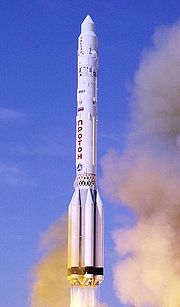
Rocket propellant
Rocket propellant is mass that is stored in some form of propellant tank, prior to being used as the propulsive mass that is ejected from a rocket engine in the form of a fluid jet to produce thrust. A fuel propellant is often burned with an oxidizer propellant to produce large volumes of very hot...
and space exploration
Space exploration
Space exploration is the use of space technology to explore outer space. Physical exploration of space is conducted both by human spaceflights and by robotic spacecraft....
programs conducted by the former Union of Soviet Socialist Republics (the Soviet Union or U.S.S.R.) from the 1930s until its dissolution in 1991. Over its sixty-year history, this primarily classified
Classified information
Classified information is sensitive information to which access is restricted by law or regulation to particular groups of persons. A formal security clearance is required to handle classified documents or access classified data. The clearance process requires a satisfactory background investigation...
military program was responsible for a number of pioneering accomplishments in space flight, including the first intercontinental ballistic missile
Intercontinental ballistic missile
An intercontinental ballistic missile is a ballistic missile with a long range typically designed for nuclear weapons delivery...
(1957), first satellite (Sputnik-1
Sputnik 1
Sputnik 1 ) was the first artificial satellite to be put into Earth's orbit. It was launched into an elliptical low Earth orbit by the Soviet Union on 4 October 1957. The unanticipated announcement of Sputnik 1s success precipitated the Sputnik crisis in the United States and ignited the Space...
), first animal in space (the dog Laika
Laika
Laika was a Soviet space dog that became the first animal to orbit the Earth – as well as the first animal to die in orbit.As little was known about the impact of spaceflight on living creatures at the time of Laika's mission, and the technology to de-orbit had not yet been developed, there...
on Sputnik 2
Sputnik 2
Sputnik 2 , or Prosteyshiy Sputnik 2 ), was the second spacecraft launched into Earth orbit, on November 3, 1957, and the first to carry a living animal, a dog named Laika. Sputnik 2 was a 4-meter high cone-shaped capsule with a base diameter of 2 meters...
), first human in space and Earth orbit (cosmonaut Yuri Gagarin
Yuri Gagarin
Yuri Alekseyevich Gagarin was a Soviet pilot and cosmonaut. He was the first human to journey into outer space, when his Vostok spacecraft completed an orbit of the Earth on April 12, 1961....
on Vostok 1
Vostok 1
Vostok 1 was the first spaceflight in the Vostok program and the first human spaceflight in history. The Vostok 3KA spacecraft was launched on April 12, 1961. The flight took Yuri Gagarin, a cosmonaut from the Soviet Union, into space. The flight marked the first time that a human entered outer...
), first woman in space and Earth orbit (cosmonaut Valentina Tereshkova
Valentina Tereshkova
Valentina Vladimirovna Tereshkova is a retired Soviet cosmonaut, and was the first woman in space. She was selected out of more than four hundred applicants, and then out of five finalists, to pilot Vostok 6 on the 16 June, 1963, becoming both the first woman and the first civilian to fly in...
on Vostok 6
Vostok 6
-Backup crew:-Reserve crew:Vostok VI-Mission parameters:*Mass: *Apogee: *Perigee: *Inclination: 64.9°*Period: 87.8 minutes9090...
), first spacewalk (cosmonaut Alexey Leonov on Voskhod 2
Voskhod 2
Voskhod 2 was a Soviet manned space mission in March 1965. Vostok-based Voskhod 3KD spacecraft with two crew members on board, Pavel Belyaev and Alexei Leonov, was equipped with an inflatable airlock...
), first Moon impact (Luna 2
Luna 2
Luna 2 was the second of the Soviet Union's Luna programme spacecraft launched to the Moon. It was the first spacecraft to reach the surface of the Moon...
), first image of the far side of the moon (Luna 3
Luna 3
The Soviet space probe Luna 3 of 1959 was the third space probe to be sent to the neighborhood of the Moon, and this mission was an early feat in the spaceborne exploration of outer space...
) and unmanned lunar soft landing (Luna 9
Luna 9
Luna 9 was an unmanned space mission of the Soviet Union's Luna program. On February 3, 1966 the Luna 9 spacecraft was the first spacecraft to achieve a soft landing on any planetary body other than Earth and to transmit photographic data to Earth.The automatic lunar station that achieved the...
), first space rover, first space station
Space station
A space station is a spacecraft capable of supporting a crew which is designed to remain in space for an extended period of time, and to which other spacecraft can dock. A space station is distinguished from other spacecraft used for human spaceflight by its lack of major propulsion or landing...
, and first interplanetary probe.
The rocket and space program of the USSR, initially boosted by the assistance of captured scientists from the advanced German rocket program, was performed mainly by Soviet engineers and scientists after 1955, and was based on some unique Soviet and Imperial Russian theoretical developments, many derived by Konstantin Eduardovich Tsiolkovskii, sometimes known as the father of theoretical astronautics. Sergey Korolyov
Sergey Korolyov
Sergei Pavlovich Korolev ; died 14 January 1966 in Moscow, Russia) was the lead Soviet rocket engineer and spacecraft designer in the Space Race between the United States and the Soviet Union during the 1950s and 1960s...
(also transliterated as Korolev) was the head of the principal design group; his official title was "chief designer" (a standard title for similar positions in the USSR). Unlike its American competitor in the "space race
Space Race
The Space Race was a mid-to-late 20th century competition between the Soviet Union and the United States for supremacy in space exploration. Between 1957 and 1975, Cold War rivalry between the two nations focused on attaining firsts in space exploration, which were seen as necessary for national...
", which had NASA
NASA
The National Aeronautics and Space Administration is the agency of the United States government that is responsible for the nation's civilian space program and for aeronautics and aerospace research...
as a single coordinating agency, the USSR's program was split among several competing design groups led by Korolyov, Mikhail Yangel
Mikhail Yangel
Mikhail Kuzmich Yangel , was a leading missile designer in the Soviet Union....
, Valentin Glushko
Valentin Glushko
Valentin Petrovich Glushko or Valentyn Petrovych Hlushko was a Soviet engineer, and the principal Soviet designer of rocket engines during the Soviet/American Space Race.-Biography:...
, and Vladimir Chelomei
Vladimir Chelomei
Vladimir Nikolayevich Chelomey was a Soviet mechanics scientist and rocket engineer from Ukraine.-Early life:Chelomey was born in Siedlce, Russian Empire into a Ukrainian family...
.
Because of the program's classified status, and for propaganda
Propaganda
Propaganda is a form of communication that is aimed at influencing the attitude of a community toward some cause or position so as to benefit oneself or one's group....
value, announcements of the outcomes of missions were delayed until success was certain, and failures were sometimes kept secret. Ultimately, as a result of Mikhail Gorbachev
Mikhail Gorbachev
Mikhail Sergeyevich Gorbachev is a former Soviet statesman, having served as General Secretary of the Communist Party of the Soviet Union from 1985 until 1991, and as the last head of state of the USSR, having served from 1988 until its dissolution in 1991...
's policy of glasnost
Glasnost
Glasnost was the policy of maximal publicity, openness, and transparency in the activities of all government institutions in the Soviet Union, together with freedom of information, introduced by Mikhail Gorbachev in the second half of the 1980s...
in the 1980s, many facts about the space program were declassified. Notable setbacks included the deaths of Korolyov, Vladimir Komarov (in the Soyuz 1
Soyuz 1
Soyuz 1 was a manned spaceflight of the Soviet space program. Launched into orbit on April 23, 1967 carrying cosmonaut Colonel Vladimir Komarov, Soyuz 1 was the first flight of the Soyuz spacecraft...
crash), and Yuri Gagarin
Yuri Gagarin
Yuri Alekseyevich Gagarin was a Soviet pilot and cosmonaut. He was the first human to journey into outer space, when his Vostok spacecraft completed an orbit of the Earth on April 12, 1961....
(on a routine fighter jet mission) between 1966 and 1968, and disastrous experiences with the huge N-1 rocket intended to power a manned lunar landing, and which exploded shortly after launch on each of four unmanned tests.
The Soviet Space Program was dissolved with the fall of the Soviet Union, with Russia
Russia
Russia or , officially known as both Russia and the Russian Federation , is a country in northern Eurasia. It is a federal semi-presidential republic, comprising 83 federal subjects...
and Ukraine
Ukraine
Ukraine is a country in Eastern Europe. It has an area of 603,628 km², making it the second largest contiguous country on the European continent, after Russia...
becoming its immediate heirs. Russia created the Russian Aviation and Space Agency, now known as the Russian Federal Space Agency
Russian Federal Space Agency
The Russian Federal Space Agency , commonly called Roscosmos and abbreviated as FKA and RKA , is the government agency responsible for the Russian space science program and general aerospace research. It was previously the Russian Aviation and Space Agency .Headquarters of Roscosmos are located...
(ROSCOSMOS), while Ukraine created the National Space Agency of Ukraine
National Space Agency of Ukraine
The State Space Agency of Ukraine is the Ukrainian government agency responsible for space policy and programs....
(NSAU).
Prewar efforts
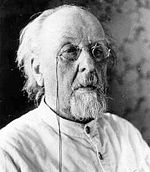
Space exploration
Space exploration is the use of space technology to explore outer space. Physical exploration of space is conducted both by human spaceflights and by robotic spacecraft....
was well established in the Russian Empire
Russian Empire
The Russian Empire was a state that existed from 1721 until the Russian Revolution of 1917. It was the successor to the Tsardom of Russia and the predecessor of the Soviet Union...
before the First World War from the writings of Konstantin Tsiolkovsky
Konstantin Tsiolkovsky
Konstantin Eduardovich Tsiolkovsky was an Imperial Russian and Soviet rocket scientist and pioneer of the astronautic theory. Along with his followers the German Hermann Oberth and the American Robert H. Goddard, he is considered to be one of the founding fathers of rocketry and astronautics...
, who published pioneering papers in the late 19th and early 20th centuries and in 1929 even introduced the concept of the multistaged rocket. Similarly the practical aspects were established by early experiments carried out by the reactive propulsion study group, GIRD
GIRD
The Moscow-based Group for the Study of Reactive Motion was a Soviet research bureau founded in 1931 to study various aspects of rocketry . In 1933 it was incorporated into the Reaction-Engine Scientific Research Institute .-History:...
in the 1920s and 1930s, where such pioneers as Sergey Korolyov
Sergey Korolyov
Sergei Pavlovich Korolev ; died 14 January 1966 in Moscow, Russia) was the lead Soviet rocket engineer and spacecraft designer in the Space Race between the United States and the Soviet Union during the 1950s and 1960s...
—who dreamed of traveling to Mars
Mars
Mars is the fourth planet from the Sun in the Solar System. The planet is named after the Roman god of war, Mars. It is often described as the "Red Planet", as the iron oxide prevalent on its surface gives it a reddish appearance...
—and German-Russian engineer Friedrich Zander
Friedrich Zander
Friedrich Zander , often transliterated Fridrikh Arturovich Tsander, was a pioneer of rocketry and spaceflight in the Russian Empire and the Soviet Union...
worked. On August 18, 1933, GIRD launched the first Soviet liquid-fueled rocket Gird-09, and on November 25, 1933, the first hybrid-fueled rocket GIRD-X. In 1940-41 another advance in the reactive propulsion field was made: the development and serial production of the Katyusha multiple rocket launcher
Multiple rocket launcher
A multiple rocket launcher is a type of unguided rocket artillery system. Like other rocket artillery, multiple rocket launchers are less accurate and have a much lower rate of fire than batteries of traditional artillery guns...
.
The Germans
During the 1930s Soviet rocket technology was comparable to GermanyGermany
Germany , officially the Federal Republic of Germany , is a federal parliamentary republic in Europe. The country consists of 16 states while the capital and largest city is Berlin. Germany covers an area of 357,021 km2 and has a largely temperate seasonal climate...
's, but Joseph Stalin
Joseph Stalin
Joseph Vissarionovich Stalin was the Premier of the Soviet Union from 6 May 1941 to 5 March 1953. He was among the Bolshevik revolutionaries who brought about the October Revolution and had held the position of first General Secretary of the Communist Party of the Soviet Union's Central Committee...
's Great Purge
Great Purge
The Great Purge was a series of campaigns of political repression and persecution in the Soviet Union orchestrated by Joseph Stalin from 1936 to 1938...
severely damaged its progress. Many leading engineers were killed, and Korolyov and others were imprisoned in the Gulag
Gulag
The Gulag was the government agency that administered the main Soviet forced labor camp systems. While the camps housed a wide range of convicts, from petty criminals to political prisoners, large numbers were convicted by simplified procedures, such as NKVD troikas and other instruments of...
. Although the Katyusha was very effective on the Eastern Front
Eastern Front (World War II)
The Eastern Front of World War II was a theatre of World War II between the European Axis powers and co-belligerent Finland against the Soviet Union, Poland, and some other Allies which encompassed Northern, Southern and Eastern Europe from 22 June 1941 to 9 May 1945...
during World War II
World War II
World War II, or the Second World War , was a global conflict lasting from 1939 to 1945, involving most of the world's nations—including all of the great powers—eventually forming two opposing military alliances: the Allies and the Axis...
, the advanced state of the German rocket program amazed Russian engineers who inspected its remains at Peenemünde
Peenemünde
The Peenemünde Army Research Center was founded in 1937 as one of five military proving grounds under the Army Weapons Office ....
and Mittelwerk
Mittelwerk
Central Works was a World War II factory that used Mittelbau-Dora forced labor in 2 main tunnels in the Kohnstein. The underground facility produced V-2 rockets, V-1 flying bombs, and other Nazi weapons.-Mittelwerk GmbH:...
after the end of the war in Europe. Although the Americans had secretly moved most leading German scientists and 100 V-2 rocket
V-2 rocket
The V-2 rocket , technical name Aggregat-4 , was a ballistic missile that was developed at the beginning of the Second World War in Germany, specifically targeted at London and later Antwerp. The liquid-propellant rocket was the world's first long-range combat-ballistic missile and first known...
s to the United States in Operation Paperclip
Operation Paperclip
Operation Paperclip was the Office of Strategic Services program used to recruit the scientists of Nazi Germany for employment by the United States in the aftermath of World War II...
the Russian program greatly benefited from captured German records and scientist
Scientist
A scientist in a broad sense is one engaging in a systematic activity to acquire knowledge. In a more restricted sense, a scientist is an individual who uses the scientific method. The person may be an expert in one or more areas of science. This article focuses on the more restricted use of the word...
s, in particular drawings obtained from the V-2 production sites.
Under the direction of Dimitri Ustinov, Korolyov and others inspected the drawings. Helped by rocket scientist Helmut Gröttrup
Helmut Gröttrup
Helmut Gröttrup was a German electrical engineer and assistant of Wernher von Braun in the V-2 rocket-project. Gröttrup was responsible for the guidance system....
and other captured Germans until the early 1950s, they built a replica of the V-2
V-2 rocket
The V-2 rocket , technical name Aggregat-4 , was a ballistic missile that was developed at the beginning of the Second World War in Germany, specifically targeted at London and later Antwerp. The liquid-propellant rocket was the world's first long-range combat-ballistic missile and first known...
called the R-1
R-1 (missile)
The R-1 rocket was a copy of the German V-2 rocket manufactured by the Soviet Union. Even though it was a copy, it was manufactured using Soviet industrial plants and gave the Soviets valuable experience which later enabled the USSR to construct its own much more capable rockets.In 1945 the...
, although the weight of Soviet nuclear warheads required a more powerful booster. Korolyov's OKB-1 design bureau was dedicated to the liquid-fueled cryogenic rockets he had been experimenting with in the late 1930s. Ultimately, this work resulted in the design of the R-7 Semyorka
R-7 Semyorka
The R-7 was a Soviet missile developed during the Cold War, and the world's first intercontinental ballistic missile. The R-7 made 28 launches between 1957 and 1961, but was never deployed operationally. A derivative, the R-7A, was deployed from 1960 to 1968...
intercontinental ballistic missile
Intercontinental ballistic missile
An intercontinental ballistic missile is a ballistic missile with a long range typically designed for nuclear weapons delivery...
(ICBM) which was successfully tested in August 1957.
Sputnik and Vostok
The Soviet space program was tied to the USSR's Five-Year PlanFive-Year Plan (USSR)
The Five-Year Plans for the National Economy of the Soviet Union were a series of nation-wide centralized exercises in rapid economic development in the Soviet Union. The plans were developed by a state planning committee based on the Theory of Productive Forces that was part of the general...
s and from the start was reliant on support from the Soviet military. Although he was "single-mindedly driven by the dream of space travel", Korolyov generally kept this a secret while working on military projects—especially, after the Soviet Union's first atomic bomb test in 1949, a missile capable of carrying a nuclear warhead to the United States—as many mocked the idea of launching satellites and manned spacecraft. Nonetheless, the first Soviet rocket with animals aboard launched in July 1951; the two dogs were recovered alive after reaching 101 km in altitude. Two months ahead of America's first such achievement, this and subsequent flights gave the Soviets valuable experience with space medicine
Space medicine
Space medicine is the practice of medicine on astronauts in outer space whereas astronautical hygiene is the application of science and technology to the prevention or control of exposure to the hazards that may cause astronaut ill health. Both these sciences work together to ensure that...
.
Because of its global range and large payload of approximately five tons, the reliable R-7 was not only effective as a strategic delivery system for nuclear warheads, but also as an excellent basis for a space vehicle. The United States' announcement in July 1955 of its plan to launch a satellite during the International Geophysical Year
International Geophysical Year
The International Geophysical Year was an international scientific project that lasted from July 1, 1957, to December 31, 1958. It marked the end of a long period during the Cold War when scientific interchange between East and West was seriously interrupted...
greatly benefited Korolyov in persuading Soviet leader Nikita Khrushchev
Nikita Khrushchev
Nikita Sergeyevich Khrushchev led the Soviet Union during part of the Cold War. He served as First Secretary of the Communist Party of the Soviet Union from 1953 to 1964, and as Chairman of the Council of Ministers, or Premier, from 1958 to 1964...
to support his plans in January 1956, in order to surpass the Americans. Plans were approved for Earth-orbiting satellites (Sputnik) to gain knowledge of space, and four unmanned military reconnaissance satellites, Zenit. Further planned developments called for a manned Earth orbit flight by 1964 and an unmanned lunar mission at an earlier date.
After the first Sputnik proved to be a successful propaganda coup
Sputnik crisis
The Sputnik crisis is the name for the American reaction to the success of the Sputnik program. It was a key event during the Cold War that began on October 4, 1957 when the Soviet Union launched Sputnik 1, the first artificial Earth satellite....
, Korolyov—now known publicly only as the mysterious "Chief Designer of Rocket-Space Systems"—was charged to accelerate the manned program, the design of which was combined with the Zenit program to produce the Vostok spacecraft
Vostok spacecraft
The Vostok was a type of spacecraft built by the Soviet Union. The first human spaceflight in history was accomplished on this spacecraft on April 12, 1961, by Soviet cosmonaut Yuri Gagarin....
. Still influenced by Tsiolkovsky—who had chosen Mars as the most important goal for space travel—in the early 1960s the Russian program under Korolyov created substantial plans for manned trips to Mars as early as 1968 to 1970. With closed-loop life support systems
Controlled Ecological Life Support System
Controlled Ecological Life Support Systems are a type of scientific endeavor to create a self-supporting life support system for space stations and colonies typically through controlled closed ecological systems, such as the BioHome, BIOS-3 and Biosphere 2.-Original concept:CELSS was first...
and electrical rocket engines, and launched from large orbiting space stations, these plans were much more ambitious than America's goal of landing on the moon
Project Apollo
The Apollo program was the spaceflight effort carried out by the United States' National Aeronautics and Space Administration , that landed the first humans on Earth's Moon. Conceived during the Presidency of Dwight D. Eisenhower, Apollo began in earnest after President John F...
.
Funding and support
Despite the Soviet space program's achievements, it was "neither a high priority nor a central tool of Soviet state policy." Khrushchev had decided that the Soviet military's funding would focus on the Strategic Rocket ForcesStrategic Rocket Forces
The Strategic Missile Troops or Strategic Rocket Forces of the Russian Federation or RVSN RF , transliteration: Raketnye voyska strategicheskogo naznacheniya Rossiyskoy Federatsii, literally Missile Troops of Strategic Designation of the Russian Federation) are a military branch of the Russian...
' ICBMs, and the space program "rode its coattails". While the West believed that Khrushchev personally ordered each new space mission for propaganda purposes, and the Soviet leader did have an unusually close relationship with Korolyov and other chief designers, he "was more concerned about money and missiles than he was about cosmonauts and the cosmos...[H]e was never particularly interested in competing with Apollo."
While the government and the Communist Party used the program's successes as propaganda tools after they occurred, systematic plans for missions based on political reasons were rare, one exception being Valentina Tereshkova
Valentina Tereshkova
Valentina Vladimirovna Tereshkova is a retired Soviet cosmonaut, and was the first woman in space. She was selected out of more than four hundred applicants, and then out of five finalists, to pilot Vostok 6 on the 16 June, 1963, becoming both the first woman and the first civilian to fly in...
, the first woman in space, on Vostok 6
Vostok 6
-Backup crew:-Reserve crew:Vostok VI-Mission parameters:*Mass: *Apogee: *Perigee: *Inclination: 64.9°*Period: 87.8 minutes9090...
in 1963. Missions were planned based on rocket availability or ad hoc reasons, rather than scientific purposes. For example, the government in February 1962 abruptly ordered an ambitious mission involving two Vostoks simultaneously in orbit launched "in ten days time" to obscure John Glenn
John Glenn
John Herschel Glenn, Jr. is a former United States Marine Corps pilot, astronaut, and United States senator who was the first American to orbit the Earth and the third American in space. Glenn was a Marine Corps fighter pilot before joining NASA's Mercury program as a member of NASA's original...
's Mercury-Atlas 6
Mercury-Atlas 6
Mercury-Atlas 6 was a human spaceflight mission conducted by NASA, the space agency of the United States. As part of Project Mercury, MA-6 was the successful first attempt by NASA to place an astronaut into orbit. The MA-6 mission was launched February 20, 1962. It made three orbits of the Earth,...
that month; the program could not do so with Vostok 3
Vostok 3
Vostok 3 was a spaceflight of the Soviet space program intended to determine the ability of the human body to function in conditions of weightlessness and test the endurance of the Vostok 3KA spacecraft over longer flights...
and Vostok 4
Vostok 4
Vostok 4 was a mission in the Soviet space program. It was launched a day after Vostok 3 with cosmonaut Pavel Popovich on board—the first time that more than one manned spacecraft were in orbit at the same time. The two Vostok capsules came within of one another and ship-to-ship radio contact was...
until August.
Internal competition

James E. Webb
James Edwin Webb was an American government official who served as the second administrator of NASA from February 14, 1961 to October 7, 1968....
through most of the 1960s, the USSR's program was split between several competing design groups. Despite the remarkable successes of the Sputniks between 1957 and 1961 and Vostoks between 1961 and 1964, after 1958 Korolyov's OKB-1 design bureau faced increasing competition from his rival chief designers, Mikhail Yangel
Mikhail Yangel
Mikhail Kuzmich Yangel , was a leading missile designer in the Soviet Union....
, Valentin Glushko
Valentin Glushko
Valentin Petrovich Glushko or Valentyn Petrovych Hlushko was a Soviet engineer, and the principal Soviet designer of rocket engines during the Soviet/American Space Race.-Biography:...
, and Vladimir Chelomei
Vladimir Chelomei
Vladimir Nikolayevich Chelomey was a Soviet mechanics scientist and rocket engineer from Ukraine.-Early life:Chelomey was born in Siedlce, Russian Empire into a Ukrainian family...
. Korolyov planned to move forward with the Soyuz
Soyuz spacecraft
Soyuz , Union) is a series of spacecraft initially designed for the Soviet space programme by the Korolyov Design Bureau in the 1960s, and still in service today...
craft and N-1
N1 rocket
N-1 was a heavy lift rocket intended to deliver payloads beyond low Earth orbit, acting as the Soviet counterpart to the NASA Saturn V rocket. This heavy lift booster had the capability of lifting very heavy loads into orbit, designed with manned extra-orbital travel in mind...
heavy booster that would be the basis of a permanent manned space station and manned exploration of the Moon
Moon
The Moon is Earth's only known natural satellite,There are a number of near-Earth asteroids including 3753 Cruithne that are co-orbital with Earth: their orbits bring them close to Earth for periods of time but then alter in the long term . These are quasi-satellites and not true moons. For more...
. However, Ustinov directed him to focus on near-Earth missions using the very reliable Voskhod spacecraft
Voskhod spacecraft
The Voskhod was a spacecraft built by the Soviet Union's space program for human spaceflight as part of the Voskhod programme. It was a development of and a follow-on to the Vostok spacecraft...
, a modified Vostok, as well as on interplanetary unmanned missions to nearby planets Venus
Venus
Venus is the second planet from the Sun, orbiting it every 224.7 Earth days. The planet is named after Venus, the Roman goddess of love and beauty. After the Moon, it is the brightest natural object in the night sky, reaching an apparent magnitude of −4.6, bright enough to cast shadows...
and Mars
Mars
Mars is the fourth planet from the Sun in the Solar System. The planet is named after the Roman god of war, Mars. It is often described as the "Red Planet", as the iron oxide prevalent on its surface gives it a reddish appearance...
.
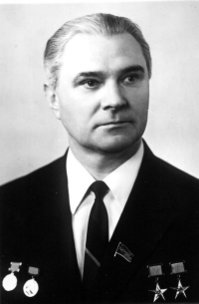
Nedelin catastrophe
The Nedelin catastrophe or Nedelin disaster was a launch pad accident that occurred on 24 October 1960, at Baikonur Cosmodrome during the development of the Soviet R-16 ICBM...
in 1960 Yangel was directed to concentrate on ICBM development. He also continued to develop his own heavy booster designs similar to Korolyov's N-1 both for military applications and for cargo flights into space to build future space stations.
Glushko was the chief rocket engine designer but had a personal friction with Korolyov and refused to develop the large single chamber cryogenic engines that Korolyov needed to build heavy boosters.
Chelomei benefited from the patronage of Khrushchev and in 1960 was given the plum jobs of developing a rocket to send a manned craft around the moon and a manned military space station. With limited space experience, his development was slow.
The Apollo program's progress alarmed the chief designers, who each advocated for his own programs as response. Multiple, overlapping designs received approval, and new proposals threatened already approved projects. Due to Korolyov's "singular persistence", in August 1964—more than three years after the United States declared its intentions—the Soviet Union finally decided to compete for the moon. It set the goal of a lunar landing in 1967—the 50th anniversary of the October Revolution
October Revolution
The October Revolution , also known as the Great October Socialist Revolution , Red October, the October Uprising or the Bolshevik Revolution, was a political revolution and a part of the Russian Revolution of 1917...
—or 1968. At one stage in the early 1960s the Soviet space program was actively developing 30 projects for launchers and spacecraft. With the fall of Krushchev in 1964 Korolyov was given complete control of the manned space program.
After Korolyov
Korolyov died in January 1966 following a routine operation that uncovered colon cancer and from complications from heart disease and severe hemorrhaging. Kerim KerimovKerim Kerimov
Lieutenant-General Kerim Aliyevich Kerimov was an Azerbaijani-Soviet/Russian aerospace engineer and a renowned rocket scientist, one of the founders of the Soviet space industry, and for many years a central figure in the Soviet space program. Despite his prominent role, his identity was kept a...
, who was formerly an architect of Vostok 1
Vostok 1
Vostok 1 was the first spaceflight in the Vostok program and the first human spaceflight in history. The Vostok 3KA spacecraft was launched on April 12, 1961. The flight took Yuri Gagarin, a cosmonaut from the Soviet Union, into space. The flight marked the first time that a human entered outer...
, was appointed Chairman of the State Commission on Piloted Flights and headed it for the next 25 years (1966–1991). He supervised every stage of development and operation of both manned space complexes as well as unmanned interplanetary stations for the former Soviet Union. One of Kerimov's greatest achievements was the launch of Mir
Mir
Mir was a space station operated in low Earth orbit from 1986 to 2001, at first by the Soviet Union and then by Russia. Assembled in orbit from 1986 to 1996, Mir was the first modular space station and had a greater mass than that of any previous spacecraft, holding the record for the...
in 1986.
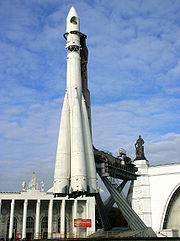
Soviet Moonshot
The Soviet manned lunar programs were a series of programs pursued by the Soviet Union to land a man on the Moon in competition with the United States Apollo program to achieve the same goal set publicly by President John F. Kennedy on May 25, 1961...
. Mishin lacked Korolyov's political authority and still faced competition from other chief designers. Under pressure Mishin approved the launch of the Soyuz 1
Soyuz 1
Soyuz 1 was a manned spaceflight of the Soviet space program. Launched into orbit on April 23, 1967 carrying cosmonaut Colonel Vladimir Komarov, Soyuz 1 was the first flight of the Soyuz spacecraft...
flight in 1967, even though the craft had never been successfully tested on an unmanned flight. The mission launched with known design problems and ended with the vehicle crashing to the ground, killing Vladimir Komarov. This was the first in-flight fatality.
Following this disaster and under new pressures, Mishin developed a drinking problem. The Soviets were narrowly beaten in sending the first manned flight around the Moon in 1968 by Apollo 8
Apollo 8
Apollo 8, the second manned mission in the American Apollo space program, was the first human spaceflight to leave Earth orbit; the first to be captured by and escape from the gravitational field of another celestial body; and the first crewed voyage to return to Earth from another celestial...
, but Mishin pressed ahead with development of the problematic super heavy N1 rocket
N1 rocket
N-1 was a heavy lift rocket intended to deliver payloads beyond low Earth orbit, acting as the Soviet counterpart to the NASA Saturn V rocket. This heavy lift booster had the capability of lifting very heavy loads into orbit, designed with manned extra-orbital travel in mind...
in the hope that the Americans would have a setback, leaving enough time to make the N-1 workable and land a man on the moon first. There was a success with the joint flight of Soyuz 4
Soyuz 4
Soyuz 4 was launched on January 14, 1969. On board the Soyuz 7K-OK spacecraft was cosmonaut Vladimir Shatalov on his first flight. The aim of the mission was to dock with Soyuz 5, transfer two crew members from that spacecraft, and return to Earth...
and Soyuz 5
Soyuz 5
Soyuz 5 was a Soyuz mission using the Soyuz 7K-OK spacecraft launched by the Soviet Union on January 15, 1969, which docked with Soyuz 4 in orbit...
in January 1969 that tested the rendezvous, docking and crew transfer techniques that would be used for the landing, and the LK Lander
LK Lander
The LK was a Soviet lunar lander and counterpart of the American Lunar Module . The LK was to have landed up to two cosmonauts on the Moon...
was tested successfully in earth orbit. But after four unmanned test launches of the N-1 ended in failure, the heavy booster was abandoned and with it any chance of the Soviets landing men on the moon in a single launch.
Besides the manned landings, abandoned Soviet moon program included a building the multipurpose moonbase Zvezda
Zvezda (moonbase)
Zvezda moonbase , also DLB Lunar Base — plan and project of 1962—1974 of Soviet manned moonbase as successor N1-L3 manned lunar expedition program. It was the first detailed such project more developed than early US Horizon and Lunex projects and later Apollo Lunar Base Wernher von Braun and NASA...
, first detailed such project with developed mockups of expedition vehicles and surface modules. Later proposed new moon manned program "Vulkan-LEK" were not adopted on economic reasons.
Following this setback, Chelomei convinced Ustinov to approve a program in 1970 to advance his Almaz
Almaz
The Almaz program was a series of military space stations launched by the Soviet Union under cover of the civilian Salyut DOS-17K program after 1971....
military space station as a means of beating the US's announced Skylab
Skylab
Skylab was a space station launched and operated by NASA, the space agency of the United States. Skylab orbited the Earth from 1973 to 1979, and included a workshop, a solar observatory, and other systems. It was launched unmanned by a modified Saturn V rocket, with a mass of...
. Mishin remained in control of the project that became Salyut
Salyut
The Salyut program was the first space station program undertaken by the Soviet Union, which consisted of a series of nine space stations launched over a period of eleven years from 1971 to 1982...
but the decision backed by Mishin to fly a three-man crew without pressure suits rather than a two-man crew with suits to Salyut 1
Salyut 1
Salyut 1 was the first space station of any kind, launched by the USSR on April 19, 1971. It was launched unmanned using a Proton-K rocket. Its first crew came later in Soyuz 10, but was unable to dock completely; its second crew launched in Soyuz 11 and remained on board for 23 days...
in 1971 proved fatal when the re-entry capsule depressurized killing the crew on their return to Earth. Mishin was removed from many projects, with Chelomei regaining control of Salyut. After working with NASA
NASA
The National Aeronautics and Space Administration is the agency of the United States government that is responsible for the nation's civilian space program and for aeronautics and aerospace research...
on the Apollo Soyuz Test Project, the Soviet leadership decided a new management approach was needed and in 1974 the N-1 was cancelled and Mishin dismissed. A single design bureau was created NPO Energia with Glushko as chief designer.
Despite of failure of manned lunar programs, USSR achieved a significant success in first in history automatic Lunokhod and Luna sample return mission
Sample return mission
A sample return mission is a spacecraft mission with the goal of returning tangible samples from an extraterrestrial location to Earth for analysis. Sample return missions may bring back merely atoms and molecules or a deposit of complex compounds such as dirt and rocks...
s. Also Mars probe program was continued with small success while exploration of Venus and then Halley comet by Venera and Vega probe programs was more effective.
Soviet Union had an unrealized early reusable winged shuttle projects (civil LKS and military Spiral
Spiral
In mathematics, a spiral is a curve which emanates from a central point, getting progressively farther away as it revolves around the point.-Spiral or helix:...
) and then Buran
Buran
Buran may refer to:* Buran , a Soviet space shuttle** Buran program, which developed the spacecraft* Buran eavesdropping device, invented by Léon Theremin, used by soviet intelligence* Buran cruise missile, a Soviet cruise missile...
.
Completed
The Soviet space program has undertaken a number of projects, including:- AlmazAlmazThe Almaz program was a series of military space stations launched by the Soviet Union under cover of the civilian Salyut DOS-17K program after 1971....
space stations - Buran program
- CosmosCosmos (satellite)Kosmos is a designation given to a large number of satellites operated by the Soviet Union and subsequently Russia. Kosmos 1, the first spacecraft to be given a Kosmos designation, was launched on March 16, 1962....
satellites - EnergiaEnergiaEnergia was a Soviet rocket that was designed by NPO Energia to serve as a heavy-lift expendable launch system as well as a booster for the Buran spacecraft. Control system main developer enterprise was the NPO "Electropribor"...
- FotonFotonFoton is the project name of two series of Russian science satellite and reentry vehicle programs. Although unmanned, the design was adapted from the manned Vostok spacecraft capsule. The primary focus of the Foton project is materials science research, but some missions have also carried...
- N1-L3 Manned Moon landing program
- Luna Moon flybys, orbiters, impacts, landers, rovers, sample returns
- Mars probe programMars probe programThe Mars program was a series of unmanned spacecraft launched by the Soviet Union between 1960 and 1973. The spacecraft were intended to explore Mars, and included flyby probes, landers and orbiters....
- Meteor meteorological satellitesMeteor (satellite)The Meteor craft are weather observation satellites launched by the USSR. The Meteor satellites were designed to monitor atmospheric and sea-surface temperatures, humidity, radiation, sea ice conditions, snow-cover, and clouds.-Meteor 2-21:...
- MolniyaMolniya (satellite)Molniya was a military communications satellite system used by the Soviet Union. The satellites were placed into highly eccentric elliptical orbits known as Molniya orbits, characterised by an inclination of +63.4 degrees and a period of around 12 hours...
communications satellites - MirMirMir was a space station operated in low Earth orbit from 1986 to 2001, at first by the Soviet Union and then by Russia. Assembled in orbit from 1986 to 1996, Mir was the first modular space station and had a greater mass than that of any previous spacecraft, holding the record for the...
space station - Proton satelliteProton satelliteThe Proton was a model of Soviet scientific artificial satellites. The maximum mass was about 17 tonnes. Four "Protons" were launched between 1965 and 1968. The satellite was developed by NPO Mashinostroyenia...
satellites - PhobosPhobos programThe Phobos program was an unmanned space mission consisting of two probes launched by the Soviet Union to study Mars and its moons Phobos and Deimos. Phobos 2 became a Mars orbiter and returned 38 images with a resolution of up to 40 meters...
Mars probes program - SalyutSalyutThe Salyut program was the first space station program undertaken by the Soviet Union, which consisted of a series of nine space stations launched over a period of eleven years from 1971 to 1982...
space stations - Soyuz program spacecraft
- Sputnik satellites
- TKS spacecraftTKS spacecraftTKS spacecraft was a Soviet spacecraft design in the late 1960s intended to supply the military Almaz space station. The spacecraft was designed for manned or autonomous cargo resupply use...
- VeneraVeneraThe Venera series probes were developed by the Soviet Union between 1961 and 1984 to gather data from Venus, Venera being the Russian name for Venus...
Venus probes program - Vega programVega programThe Vega program was a series of Venus missions which also took advantage of the appearance of Comet Halley in 1986. Vega 1 and Vega 2 were unmanned spacecraft launched in a cooperative effort among the Soviet Union and Austria, Bulgaria, Hungary, the German Democratic Republic, Poland,...
Venus and comet Halley probes program - Vostok program spacecraft
- Voskhod program spacecraft
- Zond programZond programZond was the name given to two distinct series of Soviet unmanned space program undertaken from 1964 to 1970. The first series based on 3MV planetary probe was intended to gather information about nearby planets...
Notable firsts

United States
The United States of America is a federal constitutional republic comprising fifty states and a federal district...
announced its intention to launch an artificial satellite, on July 31, 1956, the Soviet Union announced its intention to do the same. Sputnik 1
Sputnik 1
Sputnik 1 ) was the first artificial satellite to be put into Earth's orbit. It was launched into an elliptical low Earth orbit by the Soviet Union on 4 October 1957. The unanticipated announcement of Sputnik 1s success precipitated the Sputnik crisis in the United States and ignited the Space...
was launched on October 4, 1957, beating the United States and stunning people all over the world.
The Soviet space program pioneered many aspects of space exploration:
- 1957: First intercontinental ballistic missile, the R-7 SemyorkaR-7 SemyorkaThe R-7 was a Soviet missile developed during the Cold War, and the world's first intercontinental ballistic missile. The R-7 made 28 launches between 1957 and 1961, but was never deployed operationally. A derivative, the R-7A, was deployed from 1960 to 1968...
- 1957: First satellite, Sputnik 1Sputnik 1Sputnik 1 ) was the first artificial satellite to be put into Earth's orbit. It was launched into an elliptical low Earth orbit by the Soviet Union on 4 October 1957. The unanticipated announcement of Sputnik 1s success precipitated the Sputnik crisis in the United States and ignited the Space...
- 1957: First animal in Earth orbit, the dog LaikaLaikaLaika was a Soviet space dog that became the first animal to orbit the Earth – as well as the first animal to die in orbit.As little was known about the impact of spaceflight on living creatures at the time of Laika's mission, and the technology to de-orbit had not yet been developed, there...
on Sputnik 2Sputnik 2Sputnik 2 , or Prosteyshiy Sputnik 2 ), was the second spacecraft launched into Earth orbit, on November 3, 1957, and the first to carry a living animal, a dog named Laika. Sputnik 2 was a 4-meter high cone-shaped capsule with a base diameter of 2 meters... - 1959: First rocket ignition in Earth orbit, first man-made object to escape Earth's gravity, Luna 1Luna 1Luna 1 , first known as First Cosmic Ship, then known as Mechta was the first spacecraft to reach the vicinity of the Moon and the first of the Luna program of Soviet automatic interplanetary stations successfully launched in the direction of the Moon.While traveling through the outer Van Allen...
- 1959: First data communications, or telemetryTelemetryTelemetry is a technology that allows measurements to be made at a distance, usually via radio wave transmission and reception of the information. The word is derived from Greek roots: tele = remote, and metron = measure...
, to and from outer spaceOuter spaceOuter space is the void that exists between celestial bodies, including the Earth. It is not completely empty, but consists of a hard vacuum containing a low density of particles: predominantly a plasma of hydrogen and helium, as well as electromagnetic radiation, magnetic fields, and neutrinos....
, Luna 1Luna 1Luna 1 , first known as First Cosmic Ship, then known as Mechta was the first spacecraft to reach the vicinity of the Moon and the first of the Luna program of Soviet automatic interplanetary stations successfully launched in the direction of the Moon.While traveling through the outer Van Allen...
. - 1959: First man-made object to pass near the MoonMoonThe Moon is Earth's only known natural satellite,There are a number of near-Earth asteroids including 3753 Cruithne that are co-orbital with Earth: their orbits bring them close to Earth for periods of time but then alter in the long term . These are quasi-satellites and not true moons. For more...
, first man-made object in Heliocentric orbit, Luna 1Luna 1Luna 1 , first known as First Cosmic Ship, then known as Mechta was the first spacecraft to reach the vicinity of the Moon and the first of the Luna program of Soviet automatic interplanetary stations successfully launched in the direction of the Moon.While traveling through the outer Van Allen... - 1959: First probe to impact the Moon, Luna 2Luna 2Luna 2 was the second of the Soviet Union's Luna programme spacecraft launched to the Moon. It was the first spacecraft to reach the surface of the Moon...
- 1959: First images of the moon's far side, Luna 3Luna 3The Soviet space probe Luna 3 of 1959 was the third space probe to be sent to the neighborhood of the Moon, and this mission was an early feat in the spaceborne exploration of outer space...
- 1960: First animals to safely return from Earth orbit, the dogs Belka and Strelka on Sputnik 5Sputnik 5Korabl-Sputnik 2 , also known as Sputnik 5 in the West, was a Soviet artificial satellite, and the third test flight of the Vostok spacecraft. It was the first spaceflight to send animals into orbit and return them safely back to Earth...
. - 1961: First probe launched to Venus, Venera 1Venera 1On February 12, 1961, 00:34:36 UTC, was the first planetary probe launched to Venus by the Soviet Union. The Venus-1 Automatic Interplanetary Station, or Venera 1, was a 643.5 kg probe consisting of a cylindrical body 1.05 metres in diameter topped by a dome, totalling 2.035 metres...
- 1961: First person in space (International definition) and in Earth orbit, Yuri GagarinYuri GagarinYuri Alekseyevich Gagarin was a Soviet pilot and cosmonaut. He was the first human to journey into outer space, when his Vostok spacecraft completed an orbit of the Earth on April 12, 1961....
on Vostok 1Vostok 1Vostok 1 was the first spaceflight in the Vostok program and the first human spaceflight in history. The Vostok 3KA spacecraft was launched on April 12, 1961. The flight took Yuri Gagarin, a cosmonaut from the Soviet Union, into space. The flight marked the first time that a human entered outer...
, Vostok programmeVostok programmeThe Vostok programme was a Soviet human spaceflight project that succeeded in putting a person into Earth's orbit for the first time. The programme developed the Vostok spacecraft from the Zenit spy satellite project and adapted the Vostok rocket from an existing ICBM design... - 1961: First person to spend over 24 hours in space Gherman TitovGherman TitovGherman Stepanovich Titov was a Soviet cosmonaut who, on August 6, 1961, became the second human to orbit the Earth aboard Vostok 2, preceded by Yuri Gagarin on Vostok 1...
, Vostok 2Vostok 2Vostok 2 was a Soviet space mission which carried cosmonaut Gherman Titov into orbit for a full day in order to study the effects of a more prolonged period of weightlessness on the human body...
(also first person to sleep in space). - 1962: First dual manned spaceflight, Vostok 3Vostok 3Vostok 3 was a spaceflight of the Soviet space program intended to determine the ability of the human body to function in conditions of weightlessness and test the endurance of the Vostok 3KA spacecraft over longer flights...
and Vostok 4Vostok 4Vostok 4 was a mission in the Soviet space program. It was launched a day after Vostok 3 with cosmonaut Pavel Popovich on board—the first time that more than one manned spacecraft were in orbit at the same time. The two Vostok capsules came within of one another and ship-to-ship radio contact was... - 1962: First probe launched to Mars, Mars 1Mars 1Mars 1, also known as 1962 Beta Nu 1, Mars 2MV-4 and Sputnik 23, was an automatic interplanetary station launched in the direction of Mars on November 1, 1962, the first of the Soviet Mars probe program, with the intent of flying by the planet at a distance of about 11,000 km...
- 1963: First woman in space, Valentina TereshkovaValentina TereshkovaValentina Vladimirovna Tereshkova is a retired Soviet cosmonaut, and was the first woman in space. She was selected out of more than four hundred applicants, and then out of five finalists, to pilot Vostok 6 on the 16 June, 1963, becoming both the first woman and the first civilian to fly in...
, Vostok 6Vostok 6-Backup crew:-Reserve crew:Vostok VI-Mission parameters:*Mass: *Apogee: *Perigee: *Inclination: 64.9°*Period: 87.8 minutes9090... - 1964: First multi-person crew (3), Voskhod 1Voskhod 1Voskhod 1 was the seventh manned Soviet space flight. It achieved a number of "firsts" in the history of manned spaceflight, being the first space flight to carry more than one crewman into orbit, the first flight without the use of spacesuits, and the first to carry either an engineer or a...
- 1965: First extra-vehicular activity (EVAExtra-vehicular activityExtra-vehicular activity is work done by an astronaut away from the Earth, and outside of a spacecraft. The term most commonly applies to an EVA made outside a craft orbiting Earth , but also applies to an EVA made on the surface of the Moon...
), by Aleksei LeonovAleksei LeonovAlexey Arkhipovich Leonov is a retired Soviet/Russian cosmonaut and Air Force Major General who, on 18 March 1965, became the first human to conduct a space walk.-Biography:...
, Voskhod 2Voskhod 2Voskhod 2 was a Soviet manned space mission in March 1965. Vostok-based Voskhod 3KD spacecraft with two crew members on board, Pavel Belyaev and Alexei Leonov, was equipped with an inflatable airlock... - 1965: First probe to hit another planet of the Solar systemSolar SystemThe Solar System consists of the Sun and the astronomical objects gravitationally bound in orbit around it, all of which formed from the collapse of a giant molecular cloud approximately 4.6 billion years ago. The vast majority of the system's mass is in the Sun...
(VenusVenusVenus is the second planet from the Sun, orbiting it every 224.7 Earth days. The planet is named after Venus, the Roman goddess of love and beauty. After the Moon, it is the brightest natural object in the night sky, reaching an apparent magnitude of −4.6, bright enough to cast shadows...
), Venera 3Venera 3Venera 3 was a Venera program space probe that was built and launched by the Soviet Union to explore the surface of Venus. It was launched on November 16, 1965 at 04:19 UTC from Baikonur, Kazakhstan.... - 1966: First probe to make a soft landing on and transmit from the surface of the moon, Luna 9Luna 9Luna 9 was an unmanned space mission of the Soviet Union's Luna program. On February 3, 1966 the Luna 9 spacecraft was the first spacecraft to achieve a soft landing on any planetary body other than Earth and to transmit photographic data to Earth.The automatic lunar station that achieved the...
- 1966: First probe in lunar orbit, Luna 10Luna 10Luna 10 was a Luna program, robotic spacecraft mission, also called Lunik 10.The Luna 10 spacecraft was launched towards the Moon from an Earth orbiting platform on March 31, 1966. It was the first artificial satellite of the Moon...
- 1967: First unmanned rendezvous and docking, Cosmos 186/Cosmos 188. (Until 2006, this had remained the only major space achievement that the US had not duplicated.)
- 1969: First docking between two manned craft in Earth orbit and exchange of crews, Soyuz 4Soyuz 4Soyuz 4 was launched on January 14, 1969. On board the Soyuz 7K-OK spacecraft was cosmonaut Vladimir Shatalov on his first flight. The aim of the mission was to dock with Soyuz 5, transfer two crew members from that spacecraft, and return to Earth...
and Soyuz 5Soyuz 5Soyuz 5 was a Soyuz mission using the Soyuz 7K-OK spacecraft launched by the Soviet Union on January 15, 1969, which docked with Soyuz 4 in orbit... - 1970: First soil samples automatically extracted and returned to Earth from another celestial body, Luna 16Luna 16-External links:*...
- 1970: First robotic space rover, Lunokhod 1Lunokhod 1Lunokhod 1 was the first of two unmanned lunar rovers landed on the Moon by the Soviet Union as part of its Lunokhod program. The spacecraft which carried Lunokhod 1 was named Luna 17...
on the Moon. - 1970: First data received from the surface of another planet of the Solar systemSolar SystemThe Solar System consists of the Sun and the astronomical objects gravitationally bound in orbit around it, all of which formed from the collapse of a giant molecular cloud approximately 4.6 billion years ago. The vast majority of the system's mass is in the Sun...
(VenusVenusVenus is the second planet from the Sun, orbiting it every 224.7 Earth days. The planet is named after Venus, the Roman goddess of love and beauty. After the Moon, it is the brightest natural object in the night sky, reaching an apparent magnitude of −4.6, bright enough to cast shadows...
), Venera 7Venera 7The Venera 7 was a Soviet spacecraft, part of the Venera series of probes to Venus. When it landed on the Venusian surface, it became the first man-made spacecraft to successfully land on another planet and to transmit data from there back to Earth.*Launch date/time: 1970 August 17 at 05:38... - 1971: First space station, Salyut 1Salyut 1Salyut 1 was the first space station of any kind, launched by the USSR on April 19, 1971. It was launched unmanned using a Proton-K rocket. Its first crew came later in Soyuz 10, but was unable to dock completely; its second crew launched in Soyuz 11 and remained on board for 23 days...
- 1971: First probe to reach surface and make soft landing on Mars, Mars 2Mars 2The Mars program was a series of Mars unmanned landers and orbiters launched by the Soviet Union in the early 1970s.The Mars 2 and Mars 3 missions consisted of identical spacecraft, each with an orbiter and an attached lander; they were the first human artifacts to impact the surface of Mars...
- 1975: First probe to orbit Venus, to make soft landing on Venus, first photos from surface of Venus, Venera 9Venera 9Venera 9 was a USSR unmanned space mission to Venus. It consisted of an orbiter and a lander. It was launched on June 8, 1975 02:38:00 UTC and weighed 4,936 kg...
- 1980: First Hispanic and Black person in space, Arnaldo Tamayo MéndezArnaldo Tamayo MéndezArnaldo Tamayo Méndez was the first Cuban citizen and the first person from a country in the Western Hemisphere other than the United States to travel into earth orbit...
on Soyuz 38Soyuz 38-Backup crew:-Mission parameters:*Mass: 6800 kg*Perigee: 199.7 km*Apogee: 273.5 km*Inclination: 51.63°*Period: 88.194 minutes-Mission highlights:... - 1984: First woman to walk in spaceExtra-vehicular activityExtra-vehicular activity is work done by an astronaut away from the Earth, and outside of a spacecraft. The term most commonly applies to an EVA made outside a craft orbiting Earth , but also applies to an EVA made on the surface of the Moon...
, Svetlana SavitskayaSvetlana SavitskayaSvetlana Yevgenyevna Savitskaya She started training as a cosmonaut in 1980. Upon returning to Earth, Savitskaya was assigned as the commander of an all-female Soyuz crew to Salyut 7 in commemoration of the International Women's Day, a mission that was later canceled.She was twice awarded the Hero...
(Salyut 7Salyut 7Salyut 7 was a space station in low Earth orbit from April 1982 to February 1991. It was first manned in May 1982 with two crew via Soyuz T-5, and last visited in June 1986, by Soyuz T-15. Various crew and modules were used over its lifetime, including a total of 12 manned and 15 unmanned launches...
space station) - 1986: First crew to visit two separate space stations (MirMirMir was a space station operated in low Earth orbit from 1986 to 2001, at first by the Soviet Union and then by Russia. Assembled in orbit from 1986 to 1996, Mir was the first modular space station and had a greater mass than that of any previous spacecraft, holding the record for the...
and Salyut 7Salyut 7Salyut 7 was a space station in low Earth orbit from April 1982 to February 1991. It was first manned in May 1982 with two crew via Soyuz T-5, and last visited in June 1986, by Soyuz T-15. Various crew and modules were used over its lifetime, including a total of 12 manned and 15 unmanned launches...
) - 1986: First probes to deploy robotic balloons into Venus atmosphere and to return pictures of a comet during close flyby Vega 1Vega 1Vega 1 is a Soviet space probe part of the Vega program. The spacecraft was a development of the earlier Venera craft...
, Vega 2Vega 2Vega 2 is a Soviet space probe part of the Vega program. The spacecraft was a development of the earlier Venera craft. They were designed by Babakin Space Center and constructed as 5VK by Lavochkin at Khimki... - 1986: First permanently manned space station, MirMirMir was a space station operated in low Earth orbit from 1986 to 2001, at first by the Soviet Union and then by Russia. Assembled in orbit from 1986 to 1996, Mir was the first modular space station and had a greater mass than that of any previous spacecraft, holding the record for the...
, 1986–2001, with permanent presence on board (1989–1999) - 1987: First crew to spend over one year in space, Vladimir TitovVladimir TitovVladimir Georgiyevich Titov , Colonel, Russian Air Force, Ret., and former Russian cosmonaut was born January 1, 1947, in Sretensk, in the Zabaykalsky Krai region of Russia. He is married to the former Alexandra Kozlova of Ivanovo Region, Russia...
and Musa Manarov on board of Soyuz TM-4Soyuz TM-4-Mission parameters:*Mass: 7070 kg*Perigee: 337 km*Apogee: 357 km*Inclination: 51.6°*Period: 91.5 minutes-Mission highlights:...
- MirMirMir was a space station operated in low Earth orbit from 1986 to 2001, at first by the Soviet Union and then by Russia. Assembled in orbit from 1986 to 1996, Mir was the first modular space station and had a greater mass than that of any previous spacecraft, holding the record for the...

Buran
The Soviet space program produced the Space Shuttle BuranShuttle Buran
The Buran spacecraft , GRAU index 11F35 K1 was a Russian orbital vehicle analogous in function and design to the US Space Shuttle and developed by Chief Designer Gleb Lozino-Lozinskiy of Energia rocket corporation...
based on the 3rd in history super heavy Energia
Energia
Energia was a Soviet rocket that was designed by NPO Energia to serve as a heavy-lift expendable launch system as well as a booster for the Buran spacecraft. Control system main developer enterprise was the NPO "Electropribor"...
launcher. Energia would be used as the base for a manned Mars mission. Buran was intended to operate in support of large space based military platforms as a response first to the US Space Shuttle
Space Shuttle
The Space Shuttle was a manned orbital rocket and spacecraft system operated by NASA on 135 missions from 1981 to 2011. The system combined rocket launch, orbital spacecraft, and re-entry spaceplane with modular add-ons...
and then the Strategic Defense Initiative
Strategic Defense Initiative
The Strategic Defense Initiative was proposed by U.S. President Ronald Reagan on March 23, 1983 to use ground and space-based systems to protect the United States from attack by strategic nuclear ballistic missiles. The initiative focused on strategic defense rather than the prior strategic...
. By the time the system was operational, in 1988, strategic arms reduction treaties and the end of the Cold War made Buran redundant. On November 15, 1988, the Buran orbiter and its Energia rocket were launched from Baikonur Cosmodrome in Kazakhstan, and after three hours and two orbits, glided to a landing a few miles from its launch pad. Several vehicles were built, but only the one flew an unmanned test flight; it was found too expensive to operate as a civilian launcher.
Canceled interplanetary projects
Mars 4NM
Marsokhod heavy rover Mars 4NM was to be launched by the abandoned N1 launcher sometime between 1974 and 1975.Mars 5NM
Mars sample return missionSample return mission
A sample return mission is a spacecraft mission with the goal of returning tangible samples from an extraterrestrial location to Earth for analysis. Sample return missions may bring back merely atoms and molecules or a deposit of complex compounds such as dirt and rocks...
Mars 5NM was to be launched by a single N1 launcher in 1975.
Mars 5M
Mars sample return mission Mars 5M (ru) was to be double launched in parts by Proton launchers, and then joined together in orbit for flight to Mars in 1979. http://ru.wikipedia.org/w/index.php?title=%D0%9C%D0%B0%D1%80%D1%81-79Vesta
The Vesta missionVesta mission
The Soviet Union was planning a multiple asteroid flyby mission in the 1980s.The Vesta mission would have consisted of two identical probes , to be launched in 1991...
would have consisted of two identical double-purposed interplanetary probes to be launched in 1991. It was intended to fly-by Mars (instead of an early plan to Venus) and then study four asteroids belonging to different classes. At 4 Vesta
4 Vesta
Vesta, formally designated 4 Vesta, is one of the largest asteroids, with a mean diameter of about . It was discovered by Heinrich Wilhelm Olbers on March 29, 1807, and is named after the Roman virgin goddess of home and hearth, Vesta....
a penetrator would be released.
Tsiolkovsky
The Tsiolkovsky mission was planned as a double-purposed deep interplanetary probe to be launched in the 1990s for exploration of the Sun and Jupiter.Saturn
The Saturn mission was planned as a deep interplanetary probe to be launched in the 1990s for exploration of Saturn and Titan.Incidents and setbacks
The Soviet space program as well as its U.S. equivalent has experienced a number of fatal incidents and failures that undermined its propaganda opportunities. The so-called Nedelin catastropheNedelin catastrophe
The Nedelin catastrophe or Nedelin disaster was a launch pad accident that occurred on 24 October 1960, at Baikonur Cosmodrome during the development of the Soviet R-16 ICBM...
in 1960 was a disastrous explosion of a fueled rocket being tested on launchpad, killing many technical personnel, aerospace engineers, and technicians working on the project at the time of the disastrous explosion.
The first cosmonaut fatality during training occurred on March 23, 1961 when Valentin Bondarenko
Valentin Bondarenko
Valentin Vasiliyevich Bondarenko was a Soviet fighter pilot and cosmonaut. He died during a training accident in Moscow, USSR, in 1961. A crater on the Moon's far side is named for him.-Education and military training:...
died in a fire within a low pressure, high oxygen atmosphere.
The Voskhod program was canceled after two manned flights owing to the change of Soviet leadership and nearly fatal 'close calls' during the second mission
Voskhod 2
Voskhod 2 was a Soviet manned space mission in March 1965. Vostok-based Voskhod 3KD spacecraft with two crew members on board, Pavel Belyaev and Alexei Leonov, was equipped with an inflatable airlock...
. Had the planned further flights gone ahead they could have given the Soviet space program further 'firsts' including a long duration flight of 20 days, a spacewalk by a woman and an untethered spacewalk.
The deaths of Korolyov
Sergey Korolyov
Sergei Pavlovich Korolev ; died 14 January 1966 in Moscow, Russia) was the lead Soviet rocket engineer and spacecraft designer in the Space Race between the United States and the Soviet Union during the 1950s and 1960s...
, Komarov (in the Soyuz 1
Soyuz 1
Soyuz 1 was a manned spaceflight of the Soviet space program. Launched into orbit on April 23, 1967 carrying cosmonaut Colonel Vladimir Komarov, Soyuz 1 was the first flight of the Soyuz spacecraft...
crash) and Gagarin
Yuri Gagarin
Yuri Alekseyevich Gagarin was a Soviet pilot and cosmonaut. He was the first human to journey into outer space, when his Vostok spacecraft completed an orbit of the Earth on April 12, 1961....
(on routine fighter jet mission) within two years of each other understandably had substantial negative impact on the Soviet program.
The Soviets continued striving for the first lunar mission with the huge N-1 rocket, which exploded on each of four unmanned tests shortly after launch. The Americans won the race to land men on the moon with Apollo 11
Apollo 11
In early 1969, Bill Anders accepted a job with the National Space Council effective in August 1969 and announced his retirement as an astronaut. At that point Ken Mattingly was moved from the support crew into parallel training with Anders as backup Command Module Pilot in case Apollo 11 was...
on July 20, 1969.
On April 5, 1975, the second stage of a Soyuz rocket carrying 2 cosmonauts to the Salyut 4
Salyut 4
Salyut 4 was a Salyut space station launched on December 26, 1974 into an orbit with an apogee of 355 km, a perigee of 343 km and an orbital inclination of 51.6 degrees. It was essentially a copy of the DOS 3, and unlike its ill-fated sibling it was a complete success...
space station
Space station
A space station is a spacecraft capable of supporting a crew which is designed to remain in space for an extended period of time, and to which other spacecraft can dock. A space station is distinguished from other spacecraft used for human spaceflight by its lack of major propulsion or landing...
malfunctioned, resulting in the first manned launch abort. The cosmonauts were carried several thousand miles downrange and became worried that they would land in China
China
Chinese civilization may refer to:* China for more general discussion of the country.* Chinese culture* Greater China, the transnational community of ethnic Chinese.* History of China* Sinosphere, the area historically affected by Chinese culture...
, which the Soviet Union was then having difficult relations with. The capsule hit a mountain, sliding down a slope and almost slid off a cliff; fortunately the parachute lines snagged on trees and kept this from happening. As it was, the two suffered severe injuries and the commander, Lazerev, never flew again.
On March 18, 1980 a Vostok rocket
Vostok rocket
Vostok was a family of rockets derived from the Soviet R-7 Semyorka ICBM designed for the human spaceflight programme. This family of rockets launched the first artificial satellite and the first manned spacecraft in human history...
exploded on its launch pad during a fueling operation, killing 48 people.
In August 1981, Kosmos 434, which had been launched in 1971, was about to re-enter. To allay fears that the spacecraft carried nuclear materials, a spokesperson from the Ministry of Foreign Affairs of the USSR assured the Australian government on August 26, 1981 that the satellite was "an experimental lunar cabin". This was one of the first admissions by the Soviet Union that it had ever engaged in a manned lunar spaceflight program.
In September 1983, a Soyuz rocket being launched to carry cosmonauts to the Salyut 7
Salyut 7
Salyut 7 was a space station in low Earth orbit from April 1982 to February 1991. It was first manned in May 1982 with two crew via Soyuz T-5, and last visited in June 1986, by Soyuz T-15. Various crew and modules were used over its lifetime, including a total of 12 manned and 15 unmanned launches...
space station exploded on the pad, causing the Soyuz capsule's abort system to engage, saving the two cosmonauts on board.
See also the complete list of space disasters.
See also
- List of Russian aerospace engineers
- List of cosmonauts
- Sergey KorolyovSergey KorolyovSergei Pavlovich Korolev ; died 14 January 1966 in Moscow, Russia) was the lead Soviet rocket engineer and spacecraft designer in the Space Race between the United States and the Soviet Union during the 1950s and 1960s...
- Cosmonaut
- Lost Cosmonauts
- IntercosmosIntercosmosInterkosmos was a space program of the Soviet Union designed to include members of military forces of allied Warsaw Pact countries in manned and unmanned missions...
- Yuri GagarinYuri GagarinYuri Alekseyevich Gagarin was a Soviet pilot and cosmonaut. He was the first human to journey into outer space, when his Vostok spacecraft completed an orbit of the Earth on April 12, 1961....
- Valentina TereshkovaValentina TereshkovaValentina Vladimirovna Tereshkova is a retired Soviet cosmonaut, and was the first woman in space. She was selected out of more than four hundred applicants, and then out of five finalists, to pilot Vostok 6 on the 16 June, 1963, becoming both the first woman and the first civilian to fly in...
- MIRMirMir was a space station operated in low Earth orbit from 1986 to 2001, at first by the Soviet Union and then by Russia. Assembled in orbit from 1986 to 1996, Mir was the first modular space station and had a greater mass than that of any previous spacecraft, holding the record for the...
- Voskhod program
- LaikaLaikaLaika was a Soviet space dog that became the first animal to orbit the Earth – as well as the first animal to die in orbit.As little was known about the impact of spaceflight on living creatures at the time of Laika's mission, and the technology to de-orbit had not yet been developed, there...
- Soviet space dogs
- Konstantin TsiolkovskyKonstantin TsiolkovskyKonstantin Eduardovich Tsiolkovsky was an Imperial Russian and Soviet rocket scientist and pioneer of the astronautic theory. Along with his followers the German Hermann Oberth and the American Robert H. Goddard, he is considered to be one of the founding fathers of rocketry and astronautics...
- Leonid KuchmaLeonid KuchmaLeonid Danylovych Kuchma was the second President of independent Ukraine from 19 July 1994, to 23 January 2005. Kuchma took office after winning the 1994 presidential election against his rival, incumbent Leonid Kravchuk...
- N1-L3 Manned Moon Landing
- Sheldon namesSheldon namesSheldon names were used to identify launch vehicles of the Soviet Union when their Soviet names were unknown. The system was published by Dr. Charles Sheldon of the United States Library of Congress in 1968...
- Russian explorers
Chronologies
External links
- Russian Space Web
- Soviet Exploration of Venus
- Sputnik: 50 Years Ago
- PBS Red Files
- Korolev, Mastermind of the Soviet Space Program
- Cosmos Family
- Soviet manned lunar program
- Russian Space Program
- The Cosmonautics Memorial Museum in Moscow