

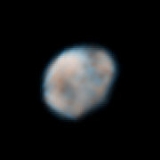
4 Vesta

Encyclopedia
Vesta, formally designated 4 Vesta, is one of the largest asteroid
s, with a mean diameter
of about 530 kilometres (329.3 mi). It was discovered by Heinrich Wilhelm Olbers on March 29, 1807, and is named after the Roman
virgin goddess
of home and hearth, Vesta
.
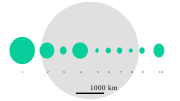
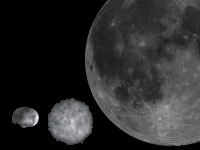
Vesta is the second-most-massive asteroid after the dwarf planet
Ceres, and comprises an estimated 9% of the mass of the asteroid belt
.
The less-massive Pallas
might have a larger volume
, which would make Vesta third in overall size, but the precise dimensions of Pallas are not known. Vesta is thought to be a remnant protoplanet
with a differentiated interior. It lost some 1% of its mass less than a billion years ago in a collision that left an enormous crater occupying much of its southern hemisphere. Debris from this event has fallen to Earth
as Howardite–Eucrite–Diogenite (HED) meteorites
, a rich source of information about the asteroid.
Vesta is the brightest asteroid visible from Earth. Its maximum distance from the Sun
is slightly farther than the minimum distance of Ceres from the Sun, though its orbit lies entirely within the Cererian orbit.
NASA's Dawn spacecraft entered orbit around Vesta on July 16, 2011 for a planned one-year exploration, and what is known about Vesta will be refined and extended as data from Dawn is received, analyzed and published.
 Heinrich Olbers discovered Pallas
in 1802, the year after the discovery of Ceres. He proposed that the two objects were the remnants of a destroyed planet. He sent a letter with his proposal to the English astronomer William Herschel
, suggesting that a search near the locations where the orbits of Ceres and Pallas intersected might reveal more fragments. These orbital intersections were located in the constellation
s of Cetus
and Virgo
.
Olbers commenced his search in 1802, and on March 29, 1807 he discovered Vesta in the constellation Virgo—a coincidence, as Ceres, Pallas, and Vesta are not fragments of a larger body. As the asteroid Juno
had been discovered in 1804, this made Vesta the fourth object to be identified in the region that is now known as the asteroid belt
. The discovery was announced in a letter addressed to German astronomer Johann H. Schröter dated March 31.
Because he already had credit for discovering a planet, Pallas, Olbers gave the honor of naming his new discovery to German mathematician Carl Friedrich Gauss
, whose orbital calculations had enabled astronomers to confirm the existence of Ceres, the first asteroid, and who had computed the orbit of the new planet in the remarkably short time of 10 hours. Gauss decided on the Roman
virgin goddess
of home and hearth, Vesta
.
and China
. In Greek
the name adopted was the Hellenic equivalent of Vesta, Hestia
(4 Εστία); in English, that name is used for 46 Hestia
(Greeks use the name "Hestia" for both, with the asteroid numbers used for disambiguation). In Chinese
, Vesta is called the 'hearth-god(dess) star', 灶神星 yàngshénxīng, in contrast to the goddess Vesta, who goes by her Latin name.
When Vesta was discovered by Olbers, Ceres, Pallas, and Juno were classified as planets and each had its own planetary symbol
. Vesta was likewise classified as a planet, and along with its name, Gauss designed an appropriate planetary symbol, , the altar of the Vesta with its sacred fire
. In Gauss's conception this was drawn in its modern form it is
After the discovery of Vesta, no further objects were discovered for 38 years, and the Solar System was thought to have eleven planets.
However, in 1845 new asteroids started being discovered at a rapid pace, and by 1851 there were fifteen, each with its own symbol, in addition to the seven major planets. It soon became clear that it would be impractical to continue inventing new planetary symbols indefinitely, and some of the existing ones proved difficult to draw quickly. That year the problem was addressed by Benjamin Apthorp Gould
, who suggested numbering asteroids in their order of discovery, and placing this number in a disk (circle) as the generic symbol of an asteroid. Thus the fourth asteroid, Vesta, acquired the generic symbol ④. This was soon coupled with the name into an official number–name designation, ④ Vesta, as the number of minor planets increased. By ca 1858, the circle had been simplified to parentheses, (4) and (4) Vesta, which was easier to typeset. Other punctuation such as 4) Vesta and 4, Vesta was also used, but had more or less completely died out by 1949. Today either (4) Vesta or more commonly 4 Vesta is used.
between 1880–82 and at the Observatoire de Toulouse in 1909. These and other observations allowed the rotation rate of the asteroid to be determined by the 1950s. However, the early estimates of the rotation rate came into question because the light curve included variations in both shape and albedo
.
Early estimates of the diameter of Vesta ranged from 383 (in 1825) to 444 km. E.C. Pickering
produced an estimated diameter of 513 ± 17 km in 1879, which is close to the modern value for the mean diameter, but the subsequent estimates ranged from a low of 390 km up to a high of 602 km during the next century. The measured estimates were based on photometry
. In 1989, speckle interferometry was used to measure a dimension that varied between 498 and 548 km during the rotational period. In 1991, an occultation
of the star SAO 93228 by Vesta was observed from multiple locations in the eastern US and Canada. Based on observations from 14 different sites, the best fit to the data is an elliptical profile with dimensions of about 550 km × 462 km.
Vesta became the first asteroid to have its mass determined. Every 18 years, the asteroid 197 Arete approaches within 0.04 AU of Vesta. In 1966, based upon observations of Vesta's gravitational perturbations of Arete, Hans G. Hertz estimated the mass of Vesta as solar mass
es. More refined estimates followed, and in 2001 the perturbations of 17 Thetis
were used to estimate the mass of Vesta as solar masses.
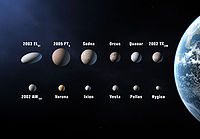 Vesta is the second-most-massive body in the asteroid belt
, though only 28% as massive as Ceres. It orbits in the inner asteroid belt interior to the Kirkwood gap
at 2.50 AU. It has a differentiated interior, and is similar to 2 Pallas
in volume (to within uncertainty) but about 25% more massive.
Vesta's shape is relatively close to a gravitationally relaxed oblate spheroid, but the large concavity and protrusion at the pole (see 'Surface features' below) combined with a mass less than 5 kg precluded Vesta from automatically being considered a dwarf planet
under International Astronomical Union (IAU) Resolution XXVI 5. Vesta may be listed as a dwarf planet
in the future, if it is convincingly determined that its shape, other than the large impact basin at the southern pole, is due to hydrostatic equilibrium
, as currently believed.
Its rotation is relatively fast for an asteroid (5.342 h) and prograde
, with the north pole pointing in the direction of right ascension
20 h 32 min, declination
+48° (in the constellation Cygnus
) with an uncertainty of about 10°. This gives an axial tilt
of 29°.
Temperatures on the surface have been estimated to lie between about −20 °C with the Sun
overhead, dropping to about −190 °C at the winter pole. Typical daytime and nighttime temperatures are −60 °C and −130 °C, respectively. This estimate is for May 6, 1996, very close to perihelion, while details vary somewhat with the seasons.
and ground based telescopes (e.g. the Keck Observatory).
The eastern and western hemispheres show markedly different terrains. From preliminary spectral analyses of the Hubble Space Telescope
images, the eastern hemisphere appears to be some kind of high-albedo
, heavily cratered "highland" terrain with aged regolith
, and craters probing into deeper plutonic layers of the crust. On the other hand, large regions of the western hemisphere are taken up by dark geologic units thought to be surface basalts, perhaps analogous to the lunar maria.
, after the mother of Romulus and Remus and a mythical vestal virgin
. Its width is 80% the diameter of Vesta. The floor of this crater is about 13 kilometres (8 mi) below, and its rim rises 4–12 km above the surrounding terrain, with total surface relief of about 25 km. A central peak rises 23 km above the lowest measured part of the crater floor and the highest measured part of the crater rim is 31 km above the crater floor low point. It is estimated that the impact responsible excavated about 1% of the volume of Vesta, and it is likely that the Vesta family
and V-type asteroid
s are the products of this collision. If this is the case, then the fact that 10-km fragments have survived bombardment until the present indicates that the crater is at most only about 1 billion years old. It would also be the original site of origin of the HED meteorite
s. In fact, all the known V-type asteroids taken together account for only about 6% of the ejected volume, with the rest presumably either in small fragments, ejected by approaching the 3:1 Kirkwood gap
, or perturbed away by the Yarkovsky effect
or radiation pressure
. Spectroscopic
analyses of the Hubble images have shown that this crater has penetrated deep through several distinct layers of the crust, and possibly into the mantle
, as indicated by spectral signatures of olivine
.
The southern polar region has a mountain that is 13 miles high.
feature about 200 kilometres (124 mi) across has been named Olbers in honour of Vesta's discoverer, but it does not appear in elevation
maps as a fresh crater would. Its nature is presently unknown; it may be an old basalt
ic surface. It serves as a reference point with the 0° longitude
prime meridian
defined to pass through its center.
"Snowman craters"
The "snowman craters" is an informal name given to a group of three adjacent craters in Vesta's northern hemisphere. The largest of the three is officially named Marcia.
on Tethys.
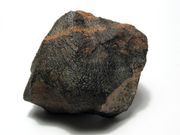 There is a large collection of potential samples from Vesta accessible to scientists, in the form of over 200 HED meteorite
s, giving insight into Vesta's geologic history and structure. NASA Infrared Telescope Facility (NASA IRTF) studies of asteroid suggest that it originated from the interior of Vesta.
Vesta is thought to consist of a metal
lic iron
–nickel
core
, an overlying rocky olivine
mantle
, with a surface crust
. From the first appearance of Ca-Al-rich inclusions
(the first solid matter in the Solar System
, forming about 4,567 million years ago), a likely time line is as follows:
Vesta is the only known intact asteroid that has been resurfaced in this manner. Because of this, some scientists refer to Vesta as a protoplanet, rather than an asteroid. However, the presence of iron meteorite
s and achondritic
meteorite classes without identified parent bodies indicates that there once were other differentiated planetesimal
s with igneous histories, which have since been shattered by impacts.
On the basis of the sizes of V-type asteroid
s (thought to be pieces of Vesta's crust ejected during large impacts), and the depth of the south polar crater (see below), the crust is thought to be roughly 10 kilometres (6 mi) thick.
are believed to be fragments of Vesta caused by collisions. The Vestian
asteroids and HED meteorite
s are examples. The V-type asteroid
1929 Kollaa
has been determined to have a composition akin to cumulate eucrite
meteorites, indicating its origin deep within Vesta's crust.
Because a number of meteorites are believed to be Vestian fragments, Vesta is currently one of only six identified Solar System
bodies for which we have physical samples, the others being Mars
, the Moon
, comet Wild 2, 25143 Itokawa
, and Earth
itself.
(ESA). Named the Asteroidal Gravity Optical and Radar Analysis (AGORA), this spacecraft
was to launch some time in 1990–1994 and perform two flybys of large asteroids. The preferred target for this mission was Vesta. AGORA would reach the asteroid belt either by a gravitational slingshot
trajectory past Mars or by means of a small ion engine. However, the proposal was refused by the ESA. A joint NASA
–ESA asteroid mission was then drawn up for a Multiple Asteroid Orbiter with Solar Electric Propulsion (MAOSEP), with one of the mission profiles including an orbit of Vesta. NASA indicated they were not interested in an asteroid mission. Instead, the ESA set up a technological study of a spacecraft with an ion drive. Other missions to the asteroid belt were proposed in the 1980s by France, Germany, Italy and the United States, but none were approved. Exploration of Vesta by fly-by and impacting penetrator was the second main target of the first plan of the multiaimed Soviet Vesta mission
, developed in cooperation with European countries for realisation in 1991–1994 but canceled due to the Soviet Union disbanding.
In the early 1990s, NASA initiated the Discovery Program
, which was intended to be a series of low-cost scientific missions. In 1996, the program's study team recommended as a high priority a mission to explore the asteroid belt using a spacecraft with an ion engine. Funding for this program remained problematic for several years, but by 2004 the Dawn vehicle had passed its critical design review.
It launched on September 27, 2007, as the first space mission to Vesta. It is planned to orbit the asteroid for one year, from July 16, 2011 until July 2012. This will coincide with late summer in the southern hemisphere of Vesta, so the large crater at the south pole will be in sunlight; since a season on Vesta lasts eleven months, the northern hemisphere, including anticipated compression fractures opposite the crater, will become visible to Dawns cameras before it leaves orbit.
On May 3, 2011, Dawn acquired its first targeting image 1.2 million kilometers from Vesta. On July 16, 2011, NASA confirmed that it received telemetry from Dawn indicating that the spacecraft successfully entered Vesta's orbit.
Scientists will use Dawn to calculate Vesta's precise mass based on gravitational interactions
. This will allow scientists to refine the mass estimates of the asteroids that are in turn perturbed
by Vesta.
NASA/DRL released imagery and summary information from a high-altitude orbit, including a two-minute video, in September 2011. Much more detailed imagery will begin to be obtained, from a lower orbit, beginning in October 2011.
from dark skies (without light pollution
). In May and June 2007, Vesta reached a peak magnitude
of +5.4, the brightest since 1989. At that time, opposition
and perihelion were only a few weeks apart. It was visible in the constellations Ophiuchus
and Scorpius
.
Less favorable oppositions during late autumn 2008 in the Northern Hemisphere
still had Vesta at a magnitude of from +6.5 to +7.3. Even when in conjunction with the Sun, Vesta will have a magnitude around +8.5; thus from a pollution-free sky it can be observed with binoculars
even at elongations much smaller than near opposition.
of Leo
on the night of February 17–18, when it was about magnitude 6.1, a brightness that makes it visible in binocular range but not for the naked eye. Under perfect dark sky conditions where all light pollution is absent it might be visible to an experienced observer without the use of a telescope or binoculars. Vesta came to opposition again on August 5, 2011, in the constellation of Capricornus
at about magnitude 5.6.
Asteroid
Asteroids are a class of small Solar System bodies in orbit around the Sun. They have also been called planetoids, especially the larger ones...
s, with a mean diameter
Diameter
In geometry, a diameter of a circle is any straight line segment that passes through the center of the circle and whose endpoints are on the circle. The diameters are the longest chords of the circle...
of about 530 kilometres (329.3 mi). It was discovered by Heinrich Wilhelm Olbers on March 29, 1807, and is named after the Roman
Roman mythology
Roman mythology is the body of traditional stories pertaining to ancient Rome's legendary origins and religious system, as represented in the literature and visual arts of the Romans...
virgin goddess
Goddess
A goddess is a female deity. In some cultures goddesses are associated with Earth, motherhood, love, and the household. In other cultures, goddesses also rule over war, death, and destruction as well as healing....
of home and hearth, Vesta
Vesta (mythology)
Vesta was the virgin goddess of the hearth, home, and family in Roman religion. Vesta's presence was symbolized by the sacred fire that burned at her hearth and temples...
.
Vesta is the second-most-massive asteroid after the dwarf planet
Dwarf planet
A dwarf planet, as defined by the International Astronomical Union , is a celestial body orbiting the Sun that is massive enough to be spherical as a result of its own gravity but has not cleared its neighboring region of planetesimals and is not a satellite...
Ceres, and comprises an estimated 9% of the mass of the asteroid belt
Asteroid belt
The asteroid belt is the region of the Solar System located roughly between the orbits of the planets Mars and Jupiter. It is occupied by numerous irregularly shaped bodies called asteroids or minor planets...
.
The less-massive Pallas
2 Pallas
Pallas, formally designated 2 Pallas, is the second asteroid to have been discovered , and one of the largest. It is estimated to constitute 7% of the mass of the asteroid belt, and its diameter of 530–565 km is comparable to, or slightly larger than, that of 4 Vesta. It is however 20%...
might have a larger volume
Volume
Volume is the quantity of three-dimensional space enclosed by some closed boundary, for example, the space that a substance or shape occupies or contains....
, which would make Vesta third in overall size, but the precise dimensions of Pallas are not known. Vesta is thought to be a remnant protoplanet
Protoplanet
Protoplanets are large planetary embryos that originate within protoplanetary discs and have undergone internal melting to produce differentiated interiors. They are believed to form out of kilometer-sized planetesimals that attract each other gravitationally and collide...
with a differentiated interior. It lost some 1% of its mass less than a billion years ago in a collision that left an enormous crater occupying much of its southern hemisphere. Debris from this event has fallen to Earth
Earth
Earth is the third planet from the Sun, and the densest and fifth-largest of the eight planets in the Solar System. It is also the largest of the Solar System's four terrestrial planets...
as Howardite–Eucrite–Diogenite (HED) meteorites
HED meteorite
HED meteorites are a subgroup of achondrite meteorites. HED stands for "Howardite–Eucrite–Diogenite".These achondrites came from a differentiated parent body and experienced extensive igneous processing not much different from the magmatic rocks found on Earth and for this reason they closely...
, a rich source of information about the asteroid.
Vesta is the brightest asteroid visible from Earth. Its maximum distance from the Sun
Sun
The Sun is the star at the center of the Solar System. It is almost perfectly spherical and consists of hot plasma interwoven with magnetic fields...
is slightly farther than the minimum distance of Ceres from the Sun, though its orbit lies entirely within the Cererian orbit.
NASA's Dawn spacecraft entered orbit around Vesta on July 16, 2011 for a planned one-year exploration, and what is known about Vesta will be refined and extended as data from Dawn is received, analyzed and published.
Discovery
2 Pallas
Pallas, formally designated 2 Pallas, is the second asteroid to have been discovered , and one of the largest. It is estimated to constitute 7% of the mass of the asteroid belt, and its diameter of 530–565 km is comparable to, or slightly larger than, that of 4 Vesta. It is however 20%...
in 1802, the year after the discovery of Ceres. He proposed that the two objects were the remnants of a destroyed planet. He sent a letter with his proposal to the English astronomer William Herschel
William Herschel
Sir Frederick William Herschel, KH, FRS, German: Friedrich Wilhelm Herschel was a German-born British astronomer, technical expert, and composer. Born in Hanover, Wilhelm first followed his father into the Military Band of Hanover, but emigrated to Britain at age 19...
, suggesting that a search near the locations where the orbits of Ceres and Pallas intersected might reveal more fragments. These orbital intersections were located in the constellation
Constellation
In modern astronomy, a constellation is an internationally defined area of the celestial sphere. These areas are grouped around asterisms, patterns formed by prominent stars within apparent proximity to one another on Earth's night sky....
s of Cetus
Cetus
Cetus is a constellation. Its name refers to Cetus, a sea monster in Greek mythology, although it is often called 'the whale' today. Cetus is located in the region of the sky that contains other water-related constellations such as Aquarius, Pisces, and Eridanus.-Ecliptic:Although Cetus is not...
and Virgo
Virgo (constellation)
Virgo is one of the constellations of the zodiac. Its name is Latin for virgin, and its symbol is . Lying between Leo to the west and Libra to the east, it is the second largest constellation in the sky...
.
Olbers commenced his search in 1802, and on March 29, 1807 he discovered Vesta in the constellation Virgo—a coincidence, as Ceres, Pallas, and Vesta are not fragments of a larger body. As the asteroid Juno
3 Juno
Juno , formal designation 3 Juno in the Minor Planet Center catalogue system, was the third asteroid to be discovered and is one of the larger main-belt asteroids, being one of the two largest stony asteroids, along with 15 Eunomia. Juno is estimated to contain 1% of the total mass of the asteroid...
had been discovered in 1804, this made Vesta the fourth object to be identified in the region that is now known as the asteroid belt
Asteroid belt
The asteroid belt is the region of the Solar System located roughly between the orbits of the planets Mars and Jupiter. It is occupied by numerous irregularly shaped bodies called asteroids or minor planets...
. The discovery was announced in a letter addressed to German astronomer Johann H. Schröter dated March 31.
Because he already had credit for discovering a planet, Pallas, Olbers gave the honor of naming his new discovery to German mathematician Carl Friedrich Gauss
Carl Friedrich Gauss
Johann Carl Friedrich Gauss was a German mathematician and scientist who contributed significantly to many fields, including number theory, statistics, analysis, differential geometry, geodesy, geophysics, electrostatics, astronomy and optics.Sometimes referred to as the Princeps mathematicorum...
, whose orbital calculations had enabled astronomers to confirm the existence of Ceres, the first asteroid, and who had computed the orbit of the new planet in the remarkably short time of 10 hours. Gauss decided on the Roman
Roman mythology
Roman mythology is the body of traditional stories pertaining to ancient Rome's legendary origins and religious system, as represented in the literature and visual arts of the Romans...
virgin goddess
Goddess
A goddess is a female deity. In some cultures goddesses are associated with Earth, motherhood, love, and the household. In other cultures, goddesses also rule over war, death, and destruction as well as healing....
of home and hearth, Vesta
Vesta (mythology)
Vesta was the virgin goddess of the hearth, home, and family in Roman religion. Vesta's presence was symbolized by the sacred fire that burned at her hearth and temples...
.
Nomenclature
Vesta was the fourth asteroid to be discovered, hence the number 4 in its formal designation. The name Vesta, or national variants thereof, is in international use with two exceptions, GreeceGreece
Greece , officially the Hellenic Republic , and historically Hellas or the Republic of Greece in English, is a country in southeastern Europe....
and China
China
Chinese civilization may refer to:* China for more general discussion of the country.* Chinese culture* Greater China, the transnational community of ethnic Chinese.* History of China* Sinosphere, the area historically affected by Chinese culture...
. In Greek
Modern Greek
Modern Greek refers to the varieties of the Greek language spoken in the modern era. The beginning of the "modern" period of the language is often symbolically assigned to the fall of the Byzantine Empire in 1453, even though that date marks no clear linguistic boundary and many characteristic...
the name adopted was the Hellenic equivalent of Vesta, Hestia
Hestia
In Greek mythology Hestia , first daughter of Cronus and Rhea , is the virgin goddess of the hearth, architecture, and of the right ordering of domesticity and the family. She received the first offering at every sacrifice in the household. In the public domain, the hearth of the prytaneum...
(4 Εστία); in English, that name is used for 46 Hestia
46 Hestia
46 Hestia is a large, dark main-belt asteroid. It is also the primary body of the Hestia clump, a group of asteroids with similar orbits.Hestia was discovered by N. R. Pogson on August 16, 1857, at the Radcliffe Observatory, Oxford. Pogson awarded the honour of naming it to William Henry Smyth,...
(Greeks use the name "Hestia" for both, with the asteroid numbers used for disambiguation). In Chinese
Standard Chinese
Standard Chinese, or Modern Standard Chinese, also known as Mandarin or Putonghua, is the official language of the People's Republic of China and Republic of China , and is one of the four official languages of Singapore....
, Vesta is called the 'hearth-god(dess) star', 灶神星 yàngshénxīng, in contrast to the goddess Vesta, who goes by her Latin name.
When Vesta was discovered by Olbers, Ceres, Pallas, and Juno were classified as planets and each had its own planetary symbol
Astronomical symbols
Astronomical symbols are symbols used to represent various celestial objects, theoretical constructs and observational events in astronomy. The earliest forms of these symbols appear in Greek papyri of late antiquity. The Byzantine codices in which the Greek papyri were preserved continued and...
. Vesta was likewise classified as a planet, and along with its name, Gauss designed an appropriate planetary symbol, , the altar of the Vesta with its sacred fire
Sacred fire of Vesta
The sacred fire of Vesta was a holy fire in Ancient Rome. The Vestal Virgins were selected by lot and served for thirty years, tending the holy fire and performing other rituals connected to domestic life—among them were the ritual sweeping of the temple on June 15 and the preparation of...
. In Gauss's conception this was drawn in its modern form it is
After the discovery of Vesta, no further objects were discovered for 38 years, and the Solar System was thought to have eleven planets.
However, in 1845 new asteroids started being discovered at a rapid pace, and by 1851 there were fifteen, each with its own symbol, in addition to the seven major planets. It soon became clear that it would be impractical to continue inventing new planetary symbols indefinitely, and some of the existing ones proved difficult to draw quickly. That year the problem was addressed by Benjamin Apthorp Gould
Benjamin Apthorp Gould
Benjamin Apthorp Gould was a pioneering American astronomer. He is notable for creating the Astronomical Journal, discovering the Gould Belt, and for founding of the Argentine National Observatory and the Argentine National Weather Service.-Biography:He was born in Boston, Massachusetts, son of...
, who suggested numbering asteroids in their order of discovery, and placing this number in a disk (circle) as the generic symbol of an asteroid. Thus the fourth asteroid, Vesta, acquired the generic symbol ④. This was soon coupled with the name into an official number–name designation, ④ Vesta, as the number of minor planets increased. By ca 1858, the circle had been simplified to parentheses, (4) and (4) Vesta, which was easier to typeset. Other punctuation such as 4) Vesta and 4, Vesta was also used, but had more or less completely died out by 1949. Today either (4) Vesta or more commonly 4 Vesta is used.
Early measurements
Photometric observations of the asteroid Vesta were made at the Harvard College ObservatoryHarvard College Observatory
The Harvard College Observatory is an institution managing a complex of buildings and multiple instruments used for astronomical research by the Harvard University Department of Astronomy. It is located in Cambridge, Massachusetts, USA, and was founded in 1839...
between 1880–82 and at the Observatoire de Toulouse in 1909. These and other observations allowed the rotation rate of the asteroid to be determined by the 1950s. However, the early estimates of the rotation rate came into question because the light curve included variations in both shape and albedo
Albedo
Albedo , or reflection coefficient, is the diffuse reflectivity or reflecting power of a surface. It is defined as the ratio of reflected radiation from the surface to incident radiation upon it...
.
Early estimates of the diameter of Vesta ranged from 383 (in 1825) to 444 km. E.C. Pickering
Edward Charles Pickering
Edward Charles Pickering was an American astronomer and physicist, brother of William Henry Pickering.Along with Carl Vogel, Pickering discovered the first spectroscopic binary stars. He wrote Elements of Physical Manipulations .Pickering attended Boston Latin School, and received his B.S. from...
produced an estimated diameter of 513 ± 17 km in 1879, which is close to the modern value for the mean diameter, but the subsequent estimates ranged from a low of 390 km up to a high of 602 km during the next century. The measured estimates were based on photometry
Photometry (astronomy)
Photometry is a technique of astronomy concerned with measuring the flux, or intensity of an astronomical object's electromagnetic radiation...
. In 1989, speckle interferometry was used to measure a dimension that varied between 498 and 548 km during the rotational period. In 1991, an occultation
Occultation
An occultation is an event that occurs when one object is hidden by another object that passes between it and the observer. The word is used in astronomy . It can also refer to any situation wherein an object in the foreground blocks from view an object in the background...
of the star SAO 93228 by Vesta was observed from multiple locations in the eastern US and Canada. Based on observations from 14 different sites, the best fit to the data is an elliptical profile with dimensions of about 550 km × 462 km.
Vesta became the first asteroid to have its mass determined. Every 18 years, the asteroid 197 Arete approaches within 0.04 AU of Vesta. In 1966, based upon observations of Vesta's gravitational perturbations of Arete, Hans G. Hertz estimated the mass of Vesta as solar mass
Solar mass
The solar mass , , is a standard unit of mass in astronomy, used to indicate the masses of other stars and galaxies...
es. More refined estimates followed, and in 2001 the perturbations of 17 Thetis
17 Thetis
17 Thetis is a large main-belt asteroid. It is an S-type asteroid, therefore giving it a relatively bright silicate surface.It was discovered by R. Luther on April 17, 1852. It was his first asteroid discovery. Its name comes from Thetis, the mother of Achilles in Greek mythology.One Thetidian...
were used to estimate the mass of Vesta as solar masses.
Physical characteristics
Asteroid belt
The asteroid belt is the region of the Solar System located roughly between the orbits of the planets Mars and Jupiter. It is occupied by numerous irregularly shaped bodies called asteroids or minor planets...
, though only 28% as massive as Ceres. It orbits in the inner asteroid belt interior to the Kirkwood gap
Kirkwood gap
A Kirkwood gap is a gap or dip in the distribution of main-belt asteroids with semi-major axis , as seen in the histogram below...
at 2.50 AU. It has a differentiated interior, and is similar to 2 Pallas
2 Pallas
Pallas, formally designated 2 Pallas, is the second asteroid to have been discovered , and one of the largest. It is estimated to constitute 7% of the mass of the asteroid belt, and its diameter of 530–565 km is comparable to, or slightly larger than, that of 4 Vesta. It is however 20%...
in volume (to within uncertainty) but about 25% more massive.
Vesta's shape is relatively close to a gravitationally relaxed oblate spheroid, but the large concavity and protrusion at the pole (see 'Surface features' below) combined with a mass less than 5 kg precluded Vesta from automatically being considered a dwarf planet
Dwarf planet
A dwarf planet, as defined by the International Astronomical Union , is a celestial body orbiting the Sun that is massive enough to be spherical as a result of its own gravity but has not cleared its neighboring region of planetesimals and is not a satellite...
under International Astronomical Union (IAU) Resolution XXVI 5. Vesta may be listed as a dwarf planet
Dwarf planet
A dwarf planet, as defined by the International Astronomical Union , is a celestial body orbiting the Sun that is massive enough to be spherical as a result of its own gravity but has not cleared its neighboring region of planetesimals and is not a satellite...
in the future, if it is convincingly determined that its shape, other than the large impact basin at the southern pole, is due to hydrostatic equilibrium
Hydrostatic equilibrium
Hydrostatic equilibrium or hydrostatic balance is the condition in fluid mechanics where a volume of a fluid is at rest or at constant velocity. This occurs when compression due to gravity is balanced by a pressure gradient force...
, as currently believed.
Its rotation is relatively fast for an asteroid (5.342 h) and prograde
Retrograde motion
Retrograde motion is motion in the direction opposite to the movement of something else, and is the contrary of direct or prograde motion. This motion can be the orbit of one body about another body or about some other point, or the rotation of a single body about its axis, or other phenomena such...
, with the north pole pointing in the direction of right ascension
Right ascension
Right ascension is the astronomical term for one of the two coordinates of a point on the celestial sphere when using the equatorial coordinate system. The other coordinate is the declination.-Explanation:...
20 h 32 min, declination
Declination
In astronomy, declination is one of the two coordinates of the equatorial coordinate system, the other being either right ascension or hour angle. Declination in astronomy is comparable to geographic latitude, but projected onto the celestial sphere. Declination is measured in degrees north and...
+48° (in the constellation Cygnus
Cygnus (constellation)
Cygnus is a northern constellation lying on the plane of the Milky Way. Its name is the Latinized Hellenic word for swan. One of the most recognizable constellations of the northern summer and autumn, it features a prominent asterism known as the Northern Cross...
) with an uncertainty of about 10°. This gives an axial tilt
Axial tilt
In astronomy, axial tilt is the angle between an object's rotational axis, and a line perpendicular to its orbital plane...
of 29°.
Temperatures on the surface have been estimated to lie between about −20 °C with the Sun
Sun
The Sun is the star at the center of the Solar System. It is almost perfectly spherical and consists of hot plasma interwoven with magnetic fields...
overhead, dropping to about −190 °C at the winter pole. Typical daytime and nighttime temperatures are −60 °C and −130 °C, respectively. This estimate is for May 6, 1996, very close to perihelion, while details vary somewhat with the seasons.
Surface features
Prior to the arrival of the Dawn spacecraft, some Vestian surface features had already been resolved using the Hubble Space TelescopeHubble Space Telescope
The Hubble Space Telescope is a space telescope that was carried into orbit by a Space Shuttle in 1990 and remains in operation. A 2.4 meter aperture telescope in low Earth orbit, Hubble's four main instruments observe in the near ultraviolet, visible, and near infrared...
and ground based telescopes (e.g. the Keck Observatory).
The eastern and western hemispheres show markedly different terrains. From preliminary spectral analyses of the Hubble Space Telescope
Hubble Space Telescope
The Hubble Space Telescope is a space telescope that was carried into orbit by a Space Shuttle in 1990 and remains in operation. A 2.4 meter aperture telescope in low Earth orbit, Hubble's four main instruments observe in the near ultraviolet, visible, and near infrared...
images, the eastern hemisphere appears to be some kind of high-albedo
Albedo
Albedo , or reflection coefficient, is the diffuse reflectivity or reflecting power of a surface. It is defined as the ratio of reflected radiation from the surface to incident radiation upon it...
, heavily cratered "highland" terrain with aged regolith
Regolith
Regolith is a layer of loose, heterogeneous material covering solid rock. It includes dust, soil, broken rock, and other related materials and is present on Earth, the Moon, some asteroids, and other terrestrial planets and moons.-Etymology:...
, and craters probing into deeper plutonic layers of the crust. On the other hand, large regions of the western hemisphere are taken up by dark geologic units thought to be surface basalts, perhaps analogous to the lunar maria.
Rheasilvia crater
The most prominent of these surface features is an enormous crater 460 kilometres (286 mi) in diameter centered near the south pole. The Dawn science team has named it RheasilviaRheasilvia
Rheasilvia is the most prominent surface feature on asteroid 4 Vesta and is believed to be an impact crater. in diameter, it is 80% the size of the asteroid, making it one of the largest craters in the Solar System, and covers most of the southern hemisphere. It was discovered in Hubble images in...
, after the mother of Romulus and Remus and a mythical vestal virgin
Vestal Virgin
In ancient Roman religion, the Vestals or Vestal Virgins , were priestesses of Vesta, goddess of the hearth. The College of the Vestals and its well-being was regarded as fundamental to the continuance and security of Rome, as embodied by their cultivation of the sacred fire that could not be...
. Its width is 80% the diameter of Vesta. The floor of this crater is about 13 kilometres (8 mi) below, and its rim rises 4–12 km above the surrounding terrain, with total surface relief of about 25 km. A central peak rises 23 km above the lowest measured part of the crater floor and the highest measured part of the crater rim is 31 km above the crater floor low point. It is estimated that the impact responsible excavated about 1% of the volume of Vesta, and it is likely that the Vesta family
Vesta family
The Vesta or Vestian family of asteroids is a large and prominent grouping of mostly V-type asteroids in the inner asteroid belt in the vicinity of 4 Vesta...
and V-type asteroid
V-type asteroid
The spectra of the V-type asteroids or Vestoids are similar to that of 4 Vesta, by far the largest asteroid in this class ....
s are the products of this collision. If this is the case, then the fact that 10-km fragments have survived bombardment until the present indicates that the crater is at most only about 1 billion years old. It would also be the original site of origin of the HED meteorite
HED meteorite
HED meteorites are a subgroup of achondrite meteorites. HED stands for "Howardite–Eucrite–Diogenite".These achondrites came from a differentiated parent body and experienced extensive igneous processing not much different from the magmatic rocks found on Earth and for this reason they closely...
s. In fact, all the known V-type asteroids taken together account for only about 6% of the ejected volume, with the rest presumably either in small fragments, ejected by approaching the 3:1 Kirkwood gap
Kirkwood gap
A Kirkwood gap is a gap or dip in the distribution of main-belt asteroids with semi-major axis , as seen in the histogram below...
, or perturbed away by the Yarkovsky effect
Yarkovsky effect
The Yarkovsky effect is a force acting on a rotating body in space caused by the anisotropic emission of thermal photons, which carry momentum...
or radiation pressure
Radiation pressure
Radiation pressure is the pressure exerted upon any surface exposed to electromagnetic radiation. If absorbed, the pressure is the power flux density divided by the speed of light...
. Spectroscopic
Spectroscopy
Spectroscopy is the study of the interaction between matter and radiated energy. Historically, spectroscopy originated through the study of visible light dispersed according to its wavelength, e.g., by a prism. Later the concept was expanded greatly to comprise any interaction with radiative...
analyses of the Hubble images have shown that this crater has penetrated deep through several distinct layers of the crust, and possibly into the mantle
Mantle (geology)
The mantle is a part of a terrestrial planet or other rocky body large enough to have differentiation by density. The interior of the Earth, similar to the other terrestrial planets, is chemically divided into layers. The mantle is a highly viscous layer between the crust and the outer core....
, as indicated by spectral signatures of olivine
Olivine
The mineral olivine is a magnesium iron silicate with the formula 2SiO4. It is a common mineral in the Earth's subsurface but weathers quickly on the surface....
.
The southern polar region has a mountain that is 13 miles high.
Other craters
Several other large craters about 150 kilometres (93 mi) wide and 7 kilometres (4 mi) deep are also present. A dark albedoAlbedo
Albedo , or reflection coefficient, is the diffuse reflectivity or reflecting power of a surface. It is defined as the ratio of reflected radiation from the surface to incident radiation upon it...
feature about 200 kilometres (124 mi) across has been named Olbers in honour of Vesta's discoverer, but it does not appear in elevation
Elevation
The elevation of a geographic location is its height above a fixed reference point, most commonly a reference geoid, a mathematical model of the Earth's sea level as an equipotential gravitational surface ....
maps as a fresh crater would. Its nature is presently unknown; it may be an old basalt
Basalt
Basalt is a common extrusive volcanic rock. It is usually grey to black and fine-grained due to rapid cooling of lava at the surface of a planet. It may be porphyritic containing larger crystals in a fine matrix, or vesicular, or frothy scoria. Unweathered basalt is black or grey...
ic surface. It serves as a reference point with the 0° longitude
Longitude
Longitude is a geographic coordinate that specifies the east-west position of a point on the Earth's surface. It is an angular measurement, usually expressed in degrees, minutes and seconds, and denoted by the Greek letter lambda ....
prime meridian
Prime Meridian
The Prime Meridian is the meridian at which the longitude is defined to be 0°.The Prime Meridian and its opposite the 180th meridian , which the International Date Line generally follows, form a great circle that divides the Earth into the Eastern and Western Hemispheres.An international...
defined to pass through its center.
"Snowman craters"
The "snowman craters" is an informal name given to a group of three adjacent craters in Vesta's northern hemisphere. The largest of the three is officially named Marcia.
Equatorial grooves
The southern equatorial region of Vesta is characterized by a series of concentric grooves. These are thought to be compression fractures from the impact that created Rheasilvia crater. If they are continuous features, they would be one of the longer chasms in the Solar System, nearly as long as Ithaca ChasmaIthaca Chasma
Ithaca Chasma is a valley on Saturn's moon Tethys, named after the island of Ithaca, in Greece. It is on average 100 km wide, 3 to 5 km deep and 2,000 km long, running approximately three-quarters of the way around Tethys' circumference, making it one of the longer valleys in the...
on Tethys.
Geology
HED meteorite
HED meteorites are a subgroup of achondrite meteorites. HED stands for "Howardite–Eucrite–Diogenite".These achondrites came from a differentiated parent body and experienced extensive igneous processing not much different from the magmatic rocks found on Earth and for this reason they closely...
s, giving insight into Vesta's geologic history and structure. NASA Infrared Telescope Facility (NASA IRTF) studies of asteroid suggest that it originated from the interior of Vesta.
Vesta is thought to consist of a metal
Metal
A metal , is an element, compound, or alloy that is a good conductor of both electricity and heat. Metals are usually malleable and shiny, that is they reflect most of incident light...
lic iron
Iron
Iron is a chemical element with the symbol Fe and atomic number 26. It is a metal in the first transition series. It is the most common element forming the planet Earth as a whole, forming much of Earth's outer and inner core. It is the fourth most common element in the Earth's crust...
–nickel
Nickel
Nickel is a chemical element with the chemical symbol Ni and atomic number 28. It is a silvery-white lustrous metal with a slight golden tinge. Nickel belongs to the transition metals and is hard and ductile...
core
Planetary core
The planetary core consists of the innermost layer of a planet.The core may be composed of solid and liquid layers, while the cores of Mars and Venus are thought to be completely solid as they lack an internally generated magnetic field. In our solar system, core size can range from about 20% to...
, an overlying rocky olivine
Olivine
The mineral olivine is a magnesium iron silicate with the formula 2SiO4. It is a common mineral in the Earth's subsurface but weathers quickly on the surface....
mantle
Mantle (geology)
The mantle is a part of a terrestrial planet or other rocky body large enough to have differentiation by density. The interior of the Earth, similar to the other terrestrial planets, is chemically divided into layers. The mantle is a highly viscous layer between the crust and the outer core....
, with a surface crust
Crust (geology)
In geology, the crust is the outermost solid shell of a rocky planet or natural satellite, which is chemically distinct from the underlying mantle...
. From the first appearance of Ca-Al-rich inclusions
Ca-Al-rich inclusions
A calcium-aluminium-rich inclusion or Ca-Al-rich Inclusion is a submillimeter to centimeter-sized light-colored calcium- and aluminium-rich inclusion found in carbonaceous chondrite meteorites...
(the first solid matter in the Solar System
Solar System
The Solar System consists of the Sun and the astronomical objects gravitationally bound in orbit around it, all of which formed from the collapse of a giant molecular cloud approximately 4.6 billion years ago. The vast majority of the system's mass is in the Sun...
, forming about 4,567 million years ago), a likely time line is as follows:
| 2–3 million years | Accretion completed |
|---|---|
| 4–5 million years | Complete or almost complete melting due to radioactive decay Radioactive decay Radioactive decay is the process by which an atomic nucleus of an unstable atom loses energy by emitting ionizing particles . The emission is spontaneous, in that the atom decays without any physical interaction with another particle from outside the atom... of 26Al, leading to separation of the metal core |
| 6–7 million years | Progressive crystallization of a convecting Convection Convection is the movement of molecules within fluids and rheids. It cannot take place in solids, since neither bulk current flows nor significant diffusion can take place in solids.... molten mantle Mantle (geology) The mantle is a part of a terrestrial planet or other rocky body large enough to have differentiation by density. The interior of the Earth, similar to the other terrestrial planets, is chemically divided into layers. The mantle is a highly viscous layer between the crust and the outer core.... . Convection stopped when about 80% of the material had crystallized |
| Extrusion Extrusive (geology) Extrusive refers to the mode of igneous volcanic rock formation in which hot magma from inside the Earth flows out onto the surface as lava or explodes violently into the atmosphere to fall back as pyroclastics or tuff... of the remaining molten material to form the crust Crust (geology) In geology, the crust is the outermost solid shell of a rocky planet or natural satellite, which is chemically distinct from the underlying mantle... , either as basalt Basalt Basalt is a common extrusive volcanic rock. It is usually grey to black and fine-grained due to rapid cooling of lava at the surface of a planet. It may be porphyritic containing larger crystals in a fine matrix, or vesicular, or frothy scoria. Unweathered basalt is black or grey... ic lava Lava Lava refers both to molten rock expelled by a volcano during an eruption and the resulting rock after solidification and cooling. This molten rock is formed in the interior of some planets, including Earth, and some of their satellites. When first erupted from a volcanic vent, lava is a liquid at... s in progressive eruptions, or possibly forming a short-lived magma Magma Magma is a mixture of molten rock, volatiles and solids that is found beneath the surface of the Earth, and is expected to exist on other terrestrial planets. Besides molten rock, magma may also contain suspended crystals and dissolved gas and sometimes also gas bubbles. Magma often collects in... ocean. |
|
| The deeper layers of the crust crystallize Crystallization Crystallization is the process of formation of solid crystals precipitating from a solution, melt or more rarely deposited directly from a gas. Crystallization is also a chemical solid–liquid separation technique, in which mass transfer of a solute from the liquid solution to a pure solid... to form plutonic rocks, while older basalts are metamorphosed Metamorphic rock Metamorphic rock is the transformation of an existing rock type, the protolith, in a process called metamorphism, which means "change in form". The protolith is subjected to heat and pressure causing profound physical and/or chemical change... due to the pressure of newer surface layers. |
|
| Slow cooling of the interior | |
Vesta is the only known intact asteroid that has been resurfaced in this manner. Because of this, some scientists refer to Vesta as a protoplanet, rather than an asteroid. However, the presence of iron meteorite
Iron meteorite
Iron meteorites are meteorites that consist overwhelmingly of nickel-iron alloys. The metal taken from these meteorites is known as meteoric iron and was one of the earliest sources of usable iron available to humans.-Occurrence:...
s and achondritic
Achondrite
An achondrite is a stony meteorite that does not contain chondrules. It consists of material similar to terrestrial basalts or plutonic rocks and has been differentiated and reprocessed to a lesser or greater degree due to melting and recrystallization on or within meteorite parent bodies...
meteorite classes without identified parent bodies indicates that there once were other differentiated planetesimal
Planetesimal
Planetesimals are solid objects thought to exist in protoplanetary disks and in debris disks.A widely accepted theory of planet formation, the so-called planetesimal hypothesis of Viktor Safronov, states that planets form out of cosmic dust grains that collide and stick to form larger and larger...
s with igneous histories, which have since been shattered by impacts.
| A lithified regolith Regolith Regolith is a layer of loose, heterogeneous material covering solid rock. It includes dust, soil, broken rock, and other related materials and is present on Earth, the Moon, some asteroids, and other terrestrial planets and moons.-Etymology:... , the source of howardite Howardite Howardites are achondritic stony meteorites that originate from the surface of the asteroid 4 Vesta, and as such are part of the HED meteorite group. There are about 200 distinct members known.-Characteristics:... s and breccia Breccia Breccia is a rock composed of broken fragments of minerals or rock cemented together by a fine-grained matrix, that can be either similar to or different from the composition of the fragments.... ted eucrite Eucrite Eucrites are achondritic stony meteorites, many of which originate from the surface of the asteroid 4 Vesta and as such are part of the HED meteorite group. They are the most common achondrite group with well over 100 distinct finds at present.... s. |
| Basalt Basalt Basalt is a common extrusive volcanic rock. It is usually grey to black and fine-grained due to rapid cooling of lava at the surface of a planet. It may be porphyritic containing larger crystals in a fine matrix, or vesicular, or frothy scoria. Unweathered basalt is black or grey... ic lava flows, a source of non-cumulate eucrite Eucrite Eucrites are achondritic stony meteorites, many of which originate from the surface of the asteroid 4 Vesta and as such are part of the HED meteorite group. They are the most common achondrite group with well over 100 distinct finds at present.... s. |
| Plutonic rocks consisting of pyroxene Pyroxene The pyroxenes are a group of important rock-forming inosilicate minerals found in many igneous and metamorphic rocks. They share a common structure consisting of single chains of silica tetrahedra and they crystallize in the monoclinic and orthorhombic systems... , pigeonite Pigeonite Pigeonite is a mineral in the clinopyroxene group. It has a general formula of Si2O6. The calcium cation fraction can vary from 5% to 25%, with iron and magnesium making up the rest of the cations.... and plagioclase Plagioclase Plagioclase is an important series of tectosilicate minerals within the feldspar family. Rather than referring to a particular mineral with a specific chemical composition, plagioclase is a solid solution series, more properly known as the plagioclase feldspar series... , the source of cumulate eucrite Eucrite Eucrites are achondritic stony meteorites, many of which originate from the surface of the asteroid 4 Vesta and as such are part of the HED meteorite group. They are the most common achondrite group with well over 100 distinct finds at present.... s. |
| Plutonic rocks rich in orthopyroxene with large grain sizes, the source of diogenite Diogenite Diogenites are a subgroup of the HED meteorite group, a type of achondritic stony meteorites.-Origin and composition:Diogenites originates from deep within the crust of the asteroid 4 Vesta, and as such are part of the HED meteorite group... s. |
On the basis of the sizes of V-type asteroid
V-type asteroid
The spectra of the V-type asteroids or Vestoids are similar to that of 4 Vesta, by far the largest asteroid in this class ....
s (thought to be pieces of Vesta's crust ejected during large impacts), and the depth of the south polar crater (see below), the crust is thought to be roughly 10 kilometres (6 mi) thick.
Fragments
Some small Solar System bodiesSmall Solar System body
A small Solar System body is an object in the Solar System that is neither a planet nor a dwarf planet, nor a satellite of a planet or dwarf planet:...
are believed to be fragments of Vesta caused by collisions. The Vestian
Vesta family
The Vesta or Vestian family of asteroids is a large and prominent grouping of mostly V-type asteroids in the inner asteroid belt in the vicinity of 4 Vesta...
asteroids and HED meteorite
HED meteorite
HED meteorites are a subgroup of achondrite meteorites. HED stands for "Howardite–Eucrite–Diogenite".These achondrites came from a differentiated parent body and experienced extensive igneous processing not much different from the magmatic rocks found on Earth and for this reason they closely...
s are examples. The V-type asteroid
V-type asteroid
The spectra of the V-type asteroids or Vestoids are similar to that of 4 Vesta, by far the largest asteroid in this class ....
1929 Kollaa
1929 Kollaa
1929 Kollaa is a main-belt asteroid discovered on January 20, 1939 by Yrjö Väisälä at Turku, Finland. It is named after the Kollaa River in Karelia, the focal point on the Winter War.- External links :*...
has been determined to have a composition akin to cumulate eucrite
Eucrite
Eucrites are achondritic stony meteorites, many of which originate from the surface of the asteroid 4 Vesta and as such are part of the HED meteorite group. They are the most common achondrite group with well over 100 distinct finds at present....
meteorites, indicating its origin deep within Vesta's crust.
Because a number of meteorites are believed to be Vestian fragments, Vesta is currently one of only six identified Solar System
Solar System
The Solar System consists of the Sun and the astronomical objects gravitationally bound in orbit around it, all of which formed from the collapse of a giant molecular cloud approximately 4.6 billion years ago. The vast majority of the system's mass is in the Sun...
bodies for which we have physical samples, the others being Mars
Mars
Mars is the fourth planet from the Sun in the Solar System. The planet is named after the Roman god of war, Mars. It is often described as the "Red Planet", as the iron oxide prevalent on its surface gives it a reddish appearance...
, the Moon
Moon
The Moon is Earth's only known natural satellite,There are a number of near-Earth asteroids including 3753 Cruithne that are co-orbital with Earth: their orbits bring them close to Earth for periods of time but then alter in the long term . These are quasi-satellites and not true moons. For more...
, comet Wild 2, 25143 Itokawa
25143 Itokawa
25143 Itokawa is an Apollo and Mars-crosser asteroid. It was the first asteroid to be the target of a sample return mission, the Japanese space probe Hayabusa.-Discovery and naming:...
, and Earth
Earth
Earth is the third planet from the Sun, and the densest and fifth-largest of the eight planets in the Solar System. It is also the largest of the Solar System's four terrestrial planets...
itself.
Exploration
In 1981, a proposal for an asteroid mission was submitted to the European Space AgencyEuropean Space Agency
The European Space Agency , established in 1975, is an intergovernmental organisation dedicated to the exploration of space, currently with 18 member states...
(ESA). Named the Asteroidal Gravity Optical and Radar Analysis (AGORA), this spacecraft
Spacecraft
A spacecraft or spaceship is a craft or machine designed for spaceflight. Spacecraft are used for a variety of purposes, including communications, earth observation, meteorology, navigation, planetary exploration and transportation of humans and cargo....
was to launch some time in 1990–1994 and perform two flybys of large asteroids. The preferred target for this mission was Vesta. AGORA would reach the asteroid belt either by a gravitational slingshot
Gravitational slingshot
In orbital mechanics and aerospace engineering, a gravitational slingshot, gravity assist maneuver, or swing-by is the use of the relative movement and gravity of a planet or other celestial body to alter the path and speed of a spacecraft, typically in order to save propellant, time, and expense...
trajectory past Mars or by means of a small ion engine. However, the proposal was refused by the ESA. A joint NASA
NASA
The National Aeronautics and Space Administration is the agency of the United States government that is responsible for the nation's civilian space program and for aeronautics and aerospace research...
–ESA asteroid mission was then drawn up for a Multiple Asteroid Orbiter with Solar Electric Propulsion (MAOSEP), with one of the mission profiles including an orbit of Vesta. NASA indicated they were not interested in an asteroid mission. Instead, the ESA set up a technological study of a spacecraft with an ion drive. Other missions to the asteroid belt were proposed in the 1980s by France, Germany, Italy and the United States, but none were approved. Exploration of Vesta by fly-by and impacting penetrator was the second main target of the first plan of the multiaimed Soviet Vesta mission
Vesta mission
The Soviet Union was planning a multiple asteroid flyby mission in the 1980s.The Vesta mission would have consisted of two identical probes , to be launched in 1991...
, developed in cooperation with European countries for realisation in 1991–1994 but canceled due to the Soviet Union disbanding.
In the early 1990s, NASA initiated the Discovery Program
Discovery Program
NASA's Discovery Program is a series of lower-cost, highly-focused American scientific space missions that are exploring the Solar System. It was founded in 1992 to implement then-NASA Administrator Daniel S. Goldin's vision of "faster, better, cheaper" planetary missions...
, which was intended to be a series of low-cost scientific missions. In 1996, the program's study team recommended as a high priority a mission to explore the asteroid belt using a spacecraft with an ion engine. Funding for this program remained problematic for several years, but by 2004 the Dawn vehicle had passed its critical design review.
It launched on September 27, 2007, as the first space mission to Vesta. It is planned to orbit the asteroid for one year, from July 16, 2011 until July 2012. This will coincide with late summer in the southern hemisphere of Vesta, so the large crater at the south pole will be in sunlight; since a season on Vesta lasts eleven months, the northern hemisphere, including anticipated compression fractures opposite the crater, will become visible to Dawns cameras before it leaves orbit.
On May 3, 2011, Dawn acquired its first targeting image 1.2 million kilometers from Vesta. On July 16, 2011, NASA confirmed that it received telemetry from Dawn indicating that the spacecraft successfully entered Vesta's orbit.
Scientists will use Dawn to calculate Vesta's precise mass based on gravitational interactions
Gravitation
Gravitation, or gravity, is a natural phenomenon by which physical bodies attract with a force proportional to their mass. Gravitation is most familiar as the agent that gives weight to objects with mass and causes them to fall to the ground when dropped...
. This will allow scientists to refine the mass estimates of the asteroids that are in turn perturbed
Perturbation (astronomy)
Perturbation is a term used in astronomy in connection with descriptions of the complex motion of a massive body which is subject to appreciable gravitational effects from more than one other massive body....
by Vesta.
NASA/DRL released imagery and summary information from a high-altitude orbit, including a two-minute video, in September 2011. Much more detailed imagery will begin to be obtained, from a lower orbit, beginning in October 2011.
Visibility
Its size and unusually bright surface make Vesta the brightest asteroid, and it is occasionally visible to the naked eyeNaked eye
The naked eye is a figure of speech referring to human visual perception unaided by a magnifying or light-collecting optical device, such as a telescope or microscope. Vision corrected to normal acuity using corrective lenses is considered "naked"...
from dark skies (without light pollution
Light pollution
Light pollution, also known as photopollution or luminous pollution, is excessive or obtrusive artificial light.The International Dark-Sky Association defines light pollution as:...
). In May and June 2007, Vesta reached a peak magnitude
Apparent magnitude
The apparent magnitude of a celestial body is a measure of its brightness as seen by an observer on Earth, adjusted to the value it would have in the absence of the atmosphere...
of +5.4, the brightest since 1989. At that time, opposition
Opposition (astronomy)
In positional astronomy, two celestial bodies are said to be in opposition when they are on opposite sides of the sky, viewed from a given place . In particular, two planets are in opposition to each other when their ecliptic longitudes differ by 180°.The astronomical symbol for opposition is ☍...
and perihelion were only a few weeks apart. It was visible in the constellations Ophiuchus
Ophiuchus
Ophiuchus is a large constellation located around the celestial equator. Its name is from the Greek "serpent-bearer", and it is commonly represented as a man grasping the snake that is represented by the constellation Serpens. Ophiuchus was one of the 48 constellations listed by the 2nd-century...
and Scorpius
Scorpius
Scorpius, sometimes known as Scorpio, is one of the constellations of the zodiac. Its name is Latin for scorpion, and its symbol is . It lies between Libra to the west and Sagittarius to the east...
.
Less favorable oppositions during late autumn 2008 in the Northern Hemisphere
Northern Hemisphere
The Northern Hemisphere is the half of a planet that is north of its equator—the word hemisphere literally means “half sphere”. It is also that half of the celestial sphere north of the celestial equator...
still had Vesta at a magnitude of from +6.5 to +7.3. Even when in conjunction with the Sun, Vesta will have a magnitude around +8.5; thus from a pollution-free sky it can be observed with binoculars
Binoculars
Binoculars, field glasses or binocular telescopes are a pair of identical or mirror-symmetrical telescopes mounted side-by-side and aligned to point accurately in the same direction, allowing the viewer to use both eyes when viewing distant objects...
even at elongations much smaller than near opposition.
2010–2011
In 2010, Vesta reached opposition in the constellationConstellation
In modern astronomy, a constellation is an internationally defined area of the celestial sphere. These areas are grouped around asterisms, patterns formed by prominent stars within apparent proximity to one another on Earth's night sky....
of Leo
Leo (constellation)
Leo is one of the constellations of the zodiac. Its name is Latin for lion. Its symbol is . Leo lies between dim Cancer to the west and Virgo to the east.-Stars:...
on the night of February 17–18, when it was about magnitude 6.1, a brightness that makes it visible in binocular range but not for the naked eye. Under perfect dark sky conditions where all light pollution is absent it might be visible to an experienced observer without the use of a telescope or binoculars. Vesta came to opposition again on August 5, 2011, in the constellation of Capricornus
Capricornus
Capricornus is one of the constellations of the zodiac; it is often called Capricorn, especially when referring to the corresponding astrological sign. Its name is Latin for "horned male goat" or "goat horn", and it is commonly represented in the form of a sea-goat: a mythical creature that is half...
at about magnitude 5.6.
See also
- 3103 Eger3103 Eger3103 Eger is an Apollo and Mars-crosser asteroid that was discovered in 1982, by Miklós Lovas. It was named after the city of Eger, Hungary.It makes eight approaches to Earth less than in the 20th and 21st centuries. The last close approach was in August 2006 at...
- 3551 Verenia3551 Verenia3551 Verenia is an Amor asteroid and a Mars crosser discovered in 1983 by R. Scott Dunbar. Although Verenia passed within 40 Gm of the Earth in the 20th century, it will never do so in the 21st...
- 3908 Nyx3908 Nyx3908 Nyx is an Amor and Mars-crosser asteroid. It was discovered by Hans-Emil Schuster on August 6, 1980, and is named after Nyx, the Greek goddess of the night, after which Pluto's moon Nix is also named...
- 4055 Magellan4055 Magellan4055 Magellan is an Amor asteroid discovered on February 24, 1985, by E. Helin at Palomar.-See also:* V-type asteroid* HED meteorite* 4 Vesta* 3908 Nyx* 3551 Verenia- External links :*...
- Asteroids in fictionAsteroids in fictionAsteroids and asteroid belts are a staple of science fiction stories. Asteroids play several potential roles in science fiction: as places which human beings might colonize; as resources for extracting minerals; as a hazard encountered by spaceships traveling between two other points; and as a...
- DiogeniteDiogeniteDiogenites are a subgroup of the HED meteorite group, a type of achondritic stony meteorites.-Origin and composition:Diogenites originates from deep within the crust of the asteroid 4 Vesta, and as such are part of the HED meteorite group...
- EucriteEucriteEucrites are achondritic stony meteorites, many of which originate from the surface of the asteroid 4 Vesta and as such are part of the HED meteorite group. They are the most common achondrite group with well over 100 distinct finds at present....
- HowarditeHowarditeHowardites are achondritic stony meteorites that originate from the surface of the asteroid 4 Vesta, and as such are part of the HED meteorite group. There are about 200 distinct members known.-Characteristics:...
- Vesta familyVesta familyThe Vesta or Vestian family of asteroids is a large and prominent grouping of mostly V-type asteroids in the inner asteroid belt in the vicinity of 4 Vesta...
General references
– Horizons can be used to obtain a current ephemeris- Keil, K.; Geological History of Asteroid 4 Vesta: The Smallest Terrestrial Planet in Asteroids III, William Bottke, Alberto Cellino, Paolo Paolicchi, and Richard P. Binzel, (Editors), University of Arizona Press (2002), ISBN 0-8165-2281-2
External links
- NASA's Dawn Spacecraft will reach orbit around Vesta in July 2011.
- NASA video clips of Vesta rotating in color
- Views of the Solar System: Vesta
- HubbleSite: Hubble Maps the Asteroid Vesta
- Encyclopaedia Britannica, Vesta – full article
- HubbleSite: Hubble Reveals Huge Crater on the Surface of the Asteroid Vesta
- HubbleSite: short movie composed from Hubble Space TelescopeHubble Space TelescopeThe Hubble Space Telescope is a space telescope that was carried into orbit by a Space Shuttle in 1990 and remains in operation. A 2.4 meter aperture telescope in low Earth orbit, Hubble's four main instruments observe in the near ultraviolet, visible, and near infrared...
images from November 1994. - Adaptive optics views of Vesta from Keck Observatory
- Differentiated interior of Vesta
- Orbital simulation from JPL (Java) / Horizons Ephemeris
- Vesta image gallery at Wikimedia Commons
- 4 Vesta images at ESA/Hubble
- Hubble views of Vesta on the Planetary Society Weblog (includes animation)
- Dawn at Vesta (NASA press kit on Dawn's operations at Vesta)
- Vesta feature names
- NASA video