

Project Mercury

Encyclopedia
In January 1960 NASA awarded Western Electric Company a contract for the Mercury tracking network
. The value of the contract was over $33 million. Also in January, McDonnell delivered the first production-type Mercury spacecraft, less than a year after award of the formal contract. On February 12, Christopher C. Kraft, Jr.
was appointed to head the Mercury operations coordination group. In April, the first spacecraft was delivered to Wallops Island
for the beach-abort
test. The test was completed successfully on May 9.
and NASA's Space Task Group.
Despite the astronauts' test pilot experience NASA at first envisioned them as "minor participants" during their flights, causing many conflicts between the astronauts and engineers during the spacecraft's design. Nonetheless, contrary to other reports, the project's leaders always intended for pilots to be able to control their spacecraft, as they valued humans' ability to contribute to missions' success. John Glenn's manual attitude adjustments during the first orbital flight were an example of the value of such control. The astronauts requested—and received—a larger window and manual reentry controls.
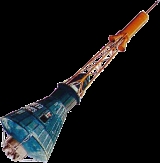
. The LES consisted of a solid fuel, 52,000 lbf
(231 kN) thrust rocket with three engine bells mounted on a tower above the spacecraft. In the event of a launch abort, the LES would fire for one second, pulling the spacecraft and astronaut away from the launch vehicle and a possible explosion. The spacecraft would then descend on its parachute recovery system. After booster engine cutoff (BECO), the LES was no longer needed and was separated from the spacecraft by a solid fuel, 800 lbf (3.6 kN) thrust jettison rocket that fired for 1.5 seconds.
After a successful liftoff, the spacecraft fired three small clustered solid-fuel, 400 lbf (1.8 kN) thrust rockets for 1 second to separate the spacecraft from the launch vehicle. These rockets were called the posigrade rockets (point D on illustration).
The spacecraft were only equipped with attitude control thrusters; after orbit insertion but before retrofire they could not change their orbit. There were three sets of high and low powered automatic control jets and separate manual jets, one for each axis (roll, pitch, and yaw
), and supplied from two separate fuel tanks, one automatic and one manual. The pilot could use any one of the three thruster systems and fuel them from either of the two fuel tanks to provide spacecraft attitude control. The Mercury spacecraft was designed to be completely controllable from the ground in the event that something impaired the pilot's ability to function.
The spacecraft had three solid-fuel, 1000 lbf (4.5 kN) thrust retrorockets that fired for 10 seconds each (point F on illustration). One was sufficient to return the spacecraft to Earth if the other two failed. The firing sequence (known as ripple firing) required firing the first retro, followed by the second retro five seconds later (while the first was still firing). Five seconds after that, the third retro fired (while the second retro was still firing).
There was a small hinged metal flap at the nose of the spacecraft called the spoiler.[pic.] If the spacecraft started to reenter nose first (another stable reentry attitude for the spacecraft), airflow over the spoiler would flip the spacecraft around to the proper, heatshield-first reentry attitude, a technique called shuttlecocking. During reentry, the astronaut would experience about 8 g-force
s on an orbital mission, and 11–12 gs on a suborbital mission.
Initial designs for the spacecraft suggested the use of either beryllium
heat-sink
heat shield
s or an ablative shield. Extensive testing settled the issue – ablative shields proved to be reliable (so much so that the initial shield thickness was safely reduced, allowing a lower total spacecraft weight), and were easier to produce — at that time, beryllium was only produced in sufficient quantities by a single company in the U.S. — and cheaper. The surface of the heat shield had a coating of aluminum with glassfiber in many layers. As the temperature rose to 2,000 °F (1,100 °C) the layers would evaporate and take the heat with it. The spacecraft would become hot but not harmfully so.
After re-entry, a small, drogue parachute was deployed at 21,000 ft (6.4km) for first lowering of speed. The main parachute was deployed at 10,000 ft (3 km), further slowing the spacecraft in preparation for landing. Just before hitting the water, a landing bag inflated from behind the heat shield to reduce the force of impact. Upon landing, additional bags inflated around the nose of the craft to keep the capsule upright in the water, and the parachutes were released. Once the recovery helicopter hooked onto the spacecraft, the astronaut blew the escape hatch to exit the capsule. It was also possible to exit the capsule through the nose cone.
, St. Louis, Missouri
. Five of the 20, Nos. 10, 12, 15, 17, and 19, were not flown. Spacecraft No. 3 and No. 4 were destroyed during unmanned test flights. Spacecraft No. 11 sank and was recovered from the bottom of the Atlantic Ocean after 38 years. Some spacecraft were modified after initial production (refurbished after launch abort, modified for longer missions, etc.) and received a letter designation after their number, examples 2B, 15B. Some spacecraft were modified twice; for example, spacecraft 15 became 15A and then 15B.
A number of Mercury boilerplate spacecraft (including mockup/prototype/replica spacecraft, made from non-flight materials or lacking production spacecraft systems and/or hardware) were also made by NASA and McDonnell Aircraft. They were designed and used to test spacecraft recovery systems, and escape tower and rocket motors. Formal tests were done on test pad at Langley and at Wallops Island using the Little Joe and Big Joe rockets.
s:
The Titan missile was also considered for use for later Mercury missions; however, the Mercury program was terminated before these missions were flown. Instead, the Titan was used for the Gemini program
which followed Mercury. The Mercury program also used a Scout rocket for a single flight, Mercury-Scout 1
, which was intended to launch a small satellite designed to evaluate the worldwide Mercury Tracking Network. Launched on November 1, 1961, however, the rocket was destroyed by the Range Safety Officer after 44 seconds of flight.
named Sam (after the Air Force's School of Aerospace Medicine). The Mercury program's complete roster of non-human space-farers is given below:
All missions were named after the rocket used and the number of missions reached by that rocket. The Redstone and Atlas rockets were meant for manned flights but they had to be tested in unmanned flights first. Therefore the first manned mission with the Redstone rocket was Mercury-Redstone 3 and the first with Atlas, the Mercury-Atlas 6.
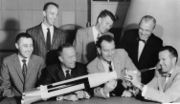 The first Americans to venture into space were drawn from a group of 110 military pilots
chosen for their flight test experience and because they met certain physical requirements.
NASA announced the selection of seven of these – known as the Mercury Seven
– as astronaut
s on 9 April 1959, though only six of the seven flew Mercury missions, after Slayton was grounded due to a heart condition.
In order of flight:
Just like the rockets and spacecraft were tested in details by unmanned flights, the astronauts went through a training program in special facilities and model arrangements. Some tests were made to see their response to weightlessness on one hand and high g forces on the other. Other parts of the training was meant to give them practice in maneuvering the spacecraft and get in and out of its narrow openings wearing a space suit. (See also: Training in Mercury Program gallery).
of the Soviet Union who flew one month before
. Gagarin also orbited the earth, which John Glenn did as the second person after him, in February 1962, at the third Mercury flight. Three more orbital flights were made, the last in 1963.
2 suborbital flights were cancelled; they began to look embarrassing after Soviet had made a day long orbital flight in August 1961. Three orbital flights were also cancelled since it was clear that the spacecraft had reached its limits. At the last flight the batteries were exhausted before reentry but, luckily, the spacecraft landed safely.
Beginning with Alan Shepard's Freedom 7 flight, the astronauts named their own spacecraft, and all added "7" to the name to acknowledge the teamwork of their fellow astronauts.
Deep space missions require a few big telescopes whereas earth orbit manned missions require many small radiostations at points that the spacecraft will pass over on its way. Unmanned missions need the same kind of radio stations but in smaller number. These differences led NASA to build an independent network for the manned missions.
's 1979 book by the same name. It also deals with the test pilots who were involved in high-speed aeronautical research
that preceded the project.
and McDonnell Douglas
) a Milestone Award for important inventions which debuted on the Mercury spacecraft. The IEEE bestows this honor on projects that were accomplished at least 25 years in the past. Boeing received the award in recognition of Project Mercury's pioneering "navigation and control instruments, autopilot, rate stabilization and control, and fly-by-wire
systems."
Manned Space Flight Network
The Manned Space Flight Network was a set of tracking stations built to support the American space efforts of Mercury, Gemini, Apollo and Skylab...
. The value of the contract was over $33 million. Also in January, McDonnell delivered the first production-type Mercury spacecraft, less than a year after award of the formal contract. On February 12, Christopher C. Kraft, Jr.
Christopher C. Kraft, Jr.
Christopher Columbus Kraft, Jr. is a retired NASA engineer and manager who was instrumental in establishing the agency's Mission Control operation...
was appointed to head the Mercury operations coordination group. In April, the first spacecraft was delivered to Wallops Island
Wallops Flight Facility
Wallops Flight Facility , located on the Eastern Shore of Virginia, is operated by NASA’s Goddard Space Flight Center, primarily as a rocket launch site to support science and exploration missions for NASA and other U.S. government agencies...
for the beach-abort
Beach Abort
The Beach Abort was an unmanned test in NASA's Project Mercury, of the Mercury spacecraft Launch Escape System. Objectives of the test were a performance evaluation of the escape system, the parachute and landing system, and recovery operations in an off-the-pad abort situation. The test took place...
test. The test was completed successfully on May 9.
Interior and control
Because of their small size, it was said that the Mercury spacecraft were worn, not ridden. With 1.7 m³ of habitable volume, the spacecraft was just large enough for the single crew member. Inside were 120 controls: 55 electrical switches, 30 fuses and 35 mechanical levers. The spacecraft was designed by Max FagetMaxime Faget
Maxime "Max" A. Faget was the designer of the Mercury capsule, and contributed to the later Gemini and Apollo spacecraft as well as the Space Shuttle.- Life :...
and NASA's Space Task Group.
Despite the astronauts' test pilot experience NASA at first envisioned them as "minor participants" during their flights, causing many conflicts between the astronauts and engineers during the spacecraft's design. Nonetheless, contrary to other reports, the project's leaders always intended for pilots to be able to control their spacecraft, as they valued humans' ability to contribute to missions' success. John Glenn's manual attitude adjustments during the first orbital flight were an example of the value of such control. The astronauts requested—and received—a larger window and manual reentry controls.
Mission profile
During the launch phase of the mission, the Mercury spacecraft and astronaut were protected from launch vehicle failures by the Launch Escape SystemLaunch escape system
A Launch Escape System is a top-mounted rocket connected to the crew module of a crewed spacecraft and used to quickly separate the crew module from the rest of the rocket in case of emergency. Since the escape rockets are above the crew module, an LES typically uses separate nozzles which are...
. The LES consisted of a solid fuel, 52,000 lbf
Pound-force
The pound force is a unit of force in some systems of measurement including English engineering units and British gravitational units.- Definitions :...
(231 kN) thrust rocket with three engine bells mounted on a tower above the spacecraft. In the event of a launch abort, the LES would fire for one second, pulling the spacecraft and astronaut away from the launch vehicle and a possible explosion. The spacecraft would then descend on its parachute recovery system. After booster engine cutoff (BECO), the LES was no longer needed and was separated from the spacecraft by a solid fuel, 800 lbf (3.6 kN) thrust jettison rocket that fired for 1.5 seconds.
After a successful liftoff, the spacecraft fired three small clustered solid-fuel, 400 lbf (1.8 kN) thrust rockets for 1 second to separate the spacecraft from the launch vehicle. These rockets were called the posigrade rockets (point D on illustration).
The spacecraft were only equipped with attitude control thrusters; after orbit insertion but before retrofire they could not change their orbit. There were three sets of high and low powered automatic control jets and separate manual jets, one for each axis (roll, pitch, and yaw
Aircraft principal axes
An aircraft in flight is free to rotate in three dimensions: pitch, nose up or down about an axis running from wing to wing), yaw, nose left or right about an axis running up and down; and roll, rotation about an axis running from nose to tail. The axes are alternatively designated as lateral,...
), and supplied from two separate fuel tanks, one automatic and one manual. The pilot could use any one of the three thruster systems and fuel them from either of the two fuel tanks to provide spacecraft attitude control. The Mercury spacecraft was designed to be completely controllable from the ground in the event that something impaired the pilot's ability to function.
The spacecraft had three solid-fuel, 1000 lbf (4.5 kN) thrust retrorockets that fired for 10 seconds each (point F on illustration). One was sufficient to return the spacecraft to Earth if the other two failed. The firing sequence (known as ripple firing) required firing the first retro, followed by the second retro five seconds later (while the first was still firing). Five seconds after that, the third retro fired (while the second retro was still firing).
There was a small hinged metal flap at the nose of the spacecraft called the spoiler.[pic.] If the spacecraft started to reenter nose first (another stable reentry attitude for the spacecraft), airflow over the spoiler would flip the spacecraft around to the proper, heatshield-first reentry attitude, a technique called shuttlecocking. During reentry, the astronaut would experience about 8 g-force
G-force
The g-force associated with an object is its acceleration relative to free-fall. This acceleration experienced by an object is due to the vector sum of non-gravitational forces acting on an object free to move. The accelerations that are not produced by gravity are termed proper accelerations, and...
s on an orbital mission, and 11–12 gs on a suborbital mission.
Initial designs for the spacecraft suggested the use of either beryllium
Beryllium
Beryllium is the chemical element with the symbol Be and atomic number 4. It is a divalent element which occurs naturally only in combination with other elements in minerals. Notable gemstones which contain beryllium include beryl and chrysoberyl...
heat-sink
Heat sink
A heat sink is a term for a component or assembly that transfers heat generated within a solid material to a fluid medium, such as air or a liquid. Examples of heat sinks are the heat exchangers used in refrigeration and air conditioning systems and the radiator in a car...
heat shield
Heat shield
A heat shield is designed to shield a substance from absorbing excessive heat from an outside source by either dissipating, reflecting or simply absorbing the heat...
s or an ablative shield. Extensive testing settled the issue – ablative shields proved to be reliable (so much so that the initial shield thickness was safely reduced, allowing a lower total spacecraft weight), and were easier to produce — at that time, beryllium was only produced in sufficient quantities by a single company in the U.S. — and cheaper. The surface of the heat shield had a coating of aluminum with glassfiber in many layers. As the temperature rose to 2,000 °F (1,100 °C) the layers would evaporate and take the heat with it. The spacecraft would become hot but not harmfully so.
After re-entry, a small, drogue parachute was deployed at 21,000 ft (6.4km) for first lowering of speed. The main parachute was deployed at 10,000 ft (3 km), further slowing the spacecraft in preparation for landing. Just before hitting the water, a landing bag inflated from behind the heat shield to reduce the force of impact. Upon landing, additional bags inflated around the nose of the craft to keep the capsule upright in the water, and the parachutes were released. Once the recovery helicopter hooked onto the spacecraft, the astronaut blew the escape hatch to exit the capsule. It was also possible to exit the capsule through the nose cone.
Production summary
NASA ordered 20 production spacecraft, numbered 1 through 20, from McDonnell Aircraft CompanyMcDonnell Aircraft
The McDonnell Aircraft Corporation was an American aerospace manufacturer based in St. Louis, Missouri. The company was founded on July 16, 1939 by James Smith McDonnell, and was best known for its military fighters, including the F-4 Phantom II, and manned spacecraft including the Mercury capsule...
, St. Louis, Missouri
St. Louis, Missouri
St. Louis is an independent city on the eastern border of Missouri, United States. With a population of 319,294, it was the 58th-largest U.S. city at the 2010 U.S. Census. The Greater St...
. Five of the 20, Nos. 10, 12, 15, 17, and 19, were not flown. Spacecraft No. 3 and No. 4 were destroyed during unmanned test flights. Spacecraft No. 11 sank and was recovered from the bottom of the Atlantic Ocean after 38 years. Some spacecraft were modified after initial production (refurbished after launch abort, modified for longer missions, etc.) and received a letter designation after their number, examples 2B, 15B. Some spacecraft were modified twice; for example, spacecraft 15 became 15A and then 15B.
A number of Mercury boilerplate spacecraft (including mockup/prototype/replica spacecraft, made from non-flight materials or lacking production spacecraft systems and/or hardware) were also made by NASA and McDonnell Aircraft. They were designed and used to test spacecraft recovery systems, and escape tower and rocket motors. Formal tests were done on test pad at Langley and at Wallops Island using the Little Joe and Big Joe rockets.
Launch vehicles
The Mercury program used three launch vehicleLaunch vehicle
In spaceflight, a launch vehicle or carrier rocket is a rocket used to carry a payload from the Earth's surface into outer space. A launch system includes the launch vehicle, the launch pad and other infrastructure....
s:
- Little Joe (height: 55 ft) – for launch escape system tests at altitude. Eight robotic flights were made, two of which carried live monkeys. It was a solid-fuel rocket designed specially for the Mercury program. Together with a Mercury boilerplate it was used to test the escape tower and abort procedures.
- RedstoneMercury-Redstone Launch VehicleThe Mercury-Redstone Launch Vehicle, designed for NASA's Project Mercury, was the first American manned space booster. It was used for six sub-orbital Mercury flights from 1960–61; culminating with the launch of the first, and 11 weeks later, the second American in space.A member of the...
(height 83 ft) – 1-stage rocket for suborbital (ballisticBallistic missileA ballistic missile is a missile that follows a sub-orbital ballistic flightpath with the objective of delivering one or more warheads to a predetermined target. The missile is only guided during the relatively brief initial powered phase of flight and its course is subsequently governed by the...
) flights. Four robotic flights were made, one of which carried a chimpanzeeChimpanzeeChimpanzee, sometimes colloquially chimp, is the common name for the two extant species of ape in the genus Pan. The Congo River forms the boundary between the native habitat of the two species:...
. After that it was used for the first two manned flights. The JupiterMercury-JupiterMercury-Jupiter was a Jupiter missile with a Mercury capsule and was proposed as a suborbital launch vehicle for Project Mercury in October, 1958; however, it was never flown, and was canceled in July 1959 due to budget constraints....
rocket was originally considered for the suborbital launch vehicle, but were replaced with the Redstone in July 1959 due to budget constraints.
- Atlas DAtlas LV-3BThe Atlas LV-3B, Atlas D Mercury Launch Vehicle or Mercury-Atlas Launch Vehicle, was a man-rated expendable launch system used as part of the United States Project Mercury to send astronauts into low Earth orbit. It was derived from the SM-65D Atlas missile, and was a member of the Atlas family of...
(height 94 ft) – 2-stage rocket for orbital manned flight. Six robotic test flights were made, four suborbital and two orbital one of which carried a chimpanzee. After that it was used for four manned orbital flights. The Atlas D rocket required extra strengthening in order to handle the increased weight of the Mercury spacecraft beyond that of the nuclear warheads they were designed to carry.
The Titan missile was also considered for use for later Mercury missions; however, the Mercury program was terminated before these missions were flown. Instead, the Titan was used for the Gemini program
Project Gemini
Project Gemini was the second human spaceflight program of NASA, the civilian space agency of the United States government. Project Gemini was conducted between projects Mercury and Apollo, with ten manned flights occurring in 1965 and 1966....
which followed Mercury. The Mercury program also used a Scout rocket for a single flight, Mercury-Scout 1
Mercury-Scout 1
Mercury-Scout 1, or MS-1, was a United States spacecraft intended to test tracking stations for Project Mercury flights. It grew out of a May 5, 1961 NASA proposal to use Scout rockets to launch small satellites to evaluate the worldwide Mercury Tracking Network in preparation for manned orbital...
, which was intended to launch a small satellite designed to evaluate the worldwide Mercury Tracking Network. Launched on November 1, 1961, however, the rocket was destroyed by the Range Safety Officer after 44 seconds of flight.
Unmanned flights
The program included 20 robotic launches. Not all of these were intended to reach space and not all were successful in completing their objectives. Four of these flights included non-human primates, starting with the fifth flight (1959) which launched a Rhesus macaqueRhesus Macaque
The Rhesus macaque , also called the Rhesus monkey, is one of the best-known species of Old World monkeys. It is listed as Least Concern in the IUCN Red List of Threatened Species in view of its wide distribution, presumed large population, and its tolerance of a broad range of habitats...
named Sam (after the Air Force's School of Aerospace Medicine). The Mercury program's complete roster of non-human space-farers is given below:
- Sam, a Rhesus macaque, launched 4 December 1959 on Little Joe 2Little Joe 2The Little Joe 2 was a test of the Mercury space capsule. It was the first American animal spaceflight, carrying the Rhesus monkey Sam close to the edge of space. He was sent to test the space equipment and the adverse effects of space on humans.The flight was launched December 4, 1959, at 11:15...
to 85 km altitude. - Miss Sam, a Rhesus macaque, launched 21 January 1960 on Little Joe 1BLittle Joe 1BThe Little Joe 1B was a Launch Escape System test of the Mercury spacecraft, conducted as part of the U.S. Mercury program. The mission also carried a female Rhesus monkey named Miss Sam in the Mercury spacecraft. The mission was launched January 21, 1960, from Wallops Island, Virginia...
to 15 km altitude. - HamHam the ChimpHam , also known as Ham the Chimp and Ham the Astrochimp, was the first chimpanzee launched into outer space in the American space program...
, a chimpanzeeChimpanzeeChimpanzee, sometimes colloquially chimp, is the common name for the two extant species of ape in the genus Pan. The Congo River forms the boundary between the native habitat of the two species:...
, launched 31 January 1961 on Mercury-Redstone 2Mercury-Redstone 2Mercury-Redstone 2 was an American space mission, launched at 16:55 UTC on January 31, 1961 from LC-5 at Cape Canaveral, Florida. Mercury spacecraft No...
for a suborbital flight. - EnosEnos (chimpanzee)Enos was the first chimpanzee that was launched into Earth orbit.Enos was purchased from the Miami Rare Bird Farm on April 3, 1960. He completed more than 1,250 hours of training for his mission at the University of Kentucky and Holloman Air Force Base...
, a chimpanzee, launched 29 November 1961 on Mercury-Atlas 5Mercury-Atlas 5Mercury-Atlas 5 was an American unmanned spaceflight of the Mercury program. It was launched on November 29, 1961 with Enos the Chimp, a chimpanzee, aboard...
for a 2-orbit flight.
All missions were named after the rocket used and the number of missions reached by that rocket. The Redstone and Atlas rockets were meant for manned flights but they had to be tested in unmanned flights first. Therefore the first manned mission with the Redstone rocket was Mercury-Redstone 3 and the first with Atlas, the Mercury-Atlas 6.
List of unmanned flights
| Mission | Rocket | Call Sign | Launch Date | Launch Time | Duration | Remarks |
|---|---|---|---|---|---|---|
| Mercury-Jupiter Mercury-Jupiter Mercury-Jupiter was a Jupiter missile with a Mercury capsule and was proposed as a suborbital launch vehicle for Project Mercury in October, 1958; however, it was never flown, and was canceled in July 1959 due to budget constraints.... |
Jupiter Jupiter (missile) The PGM-19 Jupiter was the first medium-range ballistic missile of the United States Air Force . It was a liquid-fueled rocket using RP-1 fuel and LOX oxidizer, with a single Rocketdyne LR70-NA rocket engine producing 667 kN of thrust... |
N/A | N/A | N/A | N/A | Canceled in July, 1959 – Proposed suborbital launch vehicle for Mercury. Not flown. |
| Little Joe 1 Little Joe 1 Little Joe 1 was a failed launch of a Little Joe solid fuel rocket that was designed to test the Mercury spacecraft Launch Escape and Recovery systems. The vehicle was in height, weighed approximately , and was in diameter with a fin span of... |
Little Joe | LJ-1 | 21 August 1959 | N/A | 00d 00h 00 m 20s | Test of launch escape system during flight. |
| Big Joe 1 Big Joe 1 Big Joe 1 launched an unmanned boilerplate Mercury capsule from Cape Canaveral, Florida on September 9, 1959. The objective of the Big Joe program was to test the Mercury spacecraft ablating heat shield... |
Atlas 10-D Atlas (missile) The SM-65 Atlas was the first intercontinental ballistic missile developed and deployed by the United States. It was built for the U.S. Air Force by Convair Division of General Dynamics at the Kearny Mesa assembly plant north of San Diego, California... |
Big Joe 1 | 9 September 1959 | N/A | 00d 00h 13 m | Test of heat shield and Atlas / spacecraft interface |
| Little Joe 6 Little Joe 6 The Little Joe 6 was a Launch Escape System test of the Mercury spacecraft, conducted as part of the U.S. Mercury program. The mission used a boilerplate Mercury spacecraft. The mission was launched October 4, 1959, from Wallops Island, Virginia. The Little Joe 6 flew to an apogee of 37 miles and a... |
Little Joe | LJ-6 | 4 October 1959 | N/A | 00d 00h 05 m 10s | Test of spacecraft aerodynamics and integrity |
| Little Joe 1A Little Joe 1A Little Joe 1A was an unmanned rocket launched as part of NASA's Mercury program on November 4, 1959. This flight, a repeat of the Little Joe 1 launch, was to test a launch abort under high aerodynamic load conditions. After lift-off, the pressure sensing system was to indicate when the correct... |
Little Joe | LJ-1A | 4 November 1959 | N/A | 00d 00h 08 m 11s | Test of launch escape system during flight |
| Little Joe 2 Little Joe 2 The Little Joe 2 was a test of the Mercury space capsule. It was the first American animal spaceflight, carrying the Rhesus monkey Sam close to the edge of space. He was sent to test the space equipment and the adverse effects of space on humans.The flight was launched December 4, 1959, at 11:15... |
Little Joe | LJ-2 | 4 December 1959 | N/A | 00d 00h 11 m 06s | Carried Sam the monkey to 85 kilometres in altitude |
| Little Joe 1B Little Joe 1B The Little Joe 1B was a Launch Escape System test of the Mercury spacecraft, conducted as part of the U.S. Mercury program. The mission also carried a female Rhesus monkey named Miss Sam in the Mercury spacecraft. The mission was launched January 21, 1960, from Wallops Island, Virginia... |
Little Joe | LJ-1B | 21 January 1960 | N/A | 00d 00h 08 m 35s | Carried Miss Sam the monkey to 9.3 statute miles (15 kilometres) in altitude |
| Beach Abort Beach Abort The Beach Abort was an unmanned test in NASA's Project Mercury, of the Mercury spacecraft Launch Escape System. Objectives of the test were a performance evaluation of the escape system, the parachute and landing system, and recovery operations in an off-the-pad abort situation. The test took place... |
Launch escape system Launch escape system A Launch Escape System is a top-mounted rocket connected to the crew module of a crewed spacecraft and used to quickly separate the crew module from the rest of the rocket in case of emergency. Since the escape rockets are above the crew module, an LES typically uses separate nozzles which are... |
Beach Abort | 9 May 1960 | N/A | 00d 00h 01 m 31s | Test of the off-the-pad abort system |
| Mercury-Atlas 1 Mercury-Atlas 1 Mercury-Atlas 1 was launched at 13:13 UTC on July 29, 1960 from Cape Canaveral, Florida. The Mercury spacecraft was unmanned and carried no launch escape system. The mission was to conduct a suborbital test flight and reentry of the spacecraft... |
Atlas Atlas (missile) The SM-65 Atlas was the first intercontinental ballistic missile developed and deployed by the United States. It was built for the U.S. Air Force by Convair Division of General Dynamics at the Kearny Mesa assembly plant north of San Diego, California... |
MA-1 | 29 July 1960 | 13:13 UTC Coordinated Universal Time Coordinated Universal Time is the primary time standard by which the world regulates clocks and time. It is one of several closely related successors to Greenwich Mean Time. Computer servers, online services and other entities that rely on having a universally accepted time use UTC for that purpose... |
00d 00h 03 m 18s | First flight of Mercury / Atlas |
| Little Joe 5 Little Joe 5 Little Joe 5 was an unmanned Launch Escape System test of the Mercury spacecraft, conducted as part of the U.S. Mercury program. The mission used a production Mercury spacecraft #3. The mission was launched November 8, 1960, from Wallops Island, Virginia. The Little Joe 5 flew to an apogee of 10.1... |
Little Joe | LJ-5 | 8 November 1960 | N/A | 00d 00h 02 m 22s | First flight of a production Mercury spacecraft |
| Mercury-Redstone 1 Mercury-Redstone 1 Mercury-Redstone 1 was the first Mercury-Redstone mission in the Mercury program and the first attempt to launch a Mercury spacecraft with the Mercury-Redstone launch vehicle. Intended to be an unmanned sub-orbital flight, it was launched on November 21, 1960 from Cape Canaveral, Florida... |
Redstone Mercury-Redstone Launch Vehicle The Mercury-Redstone Launch Vehicle, designed for NASA's Project Mercury, was the first American manned space booster. It was used for six sub-orbital Mercury flights from 1960–61; culminating with the launch of the first, and 11 weeks later, the second American in space.A member of the... |
MR-1 | 21 November 1960 | N/A | 00d 00h 00 m 02s | Launched 4 inches (100 mm); settled back on pad due to electrical malfunction |
| Mercury-Redstone 1A Mercury-Redstone 1A Mercury-Redstone 1A was launched on December 19, 1960 from LC-5 at Cape Canaveral, Florida. The mission objectives of this unmanned suborbital flight were to qualify the spacecraft for space flight and qualify the system for an upcoming primate suborbital flight. The spacecraft tested its... |
Redstone Mercury-Redstone Launch Vehicle The Mercury-Redstone Launch Vehicle, designed for NASA's Project Mercury, was the first American manned space booster. It was used for six sub-orbital Mercury flights from 1960–61; culminating with the launch of the first, and 11 weeks later, the second American in space.A member of the... |
MR-1A | 19 December 1960 | N/A | 00d 00h 15 m 45s | First flight of Mercury / Redstone |
| Mercury-Redstone 2 Mercury-Redstone 2 Mercury-Redstone 2 was an American space mission, launched at 16:55 UTC on January 31, 1961 from LC-5 at Cape Canaveral, Florida. Mercury spacecraft No... |
Redstone Mercury-Redstone Launch Vehicle The Mercury-Redstone Launch Vehicle, designed for NASA's Project Mercury, was the first American manned space booster. It was used for six sub-orbital Mercury flights from 1960–61; culminating with the launch of the first, and 11 weeks later, the second American in space.A member of the... |
MR-2 | 31 January 1961 | 16:55 UTC Coordinated Universal Time Coordinated Universal Time is the primary time standard by which the world regulates clocks and time. It is one of several closely related successors to Greenwich Mean Time. Computer servers, online services and other entities that rely on having a universally accepted time use UTC for that purpose... |
00d 00h 16 m 39s | Carried Ham Ham the Chimp Ham , also known as Ham the Chimp and Ham the Astrochimp, was the first chimpanzee launched into outer space in the American space program... the chimpanzee on suborbital flight |
| Mercury-Atlas 2 Mercury-Atlas 2 Mercury-Atlas 2 was launched unmanned on February 21, 1961 at 14:10 UTC, from Launch Complex 14 at Cape Canaveral, Florida. Test objectives for this flight were concerned with the ability of the spacecraft to withstand reentry under the temperature-critical abort conditions and with the capability... |
Atlas Atlas (missile) The SM-65 Atlas was the first intercontinental ballistic missile developed and deployed by the United States. It was built for the U.S. Air Force by Convair Division of General Dynamics at the Kearny Mesa assembly plant north of San Diego, California... |
MA-2 | 21 February 1961 | 14:10 UTC Coordinated Universal Time Coordinated Universal Time is the primary time standard by which the world regulates clocks and time. It is one of several closely related successors to Greenwich Mean Time. Computer servers, online services and other entities that rely on having a universally accepted time use UTC for that purpose... |
00d 00h 17 m 56s | Unmanned test |
| Little Joe 5A Little Joe 5A Little Joe 5A was an unmanned Launch Escape System test of the Mercury spacecraft, conducted as part of the U.S. Mercury program. The mission used production Mercury spacecraft # 14 atop a Little Joe booster rocket. The mission was launched March 18, 1961, from Wallops Island, Virginia. The Little... |
Little Joe | LJ-5A | 18 March 1961 | N/A | 00d 00h 23 m 48s | Test of the launch escape system during the most severe conditions of a launch |
| Mercury-Redstone BD Mercury-Redstone BD Mercury-Redstone BD was an unmanned booster development flight in the U.S. Mercury program. It was launched on March 24, 1961 from Launch Complex 5 at Cape Canaveral, Florida... |
Redstone Mercury-Redstone Launch Vehicle The Mercury-Redstone Launch Vehicle, designed for NASA's Project Mercury, was the first American manned space booster. It was used for six sub-orbital Mercury flights from 1960–61; culminating with the launch of the first, and 11 weeks later, the second American in space.A member of the... |
MR-BD | 24 March 1961 | 17:30 UTC Coordinated Universal Time Coordinated Universal Time is the primary time standard by which the world regulates clocks and time. It is one of several closely related successors to Greenwich Mean Time. Computer servers, online services and other entities that rely on having a universally accepted time use UTC for that purpose... |
00d 00h 8 m 23s | Redstone development test flight |
| Mercury-Atlas 3 Mercury-Atlas 3 Mercury-Atlas 3 was launched unmanned on April 25, 1961 at 16:15 UTC, from Launch Complex 14 at Cape Canaveral, Florida. The Mercury capsule contained a robotic "mechanical astronaut". Mercury spacecraft No. 8 and Atlas No... |
Atlas Atlas (missile) The SM-65 Atlas was the first intercontinental ballistic missile developed and deployed by the United States. It was built for the U.S. Air Force by Convair Division of General Dynamics at the Kearny Mesa assembly plant north of San Diego, California... |
MA-3 | 25 April 1961 | 16:15 UTC Coordinated Universal Time Coordinated Universal Time is the primary time standard by which the world regulates clocks and time. It is one of several closely related successors to Greenwich Mean Time. Computer servers, online services and other entities that rely on having a universally accepted time use UTC for that purpose... |
00d 00h 07 m 19s | Contained "robot astronaut" |
| Little Joe 5B Little Joe 5B Little Joe 5B was an unmanned Launch Escape System test of the Mercury spacecraft, conducted as part of the U.S. Mercury program. The mission used production Mercury spacecraft # 14A. The mission was launched April 28, 1961, from Wallops Island, Virginia. The Little Joe 5B flew to an apogee of 2.8... |
Little Joe | AB-1 | 28 April 1961 | N/A | 00d 00h 05 m 25s | Test of the launch escape system during the most severe conditions of a launch |
| Mercury-Atlas 4 Mercury-Atlas 4 Mercury-Atlas 4 was an unmanned spaceflight of the Mercury program. It was launched on September 13, 1961 at 14:09 UTC from Launch Complex 14 at Cape Canaveral, Florida. A Crewman Simulator instrument package was aboard. The craft orbited the Earth once.... |
Atlas Atlas (missile) The SM-65 Atlas was the first intercontinental ballistic missile developed and deployed by the United States. It was built for the U.S. Air Force by Convair Division of General Dynamics at the Kearny Mesa assembly plant north of San Diego, California... |
MA-4 | 13 September 1961 | 14:09 UTC Coordinated Universal Time Coordinated Universal Time is the primary time standard by which the world regulates clocks and time. It is one of several closely related successors to Greenwich Mean Time. Computer servers, online services and other entities that rely on having a universally accepted time use UTC for that purpose... |
00d 01h 49 m 20s | Unmanned test, completed one orbit |
| Mercury-Scout 1 Mercury-Scout 1 Mercury-Scout 1, or MS-1, was a United States spacecraft intended to test tracking stations for Project Mercury flights. It grew out of a May 5, 1961 NASA proposal to use Scout rockets to launch small satellites to evaluate the worldwide Mercury Tracking Network in preparation for manned orbital... |
Scout | MS-1 | 1 November 1961 | 15:32 UTC Coordinated Universal Time Coordinated Universal Time is the primary time standard by which the world regulates clocks and time. It is one of several closely related successors to Greenwich Mean Time. Computer servers, online services and other entities that rely on having a universally accepted time use UTC for that purpose... |
00d 00h 00 m 44s | Test of Mercury tracking network |
| Mercury-Atlas 5 Mercury-Atlas 5 Mercury-Atlas 5 was an American unmanned spaceflight of the Mercury program. It was launched on November 29, 1961 with Enos the Chimp, a chimpanzee, aboard... |
Atlas Atlas (missile) The SM-65 Atlas was the first intercontinental ballistic missile developed and deployed by the United States. It was built for the U.S. Air Force by Convair Division of General Dynamics at the Kearny Mesa assembly plant north of San Diego, California... |
MA-5 | 29 November 1961 | 15:08 UTC Coordinated Universal Time Coordinated Universal Time is the primary time standard by which the world regulates clocks and time. It is one of several closely related successors to Greenwich Mean Time. Computer servers, online services and other entities that rely on having a universally accepted time use UTC for that purpose... |
00d 03h 20 m 59s | Carried Enos Enos (chimpanzee) Enos was the first chimpanzee that was launched into Earth orbit.Enos was purchased from the Miami Rare Bird Farm on April 3, 1960. He completed more than 1,250 hours of training for his mission at the University of Kentucky and Holloman Air Force Base... the chimpanzee on a two-orbit flight |
Astronauts
Test pilot
A test pilot is an aviator who flies new and modified aircraft in specific maneuvers, known as flight test techniques or FTTs, allowing the results to be measured and the design to be evaluated....
chosen for their flight test experience and because they met certain physical requirements.
NASA announced the selection of seven of these – known as the Mercury Seven
Mercury Seven
Mercury Seven was the group of seven Mercury astronauts selected by NASA on April 9, 1959. They are also referred to as the Original Seven and Astronaut Group 1...
– as astronaut
Astronaut
An astronaut or cosmonaut is a person trained by a human spaceflight program to command, pilot, or serve as a crew member of a spacecraft....
s on 9 April 1959, though only six of the seven flew Mercury missions, after Slayton was grounded due to a heart condition.
In order of flight:
- Alan Bartlett Shepard, Jr.Alan ShepardAlan Bartlett Shepard, Jr. was an American naval aviator, test pilot, flag officer, and NASA astronaut who in 1961 became the second person, and the first American, in space. This Mercury flight was designed to enter space, but not to achieve orbit...
, USN (1923–1998); first American in space, May 1961Mercury-Redstone 3Mercury-Redstone 3 was the first manned space mission of the United States. Astronaut Alan Shepard piloted a 15-minute Project Mercury suborbital flight in the Freedom 7 spacecraft on May 5, 1961 to become the first American in space, three weeks after the Soviet cosmonaut Yuri Gagarin had carried... - Virgil Ivan "Gus" GrissomGus GrissomVirgil Ivan Grissom , , better known as Gus Grissom, was one of the original NASA Project Mercury astronauts and a United States Air Force pilot...
, USAF (1926–1967); flew 21 July 1961Mercury-Redstone 4Mercury-Redstone 4 was the second United States manned space mission, launched on July 21, 1961. The Mercury program suborbital flight used a Redstone rocket. The spacecraft was named Liberty Bell 7 piloted by astronaut Virgil I. "Gus" Grissom. It reached an altitude of more than 118.26 mi ...
. Died during Apollo 1 pre-launch test - John Herschel Glenn, Jr.John GlennJohn Herschel Glenn, Jr. is a former United States Marine Corps pilot, astronaut, and United States senator who was the first American to orbit the Earth and the third American in space. Glenn was a Marine Corps fighter pilot before joining NASA's Mercury program as a member of NASA's original...
, USMC (born 1921); first American to orbit the Earth, 20 February 1962Mercury-Atlas 6Mercury-Atlas 6 was a human spaceflight mission conducted by NASA, the space agency of the United States. As part of Project Mercury, MA-6 was the successful first attempt by NASA to place an astronaut into orbit. The MA-6 mission was launched February 20, 1962. It made three orbits of the Earth,... - Malcolm Scott CarpenterScott CarpenterMalcolm Scott Carpenter is an American engineer, former test pilot, astronaut, and aquanaut. He is best known as one of the original seven astronauts selected for NASA's Project Mercury in April 1959....
, USN (born 1925), flew 24 May 1962Mercury-Atlas 7-Backup crew:-Crew notes:The original prime crew for Mercury Atlas-7 was to have been Deke Slayton, with Schirra as his back-up. However Slayton was removed from all flight crew availability after the discovery of cardiac arrhythmia during a training run in the g-loading centrifuge... - Walter Marty "Wally" Schirra, Jr.Wally SchirraWalter Marty Schirra, Jr. was an American test pilot, United States Navy officer, and one of the original Mercury 7 astronauts chosen for the Project Mercury, America's effort to put humans in space. He is the only person to fly in all of America's first three space programs...
, USN (1923–2007), flew 3 October 1962Mercury-Atlas 8Mercury-Atlas 8 was an early manned space mission, part of NASA's Mercury program. Astronaut Walter M. Schirra, Jr., orbited the Earth six times in the Sigma 7 spacecraft on October 3, 1962, in a nine-hour flight focused mainly on technical evaluation rather than on scientific experimentation... - Leroy Gordon "Gordo" Cooper, Jr.Gordon CooperLeroy Gordon Cooper, Jr. , also known as Gordon Cooper, was an American aeronautical engineer, test pilot and NASA astronaut. Cooper was one of the seven original astronauts in Project Mercury, the first manned space effort by the United States...
, USAF (1927–2004), flew 15 May 1963Mercury-Atlas 9Mercury-Atlas 9 was the final manned space mission of the U.S. Mercury program, launched on May 15, 1963 from Launch Complex 14 at Cape Canaveral, Florida. The spacecraft, named Faith 7, completed 22 Earth orbits before splashing down in the Pacific Ocean, piloted by astronaut Gordon Cooper, then... - Donald Kent "Deke" SlaytonDeke SlaytonDonald Kent Slayton , better known as Deke Slayton, was an American World War II pilot and later, one of the original NASA Mercury Seven astronauts....
, USAF (1924–1993); grounded in 1962, but reinstated in 1972 and flew on the Apollo-Soyuz Test ProjectApollo-Soyuz Test Project-Backup crew:-Crew notes:Jack Swigert had originally been assigned as the command module pilot for the ASTP prime crew, but prior to the official announcement he was removed as punishment for his involvement in the Apollo 15 postage stamp scandal.-Soyuz crew:...
in 1975.
Just like the rockets and spacecraft were tested in details by unmanned flights, the astronauts went through a training program in special facilities and model arrangements. Some tests were made to see their response to weightlessness on one hand and high g forces on the other. Other parts of the training was meant to give them practice in maneuvering the spacecraft and get in and out of its narrow openings wearing a space suit. (See also: Training in Mercury Program gallery).
Piloted Mercury launches
In all, 6 manned missions were made. The most famous flights were the first and the third. In the first on May 5, 1961, Alan Shepard became the first American in space and the second person ever after Yuri GagarinYuri Gagarin
Yuri Alekseyevich Gagarin was a Soviet pilot and cosmonaut. He was the first human to journey into outer space, when his Vostok spacecraft completed an orbit of the Earth on April 12, 1961....
of the Soviet Union who flew one month before
Vostok 1
Vostok 1 was the first spaceflight in the Vostok program and the first human spaceflight in history. The Vostok 3KA spacecraft was launched on April 12, 1961. The flight took Yuri Gagarin, a cosmonaut from the Soviet Union, into space. The flight marked the first time that a human entered outer...
. Gagarin also orbited the earth, which John Glenn did as the second person after him, in February 1962, at the third Mercury flight. Three more orbital flights were made, the last in 1963.
2 suborbital flights were cancelled; they began to look embarrassing after Soviet had made a day long orbital flight in August 1961. Three orbital flights were also cancelled since it was clear that the spacecraft had reached its limits. At the last flight the batteries were exhausted before reentry but, luckily, the spacecraft landed safely.
Beginning with Alan Shepard's Freedom 7 flight, the astronauts named their own spacecraft, and all added "7" to the name to acknowledge the teamwork of their fellow astronauts.
List of flights
| Mission | Callsign | Rocket | Designation | Pilot | Launch Date | Launch Time | Duration | Remarks |
|---|---|---|---|---|---|---|---|---|
| Mercury-Redstone 3 Mercury-Redstone 3 Mercury-Redstone 3 was the first manned space mission of the United States. Astronaut Alan Shepard piloted a 15-minute Project Mercury suborbital flight in the Freedom 7 spacecraft on May 5, 1961 to become the first American in space, three weeks after the Soviet cosmonaut Yuri Gagarin had carried... |
Freedom 7 | Redstone Mercury-Redstone Launch Vehicle The Mercury-Redstone Launch Vehicle, designed for NASA's Project Mercury, was the first American manned space booster. It was used for six sub-orbital Mercury flights from 1960–61; culminating with the launch of the first, and 11 weeks later, the second American in space.A member of the... |
MR-3 | Shepard Alan Shepard Alan Bartlett Shepard, Jr. was an American naval aviator, test pilot, flag officer, and NASA astronaut who in 1961 became the second person, and the first American, in space. This Mercury flight was designed to enter space, but not to achieve orbit... |
5 May 1961 | 14:34 UTC Coordinated Universal Time Coordinated Universal Time is the primary time standard by which the world regulates clocks and time. It is one of several closely related successors to Greenwich Mean Time. Computer servers, online services and other entities that rely on having a universally accepted time use UTC for that purpose... |
00d 00h 15 m 28s |
First American to make a suborbital flight into space |
| Mercury-Redstone 4 Mercury-Redstone 4 Mercury-Redstone 4 was the second United States manned space mission, launched on July 21, 1961. The Mercury program suborbital flight used a Redstone rocket. The spacecraft was named Liberty Bell 7 piloted by astronaut Virgil I. "Gus" Grissom. It reached an altitude of more than 118.26 mi ... |
Liberty Bell 7 | Redstone Mercury-Redstone Launch Vehicle The Mercury-Redstone Launch Vehicle, designed for NASA's Project Mercury, was the first American manned space booster. It was used for six sub-orbital Mercury flights from 1960–61; culminating with the launch of the first, and 11 weeks later, the second American in space.A member of the... |
MR-4 | Grissom Gus Grissom Virgil Ivan Grissom , , better known as Gus Grissom, was one of the original NASA Project Mercury astronauts and a United States Air Force pilot... |
21 July 1961 | 12:20 UTC Coordinated Universal Time Coordinated Universal Time is the primary time standard by which the world regulates clocks and time. It is one of several closely related successors to Greenwich Mean Time. Computer servers, online services and other entities that rely on having a universally accepted time use UTC for that purpose... |
00d 00h 15 m 37s |
Second suborbital flight. Spacecraft sank before recovery when hatch unexpectedly blew off, recovered 1999. |
| Mercury-Atlas 6 Mercury-Atlas 6 Mercury-Atlas 6 was a human spaceflight mission conducted by NASA, the space agency of the United States. As part of Project Mercury, MA-6 was the successful first attempt by NASA to place an astronaut into orbit. The MA-6 mission was launched February 20, 1962. It made three orbits of the Earth,... |
Friendship 7 | Atlas Atlas LV-3B The Atlas LV-3B, Atlas D Mercury Launch Vehicle or Mercury-Atlas Launch Vehicle, was a man-rated expendable launch system used as part of the United States Project Mercury to send astronauts into low Earth orbit. It was derived from the SM-65D Atlas missile, and was a member of the Atlas family of... |
MA-6 | Glenn John Glenn John Herschel Glenn, Jr. is a former United States Marine Corps pilot, astronaut, and United States senator who was the first American to orbit the Earth and the third American in space. Glenn was a Marine Corps fighter pilot before joining NASA's Mercury program as a member of NASA's original... |
20 February 1962 | 14:47 UTC Coordinated Universal Time Coordinated Universal Time is the primary time standard by which the world regulates clocks and time. It is one of several closely related successors to Greenwich Mean Time. Computer servers, online services and other entities that rely on having a universally accepted time use UTC for that purpose... |
00d 04h 55 m 23s |
First American to orbit the Earth (for a total of 3 orbits). Spacecraft's retropack retained during re-entry due to concerns about heat shield. |
| Mercury-Atlas 7 Mercury-Atlas 7 -Backup crew:-Crew notes:The original prime crew for Mercury Atlas-7 was to have been Deke Slayton, with Schirra as his back-up. However Slayton was removed from all flight crew availability after the discovery of cardiac arrhythmia during a training run in the g-loading centrifuge... |
Aurora 7 | Atlas Atlas LV-3B The Atlas LV-3B, Atlas D Mercury Launch Vehicle or Mercury-Atlas Launch Vehicle, was a man-rated expendable launch system used as part of the United States Project Mercury to send astronauts into low Earth orbit. It was derived from the SM-65D Atlas missile, and was a member of the Atlas family of... |
MA-7 | Carpenter Scott Carpenter Malcolm Scott Carpenter is an American engineer, former test pilot, astronaut, and aquanaut. He is best known as one of the original seven astronauts selected for NASA's Project Mercury in April 1959.... |
24 May 1962 | 12:45 UTC Coordinated Universal Time Coordinated Universal Time is the primary time standard by which the world regulates clocks and time. It is one of several closely related successors to Greenwich Mean Time. Computer servers, online services and other entities that rely on having a universally accepted time use UTC for that purpose... |
00d 04h 56 m 15s |
3 orbits. Reentered off-target by 402 km. Pilot Carpenter replaced Deke Slayton Deke Slayton Donald Kent Slayton , better known as Deke Slayton, was an American World War II pilot and later, one of the original NASA Mercury Seven astronauts.... . |
| Mercury-Atlas 8 Mercury-Atlas 8 Mercury-Atlas 8 was an early manned space mission, part of NASA's Mercury program. Astronaut Walter M. Schirra, Jr., orbited the Earth six times in the Sigma 7 spacecraft on October 3, 1962, in a nine-hour flight focused mainly on technical evaluation rather than on scientific experimentation... |
Sigma 7 | Atlas Atlas LV-3B The Atlas LV-3B, Atlas D Mercury Launch Vehicle or Mercury-Atlas Launch Vehicle, was a man-rated expendable launch system used as part of the United States Project Mercury to send astronauts into low Earth orbit. It was derived from the SM-65D Atlas missile, and was a member of the Atlas family of... |
MA-8 | Schirra Wally Schirra Walter Marty Schirra, Jr. was an American test pilot, United States Navy officer, and one of the original Mercury 7 astronauts chosen for the Project Mercury, America's effort to put humans in space. He is the only person to fly in all of America's first three space programs... |
3 October 1962 | 12:15 UTC Coordinated Universal Time Coordinated Universal Time is the primary time standard by which the world regulates clocks and time. It is one of several closely related successors to Greenwich Mean Time. Computer servers, online services and other entities that rely on having a universally accepted time use UTC for that purpose... |
00d 09h 13 m 11s |
Carried out engineering tests; six orbits |
| Mercury-Atlas 9 Mercury-Atlas 9 Mercury-Atlas 9 was the final manned space mission of the U.S. Mercury program, launched on May 15, 1963 from Launch Complex 14 at Cape Canaveral, Florida. The spacecraft, named Faith 7, completed 22 Earth orbits before splashing down in the Pacific Ocean, piloted by astronaut Gordon Cooper, then... |
Faith 7 | Atlas Atlas LV-3B The Atlas LV-3B, Atlas D Mercury Launch Vehicle or Mercury-Atlas Launch Vehicle, was a man-rated expendable launch system used as part of the United States Project Mercury to send astronauts into low Earth orbit. It was derived from the SM-65D Atlas missile, and was a member of the Atlas family of... |
MA-9 | Cooper Gordon Cooper Leroy Gordon Cooper, Jr. , also known as Gordon Cooper, was an American aeronautical engineer, test pilot and NASA astronaut. Cooper was one of the seven original astronauts in Project Mercury, the first manned space effort by the United States... |
15 May 1963 | 13:04 UTC Coordinated Universal Time Coordinated Universal Time is the primary time standard by which the world regulates clocks and time. It is one of several closely related successors to Greenwich Mean Time. Computer servers, online services and other entities that rely on having a universally accepted time use UTC for that purpose... |
01d 10h 19 m 49s |
First American in space for over a day. Last American to orbit the Earth solo. 22 orbits. |
List of cancelled flights
| Mission | Callsign | Rocket | Designation | Pilot | Launch Date | Launch Time | Duration | Remarks |
|---|---|---|---|---|---|---|---|---|
| Mercury-Atlas 10 Mercury-Atlas 10 Mercury-Atlas 10 was a cancelled early manned space mission, which would have been the last flight in NASA's Mercury program. It was planned as a three-day extended mission, to launch in late 1963; the spacecraft, Freedom 7-II, would have been flown by Alan Shepard, a veteran of the suborbital... |
Freedom 7-II | Atlas Atlas LV-3B The Atlas LV-3B, Atlas D Mercury Launch Vehicle or Mercury-Atlas Launch Vehicle, was a man-rated expendable launch system used as part of the United States Project Mercury to send astronauts into low Earth orbit. It was derived from the SM-65D Atlas missile, and was a member of the Atlas family of... |
MA-10 | Shepard Alan Shepard Alan Bartlett Shepard, Jr. was an American naval aviator, test pilot, flag officer, and NASA astronaut who in 1961 became the second person, and the first American, in space. This Mercury flight was designed to enter space, but not to achieve orbit... |
N/A | N/A | N/A | Intended to be a three-day mission in October 1963; canceled 13 June 1963. |
| Mercury-Atlas 11 | Atlas Atlas LV-3B The Atlas LV-3B, Atlas D Mercury Launch Vehicle or Mercury-Atlas Launch Vehicle, was a man-rated expendable launch system used as part of the United States Project Mercury to send astronauts into low Earth orbit. It was derived from the SM-65D Atlas missile, and was a member of the Atlas family of... |
MA-11 | Grissom Gus Grissom Virgil Ivan Grissom , , better known as Gus Grissom, was one of the original NASA Project Mercury astronauts and a United States Air Force pilot... |
N/A | N/A | N/A | Intended to be a one-day mission in 1963; canceled by October 1962. | |
| Mercury-Atlas 12 | Atlas Atlas LV-3B The Atlas LV-3B, Atlas D Mercury Launch Vehicle or Mercury-Atlas Launch Vehicle, was a man-rated expendable launch system used as part of the United States Project Mercury to send astronauts into low Earth orbit. It was derived from the SM-65D Atlas missile, and was a member of the Atlas family of... |
MA-12 | Schirra Wally Schirra Walter Marty Schirra, Jr. was an American test pilot, United States Navy officer, and one of the original Mercury 7 astronauts chosen for the Project Mercury, America's effort to put humans in space. He is the only person to fly in all of America's first three space programs... |
N/A | N/A | N/A | Intended to be a one-day mission in 1963. Canceled by October 1962. |
Tracking network
To track the manned orbit missions a network of radio stations was built around the equator. Two other tracking networks already existed: one for unmanned missions and one for deep space missions, however they were not adequate for manned missions.Deep space missions require a few big telescopes whereas earth orbit manned missions require many small radiostations at points that the spacecraft will pass over on its way. Unmanned missions need the same kind of radio stations but in smaller number. These differences led NASA to build an independent network for the manned missions.
Program cost
In January 1969, NASA prepared for the US Congress an estimate of the costs for projects Mercury, Gemini, and Apollo (to the first manned Moon landing). This estimate gave the cost of Project Mercury as $392.6 million, broken down as follows:- Spacecraft: $135.3 million
- Launch vehicles: $82.9 million
- Operations: $49.3 million
- Tracking operations and equipment: $71.9 million
- Facilities: $53.2 million
Insignias
Flight patches that purport to be patches from various Mercury missions are available to the public. In reality, these patches were designed by private entrepreneurs several years after the Mercury program. When mission patches were created by crews in the Gemini program, this caused a public demand for Mercury flight patches, which was filled by these entrepreneurs. The only patches the Mercury astronauts wore, however, were the NASA logo and a name tag. Each manned Mercury spacecraft was decorated with a flight insignia featuring the spacecraft name (Freedom 7, etc.).Films
An American film about the Mercury project is The Right Stuff from 1983 adapted from Tom WolfeTom Wolfe
Thomas Kennerly "Tom" Wolfe, Jr. is a best-selling American author and journalist. He is one of the founders of the New Journalism movement of the 1960s and 1970s.-Early life and education:...
's 1979 book by the same name. It also deals with the test pilots who were involved in high-speed aeronautical research
Bell X-1
The Bell X-1, originally designated XS-1, was a joint NACA-U.S. Army/US Air Force supersonic research project built by Bell Aircraft. Conceived in 1944 and designed and built over 1945, it eventually reached nearly 1,000 mph in 1948...
that preceded the project.
Stamps
In 1962, the US Post Office honored the Mercury-Atlas 6 flight with the Project Mercury commemorative stamp, the first U.S. postal issue to depict a manned spacecraft. The stamp first went on sale in Cape Canaveral, Florida on February 20, 1962, the same day as the Project Mercury launch putting the first U.S. astronaut into orbit. On May 4th, 2011, the US Postal Service released a stamp commemorating the 50th anniversary of the May 5th, 1961 flight of Freedom 7 (which carried Alan Shepard into space).Awards
On February 25, 2011, the Institute of Electrical and Electronic Engineers, the world's largest technical professional society, awarded Boeing Company (successor to McDonnell AircraftMcDonnell Aircraft
The McDonnell Aircraft Corporation was an American aerospace manufacturer based in St. Louis, Missouri. The company was founded on July 16, 1939 by James Smith McDonnell, and was best known for its military fighters, including the F-4 Phantom II, and manned spacecraft including the Mercury capsule...
and McDonnell Douglas
McDonnell Douglas
McDonnell Douglas was a major American aerospace manufacturer and defense contractor, producing a number of famous commercial and military aircraft. It formed from a merger of McDonnell Aircraft and Douglas Aircraft in 1967. McDonnell Douglas was based at Lambert-St. Louis International Airport...
) a Milestone Award for important inventions which debuted on the Mercury spacecraft. The IEEE bestows this honor on projects that were accomplished at least 25 years in the past. Boeing received the award in recognition of Project Mercury's pioneering "navigation and control instruments, autopilot, rate stabilization and control, and fly-by-wire
Fly-by-wire
Fly-by-wire is a system that replaces the conventional manual flight controls of an aircraft with an electronic interface. The movements of flight controls are converted to electronic signals transmitted by wires , and flight control computers determine how to move the actuators at each control...
systems."