
Home      Discussion      Topics      Dictionary      Almanac
Signup       Login
Galileo spacecraft

Galileo spacecraft

Overview

Discussion
Ask a question about 'Galileo spacecraft'
Start a new discussion about 'Galileo spacecraft'
Answer questions from other users
Full Discussion Forum
 
Unanswered Questions
Encyclopedia


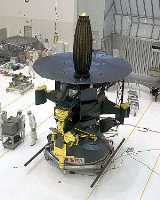
Galileo was an unmanned spacecraft
Unmanned spacecraft
Unmanned spacecraft are spacecraft without people on board, and probably includes unmanned resupply spacecraft, space probes, and most space observatories. A difference between robotic spacecraft and unmanned spacecraft, is that unmanned spacecraft is inclusive to non-robotic unmanned spacecraft,...

 sent by NASA
NASA
The National Aeronautics and Space Administration is the agency of the United States government that is responsible for the nation's civilian space program and for aeronautics and aerospace research...

 to study the planet
Planet
A planet is a celestial body orbiting a star or stellar remnant that is massive enough to be rounded by its own gravity, is not massive enough to cause thermonuclear fusion, and has cleared its neighbouring region of planetesimals.The term planet is ancient, with ties to history, science,...

 Jupiter
Jupiter
Jupiter is the fifth planet from the Sun and the largest planet within the Solar System. It is a gas giant with mass one-thousandth that of the Sun but is two and a half times the mass of all the other planets in our Solar System combined. Jupiter is classified as a gas giant along with Saturn,...

 and its moon
Natural satellite
A natural satellite or moon is a celestial body that orbits a planet or smaller body, which is called its primary. The two terms are used synonymously for non-artificial satellites of planets, of dwarf planets, and of minor planets....

s. Named after the astronomer
Astronomer
An astronomer is a scientist who studies celestial bodies such as planets, stars and galaxies.Historically, astronomy was more concerned with the classification and description of phenomena in the sky, while astrophysics attempted to explain these phenomena and the differences between them using...

 and Renaissance
Renaissance
The Renaissance was a cultural movement that spanned roughly the 14th to the 17th century, beginning in Italy in the Late Middle Ages and later spreading to the rest of Europe. The term is also used more loosely to refer to the historical era, but since the changes of the Renaissance were not...

 pioneer Galileo Galilei
Galileo Galilei
Galileo Galilei , was an Italian physicist, mathematician, astronomer, and philosopher who played a major role in the Scientific Revolution. His achievements include improvements to the telescope and consequent astronomical observations and support for Copernicanism...

, it was launched on October 18, 1989 by the Space Shuttle Atlantis
Space Shuttle Atlantis
The Space Shuttle Atlantis is a retired Space Shuttle orbiter in the Space Shuttle fleet belonging to the National Aeronautics and Space Administration , the spaceflight and space exploration agency of the United States...

 on the STS-34
STS-34
STS-34 was a NASA Space Shuttle mission using Space Shuttle Atlantis. It was the 31st shuttle mission overall, and the 5th flight for Atlantis. During the mission, the Jupiter-bound Galileo probe was deployed into space...

 mission. It arrived at Jupiter on December 7, 1995, a little more than six years later, via gravitational assist flybys of Venus
Venus
Venus is the second planet from the Sun, orbiting it every 224.7 Earth days. The planet is named after Venus, the Roman goddess of love and beauty. After the Moon, it is the brightest natural object in the night sky, reaching an apparent magnitude of −4.6, bright enough to cast shadows...

 and Earth
Earth
Earth is the third planet from the Sun, and the densest and fifth-largest of the eight planets in the Solar System. It is also the largest of the Solar System's four terrestrial planets...

.

Despite antenna problems, Galileo conducted the first asteroid
Asteroid
Asteroids are a class of small Solar System bodies in orbit around the Sun. They have also been called planetoids, especially the larger ones...

 flyby near 951 Gaspra
951 Gaspra
951 Gaspra is an S-type asteroid that orbits very close to the inner edge of the asteroid belt. Gaspra was the first asteroid ever to be closely approached when it was visited by the Galileo spacecraft, which flew by on its way to Jupiter on 29 October 1991.-Characteristics:Apart from a multitude...

, discovered the first asteroid moon
Asteroid moon
A minor planet moon is an astronomical body that orbits a minor planet as its natural satellite. It is thought that many asteroids and Kuiper belt objects may possess moons, in some cases quite substantial in size...

 Dactyl around the asteroid 243 Ida
243 Ida
243 Ida is an asteroid in the Koronis family of the asteroid belt. It was discovered on 29 September 1884 by Johann Palisa and named after a nymph from Greek mythology. Later telescopic observations categorized Ida as an S-type asteroid, the most numerous type in the inner asteroid belt. On 28...

, was the first spacecraft to orbit Jupiter, and launched the first probe into Jupiter's atmosphere.

The spacecraft measured the atmospheric composition of Jupiter and directly observed ammonia
Ammonia
Ammonia is a compound of nitrogen and hydrogen with the formula . It is a colourless gas with a characteristic pungent odour. Ammonia contributes significantly to the nutritional needs of terrestrial organisms by serving as a precursor to food and fertilizers. Ammonia, either directly or...

 clouds, which seem to be created by an outflow from the lower depths of Jupiter's atmosphere. Galileo also registered Io
Io (moon)
Io ) is the innermost of the four Galilean moons of the planet Jupiter and, with a diameter of , the fourth-largest moon in the Solar System. It was named after the mythological character of Io, a priestess of Hera who became one of the lovers of Zeus....

's volcanism
Volcanism
Volcanism is the phenomenon connected with volcanoes and volcanic activity. It includes all phenomena resulting from and causing magma within the crust or mantle of a planet to rise through the crust and form volcanic rocks on the surface....

 and the plasma
Plasma (physics)
In physics and chemistry, plasma is a state of matter similar to gas in which a certain portion of the particles are ionized. Heating a gas may ionize its molecules or atoms , thus turning it into a plasma, which contains charged particles: positive ions and negative electrons or ions...

 interactions between its and Jupiter's atmospheres. Other studies gave support for the popular theory of liquid oceans under the icy surface of Europa
Europa (moon)
Europa Slightly smaller than Earth's Moon, Europa is primarily made of silicate rock and probably has an iron core. It has a tenuous atmosphere composed primarily of oxygen. Its surface is composed of ice and is one of the smoothest in the Solar System. This surface is striated by cracks and...

. There were also indications of similar liquid-saltwater layers under the surfaces of Ganymede
Ganymede (moon)
Ganymede is a satellite of Jupiter and the largest moon in the Solar System. It is the seventh moon and third Galilean satellite outward from Jupiter. Completing an orbit in roughly seven days, Ganymede participates in a 1:2:4 orbital resonance with the moons Europa and Io, respectively...

 and Callisto
Callisto (moon)
Callisto named after the Greek mythological figure of Callisto) is a moon of the planet Jupiter. It was discovered in 1610 by Galileo Galilei. It is the third-largest moon in the Solar System and the second largest in the Jovian system, after Ganymede. Callisto has about 99% the diameter of the...

, while Ganymede was shown to possess a magnetic field
Magnetic field
A magnetic field is a mathematical description of the magnetic influence of electric currents and magnetic materials. The magnetic field at any given point is specified by both a direction and a magnitude ; as such it is a vector field.Technically, a magnetic field is a pseudo vector;...

. New evidence was also found for the existence of exosphere
Exosphere
The exosphere is the uppermost layer of Earth's atmosphere. In the exosphere, an upward travelling molecule moving fast enough to attain escape velocity can escape to space with a low chance of collisions; if it is moving below escape velocity it will be prevented from escaping from the celestial...

s around Europa, Ganymede, and Callisto.

It was furthermore discovered that Jupiter's faint ring system is formed by dust from impacts on the four small inner moons. The extent and structure of Jupiter's magnetosphere
Magnetosphere
A magnetosphere is formed when a stream of charged particles, such as the solar wind, interacts with and is deflected by the intrinsic magnetic field of a planet or similar body. Earth is surrounded by a magnetosphere, as are the other planets with intrinsic magnetic fields: Mercury, Jupiter,...

 was also mapped.

Galileo also provided the only direct observation of Comet Shoemaker-Levy 9
Comet Shoemaker-Levy 9
Comet Shoemaker–Levy 9 was a comet that broke apart and collided with Jupiter in July 1994, providing the first direct observation of an extraterrestrial collision of solar system objects. This generated a large amount of coverage in the popular media, and the comet was closely observed by...

's impact into the atmosphere of Jupiter in 1994.

On September 21, 2003, after 14 years in space and 8 years of service in the Jovian system, Galileos mission was terminated by sending the orbiter into Jupiter's atmosphere at a speed of nearly 50 kilometres per second to avoid any chance of it contaminating local moons with bacteria
Bacteria
Bacteria are a large domain of prokaryotic microorganisms. Typically a few micrometres in length, bacteria have a wide range of shapes, ranging from spheres to rods and spirals...

 from Earth
Earth
Earth is the third planet from the Sun, and the densest and fifth-largest of the eight planets in the Solar System. It is also the largest of the Solar System's four terrestrial planets...

. Of particular concern was the ice
Ice
Ice is water frozen into the solid state. Usually ice is the phase known as ice Ih, which is the most abundant of the varying solid phases on the Earth's surface. It can appear transparent or opaque bluish-white color, depending on the presence of impurities or air inclusions...

-crusted moon Europa
Europa (moon)
Europa Slightly smaller than Earth's Moon, Europa is primarily made of silicate rock and probably has an iron core. It has a tenuous atmosphere composed primarily of oxygen. Its surface is composed of ice and is one of the smoothest in the Solar System. This surface is striated by cracks and...

, which, thanks to
Galileo, scientists now suspect harbors a potentially life-supporting saltwater ocean
Ocean
An ocean is a major body of saline water, and a principal component of the hydrosphere. Approximately 71% of the Earth's surface is covered by ocean, a continuous body of water that is customarily divided into several principal oceans and smaller seas.More than half of this area is over 3,000...

 beneath its surface.

Mission overview


Galileos launch had been significantly delayed. Early plans saw it being launched by Space Shuttle
Space Shuttle
The Space Shuttle was a manned orbital rocket and spacecraft system operated by NASA on 135 missions from 1981 to 2011. The system combined rocket launch, orbital spacecraft, and re-entry spaceplane with modular add-ons...

 Columbia
Space Shuttle Columbia
Space Shuttle Columbia was the first spaceworthy Space Shuttle in NASA's orbital fleet. First launched on the STS-1 mission, the first of the Space Shuttle program, it completed 27 missions before being destroyed during re-entry on February 1, 2003 near the end of its 28th, STS-107. All seven crew...

 on what was then codenamed STS-23 in January 1982, but delays in the development of the Space Shuttle allowed more time for development of the probe.

Once it was complete, its launch was scheduled for STS-61-G on-board Atlantis
Space Shuttle Atlantis
The Space Shuttle Atlantis is a retired Space Shuttle orbiter in the Space Shuttle fleet belonging to the National Aeronautics and Space Administration , the spaceflight and space exploration agency of the United States...

 in 1986. It was to use the Centaur-G
Centaur (rocket stage)
Centaur is a rocket stage designed for use as the upper stage of space launch vehicles. Centaur boosts its satellite payload to geosynchronous orbit or, in the case of an interplanetary space probe, to or near to escape velocity...

 liquid hydrogen-fueled booster stage for a direct trajectory to Jupiter. However, the mission was further delayed by the hiatus in launches that occurred after the Space Shuttle Challenger disaster
Space Shuttle Challenger disaster
The Space Shuttle Challenger disaster occurred on January 28, 1986, when Space Shuttle Challenger broke apart 73 seconds into its flight, leading to the deaths of its seven crew members. The spacecraft disintegrated over the Atlantic Ocean, off the coast of central Florida at 11:38 am EST...

. New safety protocols introduced as a result of the disaster prohibited the use of the Centaur-G stage on the Shuttle, forcing Galileo to use a lower-powered Inertial Upper Stage
Inertial Upper Stage
The Inertial Upper Stage , originally known as the Interim Upper Stage, is a two-stage solid-fueled booster rocket developed by the U.S...

 solid-fuel booster. The mission was re-profiled to use several gravitational slingshot
Gravitational slingshot
In orbital mechanics and aerospace engineering, a gravitational slingshot, gravity assist maneuver, or swing-by is the use of the relative movement and gravity of a planet or other celestial body to alter the path and speed of a spacecraft, typically in order to save propellant, time, and expense...

s, referred to as the "VEEGA" or Venus Earth Earth Gravity Assist maneuvers, to provide the additional velocity required to reach its destination. Venus
Venus
Venus is the second planet from the Sun, orbiting it every 224.7 Earth days. The planet is named after Venus, the Roman goddess of love and beauty. After the Moon, it is the brightest natural object in the night sky, reaching an apparent magnitude of −4.6, bright enough to cast shadows...

 was flown by at 05:58:48 UT on February 10 1990 at a range of 16,106 km. Having gained 8,030 km per hour in speed, the spacecraft flew by Earth
Earth
Earth is the third planet from the Sun, and the densest and fifth-largest of the eight planets in the Solar System. It is also the largest of the Solar System's four terrestrial planets...

 twice, the first time at a range of 960 km at 20:34:34 UT on 8 December 1990 before approaching the minor planet 951 Gaspra
951 Gaspra
951 Gaspra is an S-type asteroid that orbits very close to the inner edge of the asteroid belt. Gaspra was the first asteroid ever to be closely approached when it was visited by the Galileo spacecraft, which flew by on its way to Jupiter on 29 October 1991.-Characteristics:Apart from a multitude...

 to a distance of 1,604 km at 22:37 UT on 29 October 1991. Galileo then performed a second flyby of Earth at 303.1 km at 15:09:25 UT on 8 December 1992, adding 3.7 km per second to its cumulative speed. Galileo performed close observation of a second asteroid, 243 Ida
243 Ida
243 Ida is an asteroid in the Koronis family of the asteroid belt. It was discovered on 29 September 1884 by Johann Palisa and named after a nymph from Greek mythology. Later telescopic observations categorized Ida as an S-type asteroid, the most numerous type in the inner asteroid belt. On 28...

, at 16:51:59 UT on 28 August 1993 at a range of 2,410 km. The spacecraft discovered Ida has a moon Dactyl, the first discovery of a natural satellite orbiting an asteroid. In 1994, Galileo was perfectly positioned to watch the fragments of the comet
Comet
A comet is an icy small Solar System body that, when close enough to the Sun, displays a visible coma and sometimes also a tail. These phenomena are both due to the effects of solar radiation and the solar wind upon the nucleus of the comet...

 Shoemaker-Levy 9
Comet Shoemaker-Levy 9
Comet Shoemaker–Levy 9 was a comet that broke apart and collided with Jupiter in July 1994, providing the first direct observation of an extraterrestrial collision of solar system objects. This generated a large amount of coverage in the popular media, and the comet was closely observed by...

 crash into Jupiter, whereas terrestrial telescopes had to wait to see the impact sites as they rotated into view. After releasing its atmospheric probe on 13 July 1995, the Galileo orbiter became the first man-made satellite of Jupiter at 00:27 UT on 8 December, 1995 when it fired its main engine to enter a 198-day parking orbit.

Galileo's prime mission was a two-year study of the Jovian system. The spacecraft traveled around Jupiter in elongated ellipse
Ellipse
In geometry, an ellipse is a plane curve that results from the intersection of a cone by a plane in a way that produces a closed curve. Circles are special cases of ellipses, obtained when the cutting plane is orthogonal to the cone's axis...

s, each orbit lasting about two months. The differing distances from Jupiter afforded by these orbits allowed Galileo to sample different parts of the planet's extensive magnetosphere
Magnetosphere
A magnetosphere is formed when a stream of charged particles, such as the solar wind, interacts with and is deflected by the intrinsic magnetic field of a planet or similar body. Earth is surrounded by a magnetosphere, as are the other planets with intrinsic magnetic fields: Mercury, Jupiter,...

. The orbits were designed for close-up flybys of Jupiter's largest moons. Once Galileo's prime mission was concluded, an extended mission followed, starting on December 7, 1997; the spacecraft made a number of daring close flybys of Jupiter's moons Europa
Europa (moon)
Europa Slightly smaller than Earth's Moon, Europa is primarily made of silicate rock and probably has an iron core. It has a tenuous atmosphere composed primarily of oxygen. Its surface is composed of ice and is one of the smoothest in the Solar System. This surface is striated by cracks and...

 and Io
Io (moon)
Io ) is the innermost of the four Galilean moons of the planet Jupiter and, with a diameter of , the fourth-largest moon in the Solar System. It was named after the mythological character of Io, a priestess of Hera who became one of the lovers of Zeus....

. The closest approach was 180 km (111.8 mi) on October 15, 2001. The radiation
Radiation
In physics, radiation is a process in which energetic particles or energetic waves travel through a medium or space. There are two distinct types of radiation; ionizing and non-ionizing...

 environment near Io in particular was very unhealthy for Galileos systems, and so these flybys were saved for the extended mission when loss of the spacecraft would be more acceptable.

Galileos cameras were deactivated on January 17, 2002, after they had sustained irreparable radiation damage. NASA engineers were able to recover the damaged tape recorder electronics, and Galileo continued to return scientific data until it was deorbited in 2003, performing one last scientific experiment —a measurement of the moon Amalthea
Amalthea (moon)
Amalthea is the third moon of Jupiter in order of distance from the planet. It was discovered on September 9, 1892, by Edward Emerson Barnard and named after Amalthea, a nymph in Greek mythology. It is also known as '....

's mass as the spacecraft swung by it.

The Galileo spacecraft


The Jet Propulsion Laboratory
Jet Propulsion Laboratory
Jet Propulsion Laboratory is a federally funded research and development center and NASA field center located in the San Gabriel Valley area of Los Angeles County, California, United States. The facility is headquartered in the city of Pasadena on the border of La Cañada Flintridge and Pasadena...

 built the Galileo spacecraft and managed the Galileo mission for NASA. Germany
Germany
Germany , officially the Federal Republic of Germany , is a federal parliamentary republic in Europe. The country consists of 16 states while the capital and largest city is Berlin. Germany covers an area of 357,021 km2 and has a largely temperate seasonal climate...

 supplied the propulsion module. NASA's Ames Research Center managed the probe, which was built by Hughes Aircraft Company.

At launch, the orbiter and probe together had a mass of 2,564 kilograms (5,653 pounds) and stood seven metres tall. One section of the spacecraft rotated at 3 rpm
Revolutions per minute
Revolutions per minute is a measure of the frequency of a rotation. It annotates the number of full rotations completed in one minute around a fixed axis...

, keeping Galileo stable and holding six instruments that gathered data from many different directions, including the fields and particles instruments. The other section of the spacecraft was an antenna, and data were periodically transmitted to it. Back on the ground, the mission operations team used software containing 650,000 lines of programming code in the orbit sequence design process; 1,615,000 lines in the telemetry interpretation; and 550,000 lines of code in navigation.

Command and Data Handling (CDH)


The CDH subsystem was actively redundant, with two parallel data system buses
System bus
A system bus is a single computer bus that connects the major components of a computer system. The technique was developed to reduce costs and improve modularity....

 running at all times. Each data system bus (aka string) was composed of the same functional elements, consisting of multiplexers (MUX), high-level modules (HLM), low-level modules (LLM), power converters (PC), bulk memory (BUM), data management subsystem bulk memory (DBUM), timing chains (TC), phase locked loops
Phase-locked loop
A phase-locked loop or phase lock loop is a control system that generates an output signal whose phase is related to the phase of an input "reference" signal. It is an electronic circuit consisting of a variable frequency oscillator and a phase detector...

 (PLL), Golay
Binary Golay code
In mathematics and electronics engineering, a binary Golay code is a type of error-correcting code used in digital communications. The binary Golay code, along with the ternary Golay code, has a particularly deep and interesting connection to the theory of finite sporadic groups in mathematics....

 coders (GC), hardware command decoders (HCD) and critical controllers (CRC).

The CDH subsystem was responsible for maintaining the following functions:
  1. decoding of uplink commands
  2. execution of commands and sequences
  3. execution of system-level fault-protection responses
  4. collection, processing, and formatting of telemetry data for downlink transmission
  5. movement of data between subsystems via a data system bus


The spacecraft was controlled by six RCA 1802
RCA 1802
The RCA CDP1802, also known as the COSMAC , is an 8-bit CMOS microprocessor introduced by RCA in early 1976. It is being by Intersil Corporation as a high-reliability microprocessor...

 Cosmac microprocessor
Microprocessor
A microprocessor incorporates the functions of a computer's central processing unit on a single integrated circuit, or at most a few integrated circuits. It is a multipurpose, programmable device that accepts digital data as input, processes it according to instructions stored in its memory, and...

 CPUs
Central processing unit
The central processing unit is the portion of a computer system that carries out the instructions of a computer program, to perform the basic arithmetical, logical, and input/output operations of the system. The CPU plays a role somewhat analogous to the brain in the computer. The term has been in...

: four on the spun side and two on the despun side. Each CPU was clocked at about 1.6 MHz, and fabricated on sapphire
Sapphire
Sapphire is a gemstone variety of the mineral corundum, an aluminium oxide , when it is a color other than red or dark pink; in which case the gem would instead be called a ruby, considered to be a different gemstone. Trace amounts of other elements such as iron, titanium, or chromium can give...

 (silicon on sapphire
Silicon on sapphire
Silicon on sapphire is a hetero-epitaxial process for integrated circuit manufacturing that consists of a thin layer of silicon grown on a sapphire wafer. SOS is part of the Silicon on Insulator family of CMOS technologies...

), which is a radiation-and static-hardened
Radiation hardening
Radiation hardening is a method of designing and testing electronic components and systems to make them resistant to damage or malfunctions caused by ionizing radiation , such as would be encountered in outer space, high-altitude flight, around nuclear reactors, particle accelerators, or during...

 material ideal for spacecraft operation. This microprocessor was the first low-power CMOS
CMOS
Complementary metal–oxide–semiconductor is a technology for constructing integrated circuits. CMOS technology is used in microprocessors, microcontrollers, static RAM, and other digital logic circuits...

 processor chip, quite on a par with the 8-bit 6502 that was being built into the Apple II
Apple II
The Apple II is an 8-bit home computer, one of the first highly successful mass-produced microcomputer products, designed primarily by Steve Wozniak, manufactured by Apple Computer and introduced in 1977...

 desktop computer
Desktop computer
A desktop computer is a personal computer in a form intended for regular use at a single location, as opposed to a mobile laptop or portable computer. Early desktop computers are designed to lay flat on the desk, while modern towers stand upright...

 at that time. Galileos attitude control system software was written in the HAL/S
HAL/S
HAL/S is a real-time aerospace programming language, best known for its use in the Space Shuttle program. It was designed by Intermetrics in the 1970s for NASA. HAL/S is written in XPL, a dialect of PL/I....

 programming language, also used in the Space Shuttle program
Space Shuttle program
NASA's Space Shuttle program, officially called Space Transportation System , was the United States government's manned launch vehicle program from 1981 to 2011...

.

Memory capacity provided by each BUM was 16K of RAM
Ram
-Animals:*Ram, an uncastrated male sheep*Ram cichlid, a species of freshwater fish endemic to Colombia and Venezuela-Military:*Battering ram*Ramming, a military tactic in which one vehicle runs into another...

, while the DBUMs each provided 8K of RAM. There were two BUMs and two DBUMs in the CDH subsystem and they all resided on the spun side of the spacecraft. The BUMs and DBUMs provided storage for sequences and contain various buffers for telemetry data and interbus communication.

Every HLM and LLM was built up around a single 1802 microprocessor and 32K of RAM (for HLMs) or 16K of RAM (for LLMs). Two HLMs and two LLMs resided on the spun side while two LLMs were on the despun side.

Thus, total memory capacity available to the CDH subsystem was 176K of RAM: 144K allocated to the spun side and 32K to the despun side.

Each HLM was responsible for the following functions:
  1. uplink command processing
  2. maintenance of the spacecraft clock
  3. movement of data over the data system bus
  4. execution of stored sequences (time-event tables)
  5. telemetry control
  6. error recovery including system fault-protection monitoring and response


Each LLM was responsible for the following functions:
  1. collect and format engineering data from the subsystems
  2. provide the capability to issue coded and discrete commands to spacecraft users
  3. recognize out-of-tolerance conditions on status inputs
  4. perform some system fault-protection functions


The HCD receives command data from the modulation/demodulation subsystem, decodes these data and transfers them to the HLMs and CRCs.

The CRC controls the configuration of CDH subsystem elements. It also controls access to the two data system buses by other spacecraft subsystems. In addition, the CRC supplies signals to enable certain critical events (e.g. probe separation).

The GCs provide Golay
Binary Golay code
In mathematics and electronics engineering, a binary Golay code is a type of error-correcting code used in digital communications. The binary Golay code, along with the ternary Golay code, has a particularly deep and interesting connection to the theory of finite sporadic groups in mathematics....

 encoding of data via hardware.

The TCs and PLLs establish timing within the CDH subsystem.

Propulsion


The Propulsion Subsystem consisted of a 400 N main engine and twelve 10 N thrusters, together with propellant, storage and pressurizing tanks and associated plumbing. The 10 N thrusters were mounted in groups of six on two 2-meter booms. The fuel for the system was 925 kg of monomethylhydrazine
Monomethylhydrazine
Monomethylhydrazine is a volatile hydrazine chemical with the chemical formula CH3 NH2. It is used as a rocket propellant in bipropellant rocket engines because it is hypergolic with various oxidizers such as nitrogen tetroxide and nitric acid...

 and nitrogen tetroxide. Two separate tanks held another 7 kg of helium
Helium
Helium is the chemical element with atomic number 2 and an atomic weight of 4.002602, which is represented by the symbol He. It is a colorless, odorless, tasteless, non-toxic, inert, monatomic gas that heads the noble gas group in the periodic table...

 pressurant. The Propulsion Subsystem was developed and built by Daimler Benz Aero Space AG (DASA) (formerly Messerschmitt–Bölkow–Blohm (MBB)
Messerschmitt
Messerschmitt AG was a famous German aircraft manufacturing corporation named for its chief designer, Willy Messerschmitt, and known primarily for its World War II fighter aircraft, notably the Bf 109 and Me 262...

) and provided by Germany, the major international partner in Project Galileo.

Electrical power


Solar panels
Photovoltaic module
A solar panel is a packaged, connected assembly of solar cells, also known as photovoltaic cells...

 were not a practical solution for
Galileos power needs at Jupiter's distance from the Sun (it would have needed a minimum of 65 square metres (699.7 sq ft) of solar panels); as for batteries, they would have been prohibitively massive due to the technological limitations of the time. The solution adopted consisted of two radioisotope thermoelectric generator
Radioisotope thermoelectric generator
A radioisotope thermoelectric generator is an electrical generator that obtains its power from radioactive decay. In such a device, the heat released by the decay of a suitable radioactive material is converted into electricity by the Seebeck effect using an array of thermocouples.RTGs can be...

s (RTGs). The RTGs powered the spacecraft through the radioactive decay of plutonium
Plutonium
Plutonium is a transuranic radioactive chemical element with the chemical symbol Pu and atomic number 94. It is an actinide metal of silvery-gray appearance that tarnishes when exposed to air, forming a dull coating when oxidized. The element normally exhibits six allotropes and four oxidation...

-238. The heat emitted by this decay was converted into electricity for the spacecraft through the solid-state Seebeck effect. This provided a reliable and long-lasting source of electricity unaffected by the cold space environment and high radiation fields such as those encountered in Jupiter's magnetosphere.

Each GPHS-RTG
GPHS-RTG
GPHS-RTG or General Purpose Heat Source Radioisotope Thermoelectric Generator. These are a specific American design of Radioisotope Thermoelectric Generator used on space missions GPHS-RTG or General Purpose Heat Source Radioisotope Thermoelectric Generator. These are a specific American design of...

, mounted on a 5-meter long boom, carried 7.8 kilograms (17.2 lb) of 238Pu
Plutonium
Plutonium is a transuranic radioactive chemical element with the chemical symbol Pu and atomic number 94. It is an actinide metal of silvery-gray appearance that tarnishes when exposed to air, forming a dull coating when oxidized. The element normally exhibits six allotropes and four oxidation...

. Each RTG contained 18 separate heat source modules, and each module encased four pellets of plutonium dioxide
Plutonium dioxide
Plutonium oxide is the chemical compound with the formula PuO2. This high melting point solid is a principal compound of plutonium. It can vary in color from yellow to olive green, depending on the particle size, temperature and method of production....

, a ceramic
Ceramic
A ceramic is an inorganic, nonmetallic solid prepared by the action of heat and subsequent cooling. Ceramic materials may have a crystalline or partly crystalline structure, or may be amorphous...

 material resistant to fracturing. The modules were designed to survive a range of hypothetical accidents: launch vehicle explosion or fire, re-entry into the atmosphere followed by land or water impact, and post-impact situations. An outer covering of graphite
Graphite
The mineral graphite is one of the allotropes of carbon. It was named by Abraham Gottlob Werner in 1789 from the Ancient Greek γράφω , "to draw/write", for its use in pencils, where it is commonly called lead . Unlike diamond , graphite is an electrical conductor, a semimetal...

 provided protection against the structural, thermal, and eroding environments of a potential re-entry. Additional graphite components provided impact protection, while iridium
Iridium
Iridium is the chemical element with atomic number 77, and is represented by the symbol Ir. A very hard, brittle, silvery-white transition metal of the platinum family, iridium is the second-densest element and is the most corrosion-resistant metal, even at temperatures as high as 2000 °C...

 cladding of the fuel cells provided post-impact containment. The RTGs produced about 570 watts at launch. The power output initially decreased at the rate of 0.6 watts per month and was 493 watts when Galileo arrived at Jupiter.

As the launch of Galileo neared, anti-nuclear groups, concerned over what they perceived as an unacceptable risk to the public's safety from Galileo's RTGs, sought a court injunction prohibiting Galileo's launch. RTGs had been used for years in planetary exploration without mishap: the Lincoln Experimental Satellite
Lincoln Experimental Satellite
Lincoln Experimental Satellite refers to a series of satellites designed and built by Lincoln Laboratory at MIT between 1965 and 1976, under USAF sponsorship, for testing devices and techniques for satellite communication....

s 8/9, launched by the U.S. Department of Defense
United States Department of Defense
The United States Department of Defense is the U.S...

, had 7% more plutonium on board than
Galileo, and the two Voyager spacecraft each carried 80% as much plutonium as Galileo did. However, activists remembered the messy crash of the Soviet Union's nuclear-powered Cosmos 954
Cosmos 954
Kosmos 954 was a Soviet Radar Ocean Reconnaissance Satellite with an onboard nuclear reactor. The satellite was launched on September 18, 1977 and was designed to track nuclear submarines...

 satellite in Canada in 1978, and the 1986 Challenger accident had raised public awareness of the possibility of explosive spacecraft failures. Also, no RTGs had ever been made to swing past the Earth at close range and high speed, as
Galileo's Venus-Earth-Earth Gravity Assist trajectory required it to do. This created a novel mission failure modality that might plausibly have entailed total dispersal of Galileo's plutonium in the Earth's atmosphere. Scientist Carl Sagan
Carl Sagan
Carl Edward Sagan was an American astronomer, astrophysicist, cosmologist, author, science popularizer and science communicator in astronomy and natural sciences. He published more than 600 scientific papers and articles and was author, co-author or editor of more than 20 books...

, for example, a strong supporter of the
Galileo mission, said in 1989 that "there is nothing absurd about either side of this argument."

After the Challenger accident, a study considered additional shielding and eventually rejected it, in part because such a design significantly increased the overall risk of mission failure and only shifted the other risks around (for example, if a failure on orbit had occurred, additional shielding would have significantly increased the consequences of a ground impact).

Instrumentation overview


Scientific instruments to measure fields and particles were mounted on the spinning section of the spacecraft, together with the main antenna, power supply, the propulsion module and most of Galileos computers and control electronics. The sixteen instruments, weighing 118 kg altogether, included magnetometer
Magnetometer
A magnetometer is a measuring instrument used to measure the strength or direction of a magnetic field either produced in the laboratory or existing in nature...

 sensors mounted on an 11 m boom to minimize interference from the spacecraft; a plasma instrument for detecting low energy charged particles and a plasma wave detector to study waves generated by the particles; a high energy particle detector; and a detector of cosmic and Jovian dust
Dust
Dust consists of particles in the atmosphere that arise from various sources such as soil dust lifted up by wind , volcanic eruptions, and pollution...

. It also carried the Heavy Ion Counter, an engineering experiment added to assess the potentially hazardous charged particle environments the spacecraft flew through, and an added Extreme Ultraviolet
Ultraviolet
Ultraviolet light is electromagnetic radiation with a wavelength shorter than that of visible light, but longer than X-rays, in the range 10 nm to 400 nm, and energies from 3 eV to 124 eV...

 detector associated with the UV spectrometer on the scan platform.

The despun section's instruments included the camera system; the near infrared
Infrared
Infrared light is electromagnetic radiation with a wavelength longer than that of visible light, measured from the nominal edge of visible red light at 0.74 micrometres , and extending conventionally to 300 µm...

 mapping spectrometer to make multi-spectral images for atmospheric and moon surface chemical analysis; the ultraviolet spectrometer to study gases; and the photo-polarimeter radiometer to measure radiant and reflected energy. The camera system was designed to obtain images of Jupiter's satellites at resolutions from 20 to 1,000 times better than Voyager
Voyager program
The Voyager program is a U.S program that launched two unmanned space missions, scientific probes Voyager 1 and Voyager 2. They were launched in 1977 to take advantage of a favorable planetary alignment of the late 1970s...

's best, because Galileo flew closer to the planet and its inner moons, and because the more modern CCD
Charge-coupled device
A charge-coupled device is a device for the movement of electrical charge, usually from within the device to an area where the charge can be manipulated, for example conversion into a digital value. This is achieved by "shifting" the signals between stages within the device one at a time...

 sensor in Galileos camera was more sensitive and had a broader color detection band than the vidicons of Voyager.

Instrumentation details


The following information was taken directly from NASA's
Galileo legacy site.

Despun section


Solid State Imager (SSI)

The SSI was an 800-by-800-pixel solid state camera consisting of an array of silicon sensors called a "charge coupled device" (CCD). Galileo was one of the first spacecraft to be equipped with a CCD camera. The optical portion of the camera was built as a Cassegrain telescope. Light was collected by the primary mirror and directed to a smaller secondary mirror that channeled it through a hole in the center of the primary mirror and onto the CCD. The CCD sensor was shielded from radiation
Radiation
In physics, radiation is a process in which energetic particles or energetic waves travel through a medium or space. There are two distinct types of radiation; ionizing and non-ionizing...

, a particular problem within the harsh Jovian magnetosphere. The shielding was accomplished by means of a 10 mm thick layer of tantalum
Tantalum
Tantalum is a chemical element with the symbol Ta and atomic number 73. Previously known as tantalium, the name comes from Tantalus, a character in Greek mythology. Tantalum is a rare, hard, blue-gray, lustrous transition metal that is highly corrosion resistant. It is part of the refractory...

 surrounding the CCD except where the light enters the system. An eight-position filter wheel was used to obtain images at specific wavelengths. The images were then combined electronically on Earth to produce color images. The spectral response of the SSI ranged from about 0.4 to 1.1 micrometres. The SSI weighed 29.7 kilograms and consumed, on average, 15 watts of power.
Near-Infrared Mapping Spectrometer (NIMS)

The NIMS instrument was sensitive to 0.7-to-5.2-micrometre
Micrometre
A micrometer , is by definition 1×10⁻⁶ of a meter .In plain English, it means one-millionth of a meter . Its unit symbol in the International System of Units is μm...

 wavelength IR
Infrared
Infrared light is electromagnetic radiation with a wavelength longer than that of visible light, measured from the nominal edge of visible red light at 0.74 micrometres , and extending conventionally to 300 µm...

 light, overlapping the wavelength range of the SSI. The telescope associated with NIMS was all reflective (using only mirrors and no lenses) with an aperture of 229 mm. The spectrometer
Spectrometer
A spectrometer is an instrument used to measure properties of light over a specific portion of the electromagnetic spectrum, typically used in spectroscopic analysis to identify materials. The variable measured is most often the light's intensity but could also, for instance, be the polarization...

 of NIMS used a grating to disperse the light collected by the telescope. The dispersed spectrum of light was focused on detectors of indium
Indium
Indium is a chemical element with the symbol In and atomic number 49. This rare, very soft, malleable and easily fusible post-transition metal is chemically similar to gallium and thallium, and shows the intermediate properties between these two...

 antimonide
Antimonide
Antimonides are compounds of antimony with more electropositive elements. The antimonide ion is Sb3−.Many of them are flammable or decomposed by oxygen when heated since the antimonide ion is a reducing agent....

 and silicon
Silicon
Silicon is a chemical element with the symbol Si and atomic number 14. A tetravalent metalloid, it is less reactive than its chemical analog carbon, the nonmetal directly above it in the periodic table, but more reactive than germanium, the metalloid directly below it in the table...

. The NIMS weighed 18 kilograms and used 12 watts of power on average.
Ultraviolet Spectrometer / Extreme Ultraviolet Spectrometer (UVS/EUV)

The Cassegrain telescope of the UVS had a 250 mm aperture and collected light from the observation target. Both the UVS and EUV instruments used a ruled grating
Grating
A grating is any regularly spaced collection of essentially identical, parallel, elongated elements. Gratings usually consist of a single set of elongated elements, but can consist of two sets, in which case the second set is usually perpendicular to the first...

 to disperse this light for spectral analysis. This light then passed through an exit slit into photomultiplier
Photomultiplier
Photomultiplier tubes , members of the class of vacuum tubes, and more specifically phototubes, are extremely sensitive detectors of light in the ultraviolet, visible, and near-infrared ranges of the electromagnetic spectrum...

 tubes that produced pulses or "sprays" of electrons. These electron pulses were counted, and these count numbers constituted the data that were sent to Earth. The UVS was mounted on Galileos scan platform and could be pointed to an object in inertial space. The EUV was mounted on the spun section of the spacecraft. As Galileo span, the EUV observed a narrow ribbon of space perpendicular to the spin axis. The two instruments combined weighed about 9.7 kilograms and used 5.9 watts of power.
Photopolarimeter-Radiometer (PPR)

The PPR had seven radiometry bands. One of these used no filters and observed all incoming radiation, both solar and thermal. Another band allowed only solar radiation through. The difference between the solar-plus-thermal and the solar-only channels gave the total thermal radiation emitted. The PPR also measured in five broadband channels that spanned the spectral range from 17 to 110 micrometres. The radiometer provided data on the temperatures of the Jovian satellites and Jupiter's atmosphere. The design of the instrument was based on that of an instrument flown on the Pioneer Venus spacecraft. A 100 mm aperture reflecting telescope collected light and directed it to a series of filters, and, from there, measurements were performed by the detectors of the PPR. The PPR weighed 5.0 kilograms and consumed about 5 watts of power.

Spun section


Dust Detector Subsystem (DDS)

The Dust Detector Subsystem (DDS) was used to measure the mass, electric charge, and velocity of incoming particles. The masses of dust particles that the DDS could detect go from 10−16 to 10−7 grams. The speed of these small particles could be measured over the range of 1 to 70 kilometers per second. The instrument could measure impact rates from 1 particle per 115 days (10 megaseconds) to 100 particles per second. Such data was used to help determine dust origin and dynamics within the magnetosphere
Magnetosphere
A magnetosphere is formed when a stream of charged particles, such as the solar wind, interacts with and is deflected by the intrinsic magnetic field of a planet or similar body. Earth is surrounded by a magnetosphere, as are the other planets with intrinsic magnetic fields: Mercury, Jupiter,...

. The DDS weighed 4.2 kilograms and used an average of 5.4 watts of power.
Energetic Particles Detector (EPD)

The Energetic Particles Detector (EPD) was designed to measure the numbers and energies of ions and electrons whose energies exceeded about 20 keV
Kev
Kev can refer to:*Kev Hawkins, a fictional character.*Kevin, a given name occasionally shortened to "Kev".*Kiloelectronvolt, a unit of energy who symbol is "KeV".* Krefelder Eislauf-VereinKEV can refer to:...

 (3.2 fJ). The EPD could also measure the direction of travel of such particles and, in the case of ions, could determine their composition (whether the ion is oxygen
Oxygen
Oxygen is the element with atomic number 8 and represented by the symbol O. Its name derives from the Greek roots ὀξύς and -γενής , because at the time of naming, it was mistakenly thought that all acids required oxygen in their composition...

 or sulfur
Sulfur
Sulfur or sulphur is the chemical element with atomic number 16. In the periodic table it is represented by the symbol S. It is an abundant, multivalent non-metal. Under normal conditions, sulfur atoms form cyclic octatomic molecules with chemical formula S8. Elemental sulfur is a bright yellow...

, for example). The EPD used silicon solid state detectors and a time-of-flight
Time-of-flight
Time of flight describes a variety of methods that measure the time that it takes for an object, particle or acoustic, electromagnetic or other wave to travel a distance through a medium...

 detector system to measure changes in the energetic particle population at Jupiter as a function of position and time. These measurements helped determine how the particles got their energy and how they were transported through Jupiter's magnetosphere. The EPD weighed 10.5 kilograms and used 10.1 watts of power on average.
Heavy Ion Counter (HIC)

The HIC was in effect a repackaged and updated version of some parts of the flight spare of the Voyager
Voyager program
The Voyager program is a U.S program that launched two unmanned space missions, scientific probes Voyager 1 and Voyager 2. They were launched in 1977 to take advantage of a favorable planetary alignment of the late 1970s...

 Cosmic Ray System. The HIC detected heavy ion
Ion
An ion is an atom or molecule in which the total number of electrons is not equal to the total number of protons, giving it a net positive or negative electrical charge. The name was given by physicist Michael Faraday for the substances that allow a current to pass between electrodes in a...

s using stacks of single crystal silicon wafers. The HIC could measure heavy ions with energies as low as 6 MeV (1 pJ) and as high as 200 MeV (32 pJ) per nucleon. This range included all atomic substances between carbon
Carbon
Carbon is the chemical element with symbol C and atomic number 6. As a member of group 14 on the periodic table, it is nonmetallic and tetravalent—making four electrons available to form covalent chemical bonds...

 and nickel
Nickel
Nickel is a chemical element with the chemical symbol Ni and atomic number 28. It is a silvery-white lustrous metal with a slight golden tinge. Nickel belongs to the transition metals and is hard and ductile...

. The HIC and the EUV shared a communications link and, therefore, had to share observing time. The HIC weighed 8 kilograms and used an average of 2.8 watts of power.
Magnetometer (MAG)

The magnetometer (MAG) used two sets of three sensors. The three sensors allowed the three orthogonal components of the magnetic field
Magnetic field
A magnetic field is a mathematical description of the magnetic influence of electric currents and magnetic materials. The magnetic field at any given point is specified by both a direction and a magnitude ; as such it is a vector field.Technically, a magnetic field is a pseudo vector;...

 section to be measured. One set was located at the end of the magnetometer boom and, in that position, was about 11 m from the spin axis of the spacecraft. The second set, designed to detect stronger fields, was 6.7 m from the spin axis. The boom was used to remove the MAG from the immediate vicinity of Galileo to minimize magnetic effects from the spacecraft. However, not all these effects could be eliminated by distancing the instrument. The rotation of the spacecraft was used to separate natural magnetic fields from engineering-induced fields. Another source of potential error in measurement came from the bending and twisting of the long magnetometer boom. To account for these motions, a calibration coil was mounted rigidly on the spacecraft to generate a reference magnetic field during calibrations. The magnetic field at the surface of the Earth has a strength of about 50,000 nT. At Jupiter, the outboard (11 m) set of sensors could measure magnetic field strengths in the range from ±32 to ±512 nT, while the inboard (6.7 m) set was active in the range from ±512 to ±16,384 nT. The MAG experiment weighed 7 kilograms and used 3.9 watts of power.
Plasma Subsystem (PLS)

The PLS used seven fields of view to collect charged particle
Particle radiation
Particle radiation is the radiation of energy by means of fast-moving subatomic particles. Particle radiation is referred to as a particle beam if the particles are all moving in the same direction, similar to a light beam....

s for energy and mass analysis. These fields of view covered most angles from 0 to 180 degrees, fanning out from the spin axis. The rotation of the spacecraft carried each field of view through a full circle. The PLS measured particles in the energy range from 0.9 eV to 52 keV (0.1 aJ to 8.3 fJ). The PLS weighed 13.2 kilograms and used an average of 10.7 watts of power.
Plasma Wave Subsystem (PWS)

An electric dipole antenna
Dipole antenna
A dipole antenna is a radio antenna that can be made of a simple wire, with a center-fed driven element. It consists of two metal conductors of rod or wire, oriented parallel and collinear with each other , with a small space between them. The radio frequency voltage is applied to the antenna at...

 was used to study the electric fields of plasmas, while two search coil magnetic antennas studied the magnetic fields. The electric dipole antenna was mounted at the tip of the magnetometer boom. The search coil magnetic antennas were mounted on the high-gain antenna feed. Nearly simultaneous measurements of the electric and magnetic field spectrum allowed electrostatic waves to be distinguished from electromagnetic waves. The PWS weighed 7.1 kilograms and used an average of 9.8 watts.

Galileos atmospheric entry probe


The 339-kilogram atmospheric probe, built by Hughes Aircraft Company
Hughes Aircraft
Hughes Aircraft Company was a major American aerospace and defense contractor founded in 1932 by Howard Hughes in Culver City, California as a division of Hughes Tool Company...

 at its El Segundo, California
El Segundo, California
El Segundo is a city in Los Angeles County, California, United States. Located on the Santa Monica Bay, it was incorporated on January 18, 1917, and is one of the Beach Cities of Los Angeles County and part of the South Bay Cities Council of Governments...

 plant, measured about 1.3 meters across. Inside the heat shield
Heat shield
A heat shield is designed to shield a substance from absorbing excessive heat from an outside source by either dissipating, reflecting or simply absorbing the heat...

, the scientific instruments were protected from ferocious heat during entry. The probe had to withstand extreme heat and pressure on its high-speed journey into the Jovian atmosphere, travelling at 47.8 km/s.

The probe was released from the main spacecraft in July 1995, five months before reaching Jupiter, and entered Jupiter's atmosphere with no braking beforehand. The probe was slowed from its arrival speed of about 47 kilometers per second to subsonic speed in less than two minutes.

This was by far the most difficult atmospheric entry ever attempted; the probe had to withstand 230 g
Earth's gravity
The gravity of Earth, denoted g, refers to the acceleration that the Earth imparts to objects on or near its surface. In SI units this acceleration is measured in metres per second per second or equivalently in newtons per kilogram...

 and the probe's 152 kg heat shield, making up almost half of the probe's total mass, lost 80 kg during the entry. NASA built a special laboratory, the Giant Planet Facility, to simulate the heat load, which was similar to that of an ICBM-style straight-down reentry through a thermonuclear fireball
Nuclear explosion
A nuclear explosion occurs as a result of the rapid release of energy from an intentionally high-speed nuclear reaction. The driving reaction may be nuclear fission, nuclear fusion or a multistage cascading combination of the two, though to date all fusion based weapons have used a fission device...

. It then deployed its 2.5-meter (8 ft) parachute
Parachute
A parachute is a device used to slow the motion of an object through an atmosphere by creating drag, or in the case of ram-air parachutes, aerodynamic lift. Parachutes are usually made out of light, strong cloth, originally silk, now most commonly nylon...

, and dropped its heat shield.

As the probe descended through 150 kilometers of the top layers of the Jovian atmosphere, it collected 58 minutes of data on the local weather
Weather
Weather is the state of the atmosphere, to the degree that it is hot or cold, wet or dry, calm or stormy, clear or cloudy. Most weather phenomena occur in the troposphere, just below the stratosphere. Weather refers, generally, to day-to-day temperature and precipitation activity, whereas climate...

. It only stopped transmitting when ambient pressure exceeded 23 atmospheres
Atmosphere (unit)
The standard atmosphere is an international reference pressure defined as 101325 Pa and formerly used as unit of pressure. For practical purposes it has been replaced by the bar which is 105 Pa...

 and temperature reached 153 °C (307 °F). The data was sent to the spacecraft overhead, then transmitted back to Earth. Each of 2 L-band transmitters operated at 128 bits per second and sent nearly identical streams of scientific data to the orbiter. All the probe's electronics were powered by lithium sulfur dioxide (LiSO2) batteries
Lithium battery
Lithium batteries are disposable batteries that have lithium metal or lithium compounds as an anode. Depending on the design and chemical compounds used, lithium cells can produce voltages from 1.5 V to about 3.7 V, over twice the voltage of an ordinary zinc–carbon battery or alkaline battery...

 that provided a nominal power output of about 580 watts with an estimated capacity of about 21 ampere-hours on arrival at Jupiter.


The probe included six instruments for taking data on its plunge into Jupiter:
  • an atmospheric structure instrument group measuring temperature, pressure and deceleration,
  • a neutral mass spectrometer
    Spectrometer
    A spectrometer is an instrument used to measure properties of light over a specific portion of the electromagnetic spectrum, typically used in spectroscopic analysis to identify materials. The variable measured is most often the light's intensity but could also, for instance, be the polarization...

    and
  • a helium-abundance interferometer supporting atmospheric composition studies,
  • a nephelometer
    Nephelometer
    A nephelometer is a stationary or portable instrument for measuring suspended particulates in a liquid or gas colloid. A nephelometer measures suspended particulates by employing a light beam and a light detector set to one side of the source beam. Particle density is then a function of the...

    for cloud location and cloud-particle observations,
  • a net-flux radiometer
    Radiometer
    A radiometer is a device for measuring the radiant flux of electromagnetic radiation. Generally, the term radiometer denotes an infrared radiation detector, yet it also includes detectors operating on any electromagnetic wavelength....

    measuring the difference between upward and downward radiant flux
    Radiant flux
    In radiometry, radiant flux or radiant power is the measure of the total power of electromagnetic radiation...

      at each altitude, and
  • a lightning/radio-emission instrument with an energetic-particle detector that measured light and radio emissions associated with lightning
    Lightning
    Lightning is an atmospheric electrostatic discharge accompanied by thunder, which typically occurs during thunderstorms, and sometimes during volcanic eruptions or dust storms...

     and energetic particles in Jupiter's radiation belts.


Total data returned from the probe was about 3.5 megabits (~458752 bytes). The probe stopped transmitting before the line of sight link with the orbiter was cut. The likely proximal cause of the final probe failure was overheating, which sensors indicated before signal loss.

The atmosphere through which the probe descended was somewhat hotter and more turbulent than expected. The probe was eventually completely destroyed as it continued to descend. The parachute would have melted first, roughly 30 minutes after entry, then the aluminum components after another 40 minutes of free fall. The titanium structure would have lasted 6.5 hours more before disintegrating. Due to the high pressure, the droplets of metals from the probe would finally have vaporized once their critical temperature had been reached, and mixed with Jupiter's liquid metallic hydrogen
Metallic hydrogen
Metallic hydrogen is a state of hydrogen which results when it is sufficiently compressed and undergoes a phase transition; it is an example of degenerate matter. Solid metallic hydrogen is predicted to consist of a crystal lattice of hydrogen nuclei , with a spacing which is significantly smaller...

 interior.

Science performed by the Galileo Orbiter at Jupiter


After arriving on December 7, 1995 and completing 35 orbits around Jupiter throughout a nearly eight year mission, the
Galileo Orbiter was destroyed during a controlled impact with Jupiter on September 21, 2003. During that intervening time, Galileo forever changed the way scientists saw Jupiter and provided a wealth of information on the moons orbiting the planet which will be studied for years to come. Culled from NASA's press kit, the top orbiter science results were:
  • Galileo made the first observation of ammonia
    Ammonia
    Ammonia is a compound of nitrogen and hydrogen with the formula . It is a colourless gas with a characteristic pungent odour. Ammonia contributes significantly to the nutritional needs of terrestrial organisms by serving as a precursor to food and fertilizers. Ammonia, either directly or...

     clouds in another planet's atmosphere. The atmosphere creates ammonia ice particles from material coming up from lower depths.
  • The moon Io
    Io (moon)
    Io ) is the innermost of the four Galilean moons of the planet Jupiter and, with a diameter of , the fourth-largest moon in the Solar System. It was named after the mythological character of Io, a priestess of Hera who became one of the lovers of Zeus....

     was confirmed to have extensive volcanic activity that is 100 times greater than that found on Earth. The heat and frequency of eruptions are reminiscent of early Earth.
  • Complex plasma interactions in Io's atmosphere create immense electrical currents which couple to Jupiter's atmosphere.
  • Several lines of evidence from Galileo support the theory that liquid oceans exist under Europa's icy surface.
  • Ganymede possesses its own, substantial magnetic field - the first satellite known to have one.
  • Galileo magnetic data provide evidence that Europa, Ganymede and Callisto have a liquid-saltwater layer under the visible surface.
  • Evidence exists that Europa
    Europa (moon)
    Europa Slightly smaller than Earth's Moon, Europa is primarily made of silicate rock and probably has an iron core. It has a tenuous atmosphere composed primarily of oxygen. Its surface is composed of ice and is one of the smoothest in the Solar System. This surface is striated by cracks and...

    , Ganymede
    Ganymede (moon)
    Ganymede is a satellite of Jupiter and the largest moon in the Solar System. It is the seventh moon and third Galilean satellite outward from Jupiter. Completing an orbit in roughly seven days, Ganymede participates in a 1:2:4 orbital resonance with the moons Europa and Io, respectively...

    , and Callisto
    Callisto (moon)
    Callisto named after the Greek mythological figure of Callisto) is a moon of the planet Jupiter. It was discovered in 1610 by Galileo Galilei. It is the third-largest moon in the Solar System and the second largest in the Jovian system, after Ganymede. Callisto has about 99% the diameter of the...

     all have a thin atmospheric layer known as a 'surface-bound exosphere
    Exosphere
    The exosphere is the uppermost layer of Earth's atmosphere. In the exosphere, an upward travelling molecule moving fast enough to attain escape velocity can escape to space with a low chance of collisions; if it is moving below escape velocity it will be prevented from escaping from the celestial...

    '.
  • Jupiter's ring system is formed by dust kicked up as interplanetary meteoroid
    Meteoroid
    A meteoroid is a sand- to boulder-sized particle of debris in the Solar System. The visible path of a meteoroid that enters Earth's atmosphere is called a meteor, or colloquially a shooting star or falling star. If a meteoroid reaches the ground and survives impact, then it is called a meteorite...

    s smash into the planet's four small inner moons. The outermost ring is actually two rings, one embedded with the other. There is probably a separate ring along Amalthea
    Amalthea (moon)
    Amalthea is the third moon of Jupiter in order of distance from the planet. It was discovered on September 9, 1892, by Edward Emerson Barnard and named after Amalthea, a nymph in Greek mythology. It is also known as '....

    's orbit, as well.
  • The Galileo spacecraft identified the global structure and dynamics of a giant planet's magnetosphere
    Magnetosphere
    A magnetosphere is formed when a stream of charged particles, such as the solar wind, interacts with and is deflected by the intrinsic magnetic field of a planet or similar body. Earth is surrounded by a magnetosphere, as are the other planets with intrinsic magnetic fields: Mercury, Jupiter,...

    .

The Galileo star scanner


The star scanner was a small optical telescope used to provide the spacecraft with an absolute attitude reference. It was also able serendipitously to make scientific discoveries. In the prime mission, it was found that the star scanner was able to detect high energy particles as a noise signal. These data were eventually calibrated to show the particles were predominantly > 2 MeV electrons that were trapped in the Jovian magnetic belts.

A second discovery occurred in 2000. The star scanner was observing a set of stars which included the second magnitude star Delta Velorum
Delta Velorum
Delta Velorum is a star system in the constellation Vela. It is approximately 79.7 light years from Earth. It is sometimes given the name Koo She, Chinese for 'Bow and Arrows', along with ω Velorum and stars in Canis Major....

. At one point, this star dimmed for 8 hours below the star scanner's detection threshold. Subsequent analysis of Galileo data and work by amateur and professional astronomers showed that Delta Velorum is the brightest known eclipsing binary, brighter at maximum than even Algol. It has a primary period of 45 days and the dimming is just visible with the naked eye.

A final discovery occurred during the last two orbits of the mission. When the spacecraft passed the orbit of Jupiter's moon Amalthea
Amalthea (moon)
Amalthea is the third moon of Jupiter in order of distance from the planet. It was discovered on September 9, 1892, by Edward Emerson Barnard and named after Amalthea, a nymph in Greek mythology. It is also known as '....

, the star scanner detected unexpected flashes of light that were reflections from moonlets. None of the individual moonlets were sighted twice, hence no orbits were determined and the moonlets did not meet the International Astronomical Union requirements to receive designations. It is believed that these moonlets most likely are debris ejected from Amalthea and form a tenuous, and perhaps temporary, ring.


Remote detection of life


Carl Sagan
Carl Sagan
Carl Edward Sagan was an American astronomer, astrophysicist, cosmologist, author, science popularizer and science communicator in astronomy and natural sciences. He published more than 600 scientific papers and articles and was author, co-author or editor of more than 20 books...

, pondering the question of whether life on Earth could be easily detected from space, devised a set of experiments in the late 1980s using Galileo's remote sensing instruments to determine if life indeed could be detected during the first Earth flyby of the mission in December 1990. After data acquisition and processing, Sagan et al. published a paper in Nature
Nature (journal)
Nature, first published on 4 November 1869, is ranked the world's most cited interdisciplinary scientific journal by the Science Edition of the 2010 Journal Citation Reports...

in 1993 detailing the results of the experiment. Galileo had found what are now referred to as the "Sagan criteria for life"; these were: strong absorption of light at the red end of the visible spectrum (especially over continents) which was caused by absorption by chlorophyll in photosynthesizing plants, absorption bands of molecular oxygen which is also a result of plant activity, infrared absorption bands caused by the ~1 micromole per mole
Mole (unit)
The mole is a unit of measurement used in chemistry to express amounts of a chemical substance, defined as an amount of a substance that contains as many elementary entities as there are atoms in 12 grams of pure carbon-12 , the isotope of carbon with atomic weight 12. This corresponds to a value...

 (µmol/mol) of methane in Earth's atmosphere (a gas which must be replenished by either volcanic or biological activity) and modulated narrowband radio wave transmissions uncharacteristic of any known natural source. Galileo's experiments were thus the first ever controls in the newborn science of astrobiological remote sensing.

The Galileo optical experiment


In December 1992 during Galileo's second gravity assist planetary flyby of Earth
Earth
Earth is the third planet from the Sun, and the densest and fifth-largest of the eight planets in the Solar System. It is also the largest of the Solar System's four terrestrial planets...

, another groundbreaking yet almost entirely unpublicized experiment was done using Galileo to assess the possibility of optical communication with spacecraft by detecting pulses of light from powerful lasers which were to be directly imaged by Galileo's CCD
Charge-coupled device
A charge-coupled device is a device for the movement of electrical charge, usually from within the device to an area where the charge can be manipulated, for example conversion into a digital value. This is achieved by "shifting" the signals between stages within the device one at a time...

. The experiment, dubbed Galileo OPtical EXperiment or GOPEX, used two separate sites to beam laser pulses to the spacecraft, one at Table Mountain Observatory
Table Mountain Observatory
Table Mountain Observatory is an astronomical observation facility operated by NASA's Jet Propulsion Laboratory...

 in California and the other at the Starfire Optical Range
Starfire Optical Range
Starfire Optical Range is a United States Air Force research laboratory on the Kirtland Air Force Base in Albuquerque, New Mexico...

 in New Mexico. The Table Mountain site used a frequency doubled
Nonlinear optics
Nonlinear optics is the branch of optics that describes the behavior of light in nonlinear media, that is, media in which the dielectric polarization P responds nonlinearly to the electric field E of the light...

 Neodymium
Neodymium
Neodymium is a chemical element with the symbol Nd and atomic number 60. It is a soft silvery metal that tarnishes in air. Neodymium was discovered in 1885 by the Austrian chemist Carl Auer von Welsbach. It is present in significant quantities in the ore minerals monazite and bastnäsite...

-Yttrium
Yttrium
Yttrium is a chemical element with symbol Y and atomic number 39. It is a silvery-metallic transition metal chemically similar to the lanthanides and it has often been classified as a "rare earth element". Yttrium is almost always found combined with the lanthanides in rare earth minerals and is...

-Aluminium
Aluminium
Aluminium or aluminum is a silvery white member of the boron group of chemical elements. It has the symbol Al, and its atomic number is 13. It is not soluble in water under normal circumstances....

 Garnet
Garnet
The garnet group includes a group of minerals that have been used since the Bronze Age as gemstones and abrasives. The name "garnet" may come from either the Middle English word gernet meaning 'dark red', or the Latin granatus , possibly a reference to the Punica granatum , a plant with red seeds...

 (Nd:YAG) laser operating at 532 nm with a repetition rate of ~15 to 30 Hz and a pulse power (FWHM
Full width at half maximum
Full width at half maximum is an expression of the extent of a function, given by the difference between the two extreme values of the independent variable at which the dependent variable is equal to half of its maximum value....

) in the tens of megawatts range, which was coupled to a 0.6 meter Cassegrain telescope for transmission to Galileo; the Starfire range site used a similar setup with a larger transmitting telescope (1.5 m). Long exposure (~0.1 to 0.8 s) images using Galileos 560 nm centered green filter produced images of Earth clearly showing the laser pulses even at distances of up to 6,000,000 km. Adverse weather conditions, restrictions placed on laser transmissions by the U.S. Space Defense Operations Center (SPADOC
Cheyenne Mountain
Cheyenne Mountain is a mountain located just outside the southwest side of Colorado Springs, Colorado, U.S., and is home to the Cheyenne Mountain Air Force Station and its Cheyenne Mountain Directorate, formerly known as the Cheyenne Mountain Operations Center .Throughout the Cold War and...

) and a pointing error caused by the scan platform acceleration on the spacecraft being slower than expected (which prevented laser detection on all frames with less than 400 ms exposure times) all contributed to the reduction of the number of successful detections of the laser transmission to 48 of the total 159 frames taken. Nonetheless, the experiment was considered a resounding success and the data acquired will likely be used in the future to design laser "downlinks" which will send large volumes of data very quickly, from spacecraft to Earth. The scheme is already being studied (as of 2004) for a data link to a future Mars orbiting spacecraft.

First asteroid encounter: 951 Gaspra


On October 29, 1991, two months after entering the asteroid belt, Galileo performed the first ever asteroid encounter by passing about 1600 kilometres (994.2 mi) from 951 Gaspra
951 Gaspra
951 Gaspra is an S-type asteroid that orbits very close to the inner edge of the asteroid belt. Gaspra was the first asteroid ever to be closely approached when it was visited by the Galileo spacecraft, which flew by on its way to Jupiter on 29 October 1991.-Characteristics:Apart from a multitude...

 at a relative speed of about 8 kilometers per second (18,000 mph). Several pictures of Gaspra were taken along with measurements using the NIMS instrument to indicate composition and physical properties. The last (and best) two images were played back to Earth in November 1991 and June 1992. The imagery revealed a cratered and very irregular body about 19 by 12 by 11 kilometers (12 by 7.5 by 7 miles). The remainder of data taken, including low resolution images of more of the surface, were transmitted in late November 1992.

Second asteroid encounter: 243 Ida and Dactyl


Twenty-two months after the Gaspra encounter, on August 28, 1993, Galileo flew within 2400 kilometres (1,491.3 mi) of asteroid 243 Ida
243 Ida
243 Ida is an asteroid in the Koronis family of the asteroid belt. It was discovered on 29 September 1884 by Johann Palisa and named after a nymph from Greek mythology. Later telescopic observations categorized Ida as an S-type asteroid, the most numerous type in the inner asteroid belt. On 28...

. The probe discovered that Ida had a small moon, dubbed Dactyl, only 1.4 km in diameter which was the first asteroid moon
Asteroid moon
A minor planet moon is an astronomical body that orbits a minor planet as its natural satellite. It is thought that many asteroids and Kuiper belt objects may possess moons, in some cases quite substantial in size...

 discovered. Measurements using
Galileos solid state imager, magnetometer and NIMS instrument were taken. From subsequent analysis of data, Dactyl appears to be an SII subtype S type asteroid and is spectrally different from 243 Ida. It is hypothesized that Dactyl may have been produced by partial melting within a Koronis
Koronis family
]The Koronis family is a family of asteroids in the main belt between Mars and Jupiter. They are thought to have been formed at least two billion years ago in a catastrophic collision between two larger bodies. The largest known is about in diameter. The Koronis family travels in a cluster along...

 parent body (Ida belongs to the "Koronis" family of asteroids that travels in the main Asteroid Belt between Mars and Jupiter) while the 243 Ida region escaped such igneous processing.

Main antenna failure


For reasons which in all likelihood will never be known with certainty, Galileo's high-gain antenna
High-gain antenna
A high-gain antenna is an antenna with a focused, narrow radiowave beam width. This narrow beam width allows more precise targeting of the radio signal - also known as a directional antenna...

 failed to fully deploy after its first flyby of Earth. Investigators speculate that during the time that Galileo spent in storage after the 1986 Challenger disaster, its lubricant
Lubricant
A lubricant is a substance introduced to reduce friction between moving surfaces. It may also have the function of transporting foreign particles and of distributing heat...

s evaporated, damaging the system. Engineers tried thermal-cycling the antenna, rotating the spacecraft up to its maximum spin rate of 10.5 rpm, and "hammering" the antenna deployment motors—turning them on and off repeatedly—over 13,000 times; all attempts failed to open the high-gain antenna. Fortunately, Galileo possessed an additional low-gain antenna
Low-gain antenna
A low-gain antenna is an antenna with a broad radiowave beam width. This very wide beam allows for a more reliable signal that is best used in mountainous regions, where the signal will propagate reasonably well regardless of terrain. The mountains become the equivalent of rocks in a stream,...

 that was capable of transmitting information back to Earth, although since it transmitted a signal isotropically, the low-gain antenna's bandwidth
Bandwidth (computing)
In computer networking and computer science, bandwidth, network bandwidth, data bandwidth, or digital bandwidth is a measure of available or consumed data communication resources expressed in bits/second or multiples of it .Note that in textbooks on wireless communications, modem data transmission,...

 was significantly less than the high-gain antenna's would have been; the high-gain antenna was to have transmitted at 134 kilobit
Kilobit
The kilobit is a multiple of the unit bit for digital information or computer storage. The prefix kilo is defined in the International System of Units as a multiplier of 103 , and therefore,...

s per second, whereas the low-gain antenna was only intended to transmit at about 8 to 16 bits per second. Galileo's low-gain antenna transmitted with a power of about 15 to 20 watts, which, by the time it reached Earth, and had been collected by one of the large aperture (70 m) DSN antennas, had a total power of about -170 dBm or 10 zeptowatts (10 × 10−21 watts). Through the implementation of sophisticated technologies, the arraying of several Deep Space Network
Deep Space Network
The Deep Space Network, or DSN, is a world-wide network of large antennas and communication facilities that supports interplanetary spacecraft missions. It also performs radio and radar astronomy observations for the exploration of the solar system and the universe, and supports selected...

 antennas and sensitivity upgrades to the receivers used to listen to Galileo's signal, data throughput was increased to a maximum of 160 bits per second. By further using data compression, the effective data rate could be raised to 1000 bits per second. The data collected on Jupiter and its moons was stored in the spacecraft's onboard tape recorder
Tape recorder
An audio tape recorder, tape deck, reel-to-reel tape deck, cassette deck or tape machine is an audio storage device that records and plays back sounds, including articulated voices, usually using magnetic tape, either wound on a reel or in a cassette, for storage...

, and transmitted back to Earth during the long apozene
Apsis
An apsis , plural apsides , is the point of greatest or least distance of a body from one of the foci of its elliptical orbit. In modern celestial mechanics this focus is also the center of attraction, which is usually the center of mass of the system...

 portion of the probe's orbit using the low-gain antenna. At the same time, measurements were made of Jupiter's magnetosphere and transmitted back to Earth. The reduction in available bandwidth reduced the total amount of data transmitted throughout the mission, although 70% of Galileo's science goals could still be met.

Tape recorder anomalies and remote repair


The failure of Galileo's high-gain antenna meant that data storage to Galileo's tape recorder for later compression and playback was absolutely crucial in order to obtain any substantial information from the flybys of Jupiter and its moons. In October 1995, Galileo's 114-megabyte
Megabyte
The megabyte is a multiple of the unit byte for digital information storage or transmission with two different values depending on context: bytes generally for computer memory; and one million bytes generally for computer storage. The IEEE Standards Board has decided that "Mega will mean 1 000...

 (914,489,344 bits), four-track digital tape recorder, which was manufactured by Odetics Corporation, remained stuck in rewind mode for 15 hours before engineers learned what had happened and sent commands to shut it off. Though the recorder itself was still in working order, the malfunction possibly damaged a length of tape at the end of the reel. This section of tape was subsequently declared "off limits" to any future data recording, and was covered with 25 more turns of tape to secure the section and reduce any further stresses, which could tear it. Because it happened only weeks before Galileo entered orbit around Jupiter, the anomaly prompted engineers to sacrifice data acquisition of almost all of the Io
Io (moon)
Io ) is the innermost of the four Galilean moons of the planet Jupiter and, with a diameter of , the fourth-largest moon in the Solar System. It was named after the mythological character of Io, a priestess of Hera who became one of the lovers of Zeus....

 and Europa
Europa (moon)
Europa Slightly smaller than Earth's Moon, Europa is primarily made of silicate rock and probably has an iron core. It has a tenuous atmosphere composed primarily of oxygen. Its surface is composed of ice and is one of the smoothest in the Solar System. This surface is striated by cracks and...

 observations during the orbit insertion phase, in order to focus solely on recording data sent from the Jupiter probe descent.

In November 2002, after the completion of the mission's only encounter with Jupiter's moon Amalthea
Amalthea (moon)
Amalthea is the third moon of Jupiter in order of distance from the planet. It was discovered on September 9, 1892, by Edward Emerson Barnard and named after Amalthea, a nymph in Greek mythology. It is also known as '....

, problems with playback of the tape recorder again plagued Galileo. About 10 minutes after the closest approach of the Amalthea flyby, Galileo stopped collecting data, shut down all of its instruments, and went into safe mode
Safe mode (spacecraft)
Safe mode is an operating mode of a modern spacecraft during which all non-essential systems are shut down and only essential functions such as thermal management, radio reception and attitude control are active.-Triggering events:...

, apparently as a result of exposure to Jupiter's intense radiation environment. Though most of the Amalthea data was already written to tape, it was found that the recorder refused to respond to commands telling it to play back data. After weeks of troubleshooting of an identical flight spare of the recorder on the ground, it was determined that the cause of the malfunction was a reduction of light output in three infrared Optek OP133 light emitting diodes
LEd
LEd is a TeX/LaTeX editing software working under Microsoft Windows. It is a freeware product....

 located in the drive electronics of the recorder's motor encoder
Rotary encoder
A rotary encoder, also called a shaft encoder, is an electro-mechanical device that converts the angular position or motion of a shaft or axle to an analog or digital code. The output of incremental encoders provides information about the motion of the shaft which is typically further processed...

 wheel. The GaAs
Gaas
Gaas is a commune in the Landes department in Aquitaine in south-western France....

 LEDs had been particularly sensitive to proton-irradiation-induced atomic lattice
Crystal
A crystal or crystalline solid is a solid material whose constituent atoms, molecules, or ions are arranged in an orderly repeating pattern extending in all three spatial dimensions. The scientific study of crystals and crystal formation is known as crystallography...

 displacement defects, which greatly decreased their effective light output and caused the drive motor's electronics to falsely believe the motor encoder wheel was incorrectly positioned. Galileo's flight team then began a series of "annealing
Annealing (metallurgy)
Annealing, in metallurgy and materials science, is a heat treatment wherein a material is altered, causing changes in its properties such as strength and hardness. It is a process that produces conditions by heating to above the recrystallization temperature, maintaining a suitable temperature, and...

" sessions, where current was passed through the LEDs for hours at a time to heat them to a point where some of the crystalline lattice defects would be shifted back into place, thus increasing the LED's light output. After about 100 hours of annealing and playback cycles, the recorder was able to operate for up to an hour at a time. After many subsequent playback and cooling cycles, the complete transmission back to Earth of all recorded Amalthea flyby data was successful.

Other radiation-related anomalies


Jupiter's uniquely harsh radiation environment caused over 20 anomalies over the course of Galileos mission, in addition to the incidents expanded upon above. Despite exceeding its radiation design limit by at least a factor of three, the spacecraft survived all these anomalies. Several of the science instruments suffered increased noise while within about 700000 kilometres (434,960.9 mi) of Jupiter. The quartz crystal used as the frequency reference for the radio suffered permanent frequency shifts with each Jupiter approach. A spin detector failed, and the spacecraft gyro output was biased by the radiation environment. The SSI camera began producing totally white images when the spacecraft was hit by the exceptional 'Bastille Day
Bastille Day
Bastille Day is the name given in English-speaking countries to the French National Day, which is celebrated on 14 July of each year. In France, it is formally called La Fête Nationale and commonly le quatorze juillet...

' coronal mass ejection
Coronal mass ejection
A coronal mass ejection is a massive burst of solar wind, other light isotope plasma, and magnetic fields rising above the solar corona or being released into space....

 in 2000, and did so again on subsequent close approaches to Jupiter. The most severe effect was a CDS despun bus reset of the onboard computers which occurred when the spacecraft was either close to Jupiter or in the region of space magnetically downstream of the Earth. Work-arounds were found for all of these problems, and Galileo was never rendered entirely non-functional by Jupiter's radiation.

Near-failure of atmospheric probe parachute


The atmospheric probe deployed its first parachute about one minute later than anticipated, resulting in a small loss of upper atmospheric readings. Through review of records, the problem was later determined to likely be faulty wiring in the parachute control system. The fact that the chute opened at all was attributed to luck.

It is believed today that the accelerometer controlling the parachute's pyrotechnics was installed backwards. The same thing happened to the Genesis
Genesis (spacecraft)
The Genesis spacecraft was a NASA sample return probe which collected a sample of solar wind and returned it to Earth for analysis. It was the first NASA sample return mission to return material since the Apollo Program, and the first to return material from beyond the orbit of the Moon...

 probe's sample return capsule when it returned to Earth in September 2004, causing the capsule to crash in the Utah
Utah
Utah is a state in the Western United States. It was the 45th state to join the Union, on January 4, 1896. Approximately 80% of Utah's 2,763,885 people live along the Wasatch Front, centering on Salt Lake City. This leaves vast expanses of the state nearly uninhabited, making the population the...

 desert.

Galileos end


Once its fuel supply was nearly depleted, Galileo was intentionally commanded to crash into Jupiter to eliminate any chance of a future impact with Europa that could contaminate the icy moon with terrestrial bacteria. At the completion of its 35th and final circuit around the Jovian system, Galileo impacted the gas giant in darkness just south of the equator on September 21, 2003, at 18:57 GMT, at a speed of approximately 48.26 kilometers per second (nearly 108,000 mph). In order to crash into Jupiter, Galileo was flown by Amalthea
Amalthea (moon)
Amalthea is the third moon of Jupiter in order of distance from the planet. It was discovered on September 9, 1892, by Edward Emerson Barnard and named after Amalthea, a nymph in Greek mythology. It is also known as '....

 on November 5, 2002, during its 34th orbit, allowing a measurement of the moon's mass as it passed within 163.0 ± 11.7 kilometres (7.3 mi) of its surface. Galileo then reached its greatest distance from Jupiter for the entire mission, some 26 million kilometers on April 14, 2003, before plunging back into the gas giant, taking a little less than nine months to do so.

See also

  • Exploration of Jupiter
    Exploration of Jupiter
    The exploration of Jupiter has to date been conducted via close observations by automated spacecraft. It began with the arrival of Pioneer 10 into the Jovian system in 1973, and, , has continued with seven further spacecraft missions...

  • Stamatios "Tom" Krimigis
    Stamatios Krimigis
    Stamatios M. Krimigis is a Greek-American scientist in space exploration. He has contributed to the majority of the United States' unmanned space exploration programs of the Solar system and beyond. He has contributed to exploration missions to almost every planet of our solar system...

    , the Galileo mission's Co-Principal Investigator
  • The Risk of Interplanetary Contamination
    Interplanetary contamination
    Interplanetary Contamination is the hypothetical contamination of a sterile planetary body by human spacecraft, either deliberate or unintentional. This is considered a potential form of directed panspermia...


External links