
Encyclopedia
| Ethylene |
|---|
| |
| General |
|---|
| Systematic name | Ethene |
| Molecular formula | C2H4 |
| SMILES | C=C |
| Molar mass | 28.05 g/mol |
| Appearance | colourless gas |
| CAS number | [74-85-1] |
| Properties |
|---|
| Density and phase | 1.178 g/l at 15C, gas |
| Solubility in water | Insoluble |
| Melting point | −169.1 °C |
| Boiling point | −103.7 °C |
| Structure |
|---|
| Molecular shape | planar |
| Dipole moment | zero |
| Symmetry group | D2h |
| Thermodynamic data |
|---|
Std enthalpy of formation ?fH°gas | +52.47 kJ/mol |
Standard molar entropy S°gas | 219.32 J·K−1·mol−1 |
| Hazards |
|---|
| MSDS | External MSDS |
| EU classification | Very flammable |
| NFPA 704 | |
| R-phrases | , |
| S-phrases | , , , , |
| Flash point | Flammable gas |
| Explosive limits | 2.7–36.0% |
| Autoignition temperature | 490 °C |
| Supplementary data page |
|---|
Structure and properties | n, er, etc. |
Thermodynamic data | Phase behaviour Solid, liquid, gas |
| Spectral data | UV, IR, NMR, MS |
| Related compounds |
|---|
| Other alkenes | Propene Butene |
| Related compounds | Ethane Acetylene |
Except where noted otherwise, data are given for materials in their standard state
|
|
Ethylene is the simplest
alkene hydrocarbon, consisting of four
hydrogen atoms and two
carbon atoms connected by a
double bond. Because it contains a double bond, ethylene is called an
unsaturated hydrocarbon or an
olefin.
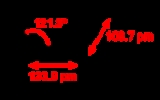
The molecule cannot twist around the double bond at room temperature, and all six atoms lie in the same plane. The
angle made by two carbon–hydrogen bonds in the molecule is 117°, very close to the 120° that would be predicted from ideal sp
2 hybridization.
Nomenclature
From 1795 on, ethylene was referred to as the
olefiant gas , because it combined with chlorine to produce the
oil of the Dutch chemists , first synthesized in 1795 by a collaboration of four
Dutch chemists.
In the mid-19th century, the suffix
-ene was widely used to refer to a molecule or part thereof that contained one fewer hydrogen atoms than the word being modified. Thus,
ethylene was the "daughter of ethyl" . The name ethylene was used in this sense as early as 1852.
In 1866, the
German chemist Augustus von Hofmann proposed a system of hydrocarbon nomenclature in which the suffixes -ane, -ene, -ine, -one, and -une were used to denote the hydrocarbons with 0, 2, 4, 6, and 8 fewer hydrogens than their parent
alkane. In this system, ethylene became
ethene. Hofmann's system eventually became the basis for the Geneva nomenclature approved by the International Congress of Chemists in 1892, which remains at the core of the
IUPAC nomenclature. However, by that time, the name ethylene was deeply entrenched, and it remains in wide use today, especially in the chemical industry.
Chemistry
The double bond is a region of slightly higher
electron density, and most of ethylene's chemistry involves other molecules reacting with and adding across its double bond. Ethylene can react with bromine, chlorine, and other
halogens, to produce halogenated hydrocarbons. It can also react with water to produce
ethanol, but the rate at which this happens is very slow unless a suitable
catalyst, such as
phosphoric or
sulfuric acid, is used. Under high pressure, and, in the presence of a catalytic metal ,
hydrogen will react with ethylene.
Production
Ethylene is produced in the petrochemical industry via
steam cracking. In this process, gaseous or light liquid hydrocarbons are briefly heated to 750–950 °C, causing numerous
free radical reactions to take place. Generally, in the course of these reactions, large hydrocarbons break down in to smaller ones and saturated hydrocarbons become unsaturated.
The result of this process is a complex mixture of hydrocarbons in which ethylene is one of the principal components. The mixture is separated by repeated compression and
distillation.
Another process is catalytic cracking where it is used in oil refineries to crack large hydrocarbon molecules into smaller ones. Use of
zeolite as a catalyst allows the cracking to be achieved at a lower temperature. It is an important way of separating alkenes from alkanes using a fractionating column.
Theoretical considerations
Although ethylene is a relatively simple molecule, its spectrum is considered to be one of the most difficult to explain adequately from both a theoretical and practical perspective. For this reason, it is often used as a test case in computational chemistry. Of particular note is the difficulty in characterizing the ultraviolet absorption of the molecule. Interest in the subtleties and details of the ethylene spectrum can be dated back to at least the 1950s.
Uses
Chemistry
Ethylene is used primarily as an intermediate in the manufacture of other chemicals, especially
plastics. Ethylene may be
polymerized directly to produce
polyethylene , the world's most widely-used plastic. Ethylene can be chlorinated to produce ethylene dichloride , a precursor to the plastic
polyvinyl chloride, or combined with
benzene to produce
ethylbenzene, which is used in the manufacture of
polystyrene, another important plastic.
Smaller amounts of ethylene are
oxidized to produce chemicals including
ethylene oxide,
ethanol, and
polyvinyl acetate.
Global demand for ethylene exceeded 100 million metric tonnes per year in 2005.
Ethylene was once used as a local
anesthetic applicable via inhalation, but it has long since been replaced in this role by nonflammable gases.
It has also been hypothesized that ethylene was the catalyst for utterances of the oracle at
Delphi in ancient
Greece.
Ethylene is used in greenhouses and is sprayed on crops to speed ripening. It is also found in many lip gloss products.
Ethylene as a plant hormone
Ethylene acts physiologically as a hormone in
plants. It stimulates the
ripening of
fruit, the opening of
flowers, and the abscission of leaves. Its biosynthesis starts from
methionine with
1-aminocyclopropane-1-carboxylic acid as a key intermediate.
"Ethylene has been used in practice since the ancient Egyptians, who would gas figs in order to stimulate ripening. The ancient Chinese would burn
incense in closed rooms to enhance the ripening of pears. It was in 1864, gas leaks from street lights showed stunting of growth, twisting of plants, and abnormal thickening of stems [see
plant senescence]. In 1901, a Russian scientist named Dimitry Neljubow showed that the active component was ethylene . Doubt discovered that ethylene stimulated abscission in 1917 . It wasn't until 1934 that Gane reported that plants synthesize ethylene . In 1935, Crocker proposed that ethylene was the plant hormone responsible for fruit ripening as well as inhibition of vegetative tissues . Ethylene is now known to have many other functions as well." - from
Since
Nicotiana benthamiana leaves are susceptible to injuries, they are used in plant physiology practicals to study ethylene secretion.
Location, characteristics and occasions for synthesis induction
- Directly induced by high levels of auxin
- Found in germinating seeds
- Induced by root flooding
- Induced by drought
- Synthesized in nodes of stems
- Synthesized in tissues of ripening fruits
- Synthesized in response to shoot environmental, pest, or disease stress
- Synthesized in senescent leaves and flowers
- Rapidly diffuses
- Inhibiting effects of ethylene on shoot growth reduced in the presence of light. Also ethylene levels are decreased by light
- The above may be because light induces auxin synthesis and moderate auxin levels inhibit ethylene.
- Released in mature cells when they do not have enough minerals and water to support both themselves and any dependent cells.
Effects
- Stimulates leaf and flower senescence
- Induces leaf abscission mainly in older leaves.
- Induces seed germination
- Induces root hair growth – this increases the efficiency of water and mineral absorption
- Stimulates epinasty – leaf petiole grows out, leaf hangs down and curls into itself
- Stimulates fruit ripening
- Induces the growth of adventitious roots during flooding
- Usually inhibits growth - although perhaps just shoot growth
- Affects neighboring individuals
- Disease/wounding resistance
- Triple response when applied to seedlings – root ? and shoot growth inhibition and pronounced hypocotyl hook bending
- Inhibits stem swelling or Stimulates cell broadening and lateral root growth
- Interference with auxin transport
- Directly or indirectly induces auxin at high levels
- Inhibits the rate of metabolism of cells in the shoot so as to redirect resources to the root
- Is a general indicator of poor root health. Strategy of senescent leaves may to funnel more resources to the root.
- May be more active at night when root and mineral acquisition are, on average, lower
- Just as a role of auxin may be to increase minerals and water by shoot growth, ethylene may do this by shoot senescence. Cytokinin and auxin hormones are released when conditions are favorable for growth, for example during the day. Ethylene and gibberellin may be released when the plant must either cut back in size, or survive on stored resources, for example during the night.
- Induces flowering in pineapples
- In food production, some plants are considered ethylene producers, while others are considered ethylene sensitive.
Effects upon humans
Ethylene is colorless, has a pleasant sweet faint odor, and has a slightly sweet taste, and as it enhances fruit ripening, assists in the development of odour-active aroma volatiles , which are responsible for the specific smell of each kind of flower or fruit. In high concentrations it can cause nausea. Its use in the food industry to induce ripening of fruit and vegetables, can lead to accumulation in refrigerator crispers, accelerating spoilage of these foods when compared with naturally ripened products.
Ethylene has long been in use as an inhalatory anaesthetic. It shows little or no carcinogenic or mutagenic properties, and although there may be moderate hyperglycemia, post operative nausea, whilst higher than nitrous oxide is less than in the use of cyclopropane. During the induction and early phases, blood pressure may rise a little, but this effect may be due to patient anxiety, as blood pressure quickly returns to normal. Cardiac arrythmias are infrequent and cardio-vascular effects are benign. Exposure at 37.5% for 15 minutes may result in marked memory disturbances. Humans exposed to as much as 50% ethylene in air, whereby the oxygen availability is decreased to 10%, experience a complete loss of consciousness and may subsequently die. Effects of exposure seem related to the issue of oxygen deprivation.
In mild doses, ethylene produces states of euphoria, associated with stimulus to the pleasure centres of the human brain. It has been hypothesised that human liking for the odours of flowers is due in part to a mild action of ethylene associated with the plant.
STAGE 1) INDIFFERENCE
- Percent of O2 Saturation at 90%
- Night vision decreased
- Mild euphoria reported.
STAGE 2) COMPENSATION
- Percent of O2 Saturation at 82 to 90%
- Respiratory rate has compensatory increase
- Pulse, also a compensatory increase
- Night vision is decreased further, focus is simplified
- Performance ability is somewhat reduced, mild distortion to speech, utterances increasingly ambiguous.
- General Alertness level is somewhat reduced to anything but central concerns
- Symptoms may begin in those patients with pre-existing significant cardiac, pulmonary, or hematologic diseases.
- Euphoria
STAGE 3) DISTURBANCE
- Percent of O2 Saturation at 64 to 82%
- Compensatory mechanisms increasingly become inadequate
- Air hunger, gasping for breath
- Fatigue, lassitude, inability to maintain balance
- Tunnel Vision, out-of-body experiences
- Dizziness
- Mild to Persistent Headache
- Belligerence, certainty of truth
- Extreme Euphoria, belief in capacities of the self enhanced
- Visual acuity is reduced, dreamlike seeing of visions
- Numbness and tingling of extremities
- Hyperventilation
- Distortions of judgement, abnormal or illogical inferences drawn
- Memory loss after event
- Increased Cyanosis
- Decreased ability for escape from toxic environment
STAGE 4) CRITICAL DISTURBANCE
- Percent of O2 Saturation at 60 to 70% or less
- Further deterioration in judgement and coordination may occur in 3 to 5 minutes or less
- Total incapacitation and unconsciousness follow rapidly
In air, ethylene acts primarily as an asphyxiant. Concentrations of ethylene required to produce any marked physiological effect will reduce the oxygen content to such a low level that life cannot be supported. For example, air containing 50% of ethylene will contain only about 10% oxygen.
Loss of consciousness results when the air contains about 11% of oxygen. Death occurs quickly when the oxygen content falls to 8% or less. There is no evidence to indicate that prolonged exposure to low concentrations of ethylene can result in chronic effects. Prolonged exposure to high concentrations may cause permanent effects because of oxygen deprivation.
Ethylene has a very low order of systemic toxicity. When used as a surgical anaesthetic, it is always administered with oxygen with an increased risk of fire. In such cases, however, it acts as a simple, rapid anaesthetic having a quick recovery. Prolonged inhalation of about 85% in oxygen is slightly toxic, resulting in a slow fall in the blood pressure; at about 94% in oxygen, ethylene is acutely fatal.
External links