

Tar

Encyclopedia
Tar is modified pitch
produced primarily from the wood and roots of pine
by destructive distillation
under pyrolysis
. Production and trade in tar was a major contributor in the economies of Northern Europe
and Colonial America
. Its main use was in preserving wooden vessels against rot. The largest user was the Royal Navy
. Demand for tar declined with the advent of iron and steel ships.
Tar-like products can also be produced from other forms of organic matter
such as peat
. Mineral products resembling tar can be produced from fossil hydrocarbon
s including petroleum
. Coal tar
is produced from coal
as a byproduct of coke
production. Bitumen is a term used for natural deposits of oil "tar" - such as at the La Brea Tar Pits
.
 In Northern Europe
, the word "tar" refers primarily to a substance that is derived
from the wood and roots of pine
. In earlier times it was often used as a water repellent coating for boats, ships, and roofs. It is still used as an additive in the flavoring of candy, alcohol and other foods. Wood tar is microbicidal
and has a pleasant odor — a sweet musky scent much like that of barbecue. Producing tar from wood was known in ancient Greece, and has probably been used in Scandinavia since the Iron Age. For centuries, dating back at least to the 14th century, tar was among Sweden
's most important exports. Sweden exported 13,000 barrels of tar in 1615 and 227,000 barrels in the peak year of 1863. Production nearly stopped in the early 20th century, when other chemicals replaced tar and wooden ships were replaced by steel ships.
The heating (dry distilling
) of pine
wood causes tar
and pitch
to drip away from the wood and leave behind charcoal. Birchbark is used to make particularly fine tar, known as "Russian oil", suitable for leather protection. The by-products of wood tar are turpentine
and charcoal
. When deciduous
tree woods are subjected to destructive distillation the products are methanol
(wood alcohol) and charcoal
.
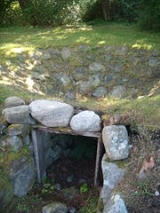
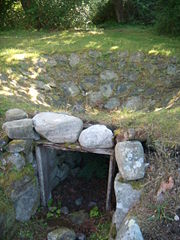
Tar kilns are dry distillation ovens, historically used in Scandinavia
for producing tar from wood. They were built close to the forest, from limestone or from more primitive holes in the ground. The bottom is sloped into an outlet hole, to allow the tar to pour out. The wood is split to dimensions of a finger and stacked densely, and finally covered tight with dirt and moss. If oxygen can enter, the wood might catch fire, and the production would be ruined. On top of this, a fire is stacked and lit. After a few hours, the tar starts to pour out, and continues to do so for a few days.
and to seal the hulls of ship
s and boat
s. For millennia wood tar was used to waterproof sail
s and boats, but today sails made from inherently waterproof synthetic substances have negated the need for tar. Wood tar is still used to seal traditional wooden boats and the roofs of historical shingle-roofed churches, as well as painting exterior walls of log buildings. Tar is also a general disinfectant.
In Finland
wood tar was once considered a panacea
reputed to heal "even those cut in twain through their midriff". A Finnish proverb states that if sauna
, vodka
and tar won't help, the disease is fatal. Wood tar is used in traditional Finnish medicine because of its microbicidial properties.
Wood tar is also available diluted as tar water
, which has numerous uses:
Mixing tar with linseed oil
varnish
produces tar paint. Tar paint has a translucent brownish hue, and can be used to saturate and tone wood and protect it from weather. Tar paint can also be toned with various pigments, producing translucent colours and preserving the wood texture.
s" (e.g., the La Brea Tar Pits
in Los Angeles
) actually contain asphalt
rather than tar. Oil sand deposits (sometimes called tar sands
) contain various mixtures of sand (or rock) with bitumen or heavy crude oil
and not tar (e.g., the Tar Tunnel
in Shropshire
). "Rangoon tar", also known as "Burmese Oil" or "Burmese Naphtha", is actually petroleum
. "Tar" and "pitch
" are sometimes used interchangeably; however, pitch is considered more solid while tar is more liquid.
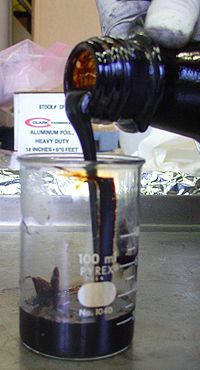
. Tar made from coal or petroleum is considered toxic and carcinogenic because of its high benzene
content, though coal tar
in low concentrations is used as a topical
medicine. Coal and petroleum tar has a pungent odour.
Coal tar is listed at number 1999 in the United Nations
list of dangerous goods
.
Pitch (resin)
Pitch is the name for any of a number of viscoelastic, solid polymers. Pitch can be made from petroleum products or plants. Petroleum-derived pitch is also called bitumen. Pitch produced from plants is also known as resin. Products made from plant resin are also known as rosin.Pitch was...
produced primarily from the wood and roots of pine
Pine
Pines are trees in the genus Pinus ,in the family Pinaceae. They make up the monotypic subfamily Pinoideae. There are about 115 species of pine, although different authorities accept between 105 and 125 species.-Etymology:...
by destructive distillation
Destructive distillation
Destructive distillation is the chemical process involving the decomposition of feedstock by heating to a high temperature; the term generally applies to processing of organic material in the absence of air or in the presence of limited amounts of oxygen or other reagents, catalysts, or solvents,...
under pyrolysis
Pyrolysis
Pyrolysis is a thermochemical decomposition of organic material at elevated temperatures without the participation of oxygen. It involves the simultaneous change of chemical composition and physical phase, and is irreversible...
. Production and trade in tar was a major contributor in the economies of Northern Europe
Northern Europe
Northern Europe is the northern part or region of Europe. Northern Europe typically refers to the seven countries in the northern part of the European subcontinent which includes Denmark, Estonia, Latvia, Lithuania, Norway, Finland and Sweden...
and Colonial America
Colonial America
The colonial history of the United States covers the history from the start of European settlement and especially the history of the thirteen colonies of Britain until they declared independence in 1776. In the late 16th century, England, France, Spain and the Netherlands launched major...
. Its main use was in preserving wooden vessels against rot. The largest user was the Royal Navy
Royal Navy
The Royal Navy is the naval warfare service branch of the British Armed Forces. Founded in the 16th century, it is the oldest service branch and is known as the Senior Service...
. Demand for tar declined with the advent of iron and steel ships.
Tar-like products can also be produced from other forms of organic matter
Organic matter
Organic matter is matter that has come from a once-living organism; is capable of decay, or the product of decay; or is composed of organic compounds...
such as peat
Peat
Peat is an accumulation of partially decayed vegetation matter or histosol. Peat forms in wetland bogs, moors, muskegs, pocosins, mires, and peat swamp forests. Peat is harvested as an important source of fuel in certain parts of the world...
. Mineral products resembling tar can be produced from fossil hydrocarbon
Fossil fuel
Fossil fuels are fuels formed by natural processes such as anaerobic decomposition of buried dead organisms. The age of the organisms and their resulting fossil fuels is typically millions of years, and sometimes exceeds 650 million years...
s including petroleum
Petroleum
Petroleum or crude oil is a naturally occurring, flammable liquid consisting of a complex mixture of hydrocarbons of various molecular weights and other liquid organic compounds, that are found in geologic formations beneath the Earth's surface. Petroleum is recovered mostly through oil drilling...
. Coal tar
Coal tar
Coal tar is a brown or black liquid of extremely high viscosity, which smells of naphthalene and aromatic hydrocarbons. Coal tar is among the by-products when coal iscarbonized to make coke or gasified to make coal gas...
is produced from coal
Coal
Coal is a combustible black or brownish-black sedimentary rock usually occurring in rock strata in layers or veins called coal beds or coal seams. The harder forms, such as anthracite coal, can be regarded as metamorphic rock because of later exposure to elevated temperature and pressure...
as a byproduct of coke
Coke (fuel)
Coke is the solid carbonaceous material derived from destructive distillation of low-ash, low-sulfur bituminous coal. Cokes from coal are grey, hard, and porous. While coke can be formed naturally, the commonly used form is man-made.- History :...
production. Bitumen is a term used for natural deposits of oil "tar" - such as at the La Brea Tar Pits
La Brea Tar Pits
The La Brea Tar Pits are a cluster of tar pits around which Hancock Park was formed, in the urban heart of Los Angeles. Asphaltum or tar has seeped up from the ground in this area for tens of thousands of years. The tar is often covered with water...
.
Production
Northern Europe
Northern Europe is the northern part or region of Europe. Northern Europe typically refers to the seven countries in the northern part of the European subcontinent which includes Denmark, Estonia, Latvia, Lithuania, Norway, Finland and Sweden...
, the word "tar" refers primarily to a substance that is derived
Pyrolysis
Pyrolysis is a thermochemical decomposition of organic material at elevated temperatures without the participation of oxygen. It involves the simultaneous change of chemical composition and physical phase, and is irreversible...
from the wood and roots of pine
Pine
Pines are trees in the genus Pinus ,in the family Pinaceae. They make up the monotypic subfamily Pinoideae. There are about 115 species of pine, although different authorities accept between 105 and 125 species.-Etymology:...
. In earlier times it was often used as a water repellent coating for boats, ships, and roofs. It is still used as an additive in the flavoring of candy, alcohol and other foods. Wood tar is microbicidal
Microbicide
Microbicides for sexually transmitted diseases, are pharmacologic agents and chemical substances that are capable of killing or destroying certain microorganisms that commonly cause human infection, for example the human immunodeficiency virus....
and has a pleasant odor — a sweet musky scent much like that of barbecue. Producing tar from wood was known in ancient Greece, and has probably been used in Scandinavia since the Iron Age. For centuries, dating back at least to the 14th century, tar was among Sweden
Sweden
Sweden , officially the Kingdom of Sweden , is a Nordic country on the Scandinavian Peninsula in Northern Europe. Sweden borders with Norway and Finland and is connected to Denmark by a bridge-tunnel across the Öresund....
's most important exports. Sweden exported 13,000 barrels of tar in 1615 and 227,000 barrels in the peak year of 1863. Production nearly stopped in the early 20th century, when other chemicals replaced tar and wooden ships were replaced by steel ships.
The heating (dry distilling
Dry distillation
Dry distillation is the heating of solid materials to produce gaseous products . The method may or may not involve pyrolysis/thermolysis. The products are condensed and collected. This method usually requires higher temperatures than classical distillation. The method has been used to obtain...
) of pine
Pine
Pines are trees in the genus Pinus ,in the family Pinaceae. They make up the monotypic subfamily Pinoideae. There are about 115 species of pine, although different authorities accept between 105 and 125 species.-Etymology:...
wood causes tar
Pine tar
Pine tar is a sticky material produced by the high temperature carbonization of pine wood in anoxic conditions . The wood is rapidly decomposed by applying heat and pressure in a closed container; the primary resulting products are charcoal and pine tar.Pine tar consists primarily of aromatic...
and pitch
Pitch (resin)
Pitch is the name for any of a number of viscoelastic, solid polymers. Pitch can be made from petroleum products or plants. Petroleum-derived pitch is also called bitumen. Pitch produced from plants is also known as resin. Products made from plant resin are also known as rosin.Pitch was...
to drip away from the wood and leave behind charcoal. Birchbark is used to make particularly fine tar, known as "Russian oil", suitable for leather protection. The by-products of wood tar are turpentine
Turpentine
Turpentine is a fluid obtained by the distillation of resin obtained from trees, mainly pine trees. It is composed of terpenes, mainly the monoterpenes alpha-pinene and beta-pinene...
and charcoal
Charcoal
Charcoal is the dark grey residue consisting of carbon, and any remaining ash, obtained by removing water and other volatile constituents from animal and vegetation substances. Charcoal is usually produced by slow pyrolysis, the heating of wood or other substances in the absence of oxygen...
. When deciduous
Deciduous
Deciduous means "falling off at maturity" or "tending to fall off", and is typically used in reference to trees or shrubs that lose their leaves seasonally, and to the shedding of other plant structures such as petals after flowering or fruit when ripe...
tree woods are subjected to destructive distillation the products are methanol
Methanol
Methanol, also known as methyl alcohol, wood alcohol, wood naphtha or wood spirits, is a chemical with the formula CH3OH . It is the simplest alcohol, and is a light, volatile, colorless, flammable liquid with a distinctive odor very similar to, but slightly sweeter than, ethanol...
(wood alcohol) and charcoal
Charcoal
Charcoal is the dark grey residue consisting of carbon, and any remaining ash, obtained by removing water and other volatile constituents from animal and vegetation substances. Charcoal is usually produced by slow pyrolysis, the heating of wood or other substances in the absence of oxygen...
.
Tar kilns are dry distillation ovens, historically used in Scandinavia
Scandinavia
Scandinavia is a cultural, historical and ethno-linguistic region in northern Europe that includes the three kingdoms of Denmark, Norway and Sweden, characterized by their common ethno-cultural heritage and language. Modern Norway and Sweden proper are situated on the Scandinavian Peninsula,...
for producing tar from wood. They were built close to the forest, from limestone or from more primitive holes in the ground. The bottom is sloped into an outlet hole, to allow the tar to pour out. The wood is split to dimensions of a finger and stacked densely, and finally covered tight with dirt and moss. If oxygen can enter, the wood might catch fire, and the production would be ruined. On top of this, a fire is stacked and lit. After a few hours, the tar starts to pour out, and continues to do so for a few days.
Uses
Tar was used as seal for roofing shinglesRoof shingle
Roof shingles are a roof covering consisting of individual overlapping elements. These elements are typically flat rectangular shapes laid in rows from the bottom edge of the roof up, with each successive higher row overlapping the joints in the row below...
and to seal the hulls of ship
Ship
Since the end of the age of sail a ship has been any large buoyant marine vessel. Ships are generally distinguished from boats based on size and cargo or passenger capacity. Ships are used on lakes, seas, and rivers for a variety of activities, such as the transport of people or goods, fishing,...
s and boat
Boat
A boat is a watercraft of any size designed to float or plane, to provide passage across water. Usually this water will be inland or in protected coastal areas. However, boats such as the whaleboat were designed to be operated from a ship in an offshore environment. In naval terms, a boat is a...
s. For millennia wood tar was used to waterproof sail
Sail
A sail is any type of surface intended to move a vessel, vehicle or rotor by being placed in a wind—in essence a propulsion wing. Sails are used in sailing.-History of sails:...
s and boats, but today sails made from inherently waterproof synthetic substances have negated the need for tar. Wood tar is still used to seal traditional wooden boats and the roofs of historical shingle-roofed churches, as well as painting exterior walls of log buildings. Tar is also a general disinfectant.
In Finland
Finland
Finland , officially the Republic of Finland, is a Nordic country situated in the Fennoscandian region of Northern Europe. It is bordered by Sweden in the west, Norway in the north and Russia in the east, while Estonia lies to its south across the Gulf of Finland.Around 5.4 million people reside...
wood tar was once considered a panacea
Panacea (medicine)
The panacea , named after the Greek goddess of healing, Panacea, also known as panchrest, was supposed to be a remedy that would cure all diseases and prolong life indefinitely...
reputed to heal "even those cut in twain through their midriff". A Finnish proverb states that if sauna
Sauna
A sauna is a small room or house designed as a place to experience dry or wet heat sessions, or an establishment with one or more of these and auxiliary facilities....
, vodka
Vodka
Vodka , is a distilled beverage. It is composed primarily of water and ethanol with traces of impurities and flavorings. Vodka is made by the distillation of fermented substances such as grains, potatoes, or sometimes fruits....
and tar won't help, the disease is fatal. Wood tar is used in traditional Finnish medicine because of its microbicidial properties.
Wood tar is also available diluted as tar water
Tar water
Tar-water is a Medieval medicine consisting of pine tar and water. It was foul tasting and so slowly dropped in popularity, but was revived in the Victorian era....
, which has numerous uses:
- As a flavoring for candies (e.g. Terva LeijonaTerva LeijonaTerva Leijona is a Finnish liquorice candy with tar flavouring. The candy is produced by the Leaf Candy Company.It is available in "Traditional flavours" such as sugarless, licorice, salmiakki...
) and alcohol (Terva Viina) - As a spice for food, like meat
- As a scent for saunaSaunaA sauna is a small room or house designed as a place to experience dry or wet heat sessions, or an establishment with one or more of these and auxiliary facilities....
s. Tar water is mixed into water which is turned into steam in the sauna - As an anti-dandruffDandruffDandruff is the shedding of dead skin cells from the scalp . Dandruff is sometimes caused by frequent exposure to extreme heat and cold. As it is normal for skin cells to die and flake off, a small amount of flaking is normal and common; about 487,000 cells/cm2 get released normally after...
agent in shampooShampooShampoo is a hair care product used for the removal of oils, dirt, skin particles, dandruff, environmental pollutants and other contaminant particles that gradually build up in hair... - As a component of cosmetics
- As a component in cigarettes
Mixing tar with linseed oil
Linseed oil
Linseed oil, also known as flaxseed oil, is a clear to yellowish oil obtained from the dried ripe seeds of the flax plant . The oil is obtained by cold pressing, sometimes followed by solvent extraction...
varnish
Varnish
Varnish is a transparent, hard, protective finish or film primarily used in wood finishing but also for other materials. Varnish is traditionally a combination of a drying oil, a resin, and a thinner or solvent. Varnish finishes are usually glossy but may be designed to produce satin or semi-gloss...
produces tar paint. Tar paint has a translucent brownish hue, and can be used to saturate and tone wood and protect it from weather. Tar paint can also be toned with various pigments, producing translucent colours and preserving the wood texture.
Definition
The word "tar" is often used to describe several distinct substances which are not actually tar. Naturally occurring "tar pitTar pit
A tar pit, or more accurately known as an asphalt pit or asphalt lake, is a geological occurrence where subterranean bitumen leaks to the surface, creating a large area of natural asphalt.-Known tar pits:...
s" (e.g., the La Brea Tar Pits
La Brea Tar Pits
The La Brea Tar Pits are a cluster of tar pits around which Hancock Park was formed, in the urban heart of Los Angeles. Asphaltum or tar has seeped up from the ground in this area for tens of thousands of years. The tar is often covered with water...
in Los Angeles
Los Angeles, California
Los Angeles , with a population at the 2010 United States Census of 3,792,621, is the most populous city in California, USA and the second most populous in the United States, after New York City. It has an area of , and is located in Southern California...
) actually contain asphalt
Asphalt
Asphalt or , also known as bitumen, is a sticky, black and highly viscous liquid or semi-solid that is present in most crude petroleums and in some natural deposits, it is a substance classed as a pitch...
rather than tar. Oil sand deposits (sometimes called tar sands
Tar sands
Bituminous sands, colloquially known as oil sands or tar sands, are a type of unconventional petroleum deposit. The sands contain naturally occurring mixtures of sand, clay, water, and a dense and extremely viscous form of petroleum technically referred to as bitumen...
) contain various mixtures of sand (or rock) with bitumen or heavy crude oil
Heavy crude oil
Heavy crude oil or extra heavy crude oil is any type of crude oil which does not flow easily. It is referred to as "heavy" because its density or specific gravity is higher than that of light crude oil. Heavy crude oil has been defined as any liquid petroleum with an API gravity less than 20°.Extra...
and not tar (e.g., the Tar Tunnel
Tar Tunnel
The Tar Tunnel is located on the north bank of the River Severn in the Ironbridge Gorge at Coalport, England, and now forms part of the Ironbridge Gorge Museum Trust....
in Shropshire
Shropshire
Shropshire is a county in the West Midlands region of England. For Eurostat purposes, the county is a NUTS 3 region and is one of four counties or unitary districts that comprise the "Shropshire and Staffordshire" NUTS 2 region. It borders Wales to the west...
). "Rangoon tar", also known as "Burmese Oil" or "Burmese Naphtha", is actually petroleum
Petroleum
Petroleum or crude oil is a naturally occurring, flammable liquid consisting of a complex mixture of hydrocarbons of various molecular weights and other liquid organic compounds, that are found in geologic formations beneath the Earth's surface. Petroleum is recovered mostly through oil drilling...
. "Tar" and "pitch
Pitch (resin)
Pitch is the name for any of a number of viscoelastic, solid polymers. Pitch can be made from petroleum products or plants. Petroleum-derived pitch is also called bitumen. Pitch produced from plants is also known as resin. Products made from plant resin are also known as rosin.Pitch was...
" are sometimes used interchangeably; however, pitch is considered more solid while tar is more liquid.
Coal
In English, German, and French, "tar" is a substance primarily derived from coal. It was formerly one of the products of gasworksGasworks
A gasworks or gas house is a factory for the manufacture of gas. The use of natural gas has made many redundant in the developed world, however they are often still used for storage.- Early gasworks :...
. Tar made from coal or petroleum is considered toxic and carcinogenic because of its high benzene
Benzene
Benzene is an organic chemical compound. It is composed of 6 carbon atoms in a ring, with 1 hydrogen atom attached to each carbon atom, with the molecular formula C6H6....
content, though coal tar
Coal tar
Coal tar is a brown or black liquid of extremely high viscosity, which smells of naphthalene and aromatic hydrocarbons. Coal tar is among the by-products when coal iscarbonized to make coke or gasified to make coal gas...
in low concentrations is used as a topical
Topical
In medicine, a topical medication is applied to body surfaces such as the skin or mucous membranes such as the vagina, anus, throat, eyes and ears.Many topical medications are epicutaneous, meaning that they are applied directly to the skin...
medicine. Coal and petroleum tar has a pungent odour.
Coal tar is listed at number 1999 in the United Nations
United Nations
The United Nations is an international organization whose stated aims are facilitating cooperation in international law, international security, economic development, social progress, human rights, and achievement of world peace...
list of dangerous goods
Dangerous goods
Dangerous goods are solids, liquids, or gases that can harm people, other living organisms, property, or the environment. They are often subject to chemical regulations. "HazMat teams" are personnel specially trained to handle dangerous goods...
.
See also
- Birch-tarBirch-tarBirch-tar or birch-pitch is a substance derived from the dry distillation of the wood of the birch.- Compounds :It is compounded of guaiacol, phenols, cresol, xylenol, and creosol.- Uses :...
- Bitumen
- Coal tarCoal tarCoal tar is a brown or black liquid of extremely high viscosity, which smells of naphthalene and aromatic hydrocarbons. Coal tar is among the by-products when coal iscarbonized to make coke or gasified to make coal gas...
- Pine tarPine tarPine tar is a sticky material produced by the high temperature carbonization of pine wood in anoxic conditions . The wood is rapidly decomposed by applying heat and pressure in a closed container; the primary resulting products are charcoal and pine tar.Pine tar consists primarily of aromatic...
- Pitch (resin)Pitch (resin)Pitch is the name for any of a number of viscoelastic, solid polymers. Pitch can be made from petroleum products or plants. Petroleum-derived pitch is also called bitumen. Pitch produced from plants is also known as resin. Products made from plant resin are also known as rosin.Pitch was...
- Pitch drop experimentPitch drop experimentThe pitch drop experiment is a long-term experiment which measures the flow of a piece of pitch over many years. Pitch is the name for any of a number of highly viscous liquids which appear solid, most commonly bitumen...
- ResinResinResin in the most specific use of the term is a hydrocarbon secretion of many plants, particularly coniferous trees. Resins are valued for their chemical properties and associated uses, such as the production of varnishes, adhesives, and food glazing agents; as an important source of raw materials...
- Tarring and featheringTarring and featheringTarring and feathering is a physical punishment, used to enforce unofficial justice or revenge. It was used in feudal Europe and its colonies in the early modern period, as well as the early American frontier, mostly as a type of mob vengeance .-Description:In a typical tar-and-feathers attack, the...
- Tar Heels
- Tar pitTar pitA tar pit, or more accurately known as an asphalt pit or asphalt lake, is a geological occurrence where subterranean bitumen leaks to the surface, creating a large area of natural asphalt.-Known tar pits:...
- TarmacTarmacTarmac is a type of road surface. Tarmac refers to a material patented by Edgar Purnell Hooley in 1901...