
All Topics  
Soot


   Email Print
   Bookmark   Link


Soot


Soot is a general term that refers to impure carbon
Carbon

Carbon is a chemical element with chemical symbol C and atomic number 6. As a member of group 14 on the periodic table, it is nonmetallic and tetravalence?making four electrons available to form covalent bond chemical bonds....
 particles resulting from the incomplete combustion of a hydrocarbon
Hydrocarbon

In organic chemistry, a hydrocarbon is an organic compound consisting entirely of hydrogen and carbon. With relation to chemical terminology, aromatic hydrocarbons or arenes, alkanes, alkenes and alkyne-based compounds composed entirely of carbon or hydrogen are referred to as "pure" hydrocarbons, whereas other hydrocarbons with bonded com...
. It is more properly restricted to the product of the gas-phase combustion process but is commonly extended to include the residual pyrolyzed fuel particles such as cenosphere
Cenosphere

A cenosphere is a lightweight, inert, hollow sphere filled with inert air or gas, typically produced as a byproduct of coal combustion at fossil fuel power plant....
s, charred wood, petroleum coke, etc. that may become airborne during pyrolysis
Pyrolysis

Pyrolysis is the chemical decomposition of a condensed substance by heating. The word is coined from the Greek language-derived morphemes pyro "fire" and lysys "decomposition"....
 and which are more properly identified as cokes or chars.


Discussion
Ask a question about 'Soot'
Start a new discussion about 'Soot'
Answer questions from other users
Full Discussion Forum


Recent Posts


Encyclopedia


Soot is a general term that refers to impure carbon
Carbon

Carbon is a chemical element with chemical symbol C and atomic number 6. As a member of group 14 on the periodic table, it is nonmetallic and tetravalence?making four electrons available to form covalent bond chemical bonds....
 particles resulting from the incomplete combustion of a hydrocarbon
Hydrocarbon

In organic chemistry, a hydrocarbon is an organic compound consisting entirely of hydrogen and carbon. With relation to chemical terminology, aromatic hydrocarbons or arenes, alkanes, alkenes and alkyne-based compounds composed entirely of carbon or hydrogen are referred to as "pure" hydrocarbons, whereas other hydrocarbons with bonded com...
. It is more properly restricted to the product of the gas-phase combustion process but is commonly extended to include the residual pyrolyzed fuel particles such as cenosphere
Cenosphere

A cenosphere is a lightweight, inert, hollow sphere filled with inert air or gas, typically produced as a byproduct of coal combustion at fossil fuel power plant....
s, charred wood, petroleum coke, etc. that may become airborne during pyrolysis
Pyrolysis

Pyrolysis is the chemical decomposition of a condensed substance by heating. The word is coined from the Greek language-derived morphemes pyro "fire" and lysys "decomposition"....
 and which are more properly identified as cokes or chars. The gas-phase soots contain polycyclic aromatic hydrocarbons (PAHs). The PAHs in soot are known mutagens and probable human carcinogens. They are classified as a "known human carcinogen" by the International Agency for Research on Cancer (IARC).

Some soots are produced commercially to be used as pigment
Pigment

A pigment is a material that changes the color of light it Reflection as the result of selective color absorption. This physical process differs from fluorescence, phosphorescence, and other forms of luminescence, in which the material itself emits light....
s, such as lampblack and carbon black
Carbon black

Carbon black is a material produced by the incomplete combustion of heavy petroleum products such as FCC tar, coal tar, ethylene cracking tar, and a small amount from vegetable oil....
. These products have been used for many years as common pigment
Pigment

A pigment is a material that changes the color of light it Reflection as the result of selective color absorption. This physical process differs from fluorescence, phosphorescence, and other forms of luminescence, in which the material itself emits light....
s used in paint
Paint

Paint is any liquid, liquifiable, or mastic composition which after application to a Substrate in a thin layer is converted to an opaque solid film....
s and ink
Ink

An ink is a liquid containing various pigments and/or dyes used for coloring a surface to produce an , writing, or design. Ink is used for drawing and/or writing with a pen, brush or quill....
s, and remain in use today in toner
Toner

File:Toner-container-black-0a.jpgToner is a Powder used in laser printers and photocopiers to form the printed text and images on the paper....
s for xerography
Xerography

Xerography is a photocopying technique developed by Chester Carlson in 1938 and patented on October 6, 1942. He received for his invention. Although dry electrostatic printing processes had been invented as far back as 1778 by Georg Christoph Lichtenberg, Carlson's innovation combined electrostatic printing with photography....
 and laser printer
Laser printer

A laser printer is a common type of computer printer that rapidly produces high quality text and graphics on plain paper. As with digital photocopiers and multifunction printers , laser printers employ a Xerography printing process but differ from analog photocopiers in that the image is produced by the direct scanning of a laser beam acros...
s. The black color of rubber
Rubber

Natural rubber is an elastomer?an Elasticity_ hydrocarbon polymer?that was originally derived from a milky colloidal suspension, or latex , found in the sap of some plants....
 tire
Tire

Tires, or tyres , are ring-shaped parts, either pneumatic or solid , that fit around wheels to protect them and enhance their function....
s is due to the use of lampblack or carbon black as an ingredient in their vulcanisation; this use accounts for around 85% of the market use of these products. Bone black, another black pigment and decolorizing agent, is the product of charring bones and is not a soot.

In India lampblack is used for a different purpose. The closest definition found is as follows. "Collyrium
Collyrium

In eye care, a collyrium is a lotion or liquid eyewash used as a cleanser for the eyes, particularly in List of eye diseases and disorders.Pre-modern medicine distinguished two kinds of collyriums: the one liquid, the other dry....
 or lampblack [or Katuka as called in Telugu], a paste made of lampblack and oil and applied to the eyes to increase their brilliancy. It is also supposed to assist in conjuring and giving second sight."

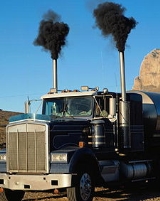
Soot, as an airborne contaminant in the environment has many different sources but they are all the result of some form of pyrolysis. They include soot from internal combustion engines, diesel engines, power plant boilers, hog-fuel boilers, ship boilers, central steam heat boilers, waste incineration, local field burning, house fires, forest fires, fireplaces, furnaces, etc. These exterior sources also contribute to the indoor environment sources such as smoking of plant matter, cooking, oil lamps, candles, quartz/halogen bulbs with settled dust, fireplaces, defective furnaces, etc. Soot in very low concentrations is capable of darkening surfaces or making particle agglomerates, such as those from ventilation systems, appear black. Soot is the primary cause of “ghosting”, the discoloration of walls and ceilings or walls and flooring where they meet. It is generally responsible for the discoloration of the walls above baseboard electric heating units.

Description


The production of soot in a flame is a complex process consisting of several chemical reactions taking place in series. In the fuel-pyrolysis zone of the flame, typically clear or blue, the fuel molecules are broken down into various fragments, including carbon-ring structures, acetylene
Acetylene

Acetylene is the chemical compound with the symbol carbonhydrogen. It is the simplest alkyne.As an alkyne, acetylene is Saturation because its two carbon atoms are Chemical bond together in a triple bond....
 (C2H2), the radical C3H3 (and higher order), as well as monatomic and diatomic hydrogen. As the combustion process continues the radicals quickly combine into new structures, giving off heat. These precursors polymerize into larger "pre-soot" chains then gather into formations of hydrogen-rich spheres in the soot-inception zone. In the soot-growth zone these spheres give up their hydrogen gas through diffusion, resulting in solids consisting of several of the formerly liquid spheres stuck together into larger chains. It is this portion of the flame that has the bright yellow color. Hydrogen-rich examples then further oxidize, releasing more heat. In perfect combustion the soot would break down into almost pure CO2 and H2O; it is only in incomplete combustion that the soot is able to form and escape the flame.

Soot normally forms at about 1400 °C, forming an excellent blackbody radiator of colors in the yellow to red spectrum. The typical yellow color of a candle flame or wood fire is produced primarily by the hot soot forming inside.

The energy being radiated from the soot is an important contributor to the ongoing combustion process, cooling the flame above the soot-growth zone and feeding energy back into the fuel-pyrolysis zone. In "pool fires" of open liquid fuel this process can feed as much as 50% of the flame's energy back into the liquid fuel below, which vaporizes it and keeps the reaction going; it would otherwise burn much more slowly. The same release of energy is responsible for quickly cooling the flame above the soot-growth region, limiting its further combustion into lighter molecules, and explaining why these fires release so much soot. A canonical example is the 2005 Hertfordshire Oil Storage Terminal fire
2005 Hertfordshire Oil Storage Terminal fire

|The 2005 Hertfordshire Oil Storage Terminal fire was caused by a series of explosions early on the morning of Sunday 11 December 2005. The terminal, generally known as the Hertfordshire Oil Storage Terminal, is an oil storage facility located near the M1 motorway on the edge of Hemel Hempstead in Hertfordshire, England....
, which released massive amounts of soot and covered the skies over a large portion of the London area.

The separation of flame into zones of different chemical reactions is due to convection
Convection

Convection in the most general terms refers to the movement of molecules within fluids . Convection is one of the major modes of heat transfer and mass transfer....
 forcing the hot reactants upward. In microgravity or zero gravity convection no longer occurs, and such flames tend to become more blue and more efficient, producing much less soot. Experiments by NASA
NASA

The National Aeronautics and Space Administration is an agency of the Federal government of the United States, responsible for the nation's public list of space agencies....
 reveal that diffusion flame
Diffusion flame

File:Fire breathing 2 Luc Viatour.jpgIn combustion, a diffusion flame is a flame in which the oxidizer combines with the fuel by diffusion. As a result, the flame speed is limited by the rate of diffusion....
s in microgravity allow more soot to be completely oxidized than in conditions on Earth, because of a series of mechanisms that differ from those in normal gravity conditions.

Production


Lampblack has been used since prehistoric times as the source for carbon black, collected by holding a cold surface over a cool flame. Candles or lamps using animal fats or waxes generate considerable amounts of soot that can be collected and then mixed with a lubricant to produce ink. This process can be easily duplicated today by passing some noncombustible surface, such as a tin can lid or glass, closely through a candle
Candle

A candle is a source of light, and sometimes a source of heat, consisting of a solid block of fuel and an embedded candle wick.Today, most candles are made from paraffin....
 flame. Lampblack produced in this way is among the darkest and least reflective substances known.

Lampblack is also used to coat aluminium foil
Aluminium foil

Aluminium foil is aluminium prepared in thin metal leafs, with a thickness less than 0.2 mm / 0.008 in, although much thinner gauges down to 0.006 mm are commonly used....
 that has been previously attached to a recording drum for use in a recording barograph
Barograph

A barograph is a recording aneroid barometer. It produces a paper or foil chart called a barogram that records the barometric pressure over time....
 or other instrument. The surface is scratched clear by a pointed stylus. In this case, the sooty smoke is produced by burning a small amount of camphor
Camphor

Camphor is a waxy, white or transparent solid with a strong, aromatic odor. It is a terpenoid with the chemical formula carbon10hydrogen16oxygen....
. After recording the image is fixed by spraying the surface with a clear lacquer
Lacquer

In a general sense, lacquer is a clear or coloured varnish that dries by solvent evaporation and often a curing process as well that produces a hard, durable finish, in any sheen level from ultra matte to high Gloss and that can be further polished as required....
. Similar coatings were used in direct recording pendulum
Pendulum

A pendulum is a weight suspended from a pivot so it can swing freely.When a pendulum is displaced from its resting Mechanical equilibrium, it is subject to a restoring force due to gravity that will accelerate it back toward the equilibrium position....
 seismometer
Seismometer

Seismometers are instruments that measure and record motions of the ground, including those of seismic waves generated by earthquakes, nuclear explosions, and other seismic sources....
s. While not a sensitive instrument, these were capable of directly recording the direction of significant horizontal shocks upon a smoked glass
Smoked glass

Smoked glass is used to refer to two different types of glass. It can be either:1) A flat sheet of glass held in the smoke of a candle flame such that one surface of the sheet of glass is covered in a layer of smoke residue....
 plate.

Hazards


Soot is in the general category of airborne particulate matter
Particulate

Particulates, alternatively referred to as particulate matter or fine particles, are tiny particles of solid or liquid suspended in a gas or liquid....
, and as such is considered hazardous to the lungs and general health when the particles are less than five micrometres in diameter, as such particles are not filtered out by the upper respiratory tract. Smoke from diesel
Diesel

Diesel or diesel fuel in general is any fuel used in diesel engines. The most common is a specific fractional distillation of petroleum fuel oil, but alternatives that are not derived from petroleum, such as biodiesel, biomass to liquid or gas to liquid diesel, are increasingly being developed and adopted....
 engines, while composed mostly of carbon soot, is considered especially dangerous owing to both its particulate size and the many other chemical compounds present.

Soot can stain clothing and can possibly cause illness if inhaled. Breathing common urban air pollution (containing soot) is much deadlier than previously thought, according to a major study and an editorial published in New England Journal of Medicine
New England Journal of Medicine

The New England Journal of Medicine is an English language peer-reviewed medical journal published by the Massachusetts Medical Society. It is one of the most popular and widely-read peer-reviewed general medical journals in the world....
 on February 1, 2007.

See also

  • Activated carbon
    Activated carbon

    Activated carbon, also called activated charcoal or activated coal, is a form of carbon that has been processed to make it extremely porous and thus to have a very large surface area available for adsorption or chemical reactions....
  • Bistre
    Bistre

    Bistre is both a shade of gray and a shade of brown made from soot, and the general name for a color resembling the pigment. Bistre's appearance is generally of a dark grayish brown, with a yellowish cast....
  • Black carbon
    Black carbon

    Black carbon or BC is formed through the incomplete combustion of fossil fuels, biofuel, and biomass, and is emitted in both anthropogenic and naturally occurring soot....
  • Carbon
    Carbon

    Carbon is a chemical element with chemical symbol C and atomic number 6. As a member of group 14 on the periodic table, it is nonmetallic and tetravalence?making four electrons available to form covalent bond chemical bonds....
  • Carbon black
    Carbon black

    Carbon black is a material produced by the incomplete combustion of heavy petroleum products such as FCC tar, coal tar, ethylene cracking tar, and a small amount from vegetable oil....
  • Colorant
  • Fullerene
    Fullerene

    Fullerene are a family of carbon Allotropy, molecules composed entirely of carbon, in the form of a hollow sphere, ellipsoid, cylinder , or plane....
  • Indian ink