


Fly ash

Encyclopedia
Fly ash is one of the residues generated in combustion
, and comprises the fine particles that rise with the flue gas
es. Ash which does not rise is termed bottom ash
. In an industrial context, fly ash usually refers to ash produced during combustion of coal
. Fly ash is generally captured by electrostatic precipitators or other particle filtration equipments before the flue gases reach the chimneys of coal-fired power plants
, and together with bottom ash
removed from the bottom of the furnace is in this case jointly known as coal ash. Depending upon the source and makeup of the coal being burned, the components of fly ash vary considerably, but all fly ash includes substantial amounts of silicon dioxide
(SiO2) (both amorphous and crystalline) and calcium oxide
(CaO), both being endemic ingredients in many coal-bearing rock strata
.
Toxic constituents depend upon the specific coal bed makeup, but may include one or more of the following elements or substances in quantities from trace amounts to several percent: arsenic
, beryllium
, boron
, cadmium
, chromium
, chromium VI, cobalt
, lead
, manganese
, mercury
, molybdenum
, selenium
, strontium
, thallium
, and vanadium
, along with dioxins and PAH compounds
.
In the past, fly ash was generally released into the atmosphere
, but pollution control equipment mandated in recent decades now require that it be captured prior to release. In the US, fly ash is generally stored at coal power plants or placed in landfills. About 43 percent is recycled, often used to supplement Portland cement
in concrete production. Some have expressed health concerns about this.
In some cases, such as the burning of solid waste to create electricity ("resource recovery" facilities a.k.a. waste-to-energy
facilities), the fly ash may contain higher levels of contaminants than the bottom ash and mixing the fly and bottom ash together brings the proportional levels of contaminants within the range to qualify as nonhazardous waste in a given state, whereas, unmixed, the fly ash would be within the range to qualify as hazardous waste.
Fly ash material solidifies while suspended in the exhaust gases and is collected by electrostatic precipitator
s or filter bags. Since the particles solidify while suspended in the exhaust gases, fly ash particles are generally spherical
in shape and range in size from 0.5 µm to 100 µm. They consist mostly of silicon dioxide
, which is present in two forms: amorphous, which is rounded and smooth, and crystalline, which is sharp, pointed and hazardous; aluminium oxide
and iron oxide
. Fly ashes are generally highly heterogeneous, consisting of a mixture of glassy particles with various identifiable crystalline phases such as quartz
, mullite
, and various iron oxide
s.
Fly ash also contains environmental toxins in significant amounts, including arsenic
(43.4 ppm); barium
(806 ppm); beryllium
(5 ppm); boron
(311 ppm); cadmium
(3.4 ppm); chromium
(136 ppm); chromium VI (90 ppm); cobalt
(35.9 ppm); copper
(112 ppm); fluorine
(29 ppm); lead
(56 ppm); manganese
(250 ppm); nickel
(77.6 ppm); selenium
(7.7 ppm); strontium
(775 ppm); thallium
(9 ppm); vanadium
(252 ppm); and zinc
(178 ppm).
The above concentrations of trace elements vary according to the kind of coal burnt to form it. In fact, in the case of bituminous coal, with the notable exception of boron, trace element concentrations are generally similar to trace element concentrations in unpolluted soils.
Two classes of fly ash are defined by ASTM
C618: Class F fly ash and Class C fly ash. The chief difference between these classes is the amount of calcium, silica, alumina, and iron content in the ash. The chemical properties of the fly ash are largely influenced by the chemical content of the coal burned (i.e., anthracite, bituminous
, and lignite
).
Not all fly ashes meet ASTM C618 requirements, although depending on the application, this may not be necessary. Ash used as a cement replacement must meet strict construction standards, but no standard environmental regulations have been established in the United States. 75% of the ash must have a fineness
of 45 µm or less, and have a carbon
content, measured by the loss on ignition (LOI), of less than 4%. In the U.S., LOI needs to be under 6%. The particle size distribution of raw fly ash is very often fluctuating constantly, due to changing performance of the coal mills and the boiler performance. This makes it necessary that, if fly ash is used in an optimal way to replace cement in concrete production, it needs to be processed using beneficiation methods like mechanical air classification. But if fly ash is used also as a filler to replace sand in concrete production, unbeneficiated fly ash with higher LOI can be also used. Especially important is the ongoing quality verification. This is mainly expressed by quality control seals like the Bureau of Indian Standards
mark or the DCL mark of the Dubai Municipality.
ic in nature, and contains less than 20% lime
(CaO). Possessing pozzolanic properties, the glassy silica and alumina of Class F fly ash requires a cementing agent, such as Portland cement, quicklime, or hydrated lime, with the presence of water in order to react and produce cementitious compounds. Alternatively, the addition of a chemical activator such as sodium silicate
(water glass) to a Class F ash can lead to the formation of a geopolymer.
contents are generally higher in Class C fly ashes.
At least one US manufacturer has announced a fly ash brick
containing up to 50 percent Class C fly ash. Testing shows the bricks meet or exceed the performance standards listed in ASTM C 216 for conventional clay brick; it is also within the allowable shrinkage limits for concrete brick in ASTM C 55, Standard Specification for Concrete Building Brick. It is estimated that the production method used in fly ash bricks will reduce the embodied energy of masonry construction by up to 90%. Bricks and pavers were expected to be available in commercial quantities before the end of 2009.
es and dispersed into the atmosphere. This created environmental and health concerns that prompted laws which have reduced fly ash emissions to less than 1 percent of ash produced. Worldwide, more than 65% of fly ash produced from coal power stations is disposed of in landfill
s and ash pond
s.
The recycling of fly ash has become an increasing concern in recent years due to increasing landfill costs and current interest in sustainable development
. , U.S. coal-fired power plants reported producing 71.1 million tons of fly ash, of which 29.1 million tons were reused in various applications. If the nearly 42 million tons of unused fly ash had been recycled, it would have reduced the need for approximately 27500 acre.ft of landfill space. Other environmental benefits to recycling fly ash includes reducing the demand for virgin materials that would need quarry
ing and substituting for materials that may be energy-intensive to create such as Portland cement
.
As of 2006, about 125 million tons of coal-combustion byproducts, including fly ash, were produced in the U.S. each year, with about 43 percent of that amount used in commercial applications, according to the American Coal Ash Association Web site. As of early 2008, the United States Environmental Protection Agency
hoped that figure would increase to 50 percent as of 2011.
The ways of fly ash utilization include (approximately in order of decreasing importance):
ic properties, fly ash is used as a replacement for some of the Portland cement
content of concrete
. The use of fly ash as a pozzolanic ingredient was recognized as early as 1914, although the earliest noteworthy study of its use was in 1937. Before its use was lost to the Dark Ages, Roman structures such as aqueduct
s or the Pantheon
in Rome used volcanic ash (which possesses similar properties to fly ash) as pozzolan in their concrete. As pozzolan greatly improves the strength and durability of concrete, the use of ash is a key factor in their preservation.
Use of fly ash as a partial replacement for Portland cement is generally limited to Class F fly ashes. It can replace up to 30% by mass of Portland cement, and can add to the concrete’s final strength and increase its chemical resistance and durability. Recently concrete mix design for partial cement replacement with High Volume Fly Ash (50 % cement replacement) has been developed. For Roller Compacted Concrete (RCC)[used in dam construction] replacement values of 70% have been achieved with processed fly ash at the Ghatghar Dam project in Maharashtra, India. Due to the spherical shape of fly ash particles, it can also increase workability of cement while reducing water demand. The replacement of Portland cement with fly ash is considered by its promoters to reduce the greenhouse gas
"footprint" of concrete, as the production of one ton of Portland cement produces approximately one ton of CO2
as compared to zero CO2 being produced using existing fly ash. New fly ash production, i.e., the burning of coal, produces approximately twenty to thirty tons of CO2 per ton of fly ash. Since the worldwide production of Portland cement is expected to reach nearly 2 billion tons by 2010, replacement of any large portion of this cement by fly ash could significantly reduce carbon emissions associated with construction, as long as the comparison takes the production of fly ash as a given.
, shear strength
, compressibility, permeability
, and frost susceptibility
. Nearly all fly ash used in embankments are Class F fly ashes.
(also called controlled low strength material, or CLSM), which is used as self-leveling, self-compacting backfill material in lieu of compacted earth or granular fill. The strength of flowable fill mixes can range from 50 to 1,200 lbf/in² (0.3 to 8.3 MPa), depending on the design requirements of the project in question. Flowable fill includes mixtures of Portland cement and filler material, and can contain mineral admixtures. Fly ash can replace either the Portland cement or fine aggregate (in most cases, river sand) as a filler material. High fly ash content mixes contain nearly all fly ash, with a small percentage of Portland cement and enough water to make the mix flowable. Low fly ash content mixes contain a high percentage of filler material, and a low percentage of fly ash, Portland cement, and water. Class F fly ash is best suited for high fly ash content mixes, whereas Class C fly ash is almost always used in low fly ash content mixes.
, where the reactivity of the fly ash glasses is used to generate a binder comparable to a hydrated Portland cement
in appearance and properties, but with possibly reduced CO2 emissions.
It should be noted that when the total carbon footprint
of the alkali required to form geopolymer cement is considered, including the calcining of limestone as an intermediate to the formation of alkali, the net reduction in total CO2 emissions may be negligible. Moreover, handling of alkali can be problematic and setting of geopolymer cements is very rapid (minutes versus hours) as compared to Portland cements, making widespread use of geopolymer cements impractical at the ready mix level.
.
In the United Kingdom, fly ash has been used for over fifty years to make concrete building blocks. They are widely used for the inner skin of cavity walls. They are naturally more thermally insulating than blocks made with other aggregates.
Ash bricks have been used in house construction in Windhoek, Namibia
since the 1970s. There is, however, a problem with the bricks in that they tend to fail or produce unsightly pop-outs. This happens when the bricks come into contact with moisture and a chemical reaction occurs causing the bricks to expand.
In India, fly ash bricks are used for construction. Leading manufacturers use an industrial standard known as "Pulverized fuel ash for lime-Pozzolana mixture" using over 75% post-industrial recycled waste, and a compression process. This produces a strong product with good insulation properties and environmental benefits.
American civil engineer Henry Liu
announced the invention of a new type of fly ash brick in 2007. Liu's brick is compressed at 4,000 psi
and cured for 24 hours in a 150 °F (66 °C) steam bath, then toughened with an air entrainment
agent, so that it lasts for more than 100 freeze-thaw cycles. Owing to the high concentration of calcium oxide
in class C fly ash, the brick can be described as self-cementing. Since this method contains no clay and uses pressure instead of heat, it saves energy, reduces mercury
pollution, and costs 20% less than traditional manufacturing techniques. This type of brick is now manufactured under license in the USA.
Some varieties of fly ash brick gain strength as they age.
.
In addition, fly ash, mainly class C, may be used in the stabilization/solidification process of hazardous wastes and contaminated soils. For example, the Rhenipal process uses fly ash as an admixture to stabilize sewage sludge and other toxic sludges. This process has been used since 1996 to stabilize large amounts of chromium(VI)
contaminated leather sludges
in Alcanena
, Portugal.
s.
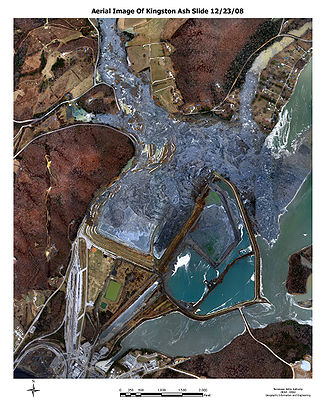 Where fly ash is stored in bulk, it is usually stored wet rather than dry so that fugitive dust is minimized. The resulting impoundments (ponds) are typically large and stable for long periods, but any breach of their dams or bunding
will be rapid and on a massive scale.
In December 2008 the collapse of an embankment at an impoundment for wet storage of fly ash at the Tennessee Valley Authority
's Kingston Fossil Plant
resulted in a major release
of 5.4 millon cubic yards of coal fly ash, damaging 3 homes and flowing into the Emory River. Cleanup costs may exceed $1.2 billion. This spill was followed a few weeks later by a smaller TVA-plant spill in Alabama
, which contaminated Widows Creek and the Tennessee River.
and other substances that are known to be detrimental to health in sufficient quantities. Potentially toxic trace elements in coal include arsenic
, beryllium
, cadmium
, barium
, chromium
, copper
, lead
, mercury
, molybdenum
, nickel
, radium
, selenium
, thorium
, uranium
, vanadium
, and zinc
. Approximately 10 percent of the mass of coals burned in the United States consists of unburnable mineral material that becomes ash, so the concentration of most trace elements in coal ash is approximately 10 times the concentration in the original coal. A 1997 analysis by the U.S. Geological Survey (USGS) found that fly ash typically contained 10 to 30 ppm of uranium, comparable to the levels found in some granit
ic rocks, phosphate
rock, and black shale
.
In 2000, the United States Environmental Protection Agency (EPA) said that coal fly ash did not need to be regulated as a hazardous waste. Studies by the U.S. Geological Survey and others of radioactive elements in coal ash have concluded that fly ash compares with common soils or rocks and should not be the source of alarm. However, community and environmental organizations have documented numerous environmental contamination and damage concerns.
A revised risk assessment approach may change the way coal combustion wastes (CCW) are regulated, according to an August 2007 EPA notice in the Federal Register
. In June 2008, the U.S. House of Representatives held an oversight hearing on the Federal government's role in addressing health and environmental risks of fly ash.
along with toxic chemicals are among the exposure concerns. Although industry has claimed that fly ash is "neither toxic nor poisonous," this is disputed. Exposure to fly ash through skin contact, inhalation of fine particle dust and drinking water may well present health risks. The National Academy of Sciences noted in 2007 that "the presence of high contaminant levels in many CCR (coal combustion residue) leachates may create human health and ecological concerns."
Fine crystalline silica present in fly ash has been linked with lung damage, in particular silicosis
. OSHA
allows 0.10 mg/m3, (one ten-thousandth of a gram per cubic meter of air).
Another fly ash component of some concern is lime (CaO). This chemical reacts with water (H2O) to form calcium hydroxide
[Ca(OH)2], giving fly ash a pH somewhere between 10 and 12, a medium to strong base. This can also cause lung damage if present in sufficient quantities.
In a study by NIOSH at a cement company, crystalline silica exposures from fly ash were determined to be of no concern. For maintaining a safe workplace emphasis must be placed on maintaining low nuisance dust levels and to use the appropriate personal protective equipment (PPE). The conclusion of this NIOSH study is supported by other studies devoted to the effects of fly ash on the health of workers in power plants. According to these studies, fly ash dust should not be considered as "silicotic dust", because most of the crystalline silica is coated by amorphic alumino-silicates (glass), the main constituent of fly ash particles. This was shown particularly on the basis of scanning electron microscopy observations, by a research work performed in the Netherlands , but similar findings were obtained also in other countries.
Combustion
Combustion or burning is the sequence of exothermic chemical reactions between a fuel and an oxidant accompanied by the production of heat and conversion of chemical species. The release of heat can result in the production of light in the form of either glowing or a flame...
, and comprises the fine particles that rise with the flue gas
Flue gas
Flue gas is the gas exiting to the atmosphere via a flue, which is a pipe or channel for conveying exhaust gases from a fireplace, oven, furnace, boiler or steam generator. Quite often, the flue gas refers to the combustion exhaust gas produced at power plants...
es. Ash which does not rise is termed bottom ash
Bottom ash
Bottom ash refers to part of the non-combustible residues of combustion. In an industrial context, it usually refers to coal combustion and comprises traces of combustibles embedded in forming clinkers and sticking to hot side walls of a coal-burning furnace during its operation. The portion of...
. In an industrial context, fly ash usually refers to ash produced during combustion of coal
Coal
Coal is a combustible black or brownish-black sedimentary rock usually occurring in rock strata in layers or veins called coal beds or coal seams. The harder forms, such as anthracite coal, can be regarded as metamorphic rock because of later exposure to elevated temperature and pressure...
. Fly ash is generally captured by electrostatic precipitators or other particle filtration equipments before the flue gases reach the chimneys of coal-fired power plants
Fossil fuel power plant
A fossil-fuel power station is a power station that burns fossil fuels such as coal, natural gas or petroleum to produce electricity. Central station fossil-fuel power plants are designed on a large scale for continuous operation...
, and together with bottom ash
Bottom ash
Bottom ash refers to part of the non-combustible residues of combustion. In an industrial context, it usually refers to coal combustion and comprises traces of combustibles embedded in forming clinkers and sticking to hot side walls of a coal-burning furnace during its operation. The portion of...
removed from the bottom of the furnace is in this case jointly known as coal ash. Depending upon the source and makeup of the coal being burned, the components of fly ash vary considerably, but all fly ash includes substantial amounts of silicon dioxide
Silicon dioxide
The chemical compound silicon dioxide, also known as silica , is an oxide of silicon with the chemical formula '. It has been known for its hardness since antiquity...
(SiO2) (both amorphous and crystalline) and calcium oxide
Calcium oxide
Calcium oxide , commonly known as quicklime or burnt lime, is a widely used chemical compound. It is a white, caustic, alkaline crystalline solid at room temperature....
(CaO), both being endemic ingredients in many coal-bearing rock strata
Stratum
In geology and related fields, a stratum is a layer of sedimentary rock or soil with internally consistent characteristics that distinguish it from other layers...
.
Toxic constituents depend upon the specific coal bed makeup, but may include one or more of the following elements or substances in quantities from trace amounts to several percent: arsenic
Arsenic
Arsenic is a chemical element with the symbol As, atomic number 33 and relative atomic mass 74.92. Arsenic occurs in many minerals, usually in conjunction with sulfur and metals, and also as a pure elemental crystal. It was first documented by Albertus Magnus in 1250.Arsenic is a metalloid...
, beryllium
Beryllium
Beryllium is the chemical element with the symbol Be and atomic number 4. It is a divalent element which occurs naturally only in combination with other elements in minerals. Notable gemstones which contain beryllium include beryl and chrysoberyl...
, boron
Boron
Boron is the chemical element with atomic number 5 and the chemical symbol B. Boron is a metalloid. Because boron is not produced by stellar nucleosynthesis, it is a low-abundance element in both the solar system and the Earth's crust. However, boron is concentrated on Earth by the...
, cadmium
Cadmium
Cadmium is a chemical element with the symbol Cd and atomic number 48. This soft, bluish-white metal is chemically similar to the two other stable metals in group 12, zinc and mercury. Similar to zinc, it prefers oxidation state +2 in most of its compounds and similar to mercury it shows a low...
, chromium
Chromium
Chromium is a chemical element which has the symbol Cr and atomic number 24. It is the first element in Group 6. It is a steely-gray, lustrous, hard metal that takes a high polish and has a high melting point. It is also odorless, tasteless, and malleable...
, chromium VI, cobalt
Cobalt
Cobalt is a chemical element with symbol Co and atomic number 27. It is found naturally only in chemically combined form. The free element, produced by reductive smelting, is a hard, lustrous, silver-gray metal....
, lead
Lead
Lead is a main-group element in the carbon group with the symbol Pb and atomic number 82. Lead is a soft, malleable poor metal. It is also counted as one of the heavy metals. Metallic lead has a bluish-white color after being freshly cut, but it soon tarnishes to a dull grayish color when exposed...
, manganese
Manganese
Manganese is a chemical element, designated by the symbol Mn. It has the atomic number 25. It is found as a free element in nature , and in many minerals...
, mercury
Mercury (element)
Mercury is a chemical element with the symbol Hg and atomic number 80. It is also known as quicksilver or hydrargyrum...
, molybdenum
Molybdenum
Molybdenum , is a Group 6 chemical element with the symbol Mo and atomic number 42. The name is from Neo-Latin Molybdaenum, from Ancient Greek , meaning lead, itself proposed as a loanword from Anatolian Luvian and Lydian languages, since its ores were confused with lead ores...
, selenium
Selenium
Selenium is a chemical element with atomic number 34, chemical symbol Se, and an atomic mass of 78.96. It is a nonmetal, whose properties are intermediate between those of adjacent chalcogen elements sulfur and tellurium...
, strontium
Strontium
Strontium is a chemical element with the symbol Sr and the atomic number 38. An alkaline earth metal, strontium is a soft silver-white or yellowish metallic element that is highly reactive chemically. The metal turns yellow when exposed to air. It occurs naturally in the minerals celestine and...
, thallium
Thallium
Thallium is a chemical element with the symbol Tl and atomic number 81. This soft gray poor metal resembles tin but discolors when exposed to air. The two chemists William Crookes and Claude-Auguste Lamy discovered thallium independently in 1861 by the newly developed method of flame spectroscopy...
, and vanadium
Vanadium
Vanadium is a chemical element with the symbol V and atomic number 23. It is a hard, silvery gray, ductile and malleable transition metal. The formation of an oxide layer stabilizes the metal against oxidation. The element is found only in chemically combined form in nature...
, along with dioxins and PAH compounds
Polycyclic aromatic hydrocarbon
Polycyclic aromatic hydrocarbons , also known as poly-aromatic hydrocarbons or polynuclear aromatic hydrocarbons, are potent atmospheric pollutants that consist of fused aromatic rings and do not contain heteroatoms or carry substituents. Naphthalene is the simplest example of a PAH...
.
In the past, fly ash was generally released into the atmosphere
Earth's atmosphere
The atmosphere of Earth is a layer of gases surrounding the planet Earth that is retained by Earth's gravity. The atmosphere protects life on Earth by absorbing ultraviolet solar radiation, warming the surface through heat retention , and reducing temperature extremes between day and night...
, but pollution control equipment mandated in recent decades now require that it be captured prior to release. In the US, fly ash is generally stored at coal power plants or placed in landfills. About 43 percent is recycled, often used to supplement Portland cement
Portland cement
Portland cement is the most common type of cement in general use around the world because it is a basic ingredient of concrete, mortar, stucco and most non-specialty grout...
in concrete production. Some have expressed health concerns about this.
In some cases, such as the burning of solid waste to create electricity ("resource recovery" facilities a.k.a. waste-to-energy
Waste-to-energy
Waste-to-energy or energy-from-waste is the process of creating energy in the form of electricity or heat from the incineration of waste source. WtE is a form of energy recovery...
facilities), the fly ash may contain higher levels of contaminants than the bottom ash and mixing the fly and bottom ash together brings the proportional levels of contaminants within the range to qualify as nonhazardous waste in a given state, whereas, unmixed, the fly ash would be within the range to qualify as hazardous waste.
Chemical composition and classification
| Component | Bituminous Bituminous coal Bituminous coal or black coal is a relatively soft coal containing a tarlike substance called bitumen. It is of higher quality than lignite coal but of poorer quality than Anthracite... |
Subbituminous | Lignite Lignite Lignite, often referred to as brown coal, or Rosebud coal by Northern Pacific Railroad,is a soft brown fuel with characteristics that put it somewhere between coal and peat... |
|---|---|---|---|
| SiO2 Silicon dioxide The chemical compound silicon dioxide, also known as silica , is an oxide of silicon with the chemical formula '. It has been known for its hardness since antiquity... (%) |
20-60 | 40-60 | 15-45 |
| Al2O3 (%) | 5-35 | 20-30 | 20-25 |
| Fe2O3 Iron oxide Iron oxides are chemical compounds composed of iron and oxygen. All together, there are sixteen known iron oxides and oxyhydroxides.Iron oxides and oxide-hydroxides are widespread in nature, play an important role in many geological and biological processes, and are widely utilized by humans, e.g.,... (%) |
10-40 | 4-10 | 4-15 |
| CaO Calcium oxide Calcium oxide , commonly known as quicklime or burnt lime, is a widely used chemical compound. It is a white, caustic, alkaline crystalline solid at room temperature.... (%) |
1-12 | 5-30 | 15-40 |
| LOI Loss on ignition Loss on Ignition is a test used in inorganic analytical chemistry, particularly in the analysis of minerals. It consists of strongly heating a sample of the material at a specified temperature, allowing volatile substances to escape, until its mass ceases to change. This may be done in air, or... (%) |
0-15 | 0-3 | 0-5 |
Fly ash material solidifies while suspended in the exhaust gases and is collected by electrostatic precipitator
Electrostatic precipitator
An electrostatic precipitator , or electrostatic air cleaner is a particulate collection device that removes particles from a flowing gas using the force of an induced electrostatic charge...
s or filter bags. Since the particles solidify while suspended in the exhaust gases, fly ash particles are generally spherical
Sphere
A sphere is a perfectly round geometrical object in three-dimensional space, such as the shape of a round ball. Like a circle in two dimensions, a perfect sphere is completely symmetrical around its center, with all points on the surface lying the same distance r from the center point...
in shape and range in size from 0.5 µm to 100 µm. They consist mostly of silicon dioxide
Silicon dioxide
The chemical compound silicon dioxide, also known as silica , is an oxide of silicon with the chemical formula '. It has been known for its hardness since antiquity...
, which is present in two forms: amorphous, which is rounded and smooth, and crystalline, which is sharp, pointed and hazardous; aluminium oxide
Aluminium oxide
Aluminium oxide is an amphoteric oxide with the chemical formula 23. It is commonly referred to as alumina, or corundum in its crystalline form, as well as many other names, reflecting its widespread occurrence in nature and industry...
and iron oxide
Iron oxide
Iron oxides are chemical compounds composed of iron and oxygen. All together, there are sixteen known iron oxides and oxyhydroxides.Iron oxides and oxide-hydroxides are widespread in nature, play an important role in many geological and biological processes, and are widely utilized by humans, e.g.,...
. Fly ashes are generally highly heterogeneous, consisting of a mixture of glassy particles with various identifiable crystalline phases such as quartz
Quartz
Quartz is the second-most-abundant mineral in the Earth's continental crust, after feldspar. It is made up of a continuous framework of SiO4 silicon–oxygen tetrahedra, with each oxygen being shared between two tetrahedra, giving an overall formula SiO2. There are many different varieties of quartz,...
, mullite
Mullite
Mullite or porcelainite is a rare silicate mineral of post-clay genesis. It can form two stoichiometric forms 3Al2O32SiO2 or 2Al2O3 SiO2. Unusually, mullite has no charge balancing cations present...
, and various iron oxide
Iron oxide
Iron oxides are chemical compounds composed of iron and oxygen. All together, there are sixteen known iron oxides and oxyhydroxides.Iron oxides and oxide-hydroxides are widespread in nature, play an important role in many geological and biological processes, and are widely utilized by humans, e.g.,...
s.
Fly ash also contains environmental toxins in significant amounts, including arsenic
Arsenic
Arsenic is a chemical element with the symbol As, atomic number 33 and relative atomic mass 74.92. Arsenic occurs in many minerals, usually in conjunction with sulfur and metals, and also as a pure elemental crystal. It was first documented by Albertus Magnus in 1250.Arsenic is a metalloid...
(43.4 ppm); barium
Barium
Barium is a chemical element with the symbol Ba and atomic number 56. It is the fifth element in Group 2, a soft silvery metallic alkaline earth metal. Barium is never found in nature in its pure form due to its reactivity with air. Its oxide is historically known as baryta but it reacts with...
(806 ppm); beryllium
Beryllium
Beryllium is the chemical element with the symbol Be and atomic number 4. It is a divalent element which occurs naturally only in combination with other elements in minerals. Notable gemstones which contain beryllium include beryl and chrysoberyl...
(5 ppm); boron
Boron
Boron is the chemical element with atomic number 5 and the chemical symbol B. Boron is a metalloid. Because boron is not produced by stellar nucleosynthesis, it is a low-abundance element in both the solar system and the Earth's crust. However, boron is concentrated on Earth by the...
(311 ppm); cadmium
Cadmium
Cadmium is a chemical element with the symbol Cd and atomic number 48. This soft, bluish-white metal is chemically similar to the two other stable metals in group 12, zinc and mercury. Similar to zinc, it prefers oxidation state +2 in most of its compounds and similar to mercury it shows a low...
(3.4 ppm); chromium
Chromium
Chromium is a chemical element which has the symbol Cr and atomic number 24. It is the first element in Group 6. It is a steely-gray, lustrous, hard metal that takes a high polish and has a high melting point. It is also odorless, tasteless, and malleable...
(136 ppm); chromium VI (90 ppm); cobalt
Cobalt
Cobalt is a chemical element with symbol Co and atomic number 27. It is found naturally only in chemically combined form. The free element, produced by reductive smelting, is a hard, lustrous, silver-gray metal....
(35.9 ppm); copper
Copper
Copper is a chemical element with the symbol Cu and atomic number 29. It is a ductile metal with very high thermal and electrical conductivity. Pure copper is soft and malleable; an exposed surface has a reddish-orange tarnish...
(112 ppm); fluorine
Fluorine
Fluorine is the chemical element with atomic number 9, represented by the symbol F. It is the lightest element of the halogen column of the periodic table and has a single stable isotope, fluorine-19. At standard pressure and temperature, fluorine is a pale yellow gas composed of diatomic...
(29 ppm); lead
Lead
Lead is a main-group element in the carbon group with the symbol Pb and atomic number 82. Lead is a soft, malleable poor metal. It is also counted as one of the heavy metals. Metallic lead has a bluish-white color after being freshly cut, but it soon tarnishes to a dull grayish color when exposed...
(56 ppm); manganese
Manganese
Manganese is a chemical element, designated by the symbol Mn. It has the atomic number 25. It is found as a free element in nature , and in many minerals...
(250 ppm); nickel
Nickel
Nickel is a chemical element with the chemical symbol Ni and atomic number 28. It is a silvery-white lustrous metal with a slight golden tinge. Nickel belongs to the transition metals and is hard and ductile...
(77.6 ppm); selenium
Selenium
Selenium is a chemical element with atomic number 34, chemical symbol Se, and an atomic mass of 78.96. It is a nonmetal, whose properties are intermediate between those of adjacent chalcogen elements sulfur and tellurium...
(7.7 ppm); strontium
Strontium
Strontium is a chemical element with the symbol Sr and the atomic number 38. An alkaline earth metal, strontium is a soft silver-white or yellowish metallic element that is highly reactive chemically. The metal turns yellow when exposed to air. It occurs naturally in the minerals celestine and...
(775 ppm); thallium
Thallium
Thallium is a chemical element with the symbol Tl and atomic number 81. This soft gray poor metal resembles tin but discolors when exposed to air. The two chemists William Crookes and Claude-Auguste Lamy discovered thallium independently in 1861 by the newly developed method of flame spectroscopy...
(9 ppm); vanadium
Vanadium
Vanadium is a chemical element with the symbol V and atomic number 23. It is a hard, silvery gray, ductile and malleable transition metal. The formation of an oxide layer stabilizes the metal against oxidation. The element is found only in chemically combined form in nature...
(252 ppm); and zinc
Zinc
Zinc , or spelter , is a metallic chemical element; it has the symbol Zn and atomic number 30. It is the first element in group 12 of the periodic table. Zinc is, in some respects, chemically similar to magnesium, because its ion is of similar size and its only common oxidation state is +2...
(178 ppm).
The above concentrations of trace elements vary according to the kind of coal burnt to form it. In fact, in the case of bituminous coal, with the notable exception of boron, trace element concentrations are generally similar to trace element concentrations in unpolluted soils.
Two classes of fly ash are defined by ASTM
ASTM International
ASTM International, known until 2001 as the American Society for Testing and Materials , is an international standards organization that develops and publishes voluntary consensus technical standards for a wide range of materials, products, systems, and services...
C618: Class F fly ash and Class C fly ash. The chief difference between these classes is the amount of calcium, silica, alumina, and iron content in the ash. The chemical properties of the fly ash are largely influenced by the chemical content of the coal burned (i.e., anthracite, bituminous
Bituminous coal
Bituminous coal or black coal is a relatively soft coal containing a tarlike substance called bitumen. It is of higher quality than lignite coal but of poorer quality than Anthracite...
, and lignite
Lignite
Lignite, often referred to as brown coal, or Rosebud coal by Northern Pacific Railroad,is a soft brown fuel with characteristics that put it somewhere between coal and peat...
).
Not all fly ashes meet ASTM C618 requirements, although depending on the application, this may not be necessary. Ash used as a cement replacement must meet strict construction standards, but no standard environmental regulations have been established in the United States. 75% of the ash must have a fineness
Fineness
The fineness of a precious metal refers to the ratio of the primary metal to any additives or impurities.A piece of alloy metal containing a precious metal may have the weight of its precious component referred to as its fine weight. For example, 1 troy ounce of 18 karat gold may be said to have a...
of 45 µm or less, and have a carbon
Carbon
Carbon is the chemical element with symbol C and atomic number 6. As a member of group 14 on the periodic table, it is nonmetallic and tetravalent—making four electrons available to form covalent chemical bonds...
content, measured by the loss on ignition (LOI), of less than 4%. In the U.S., LOI needs to be under 6%. The particle size distribution of raw fly ash is very often fluctuating constantly, due to changing performance of the coal mills and the boiler performance. This makes it necessary that, if fly ash is used in an optimal way to replace cement in concrete production, it needs to be processed using beneficiation methods like mechanical air classification. But if fly ash is used also as a filler to replace sand in concrete production, unbeneficiated fly ash with higher LOI can be also used. Especially important is the ongoing quality verification. This is mainly expressed by quality control seals like the Bureau of Indian Standards
Bureau of Indian Standards
The Bureau of Indian Standards is the national Standards Body of India working under the aegis of Ministry of Consumer Affairs, Food & Public Distribution, Government of India. It is established by the Bureau of Indian Standards Act, 1986 which came into effect on 23 December 1986...
mark or the DCL mark of the Dubai Municipality.
Class F fly ash
The burning of harder, older anthracite and bituminous coal typically produces Class F fly ash. This fly ash is pozzolanPozzolan
A pozzolan is a material which, when combined with calcium hydroxide, exhibits cementitious properties. Pozzolans are commonly used as an addition to Portland cement concrete mixtures to increase the long-term strength and other material properties of Portland cement concrete, and in some cases...
ic in nature, and contains less than 20% lime
Lime (mineral)
Lime is a general term for calcium-containing inorganic materials, in which carbonates, oxides and hydroxides predominate. Strictly speaking, lime is calcium oxide or calcium hydroxide. It is also the name for a single mineral of the CaO composition, occurring very rarely...
(CaO). Possessing pozzolanic properties, the glassy silica and alumina of Class F fly ash requires a cementing agent, such as Portland cement, quicklime, or hydrated lime, with the presence of water in order to react and produce cementitious compounds. Alternatively, the addition of a chemical activator such as sodium silicate
Sodium silicate
Sodium silicate is the common name for a compound sodium metasilicate, Na2SiO3, also known as water glass or liquid glass. It is available in aqueous solution and in solid form and is used in cements, passive fire protection, refractories, textile and lumber processing, and automobiles...
(water glass) to a Class F ash can lead to the formation of a geopolymer.
Class C fly ash
Fly ash produced from the burning of younger lignite or subbituminous coal, in addition to having pozzolanic properties, also has some self-cementing properties. In the presence of water, Class C fly ash will harden and gain strength over time. Class C fly ash generally contains more than 20% lime (CaO). Unlike Class F, self-cementing Class C fly ash does not require an activator. Alkali and sulfateSulfate
In inorganic chemistry, a sulfate is a salt of sulfuric acid.-Chemical properties:...
contents are generally higher in Class C fly ashes.
At least one US manufacturer has announced a fly ash brick
Fly ash brick
Fly ash brick are building materials, specifically masonry units, containing Class C fly ash and water. Compressed at 4,000 psi and cured for 24 hours in a 150 °F steam bath , then toughened with an air entrainment agent, the bricks last for more than 100 freeze-thaw cycles...
containing up to 50 percent Class C fly ash. Testing shows the bricks meet or exceed the performance standards listed in ASTM C 216 for conventional clay brick; it is also within the allowable shrinkage limits for concrete brick in ASTM C 55, Standard Specification for Concrete Building Brick. It is estimated that the production method used in fly ash bricks will reduce the embodied energy of masonry construction by up to 90%. Bricks and pavers were expected to be available in commercial quantities before the end of 2009.
Disposal and market sources
In the past, fly ash produced from coal combustion was simply entrained in flue gasFlue gas
Flue gas is the gas exiting to the atmosphere via a flue, which is a pipe or channel for conveying exhaust gases from a fireplace, oven, furnace, boiler or steam generator. Quite often, the flue gas refers to the combustion exhaust gas produced at power plants...
es and dispersed into the atmosphere. This created environmental and health concerns that prompted laws which have reduced fly ash emissions to less than 1 percent of ash produced. Worldwide, more than 65% of fly ash produced from coal power stations is disposed of in landfill
Landfill
A landfill site , is a site for the disposal of waste materials by burial and is the oldest form of waste treatment...
s and ash pond
Ash pond
Ash ponds are engineered structures for the disposal of fly ash. The wet disposal of fly ash into ash ponds is the most common fly ash disposal method, but other methods include dry disposal in landfills. Wet disposal has been preferred due to economic reasons, but increasing environmental concerns...
s.
The recycling of fly ash has become an increasing concern in recent years due to increasing landfill costs and current interest in sustainable development
Sustainable development
Sustainable development is a pattern of resource use, that aims to meet human needs while preserving the environment so that these needs can be met not only in the present, but also for generations to come...
. , U.S. coal-fired power plants reported producing 71.1 million tons of fly ash, of which 29.1 million tons were reused in various applications. If the nearly 42 million tons of unused fly ash had been recycled, it would have reduced the need for approximately 27500 acre.ft of landfill space. Other environmental benefits to recycling fly ash includes reducing the demand for virgin materials that would need quarry
Quarry
A quarry is a type of open-pit mine from which rock or minerals are extracted. Quarries are generally used for extracting building materials, such as dimension stone, construction aggregate, riprap, sand, and gravel. They are often collocated with concrete and asphalt plants due to the requirement...
ing and substituting for materials that may be energy-intensive to create such as Portland cement
Portland cement
Portland cement is the most common type of cement in general use around the world because it is a basic ingredient of concrete, mortar, stucco and most non-specialty grout...
.
As of 2006, about 125 million tons of coal-combustion byproducts, including fly ash, were produced in the U.S. each year, with about 43 percent of that amount used in commercial applications, according to the American Coal Ash Association Web site. As of early 2008, the United States Environmental Protection Agency
United States Environmental Protection Agency
The U.S. Environmental Protection Agency is an agency of the federal government of the United States charged with protecting human health and the environment, by writing and enforcing regulations based on laws passed by Congress...
hoped that figure would increase to 50 percent as of 2011.
Fly ash reuse
There is no U.S. governmental registration or labelling of fly ash utilization in the different sectors of the economy - industry, infrastructures and agriculture. Fly ash utilization survey data, acknowledged as incomplete, are published annually by the American Coal Ash Association.The ways of fly ash utilization include (approximately in order of decreasing importance):
- ConcreteConcreteConcrete is a composite construction material, composed of cement and other cementitious materials such as fly ash and slag cement, aggregate , water and chemical admixtures.The word concrete comes from the Latin word...
production, as a substitute material for Portland cement and sand - EmbankmentsEmbankment (transportation)To keep a road or railway line straight or flat, and where the comparative cost or practicality of alternate solutions is prohibitive, the land over which the road or rail line will travel is built up to form an embankment. An embankment is therefore in some sense the opposite of a cutting, and...
and other structural fills (usually for road construction) - GroutGroutGrout is a construction material used to embed rebars in masonry walls, connect sections of pre-cast concrete, fill voids, and seal joints . Grout is generally composed of a mixture of water, cement, sand, often color tint, and sometimes fine gravel...
and Flowable fillFlowable fillThe use of flowable fill as a highway construction material is becoming more widespread throughout the United States. Data received from questionnaires sent by the Pennsylvania Department of Transportation in 1991 and the Transportation Research Board in 1992 indicated that approximately 30...
production - Waste stabilization and solidification
- Cement clinkersClinker (cement)thumb|200px|right|Typical clinker nodulesthumb|200px|right|Hot clinkerIn the manufacture of Portland cement, clinker is lumps or nodules, usually 3-25 mm in diameter, produced by sintering limestone and alumino-silicate during the cement kiln stage.-Uses:...
production - (as a substitute material for clay) - Mine reclamationMine reclamationMine reclamation is the process of creating useful landscapes that meet a variety of goals, typically creating productive ecosystems from mined land...
- Stabilization of soft soilsClayClay is a general term including many combinations of one or more clay minerals with traces of metal oxides and organic matter. Geologic clay deposits are mostly composed of phyllosilicate minerals containing variable amounts of water trapped in the mineral structure.- Formation :Clay minerals...
- Road subbaseBase courseBase Course in pavements refers to the sub-layer material of an asphalt roadway and is placed directly on top of the undisturbed soil so as to provide a foundation to support the top layer of the pavement...
construction - As AggregateAggregate (composite)Aggregate is the component of a composite material that resists compressive stress and provides bulk to the composite material. For efficient filling, aggregate should be much smaller than the finished item, but have a wide variety of sizes...
substitute material (e.g. for brick production) - Mineral filler in asphaltic concrete
- Agricultural uses: soil amendment, fertilizer, cattle feeders, soil stabilization in stock feed yards, and agricultural stakes
- Loose application on rivers to melt ice
- Loose application on roads and parking lots for ice control
- Other applications include cosmetics, toothpaste, kitchen counter tops, floor and ceiling tiles, bowling balls, flotation devices, stucco, utensils, tool handles, picture frames, auto bodies and boat hulls, cellular concrete, geopolymersGeopolymersGeopolymer is a term covering a class of synthetic aluminosilicate materials with potential use in a number of areas, essentially as a replacement for Portland cement and for advanced high-tech composites, ceramic applications or as a form of cast stone...
, roofing tiles, roofing granules, decking, fireplace mantles, cinder block, PVC pipe, Structural Insulated Panels, house siding and trim, running tracks, blasting grit, recycled plastic lumber, utility poles and crossarms, railway sleepers, highway sound barriers, marine pilings, doors, window frames, scaffolding, sign posts, crypts, columns, railroad ties, vinyl flooring, paving stones, shower stalls, garage doors, park benches, landscape timbers, planters, pallet blocks, molding, mail boxes, artificial reef, binding agent, paintPaintPaint is any liquid, liquefiable, or mastic composition which after application to a substrate in a thin layer is converted to an opaque solid film. One may also consider the digital mimicry thereof...
s and undercoatings, metal castings, and filler in wood and plastic products.
Portland cement
Owing to its pozzolanPozzolan
A pozzolan is a material which, when combined with calcium hydroxide, exhibits cementitious properties. Pozzolans are commonly used as an addition to Portland cement concrete mixtures to increase the long-term strength and other material properties of Portland cement concrete, and in some cases...
ic properties, fly ash is used as a replacement for some of the Portland cement
Portland cement
Portland cement is the most common type of cement in general use around the world because it is a basic ingredient of concrete, mortar, stucco and most non-specialty grout...
content of concrete
Concrete
Concrete is a composite construction material, composed of cement and other cementitious materials such as fly ash and slag cement, aggregate , water and chemical admixtures.The word concrete comes from the Latin word...
. The use of fly ash as a pozzolanic ingredient was recognized as early as 1914, although the earliest noteworthy study of its use was in 1937. Before its use was lost to the Dark Ages, Roman structures such as aqueduct
Aqueduct
An aqueduct is a water supply or navigable channel constructed to convey water. In modern engineering, the term is used for any system of pipes, ditches, canals, tunnels, and other structures used for this purpose....
s or the Pantheon
Pantheon, Rome
The Pantheon ,Rarely Pantheum. This appears in Pliny's Natural History in describing this edifice: Agrippae Pantheum decoravit Diogenes Atheniensis; in columnis templi eius Caryatides probantur inter pauca operum, sicut in fastigio posita signa, sed propter altitudinem loci minus celebrata.from ,...
in Rome used volcanic ash (which possesses similar properties to fly ash) as pozzolan in their concrete. As pozzolan greatly improves the strength and durability of concrete, the use of ash is a key factor in their preservation.
Use of fly ash as a partial replacement for Portland cement is generally limited to Class F fly ashes. It can replace up to 30% by mass of Portland cement, and can add to the concrete’s final strength and increase its chemical resistance and durability. Recently concrete mix design for partial cement replacement with High Volume Fly Ash (50 % cement replacement) has been developed. For Roller Compacted Concrete (RCC)[used in dam construction] replacement values of 70% have been achieved with processed fly ash at the Ghatghar Dam project in Maharashtra, India. Due to the spherical shape of fly ash particles, it can also increase workability of cement while reducing water demand. The replacement of Portland cement with fly ash is considered by its promoters to reduce the greenhouse gas
Greenhouse gas
A greenhouse gas is a gas in an atmosphere that absorbs and emits radiation within the thermal infrared range. This process is the fundamental cause of the greenhouse effect. The primary greenhouse gases in the Earth's atmosphere are water vapor, carbon dioxide, methane, nitrous oxide, and ozone...
"footprint" of concrete, as the production of one ton of Portland cement produces approximately one ton of CO2
Carbon dioxide
Carbon dioxide is a naturally occurring chemical compound composed of two oxygen atoms covalently bonded to a single carbon atom...
as compared to zero CO2 being produced using existing fly ash. New fly ash production, i.e., the burning of coal, produces approximately twenty to thirty tons of CO2 per ton of fly ash. Since the worldwide production of Portland cement is expected to reach nearly 2 billion tons by 2010, replacement of any large portion of this cement by fly ash could significantly reduce carbon emissions associated with construction, as long as the comparison takes the production of fly ash as a given.
Embankment
Fly ash properties are somewhat unique as an engineering material. Unlike typical soils used for embankment construction, fly ash has a large uniformity coefficient consisting of clay-sized particles. Engineering properties that will affect fly ash’s use in embankments include grain size distribution, compaction characteristicsProctor compaction test
The Proctor compaction test is a laboratory method of experimentally determining the optimal moisture content at which a given soil type will become most dense and achieve its maximum dry density. The term Proctor is in honor of , who in 1933 showed that the dry density of a soil for a given...
, shear strength
Shear strength
Shear strength in engineering is a term used to describe the strength of a material or component against the type of yield or structural failure where the material or component fails in shear. A shear load is a force that tends to produce a sliding failure on a material along a plane that is...
, compressibility, permeability
Permeability (fluid)
Permeability in fluid mechanics and the earth sciences is a measure of the ability of a porous material to allow fluids to pass through it.- Units :...
, and frost susceptibility
Frost heaving
Frost heaving results from ice forming beneath the surface of soil during freezing conditions in the atmosphere. The ice grows in the direction of heat loss , starting at the freezing front or boundary in the soil...
. Nearly all fly ash used in embankments are Class F fly ashes.
Soil stabilization
Soil stabilization is the permanent physical and chemical alteration of soils to enhance their physical properties. Stabilization can increase the shear strength of a soil and/or control the shrink-swell properties of a soil, thus improving the load-bearing capacity of a sub-grade to support pavements and foundations. Stabilization can be used to treat a wide range of sub-grade materials from expansive clays to granular materials. Stabilization can be achieved with a variety of chemical additives including lime, fly ash, and Portland cement, as well as by-products such as lime-kiln dust (LKD) and cement-kiln dust (CKD). Proper design and testing is an important component of any stabilization project. This allows for the establishment of design criteria as well as the determination of the proper chemical additive and admixture rate to be used to achieve the desired engineering properties. Benefits of the stabilization process can include: Higher resistance (R) values, Reduction in plasticity, Lower permeability, Reduction of pavement thickness, Elimination of excavation - material hauling/handling - and base importation, Aids compaction, Provides “all-weather” access onto and within projects sites. Another form of soil treatment closely related to soil stabilization is soil modification, sometimes referred to as “mud drying” or soil conditioning. Although some stabilization inherently occurs in soil modification, the distinction is that soil modification is merely a means to reduce the moisture content of a soil to expedite construction, whereas stabilization can substantially increase the shear strength of a material such that it can be incorporated into the project’s structural design. The determining factors associated with soil modification vs soil stabilization may be the existing moisture content, the end use of the soil structure and ultimately the cost benefit provided. Equipment for the stabilization and modification processes include: chemical additive spreaders, soil mixers (reclaimers), portable pneumatic storage containers, water trucks, deep lift compactors, motor graders.Flowable fill
Fly ash is also used as a component in the production of flowable fillFlowable fill
The use of flowable fill as a highway construction material is becoming more widespread throughout the United States. Data received from questionnaires sent by the Pennsylvania Department of Transportation in 1991 and the Transportation Research Board in 1992 indicated that approximately 30...
(also called controlled low strength material, or CLSM), which is used as self-leveling, self-compacting backfill material in lieu of compacted earth or granular fill. The strength of flowable fill mixes can range from 50 to 1,200 lbf/in² (0.3 to 8.3 MPa), depending on the design requirements of the project in question. Flowable fill includes mixtures of Portland cement and filler material, and can contain mineral admixtures. Fly ash can replace either the Portland cement or fine aggregate (in most cases, river sand) as a filler material. High fly ash content mixes contain nearly all fly ash, with a small percentage of Portland cement and enough water to make the mix flowable. Low fly ash content mixes contain a high percentage of filler material, and a low percentage of fly ash, Portland cement, and water. Class F fly ash is best suited for high fly ash content mixes, whereas Class C fly ash is almost always used in low fly ash content mixes.
Asphalt concrete
Asphalt concrete is a composite material consisting of an asphalt binder and mineral aggregate. Both Class F and Class C fly ash can typically be used as a mineral filler to fill the voids and provide contact points between larger aggregate particles in asphalt concrete mixes. This application is used in conjunction, or as a replacement for, other binders (such as Portland cement or hydrated lime). For use in asphalt pavement, the fly ash must meet mineral filler specifications outlined in ASTM D242. The hydrophobic nature of fly ash gives pavements better resistance to stripping. Fly ash has also been shown to increase the stiffness of the asphalt matrix, improving rutting resistance and increasing mix durability.Geopolymers
More recently, fly ash has been used as a component in geopolymersGeopolymers
Geopolymer is a term covering a class of synthetic aluminosilicate materials with potential use in a number of areas, essentially as a replacement for Portland cement and for advanced high-tech composites, ceramic applications or as a form of cast stone...
, where the reactivity of the fly ash glasses is used to generate a binder comparable to a hydrated Portland cement
Portland cement
Portland cement is the most common type of cement in general use around the world because it is a basic ingredient of concrete, mortar, stucco and most non-specialty grout...
in appearance and properties, but with possibly reduced CO2 emissions.
It should be noted that when the total carbon footprint
Carbon footprint
A carbon footprint has historically been defined as "the total set of greenhouse gas emissions caused by an organization, event, product or person.". However, calculating a carbon footprint which conforms to this definition is often impracticable due to the large amount of data required, which is...
of the alkali required to form geopolymer cement is considered, including the calcining of limestone as an intermediate to the formation of alkali, the net reduction in total CO2 emissions may be negligible. Moreover, handling of alkali can be problematic and setting of geopolymer cements is very rapid (minutes versus hours) as compared to Portland cements, making widespread use of geopolymer cements impractical at the ready mix level.
Roller compacted concrete
Another application of using fly ash is in roller compacted concrete dams. Many dams in the US have been constructed with high fly ash contents. Fly ash lowers the heat of hydration allowing thicker placements to occur. Data for these can be found at the US Bureau of Reclamation. This has also been demonstrated in the Ghatghar Dam Project in IndiaIndia
India , officially the Republic of India , is a country in South Asia. It is the seventh-largest country by geographical area, the second-most populous country with over 1.2 billion people, and the most populous democracy in the world...
.
Bricks
There are several techniques for manufacturing construction bricks from fly ash, producing a wide variety of products. One type of fly ash brick is manufactured by mixing fly ash with an equal amount of clay, then firing in a kiln at about 1000 degrees C. This approach has the principal benefit of reducing the amount of clay required. Another type of fly ash brick is made by mixing soil, plaster of paris, fly ash and water, and allowing the mixture to dry. Because no heat is required, this technique reduces air pollution. More modern manufacturing processes use a greater proportion of fly ash, and a high pressure manufacturing technique, which produces high strength bricks with environmental benefits.In the United Kingdom, fly ash has been used for over fifty years to make concrete building blocks. They are widely used for the inner skin of cavity walls. They are naturally more thermally insulating than blocks made with other aggregates.
Ash bricks have been used in house construction in Windhoek, Namibia
Windhoek
Windhoek is the capital and largest city of the Republic of Namibia. It is located in central Namibia in the Khomas Highland plateau area, at around above sea level. The 2001 census determined Windhoek's population was 233,529...
since the 1970s. There is, however, a problem with the bricks in that they tend to fail or produce unsightly pop-outs. This happens when the bricks come into contact with moisture and a chemical reaction occurs causing the bricks to expand.
In India, fly ash bricks are used for construction. Leading manufacturers use an industrial standard known as "Pulverized fuel ash for lime-Pozzolana mixture" using over 75% post-industrial recycled waste, and a compression process. This produces a strong product with good insulation properties and environmental benefits.
American civil engineer Henry Liu
Henry Liu (civil engineer)
Henry Liu was a retired American civil engineer and the president of Freight Pipeline Company , now known as EcologicTech....
announced the invention of a new type of fly ash brick in 2007. Liu's brick is compressed at 4,000 psi
Pounds per square inch
The pound per square inch or, more accurately, pound-force per square inch is a unit of pressure or of stress based on avoirdupois units...
and cured for 24 hours in a 150 °F (66 °C) steam bath, then toughened with an air entrainment
Air entrainment
-Air entrainment in concrete:Air entrainment is the intentional creation of tiny air bubbles in concrete. The bubbles are introduced into the concrete by the addition to the mix of an air entraining agent, a surfactant...
agent, so that it lasts for more than 100 freeze-thaw cycles. Owing to the high concentration of calcium oxide
Calcium oxide
Calcium oxide , commonly known as quicklime or burnt lime, is a widely used chemical compound. It is a white, caustic, alkaline crystalline solid at room temperature....
in class C fly ash, the brick can be described as self-cementing. Since this method contains no clay and uses pressure instead of heat, it saves energy, reduces mercury
Mercury (element)
Mercury is a chemical element with the symbol Hg and atomic number 80. It is also known as quicksilver or hydrargyrum...
pollution, and costs 20% less than traditional manufacturing techniques. This type of brick is now manufactured under license in the USA.
Some varieties of fly ash brick gain strength as they age.
Metal matrix composites
Hollow fly ash can be infiltrated by molten metal to form solid, alumina encased spheres. Fly ash can also be mixed with molten metal and cast to reduce overall weight and density, due to the low density of fly ash. Research is underway to incorporate fly ash into lead acid batteries in a lead calcium tin fly ash composite in an effort to reduce weight of the battery.Waste treatment and stabilization
Fly ash, in view of its alkalinity and water absorption capacity, may be used in combination with other alkaline materials to transform sewage sludge into organic fertilizer or biofuelBiofuel
Biofuel is a type of fuel whose energy is derived from biological carbon fixation. Biofuels include fuels derived from biomass conversion, as well as solid biomass, liquid fuels and various biogases...
.
In addition, fly ash, mainly class C, may be used in the stabilization/solidification process of hazardous wastes and contaminated soils. For example, the Rhenipal process uses fly ash as an admixture to stabilize sewage sludge and other toxic sludges. This process has been used since 1996 to stabilize large amounts of chromium(VI)
Hexavalent chromium
Hexavalent chromium refers to chemical compounds that contain the element chromium in the +6 oxidation state. Virtually all chromium ore is processed via hexavalent chromium, specifically the salt sodium dichromate. Approximately of hexavalent chromium were produced in 1985...
contaminated leather sludges
Tanning
Tanning is the making of leather from the skins of animals which does not easily decompose. Traditionally, tanning used tannin, an acidic chemical compound from which the tanning process draws its name . Coloring may occur during tanning...
in Alcanena
Alcanena
Alcanena is a municipality in Portugal with a total area of 127 km² and a total population of 14,709 inhabitants.The municipality is composed of ten parishes, and is located in Santarém District....
, Portugal.
Present production rate of fly ash
In the United States about 131 million tons of fly ash are produced annually by 460 coal-fired power plants. A 2008 industry survey estimated that 43 percent of this ash is re-used.Groundwater contamination
Since coal contains trace levels of arsenic, barium, beryllium, boron, cadmium, chromium, thallium, selenium, molybdenum and mercury, its ash will continue to contain these traces and therefore cannot be dumped or stored where rainwater can leach the metals and move them to aquiferAquifer
An aquifer is a wet underground layer of water-bearing permeable rock or unconsolidated materials from which groundwater can be usefully extracted using a water well. The study of water flow in aquifers and the characterization of aquifers is called hydrogeology...
s.
Spills of bulk storage
Bunding
Bunding, also called a bund wall, is the area within a structure designed to prevent inundation or breaches of various types.-Liquid containment:...
will be rapid and on a massive scale.
In December 2008 the collapse of an embankment at an impoundment for wet storage of fly ash at the Tennessee Valley Authority
Tennessee Valley Authority
The Tennessee Valley Authority is a federally owned corporation in the United States created by congressional charter in May 1933 to provide navigation, flood control, electricity generation, fertilizer manufacturing, and economic development in the Tennessee Valley, a region particularly affected...
's Kingston Fossil Plant
Kingston Fossil Plant
Kingston Fossil Plant, commonly known as Kingston Steam Plant, is a Tennessee Valley Authority 1.7-GW coal-burning power plant located at in Roane County, just outside Kingston, Tennessee on the shore of Watts Bar Lake....
resulted in a major release
Kingston Fossil Plant coal fly ash slurry spill
The TVA Kingston Fossil Plant coal fly ash slurry spill occurred just before 1 a.m. on Monday December 22, 2008, when an ash dike ruptured at an solid waste containment area at the Tennessee Valley Authority's Kingston Fossil Plant in Roane County, Tennessee, USA. of coal fly ash slurry was...
of 5.4 millon cubic yards of coal fly ash, damaging 3 homes and flowing into the Emory River. Cleanup costs may exceed $1.2 billion. This spill was followed a few weeks later by a smaller TVA-plant spill in Alabama
Alabama
Alabama is a state located in the southeastern region of the United States. It is bordered by Tennessee to the north, Georgia to the east, Florida and the Gulf of Mexico to the south, and Mississippi to the west. Alabama ranks 30th in total land area and ranks second in the size of its inland...
, which contaminated Widows Creek and the Tennessee River.
Contaminants
Fly ash contains trace concentrations of heavy metalsHeavy metals
A heavy metal is a member of a loosely-defined subset of elements that exhibit metallic properties. It mainly includes the transition metals, some metalloids, lanthanides, and actinides. Many different definitions have been proposed—some based on density, some on atomic number or atomic weight,...
and other substances that are known to be detrimental to health in sufficient quantities. Potentially toxic trace elements in coal include arsenic
Arsenic
Arsenic is a chemical element with the symbol As, atomic number 33 and relative atomic mass 74.92. Arsenic occurs in many minerals, usually in conjunction with sulfur and metals, and also as a pure elemental crystal. It was first documented by Albertus Magnus in 1250.Arsenic is a metalloid...
, beryllium
Beryllium
Beryllium is the chemical element with the symbol Be and atomic number 4. It is a divalent element which occurs naturally only in combination with other elements in minerals. Notable gemstones which contain beryllium include beryl and chrysoberyl...
, cadmium
Cadmium
Cadmium is a chemical element with the symbol Cd and atomic number 48. This soft, bluish-white metal is chemically similar to the two other stable metals in group 12, zinc and mercury. Similar to zinc, it prefers oxidation state +2 in most of its compounds and similar to mercury it shows a low...
, barium
Barium
Barium is a chemical element with the symbol Ba and atomic number 56. It is the fifth element in Group 2, a soft silvery metallic alkaline earth metal. Barium is never found in nature in its pure form due to its reactivity with air. Its oxide is historically known as baryta but it reacts with...
, chromium
Chromium
Chromium is a chemical element which has the symbol Cr and atomic number 24. It is the first element in Group 6. It is a steely-gray, lustrous, hard metal that takes a high polish and has a high melting point. It is also odorless, tasteless, and malleable...
, copper
Copper
Copper is a chemical element with the symbol Cu and atomic number 29. It is a ductile metal with very high thermal and electrical conductivity. Pure copper is soft and malleable; an exposed surface has a reddish-orange tarnish...
, lead
Lead
Lead is a main-group element in the carbon group with the symbol Pb and atomic number 82. Lead is a soft, malleable poor metal. It is also counted as one of the heavy metals. Metallic lead has a bluish-white color after being freshly cut, but it soon tarnishes to a dull grayish color when exposed...
, mercury
Mercury (element)
Mercury is a chemical element with the symbol Hg and atomic number 80. It is also known as quicksilver or hydrargyrum...
, molybdenum
Molybdenum
Molybdenum , is a Group 6 chemical element with the symbol Mo and atomic number 42. The name is from Neo-Latin Molybdaenum, from Ancient Greek , meaning lead, itself proposed as a loanword from Anatolian Luvian and Lydian languages, since its ores were confused with lead ores...
, nickel
Nickel
Nickel is a chemical element with the chemical symbol Ni and atomic number 28. It is a silvery-white lustrous metal with a slight golden tinge. Nickel belongs to the transition metals and is hard and ductile...
, radium
Radium
Radium is a chemical element with atomic number 88, represented by the symbol Ra. Radium is an almost pure-white alkaline earth metal, but it readily oxidizes on exposure to air, becoming black in color. All isotopes of radium are highly radioactive, with the most stable isotope being radium-226,...
, selenium
Selenium
Selenium is a chemical element with atomic number 34, chemical symbol Se, and an atomic mass of 78.96. It is a nonmetal, whose properties are intermediate between those of adjacent chalcogen elements sulfur and tellurium...
, thorium
Thorium
Thorium is a natural radioactive chemical element with the symbol Th and atomic number 90. It was discovered in 1828 and named after Thor, the Norse god of thunder....
, uranium
Uranium
Uranium is a silvery-white metallic chemical element in the actinide series of the periodic table, with atomic number 92. It is assigned the chemical symbol U. A uranium atom has 92 protons and 92 electrons, of which 6 are valence electrons...
, vanadium
Vanadium
Vanadium is a chemical element with the symbol V and atomic number 23. It is a hard, silvery gray, ductile and malleable transition metal. The formation of an oxide layer stabilizes the metal against oxidation. The element is found only in chemically combined form in nature...
, and zinc
Zinc
Zinc , or spelter , is a metallic chemical element; it has the symbol Zn and atomic number 30. It is the first element in group 12 of the periodic table. Zinc is, in some respects, chemically similar to magnesium, because its ion is of similar size and its only common oxidation state is +2...
. Approximately 10 percent of the mass of coals burned in the United States consists of unburnable mineral material that becomes ash, so the concentration of most trace elements in coal ash is approximately 10 times the concentration in the original coal. A 1997 analysis by the U.S. Geological Survey (USGS) found that fly ash typically contained 10 to 30 ppm of uranium, comparable to the levels found in some granit
Granite
Granite is a common and widely occurring type of intrusive, felsic, igneous rock. Granite usually has a medium- to coarse-grained texture. Occasionally some individual crystals are larger than the groundmass, in which case the texture is known as porphyritic. A granitic rock with a porphyritic...
ic rocks, phosphate
Phosphate
A phosphate, an inorganic chemical, is a salt of phosphoric acid. In organic chemistry, a phosphate, or organophosphate, is an ester of phosphoric acid. Organic phosphates are important in biochemistry and biogeochemistry or ecology. Inorganic phosphates are mined to obtain phosphorus for use in...
rock, and black shale
Shale
Shale is a fine-grained, clastic sedimentary rock composed of mud that is a mix of flakes of clay minerals and tiny fragments of other minerals, especially quartz and calcite. The ratio of clay to other minerals is variable. Shale is characterized by breaks along thin laminae or parallel layering...
.
In 2000, the United States Environmental Protection Agency (EPA) said that coal fly ash did not need to be regulated as a hazardous waste. Studies by the U.S. Geological Survey and others of radioactive elements in coal ash have concluded that fly ash compares with common soils or rocks and should not be the source of alarm. However, community and environmental organizations have documented numerous environmental contamination and damage concerns.
A revised risk assessment approach may change the way coal combustion wastes (CCW) are regulated, according to an August 2007 EPA notice in the Federal Register
Federal Register
The Federal Register , abbreviated FR, or sometimes Fed. Reg.) is the official journal of the federal government of the United States that contains most routine publications and public notices of government agencies...
. In June 2008, the U.S. House of Representatives held an oversight hearing on the Federal government's role in addressing health and environmental risks of fly ash.
Exposure concerns
Crystalline silica and limeLime (mineral)
Lime is a general term for calcium-containing inorganic materials, in which carbonates, oxides and hydroxides predominate. Strictly speaking, lime is calcium oxide or calcium hydroxide. It is also the name for a single mineral of the CaO composition, occurring very rarely...
along with toxic chemicals are among the exposure concerns. Although industry has claimed that fly ash is "neither toxic nor poisonous," this is disputed. Exposure to fly ash through skin contact, inhalation of fine particle dust and drinking water may well present health risks. The National Academy of Sciences noted in 2007 that "the presence of high contaminant levels in many CCR (coal combustion residue) leachates may create human health and ecological concerns."
Fine crystalline silica present in fly ash has been linked with lung damage, in particular silicosis
Silicosis
Silicosis, also known as Potter's rot, is a form of occupational lung disease caused by inhalation of crystalline silica dust, and is marked by inflammation and scarring in forms of nodular lesions in the upper lobes of the lungs...
. OSHA
Occupational Safety and Health Administration
The United States Occupational Safety and Health Administration is an agency of the United States Department of Labor. It was created by Congress of the United States under the Occupational Safety and Health Act, signed by President Richard M. Nixon, on December 29, 1970...
allows 0.10 mg/m3, (one ten-thousandth of a gram per cubic meter of air).
Another fly ash component of some concern is lime (CaO). This chemical reacts with water (H2O) to form calcium hydroxide
Calcium hydroxide
Calcium hydroxide, traditionally called slaked lime, is an inorganic compound with the chemical formula Ca2. It is a colourless crystal or white powder and is obtained when calcium oxide is mixed, or "slaked" with water. It has many names including hydrated lime, builders lime, slack lime, cal, or...
[Ca(OH)2], giving fly ash a pH somewhere between 10 and 12, a medium to strong base. This can also cause lung damage if present in sufficient quantities.
In a study by NIOSH at a cement company, crystalline silica exposures from fly ash were determined to be of no concern. For maintaining a safe workplace emphasis must be placed on maintaining low nuisance dust levels and to use the appropriate personal protective equipment (PPE). The conclusion of this NIOSH study is supported by other studies devoted to the effects of fly ash on the health of workers in power plants. According to these studies, fly ash dust should not be considered as "silicotic dust", because most of the crystalline silica is coated by amorphic alumino-silicates (glass), the main constituent of fly ash particles. This was shown particularly on the basis of scanning electron microscopy observations, by a research work performed in the Netherlands , but similar findings were obtained also in other countries.
See also
- CementCementIn the most general sense of the word, a cement is a binder, a substance that sets and hardens independently, and can bind other materials together. The word "cement" traces to the Romans, who used the term opus caementicium to describe masonry resembling modern concrete that was made from crushed...
- ConcreteConcreteConcrete is a composite construction material, composed of cement and other cementitious materials such as fly ash and slag cement, aggregate , water and chemical admixtures.The word concrete comes from the Latin word...
- PozzolanPozzolanA pozzolan is a material which, when combined with calcium hydroxide, exhibits cementitious properties. Pozzolans are commonly used as an addition to Portland cement concrete mixtures to increase the long-term strength and other material properties of Portland cement concrete, and in some cases...
- PozzolanaPozzolanaPozzolana, also known as pozzolanic ash , is a fine, sandy volcanic ash. Pozzolanic ash was first discovered and dug in Italy, at Pozzuoli. It was later discovered at a number of other sites as well...
- Pozzolanic reactionPozzolanic reactionThe Pozzolanic reaction is the chemical reaction that occurs in hydraulic cement, a mixture of slaked lime with amorphous siliceous materials , forming non-water-soluble calcium silicate hydrates...
- Alkali Silica ReactionAlkali Silica ReactionThe alkali–silica reaction is a reaction which occurs over time in concrete between the highly alkaline cement paste and reactive non-crystalline silica, which is found in many common aggregates....
(ASR) - Alkali-aggregate reactionAlkali-aggregate reactionAlkali–aggregate reaction is a term mainly referring to a reaction which occurs over time in concrete between the highly alkaline cement paste and non-crystalline silicon dioxide, which is found in many common aggregates...
- Silica fumeSilica fumeSilica fume, also known as microsilica, is a fine-grain, thin, and very high surface area silica.It is sometimes confused with fumed silica and colloidal silica...
External links
- Evaluation of Dust Exposures at Lehigh Portland Cement Company, Union Bridge, MD, a NIOSH Report, HETA 2000-0309-2857
- Determination of Airborne Crystalline Silica Treatise by NIOSH
- "Coal Ash: 130 Million Tons of Waste" 60 Minutes (Oct. 4, 2009)
- American Coal Ash Association
- Fly Ash Information Center : Site explaining the history and uses of fly ash.
- United States Geological Survey - Radioactive Elements in Coal and Fly Ash (document)
- Public Employees for Environmental Responsibility: Coal Combustion Waste
- UK Quality Ash Association : A site promoting the many uses of fly ash in the UK
- Coal Ash Is More Radioactive than Nuclear Waste, Scientific American (13 December 2007)