


Terpene

Encyclopedia
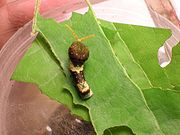
Osmeterium
The osmeterium is a fleshy organ found in the prothoracic segment of larvae of Swallowtail butterflies including Birdwings. This organ emits smelly compounds believed to be pheromones. Normally hidden, this forked structure can be everted when the caterpillar is threatened, and used to emit a...
. They are often strong smelling and thus may have had a protective function.
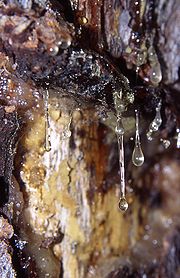
They are the major components of resin
Resin
Resin in the most specific use of the term is a hydrocarbon secretion of many plants, particularly coniferous trees. Resins are valued for their chemical properties and associated uses, such as the production of varnishes, adhesives, and food glazing agents; as an important source of raw materials...
, and of turpentine
Turpentine
Turpentine is a fluid obtained by the distillation of resin obtained from trees, mainly pine trees. It is composed of terpenes, mainly the monoterpenes alpha-pinene and beta-pinene...
produced from resin. The name "terpene" is derived from the word "turpentine
Turpentine
Turpentine is a fluid obtained by the distillation of resin obtained from trees, mainly pine trees. It is composed of terpenes, mainly the monoterpenes alpha-pinene and beta-pinene...
". In addition to their roles as end-products in many organisms, terpenes are major biosynthetic building blocks within nearly every living creature. Steroids, for example, are derivatives of the triterpene squalene
Squalene
Squalene is a natural organic compound originally obtained for commercial purposes primarily from shark liver oil, though plant sources are used as well, including amaranth seed, rice bran, wheat germ, and olives. All plants and animals produce squalene, including humans...
.
When terpenes are modified chemically, such as by oxidation or rearrangement of the carbon skeleton, the resulting compounds are generally referred to as terpenoid
Terpenoid
The terpenoids , sometimes called isoprenoids, are a large and diverse class of naturally occurring organic chemicals similar to terpenes, derived from five-carbon isoprene units assembled and modified in thousands of ways. Most are multicyclic structures that differ from one another not only in...
s. Some authors will use the term terpene to include all terpenoids. Terpenoids are also known as isoprenoids.
Terpenes and terpenoids are the primary constituents of the essential oil
Essential oil
An essential oil is a concentrated hydrophobic liquid containing volatile aroma compounds from plants. Essential oils are also known as volatile oils, ethereal oils or aetherolea, or simply as the "oil of" the plant from which they were extracted, such as oil of clove...
s of many types of plants and flowers. Essential oils are used widely as natural flavor additives for food, as fragrances in perfumery, and in traditional and alternative medicines such as aromatherapy
Aromatherapy
Aromatherapy is a form of alternative medicine that uses volatile plant materials, known as essential oils, and other aromatic compounds for the purpose of altering a person's mind, mood, cognitive function or health....
. Synthetic variations and derivatives of natural terpenes and terpenoids also greatly expand the variety of aromas used in perfumery and flavors used in food additives. Vitamin A
Vitamin A
Vitamin A is a vitamin that is needed by the retina of the eye in the form of a specific metabolite, the light-absorbing molecule retinal, that is necessary for both low-light and color vision...
is an example of a terpene.
Terpenes are released by trees more actively in warmer weather, acting as a natural form of cloud seeding
Cloud seeding
Cloud seeding, a form of intentional weather modification, is the attempt to change the amount or type of precipitation that falls from clouds, by dispersing substances into the air that serve as cloud condensation or ice nuclei, which alter the microphysical processes within the cloud...
. The clouds reflect sunlight, allowing the forest to regulate its temperature.
The aroma and flavor of hops
Hops
Hops are the female flower clusters , of a hop species, Humulus lupulus. They are used primarily as a flavoring and stability agent in beer, to which they impart a bitter, tangy flavor, though hops are also used for various purposes in other beverages and herbal medicine...
, highly desirable in some beers, comes from terpenes. Of the terpenes in hops myrcene, b-pinene, b-caryophyllene, and a-humulene are found in the largest quantities.
Structure and biosynthesis

Isoprene
Isoprene , or 2-methyl-1,3-butadiene, is a common organic compound with the formula CH2=CCH=CH2. Under standard conditions it is a colorless liquid...
, which has the molecular formula C5H8. The basic molecular formulae of terpenes are multiples of that, (C5H8)n where n is the number of linked isoprene units. This is called the isoprene rule or the C5 rule. The isoprene units may be linked together "head to tail" to form linear chains or they may be arranged to form rings. One can consider the isoprene unit as one of nature's common building blocks.
Isoprene itself does not undergo the building process, but rather activated forms, isopentenyl pyrophosphate
Isopentenyl pyrophosphate
Isopentenyl pyrophosphate is an intermediate in the classical, HMG-CoA reductase pathway used by organisms in the biosynthesis of terpenes and terpenoids. IPP is formed from acetyl-CoA via mevalonic acid...
(IPP or also isopentenyl diphosphate) and dimethylallyl pyrophosphate
Dimethylallyl pyrophosphate
Dimethylallyl pyrophosphate is an intermediate product of both mevalonic acid pathway and DOXP/MEP pathway. It is an isomer of isopentenyl pyrophosphate and exists in virtually all life forms...
(DMAPP or also dimethylallyl diphosphate), are the components in the biosynthetic pathway. IPP is formed from acetyl-CoA
Acetyl-CoA
Acetyl coenzyme A or acetyl-CoA is an important molecule in metabolism, used in many biochemical reactions. Its main function is to convey the carbon atoms within the acetyl group to the citric acid cycle to be oxidized for energy production. In chemical structure, acetyl-CoA is the thioester...
via the intermediacy of mevalonic acid
Mevalonic acid
Mevalonic acid is a key organic compound in biochemistry. The anion of mevalonic acid, the predominant form in biological media, is known as mevalonate. This compound is of major pharmaceutical importance...
in the HMG-CoA reductase pathway
HMG-CoA reductase pathway
The mevalonate pathway or HMG-CoA reductase pathway or mevalonate-dependent route or isoprenoid pathway, is an important cellular metabolic pathway present in all higher eukaryotes and many bacteria...
. An alternative, totally unrelated biosynthesis pathway of IPP is known in some bacterial groups and the plastids of plants, the so-called MEP(2-Methyl-D-erythritol-4-phosphate)-pathway, which is initiated from C5-sugars. In both pathways, IPP is isomerized to DMAPP by the enzyme isopentenyl pyrophosphate isomerase.
 |
 |
As chains of isoprene units are built up, the resulting terpenes are classified sequentially by size as hemiterpenes, monoterpenes, sesquiterpenes, diterpenes, sesterterpenes, triterpenes, and tetraterpenes.
Types
- Hemiterpenes consist of a single isoprene unit. Isoprene itself is considered the only hemiterpene, but oxygen-containing derivatives such as prenol and isovaleric acid are hemiterpenoids.
- Monoterpenes consist of two isoprene units and have the molecular formula C10H16. Examples of monoterpenes are: geraniolGeraniolGeraniol is a monoterpenoid and an alcohol. It is the primary part of rose oil, palmarosa oil, and citronella oil . It also occurs in small quantities in geranium, lemon, and many other essential oils. It appears as a clear to pale-yellow oil that is insoluble in water, but soluble in most common...
, limoneneLimoneneLimonene is a colourless liquid hydrocarbon classified as a cyclic terpene. The more common D isomer possesses a strong smell of oranges. It is used in chemical synthesis as a precursor to carvone and as a renewably-based solvent in cleaning products....
and terpineolTerpineolTerpineol is a naturally occurring monoterpene alcohol that has been isolated from a variety of sources such as cajuput oil, pine oil, and petitgrain oil. There are three isomers, alpha-, beta-, and gamma-terpineol, the last two differing only by the location of the double bond...
. - Sesquiterpenes consist of three isoprene units and have the molecular formula C15H24. Examples of sesquiterpenes are: farneseneFarneseneThe term farnesene refers to a set of six closely related chemical compounds which all are sesquiterpenes. α-Farnesene and β-farnesene are isomers, differing by the location of one double bond. α-Farnesene is 3,7,11-trimethyl-1,3,6,10-dodecatetraene and β-farnesene is...
s, farnesolFarnesolFarnesol is a natural organic compound which is an acyclic sesquiterpene alcohol found as a colorless liquid. It is insoluble in water, but miscible with oils...
. (The sesqui- prefix means one and a half.) - Diterpenes are composed for four isoprene units and have the molecular formula C20H32. They derive from geranylgeranyl pyrophosphateGeranylgeranyl pyrophosphateGeranylgeranyl pyrophosphate is an intermediate in the HMG-CoA reductase pathway used by organisms in the biosynthesis of terpenes and terpenoids. In plants it is also the precursor to carotenoids, gibberellins, tocopherols, and chlorophylls....
. Examples of diterpenes are cafestolCafestolCafestol is a diterpene molecule present in coffee.A typical bean of Coffea arabica contains about 0.6% cafestol by weight. Cafestol is present in highest quantity in unfiltered coffee drinks such as French press coffee or Turkish coffee/Greek coffee...
, kahweolKahweolKahweol is a diterpene molecule found in the beans of Coffea arabica. It is structurally related to cafestol....
, cembreneCembreneCembrene A, or sometimes neocembrene, is a natural monocyclic diterpene isolated from corals of the genus Nephthea. It is a colorless oil with a faint wax-like odor....
and taxadiene (precursor of taxol). Diterpenes also form the basis for biologically important compounds such as retinolRetinolRetinol is one of the animal forms of vitamin A. It is a diterpenoid and an alcohol. It is convertible to other forms of vitamin A, and the retinyl ester derivative of the alcohol serves as the storage form of the vitamin in animals....
, retinalRetinalRetinal, also called retinaldehyde or vitamin A aldehyde, is one of the many forms of vitamin A . Retinal is a polyene chromophore, and bound to proteins called opsins, is the chemical basis of animal vision...
, and phytolPhytolPhytol is an acyclic diterpene alcohol that can be used as a precursor for the manufacture of synthetic forms of vitamin E and vitamin K1. In ruminants, the gut fermentation of ingested plant materials liberates phytol, a constituent of chlorophyll, which is then converted to phytanic acid and...
. They are known to be antimicrobial and antiinflammatory. - Sesterterpenes, terpenes having 25 carbons and five isoprene units, are rare relative to the other sizes. (The sester- prefix means half to three, i.e. two and a half.) An example of a sesterterpene is geranylfarnesol.
- TriterpeneTriterpeneTriterpenes are terpenes consisting of six isoprene units and have the molecular formula C30H48.The pentacyclic triterpenes can be classified into lupane, oleanane or ursane groups.Animal- and plant-derived triterpenes exist, such as:*squalene...
s consist of six isoprene units and have the molecular formula C30H48. The linear triterpene squaleneSqualeneSqualene is a natural organic compound originally obtained for commercial purposes primarily from shark liver oil, though plant sources are used as well, including amaranth seed, rice bran, wheat germ, and olives. All plants and animals produce squalene, including humans...
, the major constituent of shark liver oilShark liver oilShark liver oil is obtained from sharks that are caught for food purposes and are living in cold, deep oceans. The liver oil from sharks has been used by fishermen for centuries as a folk remedy for general health...
, is derived from the reductive coupling of two molecules of farnesyl pyrophosphateFarnesyl pyrophosphateFarnesyl pyrophosphate is an intermediate in the HMG-CoA reductase pathway used by organisms in the biosynthesis of terpenes, terpenoids, and sterols...
. Squalene is then processed biosynthetically to generate either lanosterolLanosterolLanosterol is a tetracyclic triterpenoid, which is the compound from which all steroids are derived.-Role in creation of steroids:Elaboration of lanosterol under enzyme catalysis leads to the core structure of steroids. 14-Demethylation of lanosterol by CYP51 eventually yields...
or cycloartenolCycloartenolCycloartenol is an important type of stanol found in plants. The biosynthesis of cycloartenol starts from the triterpenoid squalene. It is the first precursor in the biosynthesis of other stanols and sterols, referred to as phytostanols and phytosterols in photosynthetic organisms and plants...
, the structural precursors to all the steroidSteroidA steroid is a type of organic compound that contains a characteristic arrangement of four cycloalkane rings that are joined to each other. Examples of steroids include the dietary fat cholesterol, the sex hormones estradiol and testosterone, and the anti-inflammatory drug dexamethasone.The core...
s. - Tetraterpenes contain eight isoprene units and have the molecular formula C40H64. Biologically important tetraterpenes include the acyclic lycopeneLycopeneLycopene is a bright red carotene and carotenoid pigment and phytochemical found in tomatoes and other red fruits and vegetables, such as red carrots, watermelons and papayas...
, the monocyclic gamma-carotene, and the bicyclic alpha-Alpha-caroteneα-Carotene is a form of carotene with a β-ring at one end and an ε-ring at the other. It is the second most common form of carotene.-Human physiology:...
and beta-caroteneBeta-caroteneβ-Carotene is a strongly-coloured red-orange pigment abundant in plants and fruits. It is an organic compound and chemically is classified as a hydrocarbon and specifically as a terpenoid , reflecting its derivation from isoprene units...
s. - Polyterpenes consist of long chains of many isoprene units. Natural rubberRubberNatural rubber, also called India rubber or caoutchouc, is an elastomer that was originally derived from latex, a milky colloid produced by some plants. The plants would be ‘tapped’, that is, an incision made into the bark of the tree and the sticky, milk colored latex sap collected and refined...
consists of polyisoprene in which the double bonds are cisGeometric isomerismIn organic chemistry, cis/trans isomerism or geometric isomerism or configuration isomerism or E/Z isomerism is a form of stereoisomerism describing the orientation of functional groups within a molecule...
. Some plants produce a polyisoprene with trans double bonds, known as gutta-perchaGutta-perchaGutta-percha is a genus of tropical trees native to Southeast Asia and northern Australasia, from Taiwan south to the Malay Peninsula and east to the Solomon Islands. The same term is used to refer to an inelastic natural latex produced from the sap of these trees, particularly from the species...
.
Other uses
Research into terpenes has found that many of them possess qualities that make them ideal active ingredients as part of natural agricultural pesticides.Terpin hydrate is a derivative of turpentine
Turpentine
Turpentine is a fluid obtained by the distillation of resin obtained from trees, mainly pine trees. It is composed of terpenes, mainly the monoterpenes alpha-pinene and beta-pinene...
. An expectorant and humectant
Humectant
A humectant is a hygroscopic substance. It is often a molecule with several hydrophilic groups, most often hydroxyl groups, but amines and carboxyl groups, sometimes esterified, can be encountered as well; the affinity to form hydrogen bonds with molecules of water is crucial here.Since...
, it is commonly used in the treatment of acute
Acute (medicine)
In medicine, an acute disease is a disease with either or both of:# a rapid onset, as in acute infection# a short course ....
or chronic
Chronic (medicine)
A chronic disease is a disease or other human health condition that is persistent or long-lasting in nature. The term chronic is usually applied when the course of the disease lasts for more than three months. Common chronic diseases include asthma, cancer, diabetes and HIV/AIDS.In medicine, the...
bronchitis
Bronchitis
Acute bronchitis is an inflammation of the large bronchi in the lungs that is usually caused by viruses or bacteria and may last several days or weeks. Characteristic symptoms include cough, sputum production, and shortness of breath and wheezing related to the obstruction of the inflamed airways...
and related conditions.
Terpenes are used by termites
Termite
Termites are a group of eusocial insects that, until recently, were classified at the taxonomic rank of order Isoptera , but are now accepted as the epifamily Termitoidae, of the cockroach order Blattodea...
of the Nasutitermitinae family to attack enemy insects, through the use of a specialized mechanism called a Fontanellar gun
Fontanellar gun
The fontanellar gun is a type of specialized weaponry used by the soldiers of the North American termite subfamily Nasutitermitinae to ward off predators...
.