
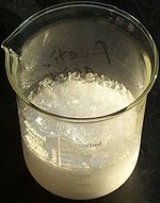
Acetic acid is an
organic compoundAn organic compound is any member of a large class of gaseous, liquid, or solid chemical compounds whose molecules contain carbon. For historical reasons discussed below, a few types of carbon-containing compounds such as carbides, carbonates, simple oxides of carbon, and cyanides, as well as the...
with the
chemical formulaA chemical formula or molecular formula is a way of expressing information about the atoms that constitute a particular chemical compound....
CH
3CO
2H (also written as CH
3COOH). It is a colourless liquid that when undiluted is also called
glacial acetic acid. Acetic acid is the main component of
vinegarVinegar is a liquid substance consisting mainly of acetic acid and water, the acetic acid being produced through the fermentation of ethanol by acetic acid bacteria. Commercial vinegar is produced either by fast or slow fermentation processes. Slow methods generally are used with traditional...
(apart from water), and has a distinctive sour taste and pungent smell. It is mainly produced as a precursor to polyvinylacetate and cellulose acetate. Although it is classified as a
weak acidA weak acid is an acid that dissociates incompletely. It does not release all of its hydrogens in a solution, donating only a partial amount of its protons to the solution...
, concentrated acetic acid is corrosive, and attacks the skin.
Acetic acid is one of the simplest
carboxylic acidCarboxylic acids are organic acids characterized by the presence of at least one carboxyl group. The general formula of a carboxylic acid is R-COOH, where R is some monovalent functional group...
s. It is an important
chemical reagentA reagent is a "substance or compound that is added to a system in order to bring about a chemical reaction, or added to see if a reaction occurs." Although the terms reactant and reagent are often used interchangeably, a reactant is less specifically a "substance that is consumed in the course of...
and industrial chemical, mainly used in the production of
cellulose acetateCellulose acetate , first prepared in 1865, is the acetate ester of cellulose. Cellulose acetate is used as a film base in photography, as a component in some adhesives, and as a frame material for eyeglasses; it is also used as a synthetic fiber and in the manufacture of cigarette filters and...
mainly for
photographic filmPhotographic film is a sheet of plastic coated with an emulsion containing light-sensitive silver halide salts with variable crystal sizes that determine the sensitivity, contrast and resolution of the film...
and
polyvinyl acetatePolyvinyl acetate, PVA, PVAc, poly, is a rubbery synthetic polymer with the formula n. It belongs to the polyvinyl esters family with the general formula -[RCOOCHCH2]-...
for wood
glueAn adhesive, or glue, is a mixture in a liquid or semi-liquid state that adheres or bonds items together. Adhesives may come from either natural or synthetic sources. The types of materials that can be bonded are vast but they are especially useful for bonding thin materials...
, as well as synthetic fibres and fabrics. In households, diluted acetic acid is often used in
descaling agentAn anti-scaling agent, also known as descaling agent, anti-limestone, anti-limescale, anti-lime or anti-scale are preparations to prevent the buildup or to remove limescale and fouling...
s. In the
food industryThe food production is a complex, global collective of diverse businesses that together supply much of the food energy consumed by the world population...
, acetic acid is used under the
food additive codeE numbers are number codes for food additives that have been assessed for use within the European Union . They are commonly found on food labels throughout the European Union. Safety assessment and approval are the responsibility of the European Food Safety Authority...
E260 as an
acidity regulatorAcidity regulators, or pH control agents, are food additives added to change or maintain pH . They can be organic or mineral acids, bases, neutralizing agents, or buffering agents....
and as a condiment. As a
food additiveFood additives are substances added to food to preserve flavor or enhance its taste and appearance.Some additives have been used for centuries; for example, preserving food by pickling , salting, as with bacon, preserving sweets or using sulfur dioxide as in some wines...
it is approved for usage in the EU, USA and Australia and New Zealand.
The global demand of acetic acid is around 6.5 million
tonneThe tonne, known as the metric ton in the US , often put pleonastically as "metric tonne" to avoid confusion with ton, is a metric system unit of mass equal to 1000 kilograms. The tonne is not an International System of Units unit, but is accepted for use with the SI...
s per year (Mt/a), of which approximately 1.5 Mt/a is met by recycling; the remainder is manufactured from
petrochemicalPetrochemicals are chemical products derived from petroleum. Some chemical compounds made from petroleum are also obtained from other fossil fuels, such as coal or natural gas, or renewable sources such as corn or sugar cane....
feedstock. As a chemical reagent, biological sources of acetic acid are of interest but generally uncompetitive. Vinegar can be dilute acetic acid produced by fermentation.
Nomenclature
The
trivial nameIn chemistry, a trivial name is a common name or vernacular name; it is a non-systematic name or non-scientific name. That is, the name is not recognised according to the rules of any formal system of nomenclature...
acetic acid is the most commonly used and
preferred IUPAC nameIn chemical nomenclature, a preferred IUPAC name is a unique name, assigned to a chemical substance and preferred among the possible names generated by IUPAC nomenclature. The "preferred IUPAC nomenclature" provides a set of rules for choosing between multiple possibilities in situations where it...
. The systematic name
ethanoic acid, a valid IUPAC name, is constructed according to the substitutive nomenclature. The name
acetic acid derives from
acetum, the
LatinLatin is an Italic language originally spoken in Latium and Ancient Rome. It, along with most European languages, is a descendant of the ancient Proto-Indo-European language. Although it is considered a dead language, a number of scholars and members of the Christian clergy speak it fluently, and...
word for
vinegarVinegar is a liquid substance consisting mainly of acetic acid and water, the acetic acid being produced through the fermentation of ethanol by acetic acid bacteria. Commercial vinegar is produced either by fast or slow fermentation processes. Slow methods generally are used with traditional...
, and is related to the word acid itself.
Glacial acetic acid is a trivial name for water-free (
anhydrousAs a general term, a substance is said to be anhydrous if it contains no water. The way of achieving the anhydrous form differs from one substance to another...
) acetic acid. Similar to the
GermanGerman is a West Germanic language, related to and classified alongside English and Dutch. With an estimated 90 – 98 million native speakers, German is one of the world's major languages and is the most widely-spoken first language in the European Union....
name
Eisessig (
ice-vinegar), the name comes from the ice-like crystals that form slightly below room temperature at 16.6 °C (61.9 °F) (the presence of 0.1% water lowers its melting point by 0.2 °C).
A common abbreviation for acetic acid is
HOAc, where
Ac stands for the
acetylIn organic chemistry, acetyl is a functional group, the acyl with chemical formula COCH3. It is sometimes represented by the symbol Ac . The acetyl group contains a methyl group single-bonded to a carbonyl...
groupIn organic chemistry, functional groups are specific groups of atoms within molecules that are responsible for the characteristic chemical reactions of those molecules. The same functional group will undergo the same or similar chemical reaction regardless of the size of the molecule it is a part of...
CH
3−C(=O)−.
AcetateAn acetate is a derivative of acetic acid. This term includes salts and esters, as well as the anion found in solution. Most of the approximately 5 billion kilograms of acetic acid produced annually in industry are used in the production of acetates, which usually take the form of polymers. In...
(CH
3COO
–), abbreviated
AcO–. The
Ac is not to be confused with the abbreviation for the
chemical elementA chemical element is a pure chemical substance consisting of one type of atom distinguished by its atomic number, which is the number of protons in its nucleus. Familiar examples of elements include carbon, oxygen, aluminum, iron, copper, gold, mercury, and lead.As of November 2011, 118 elements...
actiniumActinium is a radioactive chemical element with the symbol Ac and atomic number 89, which was discovered in 1899. It was the first non-primordial radioactive element to be isolated. Polonium, radium and radon were observed before actinium, but they were not isolated until 1902...
. To better reflect its structure, acetic acid is often written as CH
3–CO
2–H, CH
3COOH, and CH
3CO
2H. In the context of acid-base reactions, the abbreviation
HAc is sometimes used, where
Ac instead stands for acetate. Acetate is the
ionAn ion is an atom or molecule in which the total number of electrons is not equal to the total number of protons, giving it a net positive or negative electrical charge. The name was given by physicist Michael Faraday for the substances that allow a current to pass between electrodes in a...
resulting from loss of
H+The proton is a subatomic particle with the symbol or and a positive electric charge of 1 elementary charge. One or more protons are present in the nucleus of each atom, along with neutrons. The number of protons in each atom is its atomic number....
from acetic acid. The name
acetate can also refer to a
saltIn chemistry, salts are ionic compounds that result from the neutralization reaction of an acid and a base. They are composed of cations and anions so that the product is electrically neutral...
containing this anion, or an
esterEsters are chemical compounds derived by reacting an oxoacid with a hydroxyl compound such as an alcohol or phenol. Esters are usually derived from an inorganic acid or organic acid in which at least one -OH group is replaced by an -O-alkyl group, and most commonly from carboxylic acids and...
of acetic acid.
History
VinegarVinegar is a liquid substance consisting mainly of acetic acid and water, the acetic acid being produced through the fermentation of ethanol by acetic acid bacteria. Commercial vinegar is produced either by fast or slow fermentation processes. Slow methods generally are used with traditional...
was known early in civilization as the natural result of air exposure to
beerBeer is the world's most widely consumed andprobably oldest alcoholic beverage; it is the third most popular drink overall, after water and tea. It is produced by the brewing and fermentation of sugars, mainly derived from malted cereal grains, most commonly malted barley and malted wheat...
and
wineWine is an alcoholic beverage, made of fermented fruit juice, usually from grapes. The natural chemical balance of grapes lets them ferment without the addition of sugars, acids, enzymes, or other nutrients. Grape wine is produced by fermenting crushed grapes using various types of yeast. Yeast...
, as acetic acid-producing bacteria are present globally. The use of acetic acid in
alchemyAlchemy is an influential philosophical tradition whose early practitioners’ claims to profound powers were known from antiquity. The defining objectives of alchemy are varied; these include the creation of the fabled philosopher's stone possessing powers including the capability of turning base...
extends into the 3rd century BC, when the
GreekGreece , officially the Hellenic Republic , and historically Hellas or the Republic of Greece in English, is a country in southeastern Europe....
philosopher
TheophrastusTheophrastus , a Greek native of Eresos in Lesbos, was the successor to Aristotle in the Peripatetic school. He came to Athens at a young age, and initially studied in Plato's school. After Plato's death he attached himself to Aristotle. Aristotle bequeathed to Theophrastus his writings, and...
described how vinegar acted on metals to produce
pigmentA pigment is a material that changes the color of reflected or transmitted light as the result of wavelength-selective absorption. This physical process differs from fluorescence, phosphorescence, and other forms of luminescence, in which a material emits light.Many materials selectively absorb...
s useful in art, including
white lead (
lead carbonateLead carbonate is the chemical compound PbCO3. It is prepared industrially from lead acetate and carbon dioxide.It occurs naturally as the mineral cerussite.-Basic lead carbonates:...
) and
verdigrisVerdigris is the common name for a green pigment obtained through the application of acetic acid to copper plates or the natural patina formed when copper, brass or bronze is weathered and exposed to air or seawater over a period of time. It is usually a basic copper carbonate, but near the sea...
, a green mixture of
copperCopper is a chemical element with the symbol Cu and atomic number 29. It is a ductile metal with very high thermal and electrical conductivity. Pure copper is soft and malleable; an exposed surface has a reddish-orange tarnish...
salts including
copper(II) acetateCopper acetate, also referred to as cupric acetate, is the chemical compound with the formula Cu2 where OAc- is acetate . The hydrated derivative, which contains one molecule of water for each Cu atom, is available commercially. Anhydrous Cu2 is a dark green crystalline solid, whereas Cu22 is...
. Ancient
RomansRome is the capital of Italy and the country's largest and most populated city and comune, with over 2.7 million residents in . The city is located in the central-western portion of the Italian Peninsula, on the Tiber River within the Lazio region of Italy.Rome's history spans two and a half...
boiled soured wine to produce a highly sweet syrup called
sapa.
SapaDefrutum, carenum, and sapa were reductions of must used in Ancient Roman cuisine. They were made by boiling down grape juice or must in large kettles until it had been reduced to two-thirds the original volume, carenum;...
that was produced in lead pots was rich in
lead acetateLead acetate , also known as lead acetate, lead diacetate, plumbous acetate, sugar of lead, lead sugar, salt of Saturn, and Goulard's powder, is a white crystalline chemical compound with a sweetish taste. It is made by treating lead oxide with acetic acid. Like other lead compounds, it is toxic...
, a sweet substance also called
sugar of lead or
sugar of SaturnIn ancient Roman religion and myth, Saturn was a major god presiding over agriculture and the harvest time. His reign was depicted as a Golden Age of abundance and peace by many Roman authors. In medieval times he was known as the Roman god of agriculture, justice and strength. He held a sickle in...
, which contributed to
lead poisoningLead poisoning is a medical condition caused by increased levels of the heavy metal lead in the body. Lead interferes with a variety of body processes and is toxic to many organs and tissues including the heart, bones, intestines, kidneys, and reproductive and nervous systems...
among the Roman aristocracy.
In the 8th century, Jabir Ibn Hayyan (Geber) was the first to concentrate acetic acid from vinegar through
distillationDistillation is a method of separating mixtures based on differences in volatilities of components in a boiling liquid mixture. Distillation is a unit operation, or a physical separation process, and not a chemical reaction....
. In the
RenaissanceThe Renaissance was a cultural movement that spanned roughly the 14th to the 17th century, beginning in Italy in the Late Middle Ages and later spreading to the rest of Europe. The term is also used more loosely to refer to the historical era, but since the changes of the Renaissance were not...
, glacial acetic acid was prepared through the
dry distillationDry distillation is the heating of solid materials to produce gaseous products . The method may or may not involve pyrolysis/thermolysis. The products are condensed and collected. This method usually requires higher temperatures than classical distillation. The method has been used to obtain...
of certain metal acetates (the most noticeable one being copper(II) acetate). The 16th-century
GermanGermany , officially the Federal Republic of Germany , is a federal parliamentary republic in Europe. The country consists of 16 states while the capital and largest city is Berlin. Germany covers an area of 357,021 km2 and has a largely temperate seasonal climate...
alchemist
Andreas LibaviusAndreas Libavius was a German doctor and chemist.-Life:Libavius was born in Halle, Germany, as Andreas Libau. In Halle he attended the gymnasium and studied from the year 1576 in University of Wittenberg. From 1577 on he studied in the University of Jena in the faculties of philosophy and history...
described such a procedure, and he compared the glacial acetic acid produced by this means to vinegar. The presence of water in vinegar has such a profound effect on acetic acid's properties that for centuries chemists believed that glacial acetic acid and the acid found in vinegar were two different substances. French chemist
Pierre AdetPierre-Auguste Adet was a French scientist, politician, and diplomat.He worked with Lavoisier on a new chemical notation system, and was secretary to the scientific periodical Annales de chimie, founded in 1789...
proved them identical.
In 1847 German chemist, Hermann Kolbe
synthesizedIn chemistry, chemical synthesis is purposeful execution of chemical reactions to get a product, or several products. This happens by physical and chemical manipulations usually involving one or more reactions...
acetic acid from
inorganic compoundInorganic compounds have traditionally been considered to be of inanimate, non-biological origin. In contrast, organic compounds have an explicit biological origin. However, over the past century, the classification of inorganic vs organic compounds has become less important to scientists,...
s for the first time. This reaction sequence consisted of
chlorinationChlorination is the process of adding the element chlorine to water as a method of water purification to make it fit for human consumption as drinking water...
of
carbon disulfideCarbon disulfide is a colorless volatile liquid with the formula CS2. The compound is used frequently as a building block in organic chemistry as well as an industrial and chemical non-polar solvent...
to
carbon tetrachlorideCarbon tetrachloride, also known by many other names is the organic compound with the formula CCl4. It was formerly widely used in fire extinguishers, as a precursor to refrigerants, and as a cleaning agent...
, followed by
pyrolysisPyrolysis is a thermochemical decomposition of organic material at elevated temperatures without the participation of oxygen. It involves the simultaneous change of chemical composition and physical phase, and is irreversible...
to
tetrachloroethyleneTetrachloroethylene, also known under its systematic name tetrachloroethene and many other names, is a chlorocarbon with the formula Cl2C=CCl2. It is a colourless liquid widely used for dry cleaning of fabrics, hence it is sometimes called "dry-cleaning fluid." It has a sweet odor detectable by...
and aqueous chlorination to
trichloroacetic acidTrichloroacetic acid is an analogue of acetic acid in which the three hydrogen atoms of the methyl group have all been replaced by chlorine atoms....
, and concluded with
electrolyticIn chemistry and manufacturing, electrolysis is a method of using a direct electric current to drive an otherwise non-spontaneous chemical reaction...
reductionOrganic reductions or organic oxidations or organic redox reactions are redox reactions that take place with organic compounds. In organic chemistry oxidations and reductions are different from ordinary redox reactions because many reactions carry the name but do not actually involve electron...
to acetic acid.
By 1910, most glacial acetic acid was obtained from the "pyroligneous liquor" from distillation of wood. The acetic acid was isolated from this by treatment with
milk of limeCalcium hydroxide, traditionally called slaked lime, is an inorganic compound with the chemical formula Ca2. It is a colourless crystal or white powder and is obtained when calcium oxide is mixed, or "slaked" with water. It has many names including hydrated lime, builders lime, slack lime, cal, or...
, and the resulting
calcium acetateThe chemical compound calcium acetate is the calcium salt of acetic acid. It has the formula Ca2. Its standard name is calcium acetate, while calcium ethanoate is the systematic IUPAC name. An older name is acetate of lime...
was then acidified with
sulfuric acidSulfuric acid is a strong mineral acid with the molecular formula . Its historical name is oil of vitriol. Pure sulfuric acid is a highly corrosive, colorless, viscous liquid. The salts of sulfuric acid are called sulfates...
to recover acetic acid. At that time, Germany was producing 10,000
tonThe ton is a unit of measure. It has a long history and has acquired a number of meanings and uses over the years. It is used principally as a unit of weight, and as a unit of volume. It can also be used as a measure of energy, for truck classification, or as a colloquial term.It is derived from...
s of glacial acetic acid, around 30% of which was used for the manufacture of
indigo dyeIndigo dye is an organic compound with a distinctive blue color . Historically, indigo was a natural dye extracted from plants, and this process was important economically because blue dyes were once rare. Nearly all indigo dye produced today — several thousand tons each year — is synthetic...
.
Acidity
The hydrogen center in the carboxyl group (−COOH) in carboxylic acids such as acetic acid can separate from the molecule by ionization:
- CH3CO2H → CH3CO2- + H+
Because of this release of the
protonThe proton is a subatomic particle with the symbol or and a positive electric charge of 1 elementary charge. One or more protons are present in the nucleus of each atom, along with neutrons. The number of protons in each atom is its atomic number....
(H
+), acetic acid has acidic character. Acetic acid is a weak monoprotic acid. In aqueous solution, it has a
pKaAn acid dissociation constant, Ka, is a quantitative measure of the strength of an acid in solution. It is the equilibrium constant for a chemical reaction known as dissociation in the context of acid-base reactions...
value of 4.75. Its
conjugate baseWithin the Brønsted–Lowry acid-base theory , a conjugate acid is the acid member, HX, of a pair of two compounds that transform into each other by gain or loss of a proton. A conjugate acid can also be seen as the chemical substance that releases, or donates, a proton in the forward chemical...
is acetate (CH
3COO
−). A 1.0 M solution (about the concentration of domestic vinegar) has a
pHIn chemistry, pH is a measure of the acidity or basicity of an aqueous solution. Pure water is said to be neutral, with a pH close to 7.0 at . Solutions with a pH less than 7 are said to be acidic and solutions with a pH greater than 7 are basic or alkaline...
of 2.4, indicating that merely 0.4% of the acetic acid molecules are dissociated.
Structure
In solid acetic acid, the molecules form pairs (dimer)s, being connected by
hydrogen bondA hydrogen bond is the attractive interaction of a hydrogen atom with an electronegative atom, such as nitrogen, oxygen or fluorine, that comes from another molecule or chemical group. The hydrogen must be covalently bonded to another electronegative atom to create the bond...
s. The dimers can also be detected in the vapour at 120 °C (248 °F). Dimers also occur in the liquid phase in dilute solutions in non-hydrogen-bonding solvents, and a certain extent in pure acetic acid, but are disrupted by hydrogen-bonding solvents. The dissociation
enthalpyEnthalpy is a measure of the total energy of a thermodynamic system. It includes the internal energy, which is the energy required to create a system, and the amount of energy required to make room for it by displacing its environment and establishing its volume and pressure.Enthalpy is a...
of the dimer is estimated at 65.0–66.0 kJ/mol, and the dissociation entropy at 154–157 J mol
−1 K
−1. This dimerisation behaviour is shared by other lower carboxylic acids.
Solvent properties
LiquidLiquid is one of the three classical states of matter . Like a gas, a liquid is able to flow and take the shape of a container. Some liquids resist compression, while others can be compressed. Unlike a gas, a liquid does not disperse to fill every space of a container, and maintains a fairly...
acetic acid is a
hydrophilicA hydrophile, from the Greek "water" and φιλια "love," is a molecule or other molecular entity that is attracted to, and tends to be dissolved by water. A hydrophilic molecule or portion of a molecule is one that has a tendency to interact with or be dissolved by, water and other polar substances...
(polar)
protic solventIn chemistry a protic solvent is a solvent that has a hydrogen atom bound to an oxygen or a nitrogen . In general terms, any molecular solvent that contains dissociable H+ is called a protic solvent. The molecules of such solvents can donate an H+...
, similar to
ethanolEthanol, also called ethyl alcohol, pure alcohol, grain alcohol, or drinking alcohol, is a volatile, flammable, colorless liquid. It is a psychoactive drug and one of the oldest recreational drugs. Best known as the type of alcohol found in alcoholic beverages, it is also used in thermometers, as a...
and
waterWater is a chemical substance with the chemical formula H2O. A water molecule contains one oxygen and two hydrogen atoms connected by covalent bonds. Water is a liquid at ambient conditions, but it often co-exists on Earth with its solid state, ice, and gaseous state . Water also exists in a...
. With a moderate relative static permittivity (dielectric constant) of 6.2, it dissolves not only polar compounds such as inorganic salts and
sugarSugar is a class of edible crystalline carbohydrates, mainly sucrose, lactose, and fructose, characterized by a sweet flavor.Sucrose in its refined form primarily comes from sugar cane and sugar beet...
s, but also non-polar compounds such as oils and
elementsA chemical element is a pure chemical substance consisting of one type of atom distinguished by its atomic number, which is the number of protons in its nucleus. Familiar examples of elements include carbon, oxygen, aluminum, iron, copper, gold, mercury, and lead.As of November 2011, 118 elements...
such as
sulfurSulfur or sulphur is the chemical element with atomic number 16. In the periodic table it is represented by the symbol S. It is an abundant, multivalent non-metal. Under normal conditions, sulfur atoms form cyclic octatomic molecules with chemical formula S8. Elemental sulfur is a bright yellow...
and
iodineIodine is a chemical element with the symbol I and atomic number 53. The name is pronounced , , or . The name is from the , meaning violet or purple, due to the color of elemental iodine vapor....
. It readily mixes with other polar and non-polar
solventA solvent is a liquid, solid, or gas that dissolves another solid, liquid, or gaseous solute, resulting in a solution that is soluble in a certain volume of solvent at a specified temperature...
s such as water,
chloroformChloroform is an organic compound with formula CHCl3. It is one of the four chloromethanes. The colorless, sweet-smelling, dense liquid is a trihalomethane, and is considered somewhat hazardous...
, and
hexaneHexane is a hydrocarbon with the chemical formula C6H14; that is, an alkane with six carbon atoms.The term may refer to any of four other structural isomers with that formula, or to a mixture of them. In the IUPAC nomenclature, however, hexane is the unbranched isomer ; the other four structures...
. With higher alkanes (starting with
octaneOctane is a hydrocarbon and an alkane with the chemical formula C8H18, and the condensed structural formula CH36CH3. Octane has many structural isomers that differ by the amount and location of branching in the carbon chain...
), acetic acid is not completely miscible anymore, and its miscibility continues to decline with longer n-alkanes. This dissolving property and
miscibilityMiscibility is the property of liquids to mix in all proportions, forming a homogeneous solution. In principle, the term applies also to other phases , but the main focus is usually on the solubility of one liquid in another...
of acetic acid makes it a widely used industrial chemical. Its solvent properties are mainly of value in the production of
dimethyl terephthalateDimethyl terephthalate is an organic compound with the formula C6H42. It is the diester formed from terephthalic acid and methanol. It is a white solid that melts to give a distillable colourless liquid.-Production:...
.
Organic chemistry
Acetic acid undergoes the typical
chemical reactionA chemical reaction is a process that leads to the transformation of one set of chemical substances to another. Chemical reactions can be either spontaneous, requiring no input of energy, or non-spontaneous, typically following the input of some type of energy, such as heat, light or electricity...
s of a carboxylic acid. Upon treatment with a standard bases, it converts to metal
acetateAn acetate is a derivative of acetic acid. This term includes salts and esters, as well as the anion found in solution. Most of the approximately 5 billion kilograms of acetic acid produced annually in industry are used in the production of acetates, which usually take the form of polymers. In...
and
waterWater is a chemical substance with the chemical formula H2O. A water molecule contains one oxygen and two hydrogen atoms connected by covalent bonds. Water is a liquid at ambient conditions, but it often co-exists on Earth with its solid state, ice, and gaseous state . Water also exists in a...
. With strong bases (e.g., organolithium reagents), it can be doubly deprotonated to give LiCH
2CO
2Li. Reduction of acetic acid gives
ethanolEthanol, also called ethyl alcohol, pure alcohol, grain alcohol, or drinking alcohol, is a volatile, flammable, colorless liquid. It is a psychoactive drug and one of the oldest recreational drugs. Best known as the type of alcohol found in alcoholic beverages, it is also used in thermometers, as a...
. The OH group is the main site of reaction, as illustrated by the conversion of acetic acid to
acetyl chlorideAcetyl chloride, CH3COCl, also known as ethanoyl chloride or acyl chloride, is an acid chloride derived from acetic acid. It belongs to the class of organic compounds called acyl halides. It is a colorless liquid. Acetyl chloride does not exist in nature, because contact with water would hydrolyze...
. Other substitution derivatives include
acetic anhydrideAcetic anhydride, or ethanoic anhydride, is the chemical compound with the formula 2O. Commonly abbreviated Ac2O, it is the simplest isolatable acid anhydride and is a widely used reagent in organic synthesis...
; this anhydride is produced by
loss of waterA condensation reaction is a chemical reaction in which two molecules or moieties combine to form one single molecule, together with the loss of a small molecule. When this small molecule is water, it is known as a dehydration reaction; other possible small molecules lost are hydrogen chloride,...
from two molecules of acetic acid.
EsterEsters are chemical compounds derived by reacting an oxoacid with a hydroxyl compound such as an alcohol or phenol. Esters are usually derived from an inorganic acid or organic acid in which at least one -OH group is replaced by an -O-alkyl group, and most commonly from carboxylic acids and...
s of acetic acid can likewise be formed via
Fischer esterificationFischer esterification or Fischer–Speier esterification is a special type of esterification by refluxing a carboxylic acid and an alcohol in the presence of an acid catalyst. The reaction was first described by Emil Fischer and Arthur Speier in 1895. Most carboxylic acids are suitable for the...
, and
amideIn chemistry, an amide is an organic compound that contains the functional group consisting of a carbonyl group linked to a nitrogen atom . The term refers both to a class of compounds and a functional group within those compounds. The term amide also refers to deprotonated form of ammonia or an...
s can be formed. When heated above 440 °C (824 °F), acetic acid decomposes to produce
carbon dioxideCarbon dioxide is a naturally occurring chemical compound composed of two oxygen atoms covalently bonded to a single carbon atom...
and
methaneMethane is a chemical compound with the chemical formula . It is the simplest alkane, the principal component of natural gas, and probably the most abundant organic compound on earth. The relative abundance of methane makes it an attractive fuel...
, or to produce
keteneA ketene is an organic compound of the form R'RC=C=O. The term is also used specifically to mean ethenone, the simplest ketene, where R' and R are hydrogen atoms.Ketenes were first studied as a class by Hermann Staudinger.-Formation:...
and water.
Reactions with inorganic compounds
Acetic acid is mildly
corrosiveCorrosion is the disintegration of an engineered material into its constituent atoms due to chemical reactions with its surroundings. In the most common use of the word, this means electrochemical oxidation of metals in reaction with an oxidant such as oxygen...
to
metalA metal , is an element, compound, or alloy that is a good conductor of both electricity and heat. Metals are usually malleable and shiny, that is they reflect most of incident light...
s including
ironIron is a chemical element with the symbol Fe and atomic number 26. It is a metal in the first transition series. It is the most common element forming the planet Earth as a whole, forming much of Earth's outer and inner core. It is the fourth most common element in the Earth's crust...
,
magnesiumMagnesium is a chemical element with the symbol Mg, atomic number 12, and common oxidation number +2. It is an alkaline earth metal and the eighth most abundant element in the Earth's crust and ninth in the known universe as a whole...
, and
zincZinc , or spelter , is a metallic chemical element; it has the symbol Zn and atomic number 30. It is the first element in group 12 of the periodic table. Zinc is, in some respects, chemically similar to magnesium, because its ion is of similar size and its only common oxidation state is +2...
, forming
hydrogenHydrogen is the chemical element with atomic number 1. It is represented by the symbol H. With an average atomic weight of , hydrogen is the lightest and most abundant chemical element, constituting roughly 75% of the Universe's chemical elemental mass. Stars in the main sequence are mainly...
gas and salts called acetates:
- Mg + 2 CH3COOH → (CH3COO)2Mg + H2
Because
aluminiumAluminium or aluminum is a silvery white member of the boron group of chemical elements. It has the symbol Al, and its atomic number is 13. It is not soluble in water under normal circumstances....
forms a
passivatingPassivation is the process of making a material "passive", and thus less reactive with surrounding air, water, or other gases or liquids. The goal is to inhibit corrosion, whether for structural or cosmetic reasons. Passivation of metals is usually achieved by the deposition of a layer of oxide...
acid-resistant film of
aluminium oxideAluminium oxide is an amphoteric oxide with the chemical formula 23. It is commonly referred to as alumina, or corundum in its crystalline form, as well as many other names, reflecting its widespread occurrence in nature and industry...
, aluminium tanks are used to transport acetic acid. Metal acetates can also be prepared from acetic acid and an appropriate
baseFor the term in genetics, see base A base in chemistry is a substance that can accept hydrogen ions or more generally, donate electron pairs. A soluble base is referred to as an alkali if it contains and releases hydroxide ions quantitatively...
, as in the popular "
baking sodaSodium bicarbonate or sodium hydrogen carbonate is the chemical compound with the formula Na HCO3. Sodium bicarbonate is a white solid that is crystalline but often appears as a fine powder. It has a slightly salty, alkaline taste resembling that of washing soda . The natural mineral form is...
+ vinegar" reaction:
- NaHCO3 + CH3COOH → CH3COONa + CO2 + H2O
A
colour reactionIn chemistry, a color reaction or colour reaction is a chemical reaction that is used to transform colorless chemical compounds into colored derivatives which can be detected visually or with the aid of a colorimeter....
for salts of acetic acid is
iron(III) chlorideIron chloride, also called ferric chloride, is an industrial scale commodity chemical compound, with the formula FeCl3. The colour of iron chloride crystals depends on the viewing angle: by reflected light the crystals appear dark green, but by transmitted light they appear purple-red...
solution, which results in a deeply red colour that disappears after acidification. Acetates when heated with
arsenic trioxideArsenic trioxide is the inorganic compound with the formula As2O3. This commercially important oxide of arsenic is the main precursor to other arsenic compounds, including organoarsenic compounds. Approximately 50,000 tonnes are produced annually...
form
cacodyl oxideCacodyl oxide is a chemical compound of the formula [2As]2O. This organoarsenic compound is primarily of historical significance as it is sometimes considered to be the first organometallic compound synthesized in relatively pure form....
, which can be detected by its malodorous vapours.
Biochemistry
At physiological pHs, acetic acid is usually fully ionized to
acetateAn acetate is a derivative of acetic acid. This term includes salts and esters, as well as the anion found in solution. Most of the approximately 5 billion kilograms of acetic acid produced annually in industry are used in the production of acetates, which usually take the form of polymers. In...
. In
biochemistryBiochemistry, sometimes called biological chemistry, is the study of chemical processes in living organisms, including, but not limited to, living matter. Biochemistry governs all living organisms and living processes...
, acetate and acetic acid are equivalent.
The
acetylIn organic chemistry, acetyl is a functional group, the acyl with chemical formula COCH3. It is sometimes represented by the symbol Ac . The acetyl group contains a methyl group single-bonded to a carbonyl...
groupIn organic chemistry, functional groups are specific groups of atoms within molecules that are responsible for the characteristic chemical reactions of those molecules. The same functional group will undergo the same or similar chemical reaction regardless of the size of the molecule it is a part of...
, derived from acetic acid, is fundamental to all forms of life. When bound to
coenzyme ACoenzyme A is a coenzyme, notable for its role in the synthesis and oxidation of fatty acids, and the oxidation of pyruvate in the citric acid cycle. All sequenced genomes encode enzymes that use coenzyme A as a substrate, and around 4% of cellular enzymes use it as a substrate...
, it is central to the
metabolismMetabolism is the set of chemical reactions that happen in the cells of living organisms to sustain life. These processes allow organisms to grow and reproduce, maintain their structures, and respond to their environments. Metabolism is usually divided into two categories...
of
carbohydrateA carbohydrate is an organic compound with the empirical formula ; that is, consists only of carbon, hydrogen, and oxygen, with a hydrogen:oxygen atom ratio of 2:1 . However, there are exceptions to this. One common example would be deoxyribose, a component of DNA, which has the empirical...
s and
fatFats consist of a wide group of compounds that are generally soluble in organic solvents and generally insoluble in water. Chemically, fats are triglycerides, triesters of glycerol and any of several fatty acids. Fats may be either solid or liquid at room temperature, depending on their structure...
s. Unlike longer-chain carboxylic acids (the fatty acids), acetic acid does not occur in natural
triglycerideA triglyceride is an ester derived from glycerol and three fatty acids. There are many triglycerides, depending on the oil source, some are highly unsaturated, some less so....
s. However, the artificial triglyceride
triacetinThe triglyceride 1,2,3-triacetoxypropane is more generally known as triacetin and glycerin triacetate. It is the triester of glycerol and acetic acid....
(glycerine triacetate) is a common food additive and is found in cosmetics and topical medicines.
Acetic acid is produced and
excretedExcretion is the process by which waste products of metabolism and other non-useful materials are eliminated from an organism. This is primarily carried out by the lungs, kidneys and skin. This is in contrast with secretion, where the substance may have specific tasks after leaving the cell...
by
acetic acid bacteriaAcetic acid bacteria are bacteria that derive their energy from the oxidation of ethanol to acetic acid during fermentation. They are Gram-negative, aerobic, rod-shaped bacteria. Not to be confused with the genus Acetobacterium which are anaerobic homoacetogenic facultative autotrophs and can...
, notable ones being the
AcetobacterAcetobacter is a genus of acetic acid bacteria characterized by the ability to convert ethanol to acetic acid in the presence of oxygen. There are several species within this genus, and there are other bacteria capable of forming acetic acid under various conditions; but all of the Acetobacter are...
genus and
Clostridium acetobutylicumClostridium acetobutylicum, ATCC 824, is included in the genus Clostridium, is a commercially valuable bacterium sometimes called the "Weizmann Organism", after Jewish-Russian born Chaim Weizmann, then senior lecturer at the University of Manchester, England, used them in 1916 as a bio-chemical...
. These bacteria are found universally in
foodFood is any substance consumed to provide nutritional support for the body. It is usually of plant or animal origin, and contains essential nutrients, such as carbohydrates, fats, proteins, vitamins, or minerals...
stuffs,
waterWater is a chemical substance with the chemical formula H2O. A water molecule contains one oxygen and two hydrogen atoms connected by covalent bonds. Water is a liquid at ambient conditions, but it often co-exists on Earth with its solid state, ice, and gaseous state . Water also exists in a...
, and
soilSoil is a natural body consisting of layers of mineral constituents of variable thicknesses, which differ from the parent materials in their morphological, physical, chemical, and mineralogical characteristics...
, and acetic acid is produced naturally as fruits and other foods spoil. Acetic acid is also a component of the
vaginal lubricationVaginal lubrication is a lubricating fluid that is naturally produced in a woman's vagina. Vaginal lubrication or moistness is present at all times, but production increases significantly during a woman's sexual arousal in anticipation of sexual intercourse...
of humans and other
primateA primate is a mammal of the order Primates , which contains prosimians and simians. Primates arose from ancestors that lived in the trees of tropical forests; many primate characteristics represent adaptations to life in this challenging three-dimensional environment...
s, where it appears to serve as a mild antibacterial agent.
Production
Acetic acid is produced industrially both synthetically and by bacterial
fermentationFermentation is the process of extracting energy from the oxidation of organic compounds, such as carbohydrates, using an endogenous electron acceptor, which is usually an organic compound. In contrast, respiration is where electrons are donated to an exogenous electron acceptor, such as oxygen,...
. Today, the biological route accounts for only about 10% of world production, but it remains important for the production of vinegar, as many nations' food purity laws stipulate that vinegar used in foods must be of biological origin. About 75% of acetic acid made for use in the chemical industry is made by the
carbonylationCarbonylation refers to reactions that introduce carbon monoxide into organic and inorganic substrates. Carbon monoxide is abundantly available and conveniently reactive, so it is widely used as a reactant in industrial chemistry.-Organic chemistry:...
of methanol, explained below. Alternative methods account for the rest. Total worldwide production of virgin acetic acid is estimated at 5 Mt/a (million tonnes per year), approximately half of which is produced in the
United StatesThe United States of America is a federal constitutional republic comprising fifty states and a federal district...
.
EuropeEurope is, by convention, one of the world's seven continents. Comprising the westernmost peninsula of Eurasia, Europe is generally 'divided' from Asia to its east by the watershed divides of the Ural and Caucasus Mountains, the Ural River, the Caspian and Black Seas, and the waterways connecting...
an production stands at approximately 1 Mt/a and is declining, and 0.7 Mt/a is produced in
JapanJapan is an island nation in East Asia. Located in the Pacific Ocean, it lies to the east of the Sea of Japan, China, North Korea, South Korea and Russia, stretching from the Sea of Okhotsk in the north to the East China Sea and Taiwan in the south...
. Another 1.5 Mt are recycled each year, bringing the total world market to 6.5 Mt/a. The two biggest producers of virgin acetic acid are
CelaneseCelanese Corporation is a Fortune 500 global technology and specialty materials company with its headquarters in Dallas, Texas. The company is a leading producer of acetyl products, which are intermediate chemicals for nearly all major industries, and is the world's largest producer of vinyl...
and
BP ChemicalsBP p.l.c. is a global oil and gas company headquartered in London, United Kingdom. It is the third-largest energy company and fourth-largest company in the world measured by revenues and one of the six oil and gas "supermajors"...
. Other major producers include
Millennium ChemicalsMillennium Inorganic Chemicals is a Hunt Valley, MD based chemical company.The business was established in 1985. It was a subsidiary of British conglomerate Hanson plc at one time, but was demerged on 1 October 1996, when it became an independent listed company...
,
Sterling ChemicalsSterling Chemicals is a chemicals producer, located in Houston, Texas. Product include acetic acid and plasticizers....
,
SamsungThe Samsung Group is a South Korean multinational conglomerate corporation headquartered in Samsung Town, Seoul, South Korea...
,
EastmanEastman Chemical Company is a United States based chemical company, engaged in the manufacture and sale of chemicals, fibers, and plastics. Eastman has 11 manufacturing sites in seven countries, supplying its products throughout the world...
, and
Svensk EtanolkemiThe company Svensk Etanolkemi AB, or Sekab is a major Nordic producer of ethanol, ethanol derivatives such as acetic acid and ethyl acetate, and ethanol fuels such as E85. They are located in Örnsköldsvik in middle Sweden, and are owned by NEAB, a regional private consortium....
.
Methanol carbonylation
Most acetic acid is produced by methanol carbonylation. In this process,
methanolMethanol, also known as methyl alcohol, wood alcohol, wood naphtha or wood spirits, is a chemical with the formula CH3OH . It is the simplest alcohol, and is a light, volatile, colorless, flammable liquid with a distinctive odor very similar to, but slightly sweeter than, ethanol...
and
carbon monoxideCarbon monoxide , also called carbonous oxide, is a colorless, odorless, and tasteless gas that is slightly lighter than air. It is highly toxic to humans and animals in higher quantities, although it is also produced in normal animal metabolism in low quantities, and is thought to have some normal...
react to produce acetic acid according to the chemical equation:
- CH3OH + CO → CH3COOH
The process involves
iodomethaneMethyl iodide, also called iodomethane, and commonly abbreviated "MeI", is the chemical compound with the formula CH3I. It is a dense, colorless, volatile liquid. In terms of chemical structure, it is related to methane by replacement of one hydrogen atom by an atom of iodine. It is naturally...
as an intermediate, and occurs in three steps. A catalyst, usually a metal
complexIn chemistry, a coordination complex or metal complex, is an atom or ion , bonded to a surrounding array of molecules or anions, that are in turn known as ligands or complexing agents...
, is needed for the carbonylation (step 2).
- CH3OH + HI → CH3I + H2O
- CH3I + CO → CH3COI
- CH3COI + H2O → CH3COOH + HI
By altering the process conditions,
acetic anhydrideAcetic anhydride, or ethanoic anhydride, is the chemical compound with the formula 2O. Commonly abbreviated Ac2O, it is the simplest isolatable acid anhydride and is a widely used reagent in organic synthesis...
may also be produced on the same plant. Because both methanol and carbon monoxide are commodity raw materials, methanol carbonylation long appeared to be an attractive method for acetic acid production. Henry Dreyfus at
British CelaneseBritish Celanese was a chemical company based in England. Formed in 1918 it survived as an independent company until 1957 when it became a subsidiary of Courtaulds.-History:...
developed a methanol carbonylation pilot plant as early as 1925. However, a lack of practical materials that could contain the corrosive reaction mixture at the high
pressurePressure is the force per unit area applied in a direction perpendicular to the surface of an object. Gauge pressure is the pressure relative to the local atmospheric or ambient pressure.- Definition :...
s needed (200
atmThe standard atmosphere is an international reference pressure defined as 101325 Pa and formerly used as unit of pressure. For practical purposes it has been replaced by the bar which is 105 Pa...
or more) discouraged commercialization of these routes. The first commercial methanol carbonylation process, which used a
cobaltCobalt is a chemical element with symbol Co and atomic number 27. It is found naturally only in chemically combined form. The free element, produced by reductive smelting, is a hard, lustrous, silver-gray metal....
catalyst, was developed by German chemical company
BASFBASF SE is the largest chemical company in the world and is headquartered in Germany. BASF originally stood for Badische Anilin- und Soda-Fabrik . Today, the four letters are a registered trademark and the company is listed on the Frankfurt Stock Exchange, London Stock Exchange, and Zurich Stock...
in 1963. In 1968, a
rhodiumRhodium is a chemical element that is a rare, silvery-white, hard and chemically inert transition metal and a member of the platinum group. It has the chemical symbol Rh and atomic number 45. It is composed of only one isotope, 103Rh. Naturally occurring rhodium is found as the free metal, alloyed...
-based catalyst (
cis−[Rh(CO)
2I
2]
−) was discovered that could operate efficiently at lower pressure with almost no by-products. US chemical company Monsanto Company built the first plant using this catalyst in 1970, and rhodium-catalysed methanol carbonylation became the dominant method of acetic acid production (see
Monsanto processThe Monsanto process is an important method for the manufacture of acetic acid by catalytic carbonylation of methanol. This process operates at a pressure of 30–60 atm and a temperature of 150–200 °C and gives a selectivity greater than 99%. It was developed 1960 by German BASF and...
). In the late 1990s, the chemicals company
BP ChemicalsBP p.l.c. is a global oil and gas company headquartered in London, United Kingdom. It is the third-largest energy company and fourth-largest company in the world measured by revenues and one of the six oil and gas "supermajors"...
commercialized the
CativaThe Cativa process is a method for the production of acetic acid by the carbonylation of methanol. The technology, which is similar to the Monsanto process, was developed by BP Chemicals and is under license by BP Plc...
catalyst ([Ir(CO)
2I
2]
−), which is promoted by
rutheniumRuthenium is a chemical element with symbol Ru and atomic number 44. It is a rare transition metal belonging to the platinum group of the periodic table. Like the other metals of the platinum group, ruthenium is inert to most chemicals. The Russian scientist Karl Ernst Claus discovered the element...
for greater efficiency. This
iridiumIridium is the chemical element with atomic number 77, and is represented by the symbol Ir. A very hard, brittle, silvery-white transition metal of the platinum family, iridium is the second-densest element and is the most corrosion-resistant metal, even at temperatures as high as 2000 °C...
-catalysed
Cativa processThe Cativa process is a method for the production of acetic acid by the carbonylation of methanol. The technology, which is similar to the Monsanto process, was developed by BP Chemicals and is under license by BP Plc...
is
greenerGreen chemistry, also called sustainable chemistry, is a philosophy of chemical research and engineering that encourages the design of products and processes that minimize the use and generation of hazardous substances...
and more efficient and has largely supplanted the Monsanto process, often in the same production plants.
Acetaldehyde oxidation
Prior to the commercialization of the Monsanto process, most acetic acid was produced by oxidation of
acetaldehydeAcetaldehyde is an organic chemical compound with the formula CH3CHO or MeCHO. It is one of the most important aldehydes, occurring widely in nature and being produced on a large scale industrially. Acetaldehyde occurs naturally in coffee, bread, and ripe fruit, and is produced by plants as part...
. This remains the second-most-important manufacturing method, although it is usually uncompetitive with the carbonylation of methanol.
The acetaldehyde may be produced via oxidation of butane or light naphtha, or by hydration of ethylene. When
butaneButane is a gas with the formula C4H10 that is an alkane with four carbon atoms. The term may refer to any of two structural isomers, or to a mixture of them: in the IUPAC nomenclature, however, butane refers only to the unbranched n-butane isomer; the other one being called "methylpropane" or...
or light
naphthaNaphtha normally refers to a number of different flammable liquid mixtures of hydrocarbons, i.e., a component of natural gas condensate or a distillation product from petroleum, coal tar or peat boiling in a certain range and containing certain hydrocarbons. It is a broad term covering among the...
is heated with air in the presence of various metal
ionAn ion is an atom or molecule in which the total number of electrons is not equal to the total number of protons, giving it a net positive or negative electrical charge. The name was given by physicist Michael Faraday for the substances that allow a current to pass between electrodes in a...
s, including those of
manganeseManganese is a chemical element, designated by the symbol Mn. It has the atomic number 25. It is found as a free element in nature , and in many minerals...
,
cobaltCobalt is a chemical element with symbol Co and atomic number 27. It is found naturally only in chemically combined form. The free element, produced by reductive smelting, is a hard, lustrous, silver-gray metal....
, and
chromiumChromium is a chemical element which has the symbol Cr and atomic number 24. It is the first element in Group 6. It is a steely-gray, lustrous, hard metal that takes a high polish and has a high melting point. It is also odorless, tasteless, and malleable...
,
peroxidesOrganic peroxides are organic compounds containing the peroxide functional group . If the R' is hydrogen, the compound is called an organic hydroperoxide. Peresters have general structure RCOOR. The O-O bond easily breaks and forms free radicals of the form RO·...
form and then decompose to produce acetic acid according to the
chemical equationA chemical equation is the symbolic representation of a chemical reaction where the reactant entities are given on the left hand side and the product entities on the right hand side. The coefficients next to the symbols and formulae of entities are the absolute values of the stoichiometric numbers...
- 2 C4H10 + 5 O2 → 4 CH3COOH + 2 H2O
The typical reaction is conducted at
temperatureTemperature is a physical property of matter that quantitatively expresses the common notions of hot and cold. Objects of low temperature are cold, while various degrees of higher temperatures are referred to as warm or hot...
s and pressures designed to be as hot as possible while still keeping the butane a liquid. Typical reaction conditions are 150 °C (302 °F) and 55 atm. Side-products may also form, including
butanoneButanone, also known as methyl ethyl ketone or MEK, is an organic compound with the formula CH3CCH2CH3. This colorless liquid ketone has a sharp, sweet odor reminiscent of butterscotch and acetone. It is produced industrially on a large scale, and also occurs in trace amounts in nature...
,
ethyl acetateEthyl acetate is the organic compound with the formula CH3COOCH2CH3. This colorless liquid has a characteristic sweet smell and is used in glues, nail polish removers, and cigarettes...
,
formic acidFormic acid is the simplest carboxylic acid. Its chemical formula is HCOOH or HCO2H. It is an important intermediate in chemical synthesis and occurs naturally, most notably in the venom of bee and ant stings. In fact, its name comes from the Latin word for ant, formica, referring to its early...
, and
propionic acidPropanoic acid is a naturally occurring carboxylic acid with chemical formula CH3CH2COOH. It is a clear liquid with a pungent odor...
. These side-products are also commercially valuable, and the reaction conditions may be altered to produce more of them where needed. However, the separation of acetic acid from these by-products adds to the cost of the process.
Under similar conditions and using similar catalysts as are used for butane oxidation, the
oxygenOxygen is the element with atomic number 8 and represented by the symbol O. Its name derives from the Greek roots ὀξύς and -γενής , because at the time of naming, it was mistakenly thought that all acids required oxygen in their composition...
in
airThe atmosphere of Earth is a layer of gases surrounding the planet Earth that is retained by Earth's gravity. The atmosphere protects life on Earth by absorbing ultraviolet solar radiation, warming the surface through heat retention , and reducing temperature extremes between day and night...
to produce acetic acid can oxidize
acetaldehydeAcetaldehyde is an organic chemical compound with the formula CH3CHO or MeCHO. It is one of the most important aldehydes, occurring widely in nature and being produced on a large scale industrially. Acetaldehyde occurs naturally in coffee, bread, and ripe fruit, and is produced by plants as part...
.
- 2 CH3CHO + O2 → 2 CH3COOH
Using modern catalysts, this reaction can have an acetic acid yield greater than 95%. The major side-products are
ethyl acetateEthyl acetate is the organic compound with the formula CH3COOCH2CH3. This colorless liquid has a characteristic sweet smell and is used in glues, nail polish removers, and cigarettes...
,
formic acidFormic acid is the simplest carboxylic acid. Its chemical formula is HCOOH or HCO2H. It is an important intermediate in chemical synthesis and occurs naturally, most notably in the venom of bee and ant stings. In fact, its name comes from the Latin word for ant, formica, referring to its early...
, and
formaldehydeFormaldehyde is an organic compound with the formula CH2O. It is the simplest aldehyde, hence its systematic name methanal.Formaldehyde is a colorless gas with a characteristic pungent odor. It is an important precursor to many other chemical compounds, especially for polymers...
, all of which have lower
boiling pointThe boiling point of an element or a substance is the temperature at which the vapor pressure of the liquid equals the environmental pressure surrounding the liquid....
s than acetic acid and are readily separated by
distillationDistillation is a method of separating mixtures based on differences in volatilities of components in a boiling liquid mixture. Distillation is a unit operation, or a physical separation process, and not a chemical reaction....
.
Ethylene oxidation
Acetaldehyde may be prepared from
ethyleneEthylene is a gaseous organic compound with the formula . It is the simplest alkene . Because it contains a carbon-carbon double bond, ethylene is classified as an unsaturated hydrocarbon. Ethylene is widely used in industry and is also a plant hormone...
via the
Wacker processThe Wacker process or the Hoechst-Wacker process originally referred to the oxidation of ethylene to acetaldehyde by oxygen in water in the presence of a tetrachloropalladate catalyst...
, and then oxidized as above. In more recent times, chemical company
Showa Denkois a leading Japanese chemical engineering firm.Formed in 1939 by the merger of Nihon Electrical Industries and Showa Fertilizers, Showa Denko K.K. manufactures chemical products and industrial materials. SDK's products serve a wide array of fields ranging from heavy industry to the electronic...
, which opened an ethylene oxidation plant in
Ōitais a prefecture of Japan on Kyūshū Island. The prefectural capital is the city of Ōita.- History :Around the 6th century Kyushu consisted of four regions: Tsukushi-no-kuni 筑紫国, Hi-no-kuni 肥国, and Toyo no kuni...
,
JapanJapan is an island nation in East Asia. Located in the Pacific Ocean, it lies to the east of the Sea of Japan, China, North Korea, South Korea and Russia, stretching from the Sea of Okhotsk in the north to the East China Sea and Taiwan in the south...
, in 1997, commercialized a cheaper single-stage conversion of ethylene to acetic acid. The process is catalysed by a
palladiumPalladium is a chemical element with the chemical symbol Pd and an atomic number of 46. It is a rare and lustrous silvery-white metal discovered in 1803 by William Hyde Wollaston. He named it after the asteroid Pallas, which was itself named after the epithet of the Greek goddess Athena, acquired...
metal catalyst supported on a
heteropoly acidA heteropoly acid is a class of acid made up of a particular combination of hydrogen and oxygen with certain metals and non-metals. This type of acid is frequently used as a re-usable acid catalyst in chemical reactions....
such as
tungstosilicic acidSilicotungstic acid is the most commonly encountered heteropoly acid. It is widely used in heterogeneous catalysts, notably in the Showa Denko process for the manufacture of acetic acid....
. It is thought to be competitive with methanol carbonylation for smaller plants (100–250 kt/a), depending on the local price of ethylene.
Oxidative fermentation
For most of human history, acetic acid bacteria of the genus
AcetobacterAcetobacter is a genus of acetic acid bacteria characterized by the ability to convert ethanol to acetic acid in the presence of oxygen. There are several species within this genus, and there are other bacteria capable of forming acetic acid under various conditions; but all of the Acetobacter are...
have made acetic acid, in the form of vinegar. Given sufficient oxygen, these bacteria can produce vinegar from a variety of alcoholic foodstuffs. Commonly used feeds include
apple ciderCider or cyder is a fermented alcoholic beverage made from apple juice. Cider varies in alcohol content from 2% abv to 8.5% abv or more in traditional English ciders. In some regions, such as Germany and America, cider may be termed "apple wine"...
,
wineWine is an alcoholic beverage, made of fermented fruit juice, usually from grapes. The natural chemical balance of grapes lets them ferment without the addition of sugars, acids, enzymes, or other nutrients. Grape wine is produced by fermenting crushed grapes using various types of yeast. Yeast...
, and fermented
grainCereals are grasses cultivated for the edible components of their grain , composed of the endosperm, germ, and bran...
,
maltMalt is germinated cereal grains that have been dried in a process known as "malting". The grains are made to germinate by soaking in water, and are then halted from germinating further by drying with hot air...
,
riceRice is the seed of the monocot plants Oryza sativa or Oryza glaberrima . As a cereal grain, it is the most important staple food for a large part of the world's human population, especially in East Asia, Southeast Asia, South Asia, the Middle East, and the West Indies...
, or
potatoThe potato is a starchy, tuberous crop from the perennial Solanum tuberosum of the Solanaceae family . The word potato may refer to the plant itself as well as the edible tuber. In the region of the Andes, there are some other closely related cultivated potato species...
mashes. The overall chemical reaction facilitated by these bacteria is:
- C2H5OH + O2 → CH3COOH + H2O
A dilute alcohol solution inoculated with
Acetobacter and kept in a warm, airy place will become vinegar over the course of a few months. Industrial vinegar-making methods accelerate this process by improving the supply of
oxygenOxygen is the element with atomic number 8 and represented by the symbol O. Its name derives from the Greek roots ὀξύς and -γενής , because at the time of naming, it was mistakenly thought that all acids required oxygen in their composition...
to the bacteria.
The first batches of vinegar produced by fermentation probably followed errors in the
winemakingWinemaking, or vinification, is the production of wine, starting with selection of the grapes or other produce and ending with bottling the finished wine. Although most wine is made from grapes, it may also be made from other fruit or non-toxic plant material...
process. If
mustMust is freshly pressed fruit juice that contains the skins, seeds, and stems of the fruit. The solid portion of the must is called pomace; it typically makes up 7%–23% of the total weight of the must. Making must is the first step in winemaking...
is fermented at too high a temperature, acetobacter will overwhelm the
yeastYeasts are eukaryotic micro-organisms classified in the kingdom Fungi, with 1,500 species currently described estimated to be only 1% of all fungal species. Most reproduce asexually by mitosis, and many do so by an asymmetric division process called budding...
naturally occurring on the grapes. As the demand for vinegar for culinary, medical, and sanitary purposes increased, vintners quickly learned to use other organic materials to produce vinegar in the hot summer months before the grapes were ripe and ready for processing into wine. This method was slow, however, and not always successful, as the vintners did not understand the process.
One of the first modern commercial processes was the "fast method" or "German method", first practised in Germany in 1823. In this process, fermentation takes place in a tower packed with wood shavings or
charcoalCharcoal is the dark grey residue consisting of carbon, and any remaining ash, obtained by removing water and other volatile constituents from animal and vegetation substances. Charcoal is usually produced by slow pyrolysis, the heating of wood or other substances in the absence of oxygen...
. The alcohol-containing feed is trickled into the top of the tower, and fresh
airThe atmosphere of Earth is a layer of gases surrounding the planet Earth that is retained by Earth's gravity. The atmosphere protects life on Earth by absorbing ultraviolet solar radiation, warming the surface through heat retention , and reducing temperature extremes between day and night...
supplied from the bottom by either natural or forced
convectionConvection is the movement of molecules within fluids and rheids. It cannot take place in solids, since neither bulk current flows nor significant diffusion can take place in solids....
. The improved air supply in this process cut the time to prepare vinegar from months to weeks.
Nowadays, most vinegar is made in submerged tank
cultureA microbiological culture, or microbial culture, is a method of multiplying microbial organisms by letting them reproduce in predetermined culture media under controlled laboratory conditions. Microbial cultures are used to determine the type of organism, its abundance in the sample being tested,...
, first described in 1949 by Otto Hromatka and Heinrich Ebner. In this method, alcohol is fermented to vinegar in a continuously stirred tank, and oxygen is supplied by bubbling air through the solution. Using modern applications of this method, vinegar of 15% acetic acid can be prepared in only 24 hours in batch process, even 20% in 60-hour fed-batch process.
Anaerobic fermentation
Species of anaerobic bacteria, including members of the genus
ClostridiumClostridium is a genus of Gram-positive bacteria, belonging to the Firmicutes. They are obligate anaerobes capable of producing endospores. Individual cells are rod-shaped, which gives them their name, from the Greek kloster or spindle...
, can convert sugars to acetic acid directly, without using ethanol as an intermediate. The overall chemical reaction conducted by these bacteria may be represented as:
- C6H12O6 → 3 CH3COOH
These
acetogenic bacteriaAn acetogen is a microorganism that generates acetate as a product of anaerobic respiration. This process is known as acetogenesis and is different from acetate fermentation, although both occur in the absence of oxygen and produce acetate...
produce acetic acid from one-carbon compounds, including
methanolMethanol, also known as methyl alcohol, wood alcohol, wood naphtha or wood spirits, is a chemical with the formula CH3OH . It is the simplest alcohol, and is a light, volatile, colorless, flammable liquid with a distinctive odor very similar to, but slightly sweeter than, ethanol...
,
carbon monoxideCarbon monoxide , also called carbonous oxide, is a colorless, odorless, and tasteless gas that is slightly lighter than air. It is highly toxic to humans and animals in higher quantities, although it is also produced in normal animal metabolism in low quantities, and is thought to have some normal...
, or a mixture of
carbon dioxideCarbon dioxide is a naturally occurring chemical compound composed of two oxygen atoms covalently bonded to a single carbon atom...
and
hydrogenHydrogen is the chemical element with atomic number 1. It is represented by the symbol H. With an average atomic weight of , hydrogen is the lightest and most abundant chemical element, constituting roughly 75% of the Universe's chemical elemental mass. Stars in the main sequence are mainly...
:
- 2 CO2 + 4 H2 → CH3COOH + 2 H2O
This ability of
Clostridium to utilize sugars directly, or to produce acetic acid from less costly inputs, means that these bacteria could potentially produce acetic acid more efficiently than ethanol-oxidizers like
Acetobacter. However,
Clostridium bacteria are less acid-tolerant than
Acetobacter. Even the most acid-tolerant
Clostridium strains can produce vinegar of only a few per cent acetic acid, compared to
Acetobacter strains that can produce vinegar of up to 20% acetic acid. At present, it remains more cost-effective to produce vinegar using
Acetobacter than to produce it using
Clostridium and then concentrate it. As a result, although acetogenic bacteria have been known since 1940, their industrial use remains confined to a few niche applications.
Applications
Acetic acid is a chemical
reagentA reagent is a "substance or compound that is added to a system in order to bring about a chemical reaction, or added to see if a reaction occurs." Although the terms reactant and reagent are often used interchangeably, a reactant is less specifically a "substance that is consumed in the course of...
for the production of chemical compounds. The largest single use of acetic acid is in the production of vinyl acetate
monomerA monomer is an atom or a small molecule that may bind chemically to other monomers to form a polymer; the term "monomeric protein" may also be used to describe one of the proteins making up a multiprotein complex...
, closely followed by acetic anhydride and ester production. The volume of acetic acid used in vinegar is comparatively small.
Vinyl acetate monomer
The major use of acetic acid is for the production of
vinyl acetate monomer (VAM)Vinyl acetate is an organic compound with the formula CH3COOCH=CH2. A colorless liquid with a pungent odor, it is the precursor to polyvinyl acetate, an important polymer in industry.-Production:...
. This application consumes approximately 40% to 45% of the world's production of acetic acid. The reaction is of
ethyleneEthylene is a gaseous organic compound with the formula . It is the simplest alkene . Because it contains a carbon-carbon double bond, ethylene is classified as an unsaturated hydrocarbon. Ethylene is widely used in industry and is also a plant hormone...
and acetic acid with
oxygenOxygen is the element with atomic number 8 and represented by the symbol O. Its name derives from the Greek roots ὀξύς and -γενής , because at the time of naming, it was mistakenly thought that all acids required oxygen in their composition...
over a
palladiumPalladium is a chemical element with the chemical symbol Pd and an atomic number of 46. It is a rare and lustrous silvery-white metal discovered in 1803 by William Hyde Wollaston. He named it after the asteroid Pallas, which was itself named after the epithet of the Greek goddess Athena, acquired...
catalyst.
- 2 H3C–COOH + 2 C2H4 + O2 → 2 H3C–CO–O–CH=CH2 + 2 H2O
Vinyl acetate can be polymerized to
polyvinyl acetatePolyvinyl acetate, PVA, PVAc, poly, is a rubbery synthetic polymer with the formula n. It belongs to the polyvinyl esters family with the general formula -[RCOOCHCH2]-...
or to other polymers, which are components in
paintPaint is any liquid, liquefiable, or mastic composition which after application to a substrate in a thin layer is converted to an opaque solid film. One may also consider the digital mimicry thereof...
s and
adhesiveAn adhesive, or glue, is a mixture in a liquid or semi-liquid state that adheres or bonds items together. Adhesives may come from either natural or synthetic sources. The types of materials that can be bonded are vast but they are especially useful for bonding thin materials...
s.
Ester production
The major
esterEsters are chemical compounds derived by reacting an oxoacid with a hydroxyl compound such as an alcohol or phenol. Esters are usually derived from an inorganic acid or organic acid in which at least one -OH group is replaced by an -O-alkyl group, and most commonly from carboxylic acids and...
s of acetic acid are commonly used solvents for
inkInk is a liquid or paste that contains pigments and/or dyes and is used to color a surface to produce an image, text, or design. Ink is used for drawing and/or writing with a pen, brush, or quill...
s,
paintPaint is any liquid, liquefiable, or mastic composition which after application to a substrate in a thin layer is converted to an opaque solid film. One may also consider the digital mimicry thereof...
s and
coatingCoating is a covering that is applied to the surface of an object, usually referred to as the substrate. In many cases coatings are applied to improve surface properties of the substrate, such as appearance, adhesion, wetability, corrosion resistance, wear resistance, and scratch resistance...
s. The esters include
ethyl acetateEthyl acetate is the organic compound with the formula CH3COOCH2CH3. This colorless liquid has a characteristic sweet smell and is used in glues, nail polish removers, and cigarettes...
, n-
butyl acetaten-Butyl acetate, also known as butyl ethanoate, is an organic compound commonly used as a solvent in the production of lacquers and other products. It is also used as a synthetic fruit flavoring in foods such as candy, ice cream, cheeses, and baked goods. Butyl acetate is found in many types of...
,
isobutyl acetateThe chemical compound isobutyl acetate, also known as 2-methylpropyl ethanoate or β-methylpropyl acetate, is a common solvent. It is produced from the esterification of isobutanol with acetic acid. It is used as a solvent for lacquer and nitrocellulose...
, and
propyl acetateThe chemical compound propyl acetate, also known as propyl ethanoate, is a common solvent. This clear, colourless liquid is known by its characteristic odour of pears. Due to this fact, it is commonly used as a flavouring additive...
. They are typically produced by catalysed reaction from acetic acid and the corresponding
alcoholIn chemistry, an alcohol is an organic compound in which the hydroxy functional group is bound to a carbon atom. In particular, this carbon center should be saturated, having single bonds to three other atoms....
:
- H3C-COOH + HO-R → H3C-CO-O-R + H2O, (R = a general alkyl group)
Most acetate esters, however, are produced from
acetaldehydeAcetaldehyde is an organic chemical compound with the formula CH3CHO or MeCHO. It is one of the most important aldehydes, occurring widely in nature and being produced on a large scale industrially. Acetaldehyde occurs naturally in coffee, bread, and ripe fruit, and is produced by plants as part...
using the
Tishchenko reactionThe Tishchenko reaction is a chemical reaction that involves disproportionation of an aldehyde lacking a hydrogen atom in the alpha position in the presence of an alkoxide. The reaction product is an ester. Catalysts are aluminium alkoxides or sodium alkoxides...
. In addition, ether acetates are used as solvents for
nitrocelluloseNitrocellulose is a highly flammable compound formed by nitrating cellulose through exposure to nitric acid or another powerful nitrating agent. When used as a propellant or low-order explosive, it is also known as guncotton...
,
acrylic lacquersAcrylic paint is fast drying paint containing pigment suspension in acrylic polymer emulsion. Acrylic paints can be diluted with water, but become water-resistant when dry...
,
varnishVarnish is a transparent, hard, protective finish or film primarily used in wood finishing but also for other materials. Varnish is traditionally a combination of a drying oil, a resin, and a thinner or solvent. Varnish finishes are usually glossy but may be designed to produce satin or semi-gloss...
removers, and wood stains. First, glycol monoethers are produced from
ethylene oxideEthylene oxide, also called oxirane, is the organic compound with the formula . It is a cyclic ether. This means that it is composed of two alkyl groups attached to an oxygen atom in a cyclic shape . This colorless flammable gas with a faintly sweet odor is the simplest epoxide, a three-membered...
or
propylene oxidePropylene oxide is an organic compound with the molecular formula CH3CHCH2O. This colourless volatile liquid is produced on a large scale industrially, its major application being its use for the production of polyether polyols for use in making polyurethane plastics...
with alcohol, which are then esterified with acetic acid. The three major products are ethylene glycol monoethyl ether acetate (EEA), ethylene glycol monobutyl ether acetate (EBA), and propylene glycol monomethyl ether acetate (PMA, more commonly known as PGMEA in semiconductor manufacturing processes, where it is used as a resist solvent). This application consumes about 15% to 20% of worldwide acetic acid. Ether acetates, for example EEA, have been shown to be harmful to human reproduction.
Acetic anhydride
The product of the
condensationA condensation reaction is a chemical reaction in which two molecules or moieties combine to form one single molecule, together with the loss of a small molecule. When this small molecule is water, it is known as a dehydration reaction; other possible small molecules lost are hydrogen chloride,...
of two molecules of acetic acid is
acetic anhydrideAcetic anhydride, or ethanoic anhydride, is the chemical compound with the formula 2O. Commonly abbreviated Ac2O, it is the simplest isolatable acid anhydride and is a widely used reagent in organic synthesis...
. The worldwide production of acetic anhydride is a major application, and uses approximately 25% to 30% of the global production of acetic acid. The main process involves dehydration of acetic acid to give
keteneA ketene is an organic compound of the form R'RC=C=O. The term is also used specifically to mean ethenone, the simplest ketene, where R' and R are hydrogen atoms.Ketenes were first studied as a class by Hermann Staudinger.-Formation:...
, which condenses with acetic acid to give the anhydride:
- CH3CO2H → CH2=C=O + H2O
- CH3CO2H + CH2=C=O → (CH3CO)2O
Acetic anhydride is an
acetylationAcetylation describes a reaction that introduces an acetyl functional group into a chemical compound...
agent. As such, its major application is for
cellulose acetateCellulose acetate , first prepared in 1865, is the acetate ester of cellulose. Cellulose acetate is used as a film base in photography, as a component in some adhesives, and as a frame material for eyeglasses; it is also used as a synthetic fiber and in the manufacture of cigarette filters and...
, a synthetic
textileA textile or cloth is a flexible woven material consisting of a network of natural or artificial fibres often referred to as thread or yarn. Yarn is produced by spinning raw fibres of wool, flax, cotton, or other material to produce long strands...
also used for
photographic filmPhotographic film is a sheet of plastic coated with an emulsion containing light-sensitive silver halide salts with variable crystal sizes that determine the sensitivity, contrast and resolution of the film...
. Acetic anhydride is also a reagent for the production of
heroin and other compounds.
Vinegar
Vinegar is typically 4-18% acetic acid by mass. Vinegar is used directly as a
condimentA condiment is an edible substance, such as sauce or seasoning, added to food to impart a particular flavor, enhance its flavor, or in some cultures, to complement the dish. Many condiments are available packaged in single-serving sachets , like mustard or ketchup, particularly when supplied with...
, and in the
picklingPickling, also known as brining or corning is the process of preserving food by anaerobic fermentation in brine to produce lactic acid, or marinating and storing it in an acid solution, usually vinegar . The resulting food is called a pickle. This procedure gives the food a salty or sour taste...
of vegetables and other foods. Table vinegar tends to be more diluted (4% to 8% acetic acid), while commercial food pickling, in general, employs solutions that are more concentrated. The amount of acetic acid used as vinegar on a worldwide scale is not large, but is by far the oldest and best-known application.
Use as solvent
Glacial acetic acid is an excellent polar
protic solventIn chemistry a protic solvent is a solvent that has a hydrogen atom bound to an oxygen or a nitrogen . In general terms, any molecular solvent that contains dissociable H+ is called a protic solvent. The molecules of such solvents can donate an H+...
, as noted above. It is frequently used as a solvent for
recrystallization-Chemistry:In chemistry, recrystallization is a procedure for purifying compounds. The most typical situation is that a desired "compound A" is contaminated by a small amount of "impurity B". There are various methods of purification that may be attempted , which includes recrystallization...
to purify organic compounds. Acetic acid is used as a
solventA solvent is a liquid, solid, or gas that dissolves another solid, liquid, or gaseous solute, resulting in a solution that is soluble in a certain volume of solvent at a specified temperature...
in the production of
terephthalic acidTerephthalic acid is the organic compound with formula C6H42. This colourless solid is a commodity chemical, used principally as a precursor to the polyester PET, used to make clothing and plastic bottles. Several billion kilograms are produced annually...
(TPA), the raw material for
polyethylene terephthalatePolyethylene terephthalate , commonly abbreviated PET, PETE, or the obsolete PETP or PET-P, is a thermoplastic polymer resin of the polyester family and is used in synthetic fibers; beverage, food and other liquid containers; thermoforming applications; and engineering resins often in combination...
(PET). In 2006, about 20% of acetic acid is used for TPA production.
Acetic acid is often used as a solvent for reactions involving
carbocationA carbocation is an ion with a positively-charged carbon atom. The charged carbon atom in a carbocation is a "sextet", i.e. it has only six electrons in its outer valence shell instead of the eight valence electrons that ensures maximum stability . Therefore carbocations are often reactive,...
s, such as Friedel-Crafts alkylation. For example, one stage in the commercial manufacture of synthetic
camphorCamphor is a waxy, white or transparent solid with a strong, aromatic odor. It is a terpenoid with the chemical formula C10H16O. It is found in wood of the camphor laurel , a large evergreen tree found in Asia and also of Dryobalanops aromatica, a giant of the Bornean forests...
involves a
Wagner-Meerwein rearrangementA Wagner–Meerwein rearrangement is a class of carbocation 1,2-rearrangement reactions in which a hydrogen, alkyl or aryl group migrates from one carbon to a neighboring carbon.Several reviews have been published....
of camphene to isobornyl acetate; here acetic acid acts both as a solvent and as a
nucleophileA nucleophile is a species that donates an electron-pair to an electrophile to form a chemical bond in a reaction. All molecules or ions with a free pair of electrons can act as nucleophiles. Because nucleophiles donate electrons, they are by definition Lewis bases.Nucleophilic describes the...
to trap the
rearrangedA rearrangement reaction is a broad class of organic reactions where the carbon skeleton of a molecule is rearranged to give a structural isomer of the original molecule. Often a substituent moves from one atom to another atom in the same molecule...
carbocation. Acetic acid is the solvent of choice when
reducingRedox reactions describe all chemical reactions in which atoms have their oxidation state changed....
an
arylIn the context of organic molecules, aryl refers to any functional group or substituent derived from an aromatic ring, be it phenyl, naphthyl, thienyl, indolyl, etc....
nitroNitro compounds are organic compounds that contain one or more nitro functional groups . They are often highly explosive, especially when the compound contains more than one nitro group and is impure. The nitro group is one of the most common explosophores used globally...
-group to
anilineAniline, phenylamine or aminobenzene is an organic compound with the formula C6H5NH2. Consisting of a phenyl group attached to an amino group, aniline is the prototypical aromatic amine. Being a precursor to many industrial chemicals, its main use is in the manufacture of precursors to polyurethane...
using palladium-on-carbon.
Glacial acetic acid is used in analytical chemistry for the estimation of weakly alkaline substances such as organic amides. Glacial acetic acid is a much weaker
baseFor the term in genetics, see base A base in chemistry is a substance that can accept hydrogen ions or more generally, donate electron pairs. A soluble base is referred to as an alkali if it contains and releases hydroxide ions quantitatively...
than water, so the amide behaves as a strong base in this medium. It then can be titrated using a solution in glacial acetic acid of a very strong acid, such as
perchloric acidPerchloric acid is the inorganic compound with the formula HClO4. Usually encountered as an aqueous solution, this colourless compound is a strong acid comparable in strength to sulfuric and nitric acids. It is a powerful oxidizer, but its aqueous solutions up to appr. 70% are remarkably inert,...
.
Niche applications
Dilute solutions of acetic acids are also used as a
stop bathStop bath is a chemical bath usually used in processing traditional black-and-white photographic films, plates, and paper used after the material has finished developing. The purpose of the stop bath is to halt the development of the film, plate, or paper by either washing off the developing...
during the development of photographic films, and in
descaling agentAn anti-scaling agent, also known as descaling agent, anti-limestone, anti-limescale, anti-lime or anti-scale are preparations to prevent the buildup or to remove limescale and fouling...
s to remove
limescaleLimescale is the hard, off-white, chalky deposit found in kettles, hot-water boilers and the inside of inadequately maintained hot-water central heating systems...
from taps and kettles. In the clinical laboratory dilute acetic acid lyse
red blood cellRed blood cells are the most common type of blood cell and the vertebrate organism's principal means of delivering oxygen to the body tissues via the blood flow through the circulatory system...
s in order to facilitate microscopic examination.
The acidity is also used for treating the sting of the
box jellyfishBox jellyfish are cnidarian invertebrates distinguished by their cube-shaped medusae. Box jellyfish are known for the extremely potent venom produced by some species: Chironex fleckeri, Carukia barnesi and Malo kingi are among the most venomous creatures in the world...
by disabling the stinging cells of the jellyfish, preventing serious injury or death if applied immediately, and for treating
outer ear infectionsOtitis externa is an inflammation of the outer ear and ear canal. Along with otitis media, external otitis is one of the two human conditions commonly called "earache". It also occurs in many other species. Inflammation of the skin of the ear canal is the essence of this disorder...
in people in preparations such as Vosol. In this manner, acetic acid is used as a spray-on
preservativeA preservative is a naturally occurring or synthetically produced substance that is added to products such as foods, pharmaceuticals, paints, biological samples, wood, etc. to prevent decomposition by microbial growth or by undesirable chemical changes....
for livestock
silageSilage is fermented, high-moisture fodder that can be fed to ruminants or used as a biofuel feedstock for anaerobic digesters. It is fermented and stored in a process called ensiling or silaging, and is usually made from grass crops, including corn , sorghum or other cereals, using the entire...
, to discourage bacterial and
fungalA fungus is a member of a large group of eukaryotic organisms that includes microorganisms such as yeasts and molds , as well as the more familiar mushrooms. These organisms are classified as a kingdom, Fungi, which is separate from plants, animals, and bacteria...
growth. Glacial acetic acid is also used as a
wartA wart is generally a small, rough growth, typically on a human’s hands or feet but often other locations, that can resemble a cauliflower or a solid blister. They are caused by a viral infection, specifically by human papillomavirus 2 and 7. There are as many as 10 varieties of warts, the most...
and verruca remover.
Organic or inorganic salts are produced from acetic acid, including:
- Sodium acetate
Sodium acetate, CH3COONa, also abbreviated NaOAc, also sodium ethanoate, is the sodium salt of acetic acid. This colourless salt has a wide range of uses.-Industrial:...
, used in the textileA textile or cloth is a flexible woven material consisting of a network of natural or artificial fibres often referred to as thread or yarn. Yarn is produced by spinning raw fibres of wool, flax, cotton, or other material to produce long strands...
industry and as a food preservativeA preservative is a naturally occurring or synthetically produced substance that is added to products such as foods, pharmaceuticals, paints, biological samples, wood, etc. to prevent decomposition by microbial growth or by undesirable chemical changes....
(E262E numbers are number codes for food additives that have been assessed for use within the European Union . They are commonly found on food labels throughout the European Union. Safety assessment and approval are the responsibility of the European Food Safety Authority...
).
- Copper(II) acetate
Copper acetate, also referred to as cupric acetate, is the chemical compound with the formula Cu2 where OAc- is acetate . The hydrated derivative, which contains one molecule of water for each Cu atom, is available commercially. Anhydrous Cu2 is a dark green crystalline solid, whereas Cu22 is...
, used as a pigmentA pigment is a material that changes the color of reflected or transmitted light as the result of wavelength-selective absorption. This physical process differs from fluorescence, phosphorescence, and other forms of luminescence, in which a material emits light.Many materials selectively absorb...
and a fungicideFungicides are chemical compounds or biological organisms used to kill or inhibit fungi or fungal spores. Fungi can cause serious damage in agriculture, resulting in critical losses of yield, quality and profit. Fungicides are used both in agriculture and to fight fungal infections in animals...
.
- Aluminium acetate
Aluminium acetates are the aluminium salts of acetic acid. Three such salts exist:* neutral Aluminium triacetate, Al3* basic Aluminium diacetate, HOAl2* basic Aluminium monoacetate, 2AlC2H3O2-Synthesis:...
and iron(II) acetateIron acetate is an off-white or light brown solid ionic compound of iron. It is highly soluble in water and it forms a light green tetrahydrate. Iron acetate is manufactured from scrap iron and acetic acid, and it is used as a mordant by the dye industry.It can also be made by the reaction of...
—used as mordantA mordant is a substance used to set dyes on fabrics or tissue sections by forming a coordination complex with the dye which then attaches to the fabric or tissue. It may be used for dyeing fabrics, or for intensifying stains in cell or tissue preparations. The term mordant comes from the Latin...
s for dyeA dye is a colored substance that has an affinity to the substrate to which it is being applied. The dye is generally applied in an aqueous solution, and requires a mordant to improve the fastness of the dye on the fiber....
s.
- Palladium(II) acetate
Palladium acetate is a chemical compound of palladium described by the formula Pd2 or Pd2. It is considered more reactive than the analogous platinum compound...
, used as a catalyst for organic coupling reactions such as the Heck reactionThe Heck reaction is the chemical reaction of an unsaturated halide with an alkene and a base and palladium catalyst to form a substituted alkene. Together with the other palladium-catalyzed cross-coupling reactions, this reaction is of great importance, as it allows one to do substitution...
.
- Silver acetate
Silver acetate is a photosensitive, white crystalline substance commonly used as a pesticide. It also produces a repulsive taste when combined with cigarette smoke, so it is used in chewing gum and lozenges to aid the cessation of smoking.-Isolation:Silver acetate, the silver salt form of acetic...
, used as a pesticidePesticides are substances or mixture of substances intended for preventing, destroying, repelling or mitigating any pest.A pesticide may be a chemical unicycle, biological agent , antimicrobial, disinfectant or device used against any pest...
.
Substituted acetic acids produced include:
- Monochloroacetic acid (MCA), dichloroacetic acid (considered a by-product), and trichloroacetic acid
Trichloroacetic acid is an analogue of acetic acid in which the three hydrogen atoms of the methyl group have all been replaced by chlorine atoms....
. MCA is used in the manufacture of indigo dyeIndigo dye is an organic compound with a distinctive blue color . Historically, indigo was a natural dye extracted from plants, and this process was important economically because blue dyes were once rare. Nearly all indigo dye produced today — several thousand tons each year — is synthetic...
.
- Bromoacetic acid
Bromoacetic acid is the chemical compound with the formula CH2BrCO2H. This colorless solid is a relatively strong alkylating agent. Bromoacetic acid and its esters are widely used building blocks in organic synthesis, for example in pharmaceutical chemistry....
, which is esterified to produce the reagent ethyl bromoacetateEthyl 2-bromoacetate is the chemical compound with the formula CH2BrCO2C2H5. It is the ethyl ester of bromoacetic acid and is prepared in two steps from acetic acid.-Applications:...
.
- Trifluoroacetic acid
Trifluoroacetic acid is the simplest stable perfluorinated carboxylic acid chemical compound, with the formula CF3CO2H. It is a strong carboxylic acid due to the influence of the electronegative trifluoromethyl group. TFA is almost 100,000-fold more acidic than acetic acid...
, which is a common reagent in organic synthesisOrganic synthesis is a special branch of chemical synthesis and is concerned with the construction of organic compounds via organic reactions. Organic molecules can often contain a higher level of complexity compared to purely inorganic compounds, so the synthesis of organic compounds has...
.
Amounts of acetic acid used in these other applications together (apart from TPA) account for another 5–10% of acetic acid use worldwide. These applications are, however, not expected to grow as much as TPA production. Diluted acetic acid is also used in physical therapy to break up nodules of scar tissue via iontophoresis.
Safety
Concentrated acetic acid is
corrosiveCorrosion is the disintegration of an engineered material into its constituent atoms due to chemical reactions with its surroundings. In the most common use of the word, this means electrochemical oxidation of metals in reaction with an oxidant such as oxygen...
to skin and must, therefore, be handled with appropriate care, since it can cause skin burns, permanent eye damage, and irritation to the mucous membranes. These burns or blisters may not appear until hours after exposure.
LatexLatex is the stable dispersion of polymer microparticles in an aqueous medium. Latexes may be natural or synthetic.Latex as found in nature is a milky fluid found in 10% of all flowering plants . It is a complex emulsion consisting of proteins, alkaloids, starches, sugars, oils, tannins, resins,...
gloves offer no protection, so specially resistant gloves, such as those made of
nitrile rubberNitrile rubber, also known as Buna-N, Perbunan, or NBR, is a synthetic rubber copolymer of acrylonitrile and butadiene. Trade names include Nipol, Krynac and Europrene....
, are worn when handling the compound. Concentrated acetic acid can be ignited with difficulty in the laboratory. It becomes a flammable risk if the ambient temperature exceeds 39 °C (102.2 °F), and can form explosive mixtures with air above this temperature (explosive limits: 5.4–16%).
The hazards of solutions of acetic acid depend on the concentration. The following table lists the
EU classificationThe Dangerous Substances Directive is one of the main European Union laws concerning chemical safety. It was made under Article 100 of the Treaty of Rome...
of acetic acid solutions:
ConcentrationIn chemistry, concentration is defined as the abundance of a constituent divided by the total volume of a mixture. Four types can be distinguished: mass concentration, molar concentration, number concentration, and volume concentration...
by weight |
Molarity |
Classification |
R-Phrases |
| 10–25% |
1.67–4.16 mol/L |
Irritant (Xi) |
|
| 25–90% |
4.16–14.99 mol/L |
Corrosive (C) |
|
| >90% |
>14.99 mol/L |
Corrosive (C) Flammable (F) |
, |
Solutions at more than 25% acetic acid are handled in a fume hood because of the pungent, corrosive vapour. Dilute acetic acid, in the form of vinegar, is harmless. However, ingestion of stronger solutions is dangerous to human and animal life. It can cause severe damage to the digestive system, and a potentially lethal change in the acidity of the
bloodBlood is a specialized bodily fluid in animals that delivers necessary substances such as nutrients and oxygen to the cells and transports metabolic waste products away from those same cells....
.
Due to incompatibilities, it is recommended to keep acetic acid away from
chromic acidThe term chromic acid is usually used for a mixture made by adding concentrated sulfuric acid to a dichromate, which may contain a variety of compounds, including solid chromium trioxide. This kind of chromic acid may be used as a cleaning mixture for glass. Chromic acid may also refer to the...
,
ethylene glycolEthylene glycol is an organic compound widely used as an automotive antifreeze and a precursor to polymers. In its pure form, it is an odorless, colorless, syrupy, sweet-tasting liquid...
,
nitric acidNitric acid , also known as aqua fortis and spirit of nitre, is a highly corrosive and toxic strong acid.Colorless when pure, older samples tend to acquire a yellow cast due to the accumulation of oxides of nitrogen. If the solution contains more than 86% nitric acid, it is referred to as fuming...
,
perchloric acidPerchloric acid is the inorganic compound with the formula HClO4. Usually encountered as an aqueous solution, this colourless compound is a strong acid comparable in strength to sulfuric and nitric acids. It is a powerful oxidizer, but its aqueous solutions up to appr. 70% are remarkably inert,...
,
permanganateA permanganate is the general name for a chemical compound containing the manganate ion, . Because manganese is in the +7 oxidation state, the permanganate ion is a strong oxidizing agent. The ion has tetrahedral geometry...
s,
peroxideA peroxide is a compound containing an oxygen–oxygen single bond or the peroxide anion .The O−O group is called the peroxide group or peroxo group. In contrast to oxide ions, the oxygen atoms in the peroxide ion have an oxidation state of −1.The simplest stable peroxide is hydrogen peroxide...
s and
hydroxylA hydroxyl is a chemical group containing an oxygen atom covalently bonded with a hydrogen atom. In inorganic chemistry, the hydroxyl group is known as the hydroxide ion, and scientists and reference works generally use these different terms though they refer to the same chemical structure in...
s.
See also
- Acetic acid (data page)
- Material Safety Data Sheet : The handling of this chemical may incur notable safety precautions. It is highly recommend that you seek the Material Safety Datasheet for this chemical from a reliable source and follow its directions.***...
- Acetyl group, the CH3-CO– group
- Acids in wine
The acids in wine are an important component in both winemaking and the finished product of wine. They are present in both grapes and wine, having direct influences on the color, balance and taste of the wine as well as the growth and vitality of yeasts during fermentation and protecting the wine...
- Common chemicals
- Table of common chemical ingredients and where to find them :...
, where to purchase common chemicals used in experiments
- Sodium citrate
- Vinegar
Vinegar is a liquid substance consisting mainly of acetic acid and water, the acetic acid being produced through the fermentation of ethanol by acetic acid bacteria. Commercial vinegar is produced either by fast or slow fermentation processes. Slow methods generally are used with traditional...
External links