
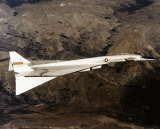
The
North American Aviation XB-70 Valkyrie was the prototype version of the proposed
B-70 nuclearA nuclear weapon is an explosive device that derives its destructive force from nuclear reactions, either fission or a combination of fission and fusion. Both reactions release vast quantities of energy from relatively small amounts of matter. The first fission bomb test released the same amount...
-armed deep-penetration
strategic bomberA strategic bomber is a heavy bomber aircraft designed to drop large amounts of ordnance onto a distant target for the purposes of debilitating an enemy's capacity to wage war. Unlike tactical bombers, which are used in the battle zone to attack troops and military equipment, strategic bombers are...
for the
United States Air ForceThe United States Air Force is the aerial warfare service branch of the United States Armed Forces and one of the American uniformed services. Initially part of the United States Army, the USAF was formed as a separate branch of the military on September 18, 1947 under the National Security Act of...
's (USAF)
Strategic Air CommandThe Strategic Air Command was both a Major Command of the United States Air Force and a "specified command" of the United States Department of Defense. SAC was the operational establishment in charge of America's land-based strategic bomber aircraft and land-based intercontinental ballistic...
. Designed by
North American AviationNorth American Aviation was a major US aerospace manufacturer, responsible for a number of historic aircraft, including the T-6 Texan trainer, the P-51 Mustang fighter, the B-25 Mitchell bomber, the F-86 Sabre jet fighter, the X-15 rocket plane, and the XB-70, as well as Apollo Command and Service...
in the late 1950s, the Valkyrie was a large six-engined aircraft able to fly
MachMach number is the speed of an object moving through air, or any other fluid substance, divided by the speed of sound as it is in that substance for its particular physical conditions, including those of temperature and pressure...
3+ at an altitude of 70000 feet (21,336 m), which would have allowed it to avoid
interceptorsAn interceptor aircraft is a type of fighter aircraft designed specifically to prevent missions of enemy aircraft, particularly bombers and reconnaissance aircraft. Interceptors generally rely on high speed and powerful armament in order to complete their mission as quickly as possible and set up...
, the only effective anti-bomber weapon at the time.
The introduction of effective high-altitude
surface-to-air missileA surface-to-air missile or ground-to-air missile is a missile designed to be launched from the ground to destroy aircraft or other missiles...
s (SAMs), the program's high development costs, and changes in the technological environment with the introduction of
intercontinental ballistic missileAn intercontinental ballistic missile is a ballistic missile with a long range typically designed for nuclear weapons delivery...
(ICBMs) led to the cancellation of the B-70 program in 1961. Although the proposed fleet of operational B-70 bombers was canceled, two prototype aircraft were built as the
XB-70A and used in supersonic test flights from 1964 to 1969. One prototype crashed following a midair collision in 1966; the other is on display at the
National Museum of the United States Air ForceThe National Museum of the United States Air Force is the official museum of the United States Air Force located at Wright-Patterson Air Force Base northeast of Dayton, Ohio. The NMUSAF is the world's largest and oldest military aviation museum with more than 360 aircraft and missiles on display...
in Ohio.
Background
As an offshoot of
BoeingThe Boeing Company is an American multinational aerospace and defense corporation, founded in 1916 by William E. Boeing in Seattle, Washington. Boeing has expanded over the years, merging with McDonnell Douglas in 1997. Boeing Corporate headquarters has been in Chicago, Illinois since 2001...
's MX-2145 manned boost-glide bomber project, the company partnered with RAND Corporation in January 1954 to explore what sort of aircraft would be needed to deliver the various nuclear weapons then under development. Providing for a long range and high payload were obvious requirements, but they also concluded that after bomb-release the plane would need supersonic speed to escape the weapon's critical blast-radius. An aircraft capable of carrying a reasonable bomb load to the
Soviet UnionThe Soviet Union , officially the Union of Soviet Socialist Republics , was a constitutionally socialist state that existed in Eurasia between 1922 and 1991....
from the continental United States had to carry a large fuel load (and thus be very large itself) due to the unrefueled range required. The need for supersonic performance would only increase this, dramatically.
The aviation industry had been examining this problem for some time. There was considerable interest in the use of nuclear powered aircraft in the bomber role from the mid-1940s. This would allow the aircraft to have effectively unlimited range without requiring unlimited fuel loads, as jet fuel would only be needed for high-speed flight. Another possibility was the use of
boronBoron is the chemical element with atomic number 5 and the chemical symbol B. Boron is a metalloid. Because boron is not produced by stellar nucleosynthesis, it is a low-abundance element in both the solar system and the Earth's crust. However, boron is concentrated on Earth by the...
-enriched "
zip fuelZip fuel, also known as high energy fuel , is any member of a family of jet fuels containing additives in the form of hydro-boron compounds, or boranes. Zip fuels offered higher power density than conventional fuels, helping extend the range of jet aircraft, a major problem for the military...
s", which improved the
energy densityEnergy density is a term used for the amount of energy stored in a given system or region of space per unit volume. Often only the useful or extractable energy is quantified, which is to say that chemically inaccessible energy such as rest mass energy is ignored...
of the fuel by about 40%, and could be used in versions of existing jet engine designs.
The U.S. Air Force followed these developments closely, and in October 1954 issued General Operational Requirement No. 38 for a new bomber with the intercontinental range of the B-52 and the Mach 2 top speed of the Convair B-58 Hustler. The new bomber was expected to enter service in 1963. Both nuclear and conventional designs would be considered. The nuclear-powered bomber was placed under "
Weapon System 125AThe WS-125 was a proposed super long range bomber, designed by the United States during the cold war. It was supposed to be a nuclear aircraft and was scheduled to be named as B-72....
" and pursued simultaneously with the jet-powered version, "Weapon System 110A".
The USAF Air Research and Development Command's (ARDC) requirement for WS-110A asked for a chemical fuel bomber with Mach 0.9 cruising speed and "maximum possible" speed during a 1,000 nautical miles (1,609 km) entrance and exit from the target. The requirement also called for a 50,000 pound (22,670 kg) payload and a combat radius of 4,000 nautical miles (4,600 mi, 7,400 km). The Air Force formed similar requirements for an WS-110L intercontinental reconnaissance system in 1955, but this was later canceled in 1958 due to better options. In July 1955 six contractors were selected to bid on WS-110A studies. Boeing and North American Aviation (NAA) submitted proposals, and on 8 November 1955 were awarded contracts for Phase 1 development.
In mid-1956, initial designs were presented by the two companies. Zip fuel was to be used in the afterburners to improve range by 10% to 15% over conventional fuel. Both designs featured huge wing tip fuel tanks that could be jettisoned when their fuel was depleted before a supersonic dash to the target. The tanks also included the outer portions of the wing, which would also be jettisoned to produce a smaller wing planform suitable for supersonic speeds.
The two designs had takeoff weights of approximately 750000 pounds (340,194.3 kg) with large fuel loads. The Air Force evaluated the designs, and in September 1956 deemed them too large and complicated for operations. The USAF ended Phase 1 development in October 1956 and instructed the two contractors to continue design studies.
Curtis LeMayCurtis Emerson LeMay was a general in the United States Air Force and the vice presidential running mate of American Independent Party candidate George Wallace in 1968....
was dismissive, declaiming that "This is not an airplane, it's a three-ship formation."
New designs
During the period that the original proposals were being studied, advances in supersonic flight were proceeding rapidly. The "long thin delta" was establishing itself as a preferred
planformIn aviation, a planform is the shape and layout of a fixed-wing aircraft's fuselage and wing. Of all the myriad planforms used, they can typically be grouped into those used for low-speed flight, found on general aviation aircraft, and those used for high-speed flight, found on many military...
for supersonic flight, replacing earlier designs like the swept wing and compound sweep as seen on designs like the Lockheed F-104 Starfighter (and the earlier NAA design for WS-110). Engines able to cope with higher temperatures and widely varying inlet air speeds were also under design, allowing for sustained supersonic speeds. By March 1957, engine development and wind tunnel testing had progressed such that the potential for all-supersonic flight appeared feasible – the cruise-and-dash approach that had resulted in huge designs was no longer needed.
The project decided that the aircraft would fly at speeds up to Mach 3 for the entire mission, instead of a combination of subsonic cruise and supersonic dash of the aircraft designs in the previous year. Zip fuel was to be burned in the engine's
afterburnerThe AfterBurner is a lighting solution for the Game Boy Advance system that was created by Triton-Labs.Originally, portablemonopoly.net was a website created to petition Nintendo to put some kind of light in their Game Boy Advance system...
to increase range. Both North American and Boeing returned new designs with very long fuselages and large delta wings. They differed primarily in engine layout; the NAA design arranged its six engines in a semi-circular duct under the rear fuselage, while the Boeing design used separate podded engines located individually on pylons below the wing.
North American had scoured the literature to find any additional advantage. This led them to an obscure report by two
NACA- Organizations :* National Advisory Committee for Aeronautics, the forerunner of the U.S. federal agency NASA* National Association for Campus Activities, an organization for programmers of university and college activities...
wind tunnelA wind tunnel is a research tool used in aerodynamic research to study the effects of air moving past solid objects.-Theory of operation:Wind tunnels were first proposed as a means of studying vehicles in free flight...
experts who wrote a report in 1956 entitled "Aircraft Configurations Developing High Lift-Drag Ratios at High Supersonics Speeds". Known today as
compression liftIn aerodynamics, compression lift refers to an aircraft that uses shock waves generated by its own supersonic flight to generate lift. This can lead to dramatic improvements in lift for supersonic/hypersonic aircraft, which often fly at high altitudes and thus suffer from decreased lift due to the...
, the idea was to use the
shock waveA shock wave is a type of propagating disturbance. Like an ordinary wave, it carries energy and can propagate through a medium or in some cases in the absence of a material medium, through a field such as the electromagnetic field...
generated off the nose or other sharp points on the aircraft as a source of high pressure air. By carefully positioning the wing in relation to the shock, the shock's high pressure could be captured on the bottom of the wing and generate additional lift. To take maximum advantage of this effect, they redesigned the underside of the aircraft to feature a large triangular intake area far forward of the engines, better positioning the shock in relation to the wing.
North American improved on the basic concept by adding a set of drooping wing tip panels that were lowered at high speed. This helped trap the shock wave under the wing between the downturned wing tips, and also added more vertical surface to the aircraft to improve directional stability at high speeds. NAA's solution had an additional advantage, as it decreased the surface area of the rear of the wing when they were moved into their high speed position. This helped offset the rearward shift of the
center of pressureThe center of pressure is the point on a body where the total sum of a pressure field acts, causing a force and no moment about that point. The total force vector acting at the center of pressure is the value of the integrated vectorial pressure field. The resultant force and center of pressure...
, or "average lift point", with increasing speeds. Under normal conditions this caused an increasing nose-down trim, which had to be offset by moving the control surfaces, increasing
drag- In science and technology :* Drag , the force which resists motion of an object through a fluid* Drag equation, a mathematical equation used in analyzing the magnitude of drag caused by fluid flow...
. When the wing tips were drooped the surface area at the rear of the wings was lowered, moving the lift forward and counteracting this effect, reducing the need for control inputs.
The buildup of heat due to skin friction during sustained supersonic flight had to be addressed. During a Mach 3 cruise the aircraft would reach an average of 450 °F (232.2 °C), although there were portions as high as 650 °F (343.3 °C). NAA proposed building their design out of a
sandwichSandwich theory describes the behaviour of a beam, plate, or shell which consists of three layers - two facesheets and one core. The most commonly used sandwich theory is linear and is an extension of first order beam theory...
panels, consisting of two thin sheets of stainless steel brazed to opposite faces of a honeycomb-shaped foil core. Expensive
titaniumTitanium is a chemical element with the symbol Ti and atomic number 22. It has a low density and is a strong, lustrous, corrosion-resistant transition metal with a silver color....
would be used only in high-temperature areas like the leading edge of the horizontal stabilizer, and the nose. For cooling the interior, the XB-70 pumped fuel en route to the engines through heat exchangers.
On 30 August 1957, the Air Force decided that enough data was available on the NAA and Boeing designs that a competition could begin. On 18 September, the Air Force issued operational requirements which called for a cruising speed of Mach 3.0 to 3.2, an over-target altitude of 70,000-75,000 ft (21,300-22,700 m), a range of up to 10,500 mi (16,900 km), and a gross weight not to exceed 490,000 lb (222,000 kg). The aircraft would have to use the hangars, runways and handling procedures used by the B-52. On 23 December 1957, the North American proposal was declared the winner of the competition, and on 24 January 1958, a contract was issued for Phase 1 development.
In February 1958, the proposed bomber was designated
B-70, with the prototypes receiving the "X" experimental prototype designation. The name "
ValkyrieIn Norse mythology, a valkyrie is one of a host of female figures who decides who dies in battle. Selecting among half of those who die in battle , the valkyries bring their chosen to the afterlife hall of the slain, Valhalla, ruled over by the god Odin...
" was the winning submission in spring 1958, selected from 20,000 entries in a USAF "Name the B-70" contest. The Air Force approved an 18-month program acceleration in March 1958 that rescheduled the first flight to December 1961. But in the fall of 1958 the service announced that this acceleration would not be possible due to lack of funding. In December 1958, a Phase II contract was issued. The mockup of the B-70 was reviewed by the Air Force in March 1959. Provisions for air-to-surface missiles and external fuel tanks were requested afterward. At the same time North American was developing the
F-108The North American XF-108 Rapier was a proposed long-range, high-speed interceptor aircraft designed by North American Aviation. Initiated to defend the United States from supersonic Soviet bombers, the program, initially called NA-257, was cancelled in 1959 due to a shortage of funds and the...
supersonic interceptor. To reduce program costs, the F-108 would share two of the engines, the escape capsule, and some smaller systems with the B-70.
The "missile problem"
The B-70 was planned to use a high-speed, high-altitude bombing approach that followed a trend of bombers flying progressively faster and higher since the start of manned bomber use. Anti-aircraft artillery with the ability to reach jet bomber altitudes of 50,000 ft and above were extremely expensive, and had almost no chance of a hit as the aircraft quickly flew out of range.
Interceptor aircraftAn interceptor aircraft is a type of fighter aircraft designed specifically to prevent missions of enemy aircraft, particularly bombers and reconnaissance aircraft. Interceptors generally rely on high speed and powerful armament in order to complete their mission as quickly as possible and set up...
were the only effective anti-bomber weapons by the early 1950s, but high altitudes were an issue for them as well; Soviet interceptors during the late 1950s could not intercept the
U-2The Lockheed U-2, nicknamed "Dragon Lady", is a single-engine, very high-altitude reconnaissance aircraft operated by the United States Air Force and previously flown by the Central Intelligence Agency . It provides day and night, very high-altitude , all-weather intelligence gathering...
reconnaissance aircraft which routinely flew past them. Adding speed made the interception problem that much more difficult, giving the defenders less time to launch their fighters.
The introduction of the first effective anti-aircraft missiles by the late 1950s had seriously upset this equation. Missiles could stand ready for rapid launch directly at the bombers, and had greater altitude capability than any aircraft. The US was aware of Soviet work in the field, and had reduced the expected operational lifetime of the U-2, expecting that it would become vulnerable to these missiles as they were improved. This eventuality came to pass in the
1960 downingThe 1960 U-2 incident occurred during the Cold War on May 1, 1960, during the presidency of Dwight D. Eisenhower and during the leadership of Soviet Premier Nikita Khrushchev, when a United States U-2 spy plane was shot down over the airspace of the Soviet Union.The United States government at...
of the U-2 flown by
Gary PowersFrancis Gary Powers was an American pilot whose Central Intelligence Agency U-2 spy plane was shot down while flying a reconnaissance mission over Soviet Union airspace, causing the 1960 U-2 incident.- Early life :...
.
Faced with this problem, military doctrine had already started shifting away from high-altitude supersonic bombing toward low-altitude penetration. As radar operates on the line-of-sight, aircraft could dramatically shorten detection distances by flying close to the Earth and hiding behind terrain. Missile sites spaced to overlap in range when attacking bombers at high altitudes would leave large gaps between their coverage for bombers flying at lower levels. With an appropriate map, the bombers could fly around the defences. Additionally, early missiles generally flew unguided for a period of time before the radar systems were able to track the missile and start sending it guidance signals. With the SA-2 Guideline missile this minimum altitude was roughly 2,000 feet.
Flying at low level provided protection against interceptors as well. Radars of the era did not have the ability to "look down"; if aimed down to detect targets at a lower altitude, the reflection of the ground would overwhelm the signal returned from a target. An interceptor flying at normal altitudes would be effectively blind to bombers below it. The interceptor could descend to lower altitudes to increase the amount of visible sky above it, but doing so would limit its radar range in the same way as the missile sites, as well as greatly increasing fuel use and thus reducing mission time. The Soviet Union would not introduce an interceptor with look-down capability until 1972 with the High Lark radar, which had very limited capability. A truly effective look-down/shoot-down system did not appear until the introduction of the Flash Dance radar on the
Mikoyan MiG-31The Mikoyan MiG-31 is a supersonic interceptor aircraft developed to replace the MiG-25 "Foxbat". The MiG-31 was designed by the Mikoyan design bureau based on the MiG-25.-Development:...
in the 1980s.
Strategic Air Command found itself in an uncomfortable position; bombers had been tuned for efficiency at high speeds and altitudes, performance that had been purchased at great cost. Before the B-70 was to replace the B-52 in the long-range role, SAC had introduced the
B-58 HustlerThe Convair B-58 Hustler was the first operational supersonic jet bomber capable of Mach 2 flight. The aircraft was designed by Convair engineer Robert H. Widmer and developed for the United States Air Force for service in the Strategic Air Command during the 1960s...
to replace the
B-47 StratojetThe Boeing Model 450 B-47 Stratojet was a long-range, six-engined, jet-powered medium bomber built to fly at high subsonic speeds and at high altitudes. It was primarily designed to drop nuclear bombs on the Soviet Union...
in the medium-range role. The Hustler was expensive to develop and purchase, and required enormous amounts of fuel and maintenance in comparison to the B-47. It was estimated that it cost three times as much to operate than the much larger and longer-ranged B-52. Flying at lower altitudes, where the
air densityThe density of air, ρ , is the mass per unit volume of Earth's atmosphere, and is a useful value in aeronautics and other sciences. Air density decreases with increasing altitude, as does air pressure. It also changes with variances in temperature or humidity...
is much higher,
drag- In science and technology :* Drag , the force which resists motion of an object through a fluid* Drag equation, a mathematical equation used in analyzing the magnitude of drag caused by fluid flow...
on the aircraft was significantly higher and limited its range and speed. At low altitudes, the Hustler ended up with performance that was only a small improvement over the B-47 it was meant to replace.
The B-70, designed for even higher speeds, altitudes and range than the B-58, suffered even more in relative terms. The B-70 was limited to only Mach 0.95 at low altitudes, only modestly higher than the B-52 at the same altitudes. It also had a smaller bombload and shorter range. Its only major advantage would be its ability to use high speed in areas without missile cover, especially on the long journey from the USA to USSR. The value was limited; the USAF's doctrine stressed that the primary reason for maintaining the bomber force in an era of ICBMs was that the bombers remained in the air at long ranges from their bases and were thus immune to sneak attack. In this case, the higher speed would only be used for a short period of time between the staging areas and the Soviet coastline.
Adding to the problems, the zip fuel program was canceled in 1959. After burning, the fuel turned into liquids and solids that increased wear on moving turbine engine components. Although the B-70 intended to use zip only in the afterburners, and thus avoid this problem, the enormous cost of the zip program for such limited gains led to its cancellation. This by itself was not a fatal problem, however, as newly developed high-energy fuels like
JP-6Jet Propellant 6 is a type of jet fuel developed for General Electric YJ93 jet engine of the XB-70 Valkyrie supersonic aircraft. JP-6 was similar to JP-5 but with a lower freezing point and improved thermal oxidative stability...
were available that made up some of the difference. By filling one of the two bomb bays with a fuel tank, range was reduced only slightly, although payload space suffered. Also, the F-108 program was canceled in September 1959, which ended the shared development that benefited the B-70 program.
Downsizing, upswing, cancellation
At two secret meetings on 16 and 18 November 1959, General
TwiningNathan Farragut Twining, KBE was a United States Air Force General, born in Monroe, Wisconsin. He was Chief of Staff of the United States Air Force from 1953 until 1957...
recommended the Air Force's plan for the B-70 to reconnoiter and strike rail-mobile Soviet ICBMs, but General White admitted the Soviets would "be able to hit the B-70 with rockets" and requested the B-70 be downgraded to "a bare minimum research and development program" at $200 million for fiscal year 1960. President Eisenhower responded that the reconnaissance and strike mission was "crazy" since the nuclear mission was attacking known production and military complexes, and emphasized he saw no need for the B-70 since the ICBM is "a cheaper, more effective way of doing the same thing". Eisenhower also identified that the B-70 would not be in manufacturing until "eight to ten years from now" and "said he thought we were talking about bows and arrows at a time of gunpowder when we spoke of bombers in the missile age." In December 1959 the Air Force announced the B-70 project would be cut to a single prototype, and most of the planned B-70 subsystems would no longer be developed.
Then interest increased due to the politics of
presidential campaign of 1960The United States presidential election of 1960 was the 44th American presidential election, held on November 8, 1960, for the term beginning January 20, 1961, and ending January 20, 1965. The incumbent president, Republican Dwight D. Eisenhower, was not eligible to run again. The Republican Party...
. A central plank of
John F. KennedyJohn Fitzgerald "Jack" Kennedy , often referred to by his initials JFK, was the 35th President of the United States, serving from 1961 until his assassination in 1963....
's campaign was that Eisenhower and the Republicans were weak on defense, and pointed to the B-70 as an example. He told a San Diego audience near NAA facilities that "I endorse wholeheartedly the B-70 manned aircraft." Kennedy also made similar campaign claims regarding other aircraft: near the Seattle Boeing plant he affirmed the need for B-52s and in Fort Worth he praised the B-58.
The Air Force changed the program to full weapon development and awarded a contract for a XB-70 prototype and 11 YB-70s in August 1960. In November 1960, the B-70 program received a $265 million appropriation from Congress for FY 1961. Nixon, trailing in his home state of California, also publicly endorsed the B-70, and on 30 October Eisenhower helped the Republican campaign with a pledge of an additional $155 million for the B-70 development program.
On taking office in January 1961, Kennedy was informed that the
missile gapThe missile gap was the term used in the United States for the perceived disparity between the number and power of the weapons in the U.S.S.R. and U.S. ballistic missile arsenals during the Cold War. The gap only existed in exaggerated estimates made by the Gaither Committee in 1957 and United...
was an illusion. On 28 March 1961, after $800 million had been spent on the B-70 program, Kennedy canceled the project as "unnecessary and economically unjustifiable" because it "stood little chance of penetrating enemy defenses successfully." Instead, Kennedy recommended "the B-70 program be carried forward essentially to explore the problem of flying at three times the speed of sound with an airframe potentially useful as a bomber."
After Congress approved $290 million of B-70 "add-on" funds to the President's 12 May 1960 modified FY 1961 budget, the Administration decided on a "Planned Utilization" of only $100 million of these funds. The Department of Defense subsequently presented data to Congress that the B-70 would add little performance for the high cost. However, after becoming the new Air Force Chief of Staff in July 1961,
Curtis LeMayCurtis Emerson LeMay was a general in the United States Air Force and the vice presidential running mate of American Independent Party candidate George Wallace in 1968....
increased his B-70 advocacy, including interviews for August
Reader's DigestReader's Digest is a general interest family magazine, published ten times annually. Formerly based in Chappaqua, New York, its headquarters is now in New York City. It was founded in 1922, by DeWitt Wallace and Lila Bell Wallace...
and November
Aviation WeekAviation Week & Space Technology, often abbreviated Aviation Week or AW&ST, is a weekly magazine owned and published by McGraw-Hill...
articles, and allowing a 25 February
General ElectricGeneral Electric Company , or GE, is an American multinational conglomerate corporation incorporated in Schenectady, New York and headquartered in Fairfield, Connecticut, United States...
tour at which the press was provided artist conceptions of, and other info about, the B-70. Congress had also continued B-70 appropriations in an effort to resurrect bomber development. After the Secretary of Defense
Robert McNamaraRobert Strange McNamara was an American business executive and the eighth Secretary of Defense, serving under Presidents John F. Kennedy and Lyndon B. Johnson from 1961 to 1968, during which time he played a large role in escalating the United States involvement in the Vietnam War...
explained again to the House Armed Services Committee (HASC) on 24 January 1962 that the B-70 was unjustifiable, LeMay subsequently argued for the B-70 to both the House and Senate committees—and was chastised by McNamara on 1 March. By 7 March 1962, the HASC—with 21 members having B-70 work in their districts—had written an appropriations bill to "direct"—by law—the Executive Branch to use all of the nearly $500 million appropriated for the RS-70. McNamara was unsuccessful with an address to the HASC on 14 March, but a 19 March 1962 11th hour
White House Rose GardenThe White House Rose Garden is a garden bordering the Oval Office and the West Wing of the White House. The garden is approximately 125 feet long and 60 feet wide...
agreement between Kennedy and HASC chairman
Carl VinsonCarl Vinson was a United States Representative from Georgia. He was a Democrat and the first person to serve for more than 50 years in the United States House of Representatives...
retracted the bill's language and the bomber remained canceled.
Experimental aircraft
The two experimental XB-70As completed, were used for the advanced study of
aerodynamicsAerodynamics is a branch of dynamics concerned with studying the motion of air, particularly when it interacts with a moving object. Aerodynamics is a subfield of fluid dynamics and gas dynamics, with much theory shared between them. Aerodynamics is often used synonymously with gas dynamics, with...
,
propulsionAir propulsion is the generation of thrust during flight by an aircraft or a creature such as a bird, bat or insect.-Aircraft:An aircraft propulsion system must serve two purposes. First, the thrust from the propulsion system must balance the drag of the airplane when the airplane is cruising...
, and other subjects related to large supersonic transports. These were named Air Vehicle 1 and 2 (AV-1 and AV-2). The production order was reduced to three prototypes in March 1961 with the third aircraft to incorporate improvements from the previous prototype. The crew was reduced to only the pilot and co-pilot for the XB-70; the navigator and bomb-aimer were not needed. XB-70 #1 was completed on 7 May 1964, and rolled out on 11 May 1964 at
Palmdale, CaliforniaPalmdale is a city located in the center of northern Los Angeles County, California, United States.Palmdale was the first community within the Antelope Valley to incorporate as a city on August 24, 1962; 47 years later, voters approved creating a charter city in November, 2009. Palmdale is...
. One report stated "nothing like it existed anywhere". AV-2 was completed on 15 October 1964. The planned third prototype (AV-3) was canceled in July 1964 while under construction. The first XB-70 had its maiden flight in September 1964 and flight testing followed.
The XB-70 flight test data and materials development aided the later Rockwell B-1 Lancer supersonic bomber program, the US supersonic transport program and, through intelligence, the Soviet
Tupolev Tu-144The Tupolev Tu-144 was a Soviet supersonic transport aircraft and remains one of only two SSTs to enter commercial service, the other being the Concorde...
. The development of the US
U-2The Lockheed U-2, nicknamed "Dragon Lady", is a single-engine, very high-altitude reconnaissance aircraft operated by the United States Air Force and previously flown by the Central Intelligence Agency . It provides day and night, very high-altitude , all-weather intelligence gathering...
and SR-71 reconnaissance aircraft along with the B-70 bomber led the Soviet Union to design and develop the
MiG-25The Mikoyan-Gurevich MiG-25 is a supersonic interceptor and reconnaissance aircraft that was among the fastest military aircraft to enter service. Designed by the Soviet Union's Mikoyan-Gurevich bureau the first prototype flew in 1964 with entry into service in 1970...
interceptor.
Design
The Valkyrie was designed to be a high-altitude bomber-sized Mach 3 aircraft with six engines.
Harrison StormsHarrison Allen Storms Jr. , nicknamed Stormy, was an American aeronautical engineer best known for his role in managing the design and construction of the command module for the Apollo program.-Early life and career:...
shaped the aircraft with a
canard surfaceIn aeronautics, canard is an airframe configuration of fixed-wing aircraft in which the forward surface is smaller than the rearward, the former being known as the "canard", while the latter is the main wing...
and a
delta wingThe delta wing is a wing planform in the form of a triangle. It is named for its similarity in shape to the Greek uppercase letter delta .-Delta-shaped stabilizers:...
, which was built largely of
stainless steelIn metallurgy, stainless steel, also known as inox steel or inox from French "inoxydable", is defined as a steel alloy with a minimum of 10.5 or 11% chromium content by mass....
,
sandwiched honeycombA sandwich-structured composite is a special class of composite materials that is fabricated by attaching two thin but stiff skins to a lightweight but thick core...
panels, and
titaniumTitanium is a chemical element with the symbol Ti and atomic number 22. It has a low density and is a strong, lustrous, corrosion-resistant transition metal with a silver color....
. The XB-70 was designed to use supersonic technologies developed for the Mach 3 Navaho, as well as a modified form of the
SM-64 NavahoThe North American SM-64 Navaho was a supersonic intercontinental cruise missile project built by North American Aviation. The program ran from 1946 to 1958 when it was cancelled in favor of intercontinental ballistic missiles...
's all-inertial guidance system.
The XB-70 used
compression liftIn aerodynamics, compression lift refers to an aircraft that uses shock waves generated by its own supersonic flight to generate lift. This can lead to dramatic improvements in lift for supersonic/hypersonic aircraft, which often fly at high altitudes and thus suffer from decreased lift due to the...
, which was generated from a prominent
wedgeIn solid geometry, a wedge is a polyhedron defined by two triangles and three trapezoid faces. A wedge has five faces, nine edges, and six vertices.A wedge is a subclass of the prismatoids with the base and opposite ridge in two parallel planes....
at the center of the engine inlets that created a
shock waveA shock wave is a type of propagating disturbance. Like an ordinary wave, it carries energy and can propagate through a medium or in some cases in the absence of a material medium, through a field such as the electromagnetic field...
below the aircraft. The
wingA wing is an appendage with a surface that produces lift for flight or propulsion through the atmosphere, or through another gaseous or liquid fluid...
included inboard
camberCamber, in aeronautics and aeronautical engineering, is the asymmetry between the top and the bottom surfaces of an aerofoil. An aerofoil that is not cambered is called a symmetric aerofoil...
to more effectively use the higher
pressure fieldPressure is the force per unit area applied in a direction perpendicular to the surface of an object. Gauge pressure is the pressure relative to the local atmospheric or ambient pressure.- Definition :...
behind the strong
shock waveA shock wave is a type of propagating disturbance. Like an ordinary wave, it carries energy and can propagate through a medium or in some cases in the absence of a material medium, through a field such as the electromagnetic field...
(the airflow at the XB-70 wing's
leading edgeThe leading edge is the part of the wing that first contacts the air; alternatively it is the foremost edge of an airfoil section. The first is an aerodynamic definition, the second a structural one....
was subsonic). The compression lift increased the lift by five percent. Unique among aircraft of its size, the outer portions of the wings were hinged, and could be pivoted downward by up to 65 degrees. This increased the aircraft's
directional stabilityDirectional stability is stability of a moving body or vehicle about an axis which is perpendicular to its direction of motion. Stability of a vehicle concerns itself with the tendency of a vehicle to return to its original direction in relation to the oncoming medium when disturbed away from...
at supersonic speeds, shifted the center of lift to a more favorable position at high speeds, and strengthened the compression lift effect. With the wingtips drooped downwards, the compression lift shock wave would be further trapped under the wings.
The XB-70 was equipped with six
General Electric YJ93-GE-3-See also:-External links:...
turbojet engines, designed to use
JP-6Jet Propellant 6 is a type of jet fuel developed for General Electric YJ93 jet engine of the XB-70 Valkyrie supersonic aircraft. JP-6 was similar to JP-5 but with a lower freezing point and improved thermal oxidative stability...
jet fuel. The engine was stated to be in the "30,000-pound class", but actually produced 28,000 lbf (124.6 kN) with
afterburnerThe AfterBurner is a lighting solution for the Game Boy Advance system that was created by Triton-Labs.Originally, portablemonopoly.net was a website created to petition Nintendo to put some kind of light in their Game Boy Advance system...
and 19,900 lbf (88 kN) without afterburner. The Valkyrie used fuel for cooling; it was pumped through
heat exchangerA heat exchanger is a piece of equipment built for efficient heat transfer from one medium to another. The media may be separated by a solid wall, so that they never mix, or they may be in direct contact...
s before reaching the engines. To reduce the likelihood of auto ignition,
nitrogenNitrogen is a chemical element that has the symbol N, atomic number of 7 and atomic mass 14.00674 u. Elemental nitrogen is a colorless, odorless, tasteless, and mostly inert diatomic gas at standard conditions, constituting 78.08% by volume of Earth's atmosphere...
was injected into the JP-6 during refueling, and the "fuel pressurization and
inerting systemAn inerting system increases the safety of a fuel tank, ball mill, or other sealed or closed-in tank that contains highly flammable material. Inert in scientific terminology means ‘not readily reactive with other elements; forming no chemical compounds or something that is not chemically...
" vaporized a 700 lb (320 kg) supply of
liquid nitrogenLiquid nitrogen is nitrogen in a liquid state at a very low temperature. It is produced industrially by fractional distillation of liquid air. Liquid nitrogen is a colourless clear liquid with density of 0.807 g/mL at its boiling point and a dielectric constant of 1.4...
to fill the fuel tank vent space and maintain tank pressure.
Operational history
Flight test program
The XB-70 flight test program was conducted from the maiden flight on 21 September 1964 through 6 August 1966. The first aircraft was found to suffer from weaknesses in the honeycomb panels, primarily due to inexperience with fabrication and quality control of this new material.
The first flight test was marred: one engine had to be shut down; an undercarriage indication malfunction meant that the flight was flown with the undercarriage down, limiting speed to about half that planned. On landing, the left-side rear wheels locked, the tires ruptured, and a fire started.
The Valkyrie first became supersonic (Mach 1.1) on the third test flight on 12 October 1964, and flew above Mach 1 for 40 minutes during the following flight on 24 October. The wing tips were also lowered partially in this flight. XB-70 #1 surpassed Mach 3 on 14 October 1965 by reaching Mach 3.02 at 70,000 ft (21,300 m).
Honeycomb panel deficiencies discovered on AV-1 were almost completely solved on the second XB-70, which first flew on 17 July 1965. On 3 January 1966, XB-70 #2 attained a speed of Mach 3.05 while flying at 72,000 ft (21,900 m). AV-2 reached a top speed of Mach 3.08 and maintained it for 20 minutes on 12 April 1966. On 19 May 1966, AV-2 reached Mach 3.06 and flew at Mach 3 for 32 minutes, covering 2,400 mi (3,840 km) in 91 minutes of total flight.
Flight research programs
After completion of the flight test program on 6 August 1966, flight research programs were conducted using the XB-70 with NAA support. The first was a joint NASA/USAF research program conducted from 3 November 1966 to 31 January 1967 for measuring the intensity and signature of sonic booms for the National Sonic Boom Program (NSBP). In 1966, AV-2 was selected for the program and was outfitted with test sensors. It flew the first sonic boom test on 6 June 1966, obtaining a speed of Mach 3.05 at 72,000 ft (21,900 m). Sonic boom testing was planned to cover a range of overpressures on the ground similar but higher than the proposed American SST. AV-2 crashed following a mid-air collision with an F-104 while flying a multi-aircraft formation.
Sonic boom and later testing continued with XB-70A #1. The second flight research program (NASA NAS4-1174) investigated "control of structural dynamics" from 25 April 1967 through the XB-70's last flight in 1969. At high altitude and high speed, the XB-70A experienced unwanted altitude changes (porpoising). NASA testing from June 1968 included two small vanes on the nose of AV-1 for measuring the response of the aircraft's stability augmentation system.
Following the loss of AV-2, 33 research flights were completed by AV-1. The XB-70's last supersonic flight took place on 17 December 1968. On 4 February 1969 AV-1 took its final flight to
Wright-Patterson Air Force BaseWright-Patterson Air Force Base is a United States Air Force base in Greene and Montgomery counties in the state of Ohio. It includes both Wright and Patterson Fields, which were originally Wilbur Wright Field and Fairfield Aviation General Supply Depot. Patterson Field is located approximately...
for museum display (now the
National Museum of the United States Air ForceThe National Museum of the United States Air Force is the official museum of the United States Air Force located at Wright-Patterson Air Force Base northeast of Dayton, Ohio. The NMUSAF is the world's largest and oldest military aviation museum with more than 360 aircraft and missiles on display...
). Flight data was collected on this subsonic trip. North American Rockwell completed a four-volume report on the B-70 that was published by NASA in April 1972.
Variants
XB-70A
- Prototype of B-70. Two were built.
- AV-1, NAA Model Number NA-278, USAF S/N 62-0001, completed 83 flights spanning 160 hours and 16 minutes.
- AV-2, NAA Model Number NA-278, USAF S/N 62-0207, flew 46 times over 92 hours and 22 minutes, before it crashed in June 1966.
XB-70B
- AV-3, NAA Model Number NA-274, USAF S/N 62-0208, Originally to be first YB-70A in March 1961, this advanced prototype was canceled while in manufacturing.
YB-70
- Preproduction version with improvements based on XB-70s.
B-70A
- Planned bomber production version of Valkyrie. A fleet of up to 65 operational bombers was planned.
RS-70
- Proposed reconnaissance-strike version with a crew of four and in-flight refueling capability.
Incidents
On 7 May 1965, the divider separating the left and right halves of the engine inlet on XB-70A AV-1 broke off in flight and was ingested into the engines, damaging all six beyond repair.
On 14 October 1965, AV-1 surpassed Mach 3, but heat and stress damaged the honeycomb panels, leaving 2 ft (0.6 m) of the
leading edgeThe leading edge is the part of the wing that first contacts the air; alternatively it is the foremost edge of an airfoil section. The first is an aerodynamic definition, the second a structural one....
of the left wing missing. These construction problems resulted in the imposition of a speed limit of Mach 2.5 on the first aircraft.
Mid-air collision
On 8 June 1966, XB-70A #2 was in close formation with four other aircraft (an F-4, F-5, T-38, and F-104) for a photoshoot at the behest of
General ElectricGeneral Electric Company , or GE, is an American multinational conglomerate corporation incorporated in Schenectady, New York and headquartered in Fairfield, Connecticut, United States...
, manufacturer of the engines of all five aircraft. With the photoshoot complete, the F-104 drifted into contact with the XB-70's right wing, flipped over and rolled inverted over the top of the Valkyrie, striking the vertical stabilizers and left wing of the bomber. The F-104 exploded, destroying the Valkyrie's rudders and damaging its left wing. With the loss of both rudders and damage to the wings, the Valkyrie entered an uncontrollable spin and crashed into the ground north of
Barstow, CaliforniaBarstow is a city in San Bernardino County, California, United States. The population was 22,639 at the 2010 census, up from 21,119 at the 2000 census. Barstow is located north of San Bernardino....
. NASA Chief Test Pilot Joe Walker (F-104 pilot) and Carl Cross (XB-70 co-pilot) were killed.
Al WhiteAlvin Swauger White was an American test pilot, engineer, and a USAF astronaut. He flew the maiden flights of both XB-70 Valkyrie aircraft, the first 2,000 mph flight, and all subsequent Mach 3 flights.-Biography:...
(XB-70 pilot) ejected, sustaining serious injuries, including one arm crushed by the closing clamshell-like escape capsule moments prior to ejection.
The USAF summary report of the accident investigation stated that, given the position of the F-104 relative to the XB-70, the F-104 pilot would not have been able to see the XB-70's wing, except by uncomfortably looking back over his left shoulder. The report said that Walker, piloting the F-104, likely maintained his position by looking at the fuselage of the XB-70, forward of his position. The F-104 was estimated to be 70 ft (21 m) to the side of, and 10 ft (3 m) below, the fuselage of the XB-70. The report concluded that from that position, without appropriate sight cues, Walker was unable to properly perceive his motion relative to the Valkyrie, leading to his aircraft drifting into contact with the XB-70's wing. The accident investigation also pointed to the wake vortex off the XB-70's right wingtip as the reason for the F-104's sudden roll over and into the bomber.
Area 51 radar operator Barnes was monitoring the flight and recording the air traffic at the time of the accident and reports that Walker radioed just before the accident "I'm opposing this mission. It is too turbulent and it has no scientific value." Barnes says the vortex sucked him in. The recording was requested by Bill Houck of NASA and has since disappeared.
Aircraft on display
Valkyrie AV-1 (AF Ser. No. 62-0001) is on display at the
National Museum of the United States Air ForceThe National Museum of the United States Air Force is the official museum of the United States Air Force located at Wright-Patterson Air Force Base northeast of Dayton, Ohio. The NMUSAF is the world's largest and oldest military aviation museum with more than 360 aircraft and missiles on display...
at Wright-Patterson AFB in
Dayton, OhioDayton is the 6th largest city in the U.S. state of Ohio and the county seat of Montgomery County, the fifth most populous county in the state. The population was 141,527 at the 2010 census. The Dayton Metropolitan Statistical Area had a population of 841,502 in the 2010 census...
. The aircraft was flown to the Museum on 4 February 1969, following the conclusion of the XB-70 testing program. Over the years the Valkyrie became the Museum's signature aircraft, appearing on Museum letterhead, and even appearing as the chief design feature for the Museum's restaurant, the
Valkyrie Cafe. , the XB-70 was in the Museum's Research & Development Hangar where it is displayed alongside other experimental aircraft in the Museum's collection.
Specifications (XB-70A)
See also
External links