

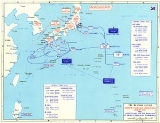
Operation Downfall

Encyclopedia
Operation Downfall was the Allied
plan for the invasion of Japan
near the end of World War II
. The operation was cancelled when Japan surrendered
after the atomic bombing
of Hiroshima
and Nagasaki and the Soviet Union
's declaration of war against Japan. The operation had two parts: Operation Olympic and Operation Coronet. Set to begin in October 1945, Operation Olympic was intended to capture the southern third of the southernmost main Japanese island, Kyūshū
, with the recently captured
island of Okinawa
to be used as a staging area. Later, in spring 1946, Operation Coronet was the planned invasion of the Kantō Plain
, near Tokyo
, on the Japanese island of Honshū
. Airbases on Kyūshū captured in Operation Olympic would allow land-based air support for Operation Coronet.
Japan's geography
made this invasion plan obvious to the Japanese as well; they were able to predict the Allied invasion plans accurately and thus adjust their defensive plan, Operation Ketsugō, accordingly. The Japanese planned an all-out defense of Kyūshū, with little left in reserve for any subsequent defense operations. Casualty predictions varied widely but were extremely high for both sides: depending on the degree to which Japanese civilians resisted the invasion, estimates ran into the millions for Allied casualties and several times that number for Japanese casualties.
, General of the Army
Douglas MacArthur
and the Joint Chiefs of Staff
—Fleet Admirals Ernest King
and William D. Leahy
, and Generals of the Army George Marshall
and Hap Arnold (the latter was commander of the U.S. Army Air Forces
). Douglas MacArthur at the time was also being considered for promotion to a special "super rank" of General of the Armies
, so as to be granted operational authority over other five star officers. However, the proposal to promote MacArthur was only at the level of informal discussion when World War II ended.
At the time, the development of the atomic bomb was a very closely guarded secret known only to a few top officials outside the Manhattan Project
, and the initial planning for the invasion of Japan did not take its existence into consideration. As the atomic bomb became available, General Marshall envisioned using it, if sufficient numbers could be produced in time, to support the invasion.
Throughout the Pacific War
, unlike the European theatre
, the Allies were unable to agree on a single Commander-in-Chief
(C-in-C). Allied command was divided into regions: by 1945, for example, Chester Nimitz was Allied C-in-C Pacific Ocean Areas
, while Douglas MacArthur was Supreme Allied Commander, South West Pacific Area
. A unified command was deemed necessary for an invasion of Japan. Inter-service squabbling
over who it should be (the US Navy wanted Nimitz, but the US Army wanted MacArthur) was so serious that it threatened to derail planning. Ultimately, the Navy partially conceded, and MacArthur was to have total command of all forces, if circumstances made it necessary.
, a joint British-American planning team produced a plan ("Appreciation and Plan for the Defeat of Japan") which did not call for an invasion of the Japanese home islands until 1947–1948. The American Joint Chiefs of Staff
believed that prolonging the war to such an extent was dangerous for national morale. Instead, at the Quebec conference, the Combined Chiefs of Staff
agreed that Japan should be forced to surrender not more than one year after Germany's surrender.
The US Navy urged the use of blockade
and airpower to bring about Japan's capitulation. They proposed operations to capture airbases in nearby Shanghai, China, and Korea
, which would give the US Army Air Forces a series of forward airbases from which to bombard Japan into submission. The US Army, on the other hand, argued that such a strategy could "prolong the war indefinitely" and expend lives needlessly, and therefore that an invasion was necessary. They supported mounting a large-scale thrust directly against the Japanese homeland, with none of the side operations that the Navy had suggested. Ultimately, the Army's viewpoint won.
Physically, Japan made an imposing target, with few beaches suitable for invasion. Only Kyūshū (the southernmost island of Japan) and the beaches of the Kantō plain
(both southwest and southeast of Tokyo
) made suitable invasion zones. The Allies decided to launch a two-stage invasion. Operation Olympic would attack southern Kyūshū. Airbases would be established, which would give cover for Operation Coronet, the attack on Tokyo Bay
.
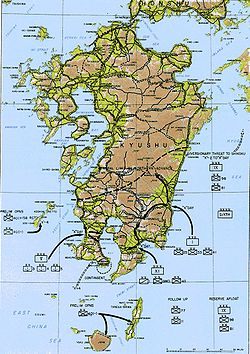
 Operation Olympic, the invasion of Kyūshū, was to begin on "X-Day", which was scheduled for November 1, 1945. The combined Allied naval armada would have been the largest ever assembled, including 42 aircraft carrier
s, 24 battleship
s, and 400 destroyer
s and destroyer escorts. Fourteen US divisions were scheduled to take part in the initial landings. Using Okinawa as a staging base, the objective would have been to seize the southern portion of Kyūshū. This area would then be used as a further staging point to attack Honshū in Operation Coronet.
Olympic was also to include a deception
plan, known as Operation Pastel
. Pastel was designed to convince the Japanese that the Joint Chiefs had rejected the notion of a direct invasion and instead were going to attempt to encircle and bombard Japan. This would require capturing bases in Formosa
, along the Chinese coast, and in the Yellow Sea
area.
The Twentieth Air Force
was to have continued its role as the main Allied strategic bomber
force used against the Japanese home islands. Tactical air support was to be the responsibility of the U.S. Far East Air Forces
(FEAF)—a formation which comprised the Fifth
, Seventh
and Thirteenth Air Force
s—during the preparation for the invasion. FEAF was responsible for attacking Japanese airfields and transportation arteries on Kyūshū and Southern Honshū (e.g. the Kanmon Tunnel
) and for attaining and maintaining air superiority over the beaches.
Before the main invasion, the offshore islands of Tanegashima
, Yakushima
, and the Koshikijima Islands
were to be taken, starting on X-5. The invasion of Okinawa had demonstrated the value of establishing secure anchorages close at hand, for ships not needed off the landing beaches and for ships damaged by air attack.
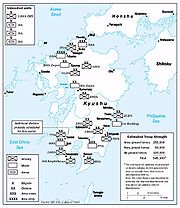
Kyūshū was to be invaded by U.S. Sixth Army
at three points: Miyazaki
, Ariake
, and Kushikino
. If a clock were drawn on a map of Kyūshū, these points would roughly correspond to 4, 5, and 7 o'clock, respectively. The 35 landing beaches were all named for automobiles: Austin
, Buick
, Cadillac through Stutz
, Winton, and Zephyr
. With one corps
assigned to each landing, the invasion planners assumed that the Americans would outnumber the Japanese by roughly three to one. In early 1945, Miyazaki was virtually undefended, while Ariake with its nearby good harbor was heavily defended. Although Kushikino was weakly defended, its imposing terrain meant that the Marines
who landed there would probably have had the toughest time.
The invasion was not supposed to conquer the entire island, just the southernmost third of it, as indicated by the dashed line on the map, "general limit of northern advance". Southern Kyūshū would offer a staging ground and a valuable airbase for Operation Coronet.
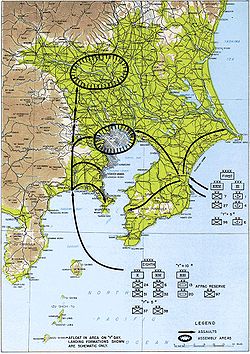
at the Kantō Plain south of the capital, was to begin on "Y-Day", which was scheduled for March 1, 1946. Coronet would have been the largest amphibious operation of all time, with 25 divisions, including the floating reserve, earmarked for the initial operations. (The Overlord invasion of Normandy
, by comparison, had 12 divisions in the initial landings.) The U.S. First Army
would have invaded at Kujūkuri Beach
, on the Bōsō Peninsula
, while U.S. Eighth Army
invaded at Hiratsuka
, on Sagami Bay
. Both armies would then drive north and inland, meeting at Tokyo.
, a Commonwealth
formation that included at least eighteen aircraft carriers (and providing 25% of the Allied Air Power) and four battleships. The Australian First Tactical Air Force
took part in the Philippines campaign (1944–45). These would likely have augmented US close air support
units over Japan. The only major re-deployment for Olympic was Tiger Force
, a Commonwealth long range heavy bomber
unit, made up of 10 squadrons, scheduled to be transferred from RAF Bomber Command
in Europe to airbases on Okinawa.
If reinforcements had been needed for Olympic, they could have been provided from forces being assembled for Coronet, which would have needed the redeployment of substantial Allied forces from Europe, South Asia
, Australasia
, and elsewhere. These would have included the U.S. First Army (15 divisions) and the Eighth Air Force, which were in Europe. The redeployment was complicated by the simultaneous partial demobilization of the U.S. Army, which drastically reduced the divisions' combat effectiveness, by stripping them of their most experienced officers and men.
According to U.S. historian John Ray Skates:
The Australian government requested the inclusion of Australian Army
units in the first wave of Olympic, but this was rejected by US commanders. Following negotiations among the western Allied powers, it was decided that a Commonwealth Corps
, initially made up of infantry divisions from the Australian, British
and Canadian armies would be used in Coronet. Reinforcements would have been available from those countries, as well as other parts of the Commonwealth. MacArthur blocked proposals to include an Indian Army
division, because of differences in language, organization, composition, equipment, training, and doctrine. He also recommended that the corps should be organized along the lines of a US corps, should use only US equipment and logistics, and should train in the US for six months before deployment; these suggestions were accepted. A British officer, Lieutenant General Sir Charles Keightley
, had been nominated to lead the Commonwealth Corps. The Australian government questioned the appointment of an officer with no experience fighting the Japanese, and suggested that Lieutenant General Leslie Morshead
should be appointed. The war ended before the details of the corps were finalized.
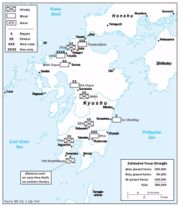
 Meanwhile, the Japanese had their own plans. Initially, they were concerned about an invasion during the summer of 1945. However, the Battle of Okinawa
went on for so long that they concluded the Allies would not be able to launch another operation before the typhoon season, during which the weather would be too risky for amphibious operations. Japanese intelligence predicted fairly closely where the invasion would take place: southern Kyūshū at Miyazaki
, Ariake Bay, and/or the Satsuma Peninsula
.
While Japan no longer had a realistic prospect of winning the war, Japan's leaders believed they could make the cost of conquering Japan too high for the Allies to accept, which would lead to some sort of armistice
rather than total defeat. The Japanese plan for defeating the invasion was called ("Operation Codename Decisive"). The Japanese had secretly constructed an underground headquarters
which could be used in the event of Allied invasion to shelter the Emperor and the Imperial General Staff.
attacks against ships involved in the invasion of Okinawa, Operation Ten-Go
, and began training pilots and assembling aircraft for the defense of Kyūshū where the Allies were likely to invade next.
The Japanese defense relied heavily on kamikaze planes. In addition to fighters and bombers, they reassigned almost all of their trainers for the mission, trying to make up in quantity what they lacked in quality. Their army and navy had more than 10,000 aircraft ready for use in July (and would have had somewhat more by October) and were planning to use almost all that could reach the invasion fleets. Ugaki also oversaw building of hundreds of small suicide boats that would also be used to attack any Allied ships that came near the shores of Kyūshū.
Fewer than 2,000 kamikaze planes launched attacks during the Battle of Okinawa, achieving approximately one hit per nine attacks. At Kyūshū, because of the more favorable circumstances (such as terrain that reduced the US's radar advantage), they hoped to get one for six by overwhelming the US defenses with large numbers of kamikaze attacks in a period of hours. The Japanese estimated that the planes would sink more than 400 ships; since they were training the pilots to target transports rather than carriers and destroyers, the casualties would be disproportionately greater than at Okinawa. One staff study estimated that the kamikazes could destroy a third to half of the invasion force before its landings.
(IJN) had ceased to be an effective fighting force. The only major Japanese warships in fighting order were six aircraft carriers, four cruisers, and one battleship, none of which could be adequately fueled. They could "sustain a force of twenty operational destroyers and perhaps forty submarines for a few days at sea."
The IJN also had about 100 Kōryū-class midget submarine
s, 250 smaller Kairyū
-class midget submarines, 400 Kaiten
manned torpedoes, and 800 Shin'yō suicide boats.
), the Japanese employed strong defenses on the beaches with little or no manpower in reserve. This tactic proved to be very vulnerable to pre-invasion shore bombardment
. Later in the war, at Peleliu
, Iwo Jima
, and Okinawa
, the Japanese switched strategy and dug in their forces in the most defensible terrain.
For the defense of Kyūshū, the Japanese took an intermediate posture, with the bulk of their defensive forces a few kilometers inland from the shore: back far enough to avoid complete exposure to naval gunnery but close enough that the Americans could not establish a secure foothold before engaging them. The counteroffensive forces were still farther back, prepared to move against whichever landing seemed to be the main effort.
In March 1945, there was only one combat division in Kyūshū. Over the next four months, the Imperial Japanese Army transferred forces from Manchuria
, Korea
, and northern Japan, while raising other forces in place. By August, they had 14 divisions and various smaller formations, including three tank brigades, for a total of 900,000 men. Although the Japanese were able to raise large numbers of new soldiers, equipping them was more difficult. By August, the Japanese Army had the equivalent of 65 divisions in the homeland but only enough equipment for 40 and only enough ammunition for 30.
The Japanese did not formally decide to stake everything on the outcome of the Battle of Kyūshū, but they concentrated their assets to such a degree that there would be little left in reserve. By one estimate, the forces in Kyūshū had 40% of all the ammunition in the Home Islands.
In addition, the Japanese had organized the Patriotic Citizens Fighting Corps, which included all healthy men aged 15 to 60 and women 17 to 40 for a total of 28 million people, for combat support and, later, combat jobs. Weapons, training, and uniforms were generally lacking: some men were armed with nothing better than muzzle-loading musket
s, longbow
s, or bamboo spears; nevertheless, they were expected to make do with what they had.
One mobilized high school girl, Yukiko Kasai, found herself issued an awl
and told, "Even killing one American soldier will do. … You must aim for the abdomen
."
—and Kyūshū was likely to be worse. To attack the ships off Okinawa, Japanese planes had to fly long distances over open water; to attack the ships off Kyūshū, they could fly overland and then short distances out to the landing fleets. Gradually, intelligence learned that the Japanese were devoting all their aircraft to the kamikaze mission and taking effective measures to conserve them until the battle. An Army estimate in May was 3,391 planes; in June, 4,862; in August, 5,911. A Navy estimate, abandoning any distinction between training and combat aircraft, in July was 8,750; in August, 10,290.
The Allies made counter-kamikaze preparations, known as the Big Blue Blanket
. This involved adding more fighter squadrons to the carriers in place of torpedo
and dive bomber
s, and converting B-17s into airborne radar pickets in manner similar to modern-day AWACS. Nimitz came up with a plan for a pre-invasion feint, sending a fleet to the invasion beaches a couple of weeks before the real invasion, to lure out the Japanese on their one-way flights, who would then find—instead of the valuable, vulnerable transports—ships loaded with anti-aircraft guns from bow to stern.
The main defense against Japanese air attacks would have come from the massive fighter forces that were being assembled in the Ryukyu Islands
. US Army Fifth
and Seventh Air Force
and US Marine air units had moved into the islands immediately after the invasion, and air strength had been increasing in preparation for the all-out assault on Japan. In preparation for the invasion, an air campaign against Japanese airfields and transportation arteries had commenced before the Japanese surrender.
had identified nine divisions in southern Kyūshū—three times the expected number. (In fact, this was still a serious underestimate of Japanese strength; see above.)
Estimated troop strength in early July was 350,000, rising to 545,000 in early August.
The build-up of Japanese troops on Kyūshū led American war planners, most importantly General George Marshall, to consider drastic changes to Olympic, or replacing it with a different plan for invasion.
. Such attacks would neutralize the Japanese tendency to fight from caves, which would increase the soldiers' exposure to gas.
Although chemical warfare had been outlawed by the Geneva Protocol
, neither the US nor Japan were signatories at the time. While the US had promised never to initiate gas warfare, Japan had used gas against the Chinese earlier in the war.
looked into the tactical use of nuclear weapon
s for the invasion of the Japanese home islands (even after the dropping of two strategic atomic bombs on Japan, Marshall did not think that the Japanese would capitulate immediately). Colonel Lyle E. Seeman reported that at least seven bombs would be available by X-Day, which could be dropped on defending forces. Seeman advised that American troops not enter an area hit by a bomb for "at least 48 hours"; the risk of nuclear fallout
was not well understood, and such a short amount of time after detonation would have resulted in substantial radiation exposure for the American troops.
Ken Nichols, the District Engineer of the Manhattan Engineer District, wrote that at the beginning of August 1945, "[p]lanning for the invasion of the main Japanese home islands had reached its final stages, and if the landings actually took place, we might supply about fifteen atomic bombs to support the troops." An air burst 1800–2000 ft (548.6–609.6 m) above the ground had been chosen for the (Hiroshima) bomb to achieve maximum blast effects, and to minimize residual radiation on the ground as it was hoped that American troops would soon occupy the city.
, northern Honshū at Sendai
, or Ominato. They also considered skipping the preliminary invasion and going directly at Tokyo. Attacking northern Honshū would have the advantage of a much weaker defense but had the disadvantage of giving up land-based air support (except the B-29s) from Okinawa.
However, Admiral Ernest King, the Chief of Naval Operations, was prepared to oppose proceeding with the invasion, with Admiral Nimitz's concurrence, which would have set off a major dispute within the US government.
Unbeknownst to the Americans, the Soviets were preparing to follow up their invasions of Sakhalin
and the Kuril Islands
with an invasion of the weakly defended island of Hokkaidō
by the end of August, which would have put pressure on the Allies to do something sooner than November. On August 15, the Japanese agreed to surrender, rendering the whole question of invasion moot.
.
Casualty estimates were based on the experience of the preceding campaigns, drawing different lessons:
Outside the government, well-informed civilians were also making guesses. Kyle Palmer, war correspondent for the Los Angeles Times
, said half a million to a million Americans would die by the end of the war. Herbert Hoover
, in a memorandums submitted to Truman and Stimson, also estimated 500,000 to 1,000,000 fatalities, and those were believed to be conservative estimates; but it is not known if Hoover discussed these specific figures in his meetings with Truman. The chief of the Army Operations division thought them "entirely too high" under "our present plan of campaign."
The Battle of Okinawa
ran up 72,000 US casualties in 82 days, of whom 12,510 were killed or missing. (This is conservative, because it excludes several thousand US soldiers who died after the battle indirectly, from their wounds.) The entire island of Okinawa is 464 sq mi (1,201.8 km²). If the US casualty rate during the invasion of Japan had been only 5% as high per unit area as it was at Okinawa, the US would still have lost 297,000 soldiers (killed or missing).
Nearly 500,000 Purple Heart
medals were manufactured in anticipation of the casualties resulting from the invasion of Japan. To the present date, all the American military casualties of the 60 years following the end of World War II
, including the Korean
and Vietnam War
s, have not exceeded that number. In 2003, there were still 120,000 of these Purple Heart medals in stock. There are so many in surplus that combat units in Iraq
and Afghanistan
are able to keep Purple Hearts on-hand for immediate award to soldiers wounded on the field.
Allies of World War II
The Allies of World War II were the countries that opposed the Axis powers during the Second World War . Former Axis states contributing to the Allied victory are not considered Allied states...
plan for the invasion of Japan
Japan
Japan is an island nation in East Asia. Located in the Pacific Ocean, it lies to the east of the Sea of Japan, China, North Korea, South Korea and Russia, stretching from the Sea of Okhotsk in the north to the East China Sea and Taiwan in the south...
near the end of World War II
World War II
World War II, or the Second World War , was a global conflict lasting from 1939 to 1945, involving most of the world's nations—including all of the great powers—eventually forming two opposing military alliances: the Allies and the Axis...
. The operation was cancelled when Japan surrendered
Surrender of Japan
The surrender of Japan in 1945 brought hostilities of World War II to a close. By the end of July 1945, the Imperial Japanese Navy was incapable of conducting operations and an Allied invasion of Japan was imminent...
after the atomic bombing
Atomic bombings of Hiroshima and Nagasaki
During the final stages of World War II in 1945, the United States conducted two atomic bombings against the cities of Hiroshima and Nagasaki in Japan, the first on August 6, 1945, and the second on August 9, 1945. These two events are the only use of nuclear weapons in war to date.For six months...
of Hiroshima
Hiroshima
is the capital of Hiroshima Prefecture, and the largest city in the Chūgoku region of western Honshu, the largest island of Japan. It became best known as the first city in history to be destroyed by a nuclear weapon when the United States Army Air Forces dropped an atomic bomb on it at 8:15 A.M...
and Nagasaki and the Soviet Union
Soviet Union
The Soviet Union , officially the Union of Soviet Socialist Republics , was a constitutionally socialist state that existed in Eurasia between 1922 and 1991....
's declaration of war against Japan. The operation had two parts: Operation Olympic and Operation Coronet. Set to begin in October 1945, Operation Olympic was intended to capture the southern third of the southernmost main Japanese island, Kyūshū
Kyushu
is the third largest island of Japan and most southwesterly of its four main islands. Its alternate ancient names include , , and . The historical regional name is referred to Kyushu and its surrounding islands....
, with the recently captured
Battle of Okinawa
The Battle of Okinawa, codenamed Operation Iceberg, was fought on the Ryukyu Islands of Okinawa and was the largest amphibious assault in the Pacific War of World War II. The 82-day-long battle lasted from early April until mid-June 1945...
island of Okinawa
Okinawa Island
Okinawa Island is the largest of the Okinawa Islands and the Ryukyu Islands of Japan, and is home to Naha, the capital of Okinawa Prefecture. The island has an area of...
to be used as a staging area. Later, in spring 1946, Operation Coronet was the planned invasion of the Kantō Plain
Kanto Plain
The ' is the largest plain in Japan located in the Kanto Region of central Honshū. The total area 17,000 sq km covers more than half of the Region extending over Tokyo, Saitama Prefecture, Kanagawa Prefecture, Chiba Prefecture, Gunma Prefecture, and Tochigi Prefecture.The northern limit borders on...
, near Tokyo
Tokyo
, ; officially , is one of the 47 prefectures of Japan. Tokyo is the capital of Japan, the center of the Greater Tokyo Area, and the largest metropolitan area of Japan. It is the seat of the Japanese government and the Imperial Palace, and the home of the Japanese Imperial Family...
, on the Japanese island of Honshū
Honshu
is the largest island of Japan. The nation's main island, it is south of Hokkaido across the Tsugaru Strait, north of Shikoku across the Inland Sea, and northeast of Kyushu across the Kanmon Strait...
. Airbases on Kyūshū captured in Operation Olympic would allow land-based air support for Operation Coronet.
Japan's geography
Geography of Japan
Japan is an island nation in East Asia comprising a stratovolcanic archipelago extending along the Pacific coast of Asia. Measured from the geographic coordinate system, Japan stretches from 24° to 46° north latitude and from 123° to 146° east longitude...
made this invasion plan obvious to the Japanese as well; they were able to predict the Allied invasion plans accurately and thus adjust their defensive plan, Operation Ketsugō, accordingly. The Japanese planned an all-out defense of Kyūshū, with little left in reserve for any subsequent defense operations. Casualty predictions varied widely but were extremely high for both sides: depending on the degree to which Japanese civilians resisted the invasion, estimates ran into the millions for Allied casualties and several times that number for Japanese casualties.
Planning
Responsibility for planning Operation Downfall fell to the U.S. commanders: Fleet Admiral Chester NimitzChester Nimitz
Fleet Admiral Chester William Nimitz, GCB, USN was a five-star admiral in the United States Navy. He held the dual command of Commander in Chief, United States Pacific Fleet , for U.S. naval forces and Commander in Chief, Pacific Ocean Areas , for U.S...
, General of the Army
General of the Army (United States)
General of the Army is a five-star general officer and is the second highest possible rank in the United States Army. A special rank of General of the Armies, which ranks above General of the Army, does exist but has only been conferred twice in the history of the Army...
Douglas MacArthur
Douglas MacArthur
General of the Army Douglas MacArthur was an American general and field marshal of the Philippine Army. He was a Chief of Staff of the United States Army during the 1930s and played a prominent role in the Pacific theater during World War II. He received the Medal of Honor for his service in the...
and the Joint Chiefs of Staff
Joint Chiefs of Staff
The Joint Chiefs of Staff is a body of senior uniformed leaders in the United States Department of Defense who advise the Secretary of Defense, the Homeland Security Council, the National Security Council and the President on military matters...
—Fleet Admirals Ernest King
Ernest King
Fleet Admiral Ernest Joseph King was Commander in Chief, United States Fleet and Chief of Naval Operations during World War II. As COMINCH, he directed the United States Navy's operations, planning, and administration and was a member of the Joint Chiefs of Staff. He was the U.S...
and William D. Leahy
William D. Leahy
Fleet Admiral William Daniel Leahy was an American naval officer, building his reputation through administration and staff work. As Chief of Naval Operations he was the senior officer in Navy, overseeing the preparations for war. After retiring from the Navy he was appointed by his close friend...
, and Generals of the Army George Marshall
George Marshall
George Catlett Marshall was an American military leader, Chief of Staff of the Army, Secretary of State, and the third Secretary of Defense...
and Hap Arnold (the latter was commander of the U.S. Army Air Forces
United States Army Air Forces
The United States Army Air Forces was the military aviation arm of the United States of America during and immediately after World War II, and the direct predecessor of the United States Air Force....
). Douglas MacArthur at the time was also being considered for promotion to a special "super rank" of General of the Armies
General of the Armies
General of the Armies of the United States, or more commonly referred to as General of the Armies, is the highest possible officer rank of the United States Army.Only two soldiers have been granted the rank of General of the Armies; John J...
, so as to be granted operational authority over other five star officers. However, the proposal to promote MacArthur was only at the level of informal discussion when World War II ended.
At the time, the development of the atomic bomb was a very closely guarded secret known only to a few top officials outside the Manhattan Project
Manhattan Project
The Manhattan Project was a research and development program, led by the United States with participation from the United Kingdom and Canada, that produced the first atomic bomb during World War II. From 1942 to 1946, the project was under the direction of Major General Leslie Groves of the US Army...
, and the initial planning for the invasion of Japan did not take its existence into consideration. As the atomic bomb became available, General Marshall envisioned using it, if sufficient numbers could be produced in time, to support the invasion.
Throughout the Pacific War
Pacific War
The Pacific War, also sometimes called the Asia-Pacific War refers broadly to the parts of World War II that took place in the Pacific Ocean, its islands, and in East Asia, then called the Far East...
, unlike the European theatre
European Theatre of World War II
The European Theatre of World War II was a huge area of heavy fighting across Europe from Germany's invasion of Poland on September 1, 1939 until the end of the war with the German unconditional surrender on May 8, 1945...
, the Allies were unable to agree on a single Commander-in-Chief
Commander-in-Chief
A commander-in-chief is the commander of a nation's military forces or significant element of those forces. In the latter case, the force element may be defined as those forces within a particular region or those forces which are associated by function. As a practical term it refers to the military...
(C-in-C). Allied command was divided into regions: by 1945, for example, Chester Nimitz was Allied C-in-C Pacific Ocean Areas
Pacific Ocean Areas
Pacific Ocean Areas was a major Allied military command in the Pacific Ocean theater of World War II. It was one of four major Allied commands during the Pacific War, and one of two United States commands in the Pacific Theater of Operations. Admiral Chester W. Nimitz of the U.S...
, while Douglas MacArthur was Supreme Allied Commander, South West Pacific Area
South West Pacific Area
South West Pacific Area was the name given to the Allied supreme military command in the South West Pacific Theatre of World War II. It was one of four major Allied commands in the Pacific theatres of World War II, during 1942–45...
. A unified command was deemed necessary for an invasion of Japan. Inter-service squabbling
Interservice rivalry
Interservice rivalry is a military term referring to rivalries that can arise between different branches of a country's armed forces, such as between a nation's land forces , naval and air forces. It also applies to the rivalries between a country's intelligence services, Central Intelligence...
over who it should be (the US Navy wanted Nimitz, but the US Army wanted MacArthur) was so serious that it threatened to derail planning. Ultimately, the Navy partially conceded, and MacArthur was to have total command of all forces, if circumstances made it necessary.
Considerations
The primary considerations that the planners had to deal with were time and casualties—how they could force Japan's surrender as quickly as possible, with as few Allied casualties as possible. Prior to the 1943 Quebec ConferenceQuebec Conference, 1943
The First Quebec Conference was a highly secret military conference held during World War II between the British, Canadian and United States governments. The conference was held in Quebec City, August 17, 1943 – August 24, 1943. It took place at the Citadelle and at the Château Frontenac. The...
, a joint British-American planning team produced a plan ("Appreciation and Plan for the Defeat of Japan") which did not call for an invasion of the Japanese home islands until 1947–1948. The American Joint Chiefs of Staff
Joint Chiefs of Staff
The Joint Chiefs of Staff is a body of senior uniformed leaders in the United States Department of Defense who advise the Secretary of Defense, the Homeland Security Council, the National Security Council and the President on military matters...
believed that prolonging the war to such an extent was dangerous for national morale. Instead, at the Quebec conference, the Combined Chiefs of Staff
Combined Chiefs of Staff
The Combined Chiefs of Staff was the supreme military command for the western Allies during World War II. It was a body constituted from the British Chiefs of Staff Committee and the American Joint Chiefs of Staff....
agreed that Japan should be forced to surrender not more than one year after Germany's surrender.
The US Navy urged the use of blockade
Blockade
A blockade is an effort to cut off food, supplies, war material or communications from a particular area by force, either in part or totally. A blockade should not be confused with an embargo or sanctions, which are legal barriers to trade, and is distinct from a siege in that a blockade is usually...
and airpower to bring about Japan's capitulation. They proposed operations to capture airbases in nearby Shanghai, China, and Korea
Korea
Korea ) is an East Asian geographic region that is currently divided into two separate sovereign states — North Korea and South Korea. Located on the Korean Peninsula, Korea is bordered by the People's Republic of China to the northwest, Russia to the northeast, and is separated from Japan to the...
, which would give the US Army Air Forces a series of forward airbases from which to bombard Japan into submission. The US Army, on the other hand, argued that such a strategy could "prolong the war indefinitely" and expend lives needlessly, and therefore that an invasion was necessary. They supported mounting a large-scale thrust directly against the Japanese homeland, with none of the side operations that the Navy had suggested. Ultimately, the Army's viewpoint won.
Physically, Japan made an imposing target, with few beaches suitable for invasion. Only Kyūshū (the southernmost island of Japan) and the beaches of the Kantō plain
Kanto region
The is a geographical area of Honshu, the largest island of Japan. The region includes the Greater Tokyo Area and encompasses seven prefectures: Gunma, Tochigi, Ibaraki, Saitama, Tokyo, Chiba, and Kanagawa. Within its boundaries, slightly more than 40 percent of the land area is the Kantō Plain....
(both southwest and southeast of Tokyo
Tokyo
, ; officially , is one of the 47 prefectures of Japan. Tokyo is the capital of Japan, the center of the Greater Tokyo Area, and the largest metropolitan area of Japan. It is the seat of the Japanese government and the Imperial Palace, and the home of the Japanese Imperial Family...
) made suitable invasion zones. The Allies decided to launch a two-stage invasion. Operation Olympic would attack southern Kyūshū. Airbases would be established, which would give cover for Operation Coronet, the attack on Tokyo Bay
Tokyo Bay
is a bay in the southern Kantō region of Japan. Its old name was .-Geography:Tokyo Bay is surrounded by the Bōsō Peninsula to the east and the Miura Peninsula to the west. In a narrow sense, Tokyo Bay is the area north of the straight line formed by the on the Miura Peninsula on one end and on...
.
Assumptions
While the geography of Japan was known, the US military planners had to estimate the defending forces that they would face. Based on intelligence available early in 1945, their assumptions included the following:- "That operations in this area will be opposed not only by the available organized military forces of the Empire, but also by a fanatically hostile population."
- "That approximately three (3) hostile divisions will be disposed in Southern KYUSHU and an additional three (3) in Northern KYUSHU at initiation of the OLYMPIC operation."
- "That total hostile forces committed against KYUSHU operations will not exceed eight (8) to ten (10) divisions and that this level will be speedily attained."
- "That approximately twenty-one (21) hostile divisions, including depot divisions, will be on HONSHU at initiation of [Coronet] and that fourteen (14) of these divisions may be employed in the KANTO PLAIN area."
- "That the enemy may withdraw his land-based air forces to the Asiatic Mainland for protection from our neutralizing attacks. That under such circumstances he can possibly amass from 2,000 to 2,500 planes in that area by exercise of rigid economy, and that this force can operate against KYUSHU landings by staging through homeland fields."
Olympic
Aircraft carrier
An aircraft carrier is a warship designed with a primary mission of deploying and recovering aircraft, acting as a seagoing airbase. Aircraft carriers thus allow a naval force to project air power worldwide without having to depend on local bases for staging aircraft operations...
s, 24 battleship
Battleship
A battleship is a large armored warship with a main battery consisting of heavy caliber guns. Battleships were larger, better armed and armored than cruisers and destroyers. As the largest armed ships in a fleet, battleships were used to attain command of the sea and represented the apex of a...
s, and 400 destroyer
Destroyer
In naval terminology, a destroyer is a fast and maneuverable yet long-endurance warship intended to escort larger vessels in a fleet, convoy or battle group and defend them against smaller, powerful, short-range attackers. Destroyers, originally called torpedo-boat destroyers in 1892, evolved from...
s and destroyer escorts. Fourteen US divisions were scheduled to take part in the initial landings. Using Okinawa as a staging base, the objective would have been to seize the southern portion of Kyūshū. This area would then be used as a further staging point to attack Honshū in Operation Coronet.
Olympic was also to include a deception
Deception
Deception, beguilement, deceit, bluff, mystification, bad faith, and subterfuge are acts to propagate beliefs that are not true, or not the whole truth . Deception can involve dissimulation, propaganda, and sleight of hand. It can employ distraction, camouflage or concealment...
plan, known as Operation Pastel
Operation Pastel
During World War II, Operation Pastel was the deception plan scheduled to protect Operation Olympic, the planned invasion of southern Japan. Pastel would have falsely portrayed a threat of an American-led invasion against ports in China via attacks on Taiwan....
. Pastel was designed to convince the Japanese that the Joint Chiefs had rejected the notion of a direct invasion and instead were going to attempt to encircle and bombard Japan. This would require capturing bases in Formosa
Taiwan
Taiwan , also known, especially in the past, as Formosa , is the largest island of the same-named island group of East Asia in the western Pacific Ocean and located off the southeastern coast of mainland China. The island forms over 99% of the current territory of the Republic of China following...
, along the Chinese coast, and in the Yellow Sea
Yellow Sea
The Yellow Sea is the name given to the northern part of the East China Sea, which is a marginal sea of the Pacific Ocean. It is located between mainland China and the Korean Peninsula. Its name comes from the sand particles from Gobi Desert sand storms that turn the surface of the water golden...
area.
The Twentieth Air Force
Twentieth Air Force
The Twentieth Air Force is a numbered air force of the United States Air Force Global Strike Command . It is headquartered at F.E. Warren Air Force Base, Wyoming.20 AF's primary mission is Intercontinental Ballistic Missile operations...
was to have continued its role as the main Allied strategic bomber
Strategic bombing
Strategic bombing is a military strategy used in a total war with the goal of defeating an enemy nation-state by destroying its economic ability and public will to wage war rather than destroying its land or naval forces...
force used against the Japanese home islands. Tactical air support was to be the responsibility of the U.S. Far East Air Forces
United States Far East Air Force
The Far East Air Force was the military aviation arm of the United States Army in the Philippines just prior to and at the beginning of World War II. Formed on 16 November 1941, FEAF was the predecessor of the Fifth Air Force of the United States Army Air Forces and United States Air...
(FEAF)—a formation which comprised the Fifth
Fifth Air Force
The Fifth Air Force is a numbered air force of the United States Air Force Pacific Air Forces . It is headquartered at Yokota Air Base, Japan....
, Seventh
Seventh Air Force
The Seventh Air Force is a numbered air force of the United States Air Force Pacific Air Forces . It is headquartered at Osan Air Base, Republic of Korea....
and Thirteenth Air Force
Thirteenth Air Force
The Thirteenth Air Force is a numbered air force of the United States Air Force Pacific Air Forces . It is headquartered at Hickam Air Force Base on the island of Oahu, Hawaii. 13 AF has never been stationed in the continental United States...
s—during the preparation for the invasion. FEAF was responsible for attacking Japanese airfields and transportation arteries on Kyūshū and Southern Honshū (e.g. the Kanmon Tunnel
Kanmon Tunnel
The Kanmon Railway Tunnel, Kanmon Roadway Tunnel, and Shin-Kanmon Tunnel are undersea tunnels crossing the Kanmon Straits between Shimonoseki, Yamaguchi and Kitakyūshū, Fukuoka in western Japan...
) and for attaining and maintaining air superiority over the beaches.
Before the main invasion, the offshore islands of Tanegashima
Tanegashima
is an island lying to the south of Kyushu, in southern Japan, and is part of Kagoshima Prefecture. The island is the second largest of the Ōsumi Islands....
, Yakushima
Yakushima
, one of the Ōsumi Islands, is an island of about 500 km² and roughly 15,000 islanders to the south of Kyūshū in Kagoshima Prefecture, Japan. The Vincennes Strait separates it from Tanegashima. The highest point on the island is Miyanoura-dake at 1,935 metres...
, and the Koshikijima Islands
Koshikijima Islands
Koshikijima Islands in the East China Sea are an island chain that belongs to the city of Satsumasendai, Kagoshima, Japan. It is located 38 km west of the port city of Ichikikushikino, Kagoshima. Kagoshima Prefecture itself exists on the island of Kyūshū.- Major islands :* Kami-Koshikijima ,...
were to be taken, starting on X-5. The invasion of Okinawa had demonstrated the value of establishing secure anchorages close at hand, for ships not needed off the landing beaches and for ships damaged by air attack.
Kyūshū was to be invaded by U.S. Sixth Army
U.S. Sixth Army
The Sixth United States Army is a field army of the United States Army.-History:It was first activated in January 1943, commanded by Lieutenant General Walter Krueger. Under the code name Alamo Force, it assumed control of the majority of US Army units involved in Operation Cartwheel, the campaign...
at three points: Miyazaki
Miyazaki, Miyazaki
is the capital city of Miyazaki Prefecture on the island of Kyūshū in Japan. Located on the coast and perforated by several rivers, Miyazaki City enjoys scenic views of both ocean and nearby, verdant mountains...
, Ariake
Ariake, Kagoshima
was a town located in Soo District, Kagoshima, Japan.On January 1, 2006 Ariake was merged with the towns of Shibushi and Matsuyama, all from Soo District, to form the new city of Shibushi and no longer exists as an independent municipality....
, and Kushikino
Kushikino, Kagoshima
was a city located in Kagoshima, Japan.On October 11, 2005 Kushikino was merged with the town of Ichiki, from Hioki District, to form the new city of Ichikikushikino....
. If a clock were drawn on a map of Kyūshū, these points would roughly correspond to 4, 5, and 7 o'clock, respectively. The 35 landing beaches were all named for automobiles: Austin
Austin Motor Company
The Austin Motor Company was a British manufacturer of automobiles. The company was founded in 1905 and merged in 1952 into the British Motor Corporation Ltd. The marque Austin was used until 1987...
, Buick
Buick
Buick is a premium brand of General Motors . Buick models are sold in the United States, Canada, Mexico, China, Taiwan, and Israel, with China being its largest market. Buick holds the distinction as the oldest active American make...
, Cadillac through Stutz
Stutz Bearcat
The Stutz Bearcat was a well-known American sports car of the pre and post World War One period.Essentially, the Bearcats were a shorter , lighter version of the standard Stutz passenger cars chassis. It was originally powered by a 390 in³, 60 horsepower straight-4 engine produced by the...
, Winton, and Zephyr
Lincoln-Zephyr
Lincoln-Zephyr was a marque for the lower priced line of luxury cars in the Lincoln line 1936-40. Lincoln-Zephyr and Mercury, introduced 1939, bridged the wide gap between Ford's V-8 De Luxe line and the exclusive Lincoln K-series cars. This served a purpose similar to Cadillac's smaller LaSalle...
. With one corps
Corps
A corps is either a large formation, or an administrative grouping of troops within an armed force with a common function such as Artillery or Signals representing an arm of service...
assigned to each landing, the invasion planners assumed that the Americans would outnumber the Japanese by roughly three to one. In early 1945, Miyazaki was virtually undefended, while Ariake with its nearby good harbor was heavily defended. Although Kushikino was weakly defended, its imposing terrain meant that the Marines
United States Marine Corps
The United States Marine Corps is a branch of the United States Armed Forces responsible for providing power projection from the sea, using the mobility of the United States Navy to deliver combined-arms task forces rapidly. It is one of seven uniformed services of the United States...
who landed there would probably have had the toughest time.
The invasion was not supposed to conquer the entire island, just the southernmost third of it, as indicated by the dashed line on the map, "general limit of northern advance". Southern Kyūshū would offer a staging ground and a valuable airbase for Operation Coronet.
Coronet
Operation Coronet, the invasion of HonshūHonshu
is the largest island of Japan. The nation's main island, it is south of Hokkaido across the Tsugaru Strait, north of Shikoku across the Inland Sea, and northeast of Kyushu across the Kanmon Strait...
at the Kantō Plain south of the capital, was to begin on "Y-Day", which was scheduled for March 1, 1946. Coronet would have been the largest amphibious operation of all time, with 25 divisions, including the floating reserve, earmarked for the initial operations. (The Overlord invasion of Normandy
Operation Overlord
Operation Overlord was the code name for the Battle of Normandy, the operation that launched the invasion of German-occupied western Europe during World War II by Allied forces. The operation commenced on 6 June 1944 with the Normandy landings...
, by comparison, had 12 divisions in the initial landings.) The U.S. First Army
U.S. First Army
The First United States Army is a field army of the United States Army. It now serves a mobilization, readiness and training command.- Establishment and World War I :...
would have invaded at Kujūkuri Beach
Kujukuri Beach
is a sandy beach located on the east coast of the Bōsō Peninsula in Chiba Prefecture, Japan. Lying within 60 km of Tokyo and being the second longest beach in Japan, it is a popular swimming and surfing destination for inhabitants of Greater Tokyo....
, on the Bōsō Peninsula
Boso Peninsula
thumb|Locationthumb|Landsat image with high-resolution data from Space Shuttle is a peninsula in Chiba prefecture on Honshū, the largest island of Japan. It forms the eastern edge of Tokyo Bay, separating it from the Pacific Ocean....
, while U.S. Eighth Army
U.S. Eighth Army
The Eighth United States Army – often unofficially abbreviated EUSA – is the commanding formation of all US Army troops in South Korea.-World War II:...
invaded at Hiratsuka
Hiratsuka, Kanagawa
is a city located in Kanagawa Prefecture, Japan. As of 2010, the city had an estimated population of 259,991 and the density of 3,830 persons per km²...
, on Sagami Bay
Sagami Bay
Sagami Bay , also known as the Sagami Gulf or Sagami Sea, lies south of Kanagawa Prefecture in Honshū, central Japan, contained within the scope of the Miura Peninsula, in Kanagawa, to the east, the Izu Peninsula, in Shizuoka Prefecture, to the west, and the Shōnan coastline to the north, while the...
. Both armies would then drive north and inland, meeting at Tokyo.
Redeployment
Olympic was to be mounted with resources already present in the Pacific, including the British Pacific FleetBritish Pacific Fleet
The British Pacific Fleet was a British Commonwealth naval force which saw action against Japan during World War II. The fleet was composed of British Commonwealth naval vessels. The BPF formally came into being on 22 November 1944...
, a Commonwealth
Commonwealth of Nations
The Commonwealth of Nations, normally referred to as the Commonwealth and formerly known as the British Commonwealth, is an intergovernmental organisation of fifty-four independent member states...
formation that included at least eighteen aircraft carriers (and providing 25% of the Allied Air Power) and four battleships. The Australian First Tactical Air Force
Australian First Tactical Air Force
The Australian First Tactical Air Force was formed on 25 October 1944 by the Royal Australian Air Force . Its purpose was to provide a mobile force of fighter and ground attack aircraft that could support Allied army and naval units fighting the Empire of Japan in the South West Pacific Area...
took part in the Philippines campaign (1944–45). These would likely have augmented US close air support
Close air support
In military tactics, close air support is defined as air action by fixed or rotary winged aircraft against hostile targets that are close to friendly forces, and which requires detailed integration of each air mission with fire and movement of these forces.The determining factor for CAS is...
units over Japan. The only major re-deployment for Olympic was Tiger Force
Tiger Force (air)
Tiger Force, also known as the Very Long Range Bomber Force, was the name given to a World War II British Commonwealth long-range heavy bomber force, formed in 1945, from squadrons serving with RAF Bomber Command in Europe, for proposed use against targets in Japan...
, a Commonwealth long range heavy bomber
Heavy bomber
A heavy bomber is a bomber aircraft of the largest size and load carrying capacity, and usually the longest range.In New START, the term "heavy bomber" is used for two types of bombers:*one with a range greater than 8,000 kilometers...
unit, made up of 10 squadrons, scheduled to be transferred from RAF Bomber Command
RAF Bomber Command
RAF Bomber Command controlled the RAF's bomber forces from 1936 to 1968. During World War II the command destroyed a significant proportion of Nazi Germany's industries and many German cities, and in the 1960s stood at the peak of its postwar military power with the V bombers and a supplemental...
in Europe to airbases on Okinawa.
If reinforcements had been needed for Olympic, they could have been provided from forces being assembled for Coronet, which would have needed the redeployment of substantial Allied forces from Europe, South Asia
South Asia
South Asia, also known as Southern Asia, is the southern region of the Asian continent, which comprises the sub-Himalayan countries and, for some authorities , also includes the adjoining countries to the west and the east...
, Australasia
Australasia
Australasia is a region of Oceania comprising Australia, New Zealand, the island of New Guinea, and neighbouring islands in the Pacific Ocean. The term was coined by Charles de Brosses in Histoire des navigations aux terres australes...
, and elsewhere. These would have included the U.S. First Army (15 divisions) and the Eighth Air Force, which were in Europe. The redeployment was complicated by the simultaneous partial demobilization of the U.S. Army, which drastically reduced the divisions' combat effectiveness, by stripping them of their most experienced officers and men.
According to U.S. historian John Ray Skates:
American planners took no note [initially] of the possibility that [non-U.S.] Allied ground troops might participate in the invasion of the Kanto Plain. The published plans indicated that assault, followup, and reserve units would all come from U.S. forces. [However, as] the Coronet plans were being refined during the [northern] summer of 1945, all the major Allied countries offered ground forces, and a debate developed at the highest levels of command over the size, mission, equipment, and support of these contingents.
The Australian government requested the inclusion of Australian Army
Australian Army
The Australian Army is Australia's military land force. It is part of the Australian Defence Force along with the Royal Australian Navy and the Royal Australian Air Force. While the Chief of Defence commands the Australian Defence Force , the Army is commanded by the Chief of Army...
units in the first wave of Olympic, but this was rejected by US commanders. Following negotiations among the western Allied powers, it was decided that a Commonwealth Corps
Commonwealth Corps
The Commonwealth Corps was the name given to a proposed British Commonwealth army formation, which was scheduled to take part in the planned Allied invasion of Japan in during 1945 and 1946. The corps was never formed however, as the Japanese surrender obviated any need for it...
, initially made up of infantry divisions from the Australian, British
British Army
The British Army is the land warfare branch of Her Majesty's Armed Forces in the United Kingdom. It came into being with the unification of the Kingdom of England and Scotland into the Kingdom of Great Britain in 1707. The new British Army incorporated Regiments that had already existed in England...
and Canadian armies would be used in Coronet. Reinforcements would have been available from those countries, as well as other parts of the Commonwealth. MacArthur blocked proposals to include an Indian Army
British Indian Army
The British Indian Army, officially simply the Indian Army, was the principal army of the British Raj in India before the partition of India in 1947...
division, because of differences in language, organization, composition, equipment, training, and doctrine. He also recommended that the corps should be organized along the lines of a US corps, should use only US equipment and logistics, and should train in the US for six months before deployment; these suggestions were accepted. A British officer, Lieutenant General Sir Charles Keightley
Charles Keightley
General Sir Charles Frederic Keightley, GCB, GBE, DSO was a senior officer in the British Army during and following World War II.-Military career:...
, had been nominated to lead the Commonwealth Corps. The Australian government questioned the appointment of an officer with no experience fighting the Japanese, and suggested that Lieutenant General Leslie Morshead
Leslie Morshead
Lieutenant General Sir Leslie James Morshead KCB, KBE, CMG, DSO, ED was an Australian soldier, teacher, businessman, and farmer, with a distinguished military career that spanned both world wars...
should be appointed. The war ended before the details of the corps were finalized.
Operation Ketsugō
Battle of Okinawa
The Battle of Okinawa, codenamed Operation Iceberg, was fought on the Ryukyu Islands of Okinawa and was the largest amphibious assault in the Pacific War of World War II. The 82-day-long battle lasted from early April until mid-June 1945...
went on for so long that they concluded the Allies would not be able to launch another operation before the typhoon season, during which the weather would be too risky for amphibious operations. Japanese intelligence predicted fairly closely where the invasion would take place: southern Kyūshū at Miyazaki
Miyazaki Prefecture
is a prefecture of Japan located on the island of Kyushu. The capital is the city of Miyazaki.- History :Historically, after the Meiji Restoration, Hyūga Province was renamed Miyazaki Prefecture....
, Ariake Bay, and/or the Satsuma Peninsula
Satsuma Peninsula
thumb|right|240px|Landsat imageThe Satsuma Peninsula is a peninsula which projects south from the southwest part of Kyūshū Island, Japan. To the west lies the East China Sea, while to the east it faces the Osumi Peninsula across Kagoshima Bay...
.
While Japan no longer had a realistic prospect of winning the war, Japan's leaders believed they could make the cost of conquering Japan too high for the Allies to accept, which would lead to some sort of armistice
Armistice
An armistice is a situation in a war where the warring parties agree to stop fighting. It is not necessarily the end of a war, but may be just a cessation of hostilities while an attempt is made to negotiate a lasting peace...
rather than total defeat. The Japanese plan for defeating the invasion was called ("Operation Codename Decisive"). The Japanese had secretly constructed an underground headquarters
Matsushiro Underground Imperial Headquarters
The was a large underground bunker complex built during the Second World War in the Matsushiro suburb of Nagano, Japan.. The facility was to be used by Emperor Hirohito, his family, and the Imperial General Headquarters to direct Japanese armed forces fighting against the Allied invasion of...
which could be used in the event of Allied invasion to shelter the Emperor and the Imperial General Staff.
Kamikaze
Admiral Matome Ugaki was recalled to Japan in February 1945 and given command of the Fifth Air Fleet on Kyūshū. The Fifth Air Fleet was assigned the task of kamikazeKamikaze
The were suicide attacks by military aviators from the Empire of Japan against Allied naval vessels in the closing stages of the Pacific campaign of World War II, designed to destroy as many warships as possible....
attacks against ships involved in the invasion of Okinawa, Operation Ten-Go
Operation Ten-Go
was the last major Japanese naval operation in the Pacific Theater of World War II. Other renderings of this operation's title in English include Operation Heaven One and Ten-ichi-gō....
, and began training pilots and assembling aircraft for the defense of Kyūshū where the Allies were likely to invade next.
The Japanese defense relied heavily on kamikaze planes. In addition to fighters and bombers, they reassigned almost all of their trainers for the mission, trying to make up in quantity what they lacked in quality. Their army and navy had more than 10,000 aircraft ready for use in July (and would have had somewhat more by October) and were planning to use almost all that could reach the invasion fleets. Ugaki also oversaw building of hundreds of small suicide boats that would also be used to attack any Allied ships that came near the shores of Kyūshū.
Fewer than 2,000 kamikaze planes launched attacks during the Battle of Okinawa, achieving approximately one hit per nine attacks. At Kyūshū, because of the more favorable circumstances (such as terrain that reduced the US's radar advantage), they hoped to get one for six by overwhelming the US defenses with large numbers of kamikaze attacks in a period of hours. The Japanese estimated that the planes would sink more than 400 ships; since they were training the pilots to target transports rather than carriers and destroyers, the casualties would be disproportionately greater than at Okinawa. One staff study estimated that the kamikazes could destroy a third to half of the invasion force before its landings.
Naval forces
By August 1945, the Imperial Japanese NavyImperial Japanese Navy
The Imperial Japanese Navy was the navy of the Empire of Japan from 1869 until 1947, when it was dissolved following Japan's constitutional renunciation of the use of force as a means of settling international disputes...
(IJN) had ceased to be an effective fighting force. The only major Japanese warships in fighting order were six aircraft carriers, four cruisers, and one battleship, none of which could be adequately fueled. They could "sustain a force of twenty operational destroyers and perhaps forty submarines for a few days at sea."
The IJN also had about 100 Kōryū-class midget submarine
Midget submarine
A midget submarine is any submarine under 150 tons, typically operated by a crew of one or two but sometimes up to 6 or 8, with little or no on-board living accommodation...
s, 250 smaller Kairyū
Kairyu class submarine
The was a class of midget submarines of the Imperial Japanese Navy, designed in 1943–1944, and produced from the beginning of 1945. These submarines were meant to meet the invading American naval forces upon their anticipated approach of Tokyo.-History:...
-class midget submarines, 400 Kaiten
Kaiten
The Kaiten were manned torpedos and suicide craft, they were used by the Imperial Japanese Navy in the final stages of World War II.-History:...
manned torpedoes, and 800 Shin'yō suicide boats.
Ground forces
In any amphibious operation, the defender has two options for defensive strategy: strong defense of the beaches or defense in depth. Early in the war (such as at TarawaBattle of Tarawa
The Battle of Tarawa, code named Operation Galvanic, was a battle in the Pacific Theater of World War II, largely fought from November 20 to November 23, 1943. It was the first American offensive in the critical central Pacific region....
), the Japanese employed strong defenses on the beaches with little or no manpower in reserve. This tactic proved to be very vulnerable to pre-invasion shore bombardment
Naval gunfire support
Naval gunfire support is the use of naval artillery to provide fire support for amphibious assault and other troops operating within their range. NGFS is one of a number of disciplines encompassed by the term Naval Fires...
. Later in the war, at Peleliu
Battle of Peleliu
The Battle of Peleliu, codenamed Operation Stalemate II, was fought between the United States and the Empire of Japan in the Pacific Theater of World War II, from September–November 1944 on the island of Peleliu, present-day Palau. U.S...
, Iwo Jima
Battle of Iwo Jima
The Battle of Iwo Jima , or Operation Detachment, was a major battle in which the United States fought for and captured the island of Iwo Jima from the Empire of Japan. The U.S...
, and Okinawa
Battle of Okinawa
The Battle of Okinawa, codenamed Operation Iceberg, was fought on the Ryukyu Islands of Okinawa and was the largest amphibious assault in the Pacific War of World War II. The 82-day-long battle lasted from early April until mid-June 1945...
, the Japanese switched strategy and dug in their forces in the most defensible terrain.
For the defense of Kyūshū, the Japanese took an intermediate posture, with the bulk of their defensive forces a few kilometers inland from the shore: back far enough to avoid complete exposure to naval gunnery but close enough that the Americans could not establish a secure foothold before engaging them. The counteroffensive forces were still farther back, prepared to move against whichever landing seemed to be the main effort.
In March 1945, there was only one combat division in Kyūshū. Over the next four months, the Imperial Japanese Army transferred forces from Manchuria
Manchuria
Manchuria is a historical name given to a large geographic region in northeast Asia. Depending on the definition of its extent, Manchuria usually falls entirely within the People's Republic of China, or is sometimes divided between China and Russia. The region is commonly referred to as Northeast...
, Korea
Korea
Korea ) is an East Asian geographic region that is currently divided into two separate sovereign states — North Korea and South Korea. Located on the Korean Peninsula, Korea is bordered by the People's Republic of China to the northwest, Russia to the northeast, and is separated from Japan to the...
, and northern Japan, while raising other forces in place. By August, they had 14 divisions and various smaller formations, including three tank brigades, for a total of 900,000 men. Although the Japanese were able to raise large numbers of new soldiers, equipping them was more difficult. By August, the Japanese Army had the equivalent of 65 divisions in the homeland but only enough equipment for 40 and only enough ammunition for 30.
The Japanese did not formally decide to stake everything on the outcome of the Battle of Kyūshū, but they concentrated their assets to such a degree that there would be little left in reserve. By one estimate, the forces in Kyūshū had 40% of all the ammunition in the Home Islands.
In addition, the Japanese had organized the Patriotic Citizens Fighting Corps, which included all healthy men aged 15 to 60 and women 17 to 40 for a total of 28 million people, for combat support and, later, combat jobs. Weapons, training, and uniforms were generally lacking: some men were armed with nothing better than muzzle-loading musket
Musket
A musket is a muzzle-loaded, smooth bore long gun, fired from the shoulder. Muskets were designed for use by infantry. A soldier armed with a musket had the designation musketman or musketeer....
s, longbow
Longbow
A longbow is a type of bow that is tall ; this will allow its user a fairly long draw, at least to the jaw....
s, or bamboo spears; nevertheless, they were expected to make do with what they had.
One mobilized high school girl, Yukiko Kasai, found herself issued an awl
Scratch awl
A scratch awl is a woodworking layout and point-making tool. It is used to scribe a line to be followed by a hand saw or chisel when making woodworking joints and other operations....
and told, "Even killing one American soldier will do. … You must aim for the abdomen
Abdomen
In vertebrates such as mammals the abdomen constitutes the part of the body between the thorax and pelvis. The region enclosed by the abdomen is termed the abdominal cavity...
."
Air threat
US military intelligence initially estimated the number of Japanese aircraft to be around 2,500. The Okinawa experience was bad: almost two fatalities and a similar number wounded per sortieSortie
Sortie is a term for deployment or dispatch of one military unit, be it an aircraft, ship, or troops from a strongpoint. The sortie, whether by one or more aircraft or vessels, usually has a specific mission....
—and Kyūshū was likely to be worse. To attack the ships off Okinawa, Japanese planes had to fly long distances over open water; to attack the ships off Kyūshū, they could fly overland and then short distances out to the landing fleets. Gradually, intelligence learned that the Japanese were devoting all their aircraft to the kamikaze mission and taking effective measures to conserve them until the battle. An Army estimate in May was 3,391 planes; in June, 4,862; in August, 5,911. A Navy estimate, abandoning any distinction between training and combat aircraft, in July was 8,750; in August, 10,290.
The Allies made counter-kamikaze preparations, known as the Big Blue Blanket
Big blue blanket
The big blue blanket was a system devised by John Thach during World War II for protecting warships from attack by Japanese kamikazes.-History and tactics:...
. This involved adding more fighter squadrons to the carriers in place of torpedo
Torpedo bomber
A torpedo bomber is a bomber aircraft designed primarily to attack ships with aerial torpedoes which could also carry out conventional bombings. Torpedo bombers existed almost exclusively prior to and during World War II when they were an important element in many famous battles, notably the...
and dive bomber
Dive bomber
A dive bomber is a bomber aircraft that dives directly at its targets in order to provide greater accuracy for the bomb it drops. Diving towards the target reduces the distance the bomb has to fall, which is the primary factor in determining the accuracy of the drop...
s, and converting B-17s into airborne radar pickets in manner similar to modern-day AWACS. Nimitz came up with a plan for a pre-invasion feint, sending a fleet to the invasion beaches a couple of weeks before the real invasion, to lure out the Japanese on their one-way flights, who would then find—instead of the valuable, vulnerable transports—ships loaded with anti-aircraft guns from bow to stern.
The main defense against Japanese air attacks would have come from the massive fighter forces that were being assembled in the Ryukyu Islands
Ryukyu Islands
The , also known as the , is a chain of islands in the western Pacific, on the eastern limit of the East China Sea and to the southwest of the island of Kyushu in Japan. From about 1829 until the mid 20th century, they were alternately called Luchu, Loochoo, or Lewchew, akin to the Mandarin...
. US Army Fifth
Fifth Air Force
The Fifth Air Force is a numbered air force of the United States Air Force Pacific Air Forces . It is headquartered at Yokota Air Base, Japan....
and Seventh Air Force
Seventh Air Force
The Seventh Air Force is a numbered air force of the United States Air Force Pacific Air Forces . It is headquartered at Osan Air Base, Republic of Korea....
and US Marine air units had moved into the islands immediately after the invasion, and air strength had been increasing in preparation for the all-out assault on Japan. In preparation for the invasion, an air campaign against Japanese airfields and transportation arteries had commenced before the Japanese surrender.
Ground threat
Through April, May, and June, Allied intelligence followed the buildup of Japanese ground forces, including five divisions added to Kyūshū, with great interest but some complacency, still projecting that in November the total for Kyūshū would be about 350,000 servicemen. That changed in July, with the discovery of four new divisions and indications of more to come. By August, the count was up to 600,000, and Magic cryptanalysisMagic (cryptography)
Magic was an Allied cryptanalysis project during World War II. It involved the United States Army's Signals Intelligence Section and the United States Navy's Communication Special Unit. -Codebreaking:...
had identified nine divisions in southern Kyūshū—three times the expected number. (In fact, this was still a serious underestimate of Japanese strength; see above.)
Estimated troop strength in early July was 350,000, rising to 545,000 in early August.
The intelligence revelations about Japanese preparations on Kyushu emerging in mid-July transmitted powerful shock waves both in the Pacific and in Washington. On 29 July, [MacArthur's intelligence chief, Major General Charles A.] Willoughby … noted first that the April estimate allowed for the Japanese capability to deploy six divisions on Kyushu, with the potential to deploy ten. "These [six] divisions have since made their appearance, as predicted," he observed, "and the end is not in sight." If not checked, this threatened "to grow to [the] point where we attack on a ratio of one (1) to one (1) which is not the recipe for victory."
The build-up of Japanese troops on Kyūshū led American war planners, most importantly General George Marshall, to consider drastic changes to Olympic, or replacing it with a different plan for invasion.
Chemical weapons
Because of its predictable wind patterns and several other factors, Japan was particularly vulnerable to gas attacksChemical warfare
Chemical warfare involves using the toxic properties of chemical substances as weapons. This type of warfare is distinct from Nuclear warfare and Biological warfare, which together make up NBC, the military acronym for Nuclear, Biological, and Chemical...
. Such attacks would neutralize the Japanese tendency to fight from caves, which would increase the soldiers' exposure to gas.
Although chemical warfare had been outlawed by the Geneva Protocol
Geneva Protocol
The Protocol for the Prohibition of the Use in War of Asphyxiating, Poisonous or other Gases, and of Bacteriological Methods of Warfare, usually called the Geneva Protocol, is a treaty prohibiting the first use of chemical and biological weapons. It was signed at Geneva on June 17, 1925 and entered...
, neither the US nor Japan were signatories at the time. While the US had promised never to initiate gas warfare, Japan had used gas against the Chinese earlier in the war.
Fear of Japanese retaliation [to chemical weapon use] lessened because by the end of the war Japan's ability to deliver gas by air or long-range guns had all but disappeared. In 1944 Ultra revealed that the Japanese doubted their ability to retaliate against United States use of gas. 'Every precaution must be taken not to give the enemy cause for a pretext to use gas,' the commanders were warned. So fearful were the Japanese leaders that they planned to ignore isolated tactical use of gas in the home islands by the US forces because they feared escalation.
Nuclear weapons
On Marshall's orders, Major General John E. HullJohn E. Hull
General John Edwin Hull was a U.S. Army general, former Vice Chief of Staff of the U.S. Army, commanded Far East Command from 1953–1955 and the U.S. Army, Pacific from 1948-1949. He served in both world wars and was a contemporary of General George Marshall and General Omar Bradley...
looked into the tactical use of nuclear weapon
Nuclear weapon
A nuclear weapon is an explosive device that derives its destructive force from nuclear reactions, either fission or a combination of fission and fusion. Both reactions release vast quantities of energy from relatively small amounts of matter. The first fission bomb test released the same amount...
s for the invasion of the Japanese home islands (even after the dropping of two strategic atomic bombs on Japan, Marshall did not think that the Japanese would capitulate immediately). Colonel Lyle E. Seeman reported that at least seven bombs would be available by X-Day, which could be dropped on defending forces. Seeman advised that American troops not enter an area hit by a bomb for "at least 48 hours"; the risk of nuclear fallout
Nuclear fallout
Fallout is the residual radioactive material propelled into the upper atmosphere following a nuclear blast, so called because it "falls out" of the sky after the explosion and shock wave have passed. It commonly refers to the radioactive dust and ash created when a nuclear weapon explodes...
was not well understood, and such a short amount of time after detonation would have resulted in substantial radiation exposure for the American troops.
Ken Nichols, the District Engineer of the Manhattan Engineer District, wrote that at the beginning of August 1945, "[p]lanning for the invasion of the main Japanese home islands had reached its final stages, and if the landings actually took place, we might supply about fifteen atomic bombs to support the troops." An air burst 1800–2000 ft (548.6–609.6 m) above the ground had been chosen for the (Hiroshima) bomb to achieve maximum blast effects, and to minimize residual radiation on the ground as it was hoped that American troops would soon occupy the city.
Alternative targets
The Joint Staff planners, taking note of the extent to which the Japanese had concentrated on Kyūshū at the expense of the rest of Japan, considered alternate places to invade such as the island of ShikokuShikoku
is the smallest and least populous of the four main islands of Japan, located south of Honshū and east of the island of Kyūshū. Its ancient names include Iyo-no-futana-shima , Iyo-shima , and Futana-shima...
, northern Honshū at Sendai
Sendai, Miyagi
is the capital city of Miyagi Prefecture, Japan, and the largest city in the Tōhoku Region. In 2005, the city had a population of one million, and was one of Japan's 19 designated cities...
, or Ominato. They also considered skipping the preliminary invasion and going directly at Tokyo. Attacking northern Honshū would have the advantage of a much weaker defense but had the disadvantage of giving up land-based air support (except the B-29s) from Okinawa.
Prospects for Olympic
General Douglas MacArthur dismissed any need to change his plans:I am certain that the Japanese air potential reported to you as accumulating to counter our OLYMPIC operation is greatly exaggerated. […] As to the movement of ground forces […] I do not credit […] the heavy strengths reported to you in southern Kyushu. […] In my opinion, there should not be the slightest thought of changing the OLYMPIC operation.
However, Admiral Ernest King, the Chief of Naval Operations, was prepared to oppose proceeding with the invasion, with Admiral Nimitz's concurrence, which would have set off a major dispute within the US government.
At this juncture, the key interaction would likely have been between Marshall and Truman. There is strong evidence that Marshall remained committed to an invasion as late as 15 August. […] But tempering Marshall's personal commitment to invasion would have been his comprehension that civilian sanction in general, and Truman's in particular, was unlikely for a costly invasion that no longer enjoyed consensus support from the armed services.
Unbeknownst to the Americans, the Soviets were preparing to follow up their invasions of Sakhalin
Sakhalin
Sakhalin or Saghalien, is a large island in the North Pacific, lying between 45°50' and 54°24' N.It is part of Russia, and is Russia's largest island, and is administered as part of Sakhalin Oblast...
and the Kuril Islands
Kuril Islands
The Kuril Islands , in Russia's Sakhalin Oblast region, form a volcanic archipelago that stretches approximately northeast from Hokkaidō, Japan, to Kamchatka, Russia, separating the Sea of Okhotsk from the North Pacific Ocean. There are 56 islands and many more minor rocks. It consists of Greater...
with an invasion of the weakly defended island of Hokkaidō
Hokkaido
, formerly known as Ezo, Yezo, Yeso, or Yesso, is Japan's second largest island; it is also the largest and northernmost of Japan's 47 prefectural-level subdivisions. The Tsugaru Strait separates Hokkaido from Honshu, although the two islands are connected by the underwater railway Seikan Tunnel...
by the end of August, which would have put pressure on the Allies to do something sooner than November. On August 15, the Japanese agreed to surrender, rendering the whole question of invasion moot.
Estimated casualties
Because the U.S. military planners assumed "that operations in this area will be opposed not only by the available organized military forces of the Empire, but also by a fanatically hostile population", high casualties were thought to be inevitable, but nobody knew with certainty how high. Several people made estimates, but they varied widely in numbers, assumptions, and purposes, which included advocating for and against the invasion. Afterwards, they were reused in the debate over the atomic bombings of Hiroshima and NagasakiDebate over the atomic bombings of Hiroshima and Nagasaki
The debate over the atomic bombings of Hiroshima and Nagasaki concerns the ethical, legal and military controversies surrounding the United States' atomic bombings of Hiroshima and Nagasaki on 6 August and 9 August 1945 at the close of the Second World War...
.
Casualty estimates were based on the experience of the preceding campaigns, drawing different lessons:
- In a letter sent to Gen. Curtis LeMayCurtis LeMayCurtis Emerson LeMay was a general in the United States Air Force and the vice presidential running mate of American Independent Party candidate George Wallace in 1968....
from Gen. Lauris NorstadLauris NorstadLauris Norstad was an American General in the United States Army Air Forces and United States Air Force.-Early life and military career:...
, when LeMay assumed command of the B-29 force on Guam, Norstad told LeMay that if an invasion took place, it would cost the US "half a million" dead. - In a study done by the Joint Chiefs of Staff in April, the figures of 7.45 casualties/1,000 man-days and 1.78 fatalities/1,000 man-days were developed. This implied that a 90-day Olympic campaign would cost 456,000 casualties, including 109,000 dead or missing. If Coronet took another 90 days, the combined cost would be 1,200,000 casualties, with 267,000 fatalities.
- A study done by Adm. Nimitz's staff in May estimated 49,000 U.S casualties in the first 30 days, including 5,000 at sea. A study done by General MacArthur's staff in June estimated 23,000 US casualties in the first 30 days and 125,000 after 120 days. When these figures were questioned by General Marshall, MacArthur submitted a revised estimate of 105,000, in part by deducting wounded men able to return to duty.
- In a conference with President Truman on June 18, Marshall, taking the Battle of LuzonBattle of LuzonThe Battle of Luzon was a land battle fought as part of the Pacific Theater of Operations of World War II by the Allied forces of the U.S., its colony The Philippines, and Mexico against forces of the Empire of Japan. The battle resulted in a U.S. and Filipino victory...
as the best model for Olympic, thought the Americans would suffer 31,000 casualties in the first 30 days (and ultimately 20% of Japanese casualties, which implied a total of 70,000 casualties). Adm. Leahy, more impressed by the Battle of Okinawa, thought the American forces would suffer a 35% casualty rate (implying an ultimate toll of 268,000). Admiral King thought that casualties in the first 30 days would fall between Luzon and Okinawa, i.e., between 31,000 and 41,000. Of these estimates, only Nimitz's included losses of the forces at sea, though kamikazes had inflicted 1.78 fatalities per kamikaze pilot in the Battle of Okinawa, and troop transports off Kyūshū would have been much more exposed.
- A study done for Secretary of WarUnited States Secretary of WarThe Secretary of War was a member of the United States President's Cabinet, beginning with George Washington's administration. A similar position, called either "Secretary at War" or "Secretary of War," was appointed to serve the Congress of the Confederation under the Articles of Confederation...
Henry Stimson's staff by William ShockleyWilliam ShockleyWilliam Bradford Shockley Jr. was an American physicist and inventor. Along with John Bardeen and Walter Houser Brattain, Shockley co-invented the transistor, for which all three were awarded the 1956 Nobel Prize in Physics.Shockley's attempts to commercialize a new transistor design in the 1950s...
estimated that conquering Japan would cost 1.7-4 million American casualties, including 400,000-800,000 fatalities, and five to ten million Japanese fatalities. The key assumption was large-scale participation by civilians in the defense of Japan.
Outside the government, well-informed civilians were also making guesses. Kyle Palmer, war correspondent for the Los Angeles Times
Los Angeles Times
The Los Angeles Times is a daily newspaper published in Los Angeles, California, since 1881. It was the second-largest metropolitan newspaper in circulation in the United States in 2008 and the fourth most widely distributed newspaper in the country....
, said half a million to a million Americans would die by the end of the war. Herbert Hoover
Herbert Hoover
Herbert Clark Hoover was the 31st President of the United States . Hoover was originally a professional mining engineer and author. As the United States Secretary of Commerce in the 1920s under Presidents Warren Harding and Calvin Coolidge, he promoted partnerships between government and business...
, in a memorandums submitted to Truman and Stimson, also estimated 500,000 to 1,000,000 fatalities, and those were believed to be conservative estimates; but it is not known if Hoover discussed these specific figures in his meetings with Truman. The chief of the Army Operations division thought them "entirely too high" under "our present plan of campaign."
The Battle of Okinawa
Battle of Okinawa
The Battle of Okinawa, codenamed Operation Iceberg, was fought on the Ryukyu Islands of Okinawa and was the largest amphibious assault in the Pacific War of World War II. The 82-day-long battle lasted from early April until mid-June 1945...
ran up 72,000 US casualties in 82 days, of whom 12,510 were killed or missing. (This is conservative, because it excludes several thousand US soldiers who died after the battle indirectly, from their wounds.) The entire island of Okinawa is 464 sq mi (1,201.8 km²). If the US casualty rate during the invasion of Japan had been only 5% as high per unit area as it was at Okinawa, the US would still have lost 297,000 soldiers (killed or missing).
Nearly 500,000 Purple Heart
Purple Heart
The Purple Heart is a United States military decoration awarded in the name of the President to those who have been wounded or killed while serving on or after April 5, 1917 with the U.S. military. The National Purple Heart Hall of Honor is located in New Windsor, New York...
medals were manufactured in anticipation of the casualties resulting from the invasion of Japan. To the present date, all the American military casualties of the 60 years following the end of World War II
World War II
World War II, or the Second World War , was a global conflict lasting from 1939 to 1945, involving most of the world's nations—including all of the great powers—eventually forming two opposing military alliances: the Allies and the Axis...
, including the Korean
Korean War
The Korean War was a conventional war between South Korea, supported by the United Nations, and North Korea, supported by the People's Republic of China , with military material aid from the Soviet Union...
and Vietnam War
Vietnam War
The Vietnam War was a Cold War-era military conflict that occurred in Vietnam, Laos, and Cambodia from 1 November 1955 to the fall of Saigon on 30 April 1975. This war followed the First Indochina War and was fought between North Vietnam, supported by its communist allies, and the government of...
s, have not exceeded that number. In 2003, there were still 120,000 of these Purple Heart medals in stock. There are so many in surplus that combat units in Iraq
Iraq
Iraq ; officially the Republic of Iraq is a country in Western Asia spanning most of the northwestern end of the Zagros mountain range, the eastern part of the Syrian Desert and the northern part of the Arabian Desert....
and Afghanistan
Afghanistan
Afghanistan , officially the Islamic Republic of Afghanistan, is a landlocked country located in the centre of Asia, forming South Asia, Central Asia and the Middle East. With a population of about 29 million, it has an area of , making it the 42nd most populous and 41st largest nation in the world...
are able to keep Purple Hearts on-hand for immediate award to soldiers wounded on the field.
External links
- Allen, Thomas B., "Operation Downfall". Houghton Mifflin Reader's Companion to Military History.
- Bauer, K. JackK. Jack BauerKarl Jack Bauer , was one of the founders of the North American Society for Oceanic History and a well-known naval historian. NASOH’s K...
, "Operation Downfall: Olympic, Coronet; World War II in the Pacific, The Invasion of Japan". ww2pacific.com. - Bauer, Jack & Coox, Alvin D., "OLYMPIC VS KETSU-GO"; Marine Corps Gazette, August 1965, Vol. 49, No. 8.
- Giangreco, Dennis M., "Casualty Projections for the U.S. Invasions of Japan, 1945–1946: Planning and Policy Implications"; Journal of Military History (July 1997)
- Giangreco, Dennis M., Transcript of "Operation Downfall: US Plans and Japanese Counter-measures". US Army Command and General Staff College, 16 February 1998.
- Hoyt, Austin, American ExperienceAmerican ExperienceAmerican Experience is a television program airing on the Public Broadcasting Service Public television stations in the United States. The program airs documentaries, many of which have won awards, about important or interesting events and people in American history...
: Victory in the Pacific; PBSPublic Broadcasting ServiceThe Public Broadcasting Service is an American non-profit public broadcasting television network with 354 member TV stations in the United States which hold collective ownership. Its headquarters is in Arlington, Virginia....
documentary. - Japanese Monograph No. 23, "Waiting for the invasion" (notes on Japanese preparations for an American invasion)
- MacEachin, Douglas J., "The Final Months of the War With Japan: Signals Intelligence, U.S. Invasion Planning, and the A-Bomb Decision"; CIA Center for the Study of Intelligence, 1998.
- Pearlman, Michael D., "Unconditional Surrender, Demobilization, and the Atomic Bomb"; Combat Studies Institute, U.S. Army Command and General Staff College, 1996.
- White, H.V., "The Japanese Plans for the Defense of Kyushu"; 31 December 1945. (link to PDF)