
All Topics  
Articles of Confederation


Articles of Confederation


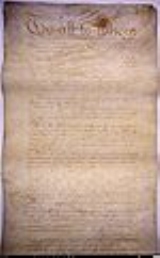
The Articles of Confederation and Perpetual Union, also the Articles of Confederation, was the governing constitution
A constitution is a system, often codified as a written document, which establishes the rules and principles by which an org...
 of the alliance of thirteen independent and sovereign states styled "United States of America
The United States of America, also known as the United States, the U.S., the U.S.A., and America, is...
." The Article's ratification (proposed in 1777) was completed in 1781, legally uniting the states by compact into the "United States of America" as a union with a confederation
A confederation is an association of sovereign states or communities, usually created by treaty but often later adopting a c...
 government. Under the Articles (and the succeeding Constitution) the states retained sovereignty over all governmental functions not specifically deputed to the central government.

The final draft of the Articles was written in the summer of 1777 and adopted by the Second Continental Congress
The Second Continental Congress was a body of representatives appointed by the legislatures of several British North America...
 on November 15, 1777 in York, Pennsylvania
York, known as the White Rose City, is a city located in south-central Pennsylvania....
 after a year of debate. In practice the final draft of the Articles served as the de facto
De facto is a Latin expression that means "in fact" or "in practice"....
system of government used by the Congress ("the United States in Congress assembled") until it became de jure
De jure is an expression that means "based on law" or "by the jury", to be closer to the term, as contrasted with de ...
by final ratification on March 1, 1781; at which point Congress became the Congress of the Confederation
The Congress of the Confederation or the United States in Congress Assembled was a body of representatives appointed b...
.


Discussion
Ask a question about 'Articles of Confederation'
Start a new discussion about 'Articles of Confederation'
Answer questions from other users
Full Discussion Forum


Recent Posts


Timeline

1777   American Revolutionary War: After 16 months of debate, the Continental Congress approves the Articles of Confederation in the temporary American capital at York, Pennsylvania.

1777   Articles of Confederation submitted to the states for ratification.

1778   South Carolina becomes the first state to ratify the Articles of Confederation.

1781   Articles of Confederation ratified by 13th state, Maryland.

1781   American Continental Congress implements the Articles of Confederation.

1787   In Philadelphia, Pennsylvania, delegates begin to convene a Constitutional Convention intended to amend the Articles of Confederation. However, a new Constitution for the United States was eventually produced. George Washington presided over the Convention.


Encyclopedia


The Articles of Confederation and Perpetual Union, also the Articles of Confederation, was the governing constitution
Constitution Summary

A constitution is a system, often codified as a written document, which establishes the rules and principles by which an org...
 of the alliance of thirteen independent and sovereign states styled "United States of America
United States

The United States of America, also known as the United States, the U.S., the U.S.A., and America, is...
." The Article's ratification (proposed in 1777) was completed in 1781, legally uniting the states by compact into the "United States of America" as a union with a confederation
Confederation

A confederation is an association of sovereign states or communities, usually created by treaty but often later adopting a c...
 government. Under the Articles (and the succeeding Constitution) the states retained sovereignty over all governmental functions not specifically deputed to the central government.

The final draft of the Articles was written in the summer of 1777 and adopted by the Second Continental Congress
Second Continental Congress

The Second Continental Congress was a body of representatives appointed by the legislatures of several British North America...
 on November 15, 1777 in York, Pennsylvania
York, Pennsylvania

York, known as the White Rose City, is a city located in south-central Pennsylvania....
 after a year of debate. In practice the final draft of the Articles served as the de facto
De facto

De facto is a Latin expression that means "in fact" or "in practice"....
system of government used by the Congress ("the United States in Congress assembled") until it became de jure
De jure

De jure is an expression that means "based on law" or "by the jury", to be closer to the term, as contrasted with de ...
by final ratification on March 1, 1781; at which point Congress became the Congress of the Confederation
Congress of the Confederation

The Congress of the Confederation or the United States in Congress Assembled was a body of representatives appointed b...
. The Articles set the rules for operations of the "United States" confederation. The confederation was capable of making war, negotiating diplomatic agreements, and resolving issues regarding the western territories; it could mint coins and borrow inside and outside the United States. An important element of the Articles was that Article XIII stipulated that "their provisions shall be inviolably observed by every state" and "the Union shall be perpetual
Perpetual Union

A Perpetual Union of the 13 American states was a key element of the Articles of Confederation and Perpetual Union....
".

The Articles were created by the chosen representatives of the states in the Second Continental Congress out of a perceived need to have "a plan of confederacy for securing the freedom, sovereignty, and independence of the United States." Although serving a crucial role in the victory in the American Revolutionary War
American Revolutionary War

The American Revolutionary War , also known as the American War of Independence, was a war between Great Britain and r...
, a group of reformers, known as "federalists", felt that the Articles lacked the necessary provisions for a sufficiently effective government. Fundamentally, a federation
Federation

A federation is a union comprised of a number of partially self-governing states or regions united by a central government....
 was sought to replace the confederation
Confederation

A confederation is an association of sovereign states or communities, usually created by treaty but often later adopting a c...
. The key criticism by those who favored a more powerful central state
State

A state is a set of institutions that possess the authority to make the rules that govern the people in one or more societie...
 (i.e. the federalists) was that the government (i.e. the Congress of the Confederation
Congress of the Confederation

The Congress of the Confederation or the United States in Congress Assembled was a body of representatives appointed b...
) lacked taxing authority; it had to request funds from the states. Also various federalist factions wanted a government that could impose uniform tariffs, give land grants, and assume responsibility for unpaid state war debts ("assumption".) Another criticism of the Articles was that they did not strike the right balance between large and small states in the legislative decision making process. Due to its one-state, one-vote plank, the larger states were expected to contribute more but had only one vote. The Articles were replaced by the United States Constitution
United States Constitution

The United States Constitution is the supreme law of the United States of America....
.

Background

The political push for the colonies to increase cooperation began in the French and Indian Wars
French and Indian Wars Summary

The French and Indian Wars is a name used in the United States for a series of conflicts in North America that represented t...
 in the mid 1750s. The opening of the American Revolutionary War
American Revolutionary War

The American Revolutionary War , also known as the American War of Independence, was a war between Great Britain and r...
 in 1775 induced the various states to cooperate in seceding from the British Empire
British Empire Overview

The British Empire was the most extensive empire in world history and for a substantial time was not only a major power but ...
. The Second Continental Congress
Second Continental Congress

The Second Continental Congress was a body of representatives appointed by the legislatures of several British North America...
 starting 1775 acted as the confederation organ that ran the war. Congress presented the Articles for enactment by the states in 1777, while prosecuting the American Revolutionary war against the Kingdom of Great Britain
Kingdom of Great Britain

Kingdom of Great Britain| align="center" colspan="2"|...
.

Ratification

Congress began to move for ratification of the Articles in 1777:

The articles can always be candidly reviewed under a sense of the difficulty of combining in one general system the various sentiments and interests of a continent divided into so many sovereign and independent communities, under a conviction of the absolute necessity of uniting all our councils and all our strength, to maintain and defend our common liberties...


The document could not become officially effective until it was ratified by all of the thirteen colonies. The first state to ratify was Virginia
Virginia

The Commonwealth of Virginia is one of the original thirteen colonies of the United States that revolted against British ru...
 on December 16, 1777. The process dragged on for several years, stalled by the refusal of some states to rescind their claims to land in the West. Maryland
Maryland

Maryland , is a Mid-Atlantic state located on the East Coast of the United States and is classified by the U.S....
 was the last holdout; it refused to go along until Virginia
Virginia

The Commonwealth of Virginia is one of the original thirteen colonies of the United States that revolted against British ru...
 and New York
New York Overview

New York is a state in the northeastern United States....
 agreed to cede their claims in the Ohio River
Ohio River

The Ohio River is a principal tributary of the Mississippi River....
 valley. A little over three years passed before Maryland's ratification on March 1, 1781.
The Article today is located in a Washington D.C. vault.

Article summaries

Even though the Articles of Confederation and the Constitution were established by many of the same people, the two documents were very different. The original five-paged Articles contained thirteen articles, a conclusion, and a signatory section. The following list contains short summaries of each of the thirteen articles.

  1. Establishes the name of the confederation as "The United States of America."
  2. Asserts the precedence of the separate states over the confederation government, i.e. "Each state retains its sovereignty, freedom, and independence, and every power, jurisdiction, and right, which is not by this Confederation expressly delegated."
  3. Establishes the United States as a league of states united ". . . for their common defense, the security of their liberties, and their mutual and general welfare, binding themselves to assist each other, against all force offered to, or attacks made upon them . . . ."
  4. Establishes freedom of movement
    Freedom of movement

    Freedom of movement, mobility rights or the right to travel is a human rights concept which is respected in the ...
    –anyone can pass freely between states, excluding "paupers, vagabonds
    Vagabond (person)

    A vagabond is a itinerant person. Such people can be tramps, rogues, hobos or schnorrers....
    , and fugitive
    Fugitive

    A fugitive is a person who is fleeing from custody, whether it be from a government arrest, government or non-government que...
    s from justice." All people are entitled to the rights established by the state into which he travels. If a crime is committed in one state and the perpetrator flees to another state, he will be extradited
    Extradition

    Extradition is the official process by which one nation or state requests and obtains from another nation or state the surre...
     to and tried in the state in which the crime was committed.
  5. Allocates one vote in the Congress of the Confederation
    Congress of the Confederation

    The Congress of the Confederation or the United States in Congress Assembled was a body of representatives appointed b...
     (United States in Congress Assembled) to each state, which was entitled to a delegation of between two and seven members. Members of Congress were appointed by state legislatures; individuals could not serve more than three out of any six years.
  6. Only the central government is allowed to conduct foreign relations
    Foreign relations

    For more information on foreign relations, see one of the following links:...
     and to declare war
    Declaration of war

    A declaration of war is a formal declaration issued by a national government indicating that a state of war exists between t...
    . No states may have navies or standing armies, or engage in war, without permission of Congress (although the state militia
    Militia Summary

    A militia is a group of citizens organized to provide paramilitary service....
    s are encouraged).
  7. When an army is raised for common defense, colonels and military ranks below colonel will be named by the state legislatures.
  8. Expenditures by the United States will be paid by funds raised by state legislatures, and apportioned to the states based on the real property values of each.
  9. Defines the powers of the central government: to declare war, to set weights and measures (including coins), and for Congress to serve as a final court for disputes between states.
  10. Defines a Committee of the States
    Committee of the States

    The Committee of the States was an arm of the United States government, under the Articles of Confederation....
     to be a government when Congress is not in session.
  11. Requires nine states to approve the admission of a new state into the confederacy; pre-approves Canada
    Province of Quebec (1763-1791)

    Province of QuebecGreat Britain acquired Canada by the Treaty of Paris when King Louis XV of France and his advisors chose ...
    , if it applies for membership.
  12. Reaffirms that the Confederation accepts war debt incurred by Congress before the Articles.
  13. Declares that the Articles are perpetual, and can only be altered by approval of Congress with ratification by all the state legislatures.


Still at war with the Kingdom of Great Britain
Kingdom of Great Britain

Kingdom of Great Britain| align="center" colspan="2"|...
, the colonists were reluctant to establish another powerful national government. Jealously guarding their new independence, members of the Continental Congress created a loosely-structured unicameral legislature that protected the liberty of the individual states. While calling on Congress to regulate military and monetary affairs, for example, the Articles of Confederation provided no mechanism to force the states to comply with requests for troops or revenue. At times, this left the military in a precarious position, as George Washington
George Washington

George Washington commanded the American colonies' Continental Army during the American Revolutionary War , and was the fir...
 wrote in a 1781 letter to the governor of Massachusetts
Massachusetts

The Commonwealth of Massachusetts is a state in the New England region of the northeastern United States....
, John Hancock
John Hancock

Joseph Raymond McCarthy was a Republican Senator from the U.S....
.


The end of the war

The Treaty of Paris (1783)
Treaty of Paris (1783)

The Treaty of Paris of 1783, signed on September 3 1783, and ratified by the U.S....
, which ended hostilities with Great Britain, languished in Congress for months because state representatives failed to attend sessions of the national legislature. Yet Congress had no power to enforce attendance. Writing to George Clinton in September 1783, George Washington complained:

Congress have come to no determination yet respecting the Peace Establishment nor am I able to say when they will. I have lately had a conference with a Committee on this subject, and have reiterated my former opinions, but it appears to me that there is not a sufficient representation to discuss Great National points.

Function

The Articles supported the Congressional direction of the Continental Army
Continental Army

The Continental Army was the unified command structure of the thirteen colonies fighting Great Britain during the American R...
, and allowed the 13 states to present a unified front when dealing with the European powers. As a tool to build a centralized war-making government, they were largely a failure, but since guerrilla warfare was an effective strategy in a war against the British Empire's army, this "failure" succeeded in winning independence.
Under the articles, Congress could make decisions, but had no power to enforce them. There was a requirement for unanimous approval before any modifications could be made to the Articles. Because the majority of lawmaking rested with the states, the central government was also kept limited.

Congress was denied the power of taxation: it could only request money from the states. The states did not generally comply with the requests in full, leaving the confederation chronically short of funds. Congress was also denied the power to regulate commerce, and as a result, the states fought over trade as well. The states and the national congress had both incurred debts during the war, and how to pay the debts became a major issue. Some states paid off their debts; however, the centralizers favored federal assumption of states' debts.

Nevertheless, the Congress of the Confederation
Congress of the Confederation

The Congress of the Confederation or the United States in Congress Assembled was a body of representatives appointed b...
 did take two actions with lasting impact. The Land Ordinance of 1785
Land Ordinance of 1785

The Land Ordinance of 1785 was adopted by the United States Congress on May 20, 1785....
 established the general land survey and ownership provisions used throughout later American expansion. The Northwest Ordinance
Northwest Ordinance

The Northwest Ordinance was an act of the Continental Congress of the United States passed on July 13, 1787 under the Articl...
 of 1787 noted the agreement of the original states to give up western land claims
State cessions Summary

The state cessions are those areas of the United States that the separate states ceded to the federal government in the late...
 and cleared the way for the entry of new states.

Once the war was won, the Continental Army
Continental Army

The Continental Army was the unified command structure of the thirteen colonies fighting Great Britain during the American R...
 was largely disbanded. A very small national force was maintained to man frontier forts and protect against Indian attacks. Meanwhile, each of the states had an army (or militia), and 11 of them had navies. The wartime promises of bounties and land grants to be paid for service were not being met. In 1783, Washington
George Washington

George Washington commanded the American colonies' Continental Army during the American Revolutionary War , and was the fir...
 defused the Newburgh conspiracy
Newburgh conspiracy

The Newburgh Conspiracy was a plot hatched in 1783 near the end of the American Revolutionary War led by General Horatio Gat...
, but riots by unpaid Pennsylvania veterans forced the Congress to leave Philadelphia temporarily.

Signatures

The Second Continental Congress approved the Articles for distribution to the states on November 15 1777. A copy was made for each state and one was kept by the Congress
Facts About Continental Congress

The Continental Congress is the label given to three successive bodies of representatives of the inhabitants of the Thirteen...
. The copies sent to the states for ratification were unsigned, and a cover letter had only the signatures of Henry Laurens
Henry Laurens

Henry Laurens was an American merchant and rice planter from South Carolina who became a political leader during the Revolu...
 and Charles Thomson
Charles Thomson Overview

Charles Thomson served as the secretary of the Continental Congress through its entirety....
, who were the President
President of the Continental Congress

The President of the Continental Congress was the presiding officer of the Continental Congress....
 and Secretary to the Congress.

But, the Articles at that time were unsigned, and the date was blank. Congress began the signing process by examining their copy of the Articles on June 27 1778. They ordered a final copy prepared (the one in the National Archives), and that delegates should inform the secretary of their authority for ratification.

On July 9, 1778, the prepared copy was ready. They dated it, and began to sign. They also requested each of the remaining states to notify its delegation when ratification was completed. On that date, delegates present from New Hampshire
New Hampshire

The State of New Hampshire is a state in the New England region of the northeastern United States....
, Massachusetts
Massachusetts

The Commonwealth of Massachusetts is a state in the New England region of the northeastern United States....
, Rhode Island
Rhode Island

The State of Rhode Island and Providence Plantations is the smallest state by land area in the United States, and the state...
, Connecticut
Connecticut

Connecticut is a state in the New England region of the United States, located in the northeastern part of the country....
, New York
New York

New York is a state in the northeastern United States....
, Pennsylvania
Pennsylvania

The Commonwealth of Pennsylvania is a state in the northeastern part of the United States....
, Virginia
Virginia

The Commonwealth of Virginia is one of the original thirteen colonies of the United States that revolted against British ru...
 and South Carolina
South Carolina

South Carolina is a state in the Southern region of the United States....
 signed the Articles to indicate that their states had ratified. New Jersey
New Jersey

New Jersey is a state in the Mid-Atlantic and Northeastern regions of the United States....
, Delaware
Delaware

Delaware is one of five Middle Atlantic States in the United States of America.ography...
 and Maryland
Maryland

Maryland , is a Mid-Atlantic state located on the East Coast of the United States and is classified by the U.S....
 could not, since their states had not ratified. North Carolina
Facts About North Carolina

North Carolina is a state in the Southeastern United States....
 and Georgia
Georgia (U.S. state)

For the country, see Georgia . For other uses, see Georgia ....
 also didn't sign that day, since their delegations were absent.

After the first signing, some delegates signed at the next meeting they attended. For example, John Wentworth of New Hampshire added his name on August 8. John Penn was the first of North Carolina's delegates to arrive (on July 10), and the delegation signed the Articles on July 21 1778.

The other states had to wait until they ratified the Articles and notified their Congressional delegation. Georgia signed on July 24, New Jersey on November 26, and Delaware on February 12 1779. Maryland refused to ratify the Articles until every state had ceded its western land claims.


On February 2, 1781, the much-awaited decision was taken by the Maryland General Assembly
Maryland General Assembly

The Maryland General Assembly is the state legislature of the U.S....
 in Annapolis. As the last piece of business during the afternoon Session, "among engrossed Bills" was "signed and sealed by Governor Thomas Sim Lee
Thomas Sim Lee

Thomas Sim Lee was an American planter and statesman of Frederick County, Maryland....
 in the Senate Chamber, in the presence of the members of both Houses… an Act to empower the delegates of this state in Congress to subscribe and ratify the articles of confederation" and perpetual union among the states. The Senate then adjourned "to the first Monday in August next." The decision of Maryland to ratify the Articles was reported to the Continental Congress on February 12. The formal signing of the Articles by the Maryland delegates took place in Philadelphia at noon time on March 1, 1781 and was celebrated in the afternoon. With these events, the Articles entered into force and the United States
United States

The United States of America, also known as the United States, the U.S., the U.S.A., and America, is...
 came into being as a united, sovereign and national state.

Congress had debated the Articles for over a year and a half, and the ratification process had taken nearly three and a half years. Many participants in the original debates were no longer delegates, and some of the signers had only recently arrived. The Articles of Confederation and Perpetual Union were signed by a group of men who were never present in the Congress at the same time.

The signers and the states they represented were:
  • New Hampshire
    New Hampshire

    The State of New Hampshire is a state in the New England region of the northeastern United States....
    : Josiah Bartlett
    Josiah Bartlett

    Josiah Bartlett, was an American physician and statesman who, as a delegate to the Continental Congress for New Hampshire, s...
     and John Wentworth Jr.
    John Wentworth Jr.

    John Wentworth, Jr. was a lawyer who served as a delegate to the Continental Congress for New Hampshire and a signer of the ...
  • Massachusetts Bay
    Massachusetts

    The Commonwealth of Massachusetts is a state in the New England region of the northeastern United States....
    : John Hancock
    John Hancock

    Joseph Raymond McCarthy was a Republican Senator from the U.S....
    , Samuel Adams
    Samuel Adams

    Samuel Adams was the chief Massachusetts leader of the Patriot cause leading to the American Revolution....
    , Elbridge Gerry
    Elbridge Gerry

    Admiral of the Fleet Louis Francis Albert Victor Nicholas Mountbatten, 1st Earl Mountbatten of Burma, KG, GCB, OM, GCSI, GC...
    , Francis Dana
    Francis Dana

    Francis Dana was an American lawyer, jurist, and statesman from Massachusetts....
    , James Lovell
    James Lovell (delegate)

    James Lovell was an American educator and statesman from Boston, Massachusetts....
    , and Samuel Holten
    Samuel Holten

    Samuel Holten was an American physician and statesman from Danvers, Massachusetts....
  • Rhode Island and Providence Plantations
    Rhode Island

    The State of Rhode Island and Providence Plantations is the smallest state by land area in the United States, and the state...
    : William Ellery
    William Ellery

    William Ellery, was a signer of the United States Declaration of Independence as a representative of Rhode Island....
    , Henry Marchant, and John Collins
    John Collins (delegate)

    John Collins was an American statesman from Newport, Rhode Island....
  • Connecticut
    Connecticut

    Connecticut is a state in the New England region of the United States, located in the northeastern part of the country....
    : Roger Sherman
    Roger Sherman

    Roger Sherman, was the only person to have signed all four basic documents of American sovereignty: the Continental Associat...
    , Samuel Huntington
    Samuel Huntington (statesman)

    Samuel Huntington was an American jurist, statesman, and revolutionary leader from Connecticut....
    , Oliver Wolcott
    Oliver Wolcott

    Oliver Wolcott, was a signer of the United States' Declaration of Independence as a representative of Connecticut....
    , Titus Hosmer
    Titus Hosmer

    Titus Hosmer was an American lawyer from Middletown, Connecticut....
    , and Andrew Adams
    Andrew Adams (congressman)

    Andrew Adams was an American lawyer, jurist, and political leader in Litchfield, Connecticut during the Revolutionary War....
  • New York
    New York

    New York is a state in the northeastern United States....
    : James Duane
    James Duane

    James Duane was a lawyer, jurist, and revolutionary leader from New York....
    , Francis Lewis
    Francis Lewis

    Francis Lewis, was a signer of the United States Declaration of Independence as a representative of New York....
    , William Duer
    William Duer (1747-1799)

    William Duer was an American lawyer, developer, and speculator from New York City....
    , and Gouverneur Morris
    Gouverneur Morris

    Gouverneur Morris was an American statesman who represented Pennsylvania in the Constitutional Convention of 1787 and was au...
  • New Jersey
    New Jersey

    New Jersey is a state in the Mid-Atlantic and Northeastern regions of the United States....
    : John Witherspoon
    John Witherspoon

    Dr. John Witherspoon, was a signer of the United States Declaration of Independence as a representative of New Jersey....
     and Nathaniel Scudder
    Nathaniel Scudder

    Nathaniel Scudder was an American physician and patriot leader during the Revolutionary War....
  • Pennsylvania
    Pennsylvania

    The Commonwealth of Pennsylvania is a state in the northeastern part of the United States....
    : Robert Morris
    Robert Morris (merchant)

    Robert Morris, Jr. was an American merchant and a signatory to the United States Declaration of Independence, the Articles o...
    , Daniel Roberdeau
    Daniel Roberdeau

    Daniel Roberdeau was an American merchant in Philadelphia, Pennsylvania....
    , Jonathan Bayard Smith
    Jonathan Bayard Smith

    Jonathan Bayard Smith was an American merchant from Philadelphia, Pennsylvania....
    , William Clingan
    William Clingan

    William Clingan was a delegate in the Continental Congress for Pennsylvania from 1777 to 1779....
    , and Joseph Reed
    Joseph Reed (jurist)

    Joseph Reed was a lawyer and jurist who lived and worked in Philadelphia, Pennsylvania....
  • Delaware
    Delaware

    Delaware is one of five Middle Atlantic States in the United States of America.ography...
    : Thomas McKean
    Thomas McKean

    Thomas McKean was an American lawyer and politician from New Castle, in New Castle County, Delaware and Philadelphia, Penn...
    , John Dickinson
    John Dickinson (delegate)

    John Dickinson was an American lawyer and politician from Jones Neck in St....
    , and Nicholas Van Dyke
    Nicholas Van Dyke (governor)

    Nicholas Van Dyke, Sr. was an American lawyer and politician from New Castle, in New Castle County, Delaware....
  • Maryland
    Maryland

    Maryland , is a Mid-Atlantic state located on the East Coast of the United States and is classified by the U.S....
    : John Hanson
    John Hanson

    John Hanson was a delegate to the Continental Congress from Maryland....
     and Daniel Carroll
    Daniel Carroll

    Daniel Carroll was a politician and one of the Founding Fathers of the United States....
  • Virginia
    Virginia

    The Commonwealth of Virginia is one of the original thirteen colonies of the United States that revolted against British ru...
    : Richard Henry Lee
    Richard Henry Lee

    Richard Henry Lee was an American who served as the sixth President of the United States in Congress assembled under the Ar...
    , John Banister
    John Banister

    John Banister was an American lawyer and an American Revolutionary War patriot from Petersburg, Virginia, son of John Banist...
    , Thomas Adams
    Thomas Adams (politician)

    Thomas Adams was a politician and businessman from Virginia....
    , John Harvie
    John Harvie Summary

    John Harvie was an American lawyer and builder from Virginia....
    , and Francis Lightfoot Lee
    Francis Lightfoot Lee

    Francis Lightfoot Lee, was a signer of the United States Declaration of Independence as a representative of Virginia....
  • North Carolina
    North Carolina

    North Carolina is a state in the Southeastern United States....
    : John Penn
    John Penn (delegate)

    John Penn, was a signer of the United States Declaration of Independence as a representative of North Carolina....
    , Cornelius Harnett
    Cornelius Harnett

    Cornelius Harnett was an American merchant, farmer, and statesman from Wilmington, North Carolina....
    , and John Williams
    John Williams (delegate) Summary

    John Williams was a signer of the United States' Articles of Confederation....
  • South Carolina
    South Carolina

    South Carolina is a state in the Southern region of the United States....
    : Henry Laurens
    Facts About Henry Laurens

    Henry Laurens was an American merchant and rice planter from South Carolina who became a political leader during the Revolu...
    , William Henry Drayton
    William Henry Drayton

    Other notable men have similar names, see: William Drayton....
    , John Mathews
    John Mathews

    John Mathews was an American lawyer from Charleston, South Carolina....
    , Richard Hutson
    Richard Hutson

    Richard Hutson was an American lawyer, judge, and politician from Charleston, South Carolina....
    , and Thomas Heyward Jr.
  • Georgia
    Georgia (U.S. state)

    For the country, see Georgia . For other uses, see Georgia ....
    : John Walton
    John Walton (1738-1783)

    John Walton was a Georgia delegate to the Continental Congress....
    , Edward Telfair
    Facts About Edward Telfair

    Edward Telfair was governor of the state of Georgia in 1786 and 1790-1793....
    , and Edward Langworthy
    Edward Langworthy

    Edward Langworthy was an American teacher who was a delegate to the Continental Congress from Georgia....


Roger Sherman (Connecticut) was the only person to sign all four great state papers of the United States: the Articles of Association
Articles of Association

The Articles of Association were petitions of grievances against Great Britain by the Thirteen Colonies and a compact among ...
, the United States Declaration of Independence
United States Declaration of Independence

The Declaration of Independence is the document in which the Thirteen Colonies in North America declared themselves independ...
, the Articles of Confederation and the United States Constitution
United States Constitution

The United States Constitution is the supreme law of the United States of America....
.

Robert Morris (Pennsylvania) was the only person besides Sherman to sign three of the great state papers of the United States: the United States Declaration of Independence
United States Declaration of Independence

The Declaration of Independence is the document in which the Thirteen Colonies in North America declared themselves independ...
, the Articles of Confederation and the United States Constitution
United States Constitution

The United States Constitution is the supreme law of the United States of America....
.

John Dickinson (Delaware) and Daniel Carroll (Maryland), along with Sherman and Morris, were the only four people to sign both the Articles of Confederation and the United States Constitution
United States Constitution

The United States Constitution is the supreme law of the United States of America....
.

Presidents of the Congress

The following list is of those who led the Congress of the Confederation
Congress of the Confederation

The Congress of the Confederation or the United States in Congress Assembled was a body of representatives appointed b...
 under the Articles of Confederation as the Presidents of the United States in Congress Assembled. Under the Articles, the president was the presiding officer of Congress, chaired the Cabinet (the Committee of the States) when Congress was in recess, and performed other administrative functions. He was not, however, a chief executive
Executive (government)

The executive is the branch of a government charged with implementing, or executing, the law and running the day-to-day ...
 in the way the successor President of the United States
President of the United States

The President of the United States of America is the head of state of the United States....
 is a chief executive, but all of the functions he executed were under the auspices and in service of the Congress.

  • Samuel Huntington
    Samuel Huntington (statesman)

    Samuel Huntington was an American jurist, statesman, and revolutionary leader from Connecticut....
  • Thomas McKean
    Thomas McKean

    Thomas McKean was an American lawyer and politician from New Castle, in New Castle County, Delaware and Philadelphia, Penn...
  • John Hanson
    John Hanson

    John Hanson was a delegate to the Continental Congress from Maryland....
  • Elias Boudinot
    Elias Boudinot

    Elias Boudinot was an early American lawyer and statesman from Elizabeth, New Jersey who was a delegate to the Continental ...
  • Thomas Mifflin
    Thomas Mifflin Overview

    Thomas Mifflin was an American merchant and politician from Philadelphia, Pennsylvania....
  • Richard Henry Lee
    Richard Henry Lee

    Richard Henry Lee was an American who served as the sixth President of the United States in Congress assembled under the Ar...
  • John Hancock
    John Hancock

    Joseph Raymond McCarthy was a Republican Senator from the U.S....
  • Nathaniel Gorham
    Nathaniel Gorham

    Nathaniel Gorham was the eighth President of the United States in Congress assembled, under the Articles of Confederation....
  • Arthur St. Clair
    Arthur St. Clair

    Arthur St. Clair was the ninth President of the Continental Congress under the Articles of Confederation, holding office fr...
  • Cyrus Griffin
    Cyrus Griffin

    Cyrus Griffin was the tenth and last President of the United States in Congress assembled under the Articles of Confederati...


For a full list of Presidents of the Congress Assembled and Presidents under the two Continental Congresses before the Articles, see President of the Continental Congress
President of the Continental Congress

The President of the Continental Congress was the presiding officer of the Continental Congress....
.

Gallery


Revision and replacement

In May 1786, Charles Pinckney
Facts About Charles Pinckney (governor)

Charles Pinckney was an American politician who was a signer of the United States Constitution, Governor of South Carolina, ...
 of South Carolina
South Carolina

South Carolina is a state in the Southern region of the United States....
 proposed that Congress revise the Articles of Confederation. Recommended changes included granting Congress
United States Congress

The United States Congress is the legislature of the United States federal government....
 power over foreign and domestic commerce, and providing means for Congress to collect money from state treasuries. Unanimous approval was necessary to make the alterations, however, and Congress failed to reach a consensus.

In September, five states assembled in the Annapolis Convention
Annapolis Convention (1786)

The Annapolis Convention was a meeting at Annapolis, Maryland of 12 delegates from five states that called for a constitutio...
 to discuss adjustments that would improve commerce. Under their chairman, Alexander Hamilton
Alexander Hamilton

Alexander Hamilton was an American politician, leading statesman, financier, intellectual, military officer, and founder of...
, they invited state representatives to convene in Philadelphia to discuss improvements to the federal government. Although the states' representatives to the Constitutional Convention
Facts About Philadelphia Convention

The Philadelphia Convention took place from May 25 to September 17, 1787, to address problems in The United States of Americ...
 in Philadelphia were only authorized to amend the Articles, the representatives held secret, closed-door sessions and wrote a new constitution. The new Constitution gave much more power to the central government, but characterization of the result is disputed. Historian Forrest McDonald, using the ideas of James Madison from Federalist 39, describes the change this way:

Historian Ralph Ketcham comments on the opinions of Patrick Henry
Patrick Henry

Patrick Henry was a prominent figure in the American Revolution, known and remembered primarily for his "Give me liberty or ...
, George Mason
George Mason

George Mason was a United States patriot, statesman, and delegate from Virginia to the U.S....
, and other antifederalists
Anti-Federalism

Anti-Federalism was the name given to two distinct counter-movements in the late 18th Century American politics:...
 who were not so eager to give up the local autonomy won by the revolution:

According to their own terms for modification (Article XIII), the Articles would still have been in effect until 1790, the year in which the last of the 13 states ratified the new Constitution. The Congress under the Articles continued to sit until November 1788, overseeing the adoption of the new Constitution by the states, and setting elections. By that date, 11 of the 13 states had ratified the new Constitution.

Historians have given many reasons for the perceived need to replace the articles in 1787. Jillson and Wilson (1994) point to the financial weakness as well as the norms, rules and institutional structures of the Congress, and the propensity to divide along sectional lines.

Rakove (1988) identifies several factors that explain the collapse of the Confederation. The lack of compulsory direct taxation power was objectionable to those wanting a strong centralized state or expecting to benefit from such power. It could not collect customs after the war because tariffs were vetoed by Rhode Island
Rhode Island

The State of Rhode Island and Providence Plantations is the smallest state by land area in the United States, and the state...
. Rakove concludes that their failure to implement national measures "stemmed not from a heady sense of independence but rather from the enormous difficulties that all the states encountered in collecting taxes, mustering men, and gathering supplies from a war-weary populace." The second group of factors Rakove identified derived from the substantive nature of the problems the Continental Congress confronted after 1783, especially the inability to create a strong foreign policy. Finally, the Confederation's lack of coercive power reduced the likelihood for profit to be made by political means, thus potential rulers were uninspired to seek power.

When the war ended in 1783, certain special interests had incentives to create a new "merchant state," much like the British state people had rebelled against. In particular, holders of war scrip and land speculators wanted a central government to pay off scrip at face value and to legalize western land holdings with disputed claims. Also, manufacturers wanted a high tariff as a barrier to foreign goods, but competition among states made this impossible without a central government.

Further reading


See also

  • History of the United States
    History of the United States Overview

    The United States is a country occupying part of the North American continent ranging from the Pacific to the Atlantic Ocean and i...
  • United States Declaration of Independence
    United States Declaration of Independence

    The Declaration of Independence is the document in which the Thirteen Colonies in North America declared themselves independ...
  • United States Constitution
    United States Constitution

    The United States Constitution is the supreme law of the United States of America....
  • United States Bill of Rights
    United States Bill of Rights

    In the United States, the Bill of Rights is the term for the first ten amendments to the United States Constitution....


External links

  • , Library of Congress
    Library of Congress

    The Library of Congress is the de facto national library of the United States and the research arm of the United States ...
  • , Library of Congress
    Library of Congress

    The Library of Congress is the de facto national library of the United States and the research arm of the United States ...
  • Audio narration (mp3) of the at Americana Phonic
  • , Chapter 45 (see page 253) of Volume 4 of Conceived in Liberty
    Conceived in Liberty

    Conceived in Liberty, authored by Murray Rothbard, is a 4-volume set covering the complete history of the United States from the p...
    by Murray Rothbard
    Murray Rothbard

    Murray Newton Rothbard was an American economist, historian and natural law theorist belonging to the Austrian School of Ec...
    , in PDF format.