


Beaver Wars

Encyclopedia
The Beaver Wars, also sometimes called the Iroquois Wars
or the French and Iroquois Wars, commonly refers to a series of conflicts fought in the mid-17th century in eastern North America. Encouraged and armed by their Dutch
and English trading partners, the Iroquois
sought to expand their territory and monopolize the fur trade
and the trade between European markets and the tribes of the western Great Lakes
region. The conflict pitted the nations of the Iroquois Confederation, led by the dominant Mohawk
, against the French-backed and largely Algonquian
-speaking tribes of the Great Lakes region
.
The wars were brutal and are considered one of the bloodiest series of conflicts in the history of North America
. As the Iroquois succeeded in the war and enlarged their territory, they realigned the tribal geography of North America, and destroyed several large tribal confederacies—including the Huron, Neutral
, Erie, and Susquehannock
—and pushed some eastern tribes west of the Mississippi River
, or southward into the Carolinas. The Iroquois also controlled the Ohio Valley lands as hunting ground, from about 1670 onward, as far as can be determined from contemporary French (Jesuit) accounts. The Ohio Country
and the Lower Peninsula of Michigan
were virtually emptied of Native people as refugees fled westward to escape Iroquois warriors. (Much of this region was later repopulated by Native peoples nominally subjected to the Six Nations; see Mingo
)
Both Algonquian
and Iroquoian societies were greatly disturbed by these wars. The conflict subsided with the loss by the Iroquois of their Dutch
allies in the New Netherland
colony, and with a growing French objective to gain the Iroquois as an ally against English
encroachment. After the Iroquois became trading partners with the English, their alliance was a crucial component of the later English expansion. They used the Iroquois conquests as a claim to the old Northwest.
begin with the voyages of Jacques Cartier
in the 1540s. Cartier wrote of encounters with a people later classified as the St. Lawrence Iroquoians
, also known as the Stadaconan or Laurentian, who occupied several fortified villages, including Stadacona
and Hochelaga
. Cartier recorded that the Stadaconans were at war with another tribe known as the Toudaman, who had destroyed one of their forts the previous year, resulting in 200 deaths. Continental wars and politics distracted French efforts at colonization in the St. Lawrence Valley until the beginning of the 17th century. When the French returned, they were surprised to find that the sites of both Stadacona and Hochelaga were abandoned—completely destroyed by an unknown enemy.
_fur_skin_(cut).jpg) Some anthropologists and historians have suggested the Mohawk of the Iroquois Confederacy destroyed and drove out the St. Lawrence Iroquoians, based on analysis of political and economic conditions at the time. When the French returned, there were no inhabitants in this part of the upper river valley. The Iroquois and Huron used it as hunting ground.
Some anthropologists and historians have suggested the Mohawk of the Iroquois Confederacy destroyed and drove out the St. Lawrence Iroquoians, based on analysis of political and economic conditions at the time. When the French returned, there were no inhabitants in this part of the upper river valley. The Iroquois and Huron used it as hunting ground.
The issue has not been fully settled. (Iroquois oral tradition, as recorded in the Jesuit Relations, speaks of a draining war between the Mohawk Iroquois and an alliance of the Susquehannock and Algonquin sometime between 1580 and 1600.)
When the French returned in 1601, the St. Lawrence Valley had already been the site of generations of blood-feud-style warfare. When Samuel de Champlain
landed at Tadoussac on the St. Lawrence, he and his small company of French adventurers were almost immediately recruited by the Montagnais
, Algonquin, and Huron to assist in attacking their Iroquois enemies upriver.
Before 1603, Champlain had formed an offensive alliance against the Iroquois. His rationale was commercial; the northern Natives were the French source of valuable fur
and the Iroquois, based in present-day New York
, interfered with that trade. The first battle in 1609 was fought at Champlain's initiative. He wrote, "I had come with no other intention than to make war". In the company of his Algonquin allies, Champlain and his forces fought a pitched battle with the Iroquois on the shores of Lake Champlain
. Champlain killed three Iroquois chiefs with an arquebus
. In 1610, Champlain and his arquebus-wielding French companions helped the Algonquin and Huron defeat a large Iroquois raiding party. In 1615, Champlain joined a Huron raiding party and took part in a siege on an Iroquois town, probably among the Onondaga
south of Lake Ontario in present-day New York. The attack ultimately failed, and Champlain was injured.
In 1610 the Dutch established a trading post on the edge of Iroquois territory, giving them direct access to European markets. This removed the Iroquois need to rely on the French and the tribes who had functioned as middlemen in the trading of goods. The new post offered valuable tools that the Iroquois could receive in exchange for animal pelts. This began the Iroquois' large-scale hunting for furs.
At this time, the conflict began to quickly grow between the Iroquois and Indians supported by the French. The Iroquois inhabited the region of present-day New York south of Lake Ontario
and west of the Hudson River
. The Iroquois lands comprised an ethnic island, surrounded on all sides by Algonquian-speaking nations, including the Shawnee
to the west in the Ohio Country. Their enemies included the Iroquoian-speaking Huron and Neutral Nation
Confederacies, who lived on the southern shore of Lake Huron and the western shore of Lake Ontario, respectively, but who were not part of the Iroquois Confederation.
In 1628 the Mohawk defeated the Mahican
and established a monopoly of trade with the Dutch at Fort Orange
, New Netherland
. The Iroquois, particularly the Mohawk, had come to rely on the trade for the purchase of firearms and other European goods for their livelihood and survival. By the 1630s, the Iroquois had become fully armed with European weaponry through their trade with the Dutch. They used their growing expertise with the arquebus to good effect in their continuing wars with the Algonquin, Huron, and other traditional enemies. The French, meanwhile, outlawed the trading of firearms to their native allies, though they occasionally gave arquebuses as gifts to individuals who convert
ed to Christianity
. Although the Iroquois first attacked their traditional enemies (the Algonquins, Mahican
s, Montagnais
, and Hurons), the alliance of these tribes with the French quickly brought the Iroquois into fierce and bloody conflict directly with the European colonists.
The use of firearms enabled overhunting and accelerated the decline of the beaver population. By 1640 the animal had largely disappeared from the Hudson Valley. Some historians have argued that the wars were accelerated by the growing scarcity of the beaver
in the lands controlled by the Iroquois in the middle 17th century. The center of the fur trade shifted northward to the colder regions of present-day southern Ontario, which was controlled by the Neutrals; as well as by the Hurons, who were the close trading partners of the French. The Iroquois were displaced in the fur trade by other nations in the region. Threatened by disease and with a declining population, the Iroquois began an aggressive campaign to expand their area of control.
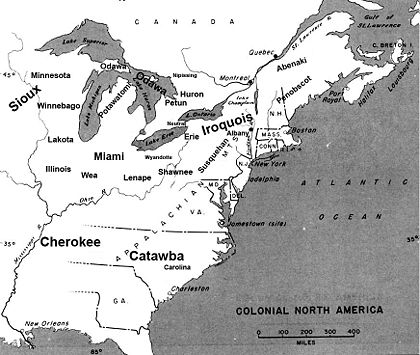 With the decline of beaver, the Iroquois began to conquer their smaller neighbors. They attacked the Wenro in 1638 and took all of their territory. Survivors fled to the Hurons for refuge. The Wenro had served as a buffer between the Iroquois and the Neutral tribe and Erie allies. These two tribes were considerably larger and more powerful than the Iroquois. With expansion to the west blocked, the Iroquois turned their attention to the north. The Dutch also encouraged the Iroquois in this strategy. At that time, the Dutch were the Iroquois' primary European trading partners, with their goods passing through Dutch trading posts down the Hudson River
and from there sent back to Europe. As the Iroquois' sources of furs declined, so did the income of the trading posts.
In 1641, the Mohawks traveled to Trois-Rivières
in New France to propose peace with the French and their allied tribes. They asked the French to set up a trading post in Iroquoia. Governor Montmagny rejected this proposal because it would imply abandonment of their Huron allies.
In the early 1640s, the war began in earnest with Iroquois attacks on frontier Huron villages along the St. Lawrence River; their intent was disruption of the trade with the French. In 1645 the French called the tribes together to negotiate a treaty to end the conflict. Two Iroquois leaders, Deganaweida and Koiseaton, traveled to New France to take part in the negotiations. The French agreed to most of the Iroquois demands, granting them trading rights in New France. The next summer a fleet of eighty canoes carrying a large harvest of furs traveled through Iroquois territory to be sold in New France. When the Iroquois arrived, the French refused to purchase the furs and told the Iroquois to sell them to the Huron, who would act as a middleman. Outraged, the Iroquois resumed the war.
The French decided to become directly involved in the conflict. The Huron and the Iroquois had similar access to manpower, each tribe having an estimated 25,000–30,000 members. To gain the upper hand, in 1647 the Huron and Susquehannock
formed an alliance to counter Iroquois aggression. Together their warriors greatly outnumbered those of the Iroquois. The Huron tried to break the Iroquois Confederacy by negotiating separate peaces with the Onondaga
and the Cayuga. When the other tribes intercepted their messengers, they put an end to the negotiations. During the summer of 1647 there were several small skirmishes between the tribes. In 1648 a more significant battle occurred when the two Algonquin tribes attempted to pass a fur convoy through an Iroquois blockade. Their attempt succeeded and they inflicted high casualties on the Iroquois.
During the following years, the Iroquois strengthened their confederacy to work more closely and create an effective central leadership. Although the workings of their government remain largely unknown, by the 1660s the five Iroquois ceased fighting among themselves. They also easily coordinated military and economic plans among all five nations. In so doing, they increased their power and achieved a level of government more advanced than those of the surrounding tribes' decentralized forms of operating.
Although Indian raids were not constant, they terrified the inhabitants of New France. Initially, the colonists felt helpless to prevent them. Some of the heroes of French-Canadian folk memory are of individuals who stood up to such attacks. An example was Dollard des Ormeaux, who died in May 1660 while resisting an Iroquois raiding force at the Long Sault
, the confluence of the St. Lawrence and the Ottawa River
s. According to legend, he succeeded in saving Montreal by his actions. Another hero was Madeleine de Verchères
, who in 1692 at age 14, led the defense of her family farm against Iroquois attack. Viewing the Iroquois as pawns of the Dutch and English, their traditional Protestant enemies, the French refused to make peace with the Natives.
, and Gabriel Lallemant
. Each is considered a martyr
of the Roman Catholic Church
. The surviving Huron fled their territory to seek assistance from the Anishinaabeg Confederacy
in the northern Great Lakes
region. The Odaawaa Nation (Ottawa)
temporarily halted Iroquois expansion further northwest. With the Hurons' withdrawal, the Iroquois controlled a fur-rich region and had no more native tribes blocking them from the French settlements in Canada.
European diseases had taken their toll on the Iroquois and neighbors in the years preceding the war, however, and their populations had drastically declined. To replace lost warriors, the Iroquois worked to integrate many of their captured enemy by adoption into their own tribes. They invited Jesuits into their territory to teach those who had converted to Christianity
. One priest recorded, "As far as I can divine, It is the design of the Iroquois to capture all the Huron...put the Chiefs to death...and with the rest to form one nation and country." The Jesuits also reached out to the Iroquois, many of whom converted to or added Catholicism
to indigenous belief. The converted Iroquois would play an important part in the years to come.
In the early 1650s, the Iroquois began to attack the French. Some of the Iroquois Nations, notably the Oneida
and Onondaga
, had peaceful relations with the French but were under control of the Mohawk. The latter were the strongest nation in the Confederacy and were hostile to the French colonists. After a failed peace treaty negotiated by Chief Canaqueese, Iroquois war parties moved north into New France along Lake Champlain
and the Richelieu River
. They attacked and blockaded Montreal
. Typically a small war party raided isolated farms or settlements. They usually killed the oldest and youngest (those who could not travel well), and took others captive. The Native Americans had a tradition of adopting captives into their societies to replace members who had died.
in 1650. By the end of 1651, they had completely driven the tribe from traditional territory, killing and assimilating thousands. At the time, the Neutrals inhabited a territory ranging from the present-day Niagara Peninsula
, westward to the Grand River
valley.
In 1654 the Iroquois attacked the Erie
, but with less success. The war between the Erie and the Iroquois lasted for two years. By 1656 the Iroquois had almost completely destroyed the Erie confederacy, whose members refused to flee to the west. The Erie territory was located on the southeastern shore of Lake Erie and was estimated to have 12,000 members in 1650. Greatly outnumbered by the tribes they had subdued, the Iroquois had been able to achieve their victories through the use of firearms purchased from the Dutch.
. 1660 marked the zenith of Iroquois military power, and they were able to use that to their advantage in the decades to follow. The Susquehannock had become allied with the English in the Maryland
colony in 1661. The English had grown fearful of the Iroquois and hoped an alliance with Susquehannock would help block the northern tribes' advance on the English colonies. In 1663 the Iroquois sent an army of 800 warriors into the Susquehannock territory. They repulsed the army, but the invasion prompted the colony of Maryland to declare war on the Iroquois.
By supplying Susquehannock forts with artillery, the English in Maryland changed the balance of power away from the Iroquois. The Susquehannock took the upper hand and began to invade Iroquois territory, where they caused significant damage. This warfare continued intermittently for 11 years. In 1674 the English in Maryland changed their Indian Policy and negotiated peace with the Iroquois. They terminated their alliance with the Susquehannock. In 1675 the militias of Virginia
and Maryland captured and executed the chiefs of the Susquehannock, whose growing power they feared. The Iroquois made quick work of the rest of the nation. They drove the warriors from traditional territory and absorbed the survivors in 1677.
During the course of this conflict, in 1670 the Iroquois also drove the Siouan-speaking Mannahoac tribe out of the northern Virginia Piedmont region. The Iroquois claimed the land by right of conquest as a hunting ground. The English acknowledged this claim in 1674 and again in 1684. They acquired the land from the Iroquois by a 1722 treaty.
The tide of war in New France began to turn in the mid-1660s with the arrival of a small contingent of regular troops from France, the brown-uniformed Carignan-Salières Regiment
—the first group of uniformed professional soldiers to enter present-day Canada. A change in administration led the New France government to authorize direct sale of arms and other military support to their Native allies. In 1664, the Dutch allies of the Iroquois lost control of the New Netherland colony to the English
. In the immediate years after the Dutch defeat, European support waned for the Iroquois.
In January 1666, the French invaded the Iroquois homeland in present-day New York. The first invasion force was led by Daniel de Remy, Sieur de Courcelle. His men were greatly outnumbered by the Iroquois and were forced to withdraw before any significant action could take place. The second invasion force was led by the aristocrat Alexandre de Prouville
the "Marquis de Tracy" and viceroy of New France
. They encountered little resistance while invading Iroquoia as many of the Confederacy's warriors were away fighting the Susquehannock. Although the invasion was abortive, they took Chief Canaqueese prisoner. With their immediate European support cut off, the Iroquois sued for peace, to which France agreed.
 Once peace was achieved with the French, the Iroquois returned to their westward conquest in their continued attempt to take control of all the land between the Algonquins and the French. As a result of Iroquois expansion and war with the Anishinaabeg Confederacy, eastern Nations such as the Lakota were pushed across the Mississippi onto the Great Plains
. There in the early 18th century, they adopted the horse culture and nomadic lifestyle for which they later became well known. Other refugees flooded the Great Lakes area, resulting in a conflict with existing nations in the region. In the Ohio Country the Shawnee
and Miami tribe
s were the dominant tribes. The Iroquois quickly overran Shawnee holdings in central Ohio forcing them to flee into Miami territory. The Miami were a powerful tribe and brought together a confederacy of their neighboring allies, including the Pottawatomie and the Illinois tribe who inhabited modern Michigan
and Illinois
. The majority of the fighting was between the Anishininaabeg Confederacy and the Iroquois Confederacy.
The Iroquois improved on their warfare as they continued to attack even farther from their home. War parties often traveled by canoes at night. They would sink their canoes and fill them with rocks to hold them on the river bottom. After going through the woods to a target, at the appointed time, they would quickly burst from the wood to cause the greatest panic among their enemy. After the attack, the Iroquois could return quickly to their boats and leave before any significant resistance could be put together. The lack of firearms caused the Algonquin tribes the greatest disadvantage. Despite their larger numbers, they were not centralized enough to mount a united defense and were unable to withstand the Iroquois. Several tribes ultimately moved west beyond the Mississippi River
, leaving much of the Ohio Valley, southern Michigan, and southern Ontario depopulated. Several large Anishinaabe
military forces, numbering in the thousands, remained to the north of Lakes Huron and Superior. They later were decisive in rolling back the Iroquois advance. From west of the Mississippi, displaced groups continued to arm war parties and attempt to retake their homelands.
Beginning in the 1670s, the French began to explore and settle the Ohio
and Illinois Country
from the Mississippi and Ohio rivers. There they discovered the Algonquin tribes of that region were locked in warfare with the Iroquois. The French established the post of Tassinong to trade with the western tribes. The Iroquois destroyed it to retain control of the fur trade with the Europeans.
During a raid into the Illinois Country in 1689, the Iroquois captured numerous prisoners and destroyed a sizable Miami settlement. The Miami asked for aid from others in the Anishinaabeg Confederacy, and a large force gathered to track down the Iroquois. Using their new firearms, the Confederacy laid an ambush near modern South Bend, Indiana
. They attacked and destroyed most of the Iroquois army. Although a large part of the region was left depopulated, the Iroquois were unable to establish a permanent presence. Their own tribe lacked the manpower to colonize the large area. After their setbacks and the local tribes' gaining firearms, the Iroquois' brief control over the region was lost. Many of the former inhabitants of the territory began to return.
At the same time, Governor of New France Louis de Buade, Comte de Frontenac, tried to revive the western fur-trade. His efforts competed with those of the Iroquois to control the traffic and they started attacking the French again. The war lasted ten years and was as bloody as the first.
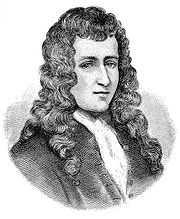
In 1681 René-Robert Cavelier, Sieur de La Salle
negotiated a treaty with the Miami and Illinois
tribes. The same year France lifted the ban on the sale of firearms to the native tribes. Colonists quickly armed the Algonquin tribes, evening the odds between the Iroquois and their enemies.
With the renewal of hostilities, the local militia of New France was stiffened after 1683 by a small force of regular French navy troops, the Compagnies Franches de la Marine
. The latter were to constitute the longest-serving unit of French regular troops in New France. Over the years, the men identified with the colony. The officer corps became completely Canadian. Essentially, these forces can be considered as Canada's first standing professional armed force. Officers' commissions, both in the militia and in the Compagnie Franches, became coveted amongst the upper class of the colony. The militia together with members of the Compagnie Franches, dressed for woodland travel similarly to their Algonquin Indian allies, and grew to specialize in the swift and mobile brand of warfare termed la petite guerre. It was characterized by long expeditions through the forests and quick raids on enemy encampments —the same kind of warfare practiced by the Iroquois and other Natives.
In June 1687, Pierre de Troyes commanded a company under Governor Denonville
for his attack against the Seneca
. This attack resulted in the destruction of Ganondagan
, the Seneca's largest village.
In September 1687, the French used 3,000 militia and regulars to attack the Iroquois in a punitive raid on their territory. They proceeded down the Richelieu River
and marched through Iroquois territory, but did not find many warriors. They burned their villages and stored crops, destroying an estimated 1.2 million bushels of corn. Many Iroquois died from starvation during the following winter.
In 1687, Denonville set out with a well-organized force to Fort Frontenac
, where they met with the 50 hereditary sachem
s of the Iroquois Confederacy from their Onondaga council fire. These 50 chiefs constituted the entire decision-making strata of the Iroquois. They had been lulled into meeting under a flag of truce. Denonville seized, chained, and shipped the 50 Iroquois chiefs to Marseilles, France, to be used as galley slaves. He then ravaged the land of the Seneca. Before he returned to New France, he travelled down the shore of Lake Ontario
and created Fort Denonville
at the site where the Niagara River
meets Lake Ontario. This site was previously used by La Salle
for a fort named Fort Conti
from 1678 to 1679, and was later used for Fort Niagara
, which still exists to this day.
The destruction of the Seneca land infuriated the Iroquois Confederacy. This, coupled with the dishonourable loss of their sachem
s, demanded they set out to terrorize New France as never before. Denonville's regulars were dissolved and dispersed to towns across the land, attempting to protect New France's homes and families. Forts were abandoned. The Iroquois destroyed farmsteads and whole families were slaughtered or captured. On August 4, 1689, Lachine
, a small town adjacent to Montreal
, was burned to the ground
. Fifteen hundred Iroquois warriors had been harassing Montreal
defences for many months prior. Denonville was finally exhausted and defeated. His tenure was followed by the return of Frontenac, who replaced Denonville as governor for the next nine years (1689–1698). Frontenac had been arranging a new plan of attack to mollify the effects of the Iroquois in North America and realized the true danger the imprisonment of the sachems created. He located the 13 surviving leaders, and they returned with him to New France in October 1698.
During a raid into the Illinois Country in 1689, the Iroquois captured numerous prisoners and destroyed a sizable Miami settlement. The Miami asked for aid from others in the Anishinaabeg Confederacy, and a large force gathered to track down the Iroquois. Using their new firearms, the Confederacy laid an ambush near modern South Bend, Indiana
. They attacked and destroyed most of the Iroquois army. Although a large part of the region was left depopulated, the Iroquois were unable to establish a permanent presence. Their own tribe lacked the manpower to colonize the large area. After their setbacks and the local tribes' gaining firearms, the Iroquois' brief control over the region was lost. Many of the former inhabitants of the territory began to return.
During King William's War
(1689–1697), the French created raiding parties with Native allies to attack English colonial settlements, as the English had used the Iroquois against the French. Some of the most notable of the French-sponsored raids in 1690 were the Schenectady massacre
in the Province of New York
; Salmon Falls, New Hampshire
; and Falmouth Neck
(present-day Portland, Maine
). The French and their allies killed settlers in the raids and carried some back to Canada. Settlers in New England raised money to redeem their captives, but some were adopted into the Native tribes. The French government generally did not intervene when the Natives kept the captives. Throughout the 1690s the French and their allies also continued to raid deep into Iroquois, destroying Mohawk villages
in 1692, and later raiding Seneca, Oneida, and Onondaga villages. The English and Iroquois banded together for operations aimed at New France, but these were largely ineffectual. The most successful incursion resulted in the 1691 Battle of La Prairie
. Because both France claimed dominion over the Iroquois, the French offensive was not halted by the 1697 Treaty of Ryswick
that brought peace between France and England, and ended overt English participation in the conflict.
in 1681, the continued colonial growth there began to encroach on the southern border of the Iroquois territory. The French policy began to change towards the Iroquois. After nearly 50 years of warfare, they began to believe that it would be impossible to ever destroy them. They decided that befriending the Iroquois would be the easiest way to ensure their monopoly on the northern fur trade and help stop English expansion. As soon as the English heard of the treaty they immediately set about to prevent it from being agreed to. It would result in the loss of Albany's
monopoly on the fur trade with the Iroquois and without their protection the northern flank, of the English colonies were be open to French attack. Despite English interference the treaty was agreed to.
The peace treaty, Great Peace of Montreal
was signed in 1701 in Montreal by 39 Indian chiefs and the French. In the treaty, the Iroquois agreed to stop marauding and to allow refugees from the Great Lakes to return east. The Shawnee eventually regained control of the Ohio Country and the lower Allegheny River
. The Miami tribe returned to take control of modern Indiana and north-west Ohio. The Pottawatomie to Michigan
, and the Illinois tribe to Illinois
. With the Dutch long removed from North America, the English had become just as powerful as the French. The Iroquois came to see that they held the balance of power between the two European powers and they used that position to their benefit for the decades to come. Their society began to quickly change as the tribes began to focus on building up a strong nation, improving their farming technology, and educating their population. The peace was lasting and it would not be until the 1720s that their territory would again be threatened by the Europeans.
Also in 1701, the Iroquois nominally gave the English much of the disputed territory north of the Ohio in the Nanfan Treaty
, although this transfer was not recognised by the French, who were the strongest actual presence there at the time. In that treaty, the Iroquois leadership claimed to have conquered this "Beaver Hunting Ground" 80 years previously, or in ca. 1621.
beginning in the 1720s. It was not until the 1740s and 1750s that the Shawnee began to return to the southern and central areas of the region, and the Miami began to resettle the western portions.
Through various European treaties, the English control over the Iroquois and their territory had been recognized before the war had ended. The English exaggerated the extent of Iroquois control in the west as a means to dispute French control of the Illinois and Ohio country. In 1768 several colonies officially purchased the "Iroquois claim" to the Ohio and Illinois Country. The colonies created the Indiana Land Company to hold the claim to all of the Northwest. It maintained a claim to the region using the Iroquois right of conquest until the company was dissolved by the United States Supreme Court in 1798.
Because a large part of the conflict between the native tribes took place far beyond the frontier and in locations that had yet to have European contact, the full extent and impact of the war is unknown. Most knowledge of the western parts of the conflict comes through accounts of French explorers and the tribes they encountered during the early years of exploration. Even the effects in the eastern regions are not fully known, as large parts of the region remained unexplored. The resident tribes did not have direct contact with Europeans, so no accounts were passed on about the wars.
Iroquois Wars
-First Invasion:In January 1666, the French invaded the Iroquois homeland in present-day New York. The first invasion force was led by Daniel de Rémy de Courcelle. His men were greatly outnumbered by the Iroquois and were forced to withdraw before any significant action could take place...
or the French and Iroquois Wars, commonly refers to a series of conflicts fought in the mid-17th century in eastern North America. Encouraged and armed by their Dutch
Netherlands
The Netherlands is a constituent country of the Kingdom of the Netherlands, located mainly in North-West Europe and with several islands in the Caribbean. Mainland Netherlands borders the North Sea to the north and west, Belgium to the south, and Germany to the east, and shares maritime borders...
and English trading partners, the Iroquois
Iroquois
The Iroquois , also known as the Haudenosaunee or the "People of the Longhouse", are an association of several tribes of indigenous people of North America...
sought to expand their territory and monopolize the fur trade
Fur trade
The fur trade is a worldwide industry dealing in the acquisition and sale of animal fur. Since the establishment of world market for in the early modern period furs of boreal, polar and cold temperate mammalian animals have been the most valued...
and the trade between European markets and the tribes of the western Great Lakes
Great Lakes
The Great Lakes are a collection of freshwater lakes located in northeastern North America, on the Canada – United States border. Consisting of Lakes Superior, Michigan, Huron, Erie, and Ontario, they form the largest group of freshwater lakes on Earth by total surface, coming in second by volume...
region. The conflict pitted the nations of the Iroquois Confederation, led by the dominant Mohawk
Mohawk nation
Mohawk are the most easterly tribe of the Iroquois confederation. They call themselves Kanien'gehaga, people of the place of the flint...
, against the French-backed and largely Algonquian
Algonquian languages
The Algonquian languages also Algonkian) are a subfamily of Native American languages which includes most of the languages in the Algic language family. The name of the Algonquian language family is distinguished from the orthographically similar Algonquin dialect of the Ojibwe language, which is a...
-speaking tribes of the Great Lakes region
Great Lakes region (North America)
The Great Lakes region of North America, occasionally known as the Third Coast or the Fresh Coast , includes the eight U.S. states of Illinois, Indiana, Michigan, Minnesota, New York, Ohio, Pennsylvania and Wisconsin as well as the Canadian province of Ontario...
.
The wars were brutal and are considered one of the bloodiest series of conflicts in the history of North America
History of the United States
The history of the United States traditionally starts with the Declaration of Independence in the year 1776, although its territory was inhabited by Native Americans since prehistoric times and then by European colonists who followed the voyages of Christopher Columbus starting in 1492. The...
. As the Iroquois succeeded in the war and enlarged their territory, they realigned the tribal geography of North America, and destroyed several large tribal confederacies—including the Huron, Neutral
Neutral Nation
The Neutrals, also known as the Attawandaron, were an Iroquoian nation of North American native people who lived near the shores of Lake Ontario and Lake Erie.-Territory:...
, Erie, and Susquehannock
Susquehannock
The Susquehannock people were Iroquoian-speaking Native Americans who lived in areas adjacent to the Susquehanna River and its tributaries from the southern part of what is now New York, through Pennsylvania, to the mouth of the Susquehanna in Maryland at the north end of the Chesapeake Bay...
—and pushed some eastern tribes west of the Mississippi River
Mississippi River
The Mississippi River is the largest river system in North America. Flowing entirely in the United States, this river rises in western Minnesota and meanders slowly southwards for to the Mississippi River Delta at the Gulf of Mexico. With its many tributaries, the Mississippi's watershed drains...
, or southward into the Carolinas. The Iroquois also controlled the Ohio Valley lands as hunting ground, from about 1670 onward, as far as can be determined from contemporary French (Jesuit) accounts. The Ohio Country
Ohio Country
The Ohio Country was the name used in the 18th century for the regions of North America west of the Appalachian Mountains and in the region of the upper Ohio River south of Lake Erie...
and the Lower Peninsula of Michigan
Lower Peninsula of Michigan
The Lower Peninsula of Michigan is the southern of the two major landmasses of the U.S. state of Michigan. It is surrounded by water on all sides except its southern border, which it shares with Ohio and Indiana. Geographically, the Lower Peninsula has a recognizable shape that many people...
were virtually emptied of Native people as refugees fled westward to escape Iroquois warriors. (Much of this region was later repopulated by Native peoples nominally subjected to the Six Nations; see Mingo
Mingo
The Mingo are an Iroquoian group of Native Americans made up of peoples who migrated west to the Ohio Country in the mid-eighteenth century. Anglo-Americans called these migrants mingos, a corruption of mingwe, an Eastern Algonquian name for Iroquoian-language groups in general. Mingos have also...
)
Both Algonquian
Algonquian peoples
The Algonquian are one of the most populous and widespread North American native language groups, with tribes originally numbering in the hundreds. Today hundreds of thousands of individuals identify with various Algonquian peoples...
and Iroquoian societies were greatly disturbed by these wars. The conflict subsided with the loss by the Iroquois of their Dutch
Netherlands
The Netherlands is a constituent country of the Kingdom of the Netherlands, located mainly in North-West Europe and with several islands in the Caribbean. Mainland Netherlands borders the North Sea to the north and west, Belgium to the south, and Germany to the east, and shares maritime borders...
allies in the New Netherland
New Netherland
New Netherland, or Nieuw-Nederland in Dutch, was the 17th-century colonial province of the Republic of the Seven United Netherlands on the East Coast of North America. The claimed territories were the lands from the Delmarva Peninsula to extreme southwestern Cape Cod...
colony, and with a growing French objective to gain the Iroquois as an ally against English
Kingdom of England
The Kingdom of England was, from 927 to 1707, a sovereign state to the northwest of continental Europe. At its height, the Kingdom of England spanned the southern two-thirds of the island of Great Britain and several smaller outlying islands; what today comprises the legal jurisdiction of England...
encroachment. After the Iroquois became trading partners with the English, their alliance was a crucial component of the later English expansion. They used the Iroquois conquests as a claim to the old Northwest.
Origins
Written records for the St. Lawrence valleySaint Lawrence River
The Saint Lawrence is a large river flowing approximately from southwest to northeast in the middle latitudes of North America, connecting the Great Lakes with the Atlantic Ocean. It is the primary drainage conveyor of the Great Lakes Basin...
begin with the voyages of Jacques Cartier
Jacques Cartier
Jacques Cartier was a French explorer of Breton origin who claimed what is now Canada for France. He was the first European to describe and map the Gulf of Saint Lawrence and the shores of the Saint Lawrence River, which he named "The Country of Canadas", after the Iroquois names for the two big...
in the 1540s. Cartier wrote of encounters with a people later classified as the St. Lawrence Iroquoians
St. Lawrence Iroquoians
The St. Lawrence Iroquoians were a prehistoric First Nations/Native American indigenous people who lived from the 14th century until about 1580 CE along the shores of the St. Lawrence River in present-day Quebec and Ontario, Canada, and New York State, United States. They spoke Laurentian...
, also known as the Stadaconan or Laurentian, who occupied several fortified villages, including Stadacona
Stadacona
Stadacona was a 16th century St. Lawrence Iroquoian village near present-day Quebec City.French explorer and navigator Jacques Cartier, travelling and charting the Saint Lawrence River, reached it on 7 September 1535. He returned to Stadacona to spend the winter there with his group of 110 men...
and Hochelaga
Hochelaga (village)
Hochelaga meaning "beaver dam" or "beaver lake" was a St. Lawrence Iroquoian 16th century fortified village at the heart of, or in the immediate vicinity of Mount Royal in present-day Montreal, Quebec, Canada. Jacques Cartier arrived by boat on October 2, 1535; he visited the village on the...
. Cartier recorded that the Stadaconans were at war with another tribe known as the Toudaman, who had destroyed one of their forts the previous year, resulting in 200 deaths. Continental wars and politics distracted French efforts at colonization in the St. Lawrence Valley until the beginning of the 17th century. When the French returned, they were surprised to find that the sites of both Stadacona and Hochelaga were abandoned—completely destroyed by an unknown enemy.
The issue has not been fully settled. (Iroquois oral tradition, as recorded in the Jesuit Relations, speaks of a draining war between the Mohawk Iroquois and an alliance of the Susquehannock and Algonquin sometime between 1580 and 1600.)
When the French returned in 1601, the St. Lawrence Valley had already been the site of generations of blood-feud-style warfare. When Samuel de Champlain
Samuel de Champlain
Samuel de Champlain , "The Father of New France", was a French navigator, cartographer, draughtsman, soldier, explorer, geographer, ethnologist, diplomat, and chronicler. He founded New France and Quebec City on July 3, 1608....
landed at Tadoussac on the St. Lawrence, he and his small company of French adventurers were almost immediately recruited by the Montagnais
Innu
The Innu are the indigenous inhabitants of an area they refer to as Nitassinan , which comprises most of the northeastern portions of the provinces of Quebec and some western portions of Labrador...
, Algonquin, and Huron to assist in attacking their Iroquois enemies upriver.
Before 1603, Champlain had formed an offensive alliance against the Iroquois. His rationale was commercial; the northern Natives were the French source of valuable fur
Fur
Fur is a synonym for hair, used more in reference to non-human animals, usually mammals; particularly those with extensives body hair coverage. The term is sometimes used to refer to the body hair of an animal as a complete coat, also known as the "pelage". Fur is also used to refer to animal...
and the Iroquois, based in present-day New York
New York
New York is a state in the Northeastern region of the United States. It is the nation's third most populous state. New York is bordered by New Jersey and Pennsylvania to the south, and by Connecticut, Massachusetts and Vermont to the east...
, interfered with that trade. The first battle in 1609 was fought at Champlain's initiative. He wrote, "I had come with no other intention than to make war". In the company of his Algonquin allies, Champlain and his forces fought a pitched battle with the Iroquois on the shores of Lake Champlain
Lake Champlain
Lake Champlain is a natural, freshwater lake in North America, located mainly within the borders of the United States but partially situated across the Canada—United States border in the Canadian province of Quebec.The New York portion of the Champlain Valley includes the eastern portions of...
. Champlain killed three Iroquois chiefs with an arquebus
Arquebus
The arquebus , or "hook tube", is an early muzzle-loaded firearm used in the 15th to 17th centuries. The word was originally modeled on the German hakenbüchse; this produced haquebute...
. In 1610, Champlain and his arquebus-wielding French companions helped the Algonquin and Huron defeat a large Iroquois raiding party. In 1615, Champlain joined a Huron raiding party and took part in a siege on an Iroquois town, probably among the Onondaga
Onondaga (tribe)
The Onondaga are one of the original five constituent nations of the Iroquois Confederacy. Their traditional homeland is in and around Onondaga County, New York...
south of Lake Ontario in present-day New York. The attack ultimately failed, and Champlain was injured.
In 1610 the Dutch established a trading post on the edge of Iroquois territory, giving them direct access to European markets. This removed the Iroquois need to rely on the French and the tribes who had functioned as middlemen in the trading of goods. The new post offered valuable tools that the Iroquois could receive in exchange for animal pelts. This began the Iroquois' large-scale hunting for furs.
At this time, the conflict began to quickly grow between the Iroquois and Indians supported by the French. The Iroquois inhabited the region of present-day New York south of Lake Ontario
Lake Ontario
Lake Ontario is one of the five Great Lakes of North America. It is bounded on the north and southwest by the Canadian province of Ontario, and on the south by the American state of New York. Ontario, Canada's most populous province, was named for the lake. In the Wyandot language, ontarío means...
and west of the Hudson River
Hudson River
The Hudson is a river that flows from north to south through eastern New York. The highest official source is at Lake Tear of the Clouds, on the slopes of Mount Marcy in the Adirondack Mountains. The river itself officially begins in Henderson Lake in Newcomb, New York...
. The Iroquois lands comprised an ethnic island, surrounded on all sides by Algonquian-speaking nations, including the Shawnee
Shawnee
The Shawnee, Shaawanwaki, Shaawanooki and Shaawanowi lenaweeki, are an Algonquian-speaking people native to North America. Historically they inhabited the areas of Ohio, Virginia, West Virginia, Western Maryland, Kentucky, Indiana, and Pennsylvania...
to the west in the Ohio Country. Their enemies included the Iroquoian-speaking Huron and Neutral Nation
Neutral Nation
The Neutrals, also known as the Attawandaron, were an Iroquoian nation of North American native people who lived near the shores of Lake Ontario and Lake Erie.-Territory:...
Confederacies, who lived on the southern shore of Lake Huron and the western shore of Lake Ontario, respectively, but who were not part of the Iroquois Confederation.
In 1628 the Mohawk defeated the Mahican
Mahican
The Mahican are an Eastern Algonquian Native American tribe, originally settling in the Hudson River Valley . After 1680, many moved to Stockbridge, Massachusetts. During the early 1820s and 1830s, most of the Mahican descendants migrated westward to northeastern Wisconsin...
and established a monopoly of trade with the Dutch at Fort Orange
Fort Orange
Fort Orange was the first permanent Dutch settlement in New Netherland and was on the site of the present-day city of Albany, New York. It was a replacement for Fort Nassau, which had been built on nearby Castle Island in the Hudson River, and which served as a trading post until 1617 or 1618,...
, New Netherland
New Netherland
New Netherland, or Nieuw-Nederland in Dutch, was the 17th-century colonial province of the Republic of the Seven United Netherlands on the East Coast of North America. The claimed territories were the lands from the Delmarva Peninsula to extreme southwestern Cape Cod...
. The Iroquois, particularly the Mohawk, had come to rely on the trade for the purchase of firearms and other European goods for their livelihood and survival. By the 1630s, the Iroquois had become fully armed with European weaponry through their trade with the Dutch. They used their growing expertise with the arquebus to good effect in their continuing wars with the Algonquin, Huron, and other traditional enemies. The French, meanwhile, outlawed the trading of firearms to their native allies, though they occasionally gave arquebuses as gifts to individuals who convert
Convert
The convert or try, in American football known as "point after", and Canadian football "Point after touchdown", is a one-scrimmage down played immediately after a touchdown during which the scoring team is allowed to attempt to score an extra one point by kicking the ball through the uprights , or...
ed to Christianity
Christianity
Christianity is a monotheistic religion based on the life and teachings of Jesus as presented in canonical gospels and other New Testament writings...
. Although the Iroquois first attacked their traditional enemies (the Algonquins, Mahican
Mahican
The Mahican are an Eastern Algonquian Native American tribe, originally settling in the Hudson River Valley . After 1680, many moved to Stockbridge, Massachusetts. During the early 1820s and 1830s, most of the Mahican descendants migrated westward to northeastern Wisconsin...
s, Montagnais
Innu
The Innu are the indigenous inhabitants of an area they refer to as Nitassinan , which comprises most of the northeastern portions of the provinces of Quebec and some western portions of Labrador...
, and Hurons), the alliance of these tribes with the French quickly brought the Iroquois into fierce and bloody conflict directly with the European colonists.
The use of firearms enabled overhunting and accelerated the decline of the beaver population. By 1640 the animal had largely disappeared from the Hudson Valley. Some historians have argued that the wars were accelerated by the growing scarcity of the beaver
American Beaver
The North American Beaver is the only species of beaver in the Americas, native to North America and introduced to South America. In the United States and Canada, where no other species of beaver occurs, it is usually simply referred to as "beaver"...
in the lands controlled by the Iroquois in the middle 17th century. The center of the fur trade shifted northward to the colder regions of present-day southern Ontario, which was controlled by the Neutrals; as well as by the Hurons, who were the close trading partners of the French. The Iroquois were displaced in the fur trade by other nations in the region. Threatened by disease and with a declining population, the Iroquois began an aggressive campaign to expand their area of control.
Conflict
Hudson River
The Hudson is a river that flows from north to south through eastern New York. The highest official source is at Lake Tear of the Clouds, on the slopes of Mount Marcy in the Adirondack Mountains. The river itself officially begins in Henderson Lake in Newcomb, New York...
and from there sent back to Europe. As the Iroquois' sources of furs declined, so did the income of the trading posts.
In 1641, the Mohawks traveled to Trois-Rivières
Trois-Rivières
Trois-Rivières means three rivers in French and may refer to:in Canada*Trois-Rivières, the largest city in the Mauricie region of Quebec, Canada*Circuit Trois-Rivières, a racetrack in Trois-Rivières, Quebec...
in New France to propose peace with the French and their allied tribes. They asked the French to set up a trading post in Iroquoia. Governor Montmagny rejected this proposal because it would imply abandonment of their Huron allies.
In the early 1640s, the war began in earnest with Iroquois attacks on frontier Huron villages along the St. Lawrence River; their intent was disruption of the trade with the French. In 1645 the French called the tribes together to negotiate a treaty to end the conflict. Two Iroquois leaders, Deganaweida and Koiseaton, traveled to New France to take part in the negotiations. The French agreed to most of the Iroquois demands, granting them trading rights in New France. The next summer a fleet of eighty canoes carrying a large harvest of furs traveled through Iroquois territory to be sold in New France. When the Iroquois arrived, the French refused to purchase the furs and told the Iroquois to sell them to the Huron, who would act as a middleman. Outraged, the Iroquois resumed the war.
The French decided to become directly involved in the conflict. The Huron and the Iroquois had similar access to manpower, each tribe having an estimated 25,000–30,000 members. To gain the upper hand, in 1647 the Huron and Susquehannock
Susquehannock
The Susquehannock people were Iroquoian-speaking Native Americans who lived in areas adjacent to the Susquehanna River and its tributaries from the southern part of what is now New York, through Pennsylvania, to the mouth of the Susquehanna in Maryland at the north end of the Chesapeake Bay...
formed an alliance to counter Iroquois aggression. Together their warriors greatly outnumbered those of the Iroquois. The Huron tried to break the Iroquois Confederacy by negotiating separate peaces with the Onondaga
Onondaga (tribe)
The Onondaga are one of the original five constituent nations of the Iroquois Confederacy. Their traditional homeland is in and around Onondaga County, New York...
and the Cayuga. When the other tribes intercepted their messengers, they put an end to the negotiations. During the summer of 1647 there were several small skirmishes between the tribes. In 1648 a more significant battle occurred when the two Algonquin tribes attempted to pass a fur convoy through an Iroquois blockade. Their attempt succeeded and they inflicted high casualties on the Iroquois.
During the following years, the Iroquois strengthened their confederacy to work more closely and create an effective central leadership. Although the workings of their government remain largely unknown, by the 1660s the five Iroquois ceased fighting among themselves. They also easily coordinated military and economic plans among all five nations. In so doing, they increased their power and achieved a level of government more advanced than those of the surrounding tribes' decentralized forms of operating.
Although Indian raids were not constant, they terrified the inhabitants of New France. Initially, the colonists felt helpless to prevent them. Some of the heroes of French-Canadian folk memory are of individuals who stood up to such attacks. An example was Dollard des Ormeaux, who died in May 1660 while resisting an Iroquois raiding force at the Long Sault
Long Sault
This article refers to the rapid on the St. Lawrence River, for the once named Long Sault Rapids on the Ottawa River which was involved in the Battle of Long Sault and the Beaver War, please see Carillon, Quebec or Carillon Canal...
, the confluence of the St. Lawrence and the Ottawa River
Ottawa River
The Ottawa River is a river in the Canadian provinces of Ontario and Quebec. For most of its length, it now defines the border between these two provinces.-Geography:...
s. According to legend, he succeeded in saving Montreal by his actions. Another hero was Madeleine de Verchères
Madeleine de Verchères
Marie-Madeleine Jarret de Verchères was the daughter of a François Jarret, a seigneur in New France, and Marie Perrot. Her ingenuity is credited with thwarting a raid on Fort Verchères when she was 14 years old....
, who in 1692 at age 14, led the defense of her family farm against Iroquois attack. Viewing the Iroquois as pawns of the Dutch and English, their traditional Protestant enemies, the French refused to make peace with the Natives.
Defeat of the Huron
In 1648, the Dutch authorized selling guns directly to the Mohawk rather than through traders, and promptly sold 400 to the Iroquois. The Confederacy sent 1,000 newly armed warriors through the woods to Huron territory. With the onset of winter, the Iroquois warriors launched a devastating attack into the heart of Huron territory, destroying several key villages, killing many warriors and taking thousands of people captive, for later adoption into the tribe. Among those killed were the Jesuit missionaries Jean Brebeuf, Charles GarnierCharles Garnier (missionary)
Charles Garnier, baptised in Paris on May 25, 1606, was a Jesuit missionary, who was martyred at Sainte-Marie among the Hurons on December 7, 1649....
, and Gabriel Lallemant
Gabriel Lallemant
Saint Gabriel Lalemant was a Jesuit missionary and one of the eight Canadian Martyrs....
. Each is considered a martyr
Martyr
A martyr is somebody who suffers persecution and death for refusing to renounce, or accept, a belief or cause, usually religious.-Meaning:...
of the Roman Catholic Church
Roman Catholic Church
The Catholic Church, also known as the Roman Catholic Church, is the world's largest Christian church, with over a billion members. Led by the Pope, it defines its mission as spreading the gospel of Jesus Christ, administering the sacraments and exercising charity...
. The surviving Huron fled their territory to seek assistance from the Anishinaabeg Confederacy
Council of Three Fires
The Council of Three Fires, also known as the People of the Three Fires, the Three Fires Confederacy, the United Nations of Chippewa, Ottawa, and Potawatomi Indians, or Niswi-mishkodewin in the Anishinaabe language, is a long-standing Anishinaabe alliance of the Ojibwe , Ottawa , and Potawatomi...
in the northern Great Lakes
Great Lakes
The Great Lakes are a collection of freshwater lakes located in northeastern North America, on the Canada – United States border. Consisting of Lakes Superior, Michigan, Huron, Erie, and Ontario, they form the largest group of freshwater lakes on Earth by total surface, coming in second by volume...
region. The Odaawaa Nation (Ottawa)
Ottawa (tribe)
The Odawa or Ottawa, said to mean "traders," are a Native American and First Nations people. They are one of the Anishinaabeg, related to but distinct from the Ojibwe nation. Their original homelands are located on Manitoulin Island, near the northern shores of Lake Huron, on the Bruce Peninsula in...
temporarily halted Iroquois expansion further northwest. With the Hurons' withdrawal, the Iroquois controlled a fur-rich region and had no more native tribes blocking them from the French settlements in Canada.
European diseases had taken their toll on the Iroquois and neighbors in the years preceding the war, however, and their populations had drastically declined. To replace lost warriors, the Iroquois worked to integrate many of their captured enemy by adoption into their own tribes. They invited Jesuits into their territory to teach those who had converted to Christianity
Christianity
Christianity is a monotheistic religion based on the life and teachings of Jesus as presented in canonical gospels and other New Testament writings...
. One priest recorded, "As far as I can divine, It is the design of the Iroquois to capture all the Huron...put the Chiefs to death...and with the rest to form one nation and country." The Jesuits also reached out to the Iroquois, many of whom converted to or added Catholicism
Catholicism
Catholicism is a broad term for the body of the Catholic faith, its theologies and doctrines, its liturgical, ethical, spiritual, and behavioral characteristics, as well as a religious people as a whole....
to indigenous belief. The converted Iroquois would play an important part in the years to come.
In the early 1650s, the Iroquois began to attack the French. Some of the Iroquois Nations, notably the Oneida
Oneida tribe
The Oneida are a Native American/First Nations people and are one of the five founding nations of the Iroquois Confederacy in the area of upstate New York...
and Onondaga
Onondaga (tribe)
The Onondaga are one of the original five constituent nations of the Iroquois Confederacy. Their traditional homeland is in and around Onondaga County, New York...
, had peaceful relations with the French but were under control of the Mohawk. The latter were the strongest nation in the Confederacy and were hostile to the French colonists. After a failed peace treaty negotiated by Chief Canaqueese, Iroquois war parties moved north into New France along Lake Champlain
Lake Champlain
Lake Champlain is a natural, freshwater lake in North America, located mainly within the borders of the United States but partially situated across the Canada—United States border in the Canadian province of Quebec.The New York portion of the Champlain Valley includes the eastern portions of...
and the Richelieu River
Richelieu River
The Richelieu River is a river in Quebec, Canada. It flows from the north end of Lake Champlain about north, ending at the confluence with the St. Lawrence River at Sorel-Tracy, Quebec downstream and northeast of Montreal...
. They attacked and blockaded Montreal
Montreal
Montreal is a city in Canada. It is the largest city in the province of Quebec, the second-largest city in Canada and the seventh largest in North America...
. Typically a small war party raided isolated farms or settlements. They usually killed the oldest and youngest (those who could not travel well), and took others captive. The Native Americans had a tradition of adopting captives into their societies to replace members who had died.
Defeat of the Erie and Neutral
The Iroquois attacked the Neutral NationNeutral Nation
The Neutrals, also known as the Attawandaron, were an Iroquoian nation of North American native people who lived near the shores of Lake Ontario and Lake Erie.-Territory:...
in 1650. By the end of 1651, they had completely driven the tribe from traditional territory, killing and assimilating thousands. At the time, the Neutrals inhabited a territory ranging from the present-day Niagara Peninsula
Niagara Peninsula
The Niagara Peninsula is the portion of Southern Ontario, Canada lying between the south shore of Lake Ontario and the north shore of Lake Erie. It stretches from the Niagara River in the east to Hamilton, Ontario in the west. The population of the peninsula is roughly 1,000,000 people...
, westward to the Grand River
Grand River (Ontario)
The Grand River is a large river in southwestern Ontario, Canada. From its source, it flows south through Grand Valley, Fergus, Elora, Waterloo, Kitchener, Cambridge, Paris, Brantford, Caledonia, and Cayuga before emptying into the north shore of Lake Erie south of Dunnville at Port Maitland...
valley.
In 1654 the Iroquois attacked the Erie
Erie (tribe)
The Erie were an Native American people historically living on the south shore of Lake Erie. An Iroquoian group, they lived in what is now western New York, northwestern Pennsylvania, and northern Ohio...
, but with less success. The war between the Erie and the Iroquois lasted for two years. By 1656 the Iroquois had almost completely destroyed the Erie confederacy, whose members refused to flee to the west. The Erie territory was located on the southeastern shore of Lake Erie and was estimated to have 12,000 members in 1650. Greatly outnumbered by the tribes they had subdued, the Iroquois had been able to achieve their victories through the use of firearms purchased from the Dutch.
Defeat of the Susquehannock
With the tribes to the north and west destroyed, the Iroquois turned their attention southward to the Iroquoian-speaking SusquehannockSusquehannock
The Susquehannock people were Iroquoian-speaking Native Americans who lived in areas adjacent to the Susquehanna River and its tributaries from the southern part of what is now New York, through Pennsylvania, to the mouth of the Susquehanna in Maryland at the north end of the Chesapeake Bay...
. 1660 marked the zenith of Iroquois military power, and they were able to use that to their advantage in the decades to follow. The Susquehannock had become allied with the English in the Maryland
Maryland
Maryland is a U.S. state located in the Mid Atlantic region of the United States, bordering Virginia, West Virginia, and the District of Columbia to its south and west; Pennsylvania to its north; and Delaware to its east...
colony in 1661. The English had grown fearful of the Iroquois and hoped an alliance with Susquehannock would help block the northern tribes' advance on the English colonies. In 1663 the Iroquois sent an army of 800 warriors into the Susquehannock territory. They repulsed the army, but the invasion prompted the colony of Maryland to declare war on the Iroquois.
By supplying Susquehannock forts with artillery, the English in Maryland changed the balance of power away from the Iroquois. The Susquehannock took the upper hand and began to invade Iroquois territory, where they caused significant damage. This warfare continued intermittently for 11 years. In 1674 the English in Maryland changed their Indian Policy and negotiated peace with the Iroquois. They terminated their alliance with the Susquehannock. In 1675 the militias of Virginia
Virginia
The Commonwealth of Virginia , is a U.S. state on the Atlantic Coast of the Southern United States. Virginia is nicknamed the "Old Dominion" and sometimes the "Mother of Presidents" after the eight U.S. presidents born there...
and Maryland captured and executed the chiefs of the Susquehannock, whose growing power they feared. The Iroquois made quick work of the rest of the nation. They drove the warriors from traditional territory and absorbed the survivors in 1677.
During the course of this conflict, in 1670 the Iroquois also drove the Siouan-speaking Mannahoac tribe out of the northern Virginia Piedmont region. The Iroquois claimed the land by right of conquest as a hunting ground. The English acknowledged this claim in 1674 and again in 1684. They acquired the land from the Iroquois by a 1722 treaty.
French counterattack
The Iroquois continued to control the countryside of New France, raiding to the edges of the walled settlements of Quebec and Montreal. In May of 1660 an Iroquois force of 160 warriors attacked Montreal and captured 17 colonists. The following year, an attack by 250 warriors yielded ten captives. In 1661 and 1662 the Iroquois made several raids against the Abenakis, who were allied with the French. The French Crown ordered a change to the governing of Canada. They put together a small military force made up of Frenchmen, Huron, and Algonquin to counter the Iroquois raids. When the militia ventured into the countryside, they were attacked by the Iroquois. Only 29 of the French survived and escaped. Five were captured and tortured to death by the Iroquois in retaliation. Despite their victory, the Iroquois also suffered a significant number of casualties. Their leaders began to consider negotiating for peace with the French.The tide of war in New France began to turn in the mid-1660s with the arrival of a small contingent of regular troops from France, the brown-uniformed Carignan-Salières Regiment
Carignan-Salières Regiment
The Carignan-Salières Regiment was a Piedmont French military unit formed by merging the Carignan Regiment and the Salières Regiment in 1659. The regiment began their existence in combat against the Ottoman Empire before being reorganized to consist of twenty-four companies before being sent to...
—the first group of uniformed professional soldiers to enter present-day Canada. A change in administration led the New France government to authorize direct sale of arms and other military support to their Native allies. In 1664, the Dutch allies of the Iroquois lost control of the New Netherland colony to the English
Kingdom of England
The Kingdom of England was, from 927 to 1707, a sovereign state to the northwest of continental Europe. At its height, the Kingdom of England spanned the southern two-thirds of the island of Great Britain and several smaller outlying islands; what today comprises the legal jurisdiction of England...
. In the immediate years after the Dutch defeat, European support waned for the Iroquois.
In January 1666, the French invaded the Iroquois homeland in present-day New York. The first invasion force was led by Daniel de Remy, Sieur de Courcelle. His men were greatly outnumbered by the Iroquois and were forced to withdraw before any significant action could take place. The second invasion force was led by the aristocrat Alexandre de Prouville
Alexandre de Prouville
Marquis Alexandre de Prouville de Tracy was a French aristocrat, statesman, and military leader. He was the seigneur of Tracy-le-Val and Tracy-le-Mont...
the "Marquis de Tracy" and viceroy of New France
New France
New France was the area colonized by France in North America during a period beginning with the exploration of the Saint Lawrence River by Jacques Cartier in 1534 and ending with the cession of New France to Spain and Great Britain in 1763...
. They encountered little resistance while invading Iroquoia as many of the Confederacy's warriors were away fighting the Susquehannock. Although the invasion was abortive, they took Chief Canaqueese prisoner. With their immediate European support cut off, the Iroquois sued for peace, to which France agreed.
Ohio and Illinois Country
Great Plains
The Great Plains are a broad expanse of flat land, much of it covered in prairie, steppe and grassland, which lies west of the Mississippi River and east of the Rocky Mountains in the United States and Canada. This area covers parts of the U.S...
. There in the early 18th century, they adopted the horse culture and nomadic lifestyle for which they later became well known. Other refugees flooded the Great Lakes area, resulting in a conflict with existing nations in the region. In the Ohio Country the Shawnee
Shawnee
The Shawnee, Shaawanwaki, Shaawanooki and Shaawanowi lenaweeki, are an Algonquian-speaking people native to North America. Historically they inhabited the areas of Ohio, Virginia, West Virginia, Western Maryland, Kentucky, Indiana, and Pennsylvania...
and Miami tribe
Miami tribe
The Miami are a Native American nation originally found in what is now Indiana, southwest Michigan, and western Ohio. The Miami Tribe of Oklahoma is the only federally recognized tribe of Miami Indians in the United States...
s were the dominant tribes. The Iroquois quickly overran Shawnee holdings in central Ohio forcing them to flee into Miami territory. The Miami were a powerful tribe and brought together a confederacy of their neighboring allies, including the Pottawatomie and the Illinois tribe who inhabited modern Michigan
Michigan
Michigan is a U.S. state located in the Great Lakes Region of the United States of America. The name Michigan is the French form of the Ojibwa word mishigamaa, meaning "large water" or "large lake"....
and Illinois
Illinois
Illinois is the fifth-most populous state of the United States of America, and is often noted for being a microcosm of the entire country. With Chicago in the northeast, small industrial cities and great agricultural productivity in central and northern Illinois, and natural resources like coal,...
. The majority of the fighting was between the Anishininaabeg Confederacy and the Iroquois Confederacy.
The Iroquois improved on their warfare as they continued to attack even farther from their home. War parties often traveled by canoes at night. They would sink their canoes and fill them with rocks to hold them on the river bottom. After going through the woods to a target, at the appointed time, they would quickly burst from the wood to cause the greatest panic among their enemy. After the attack, the Iroquois could return quickly to their boats and leave before any significant resistance could be put together. The lack of firearms caused the Algonquin tribes the greatest disadvantage. Despite their larger numbers, they were not centralized enough to mount a united defense and were unable to withstand the Iroquois. Several tribes ultimately moved west beyond the Mississippi River
Mississippi River
The Mississippi River is the largest river system in North America. Flowing entirely in the United States, this river rises in western Minnesota and meanders slowly southwards for to the Mississippi River Delta at the Gulf of Mexico. With its many tributaries, the Mississippi's watershed drains...
, leaving much of the Ohio Valley, southern Michigan, and southern Ontario depopulated. Several large Anishinaabe
Anishinaabe
Anishinaabe or Anishinabe—or more properly Anishinaabeg or Anishinabek, which is the plural form of the word—is the autonym often used by the Odawa, Ojibwe, and Algonquin peoples. They all speak closely related Anishinaabemowin/Anishinaabe languages, of the Algonquian language family.The meaning...
military forces, numbering in the thousands, remained to the north of Lakes Huron and Superior. They later were decisive in rolling back the Iroquois advance. From west of the Mississippi, displaced groups continued to arm war parties and attempt to retake their homelands.
Beginning in the 1670s, the French began to explore and settle the Ohio
Ohio Country
The Ohio Country was the name used in the 18th century for the regions of North America west of the Appalachian Mountains and in the region of the upper Ohio River south of Lake Erie...
and Illinois Country
Illinois Country
The Illinois Country , also known as Upper Louisiana, was a region in what is now the Midwestern United States that was explored and settled by the French during the 17th and 18th centuries. The terms referred to the entire Upper Mississippi River watershed, though settlement was concentrated in...
from the Mississippi and Ohio rivers. There they discovered the Algonquin tribes of that region were locked in warfare with the Iroquois. The French established the post of Tassinong to trade with the western tribes. The Iroquois destroyed it to retain control of the fur trade with the Europeans.
During a raid into the Illinois Country in 1689, the Iroquois captured numerous prisoners and destroyed a sizable Miami settlement. The Miami asked for aid from others in the Anishinaabeg Confederacy, and a large force gathered to track down the Iroquois. Using their new firearms, the Confederacy laid an ambush near modern South Bend, Indiana
South Bend, Indiana
The city of South Bend is the county seat of St. Joseph County, Indiana, United States, on the St. Joseph River near its southernmost bend, from which it derives its name. As of the 2010 Census, the city had a total of 101,168 residents; its Metropolitan Statistical Area had a population of 316,663...
. They attacked and destroyed most of the Iroquois army. Although a large part of the region was left depopulated, the Iroquois were unable to establish a permanent presence. Their own tribe lacked the manpower to colonize the large area. After their setbacks and the local tribes' gaining firearms, the Iroquois' brief control over the region was lost. Many of the former inhabitants of the territory began to return.
Resumption of war with France
As the English began to move into the former Dutch territory of upper New York State, they began to form close ties with the Iroquois. They sought to use them as a buffer and force to hinder French colonial expansion. They soon began to supply the Iroquois with firearms much as the Dutch had and encouraged them to disrupt French interests.At the same time, Governor of New France Louis de Buade, Comte de Frontenac, tried to revive the western fur-trade. His efforts competed with those of the Iroquois to control the traffic and they started attacking the French again. The war lasted ten years and was as bloody as the first.
In 1681 René-Robert Cavelier, Sieur de La Salle
René-Robert Cavelier, Sieur de La Salle
René-Robert Cavelier, Sieur de La Salle, or Robert de LaSalle was a French explorer. He explored the Great Lakes region of the United States and Canada, the Mississippi River, and the Gulf of Mexico...
negotiated a treaty with the Miami and Illinois
Illinois
Illinois is the fifth-most populous state of the United States of America, and is often noted for being a microcosm of the entire country. With Chicago in the northeast, small industrial cities and great agricultural productivity in central and northern Illinois, and natural resources like coal,...
tribes. The same year France lifted the ban on the sale of firearms to the native tribes. Colonists quickly armed the Algonquin tribes, evening the odds between the Iroquois and their enemies.
With the renewal of hostilities, the local militia of New France was stiffened after 1683 by a small force of regular French navy troops, the Compagnies Franches de la Marine
Compagnies Franches de la Marine
The Compagnies Franches de la Marine was the main organization for the defence of New France from 1683 to 1755. In 1683, the Naval Department of France began using the Compagnies to defend the fur trade and the local civilians. They were superseded by the arrival of large units of the army under...
. The latter were to constitute the longest-serving unit of French regular troops in New France. Over the years, the men identified with the colony. The officer corps became completely Canadian. Essentially, these forces can be considered as Canada's first standing professional armed force. Officers' commissions, both in the militia and in the Compagnie Franches, became coveted amongst the upper class of the colony. The militia together with members of the Compagnie Franches, dressed for woodland travel similarly to their Algonquin Indian allies, and grew to specialize in the swift and mobile brand of warfare termed la petite guerre. It was characterized by long expeditions through the forests and quick raids on enemy encampments —the same kind of warfare practiced by the Iroquois and other Natives.
In June 1687, Pierre de Troyes commanded a company under Governor Denonville
Jacques-René de Brisay de Denonville, Marquis de Denonville
Jacques-Rene de Brisay de Denonville, Marquis de Denonville was Governor General of New France from 1685 to 1689 and was a key figure in the Beaver Wars....
for his attack against the Seneca
Seneca nation
The Seneca are a group of indigenous people native to North America. They were the nation located farthest to the west within the Six Nations or Iroquois League in New York before the American Revolution. While exact population figures are unknown, approximately 15,000 to 25,000 Seneca live in...
. This attack resulted in the destruction of Ganondagan
Ganondagan State Historic Site
Ganondagan State Historic Site also known as Boughton Hill is a New York State Native American historic site in Ontario County, New York in the USA. The historic site is in the Town of Victor, southwest of the Village of Victor...
, the Seneca's largest village.
In September 1687, the French used 3,000 militia and regulars to attack the Iroquois in a punitive raid on their territory. They proceeded down the Richelieu River
Richelieu River
The Richelieu River is a river in Quebec, Canada. It flows from the north end of Lake Champlain about north, ending at the confluence with the St. Lawrence River at Sorel-Tracy, Quebec downstream and northeast of Montreal...
and marched through Iroquois territory, but did not find many warriors. They burned their villages and stored crops, destroying an estimated 1.2 million bushels of corn. Many Iroquois died from starvation during the following winter.
In 1687, Denonville set out with a well-organized force to Fort Frontenac
Fort Frontenac
Fort Frontenac was a French trading post and military fort built in 1673 in Kingston, Ontario, Canada. It was positioned at the mouth of the Cataraqui River where the St. Lawrence River leaves Lake Ontario , in a location traditionally known as Cataraqui...
, where they met with the 50 hereditary sachem
Sachem
A sachem[p] or sagamore is a paramount chief among the Algonquians or other northeast American tribes. The two words are anglicizations of cognate terms from different Eastern Algonquian languages...
s of the Iroquois Confederacy from their Onondaga council fire. These 50 chiefs constituted the entire decision-making strata of the Iroquois. They had been lulled into meeting under a flag of truce. Denonville seized, chained, and shipped the 50 Iroquois chiefs to Marseilles, France, to be used as galley slaves. He then ravaged the land of the Seneca. Before he returned to New France, he travelled down the shore of Lake Ontario
Lake Ontario
Lake Ontario is one of the five Great Lakes of North America. It is bounded on the north and southwest by the Canadian province of Ontario, and on the south by the American state of New York. Ontario, Canada's most populous province, was named for the lake. In the Wyandot language, ontarío means...
and created Fort Denonville
Fort Denonville
Fort Denonville, built in 1687 at the current site of Fort Niagara, and replaced Fort Conti on the mouth of the Niagara River and the shore of Lake Ontario. In the summer of 1687 the Governor of New France, Jacques-René de Brisay de Denonville, Marquis de Denonville, was on a military expedition...
at the site where the Niagara River
Niagara River
The Niagara River flows north from Lake Erie to Lake Ontario. It forms part of the border between the Province of Ontario in Canada and New York State in the United States. There are differing theories as to the origin of the name of the river...
meets Lake Ontario. This site was previously used by La Salle
René-Robert Cavelier, Sieur de La Salle
René-Robert Cavelier, Sieur de La Salle, or Robert de LaSalle was a French explorer. He explored the Great Lakes region of the United States and Canada, the Mississippi River, and the Gulf of Mexico...
for a fort named Fort Conti
Fort Conti
Fort Conti was built in early 1679 at the mouth of the Niagara River and Lake Ontario as a post for the French explorer René-Robert Cavelier, Sieur de La Salle. Because of the fort's location, the French hoped to control the fur trade in the upper Great Lakes...
from 1678 to 1679, and was later used for Fort Niagara
Fort Niagara
Fort Niagara is a fortification originally built to protect the interests of New France in North America. It is located near Youngstown, New York, on the eastern bank of the Niagara River at its mouth, on Lake Ontario.-Origin:...
, which still exists to this day.
The destruction of the Seneca land infuriated the Iroquois Confederacy. This, coupled with the dishonourable loss of their sachem
Sachem
A sachem[p] or sagamore is a paramount chief among the Algonquians or other northeast American tribes. The two words are anglicizations of cognate terms from different Eastern Algonquian languages...
s, demanded they set out to terrorize New France as never before. Denonville's regulars were dissolved and dispersed to towns across the land, attempting to protect New France's homes and families. Forts were abandoned. The Iroquois destroyed farmsteads and whole families were slaughtered or captured. On August 4, 1689, Lachine
Lachine, Quebec
Lachine was a city on the Island of Montreal in southwestern Quebec, Canada. It is now a borough within the city of Montreal.-History:...
, a small town adjacent to Montreal
Montreal
Montreal is a city in Canada. It is the largest city in the province of Quebec, the second-largest city in Canada and the seventh largest in North America...
, was burned to the ground
Lachine massacre
The Lachine massacre, part of the Beaver Wars, occurred when 1,500 Mohawk warriors attacked by surprise the small, 375 inhabitant, settlement of Lachine, New France at the upper end of Montreal Island on the morning of August 5, 1689...
. Fifteen hundred Iroquois warriors had been harassing Montreal
Montreal
Montreal is a city in Canada. It is the largest city in the province of Quebec, the second-largest city in Canada and the seventh largest in North America...
defences for many months prior. Denonville was finally exhausted and defeated. His tenure was followed by the return of Frontenac, who replaced Denonville as governor for the next nine years (1689–1698). Frontenac had been arranging a new plan of attack to mollify the effects of the Iroquois in North America and realized the true danger the imprisonment of the sachems created. He located the 13 surviving leaders, and they returned with him to New France in October 1698.
During a raid into the Illinois Country in 1689, the Iroquois captured numerous prisoners and destroyed a sizable Miami settlement. The Miami asked for aid from others in the Anishinaabeg Confederacy, and a large force gathered to track down the Iroquois. Using their new firearms, the Confederacy laid an ambush near modern South Bend, Indiana
South Bend, Indiana
The city of South Bend is the county seat of St. Joseph County, Indiana, United States, on the St. Joseph River near its southernmost bend, from which it derives its name. As of the 2010 Census, the city had a total of 101,168 residents; its Metropolitan Statistical Area had a population of 316,663...
. They attacked and destroyed most of the Iroquois army. Although a large part of the region was left depopulated, the Iroquois were unable to establish a permanent presence. Their own tribe lacked the manpower to colonize the large area. After their setbacks and the local tribes' gaining firearms, the Iroquois' brief control over the region was lost. Many of the former inhabitants of the territory began to return.
During King William's War
King William's War
The first of the French and Indian Wars, King William's War was the name used in the English colonies in America to refer to the North American theater of the Nine Years' War...
(1689–1697), the French created raiding parties with Native allies to attack English colonial settlements, as the English had used the Iroquois against the French. Some of the most notable of the French-sponsored raids in 1690 were the Schenectady massacre
Schenectady massacre
The Schenectady Massacre was a Canadien attack against the village of Schenectady in the colony of New York on 8 February 1690. A party of more than 200 Canadiens and allied Mohawk nation, Sault and Algonquin warriors attacked the unguarded community, destroying most of the homes, and killing or...
in the Province of New York
Province of New York
The Province of New York was an English and later British crown territory that originally included all of the present U.S. states of New York, New Jersey, Delaware and Vermont, along with inland portions of Connecticut, Massachusetts, and Maine, as well as eastern Pennsylvania...
; Salmon Falls, New Hampshire
Raid on Salmon Falls
The Raid on Salmon Falls was a French and Indian attack on the community of Salmon Falls during King William's War. The village was destroyed, and most of its residents were killed or taken prisoner for transport back to Canada...
; and Falmouth Neck
Battle of Fort Loyal
The Battle of Fort Loyal was the capture and destruction of an English settlement on the Falmouth neck , then part of the Massachusetts Bay Colony. After two days of siege, the settlement's fort, called Fort Loyal , surrendered...
(present-day Portland, Maine
Portland, Maine
Portland is the largest city in Maine and is the county seat of Cumberland County. The 2010 city population was 66,194, growing 3 percent since the census of 2000...
). The French and their allies killed settlers in the raids and carried some back to Canada. Settlers in New England raised money to redeem their captives, but some were adopted into the Native tribes. The French government generally did not intervene when the Natives kept the captives. Throughout the 1690s the French and their allies also continued to raid deep into Iroquois, destroying Mohawk villages
Mohawk Valley raid
The Mohawk Valley raid was conducted against three Mohawk villages located in the Mohawk River valley by French and Indian warriors under the overall command of Nicolas d'Ailleboust de Manthet...
in 1692, and later raiding Seneca, Oneida, and Onondaga villages. The English and Iroquois banded together for operations aimed at New France, but these were largely ineffectual. The most successful incursion resulted in the 1691 Battle of La Prairie
Battle of La Prairie
The Battle of La Prairie was an attack made on the settlement of La Prairie, New France, a frontier settlement not far from Montreal...
. Because both France claimed dominion over the Iroquois, the French offensive was not halted by the 1697 Treaty of Ryswick
Treaty of Ryswick
The Treaty of Ryswick or Ryswyck was signed on 20 September 1697 and named after Ryswick in the Dutch Republic. The treaty settled the Nine Years' War, which pitted France against the Grand Alliance of England, Spain, the Holy Roman Empire and the United Provinces.Negotiations started in May...
that brought peace between France and England, and ended overt English participation in the conflict.
Great Peace of Montreal
Finally in 1698, the Iroquois began to see the English as becoming a greater threat than the French. The English had begun colonizing PennsylvaniaPennsylvania
The Commonwealth of Pennsylvania is a U.S. state that is located in the Northeastern and Mid-Atlantic regions of the United States. The state borders Delaware and Maryland to the south, West Virginia to the southwest, Ohio to the west, New York and Ontario, Canada, to the north, and New Jersey to...
in 1681, the continued colonial growth there began to encroach on the southern border of the Iroquois territory. The French policy began to change towards the Iroquois. After nearly 50 years of warfare, they began to believe that it would be impossible to ever destroy them. They decided that befriending the Iroquois would be the easiest way to ensure their monopoly on the northern fur trade and help stop English expansion. As soon as the English heard of the treaty they immediately set about to prevent it from being agreed to. It would result in the loss of Albany's
Albany, New York
Albany is the capital city of the U.S. state of New York, the seat of Albany County, and the central city of New York's Capital District. Roughly north of New York City, Albany sits on the west bank of the Hudson River, about south of its confluence with the Mohawk River...
monopoly on the fur trade with the Iroquois and without their protection the northern flank, of the English colonies were be open to French attack. Despite English interference the treaty was agreed to.
The peace treaty, Great Peace of Montreal
Great Peace of Montreal
The Great Peace of Montreal was a peace treaty between New France and 40 First Nations of North America. It was signed on August 4, 1701, by Louis-Hector de Callière, governor of New France, and 1300 representatives of 40 aboriginal nations of the North East of North America...
was signed in 1701 in Montreal by 39 Indian chiefs and the French. In the treaty, the Iroquois agreed to stop marauding and to allow refugees from the Great Lakes to return east. The Shawnee eventually regained control of the Ohio Country and the lower Allegheny River
Allegheny River
The Allegheny River is a principal tributary of the Ohio River; it is located in the Eastern United States. The Allegheny River joins with the Monongahela River to form the Ohio River at the "Point" of Point State Park in Downtown Pittsburgh, Pennsylvania...
. The Miami tribe returned to take control of modern Indiana and north-west Ohio. The Pottawatomie to Michigan
Michigan
Michigan is a U.S. state located in the Great Lakes Region of the United States of America. The name Michigan is the French form of the Ojibwa word mishigamaa, meaning "large water" or "large lake"....
, and the Illinois tribe to Illinois
Illinois
Illinois is the fifth-most populous state of the United States of America, and is often noted for being a microcosm of the entire country. With Chicago in the northeast, small industrial cities and great agricultural productivity in central and northern Illinois, and natural resources like coal,...
. With the Dutch long removed from North America, the English had become just as powerful as the French. The Iroquois came to see that they held the balance of power between the two European powers and they used that position to their benefit for the decades to come. Their society began to quickly change as the tribes began to focus on building up a strong nation, improving their farming technology, and educating their population. The peace was lasting and it would not be until the 1720s that their territory would again be threatened by the Europeans.
Also in 1701, the Iroquois nominally gave the English much of the disputed territory north of the Ohio in the Nanfan Treaty
Nanfan Treaty
Deed from the Five Nations to the King, of their Beaver Hunting Ground, more commonly known as the Nanfan Treaty, was an agreement made between the representatives of the Iroquois Confederacy with John Nanfan, the acting colonial governor of New York, on behalf of the The Crown...
, although this transfer was not recognised by the French, who were the strongest actual presence there at the time. In that treaty, the Iroquois leadership claimed to have conquered this "Beaver Hunting Ground" 80 years previously, or in ca. 1621.
Aftermath
The Illinois Country's former inhabitants returned shortly after the war ended; the Miami, Potowatomie, Sauk, and Fox tribes became dominant in the region. The Ohio Country, which was nearer to the core of Iroquois territory, remained depopulated for longer, as the Iroquois controlled it by right of conquest as a hunting ground. The Lenape settled along the Allegheny RiverAllegheny River
The Allegheny River is a principal tributary of the Ohio River; it is located in the Eastern United States. The Allegheny River joins with the Monongahela River to form the Ohio River at the "Point" of Point State Park in Downtown Pittsburgh, Pennsylvania...
beginning in the 1720s. It was not until the 1740s and 1750s that the Shawnee began to return to the southern and central areas of the region, and the Miami began to resettle the western portions.
Through various European treaties, the English control over the Iroquois and their territory had been recognized before the war had ended. The English exaggerated the extent of Iroquois control in the west as a means to dispute French control of the Illinois and Ohio country. In 1768 several colonies officially purchased the "Iroquois claim" to the Ohio and Illinois Country. The colonies created the Indiana Land Company to hold the claim to all of the Northwest. It maintained a claim to the region using the Iroquois right of conquest until the company was dissolved by the United States Supreme Court in 1798.
Because a large part of the conflict between the native tribes took place far beyond the frontier and in locations that had yet to have European contact, the full extent and impact of the war is unknown. Most knowledge of the western parts of the conflict comes through accounts of French explorers and the tribes they encountered during the early years of exploration. Even the effects in the eastern regions are not fully known, as large parts of the region remained unexplored. The resident tribes did not have direct contact with Europeans, so no accounts were passed on about the wars.
See also
- Northwest Indian WarNorthwest Indian WarThe Northwest Indian War , also known as Little Turtle's War and by various other names, was a war fought between the United States and a confederation of numerous American Indian tribes for control of the Northwest Territory...
- Military history of FranceMilitary history of FranceThe military history of France encompasses an immense panorama of conflicts and struggles extending for more than 2,000 years across areas including modern France, greater Europe, and European territorial possessions overseas....
- History of CanadaHistory of CanadaThe history of Canada covers the period from the arrival of Paleo-Indians thousands of years ago to the present day. Canada has been inhabited for millennia by distinctive groups of Aboriginal peoples, among whom evolved trade networks, spiritual beliefs, and social hierarchies...
- Military history of CanadaMilitary history of CanadaThe military history of Canada comprises hundreds of years of armed actions in the territory encompassing modern Canada, and the role of the Canadian military in conflicts and peacekeeping worldwide. For thousands of years, the area that would become Canada was the site of sporadic intertribal wars...
- Fox WarsFox WarsThe Fox Wars were two 18th-century wars between the Fox Indians and the French , which occurred in territories that are now the states of Michigan and Wisconsin, U.S.A.. The First Fox War broke out with the French when the Fox numbered some 3,500. After the Second Fox War , the remaining 1,500...
- Oka CrisisOka CrisisThe Oka Crisis was a land dispute between a group of Mohawk people and the town of Oka, Quebec, Canada which began on July 11, 1990 and lasted until September 26, 1990. At least one person died as a result...