
The
Lenape are an
AlgonquianThe Algonquian are one of the most populous and widespread North American native language groups, with tribes originally numbering in the hundreds. Today hundreds of thousands of individuals identify with various Algonquian peoples...
group of
Native AmericanNative Americans in the United States are the indigenous peoples in North America within the boundaries of the present-day continental United States, parts of Alaska, and the island state of Hawaii. They are composed of numerous, distinct tribes, states, and ethnic groups, many of which survive as...
s of the Northeastern Woodlands. They are also called
Delaware Indians. As a result of the
American Revolutionary WarThe American Revolutionary War , the American War of Independence, or simply the Revolutionary War, began as a war between the Kingdom of Great Britain and thirteen British colonies in North America, and ended in a global war between several European great powers.The war was the result of the...
and later Indian removals from the eastern United States, today the main groups live in Canada, where they are enrolled in the
'Munsee-Delaware Nation 1,
Moravian of the Thames First Nation, and the
Delaware of Six Nations; and the United States, where they are enrolled in three federally recognized tribes, the
Delaware NationThe Delaware Nation, sometimes called the Absentee or Western Delaware, is one of two federally recognized tribe of Delaware Indians, along with the Delaware Indians based in Bartlesville, Oklahoma...
and the
Delaware Tribe of IndiansThe Delaware Tribe of Indians, sometimes called the Eastern Delaware, based in Bartlesville, Oklahoma, is one of two federally recognized tribe of Lenape Indians, along with the Delaware Nation based in Anadarko, Oklahoma.-History:...
, both located in
OklahomaOklahoma is a state located in the South Central region of the United States of America. With an estimated 3,751,351 residents as of the 2010 census and a land area of 68,667 square miles , Oklahoma is the 28th most populous and 20th-largest state...
, and the
Stockbridge-Munsee CommunityThe Stockbridge-Munsee Community is a Federally recognized Indian tribe consisting of the Mahican and Munsee peoples. Their land-base, the Stockbridge-Munsee Indian Reservation, is located at in Shawano County, Wisconsin, in the towns of Bartelme and Red Springs.-In popular culture:In The West...
, located in
WisconsinWisconsin is a U.S. state located in the north-central United States and is part of the Midwest. It is bordered by Minnesota to the west, Iowa to the southwest, Illinois to the south, Lake Michigan to the east, Michigan to the northeast, and Lake Superior to the north. Wisconsin's capital is...
. Groups of self-identified Lenape also live in other states.
At the time of
European contact in the 16th and 17th centuriesThe start of the European colonization of the Americas is typically dated to 1492. The first Europeans to reach the Americas were the Vikings during the 11th century, who established several colonies in Greenland and one short-lived settlement in present day Newfoundland...
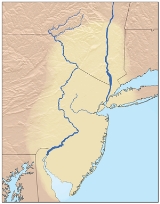
, the Lenape lived in the area they called
LenapehokingLenapehoking is a term for the lands historically inhabited by the Native American people known as the Lenape in what is now the Northeastern United States...
, roughly the area around and between the
DelawareThe Delaware River is a major river on the Atlantic coast of the United States.A Dutch expedition led by Henry Hudson in 1609 first mapped the river. The river was christened the South River in the New Netherland colony that followed, in contrast to the North River, as the Hudson River was then...
and lower
Hudson The Hudson is a river that flows from north to south through eastern New York. The highest official source is at Lake Tear of the Clouds, on the slopes of Mount Marcy in the Adirondack Mountains. The river itself officially begins in Henderson Lake in Newcomb, New York...
rivers. They spoke two related languages in the
AlgonquianThe Algonquian languages also Algonkian) are a subfamily of Native American languages which includes most of the languages in the Algic language family. The name of the Algonquian language family is distinguished from the orthographically similar Algonquin dialect of the Ojibwe language, which is a...
subfamily, collectively known as the Delaware languages:
UnamiUnami is an extinct Algonquian language formerly spoken by Lenape people in what is now the lower Hudson Valley area and New York Harbor area, New Jersey, Pennsylvania and Delaware, but later in Ontario and Oklahoma. It is one of the two Delaware languages, the other being Munsee...
and
MunseeMunsee is an endangered language of the Eastern Algonquian subgroup of the Algonquian language family, itself a branch of the Algic language family. Munsee is one of the two Delaware languages...
.
Lenape society is organized into
clanA clan is a group of people united by actual or perceived kinship and descent. Even if lineage details are unknown, clan members may be organized around a founding member or apical ancestor. The kinship-based bonds may be symbolical, whereby the clan shares a "stipulated" common ancestor that is a...
s determined by
matrilinealMatrilineality is a system in which descent is traced through the mother and maternal ancestors. Matrilineality is also a societal system in which one belongs to one's matriline or mother's lineage, which can involve the inheritance of property and/or titles.A matriline is a line of descent from a...
descent. Territory was collective, but divided by clan, with women having rights to property. A young married couple would live with the woman's family, where her mother and sisters could assist her with her growing family. Hereditary leadership passed through the maternal line, and women elders could remove leaders of whom they disapproved. Children belonged to the mother's clan, where they gained their status and identity.
At the time of European contact, the Lenape practiced large-scale agriculture, mostly
companion plantingCompanion planting is the planting of different crops in proximity , on the theory that they assist each other in nutrient uptake, pest control, pollination, and other factors necessary to increasing crop productivity...
; the women cultivated many varieties of the "
Three SistersThe Three Sisters are the three main agricultural crops of various Native American groups in North America: squash, maize, and climbing beans ....
:" corn, beans and squash. The men also practiced
huntingHunting is the practice of pursuing any living thing, usually wildlife, for food, recreation, or trade. In present-day use, the term refers to lawful hunting, as distinguished from poaching, which is the killing, trapping or capture of the hunted species contrary to applicable law...
and the harvesting of
seafoodSeafood is any form of marine life regarded as food by humans. Seafoods include fish, molluscs , crustaceans , echinoderms . Edible sea plants, such as some seaweeds and microalgae, are also seafood, and are widely eaten around the world, especially in Asia...
. They were primarily sedentary, moving to different established campsites by season.
After the arrival of settlers and traders to the 17th-century colony of
New NetherlandNew Netherland, or Nieuw-Nederland in Dutch, was the 17th-century colonial province of the Republic of the Seven United Netherlands on the East Coast of North America. The claimed territories were the lands from the Delmarva Peninsula to extreme southwestern Cape Cod...
, the Lenape and other native peoples became extensively involved in the
North American fur tradeThe North American fur trade was the industry and activities related to the acquisition, exchange, and sale of animal furs in the North American continent. Indigenous peoples of different regions traded among themselves in the Pre-Columbian Era, but Europeans participated in the trade beginning...
. Their trapping depleted the
beaverThe beaver is a primarily nocturnal, large, semi-aquatic rodent. Castor includes two extant species, North American Beaver and Eurasian Beaver . Beavers are known for building dams, canals, and lodges . They are the second-largest rodent in the world...
population in the region, proving disastrous for both the Lenape and the Dutch settlers. The Lenape were further weakened by newly introduced infectious diseases, and by conflict with both Europeans and the traditional Lenape enemies, the
IroquoianThe Iroquoian languages are a First Nation and Native American language family.-Family division:*Ruttenber, Edward Manning. 1992 [1872]. History of the Indian tribes of Hudson's River. Hope Farm Press....
-speaking
SusquehannockThe Susquehannock people were Iroquoian-speaking Native Americans who lived in areas adjacent to the Susquehanna River and its tributaries from the southern part of what is now New York, through Pennsylvania, to the mouth of the Susquehanna in Maryland at the north end of the Chesapeake Bay...
. Over the next two centuries, they were pushed out of their lands by Iroquoian enemies, treaties and overcrowding by European settlers; the Lenape moved west into the
Ohio RiverThe Ohio River is the largest tributary, by volume, of the Mississippi River. At the confluence, the Ohio is even bigger than the Mississippi and, thus, is hydrologically the main stream of the whole river system, including the Allegheny River further upstream...
valley. In the 1860s, most Lenape remaining in the
Eastern United StatesThe Eastern United States, the American East, or simply the East is traditionally defined as the states east of the Mississippi River. The first two tiers of states west of the Mississippi have traditionally been considered part of the West, but can be included in the East today; usually in...
were sent to the
Oklahoma TerritoryThe Territory of Oklahoma was an organized incorporated territory of the United States that existed from May 2, 1890, until November 16, 1907, when it was joined with the Indian Territory under a new constitution and admitted to the Union as the State of Oklahoma.-Organization:Oklahoma Territory's...
under
Indian removalIndian removal was a nineteenth century policy of the government of the United States to relocate Native American tribes living east of the Mississippi River to lands west of the river...
policy. In the 21st century, most Lenape now reside in the U.S. state of
OklahomaOklahoma is a state located in the South Central region of the United States of America. With an estimated 3,751,351 residents as of the 2010 census and a land area of 68,667 square miles , Oklahoma is the 28th most populous and 20th-largest state...
, with some communities living also in
KansasKansas is a US state located in the Midwestern United States. It is named after the Kansas River which flows through it, which in turn was named after the Kansa Native American tribe, which inhabited the area. The tribe's name is often said to mean "people of the wind" or "people of the south...
,
WisconsinWisconsin is a U.S. state located in the north-central United States and is part of the Midwest. It is bordered by Minnesota to the west, Iowa to the southwest, Illinois to the south, Lake Michigan to the east, Michigan to the northeast, and Lake Superior to the north. Wisconsin's capital is...
,
OntarioOntario is a province of Canada, located in east-central Canada. It is Canada's most populous province and second largest in total area. It is home to the nation's most populous city, Toronto, and the nation's capital, Ottawa....
, Canada, and in their traditional homelands.
Name
Leni Lenape means "Human Beings" or the "Real People" in the
Unami languageUnami is an extinct Algonquian language formerly spoken by Lenape people in what is now the lower Hudson Valley area and New York Harbor area, New Jersey, Pennsylvania and Delaware, but later in Ontario and Oklahoma. It is one of the two Delaware languages, the other being Munsee...
. Their (autonym) is also spelled Lennape or Lenapi, meaning "the people." The term "Delaware" was used by the English, who named the people for their territory by the
Delaware RiverThe Delaware River is a major river on the Atlantic coast of the United States.A Dutch expedition led by Henry Hudson in 1609 first mapped the river. The river was christened the South River in the New Netherland colony that followed, in contrast to the North River, as the Hudson River was then...
. They named the river in honor of
Lord De La WarrThomas West, 3rd and 12th Baron De La Warr was the Englishman after whom the bay, the river, and, consequently, an American Indian people and U.S. state, all later called "Delaware", were named....
, the governor of the colony at
Jamestown, VirginiaJamestown was a settlement in the Colony of Virginia. Established by the Virginia Company of London as "James Fort" on May 14, 1607 , it was the first permanent English settlement in what is now the United States, following several earlier failed attempts, including the Lost Colony of Roanoke...
. The English colonists used the exonym "Delaware" for almost all the Lenape people living along this river and its tributaries.
Society
The area of Lenape settlement, which they called
LenapehokingLenapehoking is a term for the lands historically inhabited by the Native American people known as the Lenape in what is now the Northeastern United States...
, encompassed the lower Hudson River Valley and the Delaware Valley, with the area in between - what are now known as the U.S. state of
New JerseyNew Jersey is a state in the Northeastern and Middle Atlantic regions of the United States. , its population was 8,791,894. It is bordered on the north and east by the state of New York, on the southeast and south by the Atlantic Ocean, on the west by Pennsylvania and on the southwest by Delaware...
; eastern
PennsylvaniaThe Commonwealth of Pennsylvania is a U.S. state that is located in the Northeastern and Mid-Atlantic regions of the United States. The state borders Delaware and Maryland to the south, West Virginia to the southwest, Ohio to the west, New York and Ontario, Canada, to the north, and New Jersey to...
around the
DelawareThe Delaware Valley is a term used to refer to the valley where the Delaware River flows, along with the surrounding communities. This includes the metropolitan area centered on the city of Philadelphia. Such educational institutions as Delaware Valley Regional High School in Alexandria Township...
and
LehighThe Lehigh Valley, known officially by the United States Census Bureau as the Allentown-Bethlehem-Easton, PA-NJ metropolitan area and referred to locally as The Valley and A-B-E, is a metropolitan region consisting of Lehigh, Northampton, Berks, and Carbon counties in eastern Pennsylvania and...
valleys; the north shore of
DelawareDelaware is a U.S. state located on the Atlantic Coast in the Mid-Atlantic region of the United States. It is bordered to the south and west by Maryland, and to the north by Pennsylvania...
; and much of southeastern
New YorkNew York is a state in the Northeastern region of the United States. It is the nation's third most populous state. New York is bordered by New Jersey and Pennsylvania to the south, and by Connecticut, Massachusetts and Vermont to the east...
, particularly the lower
Hudson ValleyThe Hudson Valley comprises the valley of the Hudson River and its adjacent communities in New York State, United States, from northern Westchester County northward to the cities of Albany and Troy.-History:...
,
Upper New York BayUpper New York Bay, or Upper Bay, is the traditional heart of the Port of New York and New Jersey, and often called New York Harbor. It is enclosed by the New York City boroughs of Manhattan, Brooklyn, and Staten Island and the Hudson County, New Jersey municipalities of Jersey City and Bayonne.It...
,
Staten IslandStaten Island is a borough of New York City, New York, United States, located in the southwest part of the city. Staten Island is separated from New Jersey by the Arthur Kill and the Kill Van Kull, and from the rest of New York by New York Bay...
and western
Long IslandLong Island is an island located in the southeast part of the U.S. state of New York, just east of Manhattan. Stretching northeast into the Atlantic Ocean, Long Island contains four counties, two of which are boroughs of New York City , and two of which are mainly suburban...
. Bands or tribes often identified themselves by their geographic locations. The Lenape spoke two related languages in the
AlgonquianThe Algonquian languages also Algonkian) are a subfamily of Native American languages which includes most of the languages in the Algic language family. The name of the Algonquian language family is distinguished from the orthographically similar Algonquin dialect of the Ojibwe language, which is a...
subfamily, collectively known as the Delaware languages:
MunseeMunsee is an endangered language of the Eastern Algonquian subgroup of the Algonquian language family, itself a branch of the Algic language family. Munsee is one of the two Delaware languages...
in the northern areas and
UnamiUnami is an extinct Algonquian language formerly spoken by Lenape people in what is now the lower Hudson Valley area and New York Harbor area, New Jersey, Pennsylvania and Delaware, but later in Ontario and Oklahoma. It is one of the two Delaware languages, the other being Munsee...
and a variation in the southern areas.
Early Indian "tribes" are better understood as language groups, rather than as "nations". At the time of first European contact, a Lenape individual would likely have identified primarily with his or her immediate family and clan, friends, and/or village unit; then with surrounding and familiar village units; next with more distant neighbors who spoke the same dialect; and ultimately, with all those in the surrounding area who spoke mutually comprehensible languages, including the
MahicanThe Mahican are an Eastern Algonquian Native American tribe, originally settling in the Hudson River Valley . After 1680, many moved to Stockbridge, Massachusetts. During the early 1820s and 1830s, most of the Mahican descendants migrated westward to northeastern Wisconsin...
. Among other
Algonquian peoplesThe Algonquian are one of the most populous and widespread North American native language groups, with tribes originally numbering in the hundreds. Today hundreds of thousands of individuals identify with various Algonquian peoples...
on the East Coast, the Lenape were considered the "grandfathers" from whom all the other Algonquian peoples originated. Consequently, in inter-tribal councils, the Lenape were given respect as one would to elders.
Those of a different language stock – such as the
IroquoisThe Iroquois , also known as the Haudenosaunee or the "People of the Longhouse", are an association of several tribes of indigenous people of North America...
(or, in the Lenape language, the
Minqua) – were regarded as foreign. As in the case of the Iroquois, the animosity of difference and competition spanned many generations, and different language tribes became traditional enemies. Ethnicity seems to have mattered little to the Lenape and many other "tribes". Archaeological excavations have found Lenape burials that included identifiably ethnic Iroquois remains interred along with those of Lenape. The two groups were bitter enemies since before recorded history, but intermarriage occurred. In addition, both tribes practiced adopting young captives from warfare into their tribes and assimilating them as full tribal members.
Overlaying these relationships was a
phratryIn ancient Greece, a phratry ατρία, "brotherhood", "kinfolk", derived from φρατήρ meaning "brother") was a social division of the Greek tribe...
system, a division into
clanA clan is a group of people united by actual or perceived kinship and descent. Even if lineage details are unknown, clan members may be organized around a founding member or apical ancestor. The kinship-based bonds may be symbolical, whereby the clan shares a "stipulated" common ancestor that is a...
s. Clan membership was matrilineal; children inherited membership in a clan from their
motherA mother, mum, mom, momma, or mama is a woman who has raised a child, given birth to a child, and/or supplied the ovum that grew into a child. Because of the complexity and differences of a mother's social, cultural, and religious definitions and roles, it is challenging to specify a universally...
. On reaching adulthood, a Lenape traditionally married outside the clan, a practice known by ethnographers as, "
exogamyExogamy is a social arrangement where marriage is allowed only outside of a social group. The social groups define the scope and extent of exogamy, and the rules and enforcement mechanisms that ensure its continuity. In social studies, exogamy is viewed as a combination of two related aspects:...
". The practice effectively prevented inbreeding, even among individuals whose kinship was obscure or unknown.
Early Europeans who first wrote about Indians found matrilineal social organization to be unfamiliar and perplexing. Because of this, Europeans often tried to interpret Lenape society through more familiar European arrangements. As a result, the early records are full of clues about early Lenape society, but were usually written by observers who did not fully understand what they were seeing. For example, a man's maternal uncle (his mother's brother), and not his father, was usually considered to be his closest male ancestor, since his father belonged to a different clan. The maternal uncle played a more prominent role in the lives of his sister's children than did the father. Early European chroniclers did not understand this concept.
Land was assigned to a particular clan for hunting, fishing, and cultivation. Individual private ownership of land was unknown, as the land belonged to the clan collectively while they inhabited it, but women often had rights to traditional areas for cultivation. Clans lived in fixed settlements, using the surrounding areas for communal hunting and planting until the land was exhausted. In a common practice known as "agricultural shifting", the group then moved to found a new settlement within their territory.
The Lenape practiced large-scale
agricultureAgriculture is the cultivation of animals, plants, fungi and other life forms for food, fiber, and other products used to sustain life. Agriculture was the key implement in the rise of sedentary human civilization, whereby farming of domesticated species created food surpluses that nurtured the...
to augment a mobile
hunter-gathererA hunter-gatherer or forage society is one in which most or all food is obtained from wild plants and animals, in contrast to agricultural societies which rely mainly on domesticated species. Hunting and gathering was the ancestral subsistence mode of Homo, and all modern humans were...
society in the region around the Delaware River, the lower
Hudson RiverThe Hudson is a river that flows from north to south through eastern New York. The highest official source is at Lake Tear of the Clouds, on the slopes of Mount Marcy in the Adirondack Mountains. The river itself officially begins in Henderson Lake in Newcomb, New York...
, and western
Long Island SoundLong Island Sound is an estuary of the Atlantic Ocean, located in the United States between Connecticut to the north and Long Island, New York to the south. The mouth of the Connecticut River at Old Saybrook, Connecticut, empties into the sound. On its western end the sound is bounded by the Bronx...
. The Lenape were largely a sedentary people who occupied campsites seasonally, which gave them relatively easy access to the small game that inhabited the region:
fishFish are a paraphyletic group of organisms that consist of all gill-bearing aquatic vertebrate animals that lack limbs with digits. Included in this definition are the living hagfish, lampreys, and cartilaginous and bony fish, as well as various extinct related groups...
, birds,
shellfishShellfish is a culinary and fisheries term for exoskeleton-bearing aquatic invertebrates used as food, including various species of molluscs, crustaceans, and echinoderms. Although most kinds of shellfish are harvested from saltwater environments, some kinds are found only in freshwater...
and
deerDeer are the ruminant mammals forming the family Cervidae. Species in the Cervidae family include white-tailed deer, elk, moose, red deer, reindeer, fallow deer, roe deer and chital. Male deer of all species and female reindeer grow and shed new antlers each year...
. They developed sophisticated techniques of
huntingHunting is the practice of pursuing any living thing, usually wildlife, for food, recreation, or trade. In present-day use, the term refers to lawful hunting, as distinguished from poaching, which is the killing, trapping or capture of the hunted species contrary to applicable law...
and managing their resources.
By the time of the arrival of Europeans, the Lenape were cultivating fields of vegetation through the
slash and burnSlash-and-burn is an agricultural technique which involves cutting and burning of forests or woodlands to create fields. It is subsistence agriculture that typically uses little technology or other tools. It is typically part of shifting cultivation agriculture, and of transhumance livestock...
technique. This extended the productive life of planted fields. They also harvested vast quantities of fish and shellfish from the bays of the area, and, in southern New Jersey, harvested
clamsCLaMS is a modular chemistry transport model system developed at Forschungszentrum Jülich, Germany. CLaMS was first described by McKenna et al. and was expanded into three dimensions by Konopka et al....
year-round. The success of these methods allowed the tribe to maintain a larger population than nomadic
hunter-gathererA hunter-gatherer or forage society is one in which most or all food is obtained from wild plants and animals, in contrast to agricultural societies which rely mainly on domesticated species. Hunting and gathering was the ancestral subsistence mode of Homo, and all modern humans were...
s could support. Scholars have estimated that at the time of European settlement, there may have been about 15,000 Lenape total in approximately 80 settlement sites around much of the
New York CityNew York is the most populous city in the United States and the center of the New York Metropolitan Area, one of the most populous metropolitan areas in the world. New York exerts a significant impact upon global commerce, finance, media, art, fashion, research, technology, education, and...
area, alone. In 1524 Lenape in canoes met Giovanni da Verrazzano, the first European explorer to enter
New York HarborNew York Harbor refers to the waterways of the estuary near the mouth of the Hudson River that empty into New York Bay. It is one of the largest natural harbors in the world. Although the U.S. Board of Geographic Names does not use the term, New York Harbor has important historical, governmental,...
.
The early European settlers, especially the Dutch and Swedes, were surprised at the Lenape's skill in fashioning beautiful articles of clothing from natural materials. In hot weather both men and women wore only loin cloth and skirt respectively, while they used beaver pelts or bear skins to serve as winter mantles. Additionally, both sexes might wear buckskin leggings and moccasins in cold weather. Deer hair, dyed a deep scarlet, was a favorite component of headdresses and breast ornaments for males. The Lenape also adorned themselves with various ornaments made of stone, shell, animal teeth, and claws. The women often wore headbands of dyed deer hair or wampum. They painted their skin skirts or decorated them with porcupine quills. These skirts were so elaborately appointed that, when seen from a distance, they reminded Dutch settlers of fine European lace.The winter cloaks of the women were striking, fashioned entirely from the iridescent body feathers of wild turkeys.
European contact
The first recorded contact with Europeans and people presumed to have been the Lenape was in 1524. The explorer Giovanni da Verrazzano was greeted by local Lenape who came by canoe, after his ship entered what is now called
Lower New York BayLower New York Bay is that section of New York Bay south of the Narrows, the relatively narrow strait between the shores of Staten Island and Brooklyn. The southern end of the bay opens directly to the Atlantic Ocean between two spits of land, Sandy Hook, New Jersey, and Rockaway, Queens, on Long...
.
The early interaction between the Lenape and Dutch traders in the 17th century was primarily through the
fur tradeThe fur trade is a worldwide industry dealing in the acquisition and sale of animal fur. Since the establishment of world market for in the early modern period furs of boreal, polar and cold temperate mammalian animals have been the most valued...
, specifically, the Lenape trapped and traded
beaverThe North American Beaver is the only species of beaver in the Americas, native to North America and introduced to South America. In the United States and Canada, where no other species of beaver occurs, it is usually simply referred to as "beaver"...
pelts for European-made goods. According to Dutch settler Isaac de Rasieres, who observed the Lenape in 1628, the Lenape's primary crop was
maizeMaize known in many English-speaking countries as corn or mielie/mealie, is a grain domesticated by indigenous peoples in Mesoamerica in prehistoric times. The leafy stalk produces ears which contain seeds called kernels. Though technically a grain, maize kernels are used in cooking as a vegetable...
, which they planted in March. They quickly adopted European metal tools for this task.
In May, the Lenape planted kidney beans near the maize plants; the latter served as props for the climbing bean vines. They also planted squash, whose broad leaves cut down on weeds and conserved moisture in the soil. The women devoted their summers to field work and harvested the crops in August. Women cultivated varieties of maize, squash and beans, and did most of the field work, processing and cooking of food.
The men limited their agricultural labor to clearing the field and breaking the soil. They primarily hunted and fished during the rest of the year. Dutch settler David de Vries, who stayed in the area from 1634 to 1644, described a Lenape hunt in the valley of the
Achinigeu-hach (or "Ackingsah-sack," the
Hackensack RiverThe Hackensack River is a river, approximately 45 miles long, in the U.S. states of New York and New Jersey, emptying into Newark Bay, a back chamber of New York Harbor. The watershed of the river includes part of the suburban area outside New York City just west of the lower Hudson River,...
), in which one hundred or more men stood in a line many paces from each other, beating thigh bones on their palms to drive animals to the river, where they could be killed easily. Other methods of hunting included
lassoA lasso , also referred to as a lariat, riata, or reata , is a loop of rope that is designed to be thrown around a target and tighten when pulled. It is a well-known tool of the American cowboy. The word is also a verb; to lasso is to successfully throw the loop of rope around something...
ing and drowning deer, as well as forming a circle around prey and setting the brush on fire.
17th century
New AmsterdamNew Amsterdam was a 17th-century Dutch colonial settlement that served as the capital of New Netherland. It later became New York City....
was founded by the Dutch in what would later become
New York CityNew York is the most populous city in the United States and the center of the New York Metropolitan Area, one of the most populous metropolitan areas in the world. New York exerts a significant impact upon global commerce, finance, media, art, fashion, research, technology, education, and...
in 1624. Dutch settlers founded a colony at present-day
LewesLewes is an incorporated city in Sussex County, Delaware, USA, on the Delmarva Peninsula. According to the 2010 census, the population is 2,747, a decrease of 6.3% from 2000....
,
DelawareDelaware is a U.S. state located on the Atlantic Coast in the Mid-Atlantic region of the United States. It is bordered to the south and west by Maryland, and to the north by Pennsylvania...
on June 3, 1631 and named it
ZwaanendaelZwaanendael or Swaanendael was a short lived Dutch colonial settlement in Delaware. It was built in 1631. The name is archaic Dutch spelling for "swan valley" or dale...
(Swan Valley). The colony had a short life, as in 1632 a local band of Lenape killed the 32 Dutch settlers after a misunderstanding escalated over Lenape defacement of the insignia of the Dutch West India Company. In 1634, the Iroquoian-speaking
SusquehannockThe Susquehannock people were Iroquoian-speaking Native Americans who lived in areas adjacent to the Susquehanna River and its tributaries from the southern part of what is now New York, through Pennsylvania, to the mouth of the Susquehanna in Maryland at the north end of the Chesapeake Bay...
went to war with the Lenape over access to trade with the Dutch at New Amsterdam. They defeated the Lenape, and some scholars believe that the Lenape may have become tributaries to the Susquehannock. After the warfare, the Lenape referred to the Susquehannock as "uncles." The Lenape were added to the
Covenant ChainThe Covenant Chain was a series of alliances and treaties involving the Iroquois Confederacy , the British colonies of North America, and a number of other Indian tribes...
by the Iroquois in 1676, remaining tributary to the Five (later Six) Nations until 1753.
The Lenape's quick adoption of trade goods, and their need to trap furs to meet high European demand, resulted in their disastrous over-harvesting of the beaver population in the lower Hudson Valley. With the fur sources exhausted, the Dutch shifted their operations to present-day
upstate New YorkUpstate New York is the region of the U.S. state of New York that is located north of the core of the New York metropolitan area.-Definition:There is no clear or official boundary between Upstate New York and Downstate New York...
. The Lenape who produced
wampumWampum are traditional, sacred shell beads of the Eastern Woodlands tribes of the indigenous people of North America. Wampum include the white shell beads fashioned from the North Atlantic channeled whelk shell; and the white and purple beads made from the quahog, or Western North Atlantic...
in the vicinity of Manhattan Island temporarily forestalled the negative effects of this decline in trade. Lenape population fell sharply during this period, due to high fatalities from epidemics of infectious diseases carried by Europeans, such as
measlesMeasles, also known as rubeola or morbilli, is an infection of the respiratory system caused by a virus, specifically a paramyxovirus of the genus Morbillivirus. Morbilliviruses, like other paramyxoviruses, are enveloped, single-stranded, negative-sense RNA viruses...
and
smallpoxSmallpox was an infectious disease unique to humans, caused by either of two virus variants, Variola major and Variola minor. The disease is also known by the Latin names Variola or Variola vera, which is a derivative of the Latin varius, meaning "spotted", or varus, meaning "pimple"...
, to which they had no natural
immunityImmunity is a biological term that describes a state of having sufficient biological defenses to avoid infection, disease, or other unwanted biological invasion. Immunity involves both specific and non-specific components. The non-specific components act either as barriers or as eliminators of wide...
.
The Lenape had a culture in which the clan and family controlled property. Europeans often tried to contract for land with the tribal chiefs, confusing their culture with that of neighboring tribes such as the Iroquois. The Lenape would petition for grievances on the basis that not all their families had been recognized in the transaction (not that they wanted to "share" the land). After the Dutch arrival in the 1620s, the Lenape were successful in restricting Dutch settlement until the 1660s to
PavoniaPavonia was the first European settlement on the west bank of the North River that was part of the 17th century province of New Netherland in what would become today's Hudson County, New Jersey.-Hudson and the Hackensack:...
in present-day
Jersey CityJersey City is the seat of Hudson County, New Jersey, United States.Part of the New York metropolitan area, Jersey City lies between the Hudson River and Upper New York Bay across from Lower Manhattan and the Hackensack River and Newark Bay...
along the Hudson. The Dutch finally established a garrison at Bergen, which allowed settlement west of the Hudson within the province of
New NetherlandNew Netherland, or Nieuw-Nederland in Dutch, was the 17th-century colonial province of the Republic of the Seven United Netherlands on the East Coast of North America. The claimed territories were the lands from the Delmarva Peninsula to extreme southwestern Cape Cod...
. This land was purchased from the Lenape after the fact.
In the early 1680s,
William PennWilliam Penn was an English real estate entrepreneur, philosopher, and founder of the Province of Pennsylvania, the English North American colony and the future Commonwealth of Pennsylvania. He was an early champion of democracy and religious freedom, notable for his good relations and successful...
and Quaker colonists created the English colony of
PennsylvaniaThe Commonwealth of Pennsylvania is a U.S. state that is located in the Northeastern and Mid-Atlantic regions of the United States. The state borders Delaware and Maryland to the south, West Virginia to the southwest, Ohio to the west, New York and Ontario, Canada, to the north, and New Jersey to...
beginning at the lower Delaware River. In the decades immediately following, some 20,000 new colonists arrived in the region, putting pressure on Lenape settlements and hunting grounds. Although Penn endeavored to live peaceably with the Lenape and to create a colony that would do the same, he also expected his authority and that of the colonial government to take precedence. His new colony effectively displaced the Lenape and forced others to adapt to new cultural demands. Penn gained a reputation for benevolence and tolerance, but his efforts resulted in more effective colonization of the ancestral Lenape homeland than previous ones.
18th century
William Penn died in 1718. His heirs, John Penn and Thomas Penn, and their agents were running the colony, and had abandoned many of the elder Penn's practices. In 1737, the colonial administrators claimed that they had a deed dating to the 1680s in which the Lenape-Delaware had promised to sell a portion of land beginning between the junction of the Delaware River and
Lehigh RiverThe Lehigh River, a tributary of the Delaware River, is a river located in eastern Pennsylvania, in the United States. Part of the Lehigh, along with a number of its tributaries, is designated a Pennsylvania Scenic River by the state's Department of Conservation and Natural Resources...
and extending "as far west as a man could walk in a day and a half." They contrived to have runners travel west, and thus claim huge swaths of land in the eastern portion of the state. Although reluctant to agree to the dubious claim, after years of fighting protest, the Lenape acquiesced to the
Walking PurchaseThe Walking Purchase was a purported 1737 agreement between the Penn family, the proprietors of Pennsylvania, and the Lenape . By it the Penn family and proprietors claimed an area of 1,200,000 acres and forced the Lenape to vacate it...
.
Beginning in the 18th century, the Moravian Church established missions among the Lenape. The Moravians required the Christian converts to share their
pacifismPacifism is the opposition to war and violence. The term "pacifism" was coined by the French peace campaignerÉmile Arnaud and adopted by other peace activists at the tenth Universal Peace Congress inGlasgow in 1901.- Definition :...
, as well as to live in a structured and European-style mission village. Moravian pacifism and unwillingness to take loyalty oaths caused conflicts with British authorities, who were seeking aid against the French and their Native American allies during the
French and Indian WarThe French and Indian War is the common American name for the war between Great Britain and France in North America from 1754 to 1763. In 1756, the war erupted into the world-wide conflict known as the Seven Years' War and thus came to be regarded as the North American theater of that war...
(Seven Years War). The Moravians' insistence on
ChristianA Christian is a person who adheres to Christianity, an Abrahamic, monotheistic religion based on the life and teachings of Jesus of Nazareth as recorded in the Canonical gospels and the letters of the New Testament...
Lenapes' abandoning traditional warfare practices also alienated mission populations from other Lenape and Native American groups. The Moravians accompanied Lenape relocations to Ohio and Canada, continuing their missionary work. The Moravian Lenape who settled permanently in Ontario after the
American Revolutionary WarThe American Revolutionary War , the American War of Independence, or simply the Revolutionary War, began as a war between the Kingdom of Great Britain and thirteen British colonies in North America, and ended in a global war between several European great powers.The war was the result of the...
were sometimes referred to as "
Christian MunseeThe Christian Munsee were a group of Lenape native American Indians, primarily Munsee-speaking, who converted to Christianity, following the teachings of the Moravian missionaries...
", as they mostly spoke the Munsee branch of the Delaware language.
The
Treaty of EastonThe Treaty of Easton was a colonial agreement in North America signed in October 1758 during the French and Indian War . Briefly, chiefs of 13 Native American nations, representing tribes of the Iroquois, Lenape-Delaware, Shawnee and others, agreed to be allies of the British colonies during the...
, signed in 1758 between the Lenape and the Anglo-American colonists, required the Lenape to move westward, out of present-day New York and New Jersey and into Pennsylvania, then Ohio and beyond. Sporadically they continued to raid European-American settlers from far outside the area.
During the
French and Indian WarThe French and Indian War is the common American name for the war between Great Britain and France in North America from 1754 to 1763. In 1756, the war erupted into the world-wide conflict known as the Seven Years' War and thus came to be regarded as the North American theater of that war...
, the Lenape initially sided with the French. But, such leaders as
TeedyuscungTeedyuscung was known as King of the Delawares. He worked to establish a permanent Lenape home in eastern Pennsylvania in the Lehigh, Susquehanna and Delaware River valleys. Teedyuscung participated in the Treaty of Easton which resulted in the loss of any Lenape claims to all lands in Pennsylvania...
in the east and
Tamaqua in the vicinity of modern Pittsburgh shifted to building alliances with the English. After the end of the war, however, Anglo-American settlers continued to kill Lenape, often to such an extent that the historian Amy Schutt writes the dead since the wars outnumbered those killed during the war.
In 1763 Bill Hickman, Lenape, warned English colonists in the
Juniata RiverThe Juniata River is a tributary of the Susquehanna River, approximately long, in central Pennsylvania in the United States. The river is considered scenic along much of its route, having a broad and shallow course passing through several mountain ridges and steeply-lined water gaps...
region of an impending attack. Many Lenape joined in Pontiac's War, and were numerous among those Native Americans who besieged Pittsburgh.
In April 1763
Teedyuscung was killed when his home was burned. His son Captain Bull responded by attacking settlers from New England who had migrated to the
Wyoming ValleyWyoming Valley is a region of northeastern Pennsylvania. As a metropolitan area, it is also known as the Scranton/Wilkes-Barre area, after its principal cities, Scranton and Wilkes-Barre....
of Pennsylvania. The settlers had been sponsored by the Susquehanna Company.
The Lenape were the first Indian tribe to enter into a treaty with the new United States government, with the
Treaty of Fort PittThe Treaty of Fort Pitt — also known as the Treaty With the Delawares, the Delaware Treaty, or the Fourth Treaty of Pittsburgh, — was signed on September 17, 1778 and was the first written treaty between the new United States of America and any American Indians—the Lenape in this case...
signed in 1778 during the
American Revolutionary WarThe American Revolutionary War , the American War of Independence, or simply the Revolutionary War, began as a war between the Kingdom of Great Britain and thirteen British colonies in North America, and ended in a global war between several European great powers.The war was the result of the...
. By then living mostly in the
Ohio CountryThe Ohio Country was the name used in the 18th century for the regions of North America west of the Appalachian Mountains and in the region of the upper Ohio River south of Lake Erie...
, the Lenape supplied the
Continental ArmyThe Continental Army was formed after the outbreak of the American Revolutionary War by the colonies that became the United States of America. Established by a resolution of the Continental Congress on June 14, 1775, it was created to coordinate the military efforts of the Thirteen Colonies in...
with warriors and scouts in exchange for food supplies and security.
Ohio: 1750s to 1812 (American Revolution and War of 1812)
After the signing of the
Treaty of EastonThe Treaty of Easton was a colonial agreement in North America signed in October 1758 during the French and Indian War . Briefly, chiefs of 13 Native American nations, representing tribes of the Iroquois, Lenape-Delaware, Shawnee and others, agreed to be allies of the British colonies during the...
in 1758, the Lenape were forced to move west out of their native lands into what is today known as Ohio.
During the American Revolution, the Munsee-speaking Lenape (then called Delaware) bands of the Ohio Country were deeply divided over which side, if any, to take in the conflict. Years earlier, many Lenape had migrated west to Ohio from their territory on the mid-Atlantic coast to try to escape colonial encroachment, as well as pressure from Iroquois tribes from the north. They resettled, with bands in numerous villages around their main village of
CoshoctonCoshocton may refer to:* Coshocton, Ohio* Coshocton High School* Coshocton County, Ohio...
. By the time of the Revolutionary War, the Lenape found their villages lay between the western frontier strongholds of the war's opponents: the American colonists' military outpost at
Fort PittFort Pitt was a fort built at the location of Pittsburgh, Allegheny County, Pennsylvania.-French and Indian War:The fort was built from 1759 to 1761 during the French and Indian War , next to the site of former Fort Duquesne, at the confluence the Allegheny River and the Monongahela River...
(present-day Pittsburgh) and the British with Indian allies around
Fort DetroitFort Pontchartrain du Détroit or Fort Détroit was a fort established by the French officer Antoine de la Mothe Cadillac in 1701. The location of the former fort is now in the city of Detroit in the U.S...
(in present-day
MichiganMichigan is a U.S. state located in the Great Lakes Region of the United States of America. The name Michigan is the French form of the Ojibwa word mishigamaa, meaning "large water" or "large lake"....
).
Some Lenape decided to take up arms against the American colonials and moved to the west, closer to Detroit, where they settled on the
SciotoThe Scioto River is a river in central and southern Ohio more than 231 miles in length. It rises in Auglaize County in west central Ohio, flows through Columbus, Ohio, where it collects its largest tributary, the Olentangy River, and meets the Ohio River at Portsmouth...
and
SanduskyThe Sandusky River is a tributary to Lake Erie in north-central Ohio in the United States. It is about long and flows into Lake Erie at Sandusky Bay.-Course:...
rivers. Those Lenape sympathetic to the United States remained at Coshocton, and leaders signed the
Treaty of Fort Pitt (1778)The Treaty of Fort Pitt — also known as the Treaty With the Delawares, the Delaware Treaty, or the Fourth Treaty of Pittsburgh, — was signed on September 17, 1778 and was the first written treaty between the new United States of America and any American Indians—the Lenape in this case...
with the Americans. Through this, the Lenape hoped to establish the Ohio Country as a state inhabited exclusively by Native Americans, as part of the new United States. A third group of Lenape, many of them converted
Christian MunseeThe Christian Munsee were a group of Lenape native American Indians, primarily Munsee-speaking, who converted to Christianity, following the teachings of the Moravian missionaries...
s, lived in several mission villages run by Moravians. (They spoke the Munsee branch of Delaware, an
AlgonquianAlgonquian language may refer to:* Algonquian languages, language sub-family indigenous to North America* Algonquin language, the particular Algonquian language spoken by certain First-Nations people of Canada...
language.)
White EyesWhite Eyes, named Koquethagechton , was a leader of the Lenape people in the Ohio Country during the era of the American Revolution. Sometimes known as George White Eyes, his given name in Lenape was rendered in many spelling variations in colonial records...
, the Lenape
chiefA tribal chief is the leader of a tribal society or chiefdom. Tribal societies with social stratification under a single leader emerged in the Neolithic period out of earlier tribal structures with little stratification, and they remained prevalent throughout the Iron Age.In the case of ...
who had negotiated the treaty, died in 1778. Many Lenape at Coshocton eventually joined the war against the Americans. In response, Colonel
Daniel BrodheadDaniel Brodhead IV was an American military and political leader during the American Revolutionary War and early days of the United States.-Early life:...
led an expedition out of Fort Pitt and on 19 April 1781 destroyed Coshocton. Surviving residents fled to the north. Colonel Brodhead convinced the militia to leave the Lenape at the Moravian mission villages unmolested, since they were unarmed non-combatants.
Brodhead's having to restrain the militia from attacking the Moravian villages was a reflection of the brutal nature of
frontier warfareThe Western theater of the American Revolutionary War was the area of conflict west of the Appalachian Mountains, the region which became the Northwest Territory of the United States as well as the states of Kentucky, Tennessee, and Missouri...
. Violence had escalated on both sides. Relations between regular
Continental ArmyThe Continental Army was formed after the outbreak of the American Revolutionary War by the colonies that became the United States of America. Established by a resolution of the Continental Congress on June 14, 1775, it was created to coordinate the military efforts of the Thirteen Colonies in...
officers from the East (such as Brodhead) and western militia were frequently strained. The tensions were worsened by the American government's policy of recruiting some Indian tribes as allies in the war. Western militiamen, many of whom had lost friends and family in Indian raids against settlers' encroachment, blamed all Indians for the acts of some.
During the early 1770s, missionaries, including David Zeisberger and John Heckewelder, arrived in the Ohio Country near the Delaware villages. The Moravian Church sent these men to convert the natives to Christianity. The missionaries established several missions, including Gnadenhutten, Lichtenau, and Schoenbrunn. The missionaries asked that the natives forsake all of their traditional customs and ways of life. Many Delaware did adopt Christianity, but others refused to do so. The Delaware became a divided people during the 1770s, including in Killbuck's family. Killbuck resented his grandfather for allowing the Moravians to remain in the Ohio Country. The Moravians believed in pacifism, and Killbuck believed that every convert to the Moravians deprived the Delaware of a warrior to stop further white settlement of their land.
During the French and Indian War, Killbuck assisted the English against their French enemy. In 1761, Killbuck led an English supply train from Fort Pitt to Fort Sandusky. The British paid him one dollar per day. Later Killbuck became a leader in a very dangerous time for the Delaware. The American Revolution had just begun, and Killbuck found his people caught between the English in the West and the Americans in the East. At the war's beginning, Killbuck and many Delaware claimed to be neutral. In 1778, Killbuck permitted American soldiers to traverse Delaware territory so that the soldiers could attack Fort Detroit. In return, Killbuck requested that the Americans build a fort near the natives' major village of Coshocton to provide the Delaware with protection from English attacks. The Americans agreed and built Fort Laurens, which they garrisoned.
Other Indian groups, especially the
WyandotThe Wyandot are indigenous peoples of North America, known in their native language of the Iroquoian family as the Wendat. The pre-contact people formed by the 15th century in the area of the north shore of present-day Lake Ontario, before migrating to Georgian Bay...
, the
MingoThe Mingo are an Iroquoian group of Native Americans made up of peoples who migrated west to the Ohio Country in the mid-eighteenth century. Anglo-Americans called these migrants mingos, a corruption of mingwe, an Eastern Algonquian name for Iroquoian-language groups in general. Mingos have also...
, the Munsee, the
ShawneeThe Shawnee, Shaawanwaki, Shaawanooki and Shaawanowi lenaweeki, are an Algonquian-speaking people native to North America. Historically they inhabited the areas of Ohio, Virginia, West Virginia, Western Maryland, Kentucky, Indiana, and Pennsylvania...
, and the Wolf Clan of the Delaware, favored the British. They believed that by their proclamation of 1763, restricting Anglo-American settlement to east of the Appalachian Mountains, that the British would help them preserve a Native American territory. The British planned to attack
Fort LaurensFort Laurens was an American Revolutionary War fort in what is now the U.S. state of Ohio.-Overview:The fort was built by General Lachlan McIntosh, in 1778, on the west bank of the Tuscarawas River, now in Tuscarawas County near the town of Bolivar. The fort was intended to be a staging point for...
in early 1779 and demanded that the neutral Delawares formally side with the British. Killbuck warned the Americans of the planned attack. His actions helped save the fort, but the Americans abandoned it in August 1779. The Delaware had lost their protectors and, in theory, faced attacks from the British, their native allies, and the American settlers who flooded into the area in the late 1770s and early 1780s after the war. Most Delaware formally joined the British after the American withdrawal from Fort Laurens.
Facing pressure from the British, the Americans, and even his fellow natives, Killbuck hoped a policy of neutrality would save his people from destruction. It did not.
19th century
The amateur anthropologist
Silas WoodSilas Wood was a U.S. Representative from New York.Born in West Hills, near Huntington, New York, Wood pursued classical studies....
published a book claiming that there were several American Indian tribes that were distinct to Long Island, New York. He collectively called them the
MetoacMetoac is the collective name for the group of culturally and linguistically related Native American settlements roughly east of what is now the Nassau County line on, Long Island in New York at the time of European contact in the 17th century. Metoac does not specifically refer to political,...
. Modern scientific scholarship has shown that two linguistic groups represented two
AlgonquianThe Algonquian are one of the most populous and widespread North American native language groups, with tribes originally numbering in the hundreds. Today hundreds of thousands of individuals identify with various Algonquian peoples...
cultural identities on the island, not "13 individual tribes" as asserted by Wood. The bands to the west were Lenape. Those to the east were more related culturally to the Algonquian tribes of
New EnglandNew England is a region in the northeastern corner of the United States consisting of the six states of Maine, New Hampshire, Vermont, Massachusetts, Rhode Island, and Connecticut...
across Long Island Sound, such as the Pequot. Wood (and earlier settlers) often misinterpreted the Indian use of place names for identity as indicating their names for "tribes."
Over a period of 176 years, European settlers progressively crowded the Lenape out of the East Coast and Ohio, and pressed them to move further west. Most members of the Munsee-language branch of the Lenape left the United States after the British were defeated in the American Revolutionary War, and their descendants live on three
Indian reserveIn Canada, an Indian reserve is specified by the Indian Act as a "tract of land, the legal title to which is vested in Her Majesty, that has been set apart by Her Majesty for the use and benefit of a band." The Act also specifies that land reserved for the use and benefit of a band which is not...
s in Western Ontario, Canada. They are descendants of those Lenape of
Ohio CountryThe Ohio Country was the name used in the 18th century for the regions of North America west of the Appalachian Mountains and in the region of the upper Ohio River south of Lake Erie...
who sided with the British during the Revolutionary War. The largest reserve is at
Moraviantown, OntarioMoravian No. 47 is an Indian reserve located in Chatham-Kent Ontario with an area of 13 km². It is occupied by the Moravian of the Thames First Nation, a part of the Munsee branch of the Lenape, and is commonly known as Moravian of the Thames reserve...
, where the Turtle Clan settled in 1792 following the war.
Indiana to Missouri
By the Treaty of St. Mary’s, signed October 3, 1818 in St. Mary's Ohio, the Delaware ceded their lands in Indiana for lands west of the Mississippi and an annuity of $4,000. Over the next few years, the Delaware settled on the James River near its confluence with Wilson Creek, occupying eventually about 40000 acres (161.9 km²) of the approximately 2000000 acres (8,093.7 km²) allotted to them.
Anderson, IndianaAnderson is a city in and the county seat of Madison County, Indiana, United States. It is the principal city of the Anderson, Indiana Metropolitan Statistical Area which encompasses Madison county. Anderson is the headquarters of the Church of God and home of Anderson University, which is...
is named after Chief William Anderson, whose father was Swedish. The Delaware Village in Indiana was called Anderson's Town while the Delaware Village in Missouri on the James River was often called Anderson’s Village. The tribes' cabins and cornfields were spread out along the James River and Wilson Creek.
Role in western history
Many Delaware participated in exploration of the western United States, working as trappers with the
mountain menMountain men were trappers and explorers who roamed the North American Rocky Mountains from about 1810 through the 1880s where they were instrumental in opening up the various Emigrant Trails allowing Americans in the east to settle the new territories of the far west by organized wagon trains...
, and as guides and hunters for wagon trains. They served as
army guides and scoutsNative Americans have made up an integral part of U.S. military conflicts since America's beginning. Colonists recruited Indian allies during such instances as the Pequot War from 1634–1638, the Revolutionary War, as well as in War of 1812...
in events such as the
Second Seminole WarThe Second Seminole War, also known as the Florida War, was a conflict from 1835 to 1842 in Florida between various groups of Native Americans collectively known as Seminoles and the United States, part of a series of conflicts called the Seminole Wars...
,
Frémont'sJohn Charles Frémont , was an American military officer, explorer, and the first candidate of the anti-slavery Republican Party for the office of President of the United States. During the 1840s, that era's penny press accorded Frémont the sobriquet The Pathfinder...
expeditions, and the
conquest of CaliforniaThe "Conquest of California" or Conquest of Alta California by the United States covers the initial 1846 period of the Mexican-American War in Alta California, the present day state of California, United States...
during the Mexican-American War. Occasionally, they played surprising roles as Indian allies.
Sagundai accompanied one of Frémont's expeditions as one of his Delaware guides. From California, Fremont needed to communicate with Senator Benton. Sagundai volunteered to carry the message, through some 2,200 kilometres of hostile territory. He took many scalps in this adventure, including that of a
ComancheThe Comanche are a Native American ethnic group whose historic range consisted of present-day eastern New Mexico, southern Colorado, northeastern Arizona, southern Kansas, all of Oklahoma, and most of northwest Texas. Historically, the Comanches were hunter-gatherers, with a typical Plains Indian...
with a particularly fine horse, who had outrun both Sagundai and the other Comanches. Sagundai was thrown when his horse stepped into a prairie-dog hole, avoided the Comanche's lance, shot him dead, and caught his horse by the trailing lariat to make good his own escape. Upon his arrival among his own people, the Delaware held the last war and scalp dances in their history. These were held "where Edwin Taylor now (in 1918) lives, on the hill", at
Edwardsville, KansasEdwardsville is a city in Wyandotte County, Kansas, United States and is part of the "Unified Government" which also contains Kansas City, Kansas, most of Bonner Springs, and roughly half of Lake Quivira. The city is a satellite city of Kansas City, Missouri...
.
Kansas reservation
By the terms of the "Treaty of the James Fork" made September 24, 1829 and ratified by the US Senate in 1830, the Delaware were granted lands west of the Missouri River in
Indian TerritoryThe Indian Territory, also known as the Indian Territories and the Indian Country, was land set aside within the United States for the settlement of American Indians...
in exchange for lands on the James Fork on the
White RiverThe White River is a 722-mile long river that flows through the U.S. states of Arkansas and Missouri.-Course:The source of the White River is in the Boston Mountains of northwest Arkansas, in the Ozark-St. Francis National Forest southeast of Fayetteville...
in Missouri. These lands, in what is now Kansas, were west of the Missouri and north of the
Kansas RiverThe Kansas River is a river in northeastern Kansas in the United States. It is the southwestern-most part of the Missouri River drainage, which is in turn the northwestern-most portion of the extensive Mississippi River drainage. Its name come from the Kanza people who once inhabited the area...
. The main reserve consisted of about 1000000 acres (4,046.9 km²) with an additional "outlet" strip 10 miles (16.1 km) wide extending to the west. About 1,000 Delaware lived on the Delaware Reservation in Kansas, many in log cabins, but some in substantial farm houses with outbuildings. The center of activity was in what is now
Muncie, KansasMuncie is a neighborhood in Kansas City, Kansas on the north bank of the Kansas River. Rail lines run through it. On December 8, 1874, the James-Younger Gang are believed to have robbed a Kansas Pacific Railroad there of $30,000....
, a neighborhood of
Kansas City, KansasKansas City is the third-largest city in the state of Kansas and is the county seat of Wyandotte County. It is a suburb of Kansas City, Missouri, and is the third largest city in the Kansas City Metropolitan Area. The city is part of a consolidated city-county government known as the "Unified...
north of
Delaware CrossingGrinter Place is a house on the National Register of Historic Places above the Kansas River in the Muncie neighborhood of Kansas City, Kansas.The house was constructed by Moses Grinter where he and his half-Lenape wife lived until he died in 1878 and she in 1905...
on the Kansas River. The Delaware Indian agency, the blacksmith, and the
BaptistBaptists comprise a group of Christian denominations and churches that subscribe to a doctrine that baptism should be performed only for professing believers , and that it must be done by immersion...
and Methodist
missionA religious mission or mission station is a location for missionary work.While primarily a Christian term, the concept of the religious "mission" is also used prominently by the Church of Scientology and their Scientology Missions International....
s were located there.
White encroachment
In 1854 Congress passed the
Kansas-Nebraska ActThe Kansas–Nebraska Act of 1854 created the territories of Kansas and Nebraska, opening new lands for settlement, and had the effect of repealing the Missouri Compromise of 1820 by allowing settlers in those territories to determine through Popular Sovereignty if they would allow slavery within...
, which created the Territory of Kansas and opened the area for white settlement. It also authorized negotiation with Indian tribes regarding
removalIndian removal was a nineteenth century policy of the government of the United States to relocate Native American tribes living east of the Mississippi River to lands west of the river...
. The Delaware were reluctant to negotiate for another relocation, but they feared serious trouble with white settlers, which developed.
As the Delaware were not considered citizens, they had no access to the courts, and no way to enforce their property rights. That was, theoretically, done by the United States Army after the Indian Agent had followed onerous procedures requiring both posting a public notice warning trespassers and serving written notice on them. Major B.F. Robinson, the Indian Agent appointed in 1855, did his best, but could not control the hundreds of white trespassers who stole stock, cut timber, and built houses and squatted on Delaware lands. By 1860 the Delaware had reached consensus to leave Kansas, which was in accord with the government's Indian removal policy.
Oklahoma
The main body of Lenape arrived in the northeast region of
OklahomaOklahoma is a state located in the South Central region of the United States of America. With an estimated 3,751,351 residents as of the 2010 census and a land area of 68,667 square miles , Oklahoma is the 28th most populous and 20th-largest state...
in the 1860s. Along the way many smaller groups left, or were told to stay where they were. As a result of the multiple removals, each leavign some Delaware who chose to stay in place, today, from New Jersey to Wisconsin to southwest Oklahoma, there are groups who retain a sense of connection with ancestors who lived in the Delaware Valley in the 17th century and with cousins in the Lenape diaspora.
The two largest groups are the
Delaware NationThe Delaware Nation, sometimes called the Absentee or Western Delaware, is one of two federally recognized tribe of Delaware Indians, along with the Delaware Indians based in Bartlesville, Oklahoma...
(
Anadarko, OklahomaAnadarko is a city in Caddo County, Oklahoma, United States. The population was 6,645 at the 2000 census. It is the county seat of Caddo County.-Early History:Anadarko got its name when its post office was established in 1873...
), and the
Delaware Tribe of IndiansThe Delaware Tribe of Indians, sometimes called the Eastern Delaware, based in Bartlesville, Oklahoma, is one of two federally recognized tribe of Lenape Indians, along with the Delaware Nation based in Anadarko, Oklahoma.-History:...
(
Bartlesville, OklahomaBartlesville is a city in Osage and Washington counties in the U.S. state of Oklahoma. The population was 43,070 at the 2010 census. Bartlesville is located forty-seven miles north of Tulsa and very close to Oklahoma's northern border with Kansas. It is the county seat of Washington County, in...
), the only two federally recognized Lenape (Delaware) tribes in the United States. The Oklahoma branches were established in 1867. The Delaware were required to purchase land from the reservation of the
Cherokee NationThe Cherokee Nation is the largest of three Cherokee federally recognized tribes in the United States. It was established in the 20th century, and includes people descended from members of the old Cherokee Nation who relocated voluntarily from the Southeast to Indian Territory and Cherokees who...
; they made two payments totaling $438,000. A court dispute followed over whether the sale included rights for the Delaware as citizens within the Cherokee Nation.
While the dispute was unsettled, the
Curtis Act of 1898The Curtis Act of 1898 was an amendment to the United States Dawes Act that brought about the allotment process of lands of the Five Civilized Tribes of Indian Territory: the Choctaw, Chickasaw, Muscogee, Cherokee, and Seminole...
dissolved tribal governments and ordered the allotment of tribal lands to individual members of tribes. After the lands were allotted in 160 acre (650,000 m²) lots to tribal members in 1907, the government sold "surplus" land to non-Indians. The relatively arid land was not suitable for subsistence farming on such small plots.
20th century
In 1979, the United States
Bureau of Indian AffairsThe Bureau of Indian Affairs is an agency of the federal government of the United States within the US Department of the Interior. It is responsible for the administration and management of of land held in trust by the United States for Native Americans in the United States, Native American...
revoked the tribal status of the Delaware living among Cherokee in Oklahoma. They began to count the Delaware as Cherokee. The Delaware had this decision overturned in 1996, when they were recognized by the federal government as a separate tribal nation.
21st century
The Cherokee Nation filed suit to overturn the independent federal recognition of the Delaware. The tribe lost federal recognition in a 2004 court ruling in favor of the Cherokee Nation, but regained it on 28 July 2009. After recognition, the tribe reorganized under the
Oklahoma Indian Welfare ActThe Oklahoma Indian Welfare Act of 1936, also known as the Thomas-Rogers Act, is a United States federal law that extended the US Indian Reorganization Act of 1934. It sought to return some form of tribal government to the many tribes in former Indian Territory...
. Members approved a constitution and bylaws in a May 26, 2009 vote. Jerry Douglas was elected as tribal chief.
In 2004 the Delaware of Oklahoma sued the state of Pennsylvania over land lost in 1800. This was related to the
Walking PurchaseThe Walking Purchase was a purported 1737 agreement between the Penn family, the proprietors of Pennsylvania, and the Lenape . By it the Penn family and proprietors claimed an area of 1,200,000 acres and forced the Lenape to vacate it...
of 1737, an agreement of doubtful legal standing.
Today
Lenape communities today include the following:
Oklahoma:
- Delaware Tribe of Indians
The Delaware Tribe of Indians, sometimes called the Eastern Delaware, based in Bartlesville, Oklahoma, is one of two federally recognized tribe of Lenape Indians, along with the Delaware Nation based in Anadarko, Oklahoma.-History:...
(Bartlesville, OklahomaBartlesville is a city in Osage and Washington counties in the U.S. state of Oklahoma. The population was 43,070 at the 2010 census. Bartlesville is located forty-seven miles north of Tulsa and very close to Oklahoma's northern border with Kansas. It is the county seat of Washington County, in...
), US federally recognized.
- Delaware Nation
The Delaware Nation, sometimes called the Absentee or Western Delaware, is one of two federally recognized tribe of Delaware Indians, along with the Delaware Indians based in Bartlesville, Oklahoma...
(Anadarko, OklahomaAnadarko is a city in Caddo County, Oklahoma, United States. The population was 6,645 at the 2000 census. It is the county seat of Caddo County.-Early History:Anadarko got its name when its post office was established in 1873...
), US federally recognized.
OntarioOntario is a province of Canada, located in east-central Canada. It is Canada's most populous province and second largest in total area. It is home to the nation's most populous city, Toronto, and the nation's capital, Ottawa....
, Canada:
- Munsee-Delaware Nation 1, Ontario
The Munsee-Delaware Nation No. 1 is an Indian reserve on the Thames River, west of St. Thomas, Ontario, Canada, and belongs to the Munsee-Delaware First Nation...
, Canadian reserve.
- Moravian of the Thames First Nation
Moravian No. 47 is an Indian reserve located in Chatham-Kent Ontario with an area of 13 km². It is occupied by the Moravian of the Thames First Nation, a part of the Munsee branch of the Lenape, and is commonly known as Moravian of the Thames reserve...
, Canadian reserve.
- Delaware of Six Nations (at Six Nations of the Grand River), two Canadian reserves.
Wisconsin:
- Stockbridge-Munsee Community
The Stockbridge-Munsee Community is a Federally recognized Indian tribe consisting of the Mahican and Munsee peoples. Their land-base, the Stockbridge-Munsee Indian Reservation, is located at in Shawano County, Wisconsin, in the towns of Bartelme and Red Springs.-In popular culture:In The West...
, US federally recognized.
Four or five claiming to be of Lenape descent are trying to achieve federal recognition as organized tribes. They are the Munsee-Delaware/Lenape bands of
IllinoisIllinois is the fifth-most populous state of the United States of America, and is often noted for being a microcosm of the entire country. With Chicago in the northeast, small industrial cities and great agricultural productivity in central and northern Illinois, and natural resources like coal,...
,
IndianaIndiana is a US state, admitted to the United States as the 19th on December 11, 1816. It is located in the Midwestern United States and Great Lakes Region. With 6,483,802 residents, the state is ranked 15th in population and 16th in population density. Indiana is ranked 38th in land area and is...
,
MichiganMichigan is a U.S. state located in the Great Lakes Region of the United States of America. The name Michigan is the French form of the Ojibwa word mishigamaa, meaning "large water" or "large lake"....
,
MissouriMissouri is a US state located in the Midwestern United States, bordered by Iowa, Illinois, Kentucky, Tennessee, Arkansas, Oklahoma, Kansas and Nebraska. With a 2010 population of 5,988,927, Missouri is the 18th most populous state in the nation and the fifth most populous in the Midwest. It...
,
OhioOhio is a Midwestern state in the United States. The 34th largest state by area in the U.S.,it is the 7th‑most populous with over 11.5 million residents, containing several major American cities and seven metropolitan areas with populations of 500,000 or more.The state's capital is Columbus...
and
New YorkNew York is a state in the Northeastern region of the United States. It is the nation's third most populous state. New York is bordered by New Jersey and Pennsylvania to the south, and by Connecticut, Massachusetts and Vermont to the east...
state. In addition, a Lenape group in Pennslyvania is pursuing a land claim against the state government.
Lenape or Delaware live in communities known as
Urban IndianUrban Indians are Native Americans in the United States who live in urban areas. Urban Indians represent a growing proportion of the Native population in the United States...
s in their historic homeland in a number of states such as Delaware, Maryland, New Jersey and Virginia. They also live in the
New England StatesThe New England States was a passenger train operated by the New York Central Railroad and its successor Penn Central over the Water Level Route between Chicago and points east. The New York Central introduced the New England States on June 15, 1938, coinciding with the relaunch of the Twentieth...
; within the city of
Tulsa, OklahomaTulsa is the second-largest city in the state of Oklahoma and 46th-largest city in the United States. With a population of 391,906 as of the 2010 census, it is the principal municipality of the Tulsa Metropolitan Area, a region with 937,478 residents in the MSA and 988,454 in the CSA. Tulsa's...
. New York City and Philadelphia are known to have some Lenape residents; and others live in
diasporaA diaspora is "the movement, migration, or scattering of people away from an established or ancestral homeland" or "people dispersed by whatever cause to more than one location", or "people settled far from their ancestral homelands".The word has come to refer to historical mass-dispersions of...
across the country.
Literature
The Delaware feature prominently in
The Last of the MohicansThe Last of the Mohicans: A Narrative of 1757 is a historical novel by James Fenimore Cooper, first published in February 1826. It is the second book of the Leatherstocking Tales pentalogy and the best known...
and the other
Leatherstocking TalesThe Leatherstocking Tales is a series of novels by American writer James Fenimore Cooper, each featuring the main hero Natty Bumppo, known by European settlers as "Leatherstocking," 'The Pathfinder", and "the trapper" and by the Native Americans as "Deerslayer," "La Longue Carabine" and...
of
James Fenimore CooperJames Fenimore Cooper was a prolific and popular American writer of the early 19th century. He is best remembered as a novelist who wrote numerous sea-stories and the historical novels known as the Leatherstocking Tales, featuring frontiersman Natty Bumppo...
. The Delaware are the subject of a legend which inspired the
Boy Scouts of AmericaThe Boy Scouts of America is one of the largest youth organizations in the United States, with over 4.5 million youth members in its age-related divisions...
honor society known as the
Order of the ArrowThe Order of the Arrow is the national honor society of the Boy Scouts of America . It uses American Indian-styled traditions and ceremonies to bestow recognition on scouts selected by their peers as best exemplifying the ideals of Scouting. The society was created by E. Urner Goodman, with the...
.
The
Walam OlumThe Walam Olum or Walum Olum, usually translated as "Red Record" or "Red Score," is purportedly a historical narrative of the Lenape Native American tribe. The document has provoked controversy as to its authenticity since its publication in the 1830s by botanist and antiquarian Constantine Samuel...
, which purported to be an account of the Delaware's migration to the lands around the Delaware River, emerged through the works of Constantine Samuel Rafinesque in the nineteenth century. For many decades, scholars believed it was genuine. In the 1980s and 1990s, newer textual analysis suggested it was a hoax. Some Delaware, upon hearing of it for the first time, found the account to be plausible.
In
Cormac McCarthyCormac McCarthy is an American novelist and playwright. He has written ten novels, spanning the Southern Gothic, Western, and modernist genres. He received the Pulitzer Prize and the James Tait Black Memorial Prize for Fiction for The Road...
's
Blood Meridian, the group of American scalphunters are aided by an unspecified number of Delaware, who serve as scouts and guides through the western deserts. In
The Light in the ForestThe Light in the Forest is a novel first published in 1953 by U.S. author Conrad Richter. Though it is a work of fiction and primarily features fictional characters, the novel incorporates several real people with facts from U.S...
, True Son is adopted by a band of Lenape.
In
Mark Raymond HarringtonMark Raymond Harrington was curator of archaeology at the Southwest Museum 1928-1964 and discoverer of ancient Pueblo structures near Overton, Nevada and Little Lake, California.-Early life:...
's 1938 novel,
The Indians of New Jersey: Dickon among the Lenapes, a group of Lenape find a shipwrecked English boy. His gradual integration into the tribe provides a study of Lenape life, society, weaponry, and beliefs. The book includes a glossary for Lenape terms.
Trouble's Daughter: The Story of Susanna Hutchinson, Indian Captive is a young adult novel of a fictional kidnapping by the Lenape Turtle Clan of a daughter of
Anne HutchinsonAnne Hutchinson was one of the most prominent women in colonial America, noted for her strong religious convictions, and for her stand against the staunch religious orthodoxy of 17th century Massachusetts...
, the religious reformer and founder of the
Rhode IslandThe state of Rhode Island and Providence Plantations, more commonly referred to as Rhode Island , is a state in the New England region of the United States. It is the smallest U.S. state by area...
colony.
Moon of Two Dark Horses is a novel of the friendship between a white settler and a Lenape boy at the time of the Revolutionary War.
Standing in the Light: The Captive Diary of Catharine Carey Logan, part of the
Dear America series of fictional diaries, is a novel by Mary Pope Osborne. It tells the story of the capture of a teenage girl and her brother by a band of Lenape, and the youths' assimilation into Lenape culture.
Peter Lindestrom's
Geographia America with an Account of the Delaware Indians is one of the few sympathetic contemporary accounts of Lenape life in the lower Delaware River valley during the 17th century.
Moravian missionary
John Heckewelderright|thumb|350px|sketch by [[Henry Howe]]John Gottlieb Ernestus Heckewelder was an American missionary.He was born in Bedford, England. He came to Pennsylvania in 1754, and, after finishing his education, was apprenticed to a cooper. After a visit to Ohio with Christian F...
published a sympathetic account of the Lenape in exile in the Ohio Valley. His account, published in 1818, provides some alternate Lenape tribal history disputing the tributary relationship with the Susquehannock. "Scouts of '76: a tale of the revolutionary war", a 1924 book by Charles E. Willis, contains an account of the contributions of the Lenni Lenape to the
American RevolutionThe American Revolution was the political upheaval during the last half of the 18th century in which thirteen colonies in North America joined together to break free from the British Empire, combining to become the United States of America...
when they lived in the area of Lake Wawayanda.
Notable Lenape people
- Dan Barker
Dan Barker is a prominent American atheist activist who served as a Christian preacher and musician for 19 years but left Christianity in 1984.-Biography:...
, founder of the Freedom From Religion FoundationThe Freedom From Religion Foundation is an American freethought organization based in Madison, Wisconsin. Its purposes, as stated in its bylaws, are to promote the separation of church and state and to educate the public on matters relating to atheism, agnosticism and nontheism. The FFRF publishes...
- Black Beaver
Black Beaver or Suck-tum-mah-kway was a Delaware trapper, scout, and interpreter who became a chief, and later a wealthy rancher in present-day Anadarko, Oklahoma. He is credited with establishing the California and Chisholm trails...
(1806-1880), Trapper, trader and scout; first inductee into the American Indian Hall of Fame.
- Buckongahelas
Buckongahelas was a regionally and nationally renowned Lenape chief, councilor and warrior. He was active from the days of the French and Indian War through the Northwest Indian Wars, after the United States achieved independence and settlers encroached on territory beyond the Appalachian...
, Wolf clan war leader
- Charles Journeycake
Charles Journeycake , was a Christian Indian chief of the Lenape. He visited Washington, D.C. 24 times on behalf of his people starting in 1854.-References:* *...
, Chief of the Wolf Clan from 1855 and principal chief from 1861. Visited Washington, D.C.Washington, D.C., formally the District of Columbia and commonly referred to as Washington, "the District", or simply D.C., is the capital of the United States. On July 16, 1790, the United States Congress approved the creation of a permanent national capital as permitted by the U.S. Constitution....
24 times on his tribe's behalf.
- Killbuck (Gelelemend)
Gelelemend , also known as Killbuck or John Killbuck Jr., was a Delaware chief during the American Revolutionary War...
, Turtle clan leader
- Captain Jacobs
Captain Jacobs was a Delaware chief during the French and Indian War. His real name was Tewea; he was called "Captain Jacobs" by a Pennsylvania settler who purchased land from him and thought he resembled another person by that name. He is best known as the Native American leader during the...
, War Chief
- Oratam
Oratam was sagamore, or sachem, of the Hackensack Indians living in northeastern New Jersey during the period of early European colonization in the 17th century...
, sachemA sachem[p] or sagamore is a paramount chief among the Algonquians or other northeast American tribes. The two words are anglicizations of cognate terms from different Eastern Algonquian languages...
of the HackensackHackensack was the exonym given to a band of Lenape, a Native American people is a European derivation of the Lenape word for what is now the region of northeastern New Jersey along the Hudson and Hackensack Rivers.-Territory and Society:...
- Neolin
Neolin was a prophet of the Lenni Lenape, who was derided by the British as "The Imposter." Beginning in 1762, Neolin believed that the native people needed to reject European goods and abandon dependency on foreign settlers in order to return to a more traditional lifestyle. He made arguments...
, the Delaware Prophet
- Captain Pipe
Captain Pipe , called Konieschquanoheel and also known as Hopocan, was an 18th-century chief of the Algonquian-speaking Lenape and a member of the Wolf Clan...
(Hopocan), (ca. 1725—ca. 1818), 18th Century chief and member of the Wolf Clan.
- Shingas
Shingas , was a leader of the Delaware people in the Ohio Country and a noted American Indian warrior on the western frontier during the French and Indian War. Dubbed "Shingas the Terrible" by Anglo-Americans during the war, Shingas led devastating raids against white settlements...
, Turkey clan war leader
- Tamanend
Tamanend or Tammany or Tammamend, the "affable", was a chief of one of the clans that made up the Lenni-Lenape nation in the Delaware Valley at the time Philadelphia was established...
, leader who, according to tradition, negotiated treaty with William PennWilliam Penn was an English real estate entrepreneur, philosopher, and founder of the Province of Pennsylvania, the English North American colony and the future Commonwealth of Pennsylvania. He was an early champion of democracy and religious freedom, notable for his good relations and successful...
, and who Tammany HallTammany Hall, also known as the Society of St. Tammany, the Sons of St. Tammany, or the Columbian Order, was a New York political organization founded in 1786 and incorporated on May 12, 1789 as the Tammany Society...
was named for
- Tamaqua (King Bear), Turkey clan civil leader
- Teedyuscung
Teedyuscung was known as King of the Delawares. He worked to establish a permanent Lenape home in eastern Pennsylvania in the Lehigh, Susquehanna and Delaware River valleys. Teedyuscung participated in the Treaty of Easton which resulted in the loss of any Lenape claims to all lands in Pennsylvania...
, "King" of the eastern Delawares
- White Eyes
White Eyes, named Koquethagechton , was a leader of the Lenape people in the Ohio Country during the era of the American Revolution. Sometimes known as George White Eyes, his given name in Lenape was rendered in many spelling variations in colonial records...
, Turtle clan civil leader
- Chief Newcomer, founder the village of Gekelmukpechunk (Newcomerstown), Ohio in the 1760s
- White Eyes
White Eyes, named Koquethagechton , was a leader of the Lenape people in the Ohio Country during the era of the American Revolution. Sometimes known as George White Eyes, his given name in Lenape was rendered in many spelling variations in colonial records...
(d. 1778), chief who negotiated the Treaty of Fort Pitt
See also
- Lenape settlements
Lenape settlements are villages and other sites founded by Lenape people, a Native American tribe from the Northeastern Woodlands. Many of these sites are located in Ohio.-Hell Town:...
- Burial Ridge
Burial Ridge is a Lenape burial ground located on a bluff overlooking Raritan Bay in what is today the Tottenville section of Staten Island. The burial ground, the largest pre-European burial ground in New York City is unmarked and lies today within Conference House Park.Evidence of prior Native...
- Ramapough Mountain Indians
The Ramapough Mountain Indians, also known as Ramapo Mountain Indians or the Ramapough Lenape Nation, are a group of approximately 5,000 people living around the Ramapo Mountains of northern New Jersey and southern New York. Their tribal office is located on Stag Hill Road on Houvenkopf Mountain in...
- Walking Purchase
The Walking Purchase was a purported 1737 agreement between the Penn family, the proprietors of Pennsylvania, and the Lenape . By it the Penn family and proprietors claimed an area of 1,200,000 acres and forced the Lenape to vacate it...
- Unalachtigo Lenape
The Unalachtigo , were a division of the Lenape Native Americans.Once believed to comprise the southernmost of the three main divisions of the Lenape, they were said to have occupied the west bank of the Delaware River in the state of Delaware, and also the east bank of the river in New Jersey...
- Museum of Indian Culture
The Museum of Indian Culture is a non-profit organization and educational center. Founded in 1980, it is dedicated to presenting, preserving, and perpetuating the history of the Lenape and other Northeastern Woodland Indian cultures. The Museum of Indian Culture is located in the Lehigh Parkway at...
- Hell Town, Ohio
Hell Town, Ohio, is the name for a Lenape Native American village located on Clear Creek near the abandoned town of Newville, Ohio. The site is on a high hill just north of the junction of Clear Creek and the Black Fork of the Mohican River....
(Lenape settlement in Ohio)
- Economy of the Iroquois
The economy of the Iroquois originally focused on communal production and combined elements of both horticulture and hunter-gatherer systems. The tribes of the Iroquois Confederacy and other Northern Iroquoian-speaking peoples, including the Huron, lived in the region including what is now New...
Further reading
- Adams, Richard Calmit, The Delaware Indians, a brief history, Hope Farm Press (Saugerties, NY 1995) [originally published by Government Printing Office, (Washington, DC 1909)]
- Bierhorst, John. The White Deer and Other Stories Told by the Lenape. New York: W. Morrow, 1995. ISBN 0-688-12900-5
- Brown, James W. and Rita T. Kohn, eds. Long Journey Home ISBN 978-0-253-34968-2. Indiana University Press (2007).
- Kraft, Herbert C., The Lenape: archaeology, history and ethnography, New Jersey Historical Society, (Newark, NJ 1986)
- Kraft, Herbert C. The Lenape-Delaware Indian Heritage: 10,000 B.C. to A.D. 2000. Stanhope, NJ: Lenape Books, 2001.
- O'Meara, John, Delaware-English / English-Delaware dictionary, University of Toronto Press (Toronto, 1996) ISBN 0-8020-0670-1.
- Otto, Paul
Paul Otto is an American professor of history at George Fox University, and a noted researcher in the area of Dutch-Native American relations and wampum.-Education and career:...
, The Dutch-Munsee Encounter in America: The Struggle for Sovereignty in the Hudson Valley (New York: Berghahn Books, 2006). ISBN 1-57181-672-0
- Pritchard, Evan T., Native New Yorkers: The Legacy of the Algonquin People of New York. Council Oak Books: San Francisco, 2002, 2007. ISBN 1-57178-107-2.
- Richter, Conrad, The Light In The Forest, (New York, NY 1953).
External links