
All Topics  
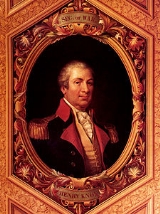
Henry Knox

 
Henry Knox

   Email Print
   Bookmark   Link


Henry Knox


Henry Knox (July 25, 1750 – October 25, 1806) was an American
United States

The United States of America is a Federal government constitutional republic comprising U.S. state and a federal district. The country is situated mostly in central North America, where its Contiguous United States and Washington, D.C., the Capital districts and territories, lie between the Pacific Ocean and Atlantic Oceans, Borders of the U...
 bookseller from Boston
Boston, Massachusetts

Boston is the State capital and largest city of the Commonwealth of Massachusetts, and is one of the oldest cities in the United States. The largest city in New England, Boston is considered the economic and cultural center of the region, and is sometimes regarded as the unofficial "Capital of New England." Boston city proper had a 2007 est...
 who became the chief artillery
Artillery

Artillery is a military Combat Arms which employs any apparatus, machine, an assortment of tools or instruments, a system or systems used as weapons for the discharge of large projectiles in combat as a major contribution of fire power within the overall military capability of an armed force....
 officer of the Continental Army
Continental Army

The American Continental Army was an army formed after the outbreak of the American Revolutionary War by the colonies that became the United States. Established by a resolution of the Continental Congress on June 15, 1775, the army was created to coordinate the military efforts of the Thirteen Colonies in their struggle against the rule of Kingdom...
 and later the nation's first Secretary of War
United States Secretary of War

File:Swearing in of Secretary Dwight Davis.jpgThe Secretary of War was a member of the United States President of the United States United States Cabinet, beginning with George Washington's administration....
.

Early life and marriage
Henry Knox was born in Boston to parents of Scots-Irish origin, William Knox and Mary (nee Campbell). His father was a ship's captain who died in 1759 in part due to mental stress arising from financial trouble.


Discussion
Ask a question about 'Henry Knox'
Start a new discussion about 'Henry Knox'
Answer questions from other users
Full Discussion Forum


Encyclopedia


Henry Knox (July 25, 1750 – October 25, 1806) was an American
United States

The United States of America is a Federal government constitutional republic comprising U.S. state and a federal district. The country is situated mostly in central North America, where its Contiguous United States and Washington, D.C., the Capital districts and territories, lie between the Pacific Ocean and Atlantic Oceans, Borders of the U...
 bookseller from Boston
Boston, Massachusetts

Boston is the State capital and largest city of the Commonwealth of Massachusetts, and is one of the oldest cities in the United States. The largest city in New England, Boston is considered the economic and cultural center of the region, and is sometimes regarded as the unofficial "Capital of New England." Boston city proper had a 2007 est...
 who became the chief artillery
Artillery

Artillery is a military Combat Arms which employs any apparatus, machine, an assortment of tools or instruments, a system or systems used as weapons for the discharge of large projectiles in combat as a major contribution of fire power within the overall military capability of an armed force....
 officer of the Continental Army
Continental Army

The American Continental Army was an army formed after the outbreak of the American Revolutionary War by the colonies that became the United States. Established by a resolution of the Continental Congress on June 15, 1775, the army was created to coordinate the military efforts of the Thirteen Colonies in their struggle against the rule of Kingdom...
 and later the nation's first Secretary of War
United States Secretary of War

File:Swearing in of Secretary Dwight Davis.jpgThe Secretary of War was a member of the United States President of the United States United States Cabinet, beginning with George Washington's administration....
.

Early life and marriage


Henry Knox was born in Boston to parents of Scots-Irish origin, William Knox and Mary (nee Campbell). His father was a ship's captain who died in 1759 in part due to mental stress arising from financial trouble. Henry left school at the age of 12 and became a clerk in a bookstore to support his mother. He later opened his own bookshop, the London Book Store, in Boston. Largely self-educated, he began to concentrate on military subjects, particularly artillery. Knox joined a local military company at eighteen, was present at the Boston Massacre
Boston Massacre

The Boston Massacre refers to an incident involving the deaths of five civilians at the hands of British Army on March 5, 1770, the legal aftermath of which helped spark the rebellion in some of the British colonies in America, which culminated in the American Revolution....
, and joined the Boston Grenadier Corps in 1772.

Henry married Lucy Flucker (1756–1824), the daughter of Boston Loyalists, on June 16, 1774. In spite of separations due to his military service, they remained a devoted couple for the rest of his life, and carried on an extensive correspondence. Since the couple fled Boston in 1775, she remained essentially homeless throughout the Revolutionary War
American Revolutionary War

The American Revolutionary War , also known as the American War of Independence, began as a war between the Kingdom of Great Britain and Thirteen Colonies on the North America, and ended in a global war between several European great powers....
. Her parents left with the British during their withdrawal from Boston
Evacuation Day (Massachusetts)

In Suffolk County, Massachusetts, March 17 is Evacuation Day, an official holiday commemorating the evacuation of the city of Boston, Massachusetts by United Kingdom forces during the American Revolutionary War....
 after the Continental Army
Continental Army

The American Continental Army was an army formed after the outbreak of the American Revolutionary War by the colonies that became the United States. Established by a resolution of the Continental Congress on June 15, 1775, the army was created to coordinate the military efforts of the Thirteen Colonies in their struggle against the rule of Kingdom...
’s victory at the Battle of Dorchester Heights, which ironically hinged upon Knox’s cannons. She never saw them again.

Military career


Knox supported the American rebels, the Sons of Liberty
Sons of Liberty

The Sons of Liberty was a secret organization of Patriot which originated in the Thirteen Colonies during the American Revolution. Kingdom of Great Britain authorities and their supporters known as Loyalist considered the Sons of Liberty as seditious rebels, referring to them as "Sons of Violence" and "Sons of Iniquity." Patriots attacked t...
, and was present at the Boston Massacre
Boston Massacre

The Boston Massacre refers to an incident involving the deaths of five civilians at the hands of British Army on March 5, 1770, the legal aftermath of which helped spark the rebellion in some of the British colonies in America, which culminated in the American Revolution....
. He volunteered as a member of the Boston Grenadier Corps in 1772 and served under General Artemas Ward
Artemas Ward

Artemas Ward was an United States Major general in the American Revolutionary War and a United States Congress from Massachusetts. President John Adams described him as "...universally esteemed, beloved and confided in by his army and his country." Ward was much more effective as a political leader than as a soldier....
 at the Battle of Bunker Hill
Battle of Bunker Hill

The Battle of Bunker Hill took place on June 17, 1775 on Breed's Hill, as part of the Siege of Boston during the American Revolutionary War. General Israel Putnam was in charge of the revolutionary forces, while Major-General William Howe, 5th Viscount Howe commanded the Kingdom of Great Britain forces....
 in 1775. Being a member of the Army of Observation, Knox met and impressed General George Washington
George Washington

George Washington was the leader of the Continental Army in the American Revolutionary War and served as the List of Presidents of the United States President of the United States of the United States of Americas ....
 when he took command. Knox offered his services to Washington, who had him commissioned a Colonel
Colonel

Colonel is a military rank of a commissioned officer, with corresponding ranks existing in almost every country in the world. It is also used in some police forces and other paramilitary rank structures....
 and gave him command of the Continental Regiment of Artillery. Washington and Knox soon became good friends.

As the Siege of Boston
Siege of Boston

}|-||}The Siege of Boston was the opening phase of the American Revolutionary War, in which New England militiamen?who later became part of the Continental Army?surrounded the town of Boston, Massachusetts, to prevent movement by the British Army garrisoned within....
 continued, he suggested that the cannons recently captured at Fort Ticonderoga
Fort Ticonderoga

Fort Ticonderoga is a large eighteenth-century fort built at a narrows at the south end of Lake Champlain where a short traverse gives access to the north end of Lake George in the state of New York....
 and at Crown Point
Crown Point

Crown Point is the name of several towns or cities, and geographic features:United States*Crown Point, Alaska*Crown Point, Indiana - Lake County...
 could have a decisive impact. Washington put him in charge of an expedition to retrieve them. His force brought them by ox-drawn sled south along the west bank of the Hudson River
Hudson River

The Hudson River, called Muh-he-kun-ne-tuk , the Great Mohegan by the Iroquois, or as the Lenape Native Americans called it in Unami, Muhheakantuck, is a river that flows from north to south through eastern New York....
 from Fort Ticonderoga
Fort Ticonderoga

Fort Ticonderoga is a large eighteenth-century fort built at a narrows at the south end of Lake Champlain where a short traverse gives access to the north end of Lake George in the state of New York....
 to Albany
Albany, New York

Albany is the Capital of the state of New York and the county seat of Albany County, New York. Albany is roughly 136 miles north of the city of New York City, and slightly south of the confluence of the Mohawk River and Hudson Rivers....
 where he crossed the Hudson, continued east through the Berkshires
The Berkshires

The Berkshires , located in the western parts of Massachusetts and Connecticut, is both a specific highland geologic region and a broader associated cultural region....
 and finally to Boston
Boston, Massachusetts

Boston is the State capital and largest city of the Commonwealth of Massachusetts, and is one of the oldest cities in the United States. The largest city in New England, Boston is considered the economic and cultural center of the region, and is sometimes regarded as the unofficial "Capital of New England." Boston city proper had a 2007 est...
. There are 56 on the from Fort Ticonderoga to Cambridge, Massachusetts
Cambridge, Massachusetts

Cambridge is a city in the Greater Boston area of Massachusetts, United States. It was named in honor of the University of Cambridge in England....
 denoting the approximately 56 day length of the journey. Knox and his men averaged approximately 5 ? miles per day, completing the 300 mile trip in 56 days, between December 5, 1775, and January 24, 1776. The Cannon Train was composed of , and weighed a total of 60 tons. Upon their arrival in Cambridge, when Washington's army took the Heights of Dorchester, the cannons were placed in a heavily fortified position
Fortification of Dorchester Heights

The Fortification of Dorchester Heights was a decisive action early in the American Revolutionary War that precipitated the end of the siege of Boston and the withdrawal of British troops from that city....
 overlooking Boston from which they threatened the British fleet in the harbor. As a result, the British were forced to withdraw to Halifax
City of Halifax

The City of Halifax was the capital of the province of Nova Scotia and county seat of Halifax County, Nova Scotia, and was the largest city in Atlantic Canada until it was amalgamated into Halifax Regional Municipality in 1996....
 on March 17, 1776. After the siege was lifted, Knox undertook the construction and improvement of defenses in Connecticut
Connecticut

Connecticut is a U.S. state located in the New England region of the northeastern United States. The state borders New York to the west and south , Massachusetts to the north, and Rhode Island to the east....
 and Rhode Island
Rhode Island

Rhode Island and Providence Plantations, more commonly referred to as Rhode Island , is a U.S. state in the New England region of the United States....
 to prepare for the British return. He rejoined the main army later during their withdrawal from New York
New York

The State of New York is a U.S. state in the Mid-Atlantic States and Northeastern United States regions of the United States and is the nation's List of U.S....
 and across New Jersey
New Jersey

New Jersey is a state in the Mid-Atlantic States and Northeastern United States regions of the United States. It is bordered on the north by New York, on the east by the Hudson River and the Atlantic Ocean, on the southwest by Delaware, and on the west by Pennsylvania....
.

During the Battle of Trenton
Battle of Trenton

}|-||}The Battle of Trenton took place on December 26, 1776, during the American Revolutionary War after General George Washington's Washington's crossing of the Delaware River north of Trenton, New Jersey....
, Colonel Knox was in charge of Washington's crossing of the Delaware River. Though hampered by ice and cold, with John Glover
John Glover (general)

John Glover was an United States fisherman, merchant, and military leader from Marblehead, Massachusetts, who served as a Brigadier General in the Continental Army during the American Revolutionary War....
's Marbleheaders (14th Continental Regiment
14th Continental Regiment

The 14th Continental Regiment, also known as the Marblehead Regiment, was raised as a Massachusetts militia regiment and formerly designated on January 1, 1776....
) manning the boats, he got the attack force of men, horses and artillery across the river without loss. Following the battle he returned the same force, along with hundreds of prisoners, captured supplies and all the boats back across the river by the afternoon of December 26. Knox was promoted to brigadier general
Brigadier General

Brigadier General is the lowest ranking General Officer in some countries, usually sitting between the ranks of Colonel and Major General.The rank can be traced back to the militaries of Europe where a brigadier general, or simply a brigadier, would command a brigade in the field....
 for this accomplishment, and Chief of Artillery.

Knox stayed with the Main Army throughout most of the active war, and saw further action at Princeton
Battle of Princeton

}|-||}The Battle of Princeton was a battle in which George Washington's revolutionary forces defeated Great Britain forces near Princeton, New Jersey, New Jersey....
, Brandywine
Battle of Brandywine

}|-||}The Battle of Brandywine was a battle of the Philadelphia campaign of the American Revolutionary War fought on September 11, 1777, in the area surrounding Chadds Ford Township, Pennsylvania, Pennsylvania....
, Germantown
Battle of Germantown

}|-||}The Battle of Germantown, a battle in the Philadelphia campaign of the American Revolutionary War, was fought on October 4, 1777 at Germantown, Philadelphia, Pennsylvania, Pennsylvania....
, Monmouth
Battle of Monmouth

}|-||}The Battle of Monmouth was an American Revolutionary War battle fought on June 28, 1778 in New Jersey. The main Continental Army under George Washington attacked the rear of the British Army's column led by Henry Clinton as they left Freehold Court-House ....
, and Yorktown
Siege of Yorktown

The Siege of Yorktown or Battle of Yorktown in 1781 was a decisive victory by combined assault of American Continental Army led by General George Washington and France in the American Revolutionary War led by General Jean-Baptiste Donatien de Vimeur, comte de Rochambeau over a British Army commanded by General Charles Cornwallis, 1st Ma...
. In 1777, while the Army was in winter quarters at Morristown, New Jersey
Morristown, New Jersey

Morristown is a Town in Morris County, New Jersey, New Jersey, United States. As of the United States 2000 Census, the town population was 18,544....
, he returned to Massachusetts to improve the Army's artillery capability. He raised an additional battalion and established the Springfield Armory
Springfield Armory

This is an article about the US Government Arsenal. For the contemporary commercial manufacturer see Springfield Armory, Inc.The Springfield Armory was the primary center for the manufacture of United States military small arms and the site of many important technological advances in gun manufacture....
 before his return in the spring. That arsenal remained a valuable source of weapons and ammunition for the rest of the war. In early 1780 he was a member of the court-martial
Court-martial

A court-martial is a military court. These military courts can determine punishments for members of the military subject to military law who are found guilty or may dismiss the charges based on the evidence and the case presented....
 of Major John André
John André

Major John Andr? was a United Kingdom army officer hanged as a secret agent during the American Revolutionary War. This was due to an incident in which he assisted Benedict Arnold's attempted surrender of the fort at West Point, New York, to the British Army....
. Knox made several other trips to the Northern states as Washington's representative to increase the flow of men and supplies to the army.
Henry Knox Oil
After Yorktown, Knox was promoted to major general
Major General

Major General or Major-General is a military rank used in many countries. It is derived from the older rank of Sergeant Major General. A Major General is a high-ranking officer, normally subordinate to the rank of Lieutenant General and senior to the ranks of Brigadier and Brigadier General....
. In 1782 he was given command of the post at West Point
West Point, New York

West Point is a federal military reservation located North of the Highland Falls, New York in Orange County, New York, United States. The population was 7,138 at the 2000 census....
. In 1783 he was one of the founders of the Society of the Cincinnati
Society of the Cincinnati

The Society of the Cincinnati is a historic organization with branches in the United States and France founded in 1783 to preserve the ideals and fellowship of the Revolutionary War officers and to pressure the government to honor pledges it had made to officers who fought for American independence....
, and led the American forces into New York City
New York City

The City of New York is the List of United States cities by population in the United States, while the New York metropolitan area ranks among the List of urban areas by population....
 as the British withdrew. He stood next to Washington during his farewell on December 4 at Fraunces Tavern
Fraunces Tavern

Fraunces Tavern is a restaurant and museum in lower Manhattan, New York City, housed in a conjectural reconstruction of a building that played a prominent role in pre-American Revolution activities, a tavern owned and run by Samuel Fraunces....
. After Washington
George Washington

George Washington was the leader of the Continental Army in the American Revolutionary War and served as the List of Presidents of the United States President of the United States of the United States of Americas ....
 retired, Knox served as the senior officer of the Continental Army from December 1783 until he left it in June 1784.

Secretary of War

The Continental Congress
Continental Congress

The Continental Congress was a convention of delegates from the Thirteen Colonies that became the governing body of the United States during the American Revolution....
 made Knox Secretary of War under the Articles of Confederation
Articles of Confederation

The Articles of Confederation and Perpetual Union was the constitution of the revolutionary wartime alliance of the thirteen United States. The Articles' ratification was completed in 1781, and legally federated several sovereign and independent states, allied under the Articles of Association into a new federation styled the "United States...
 on March 8, 1785. He held that position without interruption until September 12, 1789, when he assumed the same duties as the Secretary of War in Washington's first Cabinet.

As secretary, Knox urged and presided over the creation of a regular Navy
United States Navy

The United States Navy is the navy of the United States Armed Forces. It is one of the seven uniformed services of the United States. The U.S. Navy currently has approximately 331,682 personnel on active duty as of 31 December 2008 and 124,000 in the United States Navy Reserve....
, was responsible for a plan for a national militia
Militia

The term militia is commonly used today to refer to a military force composed of ordinary citizens to provide defense, emergency law enforcement, or paramilitary service, in times of emergency without being paid a regular salary or committed to a fixed term of service....
, and created a series of coastal fortifications. He oversaw the inclusion of the Springfield Armory as one of two national facilities. In 1791, Congress, acting on a detailed proposal from Knox, created the short-lived Legion of the United States
Legion of the United States

The Legion of the United States was a reorganization and extension of the United States Army in 1792 under the command of Major General Anthony Wayne....
.

As Secretary of War, Knox was well and responsible for managing the United States' relations with the Indian tribes
Native Americans in the United States

Native Americans in the United States are the Indigenous peoples of the Americas from the regions of North America now encompassed by the continental United States United States, including parts of Alaska and the island state of Hawaii....
 within its borders, following a 1789 act of Congress
United States Congress

The United States Congress is the Bicameralism legislature of the Federal government of the United States of the United States of America, consisting of two houses, the United States Senate and the United States House of Representatives....
. For the previous three years he had had similar responsibilities under the Congress of the Confederation
Congress of the Confederation

The Congress of the Confederation or the United States in Congress Assembled was the governing body of the United States of America from March 1, 1781, to March 4, 1789....
, although the previous position had little actual authority. Knox used his new position to argue that the United States honor the Native Americans' rights. Usual U.S. government policy involved signing treaties with Native American nations that were not intended to be kept, with the goal of seizing as much Indian land as possible. Knox publicly opposed this policy, the first U.S. government official to do so. He believed that the practice violated the republican
Republicanism

Republicanism is the ideology of governing a nation as a republic, where the head of state is appointed by other means than hereditary, often elections....
 principles embodied in the American Revolution
American Revolution

The American Revolution refers to the political upheaval during the last half of the 18th century in which the Thirteen Colonies of North America overthrew the governance of the British Empire and then rejected the British monarchy to become the sovereign United States of America....
. Furthermore, Knox feared that a policy of constant provocation would lead to costly frontier wars that would hurt the nation.

To this end, Knox argued that the United States should treat Native American tribes as sovereign, foreign nations. He envisioned a humane policy of treaties that would not be broken, resulting in a series of Indian enclaves in the West where the United States would forbid its citizens to settle. He urged President Washington to make a priority of reforming the United States' Indian policy.
Henryknox
In 1789 Washington had Knox send a bill to congress to purchase Native lands for $25,394. This was a far cheaper price to pay than to once again battle the natives. The bill made it possible for only the federal government to control native lands, rather than the states administering territories. The natives were now considered foreigners, and forced to cooperate or leave.

The first test of the new policy came from the negotiations between Knox, Secretary of State Thomas Jefferson
Thomas Jefferson

Thomas Jefferson was the List of Presidents of the United States President of the United States , the principal author of the United States Declaration of Independence , and one of the most influential Founding Fathers of the United States for his promotion of the ideals of republicanism in the United States....
, and Alexander McGillivray
Alexander McGillivray

Alexander McGillivray was a leader of the Creek American Indians in the United States during and after the American Revolution who worked to establish a Creek national identity and centralized leadership as a means of resisting American expansion onto Creek territory....
, leader of the Creek Nation. The resulting Treaty of New York
Treaty of New York

The Treaty of New York is one of several treaties signed between the United States and Native Americans in the United States, conducted in the city of New York City....
 guaranteed the Creeks a vast stretch of territory, which the U.S. pledged to protect from the encroachments of its citizens. Settlers continued to pour into Creek territory, however, and the federal troops that Knox sent could not secure the border. McGillivray abandoned the alliance with the United States in 1791, turning to Spanish
Spain

Spain or the Kingdom of Spain , is a country located in Southern Europe on the Iberian Peninsula.The Spanish constitution does not establish any official denomination of the country, even though Espa?a , Estado espa?ol and Naci?n espa?ola are used interchangeably....
 protection in the Treaty of New Orleans. The failure of the Treaty of New York marked the end of Knox's attempt to enact a new Indian policy.

On January 2, 1795, Knox left the government and returned to his home at Thomaston, Maine
Thomaston, Maine

Thomaston, Maine can refer to:*Thomaston , Maine*Thomaston , Maine*South Thomaston, Maine...
 to devote himself to caring for his growing family. He was succeeded as Secretary of War by Timothy Pickering
Timothy Pickering

Timothy Pickering was a politician from Massachusetts who served in a variety of roles, most notably as the third United States Secretary of State, serving in that office from 1795 to 1800 under Presidents George Washington and John Adams....
.

Later life


Knox settled his family at , the estate he built in Thomaston, Maine
Thomaston, Maine

Thomaston, Maine can refer to:*Thomaston , Maine*Thomaston , Maine*South Thomaston, Maine...
. He spent the rest of his life engaged in cattle farming, ship building, brick making, and real estate speculation. He had assembled a vast million-acre real estate empire in Maine through graft and corruption, triggering an armed insurrection by local settlers who, at one point, threatened to burn Montpelier to the ground. Although Knox represented his Thomaston in the Massachusetts General Court
Massachusetts General Court

The Massachusetts General Court is the State legislature of the Commonwealth of Massachusetts. The name "General Court" is a hold-over from the Colonialism Era, when this body also sat in judgment of judicial appeals cases....
 (Maine then being part of Massachusetts), he eventually became so unpopular that he lost the seat to a local blacksmith. He also was industrious in lumbering, ship building, stock raising, and brick manufacturing, although all of these businesses failed, building up staggering debts that would ultimately bankrupt his heirs. In 1806, while visiting a friend in Union, Maine
Union, Maine

Union is a New England town in Knox County, Maine, Maine, United States. The population was 2,209 at the 2000 United States Census. It is home to the Matthews Museum of Maine Heritage and annual Union Fair....
, he swallowed a chicken bone which punctured his intestine. He died of an infection (peritonitis) three days later on October 25, 1806 and was buried in Thomaston. His house was later torn down to make way for the Brunswick-Rockland railroad line. The only surviving structure is an outbuilding that currently houses the . (The current Montpelier Museum is a mid-20th century cinderblock reconstruction at a different location.)

Many incidents in Knox's career attest to his character, both good and bad. As one example, when he and Lucy were forced to leave Boston in 1775, his home was used to house British officers who looted his bookstore. In spite of personal financial hardships, he managed to make the last payment of 1,000 pounds to Longman Printers in London to cover the price of a shipment of books that he never received. In Maine, however, he would be remembered as a grasping tyrant and was forever immortalized in Nathanial Hawthorne's House of the Seven Gables, for which he served as the model for Col. Pynchon.

Two separate American forts, Fort Knox
Fort Knox

Fort Knox is a United States United States Army post in Kentucky south of Louisville, Kentucky and north of Elizabethtown, Kentucky. The base, , covers parts of Bullitt County, Kentucky, Hardin County, Kentucky, and Meade County, Kentucky counties, with Hardin county receiving the largest benefit, economically....
 (Kentucky
Kentucky

The Commonwealth of Kentucky is a U.S. state located in the East Central United States of America. Kentucky is normally included in the group of Southern United States , but it is uncommonly included, geographically and culturally, in the Midwestern United States....
), and Fort Knox (Maine) were named after him. Knox Hall at Fort Sill, Oklahoma, home of the Field Artillery Center and Field Artillery School, is also named after him. Knoxville, Tennessee
Knoxville, Tennessee

Founded in 1786, Knoxville is the third-largest city in the U.S. state of Tennessee, behind Memphis, Tennessee and Nashville, Tennessee, and is the county seat of Knox County, Tennessee....
, is named in his honor. There are counties
County (United States)

In the United States, a county is a local level of government below the U.S. state . Counties are used in 48 of the 50 states, while Louisiana is divided into List of parishes in Louisiana and Alaska into Borough ....
 named for Knox in Illinois
Knox County, Illinois

Knox County is a county located in the U.S. state of Illinois. As of 2000, the population was 55,836. Its county seat is Galesburg, Illinois, Illinois....
, Indiana
Knox County, Indiana

Knox County is a county located in Indiana in the United States. As of 2000, the population was 39,256. The county seat is Vincennes, Indiana; other communities include the city of Bicknell, Indiana and the towns Oaktown, Indiana, Wheatland, Indiana, Freelandville, Indiana, and Monroe City, Indiana....
, Kentucky
Knox County, Kentucky

Knox County is a county located in the U.S. state of Kentucky. As of 2000, the population was 31,795. Its county seat is Barbourville, Kentucky....
, Maine
Knox County, Maine

Knox County is a county located in the U.S. state of Maine. As of 2000, the population was 39,618. Its county seat is Rockland, Maine. The county is named for American Revolutionary War general and United States Secretary of War Henry Knox, who lived in the county from 1795 until his death in 1806....
, Missouri
Knox County, Missouri

Knox County is a county located in the U.S. state of Missouri. As of the United States 2000 Census, the population was 4,361. Its county seat is Edina, Missouri....
, Nebraska
Knox County, Nebraska

Knox County is a county located in the U.S. state of Nebraska. As of 2000, the population was 9,374. Its county seat is Center, Nebraska.In the Nebraska license plate system, Knox County is represented by the prefix 12 ....
, Ohio
Knox County, Ohio

Knox County is a county located in the U.S. state of Ohio, United States. As of 2000, the population was 54,500. Its county seat is Mount Vernon, Ohio and is List of Ohio county name etymologies for Henry Knox, an officer in the American Revolutionary War who was later the first United States Secretary of War....
, Tennessee
Knox County, Tennessee

Knox County is a County in the U.S. state of Tennessee. Its 2007 population was estimated at 423,874 by the United States Census Bureau. Its county seat is Knoxville, Tennessee, as it has been since the creation of the county....
, and Texas
Knox County, Texas

Knox County is a county located in the U.S. state of Texas. In 2000, its population was 4,253. Its county seat is Benjamin, Texas. The county is named for Henry Knox, an American Revolutionary War general....
.

External links