
Home      Discussion      Topics      Dictionary      Almanac
Signup       Login
Battle of Bushy Run

Battle of Bushy Run

Overview
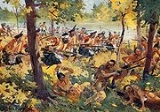
The Battle of Bushy Run was fought on August 5-6, 1763, in western Pennsylvania, between a British column under the command of Colonel Henry Bouquet
Henry Bouquet
Henry Bouquet was a prominent British Army officer in the French and Indian War and Pontiac's War. Bouquet is best known for his victory over Native Americans at the Battle of Bushy Run, lifting the siege of Fort Pitt during Pontiac's War.-Early life:Bouquet was born into a moderately wealthy...

 and a combined force of Delaware
Lenape
The Lenape are an Algonquian group of Native Americans of the Northeastern Woodlands. They are also called Delaware Indians. As a result of the American Revolutionary War and later Indian removals from the eastern United States, today the main groups live in Canada, where they are enrolled in the...

, Shawnee
Shawnee
The Shawnee, Shaawanwaki, Shaawanooki and Shaawanowi lenaweeki, are an Algonquian-speaking people native to North America. Historically they inhabited the areas of Ohio, Virginia, West Virginia, Western Maryland, Kentucky, Indiana, and Pennsylvania...

, Mingo
Mingo
The Mingo are an Iroquoian group of Native Americans made up of peoples who migrated west to the Ohio Country in the mid-eighteenth century. Anglo-Americans called these migrants mingos, a corruption of mingwe, an Eastern Algonquian name for Iroquoian-language groups in general. Mingos have also...

, and Huron warriors. This action occurred during Pontiac's Rebellion
Pontiac's Rebellion
Pontiac's War, Pontiac's Conspiracy, or Pontiac's Rebellion was a war that was launched in 1763 by a loose confederation of elements of Native American tribes primarily from the Great Lakes region, the Illinois Country, and Ohio Country who were dissatisfied with British postwar policies in the...

. Though the British suffered serious losses, they routed the tribemen and successfully relieved the garrison of Fort Pitt
Fort Pitt (Pennsylvania)
Fort Pitt was a fort built at the location of Pittsburgh, Allegheny County, Pennsylvania.-French and Indian War:The fort was built from 1759 to 1761 during the French and Indian War , next to the site of former Fort Duquesne, at the confluence the Allegheny River and the Monongahela River...

.
Discussion
Ask a question about 'Battle of Bushy Run'
Start a new discussion about 'Battle of Bushy Run'
Answer questions from other users
Full Discussion Forum
 
Unanswered Questions
Recent Discussions
Encyclopedia
The Battle of Bushy Run was fought on August 5-6, 1763, in western Pennsylvania, between a British column under the command of Colonel Henry Bouquet
Henry Bouquet
Henry Bouquet was a prominent British Army officer in the French and Indian War and Pontiac's War. Bouquet is best known for his victory over Native Americans at the Battle of Bushy Run, lifting the siege of Fort Pitt during Pontiac's War.-Early life:Bouquet was born into a moderately wealthy...

 and a combined force of Delaware
Lenape
The Lenape are an Algonquian group of Native Americans of the Northeastern Woodlands. They are also called Delaware Indians. As a result of the American Revolutionary War and later Indian removals from the eastern United States, today the main groups live in Canada, where they are enrolled in the...

, Shawnee
Shawnee
The Shawnee, Shaawanwaki, Shaawanooki and Shaawanowi lenaweeki, are an Algonquian-speaking people native to North America. Historically they inhabited the areas of Ohio, Virginia, West Virginia, Western Maryland, Kentucky, Indiana, and Pennsylvania...

, Mingo
Mingo
The Mingo are an Iroquoian group of Native Americans made up of peoples who migrated west to the Ohio Country in the mid-eighteenth century. Anglo-Americans called these migrants mingos, a corruption of mingwe, an Eastern Algonquian name for Iroquoian-language groups in general. Mingos have also...

, and Huron warriors. This action occurred during Pontiac's Rebellion
Pontiac's Rebellion
Pontiac's War, Pontiac's Conspiracy, or Pontiac's Rebellion was a war that was launched in 1763 by a loose confederation of elements of Native American tribes primarily from the Great Lakes region, the Illinois Country, and Ohio Country who were dissatisfied with British postwar policies in the...

. Though the British suffered serious losses, they routed the tribemen and successfully relieved the garrison of Fort Pitt
Fort Pitt (Pennsylvania)
Fort Pitt was a fort built at the location of Pittsburgh, Allegheny County, Pennsylvania.-French and Indian War:The fort was built from 1759 to 1761 during the French and Indian War , next to the site of former Fort Duquesne, at the confluence the Allegheny River and the Monongahela River...

.

The battle


In July 1763, a British relief column of 500 British soldiers, including the 42nd Highlanders
42nd Regiment of Foot
The 42nd Regiment of Foot was an infantry regiment of the British Army. Originally the 43rd Highlanders they were renumbered the 42nd in 1748.- Early history :...

, 60th Royal Americans, and 77th Highlanders
77th Regiment of Foot (Montgomerie's Highlanders)
The 77th Regiment of Foot was a Highland Scots Regiment raised under Major Archibald Montgomerie, son of the Earl of Eglinton. It was originally raised as the "First Highland Battalion" in 1757, around Stirling, Scotland, with thirteen companies...

, left Carlisle, Pennsylvania
Carlisle, Pennsylvania
Carlisle is a borough in and the county seat of Cumberland County, Pennsylvania, United States. The name is traditionally pronounced with emphasis on the second syllable. Carlisle is located within the Cumberland Valley, a highly productive agricultural region. As of the 2010 census, the borough...

, to relieve Fort Pitt, then under siege. Indian scouts observed Bouquet's army marching west along Forbes Road and reported this to the Indians surrounding Fort Pitt. On August 5, at about 1PM, a group of the force investing Fort Pitt ambushed the British column one mile east of Bushy Run Station, at Edge Hill. The British managed to hold their ground until after sunset, when the natives withdrew. Bouquet ordered a redoubt constructed on Edge Hill, and the British placed their wounded and livestock in the center of the perimeter.

According to one account, the allied tribes attacked in the morning, but were themselves ambushed by the sentries relieved from their evening duty. With the surprise attack of the sentries, from a flank, and a frontal assault by the main British column, the outnumbered Indians fled in a disorganized retreat.

A second account holds that the warriors attacked in the morning and "redoubled their efforts to break the British line." As the tribesmen became bolder, Bouquet realized the combat was nearing a crisis. Determined to lure his attackers close enough to maim them, the British leader deliberately weakened one section of his line. Spotting the gap in the enemy defenses, the native warriors rushed forward. Instead, the British soldiers fired a volley in their faces and "made terrible havock" with the bayonet. The surviving warriors fled and were unable to rally.

Having dispersed its attackers, Bouquet's column headed to Bushy Run, a mile along the Forbes road, where there was badly needed water. The battle has since been attributed to the Bushy Run location, despite the main fighting taking place in Edge Hill. Bouquet then marched to the relief of Fort Pitt.

Aftermath


The battle cost the lives of 50 British soldiers, including 29 of the 42nd Highlanders, seven of the 1/60th Royal Americans dead, six of the 77th Highlanders, and eight Civilians and volunteers dead. The confederacy of the Delaware, Shawnee, Mingo, and Huron also suffered an unknown number of casualties, including two prominent Delaware chiefs; estimates from contemporaries place the total of Indian losses at 60. The warrior Killbuck later told Sir William Johnson
Sir William Johnson, 1st Baronet
Sir William Johnson, 1st Baronet was an Anglo-Irish official of the British Empire. As a young man, Johnson came to the Province of New York to manage an estate purchased by his uncle, Admiral Peter Warren, which was located amidst the Mohawk, one of the Six Nations of the Iroquois League...

 that only 110 warriors were engaged. Bouquet estimated the natives brought an equal number to the action as his own force. One contemporary report claimed that 20 Indians were killed and many more wounded. The result of the battle invoked "widespread relief on the frontier", since the native warriors had been defeated on their own ground.

The site of the battle is now Bushy Run Battlefield Park.

Printed materials

  • Brumwell, Stephen. Redcoats: The British Soldier and War in the Americas, 1755-1763. NY: Cambridge University Press, 2002. ISBN 0-521-80783-2
  • Nester, William R. "Haughty Conquerors": Amherst and the Great Indian Uprising of 1763. Westport, Connecticut: Praeger, 2000. ISBN 0-275-96770-0.
  • "Colonel Henry Bouquet a biographical sketch:" Lieut-General Sir Edward Hutton Warren and son 1911


External links