

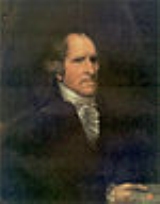
Timothy Pickering

Encyclopedia
Timothy Pickering was a politician from Massachusetts
who served in a variety of roles, most notably as the third United States Secretary of State
, serving in that office from 1795 to 1800 under Presidents George Washington
and John Adams
.
to Deacon Timothy and Mary Wingate Pickering. He was one of nine children and the younger brother of John Pickering (not to be confused with the New Hampshire judge
) who would eventually serve as Speaker of the Massachusetts House of Representatives. He attended grammar school in Salem and graduated from Harvard University
in 1763. Salem minister William Bentley
noted on Pickering: "From his youth his townsmen proclaim him assuming, turbulent, & headstrong."
After graduating from Harvard, Pickering returned to Salem where he began working for John Higginson, the town clerk and Essex County
register of deeds. Pickering was admitted to the Massachusetts Bar in 1768 and, in 1774, he succeeded Higginson as register of deeds. Soon after, he was elected to represent Salem in the Massachusetts General Court
and served as a justice in the Essex County Court of Common Pleas. On April 8, 1776, he married Rebecca White of Salem.
In January 1766, Pickering was commissioned a lieutenant in the Essex County militia. He was promoted to captain three years later. In 1769, he published his ideas on drilling soldiers in the Essex Gazette. These were published in 1775 as "An Easy Plan for a Militia." The manual was used as the Continental Army drill book until replaced by Baron von Steuben's Regulations for the Order and Discipline of the Troops of the United States
took notice and offered Pickering the position of adjutant general
of the Continental Army
in 1777. In this capacity he oversaw the building of the Great chain which was forged at the Stirling Iron Works
. The chain blocked the Royal Navy from proceeding up the Hudson River past West Point and protected that important fort from attack for the duration of the conflict. He was widely praised for his work in supplying the troops during the remainder of the conflict. In August 1780, the Continental Congress
elected Pickering Quartermaster General
.
in Pennsylvania where he assumed a series of offices at the head of Luzerne County. When he attempted to evict Connecticut settlers living in the area, Pickering was captured and held hostage for nineteen days. In 1787, he was part of the Pennsylvania convention held to consider ratification of the United States Constitution
.
After the first of Pickering's two successful attempts to make money speculating in Pennsylvania
frontier land, now-President Washington appointed him commissioner to the Iroquois
Indians; and Pickering represented the United States in the negotiation of the Treaty of Canandaigua
with the Iroquois in 1794.
in 1791. He remained in Washington's cabinet and then that of John Adams for nine years, serving as postmaster general until 1795, Secretary of War
for a brief time in 1795, then Secretary of State
from 1795 to 1800. As Secretary of State he is most remembered for his strong Federalist Party attachments to British causes, even willingness to wage war with France in service of these causes during the Adams administration. In 1799 Pickering hired Joseph Dennie
as his private secretary.
over Adams's plan to make peace with France
, Pickering was dismissed from office in May 1800. In 1802, Pickering and a band of Federalists, agitated at the lack of support for Federalists, attempted to gain support for the secession of New England from the Jeffersonian United States. The irony of a Federalist moving against the national government was not lost among his dissenters. He was named to the United States Senate
as a senator from Massachusetts
in 1803 as a member of the Federalist Party. He lost his Senate seat in 1811, and was elected to the United States House of Representatives
in U.S. House election, 1812, where he remained until 1817. His congressional career is best remembered for his leadership of the New England
secession movement (see Essex Junto
and the Hartford Convention
).
, where he lived as a farmer until his death in 1829, aged 83. In 1942, a United States
Liberty ship
named the SS Timothy Pickering
was launched. She was lost off Sicily
in 1945. Until the 1990s, Pickering's ancestral home, the circa 1651 Pickering House, was the oldest house in the United States to be owned by the same family continually.
|-
|-
|-
|-
|-
|-
Massachusetts
The Commonwealth of Massachusetts is a state in the New England region of the northeastern United States of America. It is bordered by Rhode Island and Connecticut to the south, New York to the west, and Vermont and New Hampshire to the north; at its east lies the Atlantic Ocean. As of the 2010...
who served in a variety of roles, most notably as the third United States Secretary of State
United States Secretary of State
The United States Secretary of State is the head of the United States Department of State, concerned with foreign affairs. The Secretary is a member of the Cabinet and the highest-ranking cabinet secretary both in line of succession and order of precedence...
, serving in that office from 1795 to 1800 under Presidents George Washington
George Washington
George Washington was the dominant military and political leader of the new United States of America from 1775 to 1799. He led the American victory over Great Britain in the American Revolutionary War as commander-in-chief of the Continental Army from 1775 to 1783, and presided over the writing of...
and John Adams
John Adams
John Adams was an American lawyer, statesman, diplomat and political theorist. A leading champion of independence in 1776, he was the second President of the United States...
.
Early years
Pickering was born in Salem, MassachusettsSalem, Massachusetts
Salem is a city in Essex County, Massachusetts, United States. The population was 40,407 at the 2000 census. It and Lawrence are the county seats of Essex County...
to Deacon Timothy and Mary Wingate Pickering. He was one of nine children and the younger brother of John Pickering (not to be confused with the New Hampshire judge
John Pickering (judge)
John Pickering served as Chief Justice of the New Hampshire Superior Court of Judicature and as Judge for the United States District Court for the District of New Hampshire...
) who would eventually serve as Speaker of the Massachusetts House of Representatives. He attended grammar school in Salem and graduated from Harvard University
Harvard University
Harvard University is a private Ivy League university located in Cambridge, Massachusetts, United States, established in 1636 by the Massachusetts legislature. Harvard is the oldest institution of higher learning in the United States and the first corporation chartered in the country...
in 1763. Salem minister William Bentley
William Bentley
William Bentley was an American Unitarian minister, scholar, columnist, and diarist....
noted on Pickering: "From his youth his townsmen proclaim him assuming, turbulent, & headstrong."
After graduating from Harvard, Pickering returned to Salem where he began working for John Higginson, the town clerk and Essex County
Essex County, Massachusetts
-National protected areas:* Parker River National Wildlife Refuge* Salem Maritime National Historic Site* Saugus Iron Works National Historic Site* Thacher Island National Wildlife Refuge-Demographics:...
register of deeds. Pickering was admitted to the Massachusetts Bar in 1768 and, in 1774, he succeeded Higginson as register of deeds. Soon after, he was elected to represent Salem in the Massachusetts General Court
Massachusetts General Court
The Massachusetts General Court is the state legislature of the Commonwealth of Massachusetts. The name "General Court" is a hold-over from the Colonial Era, when this body also sat in judgment of judicial appeals cases...
and served as a justice in the Essex County Court of Common Pleas. On April 8, 1776, he married Rebecca White of Salem.
In January 1766, Pickering was commissioned a lieutenant in the Essex County militia. He was promoted to captain three years later. In 1769, he published his ideas on drilling soldiers in the Essex Gazette. These were published in 1775 as "An Easy Plan for a Militia." The manual was used as the Continental Army drill book until replaced by Baron von Steuben's Regulations for the Order and Discipline of the Troops of the United States
The American Revolution
In December 1776, he led a well-drilled regiment of the Essex County militia to New York, where General George WashingtonGeorge Washington
George Washington was the dominant military and political leader of the new United States of America from 1775 to 1799. He led the American victory over Great Britain in the American Revolutionary War as commander-in-chief of the Continental Army from 1775 to 1783, and presided over the writing of...
took notice and offered Pickering the position of adjutant general
Adjutant general
An Adjutant General is a military chief administrative officer.-Imperial Russia:In Imperial Russia, the General-Adjutant was a Court officer, who was usually an army general. He served as a personal aide to the Tsar and hence was a member of the H. I. M. Retinue...
of the Continental Army
Continental Army
The Continental Army was formed after the outbreak of the American Revolutionary War by the colonies that became the United States of America. Established by a resolution of the Continental Congress on June 14, 1775, it was created to coordinate the military efforts of the Thirteen Colonies in...
in 1777. In this capacity he oversaw the building of the Great chain which was forged at the Stirling Iron Works
Stirling Iron Works
The Sterling Iron Works owned by Peter Townsend was one of the first steel and iron manufacturer in the American colonies and the first steel producer in the colony of New York...
. The chain blocked the Royal Navy from proceeding up the Hudson River past West Point and protected that important fort from attack for the duration of the conflict. He was widely praised for his work in supplying the troops during the remainder of the conflict. In August 1780, the Continental Congress
Continental Congress
The Continental Congress was a convention of delegates called together from the Thirteen Colonies that became the governing body of the United States during the American Revolution....
elected Pickering Quartermaster General
Quartermaster general (USA)
The Quartermaster General of the United States Army is a general officer who is responsible for the Quartermaster Corps, the Quartermaster branch of the U.S. Army. The Quartermaster General does not command Quartermaster units, but is primarily focused on training, doctrine and professional...
.
Rise to power
After the end of the American Revolution, Pickering made several failed attempts at financial success. In 1783, he embarked on a mercantile partnership with Samuel Hodgdon that failed two years later. In 1786, he moved to the Wyoming ValleyWyoming Valley
Wyoming Valley is a region of northeastern Pennsylvania. As a metropolitan area, it is also known as the Scranton/Wilkes-Barre area, after its principal cities, Scranton and Wilkes-Barre....
in Pennsylvania where he assumed a series of offices at the head of Luzerne County. When he attempted to evict Connecticut settlers living in the area, Pickering was captured and held hostage for nineteen days. In 1787, he was part of the Pennsylvania convention held to consider ratification of the United States Constitution
United States Constitution
The Constitution of the United States is the supreme law of the United States of America. It is the framework for the organization of the United States government and for the relationship of the federal government with the states, citizens, and all people within the United States.The first three...
.
After the first of Pickering's two successful attempts to make money speculating in Pennsylvania
Pennsylvania
The Commonwealth of Pennsylvania is a U.S. state that is located in the Northeastern and Mid-Atlantic regions of the United States. The state borders Delaware and Maryland to the south, West Virginia to the southwest, Ohio to the west, New York and Ontario, Canada, to the north, and New Jersey to...
frontier land, now-President Washington appointed him commissioner to the Iroquois
Iroquois
The Iroquois , also known as the Haudenosaunee or the "People of the Longhouse", are an association of several tribes of indigenous people of North America...
Indians; and Pickering represented the United States in the negotiation of the Treaty of Canandaigua
Treaty of Canandaigua
The Treaty of Canandaigua is a treaty signed after the American Revolutionary War between the Grand Council of the Six Nations and President George Washington representing the United States of America....
with the Iroquois in 1794.
Cabinet member
Washington brought Pickering into the government, as Postmaster GeneralUnited States Postmaster General
The United States Postmaster General is the Chief Executive Officer of the United States Postal Service. The office, in one form or another, is older than both the United States Constitution and the United States Declaration of Independence...
in 1791. He remained in Washington's cabinet and then that of John Adams for nine years, serving as postmaster general until 1795, Secretary of War
United States Secretary of War
The Secretary of War was a member of the United States President's Cabinet, beginning with George Washington's administration. A similar position, called either "Secretary at War" or "Secretary of War," was appointed to serve the Congress of the Confederation under the Articles of Confederation...
for a brief time in 1795, then Secretary of State
United States Secretary of State
The United States Secretary of State is the head of the United States Department of State, concerned with foreign affairs. The Secretary is a member of the Cabinet and the highest-ranking cabinet secretary both in line of succession and order of precedence...
from 1795 to 1800. As Secretary of State he is most remembered for his strong Federalist Party attachments to British causes, even willingness to wage war with France in service of these causes during the Adams administration. In 1799 Pickering hired Joseph Dennie
Joseph Dennie
Joseph Dennie was an American author and journalist who was one of the foremost men of letters of the Federalist Era. A Federalist, Dennie is best remembered for his series of essays entitled The Lay Preacher and as the founding editor of Port Folio, a journal espousing classical republican values...
as his private secretary.
Middle years
After a quarrel with President John AdamsJohn Adams
John Adams was an American lawyer, statesman, diplomat and political theorist. A leading champion of independence in 1776, he was the second President of the United States...
over Adams's plan to make peace with France
France
The French Republic , The French Republic , The French Republic , (commonly known as France , is a unitary semi-presidential republic in Western Europe with several overseas territories and islands located on other continents and in the Indian, Pacific, and Atlantic oceans. Metropolitan France...
, Pickering was dismissed from office in May 1800. In 1802, Pickering and a band of Federalists, agitated at the lack of support for Federalists, attempted to gain support for the secession of New England from the Jeffersonian United States. The irony of a Federalist moving against the national government was not lost among his dissenters. He was named to the United States Senate
United States Senate
The United States Senate is the upper house of the bicameral legislature of the United States, and together with the United States House of Representatives comprises the United States Congress. The composition and powers of the Senate are established in Article One of the U.S. Constitution. Each...
as a senator from Massachusetts
Massachusetts
The Commonwealth of Massachusetts is a state in the New England region of the northeastern United States of America. It is bordered by Rhode Island and Connecticut to the south, New York to the west, and Vermont and New Hampshire to the north; at its east lies the Atlantic Ocean. As of the 2010...
in 1803 as a member of the Federalist Party. He lost his Senate seat in 1811, and was elected to the United States House of Representatives
United States House of Representatives
The United States House of Representatives is one of the two Houses of the United States Congress, the bicameral legislature which also includes the Senate.The composition and powers of the House are established in Article One of the Constitution...
in U.S. House election, 1812, where he remained until 1817. His congressional career is best remembered for his leadership of the New England
New England
New England is a region in the northeastern corner of the United States consisting of the six states of Maine, New Hampshire, Vermont, Massachusetts, Rhode Island, and Connecticut...
secession movement (see Essex Junto
Essex Junto
The Essex Junto was a group of lawyers and merchants from Essex County, Massachusetts. These Federalists supported Alexander Hamilton and the Massachusetts radicals. When Hamilton was offered a place in the plot to secede New England from the Union, he denied the offer. Consequently, the Essex...
and the Hartford Convention
Hartford Convention
The Hartford Convention was an event spanning from December 15, 1814–January 4, 1815 in the United States during the War of 1812 in which New England's opposition to the war reached the point where secession from the United States was discussed...
).
Later years and afterwards
After Pickering was denied re-election in 1816, he retired to SalemSalem, Massachusetts
Salem is a city in Essex County, Massachusetts, United States. The population was 40,407 at the 2000 census. It and Lawrence are the county seats of Essex County...
, where he lived as a farmer until his death in 1829, aged 83. In 1942, a United States
United States
The United States of America is a federal constitutional republic comprising fifty states and a federal district...
Liberty ship
Liberty ship
Liberty ships were cargo ships built in the United States during World War II. Though British in conception, they were adapted by the U.S. as they were cheap and quick to build, and came to symbolize U.S. wartime industrial output. Based on vessels ordered by Britain to replace ships torpedoed by...
named the SS Timothy Pickering
SS Timothy Pickering
SS Timothy Pickering was a Liberty ship built in the United States during World War II. She was named after Timothy Pickering, the third United States Secretary of State under George Washington and John Adams....
was launched. She was lost off Sicily
Sicily
Sicily is a region of Italy, and is the largest island in the Mediterranean Sea. Along with the surrounding minor islands, it constitutes an autonomous region of Italy, the Regione Autonoma Siciliana Sicily has a rich and unique culture, especially with regard to the arts, music, literature,...
in 1945. Until the 1990s, Pickering's ancestral home, the circa 1651 Pickering House, was the oldest house in the United States to be owned by the same family continually.
External links
- Biography and portrait at Quartermaster-Generals
|-
|-
|-
|-
|-
|-