
|
|
|
|
Werner Voss
|
| |
|
| |
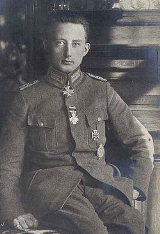
Werner Voss (April 13 1897–September 23 1917) was a renowned World War I German fighter pilot, ace and friend and rival of the renowned Manfred von Richthofen.
was born in Krefeld, the youngest of three sons of an industrial dyer.
initially enlisted in the 2nd Westphalian Hussar regiment Nr. 11 in 1914 and served on the Eastern Front.
ith many cavalrymen, Voss eventually transferred to the Luftstreitkräfte or German Air Service, learning to fly at Egelsberg near his home town.

Discussion
Ask a question about 'Werner Voss'
Start a new discussion about 'Werner Voss'
Answer questions from other users
|
Encyclopedia
Werner Voss (April 13 1897–September 23 1917) was a renowned World War I German fighter pilot, ace and friend and rival of the renowned Manfred von Richthofen.
Background
Voss was born in Krefeld, the youngest of three sons of an industrial dyer.
Involvement in World War 1
Early Military Service
Voss initially enlisted in the 2nd Westphalian Hussar regiment Nr. 11 in 1914 and served on the Eastern Front.
In the Flying Service
As with many cavalrymen, Voss eventually transferred to the Luftstreitkräfte or German Air Service, learning to fly at Egelsberg near his home town. Evidently a natural pilot, upon graduating, he was immediately enrolled as an instructor, before departing to the front.
He had to serve with Kampfstaffel 20 of Kampfgeschwader IV as an observer before he could earn his pilot's badge. Transferring to scout aircraft, he was posted to Oswald Boelcke's Jasta (Jagdstaffel) 2, where he flew as Manfred von Richthofen's wingman. At the age of only 18, he scored his first victory on November 27 1916. Flying an Albatros D.III scout aircraft decorated with an Iron cross and heart motifs (for good luck), he achieved 38 credited victories.
He was subsequently promoted to temporary commands at Jastas 5, 29, and 14, before moving to a permanent command at Jasta 10 as part of Richthofen's Jagdgeschwader I (JG I) (or "Flying Circus" as it later became known to the Allies). Having tested one of the F.1 prototypes (103/17, Wk. Nr.1730) of the Fokker Dr.I triplane scout for Anthony Fokker, Voss evidently adapted his flying style to the rotary engined triplane, being credited with a further 10 victories with this new aircraft. He adorned the cowling of his new aircraft by painting two eyes, eyebrows, and a moustache (a face motif thought by some to derive from Japanese kites). Voss was known for being a loner and an inspirational, rather than effective, leader (modern writers often describe him as 'mercurial').
He was finally shot down after single-handedly engaging up to eight Royal Aircraft Factory S.E.5s of 60 and 56 Squadrons of the Royal Flying Corps on September 23 1917 over Poelcappelle. The SE5s were flown by some of the RFC's best aces: James T.B. McCudden, Richard A. Maybery, Keith K. Muspratt, Reginald T.C. Hoidge, Arthur Rhys-Davids and Verschoyle P. Cronyn. Voss was briefly assisted by another ace, Karl Menckhoff, who was quickly forced down but survived. By exploiting the triplane's superior rate of climb and its ability to slip turn (using the rudder to turn quickly, which the triplane was very good at), Voss continually outflew his opponents. He was able to swing around at high speeds and attack those behind him, practically flying backwards. However, after flying past McCudden in a head-on confrontation, the rear of Voss's Fokker was exposed to Rhys-Davids of 56 Squadron and was struck by multiple rounds. Voss's previously-masterful flying gave way to a shaky, limping retreat. McCudden watched from high altitude as Voss went into a steep dive from which he never recovered. The uncharacteristically passive final moments of Voss's flight and his seemingly-suicidal dive suggest that he had been injured by the final volley from Rhys-David and was struggling to maintain consciousness. His aircraft crashed near Plum Farm north of Frezenberg in Belgium. Only the rudder, cowling, and parts of the undercarriage were salvaged and the aircraft was the subject of a report by 2nd Lieutenant G. Barfoot-Saunt.
One of the British pilots he fought that day, then-Captain James McCudden, a recipient of the Victoria Cross who would become a leading English ace of the war, expressed sincere regret at his death: "His flying was wonderful, his courage magnificent and in my opinion he was the bravest German airman whom it has been my privilege to see fight."
Voss' decorations and awards include: the Iron Cross 1st and 2nd Class, the Knights Cross with Swords of the Hohenzollern House Order, the Prussian Pilot Badge, and the Orden Pour le Mérite (the "Blue Max"). His final tally was 48 confirmed victories.
Voss is one of 44,292 Germans buried in the Langemark German war cemetery, some 6 km northeast of Ypres, Belgium.
External links
|
| |
|
|