

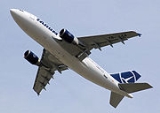
Airbus A310

Encyclopedia
The Airbus A310 is a medium- to long-range twin-engine
widebody
jet airliner
. Launched in July 1978, it was the second aircraft created by Airbus Industrie
,a consortium of European aerospace companies, Airbus is now fully owned by EADS
and since 2001 has been known as Airbus SAS. the consortium
of European aerospace companies
, which is now owned by EADS
. The A310 is a shortened derivative of the A300
, the first twin-engined widebody airliner.
The A310 (along with the A300) officially ceased production in July 2007 although the last delivery was in June 1998. As of August 2010, 255 A310s have been delivered, 193 of which are still in operation.
, it was deemed too big; the resulting redesigned Airbus A300B was smaller. Curiously, when the A300B1 was built, a number of airlines asked for greater capacity. Therefore, besides the first two prototypes, every aircraft had since been longer. As the A300 entered service, it became increasingly apparent that there was a sizable market for a smaller aircraft. Some operators did not have enough traffic as justification for the A300, while others wanted more frequency, while others still (specifically Swissair
and Lufthansa
) wanted lower aircraft-mile costs at the expense of higher seat-mile cost.
The logical thing to do, in order to offer an economic aircraft, was to firstly reduce the research and development
(R&D) costs. To do this, Airbus had to keep the redesign of the existing aircraft to a minimum. The consortium embarked on several early projects called B10MC (Minimum Change). The A300 was cut back to 220 passengers, which was then a desired capacity from many airlines. However, this would result in a small fuselage mated to a comparatively large wing and oversized undercarriage
, which would make the aircraft burn unnecessarily more fuel as it carries more weight. Another problem was the rate of inflation
, which in the UK, during 1979–1980, was 35%. This would significantly raise the development costs, and thus the cost of the final product.
During the A300's development, Hawker Siddeley Aviation was the subcontractor for the aircraft's wing, after the British government withdrew from the newly formed venture in 1969. HSA subsequently merged with three other companies in 1977, and by then, the British government had indicated its intentions to rejoin the programme. However, British Airways
(BA) and Rolls-Royce
did not relinquish their will to collaborate with the Americans, and, in BA's case, buy US aircraft. BA wanted to buy 7N7 and 7X7, which would develop into the Boeing 757
and 767
, with the latter an intended rival to the upcoming A310, as well as the Boeing 747
. The French government started talks in May 1976, saying that an order from BA was a condition for re-admission of the UK into Airbus Industrie as a full partner. As this went on, BAe held talks with Boeing and McDonnell Douglas to see if it (BAe) could partake in any future programmes, although the company's chairman, Lord Beswick
, publicly stated that the aim was really to collaborate in Europe. At the 1978 Farnborough Air Show
, Eric Varley, the British Secretary of State for Industry, announced that BAe wished to rejoin the Airbus Industrie as a full partner from 1 January 1979. This would mean BAe would be allocated 20% shareholding and would play "a full part in the development and manufacturing of the A310".
. Simultaneously, Aérospatiale
, MBB (Messerschmitt-Bölkow-Blohm
) and VFW-Fokker
held their individual studies into the new wing.
At the April 1978 Hanover Air Show, Airbus exhibited a model A310. Its wing area, at 219.25 m² (2,360 sq ft) was slightly larger than that studied, at 209 square metres (2,249.7 sq ft); its fuselage was 12 frames shorter than the A300, accommodating typical passenger loads of 195 in two-class, or 245 in economy. However, during the next 12 months, almost every aspect was further refined. On 9 June 1978, Swissair and Lufthansa developed a joint specification for the aircraft, and within a month, announced that they would place the launch orders. On 15 March, Swissair became the first airline to place a firm order for the type, announcing that it was to acquire ten with a further ten under option to replace McDonnell Douglas DC-9
series 30s on its major intra-European routes. Lufthansa quickly placed their $240 million 10-aircraft order. Air France
and Iberia shortly followed.
The increasingly strong interest in the aircraft, coupled with the recovery of the industry in the late 1970s, led Airbus to launching the A300B10, now known as the A310, into production on 7 July 1978. Lufthansa, on 1 April 1979, raised its commitment to 25 orders and 25 options. Two days later, KLM signed its order for 10 orders and 10 options at ₤238 million. Like Lufthansa, Air France on 6 July 1979 raised its order from four to 35. Other airlines announcing orders for the A310 during 1979 included Martinair
, Sabena
and Air Afrique
.
Initially, two versions of the A310 were planned, namely the regional A310-100 and the transcontinental A310-200. The A310-100 had a range of 2000 nmi (3,704 km) with 200 passengers, whilst the -200 had a higher MTOW and centre section fuel, and could carry the same load a further 1000 nmi (1,852 km). Basic engines offered included the General Electric CF6-45B2 and Pratt & Whitney JT9D-7R4
with the Rolls-Royce RB211-524B4 and the CF6-6 regarded as alternatives.
routes. The A300 and A310 introduced the concept of commonality: A300-600 and A310 pilots can qualify for the other aircraft with one day of training.
Sales of the A310 continued and by the time the development A310-200 aircraft made its first flight on 3 April 1982, orders and options for 181 aircraft had been placed by 15 airlines worldwide, a somewhat better start than that of the original A300. It was clear that the longer-range series −200 aircraft was the more popular aircraft and Airbus decided in 1979 to stop offering the low gross weight series A310-100 (originally proposed for Lufthansa), none of which were built.
Demand for the aircraft started to slow down and there were no new A310 passenger orders during the late 1990s, due to the introduction of the advanced technology Airbus A330
. The A310 (along with the A300) ceased production in July 2007, though five orders from Iraqi Airways remained on the books until July 2008. The remaining freighter sales are to be fulfilled by the new A330-200F
derivative.
The A310 was marketed as an introduction to widebody operations for developing airlines. The A310 was replaced in Airbus' lineup by the highly successful A330-200
, which shares its fuselage cross-section. Between 1983 and the very last aircraft produced in 1998, 255 A310s were delivered by Airbus.
The A300 and A310 established Airbus as a competitor to Boeing
and allowed it to go ahead with the more ambitious A320
and A330
/A340
families.
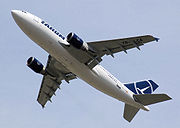
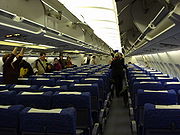
 The A310 is available in two basic versions, the medium range −200 and the longer range −300. The first version of the aircraft to be developed was the −200 but this was later joined by the −300 which then became the standard production version of the aircraft.
engines. The −200 entered service with Swissair and Lufthansa a year later. Also the late series −200 also featured wingfences just like the −300.
A convertible version, the seats can be removed and cargo placed on the main deck.
The freight version available as a new build or as a conversion of the existing wide-bodied aircraft. The A310-200F freighter has the capacity to carry 39t of freight over a distance up to 5,950 km.
and an increase in range, provided by additional centre and horizontal stabilizer (trim-tank) fuel tanks. This model also introduced wingtip fences to improve aerodynamic efficiency, a feature that has since been retrofitted to some −200s. The aircraft entered service in 1986, again with Swissair. The aircraft is also provided with a computerised fuel distribution system which allows it to be trimmed in flight resulting in less drag and therefore reduced fuel burn.
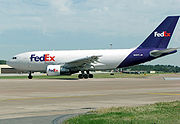
No production freighters of the A310 were produced. Operators such as FedEx Express instead adapt ex-airline A310s into freighters, most have been the −300 version. They are now the world's largest operator of A310's with 53 aircraft.
A convertible passenger/cargo version, the seats can be removed and cargo placed on the main deck.
and two by the Canadian Forces
. Deliveries began in 2004. Three were converted at EADS EFW
in Dresden, Germany; the other three at Lufthansa Technik in Hamburg, Germany. The Chilean Air Force has purchased two second-hand A310s to replace its ageing 707–320 'Aguila' tanker and transports. The first was received in October 2007.
Fourteen people suffered minor injuries in the accident at Dubai International Airport
.The aircraft came to rest at the end of the runway and was evacuated, but blocked the only active runway and forced the airport to close for nearly eight hours. The aircraft was written off.

* 157,000 kg is standard for the −300, 164,000 kg is an option.
Twinjet
A twinjet or twin jet is a jet aircraft powered by two engines. Such configuration of an aircraft is the most popular today for commercial airliners, for fighters, and many other kinds, because while offering safety from a single engine failure, it is also acceptably fuel-efficient.-Aircraft...
widebody
Wide-body aircraft
A wide-body aircraft is a large airliner with two passenger aisles, also known as a widebody aircraft or twin-aisle aircraft. The typical fuselage diameter is . In the typical wide-body economy cabin, passengers are seated seven to ten abreast, allowing a total capacity of 200 to 850 passengers...
jet airliner
Jet airliner
A jet airliner is an airliner that is powered by jet engines. This term is sometimes contracted to jetliner or jet.In contrast to today's relatively fuel-efficient, turbofan-powered air travel, first generation jet airliner travel was noisy and fuel inefficient...
. Launched in July 1978, it was the second aircraft created by Airbus Industrie
Airbus
Airbus SAS is an aircraft manufacturing subsidiary of EADS, a European aerospace company. Based in Blagnac, France, surburb of Toulouse, and with significant activity across Europe, the company produces around half of the world's jet airliners....
,a consortium of European aerospace companies, Airbus is now fully owned by EADS
EADS
The European Aeronautic Defence and Space Company N.V. is a global pan-European aerospace and defence corporation and a leading defence and military contractor worldwide...
and since 2001 has been known as Airbus SAS. the consortium
Consortium
A consortium is an association of two or more individuals, companies, organizations or governments with the objective of participating in a common activity or pooling their resources for achieving a common goal....
of European aerospace companies
Aerospace manufacturer
An aerospace manufacturer is a company or individual involved in the various aspects of designing, building, testing, selling, and maintaining aircraft, aircraft parts, missiles, rockets, and/or spacecraft....
, which is now owned by EADS
EADS
The European Aeronautic Defence and Space Company N.V. is a global pan-European aerospace and defence corporation and a leading defence and military contractor worldwide...
. The A310 is a shortened derivative of the A300
Airbus A300
The Airbus A300 is a short- to medium-range widebody jet airliner. Launched in 1972 as the world's first twin-engined widebody, it was the first product of Airbus Industrie, a consortium of European aerospace companies, wholly owned today by EADS...
, the first twin-engined widebody airliner.
The A310 (along with the A300) officially ceased production in July 2007 although the last delivery was in June 1998. As of August 2010, 255 A310s have been delivered, 193 of which are still in operation.
Background
During the development of the original Airbus A300Airbus A300
The Airbus A300 is a short- to medium-range widebody jet airliner. Launched in 1972 as the world's first twin-engined widebody, it was the first product of Airbus Industrie, a consortium of European aerospace companies, wholly owned today by EADS...
, it was deemed too big; the resulting redesigned Airbus A300B was smaller. Curiously, when the A300B1 was built, a number of airlines asked for greater capacity. Therefore, besides the first two prototypes, every aircraft had since been longer. As the A300 entered service, it became increasingly apparent that there was a sizable market for a smaller aircraft. Some operators did not have enough traffic as justification for the A300, while others wanted more frequency, while others still (specifically Swissair
Swissair
Swissair AG was the former national airline of Switzerland.It was formed from a merger between Balair and Ad Astra Aero , in 1931...
and Lufthansa
Lufthansa
Deutsche Lufthansa AG is the flag carrier of Germany and the largest airline in Europe in terms of overall passengers carried. The name of the company is derived from Luft , and Hansa .The airline is the world's fourth-largest airline in terms of overall passengers carried, operating...
) wanted lower aircraft-mile costs at the expense of higher seat-mile cost.
The logical thing to do, in order to offer an economic aircraft, was to firstly reduce the research and development
Research and development
The phrase research and development , according to the Organization for Economic Co-operation and Development, refers to "creative work undertaken on a systematic basis in order to increase the stock of knowledge, including knowledge of man, culture and society, and the use of this stock of...
(R&D) costs. To do this, Airbus had to keep the redesign of the existing aircraft to a minimum. The consortium embarked on several early projects called B10MC (Minimum Change). The A300 was cut back to 220 passengers, which was then a desired capacity from many airlines. However, this would result in a small fuselage mated to a comparatively large wing and oversized undercarriage
Undercarriage
The undercarriage or landing gear in aviation, is the structure that supports an aircraft on the ground and allows it to taxi, takeoff and land...
, which would make the aircraft burn unnecessarily more fuel as it carries more weight. Another problem was the rate of inflation
Inflation
In economics, inflation is a rise in the general level of prices of goods and services in an economy over a period of time.When the general price level rises, each unit of currency buys fewer goods and services. Consequently, inflation also reflects an erosion in the purchasing power of money – a...
, which in the UK, during 1979–1980, was 35%. This would significantly raise the development costs, and thus the cost of the final product.
During the A300's development, Hawker Siddeley Aviation was the subcontractor for the aircraft's wing, after the British government withdrew from the newly formed venture in 1969. HSA subsequently merged with three other companies in 1977, and by then, the British government had indicated its intentions to rejoin the programme. However, British Airways
British Airways
British Airways is the flag carrier airline of the United Kingdom, based in Waterside, near its main hub at London Heathrow Airport. British Airways is the largest airline in the UK based on fleet size, international flights and international destinations...
(BA) and Rolls-Royce
Rolls-Royce Limited
Rolls-Royce Limited was a renowned British car and, from 1914 on, aero-engine manufacturing company founded by Charles Stewart Rolls and Henry Royce on 15 March 1906 as the result of a partnership formed in 1904....
did not relinquish their will to collaborate with the Americans, and, in BA's case, buy US aircraft. BA wanted to buy 7N7 and 7X7, which would develop into the Boeing 757
Boeing 757
The Boeing 757 is a mid-size, narrow-body twin-engine jet airliner manufactured by Boeing Commercial Airplanes. Passenger versions of the twinjet have a capacity of 186 to 289 persons and a maximum range of , depending on variant and cabin configuration...
and 767
Boeing 767
The Boeing 767 is a mid-size, wide-body twin-engine jet airliner built by Boeing Commercial Airplanes. It was the manufacturer's first wide-body twinjet and its first airliner with a two-crew glass cockpit. The aircraft features two turbofan engines, a supercritical wing, and a conventional tail...
, with the latter an intended rival to the upcoming A310, as well as the Boeing 747
Boeing 747
The Boeing 747 is a wide-body commercial airliner and cargo transport, often referred to by its original nickname, Jumbo Jet, or Queen of the Skies. It is among the world's most recognizable aircraft, and was the first wide-body ever produced...
. The French government started talks in May 1976, saying that an order from BA was a condition for re-admission of the UK into Airbus Industrie as a full partner. As this went on, BAe held talks with Boeing and McDonnell Douglas to see if it (BAe) could partake in any future programmes, although the company's chairman, Lord Beswick
Frank Beswick, Baron Beswick
Frank Beswick, Baron Beswick was a British Labour Co-operative politician.Born in 1911 in Nottingham, Beswick's father was a coal miner. He was educated in Nottingham and then at the Working Men's College in London. He became a journalist and was elected to the London County Council...
, publicly stated that the aim was really to collaborate in Europe. At the 1978 Farnborough Air Show
Farnborough Air Show
The Farnborough International Airshow is a seven-day international trade fair for the aerospace industry which is held in even-numbered years in mid-July at Farnborough Airfield in Hampshire, England....
, Eric Varley, the British Secretary of State for Industry, announced that BAe wished to rejoin the Airbus Industrie as a full partner from 1 January 1979. This would mean BAe would be allocated 20% shareholding and would play "a full part in the development and manufacturing of the A310".
Design effort
From late 1977, before the Varley announcement BAe started work on the new wing at HatfieldHatfield Aerodrome
Hatfield Aerodrome, formerly , was an airfield and aircraft factory located in the town of Hatfield, Hertfordshire from 1930 until its closure and redevelopment in the 1990s.-Early history:...
. Simultaneously, Aérospatiale
Aérospatiale
Aérospatiale was a French aerospace manufacturer that built both civilian and military aircraft, rockets and satellites. It was originally known as Société Nationale Industrielle Aérospatiale...
, MBB (Messerschmitt-Bölkow-Blohm
Messerschmitt-Bölkow-Blohm
Messerschmitt-Bölkow-Blohm was a German aerospace company formed as the result of several mergers in the late 1960s. Among its best-known products was the MBB Bo 105 light twin helicopter...
) and VFW-Fokker
VFW-Fokker
VFW-Fokker GmbH was a joint venture of Fokker and Vereinigte Flugtechnische Werke started in 1969 that, from then on, controlled the ERNO initiative....
held their individual studies into the new wing.
At the April 1978 Hanover Air Show, Airbus exhibited a model A310. Its wing area, at 219.25 m² (2,360 sq ft) was slightly larger than that studied, at 209 square metres (2,249.7 sq ft); its fuselage was 12 frames shorter than the A300, accommodating typical passenger loads of 195 in two-class, or 245 in economy. However, during the next 12 months, almost every aspect was further refined. On 9 June 1978, Swissair and Lufthansa developed a joint specification for the aircraft, and within a month, announced that they would place the launch orders. On 15 March, Swissair became the first airline to place a firm order for the type, announcing that it was to acquire ten with a further ten under option to replace McDonnell Douglas DC-9
McDonnell Douglas DC-9
The McDonnell Douglas DC-9 is a twin-engine, single-aisle jet airliner. It was first manufactured in 1965 with its maiden flight later that year. The DC-9 was designed for frequent, short flights. The final DC-9 was delivered in October 1982.The DC-9 was followed in subsequent modified forms by...
series 30s on its major intra-European routes. Lufthansa quickly placed their $240 million 10-aircraft order. Air France
Air France
Air France , stylised as AIRFRANCE, is the French flag carrier headquartered in Tremblay-en-France, , and is one of the world's largest airlines. It is a subsidiary of the Air France-KLM Group and a founding member of the SkyTeam global airline alliance...
and Iberia shortly followed.
The increasingly strong interest in the aircraft, coupled with the recovery of the industry in the late 1970s, led Airbus to launching the A300B10, now known as the A310, into production on 7 July 1978. Lufthansa, on 1 April 1979, raised its commitment to 25 orders and 25 options. Two days later, KLM signed its order for 10 orders and 10 options at ₤238 million. Like Lufthansa, Air France on 6 July 1979 raised its order from four to 35. Other airlines announcing orders for the A310 during 1979 included Martinair
Martinair
For the American cargo airline, see Martinaire.Martinair Holland N.V., operating as Martinair, is an airline headquartered in the TransPort Building on the grounds of Amsterdam Airport Schiphol in Haarlemmermeer, Netherlands. It operates cargo services to over 50 destinations worldwide. Services...
, Sabena
Sabena
SABENA was the national airline of Belgium from 1923 to 2001, with its base at Brussels National Airport. After its bankruptcy in 2001, the newly formed SN Brussels Airlines took over part of SABENA's assets in February 2002, which then became Brussels Airlines...
and Air Afrique
Air Afrique
Air Afrique was a Pan-African airline, that was mainly owned by many West African countries for most of its history. It was established as the official transnational carrier for francophone West and Central Africa, because many of these countries did not have the capability to create and maintain a...
.
Initially, two versions of the A310 were planned, namely the regional A310-100 and the transcontinental A310-200. The A310-100 had a range of 2000 nmi (3,704 km) with 200 passengers, whilst the -200 had a higher MTOW and centre section fuel, and could carry the same load a further 1000 nmi (1,852 km). Basic engines offered included the General Electric CF6-45B2 and Pratt & Whitney JT9D-7R4
Pratt & Whitney JT9D
-Bibliography:* Gunston, Bill. World Encyclopedia of Aero Engines. Cambridge, England. Patrick Stephens Limited, 1989. ISBN 1-85260-163-9-External links:*...
with the Rolls-Royce RB211-524B4 and the CF6-6 regarded as alternatives.
Production
The range of the A310 exceeds that of the A300-series with the exception of the A300-600, which surpasses the A310-200. The ability of the A310 to go farther than earlier Airbus designs has led to the aircraft being used extensively on transatlanticTransatlantic flight
Transatlantic flight is the flight of an aircraft across the Atlantic Ocean. A transatlantic flight may proceed east-to-west, originating in Europe or Africa and terminating in North America or South America, or it may go in the reverse direction, west-to-east...
routes. The A300 and A310 introduced the concept of commonality: A300-600 and A310 pilots can qualify for the other aircraft with one day of training.
Sales of the A310 continued and by the time the development A310-200 aircraft made its first flight on 3 April 1982, orders and options for 181 aircraft had been placed by 15 airlines worldwide, a somewhat better start than that of the original A300. It was clear that the longer-range series −200 aircraft was the more popular aircraft and Airbus decided in 1979 to stop offering the low gross weight series A310-100 (originally proposed for Lufthansa), none of which were built.
Demand for the aircraft started to slow down and there were no new A310 passenger orders during the late 1990s, due to the introduction of the advanced technology Airbus A330
Airbus A330
The Airbus A330 is a wide-body twin-engine jet airliner made by Airbus, a division of EADS. Versions of the A330 have a range of and can accommodate up to 335 passengers in a two-class layout or carry of cargo....
. The A310 (along with the A300) ceased production in July 2007, though five orders from Iraqi Airways remained on the books until July 2008. The remaining freighter sales are to be fulfilled by the new A330-200F
Airbus A330
The Airbus A330 is a wide-body twin-engine jet airliner made by Airbus, a division of EADS. Versions of the A330 have a range of and can accommodate up to 335 passengers in a two-class layout or carry of cargo....
derivative.
The A310 was marketed as an introduction to widebody operations for developing airlines. The A310 was replaced in Airbus' lineup by the highly successful A330-200
Airbus A330
The Airbus A330 is a wide-body twin-engine jet airliner made by Airbus, a division of EADS. Versions of the A330 have a range of and can accommodate up to 335 passengers in a two-class layout or carry of cargo....
, which shares its fuselage cross-section. Between 1983 and the very last aircraft produced in 1998, 255 A310s were delivered by Airbus.
The A300 and A310 established Airbus as a competitor to Boeing
Competition between Airbus and Boeing
Competition between Airbus and Boeing is a result of both companies' domination of the large jet airliner market since the 1990s, a consequence of mergers within the global aerospace industry over the years. Airbus began as a consortium from Europe, whereas the American Boeing took over its former...
and allowed it to go ahead with the more ambitious A320
Airbus A320 family
The Airbus A320 family is a family of short- to medium-range, narrow-body, commercial passenger jet airliners manufactured by Airbus Industrie.Airbus was originally a consortium of European aerospace companies, and is now fully owned by EADS. Airbus's name has been Airbus SAS since 2001...
and A330
Airbus A330
The Airbus A330 is a wide-body twin-engine jet airliner made by Airbus, a division of EADS. Versions of the A330 have a range of and can accommodate up to 335 passengers in a two-class layout or carry of cargo....
/A340
Airbus A340
The Airbus A340 is a long-range four-engine wide-body commercial passenger jet airliner. Developed by Airbus Industrie,A consortium of European aerospace companies, Airbus is now fully owned by EADS and since 2001 has been known as Airbus SAS. a consortium of European aerospace companies, which is...
families.
Design
The A310 was a further development of the A300; the aircraft was initially designated the A300B10. Essentially a "baby" A300, the main differences in the two aircraft are:- Shortened fuselage: same cross section, providing capacity of about 200 passengers.
- Redesigned rear fuselage: altered tapering and moving aft of the rear bulkhead created additional capacity. The redesign was also used for the A300-600 and A330/A340 fuselages.
- Redesigned wing (reduced span and area), designed by British AerospaceBAE SystemsBAE Systems plc is a British multinational defence, security and aerospace company headquartered in London, United Kingdom, that has global interests, particularly in North America through its subsidiary BAE Systems Inc. BAE is among the world's largest military contractors; in 2009 it was the...
who rejoined Airbus consortium - Smaller horizontal tail surface.
- Later production A310s (from 1985/86) are equipped with wingtip fences to help reduce drag.
- Modified undercarriage with carbon brakes fitted as standard.
- Common pylons able to support all type of engines offered for the aircraft.
- Increased use of composite materials in both primary and secondary structure
- Electrically signalled spoilers.
- Integrated drive electrical generators.
- Improved auxiliary power unit.
Flight deck
The aircraft has a two crew "glass" cockpit as standard using CRT displays in place of the more traditional instrumentation, and modern electronic systems. The A310's flight deck was incorporated into the A300-600 enabling a dual type rating to be achieved. The flight deck has provisions for third and fourth crew seats.Variants
A310-200
The first A310, the 162nd Airbus off the production line, made its maiden flight on 3 April 1982 powered by the earlier Pratt & Whitney JT9D-7R4D1Pratt & Whitney JT9D
-Bibliography:* Gunston, Bill. World Encyclopedia of Aero Engines. Cambridge, England. Patrick Stephens Limited, 1989. ISBN 1-85260-163-9-External links:*...
engines. The −200 entered service with Swissair and Lufthansa a year later. Also the late series −200 also featured wingfences just like the −300.
- A310-200C
A convertible version, the seats can be removed and cargo placed on the main deck.
- A310-200F
The freight version available as a new build or as a conversion of the existing wide-bodied aircraft. The A310-200F freighter has the capacity to carry 39t of freight over a distance up to 5,950 km.
A310-300
First flown on 8 July 1985, the −300 is dimensionally identical to the −200 except for the provision of increased MTOWMaximum Take-Off Weight
The Maximum Takeoff Weight or Maximum Takeoff Mass of an aircraft is the maximum weight at which the pilot of the aircraft is allowed to attempt to take off, due to structural or other limits. The analogous term for rockets is Gross Lift-Off Mass, or GLOW...
and an increase in range, provided by additional centre and horizontal stabilizer (trim-tank) fuel tanks. This model also introduced wingtip fences to improve aerodynamic efficiency, a feature that has since been retrofitted to some −200s. The aircraft entered service in 1986, again with Swissair. The aircraft is also provided with a computerised fuel distribution system which allows it to be trimmed in flight resulting in less drag and therefore reduced fuel burn.
No production freighters of the A310 were produced. Operators such as FedEx Express instead adapt ex-airline A310s into freighters, most have been the −300 version. They are now the world's largest operator of A310's with 53 aircraft.
- A310-300C
A convertible passenger/cargo version, the seats can be removed and cargo placed on the main deck.
A310 MRT/MRTT
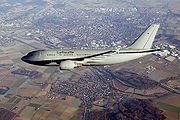
The A310 has been operated by many of the world's airforces as a pure transport (A310-300 MRT), however several have now been converted to the "Multi Role Tanker Transport" configuration by EADS, providing an aerial refueling capability. At least six have been ordered; four by the German LuftwaffeLuftwaffe
Luftwaffe is a generic German term for an air force. It is also the official name for two of the four historic German air forces, the Wehrmacht air arm founded in 1935 and disbanded in 1946; and the current Bundeswehr air arm founded in 1956....
and two by the Canadian Forces
Canadian Forces
The Canadian Forces , officially the Canadian Armed Forces , are the unified armed forces of Canada, as constituted by the National Defence Act, which states: "The Canadian Forces are the armed forces of Her Majesty raised by Canada and consist of one Service called the Canadian Armed Forces."...
. Deliveries began in 2004. Three were converted at EADS EFW
EADS EFW
EADS EFW is a subsidiary and business unit of EADS in Dresden. It is located at the Dresden Airport and became the centre of freighter aircraft conversion in the EADS group.- History :...
in Dresden, Germany; the other three at Lufthansa Technik in Hamburg, Germany. The Chilean Air Force has purchased two second-hand A310s to replace its ageing 707–320 'Aguila' tanker and transports. The first was received in October 2007.
Military operators
The A310 has been used by the armed forces of the following countries:- Belgian Air Component
- Royal Canadian Air ForceRoyal Canadian Air ForceThe history of the Royal Canadian Air Force begins in 1920, when the air force was created as the Canadian Air Force . In 1924 the CAF was renamed the Royal Canadian Air Force and granted royal sanction by King George V. The RCAF existed as an independent service until 1968...
– designated CC-150 PolarisCC-150 Polaris-External links:* *...
- Egyptian Air ForceEgyptian Air ForceThe Egyptian Air Force, or EAF , is the aviation branch of the Egyptian Armed Forces. The EAF is headed by an Air Marshal . Currently, the commander of the Egyptian Air Force is Air Marshal Reda Mahmoud Hafez Mohamed...
- French Air ForceFrench Air ForceThe French Air Force , literally Army of the Air) is the air force of the French Armed Forces. It was formed in 1909 as the Service Aéronautique, a service arm of the French Army, then was made an independent military arm in 1933...
- German Air Force
- Spanish Air ForceSpanish Air Force-The early stages:Hot air balloons had been used with military purposes in Spain as far back as 1896. In 1905, with the help of Alfredo Kindelán, Leonardo Torres y Quevedo directed the construction of the first Spanish dirigible in the Army Military Aerostatics Service, created in 1896 and located...
- Pakistan Air ForcePakistan Air ForceThe Pakistan Air Force is the leading air arm of the Pakistan Armed Forces and is primarily tasked with the aerial defence of Pakistan with a secondary role of providing air support to the Pakistan Army and the Pakistan Navy. The PAF also has a tertiary role of providing strategic air transport...
- Royal Thai Air ForceRoyal Thai Air ForceThe Royal Thai Air Force or RTAF is the air force of the Kingdom of Thailand. Since its establishment in 1913, as one of the earliest air forces of Asia, the Royal Thai Air Force had engaged in many major and minor battles. During the Vietnam war era, the air force has been developed with USAF-aid...
Deliveries
By the end of production a total of 255 A310s had been ordered and delivered.| Total | 1998 | 1997 | 1996 | 1995 | 1994 | 1993 | 1992 | 1991 | 1990 | 1989 | 1988 | 1987 | 1986 | 1985 | 1984 | 1983 | |
|---|---|---|---|---|---|---|---|---|---|---|---|---|---|---|---|---|---|
| Deliveries | 255 | 1 | 2 | 2 | 2 | 2 | 22 | 24 | 19 | 18 | 23 | 28 | 21 | 19 | 26 | 29 | 17 |
Accident and incidents
- Hull-loss accidents: 9 with a total of 825 fatalities.
- Hijackings: 10 with a total of five fatalities
- 31 July 1992: Thai Airways International Flight 311Thai Airways International Flight 311Thai Airways International Flight 311 was a flight from Bangkok, Thailand's Don Mueang International Airport to Kathmandu, Nepal's Tribhuvan International Airport. On 31 July 1992, an A310-304 on the route, registration HS-TID, crashed on approach to Tribhuvan. All 113 on board were killed.Flight...
an A310-304 carrying 99 passengers and 14 crew, crashed on approach to Tribhuvan, All 113 on board were killed. - 23 March 1994: Aeroflot Flight 593Aeroflot Flight 593Aeroflot Flight 593 was an AeroflotRussian International Airlines Airbus A310-304 that crashed into a hillside of the Kuznetsk Alatau mountain range, Kemerovo Oblast, on . The jet was en route from Sheremetyevo International Airport to Hong Kong Kai Tak International Airport with 75 occupants...
, an A310-300 carrying 63 passengers and 12 crew, crashed in Siberia after the pilot let his son sit at the controls and the autopilot partially disconnected. - 31 March 1995: Tarom Flight 371Tarom Flight 371TAROM Flight 371 was an Airbus A310 that crashed near Baloteşti in Romania on 31 March 1995. It was a flight from Bucharest's main Otopeni airport to Brussels.The flight crashed shortly after it took off...
, an A310-324 carrying 50 passengers and 10 crew crashed in BaloteştiBalotestiBaloteşti is a commune in the northwestern part of Ilfov County, Romania. Two small rivers flow through this location: Cociovaliştea and Vlăsia...
next to Otopeni International Airport near BucharestBucharestBucharest is the capital municipality, cultural, industrial, and financial centre of Romania. It is the largest city in Romania, located in the southeast of the country, at , and lies on the banks of the Dâmbovița River....
after a jamming of the throttle on the starboard engine followed by a lack of reaction by pilots, All 60 on board were killed. - 11 December 1998: Thai Airways International Flight 261 crashed in Thailand.
- 30 January 2000: Kenya Airways Flight 431Kenya Airways Flight 431Kenya Airways Flight 431 was an international scheduled Abidjan–Lagos–Nairobi passenger service, operated with an Airbus A310-304, registration 5Y-BEN, that crashed into the sea, off the coast of Côte d'Ivoire, on at 21:09:24 GMT, shortly after take-off from Félix Houphouët-Boigny International...
crashed in the Atlantic Ocean shortly after takeoff from Abidjan on 31 January 2000. - 12 July 2000: Hapag-Lloyd Flight 3378Hapag-Lloyd Flight 3378Hapag-Lloyd Flight 3378 , registered as D-AHLB, was a commercial Hapag-Lloyd Airlines Airbus A310-304 flight, on 12 July 2000. It was carrying 142 passengers and 8 crew members from Chania, Greece to Hanover, Germany....
, an A310-304, crashed during an emergency landingEmergency landingAn emergency landing is a landing made by an aircraft in response to a crisis which either interferes with the operation of the aircraft or involves sudden medical emergencies necessitating diversion to the nearest airport.-Types of emergency landings:...
in Vienna due to fuel exhaustion. - 9 July 2006: S7 Airlines Flight 778S7 Airlines Flight 778S7 Airlines Flight 778 was an Airbus A310-300 passenger flight en route from Moscow to Irkutsk when it crashed upon landing at Irkutsk International Airport at 07:44 local time on 9 July 2006 . The plane overshot the runway, sliding over several hundred metres of wet runway and grass...
, an Airbus A310-324 jet from Moscow carrying 196 passengers and eight crew, overshot the runway at IrkutskIrkutskIrkutsk is a city and the administrative center of Irkutsk Oblast, Russia, one of the largest cities in Siberia. Population: .-History:In 1652, Ivan Pokhabov built a zimovye near the site of Irkutsk for gold trading and for the collection of fur taxes from the Buryats. In 1661, Yakov Pokhabov...
in SiberiaSiberiaSiberia is an extensive region constituting almost all of Northern Asia. Comprising the central and eastern portion of the Russian Federation, it was part of the Soviet Union from its beginning, as its predecessor states, the Tsardom of Russia and the Russian Empire, conquered it during the 16th...
, plowed through a concrete barrier and caught fire as it crashed into buildings. Reports said that 70 of the 204 on board survived, with 12 still missing. Since the accident, casualty figures have fluctuated, in part due to three people boarding the aircraft who were not on the passenger manifest, and some survivors walking home after being assumed trapped in the wreckage. - 12 March 2007: Biman Bangladesh AirlinesBiman Bangladesh AirlinesBiman Bangladesh Airlines , partly transcribed from English into Bengali and the other way around) is the flag carrier airline of Bangladesh. Its main hub is at Shahjalal International Airport in Dhaka, and also operates flights from Shah Amanat International Airport in Chittagong, earning revenue...
Flight BG006, an A310-325 carrying 236 passengers and crew, suffered a collapsed nose gear while accelerating down the runway.
Fourteen people suffered minor injuries in the accident at Dubai International Airport
Dubai International Airport
Dubai International Airport is an international airport serving Dubai, the largest city of the United Arab Emirates. It is a major aviation hub in the Middle East, and is the main airport of Dubai. It is situated in the Al Garhoud district, southeast of Dubai...
.The aircraft came to rest at the end of the runway and was evacuated, but blocked the only active runway and forced the airport to close for nearly eight hours. The aircraft was written off.
- 10 June 2008: Sudan Airways Flight 109Sudan Airways Flight 109Sudan Airways Flight 109 was a scheduled flight from Amman, Jordan, to Khartoum International Airport, Sudan, by way of Damascus, Syria. At approximately 17:00 UTC on 10 June 2008 it crashed on landing in Khartoum....
, an A310-324 from Amman, Jordan carrying 203 passengers and 11 crew, veered off the runway after landing at Khartoum International AirportKhartoum International AirportKhartoum International Airport is an airport in Khartoum, the capital of Sudan.It will be replaced with a new airport 40 kilometers south of the centre of Khartoum by 2012...
during bad weather. Soon afterward a fire started in the aircraft's right wing area. As of 12 June reports confirm 30 people were killed with another six still missing. - 30 June 2009, Yemenia Flight 626Yemenia Flight 626Yemenia Flight 626 was an Airbus A310-324 twin-engine jet airliner, operated by Yemenia, operating as a scheduled international flight from Sana'a, Yemen, to Moroni, Comoros, that crashed on 30 June 2009 at around 1:50 a.m. local time while on approach to Prince Said Ibrahim International...
, an A310-324 flying from Sana'aSana'a-Districts:*Al Wahdah District*As Sabain District*Assafi'yah District*At Tahrir District*Ath'thaorah District*Az'zal District*Bani Al Harith District*Ma'ain District*Old City District*Shu'aub District-Old City:...
, Yemen, to MoroniMoroni, Comoros-References:...
, Comoros crashed into the Indian Ocean shortly before reaching its destination. The aircraft was carrying 153 passengers and crew; it seems that there was only one survivor, a 12 year old girl.
Specifications
| A310-200 | A310-200F | A310-300 | A310-300F | |
|---|---|---|---|---|
| Crew | Two | |||
| Length | 46.66 metre | |||
| Height | 15.8 metre | |||
| Wingspan | 43.9 metres (144 ft) | |||
| Wing area | 219 square metres (2,357.3 sq ft) | |||
| Wing sweep | 28 ° | |||
| Cross section | 5.64 metre | |||
| Passengers (2-cls) | 240 | 33t Tonne The tonne, known as the metric ton in the US , often put pleonastically as "metric tonne" to avoid confusion with ton, is a metric system unit of mass equal to 1000 kilograms. The tonne is not an International System of Units unit, but is accepted for use with the SI... cargo |
240 | 33t Tonne The tonne, known as the metric ton in the US , often put pleonastically as "metric tonne" to avoid confusion with ton, is a metric system unit of mass equal to 1000 kilograms. The tonne is not an International System of Units unit, but is accepted for use with the SI... cargo |
| MTOW Maximum Take-Off Weight The Maximum Takeoff Weight or Maximum Takeoff Mass of an aircraft is the maximum weight at which the pilot of the aircraft is allowed to attempt to take off, due to structural or other limits. The analogous term for rockets is Gross Lift-Off Mass, or GLOW... |
141,974 kg (312,342 lb) | 164,000 kg (361,600 lb) |
||
| Empty weight | 80,142 kg (176,312 lb) |
72400 kilograms (159,614.7 lb) | 83,100 kg (183,300 lb) |
73,900 kg |
| Max fuel | 55200 l (14,582.3 US gal) | 75470 l (19,937.1 US gal) | ||
| Cruise speed (M Mach number Mach number is the speed of an object moving through air, or any other fluid substance, divided by the speed of sound as it is in that substance for its particular physical conditions, including those of temperature and pressure... ) |
0.80 (850 km/h.) | |||
| Max speed (M) | 0.84 (901 km/h.) | |||
| Ceiling | 12,500 m (41,000 ft) | |||
| Thrust (×2) | 50000 pound-forces (222.4 kN) to 53200 pound-forces (236.6 kN) | 56000 pound-forces (249.1 kN) to 59000 pound-forces (262.4 kN) | ||
| Engines | PWJT9D-7R4 Pratt & Whitney JT9D -Bibliography:* Gunston, Bill. World Encyclopedia of Aero Engines. Cambridge, England. Patrick Stephens Limited, 1989. ISBN 1-85260-163-9-External links:*... or CF6-80C2A2 General Electric CF6 The General Electric CF6 is a family of high-bypass turbofan engines produced by GE Aviation. A development of the first high-power high-bypass jet engine available, the TF39, the CF6 powers a wide variety of civilian airliners. The basic engine core formed the basis for the LM2500, LM5000, and... |
PW4156A Pratt & Whitney PW4000 |-See also:-External links:* * *... or CF6-80C2A8 |
||
| Range | 6,800 km (3,670 nm) Transcontinental |
5550 kilometres (2,996.8 nmi) | 9,600 km (5,200 nm) Trans-atlantic |
7330 kilometres (3,957.9 nmi) |
Aircraft model designations
Source: French DGAC Type Certificate Data Sheet No. 145| Model | Certification Date | Engines |
|---|---|---|
| A310-203 | 11 March 1983 | General Electric CF6-80A3 General Electric CF6 The General Electric CF6 is a family of high-bypass turbofan engines produced by GE Aviation. A development of the first high-power high-bypass jet engine available, the TF39, the CF6 powers a wide variety of civilian airliners. The basic engine core formed the basis for the LM2500, LM5000, and... |
| A310-203C | 27 November 1984 | General Electric CF6-80A3 |
| A310-204 | 23 April 1986 | General Electric CF6-80C2A2 |
| A310-221 | 11 March 1983 | Pratt & Whitney JT9D-7R4D1 Pratt & Whitney JT9D -Bibliography:* Gunston, Bill. World Encyclopedia of Aero Engines. Cambridge, England. Patrick Stephens Limited, 1989. ISBN 1-85260-163-9-External links:*... |
| A310-222 | 22 September 1983 | Pratt & Whitney JT9D-7R4E1 Pratt & Whitney JT9D -Bibliography:* Gunston, Bill. World Encyclopedia of Aero Engines. Cambridge, England. Patrick Stephens Limited, 1989. ISBN 1-85260-163-9-External links:*... |
| A310-304 | 11 March 1986 | General Electric CF6-80C2A2 |
| A310-308 | 5 June 1991 | General Electric CF6-80C2A8 or CF6-80C2A2 |
| A310-322 | 5 December 1985 | Pratt & Whitney JT9D-7R4E1 Pratt & Whitney JT9D -Bibliography:* Gunston, Bill. World Encyclopedia of Aero Engines. Cambridge, England. Patrick Stephens Limited, 1989. ISBN 1-85260-163-9-External links:*... |
| A310-324 | 27 May 1987 | Pratt & Whitney PW4152 |
| A310-325 | 6 March 1992 | Pratt & Whitney PW4156A |
See also
External links
- Airbus A310 – Images, dimensions and full specifications
- Production List
- Official website