


Rubicon

Encyclopedia
River
A river is a natural watercourse, usually freshwater, flowing towards an ocean, a lake, a sea, or another river. In a few cases, a river simply flows into the ground or dries up completely before reaching another body of water. Small rivers may also be called by several other names, including...
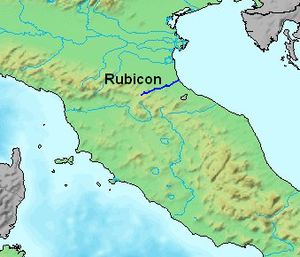
in northeastern Italy
Italy
Italy , officially the Italian Republic languages]] under the European Charter for Regional or Minority Languages. In each of these, Italy's official name is as follows:;;;;;;;;), is a unitary parliamentary republic in South-Central Europe. To the north it borders France, Switzerland, Austria and...
, about 80 kilometres long, running from the Apennine Mountains
Apennine mountains
The Apennines or Apennine Mountains or Greek oros but just as often used alone as a noun. The ancient Greeks and Romans typically but not always used "mountain" in the singular to mean one or a range; thus, "the Apennine mountain" refers to the entire chain and is translated "the Apennine...
to the Adriatic Sea
Adriatic Sea
The Adriatic Sea is a body of water separating the Italian Peninsula from the Balkan peninsula, and the system of the Apennine Mountains from that of the Dinaric Alps and adjacent ranges...
through the southern Emilia-Romagna
Emilia-Romagna
Emilia–Romagna is an administrative region of Northern Italy comprising the two historic regions of Emilia and Romagna. The capital is Bologna; it has an area of and about 4.4 million inhabitants....
region, between the towns of Rimini
Rimini
Rimini is a medium-sized city of 142,579 inhabitants in the Emilia-Romagna region of Italy, and capital city of the Province of Rimini. It is located on the Adriatic Sea, on the coast between the rivers Marecchia and Ausa...
and Cesena
Cesena
Cesena is a city and comune in the Emilia-Romagna region of northern Italy, south of Ravenna and west of Rimini, on the Savio River, co-chief of the Province of Forlì-Cesena. It is at the foot of the Apennines, and about 15 km from the Adriatic Sea.-History:Cesena was originally an Umbrian...
. The Latin word rubico comes from the adjective "rubeus", meaning "red". The river was so named because its waters are colored red by mud deposits.
The idiom
Idiom
Idiom is an expression, word, or phrase that has a figurative meaning that is comprehended in regard to a common use of that expression that is separate from the literal meaning or definition of the words of which it is made...
"Crossing the Rubicon
Crossing the Rubicon (disambiguation)
Crossing the Rubicon may refer to:* Literally, the start of Caesar's Civil War* Metaphorically, a Point of no returnMusic*Crossing the Rubicon , an album by Swedish melodic metal band Armageddon...
" means to pass a point of no return
Point of no return
The point of no return is the point beyond which one must continue on his or her current course of action because turning back is physically impossible, prohibitively expensive or dangerous. It is also used when the distance or effort required to get back would be greater than the remainder of the...
, and refers to Julius Caesar
Julius Caesar
Gaius Julius Caesar was a Roman general and statesman and a distinguished writer of Latin prose. He played a critical role in the gradual transformation of the Roman Republic into the Roman Empire....
's army's crossing of the river in 49 BC
49 BC
Year 49 BC was a year of the pre-Julian Roman calendar. At the time, it was known as the Year of the Consulship of Lentulus and Marcellus...
, which was considered an act of insurrection. Because the course of the river has changed much since then, it is impossible to confirm exactly where the Rubicon flowed when Caesar and his legions
Roman legion
A Roman legion normally indicates the basic ancient Roman army unit recruited specifically from Roman citizens. The organization of legions varied greatly over time but they were typically composed of perhaps 5,000 soldiers, divided into maniples and later into "cohorts"...
crossed it.
History
During the Roman republicRoman Republic
The Roman Republic was the period of the ancient Roman civilization where the government operated as a republic. It began with the overthrow of the Roman monarchy, traditionally dated around 508 BC, and its replacement by a government headed by two consuls, elected annually by the citizens and...
, the river Rubicon marked the boundary between the Roman province
Roman province
In Ancient Rome, a province was the basic, and, until the Tetrarchy , largest territorial and administrative unit of the empire's territorial possessions outside of Italy...
of Cisalpine Gaul
Cisalpine Gaul
Cisalpine Gaul, in Latin: Gallia Cisalpina or Citerior, also called Gallia Togata, was a Roman province until 41 BC when it was merged into Roman Italy.It bore the name Gallia, because the great body of its inhabitants, after the expulsion of the Etruscans, consisted of Gauls or Celts...
to the north and Italy proper (controlled directly by Rome and its socii allies) to the south. Governors of Roman provinces were appointed promagistrates with imperium
Imperium
Imperium is a Latin word which, in a broad sense, translates roughly as 'power to command'. In ancient Rome, different kinds of power or authority were distinguished by different terms. Imperium, referred to the sovereignty of the state over the individual...
(roughly, "right to command") in their province(s). The governor would then serve as the general of the Roman army within the territory of his province(s). Roman law
Roman law
Roman law is the legal system of ancient Rome, and the legal developments which occurred before the 7th century AD — when the Roman–Byzantine state adopted Greek as the language of government. The development of Roman law comprises more than a thousand years of jurisprudence — from the Twelve...
specified that only the elected magistrates
Roman Magistrates
The Roman Magistrates were elected officials in Ancient Rome. During the period of the Roman Kingdom, the King of Rome was the principal executive magistrate. His power, in practice, was absolute. He was the chief priest, lawgiver, judge, and the sole commander of the army...
(consul
Roman consul
A consul served in the highest elected political office of the Roman Republic.Each year, two consuls were elected together, to serve for a one-year term. Each consul was given veto power over his colleague and the officials would alternate each month...
s and praetor
Praetor
Praetor was a title granted by the government of Ancient Rome to men acting in one of two official capacities: the commander of an army, usually in the field, or the named commander before mustering the army; and an elected magistratus assigned varied duties...
s) could hold imperium within Italy. Any promagistrate who entered Italy at the head of his troops forfeited his imperium and was therefore no longer legally allowed to command troops.
Exercising imperium when forbidden by the law was a capital offence, punishable by death. Furthermore, obeying the commands of a general who did not legally possess imperium was also a capital offence. If a general entered Italy whilst exercising command of an army, both the general and his soldiers became outlaws and were automatically condemned to death. Generals were thus obliged to disband their armies before entering Italy.
In 49 BC
49 BC
Year 49 BC was a year of the pre-Julian Roman calendar. At the time, it was known as the Year of the Consulship of Lentulus and Marcellus...
, supposedly on January 10 of the Roman calendar
Roman calendar
The Roman calendar changed its form several times in the time between the founding of Rome and the fall of the Roman Empire. This article generally discusses the early Roman or pre-Julian calendars...
, G. Julius Caesar
Julius Caesar
Gaius Julius Caesar was a Roman general and statesman and a distinguished writer of Latin prose. He played a critical role in the gradual transformation of the Roman Republic into the Roman Empire....
led one legion
Roman legion
A Roman legion normally indicates the basic ancient Roman army unit recruited specifically from Roman citizens. The organization of legions varied greatly over time but they were typically composed of perhaps 5,000 soldiers, divided into maniples and later into "cohorts"...
, the Legio XIII Gemina
Legio XIII Gemina
Legio tertia decima Gemina was one of the most prominent Roman legions. It was one of Julius Caesar's key units in Gaul and in the civil war, and was the legion with which he famously crossed the Rubicon on January 10, 49 BC. The legion appears to have still been in existence in the fifth century...
, south over the Rubicon from Cisalpine Gaul to Italy to make his way to Rome. In doing so, he (deliberately) broke the law on imperium and made armed conflict inevitable. According to the historian Suetonius
Suetonius
Gaius Suetonius Tranquillus, commonly known as Suetonius , was a Roman historian belonging to the equestrian order in the early Imperial era....
, Caesar uttered the famous phrase ālea iacta est
Alea iacta est
Alea iacta est is a Latin phrase attributed by Suetonius to Julius Caesar on January 10, 49 BC as he led his army across the River Rubicon in Northern Italy...
("the die
Dice
A die is a small throwable object with multiple resting positions, used for generating random numbers...
has been cast"). Caesar's decision for swift action forced Pompey
Pompey
Gnaeus Pompeius Magnus, also known as Pompey or Pompey the Great , was a military and political leader of the late Roman Republic...
, the lawful consuls (G. Claudius Marcellus
Gaius Claudius Marcellus Maior
Gaius Claudius Marcellus Maior was a Roman consul in 49 BC.He is frequently confused with his cousin of the same name, Gaius Claudius Marcellus Minor, a consul a year before in 50 BC. Gaius was also the brother of the Marcus Claudius Marcellus, the consul of 51 BC.Little is known of him before his...
and L. Cornelius Lentulus Crus
Lucius Cornelius Lentulus Crus
Lucius Cornelius Lentulus, surnamed Crus or Cruscello , was a member of the anti-Caesarian party.In 61 BC he was the chief accuser of Publius Clodius in the affair of the festival of Bona Dea...
), and a large part of the Roman Senate
Roman Senate
The Senate of the Roman Republic was a political institution in the ancient Roman Republic, however, it was not an elected body, but one whose members were appointed by the consuls, and later by the censors. After a magistrate served his term in office, it usually was followed with automatic...
to flee Rome in fear. Caesar's subsequent victory in Caesar's civil war
Caesar's civil war
The Great Roman Civil War , also known as Caesar's Civil War, was one of the last politico-military conflicts in the Roman Republic before the establishment of the Roman Empire...
ensured that punishment for the infraction would never be rendered.
Suetonius's account depicts Caesar as undecided as he approached the river, and attributes the crossing to a supernatural apparition. The phrase "crossing the Rubicon" has survived to refer to any individual or group committing itself irrevocably to a risky or revolutionary course of action, similar to the modern phrase "passing the point of no return
Point of no return
The point of no return is the point beyond which one must continue on his or her current course of action because turning back is physically impossible, prohibitively expensive or dangerous. It is also used when the distance or effort required to get back would be greater than the remainder of the...
".
Location confusion and resolution
After Caesar's crossing, the Rubicon was a geographical feature of note until EmperorRoman Emperor
The Roman emperor was the ruler of the Roman State during the imperial period . The Romans had no single term for the office although at any given time, a given title was associated with the emperor...
Augustus
Augustus
Augustus ;23 September 63 BC – 19 August AD 14) is considered the first emperor of the Roman Empire, which he ruled alone from 27 BC until his death in 14 AD.The dates of his rule are contemporary dates; Augustus lived under two calendars, the Roman Republican until 45 BC, and the Julian...
abolished the Province of Gallia Cisalpina
Cisalpine Gaul
Cisalpine Gaul, in Latin: Gallia Cisalpina or Citerior, also called Gallia Togata, was a Roman province until 41 BC when it was merged into Roman Italy.It bore the name Gallia, because the great body of its inhabitants, after the expulsion of the Etruscans, consisted of Gauls or Celts...
(today’s northern Italy) and the river ceased to be the extreme border line of Italy. The decision robbed the Rubicon of its importance, and the name gradually disappeared from the local toponymy.
After the fall of the Roman Empire, and during the first centuries of the Middle Ages
Middle Ages
The Middle Ages is a periodization of European history from the 5th century to the 15th century. The Middle Ages follows the fall of the Western Roman Empire in 476 and precedes the Early Modern Era. It is the middle period of a three-period division of Western history: Classic, Medieval and Modern...
, the coastal plain between Ravenna
Ravenna
Ravenna is the capital city of the Province of Ravenna in the Emilia-Romagna region of Italy and the second largest comune in Italy by land area, although, at , it is little more than half the size of the largest comune, Rome...
and Rimini
Rimini
Rimini is a medium-sized city of 142,579 inhabitants in the Emilia-Romagna region of Italy, and capital city of the Province of Rimini. It is located on the Adriatic Sea, on the coast between the rivers Marecchia and Ausa...
was flooded many times. The Rubicon, as with other small rivers of the region, often changed its course during this period. For this reason, and to supply fields with water after the revival of agriculture in the late Middle Ages, during the 14th and 15th centuries, hydraulic works were built to prevent other floods and to regulate streams. As a result of this work, these rivers eventually started flowing in straight courses, as they do today.
With the revival of interest in the topography of ancient Roman Italy during the 15th century, the matter of identifying the Rubicon in the contemporary landscape became a topic of debate among Renaissance humanists. To support the claim of the Pisciatello, a spurious inscription forbidding the passage of an army in the name of the Roman people and Senate, the so-called Sanctio, was placed by a bridge on that river. The Quattrocento
Quattrocento
The cultural and artistic events of 15th century Italy are collectively referred to as the Quattrocento...
humanist Flavio Biondo
Flavio Biondo
Flavio Biondo was an Italian Renaissance humanist historian. He was one of the first historians to used a three-period division of history and is known as one of the first archaeologists.Born in the capital city of Forlì, in the Romagna region, Flavio was well schooled from an early age,...
was taken in by it; the actual inscription is conserved in the Museo Archeologico, Cesena. As the centuries went by, several rivers of Italian Adriatic coast between Ravenna and Rimini have at times been said to correspond to the ancient Rubicon.
The Via Aemilia
Via Aemilia
The Via Aemilia was a trunk Roman road in the north Italian plain, running from Ariminum , on the Adriatic coast, to Placentia on the river Padus . It was completed in 187 BC...
(National Road N°9) still follows its original Roman course as it runs between hills and plain; it would have been the obvious course to follow as it was the only major Roman road east of the Apennine Mountains
Apennine mountains
The Apennines or Apennine Mountains or Greek oros but just as often used alone as a noun. The ancient Greeks and Romans typically but not always used "mountain" in the singular to mean one or a range; thus, "the Apennine mountain" refers to the entire chain and is translated "the Apennine...
leading to and from the Po Valley
Po Valley
The Po Valley, Po Plain, Plain of the Po, or Padan Plain is a major geographical feature of Italy. It extends approximately in an east-west direction, with an area of 46,000 km² including its Venetic extension not actually related to the Po River basin; it runs from the Western Alps to the...
. Attempts to deduce the original flow of the Rubicon can be done only by studying written documents and other archaeological evidence such as Roman milestones, which indicate the distance between the ancient river and the nearest Roman towns.
It is important to underline that the starting point of a Roman road
Roman road
The Roman roads were a vital part of the development of the Roman state, from about 500 BC through the expansion during the Roman Republic and the Roman Empire. Roman roads enabled the Romans to move armies and trade goods and to communicate. The Roman road system spanned more than 400,000 km...
(some kind of “mile zero”), from which distances were counted, was always the crossing between the Cardo
Cardo
The cardo was a north-south oriented street in Roman cities, military camps, and coloniae. The cardo, an integral component of city planning, was lined with shops and vendors, and served as a hub of economic life. The main cardo was called cardo maximus.Most Roman cities also had a Decumanus...
and the Decumanus
Decumanus Maximus
In Roman city planning, a decumanus was an east-west-oriented road in a Roman city, castra , or colonia. The main decumanus was the Decumanus Maximus, which normally connected the Porta Praetoria to the Porta Decumana .This name comes from the fact that the via decumana or decimana In Roman city...
, the two principal streets in every Roman town, running north-south and east-west, respectively. In a section of the Tabula Peutingeriana
Tabula Peutingeriana
The Tabula Peutingeriana is an itinerarium showing the cursus publicus, the road network in the Roman Empire. The original map of which this is a unique copy was last revised in the fourth or early fifth century. It covers Europe, parts of Asia and North Africa...
, an ancient document showing the network of Roman roads, a river in north-eastern Italy labeled “fl. Rubico” is marked at a position 12 Roman miles (18 km) north of Rimini along the coastline; 18 km is the distance between Rimini and a place called “Ad Confluentes”, drawn west of the Rubicon, on the Via Aemilia.
In 1933, after various efforts spanning centuries, the river now called Fiumicino, crossing the town of Savignano di Romagna (now Savignano sul Rubicone
Savignano sul Rubicone
Savignano sul Rubicone is a comune in the Province of Forlì-Cesena in the Italian region Emilia-Romagna, located about 90 km southeast of Bologna and about 30 km southeast of Forlì....
), was officially identified as the former Rubicon. The final proof confirming this theory came only in 1991, when three Italian scholars (Pignotti, Ravagli, and Donati), after a comparison between the Tabula Peutingeriana
Tabula Peutingeriana
The Tabula Peutingeriana is an itinerarium showing the cursus publicus, the road network in the Roman Empire. The original map of which this is a unique copy was last revised in the fourth or early fifth century. It covers Europe, parts of Asia and North Africa...
and other ancient sources (including Cicero
Cicero
Marcus Tullius Cicero , was a Roman philosopher, statesman, lawyer, political theorist, and Roman constitutionalist. He came from a wealthy municipal family of the equestrian order, and is widely considered one of Rome's greatest orators and prose stylists.He introduced the Romans to the chief...
), showed that the distance running from Rome to the Rubicon river was 320 km. Key elements of their work are:
- The locality of San Giovanni in Compito (now a western quarter of Savignano) has to be identified with the old Ad Confluentes (“compito” means confluence of roads and it is synonymous with “confluentes”)
- The distance between Ad Confluentes and Rome, according to the Tabula PeutingerianaTabula PeutingerianaThe Tabula Peutingeriana is an itinerarium showing the cursus publicus, the road network in the Roman Empire. The original map of which this is a unique copy was last revised in the fourth or early fifth century. It covers Europe, parts of Asia and North Africa...
, is 320 km - The distance from today’s San Giovanni in Compito and the Fiumicino river is 1 Roman mile (1.48 km)
Present
Today there is very little evidence of Caesar’s historical passage. Savignano sul Rubicone is an industrial town and the river has become one of the most polluted in the Emilia-RomagnaEmilia-Romagna
Emilia–Romagna is an administrative region of Northern Italy comprising the two historic regions of Emilia and Romagna. The capital is Bologna; it has an area of and about 4.4 million inhabitants....
region. Exploitation of underground waters along the upper course of the Rubicon has reduced its flow—it was a minor river even during Roman times (“parvi Rubiconis ad undas” as Lucan
Marcus Annaeus Lucanus
Marcus Annaeus Lucanus , better known in English as Lucan, was a Roman poet, born in Corduba , in the Hispania Baetica. Despite his short life, he is regarded as one of the outstanding figures of the Imperial Latin period...
said, roughly translated "to the waves of [the] tiny Rubicon")—and has since lost its natural route, except in its upper course between low and woody hills.
In popular culture
For an extensive list of contemporary and popular use, see Rubicon (disambiguation)Rubicon (disambiguation)
Rubicon is a river in northern Italy.Rubicon may also refer to:- United States :* Rubicon, California* Rubicon, Wisconsin, a town* Rubicon , Wisconsin, an unincorporated community* Rubicon Township, Illinois...
.