

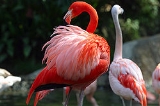
Flamingo

Encyclopedia
Flamingos or flamingoes are gregarious wading birds in the genus
Phoenicopterus (from Greek
φοίνικοπτερος meaning "Phoenix's
wing"), the only genus in the family
Phoenicopteridae. There are four flamingo species in the Americas
and two species in the Old World
.
and the James's Flamingo
, are often placed in the genus Phoenicoparrus
instead of Phoenicopterus.
Traditionally, the long-legged Ciconiiformes
, probably a paraphyletic assemblage, have been considered the flamingos' closest relatives and the family was included in the order. Usually the ibis
es and spoonbill
s of the Threskiornithidae
were considered their closest relatives within this order. Earlier genetic studies, such as those of Charles Sibley
and colleagues, also supported this relationship. Relationships to the waterfowl
were considered as well, especially as flamingos and waterfowl
are parasitized by feather lice of the genus Anaticola, which are otherwise exclusively found on ducks and geese. Other scientists proposed flamingos as waders
most closely related to the stilt
s and avocets, Recurvirostridae
. The peculiar presbyornithids were used to argue for a close relationship between flamingos, waterfowl, and waders, but they are now known to be unequivocal waterfowl
with a peculiarly derived morphology
paralleling waders and flamingos.
-_breeding_plumage_w2_img_8770.jpg) Recent molecular studies have suggested a relation with grebes, while morphological evidence also strongly supports a relationship between flamingos and grebes. They hold at least eleven morphological traits in common, which are not found on other birds. Many of these characteristics have been previously identified on flamingos, but not on grebes. The fossil Palaelodids
Recent molecular studies have suggested a relation with grebes, while morphological evidence also strongly supports a relationship between flamingos and grebes. They hold at least eleven morphological traits in common, which are not found on other birds. Many of these characteristics have been previously identified on flamingos, but not on grebes. The fossil Palaelodids
can be considered evolutionarily, and ecologically, intermediate between flamingos and grebes.
For the grebe-flamingo clade
, the taxon
Mirandornithes
("miraculous birds" due to their extreme divergence and apomorphies) has been proposed. Alternatively, they could be placed in one order, with Phoenocopteriformes taking priority.
. A considerable number of little-known birds from the Late Cretaceous
onwards are sometimes considered to be flamingo ancestors. These include the genera Torotix
, Scaniornis
, Gallornis, Agnopterus, Tiliornis, Juncitarsus
and Kashinia; these show a mix of characters and are fairly plesiomorphic in comparison to modern birds. (The supposed "Cretaceous
flamingo" Parascaniornis is actually a synonym of Baptornis
and not a close relative to any living bird). An extinct family of peculiar "swimming flamingos", the Palaelodidae
, are believed to be related to, or to be the ancestors of, the modern flamingos. This is sometimes rejected, since the fossil Elornis is known to be from some time before any palaelodid flamingos have been recorded.
There exists a fairly comprehensive fossil record of the genus Phoenicopterus. The systematics of prehistoric Phoenicopteridae known only from fossils is as follows:
 Flamingos often stand on one leg, the other tucked beneath the body. The reason for this behavior is not fully understood. Some suggest that the flamingo, like some other animals, has the ability to have half of its body go into a state of sleep, and when one side is rested, the flamingo will swap legs and then let the other half sleep, but this has not been proven. Recent research has indicated that standing on one leg may allow the birds to conserve more body heat, given that they spend a significant amount of time wading in cold water. As well as standing in the water, flamingos may stamp their webbed feet in the mud to stir up food from the bottom.
Young flamingos hatch with grey plumage, but adults range from light pink to bright red due to aqueous bacteria and beta carotene obtained from their food supply. They are not naturally pink. A well-fed, healthy flamingo is more vibrantly coloured and thus a more desirable mate; a white or pale flamingo, however, is usually unhealthy or malnourished. Captive
flamingos are a notable exception; many turn a pale pink as they are not fed carotene at levels comparable to the wild. This is changing as more zoos begin to add prawn
s and other supplements to the diets of their flamingos.
on brine shrimp
and blue-green algae. Their beaks are specially adapted to separate mud and silt from the food they eat, and are uniquely used upside-down. The filtering of food items is assisted by hairy structures called lamellae which line the mandibles, and the large rough-surfaced tongue. The pink or reddish color of flamingos comes from carotenoid
proteins in their diet of animal and plant plankton
. These proteins are broken down into pigments by liver enzymes. The source of this varies by species, and affects the saturation of color. Flamingos whose sole diet is blue-green algae are darker in color compared to those who get it second hand (e.g. from animals that have digested blue-green aglae). Zoo-fed flamingos, who often lack the color enhancer in their diet, may be given food with the additive canthaxanthin
.
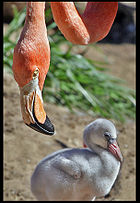
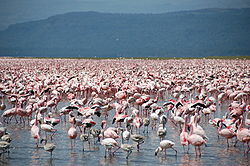 Flamingos are very social birds that live in colonies that can number in the thousands. These large colonies are believed to serve three purposes for the flamingos: predator avoidance, maximizing food intake, and exploiting scarce suitable nesting sites. The most basic and stable social unit of flamingos are pair bonds which are made up of one male and one female. The bond between them tends to be strong; however, in larger colonies (where there are more mates to choose from), mate changes will occur. In pair bonds, both the male and the female contribute to building the nest for their egg and defending it. Before breeding, flamingo colonies split into breeding groups of around 15-50 birds. Both males and females in these groups perform synchronized ritual displays. These displays serve to both stimulate synchronous nesting and establish pair formation for birds that do not already have mates. A flamingo group stands together and display to each other by rasing neck, followed by calling with head-flagging and then wing flapping. The displays do not seem to be directed towards an individual but instead occur randomly.
Flamingo pair bonds establish and defend nesting territories. They locate a suitable spot on the mudflat to build a nest, which is usually chosen by the female. It is during nest building that copulation usually occurs. Nest building can also be interrupted by another couple trying to steal the nesting site. Flamingos will viciously defend their nesting sites and young. After the chicks hatch, the only parental expense is feeding. Flamingos produce a crop milk
, like pigeons and doves, due to the action of a hormone called prolactin (see Columbidae). It contains more fat and less protein than the latter does, and it is produced in glands lining the whole of the upper digestive tract, not just the crop. Both parents nurse their chick, and young flamingos feed on this milk, which also contains red and white blood cells. In the first six days, the adults and chicks stay in the nesting sites. At around seven to twelve days the chicks begin to move and explore their surroundings. After two weeks, the chicks join groups called "microcrèches" and their parent soon leave them in these groups. Later, many microcrèches come together to form crèches which contain thousands of chicks. Chicks that do not stay in their crèches are vulnerable to predators.
lakes of Kenya
and Tanzania
. However, they are baffled as to the reason. Possible causes include avian cholera, botulism
, metal poisoning, pesticides or poison
ous bacteria
, say researchers. Also, fears for the future of the Lesser Flamingo — Phoeniconaias minor — have been raised by plans to pipe water from one of their key breeding areas, the shores of Lake Natron
. The lakes are crucial to the birds' breeding success because the flamingos feed off the blooms of cyanobacteria that thrive there.
at Zoo Basel
in Switzerland
in 1958. Since then, over 389 flamingos grew up in Basel and were distributed to other zoos around the globe.
 In Ancient Rome
, flamingo tongues were considered a delicacy. Also, Andean miners have killed flamingos for their fat, believed to be a cure for tuberculosis.
Ancient Egypt
ians believed flamingos to be the living representation of the god Ra
.
The Moche
people of ancient Peru
worshipped nature. They placed emphasis on animals and often depicted flamingos in their art.
Pink plastic flamingo
statues are popular lawn ornament
s in the United States
.
Flamingos are the national bird of The Bahamas
.
Genus
In biology, a genus is a low-level taxonomic rank used in the biological classification of living and fossil organisms, which is an example of definition by genus and differentia...
Phoenicopterus (from Greek
Greek language
Greek is an independent branch of the Indo-European family of languages. Native to the southern Balkans, it has the longest documented history of any Indo-European language, spanning 34 centuries of written records. Its writing system has been the Greek alphabet for the majority of its history;...
φοίνικοπτερος meaning "Phoenix's
Phoenix (mythology)
The phoenix or phenix is a mythical sacred firebird that can be found in the mythologies of the Arabian, Persians, Greeks, Romans, Egyptians, Chinese, Indian and Phoenicians....
wing"), the only genus in the family
Family (biology)
In biological classification, family is* a taxonomic rank. Other well-known ranks are life, domain, kingdom, phylum, class, order, genus, and species, with family fitting between order and genus. As for the other well-known ranks, there is the option of an immediately lower rank, indicated by the...
Phoenicopteridae. There are four flamingo species in the Americas
Americas
The Americas, or America , are lands in the Western hemisphere, also known as the New World. In English, the plural form the Americas is often used to refer to the landmasses of North America and South America with their associated islands and regions, while the singular form America is primarily...
and two species in the Old World
Old World
The Old World consists of those parts of the world known to classical antiquity and the European Middle Ages. It is used in the context of, and contrast with, the "New World" ....
.
Species
Six flamingo species are recognized by most sources, and these are generally placed in one genus. Two species, the AndeanAndean Flamingo
The Andean flamingo, or Phoenicopterus andinus, is one of the rarest flamingos in the world. It has a pale pink body with brighter upperparts, deep vinaceous-pink lower neck, breast, and wing-coverts. It is the only flamingo species with yellow legs and three-toed feet. The bill of the Andean...
and the James's Flamingo
James's Flamingo
James's Flamingo is also known as the Puna Flamingo. Named for Harry Berkeley James, it populates the high altitudes of Andean plateaus of Peru, Chile, Bolivia and Argentina. It is closely related to the Andean Flamingo, and the two make up the genus Phoenicoparrus...
, are often placed in the genus Phoenicoparrus
Phoenicoparrus
Phoenicoparrus is a genus of bird in the Phoenicopteridae family. The two species are commonly placed in genus Phoenicopterus along with the remaining flamingos instead.-Species:* Andean Flamingo...
instead of Phoenicopterus.
| Species | Greater Flamingo Greater Flamingo The Greater Flamingo is the most widespread species of the flamingo family. It is found in parts of Africa, southern Asia , and southern Europe... (P. roseus) |
Old World | Parts of Africa, S. Europe and S. and SW Asia (Most widespread flamingo). |
|---|---|---|
| Lesser Flamingo Lesser Flamingo The Lesser Flamingo is a species in the flamingo family of birds that resides in Africa and in southern Asia... (P. minor) |
Africa (e.g. Great Rift Valley) to NW India (most numerous flamingo). | |
| Chilean Flamingo Chilean Flamingo The Chilean Flamingo is a large species closely related to Caribbean Flamingo and Greater Flamingo, with which it was sometimes considered conspecific... (P. chilensis) |
New World | Temperate S. South America. |
| James's Flamingo James's Flamingo James's Flamingo is also known as the Puna Flamingo. Named for Harry Berkeley James, it populates the high altitudes of Andean plateaus of Peru, Chile, Bolivia and Argentina. It is closely related to the Andean Flamingo, and the two make up the genus Phoenicoparrus... (P. jamesi) |
High Andes in Peru, Chile, Bolivia and Argentina. | |
| Andean Flamingo Andean Flamingo The Andean flamingo, or Phoenicopterus andinus, is one of the rarest flamingos in the world. It has a pale pink body with brighter upperparts, deep vinaceous-pink lower neck, breast, and wing-coverts. It is the only flamingo species with yellow legs and three-toed feet. The bill of the Andean... (P. andinus) |
High Andes in Peru, Chile, Bolivia and Argentina. | |
| American Flamingo (P. ruber) |
Caribbean Caribbean The Caribbean is a crescent-shaped group of islands more than 2,000 miles long separating the Gulf of Mexico and the Caribbean Sea, to the west and south, from the Atlantic Ocean, to the east and north... and Galapagos islands Galápagos Islands The Galápagos Islands are an archipelago of volcanic islands distributed around the equator in the Pacific Ocean, west of continental Ecuador, of which they are a part.The Galápagos Islands and its surrounding waters form an Ecuadorian province, a national park, and a... . |
Systematics and evolution
A wide variety of birds have been proposed as their closest relatives, on a wide variety of evidence. To reflect the uncertainty about this matter, flamingos are generally placed in their own order.Traditionally, the long-legged Ciconiiformes
Ciconiiformes
Traditionally, the order Ciconiiformes has included a variety of large, long-legged wading birds with large bills: storks, herons, egrets, ibises, spoonbills, and several others. Ciconiiformes are known from the Late Eocene...
, probably a paraphyletic assemblage, have been considered the flamingos' closest relatives and the family was included in the order. Usually the ibis
Ibis
The ibises are a group of long-legged wading birds in the family Threskiornithidae....
es and spoonbill
Spoonbill
Spoonbills are a group of large, long-legged wading birds in the family Threskiornithidae, which also includes the Ibises.All have large, flat, spatulate bills and feed by wading through shallow water, sweeping the partly opened bill from side to side...
s of the Threskiornithidae
Threskiornithidae
The family Threskiornithidae includes 34 species of large terrestrial and wading birds, falling into two subfamilies, the ibises and the spoonbills. It was formerly known as Plataleidae. The spoonbills and ibises were once thought to be related to other groups of long-legged wading birds in the...
were considered their closest relatives within this order. Earlier genetic studies, such as those of Charles Sibley
Charles Sibley
Charles Gald Sibley was an American ornithologist and molecular biologist. He had an immense influence on the scientific classification of birds, and the work that Sibley initiated has substantially altered our understanding of the evolutionary history of modern birds.Sibley's taxonomy has been a...
and colleagues, also supported this relationship. Relationships to the waterfowl
Waterfowl
Waterfowl are certain wildfowl of the order Anseriformes, especially members of the family Anatidae, which includes ducks, geese, and swans....
were considered as well, especially as flamingos and waterfowl
Waterfowl
Waterfowl are certain wildfowl of the order Anseriformes, especially members of the family Anatidae, which includes ducks, geese, and swans....
are parasitized by feather lice of the genus Anaticola, which are otherwise exclusively found on ducks and geese. Other scientists proposed flamingos as waders
Charadriiformes
Charadriiformes is a diverse order of small to medium-large birds. It includes about 350 species and has members in all parts of the world. Most Charadriiformes live near water and eat invertebrates or other small animals; however, some are pelagic , some occupy deserts and a few are found in thick...
most closely related to the stilt
Stilt
Stilt is a common name for several species of birds in the family Recurvirostridae, which also includes those known as avocets. They are found in brackish or saline wetlands in warm or hot climates....
s and avocets, Recurvirostridae
Recurvirostridae
Recurvirostridae is a family of birds in the wader suborder Charadrii. It contains two distinct groups of birds, the avocets and the stilts .-Description and diet:...
. The peculiar presbyornithids were used to argue for a close relationship between flamingos, waterfowl, and waders, but they are now known to be unequivocal waterfowl
Waterfowl
Waterfowl are certain wildfowl of the order Anseriformes, especially members of the family Anatidae, which includes ducks, geese, and swans....
with a peculiarly derived morphology
Morphology (biology)
In biology, morphology is a branch of bioscience dealing with the study of the form and structure of organisms and their specific structural features....
paralleling waders and flamingos.
Relationship with grebes
Palaelodidae
The Palaelodidae are a family of extinct birds in the order Phoenicopteriformes, which today is represented only by the flamingos. They have been described as "swimming flamingos."Three genera are recognised:...
can be considered evolutionarily, and ecologically, intermediate between flamingos and grebes.
For the grebe-flamingo clade
Clade
A clade is a group consisting of a species and all its descendants. In the terms of biological systematics, a clade is a single "branch" on the "tree of life". The idea that such a "natural group" of organisms should be grouped together and given a taxonomic name is central to biological...
, the taxon
Taxon
|thumb|270px|[[African elephants]] form a widely-accepted taxon, the [[genus]] LoxodontaA taxon is a group of organisms, which a taxonomist adjudges to be a unit. Usually a taxon is given a name and a rank, although neither is a requirement...
Mirandornithes
Mirandornithes
Mirandornithes is a clade that consists of flamingos and grebes. The relationships of both groups have been problematic. Flamingos had been placed with numerous branches within Neognathae, such as ducks and storks. The grebes had been placed with the loons. However recent studies seem to confirm...
("miraculous birds" due to their extreme divergence and apomorphies) has been proposed. Alternatively, they could be placed in one order, with Phoenocopteriformes taking priority.
Fossil record
Flamingoes are well attested in the fossil record, with the first unequivocal member of the extant family Phoenicopteridae, Elornis known from the Late EoceneEocene
The Eocene Epoch, lasting from about 56 to 34 million years ago , is a major division of the geologic timescale and the second epoch of the Paleogene Period in the Cenozoic Era. The Eocene spans the time from the end of the Palaeocene Epoch to the beginning of the Oligocene Epoch. The start of the...
. A considerable number of little-known birds from the Late Cretaceous
Cretaceous
The Cretaceous , derived from the Latin "creta" , usually abbreviated K for its German translation Kreide , is a geologic period and system from circa to million years ago. In the geologic timescale, the Cretaceous follows the Jurassic period and is followed by the Paleogene period of the...
onwards are sometimes considered to be flamingo ancestors. These include the genera Torotix
Torotix
Torotix is a Late Cretaceous genus of aquatic bird. It lived along the shores of the Western Interior Seaway, but it is not clear whether it was a seabird or a freshwater bird, as it is only known from a humerus. Consequently, the genus is monotypic, with the single species Torotix clemensi.It...
, Scaniornis
Scaniornis
Scaniornis is a prehistoric bird genus. The only species, Scaniornis lundgreni, lived in the MP 1-5 ....
, Gallornis, Agnopterus, Tiliornis, Juncitarsus
Juncitarsus
Juncitarsus is an extinct genus of flamingo from the Eocene in the USA....
and Kashinia; these show a mix of characters and are fairly plesiomorphic in comparison to modern birds. (The supposed "Cretaceous
Cretaceous
The Cretaceous , derived from the Latin "creta" , usually abbreviated K for its German translation Kreide , is a geologic period and system from circa to million years ago. In the geologic timescale, the Cretaceous follows the Jurassic period and is followed by the Paleogene period of the...
flamingo" Parascaniornis is actually a synonym of Baptornis
Baptornis
Baptornis is an extinct genus of flightless aquatic bird from the Late Cretaceous, some 87-80 million years ago . The fossils of Baptornis advenus, the type species, were discovered in Kansas, which at its time was mostly covered by the Western Interior Seaway, a shallow shelf sea...
and not a close relative to any living bird). An extinct family of peculiar "swimming flamingos", the Palaelodidae
Palaelodidae
The Palaelodidae are a family of extinct birds in the order Phoenicopteriformes, which today is represented only by the flamingos. They have been described as "swimming flamingos."Three genera are recognised:...
, are believed to be related to, or to be the ancestors of, the modern flamingos. This is sometimes rejected, since the fossil Elornis is known to be from some time before any palaelodid flamingos have been recorded.
There exists a fairly comprehensive fossil record of the genus Phoenicopterus. The systematics of prehistoric Phoenicopteridae known only from fossils is as follows:
- Phoenicopteridae
- Elornis (Middle? Eocene - Early Oligocene) - includes Actiornis
- Phoenicopteridae gen. et sp. indet. (Camacho Middle? - Late Miocene? of San José, Uruguay)
-
- Prehistoric species of Phoenicopterus:
- Phoenicopterus croizeti (Middle Oligocene - Middle Miocene of C Europe)
- Phoenicopterus floridanus (Early Pliocene of Florida)
- Phoenicopterus stocki (Middle Pliocene of Rincón, Mexico)
- Phoenicopterus copei (Late Pleistocene of W North America and C Mexico)
- Phoenicopterus minutus (Late Pleistocene of California, USA)
- Phoenicopterus aethiopicus
- Phoenicopterus eyrensis (Late Oligocene of South Australia)
- Prehistoric species of Phoenicopterus:
Description
Young flamingos hatch with grey plumage, but adults range from light pink to bright red due to aqueous bacteria and beta carotene obtained from their food supply. They are not naturally pink. A well-fed, healthy flamingo is more vibrantly coloured and thus a more desirable mate; a white or pale flamingo, however, is usually unhealthy or malnourished. Captive
Captivity (animal)
Animals that live under human care are in captivity. Captivity can be used as a generalizing term to describe the keeping of either domesticated animals or wild animals. This may include for example farms, private homes and zoos...
flamingos are a notable exception; many turn a pale pink as they are not fed carotene at levels comparable to the wild. This is changing as more zoos begin to add prawn
Prawn
Prawns are decapod crustaceans of the sub-order Dendrobranchiata. There are 540 extant species, in seven families, and a fossil record extending back to the Devonian...
s and other supplements to the diets of their flamingos.
Feeding
Flamingos filter-feedFilter feeder
Filter feeders are animals that feed by straining suspended matter and food particles from water, typically by passing the water over a specialized filtering structure. Some animals that use this method of feeding are clams, krill, sponges, baleen whales, and many fish and some sharks. Some birds,...
on brine shrimp
Brine shrimp
Artemia is a genus of aquatic crustaceans known as brine shrimp. Artemia, the only genus in the family Artemiidae, has changed little externally since the Triassic period...
and blue-green algae. Their beaks are specially adapted to separate mud and silt from the food they eat, and are uniquely used upside-down. The filtering of food items is assisted by hairy structures called lamellae which line the mandibles, and the large rough-surfaced tongue. The pink or reddish color of flamingos comes from carotenoid
Carotenoid
Carotenoids are tetraterpenoid organic pigments that are naturally occurring in the chloroplasts and chromoplasts of plants and some other photosynthetic organisms like algae, some bacteria, and some types of fungus. Carotenoids can be synthesized fats and other basic organic metabolic building...
proteins in their diet of animal and plant plankton
Plankton
Plankton are any drifting organisms that inhabit the pelagic zone of oceans, seas, or bodies of fresh water. That is, plankton are defined by their ecological niche rather than phylogenetic or taxonomic classification...
. These proteins are broken down into pigments by liver enzymes. The source of this varies by species, and affects the saturation of color. Flamingos whose sole diet is blue-green algae are darker in color compared to those who get it second hand (e.g. from animals that have digested blue-green aglae). Zoo-fed flamingos, who often lack the color enhancer in their diet, may be given food with the additive canthaxanthin
Canthaxanthin
Canthaxanthin is a carotenoid pigment widely distributed in nature. Carotenoids belong to a larger class of phytochemicals known as terpenoids. The chemical formula of canthaxanthin is C40H52O2. It has E number E161g and is approved for use in the EU and USA however it is not approved for usage in...
.
Lifecycle
Flamingo pair bonds establish and defend nesting territories. They locate a suitable spot on the mudflat to build a nest, which is usually chosen by the female. It is during nest building that copulation usually occurs. Nest building can also be interrupted by another couple trying to steal the nesting site. Flamingos will viciously defend their nesting sites and young. After the chicks hatch, the only parental expense is feeding. Flamingos produce a crop milk
Crop milk
Crop milk is a secretion from the lining of the crop of parent birds that is regurgitated to young birds. They are found among all pigeons and doves where they are referred to as pigeon milk...
, like pigeons and doves, due to the action of a hormone called prolactin (see Columbidae). It contains more fat and less protein than the latter does, and it is produced in glands lining the whole of the upper digestive tract, not just the crop. Both parents nurse their chick, and young flamingos feed on this milk, which also contains red and white blood cells. In the first six days, the adults and chicks stay in the nesting sites. At around seven to twelve days the chicks begin to move and explore their surroundings. After two weeks, the chicks join groups called "microcrèches" and their parent soon leave them in these groups. Later, many microcrèches come together to form crèches which contain thousands of chicks. Chicks that do not stay in their crèches are vulnerable to predators.
Conservation status
Scientists have discovered that flamingos are dying by the thousands along the Great Rift ValleyGreat Rift Valley
The Great Rift Valley is a name given in the late 19th century by British explorer John Walter Gregory to the continuous geographic trench, approximately in length, that runs from northern Syria in Southwest Asia to central Mozambique in South East Africa...
lakes of Kenya
Kenya
Kenya , officially known as the Republic of Kenya, is a country in East Africa that lies on the equator, with the Indian Ocean to its south-east...
and Tanzania
Tanzania
The United Republic of Tanzania is a country in East Africa bordered by Kenya and Uganda to the north, Rwanda, Burundi, and the Democratic Republic of the Congo to the west, and Zambia, Malawi, and Mozambique to the south. The country's eastern borders lie on the Indian Ocean.Tanzania is a state...
. However, they are baffled as to the reason. Possible causes include avian cholera, botulism
Botulism
Botulism also known as botulinus intoxication is a rare but serious paralytic illness caused by botulinum toxin which is metabolic waste produced under anaerobic conditions by the bacterium Clostridium botulinum, and affecting a wide range of mammals, birds and fish...
, metal poisoning, pesticides or poison
Poison
In the context of biology, poisons are substances that can cause disturbances to organisms, usually by chemical reaction or other activity on the molecular scale, when a sufficient quantity is absorbed by an organism....
ous bacteria
Bacteria
Bacteria are a large domain of prokaryotic microorganisms. Typically a few micrometres in length, bacteria have a wide range of shapes, ranging from spheres to rods and spirals...
, say researchers. Also, fears for the future of the Lesser Flamingo — Phoeniconaias minor — have been raised by plans to pipe water from one of their key breeding areas, the shores of Lake Natron
Lake Natron
Lake Natron is a salt lake located in northern Tanzania, close to the Kenyan border, in the eastern branch of Africa's Great Rift Valley. The lake is fed by the Ewaso Ng'iro River but also by mineral-rich hot springs and is quite shallow, less than three meters deep, and varies in width depending...
. The lakes are crucial to the birds' breeding success because the flamingos feed off the blooms of cyanobacteria that thrive there.
In captivity
The first flamingo hatched in a European zoo was a Chilean FlamingoChilean Flamingo
The Chilean Flamingo is a large species closely related to Caribbean Flamingo and Greater Flamingo, with which it was sometimes considered conspecific...
at Zoo Basel
Zoo Basel
Zoo Basel is a non-profit zoo located within the city of Basel, Switzerland. Its official name is Zoologischer Garten Basel — or in English: Basel Zoological Garden. Basel residents, however, call their zoo affectionately Zolli...
in Switzerland
Switzerland
Switzerland name of one of the Swiss cantons. ; ; ; or ), in its full name the Swiss Confederation , is a federal republic consisting of 26 cantons, with Bern as the seat of the federal authorities. The country is situated in Western Europe,Or Central Europe depending on the definition....
in 1958. Since then, over 389 flamingos grew up in Basel and were distributed to other zoos around the globe.
Relationship with humans
Ancient Rome
Ancient Rome was a thriving civilization that grew on the Italian Peninsula as early as the 8th century BC. Located along the Mediterranean Sea and centered on the city of Rome, it expanded to one of the largest empires in the ancient world....
, flamingo tongues were considered a delicacy. Also, Andean miners have killed flamingos for their fat, believed to be a cure for tuberculosis.
Ancient Egypt
Ancient Egypt
Ancient Egypt was an ancient civilization of Northeastern Africa, concentrated along the lower reaches of the Nile River in what is now the modern country of Egypt. Egyptian civilization coalesced around 3150 BC with the political unification of Upper and Lower Egypt under the first pharaoh...
ians believed flamingos to be the living representation of the god Ra
Ra
Ra is the ancient Egyptian sun god. By the Fifth Dynasty he had become a major deity in ancient Egyptian religion, identified primarily with the mid-day sun...
.
The Moche
Moche
'The Moche civilization flourished in northern Peru from about 100 AD to 800 AD, during the Regional Development Epoch. While this issue is the subject of some debate, many scholars contend that the Moche were not politically organized as a monolithic empire or state...
people of ancient Peru
Peru
Peru , officially the Republic of Peru , is a country in western South America. It is bordered on the north by Ecuador and Colombia, on the east by Brazil, on the southeast by Bolivia, on the south by Chile, and on the west by the Pacific Ocean....
worshipped nature. They placed emphasis on animals and often depicted flamingos in their art.
Pink plastic flamingo
Plastic flamingo
Pink plastic flamingos are one of the most famous of lawn ornaments in the United States, along with the garden gnome and other such ornamentation....
statues are popular lawn ornament
Lawn ornament
Lawn ornaments are decorative objects placed in the grassy area of a property.- Common lawn ornaments :Bird bath - A structure designed to hold water for birds to bathe in or drink, generally supported upon a pedestal....
s in the United States
United States
The United States of America is a federal constitutional republic comprising fifty states and a federal district...
.
Flamingos are the national bird of The Bahamas
The Bahamas
The Bahamas , officially the Commonwealth of the Bahamas, is a nation consisting of 29 islands, 661 cays, and 2,387 islets . It is located in the Atlantic Ocean north of Cuba and Hispaniola , northwest of the Turks and Caicos Islands, and southeast of the United States...
.
Further reading
- Hilty, Steven L. (2003): Birds of Venezuela. Christopher HelmHelm Identification GuidesThe Helm Identification Guides are a series of books that identify groups of birds. The series include two types of guides, those that are:* Taxonomic, dealing with a particular family of birds on a worldwide scale—most early Helm Guides were this type, as well as many more-recent ones,...
, London. ISBN 0-7136-6418-5 - Svensson, Lars; Zetterström, Dan; Mullarney, Killian & Grant, P. J. (1999): Collins bird guide. HarperCollinsHarperCollinsHarperCollins is a publishing company owned by News Corporation. It is the combination of the publishers William Collins, Sons and Co Ltd, a British company, and Harper & Row, an American company, itself the result of an earlier merger of Harper & Brothers and Row, Peterson & Company. The worldwide...
, London. ISBN 0-00-219728-6
External links
- http://www.flamingo-sg.org IUCN/Wetlands International Flamingo Specialist Group
- http://www.flamingoresources.org Flamingo Resource Centre
- Greater Flamingos near Izmir - Turkey
- Photo of a juvenile flamingo
- Flamingo videos and photos on the Internet Bird Collection
- Why flamingoes stand on one leg