

Juan Perón

Encyclopedia
Juan Domingo Perón (ˈxwan doˈmiŋɡo peˈɾon; October 8, 1895 – July 1, 1974) was an Argentine
military officer, and politician. Perón was three times elected as President of Argentina
though he only managed to serve one full term, after serving in several government positions, including the Secretary of Labor and the Vice Presidency. He would return to run for the presidency a third term in 1973 and served for nine months, until his death in 1974. Perón was succeeded by his third wife and Vice President of Argentina María Estela Martínez
.
Perón and his second wife, Eva Duarte
, are immensely popular among many Argentines. They are still considered icons by the Peronists. The Peróns' followers praised their efforts to eliminate poverty and to dignify labor, while their detractors considered them demagogues
and dictators. The Peróns gave their name to the political movement known as Peronism
o, which in present-day Argentina is represented mainly by the Justicialist Party
.
immigrants and indigenous
. His paternal grandparents emigrated to Argentina from France, Scotland, and the Italian island of Sardinia
; in later life, Perón would publicly express his pride in his Sardinian roots.
Perón received a strict Catholic upbringing. His father migrated to the Patagonia region, where he purchased a sheep ranch. After the undertaking failed, the Peróns returned to Buenos Aires Province. The youth entered the National Military College in 1911 at age 16 and, after graduation, he progressed through the ranks. His principal athletic interest at the time was fencing
.
nine years later.
and Yugoslavia
as a military observer. He learned about Benito Mussolini
's government and other European governments of the time. He returned to Argentina in 1942, and served as an Army skiing
instructor in Mendoza Province
.
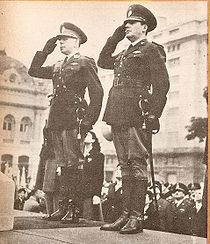 A June 4, 1943, coup d'état, the Revolution of '43
, was led by General Arturo Rawson
against conservative President Ramón Castillo
, who had been fraudulently elected to office. The military was opposed to Governor Robustiano Patrón Costas
, Castillo's hand-picked successor, who was the principal landowner in Salta Province
, as well as a main stockholder in its sugar industry.
As a colonel, Perón took a significant part in the military coup by the GOU (United Officers' Group
, a secret society) against the conservative civilian government of Castillo. At first an assistant to Secretary of War General Edelmiro Farrell
, under the administration of General Pedro Ramírez
, he later became the head of the then-insignificant Department of Labor
. Perón's work in the Labor Department led to an alliance with the socialist and syndicalist
movements in the Argentine labor unions. This caused his power and influence to increase in the military government.
After the coup, socialists from the CGT
-Nº1 labor union, through mercantile labor leader Ángel Borlenghi
and railroad
union lawyer
Juan Atilio Bramuglia
, made contact with Perón and fellow GOU Colonel Domingo Mercante
. They established an alliance to promote labor laws that had long been demanded by the workers' movement, to strengthen the unions, and to transform the Department of Labor into a more significant government office. Perón had the Department of Labor elevated to a cabinet-level secretariat in November 1943.
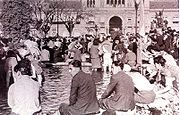 Following the devastating January 1944 San Juan earthquake
, which claimed over 10,000 lives and leveled the Andes
range city, Perón became nationally prominent in relief efforts. Junta leader Pedro Ramírez
entrusted fundraising efforts to him, and Perón marshalled celebrities from Argentina's large film industry
and other public figures. For months, a giant thermometer hung from the Buenos Aires Obelisk
to track the fundraising. The effort's success and relief for earthquake victims earned Perón widespread public approval. At this time, he met a minor radio matinee star, Eva Duarte.
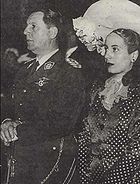 Following President Ramírez's January 1944 suspension of diplomatic relations with the Axis Powers
(against whom the new junta would declare war in March 1945), the GOU junta unseated him in favor of General Edelmiro Farrell. For contributing to his success, Perón was appointed Vice President and Secretary of War, while retaining his Labor portfolio. As Minister of Labor, Perón settled industrial disputes in favour of labor unions (as long as their leaders pledged political allegiance to him), and introduced a wide range of social welfare benefits for unionized workers. Leveraging his authority on behalf of striking abattoir workers and the right to unionize, he became increasingly thought of as presidential timber.
On September 18, 1945, he delivered an address billed as "from work to home and from home to work." The speech, prefaced by an excoriation of the conservative opposition, provoked an ovation declaring that "we've passed social reforms to make the Argentine people proud to live where they live, once again." This move fed growing rivalries against Perón and on October 9, 1945, he was forced to resign by opponents within the armed forces. Arrested four days later, he was released due to mass demonstrations
organized by the CGT; October 17 was later commemorated as Loyalty Day
. His paramour, Eva Duarte, became hugely popular after helping the CGT organize the demonstration; known as "Evita", she helped Perón gain support with labor and women's groups. She and Perón were married on October 22.
, leveraged popular support to victory over a Radical Civic Union
-led opposition alliance by about 11% in the February 24, 1946 presidential elections
.

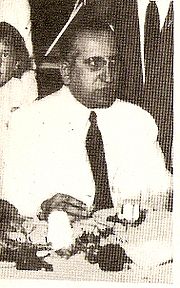 Perón's candidacy on the Labor Party ticket, announced the day after the October 17, 1945 mobilization, became a lightning rod that rallied an unusually diverse opposition against it. The majority of the centrist Radical Civic Union
(UCR), the Socialist Party, Communist Party of Argentina
and most of the conservative National Autonomist Party
(in power during most of the 1874–1916 era), had already been forged into a fractious alliance in June by interests in the financial sector and the chamber of commerce, united solely by the goal of keeping Perón from the Casa Rosada
. Organizing a massive kick-off rally in front of Congress on December 8, the Democratic Union nominated José Tamborini
and Enrique Mosca
, two prominent UCR congressmen. The alliance failed to win over several prominent lawmakers, such as Congressmen Ricardo Balbín
and Arturo Frondizi
and former Córdoba
governor Amadeo Sabattini
, all of whom opposed the Union's ties to conservative interests. In a bid to support their campaign, U.S. Ambassador Spruille Braden
published a white paper
accusing Perón, President Farrell and others of Fascist ties. Fluent in Spanish, he addressed Democratic Union rallies in person. Braden's move backfired, however, when Perón summarized the election as a choice between "Perón or Braden." He persuaded the president to sign the nationalization of the Central Bank
and the extension of mandatory Christmas bonuses, actions that contributed to his decisive victory.
When Perón became president on June 4, 1946, his two stated goals were social justice and economic independence. These two goals avoided Cold War
entanglements from choosing between capitalism over socialism, but he had no concrete means to achieve those goals. Perón instructed his economic advisors to develop a five-year plan
with the goals of increasing workers' pay, achieving full employment, stimulating industrial growth of over 40% while diversifying the sector (then dominated by food processing
), and greatly improving transportation, communication, energy and social infrastructure (in the private, as well as public, sectors).
Perón's planning prominently included political considerations. Numerous military allies were fielded as candidates, notably Colonel Domingo Mercante
who, when elected Governor of the paramount Province of Buenos Aires, became renowned for his housing program. Having brought him to power, the General Conference of Labour
(CGT) was given overwhelming support by the new administration, which introduced labour courts and filled its cabinet with labor union appointees, such as Atilio Bramuglia (Foreign Ministry) and Ángel Borlenghi
(Interior Ministry, which, in Argentina, oversees law enforcement). It also made room for amenable wealthy industrialists (Central Bank President Miguel Miranda) and socialists like José Figuerola, a Spanish economist who had years earlier advised that nation's ill-fated regime of Miguel Primo de Rivera
. Intervention of their behalf by Perón's appointees encouraged the CGT to call strikes in the face of employers reluctant to grant benefits or honor new labor legislation. Strike activity (with 500,000 working days lost in 1945) leapt to 2 million in 1946 and to over 3 million in 1947, helping wrest needed labor reforms, though permanently aligning large employers against the Peronists. Labor unions grew in ranks from around 500,000 to over 2 million by 1950, primarily in the CGT, which has since been Argentina's paramount labor union. As the country's labor force numbered around 5 million people at the time, Argentina's labor force was the most unionized in Latin America.
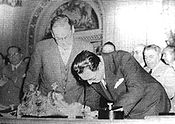 During the first half of the 20th century, a widening gap had existed between the classes; Perón hoped to close it through the increase of wages and employment, making the nation more pluralistic and less reliant on foreign trade. Before taking office in 1946, President Perón took dramatic steps which he believed would result in a more economically independent Argentina, better insulated from events such as World War II. He thought there would be another international war. The reduced availability of imports and the war's beneficial effects on both the quantity and price of Argentine exports had combined to create a US$1.7 billion cumulative surplus during those years.
In his first two years in office, Perón nationalized the Central Bank and paid off its billion-dollar debt to the Bank of England
; nationalized the railways
(mostly owned by British and French companies), merchant marine
, universities, public utilities, public transport (then, mostly tramways); and, probably most significantly, created a single purchaser for the nation's mostly export-oriented grains and oilseeds, the Institute for the Promotion of Trade (IAPI). The IAPI wrested control of Argentina's famed grain export sector from entrenched conglomerates such as Bunge y Born
; but when commodity prices fell after 1948, it began shortchanging growers. IAPI profits were used to fund welfare projects, while internal demand was encouraged by large wage increases given to workers; average real wages rose by about 35% from 1945 to 1949, while during that same period, labor's share of national income rose from 40% to 49%. Access to health care was also made a universal right, while social security was extended to virtually all members of the Argentinian working class.
In 1949 Perón first articulated his foreign policy, the "Third Way", developed to avoid the binary Cold War
divisions and keep other world powers, such as the United States and the Soviet Union, as allies rather than enemies. He restored diplomatic relations with the Soviet Union, severed since the Bolshevik Revolution in 1918, and opened grain sales to the shortage-stricken Soviets.
As relations with the U.S. deteriorated, Perón made efforts to mitigate the misunderstandings, which was made easier after Truman replaced the hostile Braden with Ambassador George Messersmith. He negotiated the release of Argentine assets in the U.S. in exchange for preferential treatment for U.S. goods, followed by Argentine ratification of the Act of Chapultepec, a centerpiece of Truman's Latin America policy. He even proposed the enlistment of Argentine troops into the Korean War
in 1950 under UN auspices (a move retracted in the face of public opposition). Perón was opposed to borrowing from foreign credit markets, preferring to float bonds domestically. He refused to enter the General Agreement on Tariffs and Trade
(precursor to the World Trade Organization
) or the International Monetary Fund
. Believing that international sports created goodwill, however, Perón hosted the 1950 World Basketball Championship
and the 1951 Pan American Games
, both of which Argentine athletes won resoundingly. His bid to host the 1956 Olympic Games
in Buenos Aires was defeated by the International Olympic Committee
by one vote.
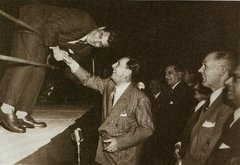 Economic success was short-lived. Following a lumbering recovery during 1933 to 1945, from 1946 to 1948 Argentina gained benefits from Perón's five-year plan
. The GDP expanded by over a fourth during that brief boom, about as much as it had during the previous decade. Using roughly half the US$1.7 billion in reserves inherited from wartime surpluses for nationalizations, economic development agencies devoted most of the other half to finance both public and private investments; the roughly 70% jump in domestic fixed investment
was accounted for mostly by industrial growth in the private sector. All this much-needed activity exposed an intrinsic weakness in the plan: it subsidized growth which, in the short term, led to a wave of imports of the capital goods that local industry could not supply. Whereas the end of World War II had allowed Argentine exports to rise from US$700 million to US$1.6 billion, Perón's changes led to skyrocketing imports (from US$300 million to US$1.6 billion), and erased the surplus by 1948.
Perón's bid for economic independence was further complicated by a number of inherited external factors. Great Britain owed Argentina over 150 million pounds Sterling
(nearly US$450 million) from agricultural exports to that nation during the war. This debt was mostly in the form of Argentine Central Bank reserves which, per the 1933 Roca-Runciman Treaty
, were deposited in the Bank of England
. The money was useless to the Argentine government, because the treaty allowed Bank of England to hold the funds in trust, something British planners could not compromise on as a result of that country's debts accrued under the Lend-Lease Act.
The nation's need for U.S. made capital good
s increased, though ongoing limits on the Central Bank's availability of hard currency
hampered access to them. Argentina's pound Sterling surpluses earned after 1946 (worth over US$200 million) were made convertible to dollars by a treaty negotiated by Central Bank President Miguel Miranda; but after a year, British Prime Minister Clement Attlee
suspended the provision. Perón accepted the transfer of over 24,000 km (15,000 mi) of British-owned railways (over half the total in Argentina) in exchange for the debt in March 1948. Due to political disputes between Perón and the U.S. government (as well as to pressure by the U.S. agricultural lobby through the Agricultural Act of 1949
), Argentine foreign exchange earnings via its exports to the U.S. fell, turning a US$100 million surplus with the U.S. into a US$300 million deficit. The combined pressure practically devoured Argentina's liquid reserves and Miranda issued a temporary restriction on the outflow of dollars to U.S. banks. The nationalization of the Port of Buenos Aires
and domestic and foreign-owned private cargo ship
s, as well as the purchase of others, nearly tripled the national merchant marine to 1.2 million tons' displacement, reducing the need for over US$100 million in shipping fees (then the largest source of Argentina's invisible balance
deficit) and leading to the inauguration of the Río Santiago Shipyards at Ensenada (on line to the present day).
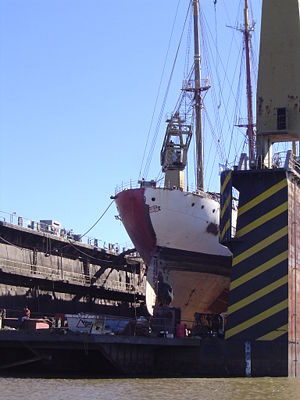 Exports fell sharply, to around US$1.1 billion during the 1949–54 era (a severe 1952 drought trimmed this to US$700 million), due in part to a deterioration in terms of trade
of about a third. The Central Bank was forced to devalue the peso
at an unprecedented rate: the peso lost about 70% of its value from early 1948 to early 1950, leading to a decline in the imports fueling industrial growth and to recession. Short of central bank reserves, Perón was forced to borrow US$125 million from the U.S. Export-Import Bank to cover a number of private banks' debts to U.S. institutions, without which their insolvency would have become a central bank liability. Austerity and better harvests in 1950 helped finance a recovery in 1951; but inflation, having risen from 13% in 1948 to 31% in 1949, reached 50% in late 1951 before stabilizing, and a second, sharper recession soon followed. Workers' purchasing power, by 1952, had declined 20% from its 1948 high and GDP, having leapt by a fourth during Perón's first two years, saw zero growth from 1948 to 1952. (The U.S. economy, by contrast, grew by about a fourth in the same interim). After 1952, however, wages began rising in real terms once more.
The increasing frequency of strikes, increasingly directed against Perón as the economy slid into stagflation
in late 1948, was dealt with through the expulsion of organizers from the CGT ranks. To consolidate his political grasp on the eve of colder economic winds, Perón called for a broad constitutional reform in September. The elected convention (whose opposition members soon resigned) approved the wholesale replacement of the 1853 Constitution of Argentina
with a new magna carta in March, explicitly guaranteeing social reforms; but also allowing the mass nationalization of natural resources and public services, as well as the re-election of the president.
Emphasizing an economic policy centerpiece dating from the 1920s, Perón made record investments in Argentina's infrastructure. Investing over US$100 million to modernize the railways (originally built on a myriad of incompatible gauges), he also nationalized a number of small, regional air carriers, forging them into Aerolíneas Argentinas
in 1950. The airline, equipped with 36 new DC-3 and DC-4 aircraft, also counted with a new international airport
and a 22 km (14 mi) freeway into Buenos Aires. This freeway was followed by one between Rosario
and Santa Fe
. Perón had mixed success in expanding the country's inadequate electric grid, which grew by only one fourth during his tenure. Argentina's installed hydroelectric capacity, however, leapt from 45 to 350 MW during his first term (to about a fifth of the total public grid). He enhanced fossil fuel
availability, inaugurating Río Turbio
(Argentina's only active coal mine) and the 1949 completion of a gas pipeline between Comodoro Rivadavia
and Buenos Aires
. The 1700 km (1060 mi) pipeline allowed natural gas production to rise quickly from 300,000 m3 to 15 million m3 daily, making the country self-sufficient in the critical energy staple. The pipeline was, at the time, the longest in the World. Oil production, however, rose only by about a fourth. As most manufacturing was powered by on-site generators and the number of motor vehicles grew by a third, the need for oil imports grew from 40% to half of the consumption, costing the national balance sheet over US$300 million a year (over a fifth of the import bill).
 Perón's government is remembered for its record social investments. He introduced a Ministry of Health to the cabinet; its first head, the neurologist
Dr. Ramón Carrillo
, oversaw the completion of over 4,200 health care facilities. Related works included construction of more than 1,000 kindergarten
s and over 8,000 schools, including several hundred technological, nursing and teachers' schools, among an array of other public investments. The new Minister of Public Works, General Juan Pistarini
, oversaw the construction of 650,000 new, public sector homes, as well as of the international airport
, one of the largest in the world at the time. The reactivation of the dormant National Mortgage Bank spurred private-sector housing development: averaging over 8 units per 1,000 inhabitants (150,000 a year), the pace was, at the time, at par with that of the United States and one of the highest rates of residential construction in the world.
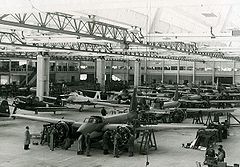
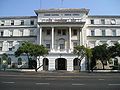 Perón modernized the Argentine Armed Forces, particularly its Air Force
. Between 1947 and 1950, Argentina manufactured two advanced jet aircraft: Pulqui I (designed by the Argentine engineers Cardehilac, Morchio and Ricciardi with the French engineer Émile Dewoitine
, condemned in France in absentia for collaborationism
), and Pulqui II
, designed by German engineer Kurt Tank
. In the test flights, the planes were flown by Lieutenant Edmundo Osvaldo Weiss and Tank, reaching 1000 km/h with the Pulqui II. Argentina continued testing the Pulqui II until 1959; in the tests, two pilots lost their lives. The Pulqui project opened the door to two successful Argentinian planes: the IA 58 Pucará and the IA 63 Pampa, manufactured at the Aircraft Factory of Córdoba.
Perón announced in 1951 that the Huemul Project
would produce nuclear fusion
before any other country. The project was led by an Austrian, Ronald Richter
, who had been recommended by Kurt Tank. Tank expected to power his aircraft with Richter's invention. Perón announced that energy produced by the fusion process would be delivered in milk-bottle sized containers. Richter announced success in 1951, but no proof was given. The next year, Perón appointed a scientific team to investigate Richter's activities. Reports by José Antonio Balseiro
and Mario Báncora revealed that the project was a fraud. After that, the Huemul Project was transferred to the Centro Atómico Bariloche (CAB) of the new National Atomic Energy Commission
(CNEA) and to the physics institute of the Universidad Nacional de Cuyo, later named Instituto Balseiro
(IB).
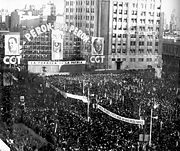 U.S. policy restricted Argentine growth during the Perón years; by placing embargoes on Argentina, the U.S. hoped to discourage the nation in its pursuit of becoming economically sovereign during a time when the world was divided into two influence spheres. U.S. interests feared losing their stake, as they had large commercial investments (over a billion dollars) vested in Argentina through the oil and meat packing industries, besides being a mechanical goods provider to Argentina. His ability to effectively deal with points of contention abroad was equally hampered by Perón's own mistrust of potential rivals, which harmed foreign relations with Bramuglia's 1949 dismissal.
The rising influence of theorist George F. Kennan
, a staunch anti-communist
, within U.S. foreign policy circles fed US suspicions that Argentine goals for economic sovereignty and neutrality were Perón's disguise for a resurgence of communism in the Americas. The U.S. Congress took a dislike of Perón and his government. In 1948 they excluded Argentine exports from the Marshall Plan
, the landmark Truman administration effort to combat communism and help rebuild war-torn European nations by offering U.S. aid. This contributed to Argentine financial crises after 1948 and, according to Perón biographer Joseph Page, "the Marshall Plan drove a final nail into the coffin that bore Perón's ambitions to transform Argentina into an industrial power." The policy deprived Argentina of potential agricultural markets in Western Europe, to the benefit of Canadian exporters
, for instance.
.jpg) Eva Perón was instrumental as a symbol of hope to the common labourer during the first five-year plan
Eva Perón was instrumental as a symbol of hope to the common labourer during the first five-year plan
. When she died in 1952, the year of the presidential elections, the people felt they had lost an ally. Coming from humble origins, she was loathed by the elite but adored by the poor for her work with the sick, elderly, and orphans. It was due to her behind-the-scenes work that women's suffrage
was granted in 1947 and a feminist wing of the 3rd party in Argentina was formed. Simultaneous to Perón's five-year plans, Evita supported a women's movement that concentrated on the rights of women, the poor and invalids.
Although her role in the politics of Perón's first term remains disputed, Eva introduced social justice and equality into the national discourse. She stated, "It is not philanthropy, nor is it charity… It is not even social welfare; to me, it is strict justice… I do nothing but return to the poor what the rest of us owe them, because we had taken it away from them unjustly."
 She established the Eva Perón Foundation
in 1948, which was perhaps the greatest contribution to her husband's social policy. Enjoying an annual budget of around US$50 million (nearly 1% of GDP at the time), the Foundation had 14,000 employees and founded hundreds of new schools, clinics, old-age homes and holiday facilities; it also distributed hundreds of thousands of household necessities, physicians' visits and scholarships, among other benefits. Among the best-known of the Foundation's many large construction projects are the Evita City
development south of Buenos Aires (25,000 homes) and the "Republic of the Children
", a theme park based on tales from the Brothers Grimm
. Following Perón's 1955 ousting, twenty such construction projects were abandoned incomplete and the foundation's US$290 million endowment was liquidated.
The portion of the five-year plans which argued for full employment, public healthcare and housing, labour benefits, and raises are a result of Eva's influence on the policy-making of Perón in his first term, as historians note that at first he simply wanted to keep imperialists out of Argentina and create effective businesses. The humanitarian relief efforts embedded in the five-year plan are Eva's creation, which endeared the Peronist movement to the working-class people from which Eva had come. Her strong ties to the poor and her position as Perón's wife brought credibility to his promises during his first presidential term and ushered in a new wave of supporters. The first lady's willingness to replace the ailing Hortensio Quijano
as Perón's running mate for the 1951 campaign
was defeated by her own frail health and by military opposition. An August 22 rally organized for her by the CGT
on Buenos Aires' wide Nueve de Julio Avenue failed to turn the tide. On September 28, elements in the Argentine Army
attempted a coup against Perón. Although unsuccessful, the mutiny marked the end of the first lady's political hopes. She died the following July.
s), "un-shirted" (descamisados, since they doffed their shirts to perform manual labor). Conservative Radical Civic Union
Congressman Ernesto Sammartino mused that Perón's voters were a "zoological flood" (aluvión zoológico). In the 1940s, upper-class students were the first to oppose Peronist workers, with the slogan: "No to cheap shoe dictatorship" (No a la dictadura de las alpargatas). A graffiti
revealing the strong opposition between Peronists and anti-Peronists appeared in upper-class districts in the 1950s, "Long live cancer!" (¡Viva el cáncer!), when Eva Perón was ill. She died of cervical cancer
in 1952 at the age of thirty-three.
At a time when credentialed teaching personnel were in short supply, Perón had fired more than 1,500 university faculty who opposed him. These included Nobel laureate Bernardo Houssay
, University of La Plata physicist Rafael Grinfeld, art scholars Pío Collivadino
and Jorge Romero Brest
, and noted author Jorge Luis Borges
, who was appointed "poultry inspector" at the Buenos Aires Municipal Wholesale Market (a post he refused). Many faculty left the country and migrated to Mexico or the United States. Weiss (2005, p. 45) recalls events in the universities:
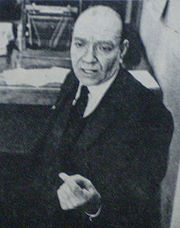 The labor movement that had brought Perón to power was not exempt from the iron fist. Elections in 1946 to the post of Secretary General of the CGT resulted in telephone workers' union leader Luis Gay's victory over Perón's nominee, former retail workers' leader Ángel Borlenghi—both central figures in Perón's famed October 17 comeback. The president had Luis Gay expelled from the CGT three months later, and replaced him with José Espejo, a little-known rank-and-filer who was close to the first lady. This was done on unsubstantiated charges that he had colluded with Perón's enemy, the former U.S. Ambassador Spruille Braden
.
The meat-packers' union leader, Cipriano Reyes, turned against Perón when he replaced the Labor Party with the Peronist Party in 1947. Organizing a strike against these moves, Reyes was arrested on the charge of plotting against the lives of the president and first lady, though accusations of a plot were never substantiated. Tortured in prison, Reyes was denied parole five years later, and freed only following the regime's 1955 downfall. Cipriano Reyes was one of hundreds of Perón's opponents held at Buenos Aires' Ramos Mejía General Hospital, one of whose basements was converted into a police detention center where torture became routine.
The populist leader was intolerant of both left-wing and conservative opposition. Though he used violence, Perón preferred to deprive the opposition of their access to media. Interior Minister Borlenghi administered El Laborista, the leading official news daily. Carlos Aloe, a personal friend of Evita's, oversaw an array of leisure magazines published by Editorial Haynes, which the Peronist Party bought a majority stake in. Through the Secretary of the Media, Raúl Apold
, socialist dailies such as La Vanguardia
or Democracia and conservative ones such as La Prensa
or La Razón
were simply closed or expropriated in favor of the CGT or ALEA, the regime's new state media company. Intimidation of the press increased: between 1943 and 1946, 110 publications were closed down; others such as La Nación and Roberto Noble
's Clarín
became more cautious and self-censoring. Perón appeared more threatened by dissident artists than by opposition political figures (though UCR leader Ricardo Balbín
spent most of 1950 in jail). Numerous prominent cultural and intellectual figures were imprisoned (publisher and critic Victoria Ocampo
, for one) or forced into exile, among them comedienne Niní Marshall
, film maker Luis Saslavsky
, pianist Osvaldo Pugliese
and actress Libertad Lamarque
, victim of a rivalry with Eva Perón.
during the government of Benito Mussolini
in Italy and Adolf Hitler
in Germany. By that year, he thought that those countries would become social democracies
. His exact words were as follows:
After the end of World War II and the rise of Perón to a popular leader, antiperonist politicians and authors would point that Perón once manifested support for Mussolini and Hitler, implying that such support involved the whole of their governments or the paths actually taken by Italy or Germany after 1938. One of the most famous examples was when Spruille Braden
did so during the 1946 election
, leading to the "Braden or Perón" slogan that was key of the Peronist victory.
However, historian Felipe Pigna
states that no researcher who has deeply studied Perón would consider him fascist. Instead, Perón would have been a pragmatic, taking useful elements from all modern ideologies of the time, such as fascism, but also the "New Deal
" policies of Franklin Delano Roosevelt, "national defense" principles, social views from religion, and even some socialist principles. Historian Tulio Halperín Donghi
would point in a similar manner that Perón was driven by strong convictions but not by full support to any mainstream ideology; and even if he did not try to hide his old admiration of fascist Italy, it wasn't a strong influence in him either. Arturo Jauretche
said that Perón was neither fascist or anti-fascist, simply realist, and that the active intervention of the working class in politics, as he saw in those countries, was a definitive phenomenon.
showed in his 1998 book that Nazis and French and Belgian collaborationists, including Pierre Daye
, met Perón in the President's official residence, the Casa Rosada
(Pink House). In this meeting, a network was created with support by the Argentine Immigration Service and the Foreign Office. The Swiss Chief of Police Heinrich Rothmund and the Croatian Roman Catholic priest Krunoslav Draganović
also helped organize the ratline
. According to Goñi, Cardinal Antonio Caggiano went to the Vatican
in the name of the Argentine government in 1946, and offered refuge for French collaborationists who had fled to Rome. Carlos Fuldner, who had scouted escape destinations for Walter Schellenberg
and Heinrich Himmler
while at the SS, was in Switzerland with a special passport describing him as "special envoy of the President of Argentina" during 1948, the busiest year for the ratlines.
An investigation of 22,000 documents by the DAIA
in 1997 discovered that the network was managed by Rodolfo Freude
who had an office in the Casa Rosada and was close to Eva Perón's brother, Juan Duarte. According to Ronald Newton, Ludwig Freude, Rodolfo's father, was probably the local representative of the Office Three secret service headed by Joachim von Ribbentrop
, with probably more influence than the German ambassador Edmund von Thermann. He had met Perón in the 1930s, and had contacts with Generals Juan Pistarini
, Domingo Martínez, and José Molina
. Ludwig Freude's house became the meetingplace for Nazis and Argentine military officers supporting the Axis. In 1943, he traveled with Perón to Europe to attempt an arms deal with Germany.
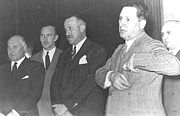 Examples of Nazis and collaborators who relocated to Argentina include Emile Dewoitine, who arrived in May 1946 and worked on the Pulqui jet, Erich Priebke
, who arrived in 1947, Josef Mengele
in 1949, Adolf Eichmann
in 1950, his adjutant Franz Stangl
, Austrian representative of Spitzy in Spain, Reinhard Spitzy, Charles Lescat
, editor of Je Suis Partout
in Vichy France
, SS functionary Ludwig Lienhardt, German industrialist Ludwig Freude, SS-Hauptsturmführer Klaus Barbie
.
Many members of the notorious Croatian Ustaše
(including their leader, Ante Pavelić
) took refuge in Argentina, as did Milan Stojadinović
, the former collaborationist
Prime Minister of monarchist Yugoslavia. In 1946 Stojadinović went to Rio de Janeiro, and then to Buenos Aires, where he was reunited with his family. Stojadinović spent the rest of his life as presidential advisor on economic and financial affairs to governments in Argentina and founded the financial newspaper El Economista.
A Croatian priest, Krunoslav Draganović
, organizer of the San Girolamo ratline
, was authorized by Perón to assist Nazi operatives to come to Argentina and evade prosecution in Europe after World War II, in particular the Ustaše. Ante Pavelić
became a security advisor of Perón, before leaving for Francoist Spain in 1957.
As in the United States (Operation Paperclip
), Argentina also welcomed displaced German scientists such as Kurt Tank and Ronald Richter. Some of these refugees took important roles in Perón's Argentina, such as French collaborationist Jacques de Mahieu
, who became an ideologue of the Peronist movement, before becoming mentor to a Roman Catholic nationalist youth group in the 1960s. Belgian collaborationist Pierre Daye
became editor of a Peronist magazine. Rodolfo Freude
, Ludwig's son, became Perón's chief of presidential intelligence in his first term. Milan Stojadinović founded El Economista
(The Economist magazine) in 1951, which still carries his name on its masthead.
Recently, Goñi's research, drawing on investigations in Argentine, Swiss, American, British and Belgian
government archives, as well as numerous interviews and other sources, was detailed in The Real Odessa
: Smuggling the Nazis to Perón's Argentina (2002), showing how escape routes known as ratlines
were used by former NSDAP members and like-minded people to escape trial and judgment. Goñi places particular emphasis on the part played by Perón's government in organizing the ratlines, as well as documenting the aid of Swiss and Vatican authorities in their flight. The Argentine consulate in Barcelona
gave false passports to fleeing Nazi war criminals and collaborationists.
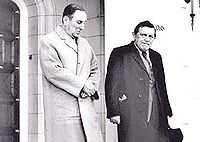 Fraser and Navarro write that Juan Perón was a complicated man who over the years stood for many different, often contradictory, things. In the book Inside Argentina from Perón to Menem author Laurence Levine, former president of the US-Argentine Chamber of Commerce
, writes, "although anti-Semitism existed in Argentina, Perón's own views and his political associations were not anti-Semitic...." Laurence also writes that one of Perón's advisors was a Jewish man from Poland named José Ber Gelbard
. U.S. Ambassador George S. Messersmith
visited Argentina in 1947 during the first term of Juan Perón. Messersmith noted, "There is not as much social discrimination against Jews here as there is right in New York or in most places at home..."
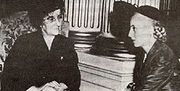 Perón sought out other Jewish Argentines as government advisers, besides Ber Gelbard. The powerful Secretary of Media, Raúl Apold
, also Jewish, was (ironically) called "Perón´s Goebbels." He favoured the creation of institutions like New Zion (Nueva Sión), the Argentine-Jewish Institute of Culture and Information, presided by Simón Mirelman, and the Argentine-Israeli Chamber of Commerce. Also, he named Rabbi Amran Blum the first Jewish professor of philosophy in the National University of Buenos Aires. After being the first Latin American government to acknowledge the State of Israel
, he sent a Jewish ambassador, Pablo Mangel, to that country. Education and Diplomacy were the two strongholds of Catholic nationalism, and both appointments were highly symbolic. The same goes for the 1946 decision of allowing Jewish army privates to celebrate their holidays, which was aimed at fostering the Jewish position in another traditionally Catholic institution, the army.
Argentina signed a generous commercial agreement with Israel that granted favourable terms for Israeli acquisitions of Argentine commodities, and also the Eva Perón Foundation sent significant humanitarian aid. Chaim Weizmann
and Golda Meir
expressed their gratitude during their visit to Buenos Aires
in 1951.
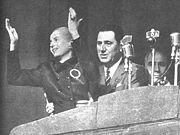 The German Argentine community in Argentina is the third largest ethnic group in the country, after the Spanish Argentines
and the Italian Argentines. The German Argentine community predates Juan Perón's presidency, going back as far as the time of the unification of Germany
. Laurence Levine writes that Perón found German civilization too "rigid" and therefore had a "distaste" for it. Crassweller writes that while Juan Perón's own personal preference was for Hispanic
culture, with which he felt a spiritual
affinity, Perón was "pragmatic
" in dealing with the diverse populace of Argentina.
While Juan Perón's Argentina allowed many Nazi criminals to take refuge in Argentina, Juan Perón's Argentina also accepted more Jewish immigrants than any other country in Latin America, which in part accounts for the fact that Argentina to this day has a population of over 200,000 Jewish citizens, the largest in Latin America, the third largest in the Americas, and the sixth largest in the world. The Jewish Virtual Library
writes that while Juan Perón had sympathized with the Axis powers, "Perón also expressed sympathy for Jewish rights and established diplomatic relations with Israel in 1949. Since then, more than 45,000 Jews have immigrated to Israel from Argentina."
Tomás Eloy Martínez
, professor of Latin American studies at Rutgers University
, writes that Juan Perón allowed Nazi criminals into the country in hopes of acquiring advanced German technology developed during the war. Martínez also notes that Eva Perón played no part in allowing Nazis into the country.
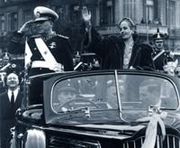 Facing only token UCR
and Socialist Party opposition and despite being unable to field his popular wife, Eva, as a running mate, Perón was re-elected in 1951
by a margin of over 30%. This election was the first to have extended suffrage to Argentine women and the first in Argentina to be televised: Perón inaugurated Channel 7
public television that October. He began his second term in June 1952 with serious economic problems, however, compounded by a severe drought that helped lead to a US$500 million trade deficit (depleting reserves).
Perón called employers and unions to a Productivity Congress to regulate social conflict through dialogue; but, the conference failed without reaching an agreement. Divisions among Peronists intensified, and the President's worsening mistrust led to the forced resignation of numerous valuable allies, notably Buenos Aires Province
Governor Domingo Mercante
. Again on the defensive, Perón accelerated generals' promotions and extended them pay hikes and other benefits. He also accelerated landmark construction projects slated for the CGT or government agencies; among these was the 41-story and 141 m (463 ft) high Atlas Building
(transferred to the Air Force
by a later regime).
Opposition to Perón grew bolder following the first lady's July 26, 1952, passing. On April 15, 1953, a terrorist group (never identified) detonated two bombs in a public rally at Plaza de Mayo
, killing 7 and injuring 95. Amid the chaos, Perón exhorted the crowd to take reprisals; they made their way to their adversaries' gathering places, the Socialist Party headquarters and the aristocratic Jockey Club (both housed in magnificent turn-of-the-century Beaux-Arts buildings), and burned them to the ground.
 A stalemate of sorts ensued between Perón and his opposition and, despite austerity measures taken late in 1952 to remedy the country's unsustainable trade deficit, the president remained generally popular. In March 1954, Perón called Vice-Presidential elections to replace the late Hortensio Quijano
, which his candidate won by a nearly two-to-one margin. Given what he felt was as solid a mandate as ever and with inflation in single digits and the economy on a more secure footing, Perón ventured into a new policy: the creation of incentives designed to attract foreign investment.
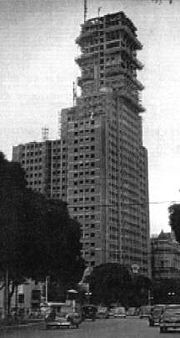 Drawn to an economy with the highest standard of living in Latin America and a new steel mill in San Nicolás de los Arroyos
, automakers FIAT
and Kaiser Motors
responded to the initiave by breaking ground on new facilities in the city of Córdoba
, as did the freight truck division of Daimler-Benz
, the first such investments since General Motors
' Argentine assembly line opened in 1926. Perón also signed an important exploration contract with Standard Oil of California, in May 1955, consolidating his new policy of substituting the two largest sources of that era's chronic trade deficits (imported petroleum and motor vehicles) with local production brought in through foreign investment. The centrist Radical Civic Union
's 1951 Vice-Presidential nominee, Arturo Frondizi
, publicly condemned what he considered to be an anti-patriotic decision; as president three years later, however, he himself signed exploration contracts with foreign oil companies.
As 1954 drew to a close, Perón unveiled reforms far more controversial to the normally conservative Argentine public, the legalization of divorce and of prostitution. The Roman Catholic Church's Argentine leaders, whose support of Perón's government had been steadily waning since the advent of the Eva Perón Foundation
, were now open antagonists of the man they called "the tyrant." Though much of Argentina's media had, since 1950, been either controlled or monitored by the administration, lurid pieces on his ongoing relationship with an underage girl named Nélida "Nelly" Rivas, something Perón never denied, filled the gossip pages. Pressed by reporters on whether his supposed new paramour was, as the magazines claimed, thirteen years of age, the witty, fifty-nine year-old Perón responded that he was "not superstitious."
Before long, however, the president's humor on the subject ran out and, following the expulsion of two Catholic priests he believed to be behind his recent image problems, Perón was excommunicated
by Pope Pius XII
on June 15, 1955. The following day, Péron called for a rally of support on the Plaza de Mayo, a time-honored custom among Argentine presidents during a challenge. However, as he spoke before a crowd of thousands, Navy fighter jets flew overhead and dropped bombs into the crowded square below before seeking refuge in Uruguay
.
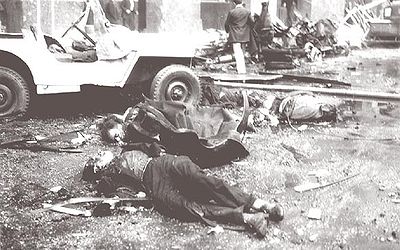 The incident
, part of a coup attempt against Perón, killed 364 people and was, from a historical perspective, the only air assault ever on Argentine soil, as well as a portent of the mayhem that Argentine society would suffer in the 1970s. It, moreover, touched off a wave of reprisals on the part of Peronists. Reminiscent of the incidents in 1953, Peronist crowds ransacked eleven Buenos Aires churches, including the Metropolitan Cathedral. On September 16, 1955, a nationalist Catholic group from both the Army and Navy, led by General Eduardo Lonardi
, General Pedro E. Aramburu
and Admiral Isaac Rojasc, led a revolt from Córdoba
. Taking power in a coup three days later, which they named Revolución Libertadora
(the "Liberating Revolution"). Perón barely escaped with his life, leaving Nelly Rivas behind, and fleeing on a gunboat provided by Paraguay
an leader Alfredo Stroessner
, up the Paraná River
.
At that point Argentina was more politically polarized than it had been since 1880. The landowning elites and other conservatives pointed to an exchange rate
that had rocketed from 4 to 30 pesos per dollar and consumer prices that had risen nearly fivefold. Employers and moderates generally agreed, qualifying that with the fact the economy had grown by over 40% (the best showing since the 1920s). The underprivileged and humanitarians looked back upon the era as one in which real wages grew by over a third and better working conditions arrived alongside benefits like pensions, health care, paid vacations and the construction of record numbers of needed schools, hospitals, works of infrastructure and housing.
 The new military regime went to great lengths to destroy both the President's and Eva Perón's reputation, putting up public exhibits of what they maintained was the Peróns' scandalously sumptous taste for antiques, jewelry, roadsters, yachts and other luxuries. They also accused other Peronist leaders of corruption; but, ultimately, though many were prosecuted, no one was convicted. The junta's first leader, Eduardo Lonardi
, appointed a Civilian Advisory Board. Its preference for a gradual approach to de-Perónization helped lead to Lonardi's ousting, however (though most of the board's recommendations stood the new president's scrutiny).
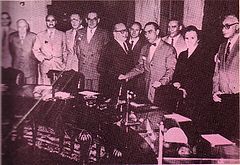 Lonardi's replacement, General Pedro Aramburu, decreed the mere mention of Juan or Eva Perón's name to be illegal. Throughout Argentina, Peronism and the very display of Peronist mementoes was banned. Partly in response to these and other excesses, Peronists and moderates in the army organized a counter-coup against Aramburu, in June 1956. Possessing an efficient intelligence network, however, Aramburu foiled the plan, having the plot's leader, General Juan José Valle
, and 26 others executed. Aramburu turned to similarly drastic means in trying to rid the country of the spectre of the Peróns, themselves. Eva Perón's cadaver was removed from its display at CGT headquarters and ordered hidden under another name in a modest grave in Milan
, Italy. Perón himself, for the time residing in Caracas, Venezuela at the kindness of ill-fated President Marcos Pérez Jiménez
, suffered a number of attempted kidnappings and assassinations ordered by Aramburu.
Continuing to exert considerable direct influence over Argentine politics despite the ongoing ban of Peronism or the Justicialist Party
as Argentina geared for the 1958 elections
, Perón instructed his supporters to cast their ballots for the moderate Arturo Frondizi
, a splinter candidate within the Peronists' largest opposition party, the Radical Civic Union
(UCR). Frondizi went on to defeat the better-known (but, more anti-Peronist) UCR leader, Ricardo Balbín
. Perón backed a "Popular Union" in 1962
, and when its candidate for governor of Buenos Aires Province
(Andrés Framini
) was elected, Frondizi was forced to resign by the military. Unable to secure a new alliance, Perón advised his followers to cast blank ballots in the 1963 elections
, demonstrating direct control over one fifth of the electorate.
Perón's stay in Venezuela had been cut short by the 1958 ousting of General Pérez Jiménez. In Panama
, he met the nightclub singer María Estela Martínez
(known as "Isabel"). Eventually settling in Madrid, Spain under the protection of Francisco Franco
, he married Isabel in 1961 and was admitted back into the Catholic Church in 1963. Following a failed December 1964 attempt to return to Buenos Aires, he sent his wife to Argentina in 1965, to meet political dissidents there. She organized a meeting in the house of Bernardo Alberte, Perón's delegate and sponsor of various left-wing Peronist movements such as the CGT de los Argentinos (CGTA), an offshoot of the umbrella CGT union. During Isabel's visit, adviser Raúl Lastiri introduced her to his father-in-law, José López Rega
. A policeman with an interest in the occult, he won Isabel's trust through their common dislike of Jorge Antonio, a prominent Argentine industrialist and the Peronist movement's main financial backer during their perilous 1960s. Accompanying her to Spain, López Rega worked for Perón's security before becoming the couple's personal secretary. A return of the peronist Popular Union in 1965 and their victories in congressional elections
that year helped lead to the overthrow of the moderate President Arturo Illia, and to the return of dictatorship.
Perón became increasingly unable to control the CGT, itself. Though he had the support of its Secretary General, José Alonso, others in the union favored distancing the CGT from the exiled leader. Chief among them, Steel and Metalworkers Union head Augusto Vandor
challenged Perón from 1965 to 1968 with mottos such as "Peronism without Perón" and "to save Perón, one has to be against Perón." Dictator Juan Carlos Onganía
's continued repression of labor demands, however, helped lead to Vandor's rapproachment with Perón—a development cut short by Vandor's as-yet unsolved 1969 murder. Labor agitation increased; the CGTA, in particular, organized opposition to the dictatorship between 1968 and 1972, and it would have an important role in the May–June 1969 Cordobazo
insurrection.
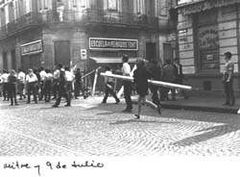
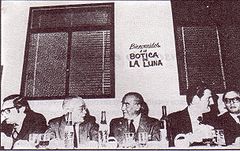 Perón began courting the far left during Onganía's dictatorship. In his book La Hora de los Pueblos (1968), Perón enunciated the main principles of his purported new Tricontinental
political vision:
He supported the more militant unions and maintained close links with the Montoneros
, a far-left Catholic Peronist group. On June 1, 1970, the Montoneros kidnapped and assassinated former anti-Peronist President Pedro Aramburu in retaliation for the June 1956 mass execution of a Peronist uprising against the junta. In 1971, he sent two letters to the film director Octavio Getino
, one congratulating him for his work with Fernando Solanas
and Gerardo Vallejo, in the Grupo Cine Liberación
, and another concerning two film documentaries, La Revolución Justicialista and Actualización política y doctrinaria.
He also cultivated ties with conservatives and the far right. He supported the leader of the conservative wing of the UCR, his erstwhile prisoner Ricardo Balbín
, against competition from within the UCR itself. Members of the right-wing Tacuara Nationalist Movement, considered the first Argentine guerrilla group, also turned towards him. Founded in the early 1960s, the Tacuaras were a fascist, anti-Semitic and anti-conformist group founded on the model of Primo de Rivera
's Falange
, and at first strongly opposed Peronism. However, they split after the 1959 Cuban Revolution
into three groups: the one most opposed to the Peronist alliance, led by Catholic priest Julio Meinvielle
, retained the original hard-line stance; the New Argentina Movement (MNA), headed by Dardo Cabo
, was founded on June 9, 1961, to commemorate General Valle's Peronist uprising on the same date in 1956, and became the precursor to all modern Catholic nationalist groups in Argentina; and the Revolutionary Nationalist Tacuara Movement (MNRT), formed by Joe Baxter and José Luis Nell, who joined Peronism believing in its capacity for revolution, and without forsaking nationalism, broke from the Church and abandoned anti-Semitism. Baxter's MNRT became progressively Marxist, and many of the Montoneros
and of the ERP
's leaders came from this group.
Following Onganía's replacement in June 1970, General Roberto M. Levingston
proposed the replacement of Argentina's myriad political parties with "four or five" (vetted by the Revolución Argentina regime). This attempt to govern indefintely against the will of the different political parties united Peronists and their opposition in a joint declaration of November 11, 1970, billed as la Hora del Pueblo (The Hour of the People), which called for free and immediate democratic elections to put an end to the political crisis. The declaration was signed by the Radical Civic Union
(UCRP), the Justicialist Party
(Peronist Party), the Argentine Socialist Party (PSA), the Democratic Progressive Party
(PCP) and the Partido Bloquista
(PB).
The opposition's call for elections led to Levingston's replacement by General Alejandro Lanusse, in March 1971. Faced with strong opposition and social conflicts, General Lanusse declared his intention to restore constitutional democracy by 1973, though without Peronist participation. Lanusse proposed the Gran Acuerdo Nacional (Great National Agreement) in July 1971, which was to find an honorable exit for the military junta without allowing Peronism to participate in the election. The proposal was rejected by Perón, who formed the FRECILINA alliance (Frente Cívico de Liberación Nacional, Civic Front of National Liberation), headed by his new delegate Héctor José Cámpora
(a member of the Peronist Left). The alliance gathered his Justicialist Party
and the Integration and Development Movement
(MID), headed by Arturo Frondizi
. FRECILINA pressed for free and unrestricted elections, which ultimately took place in March 1973.
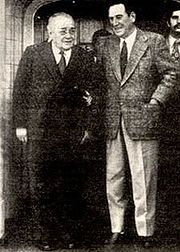 General elections
were held on March 11, 1973. Perón was banned from running, but a stand-in, Héctor Cámpora, a left-wing Peronist and his personal secretary, was elected and took office on May 25. On June 20, 1973, Perón returned from Spain to end his 18-year exile. According to Página 12 newspaper, Licio Gelli
, headmaster of Propaganda Due
, had provided an Alitalia
plane to return Perón to his native country. Gelli was part of a committee supporting Perón, along with Carlos Saúl Menem (future President of Argentina, 1989–1999). The former Italian Premier Giulio Andreotti
recalled an encounter between Perón, his wife Isabel Martínez and Gelli, saying that Perón knelt before Licio Gelli to salute him.
On the day of Perón's return, a crowd of left-wing Peronists (estimated at 3.5 million) gathered at the Ezeiza Airport in Buenos Aires to welcome him. Perón was accompanied by Cámpora, whose first measures were to grant amnesty
to all political prisoner
s and re-establish relations with Cuba, helping Fidel Castro break the United States embargo against Cuba
. This, along with his social policies, had earned him the opposition of right-wing Peronists, including the trade-unionist bureaucracy.
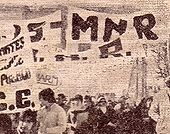
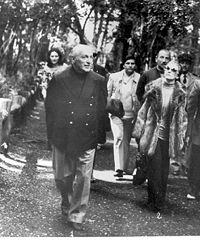 Camouflaged snipers opened fire on the crowd at the airport. The left-wing Peronist Youth Organization and the Montoneros
had been trapped. At least 13 people were killed and 365 injured in this episode, which became known as the Ezeiza massacre
.
Cámpora and Vice President Vicente Solano Lima
resigned in July 1973, paving the way for new elections
, this time with Perón's participation as the Justicialist Party
nominee. Argentina faced mounting political instability, and Perón was viewed by many as the country's only hope for prosperity and safety. UCR leader Ricardo Balbín
and Perón contemplated a Peronist-Radical joint government, but opposition in both parties made this impossible. Besides opposition among Peronists, Ricardo Balbín had to consider opposition within the UCR itself, led by Raúl Alfonsín
, a leader among the UCR's center-left. Perón received 62% of the vote, returning him to the presidency. He began his third term on October 12, 1973, with Isabel, his wife, as Vice President.
Upon Cámpora's inaugural, Perón had him appoint a trusted policy adviser to the critical Economy Ministry, José Ber Gelbard
. Inheriting an economy that had doubled in output since 1955 with little indebtedness and only modest new foreign investment, inflation had become a fixture in daily life and was worsening: consumer prices rose by 80% in the year to May 1973 (triple the long-term average, up to then). Making this a policy priority, Ber Gelbard crafted a "social pact" in hopes of finding a happy median between the needs of management and labor. Providing a framework for negotiating price controls, guidelines for collective bargaining
and a package of subsidies and credits, the pact was promptly signed by the CGT (then the largest labor union in South America) and management (represented by Julio Broner and the CGE). The measure was largely successful, initially: inflation slowed to 12% and real wages rose by over 20% during the first year. GDP growth accelerated from 3% in 1972 to over 6% in 1974. The plan also envisaged the paydown of Argentina's growing public external debt, then around US$8 billion, within four years.
The improving economic situation encouraged Perón to pursue interventionist social and economic policies similar to those he carried out in the Forties: nationalizing banks and various industries, subsidizing native businesses and consumers, regulating and taxing the agricultural sector, reviving the IAPI, placing restrictions on foreign investment, and funding a number of social welfare programs.
The 1973 oil shock, however, forced Ber Gelbard to rethink the Central Bank's projected reserves and, accordingly, undid planned reductions in stubborn budget deficits, then around US$2 billion a year (4% of GDP), and, by mid-1974, led to growing public doubts on the viability of the plan.
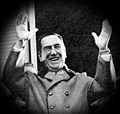
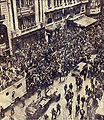 Perón's third term was also marked by an escalating conflict between the Peronist left- and right-wing factions. This turmoil was fueled primarily by calls for repression against the left on the part of leading CGT figures, a growing segment of the armed forces (particularly the navy
) and right-wing radicals within his own party, notably Perón's most fascist adviser, José López Rega
. López Rega, appointed Minister of Social Welfare, was in practice given power far beyond his purview, soon controlling up to 30 percent of the federal budget. Diverting increasing funds, he formed the Triple A, a death squad that soon began targeting not only the violent left; but moderate opposition, as well. The Montoneros
became marginalized in the Peronist movement and were mocked by Perón himself after the Ezeiza massacre. In his speech to the governors on August 2, 1973, Perón openly criticized radical Argentine youth for a lack of political maturity. The rift between Perón and the far left became irreconciliable following the September 25, 1973, murder of José Ignacio Rucci
, the moderately conservative Secretary General of CGT. Enraged, Perón enlisted López Rega to target left-wing opponents. Shortly after Perón's attack on left-wing Peronism, the Montoneros went underground. The murder itself, a commando ambush in front of Rucci's Buenos Aires residence long attributed to the Montoneros (whose record of violence had been well-established by then), remains arguably Argentina's most prominent unsolved mystery. Another guerrilla group, the Guevarists ERP
, also opposed the right-wing Peronists, and started engaging in armed struggle, attempting to create a foco
in Tucumán
, a historically underdeveloped province in Argentina's largely rural northwest
.
Perón's somewhat precarious health complicated matters. By at least one account, he may have been senile by the time he was sworn in for his third term. His wife frequently had to take over as Acting President over the course of the next year.
Perón maintained a full schedule of policy meetings with both government officials and chief base of support, the CGT. He also presided over the inaugural of the Atucha I Nuclear Power Plant
(Latin America's first) in April; the reactor, begun while he was in exile, was the fruition of work started in the 1950s by the National Atomic Energy Commission, his landmark bureau. Perón was reunited with another friend from the 1950s – Paraguayan dictator Alfredo Stroessner – on June 16 to sign the bilateral treaty that broke ground on Yacyretá Hydroelectric Dam (the world's second-largest). Arriving in Asunción
during an autumn rainstorm, he refused an umbrella while reviewing the honor guard. Perón returned to Buenos Aires with clear signs of pneumonia
and, on June 28, the president suffered a series of heart attacks
. The Vice-President, on a trade mission in Europe, returned urgently, secretly sworn in on an interim basis on June 29. Following a promising day, Perón suffered a final attack on July 1, 1974, recommending that his wife, Isabel, rely on Balbín for support. He was 78. At the president's burial Balbín uttered an historic phrase: "The old adversary bids farewell to a friend."
Isabel Perón succeeded her husband to the presidency, but proved incapable of managing the country's political and economic problems, including the left-wing insurgency and the reactions of the extreme right. Ignoring her late husband's advice, Isabel gave Balbín no role in her new government, instead granting broad powers to López Rega, who started a "dirty war
" against political opponents.
Isabel Perón's term ended abruptly on March 24, 1976, during a military coup d'état. A military junta
, headed by General Jorge Videla, took control of the country, establishing the self-styled National Reorganization Process
. The junta ramped up the "dirty war", combining widespread persecution of political dissidents with state terrorism
. The death toll rose to thousands (at least 9,000, with human rights organizations claiming it was closer to 30,000). Many of these were "the disappeared
" (desaparecidos), people kidnapped and executed without trial or record.
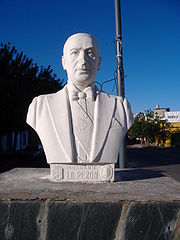 Perón was buried in La Chacarita Cemetery
in Buenos Aires. In 1987, his tomb was desecrated, and his hands and some personal effects, including his sword, were stolen. Perón's hands were cut off with a chainsaw. A ransom letter asking for US$8 million was sent to some Peronist members of Congress. This profanation was a ritualistic act to condemn Perón's spirit to eternal unrest, according to journalists David Cox and Damian Nabot in their book La segunda muerte (Peron's Second Death), who connected it to Licio Gelli
and military officers involved during Argentina's Dirty War. The bizarre incident remains unresolved.
On October 17, 2006 his body was moved to a mausoleum
at his former summer residence, rebuilt as a museum, in the Buenos Aires suburb of San Vicente
. A few people were injured in incidents as Peronist trade unions fought over access to the ceremony, although police were able to contain the violence enough for the procession to complete its route to the mausoleum. The relocation of Perón's body offered his self-proclaimed illegitimate daughter, Martha Holgado, the opportunity to obtain a DNA sample from his corpse. She had attempted to have this DNA analysis performed for 15 years, and the test in November 2006 ultimately proved she was not his daughter. Holgado died of liver cancer on June 7, 2007. Before her death, she vowed to continue the legal battle to prove she was Peron's biological child.
His namesake Peronist
movement, to the present day a struggle of ideologically diverse and competing interests, remains the central political development of Argentina since 1945.
Argentina
Argentina , officially the Argentine Republic , is the second largest country in South America by land area, after Brazil. It is constituted as a federation of 23 provinces and an autonomous city, Buenos Aires...
military officer, and politician. Perón was three times elected as President of Argentina
President of Argentina
The President of the Argentine Nation , usually known as the President of Argentina, is the head of state of Argentina. Under the national Constitution, the President is also the chief executive of the federal government and Commander-in-Chief of the armed forces.Through Argentine history, the...
though he only managed to serve one full term, after serving in several government positions, including the Secretary of Labor and the Vice Presidency. He would return to run for the presidency a third term in 1973 and served for nine months, until his death in 1974. Perón was succeeded by his third wife and Vice President of Argentina María Estela Martínez
Isabel Martínez de Perón
María Estela Martínez Cartas de Perón , better known as Isabel Martínez de Perón or Isabel Perón, is a former President of Argentina. She was also the third wife of another former President, Juan Perón...
.
Perón and his second wife, Eva Duarte
Eva Perón
María Eva Duarte de Perón was the second wife of President Juan Perón and served as the First Lady of Argentina from 1946 until her death in 1952. She is often referred to as simply Eva Perón, or by the affectionate Spanish language diminutive Evita.She was born in the village of Los Toldos in...
, are immensely popular among many Argentines. They are still considered icons by the Peronists. The Peróns' followers praised their efforts to eliminate poverty and to dignify labor, while their detractors considered them demagogues
Demagogy
Demagogy or demagoguery is a strategy for gaining political power by appealing to the prejudices, emotions, fears, vanities and expectations of the public—typically via impassioned rhetoric and propaganda, and often using nationalist, populist or religious themes...
and dictators. The Peróns gave their name to the political movement known as Peronism
Peronism
Peronism , or Justicialism , is an Argentine political movement based on the programmes associated with former President Juan Perón and his second wife, Eva Perón...
o, which in present-day Argentina is represented mainly by the Justicialist Party
Justicialist Party
The Justicialist Party , or PJ, is a Peronist political party in Argentina, and the largest component of the Peronist movement.The party was led by Néstor Kirchner, President of Argentina from 2003 to 2007, until his death on October 27, 2010. The current Argentine president, Cristina Fernández de...
.
Childhood and youth
Perón was born in Lobos, Province of Buenos Aires, Argentina on October 8, 1895. He was the son of Juana Sosa Toledo and Mario Tomás Perón. Perón's maternal grandparents were Spanish ArgentineSpanish Argentine
Spanish settlement in Argentina, that is the arrival of Spanish emigrants in Argentina, took place firstly in the period before Argentina's independence from Spain, and again in large numbers during the late 19th and early 20th centuries...
immigrants and indigenous
Argentine Amerindians
Argentina has thirty-five indigenous groups or Argentine Amerindians, according to the Complementary Survey of the Indigenous Peoples of 2004, in the first attempt in more than a hundred years that the government tried to recognize and classify the population according to ethnicity...
. His paternal grandparents emigrated to Argentina from France, Scotland, and the Italian island of Sardinia
Sardinia
Sardinia is the second-largest island in the Mediterranean Sea . It is an autonomous region of Italy, and the nearest land masses are the French island of Corsica, the Italian Peninsula, Sicily, Tunisia and the Spanish Balearic Islands.The name Sardinia is from the pre-Roman noun *sard[],...
; in later life, Perón would publicly express his pride in his Sardinian roots.
Perón received a strict Catholic upbringing. His father migrated to the Patagonia region, where he purchased a sheep ranch. After the undertaking failed, the Peróns returned to Buenos Aires Province. The youth entered the National Military College in 1911 at age 16 and, after graduation, he progressed through the ranks. His principal athletic interest at the time was fencing
Fencing
Fencing, which is also known as modern fencing to distinguish it from historical fencing, is a family of combat sports using bladed weapons.Fencing is one of four sports which have been featured at every one of the modern Olympic Games...
.
Marriage and family
Perón married his first wife, Aurelia Tizón (Potota, as Perón fondly called her), on January 5, 1929. The couple had no children, and Tizón died of uterine cancerUterine cancer
The term uterine cancer may refer to any of several different types of cancer which occur in the uterus, namely:*Uterine sarcomas: sarcomas of the myometrium, or muscular layer of the uterus, are most commonly leiomyosarcomas.*Endometrial cancer:...
nine years later.
Career
In 1938, Perón was sent to Italy, France, Spain, Germany, Hungary, AlbaniaAlbania
Albania , officially known as the Republic of Albania , is a country in Southeastern Europe, in the Balkans region. It is bordered by Montenegro to the northwest, Kosovo to the northeast, the Republic of Macedonia to the east and Greece to the south and southeast. It has a coast on the Adriatic Sea...
and Yugoslavia
Yugoslavia
Yugoslavia refers to three political entities that existed successively on the western part of the Balkans during most of the 20th century....
as a military observer. He learned about Benito Mussolini
Benito Mussolini
Benito Amilcare Andrea Mussolini was an Italian politician who led the National Fascist Party and is credited with being one of the key figures in the creation of Fascism....
's government and other European governments of the time. He returned to Argentina in 1942, and served as an Army skiing
Skiing
Skiing is a recreational activity using skis as equipment for traveling over snow. Skis are used in conjunction with boots that connect to the ski with use of a binding....
instructor in Mendoza Province
Mendoza Province
The Province of Mendoza is a province of Argentina, located in the western central part of the country in the Cuyo region. It borders to the north with San Juan, the south with La Pampa and Neuquén, the east with San Luis, and to the west with the republic of Chile; the international limit is...
.
Military government of 1943–1946
Revolution of '43
The 1943 Argentine coup d'état was a Coup d'état on June 4, 1943 which ended the government of Ramón Castillo, who had been fraudulently elected to office, as part of the period known as the Infamous Decade...
, was led by General Arturo Rawson
Arturo Rawson
Arturo Rawson was the President of Argentina from June 4, 1943 to June 7, 1943.-Biography:Born in Santiago del Estero, Rawson attended Argentina’s Military College, which he graduated from in 1907 and subsequently taught at for a time. Rawson rose through the ranks of the Argentine Army and was...
against conservative President Ramón Castillo
Ramón Castillo
Ramón S. Castillo Barrionuevo was a conservative Argentine politician who served as President of Argentina from June 27, 1942 to June 4, 1943...
, who had been fraudulently elected to office. The military was opposed to Governor Robustiano Patrón Costas
Robustiano Patrón Costas
Robustiano Patrón Costas was a conservative Argentine politician and businessman who served as interim President of the nation and governor of his native province. He led the National Democratic Party....
, Castillo's hand-picked successor, who was the principal landowner in Salta Province
Salta Province
Salta is a province of Argentina, located in the northwest of the country. Neighboring provinces are from the east clockwise Formosa, Chaco, Santiago del Estero, Tucumán and Catamarca. It also surrounds Jujuy...
, as well as a main stockholder in its sugar industry.
As a colonel, Perón took a significant part in the military coup by the GOU (United Officers' Group
United Officers' Group
The United Officers' Group or GOU was a secret society within the Argentine Army which staged a coup d'état in 1943 to overthrow President Ramón Castillo, thus ending the Infamous Decade and forming a military junta which lasted until 1945...
, a secret society) against the conservative civilian government of Castillo. At first an assistant to Secretary of War General Edelmiro Farrell
Edelmiro Julián Farrell
General Edelmiro Julián Farrell Plaul was an Argentine military officer of Irish descent. He was the de facto president of Argentina between 1944 and 1946....
, under the administration of General Pedro Ramírez
Pedro Pablo Ramírez
General Pedro Pablo Ramírez was de facto President of Argentina from June 7, 1943 to February 24, 1944. He was the founder and leader of the Guardia Nacional, Argentina's Fascist militia....
, he later became the head of the then-insignificant Department of Labor
Department of Labor
Department of Labor may refer to one of the following.*United States Department of Labor*Department of Labour *Georgia Department of Labor*Ministry of Social Protection *Department of Labor and Employment...
. Perón's work in the Labor Department led to an alliance with the socialist and syndicalist
Syndicalism
Syndicalism is a type of economic system proposed as a replacement for capitalism and an alternative to state socialism, which uses federations of collectivised trade unions or industrial unions...
movements in the Argentine labor unions. This caused his power and influence to increase in the military government.
After the coup, socialists from the CGT
General Confederation of Labour (Argentina)
The General Confederation of Labour of the Argentine Republic is a national trade union centre of Argentina founded on September 27, 1930, as the result of the merge of the USA and the COA trade union centres...
-Nº1 labor union, through mercantile labor leader Ángel Borlenghi
Ángel Borlenghi
Ángel Borlenghi was an Argentine labor leader and politician closely associated with the Peronist movement.-Early life and the labor movement:Ángel Gabriel Borlenghi was born in Buenos Aires to Italian immigrants, in 1904...
and railroad
Rail transport in Argentina
The Argentine railway network comprised of track at the end of the Second World War and was, in its time, one of the most extensive and prosperous in South America. However, with the increase in highway construction, there followed a sharp decline in railway profitability, leading to the break-up...
union lawyer
Law of Argentina
The Legal system of Argentina is a Civil law legal system. The two pillars of the Civil system are the Constitution of Argentina and the Civil Code of Argentina ....
Juan Atilio Bramuglia
Juan Atilio Bramuglia
Juan Atilio Bramuglia was an Argentine labor lawyer who served as Minister of Foreign Affairs during the administration of President Juan Perón.-Early life and career:...
, made contact with Perón and fellow GOU Colonel Domingo Mercante
Domingo Mercante
Domingo Mercante was an Argentine military officer and prominent Peronist political figure.-Life and times:...
. They established an alliance to promote labor laws that had long been demanded by the workers' movement, to strengthen the unions, and to transform the Department of Labor into a more significant government office. Perón had the Department of Labor elevated to a cabinet-level secretariat in November 1943.
1944 San Juan earthquake
The 1944 San Juan earthquake took place in the province of San Juan, in the center-west area of Argentina, a region highly prone to seismic events. This moderate to strong earthquake destroyed a large part of San Juan, the provincial capital, and killed 10,000 of its inhabitants, 10% of its...
, which claimed over 10,000 lives and leveled the Andes
Andes
The Andes is the world's longest continental mountain range. It is a continual range of highlands along the western coast of South America. This range is about long, about to wide , and of an average height of about .Along its length, the Andes is split into several ranges, which are separated...
range city, Perón became nationally prominent in relief efforts. Junta leader Pedro Ramírez
Pedro Pablo Ramírez
General Pedro Pablo Ramírez was de facto President of Argentina from June 7, 1943 to February 24, 1944. He was the founder and leader of the Guardia Nacional, Argentina's Fascist militia....
entrusted fundraising efforts to him, and Perón marshalled celebrities from Argentina's large film industry
Cinema of Argentina
The cinema of Argentina has a tradition dating back to the late nineteenth century, and continues to play a role in the culture of Argentina....
and other public figures. For months, a giant thermometer hung from the Buenos Aires Obelisk
Obelisk of Buenos Aires
The Obelisk of Buenos Aires is a national historic monument and icon of Buenos Aires. Located in the Plaza de la República, in the intersection of avenues Corrientes and 9 de Julio, it was built to commemorate the fourth centenary of the first foundation of the city.In order to enrich the...
to track the fundraising. The effort's success and relief for earthquake victims earned Perón widespread public approval. At this time, he met a minor radio matinee star, Eva Duarte.
Axis Powers
The Axis powers , also known as the Axis alliance, Axis nations, Axis countries, or just the Axis, was an alignment of great powers during the mid-20th century that fought World War II against the Allies. It began in 1936 with treaties of friendship between Germany and Italy and between Germany and...
(against whom the new junta would declare war in March 1945), the GOU junta unseated him in favor of General Edelmiro Farrell. For contributing to his success, Perón was appointed Vice President and Secretary of War, while retaining his Labor portfolio. As Minister of Labor, Perón settled industrial disputes in favour of labor unions (as long as their leaders pledged political allegiance to him), and introduced a wide range of social welfare benefits for unionized workers. Leveraging his authority on behalf of striking abattoir workers and the right to unionize, he became increasingly thought of as presidential timber.
On September 18, 1945, he delivered an address billed as "from work to home and from home to work." The speech, prefaced by an excoriation of the conservative opposition, provoked an ovation declaring that "we've passed social reforms to make the Argentine people proud to live where they live, once again." This move fed growing rivalries against Perón and on October 9, 1945, he was forced to resign by opponents within the armed forces. Arrested four days later, he was released due to mass demonstrations
Demonstration (people)
A demonstration or street protest is action by a mass group or collection of groups of people in favor of a political or other cause; it normally consists of walking in a mass march formation and either beginning with or meeting at a designated endpoint, or rally, to hear speakers.Actions such as...
organized by the CGT; October 17 was later commemorated as Loyalty Day
Loyalty Day (Argentina)
The Loyalty Day is a commemoration day in Argentina. It remembers October 17, 1945, when a massive labour demonstration at the Plaza de Mayo demanded the liberation of Juan Perón, who was jailed in Martín García island...
. His paramour, Eva Duarte, became hugely popular after helping the CGT organize the demonstration; known as "Evita", she helped Perón gain support with labor and women's groups. She and Perón were married on October 22.
Domestic policy and first term (1946–1952)
Perón and his running mate, Hortensio QuijanoHortensio Quijano
Dr. Juan Hortensio Quijano was the Vice President of Argentina under President Juan Perón from 1946 until his 1952 death in Buenos Aires.Quijano was born in Corrientes Province in 1884, and enrolled at the University of Buenos Aires, where he graduated in 1908 and received a juris doctor in 1919...
, leveraged popular support to victory over a Radical Civic Union
Radical Civic Union
The Radical Civic Union is a political party in Argentina. The party's positions on issues range from liberal to social democratic. The UCR is a member of the Socialist International. Founded in 1891 by radical liberals, it is the oldest political party active in Argentina...
-led opposition alliance by about 11% in the February 24, 1946 presidential elections
Argentine general election, 1946
The Argentine general election of 1946, the last for which only men were enfranchised, was held on 24 February. Voters chose both the President and their legislators and with a turnout of 83.4%, it produced the following results:-President:aAbstentions....
.
Radical Civic Union
The Radical Civic Union is a political party in Argentina. The party's positions on issues range from liberal to social democratic. The UCR is a member of the Socialist International. Founded in 1891 by radical liberals, it is the oldest political party active in Argentina...
(UCR), the Socialist Party, Communist Party of Argentina
Communist Party of Argentina
The Communist Party of Argentina is a communist party from Argentina. It was founded in 1918.At the 2005 legislative elections, the Party joined the Encuentro Amplio with other left-wing parties in Buenos Aires and Buenos Aires Province...
and most of the conservative National Autonomist Party
National Autonomist Party
The National Autonomist Party was an Argentine political party during the 1874-1916 period. Created on March 15, 1874 by the union of the Autonomist Party of Adolfo Alsina and the National Party of Nicolás Avellaneda...
(in power during most of the 1874–1916 era), had already been forged into a fractious alliance in June by interests in the financial sector and the chamber of commerce, united solely by the goal of keeping Perón from the Casa Rosada
Casa Rosada
La Casa Rosada is the official seat of the executive branch of the government of Argentina, and of the offices of the President. The President normally lives at the Quinta de Olivos, a compound in Olivos, Buenos Aires Province. Its characteristic color is pink, and is considered one of the most...
. Organizing a massive kick-off rally in front of Congress on December 8, the Democratic Union nominated José Tamborini
José Tamborini
José Tamborini was an Argentine physician and historically significant politician.-Life and times:José Pascual Tamborini was born in Buenos Aires, in 1886...
and Enrique Mosca
Enrique Mosca
Enrique Mosca was an Argentine lawyer and politician prominent in the centrist UCR.-Life and times:Enrique Mosca was born in Santa Fe, in 1880...
, two prominent UCR congressmen. The alliance failed to win over several prominent lawmakers, such as Congressmen Ricardo Balbín
Ricardo Balbín
Ricardo Balbín was an Argentine lawyer and politician, and one of the most important figures of the centrist Radical Civic Union , for which he was the presidential nominee four times: in 1951, 1958, and twice in 1973....
and Arturo Frondizi
Arturo Frondizi
Arturo Frondizi Ercoli was the President of Argentina between May 1, 1958, and March 29, 1962, for the Intransigent Radical Civic Union.-Early life:Frondizi was born in Paso de los Libres, Corrientes Province...
and former Córdoba
Córdoba Province (Argentina)
Córdoba is a province of Argentina, located in the center of the country. Neighboring provinces are : Santiago del Estero, Santa Fe, Buenos Aires, La Pampa, San Luis, La Rioja and Catamarca...
governor Amadeo Sabattini
Amadeo Sabattini
Amadeo Tomás Sabattini was an Argentine politician. He served as Governor of Córdoba from May 17, 1936, to May 17, 1940....
, all of whom opposed the Union's ties to conservative interests. In a bid to support their campaign, U.S. Ambassador Spruille Braden
Spruille Braden
Spruille Braden was an American diplomat, businessman, lobbyist, and member of the Council on Foreign Relations. He served as the ambassador of various Latin American countries, and as Assistant Secretary of State for Western Hemisphere Affairs...
published a white paper
White paper
A white paper is an authoritative report or guide that helps solve a problem. White papers are used to educate readers and help people make decisions, and are often requested and used in politics, policy, business, and technical fields. In commercial use, the term has also come to refer to...
accusing Perón, President Farrell and others of Fascist ties. Fluent in Spanish, he addressed Democratic Union rallies in person. Braden's move backfired, however, when Perón summarized the election as a choice between "Perón or Braden." He persuaded the president to sign the nationalization of the Central Bank
Central bank
A central bank, reserve bank, or monetary authority is a public institution that usually issues the currency, regulates the money supply, and controls the interest rates in a country. Central banks often also oversee the commercial banking system of their respective countries...
and the extension of mandatory Christmas bonuses, actions that contributed to his decisive victory.
When Perón became president on June 4, 1946, his two stated goals were social justice and economic independence. These two goals avoided Cold War
Cold War
The Cold War was the continuing state from roughly 1946 to 1991 of political conflict, military tension, proxy wars, and economic competition between the Communist World—primarily the Soviet Union and its satellite states and allies—and the powers of the Western world, primarily the United States...
entanglements from choosing between capitalism over socialism, but he had no concrete means to achieve those goals. Perón instructed his economic advisors to develop a five-year plan
Five-Year Plans of Argentina
The Five Year Plan was an Argentine state-planning strategy, during the first government of Juan Domingo Perón.- The preparations :Early in the second half of 1946, the Technical Secretariat of the Presidency began to prepare a Plan of Government for the five-year period from 1947 to 1951...
with the goals of increasing workers' pay, achieving full employment, stimulating industrial growth of over 40% while diversifying the sector (then dominated by food processing
Food processing
Food processing is the set of methods and techniques used to transform raw ingredients into food or to transform food into other forms for consumption by humans or animals either in the home or by the food processing industry...
), and greatly improving transportation, communication, energy and social infrastructure (in the private, as well as public, sectors).
Perón's planning prominently included political considerations. Numerous military allies were fielded as candidates, notably Colonel Domingo Mercante
Domingo Mercante
Domingo Mercante was an Argentine military officer and prominent Peronist political figure.-Life and times:...
who, when elected Governor of the paramount Province of Buenos Aires, became renowned for his housing program. Having brought him to power, the General Conference of Labour
General Confederation of Labour (Argentina)
The General Confederation of Labour of the Argentine Republic is a national trade union centre of Argentina founded on September 27, 1930, as the result of the merge of the USA and the COA trade union centres...
(CGT) was given overwhelming support by the new administration, which introduced labour courts and filled its cabinet with labor union appointees, such as Atilio Bramuglia (Foreign Ministry) and Ángel Borlenghi
Ángel Borlenghi
Ángel Borlenghi was an Argentine labor leader and politician closely associated with the Peronist movement.-Early life and the labor movement:Ángel Gabriel Borlenghi was born in Buenos Aires to Italian immigrants, in 1904...
(Interior Ministry, which, in Argentina, oversees law enforcement). It also made room for amenable wealthy industrialists (Central Bank President Miguel Miranda) and socialists like José Figuerola, a Spanish economist who had years earlier advised that nation's ill-fated regime of Miguel Primo de Rivera
Miguel Primo de Rivera
Miguel Primo de Rivera y Orbaneja, 2nd Marquis of Estella, 22nd Count of Sobremonte, Knight of Calatrava was a Spanish dictator, aristocrat, and a military official who was appointed Prime Minister by the King and who for seven years was a dictator, ending the turno system of alternating...
. Intervention of their behalf by Perón's appointees encouraged the CGT to call strikes in the face of employers reluctant to grant benefits or honor new labor legislation. Strike activity (with 500,000 working days lost in 1945) leapt to 2 million in 1946 and to over 3 million in 1947, helping wrest needed labor reforms, though permanently aligning large employers against the Peronists. Labor unions grew in ranks from around 500,000 to over 2 million by 1950, primarily in the CGT, which has since been Argentina's paramount labor union. As the country's labor force numbered around 5 million people at the time, Argentina's labor force was the most unionized in Latin America.
In his first two years in office, Perón nationalized the Central Bank and paid off its billion-dollar debt to the Bank of England
Bank of England
The Bank of England is the central bank of the United Kingdom and the model on which most modern central banks have been based. Established in 1694, it is the second oldest central bank in the world...
; nationalized the railways
Railway Nationalisation in Argentina
In 1948, during President Juan Perón’s first term of office, the seven British-owned and three French-owned railway companies then operating in Argentina, were purchased by the state...
(mostly owned by British and French companies), merchant marine
Ship transport
Ship transport is watercraft carrying people or goods . Sea transport has been the largest carrier of freight throughout recorded history. Although the importance of sea travel for passengers has decreased due to aviation, it is effective for short trips and pleasure cruises...
, universities, public utilities, public transport (then, mostly tramways); and, probably most significantly, created a single purchaser for the nation's mostly export-oriented grains and oilseeds, the Institute for the Promotion of Trade (IAPI). The IAPI wrested control of Argentina's famed grain export sector from entrenched conglomerates such as Bunge y Born
Bunge y Born
Bunge y Born was a multinational corporation based in Buenos Aires, Argentina, whose diverse interests included food processing and international trade in grains and oilseeds...
; but when commodity prices fell after 1948, it began shortchanging growers. IAPI profits were used to fund welfare projects, while internal demand was encouraged by large wage increases given to workers; average real wages rose by about 35% from 1945 to 1949, while during that same period, labor's share of national income rose from 40% to 49%. Access to health care was also made a universal right, while social security was extended to virtually all members of the Argentinian working class.
In 1949 Perón first articulated his foreign policy, the "Third Way", developed to avoid the binary Cold War
Cold War
The Cold War was the continuing state from roughly 1946 to 1991 of political conflict, military tension, proxy wars, and economic competition between the Communist World—primarily the Soviet Union and its satellite states and allies—and the powers of the Western world, primarily the United States...
divisions and keep other world powers, such as the United States and the Soviet Union, as allies rather than enemies. He restored diplomatic relations with the Soviet Union, severed since the Bolshevik Revolution in 1918, and opened grain sales to the shortage-stricken Soviets.
As relations with the U.S. deteriorated, Perón made efforts to mitigate the misunderstandings, which was made easier after Truman replaced the hostile Braden with Ambassador George Messersmith. He negotiated the release of Argentine assets in the U.S. in exchange for preferential treatment for U.S. goods, followed by Argentine ratification of the Act of Chapultepec, a centerpiece of Truman's Latin America policy. He even proposed the enlistment of Argentine troops into the Korean War
Korean War
The Korean War was a conventional war between South Korea, supported by the United Nations, and North Korea, supported by the People's Republic of China , with military material aid from the Soviet Union...
in 1950 under UN auspices (a move retracted in the face of public opposition). Perón was opposed to borrowing from foreign credit markets, preferring to float bonds domestically. He refused to enter the General Agreement on Tariffs and Trade
General Agreement on Tariffs and Trade
The General Agreement on Tariffs and Trade was negotiated during the UN Conference on Trade and Employment and was the outcome of the failure of negotiating governments to create the International Trade Organization . GATT was signed in 1947 and lasted until 1993, when it was replaced by the World...
(precursor to the World Trade Organization
World Trade Organization
The World Trade Organization is an organization that intends to supervise and liberalize international trade. The organization officially commenced on January 1, 1995 under the Marrakech Agreement, replacing the General Agreement on Tariffs and Trade , which commenced in 1948...
) or the International Monetary Fund
International Monetary Fund
The International Monetary Fund is an organization of 187 countries, working to foster global monetary cooperation, secure financial stability, facilitate international trade, promote high employment and sustainable economic growth, and reduce poverty around the world...
. Believing that international sports created goodwill, however, Perón hosted the 1950 World Basketball Championship
1950 FIBA World Championship
The 1950 FIBA World Championship was an international basketball tournament held by the International Basketball Federation in Buenos Aires, Argentina, from October 22 to November 3, 1950. Ten nations participated in the inaugural tournament. All competition was held at the Luna Park, Buenos Aires...
and the 1951 Pan American Games
1951 Pan American Games
The 1951 Pan American Games were held in Buenos Aires, Argentina between 25 February-9 March 1951. The Pan American Games' origins were at the Games of the X Olympiad in Los Angeles, United States, where officials representing the National Olympic Committees of the Americas discussed the staging...
, both of which Argentine athletes won resoundingly. His bid to host the 1956 Olympic Games
1956 Summer Olympics
The 1956 Melbourne Summer Olympics, officially known as the Games of the XVI Olympiad, were an international multi-sport event which was held in Melbourne, Australia, in 1956, with the exception of the equestrian events, which could not be held in Australia due to quarantine regulations...
in Buenos Aires was defeated by the International Olympic Committee
International Olympic Committee
The International Olympic Committee is an international corporation based in Lausanne, Switzerland, created by Pierre de Coubertin on 23 June 1894 with Demetrios Vikelas as its first president...
by one vote.
Five-Year Plans of Argentina
The Five Year Plan was an Argentine state-planning strategy, during the first government of Juan Domingo Perón.- The preparations :Early in the second half of 1946, the Technical Secretariat of the Presidency began to prepare a Plan of Government for the five-year period from 1947 to 1951...
. The GDP expanded by over a fourth during that brief boom, about as much as it had during the previous decade. Using roughly half the US$1.7 billion in reserves inherited from wartime surpluses for nationalizations, economic development agencies devoted most of the other half to finance both public and private investments; the roughly 70% jump in domestic fixed investment
Fixed investment
Fixed investment in economics refers to investment in fixed capital, i.e., tangible capital goods , or to the replacement of depreciated capital goods which have been scrapped....
was accounted for mostly by industrial growth in the private sector. All this much-needed activity exposed an intrinsic weakness in the plan: it subsidized growth which, in the short term, led to a wave of imports of the capital goods that local industry could not supply. Whereas the end of World War II had allowed Argentine exports to rise from US$700 million to US$1.6 billion, Perón's changes led to skyrocketing imports (from US$300 million to US$1.6 billion), and erased the surplus by 1948.
Perón's bid for economic independence was further complicated by a number of inherited external factors. Great Britain owed Argentina over 150 million pounds Sterling
Pound sterling
The pound sterling , commonly called the pound, is the official currency of the United Kingdom, its Crown Dependencies and the British Overseas Territories of South Georgia and the South Sandwich Islands, British Antarctic Territory and Tristan da Cunha. It is subdivided into 100 pence...
(nearly US$450 million) from agricultural exports to that nation during the war. This debt was mostly in the form of Argentine Central Bank reserves which, per the 1933 Roca-Runciman Treaty
Roca-Runciman Treaty
The Roca-Runciman Treaty was a commercial agreement between Argentina and Great Britain signed in London by the Vice President of Argentina, Julio Argentino Roca, Jr., and the president of the British Board of Trade, Sir Walter Runciman, the British envoy....
, were deposited in the Bank of England
Bank of England
The Bank of England is the central bank of the United Kingdom and the model on which most modern central banks have been based. Established in 1694, it is the second oldest central bank in the world...
. The money was useless to the Argentine government, because the treaty allowed Bank of England to hold the funds in trust, something British planners could not compromise on as a result of that country's debts accrued under the Lend-Lease Act.
The nation's need for U.S. made capital good
Capital good
A capital good, or simply capital in economics, is a manufactured means of production. Capital goods are acquired by a society by saving wealth which can be invested in the means of production....
s increased, though ongoing limits on the Central Bank's availability of hard currency
Hard currency
Hard currency , in economics, refers to a globally traded currency that is expected to serve as a reliable and stable store of value...
hampered access to them. Argentina's pound Sterling surpluses earned after 1946 (worth over US$200 million) were made convertible to dollars by a treaty negotiated by Central Bank President Miguel Miranda; but after a year, British Prime Minister Clement Attlee
Clement Attlee
Clement Richard Attlee, 1st Earl Attlee, KG, OM, CH, PC, FRS was a British Labour politician who served as the Prime Minister of the United Kingdom from 1945 to 1951, and as the Leader of the Labour Party from 1935 to 1955...
suspended the provision. Perón accepted the transfer of over 24,000 km (15,000 mi) of British-owned railways (over half the total in Argentina) in exchange for the debt in March 1948. Due to political disputes between Perón and the U.S. government (as well as to pressure by the U.S. agricultural lobby through the Agricultural Act of 1949
Agricultural Act of 1949
The Agricultural Act of 1949 is a United States federal law that is known as the "permanent legislation" of U.S. agricultural policy and is, in its amended form, still in effect. The Act was enacted on October 31, 1949...
), Argentine foreign exchange earnings via its exports to the U.S. fell, turning a US$100 million surplus with the U.S. into a US$300 million deficit. The combined pressure practically devoured Argentina's liquid reserves and Miranda issued a temporary restriction on the outflow of dollars to U.S. banks. The nationalization of the Port of Buenos Aires
Port of Buenos Aires
The Port of Buenos Aires is the principal maritime port in Argentina. Operated by the Administración General de Puertos , a State enterprise, it is the leading transshipment point for the foreign trade of Argentina....
and domestic and foreign-owned private cargo ship
Cargo ship
A cargo ship or freighter is any sort of ship or vessel that carries cargo, goods, and materials from one port to another. Thousands of cargo carriers ply the world's seas and oceans each year; they handle the bulk of international trade...
s, as well as the purchase of others, nearly tripled the national merchant marine to 1.2 million tons' displacement, reducing the need for over US$100 million in shipping fees (then the largest source of Argentina's invisible balance
Invisible balance
The invisible balance or balance of trade on services is that part of the balance of trade that refers to services and other products that do not result in the transfer of physical objects. Examples include consulting services, shipping services, tourism, and patent license revenues. This figure is...
deficit) and leading to the inauguration of the Río Santiago Shipyards at Ensenada (on line to the present day).
Terms of trade
In international economics and international trade, terms of trade or TOT is /. In layman's terms it means what quantity of imports can be purchased through the sale of a fixed quantity of exports...
of about a third. The Central Bank was forced to devalue the peso
Historical exchange rates of Argentine currency
The following table contains the monthly historical exchange rate of the different currencies of Argentina, expressed in Argentine currency units per United States dollar...
at an unprecedented rate: the peso lost about 70% of its value from early 1948 to early 1950, leading to a decline in the imports fueling industrial growth and to recession. Short of central bank reserves, Perón was forced to borrow US$125 million from the U.S. Export-Import Bank to cover a number of private banks' debts to U.S. institutions, without which their insolvency would have become a central bank liability. Austerity and better harvests in 1950 helped finance a recovery in 1951; but inflation, having risen from 13% in 1948 to 31% in 1949, reached 50% in late 1951 before stabilizing, and a second, sharper recession soon followed. Workers' purchasing power, by 1952, had declined 20% from its 1948 high and GDP, having leapt by a fourth during Perón's first two years, saw zero growth from 1948 to 1952. (The U.S. economy, by contrast, grew by about a fourth in the same interim). After 1952, however, wages began rising in real terms once more.
The increasing frequency of strikes, increasingly directed against Perón as the economy slid into stagflation
Stagflation
In economics, stagflation is a situation in which the inflation rate is high and the economic growth rate slows down and unemployment remains steadily high...
in late 1948, was dealt with through the expulsion of organizers from the CGT ranks. To consolidate his political grasp on the eve of colder economic winds, Perón called for a broad constitutional reform in September. The elected convention (whose opposition members soon resigned) approved the wholesale replacement of the 1853 Constitution of Argentina
Constitution of Argentina
The constitution of Argentina is one of the primary sources of existing law in Argentina. Its first version was written in 1853 by a Constitutional Assembly gathered in Santa Fe, and the doctrinal basis was taken in part from the United States Constitution...
with a new magna carta in March, explicitly guaranteeing social reforms; but also allowing the mass nationalization of natural resources and public services, as well as the re-election of the president.
Emphasizing an economic policy centerpiece dating from the 1920s, Perón made record investments in Argentina's infrastructure. Investing over US$100 million to modernize the railways (originally built on a myriad of incompatible gauges), he also nationalized a number of small, regional air carriers, forging them into Aerolíneas Argentinas
Aerolíneas Argentinas
Aerolíneas Argentinas , formally Aerolíneas Argentinas S.A., is Argentina's largest airline and serves as the country's flag carrier. Owned in its majority by the Argentine Government, the airline is headquartered in the Torre Bouchard, located in San Nicolás, Buenos Aires...
in 1950. The airline, equipped with 36 new DC-3 and DC-4 aircraft, also counted with a new international airport
Ministro Pistarini International Airport
Ministro Pistarini International Airport , more commonly known as Ezeiza International Airport owing to its location within the Ezeiza Partido in the Greater Buenos Aires, is an international airport located south-southwest of Buenos Aires, the capital city of Argentina...
and a 22 km (14 mi) freeway into Buenos Aires. This freeway was followed by one between Rosario
Rosario
Rosario is the largest city in the province of Santa Fe, Argentina. It is located northwest of Buenos Aires, on the western shore of the Paraná River and has 1,159,004 residents as of the ....
and Santa Fe
Santa Fe, Argentina
Santa Fe is the capital city of province of Santa Fe, Argentina. It sits in northeastern Argentina, near the junction of the Paraná and Salado rivers. It lies opposite the city of Paraná, to which it is linked by the Hernandarias Subfluvial Tunnel. The city is also connected by canal with the...
. Perón had mixed success in expanding the country's inadequate electric grid, which grew by only one fourth during his tenure. Argentina's installed hydroelectric capacity, however, leapt from 45 to 350 MW during his first term (to about a fifth of the total public grid). He enhanced fossil fuel
Fossil fuel
Fossil fuels are fuels formed by natural processes such as anaerobic decomposition of buried dead organisms. The age of the organisms and their resulting fossil fuels is typically millions of years, and sometimes exceeds 650 million years...
availability, inaugurating Río Turbio
Rio turbio
Rio turbio is a 1952 Argentine film directed by Alejandro Wehner....
(Argentina's only active coal mine) and the 1949 completion of a gas pipeline between Comodoro Rivadavia
Comodoro Rivadavia
Comodoro Rivadavia is a city in the Patagonian province of Chubut in southern Argentina, located on the San Jorge Gulf, an inlet of the Atlantic Ocean, at the foot of the Chenque Hill. Comodoro Rivadavia is the most important city of the San Jorge Basin....
and Buenos Aires
Buenos Aires
Buenos Aires is the capital and largest city of Argentina, and the second-largest metropolitan area in South America, after São Paulo. It is located on the western shore of the estuary of the Río de la Plata, on the southeastern coast of the South American continent...
. The 1700 km (1060 mi) pipeline allowed natural gas production to rise quickly from 300,000 m3 to 15 million m3 daily, making the country self-sufficient in the critical energy staple. The pipeline was, at the time, the longest in the World. Oil production, however, rose only by about a fourth. As most manufacturing was powered by on-site generators and the number of motor vehicles grew by a third, the need for oil imports grew from 40% to half of the consumption, costing the national balance sheet over US$300 million a year (over a fifth of the import bill).
Neurologist
A neurologist is a physician who specializes in neurology, and is trained to investigate, or diagnose and treat neurological disorders.Neurology is the medical specialty related to the human nervous system. The nervous system encompasses the brain, spinal cord, and peripheral nerves. A specialist...
Dr. Ramón Carrillo
Ramón Carrillo
Ramón Carrillo , was an Argentine neurosurgeon, neurobiologist, and public health physician born in Santiago del Estero.-Career in neurosurgery and neurobiology:...
, oversaw the completion of over 4,200 health care facilities. Related works included construction of more than 1,000 kindergarten
Kindergarten
A kindergarten is a preschool educational institution for children. The term was created by Friedrich Fröbel for the play and activity institute that he created in 1837 in Bad Blankenburg as a social experience for children for their transition from home to school...
s and over 8,000 schools, including several hundred technological, nursing and teachers' schools, among an array of other public investments. The new Minister of Public Works, General Juan Pistarini
Juan Pistarini
Juan Pistarini was an Argentine general and politician.Pistarini was born in the town of Victorica, La Pampa Province. An Army major by 1921, he was a close associate of General Agustín Justo...
, oversaw the construction of 650,000 new, public sector homes, as well as of the international airport
Ministro Pistarini International Airport
Ministro Pistarini International Airport , more commonly known as Ezeiza International Airport owing to its location within the Ezeiza Partido in the Greater Buenos Aires, is an international airport located south-southwest of Buenos Aires, the capital city of Argentina...
, one of the largest in the world at the time. The reactivation of the dormant National Mortgage Bank spurred private-sector housing development: averaging over 8 units per 1,000 inhabitants (150,000 a year), the pace was, at the time, at par with that of the United States and one of the highest rates of residential construction in the world.
Argentine Air Force
The Argentine Air Force is the national aviation branch of the Armed Forces of the Argentine Republic. , it had 14,606 military and 6,854 civilian staff.-History:...
. Between 1947 and 1950, Argentina manufactured two advanced jet aircraft: Pulqui I (designed by the Argentine engineers Cardehilac, Morchio and Ricciardi with the French engineer Émile Dewoitine
Émile Dewoitine
Émile Dewoitine was a French aviation industrialist.- Prewar industrial activities :Born in Crépy-en-Laonnois, Émile Dewoitine entered the aviation industry by working at Latécoère during Word War I...
, condemned in France in absentia for collaborationism
Collaborationism
Collaborationism is cooperation with enemy forces against one's country. Legally, it may be considered as a form of treason. Collaborationism may be associated with criminal deeds in the service of the occupying power, which may include complicity with the occupying power in murder, persecutions,...
), and Pulqui II
FMA IAe 33 Pulqui II
The FMA IAe 33 Pulqui II was a jet fighter aircraft designed by Kurt Tank in the late 1940s in Argentina, under the Perón government, and built by the Fábrica Militar de Aviones...
, designed by German engineer Kurt Tank
Kurt Tank
Kurt Waldemar Tank was a German aeronautical engineer and test pilot, heading the design department at Focke-Wulf from 1931-45. He designed several important aircraft of World War II, including the Focke-Wulf Fw 190 fighter aircraft.-Early life:Tank was born in Bromberg , Province of Posen...
. In the test flights, the planes were flown by Lieutenant Edmundo Osvaldo Weiss and Tank, reaching 1000 km/h with the Pulqui II. Argentina continued testing the Pulqui II until 1959; in the tests, two pilots lost their lives. The Pulqui project opened the door to two successful Argentinian planes: the IA 58 Pucará and the IA 63 Pampa, manufactured at the Aircraft Factory of Córdoba.
Perón announced in 1951 that the Huemul Project
Huemul Project
The Huemul Project was a secret project proposed by the German scientist of Austrian origin Ronald Richter to the government of Argentina during the first presidency of Juan Domingo Perón....
would produce nuclear fusion
Nuclear fusion
Nuclear fusion is the process by which two or more atomic nuclei join together, or "fuse", to form a single heavier nucleus. This is usually accompanied by the release or absorption of large quantities of energy...
before any other country. The project was led by an Austrian, Ronald Richter
Ronald Richter
Ronald Richter was an Austrian, later Argentine, scientist who became famous in connection with the Huemul Project and the National Atomic Energy Commission. This was intended to generate energy from nuclear fusion in the 1950s in Argentina, during the presidency of Juan Perón...
, who had been recommended by Kurt Tank. Tank expected to power his aircraft with Richter's invention. Perón announced that energy produced by the fusion process would be delivered in milk-bottle sized containers. Richter announced success in 1951, but no proof was given. The next year, Perón appointed a scientific team to investigate Richter's activities. Reports by José Antonio Balseiro
José Antonio Balseiro
José Antonio Balseiro was an Argentine physicist.Balseiro studied at the Universidad Nacional de Córdoba in his home city, before moving to La Plata to study and research, obtaining a doctorate in physics at the Universidad Nacional de La Plata. His doctoral dissertation was directed by Dr...
and Mario Báncora revealed that the project was a fraud. After that, the Huemul Project was transferred to the Centro Atómico Bariloche (CAB) of the new National Atomic Energy Commission
National Atomic Energy Commission
The National Atomic Energy Commission is the Argentine government agency in charge of nuclear energy research and development.The agency was created on May 31, 1950 with the mission of developing and controlling nuclear energy for peaceful purposes in the country.CNEA's facilities include the...
(CNEA) and to the physics institute of the Universidad Nacional de Cuyo, later named Instituto Balseiro
Instituto Balseiro
Balseiro Institute is an academic institution chartered by the National University of Cuyo and the National Atomic Energy Commission...
(IB).
The rising influence of theorist George F. Kennan
George F. Kennan
George Frost Kennan was an American adviser, diplomat, political scientist and historian, best known as "the father of containment" and as a key figure in the emergence of the Cold War...
, a staunch anti-communist
Anti-communism
Anti-communism is opposition to communism. Organized anti-communism developed in reaction to the rise of communism, especially after the 1917 October Revolution in Russia and the beginning of the Cold War in 1947.-Objections to communist theory:...
, within U.S. foreign policy circles fed US suspicions that Argentine goals for economic sovereignty and neutrality were Perón's disguise for a resurgence of communism in the Americas. The U.S. Congress took a dislike of Perón and his government. In 1948 they excluded Argentine exports from the Marshall Plan
Marshall Plan
The Marshall Plan was the large-scale American program to aid Europe where the United States gave monetary support to help rebuild European economies after the end of World War II in order to combat the spread of Soviet communism. The plan was in operation for four years beginning in April 1948...
, the landmark Truman administration effort to combat communism and help rebuild war-torn European nations by offering U.S. aid. This contributed to Argentine financial crises after 1948 and, according to Perón biographer Joseph Page, "the Marshall Plan drove a final nail into the coffin that bore Perón's ambitions to transform Argentina into an industrial power." The policy deprived Argentina of potential agricultural markets in Western Europe, to the benefit of Canadian exporters
Agriculture in Canada
Canada is one of the largest producers and exporters in the world. As with other developed nations, the proportion of the population and GDP devoted to agriculture fell dramatically over the 20th century but it remains an important element of the Canadian economy....
, for instance.
Eva Perón's influence and contribution
Five-Year Plans of Argentina
The Five Year Plan was an Argentine state-planning strategy, during the first government of Juan Domingo Perón.- The preparations :Early in the second half of 1946, the Technical Secretariat of the Presidency began to prepare a Plan of Government for the five-year period from 1947 to 1951...
. When she died in 1952, the year of the presidential elections, the people felt they had lost an ally. Coming from humble origins, she was loathed by the elite but adored by the poor for her work with the sick, elderly, and orphans. It was due to her behind-the-scenes work that women's suffrage
Women's suffrage
Women's suffrage or woman suffrage is the right of women to vote and to run for office. The expression is also used for the economic and political reform movement aimed at extending these rights to women and without any restrictions or qualifications such as property ownership, payment of tax, or...
was granted in 1947 and a feminist wing of the 3rd party in Argentina was formed. Simultaneous to Perón's five-year plans, Evita supported a women's movement that concentrated on the rights of women, the poor and invalids.
Although her role in the politics of Perón's first term remains disputed, Eva introduced social justice and equality into the national discourse. She stated, "It is not philanthropy, nor is it charity… It is not even social welfare; to me, it is strict justice… I do nothing but return to the poor what the rest of us owe them, because we had taken it away from them unjustly."
Eva Perón Foundation
The Eva Perón Foundation was a charitable foundation begun by Eva Perón, a prominent Argentine political leader, when she was the First Lady and Spiritual Leader of the Nation of Argentina. It operated from 1948 to 1955...
in 1948, which was perhaps the greatest contribution to her husband's social policy. Enjoying an annual budget of around US$50 million (nearly 1% of GDP at the time), the Foundation had 14,000 employees and founded hundreds of new schools, clinics, old-age homes and holiday facilities; it also distributed hundreds of thousands of household necessities, physicians' visits and scholarships, among other benefits. Among the best-known of the Foundation's many large construction projects are the Evita City
Ciudad Evita
Ciudad Evita is a city in La Matanza Partido, within the Greater Buenos Aires metro area. Ciudad Evita currently has about 70,000 inhabitants, and is situated about 20 kilometers from Downtown Buenos Aires and 6 kilometers from Ministro Pistarini International Airport...
development south of Buenos Aires (25,000 homes) and the "Republic of the Children
Republic of the Children
The Republic of Children also known as the City of Children, is a theme park located in Manuel B. Gonnet, a suburb west of La Plata, Argentina...
", a theme park based on tales from the Brothers Grimm
Brothers Grimm
The Brothers Grimm , Jacob Grimm and Wilhelm Grimm , were German academics, linguists, cultural researchers, and authors who collected folklore and published several collections of it as Grimm's Fairy Tales, which became very popular...
. Following Perón's 1955 ousting, twenty such construction projects were abandoned incomplete and the foundation's US$290 million endowment was liquidated.
The portion of the five-year plans which argued for full employment, public healthcare and housing, labour benefits, and raises are a result of Eva's influence on the policy-making of Perón in his first term, as historians note that at first he simply wanted to keep imperialists out of Argentina and create effective businesses. The humanitarian relief efforts embedded in the five-year plan are Eva's creation, which endeared the Peronist movement to the working-class people from which Eva had come. Her strong ties to the poor and her position as Perón's wife brought credibility to his promises during his first presidential term and ushered in a new wave of supporters. The first lady's willingness to replace the ailing Hortensio Quijano
Hortensio Quijano
Dr. Juan Hortensio Quijano was the Vice President of Argentina under President Juan Perón from 1946 until his 1952 death in Buenos Aires.Quijano was born in Corrientes Province in 1884, and enrolled at the University of Buenos Aires, where he graduated in 1908 and received a juris doctor in 1919...
as Perón's running mate for the 1951 campaign
Argentine general election, 1951
The Argentine general election of 1951, the first to have enfranchised women at the national level, was held on 11 November. Voters chose both the President and their legislators and with a turnout of 88.0%, it produced the following results:-President:...
was defeated by her own frail health and by military opposition. An August 22 rally organized for her by the CGT
General Confederation of Labour (Argentina)
The General Confederation of Labour of the Argentine Republic is a national trade union centre of Argentina founded on September 27, 1930, as the result of the merge of the USA and the COA trade union centres...
on Buenos Aires' wide Nueve de Julio Avenue failed to turn the tide. On September 28, elements in the Argentine Army
Argentine Army
The Argentine Army is the land armed force branch of the Armed Forces of the Argentine Republic and the senior military service of the country.- History :...
attempted a coup against Perón. Although unsuccessful, the mutiny marked the end of the first lady's political hopes. She died the following July.
Opposition and repression
Among upper-class Argentines, improvement of the workers' situation was a source of resentment; industrial workers from rural areas had formerly been treated as servants. It was common for better-off Argentines to refer to these workers using racist slurs like "little black heads" (cabecitas negras, the name of a bird), "greased" (grasas which came from people with grease on their hands or fingernails, i.e. blue-collar workerBlue-collar worker
A blue-collar worker is a member of the working class who performs manual labor. Blue-collar work may involve skilled or unskilled, manufacturing, mining, construction, mechanical, maintenance, technical installation and many other types of physical work...
s), "un-shirted" (descamisados, since they doffed their shirts to perform manual labor). Conservative Radical Civic Union
Radical Civic Union
The Radical Civic Union is a political party in Argentina. The party's positions on issues range from liberal to social democratic. The UCR is a member of the Socialist International. Founded in 1891 by radical liberals, it is the oldest political party active in Argentina...
Congressman Ernesto Sammartino mused that Perón's voters were a "zoological flood" (aluvión zoológico). In the 1940s, upper-class students were the first to oppose Peronist workers, with the slogan: "No to cheap shoe dictatorship" (No a la dictadura de las alpargatas). A graffiti
Graffiti
Graffiti is the name for images or lettering scratched, scrawled, painted or marked in any manner on property....
revealing the strong opposition between Peronists and anti-Peronists appeared in upper-class districts in the 1950s, "Long live cancer!" (¡Viva el cáncer!), when Eva Perón was ill. She died of cervical cancer
Cervical cancer
Cervical cancer is malignant neoplasm of the cervix uteri or cervical area. One of the most common symptoms is abnormal vaginal bleeding, but in some cases there may be no obvious symptoms until the cancer is in its advanced stages...
in 1952 at the age of thirty-three.
At a time when credentialed teaching personnel were in short supply, Perón had fired more than 1,500 university faculty who opposed him. These included Nobel laureate Bernardo Houssay
Bernardo Houssay
-External links:* * . WhoNamedIt.* . Nobel Foundation....
, University of La Plata physicist Rafael Grinfeld, art scholars Pío Collivadino
Pío Collivadino
Pío Collivadino was an Argentine painter of the post-impressionist school.-Life and work:Pío Collivadino was born in Buenos Aires, in 1869...
and Jorge Romero Brest
Jorge Romero Brest
Jorge Aníbal Romero Brest was an influential art critic in Argentina who helped popularize avant-garde art in his country.-Life and work:...
, and noted author Jorge Luis Borges
Jorge Luis Borges
Jorge Francisco Isidoro Luis Borges Acevedo , known as Jorge Luis Borges , was an Argentine writer, essayist, poet and translator born in Buenos Aires. In 1914 his family moved to Switzerland where he attended school, receiving his baccalauréat from the Collège de Genève in 1918. The family...
, who was appointed "poultry inspector" at the Buenos Aires Municipal Wholesale Market (a post he refused). Many faculty left the country and migrated to Mexico or the United States. Weiss (2005, p. 45) recalls events in the universities:
As a young student in Buenos Aires in the early 1950s, I well remember the graffiti found on many an empty wall all over town: "Build the Fatherland. Kill a Student" (Haga patria, mate un estudiante). Perón opposed the universities, which questioned his methods and his goals. A well-remembered slogan was, Alpargatas sí, libros no ("ShoesEspadrillesEspadrilles are normally casual flat, but sometimes high heeled shoes originating from the Pyrenees. They usually have a canvas or cotton fabric upper and a flexible sole made of rope or rubber material moulded to look like rope. The jute rope sole is the defining characteristic of an espadrille;...
? Yes! Books? No!"). Universities were then 'intervened'. In some, a Peronist mediocrity was appointed rector. Others were closed for years."
Spruille Braden
Spruille Braden was an American diplomat, businessman, lobbyist, and member of the Council on Foreign Relations. He served as the ambassador of various Latin American countries, and as Assistant Secretary of State for Western Hemisphere Affairs...
.
The meat-packers' union leader, Cipriano Reyes, turned against Perón when he replaced the Labor Party with the Peronist Party in 1947. Organizing a strike against these moves, Reyes was arrested on the charge of plotting against the lives of the president and first lady, though accusations of a plot were never substantiated. Tortured in prison, Reyes was denied parole five years later, and freed only following the regime's 1955 downfall. Cipriano Reyes was one of hundreds of Perón's opponents held at Buenos Aires' Ramos Mejía General Hospital, one of whose basements was converted into a police detention center where torture became routine.
The populist leader was intolerant of both left-wing and conservative opposition. Though he used violence, Perón preferred to deprive the opposition of their access to media. Interior Minister Borlenghi administered El Laborista, the leading official news daily. Carlos Aloe, a personal friend of Evita's, oversaw an array of leisure magazines published by Editorial Haynes, which the Peronist Party bought a majority stake in. Through the Secretary of the Media, Raúl Apold
Raúl Apold
Raúl Apold was the propaganda chief for Juan Domingo Perón. As a close associate of Eva Perón, Apold an official with the General Confederation of Labor.-References:* * *...
, socialist dailies such as La Vanguardia
La Vanguardia (Argentina)
La Vanguardia is an Argentine newspaper, founded by Socialist Party leader Juan B. Justo in 1894.-Early history:La Vanguardia was founded by Juan B. Justo, Esteban Jiménez, Augusto Kühn, Isidro Salomó, and Juan Fernández. Its first issue was published on April 7, 1894, and Jiménez served as its...
or Democracia and conservative ones such as La Prensa
La Prensa (Buenos Aires)
La Prensa is an Argentine daily newspaper.Based in Buenos Aires, it was founded on 18 October 1869 by José C. Paz. La Prensa ranked among the most widely circulated dailies in Argentina in subsequent decades, earning a reputation for conservatism and support for British interests in Argentina...
or La Razón
La Razón (Buenos Aires)
La Razón is a local newspaper distributed in the public transportation system in Buenos Aires, Argentina. It was founded in 1905 by Argentine journalist Emilio Morales an as an afternoon and evening newspaper in broadsheet format. The daily was acquired by a prominent news editor, José A...
were simply closed or expropriated in favor of the CGT or ALEA, the regime's new state media company. Intimidation of the press increased: between 1943 and 1946, 110 publications were closed down; others such as La Nación and Roberto Noble
Roberto Noble
Roberto Noble was an Argentine politician, journalist and publisher, perhaps best known for having founded Clarín, long Argentina's leading newsdaily and the most or second-most circulated in the Spanish-speaking world....
's Clarín
Clarín (newspaper)
Clarín is the largest newspaper in Argentina, published by the Grupo Clarín media group. It was founded by Roberto Noble on 28 August 1945. It is politically centrist but popularly understood to oppose the Kirchner government...
became more cautious and self-censoring. Perón appeared more threatened by dissident artists than by opposition political figures (though UCR leader Ricardo Balbín
Ricardo Balbín
Ricardo Balbín was an Argentine lawyer and politician, and one of the most important figures of the centrist Radical Civic Union , for which he was the presidential nominee four times: in 1951, 1958, and twice in 1973....
spent most of 1950 in jail). Numerous prominent cultural and intellectual figures were imprisoned (publisher and critic Victoria Ocampo
Victoria Ocampo
Victoria Ocampo Aguirre was an Argentine writer and intellectual, described by Jorge Luis Borges as La mujer más argentina ....
, for one) or forced into exile, among them comedienne Niní Marshall
Niní Marshall
Niní Marshall was a popular Argentine comedienne and actress.-Life and work:She was born Marina Esther Traveso in Buenos Aires to Pedro and María Ángela Traveso, a well-to-do family in Rosario, in 1903...
, film maker Luis Saslavsky
Luis Saslavsky
Luis Saslavsky was an Argentine film director, screenwriter and film producer, and one of the influential directors in the Cinema of Argentina of the classic era...
, pianist Osvaldo Pugliese
Osvaldo Pugliese
Osvaldo Pedro Pugliese was an Argentine tango musician. He developed dramatic arrangements that retained strong elements of the walking beat of salon tango but also heralded the development of concert-style tango music.Some of his music, mostly since the 50s, is used for theatrical dance...
and actress Libertad Lamarque
Libertad Lamarque
Libertad Lamarque was an Argentine-Mexican actress and singer. Originally from Argentina, she reached fame throughout Latin America while living in Mexico and working in Mexican cinema.-Career:...
, victim of a rivalry with Eva Perón.
Perón and Fascism
In 1938 Perón was sent to many countries of Europe, to study them. At his return, he would explain that he had a positive impression about SyndicalismSyndicalism
Syndicalism is a type of economic system proposed as a replacement for capitalism and an alternative to state socialism, which uses federations of collectivised trade unions or industrial unions...
during the government of Benito Mussolini
Benito Mussolini
Benito Amilcare Andrea Mussolini was an Italian politician who led the National Fascist Party and is credited with being one of the key figures in the creation of Fascism....
in Italy and Adolf Hitler
Adolf Hitler
Adolf Hitler was an Austrian-born German politician and the leader of the National Socialist German Workers Party , commonly referred to as the Nazi Party). He was Chancellor of Germany from 1933 to 1945, and head of state from 1934 to 1945...
in Germany. By that year, he thought that those countries would become social democracies
Social democracy
Social democracy is a political ideology of the center-left on the political spectrum. Social democracy is officially a form of evolutionary reformist socialism. It supports class collaboration as the course to achieve socialism...
. His exact words were as follows:
After the end of World War II and the rise of Perón to a popular leader, antiperonist politicians and authors would point that Perón once manifested support for Mussolini and Hitler, implying that such support involved the whole of their governments or the paths actually taken by Italy or Germany after 1938. One of the most famous examples was when Spruille Braden
Spruille Braden
Spruille Braden was an American diplomat, businessman, lobbyist, and member of the Council on Foreign Relations. He served as the ambassador of various Latin American countries, and as Assistant Secretary of State for Western Hemisphere Affairs...
did so during the 1946 election
Argentine general election, 1946
The Argentine general election of 1946, the last for which only men were enfranchised, was held on 24 February. Voters chose both the President and their legislators and with a turnout of 83.4%, it produced the following results:-President:aAbstentions....
, leading to the "Braden or Perón" slogan that was key of the Peronist victory.
However, historian Felipe Pigna
Felipe Pigna
Felipe Pigna, born in Mercedes, Buenos Aires, in 1959, is an Argentine historian and writer. He's currently among the best selling book authors from Argentina.- Biography :...
states that no researcher who has deeply studied Perón would consider him fascist. Instead, Perón would have been a pragmatic, taking useful elements from all modern ideologies of the time, such as fascism, but also the "New Deal
New Deal
The New Deal was a series of economic programs implemented in the United States between 1933 and 1936. They were passed by the U.S. Congress during the first term of President Franklin D. Roosevelt. The programs were Roosevelt's responses to the Great Depression, and focused on what historians call...
" policies of Franklin Delano Roosevelt, "national defense" principles, social views from religion, and even some socialist principles. Historian Tulio Halperín Donghi
Tulio Halperín Donghi
Tulio Halperín Donghi is an Argentine historian.Halperín Donghi was born in Buenos Aires, in 1926. He received both a juris doctor and a Doctorate in History from the University of Buenos Aires, in 1955. Halperín Donghi has since become among Latin America's most renowned historians...
would point in a similar manner that Perón was driven by strong convictions but not by full support to any mainstream ideology; and even if he did not try to hide his old admiration of fascist Italy, it wasn't a strong influence in him either. Arturo Jauretche
Arturo Jauretche
Arturo Martín Jauretche was an Argentine writer, politician, and philosopher.-Early years:...
said that Perón was neither fascist or anti-fascist, simply realist, and that the active intervention of the working class in politics, as he saw in those countries, was a definitive phenomenon.
Protection of Nazi war criminals
After World War II, Argentina became a leading haven for Nazi war criminals, with explicit protection from Perón. Uki GoñiUki Goñi
Uki Goñi is an Argentine author who is principally known for his work documenting the escape of Nazi war criminals from Europe.Goñi's research studies the role of the Vatican, Swiss authorities and the government of Argentina in organizing 'ratline', escape routes for fugitive criminals and...
showed in his 1998 book that Nazis and French and Belgian collaborationists, including Pierre Daye
Pierre Daye
Pierre Daye was a Belgian Nazi collaborator and follower of Rexism, who exiled himself to Juan Peron's Argentina after World War II....
, met Perón in the President's official residence, the Casa Rosada
Casa Rosada
La Casa Rosada is the official seat of the executive branch of the government of Argentina, and of the offices of the President. The President normally lives at the Quinta de Olivos, a compound in Olivos, Buenos Aires Province. Its characteristic color is pink, and is considered one of the most...
(Pink House). In this meeting, a network was created with support by the Argentine Immigration Service and the Foreign Office. The Swiss Chief of Police Heinrich Rothmund and the Croatian Roman Catholic priest Krunoslav Draganović
Krunoslav Draganovic
Krunoslav Stjepan Draganović was a Croatian Roman Catholic priest and historian who is accused as being one of the main organisers of the ratlines which aided the escape of Nazi war criminals from Europe after World War II.-Biography:Draganović was from Travnik...
also helped organize the ratline
Ratlines (history)
Ratlines were a system of escape routes for Nazis and other fascists fleeing Europe at the end of World War II. These escape routes mainly led toward havens in South America, particularly Argentina, Paraguay, Brazil, Uruguay, and Chile. Other destinations included the United States and perhaps...
. According to Goñi, Cardinal Antonio Caggiano went to the Vatican
Apostolic Palace
The Apostolic Palace is the official residence of the Pope, which is located in Vatican City. It is also known as the Sacred Palace, the Papal Palace and the Palace of the Vatican...
in the name of the Argentine government in 1946, and offered refuge for French collaborationists who had fled to Rome. Carlos Fuldner, who had scouted escape destinations for Walter Schellenberg
Walter Schellenberg
Walther Friedrich Schellenberg was a German SS-Brigadeführer who rose through the ranks of the SS to become the head of foreign intelligence following the abolition of the Abwehr in 1944.-Biography:...
and Heinrich Himmler
Heinrich Himmler
Heinrich Luitpold Himmler was Reichsführer of the SS, a military commander, and a leading member of the Nazi Party. As Chief of the German Police and the Minister of the Interior from 1943, Himmler oversaw all internal and external police and security forces, including the Gestapo...
while at the SS, was in Switzerland with a special passport describing him as "special envoy of the President of Argentina" during 1948, the busiest year for the ratlines.
An investigation of 22,000 documents by the DAIA
DAIA
DAIA is the umbrella organization of Argentina's Jewish community. As such, it represents the community in official events and conducts its contacts with authorities....
in 1997 discovered that the network was managed by Rodolfo Freude
Rodolfo Freude
Rodolfo Freude was a close advisor of Argentine President Juan Perón and served as his Director of the Information Division ....
who had an office in the Casa Rosada and was close to Eva Perón's brother, Juan Duarte. According to Ronald Newton, Ludwig Freude, Rodolfo's father, was probably the local representative of the Office Three secret service headed by Joachim von Ribbentrop
Joachim von Ribbentrop
Ulrich Friedrich Wilhelm Joachim von Ribbentrop was Foreign Minister of Germany from 1938 until 1945. He was later hanged for war crimes after the Nuremberg Trials.-Early life:...
, with probably more influence than the German ambassador Edmund von Thermann. He had met Perón in the 1930s, and had contacts with Generals Juan Pistarini
Juan Pistarini
Juan Pistarini was an Argentine general and politician.Pistarini was born in the town of Victorica, La Pampa Province. An Army major by 1921, he was a close associate of General Agustín Justo...
, Domingo Martínez, and José Molina
José Domingo Molina Gómez
José Domingo Molina Gómez was the Commander and Chief of the Argentine Army who appears to have temporarily taken "the reins of Government" on September 19, 1955. This was following the Revolución Libertadora which had begun on September 16, 1955...
. Ludwig Freude's house became the meetingplace for Nazis and Argentine military officers supporting the Axis. In 1943, he traveled with Perón to Europe to attempt an arms deal with Germany.
Erich Priebke
Erich Priebke is a former Hauptsturmführer in the Waffen SS. In 1996 he was convicted of war crimes in Italy, for participating in the massacre at the Ardeatine caves in Rome, on March 24, 1944...
, who arrived in 1947, Josef Mengele
Josef Mengele
Josef Rudolf Mengele , also known as the Angel of Death was a German SS officer and a physician in the Nazi concentration camp Auschwitz-Birkenau. He earned doctorates in anthropology from Munich University and in medicine from Frankfurt University...
in 1949, Adolf Eichmann
Adolf Eichmann
Adolf Otto Eichmann was a German Nazi and SS-Obersturmbannführer and one of the major organizers of the Holocaust...
in 1950, his adjutant Franz Stangl
Franz Stangl
Franz Paul Stangl was an Austrian-born SS commandant of the Sobibor and Treblinka extermination camps during the Operation Reinhard phase of the Holocaust. He was arrested in Brazil in 1967, extradited and tried in West Germany for the mass murder of 900,000 people, and in 1970 was found guilty...
, Austrian representative of Spitzy in Spain, Reinhard Spitzy, Charles Lescat
Charles Lescat
Charles Lescat was an Argentine citizen, who studied in France and wrote in Je suis partout, the ultra-Collaborationist review headed by Robert Brasillach....
, editor of Je Suis Partout
Je suis partout
Je suis partout was a French newspaper founded by Jean Fayard, first published on 29 November 1930. It was placed under the direction of Pierre Gaxotte until 1939...
in Vichy France
Vichy France
Vichy France, Vichy Regime, or Vichy Government, are common terms used to describe the government of France that collaborated with the Axis powers from July 1940 to August 1944. This government succeeded the Third Republic and preceded the Provisional Government of the French Republic...
, SS functionary Ludwig Lienhardt, German industrialist Ludwig Freude, SS-Hauptsturmführer Klaus Barbie
Klaus Barbie
Nikolaus 'Klaus' Barbie was an SS-Hauptsturmführer , Gestapo member and war criminal. He was known as the Butcher of Lyon.- Early life :...
.
Many members of the notorious Croatian Ustaše
Ustaše
The Ustaša - Croatian Revolutionary Movement was a Croatian fascist anti-Yugoslav separatist movement. The ideology of the movement was a blend of fascism, Nazism, and Croatian nationalism. The Ustaše supported the creation of a Greater Croatia that would span to the River Drina and to the border...
(including their leader, Ante Pavelić
Ante Pavelic
Ante Pavelić was a Croatian fascist leader, revolutionary, and politician. He ruled as Poglavnik or head, of the Independent State of Croatia , a World War II puppet state of Nazi Germany in Axis-occupied Yugoslavia...
) took refuge in Argentina, as did Milan Stojadinović
Milan Stojadinovic
Milan Stojadinović was a Yugoslav political figure and a noted economist.Stojadinović was born in Čačak in central Serbia, and went to school in Užice and Kragujevac. In 1910 he graduated from the University of Belgrade's Law School, and gained a Ph.D. in economics in 1911...
, the former collaborationist
Collaborationism
Collaborationism is cooperation with enemy forces against one's country. Legally, it may be considered as a form of treason. Collaborationism may be associated with criminal deeds in the service of the occupying power, which may include complicity with the occupying power in murder, persecutions,...
Prime Minister of monarchist Yugoslavia. In 1946 Stojadinović went to Rio de Janeiro, and then to Buenos Aires, where he was reunited with his family. Stojadinović spent the rest of his life as presidential advisor on economic and financial affairs to governments in Argentina and founded the financial newspaper El Economista.
A Croatian priest, Krunoslav Draganović
Krunoslav Draganovic
Krunoslav Stjepan Draganović was a Croatian Roman Catholic priest and historian who is accused as being one of the main organisers of the ratlines which aided the escape of Nazi war criminals from Europe after World War II.-Biography:Draganović was from Travnik...
, organizer of the San Girolamo ratline
Ratlines (history)
Ratlines were a system of escape routes for Nazis and other fascists fleeing Europe at the end of World War II. These escape routes mainly led toward havens in South America, particularly Argentina, Paraguay, Brazil, Uruguay, and Chile. Other destinations included the United States and perhaps...
, was authorized by Perón to assist Nazi operatives to come to Argentina and evade prosecution in Europe after World War II, in particular the Ustaše. Ante Pavelić
Ante Pavelic
Ante Pavelić was a Croatian fascist leader, revolutionary, and politician. He ruled as Poglavnik or head, of the Independent State of Croatia , a World War II puppet state of Nazi Germany in Axis-occupied Yugoslavia...
became a security advisor of Perón, before leaving for Francoist Spain in 1957.
As in the United States (Operation Paperclip
Operation Paperclip
Operation Paperclip was the Office of Strategic Services program used to recruit the scientists of Nazi Germany for employment by the United States in the aftermath of World War II...
), Argentina also welcomed displaced German scientists such as Kurt Tank and Ronald Richter. Some of these refugees took important roles in Perón's Argentina, such as French collaborationist Jacques de Mahieu
Jacques de Mahieu
Jacques de Mahieu was a French academic and Nazi collaborator who taught mainly in Argentina.- Early life and political activities :...
, who became an ideologue of the Peronist movement, before becoming mentor to a Roman Catholic nationalist youth group in the 1960s. Belgian collaborationist Pierre Daye
Pierre Daye
Pierre Daye was a Belgian Nazi collaborator and follower of Rexism, who exiled himself to Juan Peron's Argentina after World War II....
became editor of a Peronist magazine. Rodolfo Freude
Rodolfo Freude
Rodolfo Freude was a close advisor of Argentine President Juan Perón and served as his Director of the Information Division ....
, Ludwig's son, became Perón's chief of presidential intelligence in his first term. Milan Stojadinović founded El Economista
El Economista
El Economista is a Mexican business and economics newspaper. Founded in 1989, it publishes from Monday to Friday in five columns. One of the most commented features of this newspaper is the fact of its printing paper a strange tone of pink-orange....
(The Economist magazine) in 1951, which still carries his name on its masthead.
Recently, Goñi's research, drawing on investigations in Argentine, Swiss, American, British and Belgian
Belgium
Belgium , officially the Kingdom of Belgium, is a federal state in Western Europe. It is a founding member of the European Union and hosts the EU's headquarters, and those of several other major international organisations such as NATO.Belgium is also a member of, or affiliated to, many...
government archives, as well as numerous interviews and other sources, was detailed in The Real Odessa
ODESSA
The ODESSA, from the German Organisation der ehemaligen SS-Angehörigen, meaning “Organization of Former SS Members,” is believed to have been an international Nazi network set up toward the end of World War II by a group of SS officers...
: Smuggling the Nazis to Perón's Argentina (2002), showing how escape routes known as ratlines
Ratlines (history)
Ratlines were a system of escape routes for Nazis and other fascists fleeing Europe at the end of World War II. These escape routes mainly led toward havens in South America, particularly Argentina, Paraguay, Brazil, Uruguay, and Chile. Other destinations included the United States and perhaps...
were used by former NSDAP members and like-minded people to escape trial and judgment. Goñi places particular emphasis on the part played by Perón's government in organizing the ratlines, as well as documenting the aid of Swiss and Vatican authorities in their flight. The Argentine consulate in Barcelona
Barcelona
Barcelona is the second largest city in Spain after Madrid, and the capital of Catalonia, with a population of 1,621,537 within its administrative limits on a land area of...
gave false passports to fleeing Nazi war criminals and collaborationists.
Perón and the Jewish and German communities of Argentina
Chamber of commerce
A chamber of commerce is a form of business network, e.g., a local organization of businesses whose goal is to further the interests of businesses. Business owners in towns and cities form these local societies to advocate on behalf of the business community...
, writes, "although anti-Semitism existed in Argentina, Perón's own views and his political associations were not anti-Semitic...." Laurence also writes that one of Perón's advisors was a Jewish man from Poland named José Ber Gelbard
José Ber Gelbard
José Ber Gelbard was an Argentine activist and politician.-Career:Gelbard was born in Radomsko, Poland, in 1917. In 1930 Gelbard emigrated to Argentina with his parents and siblings. They settled in Tucumán, north of Buenos Aires. Those were tough times and Gelbard had to make a living as a...
. U.S. Ambassador George S. Messersmith
George S. Messersmith
George Strausser Messersmith was a United States ambassador to Austria, Cuba, Mexico and Argentina. Messersmith also served as the head of the U.S. Consulate in Nazi Germany during the rise of the Nazi party....
visited Argentina in 1947 during the first term of Juan Perón. Messersmith noted, "There is not as much social discrimination against Jews here as there is right in New York or in most places at home..."
Raúl Apold
Raúl Apold was the propaganda chief for Juan Domingo Perón. As a close associate of Eva Perón, Apold an official with the General Confederation of Labor.-References:* * *...
, also Jewish, was (ironically) called "Perón´s Goebbels." He favoured the creation of institutions like New Zion (Nueva Sión), the Argentine-Jewish Institute of Culture and Information, presided by Simón Mirelman, and the Argentine-Israeli Chamber of Commerce. Also, he named Rabbi Amran Blum the first Jewish professor of philosophy in the National University of Buenos Aires. After being the first Latin American government to acknowledge the State of Israel
Israel
The State of Israel is a parliamentary republic located in the Middle East, along the eastern shore of the Mediterranean Sea...
, he sent a Jewish ambassador, Pablo Mangel, to that country. Education and Diplomacy were the two strongholds of Catholic nationalism, and both appointments were highly symbolic. The same goes for the 1946 decision of allowing Jewish army privates to celebrate their holidays, which was aimed at fostering the Jewish position in another traditionally Catholic institution, the army.
Argentina signed a generous commercial agreement with Israel that granted favourable terms for Israeli acquisitions of Argentine commodities, and also the Eva Perón Foundation sent significant humanitarian aid. Chaim Weizmann
Chaim Weizmann
Chaim Azriel Weizmann, , was a Zionist leader, President of the Zionist Organization, and the first President of the State of Israel. He was elected on 1 February 1949, and served until his death in 1952....
and Golda Meir
Golda Meir
Golda Meir ; May 3, 1898 – December 8, 1978) was a teacher, kibbutznik and politician who became the fourth Prime Minister of the State of Israel....
expressed their gratitude during their visit to Buenos Aires
Buenos Aires
Buenos Aires is the capital and largest city of Argentina, and the second-largest metropolitan area in South America, after São Paulo. It is located on the western shore of the estuary of the Río de la Plata, on the southeastern coast of the South American continent...
in 1951.
Spanish settlement in Argentina
Spanish settlement in Argentina, that is the arrival of Spanish emigrants in Argentina, took place firstly in the period before Argentina's independence from Spain, and again in large numbers during the late 19th and early 20th centuries...
and the Italian Argentines. The German Argentine community predates Juan Perón's presidency, going back as far as the time of the unification of Germany
Unification of Germany
The formal unification of Germany into a politically and administratively integrated nation state officially occurred on 18 January 1871 at the Versailles Palace's Hall of Mirrors in France. Princes of the German states gathered there to proclaim Wilhelm of Prussia as Emperor Wilhelm of the German...
. Laurence Levine writes that Perón found German civilization too "rigid" and therefore had a "distaste" for it. Crassweller writes that while Juan Perón's own personal preference was for Hispanic
Hispanic
Hispanic is a term that originally denoted a relationship to Hispania, which is to say the Iberian Peninsula: Andorra, Gibraltar, Portugal and Spain. During the Modern Era, Hispanic sometimes takes on a more limited meaning, particularly in the United States, where the term means a person of ...
culture, with which he felt a spiritual
Spirituality
Spirituality can refer to an ultimate or an alleged immaterial reality; an inner path enabling a person to discover the essence of his/her being; or the “deepest values and meanings by which people live.” Spiritual practices, including meditation, prayer and contemplation, are intended to develop...
affinity, Perón was "pragmatic
Pragmatism
Pragmatism is a philosophical tradition centered on the linking of practice and theory. It describes a process where theory is extracted from practice, and applied back to practice to form what is called intelligent practice...
" in dealing with the diverse populace of Argentina.
While Juan Perón's Argentina allowed many Nazi criminals to take refuge in Argentina, Juan Perón's Argentina also accepted more Jewish immigrants than any other country in Latin America, which in part accounts for the fact that Argentina to this day has a population of over 200,000 Jewish citizens, the largest in Latin America, the third largest in the Americas, and the sixth largest in the world. The Jewish Virtual Library
Jewish Virtual Library
Jewish Virtual Library is an online encyclopedia published by the American-Israeli Cooperative Enterprise . Established in 1993, it is a comprehensive website covering Israel, the Jewish people, and Jewish culture.-History:...
writes that while Juan Perón had sympathized with the Axis powers, "Perón also expressed sympathy for Jewish rights and established diplomatic relations with Israel in 1949. Since then, more than 45,000 Jews have immigrated to Israel from Argentina."
Tomás Eloy Martínez
Tomás Eloy Martínez
Tomás Eloy Martínez was an Argentine journalist and writer.-Life and work:Born in San Miguel de Tucumán, Martínez obtained a degree in Spanish and Latin American literature from the University of Tucumán, and an MA at the University of Paris...
, professor of Latin American studies at Rutgers University
Rutgers University
Rutgers, The State University of New Jersey , is the largest institution for higher education in New Jersey, United States. It was originally chartered as Queen's College in 1766. It is the eighth-oldest college in the United States and one of the nine Colonial colleges founded before the American...
, writes that Juan Perón allowed Nazi criminals into the country in hopes of acquiring advanced German technology developed during the war. Martínez also notes that Eva Perón played no part in allowing Nazis into the country.
Perón's second term
Radical Civic Union
The Radical Civic Union is a political party in Argentina. The party's positions on issues range from liberal to social democratic. The UCR is a member of the Socialist International. Founded in 1891 by radical liberals, it is the oldest political party active in Argentina...
and Socialist Party opposition and despite being unable to field his popular wife, Eva, as a running mate, Perón was re-elected in 1951
Argentine general election, 1951
The Argentine general election of 1951, the first to have enfranchised women at the national level, was held on 11 November. Voters chose both the President and their legislators and with a turnout of 88.0%, it produced the following results:-President:...
by a margin of over 30%. This election was the first to have extended suffrage to Argentine women and the first in Argentina to be televised: Perón inaugurated Channel 7
Canal 7 Argentina
Canal Siete, TV Pública or TV Pública Digital is an Argentine television network founded on October 17, 1951. Between 1979 and 1999, the network was known as Argentina Televisora Color . During the 1978 World Cup, it was known as A78TV.Owned, financed and operated by the Argentine State, Canal 7 is...
public television that October. He began his second term in June 1952 with serious economic problems, however, compounded by a severe drought that helped lead to a US$500 million trade deficit (depleting reserves).
Perón called employers and unions to a Productivity Congress to regulate social conflict through dialogue; but, the conference failed without reaching an agreement. Divisions among Peronists intensified, and the President's worsening mistrust led to the forced resignation of numerous valuable allies, notably Buenos Aires Province
Buenos Aires Province
The Province of Buenos Aires is the largest and most populous province of Argentina. It takes the name from the city of Buenos Aires, which used to be the provincial capital until it was federalized in 1880...
Governor Domingo Mercante
Domingo Mercante
Domingo Mercante was an Argentine military officer and prominent Peronist political figure.-Life and times:...
. Again on the defensive, Perón accelerated generals' promotions and extended them pay hikes and other benefits. He also accelerated landmark construction projects slated for the CGT or government agencies; among these was the 41-story and 141 m (463 ft) high Atlas Building
Alas Building
The Alas Building is a residential and office building located in the San Nicolás section of Buenos Aires, Argentina. It stands at a height of 141 metres and houses 41 floors....
(transferred to the Air Force
Argentine Air Force
The Argentine Air Force is the national aviation branch of the Armed Forces of the Argentine Republic. , it had 14,606 military and 6,854 civilian staff.-History:...
by a later regime).
Opposition to Perón grew bolder following the first lady's July 26, 1952, passing. On April 15, 1953, a terrorist group (never identified) detonated two bombs in a public rally at Plaza de Mayo
Plaza de Mayo
The Plaza de Mayo is the main square in downtown Buenos Aires, Argentina. It is flanked by Hipólito Yrigoyen, Balcarce, Rivadavia and Bolívar streets....
, killing 7 and injuring 95. Amid the chaos, Perón exhorted the crowd to take reprisals; they made their way to their adversaries' gathering places, the Socialist Party headquarters and the aristocratic Jockey Club (both housed in magnificent turn-of-the-century Beaux-Arts buildings), and burned them to the ground.
Hortensio Quijano
Dr. Juan Hortensio Quijano was the Vice President of Argentina under President Juan Perón from 1946 until his 1952 death in Buenos Aires.Quijano was born in Corrientes Province in 1884, and enrolled at the University of Buenos Aires, where he graduated in 1908 and received a juris doctor in 1919...
, which his candidate won by a nearly two-to-one margin. Given what he felt was as solid a mandate as ever and with inflation in single digits and the economy on a more secure footing, Perón ventured into a new policy: the creation of incentives designed to attract foreign investment.
San Nicolás de los Arroyos
San Nicolás de los Arroyos is a city in the province of Buenos Aires, Argentina, on the western shore of the Paraná River, 61 km from Rosario. It has about 138,000 inhabitants . It is the head town of the partido of the same name...
, automakers FIAT
Fiat
FIAT, an acronym for Fabbrica Italiana Automobili Torino , is an Italian automobile manufacturer, engine manufacturer, financial, and industrial group based in Turin in the Italian region of Piedmont. Fiat was founded in 1899 by a group of investors including Giovanni Agnelli...
and Kaiser Motors
Kaiser Motors
Kaiser Motors Corporation made automobiles at Willow Run, Michigan, United States, from 1945 to 1953. In 1953, Kaiser merged with Willys-Overland to form Willys Motors Incorporated, moving its production operations to the Willys plant at Toledo, Ohio...
responded to the initiave by breaking ground on new facilities in the city of Córdoba
Córdoba, Argentina
Córdoba is a city located near the geographical center of Argentina, in the foothills of the Sierras Chicas on the Suquía River, about northwest of Buenos Aires. It is the capital of Córdoba Province. Córdoba is the second-largest city in Argentina after the federal capital Buenos Aires, with...
, as did the freight truck division of Daimler-Benz
Daimler-Benz
Daimler-Benz AG was a German manufacturer of automobiles, motor vehicles, and internal combustion engines; founded in 1926. An Agreement of Mutual Interest - which was valid until year 2000 - was signed on 1 May 1924 between Karl Benz's Benz & Cie., and Daimler Motoren Gesellschaft, which had...
, the first such investments since General Motors
General Motors
General Motors Company , commonly known as GM, formerly incorporated as General Motors Corporation, is an American multinational automotive corporation headquartered in Detroit, Michigan and the world's second-largest automaker in 2010...
' Argentine assembly line opened in 1926. Perón also signed an important exploration contract with Standard Oil of California, in May 1955, consolidating his new policy of substituting the two largest sources of that era's chronic trade deficits (imported petroleum and motor vehicles) with local production brought in through foreign investment. The centrist Radical Civic Union
Radical Civic Union
The Radical Civic Union is a political party in Argentina. The party's positions on issues range from liberal to social democratic. The UCR is a member of the Socialist International. Founded in 1891 by radical liberals, it is the oldest political party active in Argentina...
's 1951 Vice-Presidential nominee, Arturo Frondizi
Arturo Frondizi
Arturo Frondizi Ercoli was the President of Argentina between May 1, 1958, and March 29, 1962, for the Intransigent Radical Civic Union.-Early life:Frondizi was born in Paso de los Libres, Corrientes Province...
, publicly condemned what he considered to be an anti-patriotic decision; as president three years later, however, he himself signed exploration contracts with foreign oil companies.
As 1954 drew to a close, Perón unveiled reforms far more controversial to the normally conservative Argentine public, the legalization of divorce and of prostitution. The Roman Catholic Church's Argentine leaders, whose support of Perón's government had been steadily waning since the advent of the Eva Perón Foundation
Eva Perón Foundation
The Eva Perón Foundation was a charitable foundation begun by Eva Perón, a prominent Argentine political leader, when she was the First Lady and Spiritual Leader of the Nation of Argentina. It operated from 1948 to 1955...
, were now open antagonists of the man they called "the tyrant." Though much of Argentina's media had, since 1950, been either controlled or monitored by the administration, lurid pieces on his ongoing relationship with an underage girl named Nélida "Nelly" Rivas, something Perón never denied, filled the gossip pages. Pressed by reporters on whether his supposed new paramour was, as the magazines claimed, thirteen years of age, the witty, fifty-nine year-old Perón responded that he was "not superstitious."
Before long, however, the president's humor on the subject ran out and, following the expulsion of two Catholic priests he believed to be behind his recent image problems, Perón was excommunicated
Excommunication
Excommunication is a religious censure used to deprive, suspend or limit membership in a religious community. The word means putting [someone] out of communion. In some religions, excommunication includes spiritual condemnation of the member or group...
by Pope Pius XII
Pope Pius XII
The Venerable Pope Pius XII , born Eugenio Maria Giuseppe Giovanni Pacelli , reigned as Pope, head of the Catholic Church and sovereign of Vatican City State, from 2 March 1939 until his death in 1958....
on June 15, 1955. The following day, Péron called for a rally of support on the Plaza de Mayo, a time-honored custom among Argentine presidents during a challenge. However, as he spoke before a crowd of thousands, Navy fighter jets flew overhead and dropped bombs into the crowded square below before seeking refuge in Uruguay
Uruguay
Uruguay ,officially the Oriental Republic of Uruguay,sometimes the Eastern Republic of Uruguay; ) is a country in the southeastern part of South America. It is home to some 3.5 million people, of whom 1.8 million live in the capital Montevideo and its metropolitan area...
.
Bombing of Plaza de Mayo
The bombing of Plaza de Mayo was a massacre which took place in Buenos Aires, Argentina, on June 16 1955.At 12:40 pm, a number of aircraft from the Argentine Navy and Air Force strafed and bombed Plaza de Mayo square in Buenos Aires, in what remains to this day the largest aerial bombing ever on...
, part of a coup attempt against Perón, killed 364 people and was, from a historical perspective, the only air assault ever on Argentine soil, as well as a portent of the mayhem that Argentine society would suffer in the 1970s. It, moreover, touched off a wave of reprisals on the part of Peronists. Reminiscent of the incidents in 1953, Peronist crowds ransacked eleven Buenos Aires churches, including the Metropolitan Cathedral. On September 16, 1955, a nationalist Catholic group from both the Army and Navy, led by General Eduardo Lonardi
Eduardo Lonardi
Eduardo A. Lonardi Doucet served as de facto president of Argentina from September 23, 1955 until November 13, 1955.-Biography:He was born on September 15, 1896....
, General Pedro E. Aramburu
Pedro Eugenio Aramburu
Pedro Eugenio Aramburu Silveti was an Argentine Army General. Born in Río Cuarto, Córdoba on May 21, 1903. He was a major figure behind the military coup against Juan Perón in 1955. He became de facto president of Argentina from November 13, 1955 to May 1, 1958...
and Admiral Isaac Rojasc, led a revolt from Córdoba
Córdoba, Argentina
Córdoba is a city located near the geographical center of Argentina, in the foothills of the Sierras Chicas on the Suquía River, about northwest of Buenos Aires. It is the capital of Córdoba Province. Córdoba is the second-largest city in Argentina after the federal capital Buenos Aires, with...
. Taking power in a coup three days later, which they named Revolución Libertadora
Revolución Libertadora
The Revolución Libertadora was a military uprising that ended the second presidential term of Juan Perón in Argentina, on September 16, 1955.-History:...
(the "Liberating Revolution"). Perón barely escaped with his life, leaving Nelly Rivas behind, and fleeing on a gunboat provided by Paraguay
Paraguay
Paraguay , officially the Republic of Paraguay , is a landlocked country in South America. It is bordered by Argentina to the south and southwest, Brazil to the east and northeast, and Bolivia to the northwest. Paraguay lies on both banks of the Paraguay River, which runs through the center of the...
an leader Alfredo Stroessner
Alfredo Stroessner
Alfredo Stroessner Matiauda, whose name is also spelled Strössner or Strößner , was a Paraguayan military officer and dictator from 1954 to 1989...
, up the Paraná River
Paraná River
The Paraná River is a river in south Central South America, running through Brazil, Paraguay and Argentina for some . It is second in length only to the Amazon River among South American rivers. The name Paraná is an abbreviation of the phrase "para rehe onáva", which comes from the Tupi language...
.
At that point Argentina was more politically polarized than it had been since 1880. The landowning elites and other conservatives pointed to an exchange rate
Historical exchange rates of Argentine currency
The following table contains the monthly historical exchange rate of the different currencies of Argentina, expressed in Argentine currency units per United States dollar...
that had rocketed from 4 to 30 pesos per dollar and consumer prices that had risen nearly fivefold. Employers and moderates generally agreed, qualifying that with the fact the economy had grown by over 40% (the best showing since the 1920s). The underprivileged and humanitarians looked back upon the era as one in which real wages grew by over a third and better working conditions arrived alongside benefits like pensions, health care, paid vacations and the construction of record numbers of needed schools, hospitals, works of infrastructure and housing.
Exile (1955–1973)
Eduardo Lonardi
Eduardo A. Lonardi Doucet served as de facto president of Argentina from September 23, 1955 until November 13, 1955.-Biography:He was born on September 15, 1896....
, appointed a Civilian Advisory Board. Its preference for a gradual approach to de-Perónization helped lead to Lonardi's ousting, however (though most of the board's recommendations stood the new president's scrutiny).
Juan José Valle
Juan José Valle was an Argentine military who headed a rebellion in 1956 against General Aramburu's dictatorship....
, and 26 others executed. Aramburu turned to similarly drastic means in trying to rid the country of the spectre of the Peróns, themselves. Eva Perón's cadaver was removed from its display at CGT headquarters and ordered hidden under another name in a modest grave in Milan
Milan
Milan is the second-largest city in Italy and the capital city of the region of Lombardy and of the province of Milan. The city proper has a population of about 1.3 million, while its urban area, roughly coinciding with its administrative province and the bordering Province of Monza and Brianza ,...
, Italy. Perón himself, for the time residing in Caracas, Venezuela at the kindness of ill-fated President Marcos Pérez Jiménez
Marcos Pérez Jiménez
Marcos Evangelista Pérez Jiménez was a soldier and Presidents of Venezuela from 1952 to 1958.-Career:Marcos Evangelista Pérez Jiménez was born in Michelena, Táchira State. His father, Juan Pérez Bustamante, was a farmer; his mother, Adela Jiménez, a schoolteacher...
, suffered a number of attempted kidnappings and assassinations ordered by Aramburu.
Continuing to exert considerable direct influence over Argentine politics despite the ongoing ban of Peronism or the Justicialist Party
Justicialist Party
The Justicialist Party , or PJ, is a Peronist political party in Argentina, and the largest component of the Peronist movement.The party was led by Néstor Kirchner, President of Argentina from 2003 to 2007, until his death on October 27, 2010. The current Argentine president, Cristina Fernández de...
as Argentina geared for the 1958 elections
Argentine general election, 1958
The Argentine general election of 1958 was held on 23 February. Voters chose both the President and their legislators and with a turnout of 90.9% , it produced the following results:-President:aAbstentions....
, Perón instructed his supporters to cast their ballots for the moderate Arturo Frondizi
Arturo Frondizi
Arturo Frondizi Ercoli was the President of Argentina between May 1, 1958, and March 29, 1962, for the Intransigent Radical Civic Union.-Early life:Frondizi was born in Paso de los Libres, Corrientes Province...
, a splinter candidate within the Peronists' largest opposition party, the Radical Civic Union
Radical Civic Union
The Radical Civic Union is a political party in Argentina. The party's positions on issues range from liberal to social democratic. The UCR is a member of the Socialist International. Founded in 1891 by radical liberals, it is the oldest political party active in Argentina...
(UCR). Frondizi went on to defeat the better-known (but, more anti-Peronist) UCR leader, Ricardo Balbín
Ricardo Balbín
Ricardo Balbín was an Argentine lawyer and politician, and one of the most important figures of the centrist Radical Civic Union , for which he was the presidential nominee four times: in 1951, 1958, and twice in 1973....
. Perón backed a "Popular Union" in 1962
Argentine legislative election, 1962
The Argentine legislative elections of 1962 was held on 18 March. Voters chose their legislators and governors; with a turnout of 85.7%, it produced the following results:-Argentine Chamber of Deputies:*Results were annulled on May 1.-Background:...
, and when its candidate for governor of Buenos Aires Province
Buenos Aires Province
The Province of Buenos Aires is the largest and most populous province of Argentina. It takes the name from the city of Buenos Aires, which used to be the provincial capital until it was federalized in 1880...
(Andrés Framini
Andrés Framini
Andrés Framini was an Argentine labor leader and politician.-Early career:Andrés Framini was born in the working-class La Plata suburb of Berisso, in 1914. He entered the labor force as a peon in one of Buenos Aires' many textile manufacturers, eventually working for the important Piccaluga...
) was elected, Frondizi was forced to resign by the military. Unable to secure a new alliance, Perón advised his followers to cast blank ballots in the 1963 elections
Argentine general election, 1963
The Argentine general election of 1963 was held on 7 July. Voters chose both the President and their legislators and with a turnout of 85.6%, it produced the following results:-President:aAbstentions.-Argentine Chamber of Deputies:...
, demonstrating direct control over one fifth of the electorate.
Perón's stay in Venezuela had been cut short by the 1958 ousting of General Pérez Jiménez. In Panama
Panama
Panama , officially the Republic of Panama , is the southernmost country of Central America. Situated on the isthmus connecting North and South America, it is bordered by Costa Rica to the northwest, Colombia to the southeast, the Caribbean Sea to the north and the Pacific Ocean to the south. The...
, he met the nightclub singer María Estela Martínez
Isabel Martínez de Perón
María Estela Martínez Cartas de Perón , better known as Isabel Martínez de Perón or Isabel Perón, is a former President of Argentina. She was also the third wife of another former President, Juan Perón...
(known as "Isabel"). Eventually settling in Madrid, Spain under the protection of Francisco Franco
Francisco Franco
Francisco Franco y Bahamonde was a Spanish general, dictator and head of state of Spain from October 1936 , and de facto regent of the nominally restored Kingdom of Spain from 1947 until his death in November, 1975...
, he married Isabel in 1961 and was admitted back into the Catholic Church in 1963. Following a failed December 1964 attempt to return to Buenos Aires, he sent his wife to Argentina in 1965, to meet political dissidents there. She organized a meeting in the house of Bernardo Alberte, Perón's delegate and sponsor of various left-wing Peronist movements such as the CGT de los Argentinos (CGTA), an offshoot of the umbrella CGT union. During Isabel's visit, adviser Raúl Lastiri introduced her to his father-in-law, José López Rega
José López Rega
José López Rega was Argentina's Minister of Social Welfare during the Peronist government started in 1973 by Juan Perón and continued after Perón's death in 1974 by his third wife and vice-president, Isabel Martínez de Perón , until the coup d'etat of 1976 that initiated the so-called National...
. A policeman with an interest in the occult, he won Isabel's trust through their common dislike of Jorge Antonio, a prominent Argentine industrialist and the Peronist movement's main financial backer during their perilous 1960s. Accompanying her to Spain, López Rega worked for Perón's security before becoming the couple's personal secretary. A return of the peronist Popular Union in 1965 and their victories in congressional elections
Argentine legislative election, 1965
The Argentine legislative elections of 1965 were held on 17 March. Voters chose their legislators and, with a turnout of 83.5%, it produced the following results:-Argentine Congress:-Background:...
that year helped lead to the overthrow of the moderate President Arturo Illia, and to the return of dictatorship.
Perón became increasingly unable to control the CGT, itself. Though he had the support of its Secretary General, José Alonso, others in the union favored distancing the CGT from the exiled leader. Chief among them, Steel and Metalworkers Union head Augusto Vandor
Augusto Vandor
Augusto Timoteo Vandor was an Argentine trade unionist leader, military and politician.-Career:Vandor was born Bovril, Entre Ríos Province, to a Dutch father and a French mother, in 1923. He enlisted in the Argentine Navy in 1940, and later became an officer in the ARA Comodoro Py warship...
challenged Perón from 1965 to 1968 with mottos such as "Peronism without Perón" and "to save Perón, one has to be against Perón." Dictator Juan Carlos Onganía
Juan Carlos Onganía
Juan Carlos Onganía Carballo was de facto president of Argentina from 29 June 1966 to 8 June 1970. He rose to power as military dictator after toppling, in a coup d’état self-named Revolución Argentina , the democratically elected president Arturo Illia .-Economic and social...
's continued repression of labor demands, however, helped lead to Vandor's rapproachment with Perón—a development cut short by Vandor's as-yet unsolved 1969 murder. Labor agitation increased; the CGTA, in particular, organized opposition to the dictatorship between 1968 and 1972, and it would have an important role in the May–June 1969 Cordobazo
Cordobazo
The Cordobazo was a civil uprising in the city of Córdoba, Argentina, in the end of May 1969, during the military dictatorship of General Juan Carlos Onganía, which occurred a few days after the Rosariazo, and a year after the French May '68...
insurrection.
Tricontinental
Tricontinental is a leftist quarterly magazine founded during the 1966 Tricontinental Conference, currently published by the Cuban organisation OSPAAAL.The magazine receives much funding from sympathetic Italian groups....
political vision:
He supported the more militant unions and maintained close links with the Montoneros
Montoneros
Montoneros was an Argentine Peronist urban guerrilla group, active during the 1960s and 1970s. The name is an allusion to 19th century Argentinian history. After Juan Perón's return from 18 years of exile and the 1973 Ezeiza massacre, which marked the definitive split between left and right-wing...
, a far-left Catholic Peronist group. On June 1, 1970, the Montoneros kidnapped and assassinated former anti-Peronist President Pedro Aramburu in retaliation for the June 1956 mass execution of a Peronist uprising against the junta. In 1971, he sent two letters to the film director Octavio Getino
Octavio Getino
Octavio Getino is an Argentine film director who is best known for co-founding, along with Fernando Solanas, the Grupo Cine Liberación and the school of Third Cinema....
, one congratulating him for his work with Fernando Solanas
Fernando Solanas
Fernando Ezequiel 'Pino' Solanas is an Argentine film director, screenwriter and politician....
and Gerardo Vallejo, in the Grupo Cine Liberación
Grupo Cine Liberación
The Grupo Cine Liberación was an Argentine film movement that took place during the end of the sixties. It was founded by Fernando Solanas, Octavio Getino and Gerardo Vallejo...
, and another concerning two film documentaries, La Revolución Justicialista and Actualización política y doctrinaria.
He also cultivated ties with conservatives and the far right. He supported the leader of the conservative wing of the UCR, his erstwhile prisoner Ricardo Balbín
Ricardo Balbín
Ricardo Balbín was an Argentine lawyer and politician, and one of the most important figures of the centrist Radical Civic Union , for which he was the presidential nominee four times: in 1951, 1958, and twice in 1973....
, against competition from within the UCR itself. Members of the right-wing Tacuara Nationalist Movement, considered the first Argentine guerrilla group, also turned towards him. Founded in the early 1960s, the Tacuaras were a fascist, anti-Semitic and anti-conformist group founded on the model of Primo de Rivera
José Antonio Primo de Rivera
José Antonio Primo de Rivera y Sáenz de Heredia, 1st Duke of Primo de Rivera, 3rd Marquis of Estella , was a Spanish lawyer, nobleman, politician, and founder of the Falange Española...
's Falange
Falange
The Spanish Phalanx of the Assemblies of the National Syndicalist Offensive , known simply as the Falange, is the name assigned to several political movements and parties dating from the 1930s, most particularly the original fascist movement in Spain. The word means phalanx formation in Spanish....
, and at first strongly opposed Peronism. However, they split after the 1959 Cuban Revolution
Cuban Revolution
The Cuban Revolution was an armed revolt by Fidel Castro's 26th of July Movement against the regime of Cuban dictator Fulgencio Batista between 1953 and 1959. Batista was finally ousted on 1 January 1959, and was replaced by a revolutionary government led by Castro...
into three groups: the one most opposed to the Peronist alliance, led by Catholic priest Julio Meinvielle
Julio Meinvielle
Father Julio Meinvielle was an Argentine priest and prolific antisemitic writer.-Background:Meinvielle studied for his Doctorate in Philosophy and Theology in Rome and soon afterwards became a prolific writer of religious, historical and economic books within the school of Thomism...
, retained the original hard-line stance; the New Argentina Movement (MNA), headed by Dardo Cabo
Dardo Cabo
Dardo Manuel Cabo was an Argentine journalist and activist. The son of a famous metalworkers' union leader, he started political activism in the Movimiento Nacionalista Tacuara , a far-right youth group of the 1960s...
, was founded on June 9, 1961, to commemorate General Valle's Peronist uprising on the same date in 1956, and became the precursor to all modern Catholic nationalist groups in Argentina; and the Revolutionary Nationalist Tacuara Movement (MNRT), formed by Joe Baxter and José Luis Nell, who joined Peronism believing in its capacity for revolution, and without forsaking nationalism, broke from the Church and abandoned anti-Semitism. Baxter's MNRT became progressively Marxist, and many of the Montoneros
Montoneros
Montoneros was an Argentine Peronist urban guerrilla group, active during the 1960s and 1970s. The name is an allusion to 19th century Argentinian history. After Juan Perón's return from 18 years of exile and the 1973 Ezeiza massacre, which marked the definitive split between left and right-wing...
and of the ERP
People's Revolutionary Army (Argentina)
The Ejército Revolucionario del Pueblo was the military branch of the communist Partido Revolucionario de los Trabajadores in Argentina...
's leaders came from this group.
Following Onganía's replacement in June 1970, General Roberto M. Levingston
Roberto M. Levingston
Roberto Marcelo Levingston Laborda was a general in theArgentine Army and president of Argentina from June 18, 1970 to March 22, 1971, during the Revolución Argentina period in Argentine history...
proposed the replacement of Argentina's myriad political parties with "four or five" (vetted by the Revolución Argentina regime). This attempt to govern indefintely against the will of the different political parties united Peronists and their opposition in a joint declaration of November 11, 1970, billed as la Hora del Pueblo (The Hour of the People), which called for free and immediate democratic elections to put an end to the political crisis. The declaration was signed by the Radical Civic Union
Radical Civic Union
The Radical Civic Union is a political party in Argentina. The party's positions on issues range from liberal to social democratic. The UCR is a member of the Socialist International. Founded in 1891 by radical liberals, it is the oldest political party active in Argentina...
(UCRP), the Justicialist Party
Justicialist Party
The Justicialist Party , or PJ, is a Peronist political party in Argentina, and the largest component of the Peronist movement.The party was led by Néstor Kirchner, President of Argentina from 2003 to 2007, until his death on October 27, 2010. The current Argentine president, Cristina Fernández de...
(Peronist Party), the Argentine Socialist Party (PSA), the Democratic Progressive Party
Democratic Progressive Party (Argentina)
The Democratic Progressive Party is a provincial political party in Santa Fe, Argentina. It was founded by Lisandro de la Torre at the Savoy Hotel in Buenos Aires on December 14, 1914. One of its founders was the academic Dr...
(PCP) and the Partido Bloquista
Leopoldo Bravo
Leopoldo Bravo was an Argentine politician and diplomat. A Senator and Ambassador to the Soviet Union, he was a three-time governor of San Juan Province, where he came to be regarded as a caudillo .-Career:...
(PB).
The opposition's call for elections led to Levingston's replacement by General Alejandro Lanusse, in March 1971. Faced with strong opposition and social conflicts, General Lanusse declared his intention to restore constitutional democracy by 1973, though without Peronist participation. Lanusse proposed the Gran Acuerdo Nacional (Great National Agreement) in July 1971, which was to find an honorable exit for the military junta without allowing Peronism to participate in the election. The proposal was rejected by Perón, who formed the FRECILINA alliance (Frente Cívico de Liberación Nacional, Civic Front of National Liberation), headed by his new delegate Héctor José Cámpora
Héctor José Cámpora
Héctor José Cámpora Demaestre was president of Argentina from 25 May until 13 July 1973.Cámpora, affectionately known as el Tío , was born in the city of Mercedes, in the Province of Buenos Aires...
(a member of the Peronist Left). The alliance gathered his Justicialist Party
Justicialist Party
The Justicialist Party , or PJ, is a Peronist political party in Argentina, and the largest component of the Peronist movement.The party was led by Néstor Kirchner, President of Argentina from 2003 to 2007, until his death on October 27, 2010. The current Argentine president, Cristina Fernández de...
and the Integration and Development Movement
Integration and Development Movement
The Integration and Development Movement or MID is a political party in Argentina.-Historical overview:Flying to Caracas, Venezuela in 1956, Argentine wholesaler and publisher Rogelio Frigerio secretly negotiated an agreement between his friend, the centrist UCR's 1951 vice-presidential nominee...
(MID), headed by Arturo Frondizi
Arturo Frondizi
Arturo Frondizi Ercoli was the President of Argentina between May 1, 1958, and March 29, 1962, for the Intransigent Radical Civic Union.-Early life:Frondizi was born in Paso de los Libres, Corrientes Province...
. FRECILINA pressed for free and unrestricted elections, which ultimately took place in March 1973.
The third term (1973–1974)
Argentine general election, March 1973
The first Argentine general election of 1973 was held on 11 March. Voters chose both the President and their legislators and with a turnout of 85.5%, it produced the following results:-President:...
were held on March 11, 1973. Perón was banned from running, but a stand-in, Héctor Cámpora, a left-wing Peronist and his personal secretary, was elected and took office on May 25. On June 20, 1973, Perón returned from Spain to end his 18-year exile. According to Página 12 newspaper, Licio Gelli
Licio Gelli
Licio Gelli is an Italian financier, chiefly known for his role in the Banco Ambrosiano scandal. He was revealed in 1981 as being the Venerable Master of the clandestine Masonic lodge Propaganda Due...
, headmaster of Propaganda Due
Propaganda Due
Propaganda Due , or P2, was a Masonic lodge operating under the jurisdiction of the Grand Orient of Italy from 1945 to 1976 , and a pseudo-Masonic or "black" or "covert" lodge operating illegally from 1976 to...
, had provided an Alitalia
Alitalia
Alitalia - Linee Aeree Italiane S.p.A. , in its later stages known as Alitalia - Linee Aeree Italiane S.p.A. in Extraordinary Administration, was the former Italian flag carrier...
plane to return Perón to his native country. Gelli was part of a committee supporting Perón, along with Carlos Saúl Menem (future President of Argentina, 1989–1999). The former Italian Premier Giulio Andreotti
Giulio Andreotti
Giulio Andreotti is an Italian politician of the now dissolved centrist Christian Democracy party. He served as the 42nd Prime Minister of Italy from 1972 to 1973, from 1976 to 1979 and from 1989 to 1992. He also served as Minister of the Interior , Defense Minister and Foreign Minister and he...
recalled an encounter between Perón, his wife Isabel Martínez and Gelli, saying that Perón knelt before Licio Gelli to salute him.
On the day of Perón's return, a crowd of left-wing Peronists (estimated at 3.5 million) gathered at the Ezeiza Airport in Buenos Aires to welcome him. Perón was accompanied by Cámpora, whose first measures were to grant amnesty
Amnesty
Amnesty is a legislative or executive act by which a state restores those who may have been guilty of an offense against it to the positions of innocent people, without changing the laws defining the offense. It includes more than pardon, in as much as it obliterates all legal remembrance of the...
to all political prisoner
Political prisoner
According to the Longman Dictionary of Contemporary English, a political prisoner is ‘someone who is in prison because they have opposed or criticized the government of their own country’....
s and re-establish relations with Cuba, helping Fidel Castro break the United States embargo against Cuba
United States embargo against Cuba
The United States embargo against Cuba is a commercial, economic, and financial embargo partially imposed on Cuba in October 1960...
. This, along with his social policies, had earned him the opposition of right-wing Peronists, including the trade-unionist bureaucracy.
Montoneros
Montoneros was an Argentine Peronist urban guerrilla group, active during the 1960s and 1970s. The name is an allusion to 19th century Argentinian history. After Juan Perón's return from 18 years of exile and the 1973 Ezeiza massacre, which marked the definitive split between left and right-wing...
had been trapped. At least 13 people were killed and 365 injured in this episode, which became known as the Ezeiza massacre
1973 Ezeiza massacre
The Ezeiza massacre took place on June 20, 1973 near the Ezeiza International Airport in Buenos Aires, Argentina. Peronist masses, including many young people, had gathered there to acclaim Juan Perón's definitive return from an 18-year exile in Spain. The police counted three and a half million...
.
Cámpora and Vice President Vicente Solano Lima
Vicente Solano Lima
Vicente Solano Lima was a moderately conservative newspaper publisher and politician who served as Vice President of Argentina from May 25, 1973 to July 13, 1973.-Life and times:...
resigned in July 1973, paving the way for new elections
Argentine general election, September 1973
The second Argentine general election of 1973 was held on 23 September. Turnout was 85.5%, and it produced the following results:-Background:...
, this time with Perón's participation as the Justicialist Party
Justicialist Party
The Justicialist Party , or PJ, is a Peronist political party in Argentina, and the largest component of the Peronist movement.The party was led by Néstor Kirchner, President of Argentina from 2003 to 2007, until his death on October 27, 2010. The current Argentine president, Cristina Fernández de...
nominee. Argentina faced mounting political instability, and Perón was viewed by many as the country's only hope for prosperity and safety. UCR leader Ricardo Balbín
Ricardo Balbín
Ricardo Balbín was an Argentine lawyer and politician, and one of the most important figures of the centrist Radical Civic Union , for which he was the presidential nominee four times: in 1951, 1958, and twice in 1973....
and Perón contemplated a Peronist-Radical joint government, but opposition in both parties made this impossible. Besides opposition among Peronists, Ricardo Balbín had to consider opposition within the UCR itself, led by Raúl Alfonsín
Raúl Alfonsín
Raúl Ricardo Alfonsín was an Argentine lawyer, politician and statesman, who served as the President of Argentina from December 10, 1983, to July 8, 1989. Alfonsín was the first democratically-elected president of Argentina following the military government known as the National Reorganization...
, a leader among the UCR's center-left. Perón received 62% of the vote, returning him to the presidency. He began his third term on October 12, 1973, with Isabel, his wife, as Vice President.
Upon Cámpora's inaugural, Perón had him appoint a trusted policy adviser to the critical Economy Ministry, José Ber Gelbard
José Ber Gelbard
José Ber Gelbard was an Argentine activist and politician.-Career:Gelbard was born in Radomsko, Poland, in 1917. In 1930 Gelbard emigrated to Argentina with his parents and siblings. They settled in Tucumán, north of Buenos Aires. Those were tough times and Gelbard had to make a living as a...
. Inheriting an economy that had doubled in output since 1955 with little indebtedness and only modest new foreign investment, inflation had become a fixture in daily life and was worsening: consumer prices rose by 80% in the year to May 1973 (triple the long-term average, up to then). Making this a policy priority, Ber Gelbard crafted a "social pact" in hopes of finding a happy median between the needs of management and labor. Providing a framework for negotiating price controls, guidelines for collective bargaining
Collective bargaining
Collective bargaining is a process of negotiations between employers and the representatives of a unit of employees aimed at reaching agreements that regulate working conditions...
and a package of subsidies and credits, the pact was promptly signed by the CGT (then the largest labor union in South America) and management (represented by Julio Broner and the CGE). The measure was largely successful, initially: inflation slowed to 12% and real wages rose by over 20% during the first year. GDP growth accelerated from 3% in 1972 to over 6% in 1974. The plan also envisaged the paydown of Argentina's growing public external debt, then around US$8 billion, within four years.
The improving economic situation encouraged Perón to pursue interventionist social and economic policies similar to those he carried out in the Forties: nationalizing banks and various industries, subsidizing native businesses and consumers, regulating and taxing the agricultural sector, reviving the IAPI, placing restrictions on foreign investment, and funding a number of social welfare programs.
The 1973 oil shock, however, forced Ber Gelbard to rethink the Central Bank's projected reserves and, accordingly, undid planned reductions in stubborn budget deficits, then around US$2 billion a year (4% of GDP), and, by mid-1974, led to growing public doubts on the viability of the plan.
Argentine Navy
The Navy of the Argentine Republic or Armada of the Argentine Republic is the navy of Argentina. It is one of the three branches of the Armed Forces of the Argentine Republic, together with the Army and the Air Force....
) and right-wing radicals within his own party, notably Perón's most fascist adviser, José López Rega
José López Rega
José López Rega was Argentina's Minister of Social Welfare during the Peronist government started in 1973 by Juan Perón and continued after Perón's death in 1974 by his third wife and vice-president, Isabel Martínez de Perón , until the coup d'etat of 1976 that initiated the so-called National...
. López Rega, appointed Minister of Social Welfare, was in practice given power far beyond his purview, soon controlling up to 30 percent of the federal budget. Diverting increasing funds, he formed the Triple A, a death squad that soon began targeting not only the violent left; but moderate opposition, as well. The Montoneros
Montoneros
Montoneros was an Argentine Peronist urban guerrilla group, active during the 1960s and 1970s. The name is an allusion to 19th century Argentinian history. After Juan Perón's return from 18 years of exile and the 1973 Ezeiza massacre, which marked the definitive split between left and right-wing...
became marginalized in the Peronist movement and were mocked by Perón himself after the Ezeiza massacre. In his speech to the governors on August 2, 1973, Perón openly criticized radical Argentine youth for a lack of political maturity. The rift between Perón and the far left became irreconciliable following the September 25, 1973, murder of José Ignacio Rucci
José Ignacio Rucci
José Ignacio Rucci was an Argentine politician and union leader, appointed general secretary of the CGT in 1970...
, the moderately conservative Secretary General of CGT. Enraged, Perón enlisted López Rega to target left-wing opponents. Shortly after Perón's attack on left-wing Peronism, the Montoneros went underground. The murder itself, a commando ambush in front of Rucci's Buenos Aires residence long attributed to the Montoneros (whose record of violence had been well-established by then), remains arguably Argentina's most prominent unsolved mystery. Another guerrilla group, the Guevarists ERP
People's Revolutionary Army (Argentina)
The Ejército Revolucionario del Pueblo was the military branch of the communist Partido Revolucionario de los Trabajadores in Argentina...
, also opposed the right-wing Peronists, and started engaging in armed struggle, attempting to create a foco
Foco
The foco theory of revolution by way of guerrilla warfare, also known as focalism , was inspired by Marxist revolutionary Ernesto "Che" Guevara, based upon his experiences surrounding the rebel army's victory in the 1959 Cuban Revolution, and formalized as such by Régis Debray.Its central principle...
in Tucumán
Tucumán Province
Tucumán is the most densely populated, and the smallest by land area, of the provinces of Argentina. Located in the northwest of the country, the capital is San Miguel de Tucumán, often shortened to Tucumán. Neighboring provinces are, clockwise from the north: Salta, Santiago del Estero and...
, a historically underdeveloped province in Argentina's largely rural northwest
Argentine Northwest
The Argentine Northwest is a region of Argentina composed by the provinces of Catamarca, Jujuy, Salta, Santiago del Estero and Tucumán.-Geography:The region had 5 different biomes:* Sub-Andean humid Sierras of the east...
.
Perón's somewhat precarious health complicated matters. By at least one account, he may have been senile by the time he was sworn in for his third term. His wife frequently had to take over as Acting President over the course of the next year.
Perón maintained a full schedule of policy meetings with both government officials and chief base of support, the CGT. He also presided over the inaugural of the Atucha I Nuclear Power Plant
Atucha I nuclear power plant
Atucha I is one of two operational nuclear power plants of Argentina. It is located in the town of Lima, Zárate, Buenos Aires, about from Buenos Aires, on the right-hand shore of the Paraná de las Palmas River....
(Latin America's first) in April; the reactor, begun while he was in exile, was the fruition of work started in the 1950s by the National Atomic Energy Commission, his landmark bureau. Perón was reunited with another friend from the 1950s – Paraguayan dictator Alfredo Stroessner – on June 16 to sign the bilateral treaty that broke ground on Yacyretá Hydroelectric Dam (the world's second-largest). Arriving in Asunción
Asunción
Asunción is the capital and largest city of Paraguay.The "Ciudad de Asunción" is an autonomous capital district not part of any department. The metropolitan area, called Gran Asunción, includes the cities of San Lorenzo, Fernando de la Mora, Lambaré, Luque, Mariano Roque Alonso, Ñemby, San...
during an autumn rainstorm, he refused an umbrella while reviewing the honor guard. Perón returned to Buenos Aires with clear signs of pneumonia
Pneumonia
Pneumonia is an inflammatory condition of the lung—especially affecting the microscopic air sacs —associated with fever, chest symptoms, and a lack of air space on a chest X-ray. Pneumonia is typically caused by an infection but there are a number of other causes...
and, on June 28, the president suffered a series of heart attacks
Myocardial infarction
Myocardial infarction or acute myocardial infarction , commonly known as a heart attack, results from the interruption of blood supply to a part of the heart, causing heart cells to die...
. The Vice-President, on a trade mission in Europe, returned urgently, secretly sworn in on an interim basis on June 29. Following a promising day, Perón suffered a final attack on July 1, 1974, recommending that his wife, Isabel, rely on Balbín for support. He was 78. At the president's burial Balbín uttered an historic phrase: "The old adversary bids farewell to a friend."
Isabel Perón succeeded her husband to the presidency, but proved incapable of managing the country's political and economic problems, including the left-wing insurgency and the reactions of the extreme right. Ignoring her late husband's advice, Isabel gave Balbín no role in her new government, instead granting broad powers to López Rega, who started a "dirty war
Dirty War
The Dirty War was a period of state-sponsored violence in Argentina from 1976 until 1983. Victims of the violence included several thousand left-wing activists, including trade unionists, students, journalists, Marxists, Peronist guerrillas and alleged sympathizers, either proved or suspected...
" against political opponents.
Isabel Perón's term ended abruptly on March 24, 1976, during a military coup d'état. A military junta
Military junta
A junta or military junta is a government led by a committee of military leaders. The term derives from the Spanish language junta meaning committee, specifically a board of directors...
, headed by General Jorge Videla, took control of the country, establishing the self-styled National Reorganization Process
National Reorganization Process
The National Reorganization Process was the name used by its leaders for the military government that ruled Argentina from 1976 to 1983. In Argentina it is often known simply as la última junta militar or la última dictadura , because several of them existed throughout its history.The Argentine...
. The junta ramped up the "dirty war", combining widespread persecution of political dissidents with state terrorism
State terrorism
State terrorism may refer to acts of terrorism conducted by a state against a foreign state or people. It can also refer to acts of violence by a state against its own people.-Definition:...
. The death toll rose to thousands (at least 9,000, with human rights organizations claiming it was closer to 30,000). Many of these were "the disappeared
Forced disappearance
In international human rights law, a forced disappearance occurs when a person is secretly abducted or imprisoned by a state or political organization or by a third party with the authorization, support, or acquiescence of a state or political organization, followed by a refusal to acknowledge the...
" (desaparecidos), people kidnapped and executed without trial or record.
Mausoleum and legacy
- Also see Hands of PerónHands of PerónThe cutting of the Hands of Perón refers to a 1987 incident where the tomb of Juan Perón, former President of Argentina, was broken into and his hands dismembered and removed by persons unknown.-The incident:...
.
La Chacarita Cemetery
Cementerio de la Chacarita in Buenos Aires, Argentina, is known as the National Cemetery and is the largest in Argentina.-Location:The cemetery is in the barrio or district of Chacarita, in the northern part of Buenos Aires...
in Buenos Aires. In 1987, his tomb was desecrated, and his hands and some personal effects, including his sword, were stolen. Perón's hands were cut off with a chainsaw. A ransom letter asking for US$8 million was sent to some Peronist members of Congress. This profanation was a ritualistic act to condemn Perón's spirit to eternal unrest, according to journalists David Cox and Damian Nabot in their book La segunda muerte (Peron's Second Death), who connected it to Licio Gelli
Licio Gelli
Licio Gelli is an Italian financier, chiefly known for his role in the Banco Ambrosiano scandal. He was revealed in 1981 as being the Venerable Master of the clandestine Masonic lodge Propaganda Due...
and military officers involved during Argentina's Dirty War. The bizarre incident remains unresolved.
On October 17, 2006 his body was moved to a mausoleum
Mausoleum
A mausoleum is an external free-standing building constructed as a monument enclosing the interment space or burial chamber of a deceased person or persons. A monument without the interment is a cenotaph. A mausoleum may be considered a type of tomb or the tomb may be considered to be within the...
at his former summer residence, rebuilt as a museum, in the Buenos Aires suburb of San Vicente
San Vicente, Buenos Aires
San Vicente is the head town of the San Vicente Partido in the province of Buenos Aires, Argentina. It is located within the Gran Buenos Aires metropolitan area and has about 44,500 inhabitants as per the ....
. A few people were injured in incidents as Peronist trade unions fought over access to the ceremony, although police were able to contain the violence enough for the procession to complete its route to the mausoleum. The relocation of Perón's body offered his self-proclaimed illegitimate daughter, Martha Holgado, the opportunity to obtain a DNA sample from his corpse. She had attempted to have this DNA analysis performed for 15 years, and the test in November 2006 ultimately proved she was not his daughter. Holgado died of liver cancer on June 7, 2007. Before her death, she vowed to continue the legal battle to prove she was Peron's biological child.
His namesake Peronist
Peronism
Peronism , or Justicialism , is an Argentine political movement based on the programmes associated with former President Juan Perón and his second wife, Eva Perón...
movement, to the present day a struggle of ideologically diverse and competing interests, remains the central political development of Argentina since 1945.
Further reading
- David Cox and Damian NabotDamian NabotDamian Nabot is an investigative reporter and non-fiction author. He is currently managing editor of Political News at Crítica de la Argentina newspaper.-Early life:...
, Unveiling the enigma: Who Stole the Hands of Juan Perón? (Zumaya 2009) - Gabriele Casula (2004) "Dove naciò Perón? un enigma sardo nella storia dell'Argentina"http://www.editorisardi.it/catalogo/shopping/book_enlarge.php?id=2470 http://www.condaghes.com/scheda.asp?id=88-7356-028-8
- Guareschi, Roberto (Nov. 5, 2005). "Not quite the Evita of Argentine legend". New Straits TimesNew Straits TimesThe New Straits Times is an English-language newspaper published in Malaysia. It is Malaysia's oldest newspaper still in print , having been founded as The Straits Times in 1845, and was reestablished as the "New Straits Times" in 1965. The paper served as Malaysia's only broadsheet format English...
, p. 21. - Hugo Gambini (1999). Historia del peronismo, Editorial Planeta. F2849 .G325 1999
- Nudelman, Santiago (Buenos Aires, 1960; Chiefly draft resolutions and declarations presented by Nudelman as a member of the Cámara de Diputados of the Argentine Republic during the Perón administration)
- Page, Joseph. Perón: a biography (Random House 1983)
External links
- Casahistoria pages on Perón Les Fearns site, also links to Eva Perón pages
- The Twenty Truths of the Peronist Movement (1940s) The Justicialist movement's core tenets.
- Juan Domingo Perón Argentine Presidential Messages Well indexed dating from 1946 onwards. The actual documents are shown as photocopied images. Note: Downloading can be slow! University of Texas.
- Perón y el peronismo: un ensayo bibliográfico by Mariano Ben Plotkin.
- Webpage of author Uki Goñi with extensive documentation on Perón's involvement in harboring Nazi fugitives