

Mendoza Province

Encyclopedia
The Province of Mendoza (menˈdoθa) is a province of Argentina
, located in the western central part of the country in the Cuyo region. It borders to the north with San Juan, the south with La Pampa and Neuquén
, the east with San Luis
, and to the west with the republic of Chile
; the international limit is marked by the Andes
mountain range. Its capital city is the homonymous city of Mendoza
.
Covering an area of 148.827 km², it is the seventh biggest province of Argentina with 5.35% of the country's total surface. The population for 2010 is 1.741.610 inhabitants, which makes it the fifth largest populated province of the country, or 4.35% of the total national population.
, but there are few remains of those people to know their habits. The earliest sites of human occupation in Mandoza Province, Agua de la Cueva and Gruta del Indio, are 12-13,000 years old. On the basin of the Atuel River
, in 300 BC lived a group of people that lived from hunting, and the cultivation of maize
, pumpkin
s and bean
s. Those valleys saw the rise of the Agrelo culture, antecesor of the Huarpes. They received influences of the Inca empire during the 15th century. Oral tradition sets the arrival of the Inca Túpac Yupanqui to Coquimbo by 1470.
Puelche
s and other groups received a strong influence of the Mapuche
s.
. In 1561 Mendoza
was founded by the conquistador
Pedro del Castillo
. Until the creation of the Viceroyalty of the Río de la Plata
in 1776 the area of what is now Mendoza Province belonged to the Captaincy General of Chile.
, its 30,000 inhabitants became part of the intendency of Cuyo de Córdoba del Tucumán
, but in 1813 the intendency was separated and the Province of Cuyo
created, with José de San Martín
as its first Governor. He received important support from Mendoza when he led his Army of the Andes
from Plumerillo to the 1817 crossing of the Andes
, in his campaign to liberate Chile from the "oppression of Spain".
and San Juan
Provinces.
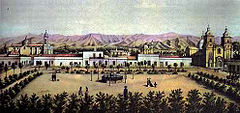 The 1861 earthquake
nearly destroyed the city of Mendoza, which had to be almost entirely reconstructed. In 1885 the railways reach the Province, allowing for easy transport for the region's wines to the port of Buenos Aires
.
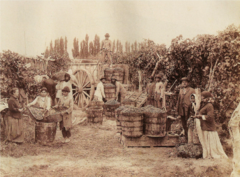
Following the development of wine industry in the province around 1900, Mendoza began to grow quickly attracting tens of thousands of European immigrants, particularly Spaniards. In 1939 the National University of Cuyo
, one of the most important of the country, was founded.
's populist policies, some of which taxed agriculture heavily to finance urban development and public works, Mendoza landowners formed the conservative Democratic Party
, which secured the Vice Governor's post in 1958. Increasing their presence in the Mendoza Legislature, the Democrats became an obstacle to progressive Governor Ernesto Ueltschi, an ally of president Arturo Frondizi
's. With majorities in both houses by 1961, they had Gov. Ueltschi removed and Democrat Vice-governor Francisco Gabrielli appointed in his stead. Elected governor in his own right in 1963, Gov. Gabrielli was deposed following the June 1966 coup against President Arturo Illia; but still benefiting from conservative credentials, he was appointed de facto governor by the same military regime in 1970.
In contrast to the pragmatism that had distinguished his 1963-66 term, Gabrielli governed with a hard line, feezing state salaries and ordering large utility rate increases, used the Mendoza police to repress dissent and took foreign policy prerogatives like collaborating with Chile
an saboteurs opposed to their country's new Marxist
president, Salvador Allende
. These events came to a head in April, 1972, however, when violent protests forced the newly unpopular Gabrielli to resign.
Upon the return to democracy in March 1973, Mendoza voters turned to a left-leaning Peronist, Alberto Martínez Baca. Quickly enacting needed labor and land reforms, Martínez Baca, however, made the mistake of appointing affiliates of the extreme-left Montoneros
movement, an organization whose armed wing had perpetrated a string of violent crimes since 1970 (and would continue to do so). Alarmed by this move from the otherwise pragmatic Martínez Baca, President Perón had him removed in June 1974.
Becoming very independent-minded following these two disappointments, Mendoza voters elected centrist Radical Civic Union
as well as populist Justicialist (Peronist) Party
lawmakers since Argentina's return to democracy in 1983. Though Mendoza has generally prospered since then, its critical wine industry was left reeling from the 1983 collapse of state-owned vintner Bodegas GIOL, whose dictatorship-era receivers had run the wine conglomerate (then the world's largest outside Europe), and accumulated over US$6 billion of debt; GIOL closed in 1991.
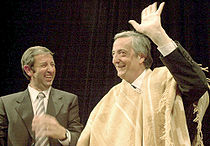 Elected in 2003, Radical Civic Union
Governor Julio Cobos
highlighted this independent sentiment by parting ways with many in his party and endorsing newly-elected Peronist President Néstor Kirchner
's policies in 2004. Over the opposition of his party, Julio Cobos
accepted the post of running mate to first lady Cristina Fernández de Kirchner
of the ruling Front for Victory
, in the presidential elections of October 2007
. Fernández and Cobos won in the first round, and Cobos became Vice President of Argentina; he was replaced by pro-Kirchner Justicialist candidate Celso Jaque
as governor. The province is represented by three senators in the Argentine Senate
, currently María Perceval
, Ernesto Sanz
and Mónica Troadello
. Mendoza is represented by 10 deputies in the Argentine Chamber of Deputies
.
On July 16, 2008, Vice President Cobos stunned observers by casting the tie-breaking vote against a presidentially-sponsored measure in the Senate that would have raised export taxes on an array of agricultural goods. His faction of the UCR won a significant victory in the 2009 mid-term elections
in Mendoza.
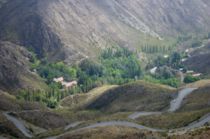 The geography of the province descends from 6959 metres (22,831 ft) at the summit of Aconcagua
to the semi-flat lands of the east. A series of longitudinal valles, such as the Uspallata, separate the Andes
from the Precordillera lower mountains. To the east, the Cuyean plains are crossed by tributaries of the Desaguadero River
. Other important rivers include Mendoza River
, Tunuyán River
, Diamante River
and Atuel River
.
The climate is continental, sunny and dry in the entire territory of the province, with warm summers and relatively cold winters. The arid
soil
due to the scant precipitation
and the great temperature difference between day and night allows mainly xerophyte
s and few trees to grow. The annual
precipitation lies between 150 and 350mm, and hail
is a significant, and not uncommon, problem in the regional viticulture
. There are fertile lands surrounding the basin
s of the many rivers born in the glacier
s of the Cordillera.
The lowlands have very hot summers (30°C to 33°C during the day, or 86F to 91F) with warm nights in the north (18°C, or 64F) and cooler evenings in the south (15°C, 59F). Precipitation falls mainly as very scarce, but often severe thunderstorms that bring hail and high winds. Falls are pleasant and dry, and winters are cool with daytime highs around 14°C (57F) and nighttime lows of 2°C (35F). When Zonda winds blow downslope from the Andes, temperatures may soar to 30°C (86F); however, Pampero winds can keep day temperatures below 5°C (41F) and nighttime lows of -8°C (18F) can be recorded. Snow is uncommon in the north, and occasional in the south.
The area around Malargue is located at higher elevation (1400 meters) and thus the weather is significantly colder: summers average 28°C (82F) during the day, but only 11°C (53F) at night, and winters range from 10°C (50F) to -2°C (28F). Here, precipitation is somewhat higher (350 mm) and winter is stormier than the summer, with 45 mm (1.8 in) falling in July. Snow is much more common, and falls several times every year: on occasion, it can be heavy. Temperatures often fall to -12°C (10F) and up to -23°C (-9F) have been recorded.
The first slopes of the Andes are dry and sunny; however, precipitation increases as one approaches the border with Chile, especially toward the south, where some areas receive over 600 mm (24 in), falling exclusively in the winter, and mostly as snow. Altitudes over 2,600 m in the north and over 2,000 m in the far south usually have ample snow cover. Summer days may be warm and sunny, but nights are always cold, whereas winter temperatures tend to be moderate, with long stretches of sunny (but very windy) weather alternating with very intense snowstorms where several meters of snow may pile up, providing excellent skiing conditions in resorts like Las Lenas, Penitentes and Vallecitos. Mountains often surpass 5,000 meters, and Aconcagua reaches 6,959 meters: at these altitudes, the climate is extremely cold and windy year round, with temperatures down to -40°C.
Different wind fronts affect the landscape, mainly the Zonda wind
, but also the mild Pampero
, the warm Viento Norte
and, in winter, the very rare Sudestada
from the Southeast. The latter wind mostly affects the pampas.
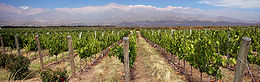 Famed worldwide for its viticulture
(with 70% of the 1.5 billion liters in Argentine wine
production), the Mendoza economy (Argentina's fifth largest) is, however, quite diversified. Its 2006 output was estimated at US$13.8 billion, or, US$8,720 per capita (about the national average). Agriculture, to be sure (though 7% of the total economy), has long accounted for much of Menodoza's foreign exchange earnings (followed closely by tourism, mainly from Chile
). Besides wine, other important crops (mainly for the Argentine market) are apple
s, pear
s, tomato
es, onion
s, plum
s, olive
s, cherries
, peach
es and quince
. Apiculture, with 30,000 beehive
s, is another growing activity favoured by Mendoza's dry weather.
 Mining is important to the Mendoza economy and has grown sharply in recent years, now accounting for 22% of output in 2005 (nearly 5 times the national average). Fourteen percent of the national reserves of petroleum
are in Mendoza, also home to large-scale mining of lime
and uranium
. Manufacturing has long contributed to the province's prosperity and still accounts for 16% of the economy. Mendoza's main industries are, of course, wine production with 1,200 wineries
turning out 1.1 billion liters in 2005, followed by canned fruits, a large petroleum refinery (in Luján de Cuyo
), cement
and others.
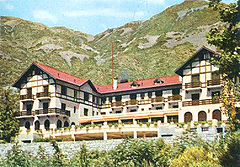
Mendoza's services sector is somewhat less developed and diversified than the national average. Tourism, long active in the scenic province, has, since the 2002 devaluation of the Argentine peso
, become one of its most important sources of income, with around 700,000 visitors per year. The main attractions are the Las Leñas
ski centre, the Aconcagua
mountain, and the provincial parks of the Atuel Canyon, Puente del Inca, Guaymallén and others. With the recent developments in Argentine wine
production, wine tourism
has also become very popular, with numerous wine-tourism oriented hotels appearing throughout the province. Wineries generally offer free tours of the premises with wine-tastings at the conclusion of the tour. In the wine-producing region, the Fiesta de la Vendimia
(grape harvest festival) receives many visitors in late February or early March. The Christ the Redeemer of the Andes
statue in the mountains on the Chilean border is a destination for many excursions.
.jpg)
.jpg) The province is divided into 18 local government areas called departments
The province is divided into 18 local government areas called departments
(Spanish: departamentos). Each is divided into one or more districts, and has an Executive Department (led by a mayor or intendente) and a Deliberative Department (legislature) to run local services. The mayor is elected by a simple majority of the popular vote every four years, while half of the Deliberative body is renewed every two years (re-election is allowed in both cases). The departments can make regulations in accordance with the provincial constitution and the Organic Law of Municipalities, but financially cannot levy taxes, but only charge for services. The most populous cities within a department may have citizens' committees appointed by the municipal government to perform certain functions.
Provinces of Argentina
Argentina is subdivided into twenty-three provinces and one autonomous city...
, located in the western central part of the country in the Cuyo region. It borders to the north with San Juan, the south with La Pampa and Neuquén
Neuquén Province
Neuquén is a province of Argentina, located in the west of the country, at the northern end of Patagonia. It borders Mendoza Province to the north, Rio Negro Province to the southeast, and Chile to the west...
, the east with San Luis
San Luis Province
San Luis is a province of Argentina located near the geographical center of the country . Neighboring provinces are, from the north clockwise, La Rioja, Córdoba, La Pampa, Mendoza and San Juan.-History:...
, and to the west with the republic of Chile
Chile
Chile ,officially the Republic of Chile , is a country in South America occupying a long, narrow coastal strip between the Andes mountains to the east and the Pacific Ocean to the west. It borders Peru to the north, Bolivia to the northeast, Argentina to the east, and the Drake Passage in the far...
; the international limit is marked by the Andes
Andes
The Andes is the world's longest continental mountain range. It is a continual range of highlands along the western coast of South America. This range is about long, about to wide , and of an average height of about .Along its length, the Andes is split into several ranges, which are separated...
mountain range. Its capital city is the homonymous city of Mendoza
Mendoza, Argentina
Mendoza is the capital city of Mendoza Province, in Argentina. It is located in the northern-central part of the province, in a region of foothills and high plains, on the eastern side of the Andes. As of the , Mendoza's population was 110,993...
.
Covering an area of 148.827 km², it is the seventh biggest province of Argentina with 5.35% of the country's total surface. The population for 2010 is 1.741.610 inhabitants, which makes it the fifth largest populated province of the country, or 4.35% of the total national population.
Pre Columbian times
Archeological studies have determined that the first inhabitants in the area date from the HoloceneHolocene
The Holocene is a geological epoch which began at the end of the Pleistocene and continues to the present. The Holocene is part of the Quaternary period. Its name comes from the Greek words and , meaning "entirely recent"...
, but there are few remains of those people to know their habits. The earliest sites of human occupation in Mandoza Province, Agua de la Cueva and Gruta del Indio, are 12-13,000 years old. On the basin of the Atuel River
Atuel River
The Atuel River is a river located mainly in the south of the Argentine province of Mendoza, with its last part in La Pampa. It is a tributary of the Desaguadero River....
, in 300 BC lived a group of people that lived from hunting, and the cultivation of maize
Maize
Maize known in many English-speaking countries as corn or mielie/mealie, is a grain domesticated by indigenous peoples in Mesoamerica in prehistoric times. The leafy stalk produces ears which contain seeds called kernels. Though technically a grain, maize kernels are used in cooking as a vegetable...
, pumpkin
Pumpkin
A pumpkin is a gourd-like squash of the genus Cucurbita and the family Cucurbitaceae . It commonly refers to cultivars of any one of the species Cucurbita pepo, Cucurbita mixta, Cucurbita maxima, and Cucurbita moschata, and is native to North America...
s and bean
Bean
Bean is a common name for large plant seeds of several genera of the family Fabaceae used for human food or animal feed....
s. Those valleys saw the rise of the Agrelo culture, antecesor of the Huarpes. They received influences of the Inca empire during the 15th century. Oral tradition sets the arrival of the Inca Túpac Yupanqui to Coquimbo by 1470.
Puelche
Puelche
Puelche is the name that the Mapuche used to give the ethnic groups who inhabited the lands to the east of the Andes Mountains including the northern Tehuelches and Hets, these last ones were also known as the Pampas or Querandíes...
s and other groups received a strong influence of the Mapuche
Mapuche
The Mapuche are a group of indigenous inhabitants of south-central Chile and southwestern Argentina. They constitute a wide-ranging ethnicity composed of various groups who shared a common social, religious and economic structure, as well as a common linguistic heritage. Their influence extended...
s.
Spanish colony (1550-1810)
The first Spanish conquerors came around 1550 from the Viceroyalty of PeruViceroyalty of Peru
Created in 1542, the Viceroyalty of Peru was a Spanish colonial administrative district that originally contained most of Spanish-ruled South America, governed from the capital of Lima...
. In 1561 Mendoza
Mendoza, Argentina
Mendoza is the capital city of Mendoza Province, in Argentina. It is located in the northern-central part of the province, in a region of foothills and high plains, on the eastern side of the Andes. As of the , Mendoza's population was 110,993...
was founded by the conquistador
Conquistador
Conquistadors were Spanish soldiers, explorers, and adventurers who brought much of the Americas under the control of Spain in the 15th to 16th centuries, following Europe's discovery of the New World by Christopher Columbus in 1492...
Pedro del Castillo
Pedro del Castillo
-Biography:He was born at Villalba de Rioja.After acting as corregidor in some recently founded American towns, he was in Chile at the orders of Francisco de Villagra, with whom he took part in the Arauco War....
. Until the creation of the Viceroyalty of the Río de la Plata
Viceroyalty of the Río de la Plata
The Viceroyalty of the Río de la Plata, , was the last and most short-lived Viceroyalty of the Spanish Empire in America.The Viceroyalty was established in 1776 out of several former Viceroyalty of Perú dependencies that mainly extended over the Río de la Plata basin, roughly the present day...
in 1776 the area of what is now Mendoza Province belonged to the Captaincy General of Chile.
Independence
With the creation of the Viceroyalty of the Río de la PlataViceroyalty of the Río de la Plata
The Viceroyalty of the Río de la Plata, , was the last and most short-lived Viceroyalty of the Spanish Empire in America.The Viceroyalty was established in 1776 out of several former Viceroyalty of Perú dependencies that mainly extended over the Río de la Plata basin, roughly the present day...
, its 30,000 inhabitants became part of the intendency of Cuyo de Córdoba del Tucumán
Tucumán Province
Tucumán is the most densely populated, and the smallest by land area, of the provinces of Argentina. Located in the northwest of the country, the capital is San Miguel de Tucumán, often shortened to Tucumán. Neighboring provinces are, clockwise from the north: Salta, Santiago del Estero and...
, but in 1813 the intendency was separated and the Province of Cuyo
Province of Cuyo
The Province of Cuyo was a historical Province of Argentina. Created on 14 November 1813 by a decree issued by the Second Triumvirate, it had its capital on Mendoza, and was composed by the territories of the present Argentine Provinces of Mendoza, San Juan and San Luis.The region was part of Chile...
created, with José de San Martín
José de San Martín
José Francisco de San Martín, known simply as Don José de San Martín , was an Argentine general and the prime leader of the southern part of South America's successful struggle for independence from Spain.Born in Yapeyú, Corrientes , he left his mother country at the...
as its first Governor. He received important support from Mendoza when he led his Army of the Andes
Army of the Andes
The Army of the Andes was a military force created by the United Provinces of the Río de la Plata and mustered by general José de San Martín in his campaign to free Chile from the Spanish Empire...
from Plumerillo to the 1817 crossing of the Andes
Crossing of the Andes
The Crossing of the Andes was one of the most important feats in the Argentine and Chilean wars of independence, in which a combined army of Argentine soldiers and Chilean exiles invaded Chile leading to Chile's liberation from Spanish rule...
, in his campaign to liberate Chile from the "oppression of Spain".
19th century
The Province of Cuyo got ultimately divided in 1820, and Mendoza parted ways with San LuisSan Luis Province
San Luis is a province of Argentina located near the geographical center of the country . Neighboring provinces are, from the north clockwise, La Rioja, Córdoba, La Pampa, Mendoza and San Juan.-History:...
and San Juan
San Juan Province (Argentina)
San Juan is a province of Argentina, located in the western part of the country. Neighbouring provinces are, moving clockwise from the north, La Rioja, San Luis and Mendoza. It borders with Chile at the west....
Provinces.
1861 Mendoza earthquake
The 1861 Mendoza earthquake was a major seismic movement in the province of Mendoza, Argentina. It took place on 20 March 1861, at 11:30 PM. It had a magnitude of 7.2 on the Surface wave magnitude scale and an intensity of IX in the Mercalli scale...
nearly destroyed the city of Mendoza, which had to be almost entirely reconstructed. In 1885 the railways reach the Province, allowing for easy transport for the region's wines to the port of Buenos Aires
Buenos Aires
Buenos Aires is the capital and largest city of Argentina, and the second-largest metropolitan area in South America, after São Paulo. It is located on the western shore of the estuary of the Río de la Plata, on the southeastern coast of the South American continent...
.
Following the development of wine industry in the province around 1900, Mendoza began to grow quickly attracting tens of thousands of European immigrants, particularly Spaniards. In 1939 the National University of Cuyo
National University of Cuyo
The National University of Cuyo is the largest center of higher education in the province of Mendoza, Argentina....
, one of the most important of the country, was founded.
20th century
Partly in reaction to President Juan PerónJuan Perón
Juan Domingo Perón was an Argentine military officer, and politician. Perón was three times elected as President of Argentina though he only managed to serve one full term, after serving in several government positions, including the Secretary of Labor and the Vice Presidency...
's populist policies, some of which taxed agriculture heavily to finance urban development and public works, Mendoza landowners formed the conservative Democratic Party
Democratic Party (Mendoza)
The Democratic Party of Mendoza is a provincial conservative party in Mendoza Province, Argentina. It was founded around 1930.Since the return of the democracy in 1983, the party has been the third political force in Mendoza, except in 1999 when it won the second position in the elections.It is a...
, which secured the Vice Governor's post in 1958. Increasing their presence in the Mendoza Legislature, the Democrats became an obstacle to progressive Governor Ernesto Ueltschi, an ally of president Arturo Frondizi
Arturo Frondizi
Arturo Frondizi Ercoli was the President of Argentina between May 1, 1958, and March 29, 1962, for the Intransigent Radical Civic Union.-Early life:Frondizi was born in Paso de los Libres, Corrientes Province...
's. With majorities in both houses by 1961, they had Gov. Ueltschi removed and Democrat Vice-governor Francisco Gabrielli appointed in his stead. Elected governor in his own right in 1963, Gov. Gabrielli was deposed following the June 1966 coup against President Arturo Illia; but still benefiting from conservative credentials, he was appointed de facto governor by the same military regime in 1970.
In contrast to the pragmatism that had distinguished his 1963-66 term, Gabrielli governed with a hard line, feezing state salaries and ordering large utility rate increases, used the Mendoza police to repress dissent and took foreign policy prerogatives like collaborating with Chile
Chile
Chile ,officially the Republic of Chile , is a country in South America occupying a long, narrow coastal strip between the Andes mountains to the east and the Pacific Ocean to the west. It borders Peru to the north, Bolivia to the northeast, Argentina to the east, and the Drake Passage in the far...
an saboteurs opposed to their country's new Marxist
Marxism
Marxism is an economic and sociopolitical worldview and method of socioeconomic inquiry that centers upon a materialist interpretation of history, a dialectical view of social change, and an analysis and critique of the development of capitalism. Marxism was pioneered in the early to mid 19th...
president, Salvador Allende
Salvador Allende
Salvador Allende Gossens was a Chilean physician and politician who is generally considered the first democratically elected Marxist to become president of a country in Latin America....
. These events came to a head in April, 1972, however, when violent protests forced the newly unpopular Gabrielli to resign.
Upon the return to democracy in March 1973, Mendoza voters turned to a left-leaning Peronist, Alberto Martínez Baca. Quickly enacting needed labor and land reforms, Martínez Baca, however, made the mistake of appointing affiliates of the extreme-left Montoneros
Montoneros
Montoneros was an Argentine Peronist urban guerrilla group, active during the 1960s and 1970s. The name is an allusion to 19th century Argentinian history. After Juan Perón's return from 18 years of exile and the 1973 Ezeiza massacre, which marked the definitive split between left and right-wing...
movement, an organization whose armed wing had perpetrated a string of violent crimes since 1970 (and would continue to do so). Alarmed by this move from the otherwise pragmatic Martínez Baca, President Perón had him removed in June 1974.
Becoming very independent-minded following these two disappointments, Mendoza voters elected centrist Radical Civic Union
Radical Civic Union
The Radical Civic Union is a political party in Argentina. The party's positions on issues range from liberal to social democratic. The UCR is a member of the Socialist International. Founded in 1891 by radical liberals, it is the oldest political party active in Argentina...
as well as populist Justicialist (Peronist) Party
Justicialist Party
The Justicialist Party , or PJ, is a Peronist political party in Argentina, and the largest component of the Peronist movement.The party was led by Néstor Kirchner, President of Argentina from 2003 to 2007, until his death on October 27, 2010. The current Argentine president, Cristina Fernández de...
lawmakers since Argentina's return to democracy in 1983. Though Mendoza has generally prospered since then, its critical wine industry was left reeling from the 1983 collapse of state-owned vintner Bodegas GIOL, whose dictatorship-era receivers had run the wine conglomerate (then the world's largest outside Europe), and accumulated over US$6 billion of debt; GIOL closed in 1991.
Radical Civic Union
The Radical Civic Union is a political party in Argentina. The party's positions on issues range from liberal to social democratic. The UCR is a member of the Socialist International. Founded in 1891 by radical liberals, it is the oldest political party active in Argentina...
Governor Julio Cobos
Julio Cobos
Julio César Cleto Cobos is an Argentine politician, currently serving as the Vice President of Argentina alongside President Cristina Fernández de Kirchner. He started his political career as member of the Radical Civic Union , becoming Governor of Mendoza in 2003...
highlighted this independent sentiment by parting ways with many in his party and endorsing newly-elected Peronist President Néstor Kirchner
Néstor Kirchner
Néstor Carlos Kirchner was an Argentine politician who served as the 54th President of Argentina from 25 May 2003 until 10 December 2007. Previously, he was Governor of Santa Cruz Province since 10 December 1991. He briefly served as Secretary General of the Union of South American Nations ...
's policies in 2004. Over the opposition of his party, Julio Cobos
Julio Cobos
Julio César Cleto Cobos is an Argentine politician, currently serving as the Vice President of Argentina alongside President Cristina Fernández de Kirchner. He started his political career as member of the Radical Civic Union , becoming Governor of Mendoza in 2003...
accepted the post of running mate to first lady Cristina Fernández de Kirchner
Cristina Fernández de Kirchner
Cristina Elisabet Fernández de Kirchner , commonly known as Cristina Fernández or Cristina Kirchner is the 55th and current President of Argentina and the widow of former President Néstor Kirchner. She is Argentina's first elected female president, and the second female president ever to serve...
of the ruling Front for Victory
Front for Victory
The Front for Victory is a Peronist political party and electoral alliance in Argentina, although it is formally a faction of the Justicialist Party. Both the former President Néstor Kirchner and the current President Cristina Fernández de Kirchner belong to this party, located on the left-wing...
, in the presidential elections of October 2007
Argentine general election, 2007
Argentina held national presidential and legislative elections on October 28, 2007, and elections for provincial governors took place on staggered dates throughout the year. For the national elections, each of the 23 provinces and the Autonomous City of Buenos Aires are considered electoral districts...
. Fernández and Cobos won in the first round, and Cobos became Vice President of Argentina; he was replaced by pro-Kirchner Justicialist candidate Celso Jaque
Celso Jaque
Celso Alejandro Jaque is an Argentine Justicialist Party politician, current governor of Mendoza Province and a former senator.Born in Malargüe, Mendoza, Jaque graduated as an accountant at the National University of Cuyo...
as governor. The province is represented by three senators in the Argentine Senate
Argentine Senate
The Argentine Senate is the upper house of the Argentine National Congress. It has 72 senators: three for each province and three for the Autonomous City of Buenos Aires...
, currently María Perceval
María Perceval
María Cristina "Marita" Perceval is an Argentine politician and member of the Justicialist Party. She is currently serving as Subsecretary for Institutional Reform and Strengthening of Democracy, a department depending of the Cabinet Chief...
, Ernesto Sanz
Ernesto Sanz
Ernesto Sanz , is an Argentine Radical Civic Union politician. He serves in the Argentine Senate representing Mendoza Province....
and Mónica Troadello
Mónica Troadello
Mónica Troadello is an Argentine politician and a member of the Justicialist Party. She is a former Senator for Mendoza Province and was part of the majority Front for Victory parliamentary group....
. Mendoza is represented by 10 deputies in the Argentine Chamber of Deputies
Argentine Chamber of Deputies
The Chamber of Deputies is the lower house of the Argentine National Congress. This Chamber holds exclusive rights to create taxes, to draft troops, and to accuse the President, the ministers and the members of the Supreme Court before the Senate....
.
On July 16, 2008, Vice President Cobos stunned observers by casting the tie-breaking vote against a presidentially-sponsored measure in the Senate that would have raised export taxes on an array of agricultural goods. His faction of the UCR won a significant victory in the 2009 mid-term elections
Argentine legislative election, 2009
Legislative elections were held in Argentina for half the seats in the Chamber of Deputies and a third of the seats in the Senate on 28 June 2009, as well as for the legislature of the City of Buenos Aires and other municipalities.-Background:...
in Mendoza.
Geography and climate
Aconcagua
Aconcagua is the highest mountain in the Americas at . It is located in the Andes mountain range, in the Argentine province of Mendoza and it lies west by north of its capital, the city of Mendoza. The summit is also located about 5 kilometres from San Juan Province and 15 kilometres from the...
to the semi-flat lands of the east. A series of longitudinal valles, such as the Uspallata, separate the Andes
Andes
The Andes is the world's longest continental mountain range. It is a continual range of highlands along the western coast of South America. This range is about long, about to wide , and of an average height of about .Along its length, the Andes is split into several ranges, which are separated...
from the Precordillera lower mountains. To the east, the Cuyean plains are crossed by tributaries of the Desaguadero River
Desaguadero River
The Desaguadero River is the general name of a river in western Argentina that receives a number of different names on its path of 1,515 kilometres, with its most important section named Desaguadero proper.-Spring:...
. Other important rivers include Mendoza River
Mendoza River
The Mendoza River is a river in the province of Mendoza, Argentina. It is formed in the Andes range between the Aconcagua and the Tupungato, by the confluence of the Vacas, the Cuevas and the Tupungato Rivers, the last being its major tributary....
, Tunuyán River
Tunuyán River
The Tunuyán River is a river in the Argentine province of Mendoza. It is born in Mount Tupungato, in the Andes range, and flows initially to the northeast, passing by the city of Tunuyán. It is then dammed by the El Carrizal Dam, after which it turns east-southeast passing near the cities of...
, Diamante River
Diamante River
The Diamante River is a river in the Argentine province of Mendoza. It is born from glaciers on the Maipo, a volcano in the Andes range in the Argentine–Chilean border, and flows east until emptying in the Desaguadero River...
and Atuel River
Atuel River
The Atuel River is a river located mainly in the south of the Argentine province of Mendoza, with its last part in La Pampa. It is a tributary of the Desaguadero River....
.
The climate is continental, sunny and dry in the entire territory of the province, with warm summers and relatively cold winters. The arid
Arid
A region is said to be arid when it is characterized by a severe lack of available water, to the extent of hindering or even preventing the growth and development of plant and animal life...
soil
Soil
Soil is a natural body consisting of layers of mineral constituents of variable thicknesses, which differ from the parent materials in their morphological, physical, chemical, and mineralogical characteristics...
due to the scant precipitation
Precipitation (meteorology)
In meteorology, precipitation In meteorology, precipitation In meteorology, precipitation (also known as one of the classes of hydrometeors, which are atmospheric water phenomena is any product of the condensation of atmospheric water vapor that falls under gravity. The main forms of precipitation...
and the great temperature difference between day and night allows mainly xerophyte
Xerophyte
A xerophyte or xerophytic organism is a plant which has adapted to survive in an environment that lacks water, such as a desert. Xerophytic plants may have adapted shapes and forms or internal functions that reduce their water loss or store water during long periods of dryness...
s and few trees to grow. The annual
Year
A year is the orbital period of the Earth moving around the Sun. For an observer on Earth, this corresponds to the period it takes the Sun to complete one course throughout the zodiac along the ecliptic....
precipitation lies between 150 and 350mm, and hail
Hail
Hail is a form of solid precipitation. It consists of balls or irregular lumps of ice, each of which is referred to as a hail stone. Hail stones on Earth consist mostly of water ice and measure between and in diameter, with the larger stones coming from severe thunderstorms...
is a significant, and not uncommon, problem in the regional viticulture
Viticulture
Viticulture is the science, production and study of grapes which deals with the series of events that occur in the vineyard. When the grapes are used for winemaking, it is also known as viniculture...
. There are fertile lands surrounding the basin
Drainage basin
A drainage basin is an extent or an area of land where surface water from rain and melting snow or ice converges to a single point, usually the exit of the basin, where the waters join another waterbody, such as a river, lake, reservoir, estuary, wetland, sea, or ocean...
s of the many rivers born in the glacier
Glacier
A glacier is a large persistent body of ice that forms where the accumulation of snow exceeds its ablation over many years, often centuries. At least 0.1 km² in area and 50 m thick, but often much larger, a glacier slowly deforms and flows due to stresses induced by its weight...
s of the Cordillera.
The lowlands have very hot summers (30°C to 33°C during the day, or 86F to 91F) with warm nights in the north (18°C, or 64F) and cooler evenings in the south (15°C, 59F). Precipitation falls mainly as very scarce, but often severe thunderstorms that bring hail and high winds. Falls are pleasant and dry, and winters are cool with daytime highs around 14°C (57F) and nighttime lows of 2°C (35F). When Zonda winds blow downslope from the Andes, temperatures may soar to 30°C (86F); however, Pampero winds can keep day temperatures below 5°C (41F) and nighttime lows of -8°C (18F) can be recorded. Snow is uncommon in the north, and occasional in the south.
The area around Malargue is located at higher elevation (1400 meters) and thus the weather is significantly colder: summers average 28°C (82F) during the day, but only 11°C (53F) at night, and winters range from 10°C (50F) to -2°C (28F). Here, precipitation is somewhat higher (350 mm) and winter is stormier than the summer, with 45 mm (1.8 in) falling in July. Snow is much more common, and falls several times every year: on occasion, it can be heavy. Temperatures often fall to -12°C (10F) and up to -23°C (-9F) have been recorded.
The first slopes of the Andes are dry and sunny; however, precipitation increases as one approaches the border with Chile, especially toward the south, where some areas receive over 600 mm (24 in), falling exclusively in the winter, and mostly as snow. Altitudes over 2,600 m in the north and over 2,000 m in the far south usually have ample snow cover. Summer days may be warm and sunny, but nights are always cold, whereas winter temperatures tend to be moderate, with long stretches of sunny (but very windy) weather alternating with very intense snowstorms where several meters of snow may pile up, providing excellent skiing conditions in resorts like Las Lenas, Penitentes and Vallecitos. Mountains often surpass 5,000 meters, and Aconcagua reaches 6,959 meters: at these altitudes, the climate is extremely cold and windy year round, with temperatures down to -40°C.
Different wind fronts affect the landscape, mainly the Zonda wind
Zonda wind
Zonda wind is a regional term for the foehn wind that often occurs on the eastern slope of the Andes, in Argentina. The Zonda is a dry wind which comes from the polar maritime air, warmed by descent from the crest, which is some 6,000 m above sea level...
, but also the mild Pampero
Pampero
Pampero may refer to:* The Pampero Winds* Industrias Pampero, C.A., rum distillery in Venezuela...
, the warm Viento Norte
Viento norte
Viento norte is a 1937 Argentine film directed by Mario Soffici....
and, in winter, the very rare Sudestada
Sudestada
Sudestada is the Spanish name for a climatic phenomenon common to the Río de la Plata and its surrounding region. The phenomenon consists of a sudden rotation of cold southern winds to the south-east...
from the Southeast. The latter wind mostly affects the pampas.
Economy
Viticulture
Viticulture is the science, production and study of grapes which deals with the series of events that occur in the vineyard. When the grapes are used for winemaking, it is also known as viniculture...
(with 70% of the 1.5 billion liters in Argentine wine
Argentine wine
The Argentine wine industry is the fifth largest producer of wine in the world. Argentine wine, as with some aspects of Argentine cuisine, has its roots in Spain...
production), the Mendoza economy (Argentina's fifth largest) is, however, quite diversified. Its 2006 output was estimated at US$13.8 billion, or, US$8,720 per capita (about the national average). Agriculture, to be sure (though 7% of the total economy), has long accounted for much of Menodoza's foreign exchange earnings (followed closely by tourism, mainly from Chile
Chile
Chile ,officially the Republic of Chile , is a country in South America occupying a long, narrow coastal strip between the Andes mountains to the east and the Pacific Ocean to the west. It borders Peru to the north, Bolivia to the northeast, Argentina to the east, and the Drake Passage in the far...
). Besides wine, other important crops (mainly for the Argentine market) are apple
Apple
The apple is the pomaceous fruit of the apple tree, species Malus domestica in the rose family . It is one of the most widely cultivated tree fruits, and the most widely known of the many members of genus Malus that are used by humans. Apple grow on small, deciduous trees that blossom in the spring...
s, pear
Pear
The pear is any of several tree species of genus Pyrus and also the name of the pomaceous fruit of these trees. Several species of pear are valued by humans for their edible fruit, but the fruit of other species is small, hard, and astringent....
s, tomato
Tomato
The word "tomato" may refer to the plant or the edible, typically red, fruit which it bears. Originating in South America, the tomato was spread around the world following the Spanish colonization of the Americas, and its many varieties are now widely grown, often in greenhouses in cooler...
es, onion
Onion
The onion , also known as the bulb onion, common onion and garden onion, is the most widely cultivated species of the genus Allium. The genus Allium also contains a number of other species variously referred to as onions and cultivated for food, such as the Japanese bunching onion The onion...
s, plum
Plum
A plum or gage is a stone fruit tree in the genus Prunus, subgenus Prunus. The subgenus is distinguished from other subgenera in the shoots having a terminal bud and solitary side buds , the flowers in groups of one to five together on short stems, and the fruit having a groove running down one...
s, olive
Olive
The olive , Olea europaea), is a species of a small tree in the family Oleaceae, native to the coastal areas of the eastern Mediterranean Basin as well as northern Iran at the south end of the Caspian Sea.Its fruit, also called the olive, is of major agricultural importance in the...
s, cherries
Cherry
The cherry is the fruit of many plants of the genus Prunus, and is a fleshy stone fruit. The cherry fruits of commerce are usually obtained from a limited number of species, including especially cultivars of the wild cherry, Prunus avium....
, peach
Peach
The peach tree is a deciduous tree growing to tall and 6 in. in diameter, belonging to the subfamily Prunoideae of the family Rosaceae. It bears an edible juicy fruit called a peach...
es and quince
Quince
The quince , or Cydonia oblonga, is the sole member of the genus Cydonia and native to warm-temperate southwest Asia in the Caucasus region...
. Apiculture, with 30,000 beehive
Beehive
A beehive is a structure in which bees live and raise their young.Beehive may also refer to:Buildings and locations:* Bee Hive, Alabama, a neighborhood in Alabama* Beehive , a wing of the New Zealand Parliament Buildings...
s, is another growing activity favoured by Mendoza's dry weather.
Petroleum
Petroleum or crude oil is a naturally occurring, flammable liquid consisting of a complex mixture of hydrocarbons of various molecular weights and other liquid organic compounds, that are found in geologic formations beneath the Earth's surface. Petroleum is recovered mostly through oil drilling...
are in Mendoza, also home to large-scale mining of lime
Lime (mineral)
Lime is a general term for calcium-containing inorganic materials, in which carbonates, oxides and hydroxides predominate. Strictly speaking, lime is calcium oxide or calcium hydroxide. It is also the name for a single mineral of the CaO composition, occurring very rarely...
and uranium
Uranium
Uranium is a silvery-white metallic chemical element in the actinide series of the periodic table, with atomic number 92. It is assigned the chemical symbol U. A uranium atom has 92 protons and 92 electrons, of which 6 are valence electrons...
. Manufacturing has long contributed to the province's prosperity and still accounts for 16% of the economy. Mendoza's main industries are, of course, wine production with 1,200 wineries
Winery
A winery is a building or property that produces wine, or a business involved in the production of wine, such as a wine company. Some wine companies own many wineries. Besides wine making equipment, larger wineries may also feature warehouses, bottling lines, laboratories, and large expanses of...
turning out 1.1 billion liters in 2005, followed by canned fruits, a large petroleum refinery (in Luján de Cuyo
Luján de Cuyo
Luján de Cuyo is the district capital of the Luján de Cuyo Department located in the west of the Mendoza Province of Argentina. It forms part of the Greater Mendoza metropolitan area.-Wine:...
), cement
Cement
In the most general sense of the word, a cement is a binder, a substance that sets and hardens independently, and can bind other materials together. The word "cement" traces to the Romans, who used the term opus caementicium to describe masonry resembling modern concrete that was made from crushed...
and others.
Mendoza's services sector is somewhat less developed and diversified than the national average. Tourism, long active in the scenic province, has, since the 2002 devaluation of the Argentine peso
Argentine peso
The peso is the currency of Argentina, identified by the symbol $ preceding the amount in the same way as many countries using dollar currencies. It is subdivided into 100 centavos. Its ISO 4217 code is ARS...
, become one of its most important sources of income, with around 700,000 visitors per year. The main attractions are the Las Leñas
Las Leñas
Las Leñas is one of the largest Andean ski resorts in Argentina, located in the western part of Mendoza Province, together with Cerro Catedral in San Carlos de Bariloche, located in Rio Negro province....
ski centre, the Aconcagua
Aconcagua
Aconcagua is the highest mountain in the Americas at . It is located in the Andes mountain range, in the Argentine province of Mendoza and it lies west by north of its capital, the city of Mendoza. The summit is also located about 5 kilometres from San Juan Province and 15 kilometres from the...
mountain, and the provincial parks of the Atuel Canyon, Puente del Inca, Guaymallén and others. With the recent developments in Argentine wine
Argentine wine
The Argentine wine industry is the fifth largest producer of wine in the world. Argentine wine, as with some aspects of Argentine cuisine, has its roots in Spain...
production, wine tourism
Wine tourism
Wine tourism refers to tourism whose purpose is or includes the tasting, consumption or purchase of wine, often at or near the source. Wine tourism can consist of visits to wineries, vineyards and restaurants known to offer unique vintages, as well as organized wine tours, wine festivals or other...
has also become very popular, with numerous wine-tourism oriented hotels appearing throughout the province. Wineries generally offer free tours of the premises with wine-tastings at the conclusion of the tour. In the wine-producing region, the Fiesta de la Vendimia
Fiesta Nacional de la Vendimia
Fiesta Nacional de la Vendimia takes place annually in Mendoza Province, Argentina. It is one of the most important festivals in the country attracting large numbers of tourists to the region...
(grape harvest festival) receives many visitors in late February or early March. The Christ the Redeemer of the Andes
Christ the Redeemer of the Andes
Christ the Redeemer of the Andes is a monument high in the Andes at 3,832 metres above mean sea level on the border between Argentina and Chile...
statue in the mountains on the Chilean border is a destination for many excursions.
Political division
Departments of Argentina
Departments form the second level of administrative division in the provinces of Argentina. There are no departments in the city of Buenos Aires, which has so far been divided into neighbourhoods as its administrative divisions, but is to be divided now into communes by a recently passed local act...
(Spanish: departamentos). Each is divided into one or more districts, and has an Executive Department (led by a mayor or intendente) and a Deliberative Department (legislature) to run local services. The mayor is elected by a simple majority of the popular vote every four years, while half of the Deliberative body is renewed every two years (re-election is allowed in both cases). The departments can make regulations in accordance with the provincial constitution and the Organic Law of Municipalities, but financially cannot levy taxes, but only charge for services. The most populous cities within a department may have citizens' committees appointed by the municipal government to perform certain functions.
- Capital DepartmentCapital Department, MendozaCapital is a department of Mendoza Province in Argentina. The provincial subdivision has a population of about 111,000 inhabitants in an area of 54 km², and its head city is Mendoza, which also serves as the provincial capital.-Sports:...
(MendozaMendoza, ArgentinaMendoza is the capital city of Mendoza Province, in Argentina. It is located in the northern-central part of the province, in a region of foothills and high plains, on the eastern side of the Andes. As of the , Mendoza's population was 110,993...
) - Capital - General Alvear DepartmentGeneral Alvear Department, MendozaGeneral Alvear is a department located in the south east of Mendoza Province in Argentina.The provincial subdivision has a population of about 44,000 inhabitants in an area of 14,448km², and its capital city is General Alvear, which is located around 900km from Buenos Aires.The City of general...
(General AlvearGeneral Alvear, MendozaGral. Alvear is the head city of the General Alvear Department, Mendoza in Mendoza Province, Argentina.Founded on August 12, 1914, it currently has a population of 26,342 , and its UN/LOCODE is ARGVA....
) - Godoy Cruz DepartmentGodoy Cruz DepartmentGodoy Cruz is a central department of Mendoza Province in Argentina.The provincial subdivision has a population of about 183,000 inhabitants in an area of 75km², and its capital city is Godoy Cruz, which is located around 1,110km from Capital Federal...
(Godoy CruzGodoy Cruz, MendozaGodoy Cruz is a city in the province of Mendoza, Argentina. It has 183,000 inhabitants as per the , and is part of the metropolitan area of the provincial capital ....
) - Guaymallén DepartmentGuaymallén DepartmentGuaymallén is a central department of Mendoza Province in Argentina.The provincial subdivision has a population of about 250,000 inhabitants in an area of 164km², and its capital city is Villa Nueva, which is located around 1,090km from Capital Federal....
(Villa NuevaVilla Nueva, MendozaVilla Nueva is a city of small size located in the central part of the Mendoza Province. It's the capital of the Guaymallén Department as well as one of its 20 districts. It constitutes together with other cities the first metropolitan area of the province and the fourth of Argentina, called...
) - Junín DepartmentJunín Department, MendozaJunín is a central department of Mendoza Province in Argentina.The provincial subdivision has a population of about 35,000 inhabitants in an area of 263km², and its capital city is Junín, which is located around 1080km from Capital Federal.-Districts:...
(JunínJunín, MendozaJunín is a town in Mendoza Province, Argentina. It is the head town of Junín Department.The town was founded on January 18, 1859....
) - La Paz DepartmentLa Paz Department, MendozaLa Paz is an eastern department of Mendoza Province in Argentina.The provincial subdivision has a population of about 9,500 inhabitants in an area of 7,105km², and its capital city is La Paz.-Districts:*Desaguadero*La Paz Norte*La Paz Sur...
(La PazLa Paz, MendozaLa Paz is a town in the northeast of the province of Mendoza, Argentina, located on National Route 7, north of the Tunuyán River. It has 9,560 inhabitants as per the , and is the head town of the La Paz Department....
) - Las Heras DepartmentLas Heras DepartmentLas Heras is a department located in the north west of Mendoza Province in Argentina.The provincial subdivision has a population of about 183,000 inhabitants in an area of 8,955km², and its capital city is Las Heras, which is located around 1,095km from Capital Federal...
(Las HerasLas Heras, MendozaLas Heras is a city in the province of Mendoza, Argentina, located in the north of the metropolitan area of the provincial capital . It has more than 180,000 inhabitants as per the and is the head town of the department of the same name....
) - Lavalle DepartmentLavalle Department, MendozaLavalle Department is a department located in the northeast of Mendoza Province in Argentina.The provincial subdivision has a population of about 32,000 inhabitants in an area of 10,212 km², and its capital city is Villa Tulumaya, which is located around 1,095 km from Capital...
(Villa TulumayaVilla TulumayaVilla Tulumaya is a town in Mendoza Province, Argentina. It is the head town of Lavalle Department.The town was founded on October 20, 1853....
) - Luján de Cuyo DepartmentLuján de Cuyo DepartmentLuján de Cuyo is a department located in the northwest of Mendoza Province in Argentina.The provincial subdivision has a population of about 104,000 inhabitants in an area of 4,847km², and its capital city is Luján de Cuyo, which is located around 1,107km from Capital...
(Luján de CuyoLuján de CuyoLuján de Cuyo is the district capital of the Luján de Cuyo Department located in the west of the Mendoza Province of Argentina. It forms part of the Greater Mendoza metropolitan area.-Wine:...
) - Maipú DepartmentMaipú Department, MendozaMaipú Department is a department and municipality located in the north west of Mendoza Province in Argentina.The department covers 617 km² and a population of 153,600 ; its capital is Maipú....
(MaipúMaipú, MendozaMaipú is a city in Mendoza Province, Argentina. It is the capital of the Maipú Department. It is located a short distance from the provincial capital, Mendoza....
) - Malargüe DepartmentMalargüe DepartmentMalargüe is a department located in the south west of Mendoza Province in Argentina. Its borders are San Rafael in the north, La Pampa Province in the east, Neuquén Province in the south and Chile to the west....
(MalargüeMalargüe- Transport and infrastructures :- Transportation :Malargüe is linked to the north of Mendoza by National Route 40. This route continues south, entering Neuquén Province, but is only partially built and not well maintained beyond Malargüe City....
) - Rivadavia DepartmentRivadavia Department, MendozaRivadavia is a central department of Mendoza Province in Argentina.The provincial subdivision has a population of about 52,500 inhabitants in an area of 2,141km², and its capital city is Rivadavia, which is located around 1,075km from Capital Federal....
(RivadaviaRivadavia, MendozaRivadavia is a city in the center-north of the province of Mendoza, Argentina. It has 52,567 inhabitants as per the , and is the head town of the Rivadavia Department...
) - San Carlos DepartmentSan Carlos Department, MendozaSan Carlos is a western department of Mendoza Province in Argentina.The provincial subdivision has a population of about 28,000 inhabitants in an area of 11,578km², and its capital city is San Carlos, which is located around 1200km from Capital Federal....
(San CarlosSan Carlos, MendozaSan Carlos or Villa San Carlos is a town in Mendoza Province, Argentina. It is the head town of San Carlos Department...
) - San Martín DepartmentSan Martín Department, MendozaSan Martín is a department located in the centre of Mendoza Province in Argentina.The provincial subdivision has a population of about 108,500 inhabitants in an area of 1,504km², and its capital city is San Martín, which is located around 1,100km from Capital Federal.-Name:The Department and its...
(San MartínSan Martín, MendozaSan Martín is a city in the north-center part of the Mendoza Province in Argentina. It is the capital of the San Martín Department and constitutes, with Palmira and La Colonia, the third-largest metropolitan area in the province.-History:...
) - San Rafael DepartmentSan Rafael DepartmentSan Rafael is one of the departments of Mendoza Province, Argentina. The seat of the department is in the city of San Rafael.-Statistics:*Geographical location: 34º 15´ to 36º southern latitude and 70º 10´ to 66º 55´ eastern longitude....
(San RafaelSan Rafael, MendozaSan Rafael is a city in the southern region of the Mendoza Province, Argentina. With more than 170,000 inhabitants , it is the largest city and the seat of San Rafael Department....
) - Santa Rosa DepartmentSanta Rosa Department, MendozaSanta Rosa is a department located in the centre of Mendoza Province in Argentina.The provincial subdivision has a population of about 16,000 inhabitants in an area of 8,510km², and its capital city is Santa Rosa, which is located around 975km from the Federal Capital.-External links:*...
(Santa RosaSanta Rosa, MendozaSanta Rosa is a city in the center-north of the province of Mendoza, Argentina, located on the northern shore of the Tunuyán River, by National Route 7, south-east from the provincial capital Mendoza. It has 15,818 inhabitants as per the , and is the head town of the Santa Rosa Department....
) - Tunuyán DepartmentTunuyán DepartmentTunuyán Department is a department located on the eastern border of Mendoza Province in Argentina.The provincial subdivision has a population of about 42,000 inhabitants in an area of 3,317km², and its capital city is Tunuyán, which is located around 1,175km from Capital Federal.-Districts:*Campo...
(TunuyánTunuyánTunuyán is a city in the west of the province of Mendoza, Argentina, located on the western shore of the Tunuyán River, south from the provincial capital Mendoza and east of the Chilean border. It has 42,125 inhabitants as per the , and is the head town of the Tunuyán Department...
) - Tupungato DepartmentTupungato DepartmentTupungato is a department located in the province of Mendoza, Argentina. The cabecera 0f Tupungato is located approximately 70 km south of Mendoza city, in the Valle de Uco....
(TupungatoTupungatoTupungato, one of the highest mountains in South America, is a massive stratovolcano dating to Pleistocene times. It lies on the border between the Chilean Metropolitan Region and the , near a major international highway about 80 km east of Santiago, Chile. It is located about south of Monte...
)
See also
- Mendoza wineMendoza wineThe Mendoza Province is one of Argentina's most important wine regions, accounting for nearly two-thirds of the country's entire wine production. Located in the eastern foothills of the Andes, in the shadow of Mount Aconcagua, vineyards are planted at the some of the highest altitudes in the world...
- List of earthquakes in Mendoza Province
- Universidad Nacional de Cuyo
External links
- Official site (Spanish)
- Mendoza Ministry of Tourism and Culture (in Spanish)
- Mendoza guide of Tourism and Culture (in Spanish)
- Discover Mendoza - Tourism in Mendoza (in Spanish)
- Universidad Nacional de Cuyo (in Spanish)
- Map of Mendoza
- Wines of Mendoza on Vinismo