
Encyclopedia
Graffiti is the application of media by
humans on publicly viewable surfaces. One definition is that it is "a drawing or writing scratched on a wall or other surface; a scribbling on an ancient wall, as those at Pompeii and Rome." . When done without the property owner's consent it is
vandalism. Some countries require the owner's consent before public organisations can prosecute such vandalism.
Graffiti has existed at least since the days of
ancient civilizations such as
classical Greece and the
Roman Empire.
History of graffiti
Etymology
The word "graffiti" expresses the plural of "graffito", although the singular form has become relatively obscure and is largely used in art history to refer to works of art made by scratching the design on a surface. Another related term is
sgraffito, a way of creating a design by scratching through one layer of pigment to reveal another one beneath. All of these
English words come from
Italian, most likely descending from "graffiato" ; ancient graffitists scratched their work into walls before the advent of spray-paint, as in
murals or
frescoes. These words derive in their turn from the Greek ??afe?? , meaning "to write". Historians continue to speculate over the vexing question as to where the term "graffiti" first referred to this form of marking.
Ancient graffiti
Historically, the term
graffiti originally referred to the inscriptions, figure drawings, etc., found on the walls of ancient sepulchers or ruins, as in the
Catacombs of Rome or at
Pompeii. Usage of the word has evolved to include any decorations that one can regard as
vandalism; or to cover pictures or writing placed on surfaces, usually external walls and sidewalks, without the permission of an owner. Thus, inscriptions made by the authors of a monument are not classed as graffiti.
The first known example of "modern style" graffiti survives in the ancient Greek city of
Ephesus and appears to
advertise prostitution, according to the tour guides of the city. It stands near the long
mosaic and stone walkway and consists of a handprint, a vaguely heart-like shape, a footprint and a number. This purportedly indicates how many steps one would have to take to find a lover, with the handprint indicating payment.
The
Romans carved graffiti into their own walls and monuments, and examples of their work also exist in
Egypt. The eruption of
Vesuvius preserved graffiti carved on the walls of
Pompeii, and they offer us a direct insight into street life: everyday
Latin, insults, magic, love declarations, political consigns. In contrast to typical modern graffiti, alphabets and quotations from famous literature have been found scribbled on the walls of Pompeii, either for the pleasure of the writer or to impress, albeit anonymously, the passer-by with one's familiarity with letters and literature. In an ancient variant on the "for a good time..." theme, an inscription gives the address of one Novellia Primigenia of Nuceria, apparently a great beauty and subject of constant enquiry; an illustration of a phallus was accompanied by the text,
mansueta tene: "Handle with care." Love was also the object of scorn:
- Quisquis amat. veniat. Veneri volo frangere costas
- fustibus et lumbos debilitare deae.
- Si potest illa mihi tenerum pertundere pectus
- quit ego non possim caput illae frangere fuste?
- Whoever loves, go to hell. I want to break Venus's ribs
- with a club and deform her hips.
- If she can break my tender heart
- why can't I hit her over the head?
-
CIL IV, 1284.
Hadrian's Villa at
Tivoli also has several examples.
Errors in spelling and grammar in graffiti not only inform us of the degree of literacy of many of the graffiti scrawlers, but they also give clues as to the pronunciation of spoken Latin. Such is the case with
CIL IV, 7838:
Vettium Firmum / aed[ilem]
quactiliar[ii] [sic]
rog[ant]. Here "qu" reflects the common pronunciation of "co". Conversely, ancient graffiti also provide us with evidence of the ability to read and write among classes of people for whom literacy was not requisite and might not otherwise be assumed. For example, the 83 graffiti found at
CIL IV, 4706-85 were executed not only by the architect Crescens, but also by most of the members of the work crew for whom he served as foreman. The brothel at
CIL VII, 12, 18-20 contains over 120 graffiti, the authors of which included the prostitutes as well as their clients. And finally, the
gladiatorial academy at
CIL IV, 4397 contained graffiti left by the gladiator Celadus Crescens
However, not only Greeks and Romans produced graffiti: the Mayan site of
Tikal in
Guatemala, also contains ancient examples.
Viking graffiti survive in
Rome and at
Newgrange Mound in
Ireland, and
Varangians carved their
runes in
Hagia Sophia in
Constantinople. The ancient
Irish inscribed stones with an alphabet called
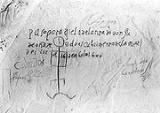
Ogham -- this standard mode of writing may not fall into the category of graffiti. There are also examples in American history, like Signature Rock , along the
Oregon Trail.
Later, French soldiers carved their names on monuments during the Napoleonic in the 1790s. There is Chinese graffiti on the great wall of China.
Art forms like
frescoes and
murals involve leaving images and writing on wall surfaces. Like the prehistoric
wall paintings created by cave dwellers, they do not comprise graffiti, as the artists generally produce them with the explicit permission of the owner or occupier of the walls.
Modern graffiti
Modern graffiti has become intertwined with
Hip-Hop as one of the 4 main elements of the culture , through hollywood and movies such as WildStyle and is often viewed as a misunderstood art form. In fact, modern graffiti pre-dates hip hop by almost a decade and is its own culture. Many Graffiti writers don't listen to hip-hop or have any affiliation to it whatsoever. The roots of modern graffiti have little to do with the hip hop culture except in the fact that a handful of participants also enjoyed the three legal aspects of hip hop and also that it was mainly practiced in the same areas where the other three elements of Hip-Hop were evolving as art forms. Many graffiti writers/artists dispute the alliance with hip hop. In addition, graffiti has been made synonymous with the anti-establishment
punk rock movement of the 1970s, with such bands as
Black Flag and
Crass stenciling to gain notoriety, thus bringing it into punk culture. Graffiti culture itself is the creator of its own fairly extensive slang primarily used by graffiti artists and not by the unaffiliated wider
hiphop culture, making it unique to style. The most prominent years in graffiti’s history were the years from 1966 – 1989. During this period graffiti was evolving through activity in
subway stations and on the
subway cars themselves.
Graffiti artists or "writers" sometimes select their nicknames , like screennames, to reflect some personal qualities, but often a tag is chosen for how the word sounds when spoken aloud or how the letters sit with each other when written; usually referred to as how the tag "flows". The letters in a word can make doing pieces very difficult if the shapes of the letters don't sit next to each other in a visually pleasing way. Also some tags are humorous plays on common expressions, such as: Page3, 2Shae, 2Cold, In1 and many others. Tags also can represent a word, but spelled differently for example; Train could be Trane or Trayne and Envy could be Envie or Envee. Tags can also contain subtle and often cryptic messages or in some cases the writers initials or other letters become a part of the tag. The current year is often put up next to tags as well; the bomber
Tox, from London, never writes just Tox; it is always Tox03, Tox04, etc. In some cases, writers dedicate or create tags or graffiti in
memory of a deceased friend, for example, "DIVA Peekrevs R.I.P. JTL '99". Tags are usually between 3 to 5 letters long to make the process of doing them
illegally faster, but can be any length at all.
Initial groundwork for graffiti begin around the late 1960s. Around this time, graffiti was mainly a form of expression by political activists. It was considered a cheap and easy way to make a statement, with minimal risk to the writer, often at the time a
hippie. As the foundations of graffiti began, gang graffiti also began to arise, used largely by gangs to mark territory. Some gangs to make use of graffiti during this era include the Savage Skulls, La Familia, and Savage Nomads. Towards the end of the 1960s the modern culture began to form in
Philadelphia,
Pennsylvania. The two writers considered to be responsible for the first true bombing are Cool Earl and Cornbread. They gained much attention from the Philadelphia press and the community itself by writing their names everywhere. Around 1970-71, the centre of graffiti innovation moved from
Philadelphia to
New York City. Once the initial foundation was laid , graffiti "pioneers" began inventing newer and more creative ways to write. Famous NYC graffiti artist Zephyr wrote an opposing viewpoint to this law.
On January 1, 2006, in New York City, legislation created by Councilmember Peter Vallone, Jr. attempted to make it illegal for a person under the age of 21 to possess spray-paint or permanent markers. The law prompted outrage by fashion and media mogul Marc Ecko who sued Mayor
Michael Bloomberg and Councilmember Vallone on behalf of art students and legitimate graffiti artists. On May 1, 2006, Judge George B. Daniels granted the plaintiffs’ request for a preliminary injunction against the recent amendments to the anti-graffiti legislation, effectively prohibiting the New York City Police Department from enforcing the restrictions. A similar measure was proposed in
New Castle County, Delaware in April 2006 and was passed into law as a county ordinance in May 2006.
Chicago's mayor,
Richard M. Daley created the 'Graffiti Blasters' to eliminate graffiti and gang-related vandalism. The bureau promises absolutely free cleanup within 24 hours of a phone call. The bureau uses paints and baking-soda based solvents to erase all varieties of graffiti.
Europe
Community cleaning squads have responded to graffiti. In
France, the Protestant youth group
Éclaireurs de France took their graffiti-scrubbing into the Meyrieres Cave near the French village of
Bruniquel in Tarn-et-Garonne, where they carefully erased the ancient paintings from the walls, earning them the 1992
Ig Nobel Prize in
archaeology.
The Anti-Social Behaviour Act 2003 became Britain's latest anti-graffiti legislation. In August 2004, the
Keep Britain Tidy campaign issued a press release calling for zero tolerance of graffiti and supporting proposals such as issuing "on the spot" fines to graffiti offenders and banning the sale of aerosol paint to teenagers. The press release also condemned the use of graffiti images in advertising and in music videos, arguing that real-world experience of graffiti stood far removed from its often-portrayed 'cool' or 'edgy' image. To back the campaign, 123 MPs signed a charter which stated:
Graffiti is not art, it's crime. On behalf of my constituents, I will do all I can to rid our community of this problem.In the UK, city councils have the power to take action against the owner of any property that has been defaced under the Anti-social Behaviour Act 2003 or, in certain cases, the Highways Act. This is often used against owners of property that are complacent in allowing protective boards to be defaced so long as the property isn't damaged.
Australia
In an effort to reduce vandalism, many cities in Australia have designated walls or areas exclusively for use by graffiti artists. Some have suggested that this discourages petty vandalism yet encourages artists to take their time and produce great art, without worry of being caught or arrested for vandalism or
trespassing. Others disagree with this approach, arguing that the presence of legal graffiti walls does not demonstrably reduce illegal graffiti elsewhere.
The
New South Wales government invested in graffiti research with findings here .
Asia
Graffiti made the news in 1993, over an incident in
Singapore involving several expensive cars found spray-painted. The police arrested a student from Singapore American School, Michael P. Fay, questioned him and subsequently charged him with vandalism. Fay pleaded guilty for vandalizing the car in addition to stealing road signs. Under the 1966 Singapore Vandalism Act, originally passed to curb the spread of communist graffiti in Singapore, the court sentenced him to four months in
jail, a fine of 3,500 Singaporean dollars , and a
caning.
The New York Times is a newspaper [i] published in New York City [i] by Arthur Ochs Sulzberger Jr. [i] ...
ran several editorials and op-eds that condemned the punishment and called on the American public to flood the Singaporean embassy with protests. Although the Singapore government received many calls for clemency, Fay's caning took place in Singapore on May 5, 1994. Fay originally received a sentence of six lashes of the cane, but the then
President of Singapore Ong Teng Cheong finally agreed to reduce his caning-sentence to four lashes.
Documentaries and films on graffiti
- Wild Style , a drama about hip hop and graffiti culture in New York City
- Style Wars , an early documentary on hip hop culture, made in New York City
- Quality of Life , a drama shot in the Mission District of San Francisco
- Piece By Piece , a feature length documentary on the history of San Francisco graffiti from the early 1980s until the present day. Called the west coast Style Wars
- Bomb the System is a drama [i] film [i] written and directed by Adam Bhala Lough [i], whi ...
, a drama about a crew of graffiti writers in modern day New York City - , a documentary about Quebec graffiti
See also
References
Notes
External links
- Documentary film on San Francisco's graffiti movement.
- Graffiti image repository containing the work of many artists.
- The first website to feature Graffiti.
- international website of graffiti and street art pictures.
- Time lapse graffiti archaeology collage.
- The Laboratory for Automation Psychology and Decision Processes LAPDP