

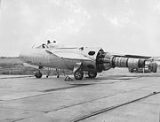
FMA IAe 33 Pulqui II

Encyclopedia
The FMA IAe 33 Pulqui II (in the indigenous language Mapuche
Mapudungun
The Mapuche language, Mapudungun is a language isolate spoken in south-central Chile and west central Argentina by the Mapuche people. It is also spelled Mapuzugun and sometimes called Mapudungu or Araucanian...
, Pulqúi: Arrow) was a jet
Jet aircraft
A jet aircraft is an aircraft propelled by jet engines. Jet aircraft generally fly much faster than propeller-powered aircraft and at higher altitudes – as high as . At these altitudes, jet engines achieve maximum efficiency over long distances. The engines in propeller-powered aircraft...
fighter aircraft
Fighter aircraft
A fighter aircraft is a military aircraft designed primarily for air-to-air combat with other aircraft, as opposed to a bomber, which is designed primarily to attack ground targets...
designed by Kurt Tank
Kurt Tank
Kurt Waldemar Tank was a German aeronautical engineer and test pilot, heading the design department at Focke-Wulf from 1931-45. He designed several important aircraft of World War II, including the Focke-Wulf Fw 190 fighter aircraft.-Early life:Tank was born in Bromberg , Province of Posen...
in the late 1940s in Argentina
Argentina
Argentina , officially the Argentine Republic , is the second largest country in South America by land area, after Brazil. It is constituted as a federation of 23 provinces and an autonomous city, Buenos Aires...
, under the Perón
Juan Perón
Juan Domingo Perón was an Argentine military officer, and politician. Perón was three times elected as President of Argentina though he only managed to serve one full term, after serving in several government positions, including the Secretary of Labor and the Vice Presidency...
government, and built by the Fábrica Militar de Aviones (FMA). Embodying many of the design elements of the wartime
World War II
World War II, or the Second World War , was a global conflict lasting from 1939 to 1945, involving most of the world's nations—including all of the great powers—eventually forming two opposing military alliances: the Allies and the Axis...
Focke-Wulf Ta 183
Focke-Wulf Ta 183
The Focke-Wulf Ta 183 Huckebein was a design for a jet-powered fighter aircraft intended as the successor to the Messerschmitt Me 262 and other day fighters in Luftwaffe service during World War II. It was developed only to the extent of wind tunnel models when the war ended, but the basic design...
, an unrealized fighter project, the FMA envisioned the IAe 33 Pulqui II as a successor to the postwar Gloster Meteor
Gloster Meteor
The Gloster Meteor was the first British jet fighter and the Allies' first operational jet. It first flew in 1943 and commenced operations on 27 July 1944 with 616 Squadron of the Royal Air Force...
F4 in service with the Fuerza Aérea Argentina. The Pulqui II's development was comparatively problematic and lengthy, with two of the four prototypes being lost in fatal crashes. Despite one of the prototypes being successfully tested in combat during the Revolución Libertadora
Revolución Libertadora
The Revolución Libertadora was a military uprising that ended the second presidential term of Juan Perón in Argentina, on September 16, 1955.-History:...
, the political, economic and technical challenges faced by the project meant that the IAe 33 was unable to reach its full potential, and the Argentine government ultimately chose to purchase F-86 Sabre
F-86 Sabre
The North American F-86 Sabre was a transonic jet fighter aircraft. Produced by North American Aviation, the Sabre is best known as America's first swept wing fighter which could counter the similarly-winged Soviet MiG-15 in high speed dogfights over the skies of the Korean War...
s from the United States in lieu of continuing development of the indigenous fighter to production status.
Background
In the late 1940s, Argentina benefited from the recruitment of prominent German aerospace scientists and engineers, fleeing Europe following the defeat of the Nazis and seeking sanctuary in Latin America. The first group of these refugees had also included French designer Émile DewoitineÉmile Dewoitine
Émile Dewoitine was a French aviation industrialist.- Prewar industrial activities :Born in Crépy-en-Laonnois, Émile Dewoitine entered the aviation industry by working at Latécoère during Word War I...
, castigated as a collaborator in his homeland, who headed up the IAe 27 Pulqui I experimental fighter program with Argentine engineers Juan Ignacio San Martín, Enrique Cardeilhac and Norberto L. Morchio. The Pulqui I was the first jet aircraft designed and built in Latin America. In 1947, flight tests revealed a mediocre performance resulting in the cancellation of the IAe 27 program. The Aerotechnical Institute , under the leadership of Morchio, persevered with its efforts to build a successful indigenous jet fighter and, at first, attempted to modify the earlier aircraft. When it became apparent that the Pulqui I had little potential for further development, the Aerotechnical Institute initiated a new design utilizing the more powerful (20.31 kN (20,310 N)) Rolls-Royce Nene
Rolls-Royce Nene
|-See also:-References:NotesBibliography* Bridgman, L, Jane's fighting aircraft of World War II. Crescent. ISBN 0-517-67964-7-External links:* *...
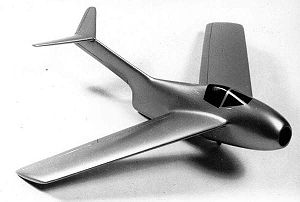
II turbojet engine. In early 1948, the Institute completed a scale model of what it called the IAe-27a Pulqui II. This design featured trapezoidal wings, swept back at an angle of 33°, and used a NACA
NACA
- Organizations :* National Advisory Committee for Aeronautics, the forerunner of the U.S. federal agency NASA* National Association for Campus Activities, an organization for programmers of university and college activities...
16009 laminar flow
Laminar flow
Laminar flow, sometimes known as streamline flow, occurs when a fluid flows in parallel layers, with no disruption between the layers. At low velocities the fluid tends to flow without lateral mixing, and adjacent layers slide past one another like playing cards. There are no cross currents...
airfoil section. A revised model was built later that year with the wings relocated to a shoulder-mounted position and the tailplane changed to a T-tail
T-tail
thumb|right|Grob motor gliderA T-tail is an aircraft tail stabilizer configuration in which the horizontal surfaces are mounted to the top of the vertical stabilizer. Traditionally, the horizontal control surfaces are mounted to the fuselage at the base of the vertical stabilizer...
configuration.
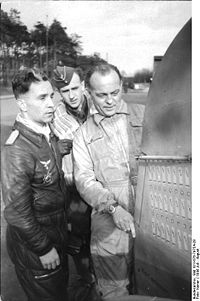
Kurt Tank
Like Dewoitine, German designer Kurt TankKurt Tank
Kurt Waldemar Tank was a German aeronautical engineer and test pilot, heading the design department at Focke-Wulf from 1931-45. He designed several important aircraft of World War II, including the Focke-Wulf Fw 190 fighter aircraft.-Early life:Tank was born in Bromberg , Province of Posen...
, the former technical director of the Focke-Wulf Flugzeugbau AG
Focke-Wulf
Focke-Wulf Flugzeugbau AG was a German manufacturer of civil and military aircraft before and during World War II. Many of the company's successful fighter aircraft designs were slight modifications of the Focke-Wulf Fw 190.-History:...
, had been similarly hired in 1947 to work on a jet fighter project for Argentina. Tank, along with 62 of his compatriots at Focke-Wulf, had emigrated to Latin America to restart his career in aerospace ventures. Surreptitiously entering the country with a passport identifying him as Pedro Matthies, he found a warm welcome and did not maintain the subterfuge of a secret identity. Along with his former employees, he was instrumental in the evolution of the Instituto Aerotécnico into Argentina's military aircraft factory, the Fábrica Militar de Aviones at Córdoba. Tank was both an engineer as well as a test pilot
Test pilot
A test pilot is an aviator who flies new and modified aircraft in specific maneuvers, known as flight test techniques or FTTs, allowing the results to be measured and the design to be evaluated....
, who had designed the Fw 190
Focke-Wulf Fw 190
The Focke-Wulf Fw 190 Würger was a German Second World War single-seat, single-engine fighter aircraft designed by Kurt Tank in the late 1930s. Powered by a radial engine, the 190 had ample power and was able to lift larger loads than its well-known counterpart, the Messerschmitt Bf 109...
fighter, but his design team had also been responsible for the Focke-Wulf Ta 183, an unbuilt project that had been declared the winner of the 1945 Emergency Fighter Competition. The diminutive, swept-wing, jet-powered Ta 183, designed by Focke-Wulf engineer/designer
Aerospace engineering
Aerospace engineering is the primary branch of engineering concerned with the design, construction and science of aircraft and spacecraft. It is divided into two major and overlapping branches: aeronautical engineering and astronautical engineering...
Hans Multhopp
Hans Multhopp
Hans Multhopp was a German aeronautical engineer/designer. Receiving a degree from the University of Göttingen, Multhopp worked with the famous designer Kurt Tank at the Focke-Wulf Flugzeugbau AG during World War II, and was the leader of the team responsible for the design of the Focke-Wulf Ta...
, had only reached the stage of wind tunnel
Wind tunnel
A wind tunnel is a research tool used in aerodynamic research to study the effects of air moving past solid objects.-Theory of operation:Wind tunnels were first proposed as a means of studying vehicles in free flight...
studies before the end of hostilities.
Design and development
After his appointment as project director for a new indigenous fighter program, Tank adapted the basic Ta 183 airframe for the Nene II engine, substantially resulting in a new design that only bore a passing resemblance to its forebear. The Nene was larger, heavier and more powerful than the Heinkel HeS 011 turbojet that had been planned for use in the Ta 183, and therefore required a new, redesigned fuselage with a larger cross-section primarily due to the Nene's centrifugal rather than the HeS 011's axial compressorGas compressor
A gas compressor is a mechanical device that increases the pressure of a gas by reducing its volume.Compressors are similar to pumps: both increase the pressure on a fluid and both can transport the fluid through a pipe. As gases are compressible, the compressor also reduces the volume of a gas...
design.
Due to the similarity of the IAe-27a and Tank's redesign of the Ta 183, Juan Ignacio San Martín, the director of the Institute merged the two parallel projects as the IAe 33 Pulqui II. The fuselage of Tank's design was further adapted to use the IAe-27a's undercarriage. The shoulder-mounted, negative-incidence wings were swept back 40°, an even greater sweep angle than those of the Ta 183, and given a small amount of anhedral. Comparable to the Ta 183's engine placement, the Nene engine was situated aft of the cockpit, near the center of gravity with engine maintenance and service facilitated through the removal of the tail section. The airframe featured a graceful, 50° swept-back T-shaped empennage
Empennage
The empennage , also known as the tail or tail assembly, of most aircraft gives stability to the aircraft, in a similar way to the feathers on an arrow...
and a pressurized
Cabin pressurization
Cabin pressurization is the pumping of compressed air into an aircraft cabin to maintain a safe and comfortable environment for crew and passengers when flying at altitude.-Need for cabin pressurization:...
cockpit topped by a clear bubble-type canopy, faired into the dorsal fuselage. Armor was provided around the cockpit and a bulletproof windscreen was incorporated. Fuel capacity was initially 1,250 l (275 Imp. gal.) internally and 800 l (176 Imp. gal.) in the wings. Armament was planned to include four 20 mm cannon, a pair mounted in a staggered, near-ventral position along each side of the fuselage slightly set back from the jet intake.
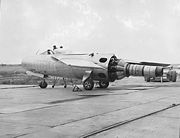
Testing and evaluation
To prove the soundness of the IAe 33 design, two gliders built under contract by another expatriate, Reimar HortenHorten brothers
Walter Horten and Reimar Horten , sometimes credited as the Horten Brothers, were German aircraft pilots and enthusiasts, and members of the Hitler Youth and Nazi party...
, were constructed and used for aerodynamics testing in 1948–1949, including flights by Tank himself. These tests revealed significant problems with lateral stability, resulting in modifications to the tail to address this problem before construction began on two prototype airframes. Due to the lack of modern machinery, the all-metal fabrication relied heavily on hand crafting and turning out the prototypes was a labor-intensive procedure. President Perón envisioned that a benefit of setting up an aviation factory in Argentina would be to introduce production standards comparable to world-class manufacturing facilities. However, Tank realized that production tools and jigs were not feasible at this stage and relied instead on essentially hand-built examples. The first airframe (No. 01) reserved for static testing, was subsequently destroyed during the tests.
The first of the "flying" IAe 33 prototypes, (No. 02) built in 1950, completed its maiden flight on 27 June of that year, with Captain Edmundo Weiss at the controls. On the second flight, ex-Focke-Wulf test pilot Otto Behrens encountered severe lateral stability problems at speeds over 700 km/h (435 mph) and returned to the airfield as a precaution. Landing at very high speed, the aircraft bounced with sufficient force to cause the right main undercarriage strut to fail. During repairs to the aircraft, in order to rectify the "tricky" landing characteristics, the front undercarriage strut was increased in length, which served to alter the angle of incidence of the aircraft, while the shock absorbers were adjusted to have a greater "throw". Although never considered docile, the modifications improved the takeoff, landing and low-speed characteristics of the IAe 33. More serious aerodynamic problems persisted, stemming from tip stall
Stall (flight)
In fluid dynamics, a stall is a reduction in the lift coefficient generated by a foil as angle of attack increases. This occurs when the critical angle of attack of the foil is exceeded...
—when the wingtip stalled before the wingroot resulting in an unpredictable "rolling moment"— that led to a change in the wing leading edge near the wingroot, while the rudder was modified in an attempt to resolve the interminable lateral instability issues. In addition, the canopy was reinforced with two external frames and a small fairing was installed above the engine exhaust.
Tank, himself a capable development test pilot, took over the test program to investigate the aircraft's stalling characteristics, although the requisite airframe changes took several months to complete, with the Pulqui II N. 02(m) for modified, not able to undertake its third proving flight until 23 October. During the ensuing high-altitude test, on two successive occasions, the IAe 33 stalled inadvertently, although Tank had sufficient height at 9,000 m for recovery. Adding ballast to the nose of the aircraft cured the problem. On 8 February 1951, Tank publicly demonstrated the IAe 33 before Perón at the Aeroparque Jorge Newbery
Aeroparque Jorge Newbery
-Accidents and incidents:*On 17 December 1969, an Austral Líneas Aéreas C-46 Commando, lost engine 1 due to fuel exhaustion shortly after take-off. The plane failed to gain height and made a crash landing in a small sport field...
in Buenos Aires. The audience also included government officials, legislators and the foreign diplomatic corps in the military attaches of the embassies, along with a large crowd of spectators. Both the IAe 27 Pulqui I and IAe 33 Pulqui II flew during the demonstration.
With the successful completion of the proving test flights, the Argentine Air Force
Argentine Air Force
The Argentine Air Force is the national aviation branch of the Armed Forces of the Argentine Republic. , it had 14,606 military and 6,854 civilian staff.-History:...
requested a pre-production order of 12 IAe 33 aircraft. In 1951, the air force established a team of service pilots to test fly the new aircraft in a series of acceptance flights. The first flight by Commander Soto on 31 May 1951 revealed severe vibrations around 1000 kilometres per hour (621 mph). Tank declared the sole prototype unserviceable pending an investigation into the problem, although this stricture appears to have been overlooked and the prototype continued to fly. On the eve of its 28th flight, Captain Vedania Mannuwal, assigned to the test program, was advised not to stress the aircraft, as the source of the vibrations experienced during the previous flight in the morning had not been discovered. Determined to "better" his team leader's recent performance, however, he ignored the precautions and began practicing aerobatic maneuvers near Córdoba during his afternoon flight. Consequently, in a high g-force
G-force
The g-force associated with an object is its acceleration relative to free-fall. This acceleration experienced by an object is due to the vector sum of non-gravitational forces acting on an object free to move. The accelerations that are not produced by gravity are termed proper accelerations, and...
turn, a structural failure
Structural failure
Structural failure refers to loss of the load-carrying capacity of a component or member within a structure or of the structure itself. Structural failure is initiated when the material is stressed to its strength limit, thus causing fracture or excessive deformations...
occurred with the wing separating from the fuselage. After struggling with the Martin-Baker
Martin-Baker
Martin-Baker Aircraft Co. Ltd. is a manufacturer of ejection seats and safety related equipment for aviation. The company origins were as an aircraft manufacturer before becoming a pioneer in the field of ejection seats...
Mk I ejection seat, Mannuwal ejected at low altitude while the aircraft was inverted. His parachute did not fully deploy, however, and he was killed. The defect in the Pulqui II was traced to faulty workmanship related to welding the joint pin that fastened the wing to the fuselage. Welding had been a dichotomy in the manufacturing process necessitated by the paucity of modern forging and pressing equipment in Argentina.
Construction of a third prototype (No. 03) began immediately after this loss. The design team initiated a number of changes to rectify design flaws found in the first "flying" prototype, including a incorporating larger rudder to improve lateral stability, increasing the size of the exhaust fairing and adding a unique air brake
Air brake (aircraft)
In aeronautics, air brakes or speedbrakes are a type of flight control surface used on an aircraft to increase drag or increase the angle of approach during landing....
that rotated out from the sides of the fuselage near the tail, along with further reinforcement of the canopy. More fuel was also carried internally to extend the range from 2030 to 3090 km (1,261.4 to 1,920 ). The new IAe 33 prototype completed its first flight on 23 September 1952, piloted by Capt. Jorge Doyle. Flight testing resumed although the aircraft was prepared for a demonstration before President Perón on 11 October 1952. Behrens, who was slated for the flight, had reservations about the flight characteristics of the Pulqui II at the extremes of its flight envelope, characterizing them as "...the worst I've ever experienced as a test pilot." Two days prior to the exhibition, while practicing his display routine, Behrens stalled the Pulqui II at low level and was killed in the resulting crash, which destroyed the prototype.
In 1953, Tank constructed a fourth prototype (No. 04) and, in an attempt to resolve the design's deep stall problems at high angles of attack, added stall fence
Wing fence
Wing fences, also known as boundary layer fences and potential fences are fixed aerodynamic devices attached to aircraft wings. Not to be confused with wingtip fences, wing fences are flat plates fixed to the upper surfaces parallel to the airflow. They are often seen on swept-wing aircraft...
s on each wing and four strakes
Strake (aviation)
In aviation, a strake is an aerodynamic surface generally mounted on the fuselage of an aircraft to improve the airflow and hence the flight characteristics.In general a strake is longer than it is wide, in contrast to a winglet or a moustache....
on the rear fuselage. Other refinements included a pressurized cockpit, additional fuel capacity and it was also the first prototype to be fitted with the definitive four 20 mm Hispano-Suiza HS.404
Hispano-Suiza HS.404
The Hispano-Suiza HS.404 was an autocannon widely used as both an aircraft and land weapon in the 20th century by British, American, French, and numerous other military services. The cannon is also referred to as Birkigt type 404, after its designer. Firing a 20 mm caliber projectile, it delivered...
cannon armament. Lt. Conan Doyle piloted the fourth IAe 33 on its maiden flight on 20 August 1953 and, along with Lt. Gonzalez and Lt. Balado, began armament testing in 1954.
While an "all-weather" IAe 33 version adding a radar
Radar
Radar is an object-detection system which uses radio waves to determine the range, altitude, direction, or speed of objects. It can be used to detect aircraft, ships, spacecraft, guided missiles, motor vehicles, weather formations, and terrain. The radar dish or antenna transmits pulses of radio...
was considered, the Argentine Air Force made tentative plans for the acquisition of 100 Pulqui II aircraft, with the production version to be a dedicated interceptor, featuring an uprated Nene engine fitted with an afterburner
AfterBurner
The AfterBurner is a lighting solution for the Game Boy Advance system that was created by Triton-Labs.Originally, portablemonopoly.net was a website created to petition Nintendo to put some kind of light in their Game Boy Advance system...
and giving it an anticipated maximum speed of Mach
Mach number
Mach number is the speed of an object moving through air, or any other fluid substance, divided by the speed of sound as it is in that substance for its particular physical conditions, including those of temperature and pressure...
0.98. A number of foreign buyers had equally expressed interest in the IAe 33, including the Netherlands in 1951 and Egypt in 1953, but the lack of a clear commitment to a production series hampered prospects for export sales, with both nations eventually settling on other readily available fighter aircraft.
Political ramifications
The IAe 33 Pulqui II project was inexorably linked to the machinations and fortunes of the Perónista regime. Although the Fábrica Militar de Aviones was charged with bringing aviation projects to completion, constant political interference contributed to the delays and disarray in aviation programs. Moreover, Tank's team was not primarily focused on the IAe 33, completing the design of the FMA IA 35 HuanqueroDINFIA IA 35
|-See also:-References:* The Illustrated Encyclopedia of Aircraft , 1985, Orbis Publishing...
multi-purpose aircraft (transport, trainer and reconnaissance roles), that eventually entered production at the Dirección Nacional de Fabricación e Investigación Aeronáutica
Industrias Aeronáuticas y Mecánicas del Estado
Industrias Aeronáuticas y Mecánicas del Estado was a state entity and autarchic conglomerate of factories of Argentina created in 1951 to promote the manufacture of aircraft and automobiles...
(DINFIA) (Spanish: "National Directorate of Aeronautical Manufacturing and Research"). The most devastating political decision was to divert the entire manufacturing program "seemingly overnight" to automotive products and agricultural equipment, essentially closing the aviation divisions. The competing DINFIA projects such as automotive manufacture served to further drain resources in time, money and personnel from the Pulqui II project.
While Argentina's finances were extremely strained at this juncture following the economic crisis in 1953, the most serious setback to the project came in January 1955 when Tank's contract expired. He reputedly requested almost twice as much money to continue but President Perón instead canceled his contract outright. Despite four years of development and trials, the IAe 33 project was still encountering teething problems and its status remained unclear although no final decision had been made to abandon a project that had reached iconic stature in the Perónist era.
Operational history
In September 1955, the sole remaining Pulqui II prototype was pressed into action in the Revolución Libertadora, a coup d'étatCoup d'état
A coup d'état state, literally: strike/blow of state)—also known as a coup, putsch, and overthrow—is the sudden, extrajudicial deposition of a government, usually by a small group of the existing state establishment—typically the military—to replace the deposed government with another body; either...
led by General Eduardo Lonardi
Eduardo Lonardi
Eduardo A. Lonardi Doucet served as de facto president of Argentina from September 23, 1955 until November 13, 1955.-Biography:He was born on September 15, 1896....
against Perón. The exact details of its participation are unknown, but when rebel forces commanded by Lonardi captured Córdoba as their first conquest, together with the Meteor F 4s fighter-bombers stationed at the Córdoba Escuela De Aviación - SACE (Military Aviation School), the IAe 33 was enlisted in the struggle. After flying combat missions against Perónist stalwarts, it later appeared in a flyover during the victory parade at Córdoba celebrating the triumph of the coup over loyalist forces.
When the military junta came to power, the IAe 33 project was thrown into disarray. The new government released many of the leading air force staff; similarly, most of Tank’s team was forced to leave Argentina with Tank himself going to India, where he worked for Hindustan Aeronautics Limited
Hindustan Aeronautics Limited
Hindustan Aeronautics Limited based in Bangalore, India, is one of Asia's largest aerospace companies. Under the management of the Indian Ministry of Defence, this state-owned company is mainly involved in aerospace industry, which includes manufacturing and assembling aircraft, navigation and...
, and later developed the HF-24 Marut supersonic fighter.
In 1956, the air force, in an effort to gain political support, planned a record flight from Córdoba to Buenos Aires to demonstrate the combat potential of the IAe 33. The Pulqui II would fly 800 km, strafe an air force practice range in the Buenos Aires area, and then return to Córdoba using only internal fuel. The only oxygen equipment available for such a long flight was scrounged from a FMA Meteor under repairs. Lt. Balado successfully completed the flight (including the strafing demonstration) at an average cruise speed of around 900 km/h, but the oxygen system failed on the return leg. The semi-conscious pilot managed to perform an emergency landing
Emergency landing
An emergency landing is a landing made by an aircraft in response to a crisis which either interferes with the operation of the aircraft or involves sudden medical emergencies necessitating diversion to the nearest airport.-Types of emergency landings:...
at high speed, but the heavy landing and resulting stress broke the landing gear, with the Pulqui II overrunning the end of the runway, the aircraft being damaged beyond repair.
Cancellation
Shortly after Balado's record flight, the Argentine Air Force reviewed its decision to acquire 100 Pulqui IIs for its fighter force. The Fábrica Militar de Aviones considered that, based on the spares and wing and fuselage components at hand, 10 aircraft could be constructed relatively quickly, however the remainder of the order would take five years to complete. Up until this time, the attrition of the original 100 Meteor F 4s obtained in the late 1940s continued, with plans for an alternative replacement, initially centered on the acquisition of 36 Canadair F-86 Mk 6 Sabres, being rejected in 1956 when the Central Bank of Argentina was unable to provide the necessary foreign exchange.When the Canadair Sabre was no longer a viable option, the Fábrica Militar de Aviones seriously considered having the Pulqui II enter series production. A new prototype was ordered in 1957, despite the United States having offered 100 combat-proven F-86 Sabre fighters that were available immediately. The fifth IAe 33 Pulqui II (No. 05) prototype, designated Pulqui IIe, was constructed in 1959 (visually identical to the fourth prototype although retaining the original frame-less, clear canopy) and entered flight testing after its first flight on 18 September 1959, with Lt. Roberto Starc flying. The continual evolution of the Pulqui II had resulted in the design team solving its inherent instability at high angles of attack, as well as increasing fuel capacity through the use of a wet wing
Wet wing
A wet wing is an aerospace engineering technique where an aircraft's wing structure is sealed and used as a fuel tank. By eliminating the need for fuel bladders, aircraft can weigh less and the wing root bending moment caused by the lift generated by the wings in flight is decreased...
, to provide sufficient range. However the fighter was now considered obsolescent, in addition to its being tainted politically by its association with Perón. Consequently, the Argentine Government decided to cancel the IAe 33 project at the zenith of its development, instead acquiring 28 F-86F-40 Sabres from the United States at a "bargain-basement price" under the Mutual Defense Assistance Act
Mutual Defense Assistance Act
The Mutual Defense Assistance Act was a United States Act of Congress signed by President Harry S. Truman on 6 October 1949. For US Foreign policy, it was the first U.S. military foreign aid legislation of the Cold War era, and initially to Europe...
.
In 1960, after completing only 12 test fights in a new role as a transonic research platform, the last IAe 33 prototype was retired and placed into storage, bringing the Pulqui II project to a culmination. The remaining factory tooling and incomplete airframes were summarily destroyed soon after.
Legacy
Despite not having achieved production status, the IAe 33 Pulqui II is still considered a significant aviation achievement because it was the first swept-wing jet fighter entirely developed and built in Latin America and, along with the Pulqui I, allowed Argentina to lay claim to becoming only the eighth nation in the world to develop such technology on its own. What doomed the project from the outset was the machinations of a corrupt political system that used nationalist fervor while bankrupting the country. Perón's dreams of building Argentina into a Latin American powerhouse centered on the creation of "blatant and rich symbols of military power", such as the Pulqui II, are portrayed in a recent film documentary where the "absurd adventure of building a model of Pulqui stands for hundreds of other quixotic projects conceived in ...the 'workshop of underdevelopment': an intermediary zone between First World industrial production and artisanal creation, typical of underdeveloped countries."
One tangible long-term benefit that can be traced to the Pulqui II project was the creation of Argentina's fledgling aviation industry, now restructured as the Lockheed Martin Aircraft Argentina S.A..
Survivors
After decades in an outdoor display at the Aeroparque, Museo Nacional de Aeronautica in Buenos Aires, today, the final prototype, the sole surviving example of the IAe 33 Pulqui II project, is preserved at the Argentine Air Force’s Museo Nacional de Aeronáutica de ArgentinaMuseo Nacional de Aeronáutica de Argentina
The Museo Nacional de Aeronáutica is a museum located in Morón, Buenos Aires, Argentina dedicated to the history of aviation, in particular the Argentine Air Force.-History:...
at Air Base Morón
Moron Airport and Air Base
Morón Airport is located southwest of the center of Morón, a city in the Buenos Aires Province of Argentina. The airport covers an area of 439 hectares...
and displayed, still in its original colors and markings, alongside the IAe 27 Pulqui I, both symbols of "lost dreams."