

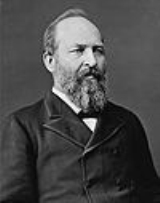
James Garfield

Encyclopedia
James Abram Garfield (November 19, 1831 – September 19, 1881) served as the 20th President of the United States
, after completing nine consecutive terms in the U.S. House of Representatives
. Garfield's accomplishments as President included a controversial resurgence of Presidential authority above Senatorial courtesy in executive appointments; energizing U.S. naval power; and purging corruption in the Post Office Department. Garfield made notable diplomatic and judiciary appointments, including a U.S. Supreme Court
justice. Garfield appointed several African Americans to prominent federal positions.
Garfield was a self-made man who came from a modest background, having been raised in obscurity on an Ohio farm by his widow
ed mother and brothers. To finance his education Garfield worked as a carpenter, and in 1856 he graduated from Williams College
, Massachusetts
. A year later, Garfield entered politics as a Republican
, after campaigning for the party's antislavery platform in Ohio. He married Lucretia Rudolph
in 1858, and in 1860 was admitted to practice law while serving as an Ohio State Senator
(1859–1861). Garfield opposed Confederate secession
, served as a Major General in the Union Army
during the American Civil War
, and fought in the battles of Middle Creek, Shiloh
and Chickamauga
. He was first elected to Congress in 1863 as Representative of the 19th District of Ohio.
Throughout Garfield's extended Congressional service after the Civil War, he fervently opposed the Greenback
, and gained a reputation as a skilled orator. He was Chairman of the Military Affairs Committee and the Appropriations Committee
and a member of the Ways and Means Committee. Garfield initially agreed with Radical Republican views regarding Reconstruction, then favored a moderate approach for civil rights enforcement for Freedmen
. In 1880, the Ohio legislature elected him to the U.S. Senate
; in that same year, the leading Republican presidential contenders – Ulysses S. Grant
, James G. Blaine
and John Sherman
– failed to garner the requisite support at their convention. Garfield became the party's compromise nominee for the 1880 Presidential Election
and successfully campaigned to defeat Democrat Winfield Hancock
in the election.
Garfield's presidency lasted just 200 days—from March 4, 1881, until his death on September 19, 1881, as a result of being shot by assassin Charles J. Guiteau
on July 2, 1881. Only William Henry Harrison
's presidency, of 32 days, was shorter. Garfield was the second of four United States Presidents who were assassinated. President Garfield advocated a bi-metal monetary system
, agricultural technology, an educated electorate, and civil rights for African American
s. He proposed substantial civil service reform, eventually passed in 1883 by his successor, Chester A. Arthur
, as the Pendleton Civil Service Reform Act
.
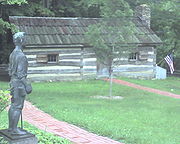 James Garfield was born the youngest of five children on November 19, 1831, in a log cabin in Orange Township, now Moreland Hills, Ohio
. His father, Abram Garfield, known locally as a wrestler, died when Garfield was 17 months old. Of Welsh
ancestry, he was reared and cared for by his mother, Eliza Ballou, who said, "He was the largest babe I had and looked like a red Irishman." Garfield's parents joined Disciples of Christ Church, which profoundly influenced their son. Garfield was able to receive rudimentary education at a village school in Orange, listening and discussing books read. Garfield knew he needed money to advance his learning.
At age 16, he struck out on his own, drawn seaward by dreams of being a seaman, and got a job for six weeks as a canal driver near Cleveland. Illness forced him to return home and, once recuperated, he began school at Geauga Academy, where he became keenly interested in academics, both learning and teaching. Garfield worked as a carpenter to support himself financially at the academy. Garfield later said of this early time, "I lament that I was born to poverty, and in this chaos of childhood, seventeen years passed before I caught any inspiration...a precious 17 years when a boy with a father and some wealth might have become fixed in manly ways." In 1849, he accepted an unsought position as a teacher, and thereafter developed an aversion to what he called "place seeking," which became, he said, "the law of my life." In 1850 Garfield resumed his church attendance and was baptized.
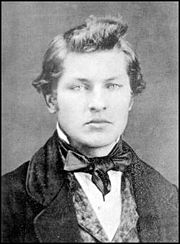 From 1851 to 1854, he attended the Western Reserve Eclectic Institute (later named Hiram College
) in Hiram, Ohio
, where he was taught by Platt Rogers Spencer
. While at Eclectic, he was most interested in the study of Greek and Latin, and he was also engaged to teach. He developed a regular preaching circuit at neighboring churches, in some cases earning a gold dollar per service. Garfield then enrolled at Williams College in Williamstown, Massachusetts
, where he joined the Delta Upsilon
fraternity and graduated in 1856 as an outstanding student. Garfield was quite impressed with the college President, Mark Hopkins
, about whom he said, "The ideal college is Mark Hopkins on one end of a log with a student on the other." Garfield earned a reputation as a skilled debater and was made President of the Philogian Society and Editor of the Williams Quarterly.
After preaching briefly at Franklin Circle Christian Church (1857–58), Garfield gave up on that vocation and applied for a job as principal of a high school in Poestenkill, New York
. After another applicant had been chosen, he returned to teach at the Eclectic Institute. Garfield was an instructor in classical languages for the 1856–1857 academic year and was made Principal of the Institute from 1857 to 1860, successfully restoring it to viability after it had fallen on hard times. During this time, Garfield revealed himself to be sympathetic with the views of moderate Republicans, though he was not yet a party man. While he did not consider himself an abolitionist
, he was opposed to slavery. After Garfield finished his education, between the 1857 and 1858 elections, he began his career in politics as a "vigorous" stump speaker
in support of the Republican Party and their anti-slavery cause. In 1858, a migrant freethinker and evolutionary named Denton challenged him to a debate (Charles Darwin
's Origin of Species was published the next year). The debate, which lasted over a week, was considered as won convincingly by Garfield.
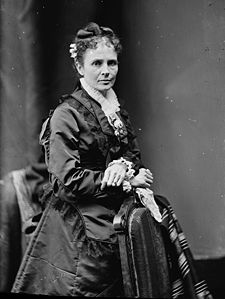 Garfield's first romantic interest was Almeda Booth in 1851, but it lasted only a year, with no formal engagement. On November 11, 1858, he married Lucretia Rudolph
, known as "Crete" to friends, and a former star Greek pupil of Garfield's. They had seven children (five sons and two daughters): Eliza Arabella Garfield (1860–63); Harry Augustus Garfield
(1863–1942); James Rudolph Garfield
(1865–1950); Mary Garfield (1867–1947); Irvin M. Garfield (1870–1951); Abram Garfield (1872–1958); and Edward Garfield (1874–76). One son, James R. Garfield, followed him into politics and became Secretary of the Interior
under President Theodore Roosevelt
.
Garfield gradually became discontented with teaching and began to study law in 1859. He was admitted to the Ohio bar
in 1860. Before admission to the bar, he was invited to enter politics by local Republican Party leaders upon the death of Cyrus Prentiss, the presumed nominee for the state senate seat for the 26th District in Ohio. He was nominated by the party convention and then elected an Ohio state senator in 1859, serving until 1861. Garfield's signature effort in the state legislature was a bill providing for the state's first geological survey
to measure its mineral resources. His initial observations about the nation leading up to the Civil War
were that secession was quite inconceivable. His response was in part a renewed zeal for the July 4 celebrations in 1860.
After Abraham Lincoln
's election, Garfield was more inclined to arms than negotiations, saying, "Other states may arm to the teeth, but if Ohio so much as cleans her rusty muskets, it is said to have offended our brethren in the South. I am weary of this weakness." On February 13, 1861, the newly elected President Lincoln arrived in Cincinnati
by train to make a speech. Garfield observed that Lincoln was "distressingly homely", yet had "the tone and bearing of a fearless, firm man."
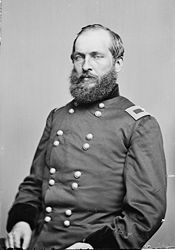 At the start of the American Civil War
, Garfield quickly grew frustrated with his vain efforts to obtain an officer's commission in the Union Army
. Ohio Governor William Dennison, Jr. charged him with a mission to travel to Illinois
to acquire musketry and to negotiate with the Governors of Illinois and Indiana
for the consolidation of troops. In the summer of 1861 he was finally commissioned a Colonel in the Union Army and given command of the 42nd Ohio Volunteer Infantry
.
General Don Carlos Buell
assigned Colonel Garfield the task of driving Confederate
forces out of eastern Kentucky
in November 1861, giving him the 18th Brigade for the campaign. In December, he departed Catlettsburg, Kentucky
, with the 40th Ohio Infantry
, the 42nd Ohio Infantry, the 14th Kentucky Infantry
, and the 22nd Kentucky Infantry
, as well as the 2nd (West) Virginia Cavalry and McLoughlin's Squadron of Cavalry. The march was uneventful until Union forces reached Paintsville, Kentucky
, on January 6, 1862, where Garfield's cavalry engaged the Confederates at Jenny's Creek. Garfield artfully positioned his troops so as to deceive Marshall into thinking that he was outnumbered, when in fact he was not. The Confederates, under Brig. Gen.
Humphrey Marshall
, withdrew to the forks of Middle Creek, two miles (3 km) from Prestonsburg, Kentucky
, on the road to Virginia
. Garfield attacked on January 9, 1862. At the end of the day's fighting the Confederates withdrew from the field, but Garfield did not pursue them, opting instead to withdraw to Prestonsburg
so he could resupply his men. His victory brought him early recognition and he was promoted to the rank of brigadier general on January 11.
Garfield later commanded the 20th Brigade of Ohio under Buell at the Battle of Shiloh
, where he led troops in an attempt, delayed by weather, to reinforce Maj Gen. Ulysses S. Grant
, after a surprise attack by Confederate General Albert S. Johnston
. He then served under Thomas J. Wood
in the Siege of Corinth
, where he assisted in the pursuit of Confederates in retreat by the overly-cautious Maj. Gen. Henry W. Halleck, which resulted in the escape of Gen. P. G. T. Beauregard
and his troops. This engendered in the furious Garfield a lasting distrust of the training at West Point. Garfield's philosophy of war in 1862—to aggressively carry the war to Southern civilians—was not then shared by the Union leadership. The tactic was later adopted and demonstrated in the campaigns of Generals Sherman
and Sheridan
.
Garfield made the following comment in 1862 concerning slavery: "...if a man is black, be he friend or foe, he is thought best kept at a distance. It is hardly possible God will let us succeed while such enormities are practiced." That summer his health suddenly deteriorated, including jaundice and significant weight loss. (Biographer Peskin speculated this may have been infectious hepatitis.) Garfield was forced to return home, where his wife nursed him back to health and their marriage was reinvigorated. He returned to duty that autumn and served on the Court-martial of Fitz John Porter
. Garfield was then sent to Washington to receive further orders. With great frustration, he repeatedly received tentative assignments, extended and later reversed, to stations in Florida, Virginia and South Carolina. During this idleness time in Washington waiting for an assignment, Garfield had an affair with Lucia Calhoun. He later admitted the affair to his wife who forgave him.
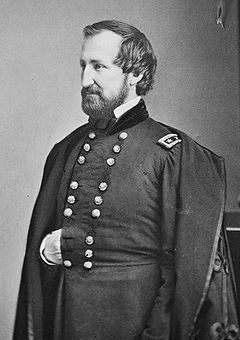 In the spring of 1863 Garfield returned to the field as Chief of Staff for William S. Rosecrans, commander of the Army of the Cumberland
; his influence in this position was greater than usual – with duties extending beyond mere communication to actual management of Rosecrans's army. Rosecrans, a highly energetic man, had a voracious appetite for conversation, which he deployed when he was unable to sleep; in Garfield he had found "the first well read person in the Army" and thus the ideal candidate for endless discussions through the night. The two became close, and covered all topics, especially religion; Rosecrans succeeded in softening Garfield's view of Catholicism. Garfield, with his enhanced influence, created an intelligence corps unsurpassed in the Union Army. He also recommended that Rosecrans should replace wing commanders Alexander McCook and Thomas Crittenden
due to their prior ineffectiveness. Rosecrans ignored these recommendations, with drastic consequences later, in the Battle of Chickamauga
. Garfield crafted a campaign designed to pursue and then trap Confederate General Braxton Bragg
in Tullahoma. The army advanced to that point with success, but Bragg retreated toward Chattanooga. Rosecrans then stalled his army's move against Bragg and made repeated requests for additional troops and supplies. Garfield argued with his superior for an immediate advance, also insisted upon by Lincoln and Rosecrans's commander, Gen. Halleck. Garfield conceived a plan to conduct a cavalry raid behind Bragg's line (similar to that Bragg was employing against Rosecrans) which Rosecrans approved; the raid, led by Abel Streight, failed, due in part to poor execution and weather. Garfield's detractors later claimed his concept was flawed. To address the continued dispute over whether to advance, Rosecrans called a war council of his generals; 10 of the 15 were opposed to the move, with Garfield voting in favor. Nevertheless Garfield, in an unusual move, drew up a report of the council's deliberations, and thus convinced Rosecrans to proceed with an advance against Bragg.
At the Battle of Chickamauga, Rosecrans issued an order which sought to fill a gap in his line, but which actually created one. As a result, his right flank was routed. Rosecrans concluded that the battle was lost and headed for Chattanooga to establish a defensive line. Garfield, however, thought that part of the army had held and, with Rosecrans's approval, headed across Missionary Ridge
to survey the Union status. Garfield's hunch was correct; his ride became legendary, while Rosecrans' error reinforced critical opinions about his leadership. While Rosecrans's army had avoided complete loss, they were left in Chattanooga surrounded by Bragg's army. Garfield sent a telegram to Secretary of War Edwin M. Stanton
alerting Washington to the need for reinforcements to avoid annihilation. As a result, Lincoln and Halleck succeeded in delivering 20,000 troops to Chattanooga by rail within nine days. One of Grant's early decisions upon assuming command of the Union Army was to replace Rosecrans with George H. Thomas. Garfield was issued orders to report to Washington, where he was promoted to Major General; shortly thereafter he gave an unambiguously abolitionist speech in Maryland. He was unsure of whether he should return to the field or assume the Ohio congressional seat he had won in October 1862. After a discussion with Lincoln, he decided in favor of the latter and resigned his commission. According to historian Jean Edward Smith
, Grant and Garfield had a "guarded relationship", since Grant put Thomas in charge of the Army of the Cumberland, rather than Garfield, after Rosecrans was dismissed.
Garfield communicated his frustration with Rosecrans in a confidential letter to his friend Secretary of the Treasury Salmon P. Chase
. Garfield's detractors later used this letter, which Chase never personally disclosed, to foster widespread criticism of Garfield as a betrayer, despite the fact that Halleck and Lincoln shared the same concerns over Rosecrans's reluctance to attack, and that Garfield had openly conveyed his concerns to Rosecrans. In later years, Charles Dana
of the New York Sun allegedly had sources indicating that Garfield had publicly stated that Rosecrans had fled the battlefield during the Battle of Chickamauga. According to biographer Peskin, the credibility of the information and the sources used are questionable. According to historian Bruce Catton
, Garfield's statements influenced the Lincoln administration to find a replacement for Rosecrans.
, was vulnerable. Garfield was conflicted – he was sure that he could better serve in Congress than in camp, but he was determined that his military position not be used as a stepping stone to political advancement. He therefore resorted to his long-held objection to "place-seeking", expressed a willingness to serve if elected, and otherwise left the matter to others. Garfield was nominated at the Republican convention on the 75th roll call vote. In October 1862 he defeated D.B. Woods by a two-to-one margin in the general election for the District's House seat in the 38th Congress
.
After the election, Garfield was anxious to determine his next military assignment and went to Washington for this purpose. While there, he developed a close alliance with Salmon P. Chase, Lincoln's Treasury Secretary. Garfield became a member of the Radical Republicans, led by Chase, in contrast with the moderate wing of the party, led by Lincoln and Montgomery Blair
. Garfield was as frustrated with Lincoln's lack of aggressiveness in pursuing the rebel enemy as Lincoln had been with Gen. McClellan. Chase and Garfield shared a disdain for West Point and the President, though Garfield praised the Emancipation Proclamation
. Garfield also shared a negative view of General McClellan, whom he considered the epitome of the Democratic
, pro-slavery, poorly-trained West Point generals.
Garfield became enthralled by the economic and financial policy discussions in Chase's office, and these subjects became his lifelong passion and expertise. Like Chase, Garfield became a staunch proponent of "honest money" or "specie payment" backed by a gold standard
, and was therefore a strong opponent of the "greenback
"; he regretted very much, but understood, the necessity for suspension of specie payment
during the emergency presented by the Civil War.
Although his desire was to continue his Army service, Garfield reluctantly took his seat in Congress upon resigning his military commission in December 1863. His first-born three-year-old child Eliza suddenly died that same month. Although he initially took a room by himself, his grief over the death of Eliza compelled him to find a roommate, which he did—Robert C. Schenck
. After Garfield's term ended, Lucretia moved to Washington to be with her husband, and the two, thereafter, never lived apart.
Garfield immediately showed an ability to command the attention of the unruly House. According to a reporter, "...when he takes the floor, Garfield's voice is heard above all others. Every ear attends...his eloquent words move the heart, convince the reason, and tell the weak and wavering which way to go." He was one of the more hawkish Republicans in the House, and served on Schenck's Military Affairs Committee
, which brought him prominence in the midst of the predominant war issues. Garfield aggressively promoted the need for a military draft, an issue almost all others shunned.
Early in his tenure, he differed from his party on several issues; his was the solitary Republican vote to terminate the use of bounties in recruiting. Some financially-able recruits had used the bounty system to buy their way out of service (called commutation), which he considered reprehensible. After many false starts, Garfield, with the support of Lincoln, procured the passage of an aggressive conscription bill which excluded commutation. In 1864 Congress passed a bill to revive the rank of Lieutenant General
. Garfield, who shared the opinion of Thaddeus Stevens
, was not in favor of this action, because the rank was intended for Grant, who had dismissed Rosecrans. Also, the recipient would thereby be given an advantage in possibly opposing Lincoln in the next election. Garfield was nevertheless very tentative in his support for the President's re-election.
Garfield, aligned with the Radical Republicans on some issues, not only favored abolition, but early in his career believed that the leaders of the rebellion had forfeited their constitutional rights. He supported the confiscation of southern plantations and even exile or execution of rebellion leaders as a means to ensure the permanent destruction of slavery. He felt Congress was obliged "to determine what legislation is necessary to secure equal justice to all loyal persons, without regard to color." With respect to the Presidential election of 1864, Garfield did not consider Lincoln particularly worthy of re-election, but no other viable alternative was available. "I have no candidate for President. I am a sad and sorrowful spectator of events." He attended the party convention and promoted Rosecrans for the V.P. nomination; this was greeted by Rosecrans's characteristic indecision, so the nomination went to Andrew Johnson
. Garfield voted with the Radical Republicans in passing the Wade–Davis Bill, designed to give Congress more authority over Reconstruction, but the bill was defeated by Lincoln's pocket veto
.
Garfield partnered with Ralph Plumb
in land speculation hoping to become wealthy, but this met with limited success. He joined with the Philadelphia-based Phillips brothers in an oil exploration investment which was moderately profitable. Garfield resumed the practice of law in 1865 as a means to improve his personal finances. His investment efforts took him to Wall Street where, the day after Lincoln's assassination, a riotous crowd led him into an impromptu speech, in part as follows: "Fellow citizens! Clouds and darkness are round about Him! His pavilion is dark waters and thick clouds of the skies! Justice and judgment are the establishment of His throne! Mercy and truth shall go before His face! Fellow citizens! God reigns, and the Government at Washington still lives!" According to witnesses the effect was tremendous and the crowd was immediately calmed. This became one of the most well-known incidents of his career.
Garfield's radicalism moderated after the civil war and Lincoln's assassination, and he assumed a temporary role as peacemaker between Congress and Andrew Johnson. At this time he commented on the readmission of the confederate states: "The burden of proof rests on each of them to show whether it is fit again to enter the federal circle in full communion of privilege. They must give us proof, strong as holy writ, that they have washed their hands and are worthy again to be trusted." When Johnson's veto terminated the Freedman's Bureau, the President had effectively entrenched himself against Congress, and Garfield rejoined the Radical camp.
With a reduced agenda on the Military Affairs Committee, Garfield was placed on the House Ways and Means Committee
, a long-awaited opportunity to focus exclusively on financial and economic issues. He immediately reprised his opposition to the greenback, saying, "any party which commits itself to paper money will go down amid the general disaster, covered with the curses of a ruined people." He called greenbacks "the printed lies of the government" and became obsessed with the morality, as well as the legality, of specie payment, and enforcement of the gold standard. This policy was against his personal interests; his investment profits were dependent upon inflation, the by-product of the greenback. His demand for "hard money" was distinctly deflationary in nature, and was opposed by most businessmen and politicians. For a time, Garfield appeared to be the only Ohio politician to hold this position.
As a proponent of laissez-faire on the economic front, he declared, "the chief duty of the government is to keep the peace and stand out of the sunshine of the people." This view was in stark contrast to his view of the role of government in reconstruction efforts. Another inconsistency in Garfield's laissez-faire philosophy was his position on free trade – he favored the tariff
, out of political necessity – when it served to protect his district's products.
Garfield was one of three attorneys who argued for the petitioners in the famous Supreme Court case Ex parte Milligan
in 1866. This was, despite many years of practicing law, Garfield's first court appearance. Jeremiah Black had taken him in as a junior partner a year before, and assigned the case to him in light of his highly reputed oratory skills. The petitioners were pro-Confederate northern men who had been found guilty and sentenced to death by a military court for treasonous activities. The case turned on whether the defendants should instead have been tried by a civilian court; Garfield was victorious, and instantly achieved a reputation as a preeminent appellate lawyer.
 Despite the allure of a newly lucrative law practice, there was little hesitancy on Garfield's part in deciding to stand for re-election in 1866, due primarily to the urgency presented by Reconstruction. The competition was stiffer, since Garfield now had taken positions on issues which bore defending, such as the draft legislation he supported, tariffs, and his involvement in the Milligan case. As much as anyone, Harmon Austin, a local man of influence, was indispensable to Garfield's success, keeping a finger on the political pulse of the district. The party convention went smoothly in his favor and Garfield won the election with a 5-to-2 margin. At the same time, the Republicans took two-thirds of the national Congressional seats.
Garfield returned to Washington very glum in spite of his success, taking the campaign criticism quite hard. He was disgusted as well at what he thought was insane talk of impeaching President Johnson. With respect to Reconstruction, he thought Congress had been magnanimous in its offers to the South. When the rebels responded to this as a sign of weakness to be exploited by further demands, he was quite prepared to renew his view of them as enemies of the Union. This attitude was popular back home, and initiated talk of a Garfield-for-Governor campaign. Garfield promptly quashed it.
The Congressman expected his new term would bring an appointment as Chairman of the Ways and Means Committee, but this was not to be, due largely to his emphatic position in favor of hard money, which did not reflect the House consensus. He was appointed as chairman of the Military Affairs Committee, the primary agenda item there being the reorganization and reduction of the armed forces to put them on a peacetime footing. Garfield at this time endorsed the view that the Senate, via the Tenure of Office Act, had final say on Presidential appointments, a position he would radically change when President himself.
In another reassessment, Garfield supported articles of impeachment against President Andrew Johnson over charges that he violated the Tenure of Office Act by removing Secretary of War Edwin M. Stanton. Garfield was absent for the actual vote due to legal work. Support for impeachment was very high, but the result was in doubt due to forebodings about the value of President pro tempore
, U.S. Senator Benjamin Wade
, a Radical Republican, as successor to President Johnson. He felt the senators were more interested in making speeches than conducting a proper trial. In the end, Chief Justice Salmon P. Chase
, who presided over the trial, was thought to have brought about Johnson's acquittal by the Senate with his statements from the bench. Thus, Garfield's very close friend distinctly became a political adversary, though he persevered with the economic and financial views he had earlier learned from Chase. In 1868 Garfield gave his noted two-hour "Currency" speech in the House, which was widely applauded as his best oratory yet; in it he advocated a gradual resumption of specie payment.
While Garfield had by then established himself as a superb orator while managing legislation on the floor of the House, he demonstrated little feel for the mood of the members or ability to control debate on items he brought forward. He continued in this new term to expect the Chairmanship of the Ways and Means Committee, but again this was misplaced, due in large part to his shortcomings as a parliamentarian; he was given the chair of the Banking and Currency Committee
, but regretted having lost the Military Affairs Chairmanship. One legislative priority of his fourth term was a bill to establish a Department of Education, which succeeded, only to be brought down by poor administration on the part of the first Commissioner of Education, Henry Barnard.
Another pet project of Garfield's this term was a bill to transfer Indian Affairs from the Interior Department to the War Department
. His estimate was that the Indians' culture could be more effectively "civilized" with the help of the more structured and disciplined military. The proposal was thought to be ill-conceived from the outset, but Garfield failed to perceive popular opinion. On a positive note in this term, Garfield was appointed chairman of a Subcommittee on the Census; as with other things mathematical, he threw himself into this head and shoulders. The two accomplishments of his work here were to revamp the counting process and to implement a major change in the questionnaire. Garfield showed improvement in handling this on the House floor and it was passed there, although it was stopped in the Senate; ten years later, a similar bill became law, with most of his groundwork in place.
In September 1870 Garfield was chairman of a Congressional committee investigating the Black Friday
Gold Panic scandal. The committee investigation into corruption was thorough, but found no indictable offenses. Garfield refused, as irrelevant, a request to subpoena the President's sister, whose husband was allegedly involved in the scandal. Garfield took full advantage of the opportunity to blame the fluctuating greenback for sowing the seeds of greed and speculation that led to the scandal. Garfield also pursued his anti-inflationist campaign against the greenback through his work on the bill for a national bank system. He successfully used the bill as a means to reduce the volume of greenbacks in circulation. Garfield's committee investigated President Grant's wife Julia's financial record. Tension remained between President Grant and Rep. Garfield.
As in the past, Garfield expected the leadership of the Ways and Means Committee to be his, but again it escaped him, due to opposition from the influential Horace Greeley
. He was appointed Chairman of the Appropriations Committee
, a position he initially spurned. In time the post commanded his interest and improved his skills as a floor manager. Garfield's outlook for the Republican Party, and the Democrats as well, was very negative at this point. He stated that "the death of both parties is all but certain; the Democrats, because every idea they have brought forward in the past 12 years is dead; and the Republicans, because its ideas have been realized." Nevertheless, when casting his votes, he remained a party regular.
Garfield thought the land grants given to expanding railroads to be an unjust practice; as well, he opposed some monopolistic practices by corporations, as well as the power sought by the workers' unions. By this time Garfield's Reconstruction philosophy had moderated. He hailed the passage of the 15th Amendment
as a triumph, and he favored the re-admission of Georgia to the Union as a matter of right, not politics. In 1871, however, Garfield could not support the Ku Klux Klan Act, passed by Congress in 1871, saying "I have never been more perplexed by a piece of legislation". He was torn between his indignation of "these terrorists" and his concern for the freedoms endangered by the power the bill gave to the President to enforce the Act through suspension of habeas corpus
.
Garfield supported the proposed establishment of the United States civil service
as a means of alleviating the burden of aggressive office seekers upon elected officials. He especially wished to eliminate the common practice whereby government workers, in exchange for their positions, were forced to kick back a percentage of their wages as political contributions.
During this term, discontented with public service, Garfield pursued opportunities in law practice, but declined a partnership offer after being advised his prospective partner was of "intemperate and licentious" reputation. Family life had also increased in importance to Garfield, who said to his wife in 1871, "When you are ill, I am like the inhabitants of a country visited by earthquakes. Like they, I lose all faith in the eternal order and fixedness of things."
In 1872 he was one of a number of Congressmen involved in the alleged Crédit Mobilier of America scandal
. As part of their expansion efforts, the principals of the Union Pacific Railroad
formed Crédit Mobilier of America and issued stock. Congressman Oakes Ames testified Garfield had purchased 10 shares of Crédit Mobiler stock for $1000, received accrued stock interest and $329 (33 per cent) in dividends sometime between December 1867 and June 1868. Ames's credibility suffered greatly due to substantive changes he made in his story under oath, along with very inconsistent and inaccurate records he provided. Garfield biographer Peskin concludes, "From a strictly legal point of view, Ames's testimony was worthless. He repeatedly contradicted himself on important points." According to the New York Times, Garfield had been in debt at the time, having taken out a mortgage on his property. Though Garfield was properly questioned for buying the stock, he had returned it to the seller. The scandal did not imperil his political career severely, though he denied the charges against him rather ineffectively, since the details were convoluted and were never clearly articulated or convincingly proven.
In 1873 Garfield appealed to President Grant to appoint Justice Noah H. Swayne as Chief Justice of the United States Supreme Court. The previous Chief Justice, Salmon P. Chase
, had died in office May 7, 1873. Pres. Grant, however, appointed Morrison R. Waite.
Later in this term, Garfield found himself in the position of having to vote for his Appropriation Committee's bill, which included a provision to increase Congressional and Presidential salaries, something he opposed. This controversial act, known as the "Salary Grab
", was signed into law in March 1873. In June congressional supporters of the law received vitriolic response from the press and the voting public. This vote was the source of an increased degree of criticism of Garfield, though he was reappointed Chairman of the Appropriations Committee and placed on the Rules Committee. The vote did, however, give rise to stiffer competition in the next election. He returned his own salary increase to the U.S. Treasury.
The Democrats assumed control of Congress in the 1874 election for the first time in 20 years. In the lame duck
session, with Garfield's support but mixed reaction, Congress passed a compromise measure providing for specie payment, to take effect in 1879. In the new session Garfield was appointed to the Ways and Means Committee and the Pacific Railroad Committee. Also in this session, Garfield and John Coburn
uncovered corruption in the Post Tradership Office at Fort Sill
—control of supplies had been monopolized, with overpricing occurring. The abuses were corrected as a result of the investigation, but Garfield and others were suspected of allowing Secretary of War William Belknap to avoid exposure. Belknap later resigned to evade impeachment when details of his involvement were revealed.
. Blaine's chances for nomination diminished with his sudden physical collapse and subsequent recuperation; when the party nominated Rutherford B. Hayes
, Garfield immediately endorsed his party's standard bearer. In terms of his own re-election, Garfield had very much desired to re-enter private life, but since the outlook for his party was dire, he felt duty-bound to join the fray. His campaign manager Austin again relied on Garfield's appointees to man their stations in the district, resulting in a unanimous party nomination, and an election victory with 60% of the vote. Any celebration was short lived, as Garfield's youngest child, Neddie, suddenly fell ill with whooping cough and died.
 When Hayes appeared to have narrowly lost the election, the Republicans launched recount efforts. Grant asked Garfield to serve as a "neutral observer" in the recount in Louisiana. His role quickly morphed into that of investigator into the "rifle clubs" which the Republicans alleged were formed by the Democrats to intimidate the black voters. Garfield's report, along with others, created enough doubt to change the election results in that state, as well as in Florida, South Carolina, and Oregon; these states then were saddled with two conflicting slates of electoral votes, which under the Constitution made Congress the final arbiter of the election. The Congress then passed a bill establishing the Electoral Commission
, which would determine the winner once and for all. Although Garfield opposed the Commission, he found himself appointed to it. Hayes emerged the victor by a Commission vote of 8 to 7, and the decision held after a Democratic attempt to filibuster
the final result. Since James G. Blaine moved from the House to the United States Senate
, Garfield became the minority Republican floor leader
of the House.
The election of 1878 brought no significant opposition to Garfield's seat in the House, though two potential obstacles existed: the Greenback Party put up a candidate, Judge Tuttle; and the district had been re-shuffled by the Democrats in an attempt to weaken the Republicans' hold. Garfield still marched to victory with a 3-to-2 margin.
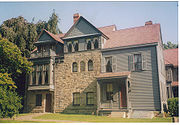
Garfield at this time purchased the property in Mentor
that reporters later dubbed Lawnfield, and from which he would conduct the first successful front porch campaign
for the Presidency. The home is now maintained by the National Park Service
as the James A. Garfield National Historic Site
.
Garfield's last Congressional session was devoted primarily to ensuring that Hayes' vetoes of Democratic appropriations were sustained; presumably Garfield succeeded, as he named his new dog "Veto".
When the Ohio off-year campaign of 1879 approached, Garfield turned his attention to securing the U. S. Senate seat for Ohio, vacated by John Sherman. The first step was to bring about a Republican victory in the Ohio legislature, which would choose the Senator. Once the Republicans captured the legislature, Garfield's victory was never in doubt; he was elected to the Senate by acclamation.
delegates in his speech against Sen. Conkling's convention rule that stated all state delegates must vote unanimously for only one candidate. After over thirty ballots, the vote totals for the leading contenders were within five votes of where they had been on the first ballot. With the 34th ballot, Wisconsin began the break to Garfield that would end with his nomination as the party's Presidential candidate. Garfield's capture of the 1880 nomination for the Presidency over the prominent contenders was considered historic. Garfield defeated the front runner Ulysses S. Grant's controversial third term bid for the nomination.
Thomas Nichol, Wharton Barker, and Benjamin Harrison
were widely considered to be the primary architects of Garfield's ascendancy during the convention, but no one could have controlled this unpredictable outcome for such a dark horse—one who had personally objected at every step. To obtain Republican Stalwart support for the ticket, former New York customs collector Chester A. Arthur
was chosen as the vice-presidential nominee and Garfield's running mate.
In the wake of such a fractured convention, the outlook for Garfield's campaign was less than optimal. In an effort to heal residual wounds from the convention, Garfield traveled to New York to bring the party's warring factions together in what was called the "New York Conference", and what was considered a personal triumph. This was the only trip of consequence which Garfield made away from home during the campaign. Powerful railroad interests were courted by the party in the wake of Supreme Court decisions that had been adverse to their interests. After assuring them that they would have the President's ear in such matters, Garfield gained their support.
Another issue in the Election of 1880 was Chinese immigration; those in the West, particularly California
, were opposed to Chinese immigration, considered antithetical to normal economic growth in that region. Easterners, such as Senator George F. Hoar
, took a more philosophical and religious stand in favor of Chinese immigration. On the eve of the election the Democrats widely published a letter—allegedly over Garfield's signature—which favored Chinese immigration, in an attempt to affect the outcome of the election. The timing of the letter's publication, some obvious inconsistencies in the letter's wording, and even the handwriting itself, led many to believe it to be a forgery.
In the general election, Garfield defeated the Democratic candidate Winfield Scott Hancock
, another distinguished former Union Army general, by 214 electoral votes to 155. The popular vote had a plurality of just over 7,000 votes out of more than 8.89 million cast. He became the only man ever to be elected to the Presidency directly from the House of Representatives and was for a short period a sitting Representative, Senator-elect, and President-elect.
, a deranged political office seeker, on July 2, 1881. Garfield lived for 80 days after he was shot, but was unable to govern. During his limited time in office, Garfield managed to initiate reform of the Post Office Department's notorious "star route
" rings and reassert the superiority of the office of the President over the U.S. Senate on the issue of executive appointments. Garfield made four federal court appointments and filled one vacancy on the U.S. Supreme Court
. His inaugural address set the agenda for his Presidency, but he did not live long enough to implement most of these policies. Garfield's persistent call for civil service reform, however, was fulfilled with the passage of the Pendleton Civil Service Reform Act
, enacted by Congress and signed by President Chester A. Arthur
in 1883. Indeed, Garfield's assassination was the primary motivation for the reform bill's passage. Garfield's single executive order was to provide government workers the day off on May 30, 1881, in order to decorate the graves of those who died in the Civil War. At the time of Garfield's residence in the office, the President's annual salary was $50,000, which would be largely consumed for the operation of the White House. And, despite rumors of ill-gotten wealth, Garfield could afford no horse and buggy to park in the White House stable, but accepted Hayes' offer of his own quite used-up rig.
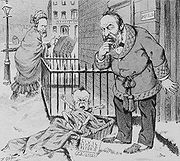 Between his election and his inauguration, Garfield was occupied with assembling a cabinet that would establish peace between the warring factions of the Republican Party, led by U.S. Sen. Roscoe Conkling
and James G. Blaine. Blaine was appointed Secretary of State; Blaine was not only the President's closest advisor, he was obsessed with knowing all that took place in the White House, and even was said to have spies posted there in his absence. Garfield nominated William Windom
of Minnesota as Secretary of the Treasury, William H. Hunt
of Louisiana as Secretary of the Navy, Robert Todd Lincoln
as Secretary of War, Samuel J. Kirkwood
of Iowa as Secretary of the Interior. New York was represented by Thomas Lemuel James
as Postmaster General. He appointed Pennsylvania's Wayne MacVeagh
, an adversary of Blaine's, as Attorney General
. Blaine tried to sabotage the appointment by convincing Garfield to name a nemesis of MacVeagh, William E. Chandler
, as Solicitor General
under MacVeagh. Only Chandler's rejection by the Senate forestalled MacVeagh's resignation over the nomination.
Snow covered much of the Capitol grounds during Garfield's inauguration, which had a low turnout of about 7,000 people. He was sworn into office by Chief Justice Morrison Waite
on March 4, 1881.
In Garfield's Inaugural Address he emphasized the civil rights of African Americans. He believed that blacks deserved the "full rights of citizenship." Garfield warned of the dangers of blacks' rights being taken away and their becoming "a permanent disfranchised peasantry." He stated, "Freedom can never yield its fullness of blessings so long as the law or its administration places the smallest obstacle in the pathway of any virtuous citizen." Garfield stated that those who had the right to vote needed to be literate and stressed the need for federal "universal education." In terms of finance, Garfield stated that bimetallism
"arrangements can be made between the leading commercial nations which will secure the general use of both metals." The President advocated agriculture as an important part of the American economy that created affordable "homes and employment for more than one-half of our people, and furnishes much the largest part of all our exports." Garfield stated that agricultural science needed to be supported by the federal government. President Garfield stated that polygamy
offended "the moral sense of manhood" and that the LDS Church, which advocated the practice, prevented the "administration of justice through ordinary instrumentalities of law."
Garfield's enduring political legacy came when he spoke on civil service reform in making federal appointments:
John Philip Sousa
led the Marine Corps band at the inaugural parade and ball. The ball was held in the National Museum
, now the Arts and Industries Building
, of the Smithsonian Institution
in Washington, D.C.
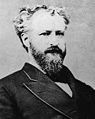 Garfield's appointment of Thomas Lemuel James to U.S. Postmaster infuriated Garfield's party rival, Stalwart Roscoe Conkling
, who demanded a commensurate appointment for his faction and his state, such as the position of Secretary of Treasury. The resulting squabble was ponderous in the brief Garfield presidency. The feud with Conkling reached a climax when the President, at Blaine's instigation, nominated Conkling's enemy, Judge William H. Robertson
, to be Collector of the Port of New York. Conkling raised the time-honored principle of senatorial courtesy
in an attempt to defeat the nomination, but to no avail. Garfield, who believed the practice to be corrupt, would not back down and threatened to withdraw all nominations unless Robertson was included. Garfield stated this would "settle the question whether the President is registering clerk of the Senate or the Executive of the United States." Ultimately, Sen. Conkling and his junior colleague, Sen. Thomas C. Platt
, resigned their Senate seats to seek vindication, but they found only further humiliation when the New York legislature elected others in their places. Robertson was appointed and Garfield's victory on behalf of the Executive over the Senate on this issue was clear. He had routed his antagonists, weakened the principle of senatorial courtesy, and revitalized the executive branch. To Blaine's chagrin, the victorious Garfield returned to his goal of balancing the interests of party factions, and re-nominated a number of Conkling's Stalwart friends to their positions.
Former President Ulysses S. Grant, an ally of Sen. Conkling, notified President Garfield by letter that he disapproved of Blaine's nomination and staunchly opposed Garfield's appointment of Robertson as the port of New York's customs collector. President Garfield wrote Grant a stern letter in reply that stated he would not be bound by party patronage and would appoint "men who represented any valuable element in the Republican party."
By July 1, 1881, minor party dissension over the Conkling affair remained while President Garfield continued his policy of forbidding Vice President Chester A. Arthur, a Conkling ally, from attending presidential cabinet meetings. Sec. Blaine, however, encouraged and supported President Garfield. Presidential historian Justice D. Doenecke stated that Garfield lacked judgment in his appointment of Robertson that proved to be problematic. Doenecke stated that the fight over Robertson was not important enough to disturb party unity over Presidential authority since the previous customs collector, Edwin A. Merrit, appointed by President Rutherford B. Hayes in 1878, was a reformer. According to Doenecke, rather than follow his initial instinct for Republican conciliation, Garfield sided with Sec. Blaine. President Hayes had initiated the break down of Senatorial courtesy and under President Garfield the process had reached a climax.
Garfield spearheaded a notable economic achievement when he arranged for the refunding of $200 million in maturing government bonds without calling a special session of Congress. The previous interest rate of 6% on the bonds was superseded by a future rate of 3.5%, which further bolstered the government's balance sheet. This action by President Garfield, a talented economist, saved the country millions of dollars in national debt.
was damaging to the Presidency while more urgent national concerns needed to be addressed. Garfield's predecessors, Grant and Hayes, had both advocated civil service reform. By 1881, civil service reform associations had organized with renewed energy across the nation, including New York. Some reformers were disappointed that President Garfield had advocated limited tenure only to minor office seekers and had given appointments to his old friends. Many prominent reformers remained loyal and supported Garfield. Garfield advocated dismissal of incompetent incumbent
appointees.
Previously in April, 1880 there had been a Congressional investigation into corruption in the Post Office Department, where profiteering rings allegedly stole millions of dollars, employing bogus mail contracts called "star routes
". This postal corruption by the rings had stealthily succeeded for many years during both the Grant and Hayes administrations. After obtaining contracts by a low bidding procedure, known as "straw-bids", costs to run the mail routes would be escalated and profits would be divided among ring members. In 1880, Garfield's predecessor, President Hayes, stopped the implementation of any new "star route" contracts in a reform effort. In April, 1881 President Garfield was given information from Attorney General Wayne MacVeagh and Postmaster Thomas L. James of postal corruption by an alleged "star route" ringleader, Second Assistant Postmaster-General, Thomas J. Brady
. Garfield immediately demanded Brady's resignation and started prosecutions led by Postmaster James that would end in the famous "star route" indictments and trials for conspiracy. When told that his party, including his own campaign manager, Stephen W. Dorsey, was involved, Garfield directed MacVeagh and James to root out the corruption in the Post Office Department "to the bone", regardless of where it might lead. According to the New York Times, many "questionable" members allegedly involved in post office corruption were fired or resigned. Brady resigned immediately on President Garfield's demand, and was eventually indicted for conspiracy. After two "star route" ring trials in 1882 and 1883, the jury found Brady not guilty. Garfield appointed Richard A. Elmer as Brady's replacement.
had gained citizenship and suffrage that enabled them to participate in state and federal offices. Garfield believed that their rights were being eroded by southern white resistance and illiteracy, and was vitally concerned that blacks would become America's permanent "peasantry". The President's answer was to have a "universal" education system funded by the federal government. Garfield's concern over education was not exaggerated; there was a 70% illiteracy rate among southern blacks. Congress and the northern white public, however, had lost interest in African American rights. Federal funding for universal education did not pass Congress during the 1880s.
President Garfield appointed several African Americans to prominent positions: Frederick Douglas, recorder of deeds in Washington; Robert Elliot, special agent to the U.S. Treasury; John M. Langston, Haiti
an minister; and Blanche K. Bruce, register to the U.S. Treasury. Garfield began to reverse the southern Democratic conciliation
policy implemented by his predecessor, Rutherford B. Hayes. In an effort to bolster southern Republican unity Garfield appointed William H. Hunt
, a carpetbag
Republican from Louisiana during Reconstruction, as Secretary of the Navy. Garfield believed that Southern support for the Republican party could be gained by "commercial and industrial" interests rather than race issues. To break hold of the resurgent Democratic Party in the Solid South
, Garfield cautiously gave senatorial patronage privilege to Virginia Senator William Mahone
of the biracial independent Readjuster Party
. Garfield was the first Republican president to initiate an election policy to obtain support from southern independents.
general, Lew Wallace
, as U.S. minister to Turkey
. Garfield appointed Wallace to Turkey believing that the Muslim
country would serve as a good background for a second popular novel. From June 27 to July 1, 1881, President Garfield appointed 25 foreign ministers and consuls. He also appointed Sec. Blaine's son third assistant to the Secretary of State.
Garfield's Secretary of State James G. Blaine had to contend with Chinese immigration, fishing disputes with Britain, and obtaining U.S. recognition from Korea. Blaine's primary task was settling a complex international war between Chile
, Bolivia
, and Peru
that started on April 5, 1879, known as the War of the Pacific
. In January 1881, Chile's naval forces had captured the Peruvian capital city Lima. Rather than remain neutral, Blaine chose to side with Perurvian leader Fracisco G. Calderón
, who had been appointed by the Chilean government. Having concern over potential British military involvement in the war, on June 15, 1881, Blaine stressed that the conflict be resolved by consent of the Latin American countries involved and that the Peruvian government pay Chile an indemnity rather than cede the contested land. In November 1881, Blaine extended invitations to Latin American countries for a conference to meet in Washington the following November. Nine countries had accepted; however, these invitations were withdrawn in April 1882 when Congress and President Arthur, Garfield's successor, cancelled the conference. Conflicting U.S. diplomatic negotiation attempts had failed to resolve the war. In October 1883, the War of the Pacific was settled by the Treaty of Ancón
. Garfield had urged that the nation's ties to its southern neighbors be strengthened; as early as 1876, he said, "I would rather blot out five or six European missions than these South American ones...They are our neighbors and friends." Garfield continued to stress the importance of these ties in succeeding years and advocated that the Panama Canal
be constructed by the U.S. and solely under U.S. jurisdiction
.
On May 13, 1881, the Garfield Administration under Sec. Blaine negotiated a reciprocal trade treaty with queen Ranavalona II, head of the Hova tribe in Madagascar
. In return, the United States acknowledged that the Hova government had complete control over all of Madagascar.
suddenly contracted malaria and possibly spinal meningitis
. She was thought to be near death; her temperature at one time reached 104 degrees. At the end of the month, her temperature subsided and her doctor recommended she recuperate in salty air. The President loyally dedicated time at her bedside until her recovery. On June 18 the Garfields left Washington and traveled to Elberon
, New Jersey
a popular beach resort.
Unknown to Garfield, in June 1881, a rejected office seeker and Stalwart Republican supporter, Charles J. Guiteau
, had plotted to murder the President. After purchasing a .44 revolver, Guiteau obsessively stalked President Garfield at Lafayette Square Park and at Garfield's Disciples of Christ Church
in Washington. Finding out that Garfield was to leave for Elberon on June 18, Guiteau decided to assassinate the President at the Washington train depot. While at the depot Guiteau lost his will to shoot the President when he saw the poor condition of Garfield's wife.
While his wife convalesced in the cool ocean air, President Garfield brought his cabinet to Elberon for consultation and ran the government by telegraph. While staying at the Elberon Hotel, President Garfield reviewed the Seventh Regiment and then spoke with pressmen at the Ocean Hotel. Garfield was to attend a formal banquet that night in honor of the Seventh Regiment veterans at the West End Hotel. Instead he retired early, after hearing news that his 80-year-old uncle, Thomas Garfield, had been killed in a locomotive accident in Cleveland, Ohio
. Windom spoke on the President's behalf at the banquet. Former President Ulysses S. Grant, who had traveled from New York with his family, was also at Elberon. On June 25, Garfield and Grant informally greeted each other in the Elberon Hotel lobby. After attending church services, Garfield returned to Washington the following day (June 27, 1881).
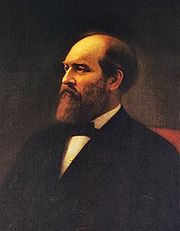
and four other federal judges.
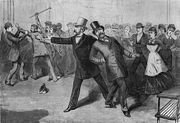 On the morning of July 2, 1881, President Garfield was on his way to his alma mater, Williams College
, where he was scheduled to deliver a speech. Garfield was accompanied by James G. Blaine, Robert Todd Lincoln, and his two sons, James and Harry. As the President was walking through the Sixth Street Station of the Baltimore and Potomac Railroad in Washington at 9:30 am, he was shot twice by an assassin, Charles J. Guiteau
, a disgruntled federal office-seeker armed with a .44 caliber pistol. As Guiteau was being arrested after the shooting, he repeatedly said, "I am a Stalwart of the Stalwarts! I did it and I want to be arrested! Arthur
is President now!" This very briefly led to unfounded suspicions that Arthur or his supporters had put Guiteau up to the crime.
Guiteau was upset over the rejection of his repeated attempts to be appointed as the United States consul in Paris
– a position for which he had no qualifications. He suffered from many delusions, including one that he had produced a speech which he was convinced was pivotal to Garfield's election, and another, that he was destined to be President himself.
Garfield exclaimed immediately after he was shot, "My God, what is this?" One bullet grazed Garfield's arm; the second bullet was thought later to have possibly lodged near his liver but could not be found; and upon autopsy was located behind the pancreas. Alexander Graham Bell
specifically devised a metal detector
to find the bullet, but the device's signal was distorted by the metal bed springs. Garfield became increasingly ill over a period of several weeks due to infection, which caused his heart to weaken. He remained bedridden in the White House with fever and extreme pain.
As the heat of summer became more oppressive for the stricken President, a Navy engineer, with the help of Simon Newcomb, installed in Garfield's room what may have been the world's first air conditioner. An air blower was installed over a chest containing 6 tons of ice, with the air then dried by conduction through a long iron box filled with cotton screens, and connected to the room's heat vent. This device was at times capable of reducing the air temperature to 20°F (11°C) below the outside temperature.
Sympathies for President Garfield poured out across the nation and the world. Condolences came from the King of Italy
and the Rothschilds
. Democratic Kentucky governor Luke P. Blackburn
ordered a day of "public fasting and prayer".
On September 6 the ailing President was moved to the Jersey Shore
in the vain hope that the fresh air and quiet there might aid his recovery. In a matter of hours, local residents put down a special rail spur
for Garfield's train; some of the ties are now part of the Garfield Tea House
. The beach cottage Garfield was taken to has been demolished.
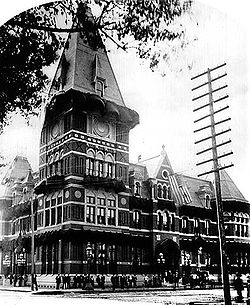 On Monday, September 19, 1881, at 10:20 p.m. President Garfield suffered and died from a massive heart attack
and a ruptured splenic artery
aneurysm
, following blood poisoning and bronchial pneumonia
. Garfield's chief doctor, Dr. Doctor Willard Bliss
(who was a Doctor of Medicine
but whose given name
was also "Doctor"), had unsuccessfully attempted to revive the fading President with restorative medication. Mrs. Garfield, having leaned over Garfield, kissed his brow and exclaimed, "Oh! Why am I made to suffer this cruel wrong?" Garfield was pronounced dead at by Dr. Bliss in the Elberon
section of Long Branch, New Jersey
. Mrs. Garfield remained with her dead husband for over an hour until prompted to leave the room. The wounded President died exactly two months before his 50th birthday. During the 80 days between his shooting and death, his only official act was to sign an extradition
paper. His final words: "My work is done."
According to some historians and medical experts Garfield might have survived his wounds had the doctors attending him had at their disposal today's medical research, techniques, and equipment. Standard medical practice at the time dictated that priority be given to locating the path of the bullet. Several of his doctors inserted their unsterilized
fingers into the wound to probe for the bullet, a common practice in the 1880s. American doctors had not fully accepted the sterilization technique implemented by Joseph Lister
during the 1860s. Historians agree that massive infection was a significant factor in President Garfield's demise. Biographer Peskin stated that medical malpractice did not contribute to Garfield's death; the inevitable infection and blood poisoning that would ensue from a deep bullet wound resulted in multiple organ damage and spinal bone fragmentation.
Guiteau was formally indicted on October 14, 1881, for the murder of the President. Although Guiteau's counsel argued the insanity defense, due to his odd character, the jury found him guilty on January 5, 1882, and he was sentenced to death. Guiteau may have had syphilis
, a disease that causes physiological mental impairment. Guiteau was executed on June 30, 1882. He was also heard to claim that important men in Europe put him up to the task, and had promised to protect him if he were caught.
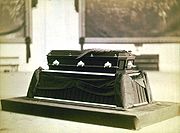 President Garfield's casket and face were viewed by 1,500 people in Long Branch before being loaded on the funeral car. As Garfield's funeral train set out, first to the Capitol and then continuing on a final leg to Cleveland for the burial, the tracks were blanketed with flowers and houses were adorned with flags. More than 70,000 citizens, some waiting over three hours, passed by his coffin as his body lay in state in Washington; later, on September 25, 1881, in Cleveland, more than 150,000—a number equal to the entire population of that city—likewise paid their respects. Garfield's body was viewed in a specially made pavilion powered by electric lighting. A wreath sent by Queen Victoria adorned Garfield's coffin. His body was temporarily interred in a vault in Cleveland's Lake View Cemetery until his permanent memorial was made.
In 1884, a monument to President Garfield was completed by sculptor Frank Happersberger and was placed on the grounds of the San Francisco Conservatory of Flowers
. On the base of the Garfield statue is a figure holding a broken sword symbolizing Garfield's assassinantion.
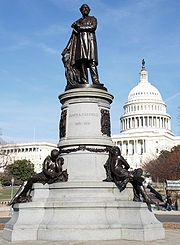
On May 18, 1887, the James A. Garfield Monument
was dedicated in Washington. The monument is a 9 foot bronze statue of Garfield mounted on a 16 foot Baroque style base, located on the U.S. Capitol grounds. Three male figures, each 5 foot in height, are on the base representing Garfield's life stages as a scholar, soldier, and statesman.
In 1889, members of the California gold mining town Bodie
, commemorated Garfield's life and death by inscribing his name on a cenotaph
located in Miners Union Cemetery in Bodie. The monument had initially been made to honor W. S. Bodey, founder of the town, however, the community decided to commemorate the memorial to Garfield.
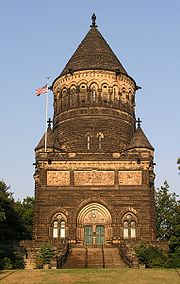 On May 19, 1890, Garfield's body was permanently interred, with great solemnity and fanfare, in a mausoleum
in Lake View Cemetery
in Cleveland . Attending the "impressive" dedication ceremonies were former President Rutherford B. Hayes, then current President Benjamin Harrison, and future President William McKinley. Garfield's former Sec. Windom also attended the ceremony. President Harrison stated that Garfield was always a "student and instructor" and that his life works and death would "continue to be instructive and inspiring incidents in American history". Five panels on the monument display Garfield as a teacher, Union Major General, an orator, taking the Presidential oath, and his body laying in state at the Capitol rotunda in Washington D.C from September 21, 1881 – September 23, 1881.
The U.S. has twice had three presidents in the same year. The first such year was 1841. Martin Van Buren
ended his single term, William Henry Harrison
was inaugurated and died a month later, then Vice President John Tyler
stepped into the vacant office. The second occurrence was in 1881. Rutherford B. Hayes
relinquished the office to James A. Garfield. Upon Garfield's death, Chester A. Arthur
became president.
President Garfield's murder by a deranged federal office seeker awakened public awareness and prompted Congress to pass civil service reform legislation. Senator George H. Pendleton
, a Democrat from Ohio, launched a reform effort that resulted in President Chester A. Arthur signing into law the Pendleton Act in January 1883. This act reversed the "spoils system" where office seekers paid or gave political service in order to obtain or keep federally appointed positions. Under the Pendleton Act, office appointments were awarded on merit and competitive examination. The law made illegal the long-time practice of giving money or service to obtain a federal appointment. To ensure the reform was implemented, Congress and President Arthur established and funded the Civil Service Commission
. The Pendleton Act, however, only covered 10% of federal government workers. President Arthur, who was previously known for having been a "veteran spoilsman", became an avid civil service reformer after President Garfield's assassination.
Garfield's stress on the importance of education for African Americans served as a catalyst for their advancement. As a scholar president, pre-dating Woodrow Wilson
, Garfield was an avid reader having a 3,000-book library that included Horace, Shakespeare, Goethe, Tennyson, and Froude's history of England.
In 1876, Garfield displayed his mathematical talent when he developed a trapezoid proof of the Pythagorean theorem
. His finding was placed in the New England Journal of Education. Math historian William Dunham stated that Garfield's trapezoid work was "really a very clever proof."
President of the United States
The President of the United States of America is the head of state and head of government of the United States. The president leads the executive branch of the federal government and is the commander-in-chief of the United States Armed Forces....
, after completing nine consecutive terms in the U.S. House of Representatives
United States House of Representatives
The United States House of Representatives is one of the two Houses of the United States Congress, the bicameral legislature which also includes the Senate.The composition and powers of the House are established in Article One of the Constitution...
. Garfield's accomplishments as President included a controversial resurgence of Presidential authority above Senatorial courtesy in executive appointments; energizing U.S. naval power; and purging corruption in the Post Office Department. Garfield made notable diplomatic and judiciary appointments, including a U.S. Supreme Court
Supreme Court of the United States
The Supreme Court of the United States is the highest court in the United States. It has ultimate appellate jurisdiction over all state and federal courts, and original jurisdiction over a small range of cases...
justice. Garfield appointed several African Americans to prominent federal positions.
Garfield was a self-made man who came from a modest background, having been raised in obscurity on an Ohio farm by his widow
Widow
A widow is a woman whose spouse has died, while a widower is a man whose spouse has died. The state of having lost one's spouse to death is termed widowhood or occasionally viduity. The adjective form is widowed...
ed mother and brothers. To finance his education Garfield worked as a carpenter, and in 1856 he graduated from Williams College
Williams College
Williams College is a private liberal arts college located in Williamstown, Massachusetts, United States. It was established in 1793 with funds from the estate of Ephraim Williams. Originally a men's college, Williams became co-educational in 1970. Fraternities were also phased out during this...
, Massachusetts
Massachusetts
The Commonwealth of Massachusetts is a state in the New England region of the northeastern United States of America. It is bordered by Rhode Island and Connecticut to the south, New York to the west, and Vermont and New Hampshire to the north; at its east lies the Atlantic Ocean. As of the 2010...
. A year later, Garfield entered politics as a Republican
Republican Party (United States)
The Republican Party is one of the two major contemporary political parties in the United States, along with the Democratic Party. Founded by anti-slavery expansion activists in 1854, it is often called the GOP . The party's platform generally reflects American conservatism in the U.S...
, after campaigning for the party's antislavery platform in Ohio. He married Lucretia Rudolph
Lucretia Garfield
Lucretia Rudolph Garfield , wife of James A. Garfield, was First Lady of the United States in 1881.-Early life:...
in 1858, and in 1860 was admitted to practice law while serving as an Ohio State Senator
Ohio Senate
The Ohio State Senate is the upper house of the Ohio General Assembly, the legislative body for the U.S. state of Ohio. There are 33 State Senators. The state legislature meets in the state capital, Columbus. The President of the Senate presides over the body when in session, and is currently Tom...
(1859–1861). Garfield opposed Confederate secession
Confederate States of America
The Confederate States of America was a government set up from 1861 to 1865 by 11 Southern slave states of the United States of America that had declared their secession from the U.S...
, served as a Major General in the Union Army
Union Army
The Union Army was the land force that fought for the Union during the American Civil War. It was also known as the Federal Army, the U.S. Army, the Northern Army and the National Army...
during the American Civil War
American Civil War
The American Civil War was a civil war fought in the United States of America. In response to the election of Abraham Lincoln as President of the United States, 11 southern slave states declared their secession from the United States and formed the Confederate States of America ; the other 25...
, and fought in the battles of Middle Creek, Shiloh
Battle of Shiloh
The Battle of Shiloh, also known as the Battle of Pittsburg Landing, was a major battle in the Western Theater of the American Civil War, fought April 6–7, 1862, in southwestern Tennessee. A Union army under Maj. Gen. Ulysses S. Grant had moved via the Tennessee River deep into Tennessee and...
and Chickamauga
Battle of Chickamauga
The Battle of Chickamauga, fought September 19–20, 1863, marked the end of a Union offensive in southeastern Tennessee and northwestern Georgia called the Chickamauga Campaign...
. He was first elected to Congress in 1863 as Representative of the 19th District of Ohio.
Throughout Garfield's extended Congressional service after the Civil War, he fervently opposed the Greenback
United States Note
A United States Note, also known as a Legal Tender Note, is a type of paper money that was issued from 1862 to 1971 in the U.S. Having been current for over 100 years, they were issued for longer than any other form of U.S. paper money. They were known popularly as "greenbacks" in their heyday, a...
, and gained a reputation as a skilled orator. He was Chairman of the Military Affairs Committee and the Appropriations Committee
United States House Committee on Appropriations
The Committee on Appropriations is a committee of the United States House of Representatives. It is in charge of setting the specific expenditures of money by the government of the United States...
and a member of the Ways and Means Committee. Garfield initially agreed with Radical Republican views regarding Reconstruction, then favored a moderate approach for civil rights enforcement for Freedmen
Freedman
A freedman is a former slave who has been released from slavery, usually by legal means. Historically, slaves became freedmen either by manumission or emancipation ....
. In 1880, the Ohio legislature elected him to the U.S. Senate
United States Senate
The United States Senate is the upper house of the bicameral legislature of the United States, and together with the United States House of Representatives comprises the United States Congress. The composition and powers of the Senate are established in Article One of the U.S. Constitution. Each...
; in that same year, the leading Republican presidential contenders – Ulysses S. Grant
Ulysses S. Grant
Ulysses S. Grant was the 18th President of the United States as well as military commander during the Civil War and post-war Reconstruction periods. Under Grant's command, the Union Army defeated the Confederate military and ended the Confederate States of America...
, James G. Blaine
James G. Blaine
James Gillespie Blaine was a U.S. Representative, Speaker of the United States House of Representatives, U.S. Senator from Maine, two-time Secretary of State...
and John Sherman
John Sherman (politician)
John Sherman, nicknamed "The Ohio Icicle" , was a U.S. Representative and U.S. Senator from Ohio during the Civil War and into the late nineteenth century. He served as both Secretary of the Treasury and Secretary of State and was the principal author of the Sherman Antitrust Act...
– failed to garner the requisite support at their convention. Garfield became the party's compromise nominee for the 1880 Presidential Election
United States presidential election, 1880
The United States presidential election of 1880 was largely seen as a referendum on the end of Reconstruction in Southern states carried out by the Republicans. There were no pressing issues of the day save tariffs, with the Republicans supporting higher tariffs and the Democrats supporting lower...
and successfully campaigned to defeat Democrat Winfield Hancock
Winfield Scott Hancock
Winfield Scott Hancock was a career U.S. Army officer and the Democratic nominee for President of the United States in 1880. He served with distinction in the Army for four decades, including service in the Mexican-American War and as a Union general in the American Civil War...
in the election.
Garfield's presidency lasted just 200 days—from March 4, 1881, until his death on September 19, 1881, as a result of being shot by assassin Charles J. Guiteau
Charles J. Guiteau
Charles Julius Guiteau was an American lawyer who assassinated U.S. President James A. Garfield. He was executed by hanging.- Background :...
on July 2, 1881. Only William Henry Harrison
William Henry Harrison
William Henry Harrison was the ninth President of the United States , an American military officer and politician, and the first president to die in office. He was 68 years, 23 days old when elected, the oldest president elected until Ronald Reagan in 1980, and last President to be born before the...
's presidency, of 32 days, was shorter. Garfield was the second of four United States Presidents who were assassinated. President Garfield advocated a bi-metal monetary system
Bimetallism
In economics, bimetallism is a monetary standard in which the value of the monetary unit is defined as equivalent both to a certain quantity of gold and to a certain quantity of silver; such a system establishes a fixed rate of exchange between the two metals...
, agricultural technology, an educated electorate, and civil rights for African American
African American
African Americans are citizens or residents of the United States who have at least partial ancestry from any of the native populations of Sub-Saharan Africa and are the direct descendants of enslaved Africans within the boundaries of the present United States...
s. He proposed substantial civil service reform, eventually passed in 1883 by his successor, Chester A. Arthur
Chester A. Arthur
Chester Alan Arthur was the 21st President of the United States . Becoming President after the assassination of President James A. Garfield, Arthur struggled to overcome suspicions of his beginnings as a politician from the New York City Republican machine, succeeding at that task by embracing...
, as the Pendleton Civil Service Reform Act
Pendleton Civil Service Reform Act
The Pendleton Civil Service Reform Act of United States is a federal law established in 1883 that stipulated that government jobs should be awarded on the basis of merit. The act provided selection of government employees competitive exams, rather than ties to politicians or political affiliation...
.
Childhood
Moreland Hills, Ohio
Moreland Hills is a village in Cuyahoga County, Ohio, United States. It is an affluent suburb of Cleveland. The population was 3,320 at the 2010 census.-History:...
. His father, Abram Garfield, known locally as a wrestler, died when Garfield was 17 months old. Of Welsh
Wales
Wales is a country that is part of the United Kingdom and the island of Great Britain, bordered by England to its east and the Atlantic Ocean and Irish Sea to its west. It has a population of three million, and a total area of 20,779 km²...
ancestry, he was reared and cared for by his mother, Eliza Ballou, who said, "He was the largest babe I had and looked like a red Irishman." Garfield's parents joined Disciples of Christ Church, which profoundly influenced their son. Garfield was able to receive rudimentary education at a village school in Orange, listening and discussing books read. Garfield knew he needed money to advance his learning.
At age 16, he struck out on his own, drawn seaward by dreams of being a seaman, and got a job for six weeks as a canal driver near Cleveland. Illness forced him to return home and, once recuperated, he began school at Geauga Academy, where he became keenly interested in academics, both learning and teaching. Garfield worked as a carpenter to support himself financially at the academy. Garfield later said of this early time, "I lament that I was born to poverty, and in this chaos of childhood, seventeen years passed before I caught any inspiration...a precious 17 years when a boy with a father and some wealth might have become fixed in manly ways." In 1849, he accepted an unsought position as a teacher, and thereafter developed an aversion to what he called "place seeking," which became, he said, "the law of my life." In 1850 Garfield resumed his church attendance and was baptized.
Education, marriage and early career
Hiram College
Hiram College is a private liberal arts college located in Hiram, Ohio. Founded by Amos Sutton Hayden of the Disciples of Christ Church in 1850, the institution has, since its first days, been nonsectarian and coeducational, and throughout its existence Hiram College has sustained this egalitarian...
) in Hiram, Ohio
Hiram, Ohio
Hiram is a village in Portage County, Ohio, United States. It was formed from portions of Hiram Township in the Connecticut Western Reserve. The population was 1,242 at the 2000 census...
, where he was taught by Platt Rogers Spencer
Platt Rogers Spencer
Platt Rogers Spencer was born in East Fishkill, New York, on November 7, 1800, and died in Geneva, Ohio, on May 16, 1864. Spencer is credited as being the originator of Spencerian penmanship, a popular system of cursive handwriting....
. While at Eclectic, he was most interested in the study of Greek and Latin, and he was also engaged to teach. He developed a regular preaching circuit at neighboring churches, in some cases earning a gold dollar per service. Garfield then enrolled at Williams College in Williamstown, Massachusetts
Williamstown, Massachusetts
Williamstown is a town in Berkshire County, in the northwest corner of Massachusetts. It shares a border with Vermont to the north and New York to the west. It is part of the Pittsfield, Massachusetts Metropolitan Statistical Area. The population was 7,754 at the 2010 census...
, where he joined the Delta Upsilon
Delta Upsilon
Delta Upsilon is the sixth oldest international, all-male, college Greek-letter organization, and is the oldest non-secret fraternity in North America...
fraternity and graduated in 1856 as an outstanding student. Garfield was quite impressed with the college President, Mark Hopkins
Mark Hopkins (educator)
Mark Hopkins was an American educator and theologian.-Life and career:Great-nephew of the theologian Samuel Hopkins, Mark Hopkins was born in Stockbridge, Massachusetts...
, about whom he said, "The ideal college is Mark Hopkins on one end of a log with a student on the other." Garfield earned a reputation as a skilled debater and was made President of the Philogian Society and Editor of the Williams Quarterly.
After preaching briefly at Franklin Circle Christian Church (1857–58), Garfield gave up on that vocation and applied for a job as principal of a high school in Poestenkill, New York
Poestenkill (town), New York
Poestenkill is a town in Rensselaer County, New York, United States. The population was 4,054 at the 2000 census. The town is named after the Poesten Kill, an important stream in the area. The words "poesten kil" are traditionally supposed to signify "foaming water" or "foaming creek" in Dutch...
. After another applicant had been chosen, he returned to teach at the Eclectic Institute. Garfield was an instructor in classical languages for the 1856–1857 academic year and was made Principal of the Institute from 1857 to 1860, successfully restoring it to viability after it had fallen on hard times. During this time, Garfield revealed himself to be sympathetic with the views of moderate Republicans, though he was not yet a party man. While he did not consider himself an abolitionist
Abolitionism
Abolitionism is a movement to end slavery.In western Europe and the Americas abolitionism was a movement to end the slave trade and set slaves free. At the behest of Dominican priest Bartolomé de las Casas who was shocked at the treatment of natives in the New World, Spain enacted the first...
, he was opposed to slavery. After Garfield finished his education, between the 1857 and 1858 elections, he began his career in politics as a "vigorous" stump speaker
Stump speech (politics)
A political stump speech is a standard speech used by a politician running for office. The term derives from the custom in 19th century America for political candidates campaigning from town to town to stand upon a sawed off tree stump to deliver a standard speech...
in support of the Republican Party and their anti-slavery cause. In 1858, a migrant freethinker and evolutionary named Denton challenged him to a debate (Charles Darwin
Charles Darwin
Charles Robert Darwin FRS was an English naturalist. He established that all species of life have descended over time from common ancestry, and proposed the scientific theory that this branching pattern of evolution resulted from a process that he called natural selection.He published his theory...
's Origin of Species was published the next year). The debate, which lasted over a week, was considered as won convincingly by Garfield.
Lucretia Garfield
Lucretia Rudolph Garfield , wife of James A. Garfield, was First Lady of the United States in 1881.-Early life:...
, known as "Crete" to friends, and a former star Greek pupil of Garfield's. They had seven children (five sons and two daughters): Eliza Arabella Garfield (1860–63); Harry Augustus Garfield
Harry Augustus Garfield
Harry Augustus "Hal" Garfield was an American lawyer, academic and public official. He was president of Williams College and supervised the Federal Fuel Administration during World War I.-Biography:He was the son of U.S. President James A...
(1863–1942); James Rudolph Garfield
James Rudolph Garfield
James Rudolph Garfield was an American politician, lawyer and son of President James Abram Garfield and First Lady Lucretia Garfield. He was Secretary of the Interior during Theodore Roosevelt's administration....
(1865–1950); Mary Garfield (1867–1947); Irvin M. Garfield (1870–1951); Abram Garfield (1872–1958); and Edward Garfield (1874–76). One son, James R. Garfield, followed him into politics and became Secretary of the Interior
United States Secretary of the Interior
The United States Secretary of the Interior is the head of the United States Department of the Interior.The US Department of the Interior should not be confused with the concept of Ministries of the Interior as used in other countries...
under President Theodore Roosevelt
Theodore Roosevelt
Theodore "Teddy" Roosevelt was the 26th President of the United States . He is noted for his exuberant personality, range of interests and achievements, and his leadership of the Progressive Movement, as well as his "cowboy" persona and robust masculinity...
.
Garfield gradually became discontented with teaching and began to study law in 1859. He was admitted to the Ohio bar
Bar (law)
Bar in a legal context has three possible meanings: the division of a courtroom between its working and public areas; the process of qualifying to practice law; and the legal profession.-Courtroom division:...
in 1860. Before admission to the bar, he was invited to enter politics by local Republican Party leaders upon the death of Cyrus Prentiss, the presumed nominee for the state senate seat for the 26th District in Ohio. He was nominated by the party convention and then elected an Ohio state senator in 1859, serving until 1861. Garfield's signature effort in the state legislature was a bill providing for the state's first geological survey
Geological survey
The term geological survey can be used to describe both the conduct of a survey for geological purposes and an institution holding geological information....
to measure its mineral resources. His initial observations about the nation leading up to the Civil War
American Civil War
The American Civil War was a civil war fought in the United States of America. In response to the election of Abraham Lincoln as President of the United States, 11 southern slave states declared their secession from the United States and formed the Confederate States of America ; the other 25...
were that secession was quite inconceivable. His response was in part a renewed zeal for the July 4 celebrations in 1860.
After Abraham Lincoln
Abraham Lincoln
Abraham Lincoln was the 16th President of the United States, serving from March 1861 until his assassination in April 1865. He successfully led his country through a great constitutional, military and moral crisis – the American Civil War – preserving the Union, while ending slavery, and...
's election, Garfield was more inclined to arms than negotiations, saying, "Other states may arm to the teeth, but if Ohio so much as cleans her rusty muskets, it is said to have offended our brethren in the South. I am weary of this weakness." On February 13, 1861, the newly elected President Lincoln arrived in Cincinnati
Cincinnati, Ohio
Cincinnati is a city in the U.S. state of Ohio. Cincinnati is the county seat of Hamilton County. Settled in 1788, the city is located to north of the Ohio River at the Ohio-Kentucky border, near Indiana. The population within city limits is 296,943 according to the 2010 census, making it Ohio's...
by train to make a speech. Garfield observed that Lincoln was "distressingly homely", yet had "the tone and bearing of a fearless, firm man."
Under Buell's command
American Civil War
The American Civil War was a civil war fought in the United States of America. In response to the election of Abraham Lincoln as President of the United States, 11 southern slave states declared their secession from the United States and formed the Confederate States of America ; the other 25...
, Garfield quickly grew frustrated with his vain efforts to obtain an officer's commission in the Union Army
Union Army
The Union Army was the land force that fought for the Union during the American Civil War. It was also known as the Federal Army, the U.S. Army, the Northern Army and the National Army...
. Ohio Governor William Dennison, Jr. charged him with a mission to travel to Illinois
Illinois
Illinois is the fifth-most populous state of the United States of America, and is often noted for being a microcosm of the entire country. With Chicago in the northeast, small industrial cities and great agricultural productivity in central and northern Illinois, and natural resources like coal,...
to acquire musketry and to negotiate with the Governors of Illinois and Indiana
Indiana
Indiana is a US state, admitted to the United States as the 19th on December 11, 1816. It is located in the Midwestern United States and Great Lakes Region. With 6,483,802 residents, the state is ranked 15th in population and 16th in population density. Indiana is ranked 38th in land area and is...
for the consolidation of troops. In the summer of 1861 he was finally commissioned a Colonel in the Union Army and given command of the 42nd Ohio Volunteer Infantry
42nd Ohio Infantry
The 42nd Ohio Volunteer Infantry was an infantry regiment in the Union Army during the American Civil War.-Service:The 42nd Ohio Infantry was organized at Camp Chase in Columbus, Ohio September through November 1861 and mustered in for three years service on December 7, 1861 under the command of...
.
General Don Carlos Buell
Don Carlos Buell
Don Carlos Buell was a career United States Army officer who fought in the Seminole War, the Mexican-American War, and the American Civil War. Buell led Union armies in two great Civil War battles—Shiloh and Perryville. The nation was angry at his failure to defeat the outnumbered...
assigned Colonel Garfield the task of driving Confederate
Confederate States Army
The Confederate States Army was the army of the Confederate States of America while the Confederacy existed during the American Civil War. On February 8, 1861, delegates from the seven Deep South states which had already declared their secession from the United States of America adopted the...
forces out of eastern Kentucky
Kentucky
The Commonwealth of Kentucky is a state located in the East Central United States of America. As classified by the United States Census Bureau, Kentucky is a Southern state, more specifically in the East South Central region. Kentucky is one of four U.S. states constituted as a commonwealth...
in November 1861, giving him the 18th Brigade for the campaign. In December, he departed Catlettsburg, Kentucky
Catlettsburg, Kentucky
Catlettsburg is a city in Boyd County, Kentucky, United States and is the county seat of Boyd County. The city population was 1,960 at the 2000 census. The city's postal ZIP code serves a greater population of 10,029, which is a better reflection of the community's size. Catlettsburg is a part of...
, with the 40th Ohio Infantry
40th Ohio Infantry
The 40th Ohio Volunteer Infantry was an infantry regiment in the Union Army during the American Civil War.-Service:The 40th Ohio Infantry was organized at Camp Chase in Columbus, Ohio September through November 1861 and mustered in for three years service on December 7, 1861 under the command of...
, the 42nd Ohio Infantry, the 14th Kentucky Infantry
14th Regiment Kentucky Volunteer Infantry
The 14th Kentucky Volunteer Infantry Regiment was an infantry regiment that served in the Union Army during the American Civil War.-Service:...
, and the 22nd Kentucky Infantry
22nd Regiment Kentucky Volunteer Infantry
The 22nd Kentucky Volunteer Infantry Regiment was an infantry regiment that served in the Union Army during the American Civil War.-Service:The 22nd Kentucky Infantry was organized at Louisa, Kentucky and mustered in on January 20, 1862....
, as well as the 2nd (West) Virginia Cavalry and McLoughlin's Squadron of Cavalry. The march was uneventful until Union forces reached Paintsville, Kentucky
Paintsville, Kentucky
-Demographics:As of the census of 2000, there were 4,132 people, 1,681 households, and 1,079 families residing in the city. The population density was 786.1 people per square mile . There were 1,901 housing units at an average density of 361.7 per square mile...
, on January 6, 1862, where Garfield's cavalry engaged the Confederates at Jenny's Creek. Garfield artfully positioned his troops so as to deceive Marshall into thinking that he was outnumbered, when in fact he was not. The Confederates, under Brig. Gen.
Brigadier General
Brigadier general is a senior rank in the armed forces. It is the lowest ranking general officer in some countries, usually sitting between the ranks of colonel and major general. When appointed to a field command, a brigadier general is typically in command of a brigade consisting of around 4,000...
Humphrey Marshall
Humphrey Marshall (general)
Humphrey Marshall was a four-term antebellum United States Congressman and a brigadier general in the Confederate States Army and a Confederate Congressman during the American Civil War.-Early life and career:...
, withdrew to the forks of Middle Creek, two miles (3 km) from Prestonsburg, Kentucky
Prestonsburg, Kentucky
Prestonsburg is a city in and the county seat of Floyd County, Kentucky, United States. It lies in the eastern part of the state, along the banks of the Levisa Fork of the Big Sandy River. It was founded in 1797 by Col. John Preston—for whom it was named—along with Solomon Stratton, Matthias...
, on the road to Virginia
Virginia
The Commonwealth of Virginia , is a U.S. state on the Atlantic Coast of the Southern United States. Virginia is nicknamed the "Old Dominion" and sometimes the "Mother of Presidents" after the eight U.S. presidents born there...
. Garfield attacked on January 9, 1862. At the end of the day's fighting the Confederates withdrew from the field, but Garfield did not pursue them, opting instead to withdraw to Prestonsburg
Prestonsburg, Kentucky
Prestonsburg is a city in and the county seat of Floyd County, Kentucky, United States. It lies in the eastern part of the state, along the banks of the Levisa Fork of the Big Sandy River. It was founded in 1797 by Col. John Preston—for whom it was named—along with Solomon Stratton, Matthias...
so he could resupply his men. His victory brought him early recognition and he was promoted to the rank of brigadier general on January 11.
Garfield later commanded the 20th Brigade of Ohio under Buell at the Battle of Shiloh
Battle of Shiloh
The Battle of Shiloh, also known as the Battle of Pittsburg Landing, was a major battle in the Western Theater of the American Civil War, fought April 6–7, 1862, in southwestern Tennessee. A Union army under Maj. Gen. Ulysses S. Grant had moved via the Tennessee River deep into Tennessee and...
, where he led troops in an attempt, delayed by weather, to reinforce Maj Gen. Ulysses S. Grant
Ulysses S. Grant
Ulysses S. Grant was the 18th President of the United States as well as military commander during the Civil War and post-war Reconstruction periods. Under Grant's command, the Union Army defeated the Confederate military and ended the Confederate States of America...
, after a surprise attack by Confederate General Albert S. Johnston
Albert Sidney Johnston
Albert Sidney Johnston served as a general in three different armies: the Texas Army, the United States Army, and the Confederate States Army...
. He then served under Thomas J. Wood
Thomas J. Wood
Thomas John Wood was a career United States Army officer and a Union general during the American Civil War.-Early life and career:...
in the Siege of Corinth
Siege of Corinth
The Siege of Corinth was an American Civil War battle fought from April 29 to May 30, 1862, in Corinth, Mississippi.-Background:...
, where he assisted in the pursuit of Confederates in retreat by the overly-cautious Maj. Gen. Henry W. Halleck, which resulted in the escape of Gen. P. G. T. Beauregard
P. G. T. Beauregard
Pierre Gustave Toutant Beauregard was a Louisiana-born American military officer, politician, inventor, writer, civil servant, and the first prominent general of the Confederate States Army during the American Civil War. Today he is commonly referred to as P. G. T. Beauregard, but he rarely used...
and his troops. This engendered in the furious Garfield a lasting distrust of the training at West Point. Garfield's philosophy of war in 1862—to aggressively carry the war to Southern civilians—was not then shared by the Union leadership. The tactic was later adopted and demonstrated in the campaigns of Generals Sherman
William Tecumseh Sherman
William Tecumseh Sherman was an American soldier, businessman, educator and author. He served as a General in the Union Army during the American Civil War , for which he received recognition for his outstanding command of military strategy as well as criticism for the harshness of the "scorched...
and Sheridan
Philip Sheridan
Philip Henry Sheridan was a career United States Army officer and a Union general in the American Civil War. His career was noted for his rapid rise to major general and his close association with Lt. Gen. Ulysses S...
.
Garfield made the following comment in 1862 concerning slavery: "...if a man is black, be he friend or foe, he is thought best kept at a distance. It is hardly possible God will let us succeed while such enormities are practiced." That summer his health suddenly deteriorated, including jaundice and significant weight loss. (Biographer Peskin speculated this may have been infectious hepatitis.) Garfield was forced to return home, where his wife nursed him back to health and their marriage was reinvigorated. He returned to duty that autumn and served on the Court-martial of Fitz John Porter
Court-martial of Fitz John Porter
The court-martial of Fitz John Porter was a major event of the American Civil War. Major General Fitz John Porter was found guilty of disobeying a lawful order, and misconduct in front of the enemy and removed from command based on internal political machinations of the Union...
. Garfield was then sent to Washington to receive further orders. With great frustration, he repeatedly received tentative assignments, extended and later reversed, to stations in Florida, Virginia and South Carolina. During this idleness time in Washington waiting for an assignment, Garfield had an affair with Lucia Calhoun. He later admitted the affair to his wife who forgave him.
Chief of staff for Rosecrans
Army of the Cumberland
The Army of the Cumberland was one of the principal Union armies in the Western Theater during the American Civil War. It was originally known as the Army of the Ohio.-History:...
; his influence in this position was greater than usual – with duties extending beyond mere communication to actual management of Rosecrans's army. Rosecrans, a highly energetic man, had a voracious appetite for conversation, which he deployed when he was unable to sleep; in Garfield he had found "the first well read person in the Army" and thus the ideal candidate for endless discussions through the night. The two became close, and covered all topics, especially religion; Rosecrans succeeded in softening Garfield's view of Catholicism. Garfield, with his enhanced influence, created an intelligence corps unsurpassed in the Union Army. He also recommended that Rosecrans should replace wing commanders Alexander McCook and Thomas Crittenden
Thomas Leonidas Crittenden
Thomas Leonidas Crittenden was a lawyer, politician, and Union general during the American Civil War.-Early life:...
due to their prior ineffectiveness. Rosecrans ignored these recommendations, with drastic consequences later, in the Battle of Chickamauga
Battle of Chickamauga
The Battle of Chickamauga, fought September 19–20, 1863, marked the end of a Union offensive in southeastern Tennessee and northwestern Georgia called the Chickamauga Campaign...
. Garfield crafted a campaign designed to pursue and then trap Confederate General Braxton Bragg
Braxton Bragg
Braxton Bragg was a career United States Army officer, and then a general in the Confederate States Army—a principal commander in the Western Theater of the American Civil War and later the military adviser to Confederate President Jefferson Davis.Bragg, a native of North Carolina, was...
in Tullahoma. The army advanced to that point with success, but Bragg retreated toward Chattanooga. Rosecrans then stalled his army's move against Bragg and made repeated requests for additional troops and supplies. Garfield argued with his superior for an immediate advance, also insisted upon by Lincoln and Rosecrans's commander, Gen. Halleck. Garfield conceived a plan to conduct a cavalry raid behind Bragg's line (similar to that Bragg was employing against Rosecrans) which Rosecrans approved; the raid, led by Abel Streight, failed, due in part to poor execution and weather. Garfield's detractors later claimed his concept was flawed. To address the continued dispute over whether to advance, Rosecrans called a war council of his generals; 10 of the 15 were opposed to the move, with Garfield voting in favor. Nevertheless Garfield, in an unusual move, drew up a report of the council's deliberations, and thus convinced Rosecrans to proceed with an advance against Bragg.
At the Battle of Chickamauga, Rosecrans issued an order which sought to fill a gap in his line, but which actually created one. As a result, his right flank was routed. Rosecrans concluded that the battle was lost and headed for Chattanooga to establish a defensive line. Garfield, however, thought that part of the army had held and, with Rosecrans's approval, headed across Missionary Ridge
Missionary Ridge
Missionary Ridge is a geographic feature in Chattanooga, Tennessee, site of the Battle of Missionary Ridge, a battle in the American Civil War, fought on November 25, 1863. Union forces under Maj. Gens. Ulysses S. Grant, William T. Sherman, and George H...
to survey the Union status. Garfield's hunch was correct; his ride became legendary, while Rosecrans' error reinforced critical opinions about his leadership. While Rosecrans's army had avoided complete loss, they were left in Chattanooga surrounded by Bragg's army. Garfield sent a telegram to Secretary of War Edwin M. Stanton
Edwin M. Stanton
Edwin McMasters Stanton was an American lawyer and politician who served as Secretary of War under the Lincoln Administration during the American Civil War from 1862–1865...
alerting Washington to the need for reinforcements to avoid annihilation. As a result, Lincoln and Halleck succeeded in delivering 20,000 troops to Chattanooga by rail within nine days. One of Grant's early decisions upon assuming command of the Union Army was to replace Rosecrans with George H. Thomas. Garfield was issued orders to report to Washington, where he was promoted to Major General; shortly thereafter he gave an unambiguously abolitionist speech in Maryland. He was unsure of whether he should return to the field or assume the Ohio congressional seat he had won in October 1862. After a discussion with Lincoln, he decided in favor of the latter and resigned his commission. According to historian Jean Edward Smith
Jean Edward Smith
Jean Edward Smith, Ph.D is professor at Marshall University and biographer. Currently he is the John Marshall Professor of Political Science at Marshall University and professor emeritus at the University of Toronto after having served as professor of political economy there for thirty-five years...
, Grant and Garfield had a "guarded relationship", since Grant put Thomas in charge of the Army of the Cumberland, rather than Garfield, after Rosecrans was dismissed.
Garfield communicated his frustration with Rosecrans in a confidential letter to his friend Secretary of the Treasury Salmon P. Chase
Salmon P. Chase
Salmon Portland Chase was an American politician and jurist who served as U.S. Senator from Ohio and the 23rd Governor of Ohio; as U.S. Treasury Secretary under President Abraham Lincoln; and as the sixth Chief Justice of the United States Supreme Court.Chase was one of the most prominent members...
. Garfield's detractors later used this letter, which Chase never personally disclosed, to foster widespread criticism of Garfield as a betrayer, despite the fact that Halleck and Lincoln shared the same concerns over Rosecrans's reluctance to attack, and that Garfield had openly conveyed his concerns to Rosecrans. In later years, Charles Dana
Charles Anderson Dana
Charles Anderson Dana was an American journalist, author, and government official, best known for his association with Ulysses S. Grant during the American Civil War and his aggressive political advocacy after the war....
of the New York Sun allegedly had sources indicating that Garfield had publicly stated that Rosecrans had fled the battlefield during the Battle of Chickamauga. According to biographer Peskin, the credibility of the information and the sources used are questionable. According to historian Bruce Catton
Bruce Catton
Charles Bruce Catton was an American historian and journalist, best known for his books on the American Civil War. Known as a narrative historian, Catton specialized in popular histories that emphasized colorful characters and historical vignettes, in addition to the basic facts, dates, and analyses...
, Garfield's statements influenced the Lincoln administration to find a replacement for Rosecrans.
Election in 1862 and first term
While serving in the army in early 1862, Garfield was approached by friends about political opportunities resulting from the redrawn 19th Ohio Congressional District; it was believed that the incumbent, John HutchinsJohn Hutchins
John Hutchins was a U.S. Representative from Ohio.Hutchins was born in Vienna, Ohio. He was a first cousin of future congressman Wells Andrews Hutchins. He attended the district schools and Western Reserve College in Cleveland, Ohio...
, was vulnerable. Garfield was conflicted – he was sure that he could better serve in Congress than in camp, but he was determined that his military position not be used as a stepping stone to political advancement. He therefore resorted to his long-held objection to "place-seeking", expressed a willingness to serve if elected, and otherwise left the matter to others. Garfield was nominated at the Republican convention on the 75th roll call vote. In October 1862 he defeated D.B. Woods by a two-to-one margin in the general election for the District's House seat in the 38th Congress
38th United States Congress
-House of Representatives:Before this Congress, the 1860 United States Census and resulting reapportionment changed the size of the House to 241 members...
.
After the election, Garfield was anxious to determine his next military assignment and went to Washington for this purpose. While there, he developed a close alliance with Salmon P. Chase, Lincoln's Treasury Secretary. Garfield became a member of the Radical Republicans, led by Chase, in contrast with the moderate wing of the party, led by Lincoln and Montgomery Blair
Montgomery Blair
Montgomery Blair , the son of Francis Preston Blair, elder brother of Francis Preston Blair, Jr. and cousin of B. Gratz Brown, was a politician and lawyer from Maryland...
. Garfield was as frustrated with Lincoln's lack of aggressiveness in pursuing the rebel enemy as Lincoln had been with Gen. McClellan. Chase and Garfield shared a disdain for West Point and the President, though Garfield praised the Emancipation Proclamation
Emancipation Proclamation
The Emancipation Proclamation is an executive order issued by United States President Abraham Lincoln on January 1, 1863, during the American Civil War using his war powers. It proclaimed the freedom of 3.1 million of the nation's 4 million slaves, and immediately freed 50,000 of them, with nearly...
. Garfield also shared a negative view of General McClellan, whom he considered the epitome of the Democratic
Democratic Party (United States)
The Democratic Party is one of two major contemporary political parties in the United States, along with the Republican Party. The party's socially liberal and progressive platform is largely considered center-left in the U.S. political spectrum. The party has the lengthiest record of continuous...
, pro-slavery, poorly-trained West Point generals.
Garfield became enthralled by the economic and financial policy discussions in Chase's office, and these subjects became his lifelong passion and expertise. Like Chase, Garfield became a staunch proponent of "honest money" or "specie payment" backed by a gold standard
Gold standard
The gold standard is a monetary system in which the standard economic unit of account is a fixed mass of gold. There are distinct kinds of gold standard...
, and was therefore a strong opponent of the "greenback
Greenback (money)
The term greenback refers to paper currency that was issued by the United States during the American Civil War.There are at least two types of notes that were called greenback:*United States Note*Demand Note...
"; he regretted very much, but understood, the necessity for suspension of specie payment
Specie Payment Resumption Act
Late in 1861, the United States federal government suspended specie payments, seeking to raise revenue for the American Civil War effort without exhausting its reserves of gold and silver. Early in 1862, the United States issued legal-tender notes, called greenbacks...
during the emergency presented by the Civil War.
Although his desire was to continue his Army service, Garfield reluctantly took his seat in Congress upon resigning his military commission in December 1863. His first-born three-year-old child Eliza suddenly died that same month. Although he initially took a room by himself, his grief over the death of Eliza compelled him to find a roommate, which he did—Robert C. Schenck
Robert C. Schenck
Robert Cumming Schenck was a Union Army general in the American Civil War, and American diplomatic representative to Brazil and the United Kingdom. He was at both battles of Bull Run and took part in the Shenandoah Valley Campaign of 1862, and the Battle of Cross Keys...
. After Garfield's term ended, Lucretia moved to Washington to be with her husband, and the two, thereafter, never lived apart.
Garfield immediately showed an ability to command the attention of the unruly House. According to a reporter, "...when he takes the floor, Garfield's voice is heard above all others. Every ear attends...his eloquent words move the heart, convince the reason, and tell the weak and wavering which way to go." He was one of the more hawkish Republicans in the House, and served on Schenck's Military Affairs Committee
United States Senate Committee on Armed Services
The Committee on Armed Services is a committee of the United States Senate empowered with legislative oversight of the nation's military, including the Department of Defense, military research and development, nuclear energy , benefits for members of the military, the Selective Service System and...
, which brought him prominence in the midst of the predominant war issues. Garfield aggressively promoted the need for a military draft, an issue almost all others shunned.
Early in his tenure, he differed from his party on several issues; his was the solitary Republican vote to terminate the use of bounties in recruiting. Some financially-able recruits had used the bounty system to buy their way out of service (called commutation), which he considered reprehensible. After many false starts, Garfield, with the support of Lincoln, procured the passage of an aggressive conscription bill which excluded commutation. In 1864 Congress passed a bill to revive the rank of Lieutenant General
Lieutenant General (United States)
In the United States Army, the United States Air Force and the United States Marine Corps, lieutenant general is a three-star general officer rank, with the pay grade of O-9. Lieutenant general ranks above major general and below general...
. Garfield, who shared the opinion of Thaddeus Stevens
Thaddeus Stevens
Thaddeus Stevens , of Pennsylvania, was a Republican leader and one of the most powerful members of the United States House of Representatives...
, was not in favor of this action, because the rank was intended for Grant, who had dismissed Rosecrans. Also, the recipient would thereby be given an advantage in possibly opposing Lincoln in the next election. Garfield was nevertheless very tentative in his support for the President's re-election.
Garfield, aligned with the Radical Republicans on some issues, not only favored abolition, but early in his career believed that the leaders of the rebellion had forfeited their constitutional rights. He supported the confiscation of southern plantations and even exile or execution of rebellion leaders as a means to ensure the permanent destruction of slavery. He felt Congress was obliged "to determine what legislation is necessary to secure equal justice to all loyal persons, without regard to color." With respect to the Presidential election of 1864, Garfield did not consider Lincoln particularly worthy of re-election, but no other viable alternative was available. "I have no candidate for President. I am a sad and sorrowful spectator of events." He attended the party convention and promoted Rosecrans for the V.P. nomination; this was greeted by Rosecrans's characteristic indecision, so the nomination went to Andrew Johnson
Andrew Johnson
Andrew Johnson was the 17th President of the United States . As Vice-President of the United States in 1865, he succeeded Abraham Lincoln following the latter's assassination. Johnson then presided over the initial and contentious Reconstruction era of the United States following the American...
. Garfield voted with the Radical Republicans in passing the Wade–Davis Bill, designed to give Congress more authority over Reconstruction, but the bill was defeated by Lincoln's pocket veto
Pocket veto
A pocket veto is a legislative maneuver in United States federal lawmaking that allows the President to veto a bill indirectly.The U.S. Constitution limits the President's period for decision on whether to sign or veto any legislation to ten days while the United States Congress is in session...
.
1864 election and second term
In the 1864 Congressional election, Garfield's district base weakened due to his refusal to support Lincoln's re-election, but was reinvigorated when he reminded his constituents of his traditional disdain of partisanship; he was then nominated by acclamation and his re-election was assured. While resting after the election, Lucretia gave him a note indicating they had been together only 20 out of the 57 weeks since his first election; he immediately resolved to take her and the family with him to live in Washington. As the war's end approached, work on the Military Affairs Committee began to wind down; the idle time resulted in weariness of Washington politics, and Garfield increased his focus on his personal finances.Garfield partnered with Ralph Plumb
Ralph Plumb
Ralph Plumb was a U.S. Representative from Illinois.Born in Busti, New York, Plumb attended the common schools.He engaged in mercantile pursuits.He moved to Ohio....
in land speculation hoping to become wealthy, but this met with limited success. He joined with the Philadelphia-based Phillips brothers in an oil exploration investment which was moderately profitable. Garfield resumed the practice of law in 1865 as a means to improve his personal finances. His investment efforts took him to Wall Street where, the day after Lincoln's assassination, a riotous crowd led him into an impromptu speech, in part as follows: "Fellow citizens! Clouds and darkness are round about Him! His pavilion is dark waters and thick clouds of the skies! Justice and judgment are the establishment of His throne! Mercy and truth shall go before His face! Fellow citizens! God reigns, and the Government at Washington still lives!" According to witnesses the effect was tremendous and the crowd was immediately calmed. This became one of the most well-known incidents of his career.
Garfield's radicalism moderated after the civil war and Lincoln's assassination, and he assumed a temporary role as peacemaker between Congress and Andrew Johnson. At this time he commented on the readmission of the confederate states: "The burden of proof rests on each of them to show whether it is fit again to enter the federal circle in full communion of privilege. They must give us proof, strong as holy writ, that they have washed their hands and are worthy again to be trusted." When Johnson's veto terminated the Freedman's Bureau, the President had effectively entrenched himself against Congress, and Garfield rejoined the Radical camp.
With a reduced agenda on the Military Affairs Committee, Garfield was placed on the House Ways and Means Committee
United States House Committee on Ways and Means
The Committee of Ways and Means is the chief tax-writing committee of the United States House of Representatives. Members of the Ways and Means Committee are not allowed to serve on any other House Committees unless they apply for a waiver from their party's congressional leadership...
, a long-awaited opportunity to focus exclusively on financial and economic issues. He immediately reprised his opposition to the greenback, saying, "any party which commits itself to paper money will go down amid the general disaster, covered with the curses of a ruined people." He called greenbacks "the printed lies of the government" and became obsessed with the morality, as well as the legality, of specie payment, and enforcement of the gold standard. This policy was against his personal interests; his investment profits were dependent upon inflation, the by-product of the greenback. His demand for "hard money" was distinctly deflationary in nature, and was opposed by most businessmen and politicians. For a time, Garfield appeared to be the only Ohio politician to hold this position.
As a proponent of laissez-faire on the economic front, he declared, "the chief duty of the government is to keep the peace and stand out of the sunshine of the people." This view was in stark contrast to his view of the role of government in reconstruction efforts. Another inconsistency in Garfield's laissez-faire philosophy was his position on free trade – he favored the tariff
Tariff
A tariff may be either tax on imports or exports , or a list or schedule of prices for such things as rail service, bus routes, and electrical usage ....
, out of political necessity – when it served to protect his district's products.
Garfield was one of three attorneys who argued for the petitioners in the famous Supreme Court case Ex parte Milligan
Ex parte Milligan
Ex parte Milligan, , was a United States Supreme Court case that ruled that the application of military tribunals to citizens when civilian courts are still operating is unconstitutional. It was also controversial because it was one of the first cases after the end of the American Civil...
in 1866. This was, despite many years of practicing law, Garfield's first court appearance. Jeremiah Black had taken him in as a junior partner a year before, and assigned the case to him in light of his highly reputed oratory skills. The petitioners were pro-Confederate northern men who had been found guilty and sentenced to death by a military court for treasonous activities. The case turned on whether the defendants should instead have been tried by a civilian court; Garfield was victorious, and instantly achieved a reputation as a preeminent appellate lawyer.
1866 election and third term
Garfield returned to Washington very glum in spite of his success, taking the campaign criticism quite hard. He was disgusted as well at what he thought was insane talk of impeaching President Johnson. With respect to Reconstruction, he thought Congress had been magnanimous in its offers to the South. When the rebels responded to this as a sign of weakness to be exploited by further demands, he was quite prepared to renew his view of them as enemies of the Union. This attitude was popular back home, and initiated talk of a Garfield-for-Governor campaign. Garfield promptly quashed it.
The Congressman expected his new term would bring an appointment as Chairman of the Ways and Means Committee, but this was not to be, due largely to his emphatic position in favor of hard money, which did not reflect the House consensus. He was appointed as chairman of the Military Affairs Committee, the primary agenda item there being the reorganization and reduction of the armed forces to put them on a peacetime footing. Garfield at this time endorsed the view that the Senate, via the Tenure of Office Act, had final say on Presidential appointments, a position he would radically change when President himself.
In another reassessment, Garfield supported articles of impeachment against President Andrew Johnson over charges that he violated the Tenure of Office Act by removing Secretary of War Edwin M. Stanton. Garfield was absent for the actual vote due to legal work. Support for impeachment was very high, but the result was in doubt due to forebodings about the value of President pro tempore
President pro tempore of the United States Senate
The President pro tempore is the second-highest-ranking official of the United States Senate. The United States Constitution states that the Vice President of the United States is the President of the Senate and the highest-ranking official of the Senate despite not being a member of the body...
, U.S. Senator Benjamin Wade
Benjamin Wade
Benjamin Franklin "Bluff" Wade was a U.S. lawyer and United States Senator. In the Senate, he was associated with the Radical Republicans of that time.-Early life:...
, a Radical Republican, as successor to President Johnson. He felt the senators were more interested in making speeches than conducting a proper trial. In the end, Chief Justice Salmon P. Chase
Salmon P. Chase
Salmon Portland Chase was an American politician and jurist who served as U.S. Senator from Ohio and the 23rd Governor of Ohio; as U.S. Treasury Secretary under President Abraham Lincoln; and as the sixth Chief Justice of the United States Supreme Court.Chase was one of the most prominent members...
, who presided over the trial, was thought to have brought about Johnson's acquittal by the Senate with his statements from the bench. Thus, Garfield's very close friend distinctly became a political adversary, though he persevered with the economic and financial views he had earlier learned from Chase. In 1868 Garfield gave his noted two-hour "Currency" speech in the House, which was widely applauded as his best oratory yet; in it he advocated a gradual resumption of specie payment.
1868 election and term
Garfield's competition for re-election to a fourth term was weaker than two years prior. The scant opposition there was had few issues with which to take him to task. A futile attempt was made to criticize him as a free trader, when the most that could be said was that he refused to aggressively pursue higher tariffs to protect local products. His nomination went quickly at the party convention; he gave over 60 speeches in his election campaign and was re-elected, with a 2 to 1 margin. Grant won the presidency. At the outset, Garfield's relationship with the newly inaugurated President was cool on both sides; Grant refused a requested post office appointment which Garfield recommended; Garfield, out of loyalty to his army commander, still harbored some resentment for Grant's dismissal of Rosecrans. After six years of housing his family in rented rooms in Washington, Garfield decided to build a house of his own, at a total cost of $13,000. His close army friend, Major David Swaim, loaned him half the money.While Garfield had by then established himself as a superb orator while managing legislation on the floor of the House, he demonstrated little feel for the mood of the members or ability to control debate on items he brought forward. He continued in this new term to expect the Chairmanship of the Ways and Means Committee, but again this was misplaced, due in large part to his shortcomings as a parliamentarian; he was given the chair of the Banking and Currency Committee
United States House Committee on Financial Services
The United States House Committee on Financial Services is the committee of the United States House of Representatives that oversees the entire financial services industry, including the securities, insurance, banking, and housing industries...
, but regretted having lost the Military Affairs Chairmanship. One legislative priority of his fourth term was a bill to establish a Department of Education, which succeeded, only to be brought down by poor administration on the part of the first Commissioner of Education, Henry Barnard.
Another pet project of Garfield's this term was a bill to transfer Indian Affairs from the Interior Department to the War Department
United States Department of War
The United States Department of War, also called the War Department , was the United States Cabinet department originally responsible for the operation and maintenance of the United States Army...
. His estimate was that the Indians' culture could be more effectively "civilized" with the help of the more structured and disciplined military. The proposal was thought to be ill-conceived from the outset, but Garfield failed to perceive popular opinion. On a positive note in this term, Garfield was appointed chairman of a Subcommittee on the Census; as with other things mathematical, he threw himself into this head and shoulders. The two accomplishments of his work here were to revamp the counting process and to implement a major change in the questionnaire. Garfield showed improvement in handling this on the House floor and it was passed there, although it was stopped in the Senate; ten years later, a similar bill became law, with most of his groundwork in place.
In September 1870 Garfield was chairman of a Congressional committee investigating the Black Friday
Black Friday (1869)
Black Friday, September 24, 1869 also known as the Fisk/Gould scandal, was a financial panic in the United States caused by two speculators’ efforts to corner the gold market on the New York Gold Exchange. It was one of several scandals that rocked the presidency of Ulysses S. Grant...
Gold Panic scandal. The committee investigation into corruption was thorough, but found no indictable offenses. Garfield refused, as irrelevant, a request to subpoena the President's sister, whose husband was allegedly involved in the scandal. Garfield took full advantage of the opportunity to blame the fluctuating greenback for sowing the seeds of greed and speculation that led to the scandal. Garfield also pursued his anti-inflationist campaign against the greenback through his work on the bill for a national bank system. He successfully used the bill as a means to reduce the volume of greenbacks in circulation. Garfield's committee investigated President Grant's wife Julia's financial record. Tension remained between President Grant and Rep. Garfield.
1870 election and fifth term
The election in 1870 brought an increased level of criticism of Garfield for his failure to support higher tariffs, especially from the iron producers in his district. He was denounced by the free traders for what support he did give to the tariff. His opponents accused him of lavish spending in the construction of his new home in Washington, which cost $13,000, while the average cost in the district was $2,000. Nevertheless, his nomination succeeded by acclamation and he won re-election by a margin of just less than 2-to-1.As in the past, Garfield expected the leadership of the Ways and Means Committee to be his, but again it escaped him, due to opposition from the influential Horace Greeley
Horace Greeley
Horace Greeley was an American newspaper editor, a founder of the Liberal Republican Party, a reformer, a politician, and an outspoken opponent of slavery...
. He was appointed Chairman of the Appropriations Committee
United States House Committee on Appropriations
The Committee on Appropriations is a committee of the United States House of Representatives. It is in charge of setting the specific expenditures of money by the government of the United States...
, a position he initially spurned. In time the post commanded his interest and improved his skills as a floor manager. Garfield's outlook for the Republican Party, and the Democrats as well, was very negative at this point. He stated that "the death of both parties is all but certain; the Democrats, because every idea they have brought forward in the past 12 years is dead; and the Republicans, because its ideas have been realized." Nevertheless, when casting his votes, he remained a party regular.
Garfield thought the land grants given to expanding railroads to be an unjust practice; as well, he opposed some monopolistic practices by corporations, as well as the power sought by the workers' unions. By this time Garfield's Reconstruction philosophy had moderated. He hailed the passage of the 15th Amendment
Fifteenth Amendment to the United States Constitution
The Fifteenth Amendment to the United States Constitution prohibits each government in the United States from denying a citizen the right to vote based on that citizen's "race, color, or previous condition of servitude"...
as a triumph, and he favored the re-admission of Georgia to the Union as a matter of right, not politics. In 1871, however, Garfield could not support the Ku Klux Klan Act, passed by Congress in 1871, saying "I have never been more perplexed by a piece of legislation". He was torn between his indignation of "these terrorists" and his concern for the freedoms endangered by the power the bill gave to the President to enforce the Act through suspension of habeas corpus
Habeas corpus
is a writ, or legal action, through which a prisoner can be released from unlawful detention. The remedy can be sought by the prisoner or by another person coming to his aid. Habeas corpus originated in the English legal system, but it is now available in many nations...
.
Garfield supported the proposed establishment of the United States civil service
United States civil service
In the United States, the civil service was established in 1872. The Federal Civil Service is defined as "all appointive positions in the executive, judicial, and legislative branches of the Government of the United States, except positions in the uniformed services." . In the early 19th century,...
as a means of alleviating the burden of aggressive office seekers upon elected officials. He especially wished to eliminate the common practice whereby government workers, in exchange for their positions, were forced to kick back a percentage of their wages as political contributions.
During this term, discontented with public service, Garfield pursued opportunities in law practice, but declined a partnership offer after being advised his prospective partner was of "intemperate and licentious" reputation. Family life had also increased in importance to Garfield, who said to his wife in 1871, "When you are ill, I am like the inhabitants of a country visited by earthquakes. Like they, I lose all faith in the eternal order and fixedness of things."
1872 election and sixth term
Garfield was not at all enthused about the re-election of President Grant in 1872—until Horace Greeley emerged as the only potential alternative. In terms of his own re-election, the competition was minimal, if not non-existent. His district was redrawn to his advantage, he was nominated by acclamation at his convention, and he went on to win re-election by a margin of 5-to-2. In that year, he took his first trip west of the Mississippi, on a successful mission to conclude an agreement regarding the relocation of the Flathead Indian tribe.In 1872 he was one of a number of Congressmen involved in the alleged Crédit Mobilier of America scandal
Crédit Mobilier of America scandal
The Crédit Mobilier scandal of 1872 involved the Union Pacific Railroad and the Crédit Mobilier of America construction company in the building of the First Transcontinental Railroad. The distribution of Crédit Mobilier shares of stock by Congressman Oakes Ames along with cash bribes to...
. As part of their expansion efforts, the principals of the Union Pacific Railroad
Union Pacific Railroad
The Union Pacific Railroad , headquartered in Omaha, Nebraska, is the largest railroad network in the United States. James R. Young is president, CEO and Chairman....
formed Crédit Mobilier of America and issued stock. Congressman Oakes Ames testified Garfield had purchased 10 shares of Crédit Mobiler stock for $1000, received accrued stock interest and $329 (33 per cent) in dividends sometime between December 1867 and June 1868. Ames's credibility suffered greatly due to substantive changes he made in his story under oath, along with very inconsistent and inaccurate records he provided. Garfield biographer Peskin concludes, "From a strictly legal point of view, Ames's testimony was worthless. He repeatedly contradicted himself on important points." According to the New York Times, Garfield had been in debt at the time, having taken out a mortgage on his property. Though Garfield was properly questioned for buying the stock, he had returned it to the seller. The scandal did not imperil his political career severely, though he denied the charges against him rather ineffectively, since the details were convoluted and were never clearly articulated or convincingly proven.
In 1873 Garfield appealed to President Grant to appoint Justice Noah H. Swayne as Chief Justice of the United States Supreme Court. The previous Chief Justice, Salmon P. Chase
Salmon P. Chase
Salmon Portland Chase was an American politician and jurist who served as U.S. Senator from Ohio and the 23rd Governor of Ohio; as U.S. Treasury Secretary under President Abraham Lincoln; and as the sixth Chief Justice of the United States Supreme Court.Chase was one of the most prominent members...
, had died in office May 7, 1873. Pres. Grant, however, appointed Morrison R. Waite.
Later in this term, Garfield found himself in the position of having to vote for his Appropriation Committee's bill, which included a provision to increase Congressional and Presidential salaries, something he opposed. This controversial act, known as the "Salary Grab
Salary Grab Act
The Salary Grab Act was passed by the United States Congress on 3 March 1873. The effect of the Act was, the day before the second-term inauguration of President Ulysses S. Grant, to double the salary of the President and the salaries of Supreme Court Justices...
", was signed into law in March 1873. In June congressional supporters of the law received vitriolic response from the press and the voting public. This vote was the source of an increased degree of criticism of Garfield, though he was reappointed Chairman of the Appropriations Committee and placed on the Rules Committee. The vote did, however, give rise to stiffer competition in the next election. He returned his own salary increase to the U.S. Treasury.
1874 election and seventh term
Garfield and his advisor Harmon Austin were energized by the upcoming election battle. Austin perceived a need for a more structured campaign organization, and wasted no time effecting it. Federal appointees of Garfield volunteered to man the organization to garner support for Garfield's nomination, which as a result seemed assured. News then arose about yet another questionable transaction on Garfield's part, now involving a paving contractor for Washington, D.C., named DeGolyer McClelland. Contributions of $90,000 to congressional members were uncovered – $5,000 to Garfield. He responded to this, tenuously claiming that this was a legal fee for legitimate work done with respect to the company's bid for a paving contract; and technically there were no federal funds involved. Years later, in 1880, correspondence was uncovered indicating that Garfield's influence had been sought in the matter and obtained. Despite the information available at the time, Garfield made a strong showing at the convention in 1874, commanding over two-thirds of the delegates, and then won re-election against Democratic and Independent opponents, though by a smaller margin than in the past.The Democrats assumed control of Congress in the 1874 election for the first time in 20 years. In the lame duck
Lame duck (politics)
A lame duck is an elected official who is approaching the end of his or her tenure, and especially an official whose successor has already been elected.-Description:The status can be due to*having lost a re-election bid...
session, with Garfield's support but mixed reaction, Congress passed a compromise measure providing for specie payment, to take effect in 1879. In the new session Garfield was appointed to the Ways and Means Committee and the Pacific Railroad Committee. Also in this session, Garfield and John Coburn
John Coburn (politician)
John Coburn was a United States Representative from Indiana and an officer in the Union Army during the American Civil War.-Early life and career:...
uncovered corruption in the Post Tradership Office at Fort Sill
Fort Sill
Fort Sill is a United States Army post near Lawton, Oklahoma, about 85 miles southwest of Oklahoma City.Today, Fort Sill remains the only active Army installation of all the forts on the South Plains built during the Indian Wars...
—control of supplies had been monopolized, with overpricing occurring. The abuses were corrected as a result of the investigation, but Garfield and others were suspected of allowing Secretary of War William Belknap to avoid exposure. Belknap later resigned to evade impeachment when details of his involvement were revealed.
1876 and 1878 elections and final terms
As the 1876 Presidential election approached, Garfield was loyal to the candidacy of his House Speaker, James G. BlaineJames G. Blaine
James Gillespie Blaine was a U.S. Representative, Speaker of the United States House of Representatives, U.S. Senator from Maine, two-time Secretary of State...
. Blaine's chances for nomination diminished with his sudden physical collapse and subsequent recuperation; when the party nominated Rutherford B. Hayes
Rutherford B. Hayes
Rutherford Birchard Hayes was the 19th President of the United States . As president, he oversaw the end of Reconstruction and the United States' entry into the Second Industrial Revolution...
, Garfield immediately endorsed his party's standard bearer. In terms of his own re-election, Garfield had very much desired to re-enter private life, but since the outlook for his party was dire, he felt duty-bound to join the fray. His campaign manager Austin again relied on Garfield's appointees to man their stations in the district, resulting in a unanimous party nomination, and an election victory with 60% of the vote. Any celebration was short lived, as Garfield's youngest child, Neddie, suddenly fell ill with whooping cough and died.
Electoral Commission (United States)
The Electoral Commission was a temporary body created by Congress to resolve the disputed United States presidential election of 1876. It consisted of 15 members. The election was contested by the Democratic ticket, Samuel J. Tilden and Thomas A. Hendricks, and the Republican ticket, Rutherford B....
, which would determine the winner once and for all. Although Garfield opposed the Commission, he found himself appointed to it. Hayes emerged the victor by a Commission vote of 8 to 7, and the decision held after a Democratic attempt to filibuster
Filibuster
A filibuster is a type of parliamentary procedure. Specifically, it is the right of an individual to extend debate, allowing a lone member to delay or entirely prevent a vote on a given proposal...
the final result. Since James G. Blaine moved from the House to the United States Senate
United States Senate
The United States Senate is the upper house of the bicameral legislature of the United States, and together with the United States House of Representatives comprises the United States Congress. The composition and powers of the Senate are established in Article One of the U.S. Constitution. Each...
, Garfield became the minority Republican floor leader
Floor Leader
Floor Leaders are leaders of their political parties in each of the houses of the legislature.- Senate :In the United States Senate, they are elected by their respective party conferences to serve as the chief Senate spokesmen for their parties and to manage and schedule the legislative and...
of the House.
The election of 1878 brought no significant opposition to Garfield's seat in the House, though two potential obstacles existed: the Greenback Party put up a candidate, Judge Tuttle; and the district had been re-shuffled by the Democrats in an attempt to weaken the Republicans' hold. Garfield still marched to victory with a 3-to-2 margin.
Garfield at this time purchased the property in Mentor
Mentor, Ohio
As of the census of 2000, there were 50,278 people, 18,797 households, and 14,229 families residing in the city. The population density was 1,878.2 people per square mile . There were 19,301 housing units at an average density of 721.0 per square mile...
that reporters later dubbed Lawnfield, and from which he would conduct the first successful front porch campaign
Front porch campaign
A front porch campaign is a low-key electoral campaign used in American politics in which the candidate remains close to or at home to make speeches to supporters who come to visit. The candidate largely does not travel around or otherwise actively campaign. The successful presidential campaigns...
for the Presidency. The home is now maintained by the National Park Service
National Park Service
The National Park Service is the U.S. federal agency that manages all national parks, many national monuments, and other conservation and historical properties with various title designations...
as the James A. Garfield National Historic Site
James A. Garfield National Historic Site
James A. Garfield National Historic Site is a United States National Historic Site located in Mentor, Ohio. The site preserves the property associated with the 20th President of the United States, James Abram Garfield.-History:...
.
Garfield's last Congressional session was devoted primarily to ensuring that Hayes' vetoes of Democratic appropriations were sustained; presumably Garfield succeeded, as he named his new dog "Veto".
When the Ohio off-year campaign of 1879 approached, Garfield turned his attention to securing the U. S. Senate seat for Ohio, vacated by John Sherman. The first step was to bring about a Republican victory in the Ohio legislature, which would choose the Senator. Once the Republicans captured the legislature, Garfield's victory was never in doubt; he was elected to the Senate by acclamation.
Presidential election of 1880
The Ohio legislature had just chosen Garfield in 1879 for the U.S. Senate seat when a faint movement began for Garfield as the next Republican nominee for President to succeed Hayes – he had chosen not to stand for re-election. In early 1880 Garfield endorsed John Sherman for the party's Presidential nomination in exchange for Sherman's earlier support of Garfield for the Senate. However, at the outset of the Republican convention, a deadlock ensued between supporters of former President Grant, James G. Blaine, and Sherman; the delegates began to look to Garfield as an optimal compromise choice. Garfield eloquently defended dissenting West VirginiaWest Virginia
West Virginia is a state in the Appalachian and Southeastern regions of the United States, bordered by Virginia to the southeast, Kentucky to the southwest, Ohio to the northwest, Pennsylvania to the northeast and Maryland to the east...
delegates in his speech against Sen. Conkling's convention rule that stated all state delegates must vote unanimously for only one candidate. After over thirty ballots, the vote totals for the leading contenders were within five votes of where they had been on the first ballot. With the 34th ballot, Wisconsin began the break to Garfield that would end with his nomination as the party's Presidential candidate. Garfield's capture of the 1880 nomination for the Presidency over the prominent contenders was considered historic. Garfield defeated the front runner Ulysses S. Grant's controversial third term bid for the nomination.
Thomas Nichol, Wharton Barker, and Benjamin Harrison
Benjamin Harrison
Benjamin Harrison was the 23rd President of the United States . Harrison, a grandson of President William Henry Harrison, was born in North Bend, Ohio, and moved to Indianapolis, Indiana at age 21, eventually becoming a prominent politician there...
were widely considered to be the primary architects of Garfield's ascendancy during the convention, but no one could have controlled this unpredictable outcome for such a dark horse—one who had personally objected at every step. To obtain Republican Stalwart support for the ticket, former New York customs collector Chester A. Arthur
Chester A. Arthur
Chester Alan Arthur was the 21st President of the United States . Becoming President after the assassination of President James A. Garfield, Arthur struggled to overcome suspicions of his beginnings as a politician from the New York City Republican machine, succeeding at that task by embracing...
was chosen as the vice-presidential nominee and Garfield's running mate.
In the wake of such a fractured convention, the outlook for Garfield's campaign was less than optimal. In an effort to heal residual wounds from the convention, Garfield traveled to New York to bring the party's warring factions together in what was called the "New York Conference", and what was considered a personal triumph. This was the only trip of consequence which Garfield made away from home during the campaign. Powerful railroad interests were courted by the party in the wake of Supreme Court decisions that had been adverse to their interests. After assuring them that they would have the President's ear in such matters, Garfield gained their support.
Another issue in the Election of 1880 was Chinese immigration; those in the West, particularly California
California
California is a state located on the West Coast of the United States. It is by far the most populous U.S. state, and the third-largest by land area...
, were opposed to Chinese immigration, considered antithetical to normal economic growth in that region. Easterners, such as Senator George F. Hoar
George Frisbie Hoar
George Frisbie Hoar was a prominent United States politician and United States Senator from Massachusetts. Hoar was born in Concord, Massachusetts...
, took a more philosophical and religious stand in favor of Chinese immigration. On the eve of the election the Democrats widely published a letter—allegedly over Garfield's signature—which favored Chinese immigration, in an attempt to affect the outcome of the election. The timing of the letter's publication, some obvious inconsistencies in the letter's wording, and even the handwriting itself, led many to believe it to be a forgery.
In the general election, Garfield defeated the Democratic candidate Winfield Scott Hancock
Winfield Scott Hancock
Winfield Scott Hancock was a career U.S. Army officer and the Democratic nominee for President of the United States in 1880. He served with distinction in the Army for four decades, including service in the Mexican-American War and as a Union general in the American Civil War...
, another distinguished former Union Army general, by 214 electoral votes to 155. The popular vote had a plurality of just over 7,000 votes out of more than 8.89 million cast. He became the only man ever to be elected to the Presidency directly from the House of Representatives and was for a short period a sitting Representative, Senator-elect, and President-elect.
Presidency 1881
As usual, the votes had barely been counted when office-seekers besieged Garfield. There were at this point over 100,000 federal government employees, most of whom expected to be replaced when a new administration took over; the President-elect described the situation as "a barrage of fear and greed." Garfield was convinced the only answer was some type of civil service reform. President Garfield had a mere four months to establish his presidency before he was shot by Charles J. GuiteauCharles J. Guiteau
Charles Julius Guiteau was an American lawyer who assassinated U.S. President James A. Garfield. He was executed by hanging.- Background :...
, a deranged political office seeker, on July 2, 1881. Garfield lived for 80 days after he was shot, but was unable to govern. During his limited time in office, Garfield managed to initiate reform of the Post Office Department's notorious "star route
Star routes
Star routes is a term used in connection with the United States postal service and the contracting of mail delivery services. The term is defunct as of 1970, but still is occasionally used to refer to Highway Contract Routes or which replaced the Star routes.-Background:Prior to 1845,...
" rings and reassert the superiority of the office of the President over the U.S. Senate on the issue of executive appointments. Garfield made four federal court appointments and filled one vacancy on the U.S. Supreme Court
Supreme Court of the United States
The Supreme Court of the United States is the highest court in the United States. It has ultimate appellate jurisdiction over all state and federal courts, and original jurisdiction over a small range of cases...
. His inaugural address set the agenda for his Presidency, but he did not live long enough to implement most of these policies. Garfield's persistent call for civil service reform, however, was fulfilled with the passage of the Pendleton Civil Service Reform Act
Pendleton Civil Service Reform Act
The Pendleton Civil Service Reform Act of United States is a federal law established in 1883 that stipulated that government jobs should be awarded on the basis of merit. The act provided selection of government employees competitive exams, rather than ties to politicians or political affiliation...
, enacted by Congress and signed by President Chester A. Arthur
Chester A. Arthur
Chester Alan Arthur was the 21st President of the United States . Becoming President after the assassination of President James A. Garfield, Arthur struggled to overcome suspicions of his beginnings as a politician from the New York City Republican machine, succeeding at that task by embracing...
in 1883. Indeed, Garfield's assassination was the primary motivation for the reform bill's passage. Garfield's single executive order was to provide government workers the day off on May 30, 1881, in order to decorate the graves of those who died in the Civil War. At the time of Garfield's residence in the office, the President's annual salary was $50,000, which would be largely consumed for the operation of the White House. And, despite rumors of ill-gotten wealth, Garfield could afford no horse and buggy to park in the White House stable, but accepted Hayes' offer of his own quite used-up rig.
Cabinet chosen and inaugural
Roscoe Conkling
Roscoe Conkling was a politician from New York who served both as a member of the United States House of Representatives and the United States Senate. He was the leader of the Stalwart faction of the Republican Party and the last person to refuse a U.S. Supreme Court appointment after he had...
and James G. Blaine. Blaine was appointed Secretary of State; Blaine was not only the President's closest advisor, he was obsessed with knowing all that took place in the White House, and even was said to have spies posted there in his absence. Garfield nominated William Windom
William Windom
This page is about the former United States politician. William Windom was an American politician from Minnesota. He served as U.S. Representative from 1859 to 1869, and as U.S. Senator from 1870 to January 1871, from March 1871 to March 1881, and from November 1881 to 1883...
of Minnesota as Secretary of the Treasury, William H. Hunt
William H. Hunt
William Henry Hunt was the United States Secretary of the Navy under President James Garfield and briefly under President Chester A. Arthur.-Biography:...
of Louisiana as Secretary of the Navy, Robert Todd Lincoln
Robert Todd Lincoln
Robert Todd Lincoln was an American lawyer and Secretary of War, and the first son of President Abraham Lincoln and Mary Todd Lincoln...
as Secretary of War, Samuel J. Kirkwood
Samuel J. Kirkwood
Samuel Jordan Kirkwood , was an American politician best known as Iowa's American Civil War Governor. He also served in the U.S. Senate and as U.S. Secretary of the Interior.-Early life and career:...
of Iowa as Secretary of the Interior. New York was represented by Thomas Lemuel James
Thomas Lemuel James
Thomas Lemuel James was an American journalist, government official, and banker who served as the United States Postmaster General in 1881.-Early life and family:...
as Postmaster General. He appointed Pennsylvania's Wayne MacVeagh
Wayne MacVeagh
Isaac Wayne MacVeagh was an American lawyer, politician, diplomat and the 36th Attorney General of the United States.-Biography:...
, an adversary of Blaine's, as Attorney General
United States Attorney General
The United States Attorney General is the head of the United States Department of Justice concerned with legal affairs and is the chief law enforcement officer of the United States government. The attorney general is considered to be the chief lawyer of the U.S. government...
. Blaine tried to sabotage the appointment by convincing Garfield to name a nemesis of MacVeagh, William E. Chandler
William E. Chandler
William Eaton Chandler was a lawyer who served as United States Secretary of the Navy and as a U.S. Senator from New Hampshire.-Early life:...
, as Solicitor General
United States Solicitor General
The United States Solicitor General is the person appointed to represent the federal government of the United States before the Supreme Court of the United States. The current Solicitor General, Donald B. Verrilli, Jr. was confirmed by the United States Senate on June 6, 2011 and sworn in on June...
under MacVeagh. Only Chandler's rejection by the Senate forestalled MacVeagh's resignation over the nomination.
Snow covered much of the Capitol grounds during Garfield's inauguration, which had a low turnout of about 7,000 people. He was sworn into office by Chief Justice Morrison Waite
Morrison Waite
Morrison Remick Waite, nicknamed "Mott" was the seventh Chief Justice of the United States from 1874 to 1888.-Early life and education:...
on March 4, 1881.
In Garfield's Inaugural Address he emphasized the civil rights of African Americans. He believed that blacks deserved the "full rights of citizenship." Garfield warned of the dangers of blacks' rights being taken away and their becoming "a permanent disfranchised peasantry." He stated, "Freedom can never yield its fullness of blessings so long as the law or its administration places the smallest obstacle in the pathway of any virtuous citizen." Garfield stated that those who had the right to vote needed to be literate and stressed the need for federal "universal education." In terms of finance, Garfield stated that bimetallism
Bimetallism
In economics, bimetallism is a monetary standard in which the value of the monetary unit is defined as equivalent both to a certain quantity of gold and to a certain quantity of silver; such a system establishes a fixed rate of exchange between the two metals...
"arrangements can be made between the leading commercial nations which will secure the general use of both metals." The President advocated agriculture as an important part of the American economy that created affordable "homes and employment for more than one-half of our people, and furnishes much the largest part of all our exports." Garfield stated that agricultural science needed to be supported by the federal government. President Garfield stated that polygamy
Polygamy
Polygamy is a marriage which includes more than two partners...
offended "the moral sense of manhood" and that the LDS Church, which advocated the practice, prevented the "administration of justice through ordinary instrumentalities of law."
Garfield's enduring political legacy came when he spoke on civil service reform in making federal appointments:
John Philip Sousa
John Philip Sousa
John Philip Sousa was an American composer and conductor of the late Romantic era, known particularly for American military and patriotic marches. Because of his mastery of march composition, he is known as "The March King" or the "American March King" due to his British counterpart Kenneth J....
led the Marine Corps band at the inaugural parade and ball. The ball was held in the National Museum
National museum
A national museum is a museum maintained by a nation.The following is a list of national museums:-Australia:*Australian National Aviation Museum*Australian National Maritime Museum*, Sydney*Australian War Memorial*Museum Victoria...
, now the Arts and Industries Building
Arts and Industries Building
The Arts and Industries Building is the second oldest of the Smithsonian museums on the National Mall in Washington, D.C. Initially named the National Museum, it was built to provide the Smithsonian with its first proper facility for public display of its growing collections.The building, designed...
, of the Smithsonian Institution
Smithsonian Institution
The Smithsonian Institution is an educational and research institute and associated museum complex, administered and funded by the government of the United States and by funds from its endowment, contributions, and profits from its retail operations, concessions, licensing activities, and magazines...
in Washington, D.C.
Senatorial courtesy defeated and bond refunding
Roscoe Conkling
Roscoe Conkling was a politician from New York who served both as a member of the United States House of Representatives and the United States Senate. He was the leader of the Stalwart faction of the Republican Party and the last person to refuse a U.S. Supreme Court appointment after he had...
, who demanded a commensurate appointment for his faction and his state, such as the position of Secretary of Treasury. The resulting squabble was ponderous in the brief Garfield presidency. The feud with Conkling reached a climax when the President, at Blaine's instigation, nominated Conkling's enemy, Judge William H. Robertson
William H. Robertson
William Henry Robertson was an American lawyer and politician from New York. He was a United States Representative from 1867 to 1869, and President pro tempore of the New York State Senate.-Life:He was the son of Henry Robertson...
, to be Collector of the Port of New York. Conkling raised the time-honored principle of senatorial courtesy
Senatorial courtesy
Senatorial courtesy is an unwritten political custom in the United States whereby the president consults the senior U.S. Senator of his political party of a given state before nominating any person to a federal vacancy within that Senator's state. It is strictly observed in connection with the...
in an attempt to defeat the nomination, but to no avail. Garfield, who believed the practice to be corrupt, would not back down and threatened to withdraw all nominations unless Robertson was included. Garfield stated this would "settle the question whether the President is registering clerk of the Senate or the Executive of the United States." Ultimately, Sen. Conkling and his junior colleague, Sen. Thomas C. Platt
Thomas C. Platt
Thomas Collier Platt was a two-term member of the U.S. House of Representatives and a three-term U.S. Senator from New York in the years 1881 and 1897-1909 — is best known as the "political boss" of the Republican Party in New York State in the late 19th Century and early 20th Century...
, resigned their Senate seats to seek vindication, but they found only further humiliation when the New York legislature elected others in their places. Robertson was appointed and Garfield's victory on behalf of the Executive over the Senate on this issue was clear. He had routed his antagonists, weakened the principle of senatorial courtesy, and revitalized the executive branch. To Blaine's chagrin, the victorious Garfield returned to his goal of balancing the interests of party factions, and re-nominated a number of Conkling's Stalwart friends to their positions.
Former President Ulysses S. Grant, an ally of Sen. Conkling, notified President Garfield by letter that he disapproved of Blaine's nomination and staunchly opposed Garfield's appointment of Robertson as the port of New York's customs collector. President Garfield wrote Grant a stern letter in reply that stated he would not be bound by party patronage and would appoint "men who represented any valuable element in the Republican party."
By July 1, 1881, minor party dissension over the Conkling affair remained while President Garfield continued his policy of forbidding Vice President Chester A. Arthur, a Conkling ally, from attending presidential cabinet meetings. Sec. Blaine, however, encouraged and supported President Garfield. Presidential historian Justice D. Doenecke stated that Garfield lacked judgment in his appointment of Robertson that proved to be problematic. Doenecke stated that the fight over Robertson was not important enough to disturb party unity over Presidential authority since the previous customs collector, Edwin A. Merrit, appointed by President Rutherford B. Hayes in 1878, was a reformer. According to Doenecke, rather than follow his initial instinct for Republican conciliation, Garfield sided with Sec. Blaine. President Hayes had initiated the break down of Senatorial courtesy and under President Garfield the process had reached a climax.
Garfield spearheaded a notable economic achievement when he arranged for the refunding of $200 million in maturing government bonds without calling a special session of Congress. The previous interest rate of 6% on the bonds was superseded by a future rate of 3.5%, which further bolstered the government's balance sheet. This action by President Garfield, a talented economist, saved the country millions of dollars in national debt.
Civil and post office reform
President Garfield believed that the spoils systemSpoils system
In the politics of the United States, a spoil system is a practice where a political party, after winning an election, gives government jobs to its voters as a reward for working toward victory, and as an incentive to keep working for the party—as opposed to a system of awarding offices on the...
was damaging to the Presidency while more urgent national concerns needed to be addressed. Garfield's predecessors, Grant and Hayes, had both advocated civil service reform. By 1881, civil service reform associations had organized with renewed energy across the nation, including New York. Some reformers were disappointed that President Garfield had advocated limited tenure only to minor office seekers and had given appointments to his old friends. Many prominent reformers remained loyal and supported Garfield. Garfield advocated dismissal of incompetent incumbent
Incumbent
The incumbent, in politics, is the existing holder of a political office. This term is usually used in reference to elections, in which races can often be defined as being between an incumbent and non-incumbent. For example, in the 2004 United States presidential election, George W...
appointees.
Previously in April, 1880 there had been a Congressional investigation into corruption in the Post Office Department, where profiteering rings allegedly stole millions of dollars, employing bogus mail contracts called "star routes
Star routes
Star routes is a term used in connection with the United States postal service and the contracting of mail delivery services. The term is defunct as of 1970, but still is occasionally used to refer to Highway Contract Routes or which replaced the Star routes.-Background:Prior to 1845,...
". This postal corruption by the rings had stealthily succeeded for many years during both the Grant and Hayes administrations. After obtaining contracts by a low bidding procedure, known as "straw-bids", costs to run the mail routes would be escalated and profits would be divided among ring members. In 1880, Garfield's predecessor, President Hayes, stopped the implementation of any new "star route" contracts in a reform effort. In April, 1881 President Garfield was given information from Attorney General Wayne MacVeagh and Postmaster Thomas L. James of postal corruption by an alleged "star route" ringleader, Second Assistant Postmaster-General, Thomas J. Brady
Thomas J. Brady
Thomas Jefferson Brady was an American Civil War General and politician.-Early life:Brady was born in Muncie, Indiana in 1839, the son of John Brady, the first mayor of Muncie, and his wife, Mary Wright Brady...
. Garfield immediately demanded Brady's resignation and started prosecutions led by Postmaster James that would end in the famous "star route" indictments and trials for conspiracy. When told that his party, including his own campaign manager, Stephen W. Dorsey, was involved, Garfield directed MacVeagh and James to root out the corruption in the Post Office Department "to the bone", regardless of where it might lead. According to the New York Times, many "questionable" members allegedly involved in post office corruption were fired or resigned. Brady resigned immediately on President Garfield's demand, and was eventually indicted for conspiracy. After two "star route" ring trials in 1882 and 1883, the jury found Brady not guilty. Garfield appointed Richard A. Elmer as Brady's replacement.
Civil rights and universal education
The plight of African American civil rights weighed heavily on Garfield's presidency. During Reconstruction, freedmenFreedman
A freedman is a former slave who has been released from slavery, usually by legal means. Historically, slaves became freedmen either by manumission or emancipation ....
had gained citizenship and suffrage that enabled them to participate in state and federal offices. Garfield believed that their rights were being eroded by southern white resistance and illiteracy, and was vitally concerned that blacks would become America's permanent "peasantry". The President's answer was to have a "universal" education system funded by the federal government. Garfield's concern over education was not exaggerated; there was a 70% illiteracy rate among southern blacks. Congress and the northern white public, however, had lost interest in African American rights. Federal funding for universal education did not pass Congress during the 1880s.
President Garfield appointed several African Americans to prominent positions: Frederick Douglas, recorder of deeds in Washington; Robert Elliot, special agent to the U.S. Treasury; John M. Langston, Haiti
Haiti
Haiti , officially the Republic of Haiti , is a Caribbean country. It occupies the western, smaller portion of the island of Hispaniola, in the Greater Antillean archipelago, which it shares with the Dominican Republic. Ayiti was the indigenous Taíno or Amerindian name for the island...
an minister; and Blanche K. Bruce, register to the U.S. Treasury. Garfield began to reverse the southern Democratic conciliation
Conciliation
Conciliation is an alternative dispute resolution process whereby the parties to a dispute agree to utilize the services of a conciliator, who then meets with the parties separately in an attempt to resolve their differences...
policy implemented by his predecessor, Rutherford B. Hayes. In an effort to bolster southern Republican unity Garfield appointed William H. Hunt
William H. Hunt
William Henry Hunt was the United States Secretary of the Navy under President James Garfield and briefly under President Chester A. Arthur.-Biography:...
, a carpetbag
Carpetbagger
Carpetbaggers was a pejorative term Southerners gave to Northerners who moved to the South during the Reconstruction era, between 1865 and 1877....
Republican from Louisiana during Reconstruction, as Secretary of the Navy. Garfield believed that Southern support for the Republican party could be gained by "commercial and industrial" interests rather than race issues. To break hold of the resurgent Democratic Party in the Solid South
Solid South
Solid South is the electoral support of the Southern United States for the Democratic Party candidates for nearly a century from 1877, the end of Reconstruction, to 1964, during the middle of the Civil Rights era....
, Garfield cautiously gave senatorial patronage privilege to Virginia Senator William Mahone
William Mahone
William Mahone was a civil engineer, teacher, soldier, railroad executive, and a member of the Virginia General Assembly and U.S. Congress. Small of stature, he was nicknamed "Little Billy"....
of the biracial independent Readjuster Party
Readjuster Party
The Readjuster Party was a political coalition formed in Virginia in the late 1870s during the turbulent period following the American Civil War. Readjusters aspired "to break the power of wealth and established privilege" and to promote public education, a program which attracted biracial support....
. Garfield was the first Republican president to initiate an election policy to obtain support from southern independents.
Foreign policy
During President Garfield's limited tenure, he appointed several ambassadors, notably James R. Lowell as U.S. minister to England; and the famous author of Ben-Hur and former Union Civil WarAmerican Civil War
The American Civil War was a civil war fought in the United States of America. In response to the election of Abraham Lincoln as President of the United States, 11 southern slave states declared their secession from the United States and formed the Confederate States of America ; the other 25...
general, Lew Wallace
Lew Wallace
Lewis "Lew" Wallace was an American lawyer, Union general in the American Civil War, territorial governor and statesman, politician and author...
, as U.S. minister to Turkey
Turkey
Turkey , known officially as the Republic of Turkey , is a Eurasian country located in Western Asia and in East Thrace in Southeastern Europe...
. Garfield appointed Wallace to Turkey believing that the Muslim
Muslim
A Muslim, also spelled Moslem, is an adherent of Islam, a monotheistic, Abrahamic religion based on the Quran, which Muslims consider the verbatim word of God as revealed to prophet Muhammad. "Muslim" is the Arabic term for "submitter" .Muslims believe that God is one and incomparable...
country would serve as a good background for a second popular novel. From June 27 to July 1, 1881, President Garfield appointed 25 foreign ministers and consuls. He also appointed Sec. Blaine's son third assistant to the Secretary of State.
Garfield's Secretary of State James G. Blaine had to contend with Chinese immigration, fishing disputes with Britain, and obtaining U.S. recognition from Korea. Blaine's primary task was settling a complex international war between Chile
Chile
Chile ,officially the Republic of Chile , is a country in South America occupying a long, narrow coastal strip between the Andes mountains to the east and the Pacific Ocean to the west. It borders Peru to the north, Bolivia to the northeast, Argentina to the east, and the Drake Passage in the far...
, Bolivia
Bolivia
Bolivia officially known as Plurinational State of Bolivia , is a landlocked country in central South America. It is the poorest country in South America...
, and Peru
Peru
Peru , officially the Republic of Peru , is a country in western South America. It is bordered on the north by Ecuador and Colombia, on the east by Brazil, on the southeast by Bolivia, on the south by Chile, and on the west by the Pacific Ocean....
that started on April 5, 1879, known as the War of the Pacific
War of the Pacific
The War of the Pacific took place in western South America from 1879 through 1883. Chile fought against Bolivia and Peru. Despite cooperation among the three nations in the war against Spain, disputes soon arose over the mineral-rich Peruvian provinces of Tarapaca, Tacna, and Arica, and the...
. In January 1881, Chile's naval forces had captured the Peruvian capital city Lima. Rather than remain neutral, Blaine chose to side with Perurvian leader Fracisco G. Calderón
Francisco García Calderón
Francisco García Calderón Landa was a lawyer and president of Peru for a short seven-month period in 1881, during the War of the Pacific. His predecessor was Nicolás de Piérola, his successor was Lizardo Montero Flores...
, who had been appointed by the Chilean government. Having concern over potential British military involvement in the war, on June 15, 1881, Blaine stressed that the conflict be resolved by consent of the Latin American countries involved and that the Peruvian government pay Chile an indemnity rather than cede the contested land. In November 1881, Blaine extended invitations to Latin American countries for a conference to meet in Washington the following November. Nine countries had accepted; however, these invitations were withdrawn in April 1882 when Congress and President Arthur, Garfield's successor, cancelled the conference. Conflicting U.S. diplomatic negotiation attempts had failed to resolve the war. In October 1883, the War of the Pacific was settled by the Treaty of Ancón
Treaty of Ancón
The Treaty of Ancón was signed by Chile and Peru on 20 October 1883, in the Ancón District near Lima. It was intended to settle the two nations' remaining territorial differences at the conclusion of their involvement in the War of the Pacific and to stabilise post-bellum relations between...
. Garfield had urged that the nation's ties to its southern neighbors be strengthened; as early as 1876, he said, "I would rather blot out five or six European missions than these South American ones...They are our neighbors and friends." Garfield continued to stress the importance of these ties in succeeding years and advocated that the Panama Canal
Panama Canal
The Panama Canal is a ship canal in Panama that joins the Atlantic Ocean and the Pacific Ocean and is a key conduit for international maritime trade. Built from 1904 to 1914, the canal has seen annual traffic rise from about 1,000 ships early on to 14,702 vessels measuring a total of 309.6...
be constructed by the U.S. and solely under U.S. jurisdiction
Jurisdiction
Jurisdiction is the practical authority granted to a formally constituted legal body or to a political leader to deal with and make pronouncements on legal matters and, by implication, to administer justice within a defined area of responsibility...
.
On May 13, 1881, the Garfield Administration under Sec. Blaine negotiated a reciprocal trade treaty with queen Ranavalona II, head of the Hova tribe in Madagascar
Madagascar
The Republic of Madagascar is an island country located in the Indian Ocean off the southeastern coast of Africa...
. In return, the United States acknowledged that the Hova government had complete control over all of Madagascar.
Naval resurgence and reform
The U.S. Navy, 15 years after the Civil War, was in a process of decline. The U.S. naval supremacy achieved during the Civil War was vanishing and morale was low. The ships were inferior and under-gunned compared to other nations' steel navies; the majority of U.S. warships were made from wood or iron and relied on wind power. Garfield's appointment as Secretary of the Navy, William H. Hunt, immediately initiated a thorough investigation into a resurgence and reform program. Severely disappointed at the condition of the navy, Hunt established an improvement planning board headed by Rear Admiral John Rogers. The board called for the construction of 68 new ships, with the majority to be steel-framed. President Arthur, Garfield's successor, highly endorsed Sec. Hunt's reforms.President Arthur replaced Sec. Hunt with Sec. Chandler, an able administrator, who implemented and continued naval modernization and reform.Wife's illness, Guiteau stalked Garfield
In mid-May 1881, Garfield's wife LucretiaLucretia Garfield
Lucretia Rudolph Garfield , wife of James A. Garfield, was First Lady of the United States in 1881.-Early life:...
suddenly contracted malaria and possibly spinal meningitis
Meningitis
Meningitis is inflammation of the protective membranes covering the brain and spinal cord, known collectively as the meninges. The inflammation may be caused by infection with viruses, bacteria, or other microorganisms, and less commonly by certain drugs...
. She was thought to be near death; her temperature at one time reached 104 degrees. At the end of the month, her temperature subsided and her doctor recommended she recuperate in salty air. The President loyally dedicated time at her bedside until her recovery. On June 18 the Garfields left Washington and traveled to Elberon
Long Branch, New Jersey
Long Branch is a city in Monmouth County, New Jersey, United States. As of the 2010 United States Census, the city population was 30,719.Long Branch was formed on April 11, 1867, as the Long Branch Commission, from portions of Ocean Township...
, New Jersey
New Jersey
New Jersey is a state in the Northeastern and Middle Atlantic regions of the United States. , its population was 8,791,894. It is bordered on the north and east by the state of New York, on the southeast and south by the Atlantic Ocean, on the west by Pennsylvania and on the southwest by Delaware...
a popular beach resort.
Unknown to Garfield, in June 1881, a rejected office seeker and Stalwart Republican supporter, Charles J. Guiteau
Charles J. Guiteau
Charles Julius Guiteau was an American lawyer who assassinated U.S. President James A. Garfield. He was executed by hanging.- Background :...
, had plotted to murder the President. After purchasing a .44 revolver, Guiteau obsessively stalked President Garfield at Lafayette Square Park and at Garfield's Disciples of Christ Church
Christian Church (Disciples of Christ)
The Christian Church is a Mainline Protestant denomination in North America. It is often referred to as The Christian Church, The Disciples of Christ, or more simply as The Disciples...
in Washington. Finding out that Garfield was to leave for Elberon on June 18, Guiteau decided to assassinate the President at the Washington train depot. While at the depot Guiteau lost his will to shoot the President when he saw the poor condition of Garfield's wife.
While his wife convalesced in the cool ocean air, President Garfield brought his cabinet to Elberon for consultation and ran the government by telegraph. While staying at the Elberon Hotel, President Garfield reviewed the Seventh Regiment and then spoke with pressmen at the Ocean Hotel. Garfield was to attend a formal banquet that night in honor of the Seventh Regiment veterans at the West End Hotel. Instead he retired early, after hearing news that his 80-year-old uncle, Thomas Garfield, had been killed in a locomotive accident in Cleveland, Ohio
Cleveland, Ohio
Cleveland is a city in the U.S. state of Ohio and is the county seat of Cuyahoga County, the most populous county in the state. The city is located in northeastern Ohio on the southern shore of Lake Erie, approximately west of the Pennsylvania border...
. Windom spoke on the President's behalf at the banquet. Former President Ulysses S. Grant, who had traveled from New York with his family, was also at Elberon. On June 25, Garfield and Grant informally greeted each other in the Elberon Hotel lobby. After attending church services, Garfield returned to Washington the following day (June 27, 1881).
Administration and Cabinet
Judicial appointments
Despite his short tenure in office, Garfield was able to appoint a Justice to the Supreme Court of the United StatesSupreme Court of the United States
The Supreme Court of the United States is the highest court in the United States. It has ultimate appellate jurisdiction over all state and federal courts, and original jurisdiction over a small range of cases...
and four other federal judges.
Supreme Court
| Judge | Seat | State | Began active service |
Ended active service |
| Stanley Matthews | seat 6 | Ohio Ohio Ohio is a Midwestern state in the United States. The 34th largest state by area in the U.S.,it is the 7th‑most populous with over 11.5 million residents, containing several major American cities and seven metropolitan areas with populations of 500,000 or more.The state's capital is Columbus... |
May 12, 1881 | March 22, 1889 |
Lower courts
| Judge | Court | Began active service |
Ended active service |
| Fifth Circuit |
|||
| W.D. La. United States District Court for the Western District of Louisiana The United States District Court for the Western District of Louisiana is a United States federal court with jurisdiction over approximately two thirds of the state of Louisiana, with courts in Alexandria, Lafayette, Lake Charles, Monroe and Shreveport... |
|||
| S.D.N.Y. United States District Court for the Southern District of New York The United States District Court for the Southern District of New York is a federal district court. Appeals from the Southern District of New York are taken to the United States Court of Appeals for the Second Circuit The United States District Court for the Southern District of New York (in case... |
|||
| D.R.I. United States District Court for the District of Rhode Island The United States District Court for the District of Rhode Island is the Federal district court whose jurisdiction is the state of Rhode Island. The District Court was created in 1790 when Rhode Island ratified the Constitution... |
Assassination
Williams College
Williams College is a private liberal arts college located in Williamstown, Massachusetts, United States. It was established in 1793 with funds from the estate of Ephraim Williams. Originally a men's college, Williams became co-educational in 1970. Fraternities were also phased out during this...
, where he was scheduled to deliver a speech. Garfield was accompanied by James G. Blaine, Robert Todd Lincoln, and his two sons, James and Harry. As the President was walking through the Sixth Street Station of the Baltimore and Potomac Railroad in Washington at 9:30 am, he was shot twice by an assassin, Charles J. Guiteau
Charles J. Guiteau
Charles Julius Guiteau was an American lawyer who assassinated U.S. President James A. Garfield. He was executed by hanging.- Background :...
, a disgruntled federal office-seeker armed with a .44 caliber pistol. As Guiteau was being arrested after the shooting, he repeatedly said, "I am a Stalwart of the Stalwarts! I did it and I want to be arrested! Arthur
Chester A. Arthur
Chester Alan Arthur was the 21st President of the United States . Becoming President after the assassination of President James A. Garfield, Arthur struggled to overcome suspicions of his beginnings as a politician from the New York City Republican machine, succeeding at that task by embracing...
is President now!" This very briefly led to unfounded suspicions that Arthur or his supporters had put Guiteau up to the crime.
Guiteau was upset over the rejection of his repeated attempts to be appointed as the United States consul in Paris
Paris
Paris is the capital and largest city in France, situated on the river Seine, in northern France, at the heart of the Île-de-France region...
– a position for which he had no qualifications. He suffered from many delusions, including one that he had produced a speech which he was convinced was pivotal to Garfield's election, and another, that he was destined to be President himself.
Garfield exclaimed immediately after he was shot, "My God, what is this?" One bullet grazed Garfield's arm; the second bullet was thought later to have possibly lodged near his liver but could not be found; and upon autopsy was located behind the pancreas. Alexander Graham Bell
Alexander Graham Bell
Alexander Graham Bell was an eminent scientist, inventor, engineer and innovator who is credited with inventing the first practical telephone....
specifically devised a metal detector
Metal detector
A metal detector is a device which responds to metal that may not be readily apparent.The simplest form of a metal detector consists of an oscillator producing an alternating current that passes through a coil producing an alternating magnetic field...
to find the bullet, but the device's signal was distorted by the metal bed springs. Garfield became increasingly ill over a period of several weeks due to infection, which caused his heart to weaken. He remained bedridden in the White House with fever and extreme pain.
As the heat of summer became more oppressive for the stricken President, a Navy engineer, with the help of Simon Newcomb, installed in Garfield's room what may have been the world's first air conditioner. An air blower was installed over a chest containing 6 tons of ice, with the air then dried by conduction through a long iron box filled with cotton screens, and connected to the room's heat vent. This device was at times capable of reducing the air temperature to 20°F (11°C) below the outside temperature.
Sympathies for President Garfield poured out across the nation and the world. Condolences came from the King of Italy
Umberto I of Italy
Umberto I or Humbert I , nicknamed the Good , was the King of Italy from 9 January 1878 until his death. He was deeply loathed in far-left circles, especially among anarchists, because of his conservatism and support of the Bava-Beccaris massacre in Milan...
and the Rothschilds
Rothschild family
The Rothschild family , known as The House of Rothschild, or more simply as the Rothschilds, is a Jewish-German family that established European banking and finance houses starting in the late 18th century...
. Democratic Kentucky governor Luke P. Blackburn
Luke P. Blackburn
Luke Pryor Blackburn was a physician, philanthropist, and politician from the US state of Kentucky. He was elected the 28th governor of Kentucky, serving from 1879 to 1883. Until the election of Ernie Fletcher in 2003, Blackburn was the only physician to serve as governor of Kentucky...
ordered a day of "public fasting and prayer".
On September 6 the ailing President was moved to the Jersey Shore
Jersey Shore
The Jersey Shore is a term used to refer to both the Atlantic coast of the U.S. state of New Jersey and the adjacent resort and residential communities. . The New Jersey State Department of Tourism considers the Shore Region, Greater Atlantic City, and the Southern Shore to be distinct, each having...
in the vain hope that the fresh air and quiet there might aid his recovery. In a matter of hours, local residents put down a special rail spur
Branch line
A branch line is a secondary railway line which branches off a more important through route, usually a main line. A very short branch line may be called a spur line...
for Garfield's train; some of the ties are now part of the Garfield Tea House
Garfield Tea House
The Garfield Tea House, in Long Branch, New Jersey, is the only remaining structure directly related to President James A. Garfield's final trip to the Jersey Shore...
. The beach cottage Garfield was taken to has been demolished.
Myocardial infarction
Myocardial infarction or acute myocardial infarction , commonly known as a heart attack, results from the interruption of blood supply to a part of the heart, causing heart cells to die...
and a ruptured splenic artery
Splenic artery
In anatomy, the splenic artery is the blood vessel that supplies oxygenated blood to the spleen. It branches from the celiac artery, and follows a course superior to the pancreas.-Branches:...
aneurysm
Aneurysm
An aneurysm or aneurism is a localized, blood-filled balloon-like bulge in the wall of a blood vessel. Aneurysms can commonly occur in arteries at the base of the brain and an aortic aneurysm occurs in the main artery carrying blood from the left ventricle of the heart...
, following blood poisoning and bronchial pneumonia
Pneumonia
Pneumonia is an inflammatory condition of the lung—especially affecting the microscopic air sacs —associated with fever, chest symptoms, and a lack of air space on a chest X-ray. Pneumonia is typically caused by an infection but there are a number of other causes...
. Garfield's chief doctor, Dr. Doctor Willard Bliss
Doctor Willard Bliss
Doctor Willard Bliss MDBliss's first name was Doctor; in addition, he earned the title Doctor. was an American physician and expert in ballistic trauma, who treated James A...
(who was a Doctor of Medicine
Doctor of Medicine
Doctor of Medicine is a doctoral degree for physicians. The degree is granted by medical schools...
but whose given name
Given name
A given name, in Western contexts often referred to as a first name, is a personal name that specifies and differentiates between members of a group of individuals, especially in a family, all of whose members usually share the same family name...
was also "Doctor"), had unsuccessfully attempted to revive the fading President with restorative medication. Mrs. Garfield, having leaned over Garfield, kissed his brow and exclaimed, "Oh! Why am I made to suffer this cruel wrong?" Garfield was pronounced dead at by Dr. Bliss in the Elberon
Elberon, New Jersey
Elberon is an unincorporated area that is part of Long Branch in Monmouth County, New Jersey, United States. The area is served as United States Postal Service ZIP code 07740....
section of Long Branch, New Jersey
Long Branch, New Jersey
Long Branch is a city in Monmouth County, New Jersey, United States. As of the 2010 United States Census, the city population was 30,719.Long Branch was formed on April 11, 1867, as the Long Branch Commission, from portions of Ocean Township...
. Mrs. Garfield remained with her dead husband for over an hour until prompted to leave the room. The wounded President died exactly two months before his 50th birthday. During the 80 days between his shooting and death, his only official act was to sign an extradition
Extradition
Extradition is the official process whereby one nation or state surrenders a suspected or convicted criminal to another nation or state. Between nation states, extradition is regulated by treaties...
paper. His final words: "My work is done."
According to some historians and medical experts Garfield might have survived his wounds had the doctors attending him had at their disposal today's medical research, techniques, and equipment. Standard medical practice at the time dictated that priority be given to locating the path of the bullet. Several of his doctors inserted their unsterilized
Asepsis
Asepsis is the state of being free from disease-causing contaminants or, preventing contact with microorganisms. The term asepsis often refers to those practices used to promote or induce asepsis in an operative field in surgery or medicine to prevent infection...
fingers into the wound to probe for the bullet, a common practice in the 1880s. American doctors had not fully accepted the sterilization technique implemented by Joseph Lister
Joseph Lister, 1st Baron Lister
Joseph Lister, 1st Baron Lister OM, FRS, PC , known as Sir Joseph Lister, Bt., between 1883 and 1897, was a British surgeon and a pioneer of antiseptic surgery, who promoted the idea of sterile surgery while working at the Glasgow Royal Infirmary...
during the 1860s. Historians agree that massive infection was a significant factor in President Garfield's demise. Biographer Peskin stated that medical malpractice did not contribute to Garfield's death; the inevitable infection and blood poisoning that would ensue from a deep bullet wound resulted in multiple organ damage and spinal bone fragmentation.
Guiteau was formally indicted on October 14, 1881, for the murder of the President. Although Guiteau's counsel argued the insanity defense, due to his odd character, the jury found him guilty on January 5, 1882, and he was sentenced to death. Guiteau may have had syphilis
Syphilis
Syphilis is a sexually transmitted infection caused by the spirochete bacterium Treponema pallidum subspecies pallidum. The primary route of transmission is through sexual contact; however, it may also be transmitted from mother to fetus during pregnancy or at birth, resulting in congenital syphilis...
, a disease that causes physiological mental impairment. Guiteau was executed on June 30, 1882. He was also heard to claim that important men in Europe put him up to the task, and had promised to protect him if he were caught.
State funeral, monuments, legacy
In 1884, a monument to President Garfield was completed by sculptor Frank Happersberger and was placed on the grounds of the San Francisco Conservatory of Flowers
Conservatory of Flowers
The Conservatory of Flowers is a greenhouse and botanical garden that houses a collection of rare and exotic plants in Golden Gate Park, San Francisco, California. With construction completed in 1878, it remains the oldest building in the park, and the oldest municipal wooden conservatory remaining...
. On the base of the Garfield statue is a figure holding a broken sword symbolizing Garfield's assassinantion.
On May 18, 1887, the James A. Garfield Monument
James A. Garfield Monument
The James A. Garfield Monument stands on the grounds of the United States Capitol in the circle at First Street, S.W., and Maryland Avenue, Washington, D.C. It is a memorial to President James A. Garfield, elected in 1880 and assassinated in 1881 after serving only four months of his term, by a...
was dedicated in Washington. The monument is a 9 foot bronze statue of Garfield mounted on a 16 foot Baroque style base, located on the U.S. Capitol grounds. Three male figures, each 5 foot in height, are on the base representing Garfield's life stages as a scholar, soldier, and statesman.
In 1889, members of the California gold mining town Bodie
Bodie, California
Bodie is a ghost town in the Bodie Hills east of the Sierra Nevada mountain range in Mono County, California, United States, about 75 miles southeast of Lake Tahoe. It is located east-southeast of Bridgeport, at an elevation of 8379 feet . As Bodie Historic District, the U.S. Department of the...
, commemorated Garfield's life and death by inscribing his name on a cenotaph
Cenotaph
A cenotaph is an "empty tomb" or a monument erected in honour of a person or group of people whose remains are elsewhere. It can also be the initial tomb for a person who has since been interred elsewhere. The word derives from the Greek κενοτάφιον = kenotaphion...
located in Miners Union Cemetery in Bodie. The monument had initially been made to honor W. S. Bodey, founder of the town, however, the community decided to commemorate the memorial to Garfield.
Mausoleum
A mausoleum is an external free-standing building constructed as a monument enclosing the interment space or burial chamber of a deceased person or persons. A monument without the interment is a cenotaph. A mausoleum may be considered a type of tomb or the tomb may be considered to be within the...
in Lake View Cemetery
Lake View Cemetery
Lake View Cemetery is located on the east side of the City of Cleveland, Ohio, along the East Cleveland and Cleveland Heights borders. There are over 104,000 people buried at Lake View, with more than 700 burials each year. There are remaining for future development. Known locally as "Cleveland's...
in Cleveland . Attending the "impressive" dedication ceremonies were former President Rutherford B. Hayes, then current President Benjamin Harrison, and future President William McKinley. Garfield's former Sec. Windom also attended the ceremony. President Harrison stated that Garfield was always a "student and instructor" and that his life works and death would "continue to be instructive and inspiring incidents in American history". Five panels on the monument display Garfield as a teacher, Union Major General, an orator, taking the Presidential oath, and his body laying in state at the Capitol rotunda in Washington D.C from September 21, 1881 – September 23, 1881.
The U.S. has twice had three presidents in the same year. The first such year was 1841. Martin Van Buren
Martin Van Buren
Martin Van Buren was the eighth President of the United States . Before his presidency, he was the eighth Vice President and the tenth Secretary of State, under Andrew Jackson ....
ended his single term, William Henry Harrison
William Henry Harrison
William Henry Harrison was the ninth President of the United States , an American military officer and politician, and the first president to die in office. He was 68 years, 23 days old when elected, the oldest president elected until Ronald Reagan in 1980, and last President to be born before the...
was inaugurated and died a month later, then Vice President John Tyler
John Tyler
John Tyler was the tenth President of the United States . A native of Virginia, Tyler served as a state legislator, governor, U.S. representative, and U.S. senator before being elected Vice President . He was the first to succeed to the office of President following the death of a predecessor...
stepped into the vacant office. The second occurrence was in 1881. Rutherford B. Hayes
Rutherford B. Hayes
Rutherford Birchard Hayes was the 19th President of the United States . As president, he oversaw the end of Reconstruction and the United States' entry into the Second Industrial Revolution...
relinquished the office to James A. Garfield. Upon Garfield's death, Chester A. Arthur
Chester A. Arthur
Chester Alan Arthur was the 21st President of the United States . Becoming President after the assassination of President James A. Garfield, Arthur struggled to overcome suspicions of his beginnings as a politician from the New York City Republican machine, succeeding at that task by embracing...
became president.
President Garfield's murder by a deranged federal office seeker awakened public awareness and prompted Congress to pass civil service reform legislation. Senator George H. Pendleton
George H. Pendleton
George Hunt Pendleton was a Representative and a Senator from Ohio. Nicknamed "Gentleman George" for his demeanor, he was the Democratic nominee for Vice President of the United States during the Civil War in 1864, running as a peace Democrat with war Democrat George B. McClellan; they lost to...
, a Democrat from Ohio, launched a reform effort that resulted in President Chester A. Arthur signing into law the Pendleton Act in January 1883. This act reversed the "spoils system" where office seekers paid or gave political service in order to obtain or keep federally appointed positions. Under the Pendleton Act, office appointments were awarded on merit and competitive examination. The law made illegal the long-time practice of giving money or service to obtain a federal appointment. To ensure the reform was implemented, Congress and President Arthur established and funded the Civil Service Commission
Civil Service Commission
-Chairmen:*John Houghton MHK, 2004-date*George Waft MLC, 1996-2004*Clare Christian MLC, 1981-1982*Noel Cringle MLC, 1992-1996*Walter Gilbey, years unknown...
. The Pendleton Act, however, only covered 10% of federal government workers. President Arthur, who was previously known for having been a "veteran spoilsman", became an avid civil service reformer after President Garfield's assassination.
Garfield's stress on the importance of education for African Americans served as a catalyst for their advancement. As a scholar president, pre-dating Woodrow Wilson
Woodrow Wilson
Thomas Woodrow Wilson was the 28th President of the United States, from 1913 to 1921. A leader of the Progressive Movement, he served as President of Princeton University from 1902 to 1910, and then as the Governor of New Jersey from 1911 to 1913...
, Garfield was an avid reader having a 3,000-book library that included Horace, Shakespeare, Goethe, Tennyson, and Froude's history of England.
In 1876, Garfield displayed his mathematical talent when he developed a trapezoid proof of the Pythagorean theorem
Pythagorean theorem
In mathematics, the Pythagorean theorem or Pythagoras' theorem is a relation in Euclidean geometry among the three sides of a right triangle...
. His finding was placed in the New England Journal of Education. Math historian William Dunham stated that Garfield's trapezoid work was "really a very clever proof."
See also
- List of American Civil War generals
- List of assassinated American politicians
- List of Presidents of the United States
- List of United States presidents
- List of United States Presidents who died in office
- US Presidents on US postage stamps
External links
- James Garfield: A Resource Guide from the Library of Congress
- Inaugural Address
- Biography from John T. Brown's Churches of Christ (1904)
- Garfield Monument Retrieved on February 12, 2008
- Extensive essay on James Garfield and shorter essays on each member of his cabinet and First Lady from the Miller Center of Public Affairs
- Photo of Bodie, California memorial dedicated to President James A. Garfield. Retrieved 08-07-2011.
| Offices and distinctions |
|---|