

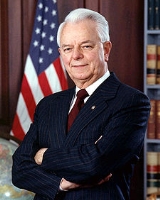
President pro tempore of the United States Senate

Overview
United States Senate
The United States Senate is the upper house of the bicameral legislature of the United States, and together with the United States House of Representatives comprises the United States Congress. The composition and powers of the Senate are established in Article One of the U.S. Constitution. Each...
. The United States Constitution
United States Constitution
The Constitution of the United States is the supreme law of the United States of America. It is the framework for the organization of the United States government and for the relationship of the federal government with the states, citizens, and all people within the United States.The first three...
states that the Vice President of the United States
Vice President of the United States
The Vice President of the United States is the holder of a public office created by the United States Constitution. The Vice President, together with the President of the United States, is indirectly elected by the people, through the Electoral College, to a four-year term...
is the President of the Senate
President of the Senate
The President of the Senate is a title often given to the presiding officer of a senate, and is the speaker of other assemblies.The senate president often ranks high in a jurisdiction's succession for its top executive office: for example, the President of the Senate of Nigeria is second in line...
and the highest-ranking official of the Senate despite not being a member of the body. During the Vice President's absence, the president pro tempore
Pro tempore
Pro tempore , abbreviated pro tem or p.t., is a Latin phrase which best translates to "for the time being" in English. This phrase is often used to describe a person who acts as a locum tenens in the absence of a superior, such as the President pro tempore of the United States Senate.Legislative...
presides over its sessions or appoints another senator to do so. The president pro tempore is elected by the Senate and is customarily the longest serving senator in the majority party.
Unanswered Questions
