


Winfield Scott Hancock

Encyclopedia
Winfield Scott Hancock (February 14, 1824 – February 9, 1886) was a career U.S. Army
officer and the Democratic
nominee for President of the United States
in 1880
. He served with distinction in the Army for four decades, including service in the Mexican-American War and as a Union
general
in the American Civil War
. Known to his Army colleagues as "Hancock the Superb", he was noted in particular for his personal leadership at the Battle of Gettysburg
in 1863. One military historian wrote, "No other Union general at Gettysburg dominated men by the sheer force of their presence more completely than Hancock." As another wrote, "... his tactical skill had won him the quick admiration of adversaries who had come to know him as the 'Thunderbolt of the Army of the Potomac
'." His military service continued after the Civil War, as Hancock participated in the military Reconstruction of the South
and the Army's presence at the Western frontier.
Hancock's reputation as a war hero at Gettysburg, combined with his rare status as a prominent figure with impeccable Unionist credentials and pro-states' rights views, made him a quadrennial presidential possibility in the years after the Civil War. His noted integrity was a counterpoint to the corruption of the era, for as President Rutherford B. Hayes
said, "... [i]f, when we make up our estimate of a public man, conspicuous both as a soldier and in civil life, we are to think first and chiefly of his manhood, his integrity, his purity, his singleness of purpose, and his unselfish devotion to duty, we can truthfully say of Hancock that he was through and through pure gold." This nationwide popularity led the Democrats to nominate him for President in 1880. Although he ran a strong campaign, Hancock was defeated by Republican
James Garfield
.
, a hamlet just northwest of Philadelphia in present-day Montgomery Township
. The twins were the sons of Benjamin Franklin Hancock and Elizabeth Hoxworth Hancock. Winfield was named after Winfield Scott
, a prominent general in the War of 1812
.
The Hancock and Hoxworth families had lived in Montgomery County
for several generations, and were of English
, Scottish
and Welsh
descent. Benjamin Hancock was a schoolteacher when his sons were born. A few years after their birth, he moved the family to Norristown
, the county seat, and began to practice law. Benjamin was also a deacon in the Baptist
church and participated in municipal government (as an avowed Democrat
).
Hancock was at first educated at Norristown Academy
, but removed to the public schools when the first one opened in Norristown in the late 1830s. In 1840, Joseph Fornance
, the local Congressman, nominated Hancock to the United States Military Academy
at West Point
. Hancock's progress at West Point was average. He graduated 18th in his class of 25 in 1844, and he was assigned to the infantry
.
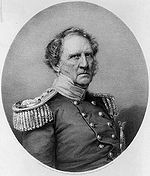 Hancock was commissioned a brevet
second lieutenant in the 6th U.S. Infantry regiment, and initially was stationed in Indian Territory
in the Red River
Valley. The region was quiet at the time, and Hancock's time there was uneventful. Upon the outbreak of war with Mexico in 1846, Hancock worked to secure himself a place at the front. Initially assigned to recruiting duties in Kentucky
, he proved so adept at signing up soldiers that his superiors were reluctant to release him from his post. By July 1847, however, Hancock was permitted to join his regiment in Puebla
, Mexico
, where they made up a part of the army led by his namesake, General Winfield Scott
.
Scott's army moved farther inland from Puebla unopposed and attacked Mexico City
from the south. During that campaign in 1847, Hancock first encountered battle at Contreras
and Churubusco
. He was appointed a brevet first lieutenant for gallant and meritorious service in those actions. Hancock was wounded in the knee at Churubusco and developed a fever. Although he was well enough to lead his regiment at Molino del Rey
, fever kept Hancock from participating in the final breakthrough of Mexico City
, something he would regret for the rest of his life. After the final victory, Hancock remained in Mexico with the 6th Infantry until the treaty of peace
was signed in 1848.
 Hancock served in a number of assignments as an army quartermaster and adjutant
, mostly in Fort Snelling
, Minnesota
and St. Louis
, Missouri
. It was in St. Louis that he met Almira ("Allie") Russell and they married on January 24, 1850. Allie gave birth to two children, Russell in 1850 and Ada in 1857, but both children died before their parents. Hancock was promoted to captain in 1855 and assigned to Fort Myers
, Florida
. Hancock's young family accompanied him to his new posting, where Allie Hancock was the only woman on the post.
Hancock's tour in Florida coincided with the end of the Third Seminole War. His duties were primarily those of a quartermaster
, and he did not see action in that campaign. As the situation in Florida began to settle down, Hancock was reassigned to Fort Leavenworth
, Kansas
. He served in the West during the partisan warfare of "Bleeding Kansas
", and in the Utah Territory
, where the 6th Infantry arrived after the Utah War
. Following the resolution of that conflict, Hancock was stationed in southern California
in November 1858. He remained there, joined by Allie and the children, until the Civil War broke out in 1861, serving as a captain and assistant quartermaster under future Confederate
General Albert Sidney Johnston
. In California, Hancock became friendly with a number of southern officers, most significantly Lewis A. Armistead of Virginia
. At the outbreak of the Civil War, Armistead and the other southerners left to join the Confederate States Army
, while Hancock remained in the service of the United States.
Hancock returned east to assume quartermaster duties for the rapidly growing Union Army
, but was quickly promoted to brigadier general on September 23, 1861, and given an infantry
brigade
to command in the division of Brig. Gen. William F. "Baldy" Smith
, Army of the Potomac
. He earned his "Superb" nickname in the Peninsula Campaign
, in 1862, by leading a critical counterattack in the Battle of Williamsburg
; army commander Maj. Gen.
George B. McClellan
telegraphed to Washington that "Hancock was superb today" and the appellation stuck. McClellan did not follow through on Hancock's initiative, however, and Confederate forces were allowed to withdraw unmolested.
In the Battle of Antietam
, Hancock assumed command of the 1st Division, II Corps, following the mortal wounding of Maj. Gen. Israel B. Richardson
in the horrific fighting at "Bloody Lane." Hancock and his staff made a dramatic entrance to the battlefield, galloping between his troops and the enemy, parallel to the Sunken Road. His men assumed that Hancock would order counterattacks against the exhausted Confederates, but he carried orders from McClellan to hold his position. He was promoted to major general of volunteers on November 29, 1862. He led his division in the disastrous attack on Marye's Heights in the Battle of Fredericksburg
the following month and was wounded in the abdomen. At the Battle of Chancellorsville
, his division covered Maj. Gen. Joseph Hooker
's withdrawal and Hancock was wounded again. His corps commander, Maj. Gen. Darius N. Couch
, transferred out of the Army of the Potomac in protest of actions Hooker took in the battle and Hancock assumed command of II Corps, which he would lead until shortly before the war's end.
 Hancock's most famous service was as a new corps commander at the Battle of Gettysburg
, July 1 to July 3, 1863. After his friend, Maj. Gen. John F. Reynolds
, was killed early on July 1, Maj. Gen. George G. Meade, the new commander of the Army of the Potomac, sent Hancock ahead to take command of the units on the field and assess the situation. Hancock thus was in temporary command of the "left wing" of the army, consisting of the I, II, III, and XI Corps. This demonstrated Meade's high confidence in him, because Hancock was not the most senior Union officer at Gettysburg at the time. Hancock and the more senior XI Corps commander, Maj. Gen. Oliver O. Howard
, argued briefly about this command arrangement, but Hancock prevailed and he organized the Union defenses on Cemetery Hill
as more numerous Confederate forces drove the I and XI Corps back through the town. He had the authority from Meade to withdraw the forces, so he was responsible for the decision to stand and fight at Gettysburg. Meade arrived after midnight and overall command reverted to him.
On July 2, Hancock's II Corps was positioned on Cemetery Ridge
, roughly in the center of the Union line, while Confederate General Robert E. Lee
launched assaults on both ends of the line. On the Union left, Lt. Gen. James Longstreet
's assault smashed the III Corps and Hancock sent in his 1st Division, under Brig. Gen. John C. Caldwell
, to reinforce the Union in the Wheatfield. As Lt. Gen. A.P. Hill's corps continued the attack toward the Union center, Hancock rallied the defenses and rushed units to the critical spots. In one famous incident, he sacrificed a regiment, the 1st Minnesota
, by ordering it to advance and charge a Confederate brigade four times its size, causing the Minnesotans to suffer 87% casualties. While costly to the regiment, this heroic sacrifice bought time to organize the defensive line and saved the day for the Union army.
 On July 3, Hancock continued in his position on Cemetery Ridge and thus bore the brunt of Pickett's Charge
. During the massive Confederate artillery bombardment that preceded the infantry assault, Hancock was prominent on horseback in reviewing and encouraging his troops. When one of his subordinates protested, "General, the corps commander ought not to risk his life that way," Hancock is said to have replied, "There are times when a corps commander's life does not count." During the infantry assault, his old friend, now Brig. Gen. Lewis A. Armistead, leading a brigade in Maj. Gen. George Pickett
's division, was wounded and died two days later. Hancock could not meet with his friend because he had just been wounded himself, a severe wound caused by a bullet striking the pommel of his saddle, entering his inner right thigh along with wood fragments and a large bent nail. Helped from his horse by aides, and with a tourniquet
applied to stanch the bleeding, he removed the saddle nail himself and, mistaking its source, remarked wryly, "They must be hard up for ammunition when they throw such shot as that." News of Armistead's mortal wounding was brought to Hancock by a member of his staff, Captain Henry H. Bingham
. Despite his pain, Hancock refused evacuation to the rear until the battle was resolved. He had been an inspiration for his troops throughout the three-day battle. Hancock later received the thanks of the U.S. Congress for "... his gallant, meritorious and conspicuous share in that great and decisive victory."
 Hancock suffered from the effects of his Gettysburg wound for the rest of the war. After recuperating in Norristown, he performed recruiting services over the winter and returned in the spring to field command of the II Corps for Lt. Gen. Ulysses S. Grant
's 1864 Overland Campaign
, but he never regained full mobility and his former youthful energy. Nevertheless, he performed well at the Battle of the Wilderness
and commanded a critical breakthrough assault of the Mule Shoe at the "Bloody Angle" in the Battle of Spotsylvania Court House
on May 12, shattering the Confederate defenders in his front, including the Stonewall Brigade
. His corps suffered enormous losses during a futile assault Grant ordered at Cold Harbor
.
After Grant's army slipped past Lee's army to cross the James River
, Hancock found himself in a position from which he might have ended the war. His corps arrived to support Baldy Smith's assaults on the lightly held Petersburg
defensive lines, but he deferred to Smith's advice because Smith knew the ground and had been on the field all day, and no significant assaults were made before the Confederate lines were reinforced. One of the great opportunities of the war was lost. After his corps participated in the assaults at Deep Bottom
, Hancock was promoted to brigadier general in the regular army, effective August 12, 1864.
Hancock's only significant military defeat occurred during the Siege of Petersburg
. His II Corps moved south of the city, along the Wilmington and Weldon Railroad
, tearing up track. On August 25, Confederate Maj. Gen. Henry Heth
attacked and overran the faulty Union position at Reams's Station
, shattering the II Corps, capturing many prisoners. Despite a later victory at Hatcher's Run
, the humiliation of Reams's Station contributed, along with the lingering effects of his Gettysburg wound, to his decision to give up field command in November. He left the II Corps after a year in which it had suffered over 40,000 casualties, but had achieved significant military victories. His first assignment was to command the ceremonial First Veterans Corps. He performed more recruiting, commanded the Middle Department, and relieved Maj. Gen. Philip Sheridan
in command of forces in the now-quiet Shenandoah Valley
. He was promoted to brevet major general in the regular army for his service at Spotsylvania, effective March 13, 1865.
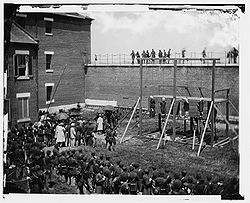 At the close of the war, Hancock was assigned to supervise the execution of the Lincoln assassination
conspirators. Lincoln had been assassinated on April 14, 1865, and by May 9 of that year, a military commission had been convened to try the accused. The actual assassin, John Wilkes Booth
, was already dead, but the trial of his co-conspirators proceeded quickly, resulting in convictions. President Andrew Johnson
ordered the executions to be carried out on July 7. Although he was reluctant to execute some of the less-culpable conspirators, especially Mary Surratt
, Hancock carried out his orders, later writing that "every soldier was bound to act as I did under similar circumstances."
. In 1866, on Grant's recommendation, Hancock was promoted to major general and was transferred, later that year, to command of the Military Department of the Missouri, which included the states of Missouri
, Kansas
, Colorado
, and New Mexico
. Hancock reported to Fort Leavenworth
, Kansas, and took up his new posting. Soon after arriving, he was assigned by General Sherman
to lead an expedition to negotiate with the Cheyenne
and Sioux
, with whom relations had worsened since the Sand Creek massacre
. The negotiations got off to a bad start, and after Hancock ordered the burning of an abandoned Cheyenne village in central Kansas, relations became worse than when the expedition had started. There was little loss of life on either side, but the mission could not be called a success.
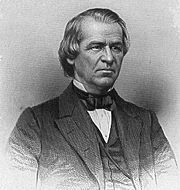 Hancock's time in the West was brief. President Johnson, unhappy with the way Republican generals were governing the South under Reconstruction, sought replacements for them. The general who offended Johnson the most was Philip Sheridan
, and Johnson soon ordered General Grant to switch the assignments of Hancock and Sheridan, believing that Hancock, a Democrat, would govern in a style more to Johnson's liking. Although neither man was pleased with the change, Sheridan reported to Fort Leavenworth and Hancock to New Orleans.
Hancock's new assignment found him in charge of the Fifth Military District
, encompassing Texas
and Louisiana
. Almost immediately upon arriving, Hancock ingratiated himself with the white conservative population by issuing his General Order Number 40 of November 29, 1867. In that order, written while traveling to New Orleans, Hancock expressed sentiments in support of President Johnson's policies, writing that if the residents of the district conducted themselves peacefully and the civilian officials perform their duties, then "the military power should cease to lead, and the civil administration resume its natural and rightful dominion." The order continued:
Hancock's order encouraged white Democrats across the South who hoped to return to civilian government more quickly, but discomforted blacks and Republicans in the South who feared a return to the antebellum ways of conservative white dominance.
Hancock's General Order Number 40 was quickly condemned by Republicans in Washington, especially by the Radicals, while President Johnson wholeheartedly approved. Heedless of the situation in Washington, Hancock soon put his words into action, refusing local Republican politicians' requests to use his power to overturn elections and court verdicts, while also letting it be known that open insurrection would be suppressed. Hancock's popularity within the Democratic party grew to the extent that he was considered a potential presidential nominee for that party in the 1868 election
. Although Hancock collected a significant number of delegates at the 1868 convention, his presidential possibilities went unfulfilled. Even so, he was henceforth identified as a rare breed in politics: one who believed in the Democratic Party's principles of states' rights and limited government, but whose anti-secessionist sentiment was unimpeachable.
1868 presidential victory, the Republicans were firmly in charge in Washington. As a result, Hancock found himself transferred once again, this time away from the sensitive assignment of reconstructing the South and into the relative backwater that was the Department of Dakota. The Department covered Minnesota
, Montana
, and the Dakotas
. As in his previous Western command, Hancock began with a conference of the Indian chiefs, but this time was more successful in establishing a peaceful intent. Relations worsened in 1870, however, as an army expedition committed a massacre
against the Blackfeet
. Relations with the Sioux
also became contentious as a result of white encroachment into the Black Hills
, in violation of the Treaty of Fort Laramie
. Still, war was averted, for the time being, and most of Hancock's command was peaceful.
It was during this tour that Hancock had the opportunity to contribute to the creation of Yellowstone National Park
. In August 1870, he ordered the 2nd Cavalry at Fort Ellis
to provide a military escort for General Henry D. Washburn
's planned exploration of the Yellowstone Region. The expedition, which was a major impetus in creating the park, became known as the Washburn-Langford-Doane Expedition
. Hancock's order led to the assignment of Lt. Gustavus Cheyney Doane
and a troop of 5 cavalrymen from Fort Ellis to escort the expedition. In 1871, Captain John W. Barlow
during his exploration of the Yellowstone region formally named a summit on what would become the southern boundary of the park Mount Hancock
to honor the general's decision to provide the escort.
died, leaving Hancock the army's senior major general. This entitled him to a more prominent command, and President Grant, still desirous to keep Hancock from a Southern post, assigned him command of the Department of the Atlantic, headquartered at Fort Columbus
on Governors Island
, in New York City
. The vast department covered the settled northeast area of the country and was militarily uneventful with the exception of the army's involvement in the Great Railroad Strike of 1877
. When railroad workers went on strike to protest wage cuts, the nation's transportation system was paralyzed. The governors of Pennsylvania, West Virginia, and Maryland asked President Hayes to call in federal troops to re-open the railways. Once federal troops entered the cities, most of the strikers melted away, but there were some violent clashes.
All the while Hancock was posted in New York, he did his best to keep his political ambitions alive. He received some votes at the Democrats' 1876 convention
, but was never a serious contender as New York governor Samuel J. Tilden
swept the field on the second ballot. The Republican candidate, Rutherford B. Hayes
, won the election, and Hancock refocused his ambition on 1880. The electoral crisis
of 1876 and the subsequent end to Reconstruction in 1877 convinced many observers that the election of 1880 would give the Democrats their best chance at victory in a generation.
, Allen G. Thurman
, Stephen Johnson Field
, and Thomas F. Bayard
. Hancock's neutrality on the monetary question, and his lingering support in the South (owing to his General Order Number 40) meant that Hancock, more than any other candidate, had nationwide support. When the Democratic convention
assembled in Cincinnati
in June 1880, Hancock led on the first ballot, but did not have a majority. By the second ballot, Hancock received the requisite two-thirds, and William Hayden English
of Indiana
was chosen as his running mate.
James A. Garfield, a Congressman from Ohio
and a skillful politician. Hancock and the Democrats expected to carry the Solid South
, but needed to add a few of the Northern states to their total to win the election. The practical differences between the parties were few, and the Republicans were reluctant to attack Hancock personally because of his heroic reputation. The one policy difference the Republicans were able to exploit was a statement in the Democratic platform endorsing "a tariff
for revenue only." Garfield's campaigners used this statement to paint the Democrats as unsympathetic to the plight of industrial laborers, a group that would benefit by a high protective tariff. The tariff issue cut Democratic support in industrialized Northern states, which were essential in establishing a Democratic majority. In the end, the Democrats and Hancock failed to carry any of the Northern states they had targeted, with the exception of New Jersey
. Hancock lost the election to Garfield. Garfield polled only 39,213 more votes than Hancock, the popular vote being 4,453,295 for Garfield and 4,414,082 for Hancock. The electoral count, however, had a much larger spread. Garfield polled 214 electoral votes and Hancock only 155.
in 1881, explaining that "The object of the NRA is to increase the military strength of the country by making skill in the use of arms as prevalent as it was in the days of the Revolution." Hancock was a Charter Director and the first president of the Military Service Institution of the United States
from 1878 until his death in 1886. He was commander-in-chief of the MOLLUS veterans organization from 1879 until his death in 1886. He was the author of Reports of Major General W. S. Hancock upon Indian Affairs, published in 1867. Hancock's last major public appearance was to preside over the funeral of President Grant in 1885, although he also made a less publicized trip that year to Gettysburg.
Hancock died in 1886 at Governors Island, still in command of the Military Division of the Atlantic, the victim of an infected carbuncle
, complicated by diabetes
. He is buried in Montgomery Cemetery
in West Norriton Township, Montgomery County, Pennsylvania, near Norristown
, Pennsylvania
. Although he outlived both of his children, he was survived by the three grandchildren fathered by his son, Russell. Hancock's wife, Almira, published Reminiscences of Winfield Scott Hancock in 1887.
In 1893, Republican General Francis A. Walker
wrote, "Although I did not vote for General Hancock, I am strongly disposed to believe that one of the best things the nation has lost in recent years has been the example and the influence of that chivalric, stately, and splendid gentleman in the White House
. Perhaps much which both parties now recognize as having been unfortunate and mischievous during the past thirteen years would have been avoided had General Hancock been elected."
Hancock's portrait adorns U.S. currency on the $2 Silver Certificate series of 1886. Approximately 1,500 to 2,500 of these bills survive today in numismatic collections. Hancock's bill is ranked number 73 on a list of "100 Greatest American Currency Notes".
s about the Civil War by the Shaara family: The Killer Angels
by Michael Shaara
and Gods and Generals and The Last Full Measure by Jeffrey Shaara
. In the films Gettysburg (1993) and Gods and Generals
(2003), based on the first two of these novels, Hancock is portrayed by Brian Mallon
and is depicted in both films in a very favorable light. A number of scenes in the novel Gods and Generals that depict Hancock and his friend Lewis Armistead in Southern California before the war have been omitted from the film.
United States Army
The United States Army is the main branch of the United States Armed Forces responsible for land-based military operations. It is the largest and oldest established branch of the U.S. military, and is one of seven U.S. uniformed services...
officer and the Democratic
Democratic Party (United States)
The Democratic Party is one of two major contemporary political parties in the United States, along with the Republican Party. The party's socially liberal and progressive platform is largely considered center-left in the U.S. political spectrum. The party has the lengthiest record of continuous...
nominee for President of the United States
President of the United States
The President of the United States of America is the head of state and head of government of the United States. The president leads the executive branch of the federal government and is the commander-in-chief of the United States Armed Forces....
in 1880
United States presidential election, 1880
The United States presidential election of 1880 was largely seen as a referendum on the end of Reconstruction in Southern states carried out by the Republicans. There were no pressing issues of the day save tariffs, with the Republicans supporting higher tariffs and the Democrats supporting lower...
. He served with distinction in the Army for four decades, including service in the Mexican-American War and as a Union
Union Army
The Union Army was the land force that fought for the Union during the American Civil War. It was also known as the Federal Army, the U.S. Army, the Northern Army and the National Army...
general
General (United States)
In the United States Army, United States Air Force, and United States Marine Corps, general is a four-star general officer rank, with the pay grade of O-10. General ranks above lieutenant general and below General of the Army or General of the Air Force; the Marine Corps does not have an...
in the American Civil War
American Civil War
The American Civil War was a civil war fought in the United States of America. In response to the election of Abraham Lincoln as President of the United States, 11 southern slave states declared their secession from the United States and formed the Confederate States of America ; the other 25...
. Known to his Army colleagues as "Hancock the Superb", he was noted in particular for his personal leadership at the Battle of Gettysburg
Battle of Gettysburg
The Battle of Gettysburg , was fought July 1–3, 1863, in and around the town of Gettysburg, Pennsylvania. The battle with the largest number of casualties in the American Civil War, it is often described as the war's turning point. Union Maj. Gen. George Gordon Meade's Army of the Potomac...
in 1863. One military historian wrote, "No other Union general at Gettysburg dominated men by the sheer force of their presence more completely than Hancock." As another wrote, "... his tactical skill had won him the quick admiration of adversaries who had come to know him as the 'Thunderbolt of the Army of the Potomac
Army of the Potomac
The Army of the Potomac was the major Union Army in the Eastern Theater of the American Civil War.-History:The Army of the Potomac was created in 1861, but was then only the size of a corps . Its nucleus was called the Army of Northeastern Virginia, under Brig. Gen...
'." His military service continued after the Civil War, as Hancock participated in the military Reconstruction of the South
Southern United States
The Southern United States—commonly referred to as the American South, Dixie, or simply the South—constitutes a large distinctive area in the southeastern and south-central United States...
and the Army's presence at the Western frontier.
Hancock's reputation as a war hero at Gettysburg, combined with his rare status as a prominent figure with impeccable Unionist credentials and pro-states' rights views, made him a quadrennial presidential possibility in the years after the Civil War. His noted integrity was a counterpoint to the corruption of the era, for as President Rutherford B. Hayes
Rutherford B. Hayes
Rutherford Birchard Hayes was the 19th President of the United States . As president, he oversaw the end of Reconstruction and the United States' entry into the Second Industrial Revolution...
said, "... [i]f, when we make up our estimate of a public man, conspicuous both as a soldier and in civil life, we are to think first and chiefly of his manhood, his integrity, his purity, his singleness of purpose, and his unselfish devotion to duty, we can truthfully say of Hancock that he was through and through pure gold." This nationwide popularity led the Democrats to nominate him for President in 1880. Although he ran a strong campaign, Hancock was defeated by Republican
Republican Party (United States)
The Republican Party is one of the two major contemporary political parties in the United States, along with the Democratic Party. Founded by anti-slavery expansion activists in 1854, it is often called the GOP . The party's platform generally reflects American conservatism in the U.S...
James Garfield
James Garfield
James Abram Garfield served as the 20th President of the United States, after completing nine consecutive terms in the U.S. House of Representatives. Garfield's accomplishments as President included a controversial resurgence of Presidential authority above Senatorial courtesy in executive...
.
Early life and family
Winfield Scott Hancock and his identical twin brother Hilary Baker Hancock were born on February 14, 1824, in Montgomery Square, PennsylvaniaPennsylvania
The Commonwealth of Pennsylvania is a U.S. state that is located in the Northeastern and Mid-Atlantic regions of the United States. The state borders Delaware and Maryland to the south, West Virginia to the southwest, Ohio to the west, New York and Ontario, Canada, to the north, and New Jersey to...
, a hamlet just northwest of Philadelphia in present-day Montgomery Township
Montgomery Township, Montgomery County, Pennsylvania
Montgomery Township is a township in Montgomery County, Pennsylvania, United States. The population was 24,790 at the 2010 census. It is the location of the Montgomery Mall, a regional shopping mall serving the Route 309 corridor of the Philadelphia suburbs. Much of Montgomery Township's...
. The twins were the sons of Benjamin Franklin Hancock and Elizabeth Hoxworth Hancock. Winfield was named after Winfield Scott
Winfield Scott
Winfield Scott was a United States Army general, and unsuccessful presidential candidate of the Whig Party in 1852....
, a prominent general in the War of 1812
War of 1812
The War of 1812 was a military conflict fought between the forces of the United States of America and those of the British Empire. The Americans declared war in 1812 for several reasons, including trade restrictions because of Britain's ongoing war with France, impressment of American merchant...
.
The Hancock and Hoxworth families had lived in Montgomery County
Montgomery County, Pennsylvania
Montgomery County is a county located in the U.S. state of Pennsylvania, in the United States. As of 2010, the population was 799,874, making it the third most populous county in Pennsylvania . The county seat is Norristown.The county was created on September 10, 1784, out of land originally part...
for several generations, and were of English
English American
English Americans are citizens or residents of the United States whose ancestry originates wholly or partly in England....
, Scottish
Scottish American
Scottish Americans or Scots Americans are citizens of the United States whose ancestry originates wholly or partly in Scotland. Scottish Americans are closely related to Scots-Irish Americans, descendants of Ulster Scots, and communities emphasize and celebrate a common heritage...
and Welsh
Welsh American
Welsh Americans are citizens of the United States whose ancestry originates wholly or partly in Wales. In the 2008 U.S. Census community survey, an estimated 1.98 million Americans had Welsh ancestry, 0.6% of the total U.S. population. This compares with a population of 3 million in Wales. However,...
descent. Benjamin Hancock was a schoolteacher when his sons were born. A few years after their birth, he moved the family to Norristown
Norristown, Pennsylvania
Norristown is a municipality in Montgomery County, Pennsylvania, northwest of the city limits of Philadelphia, on the Schuylkill River. The population was 34,324 as of the 2010 census. It is the county seat of Montgomery County...
, the county seat, and began to practice law. Benjamin was also a deacon in the Baptist
Baptist
Baptists comprise a group of Christian denominations and churches that subscribe to a doctrine that baptism should be performed only for professing believers , and that it must be done by immersion...
church and participated in municipal government (as an avowed Democrat
Democratic Party (United States)
The Democratic Party is one of two major contemporary political parties in the United States, along with the Republican Party. The party's socially liberal and progressive platform is largely considered center-left in the U.S. political spectrum. The party has the lengthiest record of continuous...
).
Hancock was at first educated at Norristown Academy
Norristown Academy
Norristown Academy was a public academy established in 1804 in Norristown, Pennsylvania. Many prominent people have been educated there, including the sons of Major General Winfield Scott Hancock, Governor David Rittenhouse Porter, James Madison Porter, and Samuel Medary....
, but removed to the public schools when the first one opened in Norristown in the late 1830s. In 1840, Joseph Fornance
Joseph Fornance
Joseph Fornance was a Democratic member of the U.S. House of Representatives from Pennsylvania.Joseph Fornance born in Lower Merion Township, Pennsylvania. He studied law, was admitted to the bar in 1832 and commenced practice in Norristown, Pennsylvania. He served as president of the council of...
, the local Congressman, nominated Hancock to the United States Military Academy
United States Military Academy
The United States Military Academy at West Point is a four-year coeducational federal service academy located at West Point, New York. The academy sits on scenic high ground overlooking the Hudson River, north of New York City...
at West Point
West Point, New York
West Point is a federal military reservation established by President of the United States Thomas Jefferson in 1802. It is a census-designated place located in Town of Highlands in Orange County, New York, United States. The population was 7,138 at the 2000 census...
. Hancock's progress at West Point was average. He graduated 18th in his class of 25 in 1844, and he was assigned to the infantry
Infantry
Infantrymen are soldiers who are specifically trained for the role of fighting on foot to engage the enemy face to face and have historically borne the brunt of the casualties of combat in wars. As the oldest branch of combat arms, they are the backbone of armies...
.
Mexican War
Brevet (military)
In many of the world's military establishments, brevet referred to a warrant authorizing a commissioned officer to hold a higher rank temporarily, but usually without receiving the pay of that higher rank except when actually serving in that role. An officer so promoted may be referred to as being...
second lieutenant in the 6th U.S. Infantry regiment, and initially was stationed in Indian Territory
Indian Territory
The Indian Territory, also known as the Indian Territories and the Indian Country, was land set aside within the United States for the settlement of American Indians...
in the Red River
Red River (Mississippi watershed)
The Red River, or sometimes the Red River of the South, is a major tributary of the Mississippi and Atchafalaya Rivers in the southern United States of America. The river gains its name from the red-bed country of its watershed. It is one of several rivers with that name...
Valley. The region was quiet at the time, and Hancock's time there was uneventful. Upon the outbreak of war with Mexico in 1846, Hancock worked to secure himself a place at the front. Initially assigned to recruiting duties in Kentucky
Kentucky
The Commonwealth of Kentucky is a state located in the East Central United States of America. As classified by the United States Census Bureau, Kentucky is a Southern state, more specifically in the East South Central region. Kentucky is one of four U.S. states constituted as a commonwealth...
, he proved so adept at signing up soldiers that his superiors were reluctant to release him from his post. By July 1847, however, Hancock was permitted to join his regiment in Puebla
Puebla, Puebla
The city and municipality of Puebla is the capital of the state of Puebla, and one of the five most important colonial cities in Mexico. Being a planned city, it is located to the east of Mexico City and west of Mexico's main port, Veracruz, on the main route between the two.The city was founded...
, Mexico
Mexico
The United Mexican States , commonly known as Mexico , is a federal constitutional republic in North America. It is bordered on the north by the United States; on the south and west by the Pacific Ocean; on the southeast by Guatemala, Belize, and the Caribbean Sea; and on the east by the Gulf of...
, where they made up a part of the army led by his namesake, General Winfield Scott
Winfield Scott
Winfield Scott was a United States Army general, and unsuccessful presidential candidate of the Whig Party in 1852....
.
Scott's army moved farther inland from Puebla unopposed and attacked Mexico City
Mexico City
Mexico City is the Federal District , capital of Mexico and seat of the federal powers of the Mexican Union. It is a federal entity within Mexico which is not part of any one of the 31 Mexican states but belongs to the federation as a whole...
from the south. During that campaign in 1847, Hancock first encountered battle at Contreras
Battle of Contreras
The Battle of Contreras, also known as the Battle of Padierna, took place during August 19–20, 1847, in the final encounters of the Mexican-American War. In the Battle of Churubusco, fighting continued the following day.-Background:...
and Churubusco
Battle of Churubusco
The Battle of Churubusco took place on August 20, 1847, in the immediate aftermath of the Battle of Contreras during the Mexican-American War. After defeating the Mexican army at Churubusco, the U.S. Army was only 5 miles away from Mexico City, the capital of the nation...
. He was appointed a brevet first lieutenant for gallant and meritorious service in those actions. Hancock was wounded in the knee at Churubusco and developed a fever. Although he was well enough to lead his regiment at Molino del Rey
Battle of Molino del Rey
The Battle of Molino del Rey was one of the bloodiest engagements of the Mexican-American War. It was fought in September 1847 between Mexican forces under General Antonio Léon against an American force under General Winfield Scott at a hill called El Molino del Rey near Mexico City.-Background:On...
, fever kept Hancock from participating in the final breakthrough of Mexico City
Battle of Chapultepec
The Battle of Chapultepec, in September 1847, was a United States victory over Mexican forces holding Chapultepec Castle west of Mexico City during the Mexican-American War.-Background:On September 13, 1847, in the costly Battle of Molino del Rey, U.S...
, something he would regret for the rest of his life. After the final victory, Hancock remained in Mexico with the 6th Infantry until the treaty of peace
Treaty of Guadalupe Hidalgo
The Treaty of Guadalupe Hidalgo is the peace treaty, largely dictated by the United States to the interim government of a militarily occupied Mexico City, that ended the Mexican-American War on February 2, 1848...
was signed in 1848.
Marriage and peacetime
Adjutant
Adjutant is a military rank or appointment. In some armies, including most English-speaking ones, it is an officer who assists a more senior officer, while in other armies, especially Francophone ones, it is an NCO , normally corresponding roughly to a Staff Sergeant or Warrant Officer.An Adjutant...
, mostly in Fort Snelling
Fort Snelling, Minnesota
Fort Snelling, originally known as Fort Saint Anthony, was a military fortification located at the confluence of the Minnesota River and Mississippi River in Hennepin County, Minnesota...
, Minnesota
Minnesota
Minnesota is a U.S. state located in the Midwestern United States. The twelfth largest state of the U.S., it is the twenty-first most populous, with 5.3 million residents. Minnesota was carved out of the eastern half of the Minnesota Territory and admitted to the Union as the thirty-second state...
and St. Louis
St. Louis, Missouri
St. Louis is an independent city on the eastern border of Missouri, United States. With a population of 319,294, it was the 58th-largest U.S. city at the 2010 U.S. Census. The Greater St...
, Missouri
Missouri
Missouri is a US state located in the Midwestern United States, bordered by Iowa, Illinois, Kentucky, Tennessee, Arkansas, Oklahoma, Kansas and Nebraska. With a 2010 population of 5,988,927, Missouri is the 18th most populous state in the nation and the fifth most populous in the Midwest. It...
. It was in St. Louis that he met Almira ("Allie") Russell and they married on January 24, 1850. Allie gave birth to two children, Russell in 1850 and Ada in 1857, but both children died before their parents. Hancock was promoted to captain in 1855 and assigned to Fort Myers
Fort Myers, Florida
Fort Myers is the county seat and commercial center of Lee County, Florida, United States. Its population was 62,298 in the 2010 census, a 29.23 percent increase over the 2000 figure....
, Florida
Florida
Florida is a state in the southeastern United States, located on the nation's Atlantic and Gulf coasts. It is bordered to the west by the Gulf of Mexico, to the north by Alabama and Georgia and to the east by the Atlantic Ocean. With a population of 18,801,310 as measured by the 2010 census, it...
. Hancock's young family accompanied him to his new posting, where Allie Hancock was the only woman on the post.
Hancock's tour in Florida coincided with the end of the Third Seminole War. His duties were primarily those of a quartermaster
Quartermaster
Quartermaster refers to two different military occupations depending on if the assigned unit is land based or naval.In land armies, especially US units, it is a term referring to either an individual soldier or a unit who specializes in distributing supplies and provisions to troops. The senior...
, and he did not see action in that campaign. As the situation in Florida began to settle down, Hancock was reassigned to Fort Leavenworth
Fort Leavenworth
Fort Leavenworth is a United States Army facility located in Leavenworth County, Kansas, immediately north of the city of Leavenworth in the upper northeast portion of the state. It is the oldest active United States Army post west of Washington, D.C. and has been in operation for over 180 years...
, Kansas
Kansas
Kansas is a US state located in the Midwestern United States. It is named after the Kansas River which flows through it, which in turn was named after the Kansa Native American tribe, which inhabited the area. The tribe's name is often said to mean "people of the wind" or "people of the south...
. He served in the West during the partisan warfare of "Bleeding Kansas
Bleeding Kansas
Bleeding Kansas, Bloody Kansas or the Border War, was a series of violent events, involving anti-slavery Free-Staters and pro-slavery "Border Ruffian" elements, that took place in the Kansas Territory and the western frontier towns of the U.S. state of Missouri roughly between 1854 and 1858...
", and in the Utah Territory
Utah Territory
The Territory of Utah was an organized incorporated territory of the United States that existed from September 9, 1850, until January 4, 1896, when the final extent of the territory was admitted to the Union as the State of Utah....
, where the 6th Infantry arrived after the Utah War
Utah War
The Utah War, also known as the Utah Expedition, Buchanan's Blunder, the Mormon War, or the Mormon Rebellion was an armed confrontation between LDS settlers in the Utah Territory and the armed forces of the United States government. The confrontation lasted from May 1857 until July 1858...
. Following the resolution of that conflict, Hancock was stationed in southern California
California
California is a state located on the West Coast of the United States. It is by far the most populous U.S. state, and the third-largest by land area...
in November 1858. He remained there, joined by Allie and the children, until the Civil War broke out in 1861, serving as a captain and assistant quartermaster under future Confederate
Confederate States Army
The Confederate States Army was the army of the Confederate States of America while the Confederacy existed during the American Civil War. On February 8, 1861, delegates from the seven Deep South states which had already declared their secession from the United States of America adopted the...
General Albert Sidney Johnston
Albert Sidney Johnston
Albert Sidney Johnston served as a general in three different armies: the Texas Army, the United States Army, and the Confederate States Army...
. In California, Hancock became friendly with a number of southern officers, most significantly Lewis A. Armistead of Virginia
Virginia
The Commonwealth of Virginia , is a U.S. state on the Atlantic Coast of the Southern United States. Virginia is nicknamed the "Old Dominion" and sometimes the "Mother of Presidents" after the eight U.S. presidents born there...
. At the outbreak of the Civil War, Armistead and the other southerners left to join the Confederate States Army
Confederate States Army
The Confederate States Army was the army of the Confederate States of America while the Confederacy existed during the American Civil War. On February 8, 1861, delegates from the seven Deep South states which had already declared their secession from the United States of America adopted the...
, while Hancock remained in the service of the United States.
Joining the Army of the Potomac
| Hancock stands the most conspicuous figure of all the general officers who did not exercise a separate command. He commanded a corps longer than any other one, and his name was never mentioned as having committed in battle a blunder for which he was responsible. He was a man of very conspicuous personal appearance.... His genial disposition made him friends, and his personal courage and his presence with his command in the thickest of the fight won for him the confidence of troops serving under him. No matter how hard the fight, the 2d corps always felt that their commander was looking after them. |
| —Ulysses S. Grant, Personal Memoirs |
Hancock returned east to assume quartermaster duties for the rapidly growing Union Army
Union Army
The Union Army was the land force that fought for the Union during the American Civil War. It was also known as the Federal Army, the U.S. Army, the Northern Army and the National Army...
, but was quickly promoted to brigadier general on September 23, 1861, and given an infantry
Infantry
Infantrymen are soldiers who are specifically trained for the role of fighting on foot to engage the enemy face to face and have historically borne the brunt of the casualties of combat in wars. As the oldest branch of combat arms, they are the backbone of armies...
brigade
Brigade
A brigade is a major tactical military formation that is typically composed of two to five battalions, plus supporting elements depending on the era and nationality of a given army and could be perceived as an enlarged/reinforced regiment...
to command in the division of Brig. Gen. William F. "Baldy" Smith
William Farrar Smith
William Farrar Smith , was a civil engineer, a member of the New York City police commission, and Union general in the American Civil War.-Early life:...
, Army of the Potomac
Army of the Potomac
The Army of the Potomac was the major Union Army in the Eastern Theater of the American Civil War.-History:The Army of the Potomac was created in 1861, but was then only the size of a corps . Its nucleus was called the Army of Northeastern Virginia, under Brig. Gen...
. He earned his "Superb" nickname in the Peninsula Campaign
Peninsula Campaign
The Peninsula Campaign of the American Civil War was a major Union operation launched in southeastern Virginia from March through July 1862, the first large-scale offensive in the Eastern Theater. The operation, commanded by Maj. Gen. George B...
, in 1862, by leading a critical counterattack in the Battle of Williamsburg
Battle of Williamsburg
The Battle of Williamsburg, also known as the Battle of Fort Magruder, took place on May 5, 1862, in York County, James City County, and Williamsburg, Virginia, as part of the Peninsula Campaign of the American Civil War...
; army commander Maj. Gen.
Major general (United States)
In the United States Army, United States Marine Corps, and United States Air Force, major general is a two-star general-officer rank, with the pay grade of O-8. Major general ranks above brigadier general and below lieutenant general...
George B. McClellan
George B. McClellan
George Brinton McClellan was a major general during the American Civil War. He organized the famous Army of the Potomac and served briefly as the general-in-chief of the Union Army. Early in the war, McClellan played an important role in raising a well-trained and organized army for the Union...
telegraphed to Washington that "Hancock was superb today" and the appellation stuck. McClellan did not follow through on Hancock's initiative, however, and Confederate forces were allowed to withdraw unmolested.
In the Battle of Antietam
Battle of Antietam
The Battle of Antietam , fought on September 17, 1862, near Sharpsburg, Maryland, and Antietam Creek, as part of the Maryland Campaign, was the first major battle in the American Civil War to take place on Northern soil. It was the bloodiest single-day battle in American history, with about 23,000...
, Hancock assumed command of the 1st Division, II Corps, following the mortal wounding of Maj. Gen. Israel B. Richardson
Israel B. Richardson
Israel Bush Richardson was a United States Army officer during the Mexican-American War and American Civil War, where he was a major general in the Union Army...
in the horrific fighting at "Bloody Lane." Hancock and his staff made a dramatic entrance to the battlefield, galloping between his troops and the enemy, parallel to the Sunken Road. His men assumed that Hancock would order counterattacks against the exhausted Confederates, but he carried orders from McClellan to hold his position. He was promoted to major general of volunteers on November 29, 1862. He led his division in the disastrous attack on Marye's Heights in the Battle of Fredericksburg
Battle of Fredericksburg
The Battle of Fredericksburg was fought December 11–15, 1862, in and around Fredericksburg, Virginia, between General Robert E. Lee's Confederate Army of Northern Virginia and the Union Army of the Potomac, commanded by Maj. Gen. Ambrose E. Burnside...
the following month and was wounded in the abdomen. At the Battle of Chancellorsville
Battle of Chancellorsville
The Battle of Chancellorsville was a major battle of the American Civil War, and the principal engagement of the Chancellorsville Campaign. It was fought from April 30 to May 6, 1863, in Spotsylvania County, Virginia, near the village of Chancellorsville. Two related battles were fought nearby on...
, his division covered Maj. Gen. Joseph Hooker
Joseph Hooker
Joseph Hooker was a career United States Army officer, achieving the rank of major general in the Union Army during the American Civil War. Although he served throughout the war, usually with distinction, Hooker is best remembered for his stunning defeat by Confederate General Robert E...
's withdrawal and Hancock was wounded again. His corps commander, Maj. Gen. Darius N. Couch
Darius N. Couch
Darius Nash Couch was an American soldier, businessman, and naturalist. He served as a career U.S. Army officer during the Mexican-American War, the Second Seminole War, and as a general officer in the Union Army during the American Civil War.During the Civil War, Couch fought notably in the...
, transferred out of the Army of the Potomac in protest of actions Hooker took in the battle and Hancock assumed command of II Corps, which he would lead until shortly before the war's end.
Gettysburg
Battle of Gettysburg
The Battle of Gettysburg , was fought July 1–3, 1863, in and around the town of Gettysburg, Pennsylvania. The battle with the largest number of casualties in the American Civil War, it is often described as the war's turning point. Union Maj. Gen. George Gordon Meade's Army of the Potomac...
, July 1 to July 3, 1863. After his friend, Maj. Gen. John F. Reynolds
John F. Reynolds
John Fulton Reynolds was a career United States Army officer and a general in the American Civil War. One of the Union Army's most respected senior commanders, he played a key role in committing the Army of the Potomac to the Battle of Gettysburg and was killed at the start of the battle.-Early...
, was killed early on July 1, Maj. Gen. George G. Meade, the new commander of the Army of the Potomac, sent Hancock ahead to take command of the units on the field and assess the situation. Hancock thus was in temporary command of the "left wing" of the army, consisting of the I, II, III, and XI Corps. This demonstrated Meade's high confidence in him, because Hancock was not the most senior Union officer at Gettysburg at the time. Hancock and the more senior XI Corps commander, Maj. Gen. Oliver O. Howard
Oliver O. Howard
Oliver Otis Howard was a career United States Army officer and a Union general in the American Civil War...
, argued briefly about this command arrangement, but Hancock prevailed and he organized the Union defenses on Cemetery Hill
Cemetery Hill
Cemetery Hill is a Gettysburg Battlefield landform which had 1863 military engagements each day of the July 1–3 Battle of Gettysburg. The northernmost part of the Army of the Potomac defensive "fish-hook" line, the hill is gently sloped and provided a site for American Civil War artillery...
as more numerous Confederate forces drove the I and XI Corps back through the town. He had the authority from Meade to withdraw the forces, so he was responsible for the decision to stand and fight at Gettysburg. Meade arrived after midnight and overall command reverted to him.
On July 2, Hancock's II Corps was positioned on Cemetery Ridge
Cemetery Ridge
Cemetery Ridge is a geographic feature in Gettysburg National Military Park south of the town of Gettysburg, Pennsylvania, that figured prominently in the Battle of Gettysburg, July 1 to July 3, 1863. It formed a primary defensive position for the Union Army during the battle, roughly the center of...
, roughly in the center of the Union line, while Confederate General Robert E. Lee
Robert E. Lee
Robert Edward Lee was a career military officer who is best known for having commanded the Confederate Army of Northern Virginia in the American Civil War....
launched assaults on both ends of the line. On the Union left, Lt. Gen. James Longstreet
James Longstreet
James Longstreet was one of the foremost Confederate generals of the American Civil War and the principal subordinate to General Robert E. Lee, who called him his "Old War Horse." He served under Lee as a corps commander for many of the famous battles fought by the Army of Northern Virginia in the...
's assault smashed the III Corps and Hancock sent in his 1st Division, under Brig. Gen. John C. Caldwell
John C. Caldwell
John Curtis Caldwell was a teacher, a Union general in the American Civil War, and an American diplomat.-Early life:Caldwell was born in Lowell, Vermont...
, to reinforce the Union in the Wheatfield. As Lt. Gen. A.P. Hill's corps continued the attack toward the Union center, Hancock rallied the defenses and rushed units to the critical spots. In one famous incident, he sacrificed a regiment, the 1st Minnesota
1st Minnesota Volunteer Infantry
The 1st Regiment, Minnesota Volunteer Infantry was a volunteer infantry regiment that served in the Union Army during the American Civil War. It was noted in particular for its gallant service and heavy casualties at the Battle of Gettysburg....
, by ordering it to advance and charge a Confederate brigade four times its size, causing the Minnesotans to suffer 87% casualties. While costly to the regiment, this heroic sacrifice bought time to organize the defensive line and saved the day for the Union army.
Pickett's Charge
Pickett's Charge was an infantry assault ordered by Confederate Gen. Robert E. Lee against Maj. Gen. George G. Meade's Union positions on Cemetery Ridge on July 3, 1863, the last day of the Battle of Gettysburg during the American Civil War. Its futility was predicted by the charge's commander,...
. During the massive Confederate artillery bombardment that preceded the infantry assault, Hancock was prominent on horseback in reviewing and encouraging his troops. When one of his subordinates protested, "General, the corps commander ought not to risk his life that way," Hancock is said to have replied, "There are times when a corps commander's life does not count." During the infantry assault, his old friend, now Brig. Gen. Lewis A. Armistead, leading a brigade in Maj. Gen. George Pickett
George Pickett
George Edward Pickett was a career United States Army officer who became a general in the Confederate States Army during the American Civil War...
's division, was wounded and died two days later. Hancock could not meet with his friend because he had just been wounded himself, a severe wound caused by a bullet striking the pommel of his saddle, entering his inner right thigh along with wood fragments and a large bent nail. Helped from his horse by aides, and with a tourniquet
Tourniquet
An emergency tourniquet is a tightly tied band applied around a body part sometimes used in an attempt to stop severe traumatic bleeding. Tourniquets are also used during venipuncture and other medical procedures. Severe bleeding means the loss of more than 1,000 ml of blood. This flow of blood...
applied to stanch the bleeding, he removed the saddle nail himself and, mistaking its source, remarked wryly, "They must be hard up for ammunition when they throw such shot as that." News of Armistead's mortal wounding was brought to Hancock by a member of his staff, Captain Henry H. Bingham
Henry H. Bingham
Henry Harrison Bingham was a Union Army officer in the American Civil War, who received the United States Military's highest award for valor, the Medal of Honor, for his actions at the Battle of the Wilderness....
. Despite his pain, Hancock refused evacuation to the rear until the battle was resolved. He had been an inspiration for his troops throughout the three-day battle. Hancock later received the thanks of the U.S. Congress for "... his gallant, meritorious and conspicuous share in that great and decisive victory."
Virginia and the end of the war
Ulysses S. Grant
Ulysses S. Grant was the 18th President of the United States as well as military commander during the Civil War and post-war Reconstruction periods. Under Grant's command, the Union Army defeated the Confederate military and ended the Confederate States of America...
's 1864 Overland Campaign
Overland Campaign
The Overland Campaign, also known as Grant's Overland Campaign and the Wilderness Campaign, was a series of battles fought in Virginia during May and June 1864, in the American Civil War. Lt. Gen. Ulysses S. Grant, general-in-chief of all Union armies, directed the actions of the Army of the...
, but he never regained full mobility and his former youthful energy. Nevertheless, he performed well at the Battle of the Wilderness
Battle of the Wilderness
The Battle of the Wilderness, fought May 5–7, 1864, was the first battle of Lt. Gen. Ulysses S. Grant's 1864 Virginia Overland Campaign against Gen. Robert E. Lee and the Confederate Army of Northern Virginia. Both armies suffered heavy casualties, a harbinger of a bloody war of attrition by...
and commanded a critical breakthrough assault of the Mule Shoe at the "Bloody Angle" in the Battle of Spotsylvania Court House
Battle of Spotsylvania Court House
The Battle of Spotsylvania Court House, sometimes simply referred to as the Battle of Spotsylvania , was the second major battle in Lt. Gen. Ulysses S. Grant's 1864 Overland Campaign of the American Civil War. Following the bloody but inconclusive Battle of the Wilderness, Grant's army disengaged...
on May 12, shattering the Confederate defenders in his front, including the Stonewall Brigade
Stonewall Brigade
The Stonewall Brigade of the Confederate Army during the American Civil War, was a famous combat unit in United States military history. It was trained and first led by General Thomas J. "Stonewall" Jackson, a professor from Virginia Military Institute...
. His corps suffered enormous losses during a futile assault Grant ordered at Cold Harbor
Battle of Cold Harbor
The Battle of Cold Harbor was fought from May 31 to June 12, 1864 . It was one of the final battles of Union Lt. Gen. Ulysses S. Grant's Overland Campaign during the American Civil War, and is remembered as one of American history's bloodiest, most lopsided battles...
.
After Grant's army slipped past Lee's army to cross the James River
James River (Virginia)
The James River is a river in the U.S. state of Virginia. It is long, extending to if one includes the Jackson River, the longer of its two source tributaries. The James River drains a catchment comprising . The watershed includes about 4% open water and an area with a population of 2.5 million...
, Hancock found himself in a position from which he might have ended the war. His corps arrived to support Baldy Smith's assaults on the lightly held Petersburg
Petersburg, Virginia
Petersburg is an independent city in Virginia, United States located on the Appomattox River and south of the state capital city of Richmond. The city's population was 32,420 as of 2010, predominantly of African-American ethnicity...
defensive lines, but he deferred to Smith's advice because Smith knew the ground and had been on the field all day, and no significant assaults were made before the Confederate lines were reinforced. One of the great opportunities of the war was lost. After his corps participated in the assaults at Deep Bottom
First Battle of Deep Bottom
The First Battle of Deep Bottom, also known as Darbytown, Strawberry Plains, New Market Road, or Gravel Hill, was fought July 27–29, 1864, at Deep Bottom in Henrico County, Virginia, as part of the Siege of Petersburg of the American Civil War. A Union force under Maj. Gens. Winfield S....
, Hancock was promoted to brigadier general in the regular army, effective August 12, 1864.
Hancock's only significant military defeat occurred during the Siege of Petersburg
Siege of Petersburg
The Richmond–Petersburg Campaign was a series of battles around Petersburg, Virginia, fought from June 9, 1864, to March 25, 1865, during the American Civil War...
. His II Corps moved south of the city, along the Wilmington and Weldon Railroad
Wilmington and Weldon Railroad
Originally chartered in 1835 as the Wilmington and Raleigh Railroad, the Wilmington and Weldon Railroad name began use in 1855. At the time of its 1840 completion, the line was the longest railroad in the world with 161.5 miles of track...
, tearing up track. On August 25, Confederate Maj. Gen. Henry Heth
Henry Heth
Henry "Harry" Heth was a career United States Army officer and a Confederate general in the American Civil War. He is best remembered for inadvertently precipitating the Battle of Gettysburg, when he sent some of his troops of the Army of Northern Virginia to the small Pennsylvania village,...
attacked and overran the faulty Union position at Reams's Station
Second Battle of Ream's Station
The Second Battle of Ream's Station was fought during the Siege of Petersburg in the American Civil War on August 25, 1864, in Dinwiddie County, Virginia. A Union force under Maj. Gen. Winfield S. Hancock began destroying part of the Weldon Railroad, which was a vital supply line for Gen. Robert...
, shattering the II Corps, capturing many prisoners. Despite a later victory at Hatcher's Run
Battle of Boydton Plank Road
-References:****...
, the humiliation of Reams's Station contributed, along with the lingering effects of his Gettysburg wound, to his decision to give up field command in November. He left the II Corps after a year in which it had suffered over 40,000 casualties, but had achieved significant military victories. His first assignment was to command the ceremonial First Veterans Corps. He performed more recruiting, commanded the Middle Department, and relieved Maj. Gen. Philip Sheridan
Philip Sheridan
Philip Henry Sheridan was a career United States Army officer and a Union general in the American Civil War. His career was noted for his rapid rise to major general and his close association with Lt. Gen. Ulysses S...
in command of forces in the now-quiet Shenandoah Valley
Shenandoah Valley
The Shenandoah Valley is both a geographic valley and cultural region of western Virginia and West Virginia in the United States. The valley is bounded to the east by the Blue Ridge Mountains, to the west by the eastern front of the Ridge-and-Valley Appalachians , to the north by the Potomac River...
. He was promoted to brevet major general in the regular army for his service at Spotsylvania, effective March 13, 1865.
Execution of Lincoln assassination conspirators
Abraham Lincoln assassination
The assassination of United States President Abraham Lincoln took place on Good Friday, April 14, 1865, as the American Civil War was drawing to a close. The assassination occurred five days after the commanding General of the Army of Northern Virginia, Robert E. Lee, and his battered Army of...
conspirators. Lincoln had been assassinated on April 14, 1865, and by May 9 of that year, a military commission had been convened to try the accused. The actual assassin, John Wilkes Booth
John Wilkes Booth
John Wilkes Booth was an American stage actor who assassinated President Abraham Lincoln at Ford's Theatre, in Washington, D.C., on April 14, 1865. Booth was a member of the prominent 19th century Booth theatrical family from Maryland and, by the 1860s, was a well-known actor...
, was already dead, but the trial of his co-conspirators proceeded quickly, resulting in convictions. President Andrew Johnson
Andrew Johnson
Andrew Johnson was the 17th President of the United States . As Vice-President of the United States in 1865, he succeeded Abraham Lincoln following the latter's assassination. Johnson then presided over the initial and contentious Reconstruction era of the United States following the American...
ordered the executions to be carried out on July 7. Although he was reluctant to execute some of the less-culpable conspirators, especially Mary Surratt
Mary Surratt
Mary Elizabeth Jenkins Surratt was an American boarding house owner who was convicted of taking part in the conspiracy to assassinate Abraham Lincoln. Sentenced to death, she was hanged, becoming the first woman executed by the United States federal government. She was the mother of John H...
, Hancock carried out his orders, later writing that "every soldier was bound to act as I did under similar circumstances."
Service on the Plains
After the executions, Hancock was assigned command of the newly organized Middle Military Department, headquartered in BaltimoreBaltimore
Baltimore is the largest independent city in the United States and the largest city and cultural center of the US state of Maryland. The city is located in central Maryland along the tidal portion of the Patapsco River, an arm of the Chesapeake Bay. Baltimore is sometimes referred to as Baltimore...
. In 1866, on Grant's recommendation, Hancock was promoted to major general and was transferred, later that year, to command of the Military Department of the Missouri, which included the states of Missouri
Missouri
Missouri is a US state located in the Midwestern United States, bordered by Iowa, Illinois, Kentucky, Tennessee, Arkansas, Oklahoma, Kansas and Nebraska. With a 2010 population of 5,988,927, Missouri is the 18th most populous state in the nation and the fifth most populous in the Midwest. It...
, Kansas
Kansas
Kansas is a US state located in the Midwestern United States. It is named after the Kansas River which flows through it, which in turn was named after the Kansa Native American tribe, which inhabited the area. The tribe's name is often said to mean "people of the wind" or "people of the south...
, Colorado
Colorado
Colorado is a U.S. state that encompasses much of the Rocky Mountains as well as the northeastern portion of the Colorado Plateau and the western edge of the Great Plains...
, and New Mexico
New Mexico
New Mexico is a state located in the southwest and western regions of the United States. New Mexico is also usually considered one of the Mountain States. With a population density of 16 per square mile, New Mexico is the sixth-most sparsely inhabited U.S...
. Hancock reported to Fort Leavenworth
Fort Leavenworth
Fort Leavenworth is a United States Army facility located in Leavenworth County, Kansas, immediately north of the city of Leavenworth in the upper northeast portion of the state. It is the oldest active United States Army post west of Washington, D.C. and has been in operation for over 180 years...
, Kansas, and took up his new posting. Soon after arriving, he was assigned by General Sherman
William Tecumseh Sherman
William Tecumseh Sherman was an American soldier, businessman, educator and author. He served as a General in the Union Army during the American Civil War , for which he received recognition for his outstanding command of military strategy as well as criticism for the harshness of the "scorched...
to lead an expedition to negotiate with the Cheyenne
Cheyenne
Cheyenne are a Native American people of the Great Plains, who are of the Algonquian language family. The Cheyenne Nation is composed of two united tribes, the Só'taeo'o and the Tsétsêhéstâhese .The Cheyenne are thought to have branched off other tribes of Algonquian stock inhabiting lands...
and Sioux
Sioux
The Sioux are Native American and First Nations people in North America. The term can refer to any ethnic group within the Great Sioux Nation or any of the nation's many language dialects...
, with whom relations had worsened since the Sand Creek massacre
Sand Creek Massacre
As conflict between Indians and white settlers and soldiers in Colorado continued, many of the Cheyenne and Arapaho, including bands under Cheyenne chiefs Black Kettle and White Antelope, were resigned to negotiate peace. The chiefs had sought to maintain peace in spite of pressures from whites...
. The negotiations got off to a bad start, and after Hancock ordered the burning of an abandoned Cheyenne village in central Kansas, relations became worse than when the expedition had started. There was little loss of life on either side, but the mission could not be called a success.
Reconstruction
Philip Sheridan
Philip Henry Sheridan was a career United States Army officer and a Union general in the American Civil War. His career was noted for his rapid rise to major general and his close association with Lt. Gen. Ulysses S...
, and Johnson soon ordered General Grant to switch the assignments of Hancock and Sheridan, believing that Hancock, a Democrat, would govern in a style more to Johnson's liking. Although neither man was pleased with the change, Sheridan reported to Fort Leavenworth and Hancock to New Orleans.
Hancock's new assignment found him in charge of the Fifth Military District
Fifth Military District
The 5th Military District was a temporary administrative unit of the United States set up during the Reconstruction period following the American Civil War. It included Texas, from Brazos Santiago Harbor, , at the Mexican border, north to Louisiana. General Philip Sheridan served as its first...
, encompassing Texas
Texas
Texas is the second largest U.S. state by both area and population, and the largest state by area in the contiguous United States.The name, based on the Caddo word "Tejas" meaning "friends" or "allies", was applied by the Spanish to the Caddo themselves and to the region of their settlement in...
and Louisiana
Louisiana
Louisiana is a state located in the southern region of the United States of America. Its capital is Baton Rouge and largest city is New Orleans. Louisiana is the only state in the U.S. with political subdivisions termed parishes, which are local governments equivalent to counties...
. Almost immediately upon arriving, Hancock ingratiated himself with the white conservative population by issuing his General Order Number 40 of November 29, 1867. In that order, written while traveling to New Orleans, Hancock expressed sentiments in support of President Johnson's policies, writing that if the residents of the district conducted themselves peacefully and the civilian officials perform their duties, then "the military power should cease to lead, and the civil administration resume its natural and rightful dominion." The order continued:
Hancock's order encouraged white Democrats across the South who hoped to return to civilian government more quickly, but discomforted blacks and Republicans in the South who feared a return to the antebellum ways of conservative white dominance.
Hancock's General Order Number 40 was quickly condemned by Republicans in Washington, especially by the Radicals, while President Johnson wholeheartedly approved. Heedless of the situation in Washington, Hancock soon put his words into action, refusing local Republican politicians' requests to use his power to overturn elections and court verdicts, while also letting it be known that open insurrection would be suppressed. Hancock's popularity within the Democratic party grew to the extent that he was considered a potential presidential nominee for that party in the 1868 election
United States presidential election, 1868
The United States presidential election of 1868 was the first presidential election to take place after the American Civil War, during the period referred to as Reconstruction...
. Although Hancock collected a significant number of delegates at the 1868 convention, his presidential possibilities went unfulfilled. Even so, he was henceforth identified as a rare breed in politics: one who believed in the Democratic Party's principles of states' rights and limited government, but whose anti-secessionist sentiment was unimpeachable.
Return to the Plains
Following General Grant'sUlysses S. Grant
Ulysses S. Grant was the 18th President of the United States as well as military commander during the Civil War and post-war Reconstruction periods. Under Grant's command, the Union Army defeated the Confederate military and ended the Confederate States of America...
1868 presidential victory, the Republicans were firmly in charge in Washington. As a result, Hancock found himself transferred once again, this time away from the sensitive assignment of reconstructing the South and into the relative backwater that was the Department of Dakota. The Department covered Minnesota
Minnesota
Minnesota is a U.S. state located in the Midwestern United States. The twelfth largest state of the U.S., it is the twenty-first most populous, with 5.3 million residents. Minnesota was carved out of the eastern half of the Minnesota Territory and admitted to the Union as the thirty-second state...
, Montana
Montana Territory
The Territory of Montana was an organized incorporated territory of the United States that existed from May 28, 1864, until November 8, 1889, when it was admitted to the Union as the State of Montana.-History:...
, and the Dakotas
Dakota Territory
The Territory of Dakota was an organized incorporated territory of the United States that existed from March 2, 1861, until November 2, 1889, when the final extent of the reduced territory was split and admitted to the Union as the states of North and South Dakota.The Dakota Territory consisted of...
. As in his previous Western command, Hancock began with a conference of the Indian chiefs, but this time was more successful in establishing a peaceful intent. Relations worsened in 1870, however, as an army expedition committed a massacre
Marias Massacre
The Marias Massacre was a massacre of Piegan Blackfeet Indians by the United States Army which took place in Montana during the late nineteenth century Indian Wars.-Background:...
against the Blackfeet
Blackfoot
The Blackfoot Confederacy or Niitsítapi is the collective name of three First Nations in Alberta and one Native American tribe in Montana....
. Relations with the Sioux
Sioux
The Sioux are Native American and First Nations people in North America. The term can refer to any ethnic group within the Great Sioux Nation or any of the nation's many language dialects...
also became contentious as a result of white encroachment into the Black Hills
Black Hills
The Black Hills are a small, isolated mountain range rising from the Great Plains of North America in western South Dakota and extending into Wyoming, USA. Set off from the main body of the Rocky Mountains, the region is something of a geological anomaly—accurately described as an "island of...
, in violation of the Treaty of Fort Laramie
Treaty of Fort Laramie (1868)
The Treaty of Fort Laramie was an agreement between the United States and the Oglala, Miniconjou, and Brulé bands of Lakota people, Yanktonai Dakota, and Arapaho Nation signed in 1868 at Fort Laramie in the Wyoming Territory, guaranteeing to the Lakota ownership of the Black Hills, and further...
. Still, war was averted, for the time being, and most of Hancock's command was peaceful.
It was during this tour that Hancock had the opportunity to contribute to the creation of Yellowstone National Park
Yellowstone National Park
Yellowstone National Park, established by the U.S. Congress and signed into law by President Ulysses S. Grant on March 1, 1872, is a national park located primarily in the U.S. state of Wyoming, although it also extends into Montana and Idaho...
. In August 1870, he ordered the 2nd Cavalry at Fort Ellis
Fort Ellis
Fort Ellis was an early United States Army outpost established August 27, 1867 to the eastern side of present-day Bozeman, Montana. The fort was established to protect and support settlers moving into the Gallatin Valley. The post was named for Civil War Colonel Augustus van Horne Ellis who was...
to provide a military escort for General Henry D. Washburn
Henry D. Washburn
Henry Dana Washburn was a U.S. Representative from Indiana and a general in the Union Army during the American Civil War.-Biography:...
's planned exploration of the Yellowstone Region. The expedition, which was a major impetus in creating the park, became known as the Washburn-Langford-Doane Expedition
Washburn-Langford-Doane Expedition
The Washburn Expedition of 1870, explored the region of northwestern Wyoming that a couple years later became Yellowstone National Park. Led by Henry Washburn, Nathaniel P. Langford and under U.S. Army escort led by Lt. Gustavus C...
. Hancock's order led to the assignment of Lt. Gustavus Cheyney Doane
Gustavus Cheyney Doane
Gustavus Cheyney Doane was a U.S. Army Cavalry Captain, explorer, inventor and Civil War soldier who played a prominent role in the exploration of Yellowstone as a member of the Washburn-Langford-Doane Expedition.-Early life:...
and a troop of 5 cavalrymen from Fort Ellis to escort the expedition. In 1871, Captain John W. Barlow
John W. Barlow
John Whitney Barlow was a career officer in the United States Army. During and after the American Civil War, he was noted for his engineering talents.-Biography:...
during his exploration of the Yellowstone region formally named a summit on what would become the southern boundary of the park Mount Hancock
Mount Hancock (Wyoming)
Mount Hancock el. is an isolated mountain peak on Big Game Ridge in Yellowstone National Park. Captain John W. Barlow named the peak in honor of General Winfield Scott Hancock during the Barlow-Heap Exploration of Yellowstone in 1871. General Hancock is noted for issuing the orders that...
to honor the general's decision to provide the escort.
Command in the East and political ambitions
In 1872, General MeadeGeorge Meade
George Gordon Meade was a career United States Army officer and civil engineer involved in coastal construction, including several lighthouses. He fought with distinction in the Second Seminole War and Mexican-American War. During the American Civil War he served as a Union general, rising from...
died, leaving Hancock the army's senior major general. This entitled him to a more prominent command, and President Grant, still desirous to keep Hancock from a Southern post, assigned him command of the Department of the Atlantic, headquartered at Fort Columbus
Fort Columbus
Fort Columbus was a fortification and army post in Governors Island, New York Harbor, New York City, New York, from 1806 to 1904.-Fort Jay:Fort Columbus was the name of a fortification and later the army post that developed around it...
on Governors Island
Governors Island
Governors Island is a island in Upper New York Bay, approximately one-half mile from the southern tip of Manhattan Island and separated from Brooklyn by Buttermilk Channel. It is legally part of the borough of Manhattan in New York City...
, in New York City
New York City
New York is the most populous city in the United States and the center of the New York Metropolitan Area, one of the most populous metropolitan areas in the world. New York exerts a significant impact upon global commerce, finance, media, art, fashion, research, technology, education, and...
. The vast department covered the settled northeast area of the country and was militarily uneventful with the exception of the army's involvement in the Great Railroad Strike of 1877
Great railroad strike of 1877
The Great Railroad Strike of 1877 began on July 14 in Martinsburg, West Virginia, United States and ended some 45 days later after it was put down by local and state militias, and federal troops.-Economic conditions in the 1870s:...
. When railroad workers went on strike to protest wage cuts, the nation's transportation system was paralyzed. The governors of Pennsylvania, West Virginia, and Maryland asked President Hayes to call in federal troops to re-open the railways. Once federal troops entered the cities, most of the strikers melted away, but there were some violent clashes.
All the while Hancock was posted in New York, he did his best to keep his political ambitions alive. He received some votes at the Democrats' 1876 convention
1876 Democratic National Convention
The 1876 Democratic National Convention assembled in St. Louis just nine days after the conclusion of the Republican National Convention. The convention opened with three contenders, Bourbon Democrat Samuel J. Tilden of New York, Thomas Hendricks of Indiana and Union General Winfield S. Hancock of...
, but was never a serious contender as New York governor Samuel J. Tilden
Samuel J. Tilden
Samuel Jones Tilden was the Democratic candidate for the U.S. presidency in the disputed election of 1876, one of the most controversial American elections of the 19th century. He was the 25th Governor of New York...
swept the field on the second ballot. The Republican candidate, Rutherford B. Hayes
Rutherford B. Hayes
Rutherford Birchard Hayes was the 19th President of the United States . As president, he oversaw the end of Reconstruction and the United States' entry into the Second Industrial Revolution...
, won the election, and Hancock refocused his ambition on 1880. The electoral crisis
Electoral Commission (United States)
The Electoral Commission was a temporary body created by Congress to resolve the disputed United States presidential election of 1876. It consisted of 15 members. The election was contested by the Democratic ticket, Samuel J. Tilden and Thomas A. Hendricks, and the Republican ticket, Rutherford B....
of 1876 and the subsequent end to Reconstruction in 1877 convinced many observers that the election of 1880 would give the Democrats their best chance at victory in a generation.
Election of 1880
| Hancock after the War |
|---|
Democratic convention
Hancock's name had been proposed several times for the Democratic nomination for president, but he never captured a majority of delegates. In 1880, however, Hancock's chances improved. President Hayes had promised not to run for a second term, and the previous Democratic nominee, Tilden, declined to run again due to poor health. Hancock faced several competitors for the nomination, including Thomas A. HendricksThomas A. Hendricks
Thomas Andrews Hendricks was an American politician who served as a Representative and a Senator from Indiana, the 16th Governor of Indiana , and the 21st Vice President of the United States...
, Allen G. Thurman
Allen G. Thurman
Allen Granberry Thurman was a Democratic Representative and Senator from Ohio, as well as the nominee of the Democratic Party for Vice President of the United States in 1888.-Biography:...
, Stephen Johnson Field
Stephen Johnson Field
Stephen Johnson Field was an American jurist. He was an Associate Justice of the United States Supreme Court of the United States Supreme Court from May 20, 1863, to December 1, 1897...
, and Thomas F. Bayard
Thomas F. Bayard
Thomas Francis Bayard was an American lawyer and politician from Wilmington, Delaware. He was a member of the Democratic Party, who served three terms as U.S. Senator from Delaware, and as U.S. Secretary of State, and U.S. Ambassador to the United Kingdom.-Early life and family:Bayard was born in...
. Hancock's neutrality on the monetary question, and his lingering support in the South (owing to his General Order Number 40) meant that Hancock, more than any other candidate, had nationwide support. When the Democratic convention
1880 Democratic National Convention
The Democratic National Convention of 1880 met June 22 to 24 of that year, at the Cincinnati Music Hall in Cincinnati, Ohio. George Hoadly served as temporary chairman and John W. Stevenson served as permanent president. Delegates nominated Winfield S. Hancock of Pennsylvania for President of the...
assembled in Cincinnati
Cincinnati, Ohio
Cincinnati is a city in the U.S. state of Ohio. Cincinnati is the county seat of Hamilton County. Settled in 1788, the city is located to north of the Ohio River at the Ohio-Kentucky border, near Indiana. The population within city limits is 296,943 according to the 2010 census, making it Ohio's...
in June 1880, Hancock led on the first ballot, but did not have a majority. By the second ballot, Hancock received the requisite two-thirds, and William Hayden English
William Hayden English
William Hayden English was an American politician from Indiana.William English was most famous for his role in the passage of the infamous, pro-slavery Lecompton Constitution of Kansas in the U.S. House of Representatives in 1858...
of Indiana
Indiana
Indiana is a US state, admitted to the United States as the 19th on December 11, 1816. It is located in the Midwestern United States and Great Lakes Region. With 6,483,802 residents, the state is ranked 15th in population and 16th in population density. Indiana is ranked 38th in land area and is...
was chosen as his running mate.
Campaign against Garfield
The Republicans nominated1880 Republican National Convention
The 1880 Republican National Convention convened from June 2 to June 8, 1880 at the Interstate Exposition Building in Chicago, Illinois, United States, and nominated James A. Garfield and Chester A...
James A. Garfield, a Congressman from Ohio
Ohio
Ohio is a Midwestern state in the United States. The 34th largest state by area in the U.S.,it is the 7th‑most populous with over 11.5 million residents, containing several major American cities and seven metropolitan areas with populations of 500,000 or more.The state's capital is Columbus...
and a skillful politician. Hancock and the Democrats expected to carry the Solid South
Solid South
Solid South is the electoral support of the Southern United States for the Democratic Party candidates for nearly a century from 1877, the end of Reconstruction, to 1964, during the middle of the Civil Rights era....
, but needed to add a few of the Northern states to their total to win the election. The practical differences between the parties were few, and the Republicans were reluctant to attack Hancock personally because of his heroic reputation. The one policy difference the Republicans were able to exploit was a statement in the Democratic platform endorsing "a tariff
Tariff in American history
Tariffs in United States history have played different roles in trade policy, political debates and the nation's economic history. Tariffs were the largest source of federal revenue from the 1790s to the eve of World War I, until it was surpassed by income taxes. Tariffs are taxes on imports and...
for revenue only." Garfield's campaigners used this statement to paint the Democrats as unsympathetic to the plight of industrial laborers, a group that would benefit by a high protective tariff. The tariff issue cut Democratic support in industrialized Northern states, which were essential in establishing a Democratic majority. In the end, the Democrats and Hancock failed to carry any of the Northern states they had targeted, with the exception of New Jersey
New Jersey
New Jersey is a state in the Northeastern and Middle Atlantic regions of the United States. , its population was 8,791,894. It is bordered on the north and east by the state of New York, on the southeast and south by the Atlantic Ocean, on the west by Pennsylvania and on the southwest by Delaware...
. Hancock lost the election to Garfield. Garfield polled only 39,213 more votes than Hancock, the popular vote being 4,453,295 for Garfield and 4,414,082 for Hancock. The electoral count, however, had a much larger spread. Garfield polled 214 electoral votes and Hancock only 155.
Later life
Hancock took his electoral defeat in stride and attended Garfield's inauguration. Following the election, Hancock carried on as commander of the Division of the Atlantic. He was elected president of the National Rifle AssociationNational Rifle Association
The National Rifle Association of America is an American non-profit 501 civil rights organization which advocates for the protection of the Second Amendment of the United States Bill of Rights and the promotion of firearm ownership rights as well as marksmanship, firearm safety, and the protection...
in 1881, explaining that "The object of the NRA is to increase the military strength of the country by making skill in the use of arms as prevalent as it was in the days of the Revolution." Hancock was a Charter Director and the first president of the Military Service Institution of the United States
Military Service Institution of the United States
The Military Service Institution of the United States was "a voluntary organization of officers of the Army for mutual improvement , fostered by Generals Sherman and Sheridan while they commanded the Army, and presided over by the senior major-generals, has now for many years been the constant...
from 1878 until his death in 1886. He was commander-in-chief of the MOLLUS veterans organization from 1879 until his death in 1886. He was the author of Reports of Major General W. S. Hancock upon Indian Affairs, published in 1867. Hancock's last major public appearance was to preside over the funeral of President Grant in 1885, although he also made a less publicized trip that year to Gettysburg.
Hancock died in 1886 at Governors Island, still in command of the Military Division of the Atlantic, the victim of an infected carbuncle
Carbuncle
A carbuncle is an abscess larger than a boil, usually with one or more openings draining pus onto the skin. It is usually caused by bacterial infection, most commonly Staphylococcus aureus. The infection is contagious and may spread to other areas of the body or other people...
, complicated by diabetes
Diabetes mellitus
Diabetes mellitus, often simply referred to as diabetes, is a group of metabolic diseases in which a person has high blood sugar, either because the body does not produce enough insulin, or because cells do not respond to the insulin that is produced...
. He is buried in Montgomery Cemetery
Montgomery Cemetery (West Norriton Township, Pennsylvania)
Montgomery Cemetery is a cemetery located near the Schuylkill River on Hartranft Avenue and along Jackson Street in West Norriton Township, Montgomery County, Pennsylvania, immediately adjacent to and southwest of the Municipality of Norristown...
in West Norriton Township, Montgomery County, Pennsylvania, near Norristown
Norristown, Pennsylvania
Norristown is a municipality in Montgomery County, Pennsylvania, northwest of the city limits of Philadelphia, on the Schuylkill River. The population was 34,324 as of the 2010 census. It is the county seat of Montgomery County...
, Pennsylvania
Pennsylvania
The Commonwealth of Pennsylvania is a U.S. state that is located in the Northeastern and Mid-Atlantic regions of the United States. The state borders Delaware and Maryland to the south, West Virginia to the southwest, Ohio to the west, New York and Ontario, Canada, to the north, and New Jersey to...
. Although he outlived both of his children, he was survived by the three grandchildren fathered by his son, Russell. Hancock's wife, Almira, published Reminiscences of Winfield Scott Hancock in 1887.
In 1893, Republican General Francis A. Walker
Francis A. Walker
Francis Austin Walker was a Member of the Legislative Assembly of Alberta, farmer and insurance salesman and soldier in northern Alberta....
wrote, "Although I did not vote for General Hancock, I am strongly disposed to believe that one of the best things the nation has lost in recent years has been the example and the influence of that chivalric, stately, and splendid gentleman in the White House
White House
The White House is the official residence and principal workplace of the president of the United States. Located at 1600 Pennsylvania Avenue NW in Washington, D.C., the house was designed by Irish-born James Hoban, and built between 1792 and 1800 of white-painted Aquia sandstone in the Neoclassical...
. Perhaps much which both parties now recognize as having been unfortunate and mischievous during the past thirteen years would have been avoided had General Hancock been elected."
In memoriam
Winfield Scott Hancock is memorialized in a number of statues:- An equestrian statue on East Cemetery Hill on the Gettysburg BattlefieldGettysburg BattlefieldThe Gettysburg Battlefield is the area of the July 1–3, 1863, military engagements of the Battle of Gettysburg within and around the borough of Gettysburg, Pennsylvania. Locations of military engagements extend from the 4 acre site of the first shot & at on the west of the borough, to East...
. - A portrait statue as part of the Pennsylvania Memorial at Gettysburg.
- An alto-relievo representing Hancock's wounding during Pickett's ChargePickett's ChargePickett's Charge was an infantry assault ordered by Confederate Gen. Robert E. Lee against Maj. Gen. George G. Meade's Union positions on Cemetery Ridge on July 3, 1863, the last day of the Battle of Gettysburg during the American Civil War. Its futility was predicted by the charge's commander,...
, on the New York State Monument at Gettysburg. - An equestrian statue located at Pennsylvania AvenuePennsylvania AvenuePennsylvania Avenue is a street in Washington, D.C. that joins the White House and the United States Capitol. Called "America's Main Street", it is the location of official parades and processions, as well as protest marches...
and 7th Street, NW in Washington, D.C.Washington, D.C.Washington, D.C., formally the District of Columbia and commonly referred to as Washington, "the District", or simply D.C., is the capital of the United States. On July 16, 1790, the United States Congress approved the creation of a permanent national capital as permitted by the U.S. Constitution.... - An equestrian statue atop the Smith Civil War Memorial in Fairmount ParkFairmount ParkFairmount Park is the municipal park system of Philadelphia, Pennsylvania. It consists of 63 parks, with , all overseen by the Philadelphia Department of Parks and Recreation, successor to the Fairmount Park Commission in 2010.-Fairmount Park proper:...
, PhiladelphiaPhiladelphia, PennsylvaniaPhiladelphia is the largest city in the Commonwealth of Pennsylvania and the county seat of Philadelphia County, with which it is coterminous. The city is located in the Northeastern United States along the Delaware and Schuylkill rivers. It is the fifth-most-populous city in the United States,...
, PennsylvaniaPennsylvaniaThe Commonwealth of Pennsylvania is a U.S. state that is located in the Northeastern and Mid-Atlantic regions of the United States. The state borders Delaware and Maryland to the south, West Virginia to the southwest, Ohio to the west, New York and Ontario, Canada, to the north, and New Jersey to...
. - A monumental bronze bust in Hancock Square, New York CityNew York CityNew York is the most populous city in the United States and the center of the New York Metropolitan Area, one of the most populous metropolitan areas in the world. New York exerts a significant impact upon global commerce, finance, media, art, fashion, research, technology, education, and...
, by sculptor James Wilson Alexander MacDonald.
Hancock's portrait adorns U.S. currency on the $2 Silver Certificate series of 1886. Approximately 1,500 to 2,500 of these bills survive today in numismatic collections. Hancock's bill is ranked number 73 on a list of "100 Greatest American Currency Notes".
In popular media
Hancock was an important character in the historical novelHistorical novel
According to Encyclopædia Britannica, a historical novel is-Development:An early example of historical prose fiction is Luó Guànzhōng's 14th century Romance of the Three Kingdoms, which covers one of the most important periods of Chinese history and left a lasting impact on Chinese culture.The...
s about the Civil War by the Shaara family: The Killer Angels
The Killer Angels
The Killer Angels is a historical novel by Michael Shaara that was awarded the Pulitzer Prize for Fiction in 1975. The book tells the story of four days of the Battle of Gettysburg in the American Civil War: June 30, 1863, as the troops of both the Union and the Confederacy move into battle around...
by Michael Shaara
Michael Shaara
Michael Shaara was an American writer of science fiction, sports fiction, and historical fiction. He was born to Italian immigrant parents in Jersey City, New Jersey, graduated from Rutgers University in 1951, and served as a sergeant in the 82nd Airborne division...
and Gods and Generals and The Last Full Measure by Jeffrey Shaara
Jeffrey Shaara
Jeffrey M. "Jeff" Shaara is an American novelist, the son of Pulitzer Prize winner Michael Shaara.Jeffrey Shaara was born in New Brunswick, New Jersey and grew up in Tallahassee, Florida...
. In the films Gettysburg (1993) and Gods and Generals
Gods and Generals (film)
Gods and Generals is a 2003 American film based on the novel Gods and Generals by Jeffrey Shaara. It depicts events that take place prior to those shown in the 1993 film Gettysburg, which was based on The Killer Angels, a novel by Shaara's father, Michael...
(2003), based on the first two of these novels, Hancock is portrayed by Brian Mallon
Brian Mallon
Brian Mallon is an American film and theater actor of Irish descent; he speaks Irish and Welsh. A native of Detroit, Mallon is primarily a stage actor, having performed on both sides of the Atlantic. He won acclaim for his one-man show, Secrets of the Celtic Heart, directed by fellow Detroiter...
and is depicted in both films in a very favorable light. A number of scenes in the novel Gods and Generals that depict Hancock and his friend Lewis Armistead in Southern California before the war have been omitted from the film.
See also
- List of American Civil War generals
Further reading
- Chalfant, William Y. Hancock's War: Conflict on the Southern Plains. Norman, OK: Arthur H. Clark Company, 2010. ISBN 978-0-87062-371-4.
- Denison, Charles Wheeler, and George B. Herbert. Hancock "The Superb": The Early life and Public Career of Winfield S. Hancock, Major-General U.S.A.. Philadelphia: The National Publishing Co., 1880. .
- Goodrich, Frederick E., and Frederick O. Prince. The Life and Public Services of Winfield Scott Hancock, Major-General, U.S.A. Boston: Lee & Shepard, 1880. .
External links
- The Democratic Trojan Horse; Harper's Weekly political cartoon about the 1880 presidential election
- W.S. Hancock Society
- Hancock Memorial at Gettysburg
- Hancock Memorial in Washington D.C.
- Hancock's report of the Battle of Gettysburg
- Hancock Park in New York City
- Hancock web biographies: www.civilwarhome.com, www.nndb.com