
All Topics  
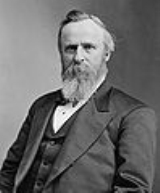
Rutherford B. Hayes


   Email Print
   Bookmark   Link


Rutherford B. Hayes


Rutherford Birchard Hayes was an American politicianPolitics of the United States

Politics of the United States of America takes place in a framework of a federal presidential representative democratic repu...
, lawyerLaw of the United States

The law of the United States was originally largely derived from the common law of the system of English law, which was in f...
, military leaderMilitary of the United States

The military of the United States, officially known as the United States Armed Forces, consist of the:...
 and the nineteenth President of the United StatesPresident of the United States

The President of the United States of America is the head of state of the United States....
 (1877–1881). Hayes was elected President by one electoral vote after the highly disputed election of 1876United States presidential election, 1876

The U.S. presidential election of 1876 was perhaps the most disputed and intense presidential election in American history....
. Losing the popular vote to his opponent, Samuel Tilden, Hayes was the only president whose election was decided by a congressional commissionElectoral Commission (United States)

The Electoral Commission was a temporary body created by Congress to resolve the disputed United States presidential electio...
.
Early life
Hayes was born in Delaware, OhioDelaware, Ohio

The City of Delaware is located near the center of the state of Ohio, about 20 miles north of Columbus, Ohio....
, on October 4, 1822. His parents were Rutherford Hayes and Sophia Birchard. His father, a storekeeper descended from Scottish immigrant to Connecticut George Hayes (1654-1725), died ten weeks before his birth and an uncle, Sardis Birchard, lived with the family and served as Hayes' guardian. Birchard was close to him throughout his life and became a father figure to him.


Discussion
Ask a question about 'Rutherford B. Hayes'
Start a new discussion about 'Rutherford B. Hayes'
Answer questions from other users
Full Discussion Forum


Timeline

1822   Born

1876   The U.S. presidential election is held. After long and heated disputes, Rutherford Birchard Hayes would be declared the winner over Samuel Jones Tilden.

1877   In the Compromise of 1877, the U.S. presidential election, 1876 presidential election of 1876 is resolved with the selection of Rutherford B. Hayes as the winner even though Samuel J. Tilden had won the popular vote on November 7, 1876

1879   Women's rights: American President Rutherford B. Hayes signs a bill allowing female attorneys to argue cases before the Supreme Court of the United States.

1881   Rutherford Birchard Hayes is succeeded as President of the United States by James Abram Garfield.

1893   Died


Quotations


Conscience is the authentic voice of God to you.

Letter to his son, Scott R. Hayes (March 8, 1892)

Every age has its temptations, its weaknesses, its dangers. Ours is in the line of the snobbish and the sordid.

Diary (May 11, 1875)

I am a freeman and jolly as a beggar.

On retiring as governor of Ohio, Letter to William Johnston (January 7, 1872)

One of the tests of the civilization of people is the treatment of its criminals.

Diary (October 30, 1892)

The progress of society is mainly ... the improvement in the condition of the workingmen of the world.

Diary (February 27, 1890)

Unjust attacks on public men do them more good than unmerited praise.

Diary (July 14, 1889)


Encyclopedia


Rutherford Birchard Hayes was an American politicianPolitics of the United States

Politics of the United States of America takes place in a framework of a federal presidential representative democratic repu...
, lawyerLaw of the United States

The law of the United States was originally largely derived from the common law of the system of English law, which was in f...
, military leaderMilitary of the United States

The military of the United States, officially known as the United States Armed Forces, consist of the:...
 and the nineteenth President of the United StatesPresident of the United States

The President of the United States of America is the head of state of the United States....
 (1877–1881). Hayes was elected President by one electoral vote after the highly disputed election of 1876United States presidential election, 1876

The U.S. presidential election of 1876 was perhaps the most disputed and intense presidential election in American history....
. Losing the popular vote to his opponent, Samuel Tilden, Hayes was the only president whose election was decided by a congressional commissionElectoral Commission (United States)

The Electoral Commission was a temporary body created by Congress to resolve the disputed United States presidential electio...
.

Early life


Hayes was born in Delaware, OhioDelaware, Ohio

The City of Delaware is located near the center of the state of Ohio, about 20 miles north of Columbus, Ohio....
, on October 4, 1822. His parents were Rutherford Hayes and Sophia Birchard. His father, a storekeeper descended from Scottish immigrant to Connecticut George Hayes (1654-1725), died ten weeks before his birth and an uncle, Sardis Birchard, lived with the family and served as Hayes' guardian. Birchard was close to him throughout his life and became a father figure to him. Hayes attended the common schools and the Methodist Academy in NorwalkNorwalk, Ohio Overview

Norwalk is a city in Huron County, Ohio, United States....
. He graduated from Kenyon CollegeKenyon College Overview

Kenyon College is a private liberal arts college in Gambier, Ohio, founded in 1824 by Bishop Philander Chase of the The Epis...
 in Gambier, OhioGambier, Ohio Summary

Gambier is a village in Knox County, Ohio, United States....
 in August 1842 at the top of his class. He was an honorary member of Delta Kappa EpsilonDelta Kappa Epsilon

Delta Kappa Epsilon is the oldest secret college men's fraternity of New England origin....
 fraternity, though he had already graduated after the Fraternity Chapter was Chartered. After briefly reading the law in ColumbusFacts About Columbus, Ohio

Columbus is the capital of the U.S....
, he graduated in 2 years from Harvard Law SchoolHarvard Law School

Harvard Law School is one of the professional graduate schools of Harvard University....
 in January 1845. He was admitted to the bar on May 10, 1845, and commenced practice in Lower Sandusky (now FremontFremont, Ohio

Fremont is a city in Sandusky County, Ohio, United States....
). After dissolving the partnership in Fremont in 1849, he moved to CincinnatiCincinnati, Ohio

Cincinnati is a southwestern Ohio city in the United States that lies on the Ohio River and is the county seat of Hamilton C...
 and resumed the practice of law.

On December 30, 1852, Hayes married Lucy Ware WebbLucy Webb Hayes

Lucy Ware Webb Hayes was the wife of President Rutherford B....
. In 1856, he was nominated for but declined a municipal judgeship, but in 1858 accepted appointment as CincinnatiCincinnati, Ohio

Cincinnati is a southwestern Ohio city in the United States that lies on the Ohio River and is the county seat of Hamilton C...
 city solicitor by the city council and won election outright to that position in 1859, losing a reelection bid in 1860.

Military service

Upon moving to Cincinnati Hayes had become a member of a prominent social organization, the Cincinnati Literary Club, whose members included Salmon P. ChaseSalmon P. Chase

Salmon Portland Chase was an American politician and jurist in the Civil War era who served as Senator from Ohio, Governor o...
 and Edward Noyes among others, and upon outbreak of the Civil WarAmerican Civil War

The American Civil War was a sectional conflict in the United States of America between the federal government and 11 Sout...
 the Literary Club made a military company. Appointed a MajorMajor

Major is a military rank the use of which varies according to country....
 in the Twenty-third Ohio Regiment by Ohio Governor William Dennison Jr.William Dennison (Ohio governor)

William Dennison, Jr. was a Whig and Republican politician from Ohio....
, he originally served as regimental judge-advocate but then was promoted to Lieutenant ColonelLieutenant Colonel

Lieutenant Colonel is a rank of commissioned officer in the armies and most marine corps and air forces of the world, typica...
 and proved competent enough at field command that by August 1862 he had been promoted to ColonelColonel Summary

Colonel is a military rank of a commissioned officer, with the corresponding ranks existing in nearly every country in the w...
 and soon after received command of his original regiment after being wounded in action. Though other presidents served in the Civil War, Hayes was the only one that was wounded. He was wounded four times.

BrevettedBrevet (military)

In the U.S. military, brevet referred to a warrant authorizing a commissioned officer to hold a higher rank temporarily, but...
 to Brigadier GeneralBrigadier General

Brigadier General is the lowest rank of general officer in some countries, usually ranking just above Colonel and just below...
 in December 1862, he commanded the First Brigade of the Kanawha Division of the Army of West VirginiaArmy of West Virginia

The Army of West Virginia was a small and short-lived military force during the Civil War that served in the Union Army in t...
 and turned back several raids. In 1864, Hayes showed particular gallantry in spearheading a frontal assault and temporarily taking command from George CrookGeorge Crook

George Crook was a career U.S. Army officer, most noted for his distinguished service during the American Civil War and the ...
 at the savage Battle of Cloyd's MountainBattle of Cloyd's Mountain

The Battle of Cloyd's Mountain was a Union victory in western Virginia in 1864 that allowed the Union forces to destroy the ...
 and continued with Crook on to Charleston. Hayes continued commanding his Brigade during the Valley Campaigns of 1864Valley Campaigns of 1864

The Valley Campaigns of 1864 were American Civil War operations and battles that took place in the Shenandoah Valley of Virg...
, participating in such major battles as the Battle of OpequonBattle of Opequon

The Battle of Opequon, also known as the Third Battle of Winchester, was a decisive victory for the Union army during ...
, the Battle of Fisher's HillBattle of Fisher's Hill Overview

In the Battle of Fisher's Hill, Phil Sheridan had almost 30,000 men while Jubal Anderson Early had just under 10,000....
, and the Battle of Cedar CreekBattle of Cedar Creek

The Battle of Cedar Creek, or The Battle of Belle Grove, October 19 1864, was one of the final, and most decisive, bat...
. At the end of the Shenandoah campaignValley Campaigns of 1864

The Valley Campaigns of 1864 were American Civil War operations and battles that took place in the Shenandoah Valley of Virg...
, Hayes was promoted to Brigadier GeneralBrigadier General

Brigadier General is the lowest rank of general officer in some countries, usually ranking just above Colonel and just below...
 in October 1864 and brevettedBrevet (military)

In the U.S. military, brevet referred to a warrant authorizing a commissioned officer to hold a higher rank temporarily, but...
 Major GeneralMajor General

Major General or Major-General is a military rank used in many countries....
. Hayes had been wounded three more times and had four horses shot from under him during his campaigning.

Hayes and McKinley

It was during his command of the 23rd Regiment of the Ohio Volunteer Infantry that Hayes met William McKinley Jr.William McKinley

William McKinley was the 25th President of the United States....
, who would later become the 25th President of the United States. Hayes promoted McKinley twice under his military command, including once for an act of bravery at Antietam. During Hayes' first Ohio gubernatorial race, McKinley engaged in political campaigning and rallying for Hayes' election by "making speeches in the Canton area". Later, as Governor of Ohio, Hayes provided political support for his fellow Republican and Ohioian during McKinley's bid for congressional election. Hayes was arguably one of the strongest political supporters underlying McKinley's military and political successes.

Political service

Hayes began political life as a WhigWhig Party (United States)

The Whig Party was a political party of the United States during the era of Jacksonian democracy....
 but in 1853 joined the Free Soil party as a delegate nominating Salmon P. ChaseSalmon P. Chase Summary

Salmon Portland Chase was an American politician and jurist in the Civil War era who served as Senator from Ohio, Governor o...
 for Governor of Ohio.

While still in the Shenandoah in 1864, Hayes received the RepublicanRepublican Party (United States)

For a detailed history and bibliography see History of the United States Republican Party....
 nomination to Congress from Cincinnati. Hayes refused to campaign, stating "I have other business just now. Any man who would leave the army at this time to electioneer for Congress ought to be scalped." Despite this, Hayes was elected and served in the Thirty-ninth and again to the Fortieth Congresses and served from March 4, 1865, to July 20, 1867, when he resigned, having been nominated for Governor of Ohio. Through the powerful voice of his friend and Civil War subordinate James M. ComlyJames M. Comly

James Munroe Stuart Comly, was a brigadier general in the Union Army during the American Civil War, as well as a journalist,...
's Ohio State Journal (one of the state's most influential newspapers), Hayes won the election and served as governor from 1868 to 1872. He was an unsuccessful candidate in 1872 for election to the Forty-third Congress, and had planned to retire from public life but was drafted by the RepublicanRepublican Party (United States)

For a detailed history and bibliography see History of the United States Republican Party....
 convention in 1875 to run for governor again and served from January 1876 to March 2, 1877. Hayes received national notice for leading a RepublicanRepublican Party (United States) Overview

For a detailed history and bibliography see History of the United States Republican Party....
 sweep of a previously DemocraticDemocratic Party (United States)

The Democratic Party is one of two major contemporary political parties in the United States, the other being the Republican...
 Ohio government.

Election of 1876

A dark horseDark horse

A dark horse candidate is one who is nominated unexpectedly, without previously having been discussed or considered as a lik...
 nominee by his convention, Hayes became president after the tumultuous, scandal-ridden years of the Grant administration. He had a reputation for honesty dating back to his Civil War years. Hayes was quite famous for his ability not to offend anyone. Henry C. AdamsHenry Cullen Adams

Henry Cullen Adams was an American farmer, public official, and U....
, a prominent political journalist and Washington insider, asserted that Hayes was "a third rate nonentity, whose only recommendation is that he is obnoxious to no one." Nevertheless, his opponent in the presidential election, DemocratDemocratic Party (United States)

The Democratic Party is one of two major contemporary political parties in the United States, the other being the Republican...
 Samuel J. TildenSamuel J. Tilden

Samuel Jones Tilden was the Democratic candidate for the US presidency in the disputed election of 1876, the most controver...
, was the favorite to win the presidential election and, in fact, won the popular vote by about 250,000 votes (with about 8.5 million voters in total).

Four states' electoral collegeElectoral college

An electoral college is a set of electors who are empowered as a deliberative body to elect someone to a particular office....
 votes were contested. In order to win, the candidates had to muster 185 votes: Tilden was short just one, with 184 votes, Hayes had 165, with 20 votes representing the four states which were contested. To make matters worse, three of these states were in the South, which was still under military occupation (the fourth was OregonFacts About Oregon

Oregon is a state in the Pacific Northwest region of the United States....
). Additionally, historians note, the election was not fair because of the improper fraud and intimidation perpetrated from both sides. A popular phrase of the day called it an election without "a free ballot and a fair count." For the next four years, Democrats would refer to Hayes as "Rutherfraud B. Hayes" for his allegedly illegitimate election, as he had lost the popular vote by roughly 250,000 votes.

To peacefully decide the results of the election, the two houses of Congress set up the Electoral CommissionElectoral Commission (United States)

The Electoral Commission was a temporary body created by Congress to resolve the disputed United States presidential electio...
 to investigate and decide upon the actual winner. The commission constituted 15 members: five from the House, five from the Senate and five from the Supreme Court. Additionally, the Commission was bi-partisan consisting of 7 Democrats, 7 Republicans and a "swing" vote in Joseph P. Bradley, a Supreme Court Justice. Bradley, however, was a Republican at heart and thus the ruling followed party lines: 8 to 7 voted for Hayes winning in all of the contested 20 electoral votes.

Key Ohio Republicans like James A. Garfield and the Democrats, however, agreed at a Washington hotel on the Wormley House Agreement. Southern Democrats were given assurances, in the Compromise of 1877Compromise of 1877

The Compromise of 1877 was an informal, unwritten deal that settled the disputed 1876 U.S....
, that if Hayes became president, he would pull federal troops out of the South and end Reconstruction. An agreement was made between them and the Republicans: if Hayes' cabinet consisted of at least one Southerner and he withdrew all Union troops from the South, then he would become President. This negated much of the reason for the Civil War, and a brutal system of segregation continued which forbade blacks from voting, participating in most professions, attending colleges, voting and going to restaurants and public places. This system of segregation would continue for almost another century.

Presidency 1877-1881

Because March 4, 1877 was a Sunday, Hayes took the oath of office in the Red Room of the White HouseWhite House

The White House is the official home and principal workplace of the President of the United States of America....
 on March 3, becoming the first president to take the oath of officeOath of office

An oath of office is an oath or affirmation a person takes before officially assuming an office....
 in the White House. This ceremony was held in secret, because the previous year's election had been so bitterly divisive that outgoing President Grant feared an insurrection by Tilden's supporters and wanted to ensure that any Democratic attempt to hijack the public inauguration ceremony would fail, Hayes having been sworn in already in private. Hayes took the oath again publicly on March 5 on the East Portico of the United States CapitolUnited States Capitol Overview

The United States Capitol is the US capitol building, that serves as home for Congress, the legislative branch of the Unite...
, and served until March 4, 1881. Hayes' best known quotation, "He serves his party best who serves his country best," is from his 1877 Inaugural AddressFacts About Inaugural Addresses of the Presidents of the United States

Inaugural Addresses of the Presidents of the United States are given each time that a United States President is inaugurated...
.

Domestic policy

When Congress sent him the bills (complete with amendments) overturning civil rights enforcement, Hayes vetoed them four times before finally signing one that satisfied his requirement for black rights. However, his subsequent attempts to reconcile with his Southern Democrat opposition by handing them prestigious civil service appointments both alienated fellow Republicans and undermined his own previous attempts at civil service reform.

Hayes' most controversial domestic act -- apart from ending Reconstruction -- came with his response to the Great Railroad Strike of 1877, in which employees of the Baltimore & Ohio Railroad walked off the job and were joined across the country by thousands of workers in their own and sympathetic industries. When the labor disputes exploded into riots in several cities, Hayes called in federal troops, who, for the first time in U.S. history, fired on the striking workers, killing more than 70. Although the troops eventually managed to restore the peace, working people and industrialists alike were displeased with the military intervention. Workers feared that the federal government had turned permanently against them, while industrialists feared that such brutal action would spark revolution along the lines of the EuropeEurope

Europe is one of the seven traditional continents of the Earth....
an Revolutions of 1848Facts About Revolutions of 1848

The European Revolutions of 1848, known in some countries as the Spring of Nations or the Year of Revolution, we...
.

Foreign policy

In 1878, Hayes was asked by ArgentinaArgentina Summary

Argentina is a country in southern South America....
 to act as arbitrator following the War of the Triple AllianceWar of the Triple Alliance

The War of the Triple Alliance, also known as the Paraguayan War, was fought from 1864 to 1870, and was one of the blo...
 between Argentina, BrazilBrazil

Brazil, officially the Federative Republic of Brazil , is the largest and most populous country in South America, and ...
 and UruguayUruguay

Uruguay, officially the Eastern Republic of Uruguay or the Republic East of the Uruguay , is a country located ...
 against ParaguayParaguay

Paraguay, officially the Republic of Paraguay , is a landlocked country in South America....
. The Argentines hoped that Hayes would give the Gran ChacoGran Chaco

The Gran Chaco, dubbed by some as "the last South American frontier", is a sparsely populated, hot and semi-arid lowland reg...
 region to them; however, he decided in favor of the Paraguayans. His decision made him a hero in Paraguay, and a city and a departmentDepartment (subnational entity)

A department is geographically defined area of a centralized state which functions as an administrative unit, usually at pro...
 were named in his honor.
He also intended to build the U.S. controlled Panama Canal, though he wasn't the one who actually did it.

But for the most part, Hayes was not very involved in foreign policy. The bulk of his problems during his presidency were small and domestically related.

Notable legislation

During his presidency, Hayes signed a number of bills including one signed on February 15, 1879 which, for the first time, allowed female attorneysLawyer

A lawyer, or legal practitioner, is a person certified to give legal advice who advises clients in legal matters....
 to argue cases before the Supreme Court of the United StatesSupreme Court of the United States

The Supreme Court of the United States is the highest judicial body in the United States and leads the judicial branch of th...
.

Other acts include:
  • Compromise of 1877Compromise of 1877

    The Compromise of 1877 was an informal, unwritten deal that settled the disputed 1876 U.S....
  • Desert Land ActDesert Land Act

    The Desert Land Act was passed by the United States Congress on 3 March 1877 to encourage and promote the economic developme...
     (1877)
  • Bland-Allison ActBland-Allison Act

    The Bland-Allison Act of 1878 is a United States federal law enacted in response to the Fourth Coinage Act, or the Crime o...
     (1878)
  • Timber and Stone ActTimber and Stone Act

    The Timber and Stone Act of 1878 in the United States sold western timberland for $2.50 per acre in 160 acre blocks....
     (1878)
  • Tidewater Act (1879)

Significant events during his presidency

  • Munn v. IllinoisMunn v. Illinois

    Munn v. Illinois, 94 U.S. 113, was a United States Supreme Court case dealing with corporate rates and agriculture....
     (1876)
  • Great Railroad Strike (1877)

(1878)

Administration and Cabinet

Supreme Court appointments

Hayes appointed two Associate Justices of the Supreme Court of the United States:

  • John Marshall HarlanJohn Marshall Harlan

    John Marshall Harlan was an American Supreme Court associate justice....
     – 1877
  • William Burnham WoodsWilliam Burnham Woods Overview

    William Burnham Woods was an American jurist, politician, and soldier....
     – 1881

Post-Presidency


Hayes did not seek re-election in 1880, keeping his pledge that he would not run for a second term. He had, in his inaugural address, proposed a one-term limitTerm limit

A term limit is a legal restriction that limits the number of terms a person may serve in a particular elected office....
 for the presidency combined with an increase in the term length to six years.

Hayes served on the Board of Trustees of the Ohio State UniversityOhio State University

The Ohio State University is a coeducational public research university in the U.S....
, the school he helped found during his time as governor of Ohio, from the end of his Presidency until his death.

Rutherford Birchard Hayes died of complications of a heart attackFacts About Myocardial infarction

Acute myocardial infarction , commonly known as a heart attack, is a disease that occurs when the blood supply to a pa...
 in FremontFremont, Ohio

Fremont is a city in Sandusky County, Ohio, United States....
, Sandusky County, OhioSandusky County, Ohio

Sandusky County is a county located in the state of Ohio, United States....
, at 12:00 p.m. on Tuesday January 17, 1893. His last words were "I know that I'm going where LucyLucy Webb Hayes

Lucy Ware Webb Hayes was the wife of President Rutherford B....
 is." Interment was in Riverwood Cemetery. Following the gift of his home to the state of Ohio for the Spiegel Grove State ParkSpiegel Grove Summary

Spiegel Grove is the the estate of President of the United States Rutherford B Hayes, in Fremont, Ohio....
, he was reinterred there in 1915.

Family

Hayes was the youngest of four children. Two of his siblings, Lorenzo Hayes (1815–1825) and Sarah Sophia Hayes (1817–1821), died in childhood, as was common at the time. Hayes was close to his surviving sibling, Fanny Arabella Hayes (1820–1856), as can be seen in this diary entry, written just after her death:
July, 1856. ?My dear only sister, my beloved Fanny, is dead! The dearest friend of childhood, the affectionate adviser, the confidante of all my life, the one I loved best, is gone; alas! never again to be seen on earth.


With Lucy Ware Webb, Hayes had the following children:

  • Birchard Austin Hayes (1853-1926)
  • James Webb Cook Hayes (1856-1934)
  • Rutherford Platt Hayes (1858-1927)
  • Joseph Thompson Hayes (1861-1863)
  • George Crook Hayes (1864-1866)
  • Fanny Hayes (1867-1950)
  • Scott Russell Hayes (1871-1923)
  • Manning Force Hayes (1873-1874)

External links

  • Retrieved on 2008-02-12