
See Also

Smithsonian Institution

The Smithsonian Institution is an educational and research institute and associated museum Museum

A museum is typically a "permanent institution in the service of society and of its development, ope... 

 complex, administered and funded by the government of the United States Federal government of the United States

The government [i] of the United States of America [i], established by the U.S. Constitution [i] ... 

 and by funds from its endowment, contributions, and profits from its shops and its magazine. Most of its facilities are located in Washington, D.C. Washington, D.C.

Washington, D.C. is the capital [i] city [i] of the United States of America [i]. ... 

, but its 19 museums and seven research centers includes sites in New York City, Virginia, Panama, and elsewhere. It has 142 million items in its collections. A monthly magazine Magazine

A magazine is a periodical publication [i] containing a variety of articles, generally financed by advertising [i] ... 

 published by the Smithsonian Institution is also named the Smithsonian.

Discussions

  Discussion Features

   Ask a question about 'Smithsonian Institution'

   Start a new discussion about 'Smithsonian Institution'

   Answer questions about 'Smithsonian Institution'

   'Smithsonian Institution' discussion forum

Timeline

1829   James Smithson leaves £100.000 to fund the Smithsonian Institution

1909   Theodore Roosevelt Theodore Roosevelt

Theodore Roosevelt, Jr. , also known as T.R. and to the public as Teddy, was the 26th President of the United States [i] ... 

 leaves New York New York

New York is a state [i] in the northeastern [i] United States [i]. ... 

 for a post-presidency safari Safari

A safari is an overland journey.... 

 in Africa Africa

Africa is one of the greatest sized continents of the Earth.... 

. The trip was sponsored by the Smithsonian Institution and National Geographic Society National Geographic Society

The National Geographic Society, based in Washington, D.C. [i] in the United States [i], is one of the w ... 

.


Encyclopedia


The Smithsonian Institution is an educational and research institute and associated museum Museum

A museum is typically a "permanent institution in the service of society and of its development, ope... 

 complex, administered and funded by the government of the United States Federal government of the United States

The government [i] of the United States of America [i], established by the U.S. Constitution [i]... 

 and by funds from its endowment, contributions, and profits from its shops and its magazine. Most of its facilities are located in Washington, D.C. Washington, D.C.

Washington, D.C. is the capital [i] city [i] of the United States of America [i]. ... 

, but its 19 museums and seven research centers includes sites in New York City, Virginia, Panama, and elsewhere. It has 142 million items in its collections.

A monthly magazine Magazine

A magazine is a periodical publication [i] containing a variety of articles, generally financed by advertising [i] ... 

 published by the Smithsonian Institution is also named the Smithsonian.

History

The Smithsonian Institution was founded for the promotion and dissemination of knowledge by a bequest to the United States United States

The United States of America, also known as the United States, the U.S., the U.S.A., a... 

 by the British United Kingdom of Great Britain and Ireland

| align="center" colspan="2"| United Kingdom ofGreat Britain and Ireland
... 

 scientist James Smithson , who had never visited the United States himself. In Smithson's will, he stated that should his nephew, Henry James Hungerford Smithsonian Institution

The Smithsonian Institution is an educational and research institute and associated museum [i] complex, ... 

, die without heirs, the Smithson estate would go to the United States of America United States

The United States of America, also known as the United States, the U.S., the U.S.A., a... 

 for creating an "Establishment for the increase & diffusion of Knowledge among men". After the nephew died without heirs in 1835, President Andrew Jackson Andrew Jackson

Andrew Jackson was the seventh President of the United States [i] , first governor [i] ... 

 informed Congress United States Congress

The United States Congress is the legislature [i] of the United States federal government [i]. ... 

 of the bequest, which amounted to 100,000 gold sovereign British Sovereign coin

A Gold Sovereign is a gold coin [i] first issued in 1489 [i] for Henry VII of England [i] and still in p ... 

s, or $500,000 U.S. dollars United States dollar

For details of current paper money [i] and coins, see Federal Reserve Note [i] and United States coinage [i] ... 

 .

Act of Congress: Eight years later, Congress passed an act establishing the Smithsonian Institution, a hybrid public/private partnership, and the act was signed into law on August 10, 1846 by James Polk James K. Polk

James Knox Polk was the eleventh President of the United States [i], serving from March 4 [i], 1845 [i]... 

. The bill was drafted by Indiana Indiana

Indiana, meaning the "Land of the Indians [i]," is a state i ... 

 Democratic Democratic Party (United States)

The Democratic Party is one of two major contemporary political parties [i] in the United States [i] ... 

 Congressman Robert Dale Owen, a Socialist Socialism

Socialism refers to a broad array of doctrines or political movements that envisage a socio-economic [i]... 

 and son of Robert Owen Robert Owen

Robert Owen was a Welsh [i] socialist [i] and social reformer. ... 

, the father of the cooperative Cooperative

A cooperative is a group of persons who join together or co-operate [i], to carry on an economic activit ... 

 movement.

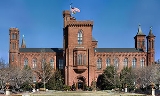
The castellated architecture of the Smithsonian Institution Building Smithsonian Institution Building

The Smithsonian Institution Building, located on the National Mall [i] in Washington, DC [i], houses the ... 

 on the National Mall National Mall

[i], the [[capital]... 

 has made it known informally as "The Castle". It was built by architect James Renwick, Jr. James Renwick, Jr.

James Renwick, Jr., was a well-known American architect [i] in the 19th-century [i]. ... 

 and completed in 1855. Many of the other buildings are also historical and architectural landmarks.

Though the Smithsonian's first secretary, Joseph Henry, wanted the Institution to be a center for scientific research, before long it became the depository for various Washington and U.S. government collections.

The voyage of the U.S. Navy United States Navy

The United States Navy is the branch of the United States armed forces [i] responsible for conducting naval [i] ... 

 circumnavigated the globe between 1838 and 1842. The United States Exploring Expedition amassed thousands of animal specimens, an herbarium of 50,000 examples, shells and minerals, tropical birds, jars of seawater and ethnographic specimens from the South Pacific.

The military and civilian surveys in the American West assembled many Native American Native Americans in the United States

American Indian and Alaskan NativesU.S. state [i]s and several of the inhabited insular areas [i] that a ... 

 artifacts as well as natural history specimens.

The Institution became a magnet for natural scientists from 1857 to 1866, who formed a group called the Megatherium Club.

The asteroid Asteroid

Asteroid, minor planet, and planetoid are synonyms, and are used to indicate a diverse group of small ce... 

 3773 Smithsonian is named in honor of the Institution.

Administration

The Smithsonian Institution is established as a trust by act of Congress, and it is functionally and legally a body of the federal government. More than two-thirds of the Smithsonian's workforce of some 6,300 persons are employees of the federal government. The Smithsonian is represented by attorneys from the United States Department of Justice United States Department of Justice

The United States Department of Justice is a Cabinet [i] department in the United States [i] ... 

 in litigation, and money judgments against the Smithsonian are also paid out of the federal treasury.

Federal courts have furthermore concluded that the Smithsonian is part of the United States government within the meaning of such statutes as the Tucker Act and the Federal Tort Claims Act. It is also treated as part of the United States government when defending against copyright infringement claims, which means that such actions must be brought before the United States Court of Federal Claims United States Court of Federal Claims

The United States Court of Federal Claims is a court that hears claims against the United States government [i] ... 

..

The nominal head of the Institution is the Chancellor, an office which has always been held by the current Chief Justice of the United States Chief Justice of the United States

The Chief Justice of the United States is the head of the judicial branch [i] of the government [i] ... 

. The affairs of the Smithsonian are conducted by its 17-member board of regents, eight members of which constitute a quorum for the conduct of business. Eight of the regents are United States officials: the Vice President Vice President of the United States

The Vice President of the United States is the second-highest executive official of the United States government [i] ... 

  and the Chief Justice of the United States, three United States Senators appointed by the Vice President in his capacity as President of the Senate, and three Members of the U.S. House of Representatives United States House of Representatives

The United States House of Representatives is one of the two chambers [i] of the United States Congress [i] ... 

 appointed by the Speaker of the House Speaker of the United States House of Representatives

The Speaker [i] of the United States House of Representatives is the presiding officer of the lower house [i] ... 

. The remaining nine regents are "persons other than Members of Congress," who are appointed by joint resolution of Congress. Regents are allowed reimbursement for their expenses in connection with attendance at meetings, but their service as regents is uncompensated. The day-to-day operations of the Smithsonian are supervised by a salaried "Secretary" chosen by the board of regents.

Secretaries of the Smithsonian

  1. Joseph Henry Joseph Henry

    Joseph Henry was a Scottish [i]-American [i] scientist. ... 

    , 1846–1878
  2. Spencer Fullerton Baird Spencer Fullerton Baird

    Spencer Fullerton Baird was an American [i] ornithologist [i] and ichthyologist [i] ... 

    , 1878–1887
  3. Samuel Pierpont Langley Samuel Pierpont Langley

    Samuel Pierpont Langley was an American [i] astronomer [i], physicist [i], inventor [i] of ... 

    , 1887–1906
  4. Charles Doolittle Walcott, 1907–1927
  5. Charles Greeley Abbot Charles Greeley Abbot

    Charles Greeley Abbot was an American [i] astrophysicist [i], astronomer [i] and Secretary ... 

    , 1928–1944
  6. Alexander Wetmore, 1944–1952
  7. Leonard Carmichael Leonard Carmichael

    Leonard Carmichael [i] was a U.S. [i] educator [i] and psychologist [i]. ... 

    , 1953–1964
  8. Sidney Dillon Ripley, 1964–1984
  9. Robert McCormick Adams, 1984–1994
  10. I. Michael Heyman, 1994–1999
  11. Lawrence M. Small, 2000–


See .

Smithsonian museums


  • Anacostia Museum and Center for African American History and Culture
  • Arthur M. Sackler Gallery Arthur M. Sackler Gallery

    The Arthur M. Sackler Gallery is an underground gallery of Asian art located on the National Mall [i], d ... 

  • Arts and Industries Building Arts and Industries Building

    The Arts and Industries Building is the second oldest of the Smithsonian [i] museums [i] ... 

  • Cooper-Hewitt, National Design Museum
  • Freer Gallery of Art Freer Gallery of Art

    The Freer Gallery of Art is the Smithsonian Institution [i]'s museum of east Asian [i] art, including art [i] ... 

  • Hirshhorn Museum and Sculpture Garden Hirshhorn Museum and Sculpture Garden

    The Hirshhorn Museum and Sculpture Garden is an art museum [i] located in Washington, DC [i] on the National Mall [i] ... 

  • National Air and Space Museum National Air and Space Museum

    The National Air and Space Museum of the Smithsonian Institution [i] in the United States [i] maintains... 

    • Steven F. Udvar-Hazy Center Steven F. Udvar-Hazy Center

      The Steven F. Udvar-Hazy Center is the Smithsonian [i] National Air and Space Museum [i] ... 

  • National Museum of African American History and Culture
  • National Museum of African Art National Museum of African Art

    The National Museum of African Art is a museum [i] that is part of the Smithsonian Institution [i] in Washington, D.C. [i] ... 

  • National Museum of American History National Museum of American History

    The National Museum of American History is a museum [i] administered by the Smithsonian Institution [i] ... 

  • National Museum of the American Indian National Museum of the American Indian

    The Smithsonians National Museum of the American Indian is an institution of living cultures dedicated t... 

  • National Museum of Natural History National Museum of Natural History

    The National Museum of Natural History is a museum [i] administered by the Smithsonian Institution [i], ... 

  • National Portrait Gallery
  • National Postal Museum National Postal Museum

    The National Postal Museum, located in Washington, D.C. [i], was established through joint agreement bet ... 

  • National Zoo Smithsonian National Zoological Park

    The Smithsonian National Zoological Park, commonly known as the National Zoo or 'Washington Zoo', ... 

  • S. Dillon Ripley Center S. Dillon Ripley Center

    The S. Dillon Ripley Center, better known simply as the Ripley Center, is one of the buildings of ... 

  • Smithsonian American Art Museum Smithsonian American Art Museum

    The Smithsonian American Art Museum is a museum [i] in Washington, D.C. [i] with an extensive collection ... 

  • Smithsonian Institution Building Smithsonian Institution Building

    The Smithsonian Institution Building, located on the National Mall [i] in Washington, DC [i], houses the ... 

  • The National Gallery of Art National Gallery of Art

    The National Gallery of Art is an art museum [i], located on the National Mall [i] in Washington, D.C. [i] ... 

     is affiliated with the Smithsonian, but it is run by a separate charter.

Smithsonian research centers

The following is a list of Smithsonian research centers, with their affiliated museum in parentheses.
  • Smithsonian Astrophysical Observatory and the associated Harvard-Smithsonian Center for Astrophysics
  • Carrie-Bow Marine Field Station
  • Center For Earth and Planetary Studies
  • Conservation and Research Center
  • Smithsonian Environmental Research Center
  • Marine Station at Fort Pierce
  • Migratory Bird Center
  • Museum Conservation Institute
  • Smithsonian Tropical Research Institute
  • Woodrow Wilson International Center for Scholars Woodrow Wilson International Center for Scholars

    The Woodrow Wilson International Center for Scholars is a United States Presidential Memorial [i] that w ... 

  • Smithsonian Institution Libraries Smithsonian Institution

    The Smithsonian Institution is an educational and research institute and associated museum [i] complex, ... 

  • Center for Folklife and Cultural Heritage

Notes

* O'Rourke v. Smithsonian Inst. Press, 399 F.3d 113 , cert. denied, No. 04-1481, 2005 U.S. LEXIS 5550 . This court decision also summarizes the history of the Institution, the composition of the Board of Regents, its interrelationship with the federal government, and prior court rulings regarding the Institution's treatment as a body of the government under various federal laws.

External links

  • presents , a publicly accessible digital resource intended to enlighten and interest the general reader. It does not represent an attempt to summarize all science, or even all branches of science on which the Smithsonian can speak with authority. It will, however, acquaint the reader with the organization, history, and activities of the scientific institution which has grown up with the nation and fostered the nation's scientific activities. It is an introduction to the workings and achievements of the scientific method over a large field, and may open doors to some branches of science.


Further reading

  • Nina Burleigh, Stranger and the Statesman: James Smithson, John Quincy Adams, and the Making of America's Greatest Museum, The Smithsonian, HarperCollins, September 2003, hardcover, 288 pages, ISBN 0-06-000241-7
  • Z. Herskovits, To the Smithsonian or Bust: The Scientific Legacy of Nikola Tesla, Yale Scientific Magazine, V. 71, Issue 4