
All Topics  
Metal detector

 
Metal Detector

   Email Print
   Bookmark   Link


Metal detector


Metal detectors use electromagnetic induction to detect metal
Metal

In chemistry, a metal is a chemical element whose atoms readily lose electrons to form positive ions , and form metallic bonds between other metal atoms and ionic bonds between nonmetal atoms....
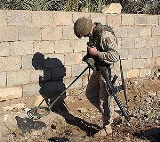
. Uses include de-mining (the detection of land mine
Land mine

A land mine is an explosive device designed to be placed on or in the ground to explode when triggered by an operator or the proximity of a vehicle, person, or animal....
s), the detection of weapons such as knives and guns, especially at airports
Airport security

Airport security refers to the techniques and methods used in protecting airports and aircraft from crime.Large numbers of people pass through airports....
, geophysical prospecting
Geophysics

Geophysics, a major discipline of the Earth sciences, is the study of the Earth by the quantitative observation of its physical properties, especially by Seismology, Electromagnetism, Radioactive decay, galvanic and potential field methods....
, archaeology and treasure hunting
Treasure hunting

Treasure hunting is the search for real treasure which has been a notable human activity for millennia....
. Metal detectors are also used to detect foreign bodies in food, and in the construction industry to detect steel reinforcing bars
Rebar

A rebar, or reinforcing bar, is a common steel bar, and is commonly used in reinforced concrete and reinforced masonry structures. It is usually formed from carbon steel, and is given ridges for better mechanical anchoring into the concrete....
 in concrete and pipes and wires buried in walls and floors.

The simplest form of a metal detector consists of an oscillator producing an alternating current that passes through a coil producing an alternating magnetic field
Magnetic field

A magnetism field is a vector field which can exert a magnetic force on moving electric charges and on magnetic dipoles . When placed in a magnetic field, magnetic dipoles tend to align their axes parallel to the magnetic field....
.


Discussion
Ask a question about 'Metal detector'
Start a new discussion about 'Metal detector'
Answer questions from other users
Full Discussion Forum


Recent Posts


Encyclopedia


Metal Detector
Metal detectors use electromagnetic induction to detect metal
Metal

In chemistry, a metal is a chemical element whose atoms readily lose electrons to form positive ions , and form metallic bonds between other metal atoms and ionic bonds between nonmetal atoms....
. Uses include de-mining (the detection of land mine
Land mine

A land mine is an explosive device designed to be placed on or in the ground to explode when triggered by an operator or the proximity of a vehicle, person, or animal....
s), the detection of weapons such as knives and guns, especially at airports
Airport security

Airport security refers to the techniques and methods used in protecting airports and aircraft from crime.Large numbers of people pass through airports....
, geophysical prospecting
Geophysics

Geophysics, a major discipline of the Earth sciences, is the study of the Earth by the quantitative observation of its physical properties, especially by Seismology, Electromagnetism, Radioactive decay, galvanic and potential field methods....
, archaeology and treasure hunting
Treasure hunting

Treasure hunting is the search for real treasure which has been a notable human activity for millennia....
. Metal detectors are also used to detect foreign bodies in food, and in the construction industry to detect steel reinforcing bars
Rebar

A rebar, or reinforcing bar, is a common steel bar, and is commonly used in reinforced concrete and reinforced masonry structures. It is usually formed from carbon steel, and is given ridges for better mechanical anchoring into the concrete....
 in concrete and pipes and wires buried in walls and floors.

The simplest form of a metal detector consists of an oscillator producing an alternating current that passes through a coil producing an alternating magnetic field
Magnetic field

A magnetism field is a vector field which can exert a magnetic force on moving electric charges and on magnetic dipoles . When placed in a magnetic field, magnetic dipoles tend to align their axes parallel to the magnetic field....
. If a piece of electrically conductive metal is close to the coil, eddy currents will be induced in the metal, and this produces an alternating magnetic field of its own. If another coil is used to measure the magnetic field (acting as a magnetometer
Magnetometer

A magnetometer is a scientific instrument used to measure the strength and/or direction of the magnetic field in the vicinity of the instrument....
), the change in the magnetic field due to the metallic object can be detected.

History and development


The first detectors

Toward the end of the 19th century, many scientists and engineers used their growing knowledge of electrical theory in an attempt to devise a machine which would pinpoint metal. The use of such a device to find ore-bearing rocks would give a huge advantage to any miner who employed it. The German physicist Heinrich Wilhelm Dove
Heinrich Wilhelm Dove

Heinrich Wilhelm Dove was a Prussian physicist and Meteorology.Dove was born in Liegnitz. Dove studied history, philosophy, and the natural sciences at the University of Breslau from 1821 until 1824....
 invented the induction balance system, which was incorporated into metal detectors a hundred years later. Early machines were crude, used a lot of battery power, and worked only to a very limited degree. Alexander Graham Bell
Alexander Graham Bell

Alexander Graham Bell was an eminent scientist, Innovation and innovator who is credited with inventing the first practical telephone.Bell's father, grandfather, and brother had all been associated with work on elocution and speech, and both his mother and wife were deaf, profoundly influencing Bell's life's work....
 used such a device to attempt to locate a bullet lodged in the chest of American President James Garfield
James Garfield

James Abram Garfield was the List of Presidents of the United States President of the United States. James A. Garfield assassination, two months after being shot and six months after his inauguration, made his tenure the second shortest in United States history....
 in 1881; the attempt was unsuccessful because the metal bed Garfield was lying on confused the detector.

Modern developments


The modern development of the metal detector began in the 1930s. [Gerhard Fisher] had developed a system of radio direction-finding, which was to be used for accurate navigation. The system worked extremely well, but Fisher noticed that there were anomalies in areas where the terrain contained ore-bearing rocks. He reasoned that if a radio beam could be distorted by metal, then it should be possible to design a machine which would detect metal using a search coil resonating at a radio frequency. In 1937 he applied for, and was granted, the first patent for a metal detector. However, it was one Lieutenant
Lieutenant

Lieutenant is a military, naval, paramilitary, fire service, emergency medical services or police commissioned officer military rank.Lieutenant may also appear as part of a title used in various other organisations with a codified command structure....
 Josef Stanislaw Kosacki
Josef Stanislaw Kosacki

Lieutenant Josef Stanislaw Kosacki was a Poland soldier who is credited with inventing the metal detector for the clearing of minefields during the Second World War....
, a Polish officer attached to a unit stationed in St Andrews
St Andrews

St Andrews is a town and former royal burgh on the east coast of Fife, Scotland. According to the recent population estimate , the town has a population of 16,596, making this the fifth largest settlement in Fife....
, Fife
Fife

Fife is a council area of Scotland, situated between the Firth of Tay and the Firth of Forth, with inland boundaries to Perth and Kinross and Clackmannanshire....
, Scotland
Scotland

conventional_long_name = ScotlandAlba|common_name= Scotland|image_flag = Flag of Scotland.svg|flag_width = 130px...
 during the early years of World War II
World War II

World War II, or the Second World War , was a global military conflict which involved a Participants in World War II, including all of the great powers, organised into two opposing military alliances: the Allies of World War II and the Axis powers....
, that refined the design into a practical detector. They were heavy, ran on vacuum tubes, and needed separate battery packs. The design invented by Stanislaw was used extensively during the clearance of the German mine fields during the Second Battle of El Alamein
Second Battle of El Alamein

The Second Battle of El Alamein marked a major turning point in the Western Desert Campaign of World War II. The battle lasted from 23 October to 5 November 1942....
 when 500 units were shipped to Field Marshal Montgomery
Bernard Montgomery, 1st Viscount Montgomery of Alamein

Field Marshal Bernard Law Montgomery, 1st Viscount Montgomery of Alamein, Order of the Garter, Order of the Bath, Distinguished Service Order, Her Majesty's Most Honourable Privy Council, , often referred to as "Monty", was an Anglo-Irish British Army officer....
 to clear the minefields of the retreating Germans, and later used during the Allied invasion of Sicily
Allied invasion of Sicily

The Allied invasion of Sicily, codenamed Operation Husky, was a major World War II campaign, in which the Allies of World War II took Sicily from the Axis ....
, the Allied invasion of Italy
Allied invasion of Italy

The process Allied invasion of Italy, was the Allies of World War II landing on mainland Italy on September 3, 1943, by General Harold Alexander's 15th Army Group during World War II....
 and the Invasion of Normandy. As it was a wartime research operation to create and refine the design of the detector, the knowledge that Stanislaw created the first practical metal detector was kept secret for over 50 years.

After the war, there were plenty of surplus mine detectors on the market; they were bought up by relic hunters who used them for fun and profit. This helped to form metal detecting into a hobby.

Further refinements


Many manufacturers of these new devices brought their own ideas to the market. Whites Electronics of Oregon began in the 50's by building a machine called the Oremaster Geiger Counter. Another leader in detector technology was Charles Garrett, who pioneered the BFO (Beat Frequency Oscillator) machine. With the invention and development of the transistor in the 50's and 60's, metal detector manufacturers and designers made smaller lighter machines with improved circuitry, running on small battery packs. Companies sprang up all over the USA and Britain to supply the growing demand.

Larger portable metal detectors are used by archaeologists and treasure hunters to locate metallic items, such as jewelry, coins
COinS

ContextObjects in Spans, commonly abbreviated COinS, is a method of embedding latent OpenURL ContextObjects in the HTML code of Web pages....
, bullets, and other various artifacts
Artifact (archaeology)

In archaeology, an artifact or artefact is any object made or modified by a human archaeological culture, and often one later recovered by some archaeological endeavor....
 buried shallowly underground.

Discriminators


Technological changes were taking place at a rapid rate too, and very few of the smaller companies managed to stay in competition with the big outfits. Goldak, Metrotech, IGWT, TEC
TEC

TEC may refer to:...
, and, quite recently, Arado
Arado

Arado may refer to:* Arado Flugzeugwerke, a German aircraft company* Arwad, an ancient city in Syria...
 ceased production of hobby machines. Some devotees of metal detecting still treasure their Arado machines, which had a reputation for being difficult to set up, but were reputed to be the deepest-seeking hobby detectors ever made. The biggest technical change in detectors was the development of the induction-balance system, where two coils are set up in an electrical equilibrium to produce a 'null' or zero balance. Introducing metal to the vicinity of the coils caused them to unbalance, producing a change of tone in the machine's speaker. Scientists had long known that every metal has a specific response to stimulation by alternating current. Each metal produces a time lag or 'phase angle
Phase angle

In the context of vectors and Phasor , the term phase angle refers to the angular component of the polar coordinate representation. The notation   for a vector with magnitude A and phase angle ?, is called angle notation....
' in its induced current, in relation to the drive current. This meant that detectors could now be set up to ignore unwanted phase angles, and respond positively only to desired metals. But there was also a downside to the development of the 'discriminator' detectors. Introducing discrimination always had the effect of reducing the sensitivity of the machine, so it was less able to find deep objects. In addition, there was the fact that some desirable metals were quite near the area of unwanted metals, such as iron. Gold, particularly in alloy form, was quite close to tinfoil in the overall spectrum, so the discrimination control had to be used carefully. The price to be paid for setting up a detector to ignore iron and tinfoil was the possibility that, sooner or later, the user would scan over, and ignore, a valuable find - perhaps a diamond engagement ring
Engagement ring

In Western tradition, an engagement ring is a jewelry ring worn by a woman indicating her engagement to be marriage. In some countries, such as the United States and the United Kingdom, it is worn on the left-hand ring finger, while in other countries, such as Poland and Ukraine, it is customary for the ring to be worn on the right-hand....
 on a beach.

New coil designs


Coil designers also tried out innovative designs. The original Induction Balance coil system consisted of two identical coils placed on top of one another. Compass Electronics produced a new design; the two coils were made in a D shape, and were mounted back-to-back to form a circle. This system was widely used in the 1970s, and both concentric and D type (or Widescan as they became known) had their fans. Another development was the invention of detectors which could cancel out the effect of mineralization in the ground. This gave greater depth, but was a non-discriminate mode. It worked best at lower frequencies than those used before, and frequencies of 3 to 20 kHz were found to produce the best results. Many detectors in the 1970s had a switch which enabled the user to switch between the discriminate mode and the non-discriminate mode. Later developments switched electronically between both modes. The development of the Induction Balance detector would ultimately result in the Motion detector, which constantly checked and balanced the background mineralization.

Pulse induction


Sd2100
At the same time, developers were looking at using a different technique in metal detection called Pulse Induction. Unlike the Beat Frequency Oscillator or the Induction Balance machines which both used a uniform alternating current at a low frequency, the pulse induction machine simply fired a high-voltage pulse of signal into the ground. In the absence of metal, the 'spike' decayed at a uniform rate, and the time it took to fall to zero volts could be accurately measured. However, if metal was present when the machine fired, a small current would flow in the metal, and the time for the voltage to drop to zero would be increased. These time differences were minute, but the improvement in electronics made it possible to measure them accurately and identify the presence of metal at a reasonable distance. These new machines had one major advantage: they were completely impervious to the effects of mineralization, and rings and other jewellery could now be located even under highly-mineralized 'black sand
Black sand

Black sand is sand that is black in colour. One type of black sand is a heavy, glossy, partly magnetic mixture of usually fine sands, found as part of a placer deposit....
'. They had one major disadvantage too: there was no way to incorporate discrimination into a Pulse induction detector. At least, that was the perceived wisdom of scientists and engineers until Eric Foster, who had run Location Technology in Ireland for many years, started a new company in Britain and produced the Goldscan, the first Pulse Induction detector which had the apparent ability to differentiate between metals. This was a new type of 'junk eliminator' circuit, which relied on the size of the target as well as its metallic response to give a control that would show positive for a gold ring and negative for a copper coin. Its ability to differentiate between non-ferrous metals was not an exact science, but gave unparalleled depth on mineralized soil or sand. Pulse Induction detectors are now widely used in the construction industry; the Whites PI-150 is an industrial machine which can detect large objects to 10 feet, using a 12 or 15 inch coil.

Future detectors


Modern top models are fully computerized, using integrated circuit technology to allow the user to set sensitivity, discrimination, track speed, threshold volume, notch filters, etc., and hold these parameters in memory for future use. Compared to just a decade ago, detectors are lighter, deeper-seeking, use less battery power, and discriminate better.

New genres of metal detector have made their appearance. BB (beat balance) and CCO (coil coupled operation) were unveiled by the electronics press in 2004. Both were invented by electronics writer and designer Thomas Scarborough and combine unprecedented simplicity with good sensitivity.

Uses of metal detectors


Metal detectors in archeology


In England and Wales
England and Wales

England and Wales is a legal unit within the United Kingdom. It consists of England and Wales, two of the four countries of the United Kingdom....
 metal detecting is legal provided permission is granted by the landowner, and the area is not a Scheduled Ancient Monument
Scheduled Ancient Monument

In the United Kingdom, a scheduled monument is a 'nationally important' archaeological site or historic building, given protection against unauthorised change....
 or covered by elements of the Countryside Stewardship Scheme
Countryside Stewardship Scheme

The Countryside Stewardship Scheme is an agri-environment scheme run by the United Kingdom Government set up in 1991.Originally introduced as a five-year pilot project by the Countryside Commission, the scheme aimed to improve the environmental value of farmland throughout England....
. Voluntary reporting of finds to the Portable Antiquities Scheme
Portable Antiquities Scheme

The Portable Antiquities Scheme is a voluntary programme run by the United Kingdom government to record the increasing numbers of small finds of archaeology interest found by members of the public....
 or the UK Detector Finds Database
UK Detector Finds Database

The UK Detector Finds Database is an initiative by some members of the metal detector community in the United Kingdom to promote good practice within the hobby....
 is encouraged. These schemes have their critic
Critic

The word critic comes from the Greek language ' , "able to discern", which in turn derives from the word ' , meaning a person who offers reasoned judgment or analysis, value judgment, interpretation, or observation....
s, however, including some archaeologists and metal detectorists. The situation in Scotland is very different. Under the Scots law principle of bona vacantia
Bona vacantia

Bona vacantia is a common law doctrine in the United Kingdom under which ownerless property passes by law to the Crown. It has largely replaced the doctrine of escheat, which had a similar effect in relation to feudal tenures....
, the Crown has claim over any object of any material where the original owner cannot be traced. There is also no 300 year limit to Scottish finds. Any artifact found, whether by metal detector survey or from an archaeological excavation, must be reported to the Crown through the Treasure Trove Advisory Panel at the National Museums of Scotland. The Panel then determines what will happen to the artifacts. Reporting is not voluntary, and failure to report the discovery of historic artifacts is a criminal offense in Scotland.

Archeology is beginning to recognize the contribution responsible metal detecting provides in adding to the knowledge of our past. One example is utilizing the skilled use of the metal detector to examine wide areas such as battlefield sites where surface scatters of metal objects may be all that survives. This has recently been demonstrated during archaeological work conducted at Antietam National Battlefield
Antietam National Battlefield

Antietam National Battlefield is a National Park Service protected area along Antietam Creek in Sharpsburg, Maryland which commemorates the American Civil War Battle of Antietam that occurred on September 17, 1862....
 in the United States.

As a hobby

Many people use consumer metal detectors to look for coins on the beach
Beach

File:MiamiSouthBeachPanoramaEdit.jpgA beach is a geology landform along the shoreline of a body of water. It usually consists of loose particles which are often composed of Rock , such as sand, gravel, shingle beach, pebbles, or cobble....
. Most metal detectors are good to detect metal only within a foot or so below the ground. The detection depth depends on the type of metal detector, type of metal in the buried object, size of buried object, type of metals in the ground, and other objects in the ground.

There are five major types of hobbyist activities involving metal detectors:
  • Coin shooting is looking for coins after an event involving many people, like a baseball game, or simply looking for any old coins. Serious coin shooters will spend hours, days and months doing historical research to locate long lost sites that have the potential to give up historical and collectible coins.
  • Prospecting
    Prospecting

    Prospecting is the physical search for minerals, fossils, precious metals or mineral specimens, and is also known as fossicking.Prospecting is synonymous in some ways with mineral exploration which is an organised, large scale and at least semi-scientific effort undertaken by mineral resource companies to find commercially viable ore deposi...
     is looking for valuable metal like gold and silver.
  • Relic hunting is very similar to coin shooting except that the relic hunter is after any type of historical artifact, relic hunters are usually very determined and dedicated not only to the research and hunting that they do but also to preserving historical artifacts. Coins, Minié ball
    Minié ball

    The Mini? ball is a type of muzzleloader rifle bullet named after co-developer, Claude Etienne Mini?, inventor of the Mini? rifle. It came to prominence in the Crimean War and American Civil War....
    s, buttons, axe heads, and buckles are just a few of the items that are commonly found by relic hunters.
  • Treasure hunting
    Treasure hunting

    Treasure hunting is the search for real treasure which has been a notable human activity for millennia....
     is looking for valuable items in general.
  • Beach combing is hunting for lost coins or jewellery lost on a beach. Beach hunting can be as simple or as complicated as one wishes to make it. Many dedicated beach hunters also familiarize themselves with tide movements and beach erosion.
  • Metal detecting clubs across the United States and United Kingdom exist for hobbyists to learn from others, show off finds from their hunts and to learn more about the hobby.


Security screening


Flughafenkontrolle
The first industrial metal detectors were developed in the 1960s and were used extensively for mining and other industrial applications. A series of aircraft hijacking
Aircraft hijacking

Aircraft hijacking is the unlawful seizure of an aircraft by force, by either an individual or a group. In most cases the pilot is forced to fly according to the orders of the hijackers....
s led the Finnish company Outokumpu
Outokumpu

Outokumpu is a group of company headquarters in Espoo, Finland, aimed at stainless steel. Outokumpu has three sites in the United Kingdom, in Sheffield, Stocksbridge and Blackburn....
 to adapt mining metal detectors, still housed in a large cylindrical pipe, to the purpose of screening airline passengers as they walked through. The development of these systems continued in a spin off company and systems branded as Metor Metal Detectors evolved in the form of the rectangular gantry now standard in airports. In common with the developments in other uses of metal detectors both alternating current and pulse systems are used, and the design of the coils and the electronics has moved forward to improve the discrimination of these systems. In 1995 systems such as the Metor 200 appeared with the ability to indicate the approximate height of the metal object above the ground, enabling security personnel to more rapidly locate the source of the signal. Smaller hand held metal detectors are also used to locate a metal object on a person more precisely.

Industrial metal detectors

Industrial metal detectors are used in the pharmaceutical, food, beverage, textile, plastics, chemicals, and packaging industries.

Contamination of food by metal shards from broken processing machinery during manufacture is a major safety issue in the food industry. Metal detectors for this purpose are widely used and integrated in the production line.

See also


External links


Demining

  • Colin King (Editor), Jane's Mines and Mine Clearance, ISBN 0-7106-2555-3.

Food industry

  • Graves M, Smith A, and Batchelor B 1998: Approaches to foreign body detection in foods, Trends in Food Science & Technology 9 21-27