

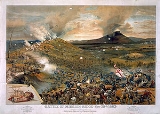
Army of the Cumberland

Encyclopedia
The Army of the Cumberland was one of the principal Union
armies in the Western Theater
during the American Civil War
. It was originally known as the Army of the Ohio
.
in November 1861, under the command of Brig. Gen.
Robert Anderson. The army fought under the name Army of the Ohio until Maj. Gen.
William S. Rosecrans assumed command of the army and the Department of the Cumberland and changed the name of the combined entity to the Army of the Cumberland. When Rosecrans assumed command, the army and the XIV Corps were the same unit, divided into three wings commanded by Alexander McCook
(Right Wing), George H. Thomas (Center), and Thomas L. Crittenden (Left).
General Orders No. 168 was the order passed by the Union Army on October 24th, 1862, that called for the commissioning of the XIII Corps and the XIV Corps into the Army of the Cumberland under the command of Maj. Gen
Ulysses S. Grant
.
The army's first significant combat under the Cumberland name was at the Battle of Stones River
. After the battle the army and XIV Corps were separated. The former Center wing became XIV Corps, the Right wing became XX Corps, and the Left wing became XXI Corps. Rosecrans still retained command of the army. He next led it through the Tullahoma Campaign
and at the Battle of Chickamauga
, after which the army became besieged at Chattanooga
. Maj. Gen. Ulysses S. Grant
arrived at Chattanooga to assume command of the Army of the Cumberland, Army of the Tennessee
, and reinforcements from the Army of the Potomac
. Rosecrans had been a popular and respected commander, but because of his defeat at Chickamauga and inability to lift the Confederate
siege, Grant chose to replace him with George H. Thomas on October 28, 1863.
In the Battles for Chattanooga
, Grant had been leery of using the Army of the Cumberland in the main fighting, fearing their morale to be too low after the defeat at Chickamauga. Instead, he used the veterans from the Army of the Potomac, proud of their recent victory at the Battle of Gettysburg
, to take Lookout Mountain
and planned to use the troops from the Army of the Tennessee
, also recent victors at the Siege of Vicksburg, to attack the Confederate right flank on Missionary Ridge
. The Army of the Cumberland was given the minor task of seizing the rifle pits at the base of Missionary Ridge. However, once they achieved their objective, four divisions (one led by Philip H. Sheridan) stormed up the ridge and routed the Confederate center. When Grant angrily asked who had ordered those troops up the ridge both Thomas and Gordon Granger
, a corps commander in the army, responded they did not know. Granger then replied, "Once those boys get started, all hell can't stop 'em."
After Grant's victory at Chattanooga earned him promotion to general-in-chief of the U.S. Army, Maj. Gen. William T. Sherman assumed command of Grant's Military Division of the Mississippi
, which controlled all Union
armies in the West. He created an "army group" of the Army of the Cumberland, the Army of the Tennessee
, and the Army of the Ohio
and marched towards Atlanta
in May 1864. On the way to Atlanta they fought in many battles and skirmishes including the Battle of Kennesaw Mountain
. In September, Atlanta fell to Sherman's army group. When Confederate general John B. Hood moved north from Atlanta, Sherman chose not to follow him and instead dispatched some of the Army of the Cumberland (IV Corps and Provisional Detachment) and the Army of the Ohio (XXIII Corps) after him. Thomas finally met Hood at the Battle of Nashville
and crushed him, thus bringing to an end any significant military actions for the Army of the Cumberland. Other elements of the Army of the Cumberland (the XIV and XX Corps) marched to the sea and north through the Carolinas with Sherman, under the command of Maj. Gen. Henry W. Slocum. These forces became the Union's Army of Georgia
and participated in the Grand Review of the Armies
in Washington, D.C.
, before President Andrew Johnson
in 1865.
Union (American Civil War)
During the American Civil War, the Union was a name used to refer to the federal government of the United States, which was supported by the twenty free states and five border slave states. It was opposed by 11 southern slave states that had declared a secession to join together to form the...
armies in the Western Theater
Western Theater of the American Civil War
This article presents an overview of major military and naval operations in the Western Theater of the American Civil War.-Theater of operations:...
during the American Civil War
American Civil War
The American Civil War was a civil war fought in the United States of America. In response to the election of Abraham Lincoln as President of the United States, 11 southern slave states declared their secession from the United States and formed the Confederate States of America ; the other 25...
. It was originally known as the Army of the Ohio
Army of the Ohio
The Army of the Ohio was the name of two Union armies in the American Civil War. The first army became the Army of the Cumberland and the second army was created in 1863.-History:...
.
History
The origin of the Army of the Cumberland dates back to the creation of the Army of the OhioArmy of the Ohio
The Army of the Ohio was the name of two Union armies in the American Civil War. The first army became the Army of the Cumberland and the second army was created in 1863.-History:...
in November 1861, under the command of Brig. Gen.
Brigadier general (United States)
A brigadier general in the United States Army, Air Force, and Marine Corps, is a one-star general officer, with the pay grade of O-7. Brigadier general ranks above a colonel and below major general. Brigadier general is equivalent to the rank of rear admiral in the other uniformed...
Robert Anderson. The army fought under the name Army of the Ohio until Maj. Gen.
Major general (United States)
In the United States Army, United States Marine Corps, and United States Air Force, major general is a two-star general-officer rank, with the pay grade of O-8. Major general ranks above brigadier general and below lieutenant general...
William S. Rosecrans assumed command of the army and the Department of the Cumberland and changed the name of the combined entity to the Army of the Cumberland. When Rosecrans assumed command, the army and the XIV Corps were the same unit, divided into three wings commanded by Alexander McCook
Alexander McDowell McCook
Alexander McDowell McCook was a career United States Army officer and a Union general in the American Civil War.-Early life:...
(Right Wing), George H. Thomas (Center), and Thomas L. Crittenden (Left).
General Orders No. 168 was the order passed by the Union Army on October 24th, 1862, that called for the commissioning of the XIII Corps and the XIV Corps into the Army of the Cumberland under the command of Maj. Gen
Major General
Major general or major-general is a military rank used in many countries. It is derived from the older rank of sergeant major general. A major general is a high-ranking officer, normally subordinate to the rank of lieutenant general and senior to the ranks of brigadier and brigadier general...
Ulysses S. Grant
Ulysses S. Grant
Ulysses S. Grant was the 18th President of the United States as well as military commander during the Civil War and post-war Reconstruction periods. Under Grant's command, the Union Army defeated the Confederate military and ended the Confederate States of America...
.
The army's first significant combat under the Cumberland name was at the Battle of Stones River
Battle of Stones River
The Battle of Stones River or Second Battle of Murfreesboro , was fought from December 31, 1862, to January 2, 1863, in Middle Tennessee, as the culmination of the Stones River Campaign in the Western Theater of the American Civil War...
. After the battle the army and XIV Corps were separated. The former Center wing became XIV Corps, the Right wing became XX Corps, and the Left wing became XXI Corps. Rosecrans still retained command of the army. He next led it through the Tullahoma Campaign
Tullahoma Campaign
The Tullahoma Campaign or Middle Tennessee Campaign was fought between June 24 and July 3, 1863, during the American Civil War. The Union Army of the Cumberland, commanded by Maj. Gen. William S...
and at the Battle of Chickamauga
Battle of Chickamauga
The Battle of Chickamauga, fought September 19–20, 1863, marked the end of a Union offensive in southeastern Tennessee and northwestern Georgia called the Chickamauga Campaign...
, after which the army became besieged at Chattanooga
Chattanooga, Tennessee
Chattanooga is the fourth-largest city in the US state of Tennessee , with a population of 169,887. It is the seat of Hamilton County...
. Maj. Gen. Ulysses S. Grant
Ulysses S. Grant
Ulysses S. Grant was the 18th President of the United States as well as military commander during the Civil War and post-war Reconstruction periods. Under Grant's command, the Union Army defeated the Confederate military and ended the Confederate States of America...
arrived at Chattanooga to assume command of the Army of the Cumberland, Army of the Tennessee
Army of the Tennessee
The Army of the Tennessee was a Union army in the Western Theater of the American Civil War, named for the Tennessee River. It should not be confused with the similarly named Army of Tennessee, a Confederate army named after the State of Tennessee....
, and reinforcements from the Army of the Potomac
Army of the Potomac
The Army of the Potomac was the major Union Army in the Eastern Theater of the American Civil War.-History:The Army of the Potomac was created in 1861, but was then only the size of a corps . Its nucleus was called the Army of Northeastern Virginia, under Brig. Gen...
. Rosecrans had been a popular and respected commander, but because of his defeat at Chickamauga and inability to lift the Confederate
Confederate States Army
The Confederate States Army was the army of the Confederate States of America while the Confederacy existed during the American Civil War. On February 8, 1861, delegates from the seven Deep South states which had already declared their secession from the United States of America adopted the...
siege, Grant chose to replace him with George H. Thomas on October 28, 1863.
In the Battles for Chattanooga
Chattanooga Campaign
The Chattanooga Campaign was a series of maneuvers and battles in October and November 1863, during the American Civil War. Following the defeat of Maj. Gen. William S. Rosecrans's Union Army of the Cumberland at the Battle of Chickamauga in September, the Confederate Army of Tennessee under Gen...
, Grant had been leery of using the Army of the Cumberland in the main fighting, fearing their morale to be too low after the defeat at Chickamauga. Instead, he used the veterans from the Army of the Potomac, proud of their recent victory at the Battle of Gettysburg
Battle of Gettysburg
The Battle of Gettysburg , was fought July 1–3, 1863, in and around the town of Gettysburg, Pennsylvania. The battle with the largest number of casualties in the American Civil War, it is often described as the war's turning point. Union Maj. Gen. George Gordon Meade's Army of the Potomac...
, to take Lookout Mountain
Battle of Lookout Mountain
The Battle of Lookout Mountain was fought November 24, 1863, as part of the Chattanooga Campaign of the American Civil War. Union forces under Maj. Gen. Joseph Hooker assaulted Lookout Mountain, Chattanooga, Tennessee, and defeated Confederate forces commanded by Maj. Gen. Carter L. Stevenson....
and planned to use the troops from the Army of the Tennessee
Army of the Tennessee
The Army of the Tennessee was a Union army in the Western Theater of the American Civil War, named for the Tennessee River. It should not be confused with the similarly named Army of Tennessee, a Confederate army named after the State of Tennessee....
, also recent victors at the Siege of Vicksburg, to attack the Confederate right flank on Missionary Ridge
Battle of Missionary Ridge
The Battle of Missionary Ridge was fought November 25, 1863, as part of the Chattanooga Campaign of the American Civil War. Following the Union victory in the Battle of Lookout Mountain on November 24, Union forces under Maj. Gen. Ulysses S. Grant assaulted Missionary Ridge and defeated the...
. The Army of the Cumberland was given the minor task of seizing the rifle pits at the base of Missionary Ridge. However, once they achieved their objective, four divisions (one led by Philip H. Sheridan) stormed up the ridge and routed the Confederate center. When Grant angrily asked who had ordered those troops up the ridge both Thomas and Gordon Granger
Gordon Granger
Gordon Granger was a career U.S. army officer and a Union general during the American Civil War. He distinguished himself at the Battle of Chickamauga.-Early life & Mexico:...
, a corps commander in the army, responded they did not know. Granger then replied, "Once those boys get started, all hell can't stop 'em."
After Grant's victory at Chattanooga earned him promotion to general-in-chief of the U.S. Army, Maj. Gen. William T. Sherman assumed command of Grant's Military Division of the Mississippi
Military Division of the Mississippi
The Military Division of the Mississippi was an administrative division of the United States Army during the American Civil War that controlled all military operations in the Western Theater.-History:...
, which controlled all Union
Union Army
The Union Army was the land force that fought for the Union during the American Civil War. It was also known as the Federal Army, the U.S. Army, the Northern Army and the National Army...
armies in the West. He created an "army group" of the Army of the Cumberland, the Army of the Tennessee
Army of the Tennessee
The Army of the Tennessee was a Union army in the Western Theater of the American Civil War, named for the Tennessee River. It should not be confused with the similarly named Army of Tennessee, a Confederate army named after the State of Tennessee....
, and the Army of the Ohio
Army of the Ohio
The Army of the Ohio was the name of two Union armies in the American Civil War. The first army became the Army of the Cumberland and the second army was created in 1863.-History:...
and marched towards Atlanta
Atlanta Campaign
The Atlanta Campaign was a series of battles fought in the Western Theater of the American Civil War throughout northwest Georgia and the area around Atlanta during the summer of 1864. Union Maj. Gen. William T. Sherman invaded Georgia from the vicinity of Chattanooga, Tennessee, beginning in May...
in May 1864. On the way to Atlanta they fought in many battles and skirmishes including the Battle of Kennesaw Mountain
Battle of Kennesaw Mountain
The Battle of Kennesaw Mountain was fought on June 27, 1864, during the Atlanta Campaign of the American Civil War. It was the most significant frontal assault launched by Union Maj. Gen. William T. Sherman against the Confederate Army of Tennessee under Gen. Joseph E...
. In September, Atlanta fell to Sherman's army group. When Confederate general John B. Hood moved north from Atlanta, Sherman chose not to follow him and instead dispatched some of the Army of the Cumberland (IV Corps and Provisional Detachment) and the Army of the Ohio (XXIII Corps) after him. Thomas finally met Hood at the Battle of Nashville
Battle of Nashville
The Battle of Nashville was a two-day battle in the Franklin-Nashville Campaign that represented the end of large-scale fighting in the Western Theater of the American Civil War. It was fought at Nashville, Tennessee, on December 15–16, 1864, between the Confederate Army of Tennessee under...
and crushed him, thus bringing to an end any significant military actions for the Army of the Cumberland. Other elements of the Army of the Cumberland (the XIV and XX Corps) marched to the sea and north through the Carolinas with Sherman, under the command of Maj. Gen. Henry W. Slocum. These forces became the Union's Army of Georgia
Army of Georgia
The Army of Georgia was a Union army that constituted the Left Wing of Major General William T. Sherman's Army Group during the March to the Sea and the Carolinas Campaign.-History:...
and participated in the Grand Review of the Armies
Grand Review of the Armies
The Grand Review of the Armies was a military procession and celebration in Washington, D.C., on May 23 and May 24, 1865, following the close of the American Civil War...
in Washington, D.C.
Washington, D.C.
Washington, D.C., formally the District of Columbia and commonly referred to as Washington, "the District", or simply D.C., is the capital of the United States. On July 16, 1790, the United States Congress approved the creation of a permanent national capital as permitted by the U.S. Constitution....
, before President Andrew Johnson
Andrew Johnson
Andrew Johnson was the 17th President of the United States . As Vice-President of the United States in 1865, he succeeded Abraham Lincoln following the latter's assassination. Johnson then presided over the initial and contentious Reconstruction era of the United States following the American...
in 1865.
Command history
| Commander | From | To | Major Battles and Campaigns |
|---|---|---|---|
| Major General William S. Rosecrans William Rosecrans William Starke Rosecrans was an inventor, coal-oil company executive, diplomat, politician, and United States Army officer. He gained fame for his role as a Union general during the American Civil War... |
October 24, 1862 | October 19, 1863 | Stones River Battle of Stones River The Battle of Stones River or Second Battle of Murfreesboro , was fought from December 31, 1862, to January 2, 1863, in Middle Tennessee, as the culmination of the Stones River Campaign in the Western Theater of the American Civil War... , Tullahoma Campaign Tullahoma Campaign The Tullahoma Campaign or Middle Tennessee Campaign was fought between June 24 and July 3, 1863, during the American Civil War. The Union Army of the Cumberland, commanded by Maj. Gen. William S... , Chickamauga Battle of Chickamauga The Battle of Chickamauga, fought September 19–20, 1863, marked the end of a Union offensive in southeastern Tennessee and northwestern Georgia called the Chickamauga Campaign... |
| Major General George H. Thomas | October 19, 1863 | August 1, 1865 | Chattanooga Chattanooga Campaign The Chattanooga Campaign was a series of maneuvers and battles in October and November 1863, during the American Civil War. Following the defeat of Maj. Gen. William S. Rosecrans's Union Army of the Cumberland at the Battle of Chickamauga in September, the Confederate Army of Tennessee under Gen... , Atlanta Campaign Atlanta Campaign The Atlanta Campaign was a series of battles fought in the Western Theater of the American Civil War throughout northwest Georgia and the area around Atlanta during the summer of 1864. Union Maj. Gen. William T. Sherman invaded Georgia from the vicinity of Chattanooga, Tennessee, beginning in May... , Franklin, Nashville Battle of Nashville The Battle of Nashville was a two-day battle in the Franklin-Nashville Campaign that represented the end of large-scale fighting in the Western Theater of the American Civil War. It was fought at Nashville, Tennessee, on December 15–16, 1864, between the Confederate Army of Tennessee under... |
Orders of battle
- Stones River Union order of battleStones River Union order of battleThe following Union Army units and commanders fought in the Battle of Stones River of the American Civil War. The Confederate order of battle is listed separately...
- Chickamauga Union order of battleChickamauga Union order of battleThe following Union Army units and commanders fought in the Battle of Chickamauga of the American Civil War. The Confederate order of battle is listed separately.-Military Rank:* MG = Major General* BG = Brigadier General* Col = Colonel...
- Chattanooga Union order of battleChattanooga Union order of battleChattanooga Union order of battle may refer to:* Wauhatchie Union order of battle* Chattanooga-Ringgold Campaign Union order of battle...
- Atlanta Campaign Union order of battleAtlanta Campaign Union order of battleThe following Union Army units and commanders fought in the Atlanta Campaign of the American Civil War. The Confederate order of battle is listed separately.This order of battle covers the period of May 7 - June 27, 1864...
- Peachtree Creek Union order of battlePeachtree Creek Union order of battleThe following Union Army units and commanders fought in the Battle of Peachtree Creek of the American Civil War. The Confederate order of battle is listed separately.-Military rank:* MG = Major General* BG = Brigadier General* Col = Colonel...
- Nashville Union order of battleNashville Union order of battleThe following Union Army units and commanders fought in the Battle of Nashville of the American Civil War. The Confederate order of battle is shown separately.-Military rank:* MG = Major General* BG = Brigadier General* Col = Colonel...
Further reading
- Daniel, Larry J. Days of Glory: The Army of the Cumberland, 1861–1865. Baton Rouge: Louisiana State University Press, 2004. ISBN 978-0-8071-3191-6.
- Hunt, Robert Eno. The Good Men Who Won the War: Army of the Cumberland Veterans and Emancipation Memory. Tuscaloosa: University of Alabama Press, 2010. ISBN 978-0-8173-1688-4.
- Prokopowicz, Gerald J. All for the Regiment: The Army of the Ohio, 1861–1862. Chapel Hill: University of North Carolina Press, 2001. ISBN 0-8078-2626-X.
- Van Horne, Thomas B. The Army of the Cumberland: Its Organizations, Campaigns, and Battles. New York: Smithmark Publishers, 1996. ISBN 0-8317-5621-7. First published 1885 by Robert Clarke & Co.