

Bimetallism

Encyclopedia
In economics
, bimetallism is a monetary standard in which the value of the monetary unit is defined as equivalent both to a certain quantity of gold and to a certain quantity of silver; such a system establishes a fixed rate of exchange between the two metals. In 1787 the United States Constitution
established gold and silver as the legal tender
of the United States
at a floating exchange rate
. Then in 1792, Alexander proposed fixing
the silver to gold exchange rate
at 15:1, as well as establishing the mint
for the public services of free coinage
and currency
regulation
"in order not to abridge the quantity of circulating medium.". With its acceptance, Sec.11 of the Coinage Act of 1792 established: "That the proportional value of gold to silver in all coins which shall by law be current as money within the United States, shall be as fifteen to one, proportional value of gold to silver. according to quantity in weight, of pure gold or pure silver;" the proportion had slipped by 1834
to sixteen to one. Bimetallism was effectively abandoned by the Coinage Act of 1873, but not formally outlawed as legal currency until the early 1900s. The merits of the system were the subject of debate in the late 19th century. If the market forces of supply and demand for either metal caused its bullion value to exceed its nominal currency value, it tends to disappear from circulation
by hoarding or melting down.
currency. After the war, in 1873, the government passed the Fourth Coinage Act and soon resumption of specie payments began without the free and unlimited coinage of silver. This put the U.S. on a mono-metallic gold standard. This angered the proponents of monetary silver, known as the silverite
s. They referred to this act as "The Crime of '73," as it was judged to have inhibited inflation. The Panic of 1893
was a severe nationwide depression that brought the money issue to the fore. The "silverites" argued that using silver would inflate the money supply and mean more cash for everyone, which they equated with prosperity. The gold advocates said silver would permanently depress the economy, but that sound money produced by a gold standard
would restore prosperity.
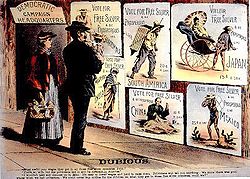 Bimetallism and "Free Silver
" were demanded by William Jennings Bryan
who took over leadership of the Democratic Party
in 1896, as well as the Populist
and Silver Republican
Parties. The Republican Party nominated William McKinley
on a platform supporting the gold standard which was favored by financial interests on the East Coast. A faction of Republicans from silver mining regions in the West known as the Silver Republicans endorsed Bryan.
Bryan, the eloquent champion of the cause, gave the famous "Cross of Gold" speech
at the National Democratic Convention on July 9, 1896 asserting that "The gold standard has slain tens of thousands." He referred to "a struggle between 'the idle holders of idle capital’ and 'the struggling masses, who produce the wealth and pay the taxes of the country;’ and, my friends, the question we are to decide is: Upon which side will the Democratic party fight?" At the peroration
, he said "You shall not press down upon the brow of labor this crown of thorns, you shall not crucify mankind upon a cross of gold." However, his presidential campaign was ultimately unsuccessful; this can be partially attributed to the discovery of the cyanide process by which gold could be extracted from low grade ore. This process and the discoveries of large gold deposits in South Africa (Witwatersrand Gold Rush
of 1887 - with large-scale production starting in 1898) and the Klondike Gold Rush
(1896) increased the world gold supply and the subsequent increase in money supply that free coinage of silver was supposed to bring. The McKinley campaign was effective at persuading voters that poor economic progress and unemployment would be exacerbated by adoption of the Bryan platform. 1896 saw the election of McKinley. The direct link to gold was abandoned in 1934 in FDR’s New Deal
program and later the link was broken by Nixon
when he closed the gold window
.
concluded that abandonment of the bimetallic standard in 1873 led to greater price instability than would have occurred otherwise, and thus resulted in long-term harm to the US economy. His retrospective analysis led him to write that the act of 1873 "... was a mistake that had highly adverse consequences."
Economics
Economics is the social science that analyzes the production, distribution, and consumption of goods and services. The term economics comes from the Ancient Greek from + , hence "rules of the house"...
, bimetallism is a monetary standard in which the value of the monetary unit is defined as equivalent both to a certain quantity of gold and to a certain quantity of silver; such a system establishes a fixed rate of exchange between the two metals. In 1787 the United States Constitution
United States Constitution
The Constitution of the United States is the supreme law of the United States of America. It is the framework for the organization of the United States government and for the relationship of the federal government with the states, citizens, and all people within the United States.The first three...
established gold and silver as the legal tender
Legal tender
Legal tender is a medium of payment allowed by law or recognized by a legal system to be valid for meeting a financial obligation. Paper currency is a common form of legal tender in many countries....
of the United States
United States
The United States of America is a federal constitutional republic comprising fifty states and a federal district...
at a floating exchange rate
Floating exchange rate
A floating exchange rate or fluctuating exchange rate is a type of exchange rate regime wherein a currency's value is allowed to fluctuate according to the foreign exchange market. A currency that uses a floating exchange rate is known as a floating currency....
. Then in 1792, Alexander proposed fixing
Price fixing
Price fixing is an agreement between participants on the same side in a market to buy or sell a product, service, or commodity only at a fixed price, or maintain the market conditions such that the price is maintained at a given level by controlling supply and demand...
the silver to gold exchange rate
Exchange rate
In finance, an exchange rate between two currencies is the rate at which one currency will be exchanged for another. It is also regarded as the value of one country’s currency in terms of another currency...
at 15:1, as well as establishing the mint
United States Mint
The United States Mint primarily produces circulating coinage for the United States to conduct its trade and commerce. The Mint was created by Congress with the Coinage Act of 1792, and placed within the Department of State...
for the public services of free coinage
Free Silver
Free Silver was an important United States political policy issue in the late 19th century and early 20th century. Its advocates were in favor of an inflationary monetary policy using the "free coinage of silver" as opposed to the less inflationary Gold Standard; its supporters were called...
and currency
Currency
In economics, currency refers to a generally accepted medium of exchange. These are usually the coins and banknotes of a particular government, which comprise the physical aspects of a nation's money supply...
regulation
Regulation
Regulation is administrative legislation that constitutes or constrains rights and allocates responsibilities. It can be distinguished from primary legislation on the one hand and judge-made law on the other...
"in order not to abridge the quantity of circulating medium.". With its acceptance, Sec.11 of the Coinage Act of 1792 established: "That the proportional value of gold to silver in all coins which shall by law be current as money within the United States, shall be as fifteen to one, proportional value of gold to silver. according to quantity in weight, of pure gold or pure silver;" the proportion had slipped by 1834
Coinage Act of 1834
The Coinage Act of 1834 was passed by the United States Congress on June 27, 1834. It raised the silver-to-gold weight ratio from its 1792 level of 15:1 to 16:1 thus setting the mint price for silver at a level below its international market price...
to sixteen to one. Bimetallism was effectively abandoned by the Coinage Act of 1873, but not formally outlawed as legal currency until the early 1900s. The merits of the system were the subject of debate in the late 19th century. If the market forces of supply and demand for either metal caused its bullion value to exceed its nominal currency value, it tends to disappear from circulation
Gresham's Law
Gresham's law is an economic principle that states: "When a government compulsorily overvalues one type of money and undervalues another, the undervalued money will leave the country or disappear from circulation into hoards, while the overvalued money will flood into circulation." It is commonly...
by hoarding or melting down.
Political debate
In the United States, bimetallism became a center of political conflict toward the end of the nineteenth century. During the civil war, to finance the war the U.S. switched from bimetallism to a fiat moneyFiat money
Fiat money is money that has value only because of government regulation or law. The term derives from the Latin fiat, meaning "let it be done", as such money is established by government decree. Where fiat money is used as currency, the term fiat currency is used.Fiat money originated in 11th...
currency. After the war, in 1873, the government passed the Fourth Coinage Act and soon resumption of specie payments began without the free and unlimited coinage of silver. This put the U.S. on a mono-metallic gold standard. This angered the proponents of monetary silver, known as the silverite
Silverite
The Silverites were members of a political movement in the United States in the late-19th century that advocated that silver should continue to be a monetary standard along with gold, as authorized under the Coinage Act of 1792...
s. They referred to this act as "The Crime of '73," as it was judged to have inhibited inflation. The Panic of 1893
Panic of 1893
The Panic of 1893 was a serious economic depression in the United States that began in 1893. Similar to the Panic of 1873, this panic was marked by the collapse of railroad overbuilding and shaky railroad financing which set off a series of bank failures...
was a severe nationwide depression that brought the money issue to the fore. The "silverites" argued that using silver would inflate the money supply and mean more cash for everyone, which they equated with prosperity. The gold advocates said silver would permanently depress the economy, but that sound money produced by a gold standard
Gold standard
The gold standard is a monetary system in which the standard economic unit of account is a fixed mass of gold. There are distinct kinds of gold standard...
would restore prosperity.
Free Silver
Free Silver was an important United States political policy issue in the late 19th century and early 20th century. Its advocates were in favor of an inflationary monetary policy using the "free coinage of silver" as opposed to the less inflationary Gold Standard; its supporters were called...
" were demanded by William Jennings Bryan
William Jennings Bryan
William Jennings Bryan was an American politician in the late-19th and early-20th centuries. He was a dominant force in the liberal wing of the Democratic Party, standing three times as its candidate for President of the United States...
who took over leadership of the Democratic Party
History of the United States Democratic Party
The history of the Democratic Party of the United States is an account of the oldest political party in the United States and arguably the oldest democratic party in the world....
in 1896, as well as the Populist
Populist Party (United States)
The People's Party, also known as the "Populists", was a short-lived political party in the United States established in 1891. It was most important in 1892-96, then rapidly faded away...
and Silver Republican
Silver Republican Party
The Silver Republican Party was a United States political faction active in the 1890s. It was so named because it split from the Republican Party over the issues of "Free Silver" and bimetallism. The main Republican Party supported the gold standard....
Parties. The Republican Party nominated William McKinley
William McKinley
William McKinley, Jr. was the 25th President of the United States . He is best known for winning fiercely fought elections, while supporting the gold standard and high tariffs; he succeeded in forging a Republican coalition that for the most part dominated national politics until the 1930s...
on a platform supporting the gold standard which was favored by financial interests on the East Coast. A faction of Republicans from silver mining regions in the West known as the Silver Republicans endorsed Bryan.
Bryan, the eloquent champion of the cause, gave the famous "Cross of Gold" speech
Cross of Gold speech
The Cross of Gold speech was delivered by William Jennings Bryan at the 1896 Democratic National Convention in Chicago on July 8, 1896. The speech advocated bimetallism. Following the Coinage Act , the United States abandoned its policy of bimetallism and began to operate a de facto gold...
at the National Democratic Convention on July 9, 1896 asserting that "The gold standard has slain tens of thousands." He referred to "a struggle between 'the idle holders of idle capital’ and 'the struggling masses, who produce the wealth and pay the taxes of the country;’ and, my friends, the question we are to decide is: Upon which side will the Democratic party fight?" At the peroration
Peroration
In classical rhetoric, a peroration was the final part of a speech. It was one of the four or five traditional components in the ordo of a speech....
, he said "You shall not press down upon the brow of labor this crown of thorns, you shall not crucify mankind upon a cross of gold." However, his presidential campaign was ultimately unsuccessful; this can be partially attributed to the discovery of the cyanide process by which gold could be extracted from low grade ore. This process and the discoveries of large gold deposits in South Africa (Witwatersrand Gold Rush
Witwatersrand Gold Rush
The Witwatersrand Gold Rush was a gold rush in 1886 that led to the establishment of Johannesburg, South Africa. It was part of the Mineral Revolution....
of 1887 - with large-scale production starting in 1898) and the Klondike Gold Rush
Klondike Gold Rush
The Klondike Gold Rush, also called the Yukon Gold Rush, the Alaska Gold Rush and the Last Great Gold Rush, was an attempt by an estimated 100,000 people to travel to the Klondike region the Yukon in north-western Canada between 1897 and 1899 in the hope of successfully prospecting for gold...
(1896) increased the world gold supply and the subsequent increase in money supply that free coinage of silver was supposed to bring. The McKinley campaign was effective at persuading voters that poor economic progress and unemployment would be exacerbated by adoption of the Bryan platform. 1896 saw the election of McKinley. The direct link to gold was abandoned in 1934 in FDR’s New Deal
New Deal
The New Deal was a series of economic programs implemented in the United States between 1933 and 1936. They were passed by the U.S. Congress during the first term of President Franklin D. Roosevelt. The programs were Roosevelt's responses to the Great Depression, and focused on what historians call...
program and later the link was broken by Nixon
Richard Nixon
Richard Milhous Nixon was the 37th President of the United States, serving from 1969 to 1974. The only president to resign the office, Nixon had previously served as a US representative and senator from California and as the 36th Vice President of the United States from 1953 to 1961 under...
when he closed the gold window
Nixon Shock
The Nixon Shock was a series of economic measures taken by U.S. President Richard Nixon in 1971 including unilaterally cancelling the direct convertibility of the United States dollar to gold that essentially ended the existing Bretton Woods system of international financial exchange.-Background:By...
.
Economic analysis
In 1992, economist Milton FriedmanMilton Friedman
Milton Friedman was an American economist, statistician, academic, and author who taught at the University of Chicago for more than three decades...
concluded that abandonment of the bimetallic standard in 1873 led to greater price instability than would have occurred otherwise, and thus resulted in long-term harm to the US economy. His retrospective analysis led him to write that the act of 1873 "... was a mistake that had highly adverse consequences."
See also
- Crime of 1873
- Political interpretations of The Wonderful Wizard of OzPolitical interpretations of The Wonderful Wizard of OzPolitical interpretations of The Wonderful Wizard of Oz include treatments of the modern fairy tale as an allegory or metaphor for the political, economic and social events of America in the 1890s...
- Silver standardSilver standardThe silver standard is a monetary system in which the standard economic unit of account is a fixed weight of silver. The silver specie standard was widespread from the fall of the Byzantine Empire until the 19th century...
- Free SilverFree SilverFree Silver was an important United States political policy issue in the late 19th century and early 20th century. Its advocates were in favor of an inflationary monetary policy using the "free coinage of silver" as opposed to the less inflationary Gold Standard; its supporters were called...
- Gresham's LawGresham's LawGresham's law is an economic principle that states: "When a government compulsorily overvalues one type of money and undervalues another, the undervalued money will leave the country or disappear from circulation into hoards, while the overvalued money will flood into circulation." It is commonly...
Primary sources
- Campaign Text-book of the National Democratic Party (1896) by Democratic Party (U.S.) National Committee: this is the Gold Democrats handbook; it strongly opposed Bryan.
- Walker, International Bimetallism (New York, 1896)
- Robert GiffenRobert GiffenSir Robert Giffen KCB , was a Scottish statistician and economist. He was born at Strathaven, Lanarkshire.He entered a solicitor's office in Glasgow, and while in that city attended courses at the university. He drifted into journalism, and after working for the Stirling Journal he went to London...
, Case against Bimetallism (London, 1896) - Joseph Shield NicholsonJoseph Shield NicholsonJoseph Shield Nicholson was an English economist, born at Wrawby, Lincolnshire.He was educated at King's College London, Edinburgh, Cambridge, and Heidelberg. He was private tutor at Cambridge and became professor of political economy at Edinburgh in 1880...
, Money and Monetary Problems (London, 1897) - Samuel Dana HortonSamuel Dana HortonSamuel Dana Horton , American writer on bimetallism, was born in Pomeroy, Ohio.He graduated at Harvard in 1864, and at the Harvard Law School in 1868, studied Roman law in Berlin in 1869, and in 1871 was admitted to the Ohio bar...
, The Silver Pound (London, 1887) - Walker, Money (New York, 1878)
- Francis Amasa WalkerFrancis Amasa WalkerFrancis Amasa Walker was an American economist, statistician, journalist, educator, academic administrator, and military officer in the Union Army. Walker was born into a prominent Boston family, the son of the economist and politician Amasa Walker, and he graduated from Amherst College at the age...
, Money, Trade and Industry (New York, 1879) - Elisha Benjamin Andrews, An honest Dollar (Hartford, 1894)
- Helm, The Joint Standard (London, 1894)
- Frank William TaussigFrank William TaussigFrank William Taussig was a U.S. economist and educator. Taussig is credited with creating the foundations of modern trade theory.-Biography:...
, The Silver Situation in the United States (New York, 1893) - Horace White (writer)Horace White (writer)Horace White was an United States journalist and financial expert, noted for his connection with the Chicago Tribune, the New York Evening Post and The Nation.-Biography:...
, Money and Banking (Boston, 1896) - James Laurence LaughlinJames Laurence LaughlinJames Laurence Laughlin was an American economist who helped to found the Federal Reserve System.Born in Deerfield, Ohio, Laughlin received his PhD from Harvard University. His thesis regarded "Anglo-Saxon Legal Procedure". A conservative, he generally subscribed to the economic theories of John...
, History of Bimetallism in the United States (New York, 1897) - Langford Lovell PriceLangford Lovell PriceLangford Lovell Price was an English economist, born in London. He was educated at Trinity College, Oxford, in 1888 became fellow and treasurer of Oriel, and was Newmarch lecturer in statistics at University College, London in 1895-96...
, Money and its Relations to Prices (London and New York, 1896) - Utley, Bimetallism (Los Angeles, 1899)
- Roger Q. MillsRoger Q. MillsRoger Quarles Mills was an American politician and an officer in the Confederate States Army during the American Civil War.-Background:...
, What shall we do with silver? (The North American ReviewNorth American ReviewThe North American Review was the first literary magazine in the United States. Founded in Boston in 1815 by journalist Nathan Hale and others, it was published continuously until 1940, when publication was suspended due to J. H. Smyth, who had purchased the magazine, being unmasked as a Japanese...
, Volume 150, Issue 402, May 1890.)
External links
- The Bimetallic Standard, a series of pages on bimetalism from Micheloud & cie.
- Speeches before the 52nd Congress (1891-1893) regarding "free silver," digitized and available on FRASER (Federal Reserve Archival System for Economic Research).
- Speeches before the 53rd Congress (1893-1895) regarding "free silver," digitized and available on FRASER (Federal Reserve Archival System for Economic Research).