

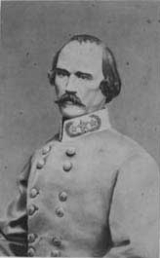
Albert Sidney Johnston

Encyclopedia
Albert Sidney Johnston served as a general in three different armies: the Texas Army
, the United States Army
, and the Confederate States Army
. He saw extensive combat during his military career, fighting actions in the Texas War of Independence, the Mexican-American War, the Utah War
, and the American Civil War
.
Considered by Confederate President
Jefferson Davis
to be the finest general officer in the Confederacy before the emergence of Robert E. Lee
, he was killed early in the Civil War at the Battle of Shiloh
and was the highest ranking officer, Union or Confederate, killed during the entire war. Davis believed the loss of Johnston "was the turning point of our fate".
, the youngest son of Dr. John and Abigail Harris Johnston. His father was a native of Salisbury, Connecticut
. Although Albert Johnston was born in Kentucky, he lived much of his life in Texas
, which he considered his home. He was first educated at Transylvania University
in Lexington
, where he met fellow student Jefferson Davis. Both were appointed to the United States Military Academy
, Davis two years behind Johnston. In 1826 Johnston graduated eighth of 41 cadets in his class from West Point with a commission as a brevet
second lieutenant in the 2nd U.S. Infantry
.
Johnston was assigned to posts in New York
and Missouri
and served in the Black Hawk War
in 1832 as chief of staff to Bvt. Brig. Gen. Henry Atkinson. In 1829 he married Henrietta Preston, sister of Kentucky politician and future civil war general William Preston
. He resigned his commission in 1834 to return to Kentucky to care for his dying wife, who succumbed two years later to tuberculosis
. They had one son, Col. William Preston Johnston
, who would also serve in the Confederate Army.
, but enlisted as a private
in the Texas Army during the Texas War of Independence against the Republic of Mexico
in 1836. One month later, Johnston was promoted to major
and the position of aide-de-camp
to General Sam Houston
. He was named Adjutant General
as a colonel
in the Republic of Texas Army on August 5, 1836. On January 31, 1837, he became senior brigadier general in command of the Texas Army.
On February 7, 1837, he fought in a duel
with Texas Brig. Gen. Felix Huston
, challenging each other for the command of the Texas Army; Johnston refused to fire on Huston and lost the position after he was wounded in the pelvis. The second president of the Republic of Texas
, Mirabeau B. Lamar
, appointed him Secretary of War on December 22, 1838. Johnston was to provide the defense of the Texas border against Mexican invasion, and in 1839 conducted a campaign against Indians
in northern Texas. In February 1840, he resigned and returned to Kentucky, where he married Eliza Griffin in 1843. They settled on a large plantation
he named China Grove in Brazoria County, Texas
.
as a colonel
of the 1st Texas Rifle Volunteers. The enlistments of his volunteers ran out just before the Battle of Monterrey
. Johnston managed to convince a few volunteers to stay and fight as he himself served as the inspector general of volunteers and fought at the battles of Monterrey and Buena Vista
. Johnston remained on his plantation after the war until he was appointed by President
Taylor to the U.S. Army as a major
and was made a paymaster in December 1849. He served in that role for more than five years, making six tours, and traveling more than 4000 miles (6,437.4 km) annually on the Indian frontier of Texas. He served on the Texas frontier at Fort Mason
and elsewhere in the West. In 1855 President Franklin Pierce
appointed him colonel of the new 2nd U.S. Cavalry (the unit that preceded the modern 5th U.S.), a new regiment, which he organized. As a key figure in the Utah War
, he led U.S. troops who established a non-Mormon government in the formerly Mormon territory. He received a brevet
promotion to brigadier general
in 1857 for his service in Utah. He spent 1860 in Kentucky until December 21, when he sailed for California to take command of the Department of the Pacific.
in California. Like many regular army officers from the South he was opposed to secession, but resigned his commission soon after he heard of the secession
of Texas. It was accepted by the War Department on May 6, 1861, effective May 3. On April 28 he moved to Los Angeles where he had family and remained there until May when, suspected by local Union authorities, he evaded arrest and joined the Los Angeles Mounted Rifles
as a private, leaving Warner's Ranch
May 27. He participated in their trek across the southwestern deserts to Texas
, crossing the Colorado River
into the Confederate Territory of Arizona on July 4, 1861. He reached Richmond, Virginia
, on or about September 1, 1861. There Johnston was appointed a full general by his friend, Jefferson Davis. On May 30, 1861, Johnston became the second highest ranking Confederate general (after the little-known Samuel Cooper
) as commander of the Western Department
. He raised the Army of Mississippi
to defend Confederate lines from the Mississippi River
to Kentucky
and the Allegheny Mountains
.
Although the Confederate States Army
won a morale-boosting victory at First Battle of Bull Run
in the East in 1861, matters in the West turned ugly by early 1862. Johnston's subordinate generals lost Fort Henry
on February 6, 1862, and Fort Donelson
on February 16, 1862, to Union Brig. Gen.
Ulysses S. Grant
. Johnston has been faulted for poor judgment in selecting Brig. Gens. Lloyd Tilghman
and John B. Floyd
for those crucial positions and for not supervising adequate construction of the forts. Union Maj. Gen.
Don Carlos Buell
subsequently captured the vital city of Nashville, Tennessee
. Gen. P.G.T. Beauregard was sent west to join Johnston and they organized their forces at Corinth, Mississippi
, planning to ambush Grant's forces at Pittsburg Landing, Tennessee
.
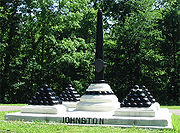 Johnston concentrated many of his forces from around the theater and launched a massive surprise attack against Grant at the Battle of Shiloh
on April 6, 1862. As the Confederate forces overran the Union camps, Johnston seemed to be everywhere, personally leading and rallying troops up and down the line. At about 2:30 p.m., while leading one of those charges, he was wounded, taking a bullet behind his right knee. He did not think the wound serious at the time, and sent his personal physician to attend to some wounded captured Union soldiers instead. It is possible that Johnston's duel in 1837 had caused nerve damage or numbness to his right leg and that he did not feel the wound to his leg as a result. The bullet had in fact clipped his popliteal artery
and his boot was filling up with blood. Within a few minutes, Johnston was observed by his staff to be nearly fainting off his horse. Among his staff was Isham G. Harris
, the Governor of Tennessee, who had ceased to make any real effort to function as governor after learning that Abraham Lincoln
had appointed Andrew Johnson
as military governor of Tennessee. Seeing Johnston slumping in his saddle and his face turning deathly pale, Harris asked: "General, are you wounded?" Johnston glanced down at his leg wound and replied with his last words: "Yes, and I fear seriously." Harris and other staff officers removed Johnston from his horse and moved him to a small ravine near the famous "Hornets Nest" and desperately tried to aid the general. He bled to death minutes later. Harris and the other officers wrapped General Johnston's body in a blanket so as not to damage the troops' morale with the sight of the dead general. Johnston and his wounded horse, Fire Eater, were taken to his field headquarters on the Corinth road, where his body remained in his tent until the Confederate Army withdrew to Corinth the next day, April 7, 1862. From there, his body was taken to the home of Colonel William Inge, which had been his headquarters in Corinth. It was covered in the Confederate flag and laid in state for several hours.
It is probable that a Confederate soldier fired the fatal round. No Union soldiers were observed to have ever gotten behind Johnston during the fatal charge, while it is known that many Confederates were firing at the Union lines while Johnston charged well in advance of his soldiers.
Johnston was the highest-ranking casualty of the war on either side, and his death was a strong blow to the morale of the Confederacy. Jefferson Davis considered him the best general in the country; this was two months before the emergence of Robert E. Lee
as the pre-eminent general of the Confederacy.
 Johnston was initially buried in New Orleans
. In 1866, a joint resolution of the Texas Legislature
was passed to have his body reinterred to the Texas State Cemetery
in Austin
The re-interment occurred in 1867. Forty years later, the state appointed Elisabet Ney
to design a monument and sculpture of him to be erected at his gravesite.
The Texas Historical Commission
has erected a historical marker near the entrance of what was once his plantation
. An adjacent marker was erected by the San Jacinto Chapter of the Daughters of The Republic of Texas
and the Lee, Roberts, and Davis Chapter of the United Daughters of the Confederate States of America
.
The University of Texas at Austin
has also recognized Johnston with a statue on the South Mall.
Republic of Texas
The Republic of Texas was an independent nation in North America, bordering the United States and Mexico, that existed from 1836 to 1846.Formed as a break-away republic from Mexico by the Texas Revolution, the state claimed borders that encompassed an area that included all of the present U.S...
, the United States Army
United States Army
The United States Army is the main branch of the United States Armed Forces responsible for land-based military operations. It is the largest and oldest established branch of the U.S. military, and is one of seven U.S. uniformed services...
, and the Confederate States Army
Confederate States Army
The Confederate States Army was the army of the Confederate States of America while the Confederacy existed during the American Civil War. On February 8, 1861, delegates from the seven Deep South states which had already declared their secession from the United States of America adopted the...
. He saw extensive combat during his military career, fighting actions in the Texas War of Independence, the Mexican-American War, the Utah War
Utah War
The Utah War, also known as the Utah Expedition, Buchanan's Blunder, the Mormon War, or the Mormon Rebellion was an armed confrontation between LDS settlers in the Utah Territory and the armed forces of the United States government. The confrontation lasted from May 1857 until July 1858...
, and the American Civil War
American Civil War
The American Civil War was a civil war fought in the United States of America. In response to the election of Abraham Lincoln as President of the United States, 11 southern slave states declared their secession from the United States and formed the Confederate States of America ; the other 25...
.
Considered by Confederate President
President of the Confederate States of America
The President of the Confederate States of America was the Head of State and Head of Government of the Confederate States of America, which was formed from the states which declared their secession from the United States, thus precipitating the American Civil War. The only person to hold the...
Jefferson Davis
Jefferson Davis
Jefferson Finis Davis , also known as Jeff Davis, was an American statesman and leader of the Confederacy during the American Civil War, serving as President for its entire history. He was born in Kentucky to Samuel and Jane Davis...
to be the finest general officer in the Confederacy before the emergence of Robert E. Lee
Robert E. Lee
Robert Edward Lee was a career military officer who is best known for having commanded the Confederate Army of Northern Virginia in the American Civil War....
, he was killed early in the Civil War at the Battle of Shiloh
Battle of Shiloh
The Battle of Shiloh, also known as the Battle of Pittsburg Landing, was a major battle in the Western Theater of the American Civil War, fought April 6–7, 1862, in southwestern Tennessee. A Union army under Maj. Gen. Ulysses S. Grant had moved via the Tennessee River deep into Tennessee and...
and was the highest ranking officer, Union or Confederate, killed during the entire war. Davis believed the loss of Johnston "was the turning point of our fate".
Early life
Johnston was born in Washington, KentuckyWashington, Kentucky
Washington is a village near the Ohio River in Mason County in the U.S. state of Kentucky. It is one of the earliest settlements in Kentucky and also one of the earliest American settlements west of the Appalachian Mountains...
, the youngest son of Dr. John and Abigail Harris Johnston. His father was a native of Salisbury, Connecticut
Salisbury, Connecticut
Salisbury is a town in Litchfield County, Connecticut, United States. The town is the northwest-most in the State of Connecticut. The MA-NY-CT Tri-State Marker is located just on the border of Salisbury...
. Although Albert Johnston was born in Kentucky, he lived much of his life in Texas
Texas
Texas is the second largest U.S. state by both area and population, and the largest state by area in the contiguous United States.The name, based on the Caddo word "Tejas" meaning "friends" or "allies", was applied by the Spanish to the Caddo themselves and to the region of their settlement in...
, which he considered his home. He was first educated at Transylvania University
Transylvania University
Transylvania University is a private, undergraduate liberal arts college in Lexington, Kentucky, United States, affiliated with the Christian Church . The school was founded in 1780. It offers 38 majors, and pre-professional degrees in engineering and accounting...
in Lexington
Lexington, Kentucky
Lexington is the second-largest city in Kentucky and the 63rd largest in the US. Known as the "Thoroughbred City" and the "Horse Capital of the World", it is located in the heart of Kentucky's Bluegrass region...
, where he met fellow student Jefferson Davis. Both were appointed to the United States Military Academy
United States Military Academy
The United States Military Academy at West Point is a four-year coeducational federal service academy located at West Point, New York. The academy sits on scenic high ground overlooking the Hudson River, north of New York City...
, Davis two years behind Johnston. In 1826 Johnston graduated eighth of 41 cadets in his class from West Point with a commission as a brevet
Brevet (military)
In many of the world's military establishments, brevet referred to a warrant authorizing a commissioned officer to hold a higher rank temporarily, but usually without receiving the pay of that higher rank except when actually serving in that role. An officer so promoted may be referred to as being...
second lieutenant in the 2nd U.S. Infantry
2nd Infantry Regiment (United States)
The 2nd Infantry Regiment is an infantry regiment in the United States Army. It has served the United States for more than two hundred years. It is the third oldest regiment in the US Army with a Lineage date of 1808 and a history extending back to 1791...
.
Johnston was assigned to posts in New York
New York
New York is a state in the Northeastern region of the United States. It is the nation's third most populous state. New York is bordered by New Jersey and Pennsylvania to the south, and by Connecticut, Massachusetts and Vermont to the east...
and Missouri
Missouri
Missouri is a US state located in the Midwestern United States, bordered by Iowa, Illinois, Kentucky, Tennessee, Arkansas, Oklahoma, Kansas and Nebraska. With a 2010 population of 5,988,927, Missouri is the 18th most populous state in the nation and the fifth most populous in the Midwest. It...
and served in the Black Hawk War
Black Hawk War
The Black Hawk War was a brief conflict fought in 1832 between the United States and Native Americans headed by Black Hawk, a Sauk leader. The war erupted soon after Black Hawk and a group of Sauks, Meskwakis, and Kickapoos known as the "British Band" crossed the Mississippi River into the U.S....
in 1832 as chief of staff to Bvt. Brig. Gen. Henry Atkinson. In 1829 he married Henrietta Preston, sister of Kentucky politician and future civil war general William Preston
William Preston (Kentucky)
William Preston was an American lawyer, politician, and ambassador. He also was a brigadier general in the Confederate Army during the American Civil War.-Biography:...
. He resigned his commission in 1834 to return to Kentucky to care for his dying wife, who succumbed two years later to tuberculosis
Tuberculosis
Tuberculosis, MTB, or TB is a common, and in many cases lethal, infectious disease caused by various strains of mycobacteria, usually Mycobacterium tuberculosis. Tuberculosis usually attacks the lungs but can also affect other parts of the body...
. They had one son, Col. William Preston Johnston
William Preston Johnston
William Preston Johnston was a lawyer, scholar, poet, and Confederate soldier.-Biography:Johnston was born in Louisville, Kentucky to Albert Sidney Johnston and Henritta Preston. At the age of four, his mother died, and he was reared by her family members...
, who would also serve in the Confederate Army.
Texas Army
In April 1834, Johnston took up farming in TexasTexas
Texas is the second largest U.S. state by both area and population, and the largest state by area in the contiguous United States.The name, based on the Caddo word "Tejas" meaning "friends" or "allies", was applied by the Spanish to the Caddo themselves and to the region of their settlement in...
, but enlisted as a private
Private (rank)
A Private is a soldier of the lowest military rank .In modern military parlance, 'Private' is shortened to 'Pte' in the United Kingdom and other Commonwealth countries and to 'Pvt.' in the United States.Notably both Sir Fitzroy MacLean and Enoch Powell are examples of, rare, rapid career...
in the Texas Army during the Texas War of Independence against the Republic of Mexico
Mexico
The United Mexican States , commonly known as Mexico , is a federal constitutional republic in North America. It is bordered on the north by the United States; on the south and west by the Pacific Ocean; on the southeast by Guatemala, Belize, and the Caribbean Sea; and on the east by the Gulf of...
in 1836. One month later, Johnston was promoted to major
Major (United States)
In the United States Army, Air Force, and Marine Corps, major is a field grade military officer rank just above the rank of captain and just below the rank of lieutenant colonel...
and the position of aide-de-camp
Aide-de-camp
An aide-de-camp is a personal assistant, secretary, or adjutant to a person of high rank, usually a senior military officer or a head of state...
to General Sam Houston
Sam Houston
Samuel Houston, known as Sam Houston , was a 19th-century American statesman, politician, and soldier. He was born in Timber Ridge in the Shenandoah Valley of Virginia, of Scots-Irish descent. Houston became a key figure in the history of Texas and was elected as the first and third President of...
. He was named Adjutant General
Adjutant general
An Adjutant General is a military chief administrative officer.-Imperial Russia:In Imperial Russia, the General-Adjutant was a Court officer, who was usually an army general. He served as a personal aide to the Tsar and hence was a member of the H. I. M. Retinue...
as a colonel
Colonel (United States)
In the United States Army, Air Force, and Marine Corps, colonel is a senior field grade military officer rank just above the rank of lieutenant colonel and just below the rank of brigadier general...
in the Republic of Texas Army on August 5, 1836. On January 31, 1837, he became senior brigadier general in command of the Texas Army.
On February 7, 1837, he fought in a duel
Duel
A duel is an arranged engagement in combat between two individuals, with matched weapons in accordance with agreed-upon rules.Duels in this form were chiefly practised in Early Modern Europe, with precedents in the medieval code of chivalry, and continued into the modern period especially among...
with Texas Brig. Gen. Felix Huston
Felix Huston
Felix Huston was a lawyer, soldier and the first commanding general of the Army of the Republic of Texas.Huston was born in Kentucky. He was a slave trader, planter and Whig politician and attorney in Natchez, Mississippi...
, challenging each other for the command of the Texas Army; Johnston refused to fire on Huston and lost the position after he was wounded in the pelvis. The second president of the Republic of Texas
Republic of Texas
The Republic of Texas was an independent nation in North America, bordering the United States and Mexico, that existed from 1836 to 1846.Formed as a break-away republic from Mexico by the Texas Revolution, the state claimed borders that encompassed an area that included all of the present U.S...
, Mirabeau B. Lamar
Mirabeau B. Lamar
Mirabeau Buonaparte Lamar was a Texas politician, diplomat and soldier who was a leading Texas political figure during the Texas Republic era. He was the second President of the Republic of Texas, after David G. Burnet and Sam Houston.-Early years:Lamar grew up at Fairfield, his father's...
, appointed him Secretary of War on December 22, 1838. Johnston was to provide the defense of the Texas border against Mexican invasion, and in 1839 conducted a campaign against Indians
Native Americans in the United States
Native Americans in the United States are the indigenous peoples in North America within the boundaries of the present-day continental United States, parts of Alaska, and the island state of Hawaii. They are composed of numerous, distinct tribes, states, and ethnic groups, many of which survive as...
in northern Texas. In February 1840, he resigned and returned to Kentucky, where he married Eliza Griffin in 1843. They settled on a large plantation
Plantation
A plantation is a long artificially established forest, farm or estate, where crops are grown for sale, often in distant markets rather than for local on-site consumption...
he named China Grove in Brazoria County, Texas
Brazoria County, Texas
Brazoria County[p] is a county in the U.S. state of Texas, located on the Gulf Coast within the Houston–Sugar Land–Baytown metropolitan area. Regionally, parts of the county are within the extreme southern-most fringe of the regions locally known as Southeast Texas. Brazoria County is among a...
.
U.S. Army
Johnston returned to the Texas Army during the Mexican-American War under General Zachary TaylorZachary Taylor
Zachary Taylor was the 12th President of the United States and an American military leader. Initially uninterested in politics, Taylor nonetheless ran as a Whig in the 1848 presidential election, defeating Lewis Cass...
as a colonel
Colonel (United States)
In the United States Army, Air Force, and Marine Corps, colonel is a senior field grade military officer rank just above the rank of lieutenant colonel and just below the rank of brigadier general...
of the 1st Texas Rifle Volunteers. The enlistments of his volunteers ran out just before the Battle of Monterrey
Battle of Monterrey
In the Battle of Monterrey during the Mexican-American War, General Pedro de Ampudia and the Mexican Army of the North was defeated by U.S...
. Johnston managed to convince a few volunteers to stay and fight as he himself served as the inspector general of volunteers and fought at the battles of Monterrey and Buena Vista
Battle of Buena Vista
The Battle of Buena Vista , also known as the Battle of Angostura, saw the United States Army use artillery to repulse the much larger Mexican army in the Mexican-American War...
. Johnston remained on his plantation after the war until he was appointed by President
President of the United States
The President of the United States of America is the head of state and head of government of the United States. The president leads the executive branch of the federal government and is the commander-in-chief of the United States Armed Forces....
Taylor to the U.S. Army as a major
Major (United States)
In the United States Army, Air Force, and Marine Corps, major is a field grade military officer rank just above the rank of captain and just below the rank of lieutenant colonel...
and was made a paymaster in December 1849. He served in that role for more than five years, making six tours, and traveling more than 4000 miles (6,437.4 km) annually on the Indian frontier of Texas. He served on the Texas frontier at Fort Mason
Fort Mason (Texas)
Fort Mason was established July 6, 1851 in what later became Mason County. It was named in honor of Lieut. George Thomson Mason, United States Army Second Lieutenant killed in the Thornton Affair during the Mexican–American War near Brownsville, April 25, 1846. At various times from 1856 to 1861...
and elsewhere in the West. In 1855 President Franklin Pierce
Franklin Pierce
Franklin Pierce was the 14th President of the United States and is the only President from New Hampshire. Pierce was a Democrat and a "doughface" who served in the U.S. House of Representatives and the Senate. Pierce took part in the Mexican-American War and became a brigadier general in the Army...
appointed him colonel of the new 2nd U.S. Cavalry (the unit that preceded the modern 5th U.S.), a new regiment, which he organized. As a key figure in the Utah War
Utah War
The Utah War, also known as the Utah Expedition, Buchanan's Blunder, the Mormon War, or the Mormon Rebellion was an armed confrontation between LDS settlers in the Utah Territory and the armed forces of the United States government. The confrontation lasted from May 1857 until July 1858...
, he led U.S. troops who established a non-Mormon government in the formerly Mormon territory. He received a brevet
Brevet (military)
In many of the world's military establishments, brevet referred to a warrant authorizing a commissioned officer to hold a higher rank temporarily, but usually without receiving the pay of that higher rank except when actually serving in that role. An officer so promoted may be referred to as being...
promotion to brigadier general
Brigadier general (United States)
A brigadier general in the United States Army, Air Force, and Marine Corps, is a one-star general officer, with the pay grade of O-7. Brigadier general ranks above a colonel and below major general. Brigadier general is equivalent to the rank of rear admiral in the other uniformed...
in 1857 for his service in Utah. He spent 1860 in Kentucky until December 21, when he sailed for California to take command of the Department of the Pacific.
Civil War
At the outbreak of the Civil War, Johnston was the commander of the U.S. Army Department of the PacificDepartment of the Pacific
The Department of the Pacific was a major command of the United States Army during the 19th century.-Formation:The Department of the Pacific was first organized on October 31, 1853, at San Francisco, California, taking over from the previous Pacific Division. The department reported directly to...
in California. Like many regular army officers from the South he was opposed to secession, but resigned his commission soon after he heard of the secession
Secession
Secession is the act of withdrawing from an organization, union, or especially a political entity. Threats of secession also can be a strategy for achieving more limited goals.-Secession theory:...
of Texas. It was accepted by the War Department on May 6, 1861, effective May 3. On April 28 he moved to Los Angeles where he had family and remained there until May when, suspected by local Union authorities, he evaded arrest and joined the Los Angeles Mounted Rifles
Los Angeles Mounted Rifles
The Los Angeles Mounted Rifles was a company of the California State Militia formed in 1861. It was the only California state unit to serve the Confederacy.- Formation :...
as a private, leaving Warner's Ranch
Warner's Ranch
Warner's Ranch near Warner Springs, California, was notable as a way station for large numbers of emigrants on the Southern Trail from 1849 to 1861, as it was a stop on both the Gila River Trail and the Butterfield Overland Mail stagecoach line...
May 27. He participated in their trek across the southwestern deserts to Texas
Texas
Texas is the second largest U.S. state by both area and population, and the largest state by area in the contiguous United States.The name, based on the Caddo word "Tejas" meaning "friends" or "allies", was applied by the Spanish to the Caddo themselves and to the region of their settlement in...
, crossing the Colorado River
Colorado River
The Colorado River , is a river in the Southwestern United States and northwestern Mexico, approximately long, draining a part of the arid regions on the western slope of the Rocky Mountains. The watershed of the Colorado River covers in parts of seven U.S. states and two Mexican states...
into the Confederate Territory of Arizona on July 4, 1861. He reached Richmond, Virginia
Richmond, Virginia
Richmond is the capital of the Commonwealth of Virginia, in the United States. It is an independent city and not part of any county. Richmond is the center of the Richmond Metropolitan Statistical Area and the Greater Richmond area...
, on or about September 1, 1861. There Johnston was appointed a full general by his friend, Jefferson Davis. On May 30, 1861, Johnston became the second highest ranking Confederate general (after the little-known Samuel Cooper
Samuel Cooper (general)
Samuel Cooper was a career United States Army officer, serving during the Second Seminole War and the Mexican-American War. Although little-known today, Cooper was also the highest ranking Confederate general during the American Civil War...
) as commander of the Western Department
Western Theater of the American Civil War
This article presents an overview of major military and naval operations in the Western Theater of the American Civil War.-Theater of operations:...
. He raised the Army of Mississippi
Army of Mississippi
There were three organizations known as the Army of Mississippi in the Confederate States Army during the American Civil War. -Army of Mississippi :This army, at times known by the names Army of the West or Army of the...
to defend Confederate lines from the Mississippi River
Mississippi River
The Mississippi River is the largest river system in North America. Flowing entirely in the United States, this river rises in western Minnesota and meanders slowly southwards for to the Mississippi River Delta at the Gulf of Mexico. With its many tributaries, the Mississippi's watershed drains...
to Kentucky
Kentucky
The Commonwealth of Kentucky is a state located in the East Central United States of America. As classified by the United States Census Bureau, Kentucky is a Southern state, more specifically in the East South Central region. Kentucky is one of four U.S. states constituted as a commonwealth...
and the Allegheny Mountains
Allegheny Mountains
The Allegheny Mountain Range , also spelled Alleghany, Allegany and, informally, the Alleghenies, is part of the vast Appalachian Mountain Range of the eastern United States and Canada...
.
Although the Confederate States Army
Confederate States Army
The Confederate States Army was the army of the Confederate States of America while the Confederacy existed during the American Civil War. On February 8, 1861, delegates from the seven Deep South states which had already declared their secession from the United States of America adopted the...
won a morale-boosting victory at First Battle of Bull Run
First Battle of Bull Run
First Battle of Bull Run, also known as First Manassas , was fought on July 21, 1861, in Prince William County, Virginia, near the City of Manassas...
in the East in 1861, matters in the West turned ugly by early 1862. Johnston's subordinate generals lost Fort Henry
Battle of Fort Henry
The Battle of Fort Henry was fought on February 6, 1862, in western Tennessee, during the American Civil War. It was the first important victory for the Union and Brig. Gen. Ulysses S. Grant in the Western Theater....
on February 6, 1862, and Fort Donelson
Battle of Fort Donelson
The Battle of Fort Donelson was fought from February 11 to February 16, 1862, in the Western Theater of the American Civil War. The capture of the fort by Union forces opened the Cumberland River as an avenue for the invasion of the South. The success elevated Brig. Gen. Ulysses S...
on February 16, 1862, to Union Brig. Gen.
Brigadier general (United States)
A brigadier general in the United States Army, Air Force, and Marine Corps, is a one-star general officer, with the pay grade of O-7. Brigadier general ranks above a colonel and below major general. Brigadier general is equivalent to the rank of rear admiral in the other uniformed...
Ulysses S. Grant
Ulysses S. Grant
Ulysses S. Grant was the 18th President of the United States as well as military commander during the Civil War and post-war Reconstruction periods. Under Grant's command, the Union Army defeated the Confederate military and ended the Confederate States of America...
. Johnston has been faulted for poor judgment in selecting Brig. Gens. Lloyd Tilghman
Lloyd Tilghman
Lloyd Tilghman was a railroad construction engineer and a Confederate general in the American Civil War, killed at the Battle of Champion Hill...
and John B. Floyd
John B. Floyd
John Buchanan Floyd was the 31st Governor of Virginia, U.S. Secretary of War, and the Confederate general in the American Civil War who lost the crucial Battle of Fort Donelson.-Early life:...
for those crucial positions and for not supervising adequate construction of the forts. Union Maj. Gen.
Major general (United States)
In the United States Army, United States Marine Corps, and United States Air Force, major general is a two-star general-officer rank, with the pay grade of O-8. Major general ranks above brigadier general and below lieutenant general...
Don Carlos Buell
Don Carlos Buell
Don Carlos Buell was a career United States Army officer who fought in the Seminole War, the Mexican-American War, and the American Civil War. Buell led Union armies in two great Civil War battles—Shiloh and Perryville. The nation was angry at his failure to defeat the outnumbered...
subsequently captured the vital city of Nashville, Tennessee
Nashville, Tennessee
Nashville is the capital of the U.S. state of Tennessee and the county seat of Davidson County. It is located on the Cumberland River in Davidson County, in the north-central part of the state. The city is a center for the health care, publishing, banking and transportation industries, and is home...
. Gen. P.G.T. Beauregard was sent west to join Johnston and they organized their forces at Corinth, Mississippi
Corinth, Mississippi
Corinth is a city in Alcorn County, Mississippi, United States. The population was 14,054 at the 2000 census. It is the county seat of Alcorn County. Its ZIP codes are 38834 and 38835.- History :...
, planning to ambush Grant's forces at Pittsburg Landing, Tennessee
Pittsburg Landing, Tennessee
Pittsburg Landing, Tennessee is a historic river landing on the west bank of the Tennessee River in Hardin County, Tennessee. It was named for "Pitts" Tucker who operated a tavern at the site in the years preceding the American Civil War...
.
Shiloh
Battle of Shiloh
The Battle of Shiloh, also known as the Battle of Pittsburg Landing, was a major battle in the Western Theater of the American Civil War, fought April 6–7, 1862, in southwestern Tennessee. A Union army under Maj. Gen. Ulysses S. Grant had moved via the Tennessee River deep into Tennessee and...
on April 6, 1862. As the Confederate forces overran the Union camps, Johnston seemed to be everywhere, personally leading and rallying troops up and down the line. At about 2:30 p.m., while leading one of those charges, he was wounded, taking a bullet behind his right knee. He did not think the wound serious at the time, and sent his personal physician to attend to some wounded captured Union soldiers instead. It is possible that Johnston's duel in 1837 had caused nerve damage or numbness to his right leg and that he did not feel the wound to his leg as a result. The bullet had in fact clipped his popliteal artery
Popliteal artery
In human anatomy, the popliteal artery is defined as the extension of the "superficial" femoral artery after passing through the adductor canal and adductor hiatus above the knee...
and his boot was filling up with blood. Within a few minutes, Johnston was observed by his staff to be nearly fainting off his horse. Among his staff was Isham G. Harris
Isham G. Harris
Isham Green Harris was an American politician. He served as Governor of Tennessee from 1857 to 1862 and as a U.S. Senator from 1877 until his death....
, the Governor of Tennessee, who had ceased to make any real effort to function as governor after learning that Abraham Lincoln
Abraham Lincoln
Abraham Lincoln was the 16th President of the United States, serving from March 1861 until his assassination in April 1865. He successfully led his country through a great constitutional, military and moral crisis – the American Civil War – preserving the Union, while ending slavery, and...
had appointed Andrew Johnson
Andrew Johnson
Andrew Johnson was the 17th President of the United States . As Vice-President of the United States in 1865, he succeeded Abraham Lincoln following the latter's assassination. Johnson then presided over the initial and contentious Reconstruction era of the United States following the American...
as military governor of Tennessee. Seeing Johnston slumping in his saddle and his face turning deathly pale, Harris asked: "General, are you wounded?" Johnston glanced down at his leg wound and replied with his last words: "Yes, and I fear seriously." Harris and other staff officers removed Johnston from his horse and moved him to a small ravine near the famous "Hornets Nest" and desperately tried to aid the general. He bled to death minutes later. Harris and the other officers wrapped General Johnston's body in a blanket so as not to damage the troops' morale with the sight of the dead general. Johnston and his wounded horse, Fire Eater, were taken to his field headquarters on the Corinth road, where his body remained in his tent until the Confederate Army withdrew to Corinth the next day, April 7, 1862. From there, his body was taken to the home of Colonel William Inge, which had been his headquarters in Corinth. It was covered in the Confederate flag and laid in state for several hours.
It is probable that a Confederate soldier fired the fatal round. No Union soldiers were observed to have ever gotten behind Johnston during the fatal charge, while it is known that many Confederates were firing at the Union lines while Johnston charged well in advance of his soldiers.
Johnston was the highest-ranking casualty of the war on either side, and his death was a strong blow to the morale of the Confederacy. Jefferson Davis considered him the best general in the country; this was two months before the emergence of Robert E. Lee
Robert E. Lee
Robert Edward Lee was a career military officer who is best known for having commanded the Confederate Army of Northern Virginia in the American Civil War....
as the pre-eminent general of the Confederacy.
Epitaph
New Orleans, Louisiana
New Orleans is a major United States port and the largest city and metropolitan area in the state of Louisiana. The New Orleans metropolitan area has a population of 1,235,650 as of 2009, the 46th largest in the USA. The New Orleans – Metairie – Bogalusa combined statistical area has a population...
. In 1866, a joint resolution of the Texas Legislature
Texas Legislature
The Legislature of the state of Texas is the state legislature of the U.S. state of Texas. The legislature is a bicameral body composed of a 31-member Senate and a 150-member House of Representatives. The Legislature meets at the Capitol in Austin...
was passed to have his body reinterred to the Texas State Cemetery
Texas State Cemetery
The Texas State Cemetery is a cemetery located on about just east of downtown Austin, the capital of Texas. Originally the burial place of Edward Burleson, Texas Revolutionary general and Vice-President of the Republic of Texas, it was expanded into a Confederate cemetery during the Civil War...
in Austin
Austin, Texas
Austin is the capital city of the U.S. state of :Texas and the seat of Travis County. Located in Central Texas on the eastern edge of the American Southwest, it is the fourth-largest city in Texas and the 14th most populous city in the United States. It was the third-fastest-growing large city in...
The re-interment occurred in 1867. Forty years later, the state appointed Elisabet Ney
Elisabet Ney
Franzisca Bernadina Wilhelmina Elisabeth Ney was a celebrated German-born sculptor who spent the first half of her life and career in Europe, producing sculpted works of famous leaders such as Otto von Bismarck, Giuseppe Garibaldi and King George V of Hanover...
to design a monument and sculpture of him to be erected at his gravesite.
The Texas Historical Commission
Texas Historical Commission
The Texas Historical Commission is an agency dedicated to historic preservation within the state of Texas. It administers the National Register of Historic Places for sites in Texas....
has erected a historical marker near the entrance of what was once his plantation
Plantation
A plantation is a long artificially established forest, farm or estate, where crops are grown for sale, often in distant markets rather than for local on-site consumption...
. An adjacent marker was erected by the San Jacinto Chapter of the Daughters of The Republic of Texas
Daughters of the Republic of Texas
The Daughters of the Republic of Texas is a sororal association dedicated to perpetuating the memory of Texas pioneer families and soldiers of the Republic of Texas. The Daughters of the Republic of Texas is best known for its role as caretakers of The Alamo. They also operate a museum in Austin...
and the Lee, Roberts, and Davis Chapter of the United Daughters of the Confederate States of America
United Daughters of the Confederacy
The United Daughters of the Confederacy is a women's heritage association dedicated to honoring the memory of those who served in the military and died in service to the Confederate States of America . UDC began as the National Association of the Daughters of the Confederacy, organized in 1894 by...
.
The University of Texas at Austin
University of Texas at Austin
The University of Texas at Austin is a state research university located in Austin, Texas, USA, and is the flagship institution of the The University of Texas System. Founded in 1883, its campus is located approximately from the Texas State Capitol in Austin...
has also recognized Johnston with a statue on the South Mall.
See also
- List of American Civil War generals
Further reading
- Daniel, Larry J. Shiloh: The Battle That Changed the Civil War. New York: Simon & Schuster, 1997. ISBN 0-684-80375-5.
- Gott, Kendall D. Where the South Lost the War: An Analysis of the Fort Henry—Fort Donelson Campaign, February 1862. Mechanicsburg, PA: Stackpole Books, 2003. ISBN 0-8117-0049-6.
- Nofi, Albert A. The Alamo and the Texas War for Independence, September 30, 1835 to April 21, 1836: Heroes, Myths, and History. New York: Da Capo Press, 2001. ISBN 978-0-306-81040-4. First published 1992 by Combined Books.
- Roland, Charles Pierce. Albert Sidney Johnston: Soldier of Three Republics. Lexington: University Press of Kentucky, 2001. ISBN 978-0-8131-9000-6. First published 1964 by University of Texas Press.
- Roland, Charles Pierce. Jefferson Davis's Greatest General: Albert Sidney Johnston. Abilene, TX: McWhiney Foundation Press, 2000. ISBN 1-893114-20-1.