
All Topics  
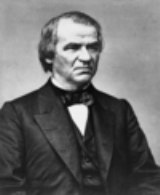
Andrew Johnson

 
Andrew Johnson

   Email Print
   Bookmark   Link


Andrew Johnson


Andrew Johnson (December 29, 1808 – July 31, 1875) was the 17th
List of Presidents of the United States

File:WhiteHouseSouthFacade.JPGThe President of the United States is the head of state and the head of government of the United States. As chief of the executive branch and head of the Federal government of the United States as a whole, the presidency is the highest political office in the United States by influence and recognition....
 President of the United States
President of the United States

The President of the United States is the head of state and head of government of the United States and is the highest political official in the United States by influence and recognition....
 (1865–69), succeeding to the Presidency upon the assassination
Abraham Lincoln assassination

The assassination of Abraham Lincoln, one of the last major events in the American Civil War, took place on Good Friday, April 14, 1865, when President of the United States Abraham Lincoln was shot while attending a performance of Our American Cousin at Ford's Theatre with his Mary Todd Lincoln and two guests....
 of Abraham Lincoln
Abraham Lincoln

Abraham Lincoln was the List of Presidents of the United States President of the United States. He successfully led the country through its greatest internal crisis, the American Civil War, preserving the Union and ending slavery....
. He was the first U.S. President to be impeached
Impeachment in the United States

Impeachment in the United States is an expressed power of the legislature which allows for formal charges to be brought against a civil officer of government for conduct committed in office....
.

At the time of the secession of the Southern states
Ordinance of Secession

The Ordinance of Secession was the document drafted and ratified in 1860 and 1861 by the states officially secession from the United States. Each state ratified its own ordinance of secession, typically by means of a specially elected Political convention or general referendum....
, Johnson was a U.S. Senator
United States Senate

The United States Senate is the upper house of the Bicameralism United States Congress, the lower house being the United States House of Representatives....
 from Greeneville in eastern Tennessee
Greeneville, Tennessee

Greeneville is a town in Greene County, Tennessee, Tennessee, United States. The population was 15,198 at the 2000 census. It is the county seat of Greene County, Tennessee....
. As a Unionist, he was the only southern Senator not to quit his post upon secession. He became the most prominent War Democrat from the South and supported the military policies of US President Abraham Lincoln during the American Civil War
American Civil War

The American Civil War , also known as the War Between the States and several Naming the American Civil War, was a civil war in the United States....
 of 1861–1865.


Discussion
Ask a question about 'Andrew Johnson'
Start a new discussion about 'Andrew Johnson'
Answer questions from other users
Full Discussion Forum


Recent Posts


Quotations


The goal to strive for is a poor government but a rich people.

As quoted in Andrew Johnson, Plebeian and Patriot (1928) by Robert Watson Winston

I must be permitted to say that I have been almost overwhelmed by the announcement of the sad event which has so recently occurred. I feel incompetent to perform duties so important and responsible as those which have been so unexpectedly thrown upon me.


Encyclopedia


Andrew Johnson (December 29, 1808 – July 31, 1875) was the 17th
List of Presidents of the United States

File:WhiteHouseSouthFacade.JPGThe President of the United States is the head of state and the head of government of the United States. As chief of the executive branch and head of the Federal government of the United States as a whole, the presidency is the highest political office in the United States by influence and recognition....
 President of the United States
President of the United States

The President of the United States is the head of state and head of government of the United States and is the highest political official in the United States by influence and recognition....
 (1865–69), succeeding to the Presidency upon the assassination
Abraham Lincoln assassination

The assassination of Abraham Lincoln, one of the last major events in the American Civil War, took place on Good Friday, April 14, 1865, when President of the United States Abraham Lincoln was shot while attending a performance of Our American Cousin at Ford's Theatre with his Mary Todd Lincoln and two guests....
 of Abraham Lincoln
Abraham Lincoln

Abraham Lincoln was the List of Presidents of the United States President of the United States. He successfully led the country through its greatest internal crisis, the American Civil War, preserving the Union and ending slavery....
. He was the first U.S. President to be impeached
Impeachment in the United States

Impeachment in the United States is an expressed power of the legislature which allows for formal charges to be brought against a civil officer of government for conduct committed in office....
.

At the time of the secession of the Southern states
Ordinance of Secession

The Ordinance of Secession was the document drafted and ratified in 1860 and 1861 by the states officially secession from the United States. Each state ratified its own ordinance of secession, typically by means of a specially elected Political convention or general referendum....
, Johnson was a U.S. Senator
United States Senate

The United States Senate is the upper house of the Bicameralism United States Congress, the lower house being the United States House of Representatives....
 from Greeneville in eastern Tennessee
Greeneville, Tennessee

Greeneville is a town in Greene County, Tennessee, Tennessee, United States. The population was 15,198 at the 2000 census. It is the county seat of Greene County, Tennessee....
. As a Unionist, he was the only southern Senator not to quit his post upon secession. He became the most prominent War Democrat from the South and supported the military policies of US President Abraham Lincoln during the American Civil War
American Civil War

The American Civil War , also known as the War Between the States and several Naming the American Civil War, was a civil war in the United States....
 of 1861–1865. In 1862 Lincoln appointed Johnson military governor of occupied Tennessee, where he proved to be energetic and effective in fighting the rebellion and beginning transition to Reconstruction.

Johnson was nominated for the Vice President
Vice President of the United States

The Vice President of the United States is the holder of a public office in the United States of America created by the Constitution of the United States....
 slot in 1864 on the National Union Party
National Union Party (United States)

The National Union Party was a political party in the United States from 1864 to 1868. It was an alliance between members of the Republican Party who backed incumbent President Abraham Lincoln and Northern Democratic Party during and after the American Civil War....
 ticket. He and Lincoln were elected in November 1864. Johnson succeeded to the Presidency upon Lincoln's assassination on April 15, 1865.

As president he took charge of Presidential Reconstruction the first phase of Reconstruction which lasted until the Radical Republicans gained control of Congress in the 1866 elections. His conciliatory policies towards the South, his hurry to reincorporate the former Confederates back into the union, and his vetoes of civil rights bills embroiled him in a bitter dispute with some Republicans. The Radicals in the House of Representatives
History of the United States House of Representatives

The United States House of Representatives is one of two chambers of the United States Congress. The House, like its Senate counterpart, was created in the United States Constitution of 1787, but its origins lie in the years before the American Revolutionary War....
 impeached him in 1868 while charging him with violating the Tenure of Office Act
Tenure of Office Act

The Tenure of Office Act , enacted over the veto of President Andrew Johnson, denied the President of the United States the power to remove from office anyone who had been appointed by the President by and with the advice and consent of the United States Senate unless the Senate also approved the removal....
, a law enacted by Congress in March 1867 over Johnson's veto, but he was acquitted by a single vote in the Senate
History of the United States Senate

The United States Senate has a history of approximately 220 years as the upper house of the United States Congress, being described in the United States Constitution in 1787 and first convened in 1789....
.

He is the most recent President to represent a party other than the Republican or Democratic parties, having represented both the Democrats and the National Union Party
National Union Party (United States)

The National Union Party was a political party in the United States from 1864 to 1868. It was an alliance between members of the Republican Party who backed incumbent President Abraham Lincoln and Northern Democratic Party during and after the American Civil War....
. He is consistently ranked by historians as being among the worst U.S. presidents
Historical rankings of United States Presidents

In political science, historical rankings of United States Presidents are surveys conducted in order to construct rankings of the success of individuals who have served as President of the United States....
.

Early life

, located at the Andrew Johnson National Historic Site
Andrew Johnson National Historic Site

Andrew Johnson National Historic Site is a National Historical Park in Greeneville, Tennessee, maintained by the National Park Service. It was established to honor Andrew Johnson, 17th President of the United States, who became president after Abraham Lincoln's death....
 in Greeneville, Tennessee
Greeneville, Tennessee

Greeneville is a town in Greene County, Tennessee, Tennessee, United States. The population was 15,198 at the 2000 census. It is the county seat of Greene County, Tennessee....
.]] Johnson was born on December 29, 1808, in Raleigh, North Carolina
Raleigh, North Carolina

Raleigh is the Capital of the state of North Carolina and the List of North Carolina county seats of Wake County, North Carolina. Raleigh is known as the ?City of Oaks? for its many oaks....
, to Jacob Johnson
Jacob Johnson (father of Andrew Johnson)

Jacob Johnson was the father of Andrew Johnson, the seventeenth President of the United States....
 and Mary McDonough. Jacob died when Andrew was around three years old, leaving his family in poverty. Johnson's mother then took in work spinning
Spinning (textiles)

Spinning is an ancient textile arts in which fiber crop, animal fiber or synthetic fiber fibers are twisted together to form yarn . For thousands of years, fiber was spun by hand using simple tools, the Spindle and distaff....
 and weaving
Weaving

Weaving is the textile arts in which two distinct sets of yarn, called the Warp and the filling or weft , are interlaced with each other to form a textile....
 to support her family and later remarried. She bound Andrew as an apprentice tailor when he was 10 or 14 years. In the 1820s, he worked as a tailor in Laurens, South Carolina
Laurens, South Carolina

Laurens is a city in Laurens County, South Carolina, South Carolina, United States. The population was 9,916 at the 2000 census. It is the county seat of Laurens County, South Carolina....
. Johnson didn't have any formal education and taught himself how to read and write.

At age 16 or 17 Johnson broke his apprenticeship
Apprenticeship

Apprenticeship is a system of training a new generation of practitioners of a skill. Apprentices or prot?g?s build their careers from apprenticeships....
 and ran away with his brother to Greeneville, Tennessee
Greeneville, Tennessee

Greeneville is a town in Greene County, Tennessee, Tennessee, United States. The population was 15,198 at the 2000 census. It is the county seat of Greene County, Tennessee....
, where he found work as a tailor. At the age of 18, Johnson married Eliza McCardle
Eliza McCardle Johnson

Elizabeth McCardle Johnson was the 18th First Lady of the United States of the United States and the wife of Andrew Johnson, the 17th President of the United States....
 in 1827. Between 1828 and 1852, the couple had five children: Martha (1828), Charles (1830), Mary (1832), Robert (1834), and Andrew Jr. (1852). Eliza taught Johnson arithmetic up to basic algebra and also tutored him to improve his literacy and writing skills.


Early political career

Johnson participated in debates at the local academy at Greeneville, Tennessee and later organized a workingman's party that elected him as alderman
Alderman

An alderman is a member of a Municipal government assembly or council in many jurisdictions. Historically the term could also refer to local municipal judges in small legal proceedings ....
 in 1829. He served in this position until he was elected mayor in 1833. In 1835 he was elected to the Tennessee House of Representatives
Tennessee House of Representatives

The Tennessee House of Representatives is the lower house of the Tennessee General Assembly, the U.S. state legislature of the U.S. state of Tennessee....
 where, after serving a single term, he was defeated for re-election.

Johnson was attracted to Andrew Jackson
Andrew Jackson

Andrew Jackson was the List of Presidents of the United States President of the United States . He was List of governors of Florida of Florida , commander of the American forces at the Battle of New Orleans , and eponym of the era of Jacksonian democracy....
's states' rights Democratic Party. He became a spokesman for the more numerous yeomen farmers and mountaineers against the wealthier, but fewer, planter elite families that had held political control both in the state and nationally. In 1839 Johnson was elected to the Tennessee Senate
Tennessee Senate

The Tennessee Senate is the upper house of the Tennessee U.S. state legislature, which is known formally as the Tennessee General Assembly.The Tennessee Senate, according to the Tennessee State Constitution of 1870, is composed of 33 members, one-third the size of the Tennessee House of Representatives....
, where he served two consecutive two-year terms. In 1843 he became the first Democrat to win election as the U.S. Representative from Tennessee's 1st congressional district
Tennessee's 1st congressional district

The Tennessee 1st Congressional District is the congressional district of northeast Tennessee, including all of Carter County, Tennessee, Cocke County, Tennessee, Greene County, Tennessee, Hamblen County, Tennessee, Hancock County, Tennessee, Hawkins County, Tennessee, Johnson County, Tennessee, Sullivan County, Tennessee, Unicoi County, Tenn...
. Among his activities for the common man's interests as a member of the House of Representatives and the Senate, Johnson advocated 'a free farm for the poor' bill where farms would be given to landless farmers. Johnson was a U.S. Representative for five terms until 1853, when he was elected governor of Tennessee.

Political ascendancy

Johnson was elected governor of Tennessee, serving from 1853 to 1857. He was then elected as a Democrat to the United States Senate, serving from October 8, 1857 to March 4, 1862. He was chairman of the Committee to Audit and Control the Contingent Expense (Thirty-sixth Congress
36th United States Congress

The Thirty-sixth United States Congress was a meeting of the legislative branch of the United States federal government, consisting of the United States Senate and the United States House of Representatives....
). Before Tennessee voted on secession, Johnson who lived in Unionist east Tennessee toured the state speaking in opposition to the act, which he said was unconstitutional. Johnson was an aggressive stump speaker and often responded to hecklers, even those in the Senate. At the time of secession
Secession

Secession is the act of withdrawing from an organization, union, or especially a political entity. It is not to be confused with succession, the act of following in order or sequence....
 of the Confederacy
Confederate States of America

The Confederate States of America formed as the government set up from 1861 to 1865 by eleven Southern United States U.S. state of the United States of America that had declared their secession from the U.S....
, Johnson was the only Senator from the seceded states to continue participation in Congress. His explanation for this decision was "Damn the negroes, I am fighting those traitorous aristocrats, their masters."

Lincoln appointed Johnson military governor of occupied Tennessee in March 1862 with the rank of brigadier general
Brigadier general (United States)

A brigadier general in the United States Army, United States Air Force, and United States Marine Corps, is a 1 star rank general officer, with the U.S....
. During his three years in this office, he "moved resolutely to eradicate all pro-Confederate influences in the state." This "unwavering commitment to the Union" was a significant factor in his choice as vice-president by Lincoln. Johnson vigorously suppressed the Confederates and later spoke out for black suffrage, arguing, "The better class of them will go to work and sustain themselves, and that class ought to be allowed to vote, on the ground that a loyal negro
Negro

Negro is a term referring to people of Black people ancestry. Prior to the shift in the lexicon of American and worldwide classification of race and ethnicity in the late 1960s, the appellation was accepted as a normal neutral formal term both by those of Black African descent as well as non-African blacks....
 is more worthy than a disloyal white man." According to tradition and local lore, on August 8, 1863, Johnson freed his personal slaves.

Vice presidency

print of the National Union Party
National Union Party (United States)

The National Union Party was a political party in the United States from 1864 to 1868. It was an alliance between members of the Republican Party who backed incumbent President Abraham Lincoln and Northern Democratic Party during and after the American Civil War....
 presidential candidates, 1864. Lithograph and watercolor.]] As a leading War Democrat and pro-Union southerner, Johnson was an ideal candidate for the Republicans in 1864 as they enlarged their base to include War Democrats. They changed the party name to the National Union Party
National Union Party (United States)

The National Union Party was a political party in the United States from 1864 to 1868. It was an alliance between members of the Republican Party who backed incumbent President Abraham Lincoln and Northern Democratic Party during and after the American Civil War....
 to reflect this expansion. During the election Johnson replaced Hannibal Hamlin
Hannibal Hamlin

Hannibal Hamlin was the List of Vice Presidents of the United States Vice President of the United States, serving under President of the United States Abraham Lincoln from 1861-1865....
 as Lincoln's running mate. He was elected Vice President of the United States
Vice President of the United States

The Vice President of the United States is the holder of a public office in the United States of America created by the Constitution of the United States....
 and was inaugurated March 4, 1865. At the ceremony, Johnson, who had been drinking to offset the pain of typhoid fever
Typhoid fever

Typhoid fever, also known as enteric fever, or commonly just typhoid, is an illness caused by the bacterium Salmonella typhi. Common worldwide, it is transmitted by the ingestion of food or water contaminated with feces from an infected person....
 (as he explained later), gave a rambling speech and appeared intoxicated to many. In early 1865, Johnson talked harshly of hanging traitors like Jefferson Davis
Jefferson Davis

Jefferson Finis Davis was an United States politician who served as President of the Confederate States of America for its entire history, 1861 to 1865, during the American Civil War....
, which endeared him to the Radicals.

Lincoln assassination
On April 14, 1865, Abraham Lincoln was shot and mortally wounded by John Wilkes Booth
John Wilkes Booth

John Wilkes Booth was an American stage actor who assassinated President of the United States Abraham Lincoln at Ford's Theatre, in Washington, D.C., on April 14, 1865....
, a Confederate
Confederate States of America

The Confederate States of America formed as the government set up from 1861 to 1865 by eleven Southern United States U.S. state of the United States of America that had declared their secession from the U.S....
 sympathizer, while the President was attending a play at Ford's Theater. Booth's plan was to destroy the administration by ordering conspirators to assassinate Johnson, lieutenant general of the Union army Ulysses S Grant, and Secretary of State
United States Secretary of State

The United States Secretary of State is the head of the United States Department of State, concerned with foreign affairs. The Secretary is a member of the President's United States Cabinet and the highest-ranking cabinet secretary both in United States presidential line of succession and United States order of precedence....
 William H. Seward
William H. Seward

William Henry Seward, Sr. was a Governor of New York, United States Senate and the United States Secretary of State under Abraham Lincoln and Andrew Johnson....
 that same night. Grant survived when he failed to attend the theater with Lincoln as planned, Seward narrowly survived his wounds, while Johnson escaped attack as his would-be assassin, George Atzerodt
George Atzerodt

George Andreas Atzerodt was a Conspiracy , with John Wilkes Booth, in the Lincoln assassination of Abraham Lincoln. He was executed along with the other co-conspirators by hanging....
, failed to go through with the plan.

Presidency 1865–1869

Andrew Johnson
The morning after Lincoln's assassination, Johnson was sworn in as President of the United States on April 15, 1865 by Lincoln's newly appointed Chief Justice
Chief Justice of the United States

The Chief Justice of the United States is the head of the United States federal courts and the chief judge of the Supreme Court of the United States....
 Salmon P. Chase
Salmon P. Chase

Salmon Portland Chase was an United States politician and jurist in the American Civil War era who served as United States Senator from Ohio and List of Governors of Ohio of Ohio; as United States Secretary of the Treasury under President of the United States Abraham Lincoln; and as Chief Justice of the United States....
. Johnson was the first Vice President to succeed to the U.S. Presidency upon the assassination
Assassination

Assassination is the targeted killing of a public figure. Assassinations may be prompted by ideology, politics, or military reasons. Additionally, assassins may be motivated by contract killing, revenge, or celebrity or may be mental disorder....
 of a President and the third vice president to become a president upon the death of a sitting president.

Johnson had an ambiguous party status. He attempted to build a party of loyalists under the National Union
National Union Party (United States)

The National Union Party was a political party in the United States from 1864 to 1868. It was an alliance between members of the Republican Party who backed incumbent President Abraham Lincoln and Northern Democratic Party during and after the American Civil War....
 label, but he did not identify with the two main parties while President—though he did try for the Democratic nomination in 1868. Asked in 1868 why he did not become a Democrat, he said "It is true I am asked why don't I join the Democratic Party. Why don't they join me...if I have administered the office of president so well?"

Reconstruction

Northern anger over the assassination of Lincoln and the immense human cost of the war led to demands for harsh policies. Vice President Andrew Johnson had taken a hard line and spoke of hanging rebel Confederates. In late April, 1865 he was noted telling an Indiana delegation that, "Treason must be made odious... traitors must be punished and impoverished ... their social power must be destroyed." However, when he succeeded Lincoln as President, Johnson took a much softer line noting, "I say, as to the leaders, punishment. I also say leniency, reconciliation and amnesty to the thousands whom they have misled and deceived," and ended up pardoning many Confederate leaders and ex-Confederates to maintain their control of Southern state governments, Southern lands, and black people.

His class-based resentment of the rich appeared in a May 1865 statement to W.H. Holden, the man he appointed governor of North Carolina: "I intend to confiscate the lands of these rich men whom I have excluded from pardon by my proclamation, and divide the proceeds thereof among the families of the wool hat boys, the Confederate soldiers, whom these men forced into battle to protect their property in slaves." In practice, Johnson was not at all harsh toward the Confederate leaders. He allowed the Southern states to hold elections in 1865, resulting in prominent ex-Confederates being elected to the U.S. Congress; however, Congress did not seat them. Congress and Johnson argued in an increasingly public way about Reconstruction and the manner in which the Southern secessionist states would be readmitted to the Union. Johnson favored a very quick restoration, similar to the plan of leniency that Lincoln advocated before his death.

Break with the Republicans: 1866

Johnson-appointed governments all passed Black Codes
Black Codes in the USA

The Black Codes were laws passed on the state and local level mainly in the rural Southern states in the United States to limit the civil rights and civil liberties of African Americans....
 that gave the freedmen second class status. In response to the Black Codes and worrisome signs of Southern recalcitrance, the Republicans blocked the re-admission of the ex-rebellious states to the Congress in fall 1865. Congress also renewed the Freedman's Bureau
Bureau of Refugees, Freedmen and Abandoned Lands

The Bureau of Refugees, Freedmen, and Abandoned Lands was a U.S. federal government Government agency that aided distressed refugees of the American Civil War....
, but Johnson vetoed it. Senator Lyman Trumbull
Lyman Trumbull

Lyman Trumbull was a United States Senator from Illinois during the American Civil War, and co-author of the Thirteenth Amendment to the United States Constitution....
 of Illinois, leader of the moderate Republicans, took affront at the Black Codes. Trumbull proposed the first Civil Rights bill.

Although strongly urged by moderates in Congress to sign the Civil Rights Bill, Johnson broke decisively with them by vetoing it on March 27. His veto message objected to the measure because it conferred citizenship on the freedmen at a time when eleven out of thirty-six States were unrepresented and attempted to fix by federal law "a perfect equality of the white and black races in every State of the Union." Johnson said it was an invasion by federal authority of the rights of the States; it had no warrant in the Constitution and was contrary to all precedents. It was a "stride toward centralization and the concentration of all legislative power in the national government." Johnson, in a letter to Governor Thomas C. Fletcher of Missouri, wrote, "This is a country for white men, and by God, as long as I am President, it shall be a government for white men."

The Democratic Party, proclaiming itself the party of white men, North and South, aligned with Johnson. However the Republicans in Congress overrode his veto (the Senate by the vote of 33:15, the House by 182:41) and the Civil Rights Bill became law.

The last moderate proposal was the Fourteenth Amendment
Fourteenth Amendment to the United States Constitution

The Fourteenth Amendment to the United States Constitution is one of the post-American Civil War Reconstruction Amendments that was first intended to secure the rights of former Slavery in the United States....
, also authored by moderate Trumbull. It was designed to put the key provisions of the Civil Rights Act into the Constitution, but it went much further. It extended citizenship to everyone born in the United States (except Indians on reservations), penalized states that did not give the vote to freedmen, and most importantly, created new federal civil rights that could be protected by federal courts. It guaranteed the federal war debt and voided all Confederate war debts. Johnson unsuccessfully sought to block ratification of the amendment.

The moderate effort to compromise with Johnson had failed and an all-out political war broke out between the Republicans (both Radical and moderate) on one side, and on the other Johnson and his allies in the Democratic party in the North, and the conservative groupings in the South. The decisive battle was the election of 1866
United States House election, 1866

The U.S. House election, 1866 was an election for the United States House of Representatives in 1866. It was a decisive event in Reconstruction era of the United States in which President Andrew Johnson faced off against the Radical Republican ....
. Johnson campaigned vigorously but was widely ridiculed. The Republicans won by a landslide (the Southern states were not allowed to vote), and took full control of Reconstruction. Johnson was almost powerless.

Historian James Ford Rhodes
James Ford Rhodes

James Ford Rhodes , was an United States industrialist and historian born in Cleveland, Ohio.He attended New York University beginning in 1865....
 has explained Johnson's inability to engage in serious negotiations:
As Senator Charles Sumner
Charles Sumner

Charles Sumner was an United States and statesman from Massachusetts. An academic lawyer and a powerful orator, Sumner was the leader of the antislavery forces in Massachusetts and a leader of the Radical Republican in the United States Senate during the American Civil War and Reconstruction era of the United States along with Thaddeus Stev...
 shrewdly said, "the President himself is his own worst counselor, as he is his own worst defender." Johnson acted in accordance with his nature. He had intellectual force but it worked in a groove. Obstinate rather than firm it undoubtedly seemed to him that following counsel and making concessions were a display of weakness. At all events from his December message to the veto of the Civil Rights Bill he yielded not a jot to Congress. The moderate senators and representatives (who constituted a majority of the Union party) asked him for only a slight compromise; their action was really an entreaty that he would unite with them to preserve Congress and the country from the policy of the radicals.

The two projects which Johnson had most at heart were the speedy admission of the Southern senators and representatives to Congress and the relegation of the question of 'negro suffrage' to the States themselves. Himself shrinking from the imposition on these communities of the franchise for the colored people, his unyielding position in regard to matters involving no vital principle did much to bring it about. His quarrel with Congress prevented the readmission into the Union on generous terms of the members of the late Confederacy; and for the quarrel and its unhappy results Johnson's lack of imagination and his inordinate sensitiveness to political gadflies were largely responsible: it was not a contest in which fundamentals were involved.

He sacrificed two important objects to petty considerations. His pride of opinion, his desire to beat, blinded him to the real welfare of the South and of the whole country.


Impeachment


First attempt
There were two attempts to remove President Andrew Johnson from office. The first occurred in the fall of 1867. On November 21, 1867, the House Judiciary committee produced a bill of impeachment that consisted of a vast collection of complaints against him. After a furious debate, a formal vote was held in the House of Representatives on December 5, 1867, which failed 57-108.

Second attempt
Ajohnsonimpeach
Johnson notified Congress that he had removed Edwin Stanton as Secretary of War and was replacing him in the interim with Adjutant-General Lorenzo Thomas
Lorenzo Thomas

Lorenzo Thomas was a career United States Army officer who was Adjutant General of the Army at the beginning of the American Civil War. After the war, he was appointed temporary United States Secretary of War by President of the United States Andrew Johnson, precipitating Johnson's Impeachment in the United States....
. Johnson had wanted to replace Stanton with former General Ulysses S. Grant
Ulysses S. Grant

Ulysses S. Grant, born Hiram Ulysses Grant , was an United States general and the List of Presidents of the United States President of the United States ....
, who refused to accept the position. This violated the Tenure of Office Act
Tenure of Office Act

The Tenure of Office Act , enacted over the veto of President Andrew Johnson, denied the President of the United States the power to remove from office anyone who had been appointed by the President by and with the advice and consent of the United States Senate unless the Senate also approved the removal....
, a law enacted by Congress in March 1867 over Johnson's veto, specifically designed to protect Stanton. Johnson had vetoed the act, claiming it was unconstitutional. The act said, "...every person holding any civil office, to which he has been appointed by and with the advice and consent of the Senate ... shall be entitled to hold such office until a successor shall have been in like manner appointed and duly qualified," thus removing the President's previous unlimited power to remove any of his Cabinet members at will. Years later in the case Myers v. United States
Myers v. United States

Myers v. United States, , was a Supreme Court of the United States decision ruling that the President of the United States has the exclusive power to remove executive branch officials, and does not need the approval of the United States Senate or any other legislative body....
 in 1926, the Supreme Court
Supreme Court of the United States

The Supreme Court of the United States is the highest judicial body in the United States, and leads the federal United States federal courts. It consists of the Chief Justice of the United States and eight Associate Justice of the Supreme Court of the United States, who are nominated by the President of the United States and confirmed with th...
 ruled that such laws were indeed unconstitutional.

The Senate and House entered into debate. Thomas attempted to move into the war office, for which Stanton had Thomas arrested. Three days after Stanton's removal, the House impeached
Impeachment

Impeachment is the first of two stages in a specific process for a legislative body to consider whether or not to forcibly remove a government official from office....
 Johnson for intentionally violating the Tenure of Office Act.

On March 5, 1868, a court of impeachment was constituted in the Senate to hear charges against the President. William M. Evarts
William M. Evarts

William Maxwell Evarts was an United States lawyer and statesman who served as US Secretary of State, US Attorney General and US Senator from New York....
 served as his counsel. Eleven articles were set out in the resolution, and the trial before the Senate lasted almost three months. Johnson's defense was based on a clause in the Tenure of Office Act stating that the then-current secretaries would hold their posts throughout the term of the President who appointed them. Since Lincoln had appointed Stanton, it was claimed, the applicability of the act had already run its course.

There were three votes in the Senate: one on May 16 for the 11th article of impeachment, which included many of the charges contained in the other articles, and two on May 26 for the second and third articles, after which the trial adjourned. On all three occasions, thirty-five Senators voted "guilty" and nineteen "not guilty." As the Constitution requires a two-thirds majority for conviction in impeachment trials, Johnson was acquitted; the 35-19 vote was one less than the majority required. A single changed vote for guilty would have convicted and removed Johnson from office. Seven Republican senators were disturbed by how the proceedings had been manipulated in order to give a one-sided presentation of the evidence. Senators William Pitt Fessenden, Joseph S. Fowler
Joseph S. Fowler

Joseph Smith Fowler was a United States Senate from Tennessee from 1866 to 1871....
, James W. Grimes
James W. Grimes

James Wilson Grimes was an United States politician, serving as the Whig Party governor of and United States Senate from Iowa.Grimes graduated from Hampton Academy and attended Dartmouth College....
, John B. Henderson
John B. Henderson

John Brooks Henderson was a United States Senator from Missouri and a co-author of the Thirteenth Amendment to the United States Constitution....
, Lyman Trumbull
Lyman Trumbull

Lyman Trumbull was a United States Senator from Illinois during the American Civil War, and co-author of the Thirteenth Amendment to the United States Constitution....
, Peter G. Van Winkle
Peter G. Van Winkle

Peter Godwin Van Winkle was a United States Senator from West Virginia.Born in New York City, he completed preparatory studies, studied law, and was admitted to the Bar , commencing practice in Parkersburg, West Virginia in 1835....
, and Edmund G. Ross
Edmund G. Ross

Edmund Gibson Ross was a politician who represented the U.S. state of Kansas after the American Civil War and was later governor of the New Mexico Territory....
 of Kansas, who provided the decisive vote, defied their party and public opinion and voted against conviction.

Christmas Day amnesty for Confederates

One of Johnson's last significant acts was granting unconditional amnesty
Amnesty

Amnesty is a legislative or executive act by which a state restores those who may have been guilty of an offense against it to the positions of innocent persons....
 to all Confederates on Christmas Day, December 25, 1868. This was after the election of U.S. Grant to succeed him, but before Grant took office in March 1869. Earlier amnesties requiring signed oaths and excluding certain classes of people were issued both by Lincoln and by Johnson.

Administration and Cabinet


Judicial appointments
Johnson appointed only nine federal judges during his presidency, all to United States district court
United States district court

The United States district courts are the general trial courts of the United States federal court system. Both Civil law and Criminal law cases are filed in the district court, which is a court of law, Equity , and admiralty....
s:

JudgeCourtBegan active
service
Ended active
service
Samuel M. BlatchfordS.D.N.Y.
United States District Court for the Southern District of New York

The United States District Court for the Southern District of New York is the United States district court whose jurisdiction comprises the following counties: Manhattan , The Bronx, Westchester County, New York, Putnam County, New York, Rockland County, New York, Orange County, New York, Dutchess County, New York, and Sullivan County, New...
May 3, 1867March 4, 1878
George Washington Brooks

George Washington Brooks was a United States federal judge.Brooks was born in Elizabeth City, North Carolina. He read law in 1846. He was in private practice of law in Elizabeth City, North Carolina from 1846 to 1852....
D.N.C.August 19, 1865 June 4, 1872
George Seabrook Bryan

George Seabrook Bryan was a United States federal judge.Bryan was born in Charleston, South Carolina. Read law.Bryan was a federal judge to the United States District Court for the District of South Carolina....
D.S.C.
United States District Court for the District of South Carolina

The United States District Court for the District of South Carolina is the United States district court whose jurisdiction is the state of South Carolina....
February 9, 1866September 1, 1886
Daniel Clark
Daniel Clark (New Hampshire)

Daniel Clark was an United States politician who served in the New Hampshire General Court and the United States Senate.Clark was born in Stratham, New Hampshire, New Hampshire....
D.N.H.
United States District Court for the District of New Hampshire

The United States District Court for the District of New Hampshire is the United States District Court whose jurisdiction comprises the state of New Hampshire....
July 27, 1866January 2, 1891
Elmer Scipio Dundy
Elmer Scipio Dundy

Elmer Scipio Dundy was a Nebraskan judge best known as the namesake of Dundy County, Nebraska. He was born in Trumbull County, Ohio on March 5th, 1830....
D. Neb.
United States District Court for the District of Nebraska

The United States District Court for the District of Nebraska is the United States District Court whose jurisdiction is the state of Nebraska....
April 9, 1868October 28, 1896
John Erskine
John Erskine (judge)

John Erskine was a United States federal judge.Erskine was born in Strabane, County Tyrone, Ireland. He read law in 1846. He was in private practice of law in Florida from 1846 to 1855....
N.D. Ga.
United States District Court for the Northern District of Georgia

The United States District Court for the Northern District of Georgia serves the residents of forty-six counties. These are divided up into four divisions....
, S.D. Ga.
United States District Court for the Southern District of Georgia

The U.S. District Court for the Southern District of Georgia serves the residents of thirty-four counties through six divisions.The Augusta, Georgia division covers: Burke County, Georgia, Columbia County, Georgia, Glascock County, Georgia, Jefferson County, Georgia, Lincoln County, Georgia, McDuffie County, Georgia, Richmond County, Geor...
January 22, 1866December 1, 1883
Edward Fox
Edward Fox (jurist)

Edward Fox was the fourth United States district court#United States district judge for the United States District Court for the District of Maine....
D. Maine
United States District Court for the District of Maine

The U.S. District Court for the District of Maine is the U.S. district court for the U.S. state of Maine. The District of Maine was one of the original thirteen district courts established by the Judiciary Act of 1789, even though Maine was not a separate state from Massachusetts until 1820....
May 31, 1866December 14, 1881
Robert Andrews Hill
Robert Andrews Hill

Robert Andrews Hill was a United States federal judge.Hill was born in Iredell County, North Carolina. He read law in 1844. He was a Constable, Williamson County, Tennessee from 1864 to 1836....
N.D. Miss.
United States District Court for the Northern District of Mississippi

The United States District Court for the Northern District of Mississippi is a federal court in the United States Court of Appeals for the Fifth Circuit with facilities in Aberdeen, Mississippi, Ackerman, Mississippi, Clarksdale, Cleveland, Mississippi, Corinth, Mississippi, Greenville, Mississippi,...
, S.D. Miss.
United States District Court for the Southern District of Mississippi

The United States District Court for the Southern District of Mississippi is a federal court in the United States Court of Appeals for the Fifth Circuit with facilities in Biloxi, Mississippi, Hattiesburg, Mississippi, Vicksburg, Mississippi, and Jackson, Mississippi....
May 1, 1866August 1, 1891
Charles Taylor Sherman

The eldest of eleven children, Charles Taylor Sherman was born February 3, 1811, in Norwalk, Connecticut to Charles Robert Sherman and his wife, Mary Sherman....
D. Ohio
United States District Court for the Northern District of Ohio

The U.S. District Court for the Northern District of Ohio is the federal trial court for the northern half of Ohio. The court has courthouses in Cleveland, Ohio , Toledo, Ohio, Akron, Ohio, and Youngstown, Ohio....
March 2, 1867November 25, 1872


States admitted to the Union

  • Nebraska
    Nebraska

    Nebraska is a U.S. state located on the Great Plains of the Midwestern United States and Western United States.Nebraska probably gets its name from the archaic Chiwere language words ?? Br?sge or the Omaha-Ponca language N? Bth?ska meaning "flat water," after the Platte River that flows through the state....
     - March 1, 1867


Foreign policy

Johnson forced the French
France

France , officially the French Republic , is a country whose Metropolitan France is located in Western Europe and that also comprises various Overseas departments and territories of France....
 out of Mexico
Mexico

The United Mexican States , commonly known as Mexico , is a federalism constitutionalism republic in North America. It is bordered on the north by the United States; on the south and west by the Pacific Ocean; on the southeast by Guatemala, Belize, and the Caribbean Sea; and on the east by the Gulf of Mexico....
 by sending a combat army to the border and issuing an ultimatum. The French withdrew in 1867, and the government they supported quickly collapsed. Secretary of State Seward
William H. Seward

William Henry Seward, Sr. was a Governor of New York, United States Senate and the United States Secretary of State under Abraham Lincoln and Andrew Johnson....
 negotiated the purchase of Alaska
Alaska purchase

The Alaska Purchase by the United States from the Russian Empire occurred in 1867 at the behest of Secretary of State William H. Seward. The territory purchased was 586,412 square miles of the modern state of Alaska....
 from Russia on April 9, 1867 for $7.2 million. This is equivalent to $ in present day terms. Critics sneered at "Seward's Folly" and "Seward's Icebox" and "Icebergia." Seward also negotiated to purchase the Danish West Indies
Danish West Indies

The Danish West Indies or "Danish Antilles", were a colony of Denmark-Norway and Denmark in the Caribbean, now known as the United States Virgin Islands....
, but the Senate refused to approve the purchase in 1867 (it eventually happened in 1917). The Senate likewise rejected Seward's arrangement with the United Kingdom to arbitrate the Alabama Claims
Alabama Claims

The Alabama Claims were a series of claims for damages by the Federal government of the United States against the Her Majesty's Government for the perceived Covert operations given to the Confederate States of America cause during the American Civil War....
.

The U.S. experienced tense relations with the United Kingdom and its colonial government in Canada in the aftermath of the war. Lingering resentment over the perception of British sympathy towards the Confederacy resulted in Johnson initially turning a blind eye towards a series of armed incursions by Irish-American civil war veterans into British territory in Canada, named the Fenian Raids
Fenian raids

The Fenian raids were attacks by members of the Fenian Brotherhood based in the United States on British army forts, customs posts and other targets in Canada in order to bring pressure on United Kingdom of Great Britain and Ireland to withdraw from Ireland, between 1866 and 1871....
. Eventually, Johnson ordered the Fenians disarmed and barred from crossing the border, but his hesitant reaction to the crisis helped motivate the movement toward Canadian Confederation
Canadian Confederation

Canadian Confederation was the process by which the federalism Dominion of Canada was formed beginning July 1, 1867 from the provinces, colony and Territory of British North America....
.

Post-presidency

Johnson was an unsuccessful candidate for election to the United States Senate from Tennessee in 1868 and to the House of Representatives in 1872. However, in 1874 the Tennessee legislature did elect him to the U.S. Senate. Johnson served from March 4, 1875, until his death from a stroke near Elizabethton, Tennessee
Elizabethton, Tennessee

Elizabethton is the county seat of Carter County, Tennessee, Tennessee, United States. Elizabethton is also the historical site of the first independent Human settlement on American soil and located west of both the Eastern Continental Divide and the original thirteen British colonization of the Americas....
, on July 31 that same year. In his first speech since returning to the Senate, which was also his last, Johnson spoke about political turmoil in Louisiana. His passion aroused a standing ovation from many of his fellow senators who had once voted to remove him from the presidency. He is the only former President to serve in the Senate.

Interment was in the Andrew Johnson National Cemetery, Greeneville, Tennessee
Greeneville, Tennessee

Greeneville is a town in Greene County, Tennessee, Tennessee, United States. The population was 15,198 at the 2000 census. It is the county seat of Greene County, Tennessee....
. In accordance with Johnson's wishes, his body was wrapped in an American flag; under his head lay a copy of the U.S. Constitution. Andrew Johnson National Cemetery is now part of the Andrew Johnson National Historic Site
Andrew Johnson National Historic Site

Andrew Johnson National Historic Site is a National Historical Park in Greeneville, Tennessee, maintained by the National Park Service. It was established to honor Andrew Johnson, 17th President of the United States, who became president after Abraham Lincoln's death....
.

Historians' changing views on Andrew Johnson

Today, historians generally regard Johnson as one of the worst presidents in U.S. history. Eric Foner
Eric Foner

Eric Foner is an United States historian. He has been a faculty member in the department of history at Columbia University since 1982 and writes extensively on political history, the history of freedom, the early history of the Republican Party , African American biography, Reconstruction era of the United States, and historiography....
 called him a "fervent white supremacist" who foiled Reconstruction
Reconstruction

Reconstruction is the era in the history of the United States from 1863 to 1877, when the United States focused on Abolitionism, destroying all traces of the Confederate States of America, establishing the rights of Freedmen, the name used for freed slaves, and through three new constitutional amendments strengthening the role of the federal...
. Sean Wilentz
Sean Wilentz

Sean Wilentz is the Sidney and Ruth Lapidus Professor of History at Princeton University, where he has taught since 1979....
 wrote that he "actively sided with former Confederates" in his attempts to derail it. This has been a modern trend of dis-esteem, primarily as the Reconstruction program itself has come to be seen as a "noble" effort to build an interracial
Interracial

Interracial is an adjective related to Race . It can have different connotations in different contexts:*Interracial adoption means placing a child of one racial group or ethnic group with adoptive parents of another racial group or ethnic group....
 nation.However, it should be noted that W. E. B. Du Bois, had proposed this view in his pioneering study, Black Reconstruction first published in 1935 (to which Foner and other recent historians are heir).

The Dunning School
Dunning School

The Dunning School refers to a group of historians who shared a historiography school of thought regarding the Reconstruction era of the United States period of American history ....
 of the early 20th century saw Johnson as a heroic bulwark against the corruption of the Radical Republicans who tried to remove the entire leadership class of the white South. In their view, Johnson seemed to be the legitimate heir of the sainted Abraham Lincoln.

By the 1930s a series of favorable biographies enhanced his prestige. Johnson's Republican critics of the 1860s appeared as disreputable to liberal historians as did the Republican critics of Franklin D. Roosevelt. Furthermore, a Beardian School (named after Charles Beard and typified by Howard K. Beale) argued that the Republican Party in the 1860s was a tool of corrupt business interests, and that Johnson stood for the people. They rated Johnson "near great," but have later changed their minds, rating Johnson "a flat failure". The Civil Rights movement
Civil rights movement

The Civil Rights Movement was a worldwide political movement for equality before the law occurring approximately between 1960 to 1980. It was accompanied by much civil unrest and popular rebellion....
 of the 1960s brought a new perspective to the practice of history as well as to civil legislation. Historians noted African American efforts to establish public education and welfare institutions, gave muted praise for Republican efforts to extend suffrage and provide other social institutions, and excoriated Johnson for siding with the opposition to extending basic rights to former slaves.

Johnson's purchase of Alaska from the Russian Empire
Russian Empire

File:Russian Emperor Flag.jpgFile:Romanov Flag.svgThe Russian Empire was a state that existed from 1721 until the Russian Revolution of 1917....
 in 1867 is believed to be his most important foreign policy action, with the purchase proving itself vital to national security during the Cold War
Cold War

The Cold War was the continuing state of conflict, tension and competition that existed between a number of world powers, including the United States, the Soviet Union, People's Republic of China, France, United Kingdom and those countries' respective allies from the mid-1940s to the early 1990s....
 (mid-1940s until the early 1990s). The idea and implementation is credited to Seward as Secretary of State, but Johnson approved the plan. Gold was not discovered in Alaska until 1880, thirteen years after the purchase and five years after Johnson's death, and oil was not discovered until 1968.

See also

  • List of American Civil War generals
    List of American Civil War generals

    This is a list of people who were general officers in the American Civil War....
  • United States presidential election, 1864
    United States presidential election, 1864

    In the United States Presidential election of 1864, Abraham Lincoln was re-elected as president. Lincoln ran under the Republican Party banner against his former top Civil War general, the Democratic Party candidate, George B....
  • History of the United States (1865-1918)
  • Tennessee Johnson
    Tennessee Johnson

    Tennessee Johnson was a 1942 in film United States film about Andrew Johnson, the 17th president of the United States. It was directed by William Dieterle and written by Milton Ginzburg, Alvin Meyes, John Balderston, and Wells Root....


Bibliography

  • Howard K. Beale, The Critical Year. A Study of Andrew Johnson and Reconstruction (1930). ISBN 0804410852
  • Michael Les Benedict, (1999). ISBN 0393319822
  • Albert E. Castel, The Presidency of Andrew Johnson (1979). ISBN 0700601902
  • D. M. DeWitt, The Impeachment and Trial of Andrew Johnson (1903).
  • Du Bois, W. E. B. 'The Transubstantiation of a Poor White' in Black Reconstruction: An Essay Toward the History of the Part Which Black People Have Played in the Attempt to Reconstruct Democracy in America, 1860-1880 (1935). ISBN 0527252808.
  • W. A. Dunning, (New York, 1898)
  • W. A. Dunning
    William Archibald Dunning

    William Archibald Dunning was an United States historian who founded the Dunning School of Reconstruction era of the United States historiography at Columbia University, where he had graduated in 1881....
    , Reconstruction, Political and Economic (New York, 1907)
  • Foster, G. Allen, Impeached: The President who almost lost his job (New York, 1964).
  • Eric L. McKitrick, Andrew Johnson and Reconstruction (1961). ISBN 0-19-505707-4
  • Martin E. Mantell; (1973)
  • Hatfield, Mark O.
    Mark Hatfield

    Mark Odom Hatfield is an American politician and educator from the state of Oregon. A Republican Party , he served for 30 years as a United States Senator from Oregon, and also as Chairman of the Senate Appropriations Committee....
    , with the Senate Historical Office, Vice Presidents of the United States, 1789-1993.(U.S. Government Printing Office, 1997), p.219
  • Howard Means, The Avenger Takes His Place: Andrew Johnson and the 45 Days That Changed the Nation (New York, 2006)
  • Milton; George Fort. The Age of Hate: Andrew Johnson and the Radicals (1930)
  • Patton; James Welch. Unionism and Reconstruction in Tennessee, 1860–1869 (1934)
  • Rhodes; James Ford Volume: 6. 1920. Pulitzer prize.
  • Schouler, James. (1917)
  • Sledge, James L. III. "Johnson, Andrew" in Encyclopedia of the American Civil War. edited by David S. Heidler and Jeanne T. Heidler. (2000)
  • Lloyd P. Stryker, Andrew Johnson: A Study in Courage (1929). ISBN 0-403-01231-7
  • Trefousse, Hans L. Andrew Johnson: A Biography (1989). ISBN 0-393-31742-0
  • Winston; Robert W. Andrew Johnson: Plebeian and Patriot (1928)


Primary sources

  • Ralph W. Haskins, LeRoy P. Graf, and Paul H. Bergeron et al., eds. The Papers of Andrew Johnson 16 volumes; University of Tennessee Press, (1967–2000). ISBN 1572330910.) Includes all letters and speeches by Johnson, and many letters written to him. Complete to 1875.


External links