

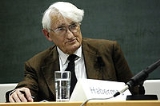
Jürgen Habermas

Encyclopedia
Jürgen Habermas (ˈjɜrɡən or ˈjʊərɡən ˈhɑːbərmɑːs, ˈjʏʁɡən ˈhaːbɐmaːs; born June 18, 1929) is a German
sociologist and philosopher in the tradition of critical theory
and pragmatism
. He is perhaps best known for his theory on the concepts of 'communicative rationality
' and the 'public sphere
'. His work focuses on the foundations of social theory
and epistemology, the analysis of advanced capitalistic societies
and democracy
, the rule of law
in a critical social-evolutionary context
, and contemporary politics, particularly German politics. Habermas's theoretical system is devoted to revealing the possibility of reason, emancipation
, and rational-critical communication latent in modern institutions and in the human capacity to deliberate and pursue rational interests. Habermas is known for his work on the concept of modernity
, particularly with respect to the discussions of "rationalization
" originally set forth by Max Weber
. While influenced by American pragmatism, action theory
, and even poststructuralism, many of the central tenets of Habermas' thought remain broadly Marxist in nature. Global polls identified him as one of the leading intellectuals of the present.
, Rhine Province
, in 1929, to a middle class and rather traditional family, Habermas came of age in postwar Germany. In his early teens, during World War II, Habermas was profoundly affected by the war. The Nuremberg Trials were a key formative moment that brought home to him the depth of Germany's moral and political failure under National Socialism.
Until his graduation from gymnasium
, Habermas lived in Gummersbach
, near Cologne
. His father, Ernst Habermas, was executive director of the Cologne Chamber of Industry and Commerce, and was described by Habermas as a Nazi sympathizer. He was brought up in a staunchly Protestant milieu, his grandfather being the director of the seminary in Gummersbach. He studied at the universities of Göttingen (1949/50), Zürich (1950/51), and Bonn (1951–54) and earned a doctorate in philosophy from Bonn in 1954 with a dissertation written on the conflict between the absolute and history in Schelling's thought, entitled, ("The absolute and history: on the schism in Schelling's
thought"). His dissertation committee included Erich Rothacker
and Oskar Becker
.
From 1956 on, he studied philosophy
and sociology
under the critical theorists
Max Horkheimer
and Theodor Adorno at the Johann Wolfgang Goethe University Frankfurt am Main Institute for Social Research
, but because of a rift between the two over his dissertation—Horkheimer had made unacceptable demands for revision—as well as his own belief that the Frankfurt School
had become paralyzed with political skepticism and disdain for modern culture—he finished his habilitation
in political science
at the University of Marburg under the Marxist Wolfgang Abendroth
. His habilitation work was entitled, (published in English translation in 1989 as The Structural Transformation of the Public Sphere
: an Inquiry into a Category of Bourgeois Society). It is a detailed social history of the development of the bourgeois public sphere from its origins in the 18th century salons up to its transformation through the influence of capital-driven mass media. In 1961, he became a privatdozent
in Marburg, and—in a move that was highly unusual for the German academic scene of that time—he was offered the position of "extraordinary professor" (professor without chair) of philosophy at the University of Heidelberg (at the instigation of Hans-Georg Gadamer
and Karl Löwith
) in 1962, which he accepted. In this same year he gained his first serious public attention, in Germany, with the publication of his habilitation. In 1964, strongly supported by Adorno, Habermas returned to Frankfurt to take over Horkheimer's chair in philosophy and sociology. The philosopher Albrecht Wellmer
was his assistant in Frankfurt from 1966 to 1970.
He accepted the position of Director of the Max Planck Institute in Starnberg
(near Munich
) in 1971, and worked there until 1983, two years after the publication of his magnum opus
, The Theory of Communicative Action
. He was elected a Foreign Honorary Member of the American Academy of Arts and Sciences
in 1984.
Habermas then returned to his chair at Frankfurt and the directorship of the Institute for Social Research
. Since retiring from Frankfurt in 1993, Habermas has continued to publish extensively. In 1986, he received the Gottfried Wilhelm Leibniz Prize
of the , which is the highest honour awarded in German research. He also holds the uncharacteristically postmodern position of "Permanent Visiting" Professor at Northwestern University
in Evanston, Illinois, and "Theodor Heuss
Professor" at The New School
, New York
.
Habermas was awarded The Prince of Asturias Award in Social Sciences of 2003. Habermas was also the 2004 Kyoto Laureate in the Arts
and Philosophy
section. He traveled to San Diego and on March 5, 2005, as part of the University of San Diego
's Kyoto Symposium, gave a speech entitled The Public Role of Religion in Secular Context, regarding the evolution of separation of Church and State
from neutrality to intense secularism
. He received the 2005 Holberg International Memorial Prize
(about € 520,000). In 2007, Habermas was listed as the 7th most-cited author in the humanities
(including the social sciences) by The Times Higher Education Guide, ahead of Max Weber
and behind Erving Goffman
.
(professor at the Hertie School of Governance
in Berlin), the social philosopher Johann Arnason (professor at La Trobe University
and chief editor of the journal Thesis Eleven
), the social philosopher Hans-Herbert Kögler (Chair of Philosophy at University of North Florida
), the sociological theorist Hans Joas
(professor at the University of Erfurt
and at the University of Chicago
), the theorist of societal evolution
Klaus Eder, the social philosopher Axel Honneth
(the current director of the Institute for Social Research), the anarcho-capitalist philosopher Hans-Hermann Hoppe
, the American philosopher Thomas McCarthy
, the co-creator of mindful inquiry in social research Jeremy J. Shapiro
, and the assassinated Serbian prime minister Zoran Đinđić.
and philosophy drawing on a number of intellectual traditions:
Jürgen Habermas considers his major contribution to be the development of the concept and theory of communicative reason or communicative rationality
, which distinguishes itself from the rationalist tradition
, by locating rationality
in structures of interpersonal linguistic communication
rather than in the structure of the cosmos
. This social theory
advances the goals of human emancipation, while maintaining an inclusive universalist moral
framework. This framework rests on the argument called universal pragmatics
- that all speech acts have an inherent telos
(the Greek
word for "end") — the goal of mutual understanding
, and that human beings possess the communicative competence to bring about such understanding. Habermas built the framework out of the speech-act philosophy of Ludwig Wittgenstein
, J. L. Austin
and John Searle
, the sociological theory of the interactional constitution of mind and self of George Herbert Mead
, the theories of moral development
of Jean Piaget
and Lawrence Kohlberg
, and the discourse ethics
of his Heidelberg colleague Karl-Otto Apel
.
Habermas's works resonate within the traditions of Kant and the Enlightenment and of democratic socialism
through his emphasis on the potential for transforming the world and arriving at a more humane, just, and egalitarian society through the realization of the human potential for reason, in part through discourse ethics
. While Habermas has stated that the Enlightenment is an "unfinished project," he argues it should be corrected and complemented, not discarded. In this he distances himself from the Frankfurt School
, criticizing it, as well as much of postmodernist thought, for excessive pessimism, radicalism
, and exaggerations.
Within sociology, Habermas's major contribution was the development of a comprehensive theory of societal evolution and modernization
focusing on the difference between communicative rationality
and rationalization
on one hand and strategic / instrumental rationality
and rationalization on the other. This includes a critique from a communicative standpoint of the differentiation-based theory
of social systems developed by Niklas Luhmann
, a student of Talcott Parsons
.
His defence of modernity
and civil society
has been a source of inspiration to others, and is considered a major philosophical alternative to the varieties of poststructuralism. He has also offered an influential analysis of late capitalism
.
Habermas perceives the rationalization, humanization
and democratization
of society in terms of the institutionalization of the potential for rationality that is inherent in the communicative competence
that is unique to the human species. Habermas contends that communicative competence has developed through the course of evolution
, but in contemporary society it is often suppressed or weakened by the way in which major domains of social life, such as the market
, the state
, and organization
s, have been given over to or taken over by strategic/instrumental rationality, so that the logic of the system supplants that of the lifeworld
.
The model of “rational reconstructions” represents the main thread of the surveys about the “structures” of the world of life (“culture”, “society” and “personality”) and their respective “functions” (cultural reproductions, social integrations and socialization). For this purpose, the dialectics between “symbolic representation” of “the structures subordinated to all worlds of
life” (“internal relationships”) and the “material reproduction” of the social systems in their complex (“external relationships” between social systems and environment) has to be considered.
This model finds an application, above all, in the “theory of the social evolution”, starting from the reconstruction of the necessary conditions for a phylogeny of the socio-cultural life forms (the “hominization”) until an analysis of the development of “social formations”, which Habermas subdivides into primitive, traditional, modern and contemporary formations.
"This paper is an attempt, primarily, to formalize the model of “reconstruction of the logic of development” of “social formations” summed up by Habermas through the differentiation between vital world and social systems (and, within them, through the “rationalization of the world of life” and the “growth in complexity of the social systems”). Secondly, it tries to offer some methodological clarifications about the “explanation of the dynamics” of “historical processes” and, in particular, about the “theoretical meaning” of the evolutional theory’s propositions. Even if the German sociologist considers that the “ex-post rational reconstructions” and “the models system/environment” cannot have a complete “historiographical application”, these certainly act as a general premise in the argumentative structure of the “historical explanation”".
Habermas argues that prior to the 18th century, European culture had been dominated by a "representational" culture, where one party sought to "represent" itself on its audience by overwhelming its subjects. As an example of "representational" culture, Habermas argued that Louis XIV
's Palace of Versailles
was meant to show the greatness of the French state and its King by overpowering the senses of visitors to the Palace. Habermas identifies "representational" culture as corresponding to the feudal stage of development according to Marxist theory, arguing that the coming of the capitalist stage of development marked the appearance of Öffentlichkeit (the public sphere). In the culture characterized by Öffentlichkeit, there occurred a public space outside of the control by the state, where individuals exchanged views and knowledge. In Habermas's view, the growth in newspaper
s, journals
, reading clubs, Masonic lodge
s, and coffeehouses in 18th century Europe, all in different ways, marked the gradual replacement of "representational" culture with Öffentlichkeit culture. Habermas argued that the essential characteristic of the Öffentlichkeit culture was its "critical" nature. Unlike "representational" culture where only one party was active and the other passive, the Öffentlichkeit culture was characterized by a dialogue as individuals either met in conversation, or exchanged views via the print media. Habermas maintains that as Britain was the most liberal country in Europe, the culture of the public sphere emerged there first around 1700, and the growth of Öffentlichkeit culture took place over most of the 18th century in Continental Europe. In his view, the French Revolution
was in large part caused by the collapse of "representational" culture, and its replacement by Öffentlichkeit culture. Though Habermas' main concern in The Structural Transformation of the Public Sphere was to expose what he regarded as the deceptive nature of free institutions in the West, his book had a major effect on the historiography of the French Revolution.
According to Habermas, a variety of factors resulted in the eventual decay of the public sphere, including the growth of a commercial
mass media
, which turned the critical public into a passive consumer public; and the welfare state, which merged the state with society so thoroughly that the public sphere was squeezed out. It also turned the "public sphere" into a site of self-interested contestation for the resources of the state rather than a space for the development of a public-minded rational consensus
.
His most known work to date, the Theory of Communicative Action (1981), is based on an adaptation of Talcott Parsons
AGIL Paradigm
. In this work, Habermas voiced criticism of the process of modernization
, which he saw as inflexible direction forced through by economic and administrative rationalization. Habermas outlined how our everyday lives are penetrated by formal systems as parallel to development of the welfare state
, corporate capitalism
and mass consumption. These reinforcing trends rationalize public life. Disfranchisement of citizens occurs as political parties and interest groups become rationalized and representative democracy
replaces participatory one
. In consequence, boundaries between public and private, the individual and society, the system and the lifeworld
are deteriorating. Democratic public life cannot develop where matters of public importance are not discussed by citizens. An "ideal speech situation
", requires participants to have the same capacities of discourse, social equality and their words are not confused by ideology or other errors. In this version of the consensus theory of truth
Habermas maintains that truth is what would be agreed upon in an ideal speech situation
.
Habermas has expressed optimism about the possibility of the revival of the public sphere. He discerns a hope for the future where the representative democracy-reliant nation-state
is replaced by a deliberative democracy
-reliant political organism based on the equal rights and obligations of citizens. In such direct democracy-driven system, the activist public sphere is needed for debates on matters of public importance and as well as the mechanism for that discussion to affect the decision-making process.
Several noted academics have provided various criticisms of Habermas's notions regarding the public sphere. John B. Thompson
, a Professor of Sociology
at the University of Cambridge
and a fellow of Jesus College, has pointed out that Habermas's notion of the public sphere is antiquated due to the proliferation of mass-media communications. Michael Schudson
from the University of California, San Diego
argues more generally that a public sphere as a place of purely rational independent debate
never existed.
Habermas has several main criticisms of postmodernism
.
In this transitional phase from Knowledge and Human Interest to The Theory of Communicative Action, Habermas's basic philosophical endeavor was to develop a more modest, fallibilist, empirical account of the philosophical claim to universality and rationality.
, Michael Stürmer
, Klaus Hildebrand
and Andreas Hillgruber
. Habermas first expressed his views on the above-mentioned historians in the Die Zeit
on July 11, 1986 in a feuilleton
(opinion piece) entitled “A Kind of Settlement of Damages”. Habermas criticized Nolte, Hildebrand, Stürmer and Hillgruber for “apologistic” history writing in regard to the Nazi era, and for seeking to “close Germany’s opening to the West” that in Habermas’s view had existed since 1945. He argued that they had tried to detach Nazi
rule and the Holocaust
from the mainstream of German history, explain away Nazism as a reaction to Bolshevism, and partially rehabilitate the reputation of the Wehrmacht
(German Army) during World War II
. Habermas wrote that Stürmer was trying to create a "vicarious religion" in German history which, together with the work of Hillgruber, glorifying the last days of the German Army on the Eastern Front, was intended to serve as a "kind of NATO philosophy colored with German nationalism" The so-called Historikerstreit ("Historians' Quarrel") was not at all one-sided, because Habermas was himself attacked by scholars like Joachim Fest
, Hagen Schulze
, Horst Möller, Imanuel Geiss
and Klaus Hildebrand
In turn, Habermas was supported by historians such as Martin Broszat
, Eberhard Jäckel
, Hans Mommsen
and Hans-Ulrich Wehler
.
engaged in a series of disputes beginning in the 1980s and culminating in a mutual understanding and friendship in the late 1990s that lasted until Derrida died in 2004. They originally came in contact when Habermas invited Derrida to speak at The University of Frankfurt in 1984. The next year Habermas published "Beyond a Temporalized Philosophy of Origins: Derrida" in The Philosophical Discourse of Modernity
in which he described Derrida’s method as being unable to provide a foundation for social critique. Derrida, citing Habermas as an example, remarked that, "those who have accused me of reducing philosophy to literature or logic to rhetoric ... have visibly and carefully avoided reading me". After Derrida’s final rebuttal in 1989 the two philosophers didn’t continue, but, as Derrida described it, groups in the academy “conducted a kind of ‘war’, in which we ourselves never took part, either personally or directly”. Then at the end of the 1990s Habermas approached Derrida at a party held at a university in the United States where they were both lecturing. They then met at Paris over dinner, and afterwards have participated in many joint projects. In 2000 they held a joint seminar on problems of philosophy, right, ethics, and politics at the University of Frankfurt. In December 2000, in Paris, Habermas gave a lecture entitled "How to answer the ethical question?" at the Judeities. Questions for Jacques Derrida conference organized by Joseph Cohen and Raphael Zagury-Orly. Following the lecture by Habermas, both thinkers engaged in a very heated debate on Heidegger and the possibility of Ethics. The conference volume was published at the Editions Galilée (Paris) in 2002, and subsequently in English at Fordham University Press (2007).
In the aftermath of 9/11
, Derrida and Habermas laid out their individual opinions on 9/11 and the War on Terror
in Giovanna Borradori's
Philosophy in a Time of Terror: Dialogues with Jürgen Habermas and Jacques Derrida. In early 2003, both Habermas and Derrida were very active in opposing the coming Iraq War, and called for in a manifesto that later became the book Old Europe, New Europe, Core Europe
for a tighter union of the states of the European Union
in order to provide a power capable of opposing American foreign policy. Derrida wrote a foreword expressing his unqualified subscription to Habermas's declaration of February 2003, "February 15, or, What Binds Europeans Together: Plea for a Common Foreign Policy, Beginning in Core Europe,” in Old Europe, New Europe, Core Europe which was a reaction to the Bush administration demands upon European nations for support for the coming Iraq War. Habermas has offered further context for this declaration in an interview.
), entitled The Dialectics of Secularization
.
It addresses such important contemporary questions as these:
In this debate a recent shift of Habermas became evident — in particular, his rethinking of the public role of religion. Habermas writes as a “methodological atheist,” which means that when doing philosophy or social science, he presumes nothing about particular religious beliefs. Yet while writing from this perspective his evolving position towards the role of religion in society has led him to some challenging questions, and as a result conceding some ground in his dialogue with the Pope, that would seem to have consequences which further complicate the positions he holds about a communicative rational solution to the problems of modernity.
In an interview in 1999 Habermas stated that,
The statement was later misquoted in a number of American newspapers and magazines as: "Christianity, and nothing else, is the ultimate foundation of liberty, conscience, human rights, and democracy, the benchmarks of Western civilization," which Habermas did not say.
Habermas now talks about the emergence of "post-secular societies" and argues that tolerance is a two-way street: secular people need to tolerate the role of religious people in the public square and vice versa.
, Foucault
and Rawls
, Derrida and Brandom. His extensive written work addresses topics stretching from social-political theory to aesthetics, epistemology and language to philosophy of religion, and his ideas have significantly influenced not only philosophy but also political-legal thought, sociology, communication studies, argumentation theory and rhetoric, developmental psychology and theology. Moreover, he has figured prominently in Germany as public intellectual, commenting on controversial issues of the day in German newspapers such as Die Zeit
.
Two broad lines of enduring interest are found in Habermas's work, one having to do with the political domain, the other with issues of rationality, communication, and knowledge.
Germany
Germany , officially the Federal Republic of Germany , is a federal parliamentary republic in Europe. The country consists of 16 states while the capital and largest city is Berlin. Germany covers an area of 357,021 km2 and has a largely temperate seasonal climate...
sociologist and philosopher in the tradition of critical theory
Critical theory
Critical theory is an examination and critique of society and culture, drawing from knowledge across the social sciences and humanities. The term has two different meanings with different origins and histories: one originating in sociology and the other in literary criticism...
and pragmatism
Pragmatism
Pragmatism is a philosophical tradition centered on the linking of practice and theory. It describes a process where theory is extracted from practice, and applied back to practice to form what is called intelligent practice...
. He is perhaps best known for his theory on the concepts of 'communicative rationality
Communicative rationality
Communicative rationality, or communicative reason, is a theory or set of theories which describes human rationality as a necessary outcome of successful communication. In particular, it is tied to the philosophy of Karl-Otto Apel, Jürgen Habermas, and their program of universal pragmatics, along...
' and the 'public sphere
Public sphere
The public sphere is an area in social life where individuals can come together to freely discuss and identify societal problems, and through that discussion influence political action...
'. His work focuses on the foundations of social theory
Social theory
Social theories are theoretical frameworks which are used to study and interpret social phenomena within a particular school of thought. An essential tool used by social scientists, theories relate to historical debates over the most valid and reliable methodologies , as well as the primacy of...
and epistemology, the analysis of advanced capitalistic societies
Advanced capitalism
In political philosophy, advanced capitalism is the situation that pertains in a society in which the capitalist model has been integrated and developed deeply and extensively and for a prolonged period of time...
and democracy
Democracy
Democracy is generally defined as a form of government in which all adult citizens have an equal say in the decisions that affect their lives. Ideally, this includes equal participation in the proposal, development and passage of legislation into law...
, the rule of law
Rule of law
The rule of law, sometimes called supremacy of law, is a legal maxim that says that governmental decisions should be made by applying known principles or laws with minimal discretion in their application...
in a critical social-evolutionary context
Sociocultural evolution
Sociocultural evolution is an umbrella term for theories of cultural evolution and social evolution, describing how cultures and societies have changed over time...
, and contemporary politics, particularly German politics. Habermas's theoretical system is devoted to revealing the possibility of reason, emancipation
Political emancipation
Emancipation is a broad term used to describe various efforts to obtain political rights or equality, often for a specifically disenfranchised group, or more generally in discussion of such matters...
, and rational-critical communication latent in modern institutions and in the human capacity to deliberate and pursue rational interests. Habermas is known for his work on the concept of modernity
Modernity
Modernity typically refers to a post-traditional, post-medieval historical period, one marked by the move from feudalism toward capitalism, industrialization, secularization, rationalization, the nation-state and its constituent institutions and forms of surveillance...
, particularly with respect to the discussions of "rationalization
Rationalization (sociology)
Rationalization is a term used in sociology to refer to a process in which an increasing number of social actions become based on considerations of teleological efficiency or calculation rather than on motivations derived from morality, emotion, custom, or tradition...
" originally set forth by Max Weber
Max Weber
Karl Emil Maximilian "Max" Weber was a German sociologist and political economist who profoundly influenced social theory, social research, and the discipline of sociology itself...
. While influenced by American pragmatism, action theory
Action theory
Action theory is an area in philosophy concerned with theories about the processes causing willful human bodily movements of more or less complex kind. This area of thought has attracted the strong interest of philosophers ever since Aristotle's Nicomachean Ethics...
, and even poststructuralism, many of the central tenets of Habermas' thought remain broadly Marxist in nature. Global polls identified him as one of the leading intellectuals of the present.
Biography
Born in DüsseldorfDüsseldorf
Düsseldorf is the capital city of the German state of North Rhine-Westphalia and centre of the Rhine-Ruhr metropolitan region.Düsseldorf is an important international business and financial centre and renowned for its fashion and trade fairs. Located centrally within the European Megalopolis, the...
, Rhine Province
Rhine Province
The Rhine Province , also known as Rhenish Prussia or synonymous to the Rhineland , was the westernmost province of the Kingdom of Prussia and the Free State of Prussia, within the German Reich, from 1822-1946. It was created from the provinces of the Lower Rhine and Jülich-Cleves-Berg...
, in 1929, to a middle class and rather traditional family, Habermas came of age in postwar Germany. In his early teens, during World War II, Habermas was profoundly affected by the war. The Nuremberg Trials were a key formative moment that brought home to him the depth of Germany's moral and political failure under National Socialism.
Until his graduation from gymnasium
Gymnasium (school)
A gymnasium is a type of school providing secondary education in some parts of Europe, comparable to English grammar schools or sixth form colleges and U.S. college preparatory high schools. The word γυμνάσιον was used in Ancient Greece, meaning a locality for both physical and intellectual...
, Habermas lived in Gummersbach
Gummersbach
Gummersbach is a city in the state of North Rhine-Westphalia, Germany, being the district seat of the Oberbergischer Kreis. It is located 50 km east of Cologne. In the past it was nicknamed "the Lime Tree Town", because lime trees lined the main street...
, near Cologne
Cologne
Cologne is Germany's fourth-largest city , and is the largest city both in the Germany Federal State of North Rhine-Westphalia and within the Rhine-Ruhr Metropolitan Area, one of the major European metropolitan areas with more than ten million inhabitants.Cologne is located on both sides of the...
. His father, Ernst Habermas, was executive director of the Cologne Chamber of Industry and Commerce, and was described by Habermas as a Nazi sympathizer. He was brought up in a staunchly Protestant milieu, his grandfather being the director of the seminary in Gummersbach. He studied at the universities of Göttingen (1949/50), Zürich (1950/51), and Bonn (1951–54) and earned a doctorate in philosophy from Bonn in 1954 with a dissertation written on the conflict between the absolute and history in Schelling's thought, entitled, ("The absolute and history: on the schism in Schelling's
Friedrich Wilhelm Joseph Schelling
Friedrich Wilhelm Joseph Schelling , later von Schelling, was a German philosopher. Standard histories of philosophy make him the midpoint in the development of German idealism, situating him between Fichte, his mentor prior to 1800, and Hegel, his former university roommate and erstwhile friend...
thought"). His dissertation committee included Erich Rothacker
Erich Rothacker
Erich Rothacker was a German philosopher, a leading exponent of philosophical anthropology. His first major work, Logik und Systematik der Geisteswissenschaften , presents the view that actual historical individuals, whose cognitive equipment is partially created by a specific cultural community...
and Oskar Becker
Oskar Becker
Oscar Becker was a German philosopher, logician, mathematician, and historian of mathematics.-Early life:Becker studied mathematics at Leipzig...
.
From 1956 on, he studied philosophy
Philosophy
Philosophy is the study of general and fundamental problems, such as those connected with existence, knowledge, values, reason, mind, and language. Philosophy is distinguished from other ways of addressing such problems by its critical, generally systematic approach and its reliance on rational...
and sociology
Sociology
Sociology is the study of society. It is a social science—a term with which it is sometimes synonymous—which uses various methods of empirical investigation and critical analysis to develop a body of knowledge about human social activity...
under the critical theorists
Critical theory
Critical theory is an examination and critique of society and culture, drawing from knowledge across the social sciences and humanities. The term has two different meanings with different origins and histories: one originating in sociology and the other in literary criticism...
Max Horkheimer
Max Horkheimer
Max Horkheimer was a German-Jewish philosopher-sociologist, famous for his work in critical theory as a member of the 'Frankfurt School' of social research. His most important works include The Eclipse of Reason and, in collaboration with Theodor Adorno, The Dialectic of Enlightenment...
and Theodor Adorno at the Johann Wolfgang Goethe University Frankfurt am Main Institute for Social Research
Institute for Social Research
The Institute for Social Research is a research organization for sociology and continental philosophy, best known as the institutional home of the Frankfurt School and critical theory....
, but because of a rift between the two over his dissertation—Horkheimer had made unacceptable demands for revision—as well as his own belief that the Frankfurt School
Frankfurt School
The Frankfurt School refers to a school of neo-Marxist interdisciplinary social theory, particularly associated with the Institute for Social Research at the University of Frankfurt am Main...
had become paralyzed with political skepticism and disdain for modern culture—he finished his habilitation
Habilitation
Habilitation is the highest academic qualification a scholar can achieve by his or her own pursuit in several European and Asian countries. Earned after obtaining a research doctorate, such as a PhD, habilitation requires the candidate to write a professorial thesis based on independent...
in political science
Political science
Political Science is a social science discipline concerned with the study of the state, government and politics. Aristotle defined it as the study of the state. It deals extensively with the theory and practice of politics, and the analysis of political systems and political behavior...
at the University of Marburg under the Marxist Wolfgang Abendroth
Wolfgang Abendroth
Wolfgang Abendroth was a socialist German jurist and political scientist. He was born in Elberfeld, now a part of Wuppertal in North Rhine-Westphalia. Abendroth was an important contributor to the constitutional foundation of postwar West Germany. He briefly held a professorship in law in East...
. His habilitation work was entitled, (published in English translation in 1989 as The Structural Transformation of the Public Sphere
The Structural Transformation of the Public Sphere
The Structural Transformation of the Public Sphere: An Inquiry into a Category of Bourgeois Society , by Jürgen Habermas, was published in 1962 and translated into English in 1989 by Thomas Burger and Frederick Lawrence...
: an Inquiry into a Category of Bourgeois Society). It is a detailed social history of the development of the bourgeois public sphere from its origins in the 18th century salons up to its transformation through the influence of capital-driven mass media. In 1961, he became a privatdozent
Privatdozent
Privatdozent or Private lecturer is a title conferred in some European university systems, especially in German-speaking countries, for someone who pursues an academic career and holds all formal qualifications to become a tenured university professor...
in Marburg, and—in a move that was highly unusual for the German academic scene of that time—he was offered the position of "extraordinary professor" (professor without chair) of philosophy at the University of Heidelberg (at the instigation of Hans-Georg Gadamer
Hans-Georg Gadamer
Hans-Georg Gadamer was a German philosopher of the continental tradition, best known for his 1960 magnum opus, Truth and Method .-Life:...
and Karl Löwith
Karl Löwith
Karl Löwith , was a German philosopher, a student of Heidegger.Löwith was born in Munich. Though he was himself Protestant, his family was of Jewish descent and he therefore had to emigrate Germany in 1934 because of the National Socialist regime. He went to Italy and in 1936 he went to Japan...
) in 1962, which he accepted. In this same year he gained his first serious public attention, in Germany, with the publication of his habilitation. In 1964, strongly supported by Adorno, Habermas returned to Frankfurt to take over Horkheimer's chair in philosophy and sociology. The philosopher Albrecht Wellmer
Albrecht Wellmer
Albrecht Wellmer is a prominent German philosopher at the Freie Universität Berlin.-Biography:He studied maths and physics at Berlin and Kiel, then philosophy and sociology at Heidelberg and Frankfurt. He was an assistant to Jürgen Habermas at the University of Frankfurt from 1966 to 1970...
was his assistant in Frankfurt from 1966 to 1970.
He accepted the position of Director of the Max Planck Institute in Starnberg
Starnberg
The city of Starnberg is in Bavaria, Germany, some 30 km south-west of Munich. It lies at the north end of Lake Starnberg, in the heart of the "Five Lakes Country", and serves as capital of the district of Starnberg...
(near Munich
Munich
Munich The city's motto is "" . Before 2006, it was "Weltstadt mit Herz" . Its native name, , is derived from the Old High German Munichen, meaning "by the monks' place". The city's name derives from the monks of the Benedictine order who founded the city; hence the monk depicted on the city's coat...
) in 1971, and worked there until 1983, two years after the publication of his magnum opus
Masterpiece
Masterpiece in modern usage refers to a creation that has been given much critical praise, especially one that is considered the greatest work of a person's career or to a work of outstanding creativity, skill or workmanship....
, The Theory of Communicative Action
The Theory of Communicative Action
The Theory of Communicative Action was published in 1981 in two volumes, the first subtitled Reason and the Rationalization of Society , the second, Lifeworld and System: A Critique of Functionalist Reason...
. He was elected a Foreign Honorary Member of the American Academy of Arts and Sciences
American Academy of Arts and Sciences
The American Academy of Arts and Sciences is an independent policy research center that conducts multidisciplinary studies of complex and emerging problems. The Academy’s elected members are leaders in the academic disciplines, the arts, business, and public affairs.James Bowdoin, John Adams, and...
in 1984.
Habermas then returned to his chair at Frankfurt and the directorship of the Institute for Social Research
Institute for Social Research
The Institute for Social Research is a research organization for sociology and continental philosophy, best known as the institutional home of the Frankfurt School and critical theory....
. Since retiring from Frankfurt in 1993, Habermas has continued to publish extensively. In 1986, he received the Gottfried Wilhelm Leibniz Prize
Gottfried Wilhelm Leibniz Prize
The Gottfried Wilhelm Leibniz Prize is a research prize awarded by the Deutsche Forschungsgemeinschaft every year since 1985 to scientists working in Germany. This highest German research prize consists of a research grant of 2.5 million euro, to be used within seven years...
of the , which is the highest honour awarded in German research. He also holds the uncharacteristically postmodern position of "Permanent Visiting" Professor at Northwestern University
Northwestern University
Northwestern University is a private research university in Evanston and Chicago, Illinois, USA. Northwestern has eleven undergraduate, graduate, and professional schools offering 124 undergraduate degrees and 145 graduate and professional degrees....
in Evanston, Illinois, and "Theodor Heuss
Theodor Heuss
Theodor Heuss was a liberal German politician who served as the first President of the Federal Republic of Germany after World War II from 1949 to 1959...
Professor" at The New School
The New School
The New School is a university in New York City, located mostly in Greenwich Village. From its founding in 1919 by progressive New York academics, and for most of its history, the university was known as the New School for Social Research. Between 1997 and 2005 it was known as New School University...
, New York
New York
New York is a state in the Northeastern region of the United States. It is the nation's third most populous state. New York is bordered by New Jersey and Pennsylvania to the south, and by Connecticut, Massachusetts and Vermont to the east...
.
Habermas was awarded The Prince of Asturias Award in Social Sciences of 2003. Habermas was also the 2004 Kyoto Laureate in the Arts
ARts
aRts, which stands for analog Real time synthesizer, is an audio framework that is no longer under development. It is best known for previously being used in KDE to simulate an analog synthesizer....
and Philosophy
Philosophy
Philosophy is the study of general and fundamental problems, such as those connected with existence, knowledge, values, reason, mind, and language. Philosophy is distinguished from other ways of addressing such problems by its critical, generally systematic approach and its reliance on rational...
section. He traveled to San Diego and on March 5, 2005, as part of the University of San Diego
University of San Diego
The University of San Diego is a Roman Catholic university in San Diego, California. USD offers more than sixty bachelor's, master’s, and doctoral programs...
's Kyoto Symposium, gave a speech entitled The Public Role of Religion in Secular Context, regarding the evolution of separation of Church and State
Separation of church and state
The concept of the separation of church and state refers to the distance in the relationship between organized religion and the nation state....
from neutrality to intense secularism
Secularism
Secularism is the principle of separation between government institutions and the persons mandated to represent the State from religious institutions and religious dignitaries...
. He received the 2005 Holberg International Memorial Prize
Holberg International Memorial Prize
The Holberg International Memorial Prize was established in 2003 by the government of Norway with the objective of increasing awareness of the value of academic scholarship within the arts, humanities, social sciences, law and theology, either within one of these fields or through interdisciplinary...
(about € 520,000). In 2007, Habermas was listed as the 7th most-cited author in the humanities
Humanities
The humanities are academic disciplines that study the human condition, using methods that are primarily analytical, critical, or speculative, as distinguished from the mainly empirical approaches of the natural sciences....
(including the social sciences) by The Times Higher Education Guide, ahead of Max Weber
Max Weber
Karl Emil Maximilian "Max" Weber was a German sociologist and political economist who profoundly influenced social theory, social research, and the discipline of sociology itself...
and behind Erving Goffman
Erving Goffman
Erving Goffman was a Canadian-born sociologist and writer.The 73rd president of American Sociological Association, Goffman's greatest contribution to social theory is his study of symbolic interaction in the form of dramaturgical perspective that began with his 1959 book The Presentation of Self...
.
Teacher and mentor
Habermas is a famed teacher and mentor. Among his most prominent students were the pragmatic philosopher Herbert Schnädelbach (theorist of discourse distinction and rationality), the political sociologist Claus OffeClaus Offe
Professor Claus Offe is a political sociologist of Marxist orientation. Once a student of Jürgen Habermas, the left-leaning German academic is counted among the second generation Frankfurt School...
(professor at the Hertie School of Governance
Hertie School of Governance
The Hertie School of Governance is a private university in Berlin, in the historic Quartier 110 of Friedrichstraße. The school is regarded as one of the leading policy institutes in Europe...
in Berlin), the social philosopher Johann Arnason (professor at La Trobe University
La Trobe University
La Trobe University is a multi-campus university in Victoria, Australia. It was established in 1964 by an Act of Parliament to become the third oldest university in the state of Victoria. The main campus of La Trobe is located in the Melbourne suburb of Bundoora; two other major campuses are...
and chief editor of the journal Thesis Eleven
Thesis Eleven
Thesis Eleven is a peer-reviewed academic journal that publishes papers four times a year in the field of Sociology. The journal's editors are Peter Beilharz , Trevor Hogan and Peter Murphy...
), the social philosopher Hans-Herbert Kögler (Chair of Philosophy at University of North Florida
University of North Florida
The University of North Florida is a public university located in Jacksonville, Florida. A member institution of the State University System of Florida, the university is accredited by the Commission on Colleges of the Southern Association of Colleges and Schools to award baccalaureate, master’s...
), the sociological theorist Hans Joas
Hans Joas
Hans Joas is a German sociologist and social theorist.Joas is the Director of the Max Weber Center for Advanced Cultural and Social Studies at the University of Erfurt and Professor of Sociology and a Member of the Committee on Social Thought at the University of Chicago. He currently serves as...
(professor at the University of Erfurt
University of Erfurt
The University of Erfurt is a public university located in Erfurt, Germany. Originally founded in 1379, the university was closed in 1816 for the next 177 years...
and at the University of Chicago
University of Chicago
The University of Chicago is a private research university in Chicago, Illinois, USA. It was founded by the American Baptist Education Society with a donation from oil magnate and philanthropist John D. Rockefeller and incorporated in 1890...
), the theorist of societal evolution
Evolution
Evolution is any change across successive generations in the heritable characteristics of biological populations. Evolutionary processes give rise to diversity at every level of biological organisation, including species, individual organisms and molecules such as DNA and proteins.Life on Earth...
Klaus Eder, the social philosopher Axel Honneth
Axel Honneth
Axel Honneth is a professor of philosophy at the University of Frankfurt, Germany and director of the Institut für Sozialforschung in Frankfurt am Main, Germany.-Biography:...
(the current director of the Institute for Social Research), the anarcho-capitalist philosopher Hans-Hermann Hoppe
Hans-Hermann Hoppe
Hans-Hermann Hoppe is an Austrian School economist of the anarcho-capitalist tradition, and a Professor Emeritus of economics at the University of Nevada, Las Vegas.-Academic career:...
, the American philosopher Thomas McCarthy
Thomas A. McCarthy
Thomas McCarthy is John Shaffer Professor of Philosophy Emeritus at Northwestern University. Before joining Northwestern in 1985, he taught for four years at Munich University and for thirteen years at Boston University. After retiring from Northwestern in 2006, he served for three years as...
, the co-creator of mindful inquiry in social research Jeremy J. Shapiro
Jeremy J. Shapiro
Dr. Jeremy J. Shapiro , is an American academic, a professor at Fielding Graduate University who works in the area of critical social theory with emphasis on the social and cultural effects of information technology and systems, social change, and the aesthetics of music...
, and the assassinated Serbian prime minister Zoran Đinđić.
Theory
Habermas has constructed a comprehensive framework of social theorySocial theory
Social theories are theoretical frameworks which are used to study and interpret social phenomena within a particular school of thought. An essential tool used by social scientists, theories relate to historical debates over the most valid and reliable methodologies , as well as the primacy of...
and philosophy drawing on a number of intellectual traditions:
- the German philosophical thoughtGerman philosophyGerman philosophy, here taken to mean either philosophy in the German language or philosophy by Germans, has been extremely diverse, and central to both the analytic and continental traditions in philosophy for centuries, from Leibniz through Kant, Hegel, Schopenhauer, Marx, Nietzsche, Heidegger...
of Immanuel KantImmanuel KantImmanuel Kant was a German philosopher from Königsberg , researching, lecturing and writing on philosophy and anthropology at the end of the 18th Century Enlightenment....
, Friedrich Schelling, G. W. F. HegelGeorg Wilhelm Friedrich HegelGeorg Wilhelm Friedrich Hegel was a German philosopher, one of the creators of German Idealism. His historicist and idealist account of reality as a whole revolutionized European philosophy and was an important precursor to Continental philosophy and Marxism.Hegel developed a comprehensive...
, Wilhelm DiltheyWilhelm DiltheyWilhelm Dilthey was a German historian, psychologist, sociologist and hermeneutic philosopher, who held Hegel's Chair in Philosophy at the University of Berlin. As a polymathic philosopher, working in a modern research university, Dilthey's research interests revolved around questions of...
, Edmund HusserlEdmund HusserlEdmund Gustav Albrecht Husserl was a philosopher and mathematician and the founder of the 20th century philosophical school of phenomenology. He broke with the positivist orientation of the science and philosophy of his day, yet he elaborated critiques of historicism and of psychologism in logic...
and Hans-Georg GadamerHans-Georg GadamerHans-Georg Gadamer was a German philosopher of the continental tradition, best known for his 1960 magnum opus, Truth and Method .-Life:... - the Marxian tradition — both the theory of Karl MarxKarl MarxKarl Heinrich Marx was a German philosopher, economist, sociologist, historian, journalist, and revolutionary socialist. His ideas played a significant role in the development of social science and the socialist political movement...
himself as well as the critical neo-Marxian theory of the Frankfurt SchoolFrankfurt SchoolThe Frankfurt School refers to a school of neo-Marxist interdisciplinary social theory, particularly associated with the Institute for Social Research at the University of Frankfurt am Main...
, i.e. Max HorkheimerMax HorkheimerMax Horkheimer was a German-Jewish philosopher-sociologist, famous for his work in critical theory as a member of the 'Frankfurt School' of social research. His most important works include The Eclipse of Reason and, in collaboration with Theodor Adorno, The Dialectic of Enlightenment...
, Theodor Adorno and Herbert MarcuseHerbert MarcuseHerbert Marcuse was a German Jewish philosopher, sociologist and political theorist, associated with the Frankfurt School of critical theory... - the sociological theories of Max WeberMax WeberKarl Emil Maximilian "Max" Weber was a German sociologist and political economist who profoundly influenced social theory, social research, and the discipline of sociology itself...
, Émile DurkheimÉmile DurkheimDavid Émile Durkheim was a French sociologist. He formally established the academic discipline and, with Karl Marx and Max Weber, is commonly cited as the principal architect of modern social science and father of sociology.Much of Durkheim's work was concerned with how societies could maintain...
and George Herbert MeadGeorge Herbert MeadGeorge Herbert Mead was an American philosopher, sociologist and psychologist, primarily affiliated with the University of Chicago, where he was one of several distinguished pragmatists. He is regarded as one of the founders of social psychology and the American sociological tradition in general.-... - the linguistic philosophyLinguistic philosophyLinguistic philosophy describes the view that philosophical problems are problems which may be solved either by reforming language, or by understanding more about the language we presently use. The former position is that of ideal language philosophy, the latter the position of ordinary language...
and speech actSpeech actSpeech Act is a technical term in linguistics and the philosophy of language. The contemporary use of the term goes back to John L. Austin's doctrine of locutionary, illocutionary, and perlocutionary acts...
theories of Ludwig WittgensteinLudwig WittgensteinLudwig Josef Johann Wittgenstein was an Austrian philosopher who worked primarily in logic, the philosophy of mathematics, the philosophy of mind, and the philosophy of language. He was professor in philosophy at the University of Cambridge from 1939 until 1947...
, J.L. Austin, P. F. StrawsonP. F. StrawsonSir Peter Frederick Strawson FBA was an English philosopher. He was the Waynflete Professor of Metaphysical Philosophy at the University of Oxford from 1968 to 1987. Before that he was appointed as a college lecturer at University College, Oxford in 1947 and became a tutorial fellow the...
, Stephen ToulminStephen ToulminStephen Edelston Toulmin was a British philosopher, author, and educator. Influenced by Ludwig Wittgenstein, Toulmin devoted his works to the analysis of moral reasoning. Throughout his writings, he sought to develop practical arguments which can be used effectively in evaluating the ethics behind...
and John SearleJohn SearleJohn Rogers Searle is an American philosopher and currently the Slusser Professor of Philosophy at the University of California, Berkeley.-Biography:... - the developmental psychology of Jean PiagetJean PiagetJean Piaget was a French-speaking Swiss developmental psychologist and philosopher known for his epistemological studies with children. His theory of cognitive development and epistemological view are together called "genetic epistemology"....
and Lawrence KohlbergLawrence KohlbergLawrence Kohlberg was a Jewish American psychologist born in Bronxville, New York, who served as a professor at the University of Chicago, as well as Harvard University. Having specialized in research on moral education and reasoning, he is best known for his theory of stages of moral development... - the American pragmatist traditionPragmatismPragmatism is a philosophical tradition centered on the linking of practice and theory. It describes a process where theory is extracted from practice, and applied back to practice to form what is called intelligent practice...
of Charles Sanders Peirce and John DeweyJohn DeweyJohn Dewey was an American philosopher, psychologist and educational reformer whose ideas have been influential in education and social reform. Dewey was an important early developer of the philosophy of pragmatism and one of the founders of functional psychology... - the sociological social systems theory of Talcott ParsonsTalcott ParsonsTalcott Parsons was an American sociologist who served on the faculty of Harvard University from 1927 to 1973....
and Niklas LuhmannNiklas LuhmannNiklas Luhmann was a German sociologist, and a prominent thinker in sociological systems theory.-Biography:... - Neo-Kantian thought
Jürgen Habermas considers his major contribution to be the development of the concept and theory of communicative reason or communicative rationality
Communicative rationality
Communicative rationality, or communicative reason, is a theory or set of theories which describes human rationality as a necessary outcome of successful communication. In particular, it is tied to the philosophy of Karl-Otto Apel, Jürgen Habermas, and their program of universal pragmatics, along...
, which distinguishes itself from the rationalist tradition
Rationalism
In epistemology and in its modern sense, rationalism is "any view appealing to reason as a source of knowledge or justification" . In more technical terms, it is a method or a theory "in which the criterion of the truth is not sensory but intellectual and deductive"...
, by locating rationality
Rationality
In philosophy, rationality is the exercise of reason. It is the manner in which people derive conclusions when considering things deliberately. It also refers to the conformity of one's beliefs with one's reasons for belief, or with one's actions with one's reasons for action...
in structures of interpersonal linguistic communication
Communication
Communication is the activity of conveying meaningful information. Communication requires a sender, a message, and an intended recipient, although the receiver need not be present or aware of the sender's intent to communicate at the time of communication; thus communication can occur across vast...
rather than in the structure of the cosmos
Cosmos
In the general sense, a cosmos is an orderly or harmonious system. It originates from the Greek term κόσμος , meaning "order" or "ornament" and is antithetical to the concept of chaos. Today, the word is generally used as a synonym of the word Universe . The word cosmos originates from the same root...
. This social theory
Social theory
Social theories are theoretical frameworks which are used to study and interpret social phenomena within a particular school of thought. An essential tool used by social scientists, theories relate to historical debates over the most valid and reliable methodologies , as well as the primacy of...
advances the goals of human emancipation, while maintaining an inclusive universalist moral
Morality
Morality is the differentiation among intentions, decisions, and actions between those that are good and bad . A moral code is a system of morality and a moral is any one practice or teaching within a moral code...
framework. This framework rests on the argument called universal pragmatics
Universal pragmatics
Universal pragmatics, more recently placed under the heading of formal pragmatics, is the philosophical study of the necessary conditions for reaching an understanding through communication...
- that all speech acts have an inherent telos
Telos (philosophy)
A telos is an end or purpose, in a fairly constrained sense used by philosophers such as Aristotle. It is the root of the term "teleology," roughly the study of purposiveness, or the study of objects with a view to their aims, purposes, or intentions. Teleology figures centrally in Aristotle's...
(the Greek
Greek language
Greek is an independent branch of the Indo-European family of languages. Native to the southern Balkans, it has the longest documented history of any Indo-European language, spanning 34 centuries of written records. Its writing system has been the Greek alphabet for the majority of its history;...
word for "end") — the goal of mutual understanding
Understanding
Understanding is a psychological process related to an abstract or physical object, such as a person, situation, or message whereby one is able to think about it and use concepts to deal adequately with that object....
, and that human beings possess the communicative competence to bring about such understanding. Habermas built the framework out of the speech-act philosophy of Ludwig Wittgenstein
Ludwig Wittgenstein
Ludwig Josef Johann Wittgenstein was an Austrian philosopher who worked primarily in logic, the philosophy of mathematics, the philosophy of mind, and the philosophy of language. He was professor in philosophy at the University of Cambridge from 1939 until 1947...
, J. L. Austin
J. L. Austin
John Langshaw Austin was a British philosopher of language, born in Lancaster and educated at Shrewsbury School and Balliol College, Oxford University. Austin is widely associated with the concept of the speech act and the idea that speech is itself a form of action...
and John Searle
John Searle
John Rogers Searle is an American philosopher and currently the Slusser Professor of Philosophy at the University of California, Berkeley.-Biography:...
, the sociological theory of the interactional constitution of mind and self of George Herbert Mead
George Herbert Mead
George Herbert Mead was an American philosopher, sociologist and psychologist, primarily affiliated with the University of Chicago, where he was one of several distinguished pragmatists. He is regarded as one of the founders of social psychology and the American sociological tradition in general.-...
, the theories of moral development
Moral Development
Moral development focuses on the emergence, change, and understanding of morality from infancy to adulthood. In the field of moral development, morality is defined as principles for how individuals ought to treat one another, with respect to justice, others’ welfare, and rights...
of Jean Piaget
Jean Piaget
Jean Piaget was a French-speaking Swiss developmental psychologist and philosopher known for his epistemological studies with children. His theory of cognitive development and epistemological view are together called "genetic epistemology"....
and Lawrence Kohlberg
Lawrence Kohlberg
Lawrence Kohlberg was a Jewish American psychologist born in Bronxville, New York, who served as a professor at the University of Chicago, as well as Harvard University. Having specialized in research on moral education and reasoning, he is best known for his theory of stages of moral development...
, and the discourse ethics
Discourse ethics
Discourse ethics, sometimes called argumentation ethics, refers to a type of argument that attempts to establish normative or ethical truths by examining the presuppositions of discourse.-Habermas and Apel:...
of his Heidelberg colleague Karl-Otto Apel
Karl-Otto Apel
Karl-Otto Apel is a German philosopher and Professor Emeritus at the University of Frankfurt am Main. Apel worked in ethics, the philosophy of language and human sciences. He wrote extensively in these fields, publishing mostly in German...
.
Habermas's works resonate within the traditions of Kant and the Enlightenment and of democratic socialism
Democratic socialism
Democratic socialism is a description used by various socialist movements and organizations to emphasize the democratic character of their political orientation...
through his emphasis on the potential for transforming the world and arriving at a more humane, just, and egalitarian society through the realization of the human potential for reason, in part through discourse ethics
Discourse ethics
Discourse ethics, sometimes called argumentation ethics, refers to a type of argument that attempts to establish normative or ethical truths by examining the presuppositions of discourse.-Habermas and Apel:...
. While Habermas has stated that the Enlightenment is an "unfinished project," he argues it should be corrected and complemented, not discarded. In this he distances himself from the Frankfurt School
Frankfurt School
The Frankfurt School refers to a school of neo-Marxist interdisciplinary social theory, particularly associated with the Institute for Social Research at the University of Frankfurt am Main...
, criticizing it, as well as much of postmodernist thought, for excessive pessimism, radicalism
Political radicalism
The term political radicalism denotes political principles focused on altering social structures through revolutionary means and changing value systems in fundamental ways...
, and exaggerations.
Within sociology, Habermas's major contribution was the development of a comprehensive theory of societal evolution and modernization
Modernization
In the social sciences, modernization or modernisation refers to a model of an evolutionary transition from a 'pre-modern' or 'traditional' to a 'modern' society. The teleology of modernization is described in social evolutionism theories, existing as a template that has been generally followed by...
focusing on the difference between communicative rationality
Communicative rationality
Communicative rationality, or communicative reason, is a theory or set of theories which describes human rationality as a necessary outcome of successful communication. In particular, it is tied to the philosophy of Karl-Otto Apel, Jürgen Habermas, and their program of universal pragmatics, along...
and rationalization
Rationalization (sociology)
Rationalization is a term used in sociology to refer to a process in which an increasing number of social actions become based on considerations of teleological efficiency or calculation rather than on motivations derived from morality, emotion, custom, or tradition...
on one hand and strategic / instrumental rationality
Instrumental rationality
Two views of instrumental rationality can be discerned in modern philosophy: one view comes from social philosophy, sociology and critical theory, whereas another comes from natural philosophy.-The view from critical theory and social philosophy:...
and rationalization on the other. This includes a critique from a communicative standpoint of the differentiation-based theory
Theory
The English word theory was derived from a technical term in Ancient Greek philosophy. The word theoria, , meant "a looking at, viewing, beholding", and referring to contemplation or speculation, as opposed to action...
of social systems developed by Niklas Luhmann
Niklas Luhmann
Niklas Luhmann was a German sociologist, and a prominent thinker in sociological systems theory.-Biography:...
, a student of Talcott Parsons
Talcott Parsons
Talcott Parsons was an American sociologist who served on the faculty of Harvard University from 1927 to 1973....
.
His defence of modernity
Modernity
Modernity typically refers to a post-traditional, post-medieval historical period, one marked by the move from feudalism toward capitalism, industrialization, secularization, rationalization, the nation-state and its constituent institutions and forms of surveillance...
and civil society
Civil society
Civil society is composed of the totality of many voluntary social relationships, civic and social organizations, and institutions that form the basis of a functioning society, as distinct from the force-backed structures of a state , the commercial institutions of the market, and private criminal...
has been a source of inspiration to others, and is considered a major philosophical alternative to the varieties of poststructuralism. He has also offered an influential analysis of late capitalism
Late capitalism
"Late capitalism" is a term used by neo-Marxists to refer to capitalism from about 1945 onwards, with the implication that it is a historically limited stage rather than an eternal feature of all future human society. Postwar German sociologists needed a term to describe contemporary society...
.
Habermas perceives the rationalization, humanization
Humanism
Humanism is an approach in study, philosophy, world view or practice that focuses on human values and concerns. In philosophy and social science, humanism is a perspective which affirms some notion of human nature, and is contrasted with anti-humanism....
and democratization
Democratization
Democratization is the transition to a more democratic political regime. It may be the transition from an authoritarian regime to a full democracy, a transition from an authoritarian political system to a semi-democracy or transition from a semi-authoritarian political system to a democratic...
of society in terms of the institutionalization of the potential for rationality that is inherent in the communicative competence
Communicative competence
Communicative competence is a term in linguistics which refers to a language user's grammatical knowledge of syntax, morphology, phonology and the like, as well as social knowledge about how and when to use utterances appropriately....
that is unique to the human species. Habermas contends that communicative competence has developed through the course of evolution
Evolution
Evolution is any change across successive generations in the heritable characteristics of biological populations. Evolutionary processes give rise to diversity at every level of biological organisation, including species, individual organisms and molecules such as DNA and proteins.Life on Earth...
, but in contemporary society it is often suppressed or weakened by the way in which major domains of social life, such as the market
Market
A market is one of many varieties of systems, institutions, procedures, social relations and infrastructures whereby parties engage in exchange. While parties may exchange goods and services by barter, most markets rely on sellers offering their goods or services in exchange for money from buyers...
, the state
State (polity)
A state is an organized political community, living under a government. States may be sovereign and may enjoy a monopoly on the legal initiation of force and are not dependent on, or subject to any other power or state. Many states are federated states which participate in a federal union...
, and organization
Organization
An organization is a social group which distributes tasks for a collective goal. The word itself is derived from the Greek word organon, itself derived from the better-known word ergon - as we know `organ` - and it means a compartment for a particular job.There are a variety of legal types of...
s, have been given over to or taken over by strategic/instrumental rationality, so that the logic of the system supplants that of the lifeworld
Lifeworld
Lifeworld may be conceived as a universe of what is self-evident or given, a world that subjects may experience together. For Husserl, the lifeworld is the fundament for all epistemological enquiries. The concept has its origin in biology and cultural Protestantism.The lifeworld concept is used in...
.
Reconstructive science
Habermas introduces the concept of “reconstructive science” with a double purpose: to place the “general theory of society” between philosophy and social science and re-establish the rift between the “great theorization” and the “empirical research”.The model of “rational reconstructions” represents the main thread of the surveys about the “structures” of the world of life (“culture”, “society” and “personality”) and their respective “functions” (cultural reproductions, social integrations and socialization). For this purpose, the dialectics between “symbolic representation” of “the structures subordinated to all worlds of
life” (“internal relationships”) and the “material reproduction” of the social systems in their complex (“external relationships” between social systems and environment) has to be considered.
This model finds an application, above all, in the “theory of the social evolution”, starting from the reconstruction of the necessary conditions for a phylogeny of the socio-cultural life forms (the “hominization”) until an analysis of the development of “social formations”, which Habermas subdivides into primitive, traditional, modern and contemporary formations.
"This paper is an attempt, primarily, to formalize the model of “reconstruction of the logic of development” of “social formations” summed up by Habermas through the differentiation between vital world and social systems (and, within them, through the “rationalization of the world of life” and the “growth in complexity of the social systems”). Secondly, it tries to offer some methodological clarifications about the “explanation of the dynamics” of “historical processes” and, in particular, about the “theoretical meaning” of the evolutional theory’s propositions. Even if the German sociologist considers that the “ex-post rational reconstructions” and “the models system/environment” cannot have a complete “historiographical application”, these certainly act as a general premise in the argumentative structure of the “historical explanation”".
The public sphere
In The Structural Transformation of the Public SphereThe Structural Transformation of the Public Sphere
The Structural Transformation of the Public Sphere: An Inquiry into a Category of Bourgeois Society , by Jürgen Habermas, was published in 1962 and translated into English in 1989 by Thomas Burger and Frederick Lawrence...
Habermas argues that prior to the 18th century, European culture had been dominated by a "representational" culture, where one party sought to "represent" itself on its audience by overwhelming its subjects. As an example of "representational" culture, Habermas argued that Louis XIV
Louis XIV of France
Louis XIV , known as Louis the Great or the Sun King , was a Bourbon monarch who ruled as King of France and Navarre. His reign, from 1643 to his death in 1715, began at the age of four and lasted seventy-two years, three months, and eighteen days...
's Palace of Versailles
Palace of Versailles
The Palace of Versailles , or simply Versailles, is a royal château in Versailles in the Île-de-France region of France. In French it is the Château de Versailles....
was meant to show the greatness of the French state and its King by overpowering the senses of visitors to the Palace. Habermas identifies "representational" culture as corresponding to the feudal stage of development according to Marxist theory, arguing that the coming of the capitalist stage of development marked the appearance of Öffentlichkeit (the public sphere). In the culture characterized by Öffentlichkeit, there occurred a public space outside of the control by the state, where individuals exchanged views and knowledge. In Habermas's view, the growth in newspaper
Newspaper
A newspaper is a scheduled publication containing news of current events, informative articles, diverse features and advertising. It usually is printed on relatively inexpensive, low-grade paper such as newsprint. By 2007, there were 6580 daily newspapers in the world selling 395 million copies a...
s, journals
Literary magazine
A literary magazine is a periodical devoted to literature in a broad sense. Literary magazines usually publish short stories, poetry and essays along with literary criticism, book reviews, biographical profiles of authors, interviews and letters...
, reading clubs, Masonic lodge
Masonic Lodge
This article is about the Masonic term for a membership group. For buildings named Masonic Lodge, see Masonic Lodge A Masonic Lodge, often termed a Private Lodge or Constituent Lodge, is the basic organisation of Freemasonry...
s, and coffeehouses in 18th century Europe, all in different ways, marked the gradual replacement of "representational" culture with Öffentlichkeit culture. Habermas argued that the essential characteristic of the Öffentlichkeit culture was its "critical" nature. Unlike "representational" culture where only one party was active and the other passive, the Öffentlichkeit culture was characterized by a dialogue as individuals either met in conversation, or exchanged views via the print media. Habermas maintains that as Britain was the most liberal country in Europe, the culture of the public sphere emerged there first around 1700, and the growth of Öffentlichkeit culture took place over most of the 18th century in Continental Europe. In his view, the French Revolution
French Revolution
The French Revolution , sometimes distinguished as the 'Great French Revolution' , was a period of radical social and political upheaval in France and Europe. The absolute monarchy that had ruled France for centuries collapsed in three years...
was in large part caused by the collapse of "representational" culture, and its replacement by Öffentlichkeit culture. Though Habermas' main concern in The Structural Transformation of the Public Sphere was to expose what he regarded as the deceptive nature of free institutions in the West, his book had a major effect on the historiography of the French Revolution.
According to Habermas, a variety of factors resulted in the eventual decay of the public sphere, including the growth of a commercial
Commerce
While business refers to the value-creating activities of an organization for profit, commerce means the whole system of an economy that constitutes an environment for business. The system includes legal, economic, political, social, cultural, and technological systems that are in operation in any...
mass media
Mass media
Mass media refers collectively to all media technologies which are intended to reach a large audience via mass communication. Broadcast media transmit their information electronically and comprise of television, film and radio, movies, CDs, DVDs and some other gadgets like cameras or video consoles...
, which turned the critical public into a passive consumer public; and the welfare state, which merged the state with society so thoroughly that the public sphere was squeezed out. It also turned the "public sphere" into a site of self-interested contestation for the resources of the state rather than a space for the development of a public-minded rational consensus
Rational consensus
Rational consensus has been proposed as best practice for group decision making, across several academic disciplines, since the early 1980s. Mathematical modeling of consensus processes was attempted as early as the 1950s....
.
His most known work to date, the Theory of Communicative Action (1981), is based on an adaptation of Talcott Parsons
Talcott Parsons
Talcott Parsons was an American sociologist who served on the faculty of Harvard University from 1927 to 1973....
AGIL Paradigm
AGIL Paradigm
The AGIL paradigm is a sociological scheme created by American sociologist Talcott Parsons in the 1950s. It is a systematic depiction of certain societal functions, which every society must meet to be able to maintain stable social life...
. In this work, Habermas voiced criticism of the process of modernization
Modernization
In the social sciences, modernization or modernisation refers to a model of an evolutionary transition from a 'pre-modern' or 'traditional' to a 'modern' society. The teleology of modernization is described in social evolutionism theories, existing as a template that has been generally followed by...
, which he saw as inflexible direction forced through by economic and administrative rationalization. Habermas outlined how our everyday lives are penetrated by formal systems as parallel to development of the welfare state
Welfare state
A welfare state is a "concept of government in which the state plays a key role in the protection and promotion of the economic and social well-being of its citizens. It is based on the principles of equality of opportunity, equitable distribution of wealth, and public responsibility for those...
, corporate capitalism
Corporate capitalism
Corporate capitalism is a term used in social science and economics to describe a capitalist marketplace characterized by the dominance of hierarchical, bureaucratic corporations, which are legally required to pursue profit....
and mass consumption. These reinforcing trends rationalize public life. Disfranchisement of citizens occurs as political parties and interest groups become rationalized and representative democracy
Representative democracy
Representative democracy is a form of government founded on the principle of elected individuals representing the people, as opposed to autocracy and direct democracy...
replaces participatory one
Participatory democracy
Participatory Democracy, also known as Deliberative Democracy, Direct Democracy and Real Democracy , is a process where political decisions are made directly by regular people...
. In consequence, boundaries between public and private, the individual and society, the system and the lifeworld
Lifeworld
Lifeworld may be conceived as a universe of what is self-evident or given, a world that subjects may experience together. For Husserl, the lifeworld is the fundament for all epistemological enquiries. The concept has its origin in biology and cultural Protestantism.The lifeworld concept is used in...
are deteriorating. Democratic public life cannot develop where matters of public importance are not discussed by citizens. An "ideal speech situation
Ideal speech situation
In the earlier philosophy of Jürgen Habermas it is argued that an ideal speech situation is found within communication between individuals when their speech is governed by basic, but required and implied, rules...
", requires participants to have the same capacities of discourse, social equality and their words are not confused by ideology or other errors. In this version of the consensus theory of truth
Consensus theory of truth
A consensus theory of truth is any theory of truth that refers to a concept of consensus as a part of its concept of truth.-Consensus gentium:...
Habermas maintains that truth is what would be agreed upon in an ideal speech situation
Ideal speech situation
In the earlier philosophy of Jürgen Habermas it is argued that an ideal speech situation is found within communication between individuals when their speech is governed by basic, but required and implied, rules...
.
Habermas has expressed optimism about the possibility of the revival of the public sphere. He discerns a hope for the future where the representative democracy-reliant nation-state
Nation-state
The nation state is a state that self-identifies as deriving its political legitimacy from serving as a sovereign entity for a nation as a sovereign territorial unit. The state is a political and geopolitical entity; the nation is a cultural and/or ethnic entity...
is replaced by a deliberative democracy
Deliberative democracy
Deliberative democracy is a form of democracy in which public deliberation is central to legitimate lawmaking. It adopts elements of both consensus decision-making and majority rule. Deliberative democracy differs from traditional democratic theory in that authentic deliberation, not mere...
-reliant political organism based on the equal rights and obligations of citizens. In such direct democracy-driven system, the activist public sphere is needed for debates on matters of public importance and as well as the mechanism for that discussion to affect the decision-making process.
Several noted academics have provided various criticisms of Habermas's notions regarding the public sphere. John B. Thompson
John Thompson (sociologist)
John Brookshire Thompson is a Sociology professor at the University of Cambridge and a fellow of Jesus College. He has studied the influence of the media in the formation of modern societies, a subject on which he is one of the few social theorists to focus...
, a Professor of Sociology
Sociology
Sociology is the study of society. It is a social science—a term with which it is sometimes synonymous—which uses various methods of empirical investigation and critical analysis to develop a body of knowledge about human social activity...
at the University of Cambridge
University of Cambridge
The University of Cambridge is a public research university located in Cambridge, United Kingdom. It is the second-oldest university in both the United Kingdom and the English-speaking world , and the seventh-oldest globally...
and a fellow of Jesus College, has pointed out that Habermas's notion of the public sphere is antiquated due to the proliferation of mass-media communications. Michael Schudson
Michael Schudson
Michael Schudson is an American academic sociologist working in the fields of journalism and its history, and public culture.-Life:...
from the University of California, San Diego
University of California, San Diego
The University of California, San Diego, commonly known as UCSD or UC San Diego, is a public research university located in the La Jolla neighborhood of San Diego, California, United States...
argues more generally that a public sphere as a place of purely rational independent debate
Debate
Debate or debating is a method of interactive and representational argument. Debate is a broader form of argument than logical argument, which only examines consistency from axiom, and factual argument, which only examines what is or isn't the case or rhetoric which is a technique of persuasion...
never existed.
Habermas versus Postmodernists
Habermas offered some early criticisms in an essay, "Modernity versus Postmodernity" (1981), which has achieved wide recognition. In that essay, Habermas raises the issue of whether, in light of the failures of the twentieth century, we "should try to hold on to the intentions of the Enlightenment, feeble as they may be, or should we declare the entire project of modernity a lost cause?" Habermas refuses to give up on the possibility of a rational, "scientific" understanding of the life-world.Habermas has several main criticisms of postmodernism
Postmodernism
Postmodernism is a philosophical movement evolved in reaction to modernism, the tendency in contemporary culture to accept only objective truth and to be inherently suspicious towards a global cultural narrative or meta-narrative. Postmodernist thought is an intentional departure from the...
.
- First, the postmodernists are equivocal about whether they are producing serious theory or literature.
- Second, Habermas feels that the postmodernists are animated by normative sentiments but the nature of those sentiments is concealed from the reader.
- Third, Habermas accuses postmodernism of being a totalizing perspective that fails "to differentiate phenomena and practices that occur within modern society".
- Lastly, Habermas asserts that postmodernists ignore that which Habermas finds absolutely central - namely, everyday life and its practices.
Important transitional works
In the period between Knowledge and Human Interest and The Theory of Communicative Action, Habermas began to develop a distinctive method for elaborating the relationship between a theoretical social science of modern societies, on the one hand, and the normative and philosophical basis for critique, on the other. Following Horkheimer's definition of critical theory, Habermas pursued three aims in his attempt to combine social science and philosophical analysis: it must be explanatory, practical, and normative. This meant that philosophy could not become the sole basis for normative reflection. Rather, Habermas argued, adequate critique requires a thoroughgoing cooperation between philosophy and social science.In this transitional phase from Knowledge and Human Interest to The Theory of Communicative Action, Habermas's basic philosophical endeavor was to develop a more modest, fallibilist, empirical account of the philosophical claim to universality and rationality.
Historikerstreit (Historians' Quarrel)
Habermas is famous as a public intellectual as well as a scholar; most notably, in the 1980s he used the popular press to attack the German historians Ernst NolteErnst Nolte
Ernst Nolte is a German historian and philosopher. Nolte’s major interest is the comparative studies of Fascism and Communism. He is Professor Emeritus of Modern History at the Free University of Berlin, where he taught from 1973 to 1991. He was previously a Professor at the University of Marburg...
, Michael Stürmer
Michael Stürmer
Michael Stürmer is a right-wing German historian best known for his role in the Historikerstreit of the 1980s, for his geographical interpretation of German history and for an admiring 2008 biography of the Russian leader Vladimir Putin .Born in Kassel, Germany, Stürmer received his education in...
, Klaus Hildebrand
Klaus Hildebrand
Klaus Hildebrand is a German conservative historian whose area of expertise is 19th-20th century German political and military history.- Biography :...
and Andreas Hillgruber
Andreas Hillgruber
Andreas Fritz Hillgruber was a conservative German historian. Hillgruber was influential as a military and diplomatic historian.At his death in 1989, the American historian Francis L...
. Habermas first expressed his views on the above-mentioned historians in the Die Zeit
Die Zeit
Die Zeit is a German nationwide weekly newspaper that is highly respected for its quality journalism.With a circulation of 488,036 and an estimated readership of slightly above 2 million, it is the most widely read German weekly newspaper...
on July 11, 1986 in a feuilleton
Feuilleton
Feuilleton was originally a kind of supplement attached to the political portion of French newspapers, consisting chiefly of non-political news and gossip, literature and art criticism, a chronicle of the latest fashions, and epigrams, charades and other literary trifles...
(opinion piece) entitled “A Kind of Settlement of Damages”. Habermas criticized Nolte, Hildebrand, Stürmer and Hillgruber for “apologistic” history writing in regard to the Nazi era, and for seeking to “close Germany’s opening to the West” that in Habermas’s view had existed since 1945. He argued that they had tried to detach Nazi
Nazism
Nazism, the common short form name of National Socialism was the ideology and practice of the Nazi Party and of Nazi Germany...
rule and the Holocaust
The Holocaust
The Holocaust , also known as the Shoah , was the genocide of approximately six million European Jews and millions of others during World War II, a programme of systematic state-sponsored murder by Nazi...
from the mainstream of German history, explain away Nazism as a reaction to Bolshevism, and partially rehabilitate the reputation of the Wehrmacht
Wehrmacht
The Wehrmacht – from , to defend and , the might/power) were the unified armed forces of Nazi Germany from 1935 to 1945. It consisted of the Heer , the Kriegsmarine and the Luftwaffe .-Origin and use of the term:...
(German Army) during World War II
World War II
World War II, or the Second World War , was a global conflict lasting from 1939 to 1945, involving most of the world's nations—including all of the great powers—eventually forming two opposing military alliances: the Allies and the Axis...
. Habermas wrote that Stürmer was trying to create a "vicarious religion" in German history which, together with the work of Hillgruber, glorifying the last days of the German Army on the Eastern Front, was intended to serve as a "kind of NATO philosophy colored with German nationalism" The so-called Historikerstreit ("Historians' Quarrel") was not at all one-sided, because Habermas was himself attacked by scholars like Joachim Fest
Joachim Fest
Joachim Clemens Fest was a German historian, journalist, critic and editor, best known for his writings and public commentary on Nazi Germany, including an important biography of Adolf Hitler and books about Albert Speer and the German Resistance...
, Hagen Schulze
Hagen Schulze
Hagen Schulze is a German historian currently working at the Free University of Berlin. He specializes in early modern and modern German and European history, particularly in comparative European nationalisms.-Life:...
, Horst Möller, Imanuel Geiss
Imanuel Geiss
Imanuel Geiss is a German historian.- Life :Imanuel Geiss was born as the youngest of 5 children to a working class family affected by the economic crisis. The unemployed father had to raise the children alone as the mother suffered from Meningitis...
and Klaus Hildebrand
Klaus Hildebrand
Klaus Hildebrand is a German conservative historian whose area of expertise is 19th-20th century German political and military history.- Biography :...
In turn, Habermas was supported by historians such as Martin Broszat
Martin Broszat
Martin Broszat was a German historian specializing in modern German social history whose work has been described by The Encyclopedia of Historians as indispensable for any serious study of the Third Reich. Broszat was born in Leipzig, Germany and studied history at the University of Leipzig and...
, Eberhard Jäckel
Eberhard Jäckel
Eberhard Jäckel is a Social Democratic German historian, noted for his studies of Adolf Hitler's role in German history. Jäckel sees Hitler as being the historical equivalent to the Chernobyl disaster.-Career:...
, Hans Mommsen
Hans Mommsen
Hans Mommsen is a left-wing German historian. He is the twin brother of the late Wolfgang Mommsen.-Biography:He was born in Marburg, the son of the historian Wilhelm Mommsen and great-grandson of the Roman historian Theodor Mommsen. He studied German, history and philosophy at the University of...
and Hans-Ulrich Wehler
Hans-Ulrich Wehler
Hans-Ulrich Wehler is a German historian known for his role in promoting social history through the "Bielefeld School", and for his critical studies of 19th century Germany.-Career:...
.
Habermas and Derrida
Habermas and Jacques DerridaJacques Derrida
Jacques Derrida was a French philosopher, born in French Algeria. He developed the critical theory known as deconstruction and his work has been labeled as post-structuralism and associated with postmodern philosophy...
engaged in a series of disputes beginning in the 1980s and culminating in a mutual understanding and friendship in the late 1990s that lasted until Derrida died in 2004. They originally came in contact when Habermas invited Derrida to speak at The University of Frankfurt in 1984. The next year Habermas published "Beyond a Temporalized Philosophy of Origins: Derrida" in The Philosophical Discourse of Modernity
The Philosophical Discourse of Modernity
The Philosophical Discourse of Modernity , by Jürgen Habermas, was published in 1985 by Suhrkamp Verlag, Frankfurt, and translated into English by Frederick Lawrence in 1987...
in which he described Derrida’s method as being unable to provide a foundation for social critique. Derrida, citing Habermas as an example, remarked that, "those who have accused me of reducing philosophy to literature or logic to rhetoric ... have visibly and carefully avoided reading me". After Derrida’s final rebuttal in 1989 the two philosophers didn’t continue, but, as Derrida described it, groups in the academy “conducted a kind of ‘war’, in which we ourselves never took part, either personally or directly”. Then at the end of the 1990s Habermas approached Derrida at a party held at a university in the United States where they were both lecturing. They then met at Paris over dinner, and afterwards have participated in many joint projects. In 2000 they held a joint seminar on problems of philosophy, right, ethics, and politics at the University of Frankfurt. In December 2000, in Paris, Habermas gave a lecture entitled "How to answer the ethical question?" at the Judeities. Questions for Jacques Derrida conference organized by Joseph Cohen and Raphael Zagury-Orly. Following the lecture by Habermas, both thinkers engaged in a very heated debate on Heidegger and the possibility of Ethics. The conference volume was published at the Editions Galilée (Paris) in 2002, and subsequently in English at Fordham University Press (2007).
In the aftermath of 9/11
September 11, 2001 attacks
The September 11 attacks The September 11 attacks The September 11 attacks (also referred to as September 11, September 11th or 9/119/11 is pronounced "nine eleven". The slash is not part of the pronunciation...
, Derrida and Habermas laid out their individual opinions on 9/11 and the War on Terror
War on Terror
The War on Terror is a term commonly applied to an international military campaign led by the United States and the United Kingdom with the support of other North Atlantic Treaty Organisation as well as non-NATO countries...
in Giovanna Borradori's
Giovanna Borradori
Giovanna Borradori is Professor of Philosophy at Vassar College. She has lived in the United States since 1989. Borradori is a specialist of Continental philosophy, Aesthetics, and the philosophy of terrorism...
Philosophy in a Time of Terror: Dialogues with Jürgen Habermas and Jacques Derrida. In early 2003, both Habermas and Derrida were very active in opposing the coming Iraq War, and called for in a manifesto that later became the book Old Europe, New Europe, Core Europe
Old Europe, New Europe, Core Europe
Old Europe, New Europe, Core Europe: Transatlantic Relations After the Iraq War documents for Anglophone readers the debate that took place among a number of European intellectuals in response to the manifesto by Jürgen Habermas and Jacques Derrida calling for Europe to come together around a...
for a tighter union of the states of the European Union
European Union
The European Union is an economic and political union of 27 independent member states which are located primarily in Europe. The EU traces its origins from the European Coal and Steel Community and the European Economic Community , formed by six countries in 1958...
in order to provide a power capable of opposing American foreign policy. Derrida wrote a foreword expressing his unqualified subscription to Habermas's declaration of February 2003, "February 15, or, What Binds Europeans Together: Plea for a Common Foreign Policy, Beginning in Core Europe,” in Old Europe, New Europe, Core Europe which was a reaction to the Bush administration demands upon European nations for support for the coming Iraq War. Habermas has offered further context for this declaration in an interview.
Dialogue with Cardinal Joseph Ratzinger (now Pope Benedict XVI)
In early 2007, Ignatius Press published a dialogue between Habermas and Roman Catholic Cardinal Joseph Ratzinger (now Pope Benedict XVIPope Benedict XVI
Benedict XVI is the 265th and current Pope, by virtue of his office of Bishop of Rome, the Sovereign of the Vatican City State and the leader of the Catholic Church as well as the other 22 sui iuris Eastern Catholic Churches in full communion with the Holy See...
), entitled The Dialectics of Secularization
Pope Benedict XVI
Benedict XVI is the 265th and current Pope, by virtue of his office of Bishop of Rome, the Sovereign of the Vatican City State and the leader of the Catholic Church as well as the other 22 sui iuris Eastern Catholic Churches in full communion with the Holy See...
.
It addresses such important contemporary questions as these:
- Is a public culture of reasonReasonReason is a term that refers to the capacity human beings have to make sense of things, to establish and verify facts, and to change or justify practices, institutions, and beliefs. It is closely associated with such characteristically human activities as philosophy, science, language, ...
and ordered libertyLibertyLiberty is a moral and political principle, or Right, that identifies the condition in which human beings are able to govern themselves, to behave according to their own free will, and take responsibility for their actions...
possible in our post-metaphysicalMetaphysicsMetaphysics is a branch of philosophy concerned with explaining the fundamental nature of being and the world, although the term is not easily defined. Traditionally, metaphysics attempts to answer two basic questions in the broadest possible terms:...
age? - Is philosophy permanently cut adrift from its grounding in beingBeingBeing , is an English word used for conceptualizing subjective and objective aspects of reality, including those fundamental to the self —related to and somewhat interchangeable with terms like "existence" and "living".In its objective usage —as in "a being," or "[a] human being" —it...
and anthropologyAnthropologyAnthropology is the study of humanity. It has origins in the humanities, the natural sciences, and the social sciences. The term "anthropology" is from the Greek anthrōpos , "man", understood to mean mankind or humanity, and -logia , "discourse" or "study", and was first used in 1501 by German...
? - Does this decline of rationality signal an opportunity or a deep crisis for religionReligionReligion is a collection of cultural systems, belief systems, and worldviews that establishes symbols that relate humanity to spirituality and, sometimes, to moral values. Many religions have narratives, symbols, traditions and sacred histories that are intended to give meaning to life or to...
itself?
In this debate a recent shift of Habermas became evident — in particular, his rethinking of the public role of religion. Habermas writes as a “methodological atheist,” which means that when doing philosophy or social science, he presumes nothing about particular religious beliefs. Yet while writing from this perspective his evolving position towards the role of religion in society has led him to some challenging questions, and as a result conceding some ground in his dialogue with the Pope, that would seem to have consequences which further complicate the positions he holds about a communicative rational solution to the problems of modernity.
In an interview in 1999 Habermas stated that,
-
- "For the normative self-understanding of modernity, Christianity has functioned as more than just a precursor or catalyst. Universalistic egalitarianismEgalitarianismEgalitarianism is a trend of thought that favors equality of some sort among moral agents, whether persons or animals. Emphasis is placed upon the fact that equality contains the idea of equity of quality...
, from which sprang the ideals of freedom and a collective life in solidarity, the autonomous conduct of life and emancipation, the individual morality of conscience, human rights and democracy, is the direct legacy of the Judaic ethic of justice and the Christian ethic of love. This legacy, substantially unchanged, has been the object of a continual critical reappropriation and reinterpretation. Up to this very day there is no alternative to it. And in light of the current challenges of a post-national constellation, we must draw sustenance now, as in the past, from this substance. Everything else is idle postmodern talk."
- "For the normative self-understanding of modernity, Christianity has functioned as more than just a precursor or catalyst. Universalistic egalitarianism
The statement was later misquoted in a number of American newspapers and magazines as: "Christianity, and nothing else, is the ultimate foundation of liberty, conscience, human rights, and democracy, the benchmarks of Western civilization," which Habermas did not say.
Habermas now talks about the emergence of "post-secular societies" and argues that tolerance is a two-way street: secular people need to tolerate the role of religious people in the public square and vice versa.
Habermas today
Habermas currently ranks as one of the most influential philosophers in the world. Bridging European and Anglo-American traditions of thought, he has engaged in debate with thinkers as diverse as Gadamer and Hilary PutnamHilary Putnam
Hilary Whitehall Putnam is an American philosopher, mathematician and computer scientist, who has been a central figure in analytic philosophy since the 1960s, especially in philosophy of mind, philosophy of language, philosophy of mathematics, and philosophy of science...
, Foucault
Michel Foucault
Michel Foucault , born Paul-Michel Foucault , was a French philosopher, social theorist and historian of ideas...
and Rawls
John Rawls
John Bordley Rawls was an American philosopher and a leading figure in moral and political philosophy. He held the James Bryant Conant University Professorship at Harvard University....
, Derrida and Brandom. His extensive written work addresses topics stretching from social-political theory to aesthetics, epistemology and language to philosophy of religion, and his ideas have significantly influenced not only philosophy but also political-legal thought, sociology, communication studies, argumentation theory and rhetoric, developmental psychology and theology. Moreover, he has figured prominently in Germany as public intellectual, commenting on controversial issues of the day in German newspapers such as Die Zeit
Die Zeit
Die Zeit is a German nationwide weekly newspaper that is highly respected for its quality journalism.With a circulation of 488,036 and an estimated readership of slightly above 2 million, it is the most widely read German weekly newspaper...
.
Two broad lines of enduring interest are found in Habermas's work, one having to do with the political domain, the other with issues of rationality, communication, and knowledge.
Major works
- The Structural Transformation of the Public SphereThe Structural Transformation of the Public SphereThe Structural Transformation of the Public Sphere: An Inquiry into a Category of Bourgeois Society , by Jürgen Habermas, was published in 1962 and translated into English in 1989 by Thomas Burger and Frederick Lawrence...
(1962) ISBN 0262581086 - Theory and Practice (1963)
- On the Logic of the Social Sciences (1967)
- Toward a Rational Society (1967)
- Technology and Science as Ideology (1968)
- Knowledge and Human Interests (1971, German 1968)
- "On Social Identity". TELOSTELOS (journal)Telos is an academic journal published in the United States. It was founded in May 1968 to provide the New Left with a coherent theoretical perspective. It sought to expand the Husserlian diagnosis of "the crisis of European sciences" to prefigure a particular program of social reconstruction...
19 (Spring 1974). New York: Telos Press - Legitimation CrisisLegitimation Crisis (book)Legitimation Crisis was published in 1975 by Beacon Press, in the translation and with an introduction of Thomas McCarthy. It was Jürgen Habermas' eighth book. It was originally published in 1973 as Legitimationsprobleme im Spätkapitalismus by Suhrkamp ....
(1975) - Communication and the Evolution of Society (1976)
- On the Pragmatics of Social Interaction (1976)
- The Theory of Communicative ActionThe Theory of Communicative ActionThe Theory of Communicative Action was published in 1981 in two volumes, the first subtitled Reason and the Rationalization of Society , the second, Lifeworld and System: A Critique of Functionalist Reason...
(1981) - Moral Consciousness and Communicative Action (1983)
- Philosophical-Political Profiles (1983)
- The Philosophical Discourse of ModernityThe Philosophical Discourse of ModernityThe Philosophical Discourse of Modernity , by Jürgen Habermas, was published in 1985 by Suhrkamp Verlag, Frankfurt, and translated into English by Frederick Lawrence in 1987...
(1985) - The New Conservatism (1985)
- The New Obscurity: The Crisis of the Welfare State (1986)
- Postmetaphysical Thinking (1988)
- Justification and Application (1991)
- Between Facts and Norms: Contributions to a Discourse Theory of Law and DemocracyBetween Facts and NormsBetween Facts and Norms is a book on deliberative politics that was published by the German political philosopher, Jürgen Habermas, in 1996. Originally published in 1992 as Faktizität und Geltung, the book is the culmination of Habermas's project that began with The Structural Transformation of the...
(1992) - On the Pragmatics of Communication (1992)
- The Inclusion of the OtherThe Inclusion of the OtherThe Inclusion of the Other is a collection of essays by Jürgen Habermas published in German in 1996 and English in 1998. The essays expand on the ideas on law and democracy first articulated in Habermas's Between Facts and Norms...
(1996) - A Berlin RepublicA Berlin RepublicA Berlin Republic is a book which is composed of a collection of transcripts of interviews with the German philosopher and sociologist Jürgen Habermas conducted by various European media in the mid-1990s...
(1997, collection of interviews with Habermas) - The Postnational ConstellationThe Postnational ConstellationThe Postnational Constellation is a 1998 series of essays by Jürgen Habermas. The work focuses on the nature of globalisation and its implications for the nation state....
(1998) - Rationality and Religion (1998)
- Truth and Justification (1998)
- The Future of Human Nature (2003) ISBN 0745629865
- Old Europe, New Europe, Core EuropeOld Europe, New Europe, Core EuropeOld Europe, New Europe, Core Europe: Transatlantic Relations After the Iraq War documents for Anglophone readers the debate that took place among a number of European intellectuals in response to the manifesto by Jürgen Habermas and Jacques Derrida calling for Europe to come together around a...
(2005) ISBN 184467018X - The Divided West (2006)
- The Dialectics of Secularization (2007, w/ Joseph Ratzinger)
- Between Naturalism and Religion: Philosophical Essays (2008)
- Europe. The Faltering Project (2009)
See also
- Brave New World argument
- Public SpherePublic sphereThe public sphere is an area in social life where individuals can come together to freely discuss and identify societal problems, and through that discussion influence political action...
- Communicative actionCommunicative actionCommunicative action is a concept associated with the German philosopher-sociologist Jürgen Habermas. Habermas uses this concept to describe cooperative action undertaken by individuals based upon mutual deliberation and argumentation...
- Communicative rationalityCommunicative rationalityCommunicative rationality, or communicative reason, is a theory or set of theories which describes human rationality as a necessary outcome of successful communication. In particular, it is tied to the philosophy of Karl-Otto Apel, Jürgen Habermas, and their program of universal pragmatics, along...
- Constitutional patriotismConstitutional patriotismConstitutional patriotism is a concept associated with the German philosopher Jürgen Habermas, yet originating from political scientist Dolf Sternberger. He used it first as the heading of the leader for German national newspaper Frankfurter Allgemeine Zeitung of 23 May 1979 - the day the German...
- Constellations
- The Foucault/Habermas debateThe Foucault/Habermas debateThe Foucault–Habermas debate is a dispute concerning whether Michel Foucault's ideas of "power analytics" and "genealogy" or Jürgen Habermas's ideas of "communicative rationality" and "discourse ethics" provide a better critique of the nature of power within society...
- Performative contradictionPerformative contradictionA performative contradiction arises when the propositional content of a statement contradicts the presuppositions of asserting it. An example of a performative contradiction is the statement "this statement can't be asserted" because the very act of asserting it presupposes it can be...
- The 2005 Global Intellectuals PollThe 2005 Global Intellectuals PollThe Top 100 Public Intellectuals Poll was conducted in November 2005 and June 2008 by Prospect Magazine and Foreign Policy on the basis of responding readers' ballot...
Further reading
- Jürgen Habermas: a philosophical—political profile by Marvin Rintala, Perspectives on Political Science, 2002-01-01
- Jürgen Habermas by Martin Matuštík (2001) ISBN 0742507963
- Postnational identity: critical theory and existential philosophy in Habermas, Kierkegaard, and Havel by Martin Matuštík (1993) ISBN 0898624207
- Thomas McCarthyThomas A. McCarthyThomas McCarthy is John Shaffer Professor of Philosophy Emeritus at Northwestern University. Before joining Northwestern in 1985, he taught for four years at Munich University and for thirteen years at Boston University. After retiring from Northwestern in 2006, he served for three years as...
, The Critical Theory of Jürgen Habermas, MIT Press, 1978.
-
- Raymond GeussRaymond GeussRaymond Geuss , a Professor in the Faculty of Philosophy, University of Cambridge, is a political philosopher and scholar of 19th and 20th century European philosophy.-Life:...
, The Idea of a Critical Theory, Cambridge University Press, 1981.
- Raymond Geuss
-
- J.G. Finlayson, Habermas: A Very Short Introduction, Oxford University Press, 2004.
-
- Jane Braaten, Habermas's Critical Theory of Society, State University of New York Press, 1991. ISBN 0791407594
-
- Erik Oddvar Eriksen and Jarle Weigard, Understanding Habermas: Communicative Action and Deliberative Democracy, Continuum International Publishing, 2004 (ISBN 082647179X).
-
- Flyvbjerg, Bent. ""Habermas and Foucault: Thinkers for Civil Society?", British Journal of Sociology, vol. 49, no. 2, June 1998, pp. 210-233.
- Detlef Horster. Habermas: An Introduction. Pennbridge, 1992 (ISBN 1-880055-01-5)
- Martin JayMartin JayMartin Jay is the Sidney Hellman Ehrman Professor of History at the University of California, Berkeley. He is a renowned Intellectual Historian and his research interests have been groundbreaking in connecting history with other academic and intellectual activities, such as the Critical Theory of...
, Marxism and Totality: The Adventures of a Concept from Lukacs to Habermas (Chapter 9), University of California Press, 1986. (ISBN 0-520-05742-2) - Ernst Piper (editor) "Historikerstreit": Die Dokumentation der Kontroverse um die Einzigartigkeit der nationalsozialistschen Judenvernichtung, Munich: Piper, 1987 translated into English by James Knowlton and Truett Cates as Forever In The Shadow Of Hitler? : Original Documents Of the Historikerstreit, The Controversy Concerning The Singularity Of The Holocaust, Atlantic Highlands, N.J. : Humanities Press, 1993, (ISBN 0391037846)
- Edgar, Andrew. The Philosophy of Habermas. Мontreal, McGill-Queen’s UP, 2005.
- Adams, Nicholas. Habermas & Theology. Cambridge, Cambridge University Press, 2006.
- Mike SandbotheMike SandbotheMike Sandbothe is a German intellectual and philosopher living in Hamburg with his wife and daughter. He is co-founder of the new branch of media philosophy and one of the main proponents of philosophical pragmatism in Europe. He held professorships for Media Culture Studies at as well as for...
, Habermas, Pragmatism, and the Media, Online publication: sandbothe.net 2008; German original in: Über Habermas. Gespräche mit Zeitgenossen, ed. by Michael Funken, Darmstadt: Primus, 2008. - Müller-Doohm, Stefan. Jürgen Habermas. Frankfurt, Suhrkamp, 2008 (Suhrkamp BasisBiographie, 38).
- Moderne Religion? Theologische und religionsphilosophische Reaktionen auf Jürgen Habermas. Hrsg. v. Knut Wenzel und Thomas M. Schmidt. Freiburg, Herder, 2009.
Awards
- 1974: Hegel Prize.
- 1976: Sigmund Freud Prize.
- 1980: Theodor W. Adorno AwardTheodor W. Adorno AwardThe Theodor W. Adorno Award is a highly prestigious German award for outstanding achievement in philosophy, theatre, music, and film. It was established by the city of Frankfurt in 1977 to commemorate the sociologist and philosopher Theodor Adorno, who had taught at the University of Frankfurt for...
. - 1985: Geschwister-Scholl-PreisGeschwister-Scholl-PreisThe Geschwister-Scholl-Preis is a literary prize which was initiated in 1980 by the State Association of Bavaria in the Stock Market Society of the German Book Trade and the city of Munich...
for his work, Die neue Unübersichtlichkeit. - 1987: The Sonning PrizeSonning PrizeThe Sonning Prize is awarded biennially for outstanding contributions to European culture. A committee headed by the rector of the University of Copenhagen decides among candidates proposed by European universities. The prize amounts to 1 mio DKK . The prize award ceremony is held on April 19 at...
awarded biennially for outstanding contributions to European culture - 1995: Karl Jaspers Prize.
- 1999: Theodor Heuss Prize.
- 2001: Peace Prize of the German Book TradePeace Prize of the German Book TradeThe Peace Prize of the German Book Trade is an international peace prize given yearly at the Frankfurt Book Fair in the Paulskirche in Frankfurt am Main, Germany...
. - 2003: The Prince of Asturias Foundation in Social Sciences.
- 2004: Kyoto PrizeKyoto PrizeThe has been awarded annually since 1985 by the Inamori Foundation, founded by Kazuo Inamori. The prize is a Japanese award similar in intent to the Nobel Prize, as it recognizes outstanding works in the fields of philosophy, arts, science and technology...
(50 million Yen). - 2005: Holberg International Memorial PrizeHolberg International Memorial PrizeThe Holberg International Memorial Prize was established in 2003 by the government of Norway with the objective of increasing awareness of the value of academic scholarship within the arts, humanities, social sciences, law and theology, either within one of these fields or through interdisciplinary...
of the Norwegian Ludvig Holberg Memorial Fund (520,000 Euro). - 2006: Bruno Kreisky AwardBruno Kreisky AwardThe Bruno Kreisky Award is a biennial award created in October 1976 on the occasion of the 65th birthday of Bruno Kreisky. The laureates are rewarded for their achievements in the field of human rights...
- 2008: European Prize of Political Culture (Hans Ringier Foundation) at the Locarno Film Festival (50,000 Euro).
- 2010: Ulysses Medal, University College Dublin.
External links
- Interview with Habermas on Youtube
- Extensive article in the Stanford Encyclopedia of PhilosophyStanford Encyclopedia of PhilosophyThe Stanford Encyclopedia of Philosophy is a freely-accessible online encyclopedia of philosophy maintained by Stanford University. Each entry is written and maintained by an expert in the field, including professors from over 65 academic institutions worldwide...
- Towards a United States of Europe, by Jürgen Habermas, at signandsight.com, published March 27, 2006
- How to save the quality press? Habermas argues for state support for quality newspapers, at signandsight.com, published May 21, 2007
- Habermas links collected by Antti Kauppinen (writings; interviews; bibliography; Habermas explained, discussed, reviewed; and other Habermas sites; updated 2004)
- Habermas, the Public Sphere, and Democracy: A Critical Intervention by Douglas Kellner
- Jurgen Habermas, On Society and Politics
- Juergen Habermas gives Memorial Lecture in honor of American Philosopher, Richard RortyRichard RortyRichard McKay Rorty was an American philosopher. He had a long and diverse academic career, including positions as Stuart Professor of Philosophy at Princeton, Kenan Professor of Humanities at the University of Virginia, and Professor of Comparative Literature at Stanford University...
on November 2, 2007 5pm Cubberley Auditorium, at Stanford University. Transcript available here. - Habermas's webpage at Stony Brooks University
- Habermas Forum updated bibliography, news and literature on Habermas
- Philosophy in a Time of Terror: Dialogues with Jürgen Habermas and Jacques Derrida