
All Topics  
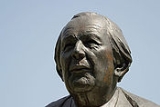
Jean Piaget

 
Jean Piaget

   Email Print
   Bookmark   Link


Jean Piaget


Jean Piaget (9 August 1896 – 16 September 1980) was a Swiss
Switzerland

Switzerland is a landlocked Swiss Alps country of roughly 7.7 million people in Western Europe with an area of 41,285 km?. Switzerland is a federal republic consisting of 26 states called Cantons of Switzerland....
 philosopher
Philosophy

Philosophy is the study of general problems concerning matters such as existence, knowledge, truth, beauty, justice, validity, mind, and language....
 and natural scientist
Natural science

In science, the term natural science refers to a methodological naturalism approach to the study of the universe, which is understood as obeying rules or law of nature origin....
,well known for his work studying children, his theory of cognitive development
Theory of cognitive development

The Theory of Cognitive Development, first developed by Jean Piaget, proposes that there are four distinct, increasingly sophisticated stages of mental representation that children pass through on their way to an adult level of intelligence....
 and for his epistemological view called "genetic epistemology
Genetic epistemology

Genetic epistemology is a study of the origins of knowledge , which was established by Jean Piaget.The goal of genetic epistemology is to link the validity of knowledge to the model of its construction....
."

The very great importance he attached to the education of children made him declare in 1934 in his role as Director of the International Bureau of Education that ‘only education is capable of saving our societies from possible collapse, whether violent, or gradual’.

In 1955 he created the International Centre for Genetic Epistemology
Epistemology

Epistemology or theory of knowledge is the branch of philosophy concerned with the nature and scope of knowledge. It addresses the questions:...
 in Geneva
Geneva

Geneva is the second-most-populous city in Switzerland and is the most populous city of Romandie . Situated where the Rh?ne River exits Lake Geneva , it is the capital of the Canton of Geneva....
 and directed it until 1980.


Discussion
Ask a question about 'Jean Piaget'
Start a new discussion about 'Jean Piaget'
Answer questions from other users
Full Discussion Forum


Recent Posts


Encyclopedia


Jean Piaget (9 August 1896 – 16 September 1980) was a Swiss
Switzerland

Switzerland is a landlocked Swiss Alps country of roughly 7.7 million people in Western Europe with an area of 41,285 km?. Switzerland is a federal republic consisting of 26 states called Cantons of Switzerland....
 philosopher
Philosophy

Philosophy is the study of general problems concerning matters such as existence, knowledge, truth, beauty, justice, validity, mind, and language....
 and natural scientist
Natural science

In science, the term natural science refers to a methodological naturalism approach to the study of the universe, which is understood as obeying rules or law of nature origin....
,well known for his work studying children, his theory of cognitive development
Theory of cognitive development

The Theory of Cognitive Development, first developed by Jean Piaget, proposes that there are four distinct, increasingly sophisticated stages of mental representation that children pass through on their way to an adult level of intelligence....
 and for his epistemological view called "genetic epistemology
Genetic epistemology

Genetic epistemology is a study of the origins of knowledge , which was established by Jean Piaget.The goal of genetic epistemology is to link the validity of knowledge to the model of its construction....
."

The very great importance he attached to the education of children made him declare in 1934 in his role as Director of the International Bureau of Education that ‘only education is capable of saving our societies from possible collapse, whether violent, or gradual’.

In 1955 he created the International Centre for Genetic Epistemology
Epistemology

Epistemology or theory of knowledge is the branch of philosophy concerned with the nature and scope of knowledge. It addresses the questions:...
 in Geneva
Geneva

Geneva is the second-most-populous city in Switzerland and is the most populous city of Romandie . Situated where the Rh?ne River exits Lake Geneva , it is the capital of the Canton of Geneva....
 and directed it until 1980. According to Ernst von Glasersfeld
Ernst von Glasersfeld

Ernst von Glasersfeld is a philosopher, a cybernetics and is Emeritus Professor of Psychology at the University of Georgia, Research Associate at the Scientific Reasoning Research Institute, and Adjunct Professor in the Department of Psychology at the University of Massachusetts, Amherst, Massachusetts....
, Jean Piaget is "the great pioneer of the constructivist theory of knowing
Constructivist epistemology

Constructivist epistemology is an epistemology perspective in philosophy about the nature of scientific knowledge held by many philosophers of science....
."

Biography

Piaget was born in 1896 in Neuchâtel
Neuchâtel

Neuch?tel is the Capital of the Swiss Cantons of Switzerland of Neuch?tel on Lake Neuch?tel.The city has approximately 31,500 inhabitants , by and large French-speaking, although the city is sometimes referred to historically by the German language name , which has the same meaning, since Prussia ruled the area until 1848....
 in the French-speaking
French language

French is a Romance language spoken around the world by around 80 million people as first language, by 190 million as second language, and by about another 200 million people as an acquired tongue, with significant speakers in 54 countries....
 part of Switzerland. His father, Arthur Piaget, was a professor of medieval literature
Medieval literature

Medieval literature is a broad subject, encompassing essentially all written works available in Europe beyond and during the Middle Ages . The literature of this time was composed of religious writings as well as secular works....
 at the University of Neuchâtel. Piaget was a precocious child who developed an interest in biology and the natural world, particularly molluscs, and even published a number of papers before he graduated from high school. He published his first scientific paper at the age of ten. Over the course of his career, Piaget wrote more than sixty books and several two articles.

Piaget received a Ph.D
Doctor of Philosophy

Doctor of Philosophy, abbreviated Ph.D. or PhD for the Latin , meaning "teacher of philosophy", is an postgraduate academic degree awarded by University....
. in natural science from the University of Neuchâtel
University of Neuchâtel

At a glance An annual budget of CHF 120 millions. An annual research fund of CHF 40 millions. Approximately 4,000 students, including 500 PhD students....
, and also studied briefly at the University of Zürich. During this time, he published two philosophical papers which showed the direction of his thinking at the time, but which he later dismissed as adolescent sex. His interest in psychoanalysis
Psychoanalysis

Psychoanalysis is a body of ideas developed by Austrian physician Sigmund Freud and his followers, which is devoted to the study of human psychological functioning and behaviour....
, a strain of psychological thought burgeoning at that time, can also be dated to this period. He then moved from Switzerland to Paris, France, where he taught at the Grange-Aux-Belles street school for boys run by Alfred Binet
Alfred Binet

Alfred Binet , France psychologist and inventor of the first usable intelligence test, the basis of today's IQ test. His principal goal was to identify students who needed special help in coping with the school curriculum....
, the developer of the Binet intelligence test. It was while he was helping to mark some instances of these intelligence tests that Piaget noticed that young children consistently gave wrong answers to certain questions. Piaget did not focus so much on the fact of the children's answers being wrong, but that young children kept making the same pattern of mistakes that older children and adults did not. This led him to the theory that young children's thought or cognitive processes are inherently different from those of adults. (Ultimately, he was to propose a global theory of developmental stages stating that individuals exhibit certain distinctive common patterns of cognition in each period in their development.) In 1921, Piaget returned to Switzerland as director of the Rousseau Institute
Rousseau Institute

Rousseau Institute is a private school in Geneva, Switzerland. In 1912, ?douard Clapar?de created an institute to turn educational theory into a science....
 in Geneva
Geneva

Geneva is the second-most-populous city in Switzerland and is the most populous city of Romandie . Situated where the Rh?ne River exits Lake Geneva , it is the capital of the Canton of Geneva....
.

In 1923, he married Valentine Châtenay, one of his students; together, the couple had three children, whom Piaget studied from infancy. In 1929, Jean Piaget accepted the post of Director of the International Bureau of Education and remained the head of this international organization until 1968. Every year, he drafted his “Director's Speeches” for the IBE Council and for the International Conference on Public Education in which he explicitly expressed his educational credo.

Theoretical work


The stages of cognitive development

Piaget's 'Four levels of development' are (1) infancy, (2) preschool, (3) childhood, and (4) adolescence. Each stage is characterized by a general cognitive structure that affects all of the child's thinking (a structuralist view influenced by philosopher Immanuel Kant
Immanuel Kant

Immanuel Kant was an 18th-century German Philosophy from the Kingdom of Prussia city of K?nigsberg . He is regarded as one of the most influential thinkers of modern Europe and of the late Age of Enlightenment....
). Each stage represents the child's understanding of reality during that period, and each but the last is an inadequate approximation of reality. Development from one stage to the next is thus caused by the accumulation of errors in the child's understanding of the environment; this accumulation eventually causes such a degree of cognitive disequilibrium that thought structures require reorganizing.

The four development stages are described in Piaget's theory as:

  1. Sensorimotor stage
    Theory of cognitive development

    The Theory of Cognitive Development, first developed by Jean Piaget, proposes that there are four distinct, increasingly sophisticated stages of mental representation that children pass through on their way to an adult level of intelligence....
    : from birth to age 2. Children experience the world through movement and senses (use five senses to explore the world). During the sensorimotor stage children are extremely egocentric, meaning they cannot perceive the world from others viewpoints and explore using senses. The sensorimotor stage is divided into six substages: "(1) simple reflexes; (2) first habits and primary circular reactions; (3) secondary circular reactions; (4) coordination of secondary circular reactions; (5) tertiary circular reactions, novelty, and curiosity; and (6) internalization of schemes."

    Simple reflexes is from birth to 1 month old. At this time infants use reflexes such as rooting and sucking.

    First habits and primary circular reactions is from 1 month to 4 months old. During this time infants learn to coordinate sensation and two types of scheme (habit and circular reactions). A primary circular reaction is when the infant tries to reproduce an event that happened by accident (ex: sucking thumb).

    The third stage, secondary circular reactions, occurs when the infant is 4 to 8 months old. At this time they become aware of things beyond their own body; they are more object oriented. At this time they might accidentally shake a rattle and continue to do it for sake of satisfaction.

    Coordination of secondary circular reactions is from 8 months to 12 months old. During this stage they can do things intentionally. They can now combine and recombine schemes and try to reach a goal (ex: use a stick to reach something). They also understand object permanence during this stage. That is, they understand that objects continue to exist even when they can't see them.

    The fifth stage occurs from 12 months old to 18 months old. During this stage infants explore new possibilities of objects; they try different things to get different results.

    During the last stage they are 18 to 24 months old. During this stage they shift to symbolic thinking.


  2. Preoperational stage
    Theory of cognitive development

    The Theory of Cognitive Development, first developed by Jean Piaget, proposes that there are four distinct, increasingly sophisticated stages of mental representation that children pass through on their way to an adult level of intelligence....
    : from ages 2 to 5 (magical thinking predominates. Acquisition of motor skills) Egocentricism begins strongly and then weakens. Children cannot conserve or use logical thinking.


  3. Concrete operational stage
    Theory of cognitive development

    The Theory of Cognitive Development, first developed by Jean Piaget, proposes that there are four distinct, increasingly sophisticated stages of mental representation that children pass through on their way to an adult level of intelligence....
    : from ages 5 to 11 (children begin to think logically but are not very concrete in their thinking) Children can now conserve and think logically but only with practical aids. They are no longer egocentric.


  4. Formal operational stage
    Theory of cognitive development

    The Theory of Cognitive Development, first developed by Jean Piaget, proposes that there are four distinct, increasingly sophisticated stages of mental representation that children pass through on their way to an adult level of intelligence....
    : after age 11 (development of abstract reasoning). Children develop abstract thought and can easily conserve and think logically in their mind.


The developmental process


Piaget provided no concise description of the development process as a whole. Broadly speaking it consisted of a cycle:

  • The child performs an action which has an effect on or organizes objects, and the child is able to note the characteristics of the action and its effects.
  • Through repeated actions, perhaps with variations or in different contexts or on different kinds of objects, the child is able to differentiate and integrate its elements and effects. This is the process of "reflecting abstraction" (described in detail in Piaget 2001).
  • At the same time, the child is able to identify the properties of objects by the way different kinds of action affect them. This is the process of "empirical abstraction".
  • By repeating this process across a wide range of objects and actions, the child establishes a new level of knowledge and insight. This is the process of forming a new "cognitive stage". This dual process allows the child to construct new ways of dealing with objects and new knowledge about objects themselves.
  • However, once the child has constructed these new kinds of knowledge, he or she starts to use them to create still more complex objects and to carry out still more complex actions. As a result, the child starts to recognize still more complex patterns and to construct still more complex objects. Thus a new stage begins, which will only be completed when all the child's activity and experience have been re-organized on this still higher level.


This process is not wholly gradual, however. Once a new level of organization, knowledge and insight proves to be effective, it will quickly be generalized to other areas. As a result, transitions between stages tend to be rapid and radical, and the bulk of the time spent in a new stage consists of refining this new cognitive level. When the knowledge that has been gained at one stage of study and experience leads rapidly and radically to a new higher stage of insight, a gestalt
Gestalt

Die Gestalt is a German language word for form or shape. It is used in English to refer to a concept of 'wholeness' . Gestalt may also refer to:...
 is said to have occurred.

It is because this process takes this dialectic
Dialectic

Dialectic is a method of argument, which has been central to both Eastern and Western philosophy since ancient times. The word "dialectic" originates in Ancient Greece, and was made popular by Plato's Socratic dialogues....
al form, in which each new stage is created through the further differentiation, integration, and synthesis of new structures out of the old, that the sequence of cognitive stages are logically necessary rather than simply empirically correct. Each new stage emerges only because the child can take for granted the achievements of its predecessors, and yet there are still more sophisticated forms of knowledge and action that are capable of being developed.

Because it covers both how we gain knowledge about objects and our reflections on our own actions, Piaget's model of development explains a number of features of human knowledge that had never previously been accounted for. For example, by showing how children progressively enrich their understanding of things by acting on and reflecting on the effects of their own previous knowledge, they are able to organize their knowledge in increasingly complex structures. Thus, once a young child can consistently and accurately recognize different kinds of animals, he or she then acquires the ability to organize the different kinds into higher groupings such as "birds", "fish", and so on. This is significant because they are now able to know things about a new animal simply on the basis of the fact that it is a bird – for example, that it will lay eggs.

At the same time, by reflecting on their own actions, the child develops an increasingly sophisticated awareness of the "rules" that govern in various ways. For example, it is by this route that Piaget explains this child's growing awareness of notions such as "right", "valid", "necessary", "proper", and so on. In other words, it is through the process of objectification
Objectification

Objectification is the process by which abstract concepts are treated as if they were concrete things or physical objects. In this sense the term is synonym to reification....
, reflection
Reflection

Reflection or reflexion may refer to:...
 and abstraction
Abstraction

Abstraction is the process or result of generalization by reducing the information content of a concept or an observable phenomenon, typically in order to retain only information which is relevant for a particular purpose....
 that the child constructs the principles on which action is not only effective or correct but also justified.

One of Piaget's most famous studies focused purely on the discriminative abilities of children between the ages of two and a half years old, and four and a half years old. He began the study by taking children of different ages and placing two lines of sweets, one with the sweets in a line spread further apart, and one with the same number of sweets in a line placed more closely together. He found that, “Children between 2 years, 6 months old and 3 years, 2 months old correctly discriminate the relative number of objects in two rows; between 3 years, 2 months and 4 years, 6 months they indicate a longer row with fewer objects to have "more"; after 4 years, 6 months they again discriminate correctly” (Cognitive Capacity of Very Young Children, p. 141). Initially younger children were not studied, because if at four years old a child could not conserve quantity, then a younger child presumably could not either. The results show however that children that are younger than three years and two months have quantity conservation, but as they get older they lose this quality, and do not recover it until four and a half years old. This attribute may be lost due to a temporary inability to solve because of an overdependence on perceptual strategies, which correlates more candy with a longer line of candy, or due to the inability for a four year old to reverse situations.

By the end of this experiment several results were found. First, younger children have a discriminative ability that shows the logical capacity for cognitive operations exists earlier than acknowledged. This study also reveals that young children can be equipped with certain qualities for cognitive operations, depending on how logical the structure of the task is. Research also shows that children develop explicit understanding at age 5 and as a result, the child will count the sweets to decide which has more. Finally the study found that overall quantity conservation is not a basic characteristic of humans' native inheritance.

Challenges

Piaget's theory, however vital in understanding child psychology, did not go without scrutiny. A main figure in the ratification of Piaget's ideas was the Russian psychologist Lev Vygotsky
Lev Vygotsky

Lev Semenovich Vygotsky was a Russian Jewish developmental psychology and the founder of cultural-historical psychology....
. Vygotsky stressed the importance of a child's cultural background as an effect to the stages of development. Because different cultures stress different social interactions, this challenged Piaget's theory that the hierarchy of learning development had to develop in succession. Vygotsky introduced the term Zone of proximal development
Zone of proximal development

The zone of proximal development , often abbreviated ZPD, is the difference between what a learner can do without help and what he or she can do with help....
 as an overall task a child would have to develop that would be too difficult to develop alone.

Genetic epistemology

According to Jean Piaget, genetic epistemology "attempts to explain knowledge, and in particular scientific knowledge, on the basis of its history, its sociogenesis, and especially the psychological origins of the notions and operations upon which it is based"[5]. Piaget believed he could test epistemological questions by studying the development of thought and action in children. As a result Piaget created a field known as genetic epistemology with its own methods and problems. He defined this field as the study of child development as a means of answering epistemological questions. His exploration of genetic epistemology is divided into four different stages: (1) the sociological model of development, (2) the biological model of intellectual development, (3) the elaboration of the logical model of intellectual development, and (4) the study of figurative thought.

Stage 1: The Sociological Model of Development

•Piaget first developed this stage in the 1920’s. He investigated the hidden side of children’s minds. Piaget proposed that children moved from a position of egocentrism to sociocentrism. For this explanation he combined the use of psychological and clinical methods to create what he called a semiclinical interview. He began the interview by asking children standardized questions and depending on how they answered, he would ask them a series of nonstandard questions. Piaget was looking for what he called “spontaneous conviction” so he often asked questions the children neither expected nor anticipated. In his studies, he noticed there was a gradual progression from intuitive to scientific and socially acceptable responses. Piaget theorized children did this because of the social interaction and the challenge to younger children’s ideas by the ideas of those children who were more advanced.

Stage 2: The Biological Model of Intellectual Development

•In this stage, Piaget described intelligence as having two closely interrelated parts. The first part, which is from the first stage, was the content of children’s thinking. The second part was the process of intellectual activity. He believed this process of thinking could be regarded as an extension of the biological process of adaptation. Adaptation has two pieces: assimilation and accommodation. To test his theory, Piaget observed the habits in his own children. He argued infants were engaging in an act of assimilation when they sucked on everything in their reach. He claimed infants transform all objects into an object to be sucked. The children were assimilating the objects to conform to their own mental structures. Piaget then made the assumption whenever one transforms the world to meet individual needs or conceptions; one is, in a way, assimilating it. Piaget also observed his children not only assimilating objects to fit their needs, but also modifying some of their mental structures to meet the demands of the environment. This is the second division of adaption known as accommodation. To start out, the infants only engaged in primarily reflex actions such as sucking, but not long after, they would pick up actual objects and put them in their mouths. When they do this, they modify their reflex response to accommodate the external objects into reflex actions. Because the two are often in conflict, they provide the impetus for intellectual development. The constant need to balance the two; triggers intellectual growth.

Stage 3: The Elaboration of the Logical Model of Intellectual Development •In the model Piaget developed in stage three, he argued the idea that intelligence develops in a series of stages that are related to age and are progressive because one stage must be accomplished before the next can occur. For each stage of development the child forms a view of reality for that age period. At the next stage, the child must keep up with earlier level of mental abilities to reconstruct concepts. Piaget concluded intellectual development as an upward expanding spiral in which children must constantly reconstruct the ideas formed at earlier levels with new, higher order concepts acquired at the next level.

Stage 4: The Study of Figurative thought

•Piaget studied areas of intelligence like perception and memory that aren’t entirely logical. Logical concepts are described as being completely reversible because they can always get back to the starting point. The perceptual concepts Piaget studied could not be manipulated. To describe the figurative process, Piaget uses pictures as examples. Pictures can’t be separated because contours cannot be separated from the forms they outline. Memory is the same way. It is never completely reversible. During this last period of work, Piaget and his colleague Inhelder also published books on perception, memory, and other figurative processes such as learning during this last period.

Recently, Jonathan Tsou argued that Piaget's later epistemological works could serve as a remedy for the flaws in Thomas Kuhn's theory of scientific revolutions. However, this criticism missed some of the history between them, as well as the existence of a "lost manuscript" by Kuhn (currently held at the University of Chicago
University of Chicago

The University of Chicago is a private university located principally in the Hyde Park, Chicago neighborhood of Chicago. Although an older university by the same name existed prior to its founding, the modern University of Chicago credits its founding to the oil magnate John D....
) that was to address his critics' concerns. It is noted, however, that the implications of his later work remain largely unexamined.

The physical microstructure of “schemes”

In his “Biology and Knowledge” (1967+ / French 1965), Piaget tentatively hinted at possible physical embodiments for his abstract “scheme” entities. At the time, there was much talk and research about RNA as such an agent of learning, and Piaget considered some of the evidence. However he did not offer any firm conclusions, and confessed that this was beyond his area of expertise.

Piaget died in 1980, and by then the RNA theory had lost its appeal. One key reason was this: Until recently, nearly all RNA was assumed to be wholly devoted to producing protein; and such protein did not fit in with the evidence about learning. However in about 2000 it became clear that only about 3% of RNA was thus employed, and the remaining “non-coding” RNA (ncRNA) — the 97% — was thus available for other tasks, including possible embodiments of Piaget’s “scheme” elements. (Traill, 2005b / 2008).

It has still not been established that this ncRNA scheme-basis is true. (There are methodological and other problems (Traill, 2000)). However some interesting theoretical advances have been made possible because of that theoretical development, including some unexpected explanations in various disciplines. In particular such molecular encoding easily explains: (i) the inheritance of stereotyped behavioural traits (capable of later modification or re-configuration); and (ii) Piagetian/Darwinian trial-and-error amongst massive populations of such entities.

It also implies the need for a significant amount of organized short-range infra-red activity, and that also yields some unexpected explanations in its own right. E.g. (iii) it possibly accounts for an anomaly in the capability of the optic nerve — which appears to carry much more information than it seems capable of (judged in terms of traditional mechanisms alone). See optic nerve
Optic nerve

The optic nerve, also called cranial nerve II, transmits visual information from the retina to the brain....
, appendix. — And (iv) it seems likely to explain the century-old mystery of how myelin geometry is controlled. (Traill, 2005a).

Influence

Despite ceasing to be a fashionable psychologist
Psychologist

"Psychologist" is an academic, occupational or professional title describing individuals who are either: * social scientists conducting research and/or teaching psychology in a college or university;...
, the magnitude of Piaget's continuing influence can be measured by the global scale and activity of the Jean Piaget Society, which holds annual conferences and attracts very large numbers of participants. His theory of cognitive development
Theory of cognitive development

The Theory of Cognitive Development, first developed by Jean Piaget, proposes that there are four distinct, increasingly sophisticated stages of mental representation that children pass through on their way to an adult level of intelligence....
 has proved influential in many different areas:

  • Developmental psychology
    Developmental psychology

    Developmental psychology, also known as human development, is the science study of systematic psychology changes that occur in human beings over the course of the life span....
  • Education
    Education

    File:Inukshuk Monterrey 1.jpgEducation can be seen as a product or a process and considered in a broad sense or a technical sense. According to philosophy of education George F....
     and Morality
    Morality

    Morality has three principal meanings.In its first, descriptive usage, morality means a code of conduct which is held to be authoritative in matters of right and wrong....
  • Historical studies of thought and cognition
  • Evolution
    Evolution

    In biology, evolution is change in the heritability trait of a population of organisms from one generation to the next. These changes are caused by a combination of three main processes: variation, reproduction, and selection....
  • Philosophy
    Philosophy

    Philosophy is the study of general problems concerning matters such as existence, knowledge, truth, beauty, justice, validity, mind, and language....
  • Primatology
    Primatology

    Primatology is the study of primates. It is a diverse discipline and primatologists can be found in departments of biology, anthropology, psychology and many others....
  • Artificial Intelligence (AI)


Developmental psychology

Piaget is without doubt one of the most influential developmental psychologists, influencing not only the work of Lev Vygotsky
Lev Vygotsky

Lev Semenovich Vygotsky was a Russian Jewish developmental psychology and the founder of cultural-historical psychology....
 and of Lawrence Kohlberg
Lawrence Kohlberg

Lawrence Kohlberg was an United States psychology born in Bronxville, New York, who served as a professor at the University of Chicago, as well as Harvard University....
 but whole generations of eminent academics. Although subjecting his ideas to massive scrutiny led to innumerable improvements and qualifications of his original model and the emergence of a plethora of neo-Piagetian and post-Piagetian variants, Piaget's original model has proved to be remarkably robust (Lourenço and Machado 1996).

Education and development of morality

During the 1970s and 1980s, Piaget's works also inspired the transformation of European and American education
Education

File:Inukshuk Monterrey 1.jpgEducation can be seen as a product or a process and considered in a broad sense or a technical sense. According to philosophy of education George F....
, including both theory and practice, leading to a more ‘child-centred’ approach. In Conversations with Jean Piaget, he says: "Education, for most people, means trying to lead the child to resemble the typical adult of his society . . . but for me and no one else, education means making creators. . . . You have to make inventors, innovators—not conformists" (Bringuier, 1980, p.132).

Mainly, Piaget influenced two parts of education: early education and moral education.

In early education, teachers use his theory of cognitive development as a tool in the classroom. According to Piaget, children developed best in a classroom with interaction. Using this idea, teachers in elementary schools or pre-school can make use of classroom time better using peer interaction.

In moral education, Piaget believed in two basic principles. The first one is the fact that children develop moral ideas in stages. The other is that children make their idea of the world: "The child is someone who constructs his own moral world view, who forms ideas about right and wrong, and fair and unfair, that are not the direct product of adult teaching and that are often maintained in the face of adult wishes to the contrary" (Gallagher, 1978, p.26). The idea is that children observe the world, and then decide what is morally correct. So in today's education, we have started to bring moral education into education, such as talking about cheating and what is morally correct in today's society, dealing with crime and morals in politics.

Piaget's theory of morality was radical in 1932 when his book, The Moral Judgment of the Child, was published, due to his use of philosophical criteria to define morality (as universalizable, generalizable, and obligatory), and his rejection of equating cultural norms and moral norms. Piaget, drawing on Kantian theory, proposed that morality developed out of peer interaction, and that it was autonomous from authority mandates. Peers, not parents, were a key source of moral concepts, such as equality, reciprocity, and justice.

In his account of the development of moral judgment Piaget (1932) introduced a fundamental distinction between different types of social relationship, or more specifically he attributed different types of psychosocial processes to different forms of social relationship. Where there is constraint because one participant holds more power than the other the relationship is asymmetrical, and, importantly, the knowledge that can be acquired by the dominated participant takes on a fixed and inflexible form. Piaget refers to this process as one of social transmission, and he refers to the way in which the elders of a tribe initiate younger members into the patterns of beliefs and practices of the group. Similarly where adults exercise a dominating influence over the growing child, it is through social transmission that children can acquire knowledge. By contrast, in cooperative relations, power is more evenly distributed between participants so that a more symmetrical relationship emerges. Under these conditions authentic forms of intellectual exchange become possible, since each partner has the freedom to project his or her own thoughts, consider the positions of others, and defend his or her own point of view. In such circumstances, where children’s thinking is not limited by a dominant influence, the conditions exist for the emergence of constructive solutions to problems, or what Piaget refers to as the reconstruction of knowledge rather than social transmission. Here the knowledge that emerges is open, flexible and regulated by the logic of argument rather than being determined by an external authority. In short, cooperative relations provide the arena for the emergence of operations, which for Piaget requires the absence of any constraining influence, and is most often illustrated by the relations that form between peers (for more on the importance of this distinction see Duveen & Psaltis, in press; Psaltis & Duveen, 2006,2007).

Historical studies of thought and cognition

Historical changes of thought have been modeled in Piagetian terms. Broadly speaking these models have mapped changes in morality, intellectual life and cognitive levels against historical changes (typically in the complexity of social systems).

Notable examples include:

  • Michael Horace Barnes' study of the co-evolution of religious and scientific thinking
  • Peter Damerow's theory of prehistoric and archaic thought
  • Kieran Egan's stages of understanding
    The Educated Mind

    The Educated Mind : How Cognitive Tools Shape Our Understanding is a 1997 book on Philosophy of education by Kieran Egan ....
  • James W. Fowler
    James W. Fowler

    Dr. James W. Fowler III, Charles Howard Candler Professor of Theology and Human Development at Emory University, was director of both the Center for Research on Faith and Moral Development and the Center for Ethics until he retired in 2005....
    's stages of faith development
    Stages of faith development

    A series of stages of faith development was proposed by Professor James W. Fowler, a developmental psychologist at Candler School of Theology, in the book Stages of Faith....
  • Suzy Gablik's stages of art history
  • Christopher Hallpike's studies of changes in cognition and moral judgment in pre-historical, archaic and classical periods ...(Hallpike 1979, 2004)
  • Lawrence Kohlberg
    Lawrence Kohlberg

    Lawrence Kohlberg was an United States psychology born in Bronxville, New York, who served as a professor at the University of Chicago, as well as Harvard University....
    's stages of moral development
    Kohlberg's stages of moral development

    Kohlberg's stages of moral development constitute the main feature of a psychological theory originally conceived by Lawrence Kohlberg while a psychology postgraduate student at the University of Chicago and developed throughout the course of his life....
  • Don Lepan's theory of the origins of modern thought and drama
  • Charles Radding's theory of the medieval intellectual development
  • Jurgen Habermas's reworking of historical materialism
    Historical materialism

    Historical materialism is a methodological approach to the study of society, economics, and history, first articulated by Karl Marx . Marx himself never used the term but referred to his approach as "the materialist conception of history."...
    .


Non human development

Neo-Piagetian stages have been applied to the maximum stage attained by various animals. For example spider
Spider

Spiders are air-breathing chelicerate arthropods that have eight legs, and chelicerae modified into fangs that inject venom. In their bodies the usual arthropod segments are fused into two Tagma , the cephalothorax and abdomen, joined by a small, cylindrical pedicel....
s attain the circular sensory motor stage, coordinating actions and perceptions. Pigeons attain the sensory motor stage, forming concepts.

Origins

The origins of human intelligence have also been studied in Piagetian terms. Wynn (1979, 1981) analysed Acheulian and Oldowan tools in terms of the insight into spatial relationships required to create each kind. On a more general level, Robinson's (2005) suggests a large-scale model for the emergence of a Piagetian intelligence.

Primatology

Piaget's models of cognition have also been applied outside the human sphere, and some primatologists assess the development and abilities of primates in terms of Piaget's model.

Philosophy

Some have taken account of Piaget's work. For example, the philosopher and social theorist Jürgen Habermas
Jürgen Habermas

J?rgen Habermas is a Germany philosopher and sociologist in the tradition of critical theory and American pragmatism. He is perhaps best known for his work on the concept of the public sphere, the topic of his first book....
 has incorporated Piaget into his work, most notably in The Theory of Communicative Action
The Theory of Communicative Action

The Theory of Communicative Action is a book by J?rgen Habermas published in 1981 in two volumes, the first subtitled Reason and the Rationalization of Society and the second, Lifeworld and System: A Critique of Functionalist Reason ....
.
The philosopher Thomas Kuhn credited Piaget's work in helping him understand the transition between modes of thought which characterized his theory of paradigm shift
Paradigm shift

Paradigm shift is the term first used by Thomas Samuel Kuhn in his influential book The Structure of Scientific Revolutions to describe a change in basic assumptions within the ruling theory of science....
s. Shortly before his death (September, 1980), Piaget was involved in a debate about the relationships between innate and acquired features of language, at the Centre Royaumont pour une Science de l'Homme, where he discussed his point of view with the linguist Noam Chomsky
Noam Chomsky

Avram Noam Chomsky is an United States linguistics, philosopher, cognitive science, political activist, author, and lecturer. He is an Institute Professor emeritus and professor emeritus of linguistics at the Massachusetts Institute of Technology....
 as well as Hilary Putnam
Hilary Putnam

Hilary Whitehall Putnam is an American philosopher who has been a central figure in analytic philosophy since the 1960s, especially in philosophy of mind, philosophy of language, and philosophy of science....
 and Stephen Toulmin
Stephen Toulmin

Stephen Edelston Toulmin is a United Kingdom philosopher, author, and educator. Influenced by the Austrian philosopher Ludwig Wittgenstein, Toulmin devoted his works to the analysis of ethics....
.

Artificial intelligence

Piaget also had a considerable effect in the field of computer science
Computer science

Computer science is the study of the theoretical foundations of information and computation, and of practical techniques for their implementation and application in computer systems....
 and artificial intelligence
Artificial intelligence

Artificial intelligence is the intelligence of machines and the branch of computer science which aims to create it. Major AI textbooks define the field as "the study and design of intelligent agents,"...
. Seymour Papert
Seymour Papert

Seymour Papert is an Massachusetts Institute of Technology mathematician, computer science, and education. He is one of the pioneers of artificial intelligence, as well as an inventor of the Logo ....
 used Piaget's work while developing the Logo programming language. Alan Kay
Alan Kay

Alan Curtis Kay is an United States computer scientist, known for his early pioneering work on object-oriented programming and Window graphical user interface design....
 used Piaget's theories as the basis for the Dynabook
Dynabook

The Dynabook concept was created by Alan Kay in 1968, two years before the founding of Xerox PARC. Kay wanted to make ?A Personal Computer For Children Of All Ages.? The ideas led to the development of the Xerox Alto prototype, which was originally called ?the interim Dynabook?....
 programming system concept, which was first discussed within the confines of the Xerox Palo Alto Research Center, or Xerox PARC
Xerox PARC

PARC , formerly Xerox PARC, is a research and development company in Palo Alto, California with a distinguished reputation for its contributions to information technology....
. These discussions led to the development of the Alto prototype, which explored for the first time all the elements of the graphical user interface
Graphical user interface

A graphical user interface is a type of user interface which allows people to human-computer interaction such as computers; hand-held devices such as MP3 Players, Portable Media Players or Gaming devices; household appliances and office equipment....
 (GUI), and influenced the creation of user interfaces in the 1980s and beyond.

Major works and achievements


Major works

  • Piaget, J. (1950). Introduction à l’Épistémologie Génétique. Paris: Presses Universitaires de France.
  • Piaget, J. (1961). La psychologie de l'intelligence. Paris: Armand Colin (1961, 1967, 1991).
  • Piaget, J. (1967). Logique et Connaissance scientifique, Encyclopédie de la Pléiade.
  • Inhelder, B. and J. Piaget (1958). The Growth of Logical Thinking from Childhood to Adolescence. New York: Basic Books.
  • Inhelder, B. and Piaget, J. (1964). The Early Growth of Logic in the Child: Classification and Seriation. London: Routledge and Kegan Paul.
  • Piaget, J. (1928). The Child's Conception of the World. London: Routledge and Kegan Paul.
  • Piaget, J. (1932). The Moral Judgment of the Child. London: Kegan Paul, Trench, Trubner and Co.
  • Piaget, J. (1952). The Child's Conception of Number. London: Routledge and Kegan Paul.
  • Piaget, J. (1953). The Origins of Intelligence in Children. London: Routledge and Kegan Paul.
  • Piaget, J. (1955). The Child's Construction of Reality. London: Routledge and Kegan Paul.
  • Piaget, J. (1971). Biology and Knowledge. Chicago: University of Chicago Press.
  • Piaget, J. (1995). Sociological Studies. London: Routledge.
  • Piaget, J. (2001). Studies in Reflecting Abstraction. Hove, UK: Psychology Press.


Other works

  • Beth, E. W., and Piaget, J. (1966). Mathematical Epistemology and Psychology. Dordrecht: D. Reidel.
  • Piaget, J. (1942). Les trois structures fondamentales de la vie psychique: rythme, régulation et groupement. Rev. Suisse de Psychologie Appliquée, 1/2 9–21.
  • Piaget, J. (1948). Où va l’éducation? UNESCO.
  • Piaget, J. (1951). Psychology of Intelligence. London: Routledge and Kegan Paul


  • Piaget, J. (1953). Logic and Psychology. Manchester: Manchester University Press.
  • Piaget, J., Beth, E.W., Dieudonné, J., Lichnerowicz, A., Choquet, G., Gattegno, C. (1955). L'enseignement des mathématiques, Neuchâtel: Delachaux & Niestlé.
  • Piaget, J. (1962). Play, Dreams and Imitation in Childhood. New York: Norton.
  • Piaget, J. (1966). Nécessité et signification des recherches comparatives en psychologie génétique. Journal International de Psychologie, 1 (1): 3-13.
  • Piaget, J. (1970). Structuralism. New York: Harper & Row.
  • Piaget, J. (1972). Psychology and Epistemology: Towards a Theory of Knowledge. Harmondsworth: Penguin.
  • Piaget, J. (1972). Insights and Illusions of Philosophy. London: Routledge and Kegan Paul.
  • Piaget, J. (1974). Experiments in Contradiction. Chicago: University of Chicago Press.
  • Piaget, J. (1974). The Place of the Sciences of Man in the System of Sciences. New York: Harper and Row, Publishers.
  • Piaget, J. (1975). The Origin of the Idea of Chance in Children. London: Routledge and Kegan Paul.
  • Piaget, J. (1977). The Grasp of Consciousness. London: Routledge and Kegan Paul.
  • Piaget, J. (1978). Success and Understanding. London: Routledge and Kegan Paul.
  • Piaget, J. (1979). Behaviour and Evolution. London: Routledge and Kegan Paul.
  • Piaget, J. (1980). Adaptation and Intelligence. London: University of Chicago Press.
  • Piaget, J. (1980). Les Formes Élémentaires de la Dialectique. Paris, Editions Gallimard.
  • Piaget, J. (1981). Intelligence and Affectivity. Their Relationship during Child Development. Palo Alto: Annual Reviews.
  • Piaget, J. (1983). Piaget's theory. In P. Mussen (ed.). Handbook of Child Psychology. 4th edition. Vol. 1. New York: Wiley.
  • Piaget, J. (1985). The Equilibration of Cognitive Structures: The Central Problem of Intellectual Development. Chicago: University of Chicago Press.
  • Piaget, J. (1987). Possibility and Necessity. 2 vols. Minneapolis: University of Minnesota Press.
  • Piaget, J. (2000). Commentary on Vygotsky. New Ideas in Psychology, 18, 241-59.
  • Piaget, J., and Garcia, R. (1989). Psychogenesis and the History of Science. New York: Columbia University Press.
  • Piaget, J., and Garcia, R. (1991). Towards a Logic of Meanings. Hillsdale, N.J.: Lawrence Erlbaum Associates.
  • Piaget, J., and Inhelder, B. (1962). The Psychology of the Child. New York: Basic Books.
  • Piaget, J., and Inhelder, B. (1967). The Child's Conception of Space. New York: W.W. Norton.


Appointments

  • 1921-25 Research Director, Institut Jean-Jacques Rousseau, Geneva
  • 1925-29 Professor of Psychology, Sociology and the Philosophy of Science, University of Neuchatel
  • 1929-39 Professor of the History of Scientific Thought, University of Geneva
  • 1929-67 Director, International Bureau of Education, Geneva
  • 1932-71 Director, Institute of Educational Sciences, University of Geneva
  • 1938-51 Professor of Experimental Psychology and Sociology, University of Lausanne
  • 1939-51 Professor of Sociology, University of Geneva
  • 1940-71 Professor of Experimental Psychology, University of Geneva
  • 1952-64 Professor of Genetic Psychology, Sorbonne, Paris
  • 1955-80 Director, International Centre for Genetic Epistemology, Geneva
  • 1971-80 Emeritus Professor, University of Geneva


Piagetian and post-Piagetian stage theories

  • Cheryl Armon's stages of reasoning about the good (Armon, 1984)
  • Michael Barnes
    Michael Barnes

    Michael Barnes may refer to:* Michael Barnes , footballer* Michael D. Barnes, U.S. politician* Michael Horace Barnes, Professor of Religious Studies, author of 'Stages of Thought' and 'In the Presence of Mystery'....
    ' historical stages of religious and scientific thinking (Barnes 2000)
  • Michael Commons
    Michael Commons

    Michael Lamport Commons is an American complex systems scientist, who developed the Model of hierarchical complexity, and is founder of the Journal of Adult Development, and co-editor of the journal Terrorism Research....
    ' Model of hierarchical complexity
    Model of hierarchical complexity

    The model of hierarchical complexity, is a framework for scoring how complex a behavior is. It quantifies the order of hierarchy complexity of a task based on mathematical principles of how the information is organized and of information science....
     (Commons,et al. 2008)
  • Peter Damerow's theory of prehistoric and archaic thought (Damerow 1995)
  • Kieran Egan's stages of understanding
    The Educated Mind

    The Educated Mind : How Cognitive Tools Shape Our Understanding is a 1997 book on Philosophy of education by Kieran Egan ....
  • Kurt W. Fischer's dynamic skill theory (Fischer, 1980)
  • James W. Fowler
    James W. Fowler

    Dr. James W. Fowler III, Charles Howard Candler Professor of Theology and Human Development at Emory University, was director of both the Center for Research on Faith and Moral Development and the Center for Ethics until he retired in 2005....
    's stages of faith development
    Stages of faith development

    A series of stages of faith development was proposed by Professor James W. Fowler, a developmental psychologist at Candler School of Theology, in the book Stages of Faith....
  • Christopher Hallpike's historical stages of cognitive moral understanding (Hallpike 1979, 2004)
  • Allen Ivey's developmental counseling and therapy (DCT) (Ivey 1986)
  • Robert Kegan
    Robert Kegan

    Robert Kegan is the William and Miriam Meehan Professor in Adult Learning and Professional Development at Harvard University. Additionally he is the Educational Chair for the Institute for Management and Leadership in Education and the Co-director for the Change Leadership Group....
    's constructive-developmental theory (Kegan 1982)
  • Lawrence Kohlberg
    Lawrence Kohlberg

    Lawrence Kohlberg was an United States psychology born in Bronxville, New York, who served as a professor at the University of Chicago, as well as Harvard University....
    's stages of moral development
    Kohlberg's stages of moral development

    Kohlberg's stages of moral development constitute the main feature of a psychological theory originally conceived by Lawrence Kohlberg while a psychology postgraduate student at the University of Chicago and developed throughout the course of his life....
  • Don Lepan's theory of the origins of modern thought and drama (LePan 1989)
  • Keith S. Lockwood
    Keith S. Lockwood

    Keith S. Lockwood Ph.D. was born in Paterson, New Jersey in 1964 and grew up in Pompton Lakes, New Jersey. He is known for his work as a fierce defender of people who belong to minority cultures and with people who have disabilites and have been economically marginalized....
    's constructivist practice with children who are deaf or hard of hearing (Lockwood 2006)
  • Gablik's stages of art history (Gablik 1977)
  • Charles Radding's theory of the medieval intellectual development (Radding 1985)
  • R.J. Robinson's stages of history (Robinson 2004)
  • Zendra Marie Moore's Theory of color. (Moore 2006)
  • Constance Kamii
    Constance Kamii

    Constance Kamii is a professor of early childhood education at the University of Alabama at Birmingham, Alabama....
    's research and practice on teaching math to young children (Kamii 1985)


Quotations

  • "Intelligence is what you use when you don't know what to do."
  • "Intelligence organizes the world by organizing itself."
  • The principal goal of education in the schools should be creating men and women who are capable of doing new things, not simply repeating what other generations have done.


See also

  • Constructivist epistemology
    Constructivist epistemology

    Constructivist epistemology is an epistemology perspective in philosophy about the nature of scientific knowledge held by many philosophers of science....
  • Developmental psychology
    Developmental psychology

    Developmental psychology, also known as human development, is the science study of systematic psychology changes that occur in human beings over the course of the life span....
  • Kohlberg's stages of moral development
    Kohlberg's stages of moral development

    Kohlberg's stages of moral development constitute the main feature of a psychological theory originally conceived by Lawrence Kohlberg while a psychology postgraduate student at the University of Chicago and developed throughout the course of his life....
  • Inquiry-based learning
    Inquiry-based learning

    Inquiry-based learning or inquiry-based science describes a range of philosophical, curricular and pedagogical approaches to teaching. Its core premises include the requirement that learning should be based around student's questions....
  • Psychosocial development
  • Cognitive acceleration
    Cognitive acceleration

    Cognitive acceleration describes a lesson style originally developed by Michael Shayer and Philip Adey at King's College London which is designed to promote student's thinking from "concrete" to "formal", abstract thinking....


External links

  • , society for the study of knowledge and development. It has some by Piaget.
  • , with full bibliography.
  • , Piaget as a scientist with resources for classes.
  • by Robert Campbell (2002), extensive summary of work and biography.
  • by Jean Piaget (1955)
  • Piaget's role in the and the
  • by Jean Piaget (1968)
  • by Jean Piaget (1962)
  • , a 4-minute clip from a documentary film used primarily in higher education.
  • - french version only - diffuse to the world community writings and talks of the Swiss scientist.