


Public sphere

Encyclopedia
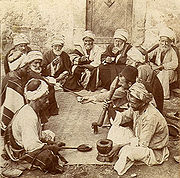
The public sphere is an area in social life where individuals can come together to freely discuss and identify societal problems, and through that discussion influence political action. It is "a discursive space in which individuals and groups congregate to discuss matters of mutual interest and, where possible, to reach a common judgment."
The public sphere can be seen as "a theater in modern societies in which political participation is enacted through the medium of talk" and "a realm of social life in which public opinion can be formed".
The public sphere mediates between the "private sphere
Private sphere
The private sphere is the complement or opposite to the public sphere. The private sphere is a certain sector of societal life in which an individual enjoys a degree of authority, unhampered by interventions from governmental or other institutions. Examples of the private sphere are family and home...
" and the "Sphere of Public Authority", "The private sphere
Private sphere
The private sphere is the complement or opposite to the public sphere. The private sphere is a certain sector of societal life in which an individual enjoys a degree of authority, unhampered by interventions from governmental or other institutions. Examples of the private sphere are family and home...
comprised civil society in the narrower sense, that is to say, the realm of commodity exchange and of social labor." Whereas the "Sphere of Public Authority" dealt with the State, or realm of the police, and the ruling class, the public sphere crossed over both these realms and "Through the vehicle of public opinion it put the state in touch with the needs of society." "This area is conceptually distinct from the state: it [is] a site for the production and circulation of discourses that can in principle be critical of the state." The public sphere 'is also distinct from the official economy; it is not an arena of market relations but rather one of discursive relations, a theater for debating and deliberating rather than for buying and selling." These distinctions between "state apparatuses, economic markets, and democratic associations...are essential to democratic theory." The people themselves came to see the public sphere as a regulatory institution against the authority of the state. The study of the public sphere centers on the idea of participatory democracy
Participatory democracy
Participatory Democracy, also known as Deliberative Democracy, Direct Democracy and Real Democracy , is a process where political decisions are made directly by regular people...
, and how public opinion
Public opinion
Public opinion is the aggregate of individual attitudes or beliefs held by the adult population. Public opinion can also be defined as the complex collection of opinions of many different people and the sum of all their views....
becomes political action.
The basic belief in public sphere theory is that political action is steered by the public sphere, and that the only legitimate governments are those that listen to the public sphere. "Democratic governance rests on the capacity of and opportunity for citizens to engage in enlightened debate". Much of the debate over the public sphere involves what is the basic theoretical structure of the public sphere, how information is deliberated in the public sphere, and what influence the public sphere has over society.
Jürgen Habermas: bourgeois public sphere
Most contemporary conceptualizations of the public sphere are based on the ideas expressed in Jürgen HabermasJürgen Habermas
Jürgen Habermas is a German sociologist and philosopher in the tradition of critical theory and pragmatism. He is perhaps best known for his theory on the concepts of 'communicative rationality' and the 'public sphere'...
' book The Structural Transformation of the Public Sphere – An Inquiry into a Category of Bourgeois Society
The Structural Transformation of the Public Sphere
The Structural Transformation of the Public Sphere: An Inquiry into a Category of Bourgeois Society , by Jürgen Habermas, was published in 1962 and translated into English in 1989 by Thomas Burger and Frederick Lawrence...
, which is a translation of his Habilitation
Habilitation
Habilitation is the highest academic qualification a scholar can achieve by his or her own pursuit in several European and Asian countries. Earned after obtaining a research doctorate, such as a PhD, habilitation requires the candidate to write a professorial thesis based on independent...
sschrift "Strukturwandel der Öffentlicheit:Untersuchungen zu einer Kategorie der bürgerlichen Gesellschaft". The German
German language
German is a West Germanic language, related to and classified alongside English and Dutch. With an estimated 90 – 98 million native speakers, German is one of the world's major languages and is the most widely-spoken first language in the European Union....
term Öffentlichkeit (Public Sphere) encompasses a variety of meanings and it implies a spatial concept, the social sites or arenas where meanings are articulated, distributed, and negotiated, as well as the collective body constituted by, and in this process, "the public". The work is still considered the foundation of contemporary public sphere theories, and most theorists cite it when discussing their own theories.
The bourgeois public sphere may be conceived above all as the sphere of private people come together as a public; they soon claimed the public sphere regulated from above against the public authorities themselves, to engage them in a debate over the general rules governing relations in the basically privatized but publicly relevant sphere of commodity exchange and social labor.
Through this work, he gave a historical-sociological account of the creation, brief flourishing, and demise of a "bourgeois" public sphere based on rational-critical debate and discussion: Habermas stipulates that, due to specific historical circumstances, a new civic society emerged in the eighteenth century. Driven by a need for open commercial arenas where news and matters of common concern could be freely exchanged and discussed - accompanied by growing rates of literacy, accessibility to literature, and a new kind of critical journalism - a separate domain from ruling authorities started to evolve across Europe. "In its clash with the arcane and bureaucratic practices of the absolutist state, the emergent bourgeoisie gradually replaced a public sphere in which the ruler’s power was merely represented before the people with a sphere in which state authority was publicly monitored through informed and critical discourse by the people".
In his historical analysis, Habermas points out three so-called "institutional criteria" as preconditions for the emergence of the new public sphere. The discursive arenas, such as Britain’s coffee houses, France’s salons and Germany’s Tischgesellschaften "may have differed in the size and compositions of their publics, the style of their proceedings, the climate of their debates, and their topical orientations", but "they all organized discussion among people that tended to be ongoing; hence they had a number of institutional criteria in common":
- Disregard of status: Preservation of "a kind of social intercourse that, far from presupposing the equality of status, disregarded status altogether. [...] Not that this idea of the public was actually realized in earnest in the coffee houses, salons, and the societies; but as an idea it had become institutionalized and thereby stated as an objective claim. If not realized, it was at least consequential." (loc.cit.)
- Domain of common concern: "... discussion within such a public presupposed the problematization of areas that until then had not been questioned. The domain of ‘common concern’ which was the object of public critical attention remained a preserve in which church and state authorities had the monopoly of interpretation. [...] The private people for whom the cultural product became available as a commodity profaned it inasmuch as they had to determine its meaning on their own (by way of rational communication with one another), verbalize it, and thus state explicitly what precisely in its implicitness for so long could assert its authority." (loc.cit.)
- Inclusivity: However exclusive the public might be in any given instance, it could never close itself off entirely and become consolidated as a clique; for it always understood and found itself immersed within a more inclusive public of all private people, persons who – insofar as they were propertied and educated – as readers, listeners, and spectators could avail themselves via the market of the objects that were subject to discussion. The issues discussed became ‘general’ not merely in their significance, but also in their accessibility: everyone had to be able to participate. [...] Wherever the public established itself institutionally as a stable group of discussants, it did not equate itself with the public but at most claimed to act as its mouthpiece, in its name, perhaps even as its educator – the new form of bourgeois representation" (loc.cit.).
Habermas argued that the Bourgeois society cultivated and upheld these criteria. The public sphere was well established in various locations including coffee shops and salons, areas of society where various people could gather and discuss matters that concerned them. The coffee houses in London society at this time became the centers of art and literary criticism, which gradually widened to include even the economic and the political disputes as matters of discussion. In French salons, as Habermas says, "opinion became emancipated from the bonds of economic dependence". Any new work, or a book or a musical composition had to get its legitimacy in these places. It not only paved a forum for self-expression, but in fact had become a platform for airing one’s opinions and agendas for public discussion.
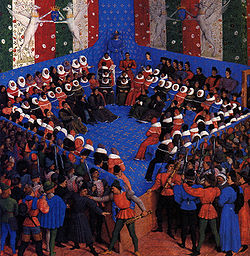
This collapse was due to the consumeristic drive that infiltrated society, so they became more concerned about consumption than political actions, and the capitalistic drive of the mass media. Suddenly the media became a tool of political forces, and a medium for advertisement rather than the medium from which the public got their information on political matters.
As Habermas argues, in due course, this sphere of rational and universalistic politics
Cosmopolitanism
Cosmopolitanism is the ideology that all human ethnic groups belong to a single community based on a shared morality. This is contrasted with communitarian and particularistic theories, especially the ideas of patriotism and nationalism...
, free from both the economy and the State, was destroyed by the same forces that initially established it. The growth of capitalistic economy led to an uneven distribution of wealth, thus widening the economic polarity. This resulted in limiting access to the public sphere and the political control of the public sphere was inevitable for the modern capitalistic forces to operate and thrive in the competitive economy.
Therewith emerged a new sort of influence, i.e., media power, which, used for purposes of manipulation, once and for all took care of the innocence of the principle of publicity. The public sphere, simultaneously prestructured and dominated by the mass media, developed into an arena infiltrated by power in which, by means of topic selection and topical contributions, a battle is fought not only over influence but over the control of communication flows that affect behavior while their strategic intentions are kept hidden as much as possible.
Counter publics, Feminist Critiques and Expansions
Although Structural TransformationThe Structural Transformation of the Public Sphere
The Structural Transformation of the Public Sphere: An Inquiry into a Category of Bourgeois Society , by Jürgen Habermas, was published in 1962 and translated into English in 1989 by Thomas Burger and Frederick Lawrence...
was (and is) one of the most influential works in contemporary German philosophy and political science, it took 27 years until an English version appeared on the market (1989). Based on a conference on the occasion of the English translation, at which Habermas himself attended, Craig Calhoun
Craig Calhoun
Craig Calhoun is an American sociologist and an advocate of using social science to address issues of public concern. He is president of the Social Science Research Council, University Professor of the Social Sciences at New York University and Director of NYU's...
(1992) edited Habermas and the Public Sphere – a thorough dissection of Habermas’ bourgeois public sphere by scholars from various academic disciplines. The core criticism at the conference was directed towards the above stated "institutional criteria":
- Hegemonic dominance and exclusion: In Rethinking the Public Sphere, Nancy Fraser revisits Habermas’ historical description of the public sphere, and confronts it with "recent revisionist historiography". She refers to other scholars, like Joan Landes, Mary RyanMary RyanMary Ryan may refer to:* Mary Ryan , Irish Fianna Fáil TD for Tipperary 1944–1961* Mary Ryan , a character from both the Fatal Fury and King of Fighters series of computer games...
and Geoff EleyGeoff EleyGeoff Eley is a British-born historian of Germany. He received his D.Phil from the University of Sussex in 1974, and has taught at the University of Michigan, Ann Arbor since 1979...
, when she argues that the bourgeois public sphere was in fact constituted by a "number of significant exclusions." In contrast to Habermas’ assertions on disregard of status and inclusivity, Fraser claims that the bourgeois public sphere discriminated against women and lower social strata of society: "... this network of clubs and associations – philanthropic, civic, professional, and cultural – was anything but accessible to everyone. On the contrary, it was the arena, the training ground and eventually the power base of a stratum of bourgeois men who were coming to see themselves as a “universal class” and preparing to assert their fitness to govern." Thus, she stipulates a hegemonic tendency of the male bourgeois public sphere, which dominated at the cost of alternative publics (for example by gender, social status, ethnicity and property ownership), thereby averting other groups from articulating their particular concerns. - Bracketing of inequalities: Fraser makes us recall that "the bourgeois conception of the public sphere requires bracketing inequalities of status": The "public sphere was to be an arena in which interlocutors would set aside such characteristics as difference in birth and fortune and speak to one another as if they were social and economic peers". Fraser refers to feminist research by Jane Mansbridge, which notes several relevant "ways in which deliberation can serve as a mask for domination". Consequently, she argues that "such bracketing usually works to the advantage of dominant groups in society and to the disadvantage of subordinates." Thus, she concludes: "In most cases it would more appropriate to unbracket inequalities in the sense of explicitly thematizing them – a point that accords with the spirit of Habermas’ later communicative ethics".
- The problematic definition of "common concern": Nancy Fraser points out that "there are no naturally given, a priori boundaries" between matters that are generally conceived as private, and ones we typically label as public (i.e. of "common concern"). As an example, she refers to the historic shift in the general conception of domestic violence, from previously being a matter of primarily private concern, to now generally being accepted as a common one: "Eventually, after sustained discursive contestation we succeeded in making it a common concern".
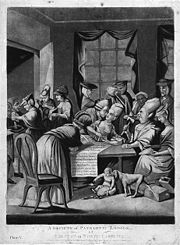
Nancy Fraser
Nancy Fraser is an American critical theorist, currently the Henry A. and Louise Loeb Professor of Political and Social Science and professor of philosophy at The New School in New York City...
identified the fact that marginalized groups are excluded from a universal public sphere, and thus it was impossible to claim that one group would in fact be inclusive. However, she claimed that marginalized groups formed their own public spheres, and termed this concept a subaltern counterpublic or Counterpublics.
Fraser worked from Habermas' basic theory because she saw it to be "an indispensable resource" but questioned the actual structure and attempted to address her concerns. She made the observation that "Habermas stops short of developing a new, post-bourgeois model of the public sphere". Fraser attempted to evaluate Habermas' bourgeois public sphere, discuss some assumptions within his model, and offer a modern conception of the public sphere.
In the historical reevaluation of the bourgeois public sphere, Fraser argues that rather than opening up the political realm to everyone, the bourgeois public sphere shifted political power from "a repressive mode of domination to a hegemonic one". Rather than rule by power, there was now rule by the majority ideology. To deal with this hegemonic domination, Fraser argues that repressed groups form "Subaltern counterpublics" that are "parallel discursive arenas where members of subordinated social groups invent and circulate counterdiscourses to formulate oppositional interpretations of their identities, interests, and needs".
Benhabib notes that in Habermas' idea of the public sphere, the distinction between public and private issues separates issues that normally affect women (issues of "reproduction, nurture and care for the young, the sick, and the elderly") into the private realm and out of the discussion in the public sphere. She argues that if the public sphere is to be open to any discussion that affects the population, there cannot be distinctions between "what is" and "what is not" discussed. Benhabib argues for the feminists to counter the popular public discourse in their own counterpublic.
The concept of heteronormativity
Heteronormativity
Heteronormativity is a term invented in 1991 to describe any of a set of lifestyle norms that hold that people fall into distinct and complementary genders with natural roles in life. It also holds that heterosexuality is the normal sexual orientation, and states that sexual and marital relations...
is used to describe the way in which those who fall outside of the basic male/female dichotomy of gender
Gender
Gender is a range of characteristics used to distinguish between males and females, particularly in the cases of men and women and the masculine and feminine attributes assigned to them. Depending on the context, the discriminating characteristics vary from sex to social role to gender identity...
or whose sexual orientations are other than heterosexual cannot meaningfully claim their identities, causing a disconnect between their public selves and their private selves. Michael Warner made the observation that the idea of an inclusive public sphere makes the assumption that we are all the same without judgments about our fellows. He argues that we must achieve some sort of disembodied state in order to participate in a universal public sphere without being judged. His observations point to a homosexual counterpublic, and offer the idea that homosexuals must otherwise remain "closeted" in order to participate in the larger public discourse.
Rhetorical public sphere
Gerard Hauser proposed a different direction for the public sphere than previous models. He proposed that public spheres were formed around the dialogue surrounding issues, rather than the identity of the population that is engaging in the discourse. "Emphasizing the rhetoricality of public spheres foregrounds their activity."Rather than arguing for an all inclusive public sphere, or the analysis of tension between public spheres, he suggested that publics were formed by active members of society around issues. They are a group of interested individuals who engage in vernacular discourse about a specific issue. "Publics may be repressed, distorted, or responsible, but any evaluation of their actual state requires that we inspect the rhetorical environment as well as the rhetorical act out of which they evolved, for these are the conditions that constitute their individual character". These people formed rhetorical public spheres that were based in discourse, not necessarily orderly discourse but any interactions whereby the interested public engages each other. This interaction can take the form of institutional actors as well as the basic "street rhetoric" that "open[s] a dialogue between competing factions." The spheres themselves formed around the issues that were being deliberated. The discussion itself would reproduce itself across the spectrum of interested publics "even though we lack personal acquaintance with all but a few of its participants and are seldom in contexts where we and they directly interact, we join these exchanges because they are discussing the same matters." In order to communicate within the public sphere, "those who enter any given arena must share a reference world for their discourse to produce awareness for shared interests and public opinions about them". This world consists of common meanings and cultural norms from which interaction can take place.
The rhetorical public sphere has several primary features:
- 1. it is discourse-based, rather than class-based.
- 2. the critical norms are derived from actual discursive practices. Taking a universal reasonableness out of the picture, arguments are judged by how well they resonate with the population that is discussing the issue.
- 3. intermediate bracketing of discursive exchanges. Rather than a conversation that goes on across a population as a whole, the public sphere is composed of many intermediate dialogs that merge later on in the discussion.
The rhetorical public sphere was characterized by five rhetorical norms from which it can be gauged and criticized. How well the public sphere adheres to these norms determine the effectiveness of the public sphere under the rhetorical model. Those norms are:
- 1. permeable boundaries: Although a public sphere may have a specific membership as with any social movement or deliberative assembly, people outside the group can participate in the discussion.
- 2. activity: Publics are active rather than passive. They do not just hear the issue and applaud, but rather they actively engage the issue and the publics surrounding the issue.
- 3. contextualized language: They require that participants adhere to the rhetorical norm of contextualized language to render their respective experiences intelligible to one another.
- 4. believable appearance: The public sphere must appear to be believable to each other and the outside public.
- 5. tolerance: In order to maintain a vibrant discourse, others opinions need to be allowed to enter within the arena.
In all this Hauser believes a public sphere is a "discursive space in which strangers discuss issues they perceive to be of consequence for them and their group. Its rhetorical exchanges are the bases for shared awareness of common issues, shared interests, tendencies of extent and strength of difference and agreement, and self-constitution as a public whose opinions bear on the organization of society."
Counter publics: Proletarian public spheres, and Public spheres of Production
Oskar NegtOskar Negt
Oskar Negt is a philosopher and social theorist in the tradition of critical theory. He is Professor of Sociology at the Universität Hannover....
& Alexander Kluge
Alexander Kluge
Alexander Kluge is an author and film director.-Early life, education and early career:Kluge was born in Halberstadt, Saxony-Anhalt, Germany....
have furthermore argued that Habermas' reflections on the bourgeois public sphere should be supplemented with reflections on the proletarian public spheres and the public spheres of production.
Proletarian Public Spheres
The distinction between bourgeois and proletarian public spheres is not mainly a distinction between classes. The proletarian public sphere is rather to be conceived of as the "excluded", vague, unarticulated impulses of resistance or resentment. The proletarian public sphere carries the subjective feelings, the egocentric malaise with the common public narrative, interests that are not socially valorized- "As extraeconomic interests, they exist—precisely in the forbidden zones of fantasy beneath the surface of taboos—as stereotypes of a proletarian context of living that is organized in a merely rudimentary form."
The bourgeois and proletarian public spheres are mutually defining: The proletarian public sphere carries the "left-overs" from the bourgeois public sphere, while the bourgeois public is based upon the productive forces of the underlying resentment:
- "In this respect, they " [i.e. the proletarian public spheres] " have two characteristics: in their defensive attitude toward society, their conservatism, and their subcultural character, they are once again mere objects; but they are, at the same time, the block of real life that goes against the valorization interest. As long as capital is dependent on living labor as a source of wealth, this element of the proletarian context of living cannot be extinguished through repression."
Public Spheres of Production
Negt and Kluge furthermore point out the necessity of considering a third dimension of the public spheres: The public spheres of production. The public spheres of production collect the impulses of resentment and instrumentalizes them in the productive spheres. The public spheres of production are wholly instrumental and have no critical impulse (unlike the bourgeois and proletarian spheres). The interests that are incorporated in the public sphere of production are given capitalist shape, and questions of their legitimity are thus neutralized.Non-liberal theories of the Public Sphere
By the end of the 20th century the discussions about public spheres got a new biopolitical twist. Traditionally the public spheres had been contemplated as to how free agents transgress the private spheres. Michael HardtMichael Hardt
Michael Hardt is an American literary theorist and political philosopher perhaps best known for Empire, written with Antonio Negri and published in 2000...
and Antonio Negri
Antonio Negri
Antonio Negri is an Italian Marxist sociologist and political philosopher.Negri is best-known for his co-authorship of Empire, and secondarily for his work on Spinoza. Born in Padua, he became a political philosophy professor in his hometown university...
have, drawing on the late Michel Foucault
Michel Foucault
Michel Foucault , born Paul-Michel Foucault , was a French philosopher, social theorist and historian of ideas...
's writings on biopolitics
Biopolitics
The term "biopolitics" or "biopolitical" can refer to several different yet often compatible concepts.-Definitions:# In the work of Michel Foucault, the style of government that regulates populations through "biopower" .# In the works of Michael Hardt and Antonio Negri, anti-capitalist insurrection...
, suggested that we reconsider the very distinction between public and private spheres. They argue that the traditional distinction is founded on a certain (capitalist) account of property that presuppose clear-cut separations between interests. This account of property is (according to Hardt and Negri) based upon a scarcity economy. The scarcity economy is characterized by an impossibility of sharing the goods. If "agent A" eats the bread, "agent B" cannot have it. The interests of agents are thus, generally, clearly separated.
However with the evolving shift in the economy towards an informational materiality, in which value is based upon the informational significance, or the narratives surrounding the products, the clear-cut subjective separation is no longer obvious. Hardt and Negri see the open source
Open source
The term open source describes practices in production and development that promote access to the end product's source materials. Some consider open source a philosophy, others consider it a pragmatic methodology...
approaches as examples of new ways of co-operation that illustrate how economic value is not founded upon exclusive possession, but rather upon collective potentialities. Informational materiality is characterized by gaining value only through being shared. Hardt and Negri thus suggest that the commons become the focal point of analyses of public relations. The point being that with this shift it becomes possible to analyse how the very distinctions between the private and public are evolving.
See also
- Argumentation TheoryArgumentation theoryArgumentation theory, or argumentation, is the interdisciplinary study of how humans should, can, and do reach conclusions through logical reasoning, that is, claims based, soundly or not, on premises. It includes the arts and sciences of civil debate, dialogue, conversation, and persuasion...
- Commons
- Interpersonal relationshipInterpersonal relationshipAn interpersonal relationship is an association between two or more people that may range from fleeting to enduring. This association may be based on limerence, love, solidarity, regular business interactions, or some other type of social commitment. Interpersonal relationships are formed in the...
- Online deliberationOnline deliberationOnline deliberation is a term associated with an emerging body of practice, research, and software dedicated to fostering serious, purposive discussion over the Internet...
- ProtestProtestA protest is an expression of objection, by words or by actions, to particular events, policies or situations. Protests can take many different forms, from individual statements to mass demonstrations...
- Public place
- PublicyPublicyPublicy is the response from public institutions a private person is able to elicit...
- Rule according to higher lawRule according to higher lawThe rule according to a higher law means that no written law may be enforced by the government unless it conforms with certain unwritten, universal principles of fairness, morality, and justice...
External links
- Public Sphere Guide A Research Guide, Teaching Guide and Resource for the Renewal of the Public Sphere
- Transformations of the Public Sphere Essay Forum
- Jürgen Habermas, "The Public Sphere: An Encyclopedia Article," New German Critique 3 (1974)
- Spark summary of Habermas' public sphere book