

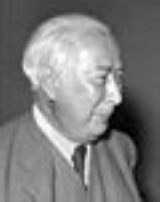
Theodor Heuss

Encyclopedia
Theodor Heuss was a liberal German
politician who served as the first President of the Federal Republic of Germany
after World War II
from 1949 to 1959. Beside stern Chancellor Konrad Adenauer
, Heuss' cordial manners largely contributed to the stabilization of democracy in West Germany
during the Wirtschaftswunder
years.
, a small Swabia
n town near Heilbronn
. He studied economics
, art history
and political science
at the universities of Munich and Berlin
, receiving his doctorate in 1905 in Munich with Lujo Brentano
as his thesis adviser. On 11 April 1908, he married Elly Heuss-Knapp
(1881–1952), with whom he had a son. The priest at the wedding ceremony held in Straßburg
was Albert Schweitzer
, a close friend of Elly.
After his studies Heuss worked as a political journalist in Berlin
and from 1905 until 1912 presided over the magazine Die Hilfe ("The Help") published by Friedrich Naumann. From 1912 to 1918, he was editor in chief of the Neckarzeitung (Neckar
Newspaper) in Heilbronn. In Berlin, he worked as editor for the weekly newsletter Deutsche Politik ("German Politics"). With Naumann, Heuss in 1903 he joined the liberal Free-minded Union, which in 1910 merged in the Progressive People's Party
(Fortschrittliche Volkspartei), in which he was engaged until its dissolution in 1918.
After World War I
, Heuss between 1923 and 1926 published the magazine Die Deutsche Nation ("The German Nation"). He had become a member of the German Democratic Party (Deutsche Demokratische Partei, DDP), from 1930 renamed German State Party
(Deutsche Staatspartei, DStP), the political heir of the Fortschrittliche Volkspartei in 1918 and was a member of the Reichstag
parliament from 1924 to 1928 and again from 1930 to 1933.
On 23 March 1933, along with his four fellow DStP parliamentarians, Heuss against his personal attitude voted in favour of the Enabling Act (Ermächtigungsgesetz), granting Chancellor Adolf Hitler
quasi-dictatorial powers. He had set out to abstain, but after Heinrich Brüning
indicated that with regard to the Reichskonkordat
the Centre Party
MPs would assent, ultimately subordinated to party discipline. When Germany became a single-party state
, the DStP was dissolved on 28 June 1933 and Heuss was divested of his Reichstag mandate by decree of Minister of the Interior Wilhelm Frick
with effect from July 8.
Following the end of his term he returned to private life. During the Third Reich he stayed in contact with a network of liberals, leading to contacts with the German resistance
towards the end of the war, though he was not an active resister. In 1936 Heuss faced a publication ban, nevertheless in 1941 he became a employee of the Frankfurter Zeitung
, one of the few remaining liberal newspapers at that time. Heuss wrote under pseudonym
s until publishing of the paper was finally prohibited in 1943. He spent the following years writing a biography of Robert Bosch
.
After World War II the US Office of Military Government
on 24 September 1945 appointed Heuss the first Minister of Education and Cultural Affairs in the German state of Württemberg-Baden
under his fellow party member Minister-president Reinhold Maier
, in favour of whom he resigned in 1946. As a co-founder of the Democratic People's Party
(Demokratische Volkspartei, DVP), the predecessor of the German Free Democratic Party (Freie Demokratische Partei, FDP) in the southwestern German states, he was a member of the Württemberg-Baden state parliament (Landtag
) from 1946 to 1949. Heuss also taught history
at the Stuttgart Institute of Technology
in 1946 and 1947, receiving the title of an honorary professor
in 1948.
After plans elaborated with Wilhelm Külz
to build up an all-German liberal party had failed, Heuss in December 1948 was elected head of West German and Berlin sections of the newly founded Free Democratic Party. He advocated uniting all liberal parties in the Western occupation zones, overcoming the split between right liberals and left liberals that had existed in the Weimar Republic
. In 1948, he was a member of the Parlamentarischer Rat
(Parliamentary Council) at Bonn
with considerable influence on the drafting of the Basic Law for the Federal Republic of Germany
(Grundgesetz).
, he relinquished his parliamentary mandate on 12 September 1949, when he was elected
President by the Federal Convention (Bundesversammlung) defeating the Social Democrat leader Kurt Schumacher
in the second ballot. By the time he was confirmed as the first democratic German president since Paul von Hindenburg
, he refused to be called “Excellency
”, preferring instead to be called simply “Herr Heuss”, Herr Bundespräsident is the German term of address up to today. Heuss' plans for a new national anthem
were aborted by Adenauer, who – in rare accordance with Kurt Schumacher – had the third stanza of the old Deutschlandlied established in 1952.
A widower since 1952, Heuss was re-elected in 1954 with practically no opposition, after the Social Democrats had renounced the nomination of a rival candidate. Not until May 1956, he could made his first state visit, invited by King Paul of Greece
. The president, accompanied by Foreign Minister Heinrich von Brentano
, was overwhelmed by the warm reception in Athens
, considering that the country had heavily suffered under German occupation in World War II. He held office until the end of his term on 12 September 1959, succeeded by Heinrich Lübke
. He had declined a third term in office, as this would have necessitated changing the constitution.
Heuss shaped the office of president by his non-partisan governing. As a representative of the democratic-liberal and cultural traditions of Germany, he was a symbol of confidence in the German post-war republic in the international community. His further state visits to Turkey
, Italy
, Canada
and the United States
, as well as to the United Kingdom
contributed greatly to the increase of appreciation toward the still young Federal Republic of Germany. He was opposed to re-armament
and the founding of the new West German Army
in 1955, but had no power to stop it. His ironic speech at the swearing in of the first new soldiers, "Nun siegt mal schön!" ("Happy war-winning!"), is well remembered. In 1959, Heuss was awarded the prestigious Peace Prize of the German Book Trade
(Friedenspreis des Deutschen Buchhandels).
In 1963 Heuss died in Stuttgart
, aged 79.
Since 1964, the Theodor Heuss Prize has been awarded for exemplary democratic disposition. Heuss's former residence is now open to the public as the Theodor-Heuss-Haus. His image appeared on one series of the two-mark
coin and numerous streets and squares all over Germany have been named in his honour. During his time in office, his image also appeared on definitive stamp
s in West Germany issued between 1954 and 1960. An Airbus A310
aircraft of the Luftwaffe
used by the German head of government also carries his name.
Germany
Germany , officially the Federal Republic of Germany , is a federal parliamentary republic in Europe. The country consists of 16 states while the capital and largest city is Berlin. Germany covers an area of 357,021 km2 and has a largely temperate seasonal climate...
politician who served as the first President of the Federal Republic of Germany
President of Germany
The President of the Federal Republic of Germany is the country's head of state. His official title in German is Bundespräsident . Germany has a parliamentary system of government and so the position of President is largely ceremonial...
after World War II
World War II
World War II, or the Second World War , was a global conflict lasting from 1939 to 1945, involving most of the world's nations—including all of the great powers—eventually forming two opposing military alliances: the Allies and the Axis...
from 1949 to 1959. Beside stern Chancellor Konrad Adenauer
Konrad Adenauer
Konrad Hermann Joseph Adenauer was a German statesman. He was the chancellor of the West Germany from 1949 to 1963. He is widely recognised as a person who led his country from the ruins of World War II to a powerful and prosperous nation that had forged close relations with old enemies France,...
, Heuss' cordial manners largely contributed to the stabilization of democracy in West Germany
West Germany
West Germany is the common English, but not official, name for the Federal Republic of Germany or FRG in the period between its creation in May 1949 to German reunification on 3 October 1990....
during the Wirtschaftswunder
Wirtschaftswunder
The term describes the rapid reconstruction and development of the economies of West Germany and Austria after World War II . The expression was used by The Times in 1950...
years.
Life
Heuss was born in BrackenheimBrackenheim
Brackenheim is a town in the district of Heilbronn in Baden-Württemberg in southern Germany. It is situated 15 km southwest of Heilbronn.With an area of 826 hectare of vineyards, it's the biggest grape-growing municipality of Württemberg....
, a small Swabia
Swabia
Swabia is a cultural, historic and linguistic region in southwestern Germany.-Geography:Like many cultural regions of Europe, Swabia's borders are not clearly defined...
n town near Heilbronn
Heilbronn
Heilbronn is a city in northern Baden-Württemberg, Germany. It is completely surrounded by Heilbronn County and with approximately 123.000 residents, it is the sixth-largest city in the state....
. He studied economics
Economics
Economics is the social science that analyzes the production, distribution, and consumption of goods and services. The term economics comes from the Ancient Greek from + , hence "rules of the house"...
, art history
Art history
Art history has historically been understood as the academic study of objects of art in their historical development and stylistic contexts, i.e. genre, design, format, and style...
and political science
Political science
Political Science is a social science discipline concerned with the study of the state, government and politics. Aristotle defined it as the study of the state. It deals extensively with the theory and practice of politics, and the analysis of political systems and political behavior...
at the universities of Munich and Berlin
Humboldt University of Berlin
The Humboldt University of Berlin is Berlin's oldest university, founded in 1810 as the University of Berlin by the liberal Prussian educational reformer and linguist Wilhelm von Humboldt, whose university model has strongly influenced other European and Western universities...
, receiving his doctorate in 1905 in Munich with Lujo Brentano
Lujo Brentano
Lujo Brentano was an eminent German economist and social reformer.Lujo Brentano, born in Aschaffenburg into one of the most distinguished German-Catholic intellectual families , attended school in Augsburg and Aschaffenburg...
as his thesis adviser. On 11 April 1908, he married Elly Heuss-Knapp
Elly Heuss-Knapp
Elisabeth Eleonore Anna Justine "Elly" Heuss-Knapp, née Knapp was a German liberal politician, author and wife of Theodor Heuss—from 1949 until her death...
(1881–1952), with whom he had a son. The priest at the wedding ceremony held in Straßburg
Strasbourg
Strasbourg is the capital and principal city of the Alsace region in eastern France and is the official seat of the European Parliament. Located close to the border with Germany, it is the capital of the Bas-Rhin département. The city and the region of Alsace are historically German-speaking,...
was Albert Schweitzer
Albert Schweitzer
Albert Schweitzer OM was a German theologian, organist, philosopher, physician, and medical missionary. He was born in Kaysersberg in the province of Alsace-Lorraine, at that time part of the German Empire...
, a close friend of Elly.
After his studies Heuss worked as a political journalist in Berlin
Berlin
Berlin is the capital city of Germany and is one of the 16 states of Germany. With a population of 3.45 million people, Berlin is Germany's largest city. It is the second most populous city proper and the seventh most populous urban area in the European Union...
and from 1905 until 1912 presided over the magazine Die Hilfe ("The Help") published by Friedrich Naumann. From 1912 to 1918, he was editor in chief of the Neckarzeitung (Neckar
Neckar
The Neckar is a long river, mainly flowing through the southwestern state of Baden-Württemberg, but also a short section through Hesse, in Germany. The Neckar is a major right tributary of the River Rhine...
Newspaper) in Heilbronn. In Berlin, he worked as editor for the weekly newsletter Deutsche Politik ("German Politics"). With Naumann, Heuss in 1903 he joined the liberal Free-minded Union, which in 1910 merged in the Progressive People's Party
Progressive People's Party (Germany)
The Progressive People's Party was a liberal party of late Imperial Germany. It was formed in 6 March, 1910 as a merger of Freeminded People's Party, Freeminded Union, and German People's Party in order to unify the various liberal groups represented in parliament...
(Fortschrittliche Volkspartei), in which he was engaged until its dissolution in 1918.
After World War I
World War I
World War I , which was predominantly called the World War or the Great War from its occurrence until 1939, and the First World War or World War I thereafter, was a major war centred in Europe that began on 28 July 1914 and lasted until 11 November 1918...
, Heuss between 1923 and 1926 published the magazine Die Deutsche Nation ("The German Nation"). He had become a member of the German Democratic Party (Deutsche Demokratische Partei, DDP), from 1930 renamed German State Party
German State Party
The German State Party was a short-lived German political party of the Weimar Republic, formed by the merger of the German Democratic Party with the People's National Reich Association in July 1930...
(Deutsche Staatspartei, DStP), the political heir of the Fortschrittliche Volkspartei in 1918 and was a member of the Reichstag
Reichstag (Weimar Republic)
The Reichstag was the parliament of Weimar Republic .German constitution commentators consider only the Reichstag and now the Bundestag the German parliament. Another organ deals with legislation too: in 1867-1918 the Bundesrat, in 1919–1933 the Reichsrat and from 1949 on the Bundesrat...
parliament from 1924 to 1928 and again from 1930 to 1933.
On 23 March 1933, along with his four fellow DStP parliamentarians, Heuss against his personal attitude voted in favour of the Enabling Act (Ermächtigungsgesetz), granting Chancellor Adolf Hitler
Adolf Hitler
Adolf Hitler was an Austrian-born German politician and the leader of the National Socialist German Workers Party , commonly referred to as the Nazi Party). He was Chancellor of Germany from 1933 to 1945, and head of state from 1934 to 1945...
quasi-dictatorial powers. He had set out to abstain, but after Heinrich Brüning
Heinrich Brüning
Heinrich Brüning was Chancellor of Germany from 1930 to 1932, during the Weimar Republic. He was the longest serving Chancellor of the Weimar Republic, and remains a controversial figure in German politics....
indicated that with regard to the Reichskonkordat
Reichskonkordat
The Reichskonkordat is a treaty that was agreed between the Holy See and Nazi government, that guarantees the rights of the Catholic Church in Germany. It was signed on July 20, 1933 by Secretary of State Eugenio Pacelli and Vice Chancellor Franz von Papen on behalf of Pope Pius XI and President...
the Centre Party
Centre Party (Germany)
The German Centre Party was a Catholic political party in Germany during the Kaiserreich and the Weimar Republic. Formed in 1870, it battled the Kulturkampf which the Prussian government launched to reduce the power of the Catholic Church...
MPs would assent, ultimately subordinated to party discipline. When Germany became a single-party state
Single-party state
A single-party state, one-party system or single-party system is a type of party system government in which a single political party forms the government and no other parties are permitted to run candidates for election...
, the DStP was dissolved on 28 June 1933 and Heuss was divested of his Reichstag mandate by decree of Minister of the Interior Wilhelm Frick
Wilhelm Frick
Wilhelm Frick was a prominent German Nazi official serving as Minister of the Interior of the Third Reich. After the end of World War II, he was tried for war crimes at the Nuremberg Trials and executed...
with effect from July 8.
Following the end of his term he returned to private life. During the Third Reich he stayed in contact with a network of liberals, leading to contacts with the German resistance
German Resistance
The German resistance was the opposition by individuals and groups in Germany to Adolf Hitler or the National Socialist regime between 1933 and 1945. Some of these engaged in active plans to remove Adolf Hitler from power and overthrow his regime...
towards the end of the war, though he was not an active resister. In 1936 Heuss faced a publication ban, nevertheless in 1941 he became a employee of the Frankfurter Zeitung
Frankfurter Zeitung
The Frankfurter Zeitung was a German language newspaper that appeared from 1856 to 1943. It emerged from a market letter that was published in Frankfurt...
, one of the few remaining liberal newspapers at that time. Heuss wrote under pseudonym
Pseudonym
A pseudonym is a name that a person assumes for a particular purpose and that differs from his or her original orthonym...
s until publishing of the paper was finally prohibited in 1943. He spent the following years writing a biography of Robert Bosch
Robert Bosch
Robert Bosch was a German industrialist, engineer and inventor, founder of Robert Bosch GmbH.-Biography:...
.
After World War II the US Office of Military Government
Office of Military Government, United States
The Office of Military Government, United States was the United States military-established government created shortly after the end of hostilities in occupied Germany in World War II. Under General Lucius D...
on 24 September 1945 appointed Heuss the first Minister of Education and Cultural Affairs in the German state of Württemberg-Baden
Württemberg-Baden
Württemberg-Baden is a former state of Federal Republic of Germany. It was created in 1945 by the U.S. occupation forces, after the previous states of Baden and Württemberg had been split up between the US and French occupation zones. Its capital was Stuttgart...
under his fellow party member Minister-president Reinhold Maier
Reinhold Maier
Reinhold Maier was a German politician and the leader of the FDP from 1957–1960.Maier was born in Schorndorf. In the Weimar Republic Maier was a member of the German Democratic Party...
, in favour of whom he resigned in 1946. As a co-founder of the Democratic People's Party
Democratic People's Party (Germany)
Democratic People's Party was the name of two liberal parties in southern Germany. It is not to be confused with the Deutsche Volkspartei of 1918 which used the same abbreviation DVP....
(Demokratische Volkspartei, DVP), the predecessor of the German Free Democratic Party (Freie Demokratische Partei, FDP) in the southwestern German states, he was a member of the Württemberg-Baden state parliament (Landtag
Landtag
A Landtag is a representative assembly or parliament in German-speaking countries with some legislative authority.- Name :...
) from 1946 to 1949. Heuss also taught history
History
History is the discovery, collection, organization, and presentation of information about past events. History can also mean the period of time after writing was invented. Scholars who write about history are called historians...
at the Stuttgart Institute of Technology
University of Stuttgart
The University of Stuttgart is a university located in Stuttgart, Germany. It was founded in 1829 and is organized in 10 faculties....
in 1946 and 1947, receiving the title of an honorary professor
Professor
A professor is a scholarly teacher; the precise meaning of the term varies by country. Literally, professor derives from Latin as a "person who professes" being usually an expert in arts or sciences; a teacher of high rank...
in 1948.
After plans elaborated with Wilhelm Külz
Wilhelm Külz
Wilhelm Külz was a German politician . In 1926 he was interior minister of the Weimar Republic. After 1945 he took actively part in establishing the LDPD...
to build up an all-German liberal party had failed, Heuss in December 1948 was elected head of West German and Berlin sections of the newly founded Free Democratic Party. He advocated uniting all liberal parties in the Western occupation zones, overcoming the split between right liberals and left liberals that had existed in the Weimar Republic
Weimar Republic
The Weimar Republic is the name given by historians to the parliamentary republic established in 1919 in Germany to replace the imperial form of government...
. In 1948, he was a member of the Parlamentarischer Rat
Parlamentarischer Rat
The Parlamentarischer Rat was the West German constitutional convention that created the current constitution of the Federal Republic of Germany...
(Parliamentary Council) at Bonn
Bonn
Bonn is the 19th largest city in Germany. Located in the Cologne/Bonn Region, about 25 kilometres south of Cologne on the river Rhine in the State of North Rhine-Westphalia, it was the capital of West Germany from 1949 to 1990 and the official seat of government of united Germany from 1990 to 1999....
with considerable influence on the drafting of the Basic Law for the Federal Republic of Germany
Basic Law for the Federal Republic of Germany
The Basic Law for the Federal Republic of Germany is the constitution of Germany. It was formally approved on 8 May 1949, and, with the signature of the Allies of World War II on 12 May, came into effect on 23 May, as the constitution of those states of West Germany that were initially included...
(Grundgesetz).
Presidency
After being elected to the first German BundestagBundestag
The Bundestag is a federal legislative body in Germany. In practice Germany is governed by a bicameral legislature, of which the Bundestag serves as the lower house and the Bundesrat the upper house. The Bundestag is established by the German Basic Law of 1949, as the successor to the earlier...
, he relinquished his parliamentary mandate on 12 September 1949, when he was elected
German presidential election, 1949
The election of the first President of the Federal Republic of Germany was held on 12 September 1949, following the first Bundestag election of August 14, 1949 and coalition talks/ negotiations between CDU/CSU, FDP and German Party ....
President by the Federal Convention (Bundesversammlung) defeating the Social Democrat leader Kurt Schumacher
Kurt Schumacher
Dr. Kurt Schumacher , was chairman of the Social Democratic Party of Germany from 1946 and first Leader of the Opposition in the West German Bundestag parliament from 1949 until his death...
in the second ballot. By the time he was confirmed as the first democratic German president since Paul von Hindenburg
Paul von Hindenburg
Paul Ludwig Hans Anton von Beneckendorff und von Hindenburg , known universally as Paul von Hindenburg was a Prussian-German field marshal, statesman, and politician, and served as the second President of Germany from 1925 to 1934....
, he refused to be called “Excellency
Excellency
Excellency is an honorific style given to certain members of an organization or state.Usually, people styled "Excellency" are heads of state, heads of government, governors, ambassadors, certain ecclesiastics, royalty, aristocracy, and military, and others holding equivalent rank .It is...
”, preferring instead to be called simply “Herr Heuss”, Herr Bundespräsident is the German term of address up to today. Heuss' plans for a new national anthem
National anthem
A national anthem is a generally patriotic musical composition that evokes and eulogizes the history, traditions and struggles of its people, recognized either by a nation's government as the official national song, or by convention through use by the people.- History :Anthems rose to prominence...
were aborted by Adenauer, who – in rare accordance with Kurt Schumacher – had the third stanza of the old Deutschlandlied established in 1952.
A widower since 1952, Heuss was re-elected in 1954 with practically no opposition, after the Social Democrats had renounced the nomination of a rival candidate. Not until May 1956, he could made his first state visit, invited by King Paul of Greece
Paul of Greece
Paul reigned as King of Greece from 1947 to 1964.-Family and early life:Paul was born in Athens, the third son of King Constantine I of Greece and his wife, Princess Sophia of Prussia. He was trained as a naval officer....
. The president, accompanied by Foreign Minister Heinrich von Brentano
Heinrich von Brentano
Heinrich von Brentano di Tremezzo was a German conservative politician and lawyer. He served as Federal Minister for Foreign Affairs from 1955 to 1961.-Personal life:...
, was overwhelmed by the warm reception in Athens
Athens
Athens , is the capital and largest city of Greece. Athens dominates the Attica region and is one of the world's oldest cities, as its recorded history spans around 3,400 years. Classical Athens was a powerful city-state...
, considering that the country had heavily suffered under German occupation in World War II. He held office until the end of his term on 12 September 1959, succeeded by Heinrich Lübke
Heinrich Lübke
Karl Heinrich Lübke was President of the Federal Republic of Germany from 1959 to 1969.-Biography:...
. He had declined a third term in office, as this would have necessitated changing the constitution.
Heuss shaped the office of president by his non-partisan governing. As a representative of the democratic-liberal and cultural traditions of Germany, he was a symbol of confidence in the German post-war republic in the international community. His further state visits to Turkey
Turkey
Turkey , known officially as the Republic of Turkey , is a Eurasian country located in Western Asia and in East Thrace in Southeastern Europe...
, Italy
Italy
Italy , officially the Italian Republic languages]] under the European Charter for Regional or Minority Languages. In each of these, Italy's official name is as follows:;;;;;;;;), is a unitary parliamentary republic in South-Central Europe. To the north it borders France, Switzerland, Austria and...
, Canada
Canada
Canada is a North American country consisting of ten provinces and three territories. Located in the northern part of the continent, it extends from the Atlantic Ocean in the east to the Pacific Ocean in the west, and northward into the Arctic Ocean...
and the United States
United States
The United States of America is a federal constitutional republic comprising fifty states and a federal district...
, as well as to the United Kingdom
United Kingdom
The United Kingdom of Great Britain and Northern IrelandIn the United Kingdom and Dependencies, other languages have been officially recognised as legitimate autochthonous languages under the European Charter for Regional or Minority Languages...
contributed greatly to the increase of appreciation toward the still young Federal Republic of Germany. He was opposed to re-armament
Wiederbewaffnung
Wiederbewaffnung refers to the United States of America plan to help build up West Germany after World War II. They could not function outside an alliance framework . These events lead to the establishment of the Bundeswehr, the West German army, in 1955.Heinz Guderian stated that the fight was...
and the founding of the new West German Army
Bundeswehr
The Bundeswehr consists of the unified armed forces of Germany and their civil administration and procurement authorities...
in 1955, but had no power to stop it. His ironic speech at the swearing in of the first new soldiers, "Nun siegt mal schön!" ("Happy war-winning!"), is well remembered. In 1959, Heuss was awarded the prestigious Peace Prize of the German Book Trade
Peace Prize of the German Book Trade
The Peace Prize of the German Book Trade is an international peace prize given yearly at the Frankfurt Book Fair in the Paulskirche in Frankfurt am Main, Germany...
(Friedenspreis des Deutschen Buchhandels).
In 1963 Heuss died in Stuttgart
Stuttgart
Stuttgart is the capital of the state of Baden-Württemberg in southern Germany. The sixth-largest city in Germany, Stuttgart has a population of 600,038 while the metropolitan area has a population of 5.3 million ....
, aged 79.
Since 1964, the Theodor Heuss Prize has been awarded for exemplary democratic disposition. Heuss's former residence is now open to the public as the Theodor-Heuss-Haus. His image appeared on one series of the two-mark
German mark
The Deutsche Mark |mark]], abbreviated "DM") was the official currency of West Germany and Germany until the adoption of the euro in 2002. It is commonly called the "Deutschmark" in English but not in German. Germans often say "Mark" or "D-Mark"...
coin and numerous streets and squares all over Germany have been named in his honour. During his time in office, his image also appeared on definitive stamp
Definitive stamp
A definitive stamp is a postage stamp, that is part of a regular issue of a country's stamps available for sale by the postal service for an extended period of time...
s in West Germany issued between 1954 and 1960. An Airbus A310
Airbus A310
The Airbus A310 is a medium- to long-range twin-engine widebody jet airliner. Launched in July 1978, it was the second aircraft created by Airbus Industrie,a consortium of European aerospace companies, Airbus is now fully owned by EADS and since 2001 has been known as Airbus SAS. the consortium of...
aircraft of the Luftwaffe
Luftwaffe
Luftwaffe is a generic German term for an air force. It is also the official name for two of the four historic German air forces, the Wehrmacht air arm founded in 1935 and disbanded in 1946; and the current Bundeswehr air arm founded in 1956....
used by the German head of government also carries his name.
External links
- dhm.de - Museum of German History
- stiftung-heuss-haus.de - Foundation Theodor-Heuss-Haus
- bundespraesident.de Office of the President