

Rhine Province

Encyclopedia
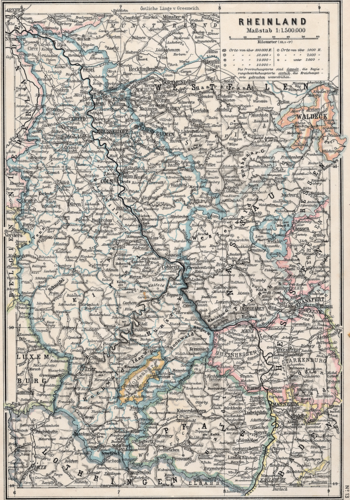
The Rhine Province also known as Rhenish Prussia (Rheinpreußen) or synonymous to the Rhineland
(Rheinland), was the westernmost province
of the Kingdom of Prussia
and the Free State of Prussia, within the German Reich, from 1822-1946. It was created from the provinces of the Lower Rhine
and Jülich-Cleves-Berg
. Its capital was Koblenz
and in 1939 it had 8.0 million inhabitants. The Province of Hohenzollern
was militarily associated with the Oberpräsident of the Rhine Province.
The Rhine Province bounded on the north by the Netherlands
, on the east by the Prussian provinces of Westphalia
and Hesse-Nassau, and the grand duchy of Hesse-Darmstadt
, on the southeast by the Electoral Palatinate, on the south and southwest by Lorraine
, and on the west by Luxembourg
, Belgium
and the Netherlands.
The small district of Wetzlar
in the midst of the province of Hesse also belonged to the Rhine Province, which, on the other hand, surrounded the Oldenburg
principality of Birkenfeld
.
In 1911, the extent of the province was 10,423 km2; its extreme length, from north to south, was nearly 200 km, and its greatest breadth was just under 90 km. It included about 200 km. of the course of the Rhine, which formed the eastern frontier of the province from Bingen
to Coblenz, and then flowed through this eastern frontier in a north-westerly direction.
) was more closely related to the Netherlands. On the western and southern frontiers resided smaller French-speaking communities.
The Rhine province was the most densely populated part of Prussia, the general average being 617 persons per sq. m. The province contains a greater number of large towns than any other province in Prussia. Upwards of half the population were supported by industrial and commercial pursuits, and barely a quarter by agriculture. There was the university at Bonn, and elementary education was especially successful.
, Düsseldorf, Cologne, Aachen and Trier. Coblenz was the official capital, though Cologne was the largest and most important city. Being a frontier province the Rhineland was strongly garrisoned, and the Rhine was guarded by the three strong fortresses of Cologne with Deutz, Coblenz with Ehrenbreitstein, and Wesel. The province sent 35 members to the German Reichstag and 62 to the Prussian house of representatives.
The vine-culture occupied a space of about 30000 acres (121.4 km²), about half of which was in the valley of the Mosel, a third in that of the Rhine itself, and the rest mainly on the Nahe and the Ahr. In the hilly districts more than half the surface was sometimes occupied by forests, and large plantations of oak are formed for the use of the bark in tanning.
Considerable herds of cattle were reared on the rich pastures of the lower Rhine, but the number of sheep in the province was comparatively small, not greatly in excess of that of the goats. The wooded hills were well stocked with deer, and a stray wolf occasionally found its way from the forests of the Ardennes into those of the Hunsrück.
The salmon fishery of the Rhine was very productive, and trout abound in the mountain streams.
Besides parts of the carboniferous measures of the Saar and the Ruhr, it also contains important deposits of coal near Aachen. Iron ore was found in abundance near Coblenz, the Bleiberg in the Eifel possessed an apparently inexhaustible supply of lead, and zinc was found near Cologne and Aachen. The mineral products of the district also included lignite, copper, manganese, vitriol, lime, gypsum, volcanic stones (used for millstones) and slates. By far the most important item was coal.
Of the numerous mineral springs the best known were those of Aachen and Kreuznach.
The industry was mainly concentrated round two chief centres, Aachen and Düsseldorf (with the valley of the Wupper), while there were naturally few manufactures in the hilly districts of the south or the marshy flats of the north. The largest iron and steel works were at Essen, Oberhausen, Duisburg, Düsseldorf and Cologne, while cutlery and other small metallic wares were extensively made at Solingen, Remscheid and Aachen.
The cloth of Aachen and the silk of Krefeld formed important articles of export. The chief industries of Elberfeld-Barmen and the valley of the Wupper were cotton-weaving, calico-printing and the manufacture of turkey red and other dyes. Linen was largely made at Gladbach, leather at Malmedy, glass in the Saar district and beetroot sugar near Cologne.
Though the Rhineland was par excellence the country of the vine, beer was produced in quantities, distilleries were also numerous, and large quantities of sparkling Moselle were made at Coblenz, chiefly for exportation to England.
Commerce was greatly aided by the navigable rivers, a very extensive network of railways, and the excellent roads constructed during the French régime. The imports consist mainly of raw material for working up in the factories of the district, while the principal exports are coal, fruit, wine, dyes, cloth, silk and other manufactured articles of various descriptions.
s of Lower Rhine
and Jülich-Cleves-Berg
. Its capital was Koblenz
; it had 8.0 million inhabitants by 1939. In 1920, the Saar
was separated from the Rhine Province and administered by the League of Nations
until a plebiscite in 1935, when the region was returned to Germany. At the same time, in 1920, the districts of Eupen
and Malmedy
were transferred to Belgium
(see German-Speaking Community of Belgium
). In 1946, the Rhine Province was divided up between the newly-founded states of North Rhine-Westphalia
and Rhineland-Palatinate
. The town of Wetzlar
became part of Hesse
.
, Allied forces occupied the Rhineland as far east as the river with some small bridgeheads on the east bank at places like Cologne
. Under the terms of the Treaty of Versailles
of 1919 the occupation was continued and the Inter-Allied Rhineland High Commission
was set up to supervise affairs. The treaty specified three occupation Zones, which were due to be evacuated by Allied troops five, ten and finally 15 years after the formal ratification of the treaty, which took place in 1920, thus the occupation was intended to last until 1935. In fact, the last Allied troops left Germany five years prior to that date in 1930 in a good-will reaction to the Weimar Republic
's policy of reconciliation in the era of Gustav Stresemann
and the Locarno Pact.
Sections of the Rhineland, that had once belonged to the Habsburg Netherlands Duchy of Limburg, were annexed by Belgium in the Treaty of Versailles
. The cantons of Eupen
, Malmedy
and Sankt Vith though, with the exception of Malmedy, German in culture and language became the East Cantons of Belgium
against the will of the population. Today German
is the third official language, along with French
and Dutch
.
During the occupation (1919–1930) the French encouraged the establishment of an independent Rhenish Republic
, banking on traditional anti-Prussian resentments (see: history of Palatinate). In the end, the separatists failed to gain any decisive support among the population.
The Treaty of Versailles also specified the de-militarization of the entire area to provide a buffer between Germany on one side and France
, Belgium
and Luxembourg
(and to a lesser extent, the Netherlands
) on the other side, which meant that no German forces were allowed there after the Allied forces had withdrawn. Furthermore (and quite unbearably from the German perspective) the treaty entitled the Allies to reoccupy the Rhineland at their will, if the Allies unilaterally found the German side responsible for any violation of the treaty.
In violation of the Treaty of Versailles and the spirit of the Locarno Pact, Nazi Germany
remilitarized the Rhineland
on Saturday, March 7, 1936. The occupation was done with very little military force, the troops entering on tractors, and no effort was made to stop it (see Appeasement of Hitler), even though the French had an overwhelming force nearby. France
could not act due to political instability at the time, and, since the remilitarization occurred at a weekend, the British Government could not find out or discuss actions to be taken until the following Monday. As a result of this, the governments were inclined to see the remilitarization as a fait accompli.
Hitler took a risk when he sent his troops to the Rhineland. He told them to "turn back and not to resist" if they were stopped by the French Army. The French, however, did not try to stop them because they were currently holding elections and the president did not want to start a war with Germany.
The British government did not oppose the act in principle, feeling with Lord Lothian
that "the Germans are after all only going into their own back garden" but rejected the Nazi manner of accomplishing the act. Winston Churchill
, however, advocated military action through cooperation by the British and French.
The remilitarization of the Rhineland was favoured by some of the local population, because of a resurgence of German nationalism and harboured bitterness over the Allied occupation of the Rhineland until 1930 (Saarland
until 1935).
A side-effect of the French occupations was the offspring of French soldiers and German woman. These children, who were seen as the continuing French pollution of German culture, were shunned by the broader German society and were known as Rhineland Bastards. Children fathered by French colonial troops of African ancestry were especially despised and became targets of Nazi sterilisation programmes in the 1930s. The American poet Charles Bukowski
was born in 1920 in Andernach
as the son of a German mother and a Polish-American U.S. soldier, serving among the occupation troops and soldiers.
that sought to allow the Second British Army to advance past the northern flank of the Siegfried Line
and enter the Ruhr
industrial area. After the failure of that operation for five months, from September 1944 until February 1945, the First United States Army fought a costly battle to capture the Hürtgen Forest
. The heavily forested and ravined terrain of the Hürtgen negated Allied combined arms advantages (close air support, armor, artillery) and favoured German defenders. The U.S. Army lost 24,000 troops. The military necessity of their sacrifice has been debated by military historians.
under General Henry Crerar reinforced by elements of the British Second Army
under General Miles Dempsey
, drove through the Rhineland beginning in the first week of February 1945.
Operation Veritable
lasted several weeks, with the end result of clearing all German forces from the west side of the Rhine river. The supporting operation by the First US Army, Operation Grenade
, was planned to coincide from the River Roer
, in the south. This was delayed for two weeks however, by German flooding of the Roer valley.
captured the last intact bridge over the Rhine at Remagen
. General George Patton's Third US Army also made a crossing of the river the day before the much anticipated Rhine crossings by the 21st Army Group (First Canadian Army
and the British Second Army
) under Field Marshal Montgomery in the third week of March 1945.
Operation Varsity
was a massive airborne operation in conjunction with Operation Plunder
, the amphibious crossings. By early April, the Rhine had been crossed by all the Allied armies operating west of the river, and the battles for the Rhineland were over.
In 1946, the Rhine Province was divided into the newly-founded states of Hesse
, North Rhine-Westphalia
and Rhineland-Palatinate
.
Rhineland
Historically, the Rhinelands refers to a loosely-defined region embracing the land on either bank of the River Rhine in central Europe....
(Rheinland), was the westernmost province
Provinces of Prussia
The Provinces of Prussia constituted the main administrative divisions of Prussia. Following the dissolution of the Holy Roman Empire in 1806 and the Congress of Vienna in 1815 the various princely states in Germany gained their nominal sovereignty, but the reunification process that culminated in...
of the Kingdom of Prussia
Kingdom of Prussia
The Kingdom of Prussia was a German kingdom from 1701 to 1918. Until the defeat of Germany in World War I, it comprised almost two-thirds of the area of the German Empire...
and the Free State of Prussia, within the German Reich, from 1822-1946. It was created from the provinces of the Lower Rhine
Grand Duchy of the Lower Rhine
The Grand Duchy of the Lower Rhine , or simply known as the Lower Rhine Province was a province of the Kingdom of Prussia and existed from 1815 to 1822....
and Jülich-Cleves-Berg
Province of Jülich-Cleves-Berg
The Province of Jülich-Cleves-Berg was a province of the Kingdom of Prussia from 1815–22. The province was largely made up of the land held by the former United Duchies of Jülich-Cleves-Berg...
. Its capital was Koblenz
Koblenz
Koblenz is a German city situated on both banks of the Rhine at its confluence with the Moselle, where the Deutsches Eck and its monument are situated.As Koblenz was one of the military posts established by Drusus about 8 BC, the...
and in 1939 it had 8.0 million inhabitants. The Province of Hohenzollern
Province of Hohenzollern
Hohenzollern was a de facto province of the Kingdom of Prussia. It was created in 1850 by joining the principalities of Hohenzollern-Sigmaringen and Hohenzollern-Hechingen after both formerly independently ruling Catholic princely lines of the House of Hohenzollern had handed over their...
was militarily associated with the Oberpräsident of the Rhine Province.
The Rhine Province bounded on the north by the Netherlands
Netherlands
The Netherlands is a constituent country of the Kingdom of the Netherlands, located mainly in North-West Europe and with several islands in the Caribbean. Mainland Netherlands borders the North Sea to the north and west, Belgium to the south, and Germany to the east, and shares maritime borders...
, on the east by the Prussian provinces of Westphalia
Province of Westphalia
The Province of Westphalia was a province of the Kingdom of Prussia and the Free State of Prussia from 1815 to 1946.-History:Napoleon Bonaparte founded the Kingdom of Westphalia, which was a client state of the First French Empire from 1807 to 1813...
and Hesse-Nassau, and the grand duchy of Hesse-Darmstadt
Grand Duchy of Hesse
The Grand Duchy of Hesse and by Rhine , or, between 1806 and 1816, Grand Duchy of Hesse —as it was also known after 1816—was a member state of the German Confederation from 1806, when the Landgraviate of Hesse-Darmstadt was elevated to a Grand Duchy, until 1918, when all the German...
, on the southeast by the Electoral Palatinate, on the south and southwest by Lorraine
Lorraine (province)
The Duchy of Upper Lorraine was an historical duchy roughly corresponding with the present-day northeastern Lorraine region of France, including parts of modern Luxembourg and Germany. The main cities were Metz, Verdun, and the historic capital Nancy....
, and on the west by Luxembourg
Luxembourg
Luxembourg , officially the Grand Duchy of Luxembourg , is a landlocked country in western Europe, bordered by Belgium, France, and Germany. It has two principal regions: the Oesling in the North as part of the Ardennes massif, and the Gutland in the south...
, Belgium
Belgium
Belgium , officially the Kingdom of Belgium, is a federal state in Western Europe. It is a founding member of the European Union and hosts the EU's headquarters, and those of several other major international organisations such as NATO.Belgium is also a member of, or affiliated to, many...
and the Netherlands.
The small district of Wetzlar
Wetzlar
Wetzlar is a city in the state of Hesse, Germany. Located at 8° 30′ E, 50° 34′ N, Wetzlar straddles the river Lahn and is on the German Timber-Framework Road which passes mile upon mile of half-timbered houses. Historically, the city has acted as the hub of the Lahn-Dill-Kreis on the north edge of...
in the midst of the province of Hesse also belonged to the Rhine Province, which, on the other hand, surrounded the Oldenburg
Oldenburg (state)
Oldenburg — named after its capital, the town of Oldenburg — was a state in the north of present-day Germany. Oldenburg survived from 1180 until 1918 as a county, duchy and grand duchy, and from 1918 until 1946 as a free state. It was located near the mouth of the River Weser...
principality of Birkenfeld
Birkenfeld
Birkenfeld is a town and the district seat of the Birkenfeld district in southwest Rhineland-Palatinate, Germany. It is also the seat of the like-named Verbandsgemeinde.-Location:...
.
In 1911, the extent of the province was 10,423 km2; its extreme length, from north to south, was nearly 200 km, and its greatest breadth was just under 90 km. It included about 200 km. of the course of the Rhine, which formed the eastern frontier of the province from Bingen
Bingen am Rhein
Bingen am Rhein is a town in the Mainz-Bingen district in Rhineland-Palatinate, Germany.The settlement’s original name was Bingium, a Celtic word that may have meant “hole in the rock”, a description of the shoal behind the Mäuseturm, known as the Binger Loch. Bingen was the starting point for the...
to Coblenz, and then flowed through this eastern frontier in a north-westerly direction.
Demographics
The population of the Rhine province in 1905 was 6,435,778, including 4,472,058 Roman Catholics, 1,877,582 Protestants and 55,408 Jews. The left bank was predominately Roman Catholic, while on the right bank about half the population was Protestant. The great bulk of the population was German, although the northern part (Province of Jülich-Cleves-BergProvince of Jülich-Cleves-Berg
The Province of Jülich-Cleves-Berg was a province of the Kingdom of Prussia from 1815–22. The province was largely made up of the land held by the former United Duchies of Jülich-Cleves-Berg...
) was more closely related to the Netherlands. On the western and southern frontiers resided smaller French-speaking communities.
The Rhine province was the most densely populated part of Prussia, the general average being 617 persons per sq. m. The province contains a greater number of large towns than any other province in Prussia. Upwards of half the population were supported by industrial and commercial pursuits, and barely a quarter by agriculture. There was the university at Bonn, and elementary education was especially successful.
Government
For purposes of administration the province was divided into the five districts of CoblenzKoblenz
Koblenz is a German city situated on both banks of the Rhine at its confluence with the Moselle, where the Deutsches Eck and its monument are situated.As Koblenz was one of the military posts established by Drusus about 8 BC, the...
, Düsseldorf, Cologne, Aachen and Trier. Coblenz was the official capital, though Cologne was the largest and most important city. Being a frontier province the Rhineland was strongly garrisoned, and the Rhine was guarded by the three strong fortresses of Cologne with Deutz, Coblenz with Ehrenbreitstein, and Wesel. The province sent 35 members to the German Reichstag and 62 to the Prussian house of representatives.
Agriculture
Of the total area of the Rhine province about 45% was occupied by arable land, 16% by meadows and pastures, and 31% by forests. Little except oats and potatoes could be raised on the high-lying plateaus in the south of the province, but the river-valleys and the northern lowlands were extremely fertile. The great bulk of the soil was in the hands of small proprietors, and this is alleged to have had the effect of somewhat retarding the progress of scientific agriculture. The usual cereal crops were, however, all grown with success, and tobacco, hops, flax, hemp and beetroot (for sugar) were cultivated for commercial purposes. Large quantities of fruit were also produced.The vine-culture occupied a space of about 30000 acres (121.4 km²), about half of which was in the valley of the Mosel, a third in that of the Rhine itself, and the rest mainly on the Nahe and the Ahr. In the hilly districts more than half the surface was sometimes occupied by forests, and large plantations of oak are formed for the use of the bark in tanning.
Considerable herds of cattle were reared on the rich pastures of the lower Rhine, but the number of sheep in the province was comparatively small, not greatly in excess of that of the goats. The wooded hills were well stocked with deer, and a stray wolf occasionally found its way from the forests of the Ardennes into those of the Hunsrück.
The salmon fishery of the Rhine was very productive, and trout abound in the mountain streams.
Mineral resources
The great mineral wealth of the Rhine province furnished its most substantial claim to the title of the “richest jewel in the crown of Prussia.”Besides parts of the carboniferous measures of the Saar and the Ruhr, it also contains important deposits of coal near Aachen. Iron ore was found in abundance near Coblenz, the Bleiberg in the Eifel possessed an apparently inexhaustible supply of lead, and zinc was found near Cologne and Aachen. The mineral products of the district also included lignite, copper, manganese, vitriol, lime, gypsum, volcanic stones (used for millstones) and slates. By far the most important item was coal.
Of the numerous mineral springs the best known were those of Aachen and Kreuznach.
Industries
The mineral resources of the Prussian Rhine province, coupled with its favourable situation and the facilities of transit afforded by its great waterway, made it the most important manufacturing district in Germany.The industry was mainly concentrated round two chief centres, Aachen and Düsseldorf (with the valley of the Wupper), while there were naturally few manufactures in the hilly districts of the south or the marshy flats of the north. The largest iron and steel works were at Essen, Oberhausen, Duisburg, Düsseldorf and Cologne, while cutlery and other small metallic wares were extensively made at Solingen, Remscheid and Aachen.
The cloth of Aachen and the silk of Krefeld formed important articles of export. The chief industries of Elberfeld-Barmen and the valley of the Wupper were cotton-weaving, calico-printing and the manufacture of turkey red and other dyes. Linen was largely made at Gladbach, leather at Malmedy, glass in the Saar district and beetroot sugar near Cologne.
Though the Rhineland was par excellence the country of the vine, beer was produced in quantities, distilleries were also numerous, and large quantities of sparkling Moselle were made at Coblenz, chiefly for exportation to England.
Commerce was greatly aided by the navigable rivers, a very extensive network of railways, and the excellent roads constructed during the French régime. The imports consist mainly of raw material for working up in the factories of the district, while the principal exports are coal, fruit, wine, dyes, cloth, silk and other manufactured articles of various descriptions.
History
Prussia established the Rhine Province in 1824 by joining the provinceProvince
A province is a territorial unit, almost always an administrative division, within a country or state.-Etymology:The English word "province" is attested since about 1330 and derives from the 13th-century Old French "province," which itself comes from the Latin word "provincia," which referred to...
s of Lower Rhine
Lower Rhine
The Lower Rhine flows from Bonn, Germany, to the North Sea at Hoek van Holland, Netherlands.Almost immediately after entering the Netherlands, the Rhine splits into many branches. The main branch is called the Waal which flows from Nijmegen to meet the river Meuse; after which it is called Merwede...
and Jülich-Cleves-Berg
Province of Jülich-Cleves-Berg
The Province of Jülich-Cleves-Berg was a province of the Kingdom of Prussia from 1815–22. The province was largely made up of the land held by the former United Duchies of Jülich-Cleves-Berg...
. Its capital was Koblenz
Koblenz
Koblenz is a German city situated on both banks of the Rhine at its confluence with the Moselle, where the Deutsches Eck and its monument are situated.As Koblenz was one of the military posts established by Drusus about 8 BC, the...
; it had 8.0 million inhabitants by 1939. In 1920, the Saar
Saar (League of Nations)
The Territory of the Saar Basin , also referred as the Saar or Saargebiet, was a region of Germany that was occupied and governed by Britain and France from 1920 to 1935 under a League of Nations mandate, with the occupation originally being under the auspices of the Treaty of Versailles...
was separated from the Rhine Province and administered by the League of Nations
League of Nations
The League of Nations was an intergovernmental organization founded as a result of the Paris Peace Conference that ended the First World War. It was the first permanent international organization whose principal mission was to maintain world peace...
until a plebiscite in 1935, when the region was returned to Germany. At the same time, in 1920, the districts of Eupen
Eupen
Eupen is a municipality in the Belgian province of Liège, from the German border , from the Dutch border and from the "High Fens" nature reserve...
and Malmedy
Malmedy
Malmedy is a municipality of Belgium. It lies in the country's Walloon Region, Province of Liège. It belongs to the French Community of Belgium, within which it is French-speaking with facilities for German-speakers. On January 1, 2006 Malmedy had a total population of 11,829...
were transferred to Belgium
Belgium
Belgium , officially the Kingdom of Belgium, is a federal state in Western Europe. It is a founding member of the European Union and hosts the EU's headquarters, and those of several other major international organisations such as NATO.Belgium is also a member of, or affiliated to, many...
(see German-Speaking Community of Belgium
German-speaking Community of Belgium
The German-speaking Community of Belgium is one of the three federal communities of Belgium. Covering an area of 854 km² within the province of Liège in Wallonia, it includes nine of the eleven municipalities of the so-called East Cantons...
). In 1946, the Rhine Province was divided up between the newly-founded states of North Rhine-Westphalia
North Rhine-Westphalia
North Rhine-Westphalia is the most populous state of Germany, with four of the country's ten largest cities. The state was formed in 1946 as a merger of the northern Rhineland and Westphalia, both formerly part of Prussia. Its capital is Düsseldorf. The state is currently run by a coalition of the...
and Rhineland-Palatinate
Rhineland-Palatinate
Rhineland-Palatinate is one of the 16 states of the Federal Republic of Germany. It has an area of and about four million inhabitants. The capital is Mainz. English speakers also commonly refer to the state by its German name, Rheinland-Pfalz ....
. The town of Wetzlar
Wetzlar
Wetzlar is a city in the state of Hesse, Germany. Located at 8° 30′ E, 50° 34′ N, Wetzlar straddles the river Lahn and is on the German Timber-Framework Road which passes mile upon mile of half-timbered houses. Historically, the city has acted as the hub of the Lahn-Dill-Kreis on the north edge of...
became part of Hesse
Hesse
Hesse or Hessia is both a cultural region of Germany and the name of an individual German state.* The cultural region of Hesse includes both the State of Hesse and the area known as Rhenish Hesse in the neighbouring Rhineland-Palatinate state...
.
Following World War I
Following the Armistice of 1918Armistice with Germany (Compiègne)
The armistice between the Allies and Germany was an agreement that ended the fighting in the First World War. It was signed in a railway carriage in Compiègne Forest on 11 November 1918 and marked a victory for the Allies and a complete defeat for Germany, although not technically a surrender...
, Allied forces occupied the Rhineland as far east as the river with some small bridgeheads on the east bank at places like Cologne
Cologne
Cologne is Germany's fourth-largest city , and is the largest city both in the Germany Federal State of North Rhine-Westphalia and within the Rhine-Ruhr Metropolitan Area, one of the major European metropolitan areas with more than ten million inhabitants.Cologne is located on both sides of the...
. Under the terms of the Treaty of Versailles
Treaty of Versailles
The Treaty of Versailles was one of the peace treaties at the end of World War I. It ended the state of war between Germany and the Allied Powers. It was signed on 28 June 1919, exactly five years after the assassination of Archduke Franz Ferdinand. The other Central Powers on the German side of...
of 1919 the occupation was continued and the Inter-Allied Rhineland High Commission
Inter-Allied Rhineland High Commission
The Inter-Allied Rhineland High Commission was created by the Treaty of Versailles on 28 June 1919, to supervise the occupation of the Rhineland and "ensure, by any means, the security and satisfaction of all the needs of the Armies of Occupation".. It came into being on 10 January 1920, when the...
was set up to supervise affairs. The treaty specified three occupation Zones, which were due to be evacuated by Allied troops five, ten and finally 15 years after the formal ratification of the treaty, which took place in 1920, thus the occupation was intended to last until 1935. In fact, the last Allied troops left Germany five years prior to that date in 1930 in a good-will reaction to the Weimar Republic
Weimar Republic
The Weimar Republic is the name given by historians to the parliamentary republic established in 1919 in Germany to replace the imperial form of government...
's policy of reconciliation in the era of Gustav Stresemann
Gustav Stresemann
was a German politician and statesman who served as Chancellor and Foreign Minister during the Weimar Republic. He was co-laureate of the Nobel Peace Prize in 1926.Stresemann's politics defy easy categorization...
and the Locarno Pact.
Sections of the Rhineland, that had once belonged to the Habsburg Netherlands Duchy of Limburg, were annexed by Belgium in the Treaty of Versailles
Treaty of Versailles
The Treaty of Versailles was one of the peace treaties at the end of World War I. It ended the state of war between Germany and the Allied Powers. It was signed on 28 June 1919, exactly five years after the assassination of Archduke Franz Ferdinand. The other Central Powers on the German side of...
. The cantons of Eupen
Eupen
Eupen is a municipality in the Belgian province of Liège, from the German border , from the Dutch border and from the "High Fens" nature reserve...
, Malmedy
Malmedy
Malmedy is a municipality of Belgium. It lies in the country's Walloon Region, Province of Liège. It belongs to the French Community of Belgium, within which it is French-speaking with facilities for German-speakers. On January 1, 2006 Malmedy had a total population of 11,829...
and Sankt Vith though, with the exception of Malmedy, German in culture and language became the East Cantons of Belgium
Belgium
Belgium , officially the Kingdom of Belgium, is a federal state in Western Europe. It is a founding member of the European Union and hosts the EU's headquarters, and those of several other major international organisations such as NATO.Belgium is also a member of, or affiliated to, many...
against the will of the population. Today German
German language
German is a West Germanic language, related to and classified alongside English and Dutch. With an estimated 90 – 98 million native speakers, German is one of the world's major languages and is the most widely-spoken first language in the European Union....
is the third official language, along with French
French language
French is a Romance language spoken as a first language in France, the Romandy region in Switzerland, Wallonia and Brussels in Belgium, Monaco, the regions of Quebec and Acadia in Canada, and by various communities elsewhere. Second-language speakers of French are distributed throughout many parts...
and Dutch
Dutch language
Dutch is a West Germanic language and the native language of the majority of the population of the Netherlands, Belgium, and Suriname, the three member states of the Dutch Language Union. Most speakers live in the European Union, where it is a first language for about 23 million and a second...
.
During the occupation (1919–1930) the French encouraged the establishment of an independent Rhenish Republic
Rhenish Republic
The Rhenish Republic was proclaimed at Aachen in October 1923 during the Occupation of the Ruhr by troops from France and Belgium between January 1923 and 1925...
, banking on traditional anti-Prussian resentments (see: history of Palatinate). In the end, the separatists failed to gain any decisive support among the population.
The Treaty of Versailles also specified the de-militarization of the entire area to provide a buffer between Germany on one side and France
France
The French Republic , The French Republic , The French Republic , (commonly known as France , is a unitary semi-presidential republic in Western Europe with several overseas territories and islands located on other continents and in the Indian, Pacific, and Atlantic oceans. Metropolitan France...
, Belgium
Belgium
Belgium , officially the Kingdom of Belgium, is a federal state in Western Europe. It is a founding member of the European Union and hosts the EU's headquarters, and those of several other major international organisations such as NATO.Belgium is also a member of, or affiliated to, many...
and Luxembourg
Luxembourg
Luxembourg , officially the Grand Duchy of Luxembourg , is a landlocked country in western Europe, bordered by Belgium, France, and Germany. It has two principal regions: the Oesling in the North as part of the Ardennes massif, and the Gutland in the south...
(and to a lesser extent, the Netherlands
Netherlands
The Netherlands is a constituent country of the Kingdom of the Netherlands, located mainly in North-West Europe and with several islands in the Caribbean. Mainland Netherlands borders the North Sea to the north and west, Belgium to the south, and Germany to the east, and shares maritime borders...
) on the other side, which meant that no German forces were allowed there after the Allied forces had withdrawn. Furthermore (and quite unbearably from the German perspective) the treaty entitled the Allies to reoccupy the Rhineland at their will, if the Allies unilaterally found the German side responsible for any violation of the treaty.
In violation of the Treaty of Versailles and the spirit of the Locarno Pact, Nazi Germany
Nazi Germany
Nazi Germany , also known as the Third Reich , but officially called German Reich from 1933 to 1943 and Greater German Reich from 26 June 1943 onward, is the name commonly used to refer to the state of Germany from 1933 to 1945, when it was a totalitarian dictatorship ruled by...
remilitarized the Rhineland
Remilitarization of the Rhineland
The Remilitarization of the Rhineland by the German Army took place on 7 March 1936 when German military forces entered the Rhineland. This was significant because it violated the terms of the Locarno Treaties and was the first time since the end of World War I that German troops had been in this...
on Saturday, March 7, 1936. The occupation was done with very little military force, the troops entering on tractors, and no effort was made to stop it (see Appeasement of Hitler), even though the French had an overwhelming force nearby. France
France
The French Republic , The French Republic , The French Republic , (commonly known as France , is a unitary semi-presidential republic in Western Europe with several overseas territories and islands located on other continents and in the Indian, Pacific, and Atlantic oceans. Metropolitan France...
could not act due to political instability at the time, and, since the remilitarization occurred at a weekend, the British Government could not find out or discuss actions to be taken until the following Monday. As a result of this, the governments were inclined to see the remilitarization as a fait accompli.
Hitler took a risk when he sent his troops to the Rhineland. He told them to "turn back and not to resist" if they were stopped by the French Army. The French, however, did not try to stop them because they were currently holding elections and the president did not want to start a war with Germany.
The British government did not oppose the act in principle, feeling with Lord Lothian
Philip Kerr, 11th Marquess of Lothian
Philip Henry Kerr, 11th Marquess of Lothian KT CH PC was a British politician and diplomat.Philip Kerr was the son of Lord Ralph Drury Kerr, the third son of John Kerr, 7th Marquess of Lothian...
that "the Germans are after all only going into their own back garden" but rejected the Nazi manner of accomplishing the act. Winston Churchill
Winston Churchill
Sir Winston Leonard Spencer-Churchill, was a predominantly Conservative British politician and statesman known for his leadership of the United Kingdom during the Second World War. He is widely regarded as one of the greatest wartime leaders of the century and served as Prime Minister twice...
, however, advocated military action through cooperation by the British and French.
The remilitarization of the Rhineland was favoured by some of the local population, because of a resurgence of German nationalism and harboured bitterness over the Allied occupation of the Rhineland until 1930 (Saarland
Saarland
Saarland is one of the sixteen states of Germany. The capital is Saarbrücken. It has an area of 2570 km² and 1,045,000 inhabitants. In both area and population, it is the smallest state in Germany other than the city-states...
until 1935).
A side-effect of the French occupations was the offspring of French soldiers and German woman. These children, who were seen as the continuing French pollution of German culture, were shunned by the broader German society and were known as Rhineland Bastards. Children fathered by French colonial troops of African ancestry were especially despised and became targets of Nazi sterilisation programmes in the 1930s. The American poet Charles Bukowski
Charles Bukowski
Henry Charles Bukowski was an American poet, novelist and short story writer. His writing was influenced by the social, cultural and economic ambience of his home city of Los Angeles...
was born in 1920 in Andernach
Andernach
Andernach is a town in the district of Mayen-Koblenz, in Rhineland-Palatinate, Germany, of currently about 30,000 inhabitants. It is situated towards the end of the Neuwied basin on the left bank of the Rhine between the former tiny fishing village of Fornich in the north and the mouth of the...
as the son of a German mother and a Polish-American U.S. soldier, serving among the occupation troops and soldiers.
U.S. Army
The first operation of the campaign was the Allied Operation Market GardenOperation Market Garden
Operation Market Garden was an unsuccessful Allied military operation, fought in the Netherlands and Germany in the Second World War. It was the largest airborne operation up to that time....
that sought to allow the Second British Army to advance past the northern flank of the Siegfried Line
Siegfried Line
The original Siegfried line was a line of defensive forts and tank defences built by Germany as a section of the Hindenburg Line 1916–1917 in northern France during World War I...
and enter the Ruhr
Ruhr
The Ruhr is a medium-size river in western Germany , a right tributary of the Rhine.-Description:The source of the Ruhr is near the town of Winterberg in the mountainous Sauerland region, at an elevation of approximately 2,200 feet...
industrial area. After the failure of that operation for five months, from September 1944 until February 1945, the First United States Army fought a costly battle to capture the Hürtgen Forest
Battle of Hurtgen Forest
The Battle of Hürtgen Forest is the name given to the series of fierce battles fought between U.S. and German forces during World War II in the Hürtgen Forest, which became the longest battle on German ground during World War II, and the longest single battle the U.S. Army has ever fought...
. The heavily forested and ravined terrain of the Hürtgen negated Allied combined arms advantages (close air support, armor, artillery) and favoured German defenders. The U.S. Army lost 24,000 troops. The military necessity of their sacrifice has been debated by military historians.
Canadian Army
In early 1945, after a long winter stalemate, military operations by most Allied armies in Northwest Europe resumed with the goal of reaching the Rhine. From their winter positions in The Netherlands, the First Canadian ArmyFirst Canadian Army
The First Canadian Army was the senior Canadian operational formation in Europe during the Second World War.The Army was formed in early 1942, replacing the existing unnumbered Canadian Corps, as the growing number of Canadian forces in the United Kingdom necessitated an expansion to two corps...
under General Henry Crerar reinforced by elements of the British Second Army
British Second Army
The British Second Army was active during both the First and Second World Wars. During the First World War the army was active on the Western Front and in Italy...
under General Miles Dempsey
Miles Dempsey
General Sir Miles Christopher Dempsey, GBE, KCB, DSO, MC was commander of the British Second Army during the D-Day landings in the Second World War...
, drove through the Rhineland beginning in the first week of February 1945.
Operation Veritable
Operation Veritable
Operation Veritable was a Second World War pincer movement conducted by Field Marshal Bernard Montgomery's 21st Army Group to clear and occupy the land between the Rhine and Maas rivers. It took place between 8 February and 11 March 1945. It was a part of General Dwight Eisenhower's "broad front"...
lasted several weeks, with the end result of clearing all German forces from the west side of the Rhine river. The supporting operation by the First US Army, Operation Grenade
Operation Grenade
During World War II, Operation Grenade was the plan for the U.S. 9th Army to cross the Roer river in February 1945.On 9 February, the U.S...
, was planned to coincide from the River Roer
Rur
The Rur , — not to be confused with the Ruhr — is a river which flows through portions of Belgium, Germany and the Netherlands. It is a right tributary to the river Meuse...
, in the south. This was delayed for two weeks however, by German flooding of the Roer valley.
Other actions
On March 7, 1945 a company of armoured infantry of the U.S. 9th Armored DivisionU.S. 9th Armored Division
The 9th Armored Division was an armored division of the United States Army in World War II. In honor of their World War II service, the 9th was officially nicknamed the "Phantom Division."-History:...
captured the last intact bridge over the Rhine at Remagen
Remagen
Remagen is a town in Germany in Rhineland-Palatinate, in the district of Ahrweiler. It is about a one hour drive from Cologne , just south of Bonn, the former West German capital. It is situated on the River Rhine. There is a ferry across the Rhine from Remagen every 10–15 minutes in the summer...
. General George Patton's Third US Army also made a crossing of the river the day before the much anticipated Rhine crossings by the 21st Army Group (First Canadian Army
First Canadian Army
The First Canadian Army was the senior Canadian operational formation in Europe during the Second World War.The Army was formed in early 1942, replacing the existing unnumbered Canadian Corps, as the growing number of Canadian forces in the United Kingdom necessitated an expansion to two corps...
and the British Second Army
British Second Army
The British Second Army was active during both the First and Second World Wars. During the First World War the army was active on the Western Front and in Italy...
) under Field Marshal Montgomery in the third week of March 1945.
Operation Varsity
Operation Varsity
Operation Varsity was a successful joint American–British airborne operation that took place toward the end of World War II...
was a massive airborne operation in conjunction with Operation Plunder
Operation Plunder
Commencing on the night of 23 March 1945 during World War II, Operation Plunder was the crossing of the River Rhine at Rees, Wesel, and south of the Lippe River by the British 2nd Army, under Lieutenant-General Sir Miles Dempsey , and the U.S. Ninth Army , under Lieutenant General William Simpson...
, the amphibious crossings. By early April, the Rhine had been crossed by all the Allied armies operating west of the river, and the battles for the Rhineland were over.
Battle honours
In the official histories of the British and Canadian armies, the term Rhineland refers only to fighting west of the river in February and March 1945, with subsequent operations on the river and to the east known as "Rhine Crossing". Both terms are official Battle Honours in the Commonwealth forces.In 1946, the Rhine Province was divided into the newly-founded states of Hesse
Hesse
Hesse or Hessia is both a cultural region of Germany and the name of an individual German state.* The cultural region of Hesse includes both the State of Hesse and the area known as Rhenish Hesse in the neighbouring Rhineland-Palatinate state...
, North Rhine-Westphalia
North Rhine-Westphalia
North Rhine-Westphalia is the most populous state of Germany, with four of the country's ten largest cities. The state was formed in 1946 as a merger of the northern Rhineland and Westphalia, both formerly part of Prussia. Its capital is Düsseldorf. The state is currently run by a coalition of the...
and Rhineland-Palatinate
Rhineland-Palatinate
Rhineland-Palatinate is one of the 16 states of the Federal Republic of Germany. It has an area of and about four million inhabitants. The capital is Mainz. English speakers also commonly refer to the state by its German name, Rheinland-Pfalz ....
.