

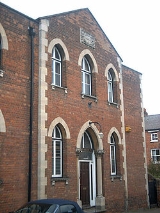
Masonic Lodge

Encyclopedia
This article is about the Masonic term for a membership group. For buildings named Masonic Lodge, see Masonic Lodge (disambiguation)
A Masonic Lodge, often termed a Private Lodge or Constituent Lodge, is the basic organisation of Freemasonry
. Every new Lodge must be warranted or chartered by a Grand Lodge, but is subject to its direction only in enforcing the published Constitution of the jurisdiction. By exception the three surviving lodges that formed the world's first known Grand Lodge in London (today called the United Grand Lodge of England
) have the unique privilege to operate as time immemorial i.e. without such warrant; only one other lodge operates without a warrant - this is the Grand Stewards' Lodge in London, although it is not also entitled to the "time immemorial" title. A Freemason is generally entitled to visit any Lodge, in any jurisdiction (i.e. under any Grand Lodge) in amity with his own. In some jurisdictions this privilege is restricted to Master Masons (that is, Freemasons who have attained the Order's third degree). He is first usually required to check, and certify, the regularity of the relationship of the Lodge - and be able to satisfy that Lodge of his regularity of membership. Freemasons gather together as a Lodge to work the three basic Degrees of Entered Apprentice, Fellowcraft and Master Mason.
Blue Lodges, Craft Lodges or Ancient Craft Lodges refer to the lodges that work the first three Masonic degrees, rather than the appendant Masonic orders
such as York Rite
and Scottish Rite
. The term "Craft Lodge" is used in Great Britain
. The Blue Lodge is said to refer to the traditional colour of regalia in Lodges derived from English or Irish Freemasonry. Although the term was originally frowned upon, it has gained widespread and mainstream usage in America in recent times.
Research Lodge
s have the purpose of furthering Masonic scholarship. Quatuor Coronati Lodge
is an example of a Research Lodge; it has a strictly limited membership and receives visitors and papers from all over the world. Many jurisdictions have well-established Research Lodges, which usually meet less frequently than Blue Lodges and do not confer degrees.
In Great Britain, a Lodge of Instruction may be associated with a Lodge, but is not constituted separately. The Lodge of Instruction provides the Officers and those who wish to become Officers an opportunity to rehearse ritual under the guidance of an experienced brother; there may also be lectures around the ritual and the symbolism in the lodge within a Lodge of Instruction, in order to develop the knowledge and understanding of the membership.
In some jurisdictions in the United States, the Lodge of Instruction serves as a warranted lodge for candidate instruction in other aspects of Freemasonry besides ritual rehearsal, as well as hosting a speaker on topics both Masonic and non-Masonic.
In Great Britain, the term Mother Lodge is used to identify the particular Lodge where the individual was first "made a Mason" (i.e. received his Entered Apprentice degree). 'Mother Lodge' may also refer to a Lodge which sponsors the creation of a new Lodge, the Daughter Lodge, to be warranted under the jurisdiction of the same Grand Lodge; specific procedures pertaining to this vary throughout history and in different jurisdictions. Lodge Mother Kilwinning
No 0 in the Grand Lodge of Scotland
is known as the Mother Lodge of Scotland, having been referred to in the Schaw Statutes of 1598 and 1599, and having itself warranted other Lodges at a time when it did not subscribe to a Grand Lodge.
s or Grand Orients, whose published constitutions define the structure of freemasonry under their authority, and which appoint Grand Officers from their senior masons. Provincial Grand Lodges (which in England generally correspond to historic counties) exercise an intermediate authority, and also appoint Provincial Grand Officers.
Different Grand Lodges and their regions show subtleties of tradition and variation in the degrees and practice; for example under the Grand Lodge of Scotland
, the Mark Degree (which is unrecognised by the United Grand Lodge of England
, but has a separate Mark Grand Lodge) is integrated into "The Craft" as a completion of the second degree. In any case, Grand Lodges have limited jurisdiction over their member Lodges, and where there is no prescribed ritual Lodges may thus have considerable freedom of practice. Despite these minor differences, fraternal relations exist between Lodges of corresponding degrees under different Grand Lodges.
Master Masons are considered full lifetime members of the Lodge where they received their degrees, unless they are "dropped from the rolls" due to violations such as non-payment of dues, or if they resign, usually for personal reasons or to join another Lodge in those jurisdictions where multiple membership is not permitted. A Mason may be expelled from his Lodge and Freemasonry in general if convicted of particularly serious violations of Civil or Masonic law.
A Master Mason "in good standing" (i.e. whose dues are current and who is not subject to Masonic investigation or discipline) may join another regular Lodge; he need not take his degrees again, but may be expected to serve the new Lodge in office.
If a Master Mason is dropped from the rolls for non-payment of dues, under most circumstances he may be immediately reinstated in good standing simply by paying his current dues as well as any back dues owed, although in many jurisdictions there is a requirement to ballot for re-admission.
Many Grand Lodges permit Master Masons to be "plural affiliates," or members of more than one Lodge simultaneously. In some jurisdictions plural affiliates are prohibited from serving as an elected officer of more than one Lodge at any given time.
These rules are different for Freemasons of the Entered Apprentice and Fellowcraft Degrees. In some Grand Lodges an Entered Apprentice or Fellowcraft may not receive a demit, but may join another Lodge with the intent of earning the Master Mason Degree with the consent of his original Lodge.
There are certain 'progressive' offices through which members move by a process of effective promotion, but also other more permanent offices, usually held by experienced members.
Masonic Lodge (disambiguation)
A Masonic Lodge is a basic organizational unit in Freemasonry.Masonic Lodge may also refer to one of several specific buildings:*Masonic Lodge No. 238, Dalton, Georgia, listed on the NRHP in Whitfield County...
A Masonic Lodge, often termed a Private Lodge or Constituent Lodge, is the basic organisation of Freemasonry
Freemasonry
Freemasonry is a fraternal organisation that arose from obscure origins in the late 16th to early 17th century. Freemasonry now exists in various forms all over the world, with a membership estimated at around six million, including approximately 150,000 under the jurisdictions of the Grand Lodge...
. Every new Lodge must be warranted or chartered by a Grand Lodge, but is subject to its direction only in enforcing the published Constitution of the jurisdiction. By exception the three surviving lodges that formed the world's first known Grand Lodge in London (today called the United Grand Lodge of England
United Grand Lodge of England
The United Grand Lodge of England is the main governing body of freemasonry within England and Wales and in other, predominantly ex-British Empire and Commonwealth countries outside the United Kingdom. It is the oldest Grand Lodge in the world, deriving its origin from 1717...
) have the unique privilege to operate as time immemorial i.e. without such warrant; only one other lodge operates without a warrant - this is the Grand Stewards' Lodge in London, although it is not also entitled to the "time immemorial" title. A Freemason is generally entitled to visit any Lodge, in any jurisdiction (i.e. under any Grand Lodge) in amity with his own. In some jurisdictions this privilege is restricted to Master Masons (that is, Freemasons who have attained the Order's third degree). He is first usually required to check, and certify, the regularity of the relationship of the Lodge - and be able to satisfy that Lodge of his regularity of membership. Freemasons gather together as a Lodge to work the three basic Degrees of Entered Apprentice, Fellowcraft and Master Mason.
Types
Freemasons meet as a Lodge not in a Lodge, although Masonic premises may be called Lodges, as well as Temples ("of Philosophy and the Arts"). In many countries Masonic Centre or Hall has now replaced these terms to avoid arousing prejudice and suspicion. Several different Lodges, or other Masonic organisations, often use the same premises at different times.Blue Lodges, Craft Lodges or Ancient Craft Lodges refer to the lodges that work the first three Masonic degrees, rather than the appendant Masonic orders
Masonic appendant bodies
The fraternity of Freemasonry, also known as "Free and Accepted Masons," is organized by private groups of members variously known in English as lodges, chapters, councils, commanderies, consistories, etc., which can be collectively referred to as Masonic bodies.The basic unit to which an...
such as York Rite
York Rite
The York Rite or American Rite is one of several Rites of the worldwide fraternity known as Freemasonry. A Rite is a series of progressive degrees that are conferred by various Masonic organizations or bodies, each of which operates under the control of its own central authority...
and Scottish Rite
Scottish Rite
The Ancient and Accepted Scottish Rite of Freemasonry , commonly known as simply the Scottish Rite, is one of several Rites of the worldwide fraternity known as Freemasonry...
. The term "Craft Lodge" is used in Great Britain
Great Britain
Great Britain or Britain is an island situated to the northwest of Continental Europe. It is the ninth largest island in the world, and the largest European island, as well as the largest of the British Isles...
. The Blue Lodge is said to refer to the traditional colour of regalia in Lodges derived from English or Irish Freemasonry. Although the term was originally frowned upon, it has gained widespread and mainstream usage in America in recent times.
Research Lodge
Research Lodge
A Research Lodge is a Masonic lodge that is devoted to Masonic research. It is a lodge, and as such has a charter from some Grand Lodge. However, it does not confer degrees, and restricts membership to Master Masons of some jurisdiction in amity with the jurisdiction that the research lodge is in...
s have the purpose of furthering Masonic scholarship. Quatuor Coronati Lodge
Quatuor Coronati Lodge
Quatuor Coronati Lodge No. 2076 is a Masonic lodge in London dedicated to Masonic research. Founded in 1886, the lodge meets at Freemasons' Hall, Great Queen Street....
is an example of a Research Lodge; it has a strictly limited membership and receives visitors and papers from all over the world. Many jurisdictions have well-established Research Lodges, which usually meet less frequently than Blue Lodges and do not confer degrees.
In Great Britain, a Lodge of Instruction may be associated with a Lodge, but is not constituted separately. The Lodge of Instruction provides the Officers and those who wish to become Officers an opportunity to rehearse ritual under the guidance of an experienced brother; there may also be lectures around the ritual and the symbolism in the lodge within a Lodge of Instruction, in order to develop the knowledge and understanding of the membership.
In some jurisdictions in the United States, the Lodge of Instruction serves as a warranted lodge for candidate instruction in other aspects of Freemasonry besides ritual rehearsal, as well as hosting a speaker on topics both Masonic and non-Masonic.
In Great Britain, the term Mother Lodge is used to identify the particular Lodge where the individual was first "made a Mason" (i.e. received his Entered Apprentice degree). 'Mother Lodge' may also refer to a Lodge which sponsors the creation of a new Lodge, the Daughter Lodge, to be warranted under the jurisdiction of the same Grand Lodge; specific procedures pertaining to this vary throughout history and in different jurisdictions. Lodge Mother Kilwinning
Lodge Mother Kilwinning
Lodge Mother Kilwinning is a Masonic Lodge in Kilwinning, Scotland under the auspices of the Grand Lodge of Scotland. It is number 0 on the Roll, and is reputed to be the oldest Lodge not only in Scotland, but the world...
No 0 in the Grand Lodge of Scotland
Grand Lodge of Scotland
The Grand Lodge of Antient, Free and Accepted Masons of Scotland was founded in 1736 – although only a third of all lodges were represented at the foundation meeting of the Grand Lodge....
is known as the Mother Lodge of Scotland, having been referred to in the Schaw Statutes of 1598 and 1599, and having itself warranted other Lodges at a time when it did not subscribe to a Grand Lodge.
Organization
Lodges are governed by national, state or provincial authorities, usually called Grand LodgeGrand Lodge
A Grand Lodge, or "Grand Orient", is the usual governing body of "Craft", or "Blue Lodge", Freemasonry in a particular jurisdiction. The first Masonic Grand Lodge was established in England in 1717 as the Premier Grand Lodge of England....
s or Grand Orients, whose published constitutions define the structure of freemasonry under their authority, and which appoint Grand Officers from their senior masons. Provincial Grand Lodges (which in England generally correspond to historic counties) exercise an intermediate authority, and also appoint Provincial Grand Officers.
Different Grand Lodges and their regions show subtleties of tradition and variation in the degrees and practice; for example under the Grand Lodge of Scotland
Scotland
Scotland is a country that is part of the United Kingdom. Occupying the northern third of the island of Great Britain, it shares a border with England to the south and is bounded by the North Sea to the east, the Atlantic Ocean to the north and west, and the North Channel and Irish Sea to the...
, the Mark Degree (which is unrecognised by the United Grand Lodge of England
United Grand Lodge of England
The United Grand Lodge of England is the main governing body of freemasonry within England and Wales and in other, predominantly ex-British Empire and Commonwealth countries outside the United Kingdom. It is the oldest Grand Lodge in the world, deriving its origin from 1717...
, but has a separate Mark Grand Lodge) is integrated into "The Craft" as a completion of the second degree. In any case, Grand Lodges have limited jurisdiction over their member Lodges, and where there is no prescribed ritual Lodges may thus have considerable freedom of practice. Despite these minor differences, fraternal relations exist between Lodges of corresponding degrees under different Grand Lodges.
Membership
After a Lodge elects or approves a candidate in accordance with the requirements of its Grand Lodge, it will decide whether to give the candidate each degree in order. Generally speaking those who have only received the Entered Apprentice degree are considered Freemasons, but hold limited privileges until they attain the Master Mason degree; under UGLE only a Master Mason will receive a Grand Lodge certificate, which may be demanded by any other Lodge he wishes to visit.Master Masons are considered full lifetime members of the Lodge where they received their degrees, unless they are "dropped from the rolls" due to violations such as non-payment of dues, or if they resign, usually for personal reasons or to join another Lodge in those jurisdictions where multiple membership is not permitted. A Mason may be expelled from his Lodge and Freemasonry in general if convicted of particularly serious violations of Civil or Masonic law.
A Master Mason "in good standing" (i.e. whose dues are current and who is not subject to Masonic investigation or discipline) may join another regular Lodge; he need not take his degrees again, but may be expected to serve the new Lodge in office.
If a Master Mason is dropped from the rolls for non-payment of dues, under most circumstances he may be immediately reinstated in good standing simply by paying his current dues as well as any back dues owed, although in many jurisdictions there is a requirement to ballot for re-admission.
Many Grand Lodges permit Master Masons to be "plural affiliates," or members of more than one Lodge simultaneously. In some jurisdictions plural affiliates are prohibited from serving as an elected officer of more than one Lodge at any given time.
These rules are different for Freemasons of the Entered Apprentice and Fellowcraft Degrees. In some Grand Lodges an Entered Apprentice or Fellowcraft may not receive a demit, but may join another Lodge with the intent of earning the Master Mason Degree with the consent of his original Lodge.
Officers
The names, roles and numbers of Lodge officers vary widely from jurisdiction to jurisdiction. In most cases, there is an equivalent office in the Grand Lodge of the given jurisdiction, with the addition of the prefix 'Grand' to the title in question.There are certain 'progressive' offices through which members move by a process of effective promotion, but also other more permanent offices, usually held by experienced members.