All Topics  
Car handling

 
Car Handling

   Email Print
   Bookmark   Link


Car handling


Car handling and vehicle handling is a description of the way wheeled vehicles perform transverse to their direction of motion, particularly during cornering and swerving. It also includes their stability when moving in a straight line. Handling and braking are the major components of a vehicle's "active" safety. The maximum lateral acceleration is sometimes discussed separately as "road holding".





Discussion
Ask a question about 'Car handling'
Start a new discussion about 'Car handling'
Answer questions from other users
Full Discussion Forum


Recent Posts


Encyclopedia


Car handling and vehicle handling is a description of the way wheeled vehicles perform transverse to their direction of motion, particularly during cornering and swerving. It also includes their stability when moving in a straight line. Handling and braking are the major components of a vehicle's "active" safety. The maximum lateral acceleration is sometimes discussed separately as "road holding". Handling is an esoteric performance area because rapid and violent manoeuvres are often only used in unforeseen circumstances. (This discussion is directed at road vehicles with at least three wheels, but some of it may apply to other ground vehicles.)

Cars that drive on public roads, whose engineering requirements emphasize handling above passenger space and comfort, are called sports car
Sports car

A sports car is a term used to describe a class of automobile. The exact definition varies, but generally it is used to refer to a low to ground, light weight vehicle with a powerful engine....
s.

Factors that affect a car's handling


Weight distribution


Center of gravity height

The center of gravity height, relative to the track, determines load transfer
Load transfer

In automobiles, load transfer is the imaginary "shifting" of weight around a motor vehicle during acceleration . This includes Brake, and deceleration ....
, (related to, but not exactly weight transfer
Weight transfer

In automobiles, weight transfer ,refers to the redistribution of weight supported by each tire during acceleration . This includes Brake, or deceleration ....
), from side to side and causes body lean. Centrifugal force acts at the center of gravity to lean the car toward the outside of the curve, increasing downward force on the outside tires.

Height of the center of gravity relative to the wheelbase determines load transfer between front and rear. The car's momentum acts at its center of gravity to tilt the car forward or backward, respectively during braking and acceleration. Since it is only the downward force that changes and not the location of the center of gravity, the effect on over/under steer is opposite to that of an actual change in the center of gravity. When a car is braking, the downward load on the front tires increases and that on the rear decreases, with corresponding change in their ability to take sideways load, causing oversteer
Oversteer

Oversteer is a phenomenon that can occur in an automobile while attempting to corner or while already cornering. The car is said to oversteer when the rear wheels do not track behind the front wheels but instead slide out toward the outside of the turn....
.

Lower center of gravity is the principal performance advantage of sports car
Sports car

A sports car is a term used to describe a class of automobile. The exact definition varies, but generally it is used to refer to a low to ground, light weight vehicle with a powerful engine....
s, compared to sedans and (especially) SUVs. Some cars have light materials in their roofs, partly for this reason. It is also part of the reason that traditional sports cars are open or convertible.

Body lean can also be controlled by the springs, anti-roll bars or the roll center
Roll center

The roll center of a vehicle is the notional point at which the cornering forces in the suspension are reacted to the vehicle body.Theory...
 heights.

Center of gravity forward or back
In steady-state cornering, because of the center of gravity, front-heavy cars tend to understeer
Understeer

Understeer is a term for a car handling condition in which during cornering the circular path of the vehicle's motion is of a greater radius than the circle indicated by the direction its wheels are pointed....
 and rear-heavy cars to oversteer, all other things being equal. The mid-engine design
Mid-engine design

A mid-engine layout describes the placement of an automobile internal-combustion engine between the rear and front axles. Another term for this is mid-ship....
 offers the ideal center of gravity.

When all four wheels and tires are of equal size, as is most often the case with passenger cars, a weight distribution close to "50/50" (i.e. the center of mass
Center of mass

The center of mass of a system of wiktionary:Particles is a specific point at which, for many purposes, the system's mass behaves as if it were concentrated....
 is mid-way between the front and rear axles) produces the preferred handling compromise.

The rearward weight bias preferred by sports and racing cars results from handling effects during the transition from straight-ahead to cornering. During corner entry the front tires, in addition to generating part of the lateral force required to accelerate the car's center of mass
Center of mass

The center of mass of a system of wiktionary:Particles is a specific point at which, for many purposes, the system's mass behaves as if it were concentrated....
 into the turn, also generate a torque about the car's vertical axis that starts the car rotating into the turn. However, the lateral force being generated by the rear tires is acting in the opposite torsional sense, trying to rotate the car out of the turn. For this reason, a car with "50/50" weight distribution will understeer on initial corner entry. To avoid this problem, sports and racing cars often have a more rearward weight distribution. In the case of pure racing cars, this is typically between "40/60" and "35/65." This gives the front tires an advantage in overcoming the car's moment of inertia
Moment of inertia

Moment of inertia, also called mass moment of inertia or the angular mass, is a measure of an object's resistance to changes in its rotation rate....
 (yaw angular inertia), thus reducing corner-entry understeer.

Using wheels and tires of different sizes (proportional to the weight carried by each end) is a lever automakers can use to fine tune the resulting over/understeer characteristics.

Roll angular inertia
This increases the time it takes to settle down and follow the steering. It depends on the (square of the) height and width, and (for a uniform mass distribution) can be approximately calculated by the equation: .

Greater width, then, though it counteracts center of gravity height, hurts handling by increasing angular inertia. Some high performance cars have light materials in their fenders and roofs partly for this reason.

Yaw and pitch angular inertia
Moment of inertia

Moment of inertia, also called mass moment of inertia or the angular mass, is a measure of an object's resistance to changes in its rotation rate....
 (polar moment)
Unless the vehicle is very short, compared to its height or width, these are about equal. Angular inertia determines the rotational inertia of an object for a given rate of rotation. The yaw
Yaw angle

The yaw angle is the angle between a vehicle's heading and a reference heading . One of the Tait-Bryan angles. In aeronautics, robotics and marine control, it is typically assigned the shorthand notation ....
 angular inertia tends to keep the direction the car is pointing changing at a constant rate. This makes it slower to swerve or go into a tight curve, and it also makes it slower to turn straight again. The pitch angular inertia detracts from the ability of the suspension to keep front and back tire loadings constant on uneven surfaces and therefore contributes to bump steer. Angular inertia is an integral over the square of the distance from the center of gravity, so it favors small cars even though the lever arms (wheelbase and track) also increase with scale. (Since cars have reasonable symmetrical shapes, the off-diagonal terms of the angular inertia tensor
Tensor

A tensor is an object which extends the notion of Scalar , Vector , and Matrix . The term has slightly different meanings in mathematics and physics....
 can usually be ignored.) Mass near the ends of a car can be avoided, without re-designing it to be shorter, by the use of light materials for bumpers and fenders or by deleting them entirely.

Suspension

Automobile suspension
Suspension (vehicle)

Suspension is the term given to the system of spring , shock absorbers and Linkage that connects a vehicle to its wheels. Suspension systems serve a dual purpose ? contributing to the car's car handling and brake for good active safety and driving pleasure, and keeping vehicle occupants comfortable and reasonably well isolated from road no...
s have many variable characteristics, which are generally different in the front and rear and all of which affect handling. Some of these are: spring rate, damping, straight ahead camber angle
Camber angle

Camber angle is the angle made by the wheel of an automobile; specifically, it is the angle between the vertical axis of the wheel and the vertical axis of the vehicle when viewed from the front or rear....
, camber change with wheel travel, roll center height and the flexibility and vibration modes of the suspension elements. Suspension also affects unsprung weight.

Many cars have suspension that connects the wheels on the two sides, either by a sway bar
Sway bar

A sway bar is an automobile suspension device. It connects opposite wheels together through short lever arms linked by a torsion spring. A sway bar increases the suspension's roll stiffness?its resistance to roll in turns, independent of its Hooke's law#Spring equation in the vertical direction....
 and/or by a solid axle. The Citroën 2CV
Citroën 2CV

The Citro?n 2CV is an economy car produced by the France automaker Citro?n from 1949 to 1990. It is considered one of their most cultural icon cars....
 has interaction between the front and rear suspension.

The flexing of the frame interacts with the suspension. (See below.)

Suspension travel
The severe handling vice of the TR3
Triumph TR3B

The Triumph TR3"B" is a sports car and was produced by the Triumph Motor Company in 1962. It followed the Triumph TR3A and was offered concurrent with the Triumph TR4, which started production in 1961....
 and related cars was caused by running out of suspension travel. (See below.) Other vehicles will run out of suspension travel with some combination of bumps and turns, with similarly catastrophic effect. Excessively modified cars also may encounter this problem.

Tires and wheels

In general, larger tire
Tire

Tires, or tyres , are ring-shaped parts, either pneumatic or solid , that fit around wheels to protect them and enhance their function....
s, softer rubber
Rubber

Natural rubber is an elastomer?an Elasticity_ hydrocarbon polymer?that was originally derived from a milky colloidal suspension, or latex , found in the sap of some plants....
, higher hysteresis
Hysteresis

A system with hysteresis can be summarized as a system that may be in any number of states, independent of the inputs to the system. To be exact, a system with hysteresis exhibits path-dependence, or "rate-independent memory"....
 rubber and stiffer cord configurations increase road holding and improve handling. On most types of poor surfaces, large diameter wheel
Wheel

A wheel is a circular device that is capable of rotating on its axis, facilitating movement or transportation whilst supporting a load , or performing labour in machines....
s perform better than lower wider wheels. The fact that larger tires, relative to weight, stick better is the main reason that front heavy cars tend to understeer and rear heavy to oversteer. The depth of tread remaining greatly affects aquaplaning (riding over deep water without reaching the road surface). Increasing tire pressures reduces their slip angle, but (for given road conditions and loading) there is an optimum pressure for road holding.

Track and wheelbase

The track provides the resistance to sideways weight transfer and body lean. The wheelbase provides resistance to front/back weight transfer and to pitch angular inertia, and provides the torque lever arm to rotate the car when swerving. The wheelbase, however, is less important than angular inertia (polar moment) to the vehicle's ability to swerve quickly.

Unsprung weight

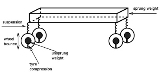
Car Diagram
Ignoring the flexing of other components, a car can be modeled as the sprung weight, carried by the springs, carried by the unsprung weight
Unsprung weight

In a ground vehicle with a suspension , the unsprung weight is the mass of the suspension, wheels or Caterpillar tracks , and other components directly connected to them, rather than supported by the suspension....
, carried by the tires, carried by the road. Without the unsprung weight, the force of a tire on the road would come from the vehicle weight and motion, transmitted by the spring. But the unsprung weight is cushioned from uneven road surfaces only by the springiness of the tires (and wire wheels if fitted). To alleviate this (for fuel economy
Fuel economy in automobiles

Fuel economy in automobiles is the amount of fuel required to move the automobile over a given distance. While the fuel efficiency of petroleum internal combustion engine has improved markedly in recent decades, , this does not necessarily translate into better fuel economy, if larger and heavier vehicles are used, or if that effici...
 and to avoid overheating at high speed) tires have limited internal damping. So the "wheel bounce" or resonant motion of the unsprung weight moving up and down on the springiness of the tire is only poorly damped, mainly by the dampers or Shock absorber
Shock absorber

A shock absorber in common parlance is a mechanical device designed to smooth out or damping shock impulse, and dissipate kinetic energy....
s of the suspension. For these reasons, high unsprung weight reduces road holding and increases unpredictable changes in direction on rough surfaces (as well as degrading ride comfort
Ride quality

Ride quality refers to the degree of protection offered vehicle occupants from uneven elements in the road surface, or the terrain if driving off-road....
 and increasing mechanical loads).

This unsprung weight includes the wheels and tires, usually the brake
Brake

A brake is a device for applying a force against the friction of the road, slowing or stopping the motion of a machine or vehicle, or alternatively a device to restrain it from starting to move again....
s, plus some percentage of the suspension, depending on how much of the suspension moves with the body and how much with the wheels; for instance a solid axle is completely unsprung. The main factors that improve unsprung weight are a sprung differential (as opposed to live axle
Live axle

A live axle, sometimes called a solid axle, is a type of beam axle suspension that uses the driveshafts that transmit power to the wheels to connect the wheels laterally so that they move together as a unit....
) and inboard brake
Inboard brake

An inboard braking system is an automobile technology wherein the brakes are mounted so as not to contribute to the vehicles unsprung weight. Inboard brakes are by definition always used on axles that have independent suspension....
s. (The De Dion tube
De Dion tube

A de Dion tube is an automobile suspension technology. It is a sophisticated form of non-independent suspension and is a considerable improvement over the alternative swing axle and Hotchkiss drive types....
 suspension operates much as a live axle does, but represents an improvement because the diff is mounted to the body, thereby reducing the unsprung weight.) Aluminum wheels also help. Magnesium alloy wheels are even lighter but corrode easily.

Since only the brakes on the driving wheels can easily be inboard, the Citroën 2CV
Citroën 2CV

The Citro?n 2CV is an economy car produced by the France automaker Citro?n from 1949 to 1990. It is considered one of their most cultural icon cars....
 had inertial dampers on its rear wheel hubs to damp only wheel bounce.

Aerodynamics

Aerodynamic forces are generally proportional to the square of the air speed, therefore car aerodynamics become rapidly more important as speed increases. Like darts, aeroplanes, etc., cars can be stabilised by fins and other rear aerodynamic devices. However, in addition to this cars also use downforce or "negative lift" to improve road holding. This is prominent on many types of racing cars, but is also used on most passenger cars to some degree, if only to counteract the tendency for the car to otherwise produce positive lift.

In addition to providing increased adhesion, car aerodynamics are frequently designed to compensate for the inherent increase in oversteer as cornering speed increases. When a car corners, it must rotate about its vertical axis as well as translate its center of mass
Center of mass

The center of mass of a system of wiktionary:Particles is a specific point at which, for many purposes, the system's mass behaves as if it were concentrated....
 in an arc. However, in a tight-radius (lower speed) corner the angular velocity
Angular velocity

In physics, the angular velocity is a vector quantity which specifies the angular speed, and axis about which an object is rotating. The SI unit of angular velocity is radians per second, although it may be measured in other units such as degrees per second, revolutions per second, degrees per hour, etc....
 of the car is high, while in a longer-radius (higher speed) corner the angular velocity
Angular velocity

In physics, the angular velocity is a vector quantity which specifies the angular speed, and axis about which an object is rotating. The SI unit of angular velocity is radians per second, although it may be measured in other units such as degrees per second, revolutions per second, degrees per hour, etc....
 is much lower. Therefore, the front tires have a more difficult time overcoming the car's moment of inertia
Moment of inertia

Moment of inertia, also called mass moment of inertia or the angular mass, is a measure of an object's resistance to changes in its rotation rate....
 during corner entry at low speed, and much less difficulty as the cornering speed increases. So the natural tendency of any car is to understeer on entry to low-speed corners and oversteer on entry to high-speed corners. To compensate for this unavoidable effect, car designers often bias the car's handling toward less corner-entry understeer (such as by lowering the front roll center
Roll center

The roll center of a vehicle is the notional point at which the cornering forces in the suspension are reacted to the vehicle body.Theory...
), and add rearward bias to the aerodynamic downforce to compensate in higher-speed corners. The rearward aerodynamic bias may be achieved by an airfoil or "spoiler" mounted near the rear of the car, but a useful effect can also be achieved by careful shaping of the body as a whole, particularly the aft areas

Delivery of power to the wheels and brakes

The coefficient of friction of rubber on the road limits the magnitude of the vector sum of the transverse and longitudinal force. So the driven wheels or those supplying the most braking
Brake

A brake is a device for applying a force against the friction of the road, slowing or stopping the motion of a machine or vehicle, or alternatively a device to restrain it from starting to move again....
 tend to slip sideways. This phenomenon is often explained by use of the circle of forces
Circle of forces

The Circle of forces or Traction circle is a useful way to think about the dynamic interaction between a vehicle's tire and the road surface....
 model.

One reason that sports cars are usually rear wheel drive is that power induced oversteer is useful, to a skilled driver, for tight curves. The weight transfer under acceleration has the opposite effect and either may dominate, depending on the conditions. Inducing understeer by applying power in a front wheel drive car is useful via proper use of "Left-foot braking
Left-foot braking

Left-foot braking is the technique of using the left foot to operate the brake pedal in an automobile, leaving the right foot dedicated to the throttle pedal....
." In any case, this is not an important safety issue, because power is not normally used in emergency situations. Using low gears down steep hills may cause some oversteer.

The effect of braking on handling is complicated by load transfer
Load transfer

In automobiles, load transfer is the imaginary "shifting" of weight around a motor vehicle during acceleration . This includes Brake, and deceleration ....
, which is proportional to the (negative) acceleration times the ratio of the center of gravity height to the wheelbase. The difficulty is that the acceleration at the limit of adhesion depends on the road surface, so with the same ratio of front to back braking force, a car will understeer under braking on slick surfaces and oversteer under hard braking on solid surfaces. Most modern cars combat this by varying the distribution of braking in some way. This is important with a high center of gravity, but it is also done on low center of gravity cars, from which a higher level of performance is expected.

Steering

Depending on the driver, steering
Steering

Steering is the term applied to the collection of components, linkages, etc. which will allow for a vessel or vehicle to follow the desired course....
 force and transmission of road forces back to the steering wheel and the steering ratio
Steering ratio

Steering ratio refers to the ratio between the turn of the steering wheel or handlebars and the turn of the wheels . In motorcycles and bicycles, the steering ratio is always 1:1, while in most passenger cars, it is between 12 and 20:1....
 of turns of the steering wheel to turns of the road wheels affect control and awareness. Play — free rotation of the steering wheel before the wheels rotate — is a common problem, especially in older model and worn cars. Another is friction. Rack and pinion
Rack and pinion

A rack and pinion is a pair of gears which convert rotational motion into linear motion. The circular pinion engages teeth on a flat bar - the rack....
 steering is generally considered the best type of mechanism for control effectiveness. The linkage also contributes play and friction. Caster — offset of the steering axis from the contact patch
Contact patch

Contact patch is the portion of a vehicle's tire that is in actual contact with the road surface.It is most commonly used in the discussion of pneumatic tires, , where the term is strictly used to describe the portion of the tire?s tread that touches the road surface....
 — provides some of the self-centering tendency.

Precision of the steering is particularly important on ice or hard packed snow where the slip angle at the limit of adhesion is smaller than on dry roads.

The steering effort depends on the downward force on the steering tires and on the radius of the contact patch. So for constant tire pressure, it goes like the 1.5 power of the vehicle's weight. The driver's ability to exert torque on the wheel scales similarly with his size. The wheels must be rotated farther on a longer car to turn with a given radius. Power steering
Power steering

Power steering is a system for reducing the steering effort on vehicles by using an external power source to assist in turning the wheel.The earliest known patent related to power steering was filed on August 30, 1932, by Francis W....
 reduces the required force at the expense of feel. It is useful, mostly in parking, when the weight of a front-heavy vehicle exceeds about ten or fifteen times the driver's weight, for physically impaired drivers and when there is much friction in the steering mechanism.

Four-wheel steering
Steering

Steering is the term applied to the collection of components, linkages, etc. which will allow for a vessel or vehicle to follow the desired course....
 has begun to be used on road cars (Some WW II reconnaissance vehicles had it). It relieves the effect of angular inertia by starting the whole car moving before it rotates toward the desired direction. It can also be used, in the other direction, to reduce the turning radius. Some cars will do one or the other, depending on the speed.

Steering geometry changes due to bumps in the road may cause the front wheels to steer in different directions together or independent of each other. The steering linkage should be designed to minimize this effect.

Electronic stability control
Electronic Stability Control

Electronic stability control is a computerized technology that improves the safety of a car handling by detecting and preventing skids. When ESC detects loss of steering control, ESC automatically applies individual brakes to help "steer" the vehicle where the driver wants to go....
 

Since automobile safety is mainly a control issue, one should expect a largely electronic solution. Apparently there has already been some advance in this direction.

On the other hand, since stability control works by reducing sudden manoeuvres, until the electronics helps to detect the danger sooner, it can never take the place of a low center of gravity, which provides both stability and fast avoidance. (See Wireless vehicle safety communications.)

The stability control of some cars may not be compatible with some driving techniques, such as power induced over-steer. It is therefore, at least from a sporting point of view, preferable that it can be disabled.

Static alignment of the wheels

Of course things should be the same, left and right, for road cars. Camber affects steering because a tire generates a force towards the side that the top is leaning towards. This is called camber thrust. Additional front negative camber is used to improve the cornering ability of cars with insufficient camber gain.

Rigidity of the frame

The frame may flex with load, especially twisting on bumps. Rigidity is considered to help handling. At least it simplifies the suspension engineers work. Some cars, such as the Mercedes-Benz 300SL
Mercedes-Benz 300SL

The Mercedes-Benz 300SL was introduced in 1954 as a two-seat, closed sports car with characteristic gull-wing doors. Later it was offered as an open roadster....
 have had high doors to allow a stiffer frame.

Driver handling the car

Handling is a property of the car, but different characteristics will work well with different drivers.

Familiarity

A person learns to control a car much as he learns to control his body, so the more he has driven a car or type of car the better it will handle for them. One needs to take extra care for the first few months after buying a car, especially if it differs in design from those they are used to. Other things that a driver must adjust to include changes in tires, tire pressures and load. That is, handling is not just good or bad; it is also the same or different.

Position and support for the driver

Having to take up "g forces" in his/her arms interferes with a driver's precise steering. In a similar manner, a lack of support for the seating position of the driver may cause them to move around as the car undergoes rapid acceleration (through cornering, taking off or braking). This interferes with precise control inputs, making the car more difficult to control.

Being able to reach the controls easily is also an important consideration, especially if a car is being driven hard.

In some circumstances, good support may allow a driver to retain some control, even after a minor accident or after the first stage of an accident.

External conditions that affect handling


Weather

Weather affects handling by making the road slippery. Different tire
Tire

Tires, or tyres , are ring-shaped parts, either pneumatic or solid , that fit around wheels to protect them and enhance their function....
s do best in different weather. Deep water is an exception to the rule that wider tires improve road holding. (See aquaplaning under tires, below.)

Road condition

Cars with relatively soft suspension and with low unsprung weight
Unsprung weight

In a ground vehicle with a suspension , the unsprung weight is the mass of the suspension, wheels or Caterpillar tracks , and other components directly connected to them, rather than supported by the suspension....
 are least affected by uneven surfaces, while on flat smooth surfaces the stiffer the better. Unexpected water, ice, oil, etc. are hazards.

Common handling problems

When any wheel leaves contact with the road there is a change in handling, so the suspension should keep all four (or three) wheels on the road in spite of hard cornering, swerving and bumps in the road. It is very important for handling, as well as other reasons, not to run out of suspension travel and "bottom" or "top".

It is usually most desirable to have the car adjusted
Racing setup

In auto racing, the racing setup or car setup is the set of adjustments made to the vehicle in order to optimize its behaviour . Adjustments can occur in Suspension , brakes, Transmission , and many others....
 for a small amount of understeer
Understeer

Understeer is a term for a car handling condition in which during cornering the circular path of the vehicle's motion is of a greater radius than the circle indicated by the direction its wheels are pointed....
, so that it responds predictably to a turn of the steering wheel and the rear wheels have a smaller slip angle than the front wheels. However this may not be achievable for all loading, road and weather conditions, speed ranges, or while turning under acceleration or braking. Ideally, a car should carry passengers and baggage near its center of gravity and have similar tire loading, camber angle
Camber angle

Camber angle is the angle made by the wheel of an automobile; specifically, it is the angle between the vertical axis of the wheel and the vertical axis of the vehicle when viewed from the front or rear....
 and roll stiffness in front and back to minimise the variation in handling characteristics. A driver can learn to deal with excessive oversteer or understeer, but not if it varies greatly in a short period of time.

The most important common handling failings are;

  • Understeer
    Understeer

    Understeer is a term for a car handling condition in which during cornering the circular path of the vehicle's motion is of a greater radius than the circle indicated by the direction its wheels are pointed....
     - the front wheels tend to crawl slightly or even slip and drift towards the outside of the turn. The driver can compensate by turning a little more tightly, but road-holding is reduced, the car's behaviour is less predictable and the tires are liable to wear more quickly.


  • Oversteer
    Oversteer

    Oversteer is a phenomenon that can occur in an automobile while attempting to corner or while already cornering. The car is said to oversteer when the rear wheels do not track behind the front wheels but instead slide out toward the outside of the turn....
     - the rear wheels tend to crawl or slip towards the outside of the turn more than the front. The driver must correct by steering away from the corner, otherwise the car is liable to spin, if pushed to its limit. Oversteer is sometimes useful, to assist in steering, especially if it occurs only when the driver chooses it by applying power.


  • Bump steer – Is the effect of irregularity of a road surface on the angle or motion of a car. It may be the result of the kinematic motion of the suspension rising or falling, causing toe-in or toe-out at the loaded wheel, ultimately affecting the yaw angle (heading) of the car. This will always happen under some conditions but depends on suspension, steering linkage, unsprung weight, angular inertia, differential type, frame rigidity, tires and tire pressures. If suspension travel is exhausted the wheel either bottoms or loses contact with the road. As with hard turning on flat roads, it is better if the wheel picks up by the spring reaching its neutral shape, rather than by suddenly contacting a limiting structure of the suspension.


  • Body roll
    Body roll

    On wheeled or tracked vehicles, body roll is a reference to the load transfer of a vehicle towards the outside of a turn. When a vehicle is fitted with a Suspension , it works to keep the wheels or tracked vehicle in contact with the road, providing grip for the driver of vehicle to control its direction....
     - the car leans towards the outside of the curve. This interferes with the driver's control, because he must wait for the car to finish leaning before he can fully judge the effect of his steering change. It also adds to the delay before the car moves in the desired direction.


  • Weight transfer
    Weight transfer

    In automobiles, weight transfer ,refers to the redistribution of weight supported by each tire during acceleration . This includes Brake, or deceleration ....
     - the wheels on the outside of a curve are more heavily loaded than those on the inside. This tends to overload the tires on the outside and therefore reduce road holding. Weight transfer (sum of front and back), in steady cornering, is determined by the ratio of the height of a car's center of gravity to its track. Differences between the weight transfer in front and back are determined by the relative roll stiffness and contribute to the over or under-steer characteristics.
    • When the weight transfer equals half the vehicle's loaded weight, it will start to roll over
      Rollover

      Rollover is a type of car accident, where a vehicle turns over on its side or roof. The main cause for rolling over is turning too sharply while moving too fast....
      . This can be avoided by manually or automatically reducing the turn rate, but this causes further reduction in road-holding. (A collision may be preferable to a rollover.)


  • Slow response - sideways acceleration does not start immediately when the steering is turned and may not stop immediately when it is returned to center. This is partly caused by body roll. Other causes include tires with high slip angle, and yaw and roll angular inertia. Roll angular inertia aggravates body roll by delaying it. Soft tires aggravate yaw angular inertia by waiting for the car to reach their slip angle before turning the car.


Compromises

Ride quality
Ride quality

Ride quality refers to the degree of protection offered vehicle occupants from uneven elements in the road surface, or the terrain if driving off-road....
 and handling have always been a compromise - technology has over time allowed automakers to combine more of both features in the same vehicle. High levels of comfort are difficult to reconcile with a low center of gravity, body roll resistance, low angular inertia, support for the driver, steering feel and other characteristics that make a car handle well.

For ordinary production cars, manufactures err towards deliberate understeer as this is safer for inexperienced or inattentive drivers than is oversteer. Other compromises involve comfort and utility, such as preference for a softer smoother ride or more seating capacity.

Inboard brake
Inboard brake

An inboard braking system is an automobile technology wherein the brakes are mounted so as not to contribute to the vehicles unsprung weight. Inboard brakes are by definition always used on axles that have independent suspension....
s improve both handling and comfort but take up space and are harder to cool. Large engines tend to make cars front or rear heavy. In tires, fuel economy, staying cool at high speeds, ride comfort and long wear all tend to conflict with road holding, while wet, dry, deep water and snow road holding are not exactly compatible. A-arm or wishbone front suspension tends to give better handling, because it provides the engineers more freedom to choose the geometry, and more road holding, because the camber is better suited to radial tires, than MacPherson strut
MacPherson strut

The MacPherson strut is a type of automobile suspension system which uses the axis of a telescopic damper as the upper steering pivot, widely used in modern vehicles and named after Earl S....
, but it takes more space.

The older Live axle
Live axle

A live axle, sometimes called a solid axle, is a type of beam axle suspension that uses the driveshafts that transmit power to the wheels to connect the wheels laterally so that they move together as a unit....
 rear suspension technology, familiar from the Ford Model T
Ford Model T

The Ford Model T was an automobile produced by Henry Ford's Ford Motor Company from 1908 through 1927. The Model T set 1908 as the historic year that the automobile came into popular usage....
, is still widely used in most sport utility vehicles and trucks. The live axle suspension is still used in some sports cars, like the Ford Mustang, and is better for drag racing, but generally has problems with grip on bumpy corners, and stability at high speeds on bumpy straights. Having said that a good live axle can be superior to a poor independent rear suspension system, in most circumstances.

Aftermarket
Aftermarket (automotive)

The automotive aftermarket is the part of the automotive industry concerned with the manufacturing, remanufacturing, distribution, retailing, and installation of all vehicle parts, chemicals, tools, equipment and accessories for light and heavy vehicles, after the sale of the automobile by the original equipment manufacturer to the consumer....
 modifications and adjustments

Lowering the center of gravity will always help the handling (as well as reduce the chance of roll-over). This can be done to some extent by using plastic windows (or none) and light roof, hood (bonnet) and boot (trunk) lid materials, by reducing the ground clearance, etc. Increasing the track with "reversed" wheels will have a similar effect, but remember that the wider the car the less spare room it has on the road and the farther you may have to swerve to miss an obstacle. Stiffer springs and/or shocks, both front and rear, will generally improve handling, at the expense of comfort on small bumps. Performance suspension kits are available. Light alloy (mostly aluminum or magnesium) wheels improve handling as well as ride comfort.

Moment of inertia can be reduced by using lighter bumpers and wings (fenders), or none at all.

Cars with unusual handling problems


Certain vehicles can be involved in a disproportionate share of single-vehicle accident
Single-vehicle accident

A single vehicle collision or single-vehicle accident is, as the name implies, a type of road traffic accident in which only one vehicle is involved....
s - their handling characteristics may play a role:
  • early Porsche 911s
    Porsche 911

    The Porsche 911 is a sports car made by Porsche Aktiengesellschaft of Stuttgart, Germany. The famous, distinctive, and durable design is notable for being rear engined like the Porsche-designed Volkswagen Beetle it had been based on....
     — suffered from treacherous lift off oversteer (where the car unpredictably leaves the road tail first); also the inside front wheel leaves the road during hard cornering on dry pavement, causing increasing understeer. The roll bar
    Sway bar

    A sway bar is an automobile suspension device. It connects opposite wheels together through short lever arms linked by a torsion spring. A sway bar increases the suspension's roll stiffness?its resistance to roll in turns, independent of its Hooke's law#Spring equation in the vertical direction....
     stiffness at the front is set to compensate for the rear-heaviness and gives neutral handling in ordinary driving. This compensation starts to give out when the wheel lifts. A skilled driver can use the 911's other features to his/her advantage, making the 911 an extremely capable sports car in expert hands. Later 911s have had increasingly sophisticated rear suspensions and larger rear tires, eliminating these problems.
  • Triumph TR2, and TR3
    Triumph TR3B

    The Triumph TR3"B" is a sports car and was produced by the Triumph Motor Company in 1962. It followed the Triumph TR3A and was offered concurrent with the Triumph TR4, which started production in 1961....
     — began to oversteer more suddenly when their inside rear wheel lifted.
  • Volkswagen Beetle
    Volkswagen Beetle

    The Volkswagen Type 1 is an economy car produced by the Germany auto maker Volkswagen from 1938 until 2003. The car was originally known as K?fer, the German language word for "beetle," from which the popular English nickname originates....
      — (original Beetle) senstitivity to crosswinds, due to the lightness of the front of the rear engine car; and poor roll stability due to the swing axle
    Swing axle

    A swing axle is a simple type of independent suspension first used in early aircraft , such as the Sopwith and Fokker, usually with rubber bungee and no damping....
     suspension. People who drove them hard fitted reversed wheels and bigger rear tires and rims to ameliorate.
  • Chevrolet Corvair
    Chevrolet Corvair

    The Chevrolet Corvair is a automobile produced by the Chevrolet division of General Motors from 1959 to 1969, for the 1960–1969 model years....
     - cited for dangerous handling in Unsafe at Any Speed
    Unsafe at Any Speed

    Unsafe at Any Speed: The Designed-In Dangers of the American Automobile by Ralph Nader, published in 1965, is a book detailing resistance by car manufacturers to the introduction of safety features, like seat belts, and their general reluctance to spend money on improving safety....
     caused by poor roll stability due to the swing axle
    Swing axle

    A swing axle is a simple type of independent suspension first used in early aircraft , such as the Sopwith and Fokker, usually with rubber bungee and no damping....
      rear suspension similar to that used in the Volkswagen Beetle. These problems were corrected with the redesign of the Corvair for 1965, however, it died from its negative publicity.
  • The large, rear-engine
    Rear-engine design

    In automobile design, a rear-engine design layout places the engine at the rear of the vehicle. The center of gravity of the engine itself is past the rear axle....
     Tatra
    Tatra (car)

    Tatra is a vehicle manufacturer in Koprivnice, Czech Republic. The company was founded in 1850 as Nesselsdorfer Wagenbau-Fabriksgesellschaft, a wagon and carriage manufacturer, and in 1897 produced the first motor car in central Europe, the Pr?sident....
     (known as the 'Czech
    Czechoslovakia

    Czechoslovakia was a sovereign state in Central Europe that existed from October 1918 until 1992 . On January 1, 1993, Czechoslovakia dissolution of Czechoslovakia into the Czech Republic and Slovakia....
     secret weapon') killed so many Nazi officers during World War II
    World War II

    World War II, or the Second World War , was a global military conflict which involved a Participants in World War II, including all of the great powers, organised into two opposing military alliances: the Allies of World War II and the Axis powers....
     that the German Army eventually forbade its officers from driving the Tatra.
  • Some 1950s American "full size" cars responded very slowly to steering changes because of their very large angular inertia, softly tuned suspension which made ride quality a priority over cornering, and comfort oriented cross bias tires. Auto Motor und Sport reported on one of these that they lacked the courage to test it for top speed, probably due to their familiarity with smaller European cars and their unfamiliarity with large American cars.
  • Dodge Omni
    Dodge Omni

    The Dodge Omni and the similar Plymouth Horizon were front wheel drive cars introduced by the Dodge and Plymouth automobile divisions of Chrysler Corporation in North America in 1978, and were based on a European Simca-based design of the Simca Horizon....
     and Plymouth Horizon — these early American responses to the Volkswagen Rabbit were found "unacceptable" in their initial testing by Consumer Reports
    Consumer Reports

    Consumer Reports is an United States magazine published monthly by Consumers Union. It publishes reviews and comparisons of consumer products and services based on reporting and results from its in-house testing laboratory....
    , due to an observed tendency to display an uncontrollable oscillating yaw from side to side under certain steering inputs. While Chrysler
    Chrysler

    Chrysler LLC is an American automobile manufacturer that has manufactured automobiles since 1925. From 1998 to 2007, Chrysler and its subsidiaries were part of the German based DaimlerChrysler ....
    's denials of this behaviour were countered by a persistent trickle of independent reports of this behaviour, production of the cars was altered to equip them with both a lighter weight steering wheel and a steering damper, and no further reports of this problem were heard.
  • The Suzuki Samurai — was similarly reported by Consumer Reports
    Consumer Reports

    Consumer Reports is an United States magazine published monthly by Consumers Union. It publishes reviews and comparisons of consumer products and services based on reporting and results from its in-house testing laboratory....
     to exhibit a propensity to tipping over onto two wheels, to the point where they were afraid to continue testing the vehicle without the attachment of outrigger wheels to catch it from completely rolling over; once again, they rated it as "Unacceptable", and once again the manufacturer denied that it was any sort of problem "in the real world", while reports by owners who had experienced such rollovers steadily trickled in. The vehicle was eventually taken off the market before any changes were made to the handling. As SUVs became popular, however, it became evident that their high center of mass made them more likely to tip over than passenger cars, and some even did so during Consumer Reports' testing; but none other than the Samurai showed such a readiness to roll over that they were rated unacceptable, as theoretically predictable by the Samurai's being exceptionally short and narrow. See http://www.safercar.gov/Rollover.
  • Mercedes-Benz A-Class
    Mercedes-Benz A-Class

    The Mercedes-Benz A-Class is a compact car produced by the Germany automaker Mercedes-Benz. The first generation was introduced in 1997 and a redesign appeared in 2004....
     — a tall car with a high center of gravity; early models showed excessive body roll during sharp swerving manoeuvres and rolled over, most particularly during the Swedish moose test
    Moose test

    A moose test is a test to determine how a certain vehicle acts when the driver evades a suddenly appearing obstacle . It became well-known under the name ?lgtest when in 1997 the newly invented Mercedes-Benz A-Class failed an examination of the Swedish motor magazine Teknikens V?rld....
    . This was later corrected using Electronic Stability Control
    Electronic Stability Control

    Electronic stability control is a computerized technology that improves the safety of a car handling by detecting and preventing skids. When ESC detects loss of steering control, ESC automatically applies individual brakes to help "steer" the vehicle where the driver wants to go....
     and retrofitted at great expense to earlier cars.
  • Ford Explorer
    Ford Explorer

    The Ford Explorer is a mid-size sport utility vehicle sold in North America and built by the Ford Motor Company since 1990. It's manufactured in Louisville, Kentucky ....
     — a dangerous tendency to blow a rear tire and flip over. Ford had constructed a vehicle with a high center of gravity - the tendency to roll over on sharp changes in direction is built in to the vehicle. Ford attempted to counteract the forces of nature by specifying lower than optimum pressures, in the tires in order to induce them to lose traction and slide under sideways forces rather than to grip and force the vehicle to roll over. For reasons that were never entirely clear, these vehicles then suffered from sudden tire blow outs, which led to a spate of well publicized single-vehicle accident
    Single-vehicle accident

    A single vehicle collision or single-vehicle accident is, as the name implies, a type of road traffic accident in which only one vehicle is involved....
    s.
Ford and Firestone
Firestone Tire and Rubber Company

The Firestone Tire and Rubber Company was founded by Harvey Firestone in 1900 to supply pneumatic tires for wagons, buggies, and other forms of wheeled transportation common in the era....
, the makers of the tires, pointed fingers at each other, with the final blame being assigned to quality control practices at a Firestone plant which was undergoing a strike
Strike action

Strike action, often simply called a strike, is a work stoppage caused by the mass refusal of employees to perform labour . A strike usually takes place in response to employee grievances....
. Tires from a different Firestone plant were not associated with this problem. An internal document dated 1989 states
Engineering has recommended use of tire pressures below maximum allowable inflation levels for all UN46 tires. As described previously, the reduced tire pressures increase understeer and reduce maximum cornering capacity (both 'stabilising' influences). This practice has been used routinely in heavy duty pick-up truck and car station wagon applications to assure adequate understeer
Understeer

Understeer is a term for a car handling condition in which during cornering the circular path of the vehicle's motion is of a greater radius than the circle indicated by the direction its wheels are pointed....
 under all loading conditions. Nissan (Pathfinder), Toyota, Chevrolet, and Dodge also reduce tire pressures for selected applications. While we cannot be sure of their reasons, similarities in vehicle loading suggest that maintaining a minimal level of understeer under rear-loaded conditions may be the compelling factor.
http://www.citizen.org/autosafety/articles.cfm?ID=5336
This contributed to build-up of heat and tire deterioration under sustained high speed use, and eventual failure of the most highly stressed tire. Of course, the possibility that slightly substandard tire construction and slightly higher than average tire stress, neither of which would be problematic in themselves, would in combination result in tire failure is quite likely. The controversy continues without unequivocal conclusions, but it also brought public attention to a generally high incidence of rollover accidents involving SUVs, which the manufacturers continue to address in various ways.
(One of the handling advantages of sports car
Sports car

A sports car is a term used to describe a class of automobile. The exact definition varies, but generally it is used to refer to a low to ground, light weight vehicle with a powerful engine....
s is that their very lack of carrying capacity allows their standard tire pressures, as well as sizes, to be optimised for light load.)
  • The Jensen
    Jensen Motors

    Jensen Motors, Ltd was a United Kingdom manufacturer of sports cars and commercial vehicles, based in West Bromwich ....
     GT (hatchback coupe) — was introduced in attempt to broaden the sales base of the Jensen Healey, which had up to that time been a roadster or convertible. Its road test report in Motor Magazine and a very similar one, soon after, in Road & Track
    Road & Track

    Road & Track is an automobile enthusiast magazine in the United States, founded by two friends in 1947. It is owned by Hachette Filipacchi M?dias and is published monthly....
     concluded that it was no longer fun enough to drive to be worth that much money. They blamed it on minor suspension changes. Much more likely, the change in weight distribution was at fault. The Jensen Healey was a rather low and wide fairly expensive sports car, but the specifications of its suspension were not particularly impressive, having a solid rear axle. Unlike the AC
    AC Cars

    AC Cars Group Ltd. formerly known as Auto Carriers Ltd. is a United Kingdom specialist automobile manufacturer and one of the oldest independent car marques founded in Britain....
     Ace, with its double transverse leaf rear suspension and aluminium body, the Jensen Healey could not stand the weight of that high up metal and glass and still earn a premium price for its handling. The changes also included a cast iron exhaust manifold replacing the aluminium one, probably to partly balance the high and far back weight of the top. The car had also suffered reliability problems with engines that Jensen bought from Lotus
    Lotus Cars

    File:Final assembly.jpgLotus Cars is a United Kingdom manufacturer of sports car and race car automobiles based at Hethel, Norfolk, England. The company designs and builds race and production automobiles of light weight and high Car handling characteristics....
    . The factory building was used to build multi-tub truck frames.


  • The rear engined Renault Dauphine
    Renault Dauphine

    The Renault Dauphine is an automobile produced by France manufacturer Renault from 1956 to 1967. A luxury version, badged as the Renault Ondine was sold from 1960 to 1962....
     earned in Spain
    Spain

    Spain or the Kingdom of Spain , is a country located in Southern Europe on the Iberian Peninsula.The Spanish constitution does not establish any official denomination of the country, even though Espa?a , Estado espa?ol and Naci?n espa?ola are used interchangeably....
     the sobriquet
    Sobriquet

    A sobriquet is a nickname or a fancy name, usually a familiar name given by others as distinct from a pseudonym assumed as a disguise, but a nickname which is familiar enough such that it can be used in place of a real name without the need of explanation....
     of the "widow's car", due to its bad handling.


See also


  • Driving
    Driving

    Driving is the controlled operation of a land vehicle, such as a automobile, truck or bus. Although direct operation of a bicycle, a mounted animal or a motorcycle is commonly called riding, such operators are usually legally considered to be drivers and are required to obey the rules of the road which apply to all drivers....


  • Sports car
    Sports car

    A sports car is a term used to describe a class of automobile. The exact definition varies, but generally it is used to refer to a low to ground, light weight vehicle with a powerful engine....


  • Mechanical engineering
    Mechanical engineering

    Mechanical Engineering is an engineering discipline that involves the application of physics#branches of physics for analysis, design, manufacturing, and maintenance of machine....


  • Car safety
    Car safety

    Automobile safety is the avoidance of automobile accidents or the minimization of harmful effects of accidents, in particular as pertaining to human life and health....


  • Auto racing
    Auto racing

    Auto racing is a motorsport involving racing cars. It is one of the world's most watched television sports....


  • Automotive suspension design
    Automotive suspension design

    Automotive suspension design is an aspect of automotive engineering, concerned with designing the Suspension for cars and trucks.The process entails...


  • Downforce
    Downforce

    The term 'downforce' describes the downward pressure created by the aerodynamics characteristics of a car that allows it to travel faster through a corner by increasing the pressure between the contact area of the tire and the road surface, thus creating more grip ....


  • Grip (autoracing)
    Grip (autoracing)

    Description A term describing the total cornering envelope of a race car by the friction component of the tire, the weight of the machine and the downforce generated....


External links