

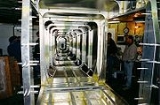
Monocoque

Encyclopedia
Monocoque (ˈmɒnɵkɒk or ˈmɒnɵkoʊk) is a construction technique that supports structural load by using an object's external skin, as opposed to using an internal frame
or truss
that is then covered with a non-load-bearing skin
or coachwork
. The term is also used to indicate a form of vehicle construction in which the body and chassis form a single unit.
The word monocoque comes from the Greek
for single (mono) and French
for shell (coque).
The technique may also be called structural skin, stressed skin, unit body, unibody, unitary construction, or Body Frame Integral. Pure monocoques lack internal longitudinal stiffening but are heavier as a result. A semi-monocoque differs in having longerons
and stringers
. Structures built up from hollow tube frames, such as bicycles are not usually monococques as the primary stresses are not applied to the surface of the tube, but rather to the ends.
Monocoque construction was pioneered in boats, such as with the Viking Longship
and the Amerindian Canoe
where it offered the low structural weight necessary in vessels that were frequently expected to be beached or carried or portaged
overland.
Modern use of moncocoque structures in other applications began in aviation where pioneers used their experience in boatbuilding to provide the necessary structures. Early designs appeared in 1912 such as the Deperdussin Monocoque
, and had found widespread use by the late 1930s when it was applied to metal structures such as on the Douglas DC-3
. Automobiles used monocoque designs as early as 1923 but widespread adoption did not begin until the second half of the 20th century. Today, a welded unit body is the predominant automobile construction technique. Monocoque designs also appear (albeit extremely rarely) on motorcycles and in architecture
- such as with geodesic domes
.
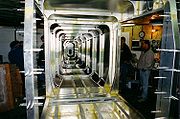 Early aircraft were constructed using internal frames, typically of wood
or steel
tubing, which were then covered (or skinned) with fabric such as irish linen
or cotton
. Aircraft dope
was then applied which tightened the fabric and provided a smooth sealed surface necessary to prevent excessive drag.
This fabric could provide no strength in compression and little in tension so to resist buckling these aircraft relied on the rigidity of the framework. Some early aircraft designers began to use sheet metal
or plywood
but only to provide access to the inside of the airframe or for non-structural aerodynamic fairings. Due to the alloys available, this provided little additional strength however the experience in working with molded laminates would prove useful.
Initially used only for skinning over an existing structure due to poor structural qualities, new aluminium
alloys useful for structural purposes first appeared during World War I
. By the late 1920s further improvements in its strength and durability allowed duralumin to be adopted extensively for internal framing members and the skin.
It was realised that if the skin were strong enough it could eliminate the need for internal framing but this would be heavy. Thin sheet metal gauges could easily resist tension and shear loads but buckled under bending and compression. However, if curved, corrugated or rolled into pipe, sheet metal could be made strong against bending and compression loads as well. Stressed skins began to be combined with greatly reduced internal stiffening and came to be what is now known as semi-monocoque. The first aircraft known to have used this new method of construction came from Dornier, the Dornier D.I of 1918 for example, but, although of considerable official interest, it was ignored by other aircraft manufacturers.
In the meantime, the Junkers F.13
and the Ford Trimotor
, which loosely copied the Junkers structural design, retained an internal aluminium frame but covered these with a thin skin of corrugated
aluminium sheeting. The corrugations allowed the aircraft's skin to take compression and bending loads, replacing ribs and stringers and could be regarded as a stressed skin structure augmented by an internal frame or semi-monocoque structure. The skin itself was now a significant structural element and it was to become even more important when airframes were required to take ever increasing loads.
In the 1930s huge increases in engine power, speed, and operating altitudes required monoplanes and streamlined airframes with stiff, strong skins which semi-monocoque construction was ideal for. Torsional
(twisting) stiffness was essential to avoid aerolastic
deformation under the rising aerodynamic loads and structures that did not make use of the skin as a structural element could not handle the loads without being excessively thick. An outstanding example is the Douglas DC-3
. World War II
was a major catalyst for aircraft development. At the beginning of the war many aircraft still used mixed construction and relied on internal frames but by the end of the war all high-performance airplanes used semi or full monocoque construction. Sheetmetal is strongest when curved in more than two directions, but this requires expensive stamping machines or the laborious use of English wheel
s. The cost of these machines delayed the introduction of this technique in many countries, such as Italy, Holland and France.
designs originally used body-on-frame
construction, where a load-bearing chassis
consisting of frame
, powertrain
, and suspension
formed the base vehicle, and supported a non-load-bearing body or coachwork
. Over time, this was supplanted by monocoque designs, integrating the body and chassis into a single unit. The external panels may be stressed, in such cases as the rocker panels, windshield frame and roof pillars, or non-stressed, as is often the case with fenders. Today, spot welded
unit body is the dominant technique, although some vehicles (particularly truck
s and bus
es) still use body-on-frame.
have monocoque hulls rather than a separate body and frame, while the truck-based M3 Half-track
and up-armored humvee have separate bodies to which armor has been added.
s are not monocoques; they are classic framed structures. However, carbon fibre monocoque framesets are slowly emerging in high-end competitive bicycles, due to their stiffness and light weight. The American company Kestrel USA
pioneered the use of carbon fibre monocoques in bike frame manufacture in the 1980s, and since then the technique has become increasingly widely used. Items such as seat-posts and other components are now employing the same technique.
A Grand Prix motorcycle racing
monocoque motorcycle
was developed in 1967
by Ossa
, a Spanish motorcycle brand. Notable designers such as Eric Offenstadt and Dan Hanebrink created unique monocoque designs in the early 1970s. The 1973 Isle of Man TT
was won by Peter Williams
on the monocoque-framed Norton
John Player Special. Honda
also experimented with a monocoque motorcycle in 1979
with its NR500. In 1987 John Britten
developed the Aero-D One featuring a composite monocoque chassis that only weighed 12 kg. In 2009 Ducati introduced the Desmosedici GP9 with a carbon fibre semi-monocoque chassis.
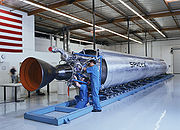
Various rocket
s have used pressure-stabilized monocoque designs, including Atlas
and Falcon I. Atlas was very light weight since its sole structural support was provided by its single-wall steel "balloon" fuel tanks, which held their shape by internal pressure.
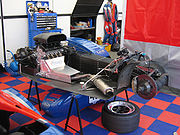
Frame (vehicle)
A frame is the main structure of the chassis of a motor vehicle. All other components fasten to it; a term for this is design is body-on-frame construction.In 1920, every motor vehicle other than a few cars based on motorcycles had a frame...
or truss
Truss
In architecture and structural engineering, a truss is a structure comprising one or more triangular units constructed with straight members whose ends are connected at joints referred to as nodes. External forces and reactions to those forces are considered to act only at the nodes and result in...
that is then covered with a non-load-bearing skin
Skin (aircraft)
The wings and fuselage of aircraft are covered by what is referred to as the skin. Aircraft have a protective and functional covering that is also called the skin of the flying machines. Soft single skin kite examples the use of the term for kite wings....
or coachwork
Coachwork
Coachwork is the body of a horse-drawn coach or carriage, a motor vehicle , a railroad car or railway carriage. Usually reserved for bodies built on a separate chassis, rather than being of unitary or monocoque construction...
. The term is also used to indicate a form of vehicle construction in which the body and chassis form a single unit.
The word monocoque comes from the Greek
Greek language
Greek is an independent branch of the Indo-European family of languages. Native to the southern Balkans, it has the longest documented history of any Indo-European language, spanning 34 centuries of written records. Its writing system has been the Greek alphabet for the majority of its history;...
for single (mono) and French
French language
French is a Romance language spoken as a first language in France, the Romandy region in Switzerland, Wallonia and Brussels in Belgium, Monaco, the regions of Quebec and Acadia in Canada, and by various communities elsewhere. Second-language speakers of French are distributed throughout many parts...
for shell (coque).
The technique may also be called structural skin, stressed skin, unit body, unibody, unitary construction, or Body Frame Integral. Pure monocoques lack internal longitudinal stiffening but are heavier as a result. A semi-monocoque differs in having longerons
Longeron
In aircraft construction, a longeron or stringer or stiffener is a thin strip of wood, metal or carbon fiber, to which the skin of the aircraft is fastened. In the fuselage, longerons are attached to formers and run the longitudinal direction of the aircraft...
and stringers
Stringer
Stringer may refer to:* Stringer , a type of freelance journalism* Stringer * Stringer , or longeron, a strip of wood or metal to which the skin of an aircraft is fastened...
. Structures built up from hollow tube frames, such as bicycles are not usually monococques as the primary stresses are not applied to the surface of the tube, but rather to the ends.
Monocoque construction was pioneered in boats, such as with the Viking Longship
Longship
Longships were sea vessels made and used by the Vikings from the Nordic countries for trade, commerce, exploration, and warfare during the Viking Age. The longship’s design evolved over many years, beginning in the Stone Age with the invention of the umiak and continuing up to the 9th century with...
and the Amerindian Canoe
Canoe
A canoe or Canadian canoe is a small narrow boat, typically human-powered, though it may also be powered by sails or small electric or gas motors. Canoes are usually pointed at both bow and stern and are normally open on top, but can be decked over A canoe (North American English) or Canadian...
where it offered the low structural weight necessary in vessels that were frequently expected to be beached or carried or portaged
Portage
Portage or portaging refers to the practice of carrying watercraft or cargo over land to avoid river obstacles, or between two bodies of water. A place where this carrying occurs is also called a portage; a person doing the carrying is called a porter.The English word portage is derived from the...
overland.
Modern use of moncocoque structures in other applications began in aviation where pioneers used their experience in boatbuilding to provide the necessary structures. Early designs appeared in 1912 such as the Deperdussin Monocoque
Deperdussin Monocoque
- References :*Wayne Biddle - Barons of the Sky: From Early Flight to Strategic Warfare. Johns Hopkins University Press, 2001. ISBN 0801868289.*Émile Auguste Duchêne - Flight Without Formulae: Simple Discussions on the Mechanics of the Aeroplane. Longmans, Green and co., 1914....
, and had found widespread use by the late 1930s when it was applied to metal structures such as on the Douglas DC-3
Douglas DC-3
The Douglas DC-3 is an American fixed-wing propeller-driven aircraft whose speed and range revolutionized air transport in the 1930s and 1940s. Its lasting impact on the airline industry and World War II makes it one of the most significant transport aircraft ever made...
. Automobiles used monocoque designs as early as 1923 but widespread adoption did not begin until the second half of the 20th century. Today, a welded unit body is the predominant automobile construction technique. Monocoque designs also appear (albeit extremely rarely) on motorcycles and in architecture
Architecture
Architecture is both the process and product of planning, designing and construction. Architectural works, in the material form of buildings, are often perceived as cultural and political symbols and as works of art...
- such as with geodesic domes
Geodesic dome
A geodesic dome is a spherical or partial-spherical shell structure or lattice shell based on a network of great circles on the surface of a sphere. The geodesics intersect to form triangular elements that have local triangular rigidity and also distribute the stress across the structure. When...
.
Aircraft
Wood
Wood is a hard, fibrous tissue found in many trees. It has been used for hundreds of thousands of years for both fuel and as a construction material. It is an organic material, a natural composite of cellulose fibers embedded in a matrix of lignin which resists compression...
or steel
Steel
Steel is an alloy that consists mostly of iron and has a carbon content between 0.2% and 2.1% by weight, depending on the grade. Carbon is the most common alloying material for iron, but various other alloying elements are used, such as manganese, chromium, vanadium, and tungsten...
tubing, which were then covered (or skinned) with fabric such as irish linen
Irish linen
Irish linen is the brand name given to linen produced in Ireland. Linen is cloth woven from, or yarn spun from the flax fibre, which was grown in Ireland for many years before advanced agricultural methods and more suitable climate led to the concentration of quality flax cultivation in northern...
or cotton
Cotton
Cotton is a soft, fluffy staple fiber that grows in a boll, or protective capsule, around the seeds of cotton plants of the genus Gossypium. The fiber is almost pure cellulose. The botanical purpose of cotton fiber is to aid in seed dispersal....
. Aircraft dope
Aircraft dope
thumb|right|[[United Kingdom military aircraft serials|2699]] a [[World War I]] [[Royal Aircraft Factory B.E.2]] finished in a clear dopeAircraft dope is a plasticised lacquer that is applied to fabric-covered aircraft...
was then applied which tightened the fabric and provided a smooth sealed surface necessary to prevent excessive drag.
This fabric could provide no strength in compression and little in tension so to resist buckling these aircraft relied on the rigidity of the framework. Some early aircraft designers began to use sheet metal
Sheet metal
Sheet metal is simply metal formed into thin and flat pieces. It is one of the fundamental forms used in metalworking, and can be cut and bent into a variety of different shapes. Countless everyday objects are constructed of the material...
or plywood
Plywood
Plywood is a type of manufactured timber made from thin sheets of wood veneer. It is one of the most widely used wood products. It is flexible, inexpensive, workable, re-usable, and can usually be locally manufactured...
but only to provide access to the inside of the airframe or for non-structural aerodynamic fairings. Due to the alloys available, this provided little additional strength however the experience in working with molded laminates would prove useful.
Design and development
In 1912 Deperdussin introduced their monocoque racer using a fuselage made up of three layers of laminated strips of glued poplar veneer, which provided both the external skin and the main load-bearing structure. This reduced drag so effectively it was able to win most of the races it was entered into. This style of construction was copied, with some variations, in Germany by Albatros and others however it was prone to damage from moisture.Initially used only for skinning over an existing structure due to poor structural qualities, new aluminium
Aluminium
Aluminium or aluminum is a silvery white member of the boron group of chemical elements. It has the symbol Al, and its atomic number is 13. It is not soluble in water under normal circumstances....
alloys useful for structural purposes first appeared during World War I
World War I
World War I , which was predominantly called the World War or the Great War from its occurrence until 1939, and the First World War or World War I thereafter, was a major war centred in Europe that began on 28 July 1914 and lasted until 11 November 1918...
. By the late 1920s further improvements in its strength and durability allowed duralumin to be adopted extensively for internal framing members and the skin.
It was realised that if the skin were strong enough it could eliminate the need for internal framing but this would be heavy. Thin sheet metal gauges could easily resist tension and shear loads but buckled under bending and compression. However, if curved, corrugated or rolled into pipe, sheet metal could be made strong against bending and compression loads as well. Stressed skins began to be combined with greatly reduced internal stiffening and came to be what is now known as semi-monocoque. The first aircraft known to have used this new method of construction came from Dornier, the Dornier D.I of 1918 for example, but, although of considerable official interest, it was ignored by other aircraft manufacturers.
In the meantime, the Junkers F.13
Junkers F.13
The Junkers F.13 was the world's first all-metal transport aircraft, developed in Germany at the end of World War I. It was an advanced cantilever-wing monoplane, with enclosed accommodation for four passengers. Over 300 were sold...
and the Ford Trimotor
Ford Trimotor
The Ford Trimotor was an American three-engined transport plane that was first produced in 1925 by the companies of Henry Ford and that continued to be produced until June 7, 1933. Throughout its time in production, a total of 199 Ford Trimotors were produced...
, which loosely copied the Junkers structural design, retained an internal aluminium frame but covered these with a thin skin of corrugated
Corrugated
The term corrugated, describing a series of parallel ridges and furrows, may refer to the following:*Corrugated fiberboard also called corrugated cardboard*Corrugated galvanised iron*Corrugated plastic*Corrugated Frog...
aluminium sheeting. The corrugations allowed the aircraft's skin to take compression and bending loads, replacing ribs and stringers and could be regarded as a stressed skin structure augmented by an internal frame or semi-monocoque structure. The skin itself was now a significant structural element and it was to become even more important when airframes were required to take ever increasing loads.
In the 1930s huge increases in engine power, speed, and operating altitudes required monoplanes and streamlined airframes with stiff, strong skins which semi-monocoque construction was ideal for. Torsional
Torsion (mechanics)
In solid mechanics, torsion is the twisting of an object due to an applied torque. In sections perpendicular to the torque axis, the resultant shear stress in this section is perpendicular to the radius....
(twisting) stiffness was essential to avoid aerolastic
Aeroelasticity
Aeroelasticity is the science which studies the interactions among inertial, elastic, and aerodynamic forces. It was defined by Arthur Collar in 1947 as "the study of the mutual interaction that takes place within the triangle of the inertial, elastic, and aerodynamic forces acting on structural...
deformation under the rising aerodynamic loads and structures that did not make use of the skin as a structural element could not handle the loads without being excessively thick. An outstanding example is the Douglas DC-3
Douglas DC-3
The Douglas DC-3 is an American fixed-wing propeller-driven aircraft whose speed and range revolutionized air transport in the 1930s and 1940s. Its lasting impact on the airline industry and World War II makes it one of the most significant transport aircraft ever made...
. World War II
World War II
World War II, or the Second World War , was a global conflict lasting from 1939 to 1945, involving most of the world's nations—including all of the great powers—eventually forming two opposing military alliances: the Allies and the Axis...
was a major catalyst for aircraft development. At the beginning of the war many aircraft still used mixed construction and relied on internal frames but by the end of the war all high-performance airplanes used semi or full monocoque construction. Sheetmetal is strongest when curved in more than two directions, but this requires expensive stamping machines or the laborious use of English wheel
English Wheel
The English wheel, in Britain also known as a Wheeling machine, is a metalworking tool that enables a craftsman to form compound curves from flat sheets of metal such as aluminium or steel. The process of using an English wheel is known as Wheeling...
s. The cost of these machines delayed the introduction of this technique in many countries, such as Italy, Holland and France.
Automobiles
Similar to aircraft, automobileAutomobile
An automobile, autocar, motor car or car is a wheeled motor vehicle used for transporting passengers, which also carries its own engine or motor...
designs originally used body-on-frame
Body-on-frame
Body-on-frame is an automobile construction method. Mounting a separate body to a rigid frame that supports the drivetrain was the original method of building automobiles, and its use continues to this day. The original frames were made of wood , but steel ladder frames became common in the 1930s...
construction, where a load-bearing chassis
Chassis
A chassis consists of an internal framework that supports a man-made object. It is analogous to an animal's skeleton. An example of a chassis is the underpart of a motor vehicle, consisting of the frame with the wheels and machinery.- Vehicles :In the case of vehicles, the term chassis means the...
consisting of frame
Frame (vehicle)
A frame is the main structure of the chassis of a motor vehicle. All other components fasten to it; a term for this is design is body-on-frame construction.In 1920, every motor vehicle other than a few cars based on motorcycles had a frame...
, powertrain
Powertrain
In a motor vehicle, the term powertrain or powerplant refers to the group of components that generate power and deliver it to the road surface, water, or air. This includes the engine, transmission, drive shafts, differentials, and the final drive...
, and suspension
Suspension (vehicle)
Suspension is the term given to the system of springs, shock absorbers and linkages that connects a vehicle to its wheels. Suspension systems serve a dual purpose — contributing to the car's roadholding/handling and braking for good active safety and driving pleasure, and keeping vehicle occupants...
formed the base vehicle, and supported a non-load-bearing body or coachwork
Coachwork
Coachwork is the body of a horse-drawn coach or carriage, a motor vehicle , a railroad car or railway carriage. Usually reserved for bodies built on a separate chassis, rather than being of unitary or monocoque construction...
. Over time, this was supplanted by monocoque designs, integrating the body and chassis into a single unit. The external panels may be stressed, in such cases as the rocker panels, windshield frame and roof pillars, or non-stressed, as is often the case with fenders. Today, spot welded
Spot welding
Spot welding is a process in which contacting metal surfaces are joined by the heat obtained from resistance to electric current flow. Work-pieces are held together under pressure exerted by electrodes. Typically the sheets are in the thickness range...
unit body is the dominant technique, although some vehicles (particularly truck
Truck
A truck or lorry is a motor vehicle designed to transport cargo. Trucks vary greatly in size, power, and configuration, with the smallest being mechanically similar to an automobile...
s and bus
Bus
A bus is a road vehicle designed to carry passengers. Buses can have a capacity as high as 300 passengers. The most common type of bus is the single-decker bus, with larger loads carried by double-decker buses and articulated buses, and smaller loads carried by midibuses and minibuses; coaches are...
es) still use body-on-frame.
Armored vehicles
Tanks and other armored vehicles generally use a body or chassis which is built of the armor rather than attaching armor to a body-on-frame design. Though this generally produces a fairly heavy vehicle, it can reduce weight for a given amount of armor compared to soft-skinned vehicles to which armor has been added either as a modification or a kit. For example, the German Fuchs 2 and RG-33RG-33
The RG-33 is a mine-resistant light armored vehicle initially designed by BAE Systems Land Systems South Africa a South African subsidiary of BAE Systems. BAE Systems in the US extensively modified it with additional protection, new power train and suspension systems. It was built in a number of...
have monocoque hulls rather than a separate body and frame, while the truck-based M3 Half-track
M3 Half-track
The Carrier, Personnel Half-track M3 was an armored vehicle used by the United States, the British Empire and the other Allies during World War II and the Cold War. Nearly 43,000 were produced, and supplied to the U.S...
and up-armored humvee have separate bodies to which armor has been added.
Two-wheeled vehicles
Traditional bicycleBicycle
A bicycle, also known as a bike, pushbike or cycle, is a human-powered, pedal-driven, single-track vehicle, having two wheels attached to a frame, one behind the other. A person who rides a bicycle is called a cyclist, or bicyclist....
s are not monocoques; they are classic framed structures. However, carbon fibre monocoque framesets are slowly emerging in high-end competitive bicycles, due to their stiffness and light weight. The American company Kestrel USA
Kestrel USA
Kestrel is an American bicycle manufacturer headquartered in Santa Cruz, California specializing in high-end bikes for triathlon, road bicycle racing and mountain biking...
pioneered the use of carbon fibre monocoques in bike frame manufacture in the 1980s, and since then the technique has become increasingly widely used. Items such as seat-posts and other components are now employing the same technique.
A Grand Prix motorcycle racing
Grand Prix motorcycle racing
Road Racing World Championship Grand Prix is the premier championship of motorcycle road racing currently divided into three distinct classes: 125cc, Moto2 and MotoGP. The 125cc class uses a two-stroke engine while Moto2 and MotoGP use four-stroke engines. In 2010 the 250cc two-stroke was replaced...
monocoque motorcycle
Motorcycle
A motorcycle is a single-track, two-wheeled motor vehicle. Motorcycles vary considerably depending on the task for which they are designed, such as long distance travel, navigating congested urban traffic, cruising, sport and racing, or off-road conditions.Motorcycles are one of the most...
was developed in 1967
1967 Grand Prix motorcycle racing season
The 1967 Grand Prix motorcycle racing season was the 19th F.I.M. Road Racing World Championship Grand Prix season. The season consisted of thirteen Grand Prix races in six classes: 500cc, 350cc, 250cc, 125cc, 50cc and Sidecars 500cc...
by Ossa
Ossa (motorcycle)
Ossa was a motorcycle manufacturer based in Catalonia, Spain which was active from 1924 to 1982. Founded by Manuel Giró, an industrialist from Barcelona, Ossa was best known for lightweight two-stroke-engined bikes used in Observed Trials and Motocross...
, a Spanish motorcycle brand. Notable designers such as Eric Offenstadt and Dan Hanebrink created unique monocoque designs in the early 1970s. The 1973 Isle of Man TT
Isle of Man TT
The International Isle of Man TT Race is a motorcycle racing event held on the Isle of Man and was for many years the most prestigious motorcycle race in the world...
was won by Peter Williams
Peter Williams
Peter Williams is the name of:* Sir Peter Williams , former chairman of Oxford Instruments; Chancellor, University of Leicester* Peter Williams , New Zealand television presenter...
on the monocoque-framed Norton
Norton
-England:*Norton, County Durham*Norton, Hertfordshire*Norton, Kent*Norton, Northamptonshire*Norton, Nottinghamshire*Norton, Runcorn, Cheshire*Norton, Suffolk*Norton, Dudley, West Midlands*Norton, Worcester, Worcestershire*Norton, Doncaster, South Yorkshire...
John Player Special. Honda
Honda
is a Japanese public multinational corporation primarily known as a manufacturer of automobiles and motorcycles.Honda has been the world's largest motorcycle manufacturer since 1959, as well as the world's largest manufacturer of internal combustion engines measured by volume, producing more than...
also experimented with a monocoque motorcycle in 1979
1979 Grand Prix motorcycle racing season
The 1979 Grand Prix motorcycle racing season was the 31st F.I.M. Road Racing World Championship season.-Season summary:A season of changing fortunes in the 500cc class saw American, Kenny Roberts capture his second crown in the face of the Suzuki-mounted opposition. In the 50cc class, Eugenio...
with its NR500. In 1987 John Britten
John Britten
John Kenton Britten was a New Zealand mechanical engineer who designed a world-record-setting motorcycle with innovative features which are still ahead of contemporary design.-Biography:...
developed the Aero-D One featuring a composite monocoque chassis that only weighed 12 kg. In 2009 Ducati introduced the Desmosedici GP9 with a carbon fibre semi-monocoque chassis.
Rockets
Various rocket
Rocket
A rocket is a missile, spacecraft, aircraft or other vehicle which obtains thrust from a rocket engine. In all rockets, the exhaust is formed entirely from propellants carried within the rocket before use. Rocket engines work by action and reaction...
s have used pressure-stabilized monocoque designs, including Atlas
Atlas (rocket family)
Atlas is a family of U.S. space launch vehicles. The original Atlas missile was designed in the late 1950s and produced by the Convair Division of General Dynamics, to be used as an intercontinental ballistic missile...
and Falcon I. Atlas was very light weight since its sole structural support was provided by its single-wall steel "balloon" fuel tanks, which held their shape by internal pressure.
See also
- Backbone chassisBackbone chassisBackbone tube chassis is a type of an automobile construction chassis that is similar to the body-on-frame design. Instead of a two-dimensional ladder type structure, it consists of a strong tubular backbone that connects the front and rear suspension attachment areas...
- Frame (vehicle)Frame (vehicle)A frame is the main structure of the chassis of a motor vehicle. All other components fasten to it; a term for this is design is body-on-frame construction.In 1920, every motor vehicle other than a few cars based on motorcycles had a frame...
- ChassisChassisA chassis consists of an internal framework that supports a man-made object. It is analogous to an animal's skeleton. An example of a chassis is the underpart of a motor vehicle, consisting of the frame with the wheels and machinery.- Vehicles :In the case of vehicles, the term chassis means the...
- CoachworkCoachworkCoachwork is the body of a horse-drawn coach or carriage, a motor vehicle , a railroad car or railway carriage. Usually reserved for bodies built on a separate chassis, rather than being of unitary or monocoque construction...
- Body-on-frameBody-on-frameBody-on-frame is an automobile construction method. Mounting a separate body to a rigid frame that supports the drivetrain was the original method of building automobiles, and its use continues to this day. The original frames were made of wood , but steel ladder frames became common in the 1930s...
- CoachbuilderCoachbuilderA coachbuilder is a manufacturer of bodies for carriages or automobiles.The trade dates back several centuries. Rippon was active in the time of Queen Elizabeth I, Barker founded in 1710 by an officer in Queen Anne's Guards, Brewster a relative newcomer , formed in 1810. Others in Britain included...
- Strut barStrut barA strut bar, strut brace, or strut tower brace is a mostly aftermarket car suspension accessory usually used in conjunction with MacPherson struts on monocoque or unibody chassis to provide extra stiffness between the strut towers....
- AirframeAirframeThe airframe of an aircraft is its mechanical structure. It is typically considered to include fuselage, wings and undercarriage and exclude the propulsion system...
- Spaceframe
- SuperleggeraSuperleggeraSuperleggera is an automobile chassis construction technology developed by Felice Bianchi Anderloni of Italian coachbuilder Carrozzeria Touring. The company was located just north of Milan, near Alfa Romeo, Italian Citroen, and the former Isotta-Fraschini plant...
- Thin-shell structureThin-shell structureThin-shell structures are light weight constructions using shell elements. These elements are typically curved and are assembled to large structures...