

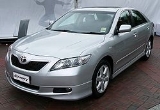
Toyota Camry

Encyclopedia
The Toyota Camry is a series of mid-size (originally compact
) automobiles manufactured by Toyota since 1982, and sold in the majority of automotive markets throughout the world. Between 1980 and 1982, the "Camry" nameplate was delegated to a four-door sedan, known as the Toyota Celica Camry.
The name "Camry" is an Anglicized
phonetic transcription of the Japanese word kanmuri (冠, かんむり), meaning "crown". This follows Toyota's naming tradition of using the crown name for primary models starting with the Toyota Crown
in 1955, continuing with the Toyota Corona
and Corolla
; the Latin
words for "crown" and "small crown", respectively.
The Camry is the best-selling car in North America
. The Camry also sells very well in Australia
, and a number of Asia
n markets. Despite international success, the Camry has not sold as well in its home market Japan, or in Europe, where sales ended in 2004. For the East
and Southeast Asia
n markets, high-specification Camry models are seen as executive cars. Since the XV30 series, the Camrys sold in these markets have sported revised front- and rear-end treatment. For the 2006 onwards XV40 version, the same was done, although the Australian-designed and Camry-derived Toyota Aurion
(XV40) was the donor model. The Aurion features revised front- and rear-end styling and changes to the interior, but is fitted with the same powertrain
s.
Toyota's Camry originated in January 1980 as a four-door sedan approximate to the Toyota Celica
coupe
and liftback. Known as the "Celica Camry" and sold only in Japan at Toyota Corolla Store retail dealerships, the four-door shared few components with the model from which its name derives. Instead, Toyota elongated the front-end of the Carina
(A40, A50), incorporating styling cues to resemble the 1978–1981 Celica XX
(known as the Celica Supra in export markets).
Camry became an independent model line in 1982 with the V10 series, available in four-door sedan and five-door liftback body styles. At this point, Camry, now an international model line, was positioned above the Carina and Corona
, two other similar-sized vehicles manufactured by Toyota at the time. The Camry V10 also spawned a badge engineered
equivalent, the Vista V10, a more luxurious version of the Camry sold in the Japanese market.
The Camry V20 model debuted in 1986, following much the same formula as its predecessor. Although the liftback body variant was substituted with a station wagon
, the Vista derivative continued. When Toyota replaced the V20 in 1990 with the V30, the model series was exclusive to Japan. Automotive tax regulations in that country dictated the retention of a narrower body as utilized in the previous Camry generations. However, overseas demand for a larger Camry resulted in the development of a "wide-body" XV10 model, introduced to North America in 1991. Japan also received this wider model, although it was sold under the "Toyota Scepter" name there.
The Japanese market received a new narrow-body V40 series Camry in 1994 to replace V30, yet the wide-body XV10 Camry continued unchanged. The XV10 replacement, the XV20 Camry, arrived in 1996. This new model ceased the era of separate Camrys—a global Camry—and a smaller Japanese-only version. In Japan, the smaller Vista V50 took up the former V40 Camry role after 1998.
and Corona
. A twin was announced at this point—the Toyota Vista—a highly specified Camry derivative model sold through separate Toyota Vista Store dealerships in Japan.
The design of the first-generation Camry fit well within the box-shaped trends of the early 1980s. Additionally, the vehicle size and available options were characteristic of Japanese-designed cars of the time; the Camry was a compact sedan, with a solid but spartan construction and competed indirectly against larger American counterparts.
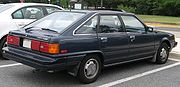 In North America
, the Camry was available with a 68 kW (SAE) 2.0-liter 2S-ELC
engine, 1.8-liter 1C-TLC
or a 2.0-liter 2C-TLC
turbodiesel
engine rated at 55 kW. Either a four-door sedan or five-door liftback body style
could be specified, and could be purchased with either a five-speed manual transmission
or a four-speed A140E
automatic
. In contrast to the rear-wheel drive Celica Camry, the Toyota Camry was a front-wheel drive
vehicle built on an all-new platform.
North American-bound V10 Camrys were available in DX and LE trim levels. LE models included additional standard features such as body-colored bumpers, tachometer, upgraded stereo, power mirrors, variable intermittent wipers, et cetera. A minor model update in 1985 included new headlights, taillight update, new gauge fonts, slightly larger front seats, and larger center glove box. The cruise control
switchgear on models equipped as such were relocated from the dash to the wiper stalk. DX trim tire size also increased from 165 to 185 mm (6.5 to 7.3 in), the same width as the LE trim.
In Australia, the Camry range was limited to a single-grade GLi liftback variant. The sole powertrain offered was the petrol-fueled 2.0-litre (77 kW engine) coupled with a five-speed manual or four-speed automatic transmission.
The United Kingdom
, and much of Continental Europe
got the sedan and liftback versions: these were available in 1.8-liter GLi or 2.0-liter GLi trim levels. A 2.0-liter GLD turbodiesel was also offered.
and five-door station wagon
, while dropping the liftback body style. The hardtop version was sold only in the Japanese market under the "Camry Prominent" name. Like the previous V10 model, there was again a parallel model for the home market, the Vista V20. The Vista was offered in the sedan and hardtop configurations, with the hardtop forming the basis for the Lexus ES 250 sold in North America from 1989 through to 1991.
In 1988, an all-wheel drive system dubbed All-Trac
was introduced and a 2.5-liter 118 kW (JIS) V6 engine
were added as options for the first time. The V6 was fuel-injected
with 24 valves, and dual overhead camshafts
, much like the upgraded 96 kW JIS four-cylinder engine. In Japan there was a GT model using the older 3S-GE engine as used on the Celica. This particular model also had a factory strut brace similar to an AE92 Corolla and rode on the V6 model's 15 inch alloy wheel
s. This particular model also had an electronic instrument cluster.
In 1987, Toyota Australia
began producing these second-generation Camrys in Port Melbourne, Victoria
. In fact, it was the first Camry ever made outside of Japan. A 1.8-liter four-cylinder engine rated at 64 kW was standard on the base model, while a twin-cam
, multi-valve 2.0-liter straight-four engine and five-speed manual transmission
was available on all others. A four-speed overdrive
automatic
was made optional. All models bar the Ultima had a two-barrel carburettor
version of the engine (3S-FC); the Ultima featured an electronic fuel-injected
(EFI) version of the same (3S-FE). The base engine produced 82 kW and 166 newton metre of torque
, with 88 kW and 171 newton metres (126.1 ft·lbf) for the EFI version. In 1988, a 2.5-liter V6 was introduced. The V6 sat the very top of the range, and was the only model to be imported from Japan. Due to its positioning in the line-up, and the high import duty it attracted, it was very expensive (almost ), and only sold in small numbers. In 1989, the 1.8-liter engine was dropped, and was replaced with the 2.0-liter carbureted engine, until early 1991, when the EFI version of was made standard. This was the result of the introduction of more stringent emission standard
s in Australia.
Toyota Motor Manufacturing Kentucky
, the first wholly owned US Toyota plant, began producing the Camry in 1988, where three trim levels of the second-generation Camry were made: the unbadged base model, the DX, and the LE. The country of manufacture can be found by looking at the first character of the VIN. A Camry manufactured in Japan has a VIN starting with "J", a model made in the US starts with "4" and a model made in Australia starts with "6".
The 2.5-liter engine and Camry chassis was repackaged as the upscale Lexus ES 250. The ES 250 was essentially the Japanese-market Camry hardtop. In 1991, anti-lock brakes
became optional on the V6, LE, and station wagon models.
in this regard. Like before, a Japanese market-only Vista version of the Camry was also offered in both sedan and hardtop body variants. The Camry hardtop was again sold under the "Camry Prominent" title.
After 1991, a four-wheel steering version of the V30 Camry was sold with a 2.0-liter V6 engine, with the name "Toyota Camry V6 Prominent 4WS", and chassis code E-VZV31.
An updated model appeared in July 1992. The scope of changes ranged from a new, larger grille
and a revised air conditioning
unit. At the same time the ZX touring package appeared in place of GT.
Engines for the V40 were a 1.8-liter (4S-FE type) and 2.0-liter (3S-FE type), and a 2.2-liter turbodiesel
(3C-T type). At launch only the 2.0-liter model was available in all-wheel drive mode, although afterwards the 2.2-liter turbodiesel could be optioned with this system.
Toyota updated the V40 in June 1996. In the update anti-lock brakes
and dual air bags became standard equipment. After 1998, the Japanese market Camry and international Camry became in-line with each other, with the Vista
taking over the V30 and V40 Camry roles.
V20 Camry with the Japanese market-only V30 series in 1990. However, international markets such as Australia and North America received a widened version of the V30, known as the XV10 series. While marginally larger than the V20, the V30 had to comply with Japanese tax legislation which restricted the car's width to 1700 millimetres (66.9 in) and length to 4700 millimetres (185 in). Particularly in the United States
, this narrower model was seen as compromised, thus limiting its sales potential. As a result, the "wide-body" mid-size
Camry (XV10) was designed. Introduced to North America in 1991, the XV10 Camry was sold alongside the V30 in Japan, badged as the Toyota Scepter. Toyota chose the name "Scepter" as a reference to the Camry/Crown naming tradition, as a "scepter
" is a symbolic ornamental staff held by a ruling monarch, a prominent item of royal regalia.
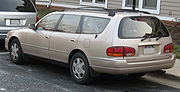 The smaller V30 Camry varied in other areas besides the size. Although the underpinnings
, doors
and fender
s, and overall basic design cues were common between the two cars, the smaller Camry sported harder, more angular front- and rear-end styling treatment, with the wide-body model presenting a more curvaceous silhouette. This was a departure from the V20 generation Camry which, although had many more rounded panels than the V10 series, was nevertheless generally slab-sided in shape. A two-door Camry coupé was added to compete with the Honda Accord
coupé. However, the Camry Coupé was never popular and was dropped in 1997. A two-door Camry would not be reintroduced until 1999, with the Toyota Camry Solara
.
The Japanese V30 model was replaced by the Camry V40 in 1994, however, this was also a Japan-only model. International markets instead retained the wider XV10 until it was replaced by the XV20 in 1996. The V40 and XV20 models were sold alongside one another in the Japanese market until 1998. At this time, the Vista V50 took the place of the V40, ending the period of separate Camrys for the Japanese and international markets.
The XV10, at its most basic level, offered a 2.2-liter 5S-FE
four-cylinder engine, up from 2.0 liters in the V20 and V30 Camrys. This unit produced 97 kW of power and 197 newton metre of torque
, although the exact figures varied slightly depending on the market. Power and displacement
increases were also received for the V6 engine
. The 3.0-liter 3VZ-FE
unit was rated at 138 kW and 264 newton metre. An all-new aluminium
1MZ-FE
V6 debuted in North American models from 1994, with other markets retaining the 3VZ-FE V6. Power and torque rose to 140 kW and 275 newton metre, respectively.
In Australia, the V6 engine Camry was badged "Camry Vienta" when launched in 1993, later becoming the Toyota Vienta in 1995. In South Africa, the XV10 Camry was manufactured by Toyota SA in Durban
from 1992 to 2002, offering both the 2.2-liter and 3.0-liter engines, although only in sedan configuration. These were also marketed and sold into Namibia
, Botswana
and Zimbabwe
.
In 2000, the sedan models received a mid-model upgrade to the front and rear fascias, but remained otherwise similar to the 1997 to 1999 models.
In the United States, the Camry SE was dropped and the base model was renamed the CE for the 1997 model year. Both the LE and the XLE trims were carried over from the previous series. All trim levels were available with either the 2.2-liter I4 or the 3.0-liter V6 engine except the Solara SLE, which was only available with the V6. TRD
offered a supercharger kit for 1997 through to 2000 V6 models raising power to 247 hp and 242 lbft of torque. A coupe was added in 1999, and then a convertible form in 2000. In contrast to the coupe from the XV10 generation Camrys, the new two-door cars were given a separate nameplate Camry Solara
, or simply Solara. They were also a significant styling departure from the sedan. The Solara was available in SE and SLE trims, corresponding roughly to the sedan's LE and XLE trims.
Power was increased slightly to 133 hp SAE for the 5S-FE
2.2 L I4
and 192 hp SAE for the 1MZ-FE V6. Manual transmissions (model: S51) were only available on the CE trim level, LE V6, and any Solara model.
, Corolla
, and Camry Solara
), but without a station wagon for the first time. Due to station wagons losing popularity to minivan
and crossover SUV
s, the Camry wagon was replaced by the Highlander
SUV, which utilizes the Camry's platform.
Until the 2003 model year, the Camry Solara
remained on the XV20 series chassis, and received only minor styling upgrades to the front and rear ends. However, the Solara did receive the same 2.4-liter 2AZ-FE I4 engine that was available on the Camry sedan. The US received three engine options, a 2.4-liter inline-four, a 3.0-liter V6, and a 3.3-liter version of the same, which was only available for the Camry's sportier "SE" model.
Starting from this generation, the Camry had two different distinctive designs, an American version with a more conservative design and an Asian version with more chrome, larger head lamps and tail lamps and a general greater emphasis on its width. Later generation Camry will see greater differentiation, with the Asian Camry adopting a more luxurious design, while the American Camry pursued a more mass-appeal approach.
in Australia, fitted with a 3.5 V6 to compete against large Australian sedans like the Ford Falcon and Holden Commodore. The standard Camry (similar to American / Japanese market models), fitted with smaller 4-cylinder engines continue to be sold alongside the Aurion.
The XV40 Camry was introduced at the 2006 North American International Auto Show alongside a hybrid version and went on sale in March 2006 for the 2007 model year. Toyota completely redesigned the Camry giving it a sleeker design. Toyota normally begins selling the Camry in September but cut the previous model's lifespan to 4.5 years instead of 5 years.
Power comes from a choice of four and six-cylinder engines. For 2010, power was increased to 169 horsepower, versus the 158 from 2007 to 2009. Power locks, stability control, and traction control were also made standard for 2010. The 2.4-liter 2AZ-FE I4
engine was carried over and produced 158 hp. It came with a five-speed manual or five-speed automatic transmission. The 3.5-liter 2GR-FE
V6 in contrast came with a new six-speed automatic and produced 268 hp. The Camry was facelifted in 2009 for the 2010 model year with a redesigned fascia, taillights, and an all-new 2.5-liter 2AR-FE four-cylinder engine with a new six-speed automatic transmission. The 2.5-liter engine produces 169 hp for the base, LE, XLE 4-cylinder models, and for the "SE" 4-cylinder; engine output is 179 hp.
The XV40 series Camry is the first in which the Camry has been available as a gasoline/electric hybrid. The Camry Hybrid utilizes Toyota’s second-generation Hybrid Synergy Drive
(HSD) and a 2AZ-FXE
four-cylinder with 110 kW in conjunction with a 30 kW electric motor for a combined output of 140 kW.
In this generation, the Camry line-up for the Japanese domestic market was reduced to being just a single variant (hybrid only). The Japanese market will now share the same Camry model as the Asian market Camry. (Prior to this, Japanese market Camry are similar to American market models).
Compact car
A compact car , or small family car , is a classification of cars which are larger than a supermini but smaller than or equal to a mid-size car...
) automobiles manufactured by Toyota since 1982, and sold in the majority of automotive markets throughout the world. Between 1980 and 1982, the "Camry" nameplate was delegated to a four-door sedan, known as the Toyota Celica Camry.
The name "Camry" is an Anglicized
Anglicisation
Anglicisation, or anglicization , is the process of converting verbal or written elements of any other language into a form that is more comprehensible to an English speaker, or, more generally, of altering something such that it becomes English in form or character.The term most often refers to...
phonetic transcription of the Japanese word kanmuri (冠, かんむり), meaning "crown". This follows Toyota's naming tradition of using the crown name for primary models starting with the Toyota Crown
Toyota Crown
The Toyota Crown is a line of full-size luxury sedans by Toyota. The range was primarily available in Japan and some other Asian countries, originally designed to serve as a taxi...
in 1955, continuing with the Toyota Corona
Toyota Corona
The Toyota Corona is an automobile manufactured by the Japanese automaker Toyota between 1957 and 2002. Traditionally, the competitor from Nissan was the Nissan Bluebird. The word Corona is Latin for "crown"...
and Corolla
Toyota Corolla
The Toyota Corolla is a line of subcompact and compact cars manufactured by the Japanese automaker Toyota, which has become very popular throughout the world since the nameplate was first introduced in 1966. In 1997, the Corolla became the best selling nameplate in the world, with over 35 million...
; the Latin
Latin
Latin is an Italic language originally spoken in Latium and Ancient Rome. It, along with most European languages, is a descendant of the ancient Proto-Indo-European language. Although it is considered a dead language, a number of scholars and members of the Christian clergy speak it fluently, and...
words for "crown" and "small crown", respectively.
The Camry is the best-selling car in North America
North America
North America is a continent wholly within the Northern Hemisphere and almost wholly within the Western Hemisphere. It is also considered a northern subcontinent of the Americas...
. The Camry also sells very well in Australia
Australia
Australia , officially the Commonwealth of Australia, is a country in the Southern Hemisphere comprising the mainland of the Australian continent, the island of Tasmania, and numerous smaller islands in the Indian and Pacific Oceans. It is the world's sixth-largest country by total area...
, and a number of Asia
Asia
Asia is the world's largest and most populous continent, located primarily in the eastern and northern hemispheres. It covers 8.7% of the Earth's total surface area and with approximately 3.879 billion people, it hosts 60% of the world's current human population...
n markets. Despite international success, the Camry has not sold as well in its home market Japan, or in Europe, where sales ended in 2004. For the East
East Asia
East Asia or Eastern Asia is a subregion of Asia that can be defined in either geographical or cultural terms...
and Southeast Asia
Southeast Asia
Southeast Asia, South-East Asia, South East Asia or Southeastern Asia is a subregion of Asia, consisting of the countries that are geographically south of China, east of India, west of New Guinea and north of Australia. The region lies on the intersection of geological plates, with heavy seismic...
n markets, high-specification Camry models are seen as executive cars. Since the XV30 series, the Camrys sold in these markets have sported revised front- and rear-end treatment. For the 2006 onwards XV40 version, the same was done, although the Australian-designed and Camry-derived Toyota Aurion
Toyota Aurion
The Toyota Aurion is a mid-size car produced by Toyota in Australia and parts of Asia since 2006. The Aurion, given the model designation XV40 is essentially a Toyota Camry with revised front- and rear-end treatment, along with changes to the interior...
(XV40) was the donor model. The Aurion features revised front- and rear-end styling and changes to the interior, but is fitted with the same powertrain
Powertrain
In a motor vehicle, the term powertrain or powerplant refers to the group of components that generate power and deliver it to the road surface, water, or air. This includes the engine, transmission, drive shafts, differentials, and the final drive...
s.
Narrow-body
]Toyota's Camry originated in January 1980 as a four-door sedan approximate to the Toyota Celica
Toyota Celica
The Toyota Celica name has been applied to a series of coupes made by the Japanese company Toyota. The name is ultimately derived from the Latin word coelica meaning "heavenly" or "celestial"....
coupe
Coupé
A coupé or coupe is a closed car body style , the precise definition of which varies from manufacturer to manufacturer, and over time...
and liftback. Known as the "Celica Camry" and sold only in Japan at Toyota Corolla Store retail dealerships, the four-door shared few components with the model from which its name derives. Instead, Toyota elongated the front-end of the Carina
Toyota Carina
Released in Japan August 1977, the next-generation Carina was available in Germany in December 1977 and in other European countries during 1978. In most markets it was fitted with the same 1,588 cc 2T engine as its predecessor. In the Carina, an output of was claimed...
(A40, A50), incorporating styling cues to resemble the 1978–1981 Celica XX
Toyota Supra
The Toyota Supra is a sports car/grand tourer that was produced by Toyota Motor Company from 1979 to 2002. The styling of the Toyota Supra was derived from the Toyota Celica, but it was both longer and wider. Starting in mid-1986, the Supra became its own model and was no longer based on the Celica...
(known as the Celica Supra in export markets).
Camry became an independent model line in 1982 with the V10 series, available in four-door sedan and five-door liftback body styles. At this point, Camry, now an international model line, was positioned above the Carina and Corona
Toyota Corona
The Toyota Corona is an automobile manufactured by the Japanese automaker Toyota between 1957 and 2002. Traditionally, the competitor from Nissan was the Nissan Bluebird. The word Corona is Latin for "crown"...
, two other similar-sized vehicles manufactured by Toyota at the time. The Camry V10 also spawned a badge engineered
Badge engineering
Badge engineering is an ironic term that describes the rebadging of one product as another...
equivalent, the Vista V10, a more luxurious version of the Camry sold in the Japanese market.
The Camry V20 model debuted in 1986, following much the same formula as its predecessor. Although the liftback body variant was substituted with a station wagon
Station wagon
A station wagon is a body style variant of a sedan/saloon with its roof extended rearward over a shared passenger/cargo volume with access at the back via a third or fifth door , instead of a trunk lid...
, the Vista derivative continued. When Toyota replaced the V20 in 1990 with the V30, the model series was exclusive to Japan. Automotive tax regulations in that country dictated the retention of a narrower body as utilized in the previous Camry generations. However, overseas demand for a larger Camry resulted in the development of a "wide-body" XV10 model, introduced to North America in 1991. Japan also received this wider model, although it was sold under the "Toyota Scepter" name there.
The Japanese market received a new narrow-body V40 series Camry in 1994 to replace V30, yet the wide-body XV10 Camry continued unchanged. The XV10 replacement, the XV20 Camry, arrived in 1996. This new model ceased the era of separate Camrys—a global Camry—and a smaller Japanese-only version. In Japan, the smaller Vista V50 took up the former V40 Camry role after 1998.
V10 (1982–1986)
Introduced in 1982, the Camry V10 was sold as a compact four-door sedan and five-door liftback. Unlike the preceding Celica Camry, the V10 series Camry was exported in significant numbers. In the Toyota hierarchy, the Camry was situated above the comparably sized Toyota CarinaToyota Carina
Released in Japan August 1977, the next-generation Carina was available in Germany in December 1977 and in other European countries during 1978. In most markets it was fitted with the same 1,588 cc 2T engine as its predecessor. In the Carina, an output of was claimed...
and Corona
Toyota Corona
The Toyota Corona is an automobile manufactured by the Japanese automaker Toyota between 1957 and 2002. Traditionally, the competitor from Nissan was the Nissan Bluebird. The word Corona is Latin for "crown"...
. A twin was announced at this point—the Toyota Vista—a highly specified Camry derivative model sold through separate Toyota Vista Store dealerships in Japan.
The design of the first-generation Camry fit well within the box-shaped trends of the early 1980s. Additionally, the vehicle size and available options were characteristic of Japanese-designed cars of the time; the Camry was a compact sedan, with a solid but spartan construction and competed indirectly against larger American counterparts.
North America
North America is a continent wholly within the Northern Hemisphere and almost wholly within the Western Hemisphere. It is also considered a northern subcontinent of the Americas...
, the Camry was available with a 68 kW (SAE) 2.0-liter 2S-ELC
Toyota S engine
The Toyota S Series engines are a family of straight-4 engines with displacement from 1.8 L to 2.2 L produced by Toyota Motor Corporation. The series has cast iron engine blocks and alloy cylinder heads.-Table of S-block engines:-1S:...
engine, 1.8-liter 1C-TLC
Toyota C engine
-Features at a glance:-1C, 1C-L, 1C-LC:Applications:* CA60/67 Carina 1982-1988* CE70/71/72 Corolla 1982-1987* CE80 Corolla 1983-1987* CE90/96/97 Corolla 1987-1992* CT140/147 Corona 1982-1987* CM20/25 LiteAce / TownAce 1982-1986...
or a 2.0-liter 2C-TLC
Toyota C engine
-Features at a glance:-1C, 1C-L, 1C-LC:Applications:* CA60/67 Carina 1982-1988* CE70/71/72 Corolla 1982-1987* CE80 Corolla 1983-1987* CE90/96/97 Corolla 1987-1992* CT140/147 Corona 1982-1987* CM20/25 LiteAce / TownAce 1982-1986...
turbodiesel
Turbodiesel
Turbodiesel refers to any diesel engine with a turbocharger. Turbocharging is the norm rather than the exception in modern car and truck diesel engines...
engine rated at 55 kW. Either a four-door sedan or five-door liftback body style
Car body style
Automobiles' body styles are highly variable. Some body styles remain in production, while others become less common or obsolete. They may or may not correlate to a car's price, size or intended market classification. The same car model might be available in multiple body styles comprising a...
could be specified, and could be purchased with either a five-speed manual transmission
Manual transmission
A manual transmission, also known as a manual gearbox or standard transmission is a type of transmission used in motor vehicle applications...
or a four-speed A140E
Toyota A transmission
Toyota Motor Corporation's A family is a family of automatic FWD/RWD/4WD transmissions built by Aisin-Warner. They share much in common with Volvo's AW7* and Aisin-Warner's 03-71* transmissions, which are found in Suzukis, Mitsubishis, and other Asian vehicles.A = Aisin AutomaticSecond last digit...
automatic
Automatic transmission
An automatic transmission is one type of motor vehicle transmission that can automatically change gear ratios as the vehicle moves, freeing the driver from having to shift gears manually...
. In contrast to the rear-wheel drive Celica Camry, the Toyota Camry was a front-wheel drive
Front-wheel drive
Front-wheel drive is a form of engine/transmission layout used in motor vehicles, where the engine drives the front wheels only. Most modern front-wheel drive vehicles feature a transverse engine, rather than the conventional longitudinal engine arrangement generally found in rear-wheel drive and...
vehicle built on an all-new platform.
North American-bound V10 Camrys were available in DX and LE trim levels. LE models included additional standard features such as body-colored bumpers, tachometer, upgraded stereo, power mirrors, variable intermittent wipers, et cetera. A minor model update in 1985 included new headlights, taillight update, new gauge fonts, slightly larger front seats, and larger center glove box. The cruise control
Cruise control
Cruise control is a system that automatically controls the speed of a motor vehicle. The system takes over the throttle of the car to maintain a steady speed as set by the driver.-History:...
switchgear on models equipped as such were relocated from the dash to the wiper stalk. DX trim tire size also increased from 165 to 185 mm (6.5 to 7.3 in), the same width as the LE trim.
In Australia, the Camry range was limited to a single-grade GLi liftback variant. The sole powertrain offered was the petrol-fueled 2.0-litre (77 kW engine) coupled with a five-speed manual or four-speed automatic transmission.
The United Kingdom
United Kingdom
The United Kingdom of Great Britain and Northern IrelandIn the United Kingdom and Dependencies, other languages have been officially recognised as legitimate autochthonous languages under the European Charter for Regional or Minority Languages...
, and much of Continental Europe
Continental Europe
Continental Europe, also referred to as mainland Europe or simply the Continent, is the continent of Europe, explicitly excluding European islands....
got the sedan and liftback versions: these were available in 1.8-liter GLi or 2.0-liter GLi trim levels. A 2.0-liter GLD turbodiesel was also offered.
V20 (1986–1990)
The second Camry model premiered in 1986, this time including a four-door hardtopHardtop
A hardtop is a term for a rigid, rather than canvas, automobile roof. It has been used in several contexts: detachable hardtops, retractable hardtop roofs, and the so-called pillarless hardtop body style....
and five-door station wagon
Station wagon
A station wagon is a body style variant of a sedan/saloon with its roof extended rearward over a shared passenger/cargo volume with access at the back via a third or fifth door , instead of a trunk lid...
, while dropping the liftback body style. The hardtop version was sold only in the Japanese market under the "Camry Prominent" name. Like the previous V10 model, there was again a parallel model for the home market, the Vista V20. The Vista was offered in the sedan and hardtop configurations, with the hardtop forming the basis for the Lexus ES 250 sold in North America from 1989 through to 1991.
In 1988, an all-wheel drive system dubbed All-Trac
All-Trac
All-Trac was a proprietary full time symmetric all wheel drive system used on a variety of Toyota badged models from 1988 to 2000. It was considered a revolutionary advance for all-wheel drive automobiles into the mainstream consumer market and its electronic/vacuum controlled locking center...
was introduced and a 2.5-liter 118 kW (JIS) V6 engine
V6 engine
A V6 engine is a V engine with six cylinders mounted on the crankcase in two banks of three cylinders, usually set at either a right angle or an acute angle to each other, with all six pistons driving a common crankshaft...
were added as options for the first time. The V6 was fuel-injected
Fuel injection
Fuel injection is a system for admitting fuel into an internal combustion engine. It has become the primary fuel delivery system used in automotive petrol engines, having almost completely replaced carburetors in the late 1980s....
with 24 valves, and dual overhead camshafts
Overhead camshaft
Overhead cam valvetrain configurations place the engine camshaft within the cylinder heads, above the combustion chambers, and drive the valves or lifters in a more direct manner compared to overhead valves and pushrods...
, much like the upgraded 96 kW JIS four-cylinder engine. In Japan there was a GT model using the older 3S-GE engine as used on the Celica. This particular model also had a factory strut brace similar to an AE92 Corolla and rode on the V6 model's 15 inch alloy wheel
Alloy wheel
Alloy wheels are automobile wheels which are made from an alloy of aluminium or magnesium. They are typically lighter for the same strength...
s. This particular model also had an electronic instrument cluster.
In 1987, Toyota Australia
Toyota Australia
Toyota Motor Corporation Australia, or Toyota Australia, is a subsidiary of Toyota Motor Corporation, which is based in Japan. TMCA markets Toyota products and manages motorsport, advertising and business operations for Toyota Motor Corporation in Australia...
began producing these second-generation Camrys in Port Melbourne, Victoria
Port Melbourne, Victoria
Port Melbourne is a suburb of Melbourne, Victoria, Australia, 5 km southwest of Melbourne's central business district. Its Local Government areas are the cities of Port Phillip and Melbourne. At the 2006 Census, Port Melbourne had a population of 13,293....
. In fact, it was the first Camry ever made outside of Japan. A 1.8-liter four-cylinder engine rated at 64 kW was standard on the base model, while a twin-cam
Cam
A cam is a rotating or sliding piece in a mechanical linkage used especially in transforming rotary motion into linear motion or vice-versa. It is often a part of a rotating wheel or shaft that strikes a lever at one or more points on its circular path...
, multi-valve 2.0-liter straight-four engine and five-speed manual transmission
Manual transmission
A manual transmission, also known as a manual gearbox or standard transmission is a type of transmission used in motor vehicle applications...
was available on all others. A four-speed overdrive
Overdrive (mechanics)
Overdrive is a term used to describe a mechanism that allows an automobile to cruise at sustained speed with reduced engine RPM, leading to better fuel economy, lower noise and lower wear...
automatic
Automatic transmission
An automatic transmission is one type of motor vehicle transmission that can automatically change gear ratios as the vehicle moves, freeing the driver from having to shift gears manually...
was made optional. All models bar the Ultima had a two-barrel carburettor
Carburetor
A carburetor , carburettor, or carburetter is a device that blends air and fuel for an internal combustion engine. It is sometimes shortened to carb in North America and the United Kingdom....
version of the engine (3S-FC); the Ultima featured an electronic fuel-injected
Fuel injection
Fuel injection is a system for admitting fuel into an internal combustion engine. It has become the primary fuel delivery system used in automotive petrol engines, having almost completely replaced carburetors in the late 1980s....
(EFI) version of the same (3S-FE). The base engine produced 82 kW and 166 newton metre of torque
Torque
Torque, moment or moment of force , is the tendency of a force to rotate an object about an axis, fulcrum, or pivot. Just as a force is a push or a pull, a torque can be thought of as a twist....
, with 88 kW and 171 newton metres (126.1 ft·lbf) for the EFI version. In 1988, a 2.5-liter V6 was introduced. The V6 sat the very top of the range, and was the only model to be imported from Japan. Due to its positioning in the line-up, and the high import duty it attracted, it was very expensive (almost ), and only sold in small numbers. In 1989, the 1.8-liter engine was dropped, and was replaced with the 2.0-liter carbureted engine, until early 1991, when the EFI version of was made standard. This was the result of the introduction of more stringent emission standard
Emission standard
Emission standards are requirements that set specific limits to the amount of pollutants that can be released into the environment. Many emissions standards focus on regulating pollutants released by automobiles and other powered vehicles but they can also regulate emissions from industry, power...
s in Australia.
Toyota Motor Manufacturing Kentucky
Toyota Motor Manufacturing Kentucky
Toyota Motor Manufacturing Kentucky, Inc. is an automobile manufacturing factory in Georgetown, Kentucky, USA. It is part of Toyota Motor Engineering & Manufacturing North America , owned by Toyota Motor Company of Japan....
, the first wholly owned US Toyota plant, began producing the Camry in 1988, where three trim levels of the second-generation Camry were made: the unbadged base model, the DX, and the LE. The country of manufacture can be found by looking at the first character of the VIN. A Camry manufactured in Japan has a VIN starting with "J", a model made in the US starts with "4" and a model made in Australia starts with "6".
The 2.5-liter engine and Camry chassis was repackaged as the upscale Lexus ES 250. The ES 250 was essentially the Japanese-market Camry hardtop. In 1991, anti-lock brakes
Anti-lock braking system
An anti-lock braking system is a safety system that allows the wheels on a motor vehicle to continue interacting tractively with the road surface as directed by driver steering inputs while braking, preventing the wheels from locking up and therefore avoiding skidding.An ABS generally offers...
became optional on the V6, LE, and station wagon models.
V30 (1990–1994)
The Camry V30 was introduced exclusively to the Japanese market in July 1990. A widened version of this model, the Camry XV10 was also produced, which was designed for international markets. The V30 was mostly identical to the wider XV10 except for the front- and rear-end styling to an otherwise unchanged body. The V30 remained smaller than the XV10 to offer Japanese buyers a sedan that was within Japanese regulations concerning exterior dimensions and engine displacement. The V30 joined the Toyota CoronaToyota Corona T190
The Toyota Corona T190 was launched in March 1992. The exterior dimensions and engine sizes remained in compliance with Japanese size regulations so as to continue to offer a product for Japanese buyers wanting to reduce their annual tax liability...
in this regard. Like before, a Japanese market-only Vista version of the Camry was also offered in both sedan and hardtop body variants. The Camry hardtop was again sold under the "Camry Prominent" title.
After 1991, a four-wheel steering version of the V30 Camry was sold with a 2.0-liter V6 engine, with the name "Toyota Camry V6 Prominent 4WS", and chassis code E-VZV31.
An updated model appeared in July 1992. The scope of changes ranged from a new, larger grille
Grille
A grille or grill is an opening of several slits side by side in a wall or metal sheet or other barrier, usually to let air or water enter and/or leave but keep larger objects including people and animals in or out.-Spelling:In the United States, "grille" is used to differentiate the automotive...
and a revised air conditioning
Air conditioning
An air conditioner is a home appliance, system, or mechanism designed to dehumidify and extract heat from an area. The cooling is done using a simple refrigeration cycle...
unit. At the same time the ZX touring package appeared in place of GT.
V40 (1994–1998)
The Camry V40 appeared in July 1994 exclusively for the Japanese market. The Toyota Vista twin continued on, although the Camry Prominent hardtop was no longer offered; only the Vista was available as a hardtop.Engines for the V40 were a 1.8-liter (4S-FE type) and 2.0-liter (3S-FE type), and a 2.2-liter turbodiesel
Turbodiesel
Turbodiesel refers to any diesel engine with a turbocharger. Turbocharging is the norm rather than the exception in modern car and truck diesel engines...
(3C-T type). At launch only the 2.0-liter model was available in all-wheel drive mode, although afterwards the 2.2-liter turbodiesel could be optioned with this system.
Toyota updated the V40 in June 1996. In the update anti-lock brakes
Anti-lock braking system
An anti-lock braking system is a safety system that allows the wheels on a motor vehicle to continue interacting tractively with the road surface as directed by driver steering inputs while braking, preventing the wheels from locking up and therefore avoiding skidding.An ABS generally offers...
and dual air bags became standard equipment. After 1998, the Japanese market Camry and international Camry became in-line with each other, with the Vista
Toyota Vista
The Toyota Vista is a compact car launched in 1982 as a sister nameplate to the Camry by Toyota in Japan. The name was introduced to tie in with the Toyota Vista dealership network, and launched around the same time...
taking over the V30 and V40 Camry roles.
XV10 (1991–1996)
Toyota replaced the compactCompact car
A compact car , or small family car , is a classification of cars which are larger than a supermini but smaller than or equal to a mid-size car...
V20 Camry with the Japanese market-only V30 series in 1990. However, international markets such as Australia and North America received a widened version of the V30, known as the XV10 series. While marginally larger than the V20, the V30 had to comply with Japanese tax legislation which restricted the car's width to 1700 millimetres (66.9 in) and length to 4700 millimetres (185 in). Particularly in the United States
United States
The United States of America is a federal constitutional republic comprising fifty states and a federal district...
, this narrower model was seen as compromised, thus limiting its sales potential. As a result, the "wide-body" mid-size
Mid-size car
A mid-size car is the North American/Australian standard for an automobile with a size equal to or greater than that of a compact...
Camry (XV10) was designed. Introduced to North America in 1991, the XV10 Camry was sold alongside the V30 in Japan, badged as the Toyota Scepter. Toyota chose the name "Scepter" as a reference to the Camry/Crown naming tradition, as a "scepter
Sceptre
A sceptre is a symbolic ornamental rod or wand borne in the hand by a ruling monarch as an item of royal or imperial insignia.-Antiquity:...
" is a symbolic ornamental staff held by a ruling monarch, a prominent item of royal regalia.
Automobile platform
An automobile platform is a shared set of common design, engineering, and production efforts, as well as major components over a number of outwardly distinct models and even types of automobiles, often from different, but related marques...
, doors
Vehicle door
A vehicle door is a partition, typically hinged, but sometimes attached by other mechanisms such as tracks, in front of an opening which is used for entering and exiting a vehicle. A vehicle door can be opened to provide access to the opening, or closed to secure it. These doors are similar to...
and fender
Fender (vehicle)
Fender is the US English term for the part of an automobile, motorcycle or other vehicle body that frames a wheel well . Its primary purpose is to prevent sand, mud, rocks, liquids, and other road spray from being thrown into the air by the rotating tire. Fenders are typically rigid and can be...
s, and overall basic design cues were common between the two cars, the smaller Camry sported harder, more angular front- and rear-end styling treatment, with the wide-body model presenting a more curvaceous silhouette. This was a departure from the V20 generation Camry which, although had many more rounded panels than the V10 series, was nevertheless generally slab-sided in shape. A two-door Camry coupé was added to compete with the Honda Accord
Honda Accord
The Honda Accord is a series of compact, mid-size and full-size automobiles manufactured by Honda since 1976, and sold in a majority of automotive markets throughout the world....
coupé. However, the Camry Coupé was never popular and was dropped in 1997. A two-door Camry would not be reintroduced until 1999, with the Toyota Camry Solara
Toyota Camry Solara
This page is about the automobile manufactured by Toyota. For other uses, see Solara The Toyota Camry Solara, also more commonly known as the Toyota Solara, is a mid-size coupe/convertible designed and engineered by Toyota...
.
The Japanese V30 model was replaced by the Camry V40 in 1994, however, this was also a Japan-only model. International markets instead retained the wider XV10 until it was replaced by the XV20 in 1996. The V40 and XV20 models were sold alongside one another in the Japanese market until 1998. At this time, the Vista V50 took the place of the V40, ending the period of separate Camrys for the Japanese and international markets.
The XV10, at its most basic level, offered a 2.2-liter 5S-FE
Toyota S engine
The Toyota S Series engines are a family of straight-4 engines with displacement from 1.8 L to 2.2 L produced by Toyota Motor Corporation. The series has cast iron engine blocks and alloy cylinder heads.-Table of S-block engines:-1S:...
four-cylinder engine, up from 2.0 liters in the V20 and V30 Camrys. This unit produced 97 kW of power and 197 newton metre of torque
Torque
Torque, moment or moment of force , is the tendency of a force to rotate an object about an axis, fulcrum, or pivot. Just as a force is a push or a pull, a torque can be thought of as a twist....
, although the exact figures varied slightly depending on the market. Power and displacement
Engine displacement
Engine displacement is the volume swept by all the pistons inside the cylinders of an internal combustion engine in a single movement from top dead centre to bottom dead centre . It is commonly specified in cubic centimeters , litres , or cubic inches...
increases were also received for the V6 engine
V6 engine
A V6 engine is a V engine with six cylinders mounted on the crankcase in two banks of three cylinders, usually set at either a right angle or an acute angle to each other, with all six pistons driving a common crankshaft...
. The 3.0-liter 3VZ-FE
Toyota VZ engine
The Toyota VZ engine family is a series of V6 gasoline piston engines ranging from 2.0L to 3.4L in displacement and both SOHC and DOHC configurations. The family introduced many changes for Toyota, including various EFI, ECU, and engine improvements from generation to generation. The VZ was...
unit was rated at 138 kW and 264 newton metre. An all-new aluminium
Aluminium
Aluminium or aluminum is a silvery white member of the boron group of chemical elements. It has the symbol Al, and its atomic number is 13. It is not soluble in water under normal circumstances....
1MZ-FE
Toyota MZ engine
The Toyota MZ engine family is a V6 piston engine series. The MZ series has an aluminium engine block and aluminium alloy DOHC cylinder heads. The cylinders are lined with cast iron, and is of a closed deck design . The engine is a 60 degree V6 design...
V6 debuted in North American models from 1994, with other markets retaining the 3VZ-FE V6. Power and torque rose to 140 kW and 275 newton metre, respectively.
In Australia, the V6 engine Camry was badged "Camry Vienta" when launched in 1993, later becoming the Toyota Vienta in 1995. In South Africa, the XV10 Camry was manufactured by Toyota SA in Durban
Durban
Durban is the largest city in the South African province of KwaZulu-Natal and the third largest city in South Africa. It forms part of the eThekwini metropolitan municipality. Durban is famous for being the busiest port in South Africa. It is also seen as one of the major centres of tourism...
from 1992 to 2002, offering both the 2.2-liter and 3.0-liter engines, although only in sedan configuration. These were also marketed and sold into Namibia
Namibia
Namibia, officially the Republic of Namibia , is a country in southern Africa whose western border is the Atlantic Ocean. It shares land borders with Angola and Zambia to the north, Botswana to the east and South Africa to the south and east. It gained independence from South Africa on 21 March...
, Botswana
Botswana
Botswana, officially the Republic of Botswana , is a landlocked country located in Southern Africa. The citizens are referred to as "Batswana" . Formerly the British protectorate of Bechuanaland, Botswana adopted its new name after becoming independent within the Commonwealth on 30 September 1966...
and Zimbabwe
Zimbabwe
Zimbabwe is a landlocked country located in the southern part of the African continent, between the Zambezi and Limpopo rivers. It is bordered by South Africa to the south, Botswana to the southwest, Zambia and a tip of Namibia to the northwest and Mozambique to the east. Zimbabwe has three...
.
XV20 (1996–2001)
The XV20 series Camry was launched in Japan in December 1996. It continued as a sedan and station wagon (called the Camry Gracia in Japan), though the latter model was not sold in the United States. This generation was launched in the US for the 1997 model year.In 2000, the sedan models received a mid-model upgrade to the front and rear fascias, but remained otherwise similar to the 1997 to 1999 models.
In the United States, the Camry SE was dropped and the base model was renamed the CE for the 1997 model year. Both the LE and the XLE trims were carried over from the previous series. All trim levels were available with either the 2.2-liter I4 or the 3.0-liter V6 engine except the Solara SLE, which was only available with the V6. TRD
TRD
TRD may refer to:*Toyota Racing Development, the in-house tuning shop for Toyota-brand automobiles*Treatment-resistant depression , a type of depression used to describe individuals diagnosed with major depressive disorder and do not respond to traditional forms of treatment *Tucson Roller Derby,...
offered a supercharger kit for 1997 through to 2000 V6 models raising power to 247 hp and 242 lbft of torque. A coupe was added in 1999, and then a convertible form in 2000. In contrast to the coupe from the XV10 generation Camrys, the new two-door cars were given a separate nameplate Camry Solara
Toyota Camry Solara
This page is about the automobile manufactured by Toyota. For other uses, see Solara The Toyota Camry Solara, also more commonly known as the Toyota Solara, is a mid-size coupe/convertible designed and engineered by Toyota...
, or simply Solara. They were also a significant styling departure from the sedan. The Solara was available in SE and SLE trims, corresponding roughly to the sedan's LE and XLE trims.
Power was increased slightly to 133 hp SAE for the 5S-FE
Toyota S engine
The Toyota S Series engines are a family of straight-4 engines with displacement from 1.8 L to 2.2 L produced by Toyota Motor Corporation. The series has cast iron engine blocks and alloy cylinder heads.-Table of S-block engines:-1S:...
2.2 L I4
Straight-4
The inline-four engine or straight-four engine is an internal combustion engine with all four cylinders mounted in a straight line, or plane along the crankcase. The single bank of cylinders may be oriented in either a vertical or an inclined plane with all the pistons driving a common crankshaft....
and 192 hp SAE for the 1MZ-FE V6. Manual transmissions (model: S51) were only available on the CE trim level, LE V6, and any Solara model.
XV30 (2001–2006)
In September 2001, the 2002 model year Toyota Camry was released as a larger sedan (taking styling cues from the successful VitzToyota Vitz
The Toyota Vitz is a line of three- and five-door hatchback subcompact cars produced since 1998 by the Japanese automobile manufacturer Toyota. Now in its third generation, the name "Toyota Vitz" has been used consistently in Japan, with most international markets receiving the same vehicle under...
, Corolla
Toyota Corolla
The Toyota Corolla is a line of subcompact and compact cars manufactured by the Japanese automaker Toyota, which has become very popular throughout the world since the nameplate was first introduced in 1966. In 1997, the Corolla became the best selling nameplate in the world, with over 35 million...
, and Camry Solara
Toyota Camry Solara
This page is about the automobile manufactured by Toyota. For other uses, see Solara The Toyota Camry Solara, also more commonly known as the Toyota Solara, is a mid-size coupe/convertible designed and engineered by Toyota...
), but without a station wagon for the first time. Due to station wagons losing popularity to minivan
Minivan
Minivan is a type of van designed for personal use. Minivans are typically either two-box or one box designs for maximum interior volume – and are taller than a sedan, hatchback, or a station wagon....
and crossover SUV
Crossover SUV
A crossover SUV is a vehicle built on a car platform and combining, in highly variable degrees, features of a sport utility vehicle with features from a passenger vehicle, especially those of a station wagon or hatchback.Using the unibody construction typical of passenger vehicles, the crossover...
s, the Camry wagon was replaced by the Highlander
Toyota Highlander
The Toyota Highlander is a midsize crossover SUV produced by Toyota. It is a taller, heavier version of the Toyota Camry.Announced in April 2000 at the New York Auto Show and arriving in late 2000 in Japan and January, 2001, in North America, the Highlander became the first car-based midsize SUV or...
SUV, which utilizes the Camry's platform.
Until the 2003 model year, the Camry Solara
Toyota Camry Solara
This page is about the automobile manufactured by Toyota. For other uses, see Solara The Toyota Camry Solara, also more commonly known as the Toyota Solara, is a mid-size coupe/convertible designed and engineered by Toyota...
remained on the XV20 series chassis, and received only minor styling upgrades to the front and rear ends. However, the Solara did receive the same 2.4-liter 2AZ-FE I4 engine that was available on the Camry sedan. The US received three engine options, a 2.4-liter inline-four, a 3.0-liter V6, and a 3.3-liter version of the same, which was only available for the Camry's sportier "SE" model.
Starting from this generation, the Camry had two different distinctive designs, an American version with a more conservative design and an Asian version with more chrome, larger head lamps and tail lamps and a general greater emphasis on its width. Later generation Camry will see greater differentiation, with the Asian Camry adopting a more luxurious design, while the American Camry pursued a more mass-appeal approach.
XV40 (2006–2011)
This generation of Camry saw even greater differentiation between American market (and Japanese domestic market) Camry, and the Asian market Camry. The Asian Camry has a larger body size targeted at a higher end market, priced just below entry-level German luxury models. The same Asian Camry is also sold as the Toyota AurionToyota Aurion
The Toyota Aurion is a mid-size car produced by Toyota in Australia and parts of Asia since 2006. The Aurion, given the model designation XV40 is essentially a Toyota Camry with revised front- and rear-end treatment, along with changes to the interior...
in Australia, fitted with a 3.5 V6 to compete against large Australian sedans like the Ford Falcon and Holden Commodore. The standard Camry (similar to American / Japanese market models), fitted with smaller 4-cylinder engines continue to be sold alongside the Aurion.
The XV40 Camry was introduced at the 2006 North American International Auto Show alongside a hybrid version and went on sale in March 2006 for the 2007 model year. Toyota completely redesigned the Camry giving it a sleeker design. Toyota normally begins selling the Camry in September but cut the previous model's lifespan to 4.5 years instead of 5 years.
Power comes from a choice of four and six-cylinder engines. For 2010, power was increased to 169 horsepower, versus the 158 from 2007 to 2009. Power locks, stability control, and traction control were also made standard for 2010. The 2.4-liter 2AZ-FE I4
Straight-4
The inline-four engine or straight-four engine is an internal combustion engine with all four cylinders mounted in a straight line, or plane along the crankcase. The single bank of cylinders may be oriented in either a vertical or an inclined plane with all the pistons driving a common crankshaft....
engine was carried over and produced 158 hp. It came with a five-speed manual or five-speed automatic transmission. The 3.5-liter 2GR-FE
Toyota GR engine
The Toyota GR engine family is an open-deck, V6 piston engine series. The GR series has a 60° die-cast aluminum block and aluminum DOHC cylinder heads. This engine series also features 4 valves per cylinder, forged steel connecting rods, one-piece cast camshafts, and a cast aluminum lower intake...
V6 in contrast came with a new six-speed automatic and produced 268 hp. The Camry was facelifted in 2009 for the 2010 model year with a redesigned fascia, taillights, and an all-new 2.5-liter 2AR-FE four-cylinder engine with a new six-speed automatic transmission. The 2.5-liter engine produces 169 hp for the base, LE, XLE 4-cylinder models, and for the "SE" 4-cylinder; engine output is 179 hp.
The XV40 series Camry is the first in which the Camry has been available as a gasoline/electric hybrid. The Camry Hybrid utilizes Toyota’s second-generation Hybrid Synergy Drive
Hybrid Synergy Drive
Hybrid Synergy Drive is a set of hybrid car technologies developed by Toyota and used in the company's Auris, Prius, Highlander Hybrid, Camry Hybrid, Estima, Alphard, Lexus CT, Lexus RX 400h/RX 450h, Lexus GS 450h, Lexus LS 600h/LS 600hL, and Lexus HS 250h automobiles. Toyota also licenses its HSD...
(HSD) and a 2AZ-FXE
Toyota AZ engine
The Toyota AZ engine family is a straight-4 piston engine series. The AZ series uses an aluminium engine block with cast iron cylinder liners and aluminium DOHC cylinder heads. The engine series features many advanced technologies including slant-squish combustion chambers,offset cylinder and...
four-cylinder with 110 kW in conjunction with a 30 kW electric motor for a combined output of 140 kW.
XV50 (2011–present)
The new Camry was introduced on August 23, 2011, and began U.S. sales in September 2011. The interior received a major restyling, while the exterior received all-new sheet metal and more angular styling.In this generation, the Camry line-up for the Japanese domestic market was reduced to being just a single variant (hybrid only). The Japanese market will now share the same Camry model as the Asian market Camry. (Prior to this, Japanese market Camry are similar to American market models).
Sales
| Country | 1980 | 1981 | 1982 | 1983 | 1984 | 1985 | 1986 | 1987 | 1988 | 1989 |
|---|---|---|---|---|---|---|---|---|---|---|
| United States | 52,651 | 93,725 | 128,143 | 151,767 | 186,623 | 225,322 | 255,252 | |||
| 1990 | 1991 | 1992 | 1993 | 1994 | 1995 | 1996 | 1997 | 1998 | 1999 | |
| United States | 283,042 | 262,531 | 284,751 | 297,836 | 319,718 | 326,632 | 357,359 | 394,397 | 427,308 | 445,696 |
| 2000 | 2001 | 2002 | 2003 | 2004 | 2005 | 2006 | 2007 | 2008 | 2009 | |
| Canada | 15,524 | |||||||||
| United States | 422,961 | 388,512 | 434,145 | 413,296 | 426,990 | 431,703 | 448,445 | 473,108 | 436,617 | 356,824 |
| 2010 | ||||||||||
| United States | 327,804 |